1. Introduction
Language production is the set of processes that allows individuals to translate thoughts into speech. These processes include the selection of a concept to be expressed, the lexical retrieval of the words and their morphological properties, and the planning and the monitoring of the articulatory aspects of the speech output. Although unimpaired individuals appear to conduct all these processes effortlessly and with high reliability, it requires the participation of executive control (EC) processes (Roelofs & Piai, Reference Roelofs and Piai2011; Strijkers, Holcomb & Costa, Reference Strijkers, Holcomb and Costa2011; Ye & Zhou, Reference Ye and Zhou2009). Hence, the domain-general EC system is constantly interacting with the language production system to guarantee successful communication. A particular instance in which this interaction becomes very apparent is that of bilingual speech production, since bilingual speakers, beyond mastering all the processes involved in lexicalization, also have to learn how to prevent cross-language interference. That is, bilinguals need not only to select the language in which they want to conduct verbalization (according to the communicative setting), but they also need to avoid the potential interference from the irrelevant language. Furthermore, on some occasions bilinguals have to switch between the two languages according to the given interlocutor. The cognitive processes involved in this ability are usually referred to as bilingual language control (bLC) (e.g., Abutalebi & Green, Reference Abutalebi and Green2007; Green, Reference Green1986, Reference Green1998; Soveri, Rodriguez-Fornells & Laine, Reference Soveri, Rodriguez-Fornells and Laine2011). The goal of the present investigation is to explore whether and how bLC is affected by aging. To do so, we compare the performance of three age groups of bilingual speakers (young, middle-aged and elderly) on a typical bLC task called the language switching task.
Most of the current evidence regarding bLC comes almost exclusively from studies in which young university students have been tested (Calabria, Hernandez, Branzi & Costa, Reference Calabria, Hernandez, Branzi and Costa2011; Costa & Santesteban, Reference Costa and Santesteban2004; Costa, Santesteban & Ivanova, Reference Costa, Santesteban and Ivanova2006; Garbin, Costa, Sanjuan, Forn, Rodriguez-Pujadas, Ventura, Belloch, Hernandez & Ávila, Reference Garbin, Costa, Sanjuan, Forn, Rodriguez-Pujadas, Ventura, Belloch, Hernandez and Ávila2011; Hernandez, Dapretto, Mazziotta & Bookheimer, Reference Hernandez, Dapretto, Mazziotta and Bookheimer2001; Hervais-Adelman, Moser-Mercer & Golestani, Reference Hervais-Adelman, Moser-Mercer and Golestani2011; Magezi, Khateb, Mouthon, Spierer & Annoni, Reference Magezi, Khateb, Mouthon, Spierer and Annoni2012). To date, the few studies that have investigated the effects of aging on the functioning of the bLC have shown moderate effects. For instance, Gollan, Sandoval and Salmon (Reference Gollan, Sandoval and Salmon2011) showed that the number of cross-language intrusions during verbal fluency tasks increases little with age. Moreover, Weissberger, Wierenga, Bondi and Gollan (Reference Weissberger, Wierenga, Bondi and Gollan2012) showed a complex pattern of switching costs in which some of such costs were affected by aging and others were not. For example, while language mixing costs were relatively unaffected by aging, local-switch costs were affected. Thus, the current evidence is not sufficient to argue in favour of detrimental effects of aging on bLC.
Furthermore, there are also reasons to suspect age-related changes over bLC. First, to the extent that bLC depends on the efficient functioning of the EC system, one might expect that the decline of the EC system associated with aging (Greenwood, Reference Greenwood2000; Rhodes, Reference Rhodes2004; Tisserand & Jolles, Reference Tisserand and Jolles2003; Verhaeghen & Cerella, Reference Verhaeghen and Cerella2002; Verhaeghen, Steitz, Sliwinski & Cerella, Reference Verhaeghen, Steitz, Sliwinski and Cerella2003; Wasylyshyn, Verhaeghen & Sliwinski, Reference Wasylyshyn, Verhaeghen and Sliwinski2011) affects the functionality of the bLC system as well. Indeed, some authors have proposed that some of the age-related changes in language production are due to defective functioning of EC mechanisms, such as the weakness of the inhibitory control and/or the reduction of working memory abilities. Second, it has been reported that aging affects a bilingual's performance in language production tasks. For example, Bialystok, Craik and Luk (Reference Bialystok, Craik and Luk2008) reported that bilingual elderly adults compared to young bilinguals have deficits in lexical access when tested in a verbal fluency task. Gollan et al. (Reference Gollan, Sandoval and Salmon2011) also found an increase in cross-language intrusions (e.g., an English word when speaking Spanish) in elderly bilinguals in verbal fluency. These results suggest that there are age-related changes in bilingual language production that are probably due to a loss in efficiency of bLC.
The available evidence for the age effects of bLC comes from language switching studies (Gollan & Ferreira, Reference Gollan and Ferreira2009; Hernandez & Khonert, Reference Hernandez and Khonert1999; Weissberger et al., Reference Weissberger, Wierenga, Bondi and Gollan2012). A typical example of this task is the following: participants are required to name a series of pictures in different language conditions and the language to use in each trial is cued. There are two kinds of trials: those in which, in a given trial and in the immediately preceding trial, the naming language does not change (repeat trials), and those in which the language changes from one trial to the successive one (switch trials). Participants are slower and less accurate on switch trials than repeat trials, thus the difference in reaction times between these two types of trials is named language switch cost. Two main findings have been reported in this context (Gollan & Ferreira, Reference Gollan and Ferreira2009; Hernandez & Khonert, Reference Hernandez and Khonert1999; Weissberger et al., Reference Weissberger, Wierenga, Bondi and Gollan2012): (i) elderly bilinguals are overall slower and more error-prone than young bilinguals; (ii) there is an age-related increase in the magnitude of switch costs.
In the present study we further explore the age-related changes on bLC across the lifespan using language switching in Catalan–Spanish bilinguals of three age groups: young, middle-aged and elderly adults.
A second goal of this article is to advance our knowledge of how the bLC relates to the domain-general EC system. Although at present few can deny that these two systems interact (for reviews, see Abutalebi & Green, Reference Abutalebi and Green2007; Hervais-Adelman et al., Reference Hervais-Adelman, Moser-Mercer and Golestani2011) we are far from understanding in which way they do so. Perhaps one way to gain more knowledge on this issue is to address whether the performances in linguistic and non-linguistic switching tasks suffer from a similar decline due to aging. To assess this issue, in the present study we also test the three age groups of participants in a non-linguistic switching task, in which bilinguals are cued to judge a series of pictures according to two sorting criteria based on their colour or their shape. Next, we discuss a series of studies that are relevant in this context.
In a recent article, Prior and Gollan (Reference Prior and Gollan2011) assessed the relationship between the EC and bLC by testing bilinguals and monolinguals using a non-linguistic switching task and bilinguals in a language switching task. Interestingly, the group of bilinguals that reported switching languages frequently showed a smaller language switch cost than the group of bilinguals that claimed not to switch languages so frequently. Furthermore, those that switched often showed a smaller switch cost in the non-linguistic task as compared to the monolinguals, suggesting a link between bLC and EC system.
Somewhat in contrast with these observations, Calabria et al. (Reference Calabria, Hernandez, Branzi and Costa2011) failed to observe a correlation between the magnitude of switch costs observed in language switching and in non-linguistic switching tasks. The results revealed that the two types of switch cost were uncorrelated, suggesting that the bLC mechanisms are not fully subsidiary to those of the domain-general EC system.
A recent study by Weissberger et al. (Reference Weissberger, Wierenga, Bondi and Gollan2012) has addressed the issue of the cross-talk between the bLC and EC system by studying the performance of elderly bilinguals. Weissberger et al. (Reference Weissberger, Wierenga, Bondi and Gollan2012) observed an age-related increase in the magnitude of the language switch cost, that is, the magnitude of the switch cost was smaller for younger than elderly bilinguals. Interestingly, however, the performance in the non-linguistic switch task was much less affected by aging, showing significant effects only for error rates. This pattern was interpreted as revealing differential effects of aging on the bLC and EC systems.Footnote 1
1.1 The present study
The aim of the present study is two-fold: first, to further explore to what extent and how bLC is affected by aging, and second, to assess the interaction of the bLC and EC mechanisms across the lifespan.
To achieve these goals, sixty Catalan–Spanish highly-proficient bilinguals of three age groups (young, middle-aged and elderly) were tested in a language switching task and in a non-linguistic switching task (sorting by colour and shape) (see Calabria et al., Reference Calabria, Hernandez, Branzi and Costa2011). We pay attention to both the quantitative and qualitative aspects of the switch costs. Quantitatively, we assess the presence of correlations between the two tasks in terms of overall speed and in terms of the magnitude of the switch costs, paying special attention to how these magnitudes are affected by aging. The qualitative analysis assesses whether the pattern of switch costs in the two tasks is affected by aging. Here, it is not so much important whether the two tasks elicit the same pattern of switching costs, but rather whether such a pattern is affected by aging in both tasks.
The asymmetry of the switch costs is defined as the degree to which the magnitude of the costs to switch between two tasks is similar. One variable that affects switch cost is, for example, the relative difficulty of the two tasks at hand during the experiment (e.g., Calabria et al., Reference Calabria, Hernandez, Branzi and Costa2011; Martin, Barcelo, Hernandez & Costa, Reference Martin, Barcelo, Hernandez and Costa2011). For instance, the switching costs tend to be larger when switching into the easier task than when switching into the more difficult one (for theoretical explanation see the review by Koch, Gade, Schuch & Philipp, Reference Koch, Gade, Schuch and Philipp2010). Similarly, when the task switching involves two languages, low-proficient bilinguals show asymmetrical switch costs (i.e., larger switch-costs when switching into the easier language) which parallel the pattern of the non-linguistic task-switching paradigms. That is, for low-proficient bilinguals switching into the less proficient (and hence, the more difficult task) language (L2) is easier (in terms of RTs and errors) than switching into the more proficient (and hence, the easier task) language (L1) (e.g., Meuter & Allport, Reference Meuter and Allport1999). This linguistic asymmetrical switch cost can be explained in the same manner as domain-general asymmetrical switching costs. In fact, Meuter and Allport (Reference Meuter and Allport1999) argued that the magnitude of the inhibition applied to two languages is dependent on the relative strength of the two languages. Therefore, when the less proficient L2 needs to be produced, the more proficient L1 needs to be inhibited more than the other way around. Thus, an asymmetrical switch cost arises because the amount of inhibition that needs to be overcome during the switch into L1 is larger than when switching into L2. However, several studies conducted with highly-proficient bilinguals revealed no asymmetrical language switching costs. That is, when highly-proficient bilinguals are asked to switch between their two proficient languages (hence little difference in difficulty between the two tasks), the switching costs are comparable in both directions (from L1 to L2 and vice versa) (Calabria et al., Reference Calabria, Hernandez, Branzi and Costa2011; Costa & Santesteban, Reference Costa and Santesteban2004; Costa et al., Reference Costa, Santesteban and Ivanova2006).
Interestingly, this pattern of switching costs in highly-proficient bilinguals is restricted to the linguistic domain. In a previous study, we found symmetrical switching costs for highly-proficient young bilinguals when switching between languages, and asymmetrical switching costs when they switched from colour to shape, that is, in a non-linguistic switching task (Calabria et al., Reference Calabria, Hernandez, Branzi and Costa2011). What is important in the present context is whether these different patterns of switching costs would vary across the life span. That is, whether the linguistic switching symmetry and the non-linguistic switching asymmetry would be affected by aging.
To recapitulate, we examine the issue of the integrity of bLC and its relation with the EC system in several ways.
First, we will evaluate the integrity of bLC by looking at the speed of processing, the accuracy and the magnitude of the language switch costs in the three age groups. For instance, a slowing of the reaction times, an increase in errors and the switch costs across groups would indicate age-related changes over bLC. Moreover, we will also look at the qualitative aspect of the language switch cost, such as the symmetry, in the three age groups of bilinguals as an index of the efficiency of bLC functioning.
Second, to explore the relationship between bLC and EC, we will examine:
-
(a) From a quantitative point of view, the magnitude of linguistic and non-linguistic switch costs and any potential correlations between the two switch costs. A similar age-related increase in the switch costs and significant correlations between switch costs in linguistic and non-linguistic switching tasks would suggest similar age-related effects, and to some extent, demonstrate that the bLC mechanisms are fully subsidiary to those of the EC system.
-
(b) From a qualitative point of view, we examine the pattern of switch costs in terms of the symmetry/asymmetry within the linguistic and non-linguistic switching tasks across three age groups. The presence of similar age-related changes in the pattern of switch costs in both tasks would suggest that the mechanisms of bLC are completely subsidiary to the EC system.
2. Methods
2.1 Participants
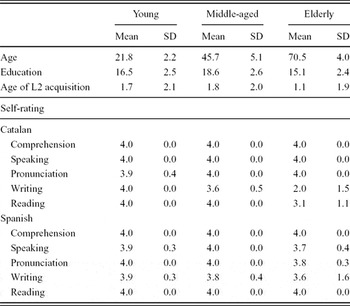
Sixty bilinguals took part in the experiment. All participants were early and highly-proficient Catalan–Spanish bilinguals with Catalan as L1, having learned Spanish before the age of six. Their proficiency in the two languages was tested by means of a questionnaire at the end of the experiment. Each participant self-rated on a four-point scale the abilities of speaking, pronunciation, comprehension, writing and reading for each language (1 = poor, 2 = regular, 3 = good, 4 = perfect).
The whole sample of participants was divided into three age groups, such as: young (n = 20; mean age = 21.8 years, range = 19–27 years), middle-aged (n = 20; mean age = 45.7, range = 38–53), and elderly bilinguals (n = 20, mean age = 70.5, range = 62–77). The characteristics of the three age groups of participants (age, education, age of acquisition of L2, and language proficiency) are reported in the Table 1.
Participant characteristics for the three age groups.

2.2 Materials and procedure
The experiment was conducted in a soundproof room. Participants performed the linguistic and non-linguistic versions of the tasks in the same session. The experiments were controlled by the software DMDX (Forster & Forster, Reference Forster and Forster2003), which recorded participants’ vocal and manual responses. Responses were analysed offline and naming latencies were measured from the onset of the word through Checkvocal, a data analysis program for naming tasks in DMDX (Protopapas, Reference Protopapas2007). The order of the two tasks was counterbalanced across participants, meaning that half of the participants started with the language switching task and the other half with the non-linguistic switching task. Each experiment started with a practice session of 80 trials.
Linguistic switching task
Eight pictures of objects were selected from Snodgrass and Vanderwart (Reference Snodgrass and Vanderwart1980). Half of them referred to cognate words (Spanish/Catalan names: Caracol/Cargol (in English, “snail”); Escoba/Escombra (“broom”); Martillo/Martell (“hammer”); Reloj/Rellotge (“watch”)), and the other half to non-cognate words (Calcetín/Mitjó (“sock”); Manzana/Poma (“apple”); Silla/Cadira (“chair”); Tenedor/Forquilla (“fork”)). Note that in all analyses the two categories were collapsed since there was no difference between cognate and non-cognate words.
Participants were required to name the picture in Catalan or in Spanish. A Catalan or Spanish flag, which was presented along with the picture, acted as a cue to indicate in which language subjects had to name the picture.
There were two types of trials: (i) those in which participants were required to name the picture in the same language as the preceding trial (repeat trial), and (ii) those in which participants were required to name in the other language with respect to the previous trial (switch trial). There were a total of 320 trials divided in two blocks with 160 trials each. The total distribution of trials was: 128 repeat trials in Catalan, 128 repeat trials in Spanish, 32 switch trials in Catalan and 32 in Spanish.
Participants were asked to name the picture as fast as possible and they were informed that the language to be used was to be indicated by a flag, presented on the top of the picture. The pictures were presented in a series of between three and seven trials and at the end of each series an asterisk appeared, and the participants pressed the spacebar to start the next series. At the beginning of each series a word cue was presented for 1000 ms indicating in which language participants had to start to name in (CATALÀ, for Catalan; ESPAÑOL, for Spanish) and for the other trials of the series the cue appeared along with the picture to name. The picture appeared for 1700 ms and the timeout to respond was 5000 ms.
Non-linguistic switching task
Three shapes (square, circle, and triangle) and three colours (green, blue, and red) were selected for the task. The three shapes were combined with the three colours, resulting in a total of nine coloured shapes (e.g., green square, blue square etc.). Participants were presented with an array containing three shapes, two at the top of the screen and one at the bottom. They were instructed to match the shape at the bottom with one of the two at the top of the display according to two possible criteria (shape or colour). The criterion was indicated by a cue (COLOR, for Colour; FORMA, for Shape) appearing in the centre of the array. As in the linguistic version of the task, there were two types of trials: repeat and switch trials.
At the beginning of each series a word cue was presented for 1000 ms indicating by which rule participants must start matching each item (COLOR, for Colour; FORMA, for Shape). Then the array appeared for 2500 ms and the timeout to respond was 3000 ms.
Participants gave the response by pressing one of the two keys, M or V, according to the position of the matched picture at the top of the array. Specifically, they had to press the M key when the correct answer was at the top-right part of the array and the V key when the correct response was at the top-left part of the array.
3. Results
First, we analysed the data for RTs and accuracy (percentage of correct responses). RTs exceeding three standard deviations above or below a given participant's mean were excluded from the analyses. Second, we performed a distributional analysis of the RTs by fitting the data to an ex-Gaussian distribution. All the details of this second analysis are reported below.
3.1 Omnibus ANOVA
We first ran an omnibus ANOVA on RTs including the following variables: “type of trial” (switch vs. repeat) and “task version” (linguistic vs. non-linguistic) as within-subject variables and “group” (young, middle-aged and elderly) as between-subject factor.
All main effects were significant, that is “task version” (F(1,57) = 11.21, MSE = 21084.52, p = .001, ηp2 = .16), “type of trial” (F(1,57) = 230.27, MSE = 1651.42, p < .0001, ηp2 = .80) and “group” (F(1,57) = 14.26, MSE = 55519.71, p < .0001, ηp2 = .33). The interaction between “type of trial” and “group” was marginally significant (F(1,57) = 2.49, MSE = 1651.42, p = .09, ηp2 = .09).
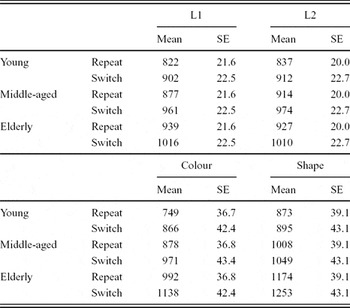
Importantly, the interaction between “task version” and “group” was significant (F(1,57) = 8.69, MSE = 21084.52, p = .001, ηp2 = .23), revealing that the performance in the two tasks was affected differently by age (see Table 2). To further explore how age affected the switching tasks differently, the results from the linguistic and the non-linguistic switching task were further analysed separately.
Mean RTs and SEs of the linguistic and non-linguistic switching tasks broken down by conditions and age groups.

3.2 Linguistic switching task
The variables considered in the analyses were “type of trial” (switch vs. repeat) and “response language” (L1 vs. L2) as within-subject factors and “group” (young, middle-aged and elderly) as between-subject factor which were included in a repeated-measure ANOVA on naming latencies and accuracy.
Reaction times
The main effect of “group” was significant (F(1,57) = 6.77, MSE = 32742.16, p = .002, ηp2 = .19). Post-hoc analysis revealed significant differences only between young participants and the other two groups (all ps < .03). The main effect of “type of trial” was significant (F(1,57) = 167.21, MSE = 2083.70, p <.0001, ηp2 = .75) indicating that participants responded slower to switch trials (962 ms) than to repeat trials (886 ms). The main effect of “response language” was not significant (F(1,57) = 2.93, MSE = 1803.18, p = .10). The interaction between “group” and “response language” was also significant (F(1,57) = 3.22, MSE = 1803.18, p = .05, ηp2 = .11), indicating that the difference between the latencies in the two languages were only present for the middle-aged group.
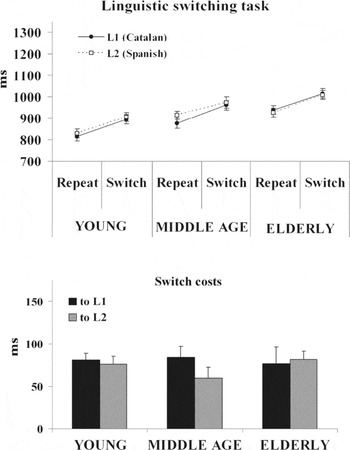
Interestingly, no other interactions were significant. First, in quantitative terms, this means that the magnitude of the linguistic switch cost is not modulated by age. Indeed, as it can be appreciated in Figure 1, the magnitude of the switch costs was very similar for all three groups, and far from ceiling or floor effects. Second, qualitatively, we can conclude that the pattern of switch costs is not affected by age, since it appears to be symmetrical across all ages. That is, switching from L1 into L2 and vice versa has the same cost irrespective of the age of the bilingual speakers.
Performances on the linguistic switching task for the three age groups of participants. Error bars represent standard errors.

These conclusions are further supported by a regression analysis in which age and age of L2 acquisition are taken into account. In this analysis the magnitude of the linguistic switch costs (in L1 and L2, separately, and also with collapsing both costs) was not modulated by these two variables, regardless of whether the fit was linear (all ps > .41), logarithmic (all ps > .91) or quadratic (all ps > .68).
Accuracy
There was no effect of age in accuracy (“group”: F(2,57) = 1.89, MSE = 11.37, p = .16). Participants were less accurate in switch trials (95.9%) than repeat trials (97.2%) (“type of trial”: F(1,57) = 9.18, MSE = 11.17, p = .004; ηp2 = .14). No interaction was statistically significant.
3.3 Non-linguistic switching task
The results of this task were submitted basically to the same analysis as in the previous task. The variables considered in the analysis were “group” as a between-subject factor, “type of trial” (switch vs. repeat) and “sorting criterion” (colour and form), which were included as a within-subject factor in a repeated-measure ANOVA using RTs and accuracy as dependent variables.
Reaction times
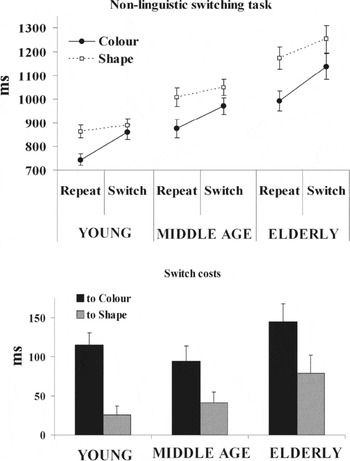
The main effect of “group” was significant (F(1,57) = 14.34, MSE = 120466.30, p < .001, ηp2 = .34) (see Figure 2). Post-hoc analysis showed that the young group was the faster one and the elderly group the slower one, and the middle-aged group in the middle of the other two groups (all ps < .02).
Performances on the non-linguistic switching task for the three age groups of participants. Error bars represent standard errors.

Overall, participants were faster to sort by colour (932 ms) than by shape (1042 ms) (F(1,57) = 167.21, MSE = 2083.70, p < .0001, ηp2 = .75), and faster to respond in repeat trials (945 ms) compared to switch trials (1028 ms) (F(1,57) = 94.72, MSE = 4354.45, p < .0001, ηp2 = .79). Moreover, the interaction between “sorting criterion” and “type of trial” was significant (F(1,57) = 28.95, MSE = 2665.73, p < .0001, ηp2 = .34), meaning that the switch cost interacted with criterion. That is, participants showed higher costs when they switched from shape to colour (118 ms) (F(1,59) = 101.23, MSE = 4183.64, p < .0001, ηp2 = .63), than when they switched from colour to shape (47 ms) (F(1,59) = 21.49, MSE = 3111.93, p < .0001, ηp2 = .27).
Finally, the non-linguistic switch cost interacted with the main effect of “group” (interaction between “type of trial” and “group”: F(2,59) = 2.99, MSE = 4354.45, p = .05, ηp2 = 0.10), being significantly higher in the elderly group (112 ms) compared to the other two age groups (young = 69 ms and middle-aged = 68 ms).
The analysis performed here was the same as the analysis for the language switching task when age and age of L2 acquisition are taken into account as continuous variables. In this case, participants’ age, but not age of L2 acquisition (all ps > .42), accounted for a significant amount of the variance associated with switching cost for shape (R2 = .13, B = 1.42, p = .004), and combined cost (R2 = .11, B = 1.13, p = .009), but not for the cost for colour (p = .25). Interestingly, the effect of age on the combined non-linguistic cost was also present when the data were modelled as logarithmic (p = .02) and quadratic (p = .005), confirming the effect of age on the non-linguistic switch cost.
Accuracy
There was no effect of age in accuracy (“group”: (F(2,57) = 0.61, MSE = 18.93, p = .55). Participants were less accurate in switch trials (89.9%) than repeat trials (93.2%) (“type of trial”: F(1,57) = 56.87, MSE = 12.14, p < .0001) and they were less accurate in sorting by shape (90.6%) than by colour (92.5%) (F(1,57) = 10.22, MSE = 20.84, p = .002, ηp2 = .15). Also, the interaction between “sorting criterion” and “type of trial” was significant (F(1,57) = 32.80, MSE = 16.22, p < .0001, ηp2 = .36), revealing that the difference in accuracy between repeat and switch trials was only significant when sorting by colour (p < .0001) but not by shape (p > .05).
3.4 Ex-Gaussian analysis
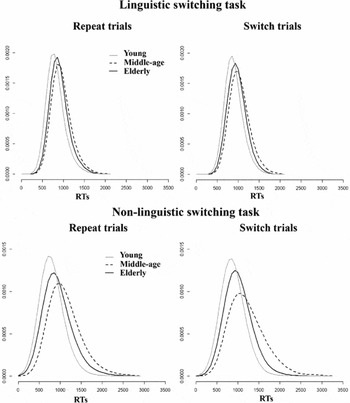
In the present section we present the distribution analysis we performed on the data. These analyses provide a more detailed description of the differences in performance between groups and task, and could potentially help address the effects of aging over the bLC and the EC system. A quick look at the distributions (see Figure 3) gives an overall impression of the differences between groups. Firstly, for the linguistic task there are differences on overall RTs both for switch and repeat trials. However, the general shapes of the distributions are very similar across groups. Secondly, for the non-linguistic task, one can appreciate also differences in RTs for switch and repeat trials. Interestingly, however, for the switch trials one can see that the tail of the distribution for the elderly group is more pronounced. In other words, very long RTs contribute considerably to the overall switch cost for this group.
RT distributions of repeat and switch trials broken by age groups and task versions.

To assess whether this visual impression is statistically meaningful, we performed a distributional analysis fitting the data to an ex-Gaussian distribution. This fitting decomposes the overall RT distribution into two distributions, the normal and the exponential one. The normal distribution is characterized by two parameters, such as mu (μ) and sigma (σ). μ is the mean of the fitted normal distribution, and σ corresponds to the variance. The exponential distribution corresponds to the tail of the RT distribution, and it is characterized by the parameter tau (τ). The question here is whether the differences between the groups in the magnitude of the switching costs (both linguistic and non-linguistic) are captured by the normal component of the RT distribution or by the exponential one. This is important since according to some authors the cognitive processes behind differences in these components might be different (see Discussion).
The raw data was sorted by type of trial (switch and repeat) and by age group (young, middle-aged and elderly) and separately for the two tasks. The parameters of the ex-Gaussian distribution (μ and τ) were obtained for each participant using the quantile maximum likelihood (QML) estimation procedure in QMPE 2.18 (Cousineau, Brown & Heathcote, Reference Cousineau, Brown and Heathcote2004). The estimation results into a value for each parameter (μ and τ) and for each participant per condition.
We then ran repeated-measures ANOVAs separately for μ and τ, separately for each task.
Linguistic switching task
The variables considered in the analyses were “type of trial” (switch vs. repeat) and “response language” (L1 and L2) as within-subject factors and “group” (young, middle-aged and elderly) as between-subject factor.
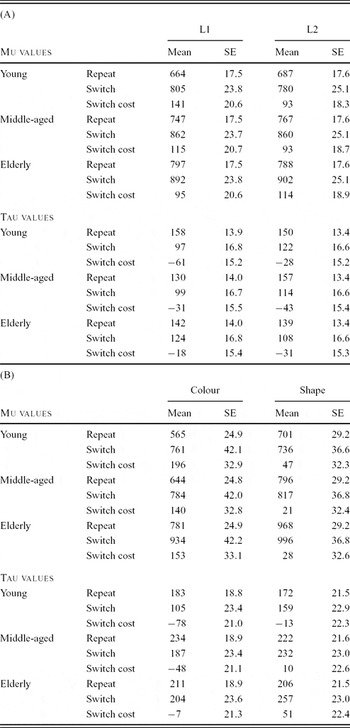
For μ, the main effect of “group” was significant (F(1,57) = 13.56, MSE = 24855.77, p < .0001, ηp2 = .32) and the post-hoc analysis revealed that the young group had the smaller μ values (721 ms) than the middle-aged group (811 ms, p = .002) and the elderly group (847 ms, p < .0001). In other words, the older the participants are, the slower the normal component of the RT distribution is.
Participants were slower in the switch trials (851 ms) than in the repeat trials (742 ms) (“type of trial”: F(1,57) = 144.06, MSE = 5048.89, p < .0001, ηp2 = .72), but naming latencies for μ were not modulated by language (“response language”: F(1,57) = 0.17, MSE = 3680.44, p = .68). Interestingly, the interaction between “type of trial” and “response language” was not significant, meaning that the linguistic switch cost was the same when switching into the L1 and the L2. Moreover, the non-significant interactions with “group” also indicate that the magnitude of the switch cost for μ was not modulated by age (see Table 3).
Means and SEs of the mu and the tau values in the linguistic (panel A) and non-linguistic (panel B) switching tasks.

For τ, only the main effect of “type of trial” was significant (F(1,57) = 18.57, MSE = 4011.32, p < .0001, ηp2 = .25), indicating that overall the participants had smaller τ values in the switch trials (111 ms) than in the repeat trials (146 ms).
Non-linguistic switching task
The variables considered in the analysis were “group” as a between-subject factor, “type of trial” (switch vs. repeat) and “sorting criterion” (colour vs. form) as within-subject factors.
For μ, the main effect of “group” was significant (F(1,57) = 16.99, MSE = 67932.97, p < .0001, ηp2 = .73), indicating that the elderly group had higher μ values (920 ms) than the middle-aged group (761 ms, p = .001) and the young group (691 ms, p < .0001). Overall the participants were slower in the switch trials (838 ms) than in the repeat trial (742 ms) (“type of trial”: F(1,57) = 58.33, MSE = 10686.94, p < .0001, ηp2 = .51), and slower when they matched for shape (836 ms) than for colour (745 ms) (“sorting criterion”: F(1,57) = 65.93, MSE = 8400.26, p < .0001, ηp2 = .54). Moreover, the interaction between “type of trial” and “sorting criterion” was also significant (F(1,57) = 50.11, MSE = 4519.96, p <.0001, ηp2 = .47), indicating that the non-linguistic switch cost for μ was asymmetrical. However, the non-significant interactions with group indicate than for μ the magnitude of the switch cost was not affected by age.
For τ, the main effect of “group” was significant (F(1,57) = 5.66, MSE = 19631.93, p = .006, ηp2 = .16) and post-hoc analysis revealed that the young group had smaller τ values (154 ms) than the middle-aged group (218 ms, p = .01) and the elderly group (219 ms, p = .01). Participants were slower to match for shape (208 ms) than for colour (187 ms) (“sorting criterion”: F(1,57) = 4.16, MSE = 6021.14, p = .05, ηp2 = .07), whereas there was not any effect of “type of trial” (F(1,57) = 1.73, MSE = 6966.63, p = 0.19). However, the interaction between “type of trial” and “sorting criterion” was significant (F(1,57) = 10.34, MSE = 5270.70, p = .002, ηp2 = .15), suggesting that the non-linguistic switch cost was asymmetrical. Finally, the non-linguistic switch cost was modulated by age (interaction between “type of trial” and “group”: F(1,57) = 3.31, MSE = 6966.63, p = .04, ηp2 = .10). To further explore this interaction we submitted the τ values for the switch cost to a one-way ANOVA with group as between-subject factor. Indeed, we found that only the young group had smaller τ values (–45 ms) than the elderly group (22 ms, p = .01).
3.4 On the correlation between the two tasks
In the present set of analysis, we further explore the potential relationship between age and the switching costs in the two tasks.
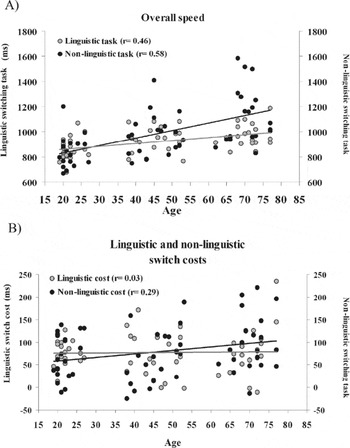
The first relevant observation is that overall speed in both switching tasks is correlated with age; namely the older the participant is the slower he/she performs the linguistic task (r = .46, p < .001) and the non-linguistic task (r = .58, p < .001) (see Figure 4A). However, while the magnitude of the non-linguistic switch cost positively correlated with age (r = .29, p = .03) (see Figure 4B), the magnitude of the language switch cost did not (r = .03, p = .80).
Correlation of individuals’ performances on overall speed (panel A) and switch costs (panel B) as a function of age of participants.

Additionally, we used a correlation analysis to compare the magnitude of the switch costs between the linguistic and non-linguistic switching tasks. In fact, if we assume that the switch cost reflects to some extent the efficiency of the bLC and EC in the same way, we may expect that the magnitude of the two switch costs (linguistic and non-linguistic) varies in the same manner in participants. To do so, we correlated the total switch cost between the linguistic task and the non-linguistic task (collapsing language in one case and the sorting criteria in the other case) for each age group. We first ran the correlation separately for each group because of the difference in the variability of the switch cost across groups, especially in the elderly group. The correlations between the two switch costs were not significant in any age group (young: r = −.12, p = .61; middle-aged: r = −.21, p = .35, elderly: r = .22, p = .34).
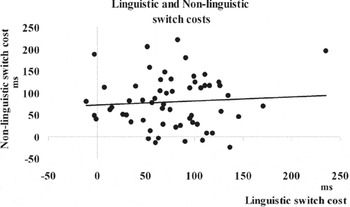
In order to gain more statistical power we ran the analysis with all the participants resulting in a total number of 60. The switch costs of the two tasks were not significantly correlated (r = .04, p = .75) (see Figure 5).
Correlation of individuals’ performances between the linguistic and non-linguistic switching tasks.

4 Discussion and conclusion
The main goal of the present study was to investigate the age-related changes of bLC. To do so we compared the performances of three age groups of Catalan–Spanish highly-proficient bilinguals in the language switching task. The results show several interesting findings.
First, we found an age-related effect on the overall speed of processing for elderly adults when compared to young adults, probably suggesting a general effect of aging on cognition. However, when we looked at the language switching cost, we did not find any difference in the magnitude of such a cost among the three age groups. Indeed, the age of the participants was not correlated with the magnitude of the language switch cost. Moreover, the distributional analysis confirmed that the magnitude of the language switch cost was not affected by age in neither the exponential nor normal components. This is an interesting result because it suggests that the language control abilities of bilinguals are, to some extent, protected against the cognitive decline associated with aging.
Second, the pattern of the language switch cost was symmetrical for the three age groups. As highlighted in the Introduction, highly-proficient bilinguals generally show a symmetrical language switch cost, that is the same cost when switching from L1 into L2 and vice versa (Calabria et al., Reference Calabria, Hernandez, Branzi and Costa2011; Costa & Santesteban, Reference Costa and Santesteban2004; Costa et al., Reference Costa, Santesteban and Ivanova2006), a pattern of switch cost that is not usually found in low-proficient bilinguals (e.g., Meuter & Allport, Reference Meuter and Allport1999). This has been explained as a qualitative difference in the recruitment of the bLC mechanisms related to proficiency. For instance, low-proficient bilinguals could make use of inhibitory control to get rid of the interference of L1 when speaking in L2, that is, to prevent the interference of the strong language over the weak language. On the other hand, highly-proficient bilinguals behave differently and in the same condition they show a symmetrical switch cost. Regardless of the merits of such an explanation, our contribution here is the observation that the bLC system does not seem to be affected by age-related decline. This appears to be so, from both quantitative and qualitative points of view, namely in terms of the magnitude of the switch cost and in terms of the symmetrical switch costs for the two languages.
This conclusion contrasts with that reached by Weissberger et al. (Reference Weissberger, Wierenga, Bondi and Gollan2012), where an aging effect on the magnitude of language switch costs was observed. Although quantitative differences were observed in this study, it is worth noticing that the same symmetrical pattern of switch costs was observed for young and elderly individuals. Hence, qualitatively the same pattern was observed regardless of aging. At present, it is difficult to account for the differences between the two studies in terms of the quantitative effects given the many differences between the two studies. Further research needs to be conducted to clarify this issue.
The second aim of the study was to explore the nature of the cross-talk between bLC and the domain-general EC system by focusing on age-related changes in linguistic and non-linguistic switching tasks. In the non-linguistic switching task participants had to judge a series of pictures according to two sorting criteria: their colour, or their shape according to a cue. In this task, we actually found an age-related change both in the speed of processing and in the magnitude of the switch cost. That is, the three age groups were different in overall speed, with the elderly group the slowest and the young group the fastest, and the magnitude of the switch cost was larger for the elderly compared to young adults.Footnote 2 We also found that age, considered as a continuum variable, positively correlated with the magnitude of the non-linguistic switching cost. These results contrast sharply with those observed in the linguistic switching task, in which the magnitude of the language switch cost was not affected by aging. In fact, the correlation analyses revealed weak associations between performances in the two tasks. Although the speed with which the tasks were performed correlated with age, only the non-linguistic switch cost was correlated with aging. Crucially, linguistic and non-linguistic switch costs were uncorrelated for any of the three groups of participants. That is, the cost of switching languages cannot be predicted by the cost of switching tasks.
Taken together, the results from the linguistic and non-linguistic switching tasks suggest that aging affects, in a relatively different manner, bLC and the EC systems. Hence, to the extent that such a differential effect of aging can be understood as revealing different underlying mechanisms for the two systems, we should conclude that the bLC cannot be reduced to a specific instance of the EC system.
Interestingly, and despite the number of differences between our study and that of Weissberger et al. (Reference Weissberger, Wierenga, Bondi and Gollan2012), the authors reached similar conclusions to the ones drawn above. Indeed, they found an instructive dissociation: a subset of elderly bilinguals was able to perform the language switching task but not the non-linguistic switching task. Thus, the relative sparing of the processes involved in the bLC in the presence of a deficient EC system, suggests that the bLC and the EC systems are only partially shared and that some of the bLC mechanisms are protected against aging (for similar conclusions see Gollan et al., Reference Gollan, Sandoval and Salmon2011).
These conclusions do not necessarily conflict with the information provided by the neuroimaging literature. Indeed, there is a growing body of evidence revealing that bLC and EC share some common neural substrate. For instance, Abutalebi and Green (Reference Abutalebi and Green2007) suggested that the same neural regions (the dorsolateral prefrontal cortex, the anterior cingulate cortex and the caudate nucleus) are engaged during both language switching tasks (e.g., Abutalebi, Della Rosa, Ding, Weekes, Costa & Green, Reference Abutalebi, Rosa, Ding, Weekes, Costa and Green2013; Abutalebi, Della Rosa, Green, Hernandez, Scifo, Keim, Cappa & Costa, Reference Abutalebi, Rosa, Green, Hernandez, Scifo, Keim, Cappa and Costa2012; Garbin et al., Reference Garbin, Costa, Sanjuan, Forn, Rodriguez-Pujadas, Ventura, Belloch, Hernandez and Ávila2011; Hernandez et al., Reference Hernandez, Dapretto, Mazziotta and Bookheimer2001; for a review see also Hervais-Adelman et al., Reference Hervais-Adelman, Moser-Mercer and Golestani2011) and non-linguistic switching tasks (e.g., Botvinick, Braver, Barch, Carter & Cohen, Reference Botvinick, Braver, Barch, Carter and Cohen2001; Botvinick, Cohen & Carter, Reference Botvinick, Cohen and Carter2004). This evidence supports the hypothesis that the mechanisms for language control are subsidiary to those of the domain-general EC. However, there is also evidence going against the claim of functional overlap between bLC and EC (e.g., Abutalebi, Annoni, Zimine, Pegna, Seghier, Lee-Jahnke, Lazeyras, Cappa & Khateb, Reference Abutalebi, Annoni, Zimine, Pegna, Seghier, Lee-Jahnke, Lazeyras, Cappa and Khateb2008). In an fMRI study those authors demonstrated the existence of a neural network that is specifically recruited to switch between two different linguistic registers but not between two intra-linguistic tasks. This suggests that some of bLC mechanisms are specific to language and not involved in any other switching task.
Thus, the issue here is to determine which components are specific to bLC and which are shared with the domain-general EC. The fitting of the data to the ex-Gaussian distribution can help provide a tentative answer. This analysis revealed that the normal and exponential components of the distribution differentially captured age related variability for the two tasks. Empirically, the parameter estimation of these two components (μ and τ) is usually used as a tool to better describe the distribution of the RTs. However, some authors suggest that group differences in the parameters also indicate the different degree to which cognitive processes are recruited during task execution (for a review see Matzke & Wagenmakers, Reference Matzke and Wagenmakers2009).
In this context, the results of the ex-Gaussian distribution analysis may help us to identify which are the shared and specific processes of the two systems. This is a complex issue that goes beyond the scope of this article. However, we can put forward the following tentative account.
The EC system includes a set of mechanisms, such as inhibitory control, monitoring, shifting, and working memory, etc. (e.g., Miyake, Friedman, Emerson, Witzki & Howerter, Reference Miyake, Friedman, Emerson, Witzki and Howerter2000) and aging affects some of these EC processes. Actually, in the non-linguistic task we found that the switch cost increased in the elderly group (as compared to the young group) and, interestingly, this relative increase was indexed by the exponential component of the distribution for switch trials (τ), and not by a general shift in the normal component of the distribution (μ). That is, the larger switch costs for elderly people do not stem from an overall slowing down in switch trials, but rather for a disproportionately presence of very slow RTs in such condition (the exponential component, τ values). So, then the question is: what cognitive process leads to such an increment of the exponential component in the switch trials? One possibility is that inhibitory control deficits are behind these long RTs, therefore reducing the ability of elderly people to switch smoothly between different tasks. Indeed, some researchers suggest that the exponential component captures the efficiency of the inhibitory control system (e.g., Penner-Wilger, Leth-Steensen & LeFevre, Reference Penner-Wilger, Leth-Steensen and LeFevre2002; Schmiedek, Oberauer, Wilhelm, Suss & Wittmann, Reference Schmiedek, Oberauer, Wilhelm, Suss and Wittmann2007; Spieler, Balota & Faust, Reference Spieler, Balota and Faust1996). Regardless of the merits of this tentative interpretation of this distributional analysis, what is relevant here is the contrastive distribution observed in the language switching task. In this task, there were no differences in the exponential component of the distribution neither for the comparison between groups nor for conditions. Hence, whatever the cognitive process that is behind the age-related decline in the ability to switch between non-linguistic tasks, it does not seem to be involved (at least to the same degree) in the language switch task.
In accordance with this view, some authors have argued that in the case of high-proficient bilingualism, the bLC would not resort in inhibitory mechanisms but rather in a language-specific selection mechanism that is built into the linguistic system of the speaker, and relatively independent of the EC system. Under this language-specific selection account, one could predict that a reduction in the efficiency of the inhibitory mechanism would leave relative unaffected the ability of bilingual speakers to perform language control.
Interestingly, this view leads to the further hypothesis that bLC should be affected by aging in low-proficient bilinguals. Further research should be carried out to test this hypothesis.
To conclude, our study adds new evidence to a differential age-related change over bLC and the domain-general EC system in highly-proficient bilinguals. Specifically, our results show that bLC is not totally affected by age despite the fact the EC system was impaired in elderly bilinguals. Moreover, the increase in the switch cost during the EC task was not correlated to switch costs during bLC task. Taken together, this suggests that the underlying mechanisms of bLC and EC systems are not totally shared. Further research is needed to explore in more detail which mechanisms are more affected by age within the EC system by, for instance, using tasks that involve the different processes of domain-general EC system.