Implications
This study revealed that artificial rearing of lambs with colostrum alternative and milk replacer represents an appropriate strategy to maximize the number of lambs weaned per ewe with a similar final BW achieved to lambs reared on the ewe. However, direct contact with the ewe provided a competitive advantage in naturally reared lambs allowing them to better develop their immune system and rumen function, which led to increased BW gain during the fattening period.
Introduction
Two main systems exist for rearing offspring in ruminant production: in commercial dairy systems, or when dam milk is not available in sufficient amount or sanitary condition, newborns are separated from their dams within the first hours after birth and fed either milk replacer or whole milk; in contrast, in meat production systems, newborn animals generally remain with their dams until weaning. A recent study has reported that goat kids reared with their dams had greater rumen development than their twins fed on milk replacer and isolated from adult animals, despite both groups having access to the same solid feed (Abecia et al., Reference Abecia, Ramos-Morales, Martínez-Fernandez, Arco, Martín-García, Newbold and Yáñez-Ruiz2014). However, it remains unknown whether these differences are transitory or if they persist later in life during the fattening period.
Lambs are born hypogammaglobulinemic due to the complexity of the synepitheliochorial ruminant placenta, which does not allow sufficient transfer of immunoglobulins from the dam to the foetus (Hernández-Castellano et al., Reference Hernández-Castellano, Almeida, Castro and Arguello2014; Hernández-Castellano et al., Reference Hernández-Castellano, Suárez-Trujillo, Martell-Jaizme, Cugno, Argüello and Castro2015), thus immunoglobulin G (IgG) transfer from colostrum is vital for the neonatal health (Arguello et al., Reference Arguello, Castro, Capote, Tyler and Holloway2004b). Insufficient neonatal absorption of colostral immunoglobulins within the 1st day of life has been associated with failure of passive immunity transfer, which is indicated when serum IgG levels are below a certain threshold (generally 10 mg/ml in calves, 12 mg/ml in goats and 15 mg/ml in lambs) leading to increased risk for neonatal diseases, mortality and with a negative effect on adult health, longevity and performance (DeNise et al., Reference DeNise, Robison, Stott and Armstrong1989; Arguello et al., Reference Arguello, Castro, Zamorano, Castroalonso and Capote2004a, Faber et al., Reference Faber, Faber, McCauley and Ax2005; Alves et al., Reference Alves, Alves, Ascari, Junqueira, Coutinho, Lima, Pérez, De Paula, Furusho-Garcia and Abreu2015). As a result, higher morbidity and mortality rates have been observed in colostrum-deprived lambs (80% and 67%) than colostrum-fed lambs (20% and 13%) (Hodgson et al., Reference Hodgson, Moon, Hay and Quirie1992). In addition, there is increasing evidence showing that nutritional management in the pre-weaning period determines to a great extent the potential for milk production during subsequent lactations: several studies have indicated that those heifers fed with a greater volume of the same high-quality colostrum (Faber et al., Reference Faber, Faber, McCauley and Ax2005) and those with a greater plasma concentration of IgG shortly after birth (DeNise et al., Reference DeNise, Robison, Stott and Armstrong1989) had higher milk yield than their counterpart control animals during their productive life. Moreover, it has been noted that increased growth rate before weaning results in positive effects on milk yield in cattle (Soberon et al., Reference Soberon, Raffrenato, Everett and Van Amburgh2012). Thus, the general recommendation is to actively feed lambs with colostrum from a freshly lambed ewe in order to maximize passive immunity transfer. However, when ewe colostrum is scarce the supplementation of lambs with colostrum alternatives may represent a strategy to maximize the number of lambs weaned. Nevertheless, it remains unknown whether these early life interventions in lambs could have similar long-lasting consequences to those described in cattle.
In this study we hypothesized that nutritional interventions early in the life of the lambs could have immediate effects on the animal’s health and performance, with some effects persistent later in life under conventional production systems. These nutritional interventions during the pre-weaning period consisted of (1) lambs remained with the ewe (natural rearing) (NN), (2) ewe colostrum followed by artificial rearing with milk replacer (NA) and (3) colostrum alternative supplementation and artificial rearing (AA).
Material and methods
Animals and diets
Triplet sibling lambs were used to provide similar genetic background, gestation environment and ewe colostrum in order to minimize the inter-animal variation across treatments. Thus, after pregnancy scanning, 24 pregnant Aberdale ewes carrying triplets were selected from the Aberystwyth University commercial flock. A total of 72 Aberdale-texel crossbreed lambs were born within an 8-day period (14–22 April). At birth, umbilical cords were disinfected with iodine and lambs were weighed. One sibling of each triplet set was randomly allocated to one of three experimental treatments. During this allocation process sex and initial BW of the lambs was considered resulting in similar sex distribution (average 13 males and 11 females per group) and birth weights (3.8±0.8 kg) across treatments. All three sibling lambs were kept with their mother in an individual pen during the first 24 h after birth. Two siblings (NN and NA) were encouraged to suckle ewe colostrum by connecting them to an ewe’s teat four times over the first 24 h (1, 2, 4 and 6 h after birth) until the gut filling was evident in order to ensure a high colostrum intake. Then, one of those siblings (NN) remained with its mother suckling ewe milk from birth to weaning, whereas the second sibling (NA) was separated from its dam after 24 h and artificially reared with milk replacer. On the contrary, the third sibling (AA) was not encouraged to suckle ewe colostrum; instead, it was immediately fed with 50 g of colostrum alternatively divided into two equal doses at 1 and 6 h after birth followed by artificial rearing with milk replacer. In this latter group, no obvious signs of gut filling with ewe colostrum were noted suggesting a minimal intake of it. Colostrum alternative was freshly prepared by mixing 25 g of product (Lamb Volostrum; Volar Ltd, Lampeter, UK) in 50 ml of water at 30°C and provided by a stomach tube at each time (1 and 6 h after birth). Milk replacer was prepared by mixing 200 g of milk powder (Lamlac Instant; Volar Ltd) with water to make up 1 l of reconstituted milk following the manufacturer instructions. During their 1st week of life all lambs had access to heat lamps and warm milk replacer (39°C) offered ad libitum using temperature-controlled feeders (Ewe 2 Feeder; Volar Ltd). Lambs that did not suckle were stomach tubed and trained to suck from a teat connected to the milk feeder. After 1 week of age all lambs were able to suckle and milk replacer was offered ad libitum at room temperature (average 12°C) using two buckets connected to four teats for each experimental group. These milk buckets were emptied twice a day and thoroughly cleaned and rinsed, using soap and hot water.
At 24 h after birth, blood was sampled (see below), and all animals were tagged and intramuscularly injected with 1 ml of AD3E (NAPHA Veterinary, Ho Chi Minh City, Vietnam) to prevent vitamin deficiency. Then, all lambs from the same treatment were placed together in a single pen (10×12 m) with clean and dry barley straw bedding and ad libitum access to creep feed (NuGro CCF, Aberystwyth, UK), ryegrass hay and water (chemical composition described in Supplementary Table S1). During the milk feeding stage all three groups of animals were physically separated from each other (1 m gap) but kept in the same building with an average temperature of 12°C, relative humidity of 86% and an average of 10 h of day light. Treatments NA and AA also had free access to milk replacer which was freshly prepared twice a day at 0900 and 1700 h. Lambs from treatment NN shared a pen with their mothers that were fed twice a day with the same ryegrass hay and commercial concentrate (Wynnstay; High Production Ewes, Llanidloes, UK). Ewes were physically separated from the NN lambs for 10 min during the concentrate feeding. Group intakes of milk replacer and creep feed were recorded daily until weaning. Animals were inspected daily for signs of disease. The severity of diarrheal events was recorded based on the following score index (Bentounsi et al., Reference Bentounsi, Meradi and Cabaret2012): 1 corresponds to normal lamb faeces in pellets, 2 corresponds to ‘soft’ faeces (similar to cow pat), 3 corresponds to mild diarrhoea with semi-liquid faeces and 4 corresponds to profuse diarrhoea with liquid faeces. Animals with a score equal or above 3 received a single dose of intramuscular antibiotic treatment (Pen-Strep; Norbrook Laboratories Ltd, Newry, Northern Ireland). Lambs were weekly weighed using a digital balance to determine their growth during the entire duration of the experiment.
Animals were weaned at 45 days of age by abrupt weaning and kept in the same building with the same solid feed for a further week. When lambs were on average 8 weeks of age, all experimental lambs were grouped together on the same ryegrass pasture (Lolium perenne) with free access to creep feed until 10 weeks of age but not thereafter. Thus, all lambs grazed the same pasture over 5 months (from June to November). Animals belonging to the same sibling set were always sampled and weighed at the same time. Moreover, when the average BW of a given set of siblings reached the optimum slaughter weight (~40 kg and between 23 and 31 weeks of age), all three lambs were slaughtered in a commercial abattoir. Carcass weight and performance was assessed at an official abattoir according to the EUROP classification (Johansen et al., Reference Johansen, Aastveit, Egelandsdal, Kvaal and Røe2006).
Sampling and analyses
Blood samples (5 ml) were collected from the jugular vein at 24 h after birth for IgG and blood cells measurements. Moreover, blood samples were also taken when animals reached 45 days of age (weaning) and at 23 weeks of age (near the end of the fattening period). One blood subsample (2 ml) was placed in a tube with anticoagulant (K3-ethylenediaminetetraacetic acid) mixed by inversion 10 times, kept at 4°C and immediately analysed for haematology using a Mythic 18 Vet Haematology Analyser (Woodley Equipment Company Ltd, Horwich, UK). This analysis determined the levels of the main blood cells and their morphotypes (see below). A second subsample (3 ml) was placed in a tube without anticoagulant; serum was harvested by centrifugation at 2000×g for 15 min and stored at −20°C until analysis. Serum metabolites were determined using RX Daytona+ equipment (Randox Laboratories Ltd, Crumlin, UK).
Colostrum (10 ml) and milk (50 ml) samples were obtained by hand milking from each ewe at 24 h after the birth of the first lamb and at 45 days postpartum, respectively. Samples were kept frozen, and milk and colostrum composition (Table 1) was determined using a milk analyser (LactoScope Advance FTIR; Delta Instruments, Drachten, The Netherlands). Concentration of IgG in serum and colostrum was determined using the Sheep IgG ELISA 96-well plate kit (reference GWB-OVI374; GenWay Biotech Inc, San Diego, CA, USA) after dilution (4×10⁻⁴ and 4×10⁻⁶ for serum and colostrum, respectively) and absorbance determination at 450 nm using a plate reader (PowerWave XS2; BioTek, Swindow, UK). Concentration of IgG was also estimated based on the serum density: Temperature corrected density (nD TC) in serum samples (100 µl) was measured in triplicate using an automatic digital refractometer (Reichert AR200 Ver 1.8, Ametek, Germany) and the estimated serum IgG concentration was obtained based on the regression equations described by Morril (Reference Morril2011): IgG (mg/ml)=5919.1×nD TC−7946.1.
Colostrum and milk composition from sheep

1 Natural colostrum and milk sampled at 24 h and 45 days after parturition, respectively.
2 Values after mixing 25 g of colostrum alternative with 50 ml of water. Figures obtained experimentally which may differ from the declared composition.
3 After mixing 200 g of milk replacer with water to make up 1 l of reconstituted milk. Figures obtained experimentally which may differ from the declared composition.
Faecal analysis
At 23 weeks of age, faecal grab samples were collected from each animal on 2 non-consecutive days, frozen and pooled by animal (30 g dry matter (DM) approximately). On the same day as faecal sampling, ryegrass pasture was cut to 5 cm above soil level from four different locations of the field and immediately frozen for further analysis. The effect of the experimental treatments on pasture digestibility was estimated using the acid insoluble ash as an internal marker (Thonney et al., Reference Thonney, Duhaime, Moe and Reid1979). For feed and faeces analyses, DM content was determined by drying in an oven at 105°C for 24 h. Organic matter (OM) concentration was determined by heating at 550°C for 6 h in a muffle furnace. Nitrogen and carbon concentration was measured by the Dumas combustion method (Elementar analyser; Vario MAX cube, Langenselbold, Germany). Neutral-detergent fibre and ADF were determined using an automated fibre analyser (ANKOM 2000; Ankom Technology, Macedon, NY, USA) using heat stable amylase and sodium sulphide.
For faecal fingerprint analysis, samples were analysed as previously reported (Belanche et al., Reference Belanche, Newbold, Lin, Stevens and Kingston-Smith2017). Briefly, freeze dry samples were ground to a fine powder (IKA Analytical Mill, Staufer, Germany) and analysed by attenuated total reflectance (ATR) from 4000 to 600 cm−1 using an Equinox 55 Fourier transformed IR (FTIR) spectrophotometer (Bruker Ltd, Coventry, UK), and scanned using the Golden Gate ATR accessory (Specac Ltd, Slough, UK). Infrared settings and data collection were conducted as previously reported (Belanche et al., Reference Belanche, Weisbjerg, Allison, Newbold and Moorby2014). Fourier transformed IR spectra were imported into Matlab (version 2007b; The MathWorks Inc., Natick, MA, USA), averaged, transformed to the first Savitzky–Golay derivative to smooth baseline noise and improve spectral resolution using a 13-point window, and then mean centre normalized (mean=1, standard deviation=1). Data were then analysed by non-parametric permutational multi-variate analysis of variance using PRIMER-6 software (PRIMER-E Ltd, Plymouth, UK). Statistical signification was calculated after 999 random permutations of residuals under a reduced model using the Monte-Carlo test. For graphical interpretation, principal component analysis was conducted and a canonical variate analysis was performed based on the data compiled in the main principal components (Genstat 18th Edition, VSN International, Hemel Hempstead, UK).
Calculations and statistical analysis
Haematological analysis determined the levels of red blood cells, haemoglobin, haematocrit, mean corpuscular volume (MCV), mean corpuscular haemoglobin (MCH), mean corpuscular haemoglobin concentration (MCHC), red blood cell distribution width (RBCDW), white blood cells and its morphotype percentages, platelets, mean platelets volume (MPV), thrombocrit and platelet distribution width (PDW). Although the plasma metabolic analysis measured: calcium, glucose, β-hydroxybutyrate (BHB), cholesterol, triglycerides, high-density lipoproteins (HDL), low-density lipoproteins (LDL), albumin, creatinine, urea, ammonia, l-lactate dehydrogenase and alkaline phosphatase levels, globulins and LDL concentrations in plasma were mathematically calculated:
 $${\rm Globulins}{\equals}{\rm Total}\,{\rm proteins}-{\rm Albumin}$$
 $${\rm LDL}{\equals}{\rm Cholesterol}-{\rm HDL}-\left( {{\rm Triglycerides}/5} \right)$$
To evaluate the effect of experimental treatments on blood parameters, data were analysed using a repeated measures procedure (residual maximum likelihood) using Genstat 18th edition (VSN International, Hemel Hempstead, UK) as follows:
 $$Y_{{ijk}} {\equals}\mu {\plus}R_{i} {\plus}T_{j} {\plus}RT_{{ij}} {\plus}T_{k} {\plus}A_{l} {\plus}e_{{ijkl}} $$
where Y ijk is the dependent, continuous variable (n=24), µ the overall mean, M i the fixed effect of the type of rearing (i=NN v. NA v. AA), T j the fixed effect of the animal age (j=weaning v. fattening), FV ij is their interaction, S k the random effect of the triplet set used as a block (k=1–24), A l the random effect of the animal (j=1–72) and e ijkl is the residual error. For animal weight, growth and carcass performance data, the term sex (male v. females) was also included as a fixed effect. When significant effects were detected across treatments, means were compared by Fisher’s protected LSD test. Significant effects were declared at P<0.05.
Results
Animal health
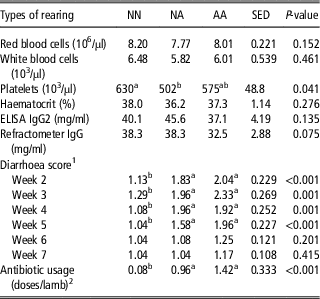
At 24 h after birth all animals remained in good health and no haematological differences were observed across treatments (Table 2). Alternative supplementation followed by artificial rearing lambs tended to have lower plasma IgG concentrations at 24 h of age in comparison to NN and NA lambs when measured by refractometry (P=0.075) but did not reach statistical significance when measured with ELISA (P=0.135). Animals artificially reared (NA and AA) suffered a greater incidence of diarrhoea episodes than NN lambs from 2 to 5 weeks of age but this effect disappeared thereafter. Antibiotic usage was also higher for NA and AA lambs than for NN lambs (P<0.001) and the number of animals with recurrent diarrhoea which required more than two antibiotic doses were 0, 6 and 9 for NN, NA and AA lambs, respectively. No antibiotic treatment was required for any lamb from week 5 onwards.
Effect of colostrum alternative and artificial rearing on plasma immunoglobulin G (IgG) levels and haematology at 24 h after birth and incidence of diarrhoea in lambs

IgG=Immunoglobulin G; NN=natural rearing; NA=ewe colostrum and artificial milk feeding; AA=colostrum alternative and artificial milk feeding; SED=Standard error of the difference among means.
a,bWithin a row means without a common superscript differ (P<0.05).
1 Diarrhoea score: 1, absence, 2, very mild, 3, moderate and 4, severe.
2 Intramuscular penicillin–streptomycin.
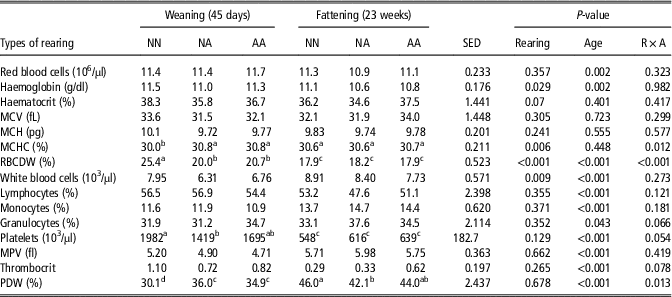
The age of the lambs exerted a major effect on the blood cell distribution (Table 3) and the concentration of most plasma metabolites (Table 4). At weaning animals had a greater concentration of red blood cells, haemoglobin, RBCDW, lymphocytes, platelets, thrombocrit and plasma levels of calcium, glucose, cholesterol, triglycerides, HDL, LDL, albumin, creatinine, amylase and alkaline phosphatase than animals at fattening (P<0.01). On the contrary, at fattening animals had a greater concentration of white blood cells, monocytes, granulocytes, MPV, PDW and plasma levels of BHB, total proteins, globulins and urea (P<0.001). However, artificial rearing also had some mid- and long-term effects on the animals’ health (Table 3). Independently of the age considered, NN lambs had a greater haemoglobin (P=0.029), haematocrit (P=0.070), white blood cells (P=0.009) and calcium levels than NA and AA lambs. Moreover, a significant interaction was observed for several metabolites and haematological parameters: at weaning NN lambs had greater RBCDW (P>0.001), BHB (P<0.001), HDL (P=0.025) and amylase plasma levels (P<0.001), as well as lower MCHC (P=0.012), PDW (P=0.013), LDL (P=0.009) and alkaline phosphatase (P=0.002) were observed in NN lambs than in NA or AA, but no such differences were observed at fattening.
Effect of colostrum alternative and artificial rearing on haematology and blood metabolites in lambs

NN=natural rearing; NA=ewe colostrum and artificial milk feeding; AA=colostrum alternative and artificial milk feeding; SED=Standard error of the difference among means; R×A=Interaction rearing system and age; MCV=mean corpuscular volume; MCH=mean corpuscular haemoglobin; MCHC=mean corpuscular haemoglobin concentration; RBCDW=red blood cell distribution width; MPV=mean platelets volume; PDW=platelet distribution width.
a,bWithin a row means without a common superscript differ (P<0.05).
Effect of colostrum alternative and artificial rearing on blood metabolites in lambs

NN=natural rearing; NA=ewe colostrum and artificial milk feeding; AA=colostrum alternative and artificial milk feeding; SED=Standard error of the difference among means; R×A=Interaction rearing system and age; BHB=beta-hydroxybutyrate; HDL=high-density lipoproteins; LDL=low-density lipoproteins.
a,b,cWithin a row means without a common superscript differ (P<0.05).
1 Mathematically calculated: LDL=Cholesterol−HDL−(Triglycerides/5); Globulin=Total proteins−Albumin.
Animal performance
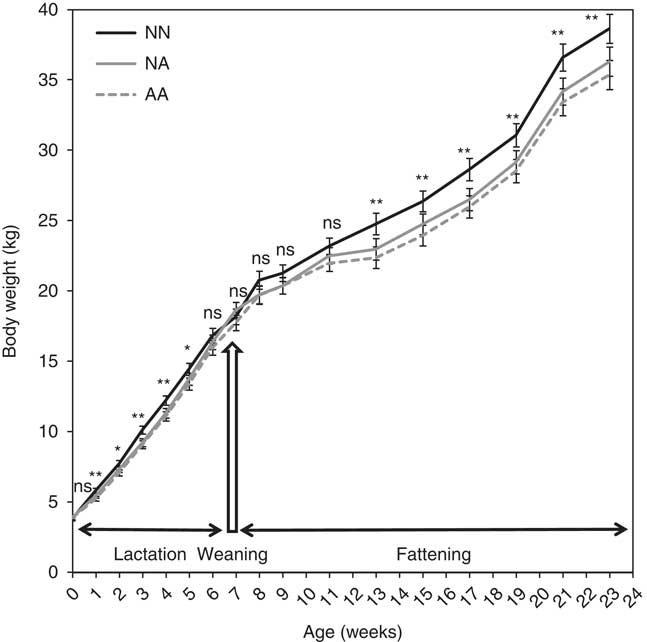
Average group intake of milk replacer remained constant until week 3 (300 g DM/day per lamb) and linearly increased thereafter reaching 550 g DM/day at weaning for AA and NA groups, while milk intake in NN lambs was not recorded. Group intake of creep feed also remained low and constant until week 4 across treatments, and increased linearly thereafter reaching an average of 256, 137 and 96 g DM/day at weaning for treatments NN, NA and AA, respectively. No differences in BW were observed at birth across treatments, but NN lambs had a greater BW than NA and AA lambs from week 2 to 5. These differences disappeared during the weaning stage and reappeared from week 11 onwards (Figure 1). No differences in the average daily gain (ADG) were observed before weaning (Table 5), but NN lambs had a greater ADG during the fattening period calculated from weaning to 23 weeks of age (P<0.001). In terms of carcass composition, NN lambs had a higher slaughter weight than NA and AA lambs (P<0.001), but NN lambs tend to have a lower dressing percentage resulting in similar carcass weight and conformation across treatments. Male lambs tended to have a greater BW at birth and ADG during the fattening period (P=0.047); however, no differences were observed in carcass conformation.
Effect of colostrum alternative and artificial rearing on lamb’s growth. NN, natural rearing; NA, ewe colostrum and artificial milk feeding; AA, colostrum alternative and artificial milk feeding. Standard error of the mean level of signification is depicted: ns, not significant, * P<0.05, ** P<0.01.

Effect of colostrum alternative and artificial rearing on animal and carcass performances in lambs

NN=natural rearing; NA=ewe colostrum and artificial milk feeding; AA=colostrum alternative and artificial milk feeding; ADG=average daily gain; SED=standard error of the difference among means.
1 EUROP classification. Conformation: E=5, U=4, R=3, O=2, P=1. Fatness: 1=1, 2=2, 3 L=3, 3 H=3.5, 4 L=4, 4 H=4.5, 5=5.
Pasture utilization
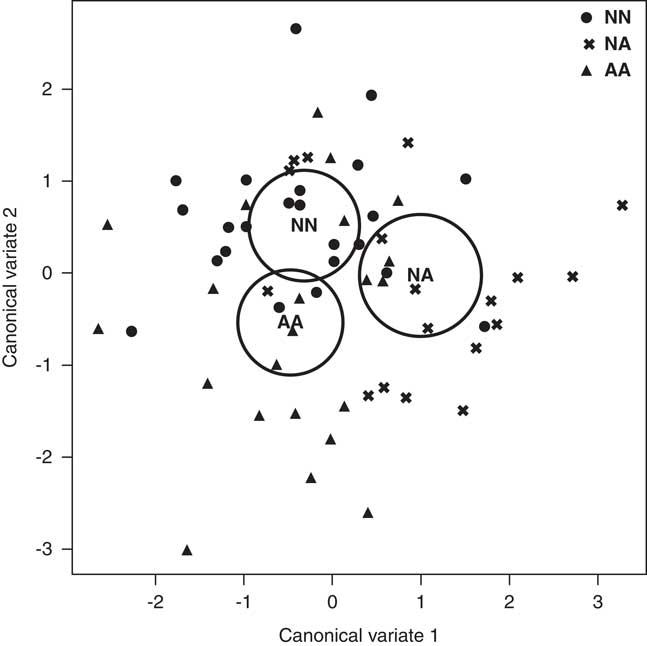
The chemical structure of the faecal samples tended to differ (P=0.079) between treatments based on the PERMANOVA analysis of the FTIR spectral data (Supplementary Table S2). Canonical variate analysis (Figure 2) compiling the information of the first 15 principal components (representing 98.1% of the total variance) showed that these differences were more obvious between NA and the other two experimental groups. In terms of pasture digestibility (Table 6), values were always highest for NN lambs: NN and AA lambs had higher digestibility for DM (P<0.001), C (P<0.001) and N (P=0.003) than NA lambs, whereas no differences were observed in NDF and ADF digestibility.
Canonical variate analysis illustrating the impact of nutritional intervention in early life on the faecal Fourier-transform infrared spectra from lambs of 23 weeks of age. NN, natural rearing (circles); NA, ewe colostrum and artificial milk feeding (crosses); AA, colostrum alternative and artificial milk feeding (triangles). Big circles indicate the 99% confidence interval of the mean for each treatment.

Effect of artificial rearing on total tract digestibility (% in dry matter (DM) basis) in grazing lambs (23 weeks of age)

NN=natural rearing; NA=ewe colostrum and artificial milk feeding; AA=colostrum alternative and artificial milk feeding; SED=Standard error of the difference among means.
a,bWithin a row means without a common superscript differ (P<0.05).
Discussion
Effect of colostrum alternative
Colostrum products have been shown to provide a degree of passive immunity transfer (Seymour et al., Reference Seymour, Nocek and Siciliano-Jones1995; Castro et al., Reference Castro, Capote, Morales, Quesada, Briggs and Argüello2007), although the results vary greatly depending on the product used, colostrum preservation methods, dosage techniques and inter-animal variation (Arguello et al., Reference Arguello, Castro, Capote, Tyler and Holloway2004b). As a result, colostrum products that typically contain lacteal-derived or plasma-derived IgG are classified as either colostrum replacers or colostrum supplements depending on their ability to raise serum IgG concentration above a certain threshold (typically 15 mg/ml in lambs) (Alves et al., Reference Alves, Alves, Ascari, Junqueira, Coutinho, Lima, Pérez, De Paula, Furusho-Garcia and Abreu2015). Colostrum supplements (as in our study) can be used to increase the amount of IgG fed to lambs when only low or medium quality/quantity colostrum is available. However, supplements cannot replace high-quality colostrum, which is still considered the gold standard for feeding newborn lambs (Jones et al., Reference Jones, James, Quigley and McGilliard2004). Our study aimed to simulate two real scenarios in the artificial rearing of lambs: one (NN and NA lambs) consisting of maximizing colostrum intake by encouraging lambs to suckle for at least four times from the ewe; and an alternative strategy (AA lambs) based on colostrum alternative supplementation of lambs with an insufficient intake of ewe colostrum. To achieve this later situation, AA lambs were not encouraged to suckle and had to compete with their two siblings for the remaining ewe colostrum.
A rapid change in the colostrum composition to transitional milk has been described during the post-partum period (Alves et al., Reference Alves, Alves, Ascari, Junqueira, Coutinho, Lima, Pérez, De Paula, Furusho-Garcia and Abreu2015). In our study, despite the late sampling of ewe colostrum (24 h after the first lamb was born), the IgG concentrations (average 42.2 g/l) were comparable to published literature (from 15.7 to 65 g/l) in which the samples were collected just after parturition (Vatankhah, Reference Vatankhah2013; Alves et al., Reference Alves, Alves, Ascari, Junqueira, Coutinho, Lima, Pérez, De Paula, Furusho-Garcia and Abreu2015; Hernández-Castellano et al., Reference Hernández-Castellano, Suárez-Trujillo, Martell-Jaizme, Cugno, Argüello and Castro2015), possibly as a result of a higher colostrum production in high prolific ewes. As a result, only one lamb had an IgG concentration below 15 mg/ml at 24 h after birth suggesting effective overall passive immunity transfer across treatments (Alves et al., Reference Alves, Alves, Ascari, Junqueira, Coutinho, Lima, Pérez, De Paula, Furusho-Garcia and Abreu2015). This may explain the lack of differences in terms of growth, haematology parameters and blood metabolites levels between NA and AA lambs, as well as the absence of deaths before weaning. Moreover, the high level of easily digestible energy and protein in the colostrum alternative also seems to represent an important source of nutrients for the lambs during its first hours of life to maintain body temperature and good health (Jones et al., Reference Jones, James, Quigley and McGilliard2004). Thus, the supply of colostrum alternative after birth can be considered an appropriate strategy to prevent health problems and maximize the number of lambs weaned per ewe when ewe colostrum is insufficient.
Effect of artificial rearing on lamb’s health
This study does not attempt a direct comparison of the effects of milk replacer v. maternal milk since artificial rearing involves the replacement of the contributions made by the ewe which are essential to the growth and development of the lamb. This not only includes the feed supply but also the warmth, shelter and ‘mothering’ normally provided by the ewe. Our experiment showed a greater incidence of diarrhoea events in artificially reared lambs than those reared on the ewe. These diarrhoea episodes appeared from week 2 to week 5; they were very mild (<2.0 scored) and required an average of 1.2 antibiotic doses per lamb, whilst antibiotic usage in NN lambs was negligible. Although these diarrheal events did not trigger any deaths, they could explain the lower ADG for NA and AA lambs during the first 5 weeks. Similar diarrhoea events starting at 2 weeks of age have been described in calves and various pathogens compatible with enteric infections have been identified in the necropsy (i.e. Salmonella, Cryptosporidium parvum, Escherichia coli and coronavirus) (Quigley et al., Reference Quigley, Wolfe and Elsasser2006). None of the lambs required the use of antibiotics from week 5 onwards, and the study of the rumen microbial community showed no residual antibiotic effects at 45 days and 23 weeks of age (data not shown). Thus, the potential long-term effect of antibiotics on blood metabolites and animal performance seems to be negligible under our experimental conditions.
Various studies have investigated the effect of different artificial milk feeding strategies to prevent diarrheal events and to improve animal performance: Jasper and Weary (Reference Jasper and Weary2002) concluded that ad libitum nipple feeding of whole milk to dairy calves v. restricted can increase weight gain with no diarrheal problems nor detrimental effects on feed intake after weaning. Quigley (Reference Quigley, Wolfe and Elsasser2006) observed calves that fed a variable amount of milk replacer (peaking at 3 weeks of age with 908 g/day) had not only greater ADG but also increased incidence of diarrhoea which required added veterinary treatment in comparison to those fed a fixed amount (454 g/day). Thus, it seems that our artificial rearing strategy based on the ad libitum access to milk replacer might not only explain the incidence of moderate diarrhoea but also did help to prevent feed competition between lambs, because lambs in contrast to calves tend to be reared in groups with a large number of animals. More research is needed to assess whether these diarrheal events could be minimized by using alternative rearing systems such as automatic feeding machines.
Although most lambs remained in good health from birth to slaughter, the haematological analysis revealed that NN lambs had higher levels of white blood cell at weaning in comparison to artificially reared lambs (+21.6%), and those differences persisted during the fattening period (+10.5%). It has been shown that colostrum and milk have viable cells, including neutrophils and macrophages, which secrete a range of immune-related components (Stelwagen et al., Reference Stelwagen, Carpenter, Haigh, Hodgkinson and Wheeler2009). Our findings are in line with this observation and suggest that direct contact with adult animals in NN may also represent an important exposure to antigens, which may help in the immune system development of young lambs with long-lasting effects on the levels of white blood cells. Moreover, artificially reared lambs had lower haemoglobin levels (−2.8%) and haematocrit (−5.3%) at weaning in comparison to NN lambs. The variation in the size of red cells (anisocytosis) provided an insight of the potential reasons of slight signs of anaemia. Since neither the size of the red blood cells (MCV) nor the amount of haemoglobin per cell (MCH) were affected, it seems that the normocytic anaemia was very mild and partially compensated by a greater amount of haemoglobin per unit of volume (MCHC +2.6%). Despite this lack of severity, artificially reared lambs still had lower levels of haemoglobin (−3.3%) and haematocrit (−0.4%) during the fattening period suggesting a small but long-term effect of the type of rearing strategy on the animals’ health. On the contrary, NN lambs had a higher coefficient of variation in RBCDW (+20.0%), which is compatible with early stages of iron deficiency at weaning in animals having limited amounts of milk (Blaxter et al., Reference Blaxter, Sharman and MacDonald1957), possibly as a result of a lower milk intake and lower iron content in the ewe milk in comparison to lambs fed milk replacer ad libitum. This observation was supported by the lower blood calcium concentration in NN lambs at weaning (−6.7%) and fattening (−4.2%). Increases in plasma glucose and urea concentrations have been associated with higher artificial milk intake in calves (Quigley et al., Reference Quigley, Wolfe and Elsasser2006). However, in our study all experimental treatments had similar glucose, urea and total protein levels at weaning, possibly because a lower milk intake in NN lambs during late milk feeding period in comparison to those fed milk replacer was compensated by a greater creep feed intake (256 v. 116 g/day). Our experiment indicates that protein and energy sources included in the milk replacer were highly digestible since no differences in the plasma concentration of metabolites related with the protein (total proteins, albumin, globulin, creatinine, urea and ammonia) and energy (glucose) metabolism were detected across treatments. These findings agree with the similar content of urea nitrogen, total protein, albumin and globulin in the serum of lambs fed milk replacers made up of milk protein or other protein sources (Huang et al., Reference Huang, Tu, Si, Xu, Guo, Guo, Yang and Diao2015). Most of the milk bypasses the rumen through the oesophageal groove, thus high milk intake in artificially reared lambs may increase the amino acid flow to the small intestine leading to an increase in the deamination processes occurring in the liver as was reflected by increased levels of alkaline phosphatase (+30%) as an indicator of the liver stress (Reichling and Kaplan, Reference Reichling and Kaplan1988). On the contrary, solid feed (carbohydrates and proteins) is fermented in the rumen producing volatile fatty acids and ammonia as the main fermentation end product. Thus, the increased levels of β-hydroxybutyrate in NN at weaning (+2.6-fold times) suggest a greater physiological and fermentative development of the rumen. Although cholesterol and triglyceride concentrations were unaffected by the experimental treatments, artificially reared lambs had lower levels of HDL (−13%) and higher levels of LDL (+38%) at weaning than NN lambs. Increased blood levels of LDL are considered a circulatory risk factor, which can be mainly determined by diet, physical activity, genetics, sex and age (Sigurdardottir et al., Reference Sigurdardottir, Fagerberg and Hulthe2002). Overall, our data also showed that most of the haematological and metabolite differences observed at weaning were transient and tended to disappear later in life with no further effects on the animal’s health.
Effect of artificial rearing on productive performance
This study revealed that in comparison with artificially reared lambs, NN lambs had a higher neonatal growth, suggesting that the ewe mothering instinct helps lambs to suckle more efficiently during the 1st days of life. Moreover, this competitive advantage was maintained until 3 weeks after birth, when NN lambs reached the greatest differences in BW (+10.5%), corresponding with the peak in the lactation curve described for crossbred ewes rearing lambs (Cardellino and Benson, Reference Cardellino and Benson2002). However, these differences tended to disappear as weaning approached, possibly due to the increased milk intake recorded for the artificially reared lambs (average 2.9 l/day), resulting in similar BW at weaning across treatments. This observation agrees with the lack of differences in weaning weights reported for Comisana lambs reared artificially or conventionally (Napolitano et al., Reference Napolitano, Cifuni, Pacelli, Riviezzi and Girolami2002).
However, differences in BW gain reappeared after weaning despite all lambs being grazed together on the same pasture. As a result, NN lambs had a greater growth during the fattening period (+16%) and higher BW from week 13 onwards. Several reasons could explain these findings: (i) The greater solid feed intake observed in NN lambs at weaning (256 v. 116 g DM/day) has been described as a key factor which promotes the rumen physiological development in calves and facilitates a smooth transition to the solid diet (Khan et al., Reference Khan, Weary and Von Keyserlingk2011). (ii) The direct contact with adult animals represents a source of microbes (i.e. bacteria, protozoa, methanogens, anaerobic fungi) which are crucial for the development of the symbiotic rumen microbiota (Belanche et al., Reference Belanche, Balcells, de la Fuente, Yanez-Ruiz, Fondevila and Calleja2010; Belanche et al., Reference Belanche, Abecia, Holtrop, Guada, Castrillo, de la Fuente and Balcells2011). (iii) Adult animals teach young animals in terms of feeding behaviour since the presence of adult companions has been reported to increase solid feed intake and performance of calves before and after weaning (Vieira et al., Reference Vieira, Von Keyserlingk and Weary2012) as was noted in our experiment.
Our findings also suggest that the greater BW gain in NN lambs during the fattening period may in part be explained by greater feed DM digestibility (+5.9%) in comparison to NA lambs, although differences were less obvious (+2.0%) when compared with AA lambs. These differences in forage utilization were also observed based on the fingerprint analysis of faecal samples using FTIR spectroscopy. As a result, NN lambs reached a greater final BW (+7.0%) at slaughter but they performed substantially worse in dressing percentage (−5.7%) leading to similar carcass weight, carcass confirmation and fatness. This observation indicates that NN lambs may have a greater rumen size, slower rumen transit time or greater wool yield all of which could reduce the killing out percentage. These findings support previous observations which suggest that rearing lambs on the ewe, and the early intake of solid feed are important drivers not only for the rumen anatomical enlargement but also for the physiological and microbiological development (Yáñez-Ruiz et al., Reference Yáñez-Ruiz, Abecia and Newbold2015). Thus, more research is needed based on a better description of the rumen dynamics of feed utilization, rumen microbiota and animal behavioural studies to elucidate which factor plays a greater role on animal resilience and productivity during the post-weaning processes as well as later in life.
Acknowledgements
This work has been supported by the European Regional Development Fund Program through the Welsh Government (WISE Network) and Volac International Ltd. The authors thank D. R. Yáñez-Ruiz for his contribution to the paper preparation.
Declaration of interest
There is not conflict of interests.
Ethical standards
All animal procedures were carried out according to the Home Office Scientific Procedures, Act 1986 and protocols were approved by the Aberystwyth University Ethics Committee (PLL 40/3653; PIL 40/9798).
Software and data repository resources
None of the data were deposited in an official repository
Supplementary material
To view supplementary material for this article, please visit https://doi.org/10.1017/S1751731118002100