Introduction
Grosjean (Reference Grosjean1989, p. 6) states that “the bilingual is . . . an integrated whole, a unique and specific speaker-hearer, and not the sum of two monolinguals”. Research has long sought to elucidate the nature of the bilingual system, often focusing on semantic representations and (mutual) crosslinguistic influence between two co-existing languages. For example, many studies have found shifts of semantic category boundaries (e.g., Ameel, Storms, Malt & Sloman, Reference Ameel, Storms, Malt and Sloman2005; Athanasopoulos, Reference Athanasopoulos2009; Athanasopoulos, Damjanovic, Krajciova & Sasaki, Reference Athanasopoulos, Damjanovic, Krajciova and Sasaki2011; Ervin, Reference Ervin1961; Pavlenko & Malt, Reference Pavlenko and Malt2011). One of the proposed principles behind these patterns is convergence (Ameel, Malt, Storms & Van Assche, Reference Ameel, Malt, Storms and Assche2009; Bullock & Gerfen, Reference Bullock and Gerfen2004; Bullock & Toribio, Reference Bullock and Toribio2004; Clyne, Reference Clyne1987; Gathercole & Moawad, Reference Gathercole and Moawad2010; Muysken, Reference Muysken2000; Thomason & Kaufman, Reference Thomason and Kaufman1988; Wolff & Ventura, Reference Wolff and Ventura2009), a process of increasing similarity supposedly driven by the existing overlap between two languages. These studies are often focused on gradient categories, such as colour categories, in naming tasks. It is much less clear what would happen in a case where there is a semi-obligatory distinction in one language that is not present in the other, in a situation where the distinction is relevant to the communicative task. This study examines such a situation in the domain of placement verbs in French and Dutch in functional Belgian French–Dutch bilinguals.
Background
Multiple languages in one mind do not exist independently of each other. A core issue in acquisition and bilingualism studies is to improve our understanding of “the influence of a person's knowledge of one language on that person's knowledge or use of another language” (Jarvis & Pavlenko, Reference Jarvis and Pavlenko2008, p. 1), often labelled as transfer or crosslinguistic influence (CLI; Kellerman & Sharwood Smith, Reference Kellerman and Sharwood Smith1986; Odlin, Reference Odlin2005). Interactions between established and emerging languages or between multiple established languages have been examined in a range of linguistic domains such as phonology (e.g., Flege & MacKay, Reference Flege and MacKay2004; McAllister, Flege & Piske, Reference McAllister, Flege and Piske2002), syntax (Yip & Matthews, Reference Yip and Matthews2000), and the lexicon (e.g., Ringbom, Reference Ringbom2007), looking at effects both offline and online, in production and perception, behaviourally as well as in neurocognition, (e.g., Costa, Reference Costa, Bhatia and Richie2004; Dussias, Reference Dussias and Nicol2001; FitzPatrick & Indefrey, Reference FitzPatrick and Indefrey2010; Gollan & Kroll, Reference Gollan, Kroll and Rapp2001; Marian & Spivey, Reference Marian and Spivey2003; Roberts, Gullberg & Indefrey, Reference Roberts, Gullberg and Indefrey2008; Weber & Cutler, Reference Weber and Cutler2004). The directionality of the influence has also been examined. Studies have traditionally examined the effect of an established first language (L1) on a developing second language (L2), so-called forward transfer. More recently the influence from the L2 on the L1 has also been explored, so-called reverse transfer (Cook, Reference Cook2003) both for highly proficient L2 users (e.g., Balcom, Reference Balcom2003; Dussias, Reference Dussias2003; Jarvis, Reference Jarvis2003; Pavlenko & Malt, Reference Pavlenko and Malt2011), and in cases where the L2 knowledge, use, and exposure has been minimal (Brown & Gullberg, Reference Brown and Gullberg2008, Reference Brown and Gullberg2010, Reference Brown and Gullberg2011, Jarvis, Reference Jarvis2003; Van Hell & Dijkstra, Reference Van Hell and Dijkstra2002).
Much of the work cited has focused on the potential independence of the separate languages. However, in a parallel tradition, studies have observed properties of non-separability in the bilingual system, such as co-activation (e.g., Costa, Reference Costa, Bhatia and Richie2004; De Bot, Reference De Bot2004; Kroll & Stewart, Reference Kroll and Stewart1994; Kroll & Sunderman, Reference Kroll, Sunderman, Doughty and Long2003; Marian, Spivey & Hirsch, Reference Marian, Spivey and Hirsch2003; Weinreich, Reference Weinreich1953), and degrees of overlap in representations between the language systems such that bilinguals’ languages shift towards each other while at the same time maintaining some degree of language-specificity.
In an early study Ervin (Reference Ervin1961) found that bilinguals name colours differently from their monolingual counterparts in ways that suggest an influence of the semantic categories in one language on the category boundaries in the other. This finding has been replicated in more recent studies investigating how Greek–English and Japanese–English bilinguals label colours (Athanasopoulos, Reference Athanasopoulos2009; Athanasopoulos et al., Reference Athanasopoulos, Damjanovic, Krajciova and Sasaki2011). Intermediate and advanced Greek and Japanese L2 learners of English, who have two basic colour terms for blue in their L1 and one basic colour term for blue in their L2 English, can be observed to shift their naming patterns for focal colours in their L1s. In Greek, one of the terms for focal colours moves closer to the focal colour for the English blue. However, the focal colour for the other Greek term also shifts in order for the two distinct categories in Greek to remain separate (Athanasopoulos, Reference Athanasopoulos2009).
Similar results have been found in studies investigating bilingual naming and categorisation of artefacts (Ameel et al., Reference Ameel, Storms, Malt and Sloman2005; Pavlenko & Malt, Reference Pavlenko and Malt2011), emotion words (Pavlenko, Reference Pavlenko2002, Reference Pavlenko and Pavlenko2009), lexicalisation patterns of motion (Brown & Gullberg, Reference Brown and Gullberg2008, Reference Brown and Gullberg2011; Filipovic, Reference Filipovic2011), semantic categorisation of nouns and verbs (Gathercole & Moawad, Reference Gathercole and Moawad2010) and aspectual encoding of events (Bylund, Reference Bylund2009; Bylund & Jarvis, Reference Bylund and Jarvis2011; Flecken, Reference Flecken2011).
In a study of artefact naming (Ameel et al., Reference Ameel, Storms, Malt and Sloman2005) functional French–Dutch bilinguals in a Dutch-dominant environment were asked to name pictures of a set of dishes and a set of bottles/containers. The results showed that the bilinguals maintained the language-specific categories that had been found in monolingual groups. For example, two categories, bouteille “bottle” and flacon “bottle” in French, were described by one category, fles “bottle” in Dutch. However, the bilinguals differed from the monolinguals in terms of the items that the categories consisted of. The term bouteille “bottle” was overextended to encompass more objects, for instance. Based on these findings the authors reject both a claim for two entirely separate systems (two-pattern hypothesis) and a claim for a completely merged system (the one-pattern hypothesis). Instead they propose a system where there is partial, but not complete, overlap between the bilingual's systems which allows the shared part to be more similar for bilinguals than the two monolingual groups, while at the same time leaving room for language-specific features (see also Hulk & Müller, Reference Hulk and Müller2000). The transitions appear to be affected by proficiency levels (e.g., Pavlenko & Malt, Reference Pavlenko and Malt2011), but also by the relationships between semantic categories.
In a semantic categorisation study Gathercole and Moawad (Reference Gathercole and Moawad2010) investigated interaction in L1 (Arabic) and L2 (English) for both early and late L2 learners. They focused on nouns and verbs that overlapped in the two languages but were not perfect translation equivalents. In half of the cases the English category had a wider application and in the other half the Arabic category did. For example, the English word fold has a wider application than the Arabic equivalents yitwi “fold [for clothes]” and yirabie “fold [for arms]”. They found that both early and late L2 learners did not use the English categories in a native-like way when they were wider than the Arabic ones, but provided more correct answers when the English categories were narrower than the Arabic ones.
Importantly, the categories examined in the naming studies reviewed above are mostly gradient. In the case of colour terms it is the focal colour that shifts, yet the semantic category structure is maintained in a modified fashion. Similarly for artefact naming, the monolingual and bilingual patterns are established by looking at the label used most frequently for a particular object. It is not the case that no other label is ever used for that object. Rather, speakers have a collective preference for one of the labels. The category boundaries are thus somewhat fuzzy. It remains unclear, however, what happens to the functional bilingual system in cases where one language makes a semi-obligatory distinction where the other language does not, that is, when there is no category boundary to shift, but instead semi-obligatory distinctions must be made. This is the case for placement verbs describing horizontal and vertical scenes in Dutch, where Narasimhan and Gullberg (Reference Narasimhan and Gullberg2011) found that Dutch-speaking adults use leggen “lay” in over 95% of cases for horizontally placed items and zetten “set/stand” in 99% of cases for vertically placed items. Similarly, Malt, Gennari, Imai, Ameel, Tsuda and Majid (Reference Malt, Gennari, Imai, Ameel, Tsuda and Majid2008) found that naming patterns for verbs of locomotion were based on a strict physiological distinction between walking and running gaits. Semi-obligatory contrasts have previously been examined as a learning challenge in L2 acquisition (e.g., Geeslin, Reference Geeslin2003; Gullberg, Reference Gullberg2009; Viberg, Reference Viberg, Haastrup and Viberg1998), but much less is known about the effect of prolonged contact of two languages with different degrees of semantic specificity on the functional bilingual system.
The current study investigates the nature of the bilingual system in the domain of placement events, a domain which is a basic part of the human experience while at the same time exhibiting great crosslinguistic variation (see e.g., papers in Kopecka & Narasimhan, Reference Kopecka and Narasimhan2012). This is an excellent test bed for examining the bilingual system, because, although there is great variation in how languages carve up the semantic space of placement events, there is also basic similarity in that all events involve an agent causing an object to move to a goal.
Placement events
Placement events are acts of causative translocation, that is events where an agent causes something to move somewhere, for example, putting a cup on a table. Despite the simplicity of these concrete events they are not solely described by semantically light verbs as in English. In fact, there are semantic typological differences in how languages express these events, and semantically light verbs like the English put may be the exception rather than the rule in the domain (Narasimhan, Kopecka, Bowerman, Gullberg & Majid, Reference Narasimhan, Kopecka, Bowerman, Gullberg and Majid2012). The languages in the present study, French and Dutch, also differ in the way they convey placement information. Note that we are considering situations in which there is simple support from below on a flat surface. Situations where the end-state is a containment-relation (e.g., putting something in drawer) are not taken into consideration, since those are very likely to elicit different verbs (e.g., stoppen “stuff”, steken “stick into”). For similar reasons, situations with support from above (e.g., hanging a jacket over a chair) or point attachment (e.g., hanging a coat on a hook) are also not included (Bowerman, Reference Bowerman, Bloom, Peterson, Nadel and Garrett1996). The domain under investigation, then, is limited to caused motion with the additional stipulation that the final resulting state of the objects being placed is with support from below.
Germanic languages, with the exception of English, have a set of caused posture verbs. These are verbs that are related to a set of intransitive locative posture verbs (e.g., liggen “lie”/leggen “lay” and staan “stand”/zetten “set” in Dutch) in these languages, but there is no one-to-one mapping (for overviews see Ameka & Levinson, Reference Ameka and Levinson2007; Newman, Reference Newman2002). These placement verbs do not only denote cause an object to move, but also specify the final configuration of the object in relation to the ground. While Swedish, Dutch, and German all have such systems, they nevertheless differ subtly in the way they operate. Swedish makes a three-way distinction in the verbs sätta “set”, ställa “stand”, and lägga “lay” (Gullberg & Burenhult, Reference Gullberg and Burenhult2012), while German makes a two-way distinction between stellen “set/stand” and legen “lay” for the same semantic space (Kutscher & Schulze-Berndt, Reference Kutscher and Schulze-Berndt2007). These languages have sets of other verbs in the same domain, but these are the ones closest to default in the domain of support from below (see Gullberg & Burenhult, Reference Gullberg and Burenhult2012).
Of the two target languages in the present study Dutch belongs to the West-Germanic language family. As such it has a caused posture system that distinguishes two verbs, leggen “lay” and zetten “set/stand”. The choice between these verbs for an individual event is based on several properties (Lemmens, Reference Lemmens2002, Reference Lemmens, Stefanowitsch and Gries2006; Van Oosten, Reference Van Oosten, Van Oosten and Snapper1986). The first is whether an object has a natural base to rest on and whether it rests on it, that is, whether the object is in its canonical position. If this is the case, zetten is used. If not, leggen is used. If an object does not have a natural base (e.g., a ball), leggen is also used. It follows that zetten cannot be used for every object. Conversely, leggen can be used for all items depending on their orientation. The second property is concerned with whether an object is extended horizontally (wider than high), which yields leggen, or vertically (higher than wide) which yields zetten. However, the leggen/zetten distinction is only one dimension in a wider caused motion domain. There are other verbs that denote different properties of the placement event. For example, pens can lie in a drawer and sit in a briefcase. The caused motion verb used for the former situation can be leggen, but in both cases other verbs can be used, such as stoppen “put into”, a caused motion verb which focuses on the resulting containment relation. This illustrates exactly why in this study we are focusing on scenes in which the placement action results in simple support from below on a flat surface.
For every scene of this type a speaker of Dutch has to make a semi-obligatory choice as to which of the two verbs is appropriate. Making this choice crucially hinges on attending to the object properties and its configuration in relation to the ground. Although these verbs are frequent and semi-obligatory in the language, they cause acquisition challenges for Dutch children. Narasimhan and Gullberg (Reference Narasimhan and Gullberg2011) found that Dutch children overextend the use of leggen “lay” to include vertical scenes even at the age of five. A possible explanation for the difficulty may reside in the extension patterns that can be observed in the wider language. Both verbs are also used in non-placement contexts, for example een fiets op slot zetten “lock a bicycle” and koffie zetten “to make coffee” for zetten, or uitleggen “explain” and vastleggen “capture, to register” for leggen. Whereas zetten “set” is the more frequent verb overall, leggen is less ambiguous once we take into account the metaphorical and idiomatic extensions in the language.
Descriptions of simple manual placement actions in French are characterised by extensive use of one all-purpose placement verb, mettre “put” (Chenu & Jisa, Reference Chenu, Jisa, Clark and Kelly2006; Gullberg, Reference Gullberg, Pederson and Bohnemeyer2011a; Hickmann Reference Hickmann, Aurnague, Hickmann and Vieu2007; Hickmann & Hendriks, Reference Hickmann and Hendriks2006). Mettre can be said to be semantically coarse-grained with a high degree of semantic generality (Chenu & Jisa, Reference Chenu, Jisa, Clark and Kelly2006; Gullberg, Reference Gullberg, Pederson and Bohnemeyer2011a), and is appropriate in a wide range of contexts with a wide range of arguments (Chenu & Jisa Reference Chenu, Jisa, Clark and Kelly2006). Hickmann and Hendriks (Reference Hickmann and Hendriks2006) found that mettre was used to describe a range of event categories in a wide set of stimulus materials. Gullberg (Reference Gullberg, Pederson and Bohnemeyer2011a) elicited descriptions of horizontally and vertically placed objects and found that mettre “put” accounted for 51% of all scenes covering both types of situations. Chenu and Jisa (Reference Chenu, Jisa, Clark and Kelly2006) further found that mettre was the most frequently occurring placement verb (61% and 71%) in mothers” speech to 12-to-36-month-old children in French.
In addition to a general placement verb French also has other verbs that conflate different meaning components to various degrees (Chenu & Jisa, Reference Chenu, Jisa, Clark and Kelly2006), for example, poser “put (down)” or verser “pour” which constrains the object (liquids or small pieces) and the ground (container or flat surface). Chenu and Jisa argue that in cases of specific verbs the ground is not a compulsory element of the description, whereas it is compulsory to add a ground component for mettre “put” due to its unspecified nature. Similarly, Hickmann and Hendriks (Reference Hickmann and Hendriks2006) divide the more specific verbs into several categories, for instance, specific manner of attachment (e.g., coller “stick”), and manner of causing motion (e.g., tirer “pull”). Gullberg (Reference Gullberg, Pederson and Bohnemeyer2011a) also found that poser “place”, accounted for a considerable portion of verb uses (18%). However, its use was limited to vertical scenes.
Semantic specificity is not limited to the verb only, but may also be represented elsewhere in the clause. In the domain of motion typology a long line of research specifically targets the question of which semantic elements are expressed where and how, so-called lexicalisation patterns (Slobin, Reference Slobin, Strömqvist and Verhoeven2004; Talmy, Reference Talmy and Shopen1985, Reference Talmy2000). “Distributed semantics” of spatial information has been observed in several domains (Levinson & Meira, Reference Levinson and Meira2003; Sinha & Kuteva, Reference Sinha and Kuteva1995). For example, there may be a division of labour between the semantic granularity of verbs and prepositions (e.g., Chenu & Jisa, Reference Chenu, Jisa, Clark and Kelly2006; Gullberg & Burenhult, Reference Gullberg and Burenhult2012; Hickmann & Hendriks, Reference Hickmann and Hendriks2006). Verbs with a high degree of semantic specificity are already informative about the relationship between the figure (the object being handled) and the ground (the entity in relation to which the object is being placed) leaving little room for variation in the preposition. Conversely, highly general verbs leave room for the preposition to specify the Figure–Ground relationship. Chenu and Jisa (Reference Chenu, Jisa, Clark and Kelly2006) suggest that in addition to a general placement verb mettre, French also has a general preposition, à, that “does not indicate a specific relation between figure and ground” (p. 11). Hickmann and Hendriks (Reference Hickmann and Hendriks2006) examined the distribution of specific information across caused motion verbs and prepositions. They found that it is rare for both the verb and the preposition to be general. Rather, the typical pattern is a division of labour between the verb and the preposition in degree of granularity, although there are also occurrences where both verb and preposition are specific.
In sum, French and Dutch can be distinguished based on the semantic components they habitually express in the verb. Both languages specify the conflated semantic elements cause to move an object somewhere, but only Dutch specifies the resultative end state. The verbs in Dutch are semantically more fine-grained than the general placement verb that is habitually used in French. These crosslinguistic differences raise questions about how a bilingual system copes when languages with different degrees of granularity come into contact in one mind.
Placement, acquisition, and bilingualism
Second language acquisition poses different challenges depending on the direction of movement, going from a system of one verb to many, that is, from more general to more specific verbs, versus going from a system of many verbs to one, that is, from a more specific to a more general verb. There is ample evidence to suggest that in L2 acquisition going from one to many generally is challenging (e.g., Coppieters, Reference Coppieters1987; Ellis, Reference Ellis1994; Ijaz, Reference Ijaz1986; Jarvis & Pavlenko, Reference Jarvis and Pavlenko2008; Jiang, Reference Jiang2002). In the placement domain a study of L2 Swedish by speakers of Finnish, Spanish, and Polish found that learners tended to either use avoidance strategies (such as using intransitive locative verbs, e.g., nyckel äh ligger på /. . ./ bord “key eh lies on /. . ./ table”, Viberg, Reference Viberg, Haastrup and Viberg1998, p. 192) or overgeneralising one of the possible caused posture verbs to cover a wider range of scenes than typical for the language (Viberg, Reference Viberg, Haastrup and Viberg1998). The choice of verbs differed for different participants. Viberg found an interaction between the distinctions in the source language and those in the target language. Speakers of L1 Polish overextended the verb ställa “stand” less often than speakers of L1 Spanish or L1 Finnish. Polish has a translation equivalent of the verb ställa whereas Spanish and Finnish do not. Similar patterns were found in a study of placement verb use in English learners of L2 Dutch (Gullberg, Reference Gullberg2009). The participants employed similar strategies, either using constructions with doen “do” or other more general non-placement forms. In cases where they did use placement verbs learners tended to overgeneralise one placement verb zetten “set/stand” over leggen “lay” to include both types of scenes. Going from one verb to multiple verbs thus poses a learning challenge.
Another study investigating Dutch learners of L2 French (Gullberg, Reference Gullberg and Pavlenko2011b) examined the reverse challenge, namely going from a system of many verbs to one, that is, from a more general to a more specific system. The study revealed that although speech production was target-like, there were still traces of L1-specificity in the gesture production. The findings suggest that even learning a more general system is not entirely straightforward but requires semantic re-organisation.
Placement verbs have also been examined in functional German–Romansh bilinguals in Switzerland (Berthele, Reference Berthele2012). Romansh has a general placement verb whereas (Swiss) German has a caused posture system. In addition, German allows for a construction with tun “do” which can be used with all types of scenes. The bilinguals in this sample made frequent use of this option, which they employed with greater frequency than German monolinguals. In addition, they overgeneralised one of the caused posture verbs, in this case legen “lay”, to cover all types of scenes.
Overall, the results from these studies suggest that bringing placement verb systems with different granularity into contact with one another leads to issues of underspecification, overuse of general verbs, and overspecification, providing additional information not present in the target language in gesture. Similarity between the languages may play an important role for both learners and functional bilinguals. However, depending on the properties of the languages involved, the direction of the learning challenge, what is measured, and the stage of acquisition, different patterns might manifest themselves in functional bilinguals and various types of L2 learners.
The current study
Previous studies investigating the semantic-conceptual domain have typically found boundary shifting in the bilingual system while, crucially, maintaining language-specific categories. Most of these studies have investigated gradient categories. In the present study we examine two established co-existing languages in the bilingual mind in a domain where there is a semi-obligatory distinction in one language that is not present in the other and in a situation where the distinction is relevant to the communicative task. We ask what the nature of the bilingual system is in a case where a subtle boundary shift does not seem possible, because there is a clear-cut semi-obligatory distinction in one language that is absent in the other. We consider both verb semantics and semantics distributed across the clause (Sinha & Kuteva, Reference Sinha and Kuteva1995; Slobin, Reference Slobin, Gumpertz and Levinson1996; Talmy, Reference Talmy1991, Reference Talmy2000). We ask (i) whether there is evidence of a merged system despite the obligatory nature and the communicative relevance of the distinction, and (ii) whether such a merged system is realised as a more general or a more specific system.
There are two possible options for a merged system of French and Dutch placement verb semantics: first, a more general system, that is, a loss of specificity resulting in more general semantics, or second, a more specific system, that is, a system displaying the semantic specificity from both the bilingual's languages. There is a third possibility in which there is overlap in parts and language-specificity in other. However, this option is unlikely in the current study, since we are looking at a limited domain in which one language makes a semi-obligatory two-way distinction where the other language does not. The relevant elements in placement actions are (i) the semantically conflated elements cause to move an object somewhere, and (ii) to end up in a specific configuration in a resultative state. The French monolingual system typically expresses (i) in the placement verb, and Dutch expresses (i) + (ii) in the placement verb. Relevant semantic orientation information may also be expressed in other loci in the clause such as in adverbials. If we consider this additional possibility, there are four possible patterns:
(a) No specificity in the verb or elsewhere
(b) No specificity in the verb, but specificity expressed elsewhere
(c) Specificity in the verb, but not elsewhere
(d) Specificity both in the verb and elsewhere.
Option (a) is the typical pattern for French (Chenu & Jisa, Reference Chenu, Jisa, Clark and Kelly2006; Gullberg, Reference Gullberg, Pederson and Bohnemeyer2011a; Hickmann Reference Hickmann, Aurnague, Hickmann and Vieu2007; Hickmann & Hendriks, Reference Hickmann and Hendriks2006), while option (c) is the typical pattern for Dutch (Lemmens, Reference Lemmens2002, Reference Lemmens, Stefanowitsch and Gries2006; Van Oosten, Reference Van Oosten, Van Oosten and Snapper1986). For gradient categories it has been shown that category boundaries shift yet the language-specific categories are maintained. However, we do not know what will happen when the categories involved do not have fuzzy boundaries.
Methodology
Participants
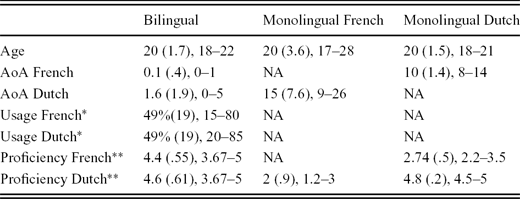
A total of 31 adults aged between 17 and 28 years participated in this study. Participants fell into one of three groups: monolingual French speakers (N = 9), monolingual Dutch speakers (N = 14), and bilingual French–Dutch speakers (N = 8). All participants were students at Belgian universities. Prior to taking part participants filled out an online language background questionnaire (an adapted version of Gullberg & Indefrey, Reference Gullberg and Indefrey2003). Information gathered included biographical information, self-rated proficiency measures, information on language background and language use. Table 1 summarises the background details.
Language background information participants (Mean, SD, range).

AoA = Age of Acquisition
* Estimated percentage of use. None of the French monolinguals reported currently using any Dutch. None of the Dutch monolinguals reported using French on a daily basis.
** Self-rated proficiency on a five-point scale. The French monolinguals did not report their proficiency for French. The Dutch proficiency score for French monolinguals is based on the four people who reported having some knowledge of Dutch. All Dutch monolinguals reported having some knowledge of French.
The Dutch-speaking monolinguals (aged 18–21 years, M = 20) were recruited from the first year psychology student pool at the University of Leuven situated in the Dutch-speaking part of Belgium (Flanders). All participants in this group were born in Flanders and reported that their native language as well as that of their parents was Dutch. The French-speaking monolinguals (aged 17–28 years; M = 20) were recruited from the departments of history, French, and philosophy at the University of Namur situated in the French-speaking part of Belgium (Wallonia). Eight out of nine participants were born in Wallonia. One person was born in France, but he had lived in Belgium for the last four years. His results did not differ from the rest of the group. All participants reported being native speakers of French. Only one person reported having one non-French-speaking parent, but he did not have knowledge of the language in question himself.
All the participants in the monolingual groups are functional monolinguals, meaning that they only use one language on a day-to-day basis, but knowledge of other languages could not be ruled out. All participants reported having some knowledge of English. The Dutch participants also reported having some knowledge of French, which is part of the secondary school curriculum. However, they reported that these and additional languages were not used fluently and/or frequently. While these two groups could be classed as minimally bilingual (Cook, Reference Cook1992), for the sake of convenience we will refer to them as monolinguals here.
The bilingual participants (aged 18–23 years, M = 20) were students in the language department at the Vrije Universiteit Brussel, which is the Dutch-speaking University in Brussels. The recruitment material contained descriptions in both languages. All participants were functional bilinguals, meaning that they used two languages (French and Dutch) fluently and proficiently on a day-to-day basis. One participant was born and raised in a French-speaking area and one person in a Dutch-speaking area; the others were all born in Brussels Capital Region, which is officially bilingual. Four of the participants are early simultaneous bilinguals who were exposed to the two languages from birth. Three participants were early bilinguals learning one of the languages (Dutch in all cases) before the age of three. One participant started learning Dutch at the age of five. Similar to the monolingual groups the bilinguals also indicated having knowledge of languages other than French and Dutch. Again, they reported that the languages were not being used frequently.
Self-rated proficiency scores were obtained for all known languages for speaking, writing, reading, and listening skill as well as grammar use and pronunciation. Skills were rated on a five-point scale (1 = very poor, 5 = very good). Scores for all six skills were summed giving a potential total of thirty. This was then divided into six levels in five-point steps. Scores in the two languages were considered the same if they fell within the same level (adapted from Langdon, Wiig & Nielsen, Reference Langdon, Wiig and Nielsen2005). All participants indicated being equally proficient in both languages. There was no significant difference in self-rated proficiency between language 1 and language 2 (t(7) = 1.46, p = .187).
Stimuli
The stimulus materials consist of 35 short video clips of placement events based on Gullberg (Reference Gullberg2009, Reference Gullberg, Pederson and Bohnemeyer2011a, Reference Gullberg and Pavlenkob). The task consists of five training items, twenty target items (ten horizontally oriented, ten vertically oriented), and ten filler items (see Appendix 1). These items were piloted in picture form first to ensure they were unambiguous in their vertical/horizontal assignment (zetten “set/stand”/leggen “lay”). Of the filler items two were used as an introductory and a concluding clip. Each of the clips consists of two parts. In the first part a girl takes something from a pile of objects. This involves a close-up in which the item, part of the pile, and the girl's hand(s) are visible. In the second part of the clip the girl puts the item (either horizontally or vertically oriented) on a predetermined spot in the room, showing the girl's hand and enough of the environment to determine the location of the object.
Procedure
The task is a Director–Matcher task (Clark, Carpenter & Just, Reference Clark, Carpenter, Just and Chase1973). One person (the Director) watches the placement clips and after each clip tells another person (the Matcher) what happens. The Matcher then draws the object into a schematic overview of the room (Gullberg, Reference Gullberg2009, Reference Gullberg, Pederson and Bohnemeyer2011a, Reference Gullberg and Pavlenkob). Along with location, orientation information is communicatively relevant to the task. The Director is always the genuine participant, while the Matcher is a confederate for the Dutch monolingual group and bilingual group and, for practical reasons, a naïve interlocutor for the French monolingual group. The confederate is a native speaker of the relevant language. This is true both for the bilingual group, which has a French, a Dutch, and a bilingual confederate, respectively for each language session, and the monolingual control groups. The reason for this is to put/keep participants in the right “language mode” (Grosjean, Reference Grosjean1998).
The monolingual groups were tested once in their L1. The bilingual group was tested three times in three different language conditions: French, Dutch, and French–Dutch mixed condition. The mixed condition is not part of the current study. Not taking into account the mixed condition, three participants started with the Dutch condition and five with the French condition. Sessions were filmed. All participants were paid for their participation and consent to use the data was obtained from all participants.
Coding
For each item speech was transcribed orthographically using the video annotation software ELAN (Wittenburg, Brugman, Russel, Klassmann & Sloetjes, Reference Wittenburg, Brugman, Russel, Klassmann and Sloetjes2006). The target utterance was then selected. Only the first spontaneously produced description of each item was used. This typically included the object pronoun, the placement verb, and the locative expression. Repetitions, self-corrections, answers after prompting, and elaborations were not taken into account.
A typical description, illustrated in (1), mentions the picking up action and the putting down action:
(1) The girl picks up a cup and puts it on the table.
Only the second part of the utterance containing the placement event is of relevance and considered to be a target description (in bold in (1)).
Each target utterance was coded for the following properties:
(a) word order of the agent, object, verb, and locative expression;
(b) the lexical verb choice;
(c) orientation information outside the verb (in adverbials).
Analyses
The following analyses were performed. First, we examined word order to ascertain what information is generally present in French and Dutch for the monolinguals and bilinguals. This was done to ensure that similar elements were expressed in both languages such that differences in verb semantics could be isolated. Second, we examined verb choice in French for, first, the monolinguals and then the bilinguals and compared the two groups. Then, we compared the verb choices in Dutch for the monolinguals and the bilinguals, considering the horizontal and vertical scenes separately in this case. Finally, we investigated the extent to which orientation information was expressed outside the verb across the groups and languages.
For the statistical analyses we used logistic mixed effect models which calculated the extent to which the likelihood of the difference between groups was predicted by the manipulated variable. The analysis accounted for by-item and by-participant variance by including random intercepts for these variables (see Baayen, Reference Baayen2008; Baayen, Davidson & Bates, Reference Baayen, Davidson and Bates2008 for more information on mixed-effects modelling in language research).
Results
Word order
In order to ensure that the descriptions were comparable across languages in terms of information expressed we investigated word order patterns. In a typical description participants mention the picking up action and the putting away action, as in example (1). In French the target description is typically expressed as a clause with elided or zero anaphor subject, a pronominalised object, a verb, and a locative expression, as in (2). In Dutch, illustrated in (3), descriptions typically consist of elided or a zero anaphor subject, a verb, a pronominalised object, and a locative expression.
(2)


(3)

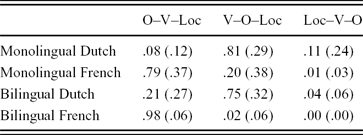
From a total of 768 utterances 676 show one of two patterns: (a) Object – Verb – Locative expression (O–V–Loc), (b) Verb – Object – Locative expression (V–O–Loc). The remaining utterances consist of cases where the location is mentioned first (Loc–V–O) and cases where not all of the elements are expressed (e.g., Tas op de stoel “Bag on chair”).
Table 2 shows that the typical pattern for monolingual French is O–V–Loc, while for monolingual Dutch it is V–O–Loc. The bilinguals show the same language-specific patterns in each of the languages. A mixed logistic regression analysis on the likelihood of bilinguals using the same structure as the monolinguals with participants and items as random factors shows that the bilinguals do not differ from the monolinguals in the respective languages (for French β = –.4629, Z = –.211, p = .8332; for Dutch β = –1.0309, Z = –.694, p = .487).
Mean proportion (SD) of structure type.
There are language-specific patterns for word order in French and Dutch and this holds for bilinguals as well as monolinguals. However, the difference is a strict word order issue. Crucially, monolingual speakers of French and Dutch express the same content and bilinguals do not differ from the monolinguals in either of their two languages. Any differences in verb semantics are therefore not due to topicalisation or focus shift away from the placement event.
Verb choice in French
Monolinguals
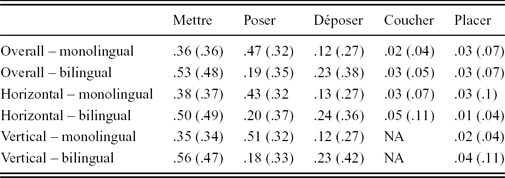
In the monolingual French sample there are five verb types. Table 3 shows the mean proportion of tokens for each type for the monolinguals and bilinguals in French.
Mean proportion (SD) of tokens for each verb type for the monolinguals and bilinguals in French.
The most frequent verb used by the monolinguals is poser “place”, see (4), although mettre “put” is also frequently used, see (5):
(4)

(5)

As expected, orientation does not seem to play a role in determining verb choice, since the tokens are evenly divided between horizontal scenes (H-scenes) and vertical scenes (V-scenes). The obvious exception to this is coucher “make lie” which only occurs with H-items (see example (6)), but is rarely used. Poser occurs slightly more often with V-items than H-items.
(6)

Bilinguals
The bilingual French sample likewise consists of five types. Table 3 below shows the mean proportion of tokens for each type. The bilinguals use mettre “put” for over half of the utterances, as in (7), but poser “place”, as in (8), and déposer “put”, as in (9), also occur. Again, orientation does not play a role in verb choice.
(7)

(8)

(9)

There is a difference between the monolingual and the bilingual group in the use of the expected general placement verb, mettre “put”. A mixed logistic regression analysis of the participants’ likelihood to use mettre with participants and items as random factors shows significant effects for verb choice. Bilinguals are significantly more likely to use mettre (M = .53, SD = .48) than the French monolinguals are (M = .36, SD = .36; β = 4.362, Z = 2.290, p < .05).
Individual preferences also seem to play a role. Speakers have a strong preference for one or the other of the general placement verbs (mettre “put”, poser “place”, or déposer “put”). Each speaker has a verb that they used in 50% or more of the utterances. Monolinguals use their preferred verb 78% of the time and bilinguals use their preferred verb 88% of the time.
In sum, the results for French reveal the expected preference for a general placement verb both in monolinguals and bilinguals. Moreover, bilinguals are more likely to use mettre “put” than the monolinguals.
Verb choice in Dutch for horizontal scenes by monolinguals and bilinguals
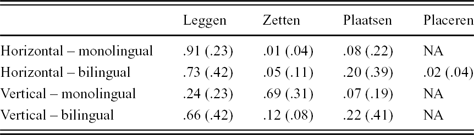
Table 4 shows the verb choices for the horizontal and vertical scenes in Dutch by both mono- and bilinguals. The monolingual group provides three verb types (leggen “lay”, plaatsen “place”, zetten “set/stand”). Leggen, illustrated in (10), accounts for the vast majority of utterances.
(10)
Mean proportion (SD) of tokens for each verb type for the monolinguals and bilinguals in Dutch for the horizontal and vertical scenes.
The bilingual group provides four verb types (leggen “lay”, zetten “set/stand”, plaatsen “place”, placeren “place”). Again leggen accounts for the majority of tokens, as in (11) for example:
(11)

There is a little more variation in the bilingual group than in the monolingual group due to the popularity of the verb plaatsen “place”, but a mixed logistic regression of the likelihood of the expected verb choice, that is leggen “lay” as opposed to zetten “set/stand”, plaatsen “place”, or placeren “place”, with participants and items as random factors, yielded no significant differences (β = 1.751, Z = .738, p = .46).
As with the French data we also looked at how many of the tokens the participants’ preferred verb accounted for. For the monolinguals the mean percentage is 95% and for the bilinguals 90%.
Verb choices in Dutch for vertical scenes by monolinguals and bilinguals
Table 4 also shows the verb choices in Dutch for the vertical scenes by both monolingual and bilingual participants. The monolingual group provides three verb types (leggen “lay”, zetten “set/stand”, plaatsen “place”). Zetten, illustrated in (12), accounts for the majority of tokens.
(12)

The bilingual group provides the same three verb types. In this case leggen “lay”, illustrated in (13), accounts for the majority of tokens.
(13)

A mixed logistic regression analysis on the likelihood of the expected verb choice (zetten “set/stand”) with participants and items as random factors showed that the bilinguals are significantly more likely to use the unexpected verb, leggen “lay”, for vertical scenes than monolinguals are (β = 3.25, Z = 4.083, p < .001).
For vertical scenes the preferred verb accounted for 75% of the data for monolinguals and 88% for bilinguals.
The results from the analyses of the Dutch descriptions show that the monolinguals distinguish between horizontal and vertical scenes in their verb choice; they use leggen “lay” for horizontal scenes and zetten “set/stand” for vertical scenes. The bilinguals, in contrast, do not. They use leggen for horizontal scenes, but are also likely to use leggen for vertical scenes.
Orientation information outside the verb
The verb is not the only place where orientation information can be expressed. It is also possible to express this information outside the verb in adverbials. Examples (14), (15), and (16) show instances of orientation information expressed in adverbial adjunct phrases or additional clauses. Example (16) in particular is interesting, since in that case the information expressed in the verb (i.e. horizontal orientation) and the adverbial (i.e. vertical orientation) seemingly contradicts each other unless the verb has a more general meaning – an interpretation which is supported by the overall pattern.
(14)
(15)
(16)
Interestingly, cases of orientation information expressed outside the verb are rare. In total, there are 59 instances of orientation information expressed outside the verb. These occurrences occur only with 11 out of 20 items. Six items (five horizontal, one vertical) account for 83% of the occurrences. The horizontal items are all items with a natural base, but in a non-canonical position (e.g., a thermos flask on its side). In these cases, orientation information could be said to be highlighted, since it contrasts with the typical configuration. The only vertical item represents a set of books being put upright (see (14), (15), and (16)) on a shelf. Books are interesting in this respect, since they can equally plausibly be put upright or lying down and as such the specification of the orientation is informative. In addition to being rare and not evenly distributed across items, these occurrences are also not used equally often by each group (proportion of utterances expressing orientation information outside the verb: monolingual Dutch .094, monolinguals French .056, bilinguals Dutch .074, bilinguals French .069).
Orientation information is thus most likely to be added by the monolingual Dutch participants who are already specifying obligatory orientation in their verb choice. In cases where objects are located in a non-canonical position they may further stress orientation by mentioning it in an adverbial. It does not appear to be an alternative strategy for the bilinguals.
General discussion
This study sets out to investigate the nature of the functional bilingual system in a case where there is a semi-obligatory distinction in one language that is absent in the other, namely in the case of placement verbs in French and Dutch. We ask (i) whether there is evidence of a merged system despite the obligatory nature and the communicative relevance of the distinction, and (ii) whether such a merged system is realised as a more general or a more specific system.
The results show that in French two general placement verbs are used, mettre “put” and poser “place”. The bilinguals use mettre significantly more often than the monolinguals but both verbs are used as general placement verbs across items and orientations by both monolinguals and bilinguals. The Dutch monolinguals use different verbs to distinguish horizontal (leggen “lay”) and vertical (zetten “set/stand”) scenes. However, the bilinguals overextend leggen in Dutch to include both horizontal and vertical scenes. Moreover, information about orientation expressed outside the verb in adverbials was most likely to be provided by the monolinguals in Dutch, that is, by the speakers who are already making the distinction between horizontal and vertical scenes in their verb choice.
We posited four possible patterns for expressing the pertinent semantic components in placement events (cause an object to move somewhere and end up in a particular configuration):
(a) No specificity in the verb or elsewhere.
(b) No specificity in the verb, but specificity expressed elsewhere.
(c) Specificity in the verb, but not elsewhere.
(d) Specificity both in the verb and elsewhere.
For the monolinguals the results are as expected. The monolingual French speakers largely adhere to pattern (a), although there are a limited number of occurrences for pattern (b) as well. In monolingual Dutch the prevalent pattern is pattern (c). Pattern (d) also occurred, but again in a limited number of cases. The bilingual speakers in French use pattern (a) in the majority of cases with pattern (b) occurring in some cases much like the French monolinguals. However, in Dutch the bilinguals mostly use pattern (a) unlike the monolingual Dutch speakers. They use a specific verb, leggen, but they do not attach the specific meaning to it. They also use pattern (b) on occasion, but again only in a limited number of cases.
Although the option for more specific expressions of placement events exists in both languages (patterns (b) and (d)), and although we find instances of these patterns across all the groups, they are rarely used. Furthermore, the instances of adverbial use seem motivated by the context. For example, in cases where there is no default orientation (e.g., books) the orientation specification is more informative. It therefore seems as if specific orientation information outside the verb is provided when the orientation needs to be highlighted in some way. These cases are therefore not seen as similar constructions but they are marked as atypical by the monolinguals. Importantly, bilinguals do not use this strategy to create a more specific system in both of their languages. Instead, they use more general semantics in both French and Dutch.
Overall, then, for semi-obligatory categories we find that one of the categories is not maintained in one of the languages, resulting in a more general semantic system in comparison with the non-contact variety. One might be tempted to think of this as a unilateral crosslinguistic influence of French on Dutch. However, it may be premature to do so. In order to preclude a general bilingual effect and to determine that we are really dealing with an effect of French on Dutch, a different language pair is needed in order to triangulate (see Jarvis & Pavlenko, Reference Jarvis and Pavlenko2008).
It is striking that bilinguals do not maintain one of a set of semi-obligatory categories in one of the languages rather than preserving language-specific category structure. Interestingly, the patterns closely resemble those attested in adult L2 acquisition when learners go from a single general category in their first language to two or more specific categories in the same domain in their L2 (e.g., Geeslin, Reference Geeslin2003; Gullberg, Reference Gullberg2009). They too seem to opt for a general category. In the case of L2 acquisition, this is typically seen as incomplete acquisition leading to unacceptable structures, whereas in the case of the Belgian bilinguals, the speakers are considered to be fluent and competent speakers of both their languages. Incomplete acquisition, thus, does not apply to them. This does, however, raise the question of whether the mechanisms underlying these merged systems might be the same.
Convergence
One term proposed to account for merged systems is convergence. The term is widely used in the language contact literature (see e.g., Bullock & Toribio, Reference Bullock and Toribio2004; Thomason & Kaufman, Reference Thomason and Kaufman1988) but has been adopted by researchers investigating language contact in the bilingual mind. Crucial to all accounts of convergence is the notion of similarity or equivalence whereby two languages move closer together in some respect taking the existing overlap between the language patterns as a point to gravitate towards. It has alternately been expressed as “congruent lexicalization” (Muysken, Reference Muysken2000), “a property that is initially merely similar” (Bullock & Toribio, Reference Bullock and Toribio2004), “close in conceptual space” (Gathercole & Moawad, Reference Gathercole and Moawad2010), “highly similar elements in the L1 and L2” (Wolff & Ventura, Reference Wolff and Ventura2009), “conceptually equivalent” (Berthele, Reference Berthele2012), or “rough translation equivalents” (Ameel et al., Reference Ameel, Malt, Storms and Assche2009). These are general descriptions that do not say anything specific about the degree of change (e.g., a slight shift in category boundaries vs. a complete drop of a semantic feature) or the exact type of change (e.g., a shift in distributional frequencies of use of a structure vs. merging two phonological categories into one).
The general description of convergence as a move towards a common point of overlap applied to a system of semantic features could lead to the following possible outcome patterns:Footnote 1
(i) A more general system in one language as compared to its non-contact version.
(ii) A more specific system in one language as compared to its non-contact version.
(iii) A more general system in both languages as compared to their non-contact versions.
(iv) A more specific system in both languages as compared to their non-contact versions.
This account of convergence works well for the current data set where a situation emerges comparable to pattern (i), that is, a more general system in one language as compared to its non-contact variety. Bilinguals in Dutch do not maintain a distinction that is not present in their other language making the languages more similar. Again, it is striking that there is little evidence of bilinguals strategically moving object-related information into other parts of the utterance. It seems as if there is a real and global shift in focus away from object information, arguably reflecting different placement verb semantics and a different set of placement event representations in bilinguals as compared to monolinguals.
However, we should proceed with some caution. When we consider the wider context of language, this account may not hold up even for a restricted feature-based situation. That is, for two languages in use it is possible, for example, that a shift in the verb semantics of one verb might have more widespread effects in related parts of the language such as the prepositional system or in neighbouring verbs. In addition, many concrete words have metaphorical extensions or idiomatic expressions associated with them. It is unclear how this description of convergence would apply in those cases. We cannot exclude the possibility that the bilinguals express object related information in Dutch verbs and structures not captured in the current data set. Nonetheless, the shifts observed are striking.
Mechanisms of convergence
Thus far, we have considered convergence mainly as an outcome of prolonged contact. However, the question remains what the underlying mechanism may be. We discuss three options suggested in the literature: a distributional account, a functional account, and a processing economy account, two of which we consider to be applicable to the data set at hand (for further discussion of mechanisms of convergence see, for example, Ameel et al., Reference Ameel, Malt, Storms and Assche2009). In structural terms convergence could be instantiated as a preference for a particular structure A over another equally acceptable structure B in a language, if the other language has a structure that is the same or equal, leading to a difference in distributional frequencies. Clyne (Reference Clyne1987) offers changes in distributional frequencies as a possible facilitator for code-switching. In the literature on early bilingual L1 acquisition, structural convergence as a phenomenon is also widely discussed (Döpke, Reference Döpke1998; Gawlitzek-Maiwald & Tracy, Reference Gawlitzek-Maiwald and Tracy1996; Hulk & Müller, Reference Hulk and Müller2000; Müller & Hulk, Reference Müller and Hulk2001). In the current data set, however, this account of convergence does not apply. It is not the case that there are two equally acceptable alternatives and therefore a change in distributional frequencies is not an option.
Berthele (Reference Berthele2012) instead suggests an account based on functionality, whereby semantic distinctions that are not communicatively and pragmatically relevant are more prone to being dropped. That is, for German the distinction between the caused positionals has no functional purpose, since it is also acceptable to use constructions with tun “do”, and hence the distinctions are dropped. It is an interesting suggestion that non-functional distinctions might be more susceptible to being dropped. However, this begs the question why many of these (seemingly) useless distinctions still exist in general (e.g., grammatical gender). In the placement domain, specifically, there is no evidence that caused positionals are disappearing in other languages (see papers in Kopecka & Narasimhan, Reference Kopecka and Narasimhan2012).
It is also possible that bilinguals are making a functional choice. That is, the specification is part of their semantic-conceptual representation, but they are simplifying on a practical discourse level. In other words, they know and attend to the distinctions, and yet choose not to encode them in their speech. Although this is an option, it is an unlikely one, since the orientation information is actually pertinent to the task in this particular situation; it is relevant to discourse. Rather, it seems that the bilinguals are not attending to the orientation information at all as indicated by the fact that the use of orientation information elsewhere in the clause is hardly used by the bilinguals. It is the Dutch monolinguals, who are already attending to the information, who use this option.
A third account is Muysken's (Reference Muysken2000) suggestion that “processing economy” is a possible force behind the move towards a more general system (see also Ameel et al., Reference Ameel, Malt, Storms and Assche2009). He suggests that “[i]t is conceivable that there is a uniformizing tendency resulting from the processing system, tending towards one superficial word order for both languages, etc.” (Muysken, Reference Muysken2000, p. 277). While this is an attractive idea it is not clear exactly what it means to lighten the processing load especially in relation to distributed semantics. Processing studies typically focus on single lexical items, morphological complexity, or syntactic constructions, but are rarely concerned with how meaning elements spread out over an entire clause or utterance can be related to processing load.
It is possible that there is a move towards a more general system for reasons of functional economy, that is not maintaining a seemingly uninformative distinction. It is equally possible that the move toward a more general system is prompted by processing economy. The current data set does not allow us to probe these questions in detail. However, the observed patterns clearly suggest that this matter should be investigated further.
In conclusion, this study shows that the bilingual system can be surprisingly and quite dramatically different from its monolingual counterparts. Bilinguals may not maintain one of a set of semi-obligatory categories in one of the languages rather than preserve language-specific category structure. Although such patterns would be seen as unacceptable in L2 acquisition, they seem to be a natural result of functional bilingualism. These results appear to support Grosjean's notion of the bilingual as a specific speaker-hearer and suggest that within a limited domain the bilingual third pattern can look quite markedly different. This raises questions regarding exactly how pervasive these differences are and opens for further explorations of the bilingual system beyond the individual word at broader levels of language.
Appendix. Target items
Horizontal target items
Vertical target items