1. Introduction
After the Second World War, Dutch authorities allowed – for reasons discussed at length below – 8,000 displaced persons (DPs) from camps in Germany to come and live in the Netherlands. DPs were people who were deported or moved by the Nazis, or who moved themselves in the aftermath of the Second World War. In 1944, Allied forces had estimated there were 11 million DPs in Europe.Footnote 1 The term ‘DP’ was used for a very diverse group of people. DPs could be evacuees, political fugitives, former political prisoners, forced and voluntary workers, deportees, civilian internees, ex-prisoners of war (POWs), concentration camp survivors, non-German soldiers, members of the Polish Corps, and civilians fleeing west from the Soviet Army.Footnote 2 The 12 million ethnic Germans, who were expelled from countries that had been occupied by the Nazis or ruled by fascists, were not labelled DPs, but ‘expellees’.Footnote 3
The Dutch plan led to debates in parliament and the press, which are analysed in the sections below. Initially, the plan of the minister of transport had been to allow 5,000 Jewish DPs to come to the Netherlands. Civil servants were strongly opposed to this and mentioned housing shortages and potential labour market competition as reasons for their opposition. They suggested lowering the number to 500. In the end, the Dutch government decided that at the most 500 out of the 8,000 DPs could be Jewish. During the extremely cold winter of 1946/1947 the directors of the Dutch mines started to lobby for permission to recruit DPs. They preferred Poles. The Dutch Communist Party, however, agitated against this recruitment and called the DPs fascists, free-riders, rapists and criminals. The Communist Party warned there might be a miners’ strike if the mining directors carried out their recruitment plan. Dutch authorities stuck to their plan, and a committee, including civil servants from the Ministry of Justice and potential employers, visited the camps. Rather surprisingly, in the spring of 1948 the non-communist press also started to agitate against recruitment and called the DPs a destabilising factor. The recruitment was stopped after only half of the available places had been filled. This article analyses why the framing of the DP issue changed so fundamentally within only a few years.
Dutch policies were restrictive compared to other countries: the Netherlands invited few DPs, even fewer came and 25 per cent of those who did come returned to DP camps. Authors have paid some attention to DPs in the Netherlands, but Tycho Walaardt's previous work did so only in passing, and Corrie K. Berghuis primarily pays attention to political actors.Footnote 4 Frank Caestecker and Lieselotte Luyckx described Belgian DPs, and mentioned Dutch DPs briefly.Footnote 5 The literature on other countries, described below, is more extensive.Footnote 6
This article starts with three sections that provide a broader context. Section 2 addresses the situation in the DP camps, and section 3 looks at the policies of France, the UK, Belgium, the US, Canada and Australia. All of these countries were restrictive when it came to admitting DPs because they regarded them as unproductive. Section 4 describes the situation in the Netherlands in the immediate post-war years, with the housing shortage as the most pressing problem. However, there was also a need for workers, especially in sectors that were crucial to the reconstruction of the country. The Netherlands depended on other countries and on international organisations to solve its post-war problems. The article continues with a section on the material and methods that were used. This article analyses how the DP issue was framed by all actors involved: non-governmental organisations, the Dutch government, the Dutch Homeland Security Department (Binnenlandse Vleiligheidsdienst, BVD), newspapers, and employers. The remainder of the article is broken down into six short time periods, each with its own dominant frame. This article will show why debates about DPs changed rapidly within a short period (1945–1951).
2. Refugees, DPs, expellees and ‘infiltrees’
After the war, Germany was divided into three zones of occupation by the UK, the US and the Soviet Union (France later also gained a zone). In the US and UK zones the DP problem was acknowledged, but according to the USSR there was no problem in their zone, and organisations were not allowed to investigate or help.Footnote 7 Soviet authorities wanted all DPs to be repatriated, as had been agreed at the Yalta Conference in February 1945, where the leaders of the US, the UK and the USSR discussed post-war reorganisation. By July 1945, 1.6 million Soviet subjects had been repatriated.Footnote 8 Soviet authorities claimed the West hindered the return of more DPs to the Soviet Union, because it needed workers. According to the Soviets, DP camps sheltered Nazi collaborators and war criminals who sought to evade justice.Footnote 9 Western Allies, however, said they refused further repatriations to the USSR because returnees were maltreated, executed or deported to the Gulag (the Soviet forced labour camps).Footnote 10 They refused to force unwilling DPs onto trains going east. This angered the USSR.Footnote 11
Since the DP issue was too large for a single country to handle, attempts were made to solve it at a multilateral level.Footnote 12 The IGCR (Intergovernmental Committee on Refugees), which had been created in 1938 to assist Jews fleeing Germany, was to care for all refugees from 1943 onwards. In 1943, the UNRRA (United Nations Relief and Rehabilitation Administration) was set up. Two thirds of its initial 2 billion dollar budget came from the US.Footnote 13 UNRRA controlled 900 camps in Germany, Austria and Italy. IGCR was meant to deal with the resettlement of refugees, and UNRRA with the repatriation of DPs. This division of tasks was unworkable, because the lines between them were blurred. The unrepatriable DPs did not fall into either category.Footnote 14
The DP issue was difficult to solve because numbers were large, and they initially increased, rather than decreased.Footnote 15 As Allied troops pressed further into war-torn Europe, they found that the uncontrolled movement of people hindered troops, and frustrated the war effort. There was no food, no medical care and no transport for DPs. Diseases spread and Nazis hid among the DPs. Leaflets in several languages were dropped from planes and handed out to people, urging them either to register and stay where they were until support could be provided, or go to nearby camps for help.Footnote 16 Dutch, Belgian and French men, who had worked in Nazi Germany, started to walk home, ignoring instructions.Footnote 17
By September 1945, the military and UNRRA had repatriated 4.6 million people, while 2 to 3 million people either found their own way back, or were helped by others. Return rates were 33,000 to 65,000 per day, depending on who was counting, and who was counted.Footnote 18 Registration was difficult because of the constant movement, and the DPs’ lack of identity papers.Footnote 19 After September 1945, 1.2 million DPs were still in camps in the western zones in Germany. The 720,000 DPs who had or claimed Polish nationality were by far the largest group.Footnote 20 DPs from countries under Soviet control or from the USSR were seen as unrepatriable. Between October 1945 and March 1946 repatriation came to a standstill because of transportation problems and winter conditions. By March 1946 Balts (Estonians, Lithuanians and Latvians) became a more visible group when their numbers increased (from 150,000 to 200,000). They were exempted from repatriation because western Allies did not recognise the Soviet incorporation of the Baltic states.Footnote 21
Only a small percentage of the DPs were Jewish. Immediately after the war, there were 36,000 to 50,000 Jewish DPs, but their number fell because 20,000 to 30,000 weak Holocaust survivors died shortly after their liberation.Footnote 22 Initially, Jews were housed in camps with other groups, including fascists and Nazi collaborators. In June 1945, the US government sent Earl G. Harrison to examine the European DP camps. His tour resulted in the Harrison Report, which was published in August 1945 and which harshly criticised the conditions in the camps, and described the horrifying conditions under which Jews in particular lived. It called for immediate changes to the camps, the creation of specific Jewish camps, and increased possibilities to migrate to the US and Palestine. The UK was not willing to allow the latter, but US president Truman agreed to increase possibilities for migration to the US.
The Jewish camps attracted Jews from Poland, who had returned from Germany or the USSR to Poland, and who encountered new outbreaks of anti-Semitism in post-war Poland. These Jews, who escaped from Poland back to Germany, were called ‘infiltrees’ because they evaded border controls.Footnote 23 In 1945 Jews formed 4 per cent of the DPs; this increased to 25 per cent in 1947.Footnote 24 The increase was not only the result of arrival of Jews from Poland and the USSR, but also of a faster departure of the non-Jewish DPs.
Shortly after the war, doctors who were interested in what camp life did to people described DPs as ‘apathetic hypochondriacs’, or as ‘aggressive’, ‘jealous’ and ‘reckless’.Footnote 25 Doctors furthermore called DPs ‘weak’, ‘problematic’, ‘inert’ and ‘nervous’. In their view, Jewish DPs were largely passive, but on some occasions panicky.Footnote 26 These descriptions made DPs unattractive to countries that wanted workers. DPs, who were unable or unwilling to repatriate, were labelled ‘an irritating remnant’.Footnote 27 By 1948, the term ‘displaced persons’ had gained a strong negative connotation.Footnote 28 Zionist lobbyists enforced the image of a people that nobody cared about before and after the war, hoping it would increase chances for migration to Palestine. The Jews in DP camps who married and started families were less attractive to countries with housing shortages.Footnote 29
In 1947, UNRRA was still running 762 camps.Footnote 30 The US withdrew its financial support because it was unhappy with the UNRRA's functioning, and feared it was influenced too much by the USSR. In 1947 UNRRA and IGCR were replaced by the UN-affiliated, and US- and UK-controlled IRO (International Refugee Organization).Footnote 31 The US paid 50 per cent of the IRO's budget. The IRO's main task was to find a place for the last million refugees or DPs in Europe. There was a strong emphasis on the fact that they were ‘the last’.Footnote 32 Originally the IRO was to repatriate people, but soon it started to resettle them instead.Footnote 33 Initially the IRO produced negative reports about DPs, with anti-Semitic undertones, but later it embarked on advertising campaigns that avoided giving attention to distress and horror, and presented DPs as energetic, hard-working and freedom-loving.Footnote 34 A journalist, who visited an IRO camp, observed how intellectuals were learning to be garage mechanics and bricklayers since no country wanted musicians, painters or doctors.Footnote 35
3. Selection
Some IRO leaders criticised the selection among DPs, but the recruiting countries wanted workers, and the IRO wanted empty camps.Footnote 36 Recruiters from 50 countries ‘shopped’ in DP camps.Footnote 37 Selection was based on marital status, skill, age, education, religion, and political and criminal antecedents. People who were ill or old, intellectuals, and those with dependants were difficult to place. They were labelled the ‘hard core’ or the ‘residue’.Footnote 38 Countries such as Belgium, the UK, Canada, France, Australia, and the US all developed schemes for the selection of DPs. In all countries these schemes led to debates, which were similar to those in the Netherlands.
Belgium was the first country to launch a recruitment plan.Footnote 39 The focus was on mining, where there were severe shortages. Belgian authorities looked at Poles in DP camps as potential miners. The authorities, however, feared DPs could not be returned if they proved unsuitable for mining, and suggested to the US that the DPs be employed in Belgium until their migration to the US could be guaranteed, which should be within ten years at the most. The plan was not put into effect. After that, Belgian and Allied authorities agreed that ‘unsuitables’ – as they were commonly called – could be returned to DP camps within three months. ‘Suitables’ could be joined by their wives and children after these three months. Belgian trade unions protested against the plan because they feared competition on the labour market, and they objected to allocating family houses to the foreign workers at a time of housing shortages.Footnote 40 Belgium wanted to recruit 32,000 workers, but in the end only 21,906 came, mostly Poles, Ukrainians and Balts.Footnote 41 Those who came and stayed were followed by 15,000 dependants, while 8,000 DPs returned to camp life after a short while. This led to debates: should these returned DPs be allowed to migrate elsewhere, since they had already had a chance? Authorities decided that they could, since they had not really been resettled in Belgium.Footnote 42
In the UK, recruitment plans were made early as well, and these also led to debates. The UK needed to increase its working population, which had fallen by 1.38 million between mid-1945 and the end of 1946 when the school leaving age was raised, and married women, and elderly people, who had worked beyond retirement age during the war, stopped working.Footnote 43 In addition, 1.5 million British residents emigrated in this period. As in other countries, there were labour shortages in sectors that were essential to post-war reconstruction: mining, textiles, construction, and health services.Footnote 44 Newspapers called on the government to deal with these shortages. New workers were found among the Polish veterans, who fought under British command during the war, and who were still the financial responsibility of Britain. Within two years, 114,000 of these Poles enrolled in a Resettlement Scheme (16,000 of them returned to Poland or migrated to a third country).Footnote 45 Despite the shortages, trade unions protested against their employment, as they had done in Belgium. The Communist Party of Great Britain said, 500,000 ‘of our best young men’ were emigrating, while ‘we employ Poles who ought to go back to their own country’.Footnote 46 Communist and left-wing newspapers labelled the Poles fascists. The Catholic press was more positive, while the popular press was critical. In an attempt to change the tone of the newspapers, the War Office invited journalists to visit Polish camps in the UK.Footnote 47 These visits did lead to a more positive tone.
Because of shortages in hospitals and other care facilities, the UK decided specifically to recruit Baltic women from camps in Germany. The immigration of women was seen as less politically sensitive than that of men. British authorities were in a hurry to find these workers, since they feared others would skim off the cream of the crop. Under this so-called Baltic Cygnet Scheme, 1,500 women were selected in 1946. They had to be between 21 and 40 years of age, single, without dependants, healthy and not pregnant. Recruitment proved difficult because women were unwilling to leave dependants behind.Footnote 48 The arrival of the Baltic women was covered extensively by British newspapers, which described the women as intelligent, smartly dressed, and strong-looking.Footnote 49
British officials preferred the label ‘European Volunteer Workers’ (EVWs) over ‘displaced persons’ as the latter term was regarded as pejorative.Footnote 50 In the British Cabinet it was argued that the term ‘European’ was preferable to ‘foreign’ or ‘alien’ because it emphasised joint heritage.Footnote 51 The EVW scheme excluded Jews because of the situation in Palestine and anti-Semitism in the UK, according to a Foreign Office memorandum.Footnote 52
The Baltic Cygnet Scheme was followed by the Westward Ho! Programme, which brought another 78,500 to 82,000 workers and dependants to Britain.Footnote 53 The programme was brought to the attention of DPs by leaflets, presentations, and visits to camps. The Ministry of Labour said that the object was to find workers for essential industries, not to resettle DPs in work to their liking. Critics called selection a slave market.Footnote 54 Within the British government there were debates about the deportability of stateless people. Technically they could be deported if a third country was willing to take them, but there were humanitarian and political objections to sending people back to DP camps. These objections diminished when the Allied Control Commission in Germany agreed to take back ‘unsuitables’ within a 12-month period. Careful screening would minimise the need to return DPs.Footnote 55 In the UK a range of activities was developed to make the DP schemes acceptable, such as feeding information to women's magazines and local newspapers, and a pro-EVW BBC radio programme.Footnote 56 British newspapers described selection in positive terms. According to The Times only the brightest and best educated were invited and everybody was medically examined.Footnote 57
Canada also started by recruiting Baltic women. It favoured Protestant DPs; only 10 to 15 per cent should be Jewish. When Canadian recruiters failed to find sufficient suitable women, they redefined single: ‘without dependents whose whereabouts are known’.Footnote 58 Canada in the end recruited 123,479 DPs (of whom 16,012 were Jewish: 12 per cent) who were put to work as domestics, or found employment in forestry and agriculture.Footnote 59
France started recruiting late, and it was trying to find workers, as well as people to repopulate the country. The French plans met with protest from the communists, who had much more support than those in the UK. The French communist press wrote that most DPs were fascist, as communist newspapers in other countries did. France only accepted DPs after US congress threatened to withdraw Marshall Aid from countries that did not take a reasonable number of DPs.Footnote 60 Marshall feared that overpopulation in Europe would undermine reconstruction and would lead to political instability, and therefore put pressure on European countries to solve the DP problem.Footnote 61 In the spring of 1947 France assumed it needed 300,000 to 400,000 extra workers. It wanted single men and women, and rejected 50 per cent of the candidates for medical reasons. French authorities feared that the most productive workers had already been culled by Belgium and Britain. In the end, France attracted only 38,000 workers because DPs did not want to go to a country severely damaged by war. The French also did not advertise their country actively in DP camps.Footnote 62
Australia started even later than France with its recruitment. Between 1947 and 1952 170,000 DPs arrived in Australia.Footnote 63 Australia wanted workers, and not refugees. It focused on DPs from eastern Europe, to whom the media and the government referred as the ‘Beautiful Balts’, although not all came from Baltic countries.Footnote 64 The Australian government severely restricted the number of Jews it allowed to come (6 per cent of the DPs going to Australia were Jewish). An Australian MP said that Australia should not be ‘a dumping ground’ for people whom ‘Europe itself, in the course of 2000 years, had not been able to absorb’.Footnote 65
In the US, a very strong lobby developed to recruit Latvians for work in the agricultural South. The US Displaced Persons Act, signed in June 1948, sidestepped 1924 quota restrictions, and made it possible for 400,000 DPs to migrate if they had a sponsor to guarantee housing and employment. As elsewhere, the scheme discriminated against Jews.Footnote 66 However, while many other countries favoured singles, the US did admit families. The US recruiters treated DPs like ‘cattle and slaves’, according to critics, and controlled where they worked and lived.Footnote 67
Overall, all countries were selecting and all countries were emphasising that they needed workers, rather than refugees or DPs. All countries preferred people from eastern Europe, frequently referred to as Balts. All countries discriminated against Jews, on whose behalf the strongest humanitarian claims could have been made. After 1948, 132,000 Jewish DPs left Europe for the new state of Israel, without any selection according to health or skill.Footnote 68
4. The Dutch context
In May 1946, the first post-war Dutch elections were held. The Social Democrats (PvdA) won 29 out of 100 seats, and the Catholics (KVP) 32. They formed a coalition government, and embarked on a policy of controlling the labour markets and prices. The Communists gained 10 seats, and formed the opposition with smaller Protestant and liberal parties.
During the Second World War, 230,000 to 330,000 Dutch died (out of a population of 10 million). The damage caused by the war was calculated to be 26 billion guilders (9.7 billion US dollars), and there were food and coal shortages.Footnote 69 The housing shortage was estimated to be 300,000. Six hundred thousand acres of land had been flooded (8 per cent of the Netherlands) after dikes had been damaged. The Dutch feared overpopulation, a third world war and a return of pre-war unemployment.Footnote 70 The government financed the emigration of 400,000 people from the Netherlands. Newspapers encouraged people to migrate, but lack of shipping capacity delayed departure until mid-1947.Footnote 71 The Dutch queen and prime minister personally campaigned with the US for an enlargement of the Dutch quota, using Dutch overpopulation as their main argument.Footnote 72
Only 38,000 of the 140,000 Jews living in the Netherlands at the beginning of the war survived the Holocaust. The Netherlands had the lowest percentage of Jewish survivors of all west European countries.Footnote 73 After the war, 350,000 Dutch came out of hiding, and tried to return home. Fifty thousand children, who had been moved out of war and hunger zones, were being returned home as well. In July 1945 about 130,000 people who were suspected of war crimes and collaboration were arrested and placed in 130 internment camps. In 1946, the Dutch minister of reconstruction proposed to deport 20,000 Dutch collaborators to Germany, or to Dutch New Guinea.Footnote 74 These plans were not put into practice. The Dutch also planned to deport 25,000 Germans from the Netherlands, but the plan was aborted after 15 per cent had been deported. Dutch authorities also wanted to annex parts of Germany, as compensation for losses during the war. Originally, a large part of Germany was claimed (10,000 km2, with a population of 1.5 million Germans). The Dutch argued they needed space, and the region to be annexed would accommodate the Dutch surplus population until the year 2000. The UK and US, however, strongly opposed these plans, and since the Dutch needed Allied support to increase shipping through Rotterdam, annexation plans were toned down.Footnote 75 In the end, 69 km2 was annexed with in total 9,553 Germans, who were not deported.Footnote 76
In the post-war years, 115,000 people were repatriated to the Netherlands from the Dutch East Indies or Indonesia.Footnote 77 Dutch authorities feared hundreds of thousands more would come. They hoped that some of the repatriates would be able to go to the US as refugees. About 17,000 to 24,000 of them indeed did do so under the terms of the US Refugee Relief Act.Footnote 78
The relationship with the USSR restricted the Dutch authorities’ room to manoeuvre. Three groups of migrants affected Dutch relations with the Soviet Union. In the first place, in 1946, 1,000 Soviet subjects arrived illegally in the Netherlands.Footnote 79 About 350 to 440 of them were Mennonites whose religion had its origins in the sixteenth-century Netherlands. The Dutch refused to help Soviet authorities to repatriate them, and eventually helped thousands of Mennonites to migrate to Canada, the US and Paraguay.Footnote 80 This Dutch support for the Mennonites greatly annoyed the Soviet Union. Secondly, there were the so-called Ostarbeiterinnen: these were Soviet women and girls who had been deported by the Nazis and put to work as forced labourers.Footnote 81 They met Dutch men, who were working in Germany as forced or voluntary labourers, and after the war they accompanied their boyfriends or husbands to the Netherlands. If they were married to a Dutch man, they had Dutch citizenship, but Soviet authorities did not recognise their marriages, nor their loss of Soviet citizenship. Between December 1944 (when the Dutch South was already liberated but the North not) and December 1945, 9,400 Soviet subjects, including 4,200 women, were repatriated to the USSR. After December 1945, Dutch authorities forbade this forced repatriation. In the end, 2,723 Soviet subjects stayed in the Netherlands, including 800 women. The Dutch refusal to repatriate the women also angered the Soviet Union, while the forced deportations aggravated the Dutch. Thirdly, there were 30,000 Dutch former forced labourers who were in the Russian zone, and there were 8,000 Dutch men in Soviet POW camps, who had fought with the Nazis on the Eastern Front.Footnote 82 The Dutch needed Soviet support for their return.
Poles were another important group in Dutch debates. There were three groups of Poles. In the first place, there were the Poles who fought with the Allies in the Netherlands. Initially 7,000 wanted to stay, later 2,000. Secondly, the UK asked several countries to resettle some of the Polish veterans who – as mentioned above – fought in the Polish Armed Forces under British command. The Netherlands admitted 3,300 of these Poles provided they worked in the mines. Lastly, there were the Poles who came from DP camps in Germany (about 75 per cent of the DPs in the Netherlands were Polish).Footnote 83 In the newspapers and in political debates, the words ‘Poles’, ‘Balts’ and ‘DPs’ were used as synonyms, and all Poles were grouped together despite differences.
Overall, the Netherlands came out of the war severely damaged, and was confronted with much displacement. The Dutch needed the support of western Allies to increase shipping via Rotterdam, they needed Soviet support for the return of Dutch men who were still in the USSR, they needed IRO support for their emigration schemes, and they hoped the US would absorb repatriates from the (former) Dutch East Indies. The Dutch angered western Allies with their annexation plans, and their deportation of ethnic Germans, while they angered Soviet authorities with their refusal to deport Mennonites and Ostarbeiterinnen.
5. Material and method
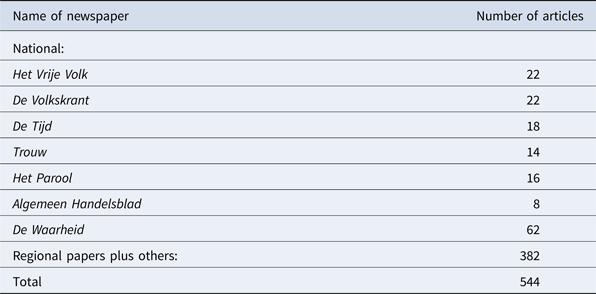
We used five types of sources to answer the question why debates about DPs changed rapidly within a short period (1945–1951): (1) The IRO archive in the Netherlands, which holds information about how its Dutch branch proposed to solve the DP problem;Footnote 84 (2) documents from the archive of Dutch Homeland Security Department relating to communist agitation against DP recruitment;Footnote 85 (3) minutes of parliamentary debates;Footnote 86 (4) archival material from the Ministry of Justice;Footnote 87 and (5) 544 newspaper articles (Table 1).
Number of newspaper articles used

Sources: See main text.
About half of the Dutch newspapers have been digitised.Footnote 88 The ink and paper used for newspapers in this period was of a poor quality. This makes it difficult to use optical character recognition (OCR) software. About 70 per cent of the text comes out corrupted.Footnote 89 (For instance, this sentence in Dutch: ‘Het aantal “displaced persons”, dat tot nu toe in de Belgische mijnen is te werk gesteld bedraagt 3000’, after using OCR, turns into ‘Hel slants „displaced persons”, tlat [ot nü loc il de Belgische mijnen is te werk gestel bedraagl 3000.’) Coding was therefore done manually. Search terms were ‘displaced persons’, its Dutch translation (verplaatste personen), and ‘DPs’. In addition, we searched non-digitised newspapers. De Telegraaf (a populist newspaper) was forbidden in this period, because of its wartime collaboration. The articles we used came from Het Parool (former wartime resistance newspaper), Trouw (Protestant), De Volkskrant and De Tijd (both Catholic), Het Algemeen Handelsblad and NRC (both liberal right-wing newspapers), Het Vrije Volk (social democrat newspaper) and De Waarheid (communist, newspaper of the CPN). De Waarheid was not yet the isolated newspaper it became a few years later. Until 1948 (when its editor-in-chief was fired by the Dutch Communist Party) its coverage reflected the influence of the wartime resistance movement, from which the newspaper sprang. Het Vrije Volk, De Volkskrant and De Tijd were strongly aligned to the parties in government (respectively the PvdA and the KVP), but as earlier research showed, they were nevertheless critical towards government policies.Footnote 90 Regional newspapers have been included because they published articles when DPs arrived in their region.
As a method we used frame analysis. This term is used in the literature for a large variety of approaches.Footnote 91 We took a simple deductive or top-down approach, whereby five generic frames (identified as such in the literature) function as a starting point:Footnote 92 the responsibility/legalistic frame (who is the problem, who has to offer a solution, what is the law), economic (costs and gains), humanitarian (individuals/personal stories), morality (decency, tradition, Christianity), and conflict/endangering (referring to cultural/religious differences, security). We combined this with an inductive or bottom-up approach, keeping an eye out for alternative ways of framing.Footnote 93
As described below, all newspapers with the exception of De Waarheid more or less used the same frame, albeit different per period. The Dutch Homeland Security Department was interested most in what De Waarheid wrote, and therefore we pay explicit attention to that newspaper. The Netherlands recruited DPs as domestic servants, textile workers, and miners. Mining directorates were, however, the most important claim makers, and mining was discussed more than other subjects by the press and policymakers. Therefore it receives more attention in the sections below.
6. Period 1 (first post-war year): threats, costs and morality
In May 1945, the number of DPs from the Netherlands was, according to newspapers, 400,000, including 300,000 forced labourers, 12,000 POW and 20,000 political prisoners. The number of 400,000 refers, however, to people of Dutch nationality, and not those of other nationalities, who took centre stage later. In July 1945, one hundred ambulances were dispatched to the concentration camps of Buchenwald and Dachau to locate ‘lost’ persons.Footnote 94 Per day, 2,000 Dutch DPs were repatriated.Footnote 95 Newspapers presented detailed information about how they would travel despite destroyed railroads, robbed trains and bombed bridges, thus emphasising control and efficiency.Footnote 96 Newspapers linked the DP issue to the fate of the Dutch forced labourers who were still in the Russian zone, and that of Dutch Nazi collaborators in Soviet camps.Footnote 97
In June 1946, 25 newspaper articles used the word ‘innocent’: DPs were the victims of two brutal, tyrannical regimes. They survived Nazism and escaped communism. Newspapers in the southern Dutch mining province the Limburg urged authorities to end the DPs’ misery, and find solutions for the doomed in camps, framing the issue in humanitarian terms.Footnote 98 The Dutch UNRRA officer wrote to the wife of the Dutch prime minister that many Baltic girls spent their days in idleness, while Dutch families needed maids. Contrary to other DPs, who suffered from poor morale, laziness and unreliability, the Baltic girls behaved well, he wrote, highlighting the benefits of recruitment.Footnote 99 Civil servants, however, strongly objected, emphasising costs and threats: it was impossible to check their antecedents, the girls could not be returned, and they might compete with Dutch girls on the labour market. Furthermore, admitting them could harm diplomatic relations with the USSR and frustrate the return of Dutch men. Moreover, there were already many other immigrants coming to the Netherlands.Footnote 100 Nonetheless, despite these objections, 80 girls were admitted as a test.
In August 1946, the minister of transport suggested inviting 5,000 Jewish DPs to compensate for what had happened to Dutch Jews during the war. According to the minister, at least family members of Jews already in the Netherlands should be allowed to come provided Jewish organisations guaranteed financial support. Young Jews should be able to come if they wanted to work in sectors in which a large number of Jews worked before the war (tailoring and the diamond industry). In addition, Jews who wanted to train on a farm, preparing for migration to Palestine, should also be allowed to come.Footnote 101 Civil servants opposed the plan, and referred to housing shortages and labour market competition.Footnote 102 A government committee thereupon lowered the number from 5,000 to 500 arguing that the Netherlands had to recover from war damages first. The secretary-general of the Ministry of Justice disagreed with his staff and pleaded for larger numbers: Christian charity, the Dutch tradition of welcoming exiles, and the suffering of Jews during the war, justified this gesture. Jewish organisations also pressed for larger numbers, and offered housing and financial support. They presented dramatic individual cases of Jewish DPs.Footnote 103 Authorities in the end decided to recruit 8,000 DPs, 500 of whom could be Jewish. All DPs had to be single, skilled workers, without criminal or political antecedents. Initially 100 of the 500 Jewish DPs could come on humanitarian grounds, provided they had financial support from an organisation or family members. This number was lowered to 50. The others could only come if they were able to work.Footnote 104
Overall, in this first period, bureaucrats largely argued against inviting DPs because they were non-returnable, they might be competitors on the labour market, or could be a threat to the position of Dutch men in the USSR. They referred to the arrival of other migrants and housing shortages. Newspapers (with the exception of De Waarheid) and organisations, in contrast, emphasised victimhood and moral duty.
7. Period 2 (winter 1946/1947): gains
In the second period, debates were less about Jews, and more about miners. Authorities did not see Jews as potential miners.Footnote 105 During the war, Dutch mines had not employed forced labour, as other countries had. After the war, there were labour shortages in the mines but not because of a sudden departure of POWs, as was the case in Belgium.Footnote 106
The winter of 1946/1947 was the coldest since 1789. The freeze started in December and continued until March. Transport across water came to a standstill and 500 ships carrying coal were trapped in the ice. The bishop of the mining town the Roermond gave miners permission to work on Sundays, and soldiers were sent to the mines to help out.Footnote 107 According to newspapers, only an increase in the number of miners could solve the coal crisis. If it was impossible to recruit Dutch workers, employers should look for foreigners, De Volkskrant wrote.Footnote 108 Calls in newspapers for more miners were published next to articles about the recruitment of DPs by other countries.Footnote 109 The Dutch would miss out on opportunities, newspapers implied. In February 1947, the head of the Dutch State Mines promised the Dutch would not have to suffer another bitterly cold winter in the future.Footnote 110 In April 1947, a newspaper ran the headline: ‘More coal, then also more men and machines’.Footnote 111 According to the director of the State Mines, production could only increase if there were more miners. According to De Waarheid, DPs were, however, free-riders who preferred camp life because they were given food, shelter and pocket money. Many DPs misbehaved in Germany, the crime rate among them was high, as was the number of rapists, the newspaper wrote. It wondered how ‘we’ could allow such people to work in vital sectors of the Dutch economy.Footnote 112
Overall, in this period, the cold winter and coal crisis, and thus the gains of recruitment formed the dominant frame. Only De Waarheid emphasised threats.
8. Period 3 (March 1947 to June 1947): gains again
The Dutch Homeland Security Department referred to a pamphlet that the Dutch Communist Party had distributed in the mining region: the 5,000 Poles that were to be recruited were fascists and desperados who were unable to find work in Poland.Footnote 113 The mining directorates, however, pointed out that either Poles should come, or else the mines would return to pre-war practices of exploiting miners. That was a practice against which the communists had always protested, they warned. The communist pamphleteers pointed out that the mining region would become ‘a site of inhumane toil and the dumping ground of international riffraff’. According to the Dutch Homeland Security Department, communists in Belgium claimed that the Baltic ‘Blacks’ did not come to work, but only to avoid repatriation. In England miners had refused to work with Poles, and Belgian miners planned to follow this example, the Homeland report said.Footnote 114 Four newspapers mentioned DPs could be communist spies. One paper suggested splitting the DPs: useful workers to one side of the camp and unwanted elements, such as communists and criminals, to the other.Footnote 115 In light of what had happened in Nazi extermination camps, where going left or right meant instant death or (temporary) survival, this was a surprising suggestion.
One civil servant said that sending DPs back to the ‘Red Army’ was ‘inhumane, irresponsible, and an act of barbarism’. Offering them a new home was a moral duty.Footnote 116 The Ministry of Justice was, however, pessimistic about the DPs’ moral standards.Footnote 117 In May 1947, representatives of the Ministries of Justice, the IRO, Jewish organisations and employment agencies discussed the possibilities of recruiting married DPs. A plan to build a camp with temporary houses was dismissed since Dutch married candidates for the mines had been turned away shortly before because of housing shortages. The Dutch would respond negatively if married DPs were provided with houses while they were not. The mining directorates feared Dutch miners would protest and strike.Footnote 118 Jewish organisations said that the DP issue should be discussed in humanitarian terms, but all others disagreed, and feared that the Dutch population would not be convinced by humanitarian arguments.Footnote 119
In June 1947, the Dutch parliament ratified the decision to invite 3,500 men and 4,500 women from DP camps. A potential demand for domestic servants and shortages of women in the textile and clothing industries, and in nursing were given as a reason to recruit more women than men.Footnote 120 Nobody mentioned that the arrival of women would be more acceptable than that of men, as was the case in other countries. Journalists were remarkably unanimous: 53 articles stressed that Dutch recruiters should only select DPs with skills and a good character, who were mentally and physically fit and willing to work in mining (men), and in the textile industry or as domestics (women).Footnote 121 Het Parool called the DP camps the most horrible legacy of Hitler, and a problem that needed to be solved urgently. The newspaper added that it was likely that there were quite a few fascists among the Poles and Latvians, but critical screening by Dutch recruiters made it less likely that they came to the Netherlands.Footnote 122
Companies that benefited Dutch export or saved the Dutch treasury foreign currency should be able to attract DPs, newspapers claimed.Footnote 123 Journalists calculated how much money could be saved: one miner could produce 400 tons of coal and save the treasury 25,000 guilders on imports, and one textile worker saved the treasury 12,500 guilders.Footnote 124 Forty-seven articles stressed that no Dutch workers were available to do this work. The similarity between the articles suggests they may have been fed this information by the government or the IRO, as was the case in other countries. When a trainload of DPs arrived, newspapers ran the headlines: ‘New labourers for the mining companies’. Newspapers emphasised that the DPs would be miners and factory workers.Footnote 125 They would not be competing with the Dutch for jobs. The extensive screening processes guaranteed that all selected DPs were trustworthy, single and able to work, a local Limburg newspaper added.Footnote 126 Recruiters visited 400 camps in Germany, and checked health, morals, ability to work, activities during the war and political affiliations, according to newspapers.Footnote 127 The dominant frame remained ‘gains’, although DPs should also be welcomed to honour the tradition of hospitality, de Volkskrant added as an afterthought.Footnote 128 Only De Waarheid predicted problems.Footnote 129
9. Period 4 (summer 1947): humanitarian?
Het Limburgsch Dagblad wrote about DP camp leaders, who toured the Netherlands. They were aware that the Netherlands wanted singles only because of housing shortages, but that this might be an obstacle because families would not want to be torn apart (again), the newspaper said.Footnote 130 The leaders visited key sectors of the Dutch economy.Footnote 131 Newspapers stressed that the trip was paid for by private enterprise and that public spending was avoided. Upon their return, the leaders had to inform ‘their’ people about opportunities in the Netherlands. One of them, a Latvian professor, explained to a newspaper that DPs could solve labour shortages and help rebuild the Netherlands.Footnote 132 Latvians did not need much: a kitchen and one room were enough.
Newspapers now added a new factor. In September 1947, De Volkskrant wrote that the American minister of foreign affairs had declared that countries that did not take DPs would no longer receive Marshall Aid. France, Belgium, the US and the UK had already taken substantial numbers of DPs, and the Netherlands were expected to do so as well. The country should make this friendly gesture towards the UN, the newspaper added. Furthermore, it was hoped that the DPs’ arrival would alleviate shortages on the labour market. The DPs were, however, unskilled and undisciplined, De Volkskrant added, and receiving them should therefore be seen largely as an act of charity.Footnote 133
De Waarheid repeated its earlier protest: employers recruited DPs because they were cheaper than Dutch workers. If working conditions were better there would be no need to hire foreigners.Footnote 134 Furthermore, the newspaper said, most DPs had supported the Nazis, employers needed grateful and obedient workers, and DPs were strike-breakers.Footnote 135 Other newspapers now also became more critical. De Tijd described DPs as a ‘strange and complicated mixture of pariahs’, using words that previously only the communist press had used.Footnote 136 They were clearly not the workers the Netherlands wished to recruit, De Tijd and Het Vrije Volk (newspapers that were connected to the parties in government) wrote.Footnote 137
In the autumn of 1947, Dutch recruiters visited camps in Germany.Footnote 138 The mission included civil servants from the Ministry of Justice who checked political and criminal antecedents. Potential employers and Labour Exchanges looked at skills, and doctors conducted medical examinations.Footnote 139 According to the mission, it was time-consuming to perform checks, but they were necessary to avoid future problems. Employers pressed for speed and highlighted economic needs. The director of a textile factory said only more workers could end the shortages of clothes in the Netherlands.Footnote 140 The director of a dock in the province of Zeeland stated that only skilled DPs could revive his business.Footnote 141 The director of a textile factory added that recruitment of DPs was his last option; otherwise his factory would be moved abroad.Footnote 142 Other employers pressed for recruitment in similar terms.Footnote 143 A journalist called it ‘mutual aid’: motivated and useful workers were invited, who could repay hospitality with work.Footnote 144 A civil servant echoed that when he said that DPs were invited, not because they needed protection, but because they could be put to work.Footnote 145
When the plan to invite 8,000 DPs gained attraction, newspapers also stressed Dutch humanitarian obligations. ‘The unfortunate and uprooted’ deserved a welcome, because it was inhumane to let them live among their former persecutors.Footnote 146 Dutch authorities were asked to comply with the famous tradition of Dutch tolerance.Footnote 147 The minister of public works and reconstruction hoped that the Dutch public would give DPs a warm welcome, because the Dutch economy needed them.Footnote 148 Employers housed and fed the DPs, so there were no public costs, according to a local newspaper.Footnote 149
In order to increase empathy, 28 articles presented stories about individual DPs. The Estonian woman Irene, for instance, told how during the war she worked as a forced labourer in a German factory. After the war, she refused to be repatriated, because she disliked the Russians as much as the Nazis.Footnote 150 Het Vrije Volk followed a similar strategy and interviewed Jitschak, a 39-year-old Polish man, whom the journalist described as having a deeply lined face and grey hair, emphasising the man's past suffering. For years, Jitschak had roamed the streets of eastern Europe and Siberia. He was pleased with the golden opportunity to go to the Netherlands, where he could work as a tailor, no longer needed to beg, and could send his son to school. The future for this ‘honest family’ looked bright in a country where a vacuum cleaner and electric razor were within everyone's reach, the newspaper added, highlighting the perks of capitalism.Footnote 151 A Polish DP explained that, after years of suffering, he hoped to become ‘a normal Dutch citizen with a job’. His companion stressed his eagerness to go to the mines. A journalist described him, in a covert attempt to indicate that he was not Jewish, as a man with blue eyes and blond hair. The Americans had employed both men as security agents in Germany and therefore they could be trusted, Het Parool wrote.Footnote 152 These stories echoed IRO strategies, as described above for other countries, but no mention of the IRO as a source was made.
De Waarheid also published personal stories, but with a different twist: several Poles were quoted saying that they had not yet seen the new Poland.Footnote 153 They refused to be repatriated because they believed the Russians occupied their country and indiscriminately arrested people. De Waarheid accused Polish organisations in the Netherlands and the Dutch press of anti-communist indoctrination. When the Poles learned the truth about the new Poland, they would return, according to De Waarheid. Wanda – one of the Poles – explained that the Nazis carried away her parents and forced her to work in a German factory. What could Wanda know about the new Poland, De Waarheid asked? The newspaper added that DPs were ‘a nasty mishmash of adventurers, embittered opponents of democracy, former Nazi officers, reactionaries, spies, antidemocrats, antisocial people, ordinary criminals and scum’.Footnote 154
Despite criticism, all newspapers, except De Waarheid, also emphasised that DPs would assimilate quickly.Footnote 155 Newspapers specified in detail where DPs would work, thus stressing that Dutch authorities were still in control and knew who came, and what they would do.Footnote 156 Trouw wrote about nine non-selected Polish DPs who had replaced nine selected candidates, who did not show up when a train was about to leave for the Netherlands. The Dutch police expelled the non-selected Poles to Germany, because their antecedents had not been checked prior to departure. They were deported, according to Trouw, because otherwise ‘millions of others’, who could harm public order, would illegally come to the Netherlands.Footnote 157
Newspapers now embarked on a more explicit threat frame and wrote that it was dangerous not to solve the DP problem: world peace was unlikely as long as millions of people were living in exile.Footnote 158 A civil servant, quoted in De Tijd, said that some DPs were criminals and politically untrustworthy.Footnote 159 Newspapers, however, again assured their readers that Dutch recruiters carefully checked the antecedents of DPs and excluded Nazis and communists.Footnote 160
Overall, in this period ‘need for workers’ and thus gains continued to be the dominant frame, but newspapers now added extra arguments: humanitarian and moral reasons, DPs as easy assimilators, and the threat of worldwide socio-political instability. Housing remained an argument against recruitment, but it was now presented as the problem of the employers, not as that of society. The DP issue was framed in humanitarian terms, when the gains argument started to lose its strength, but also doubts and fears were expressed increasingly.
10. Period 5 (autumn 1947/spring 1948): threat
In September 1947, a journalist doubted if there were sufficient candidates to fill the Dutch quota of 8,000 since other countries had already been recruiting in camps for a while.Footnote 161 Material in the archive of the Ministry of Justice shows that recruitment was slow and cumbersome. It was impossible to obtain trustworthy information about the DPs’ background, and recruiters relied on their gut feelings.Footnote 162 They complained how difficult it was to find skilled, single and young DPs willing to go to the Netherlands. Most of them wanted to go overseas, partly because they feared a Russian invasion.Footnote 163 Another complicating factor was, according to a recruiter, that other western countries promised DPs a golden future.Footnote 164 A committee evaluated the lack of success; 14 other countries were recruiting as well, and the propaganda material that the Dutch had prepared had not arrived on time. In October 1947, only 650 DPs had been recruited.Footnote 165 The number of single women was much lower than planned (300 thus far).Footnote 166
DPs should enjoy Dutch hospitality, as long as they worked, newspapers wrote. If a DP tried to find a different position than the one for which he was recruited, he would be sent back to Germany, a newspaper emphasised.Footnote 167 One line that appeared in several papers was ‘if a DP became unemployed or refused to work, American or British Allied forces allowed forced repatriation to Germany’.Footnote 168 ‘Unsuitables’ who were a public charge could be evicted, according to Dutch law. It was one of the few instances in which papers used a legalistic argument. Miners who refused to work would become homeless, since they were housed by their employer. Furthermore, several miners, who had been fired, had stirred up trouble among the other miners.Footnote 169 Authorities pressed for the means to return ‘unsuitables’. In February 1948, H. Sark, the IRO's representative in the Netherlands, wrote to the assistant executive secretary for Repatriation and Resettlement that the issue of unsuitable DPs had not yet been solved. General Clay, of the American Zone, refused to take them back. The Americans were not willing to include a returnee clause in the DP recruitment agreement, although Dutch authorities were convinced there already was such a clause in place. Sark pointed out that he could not imagine that any country would conclude an agreement without such a clause. No mention was made of the returnee clauses the British and Belgians had successfully negotiated. Sark added that a country could do little if people ran off, and returned to Germany on their own account.Footnote 170 It was a barely disguised threat by Sark: the only two options were organised return, or chaos.
In the meantime, recruitment continued. A Dutch journalist compared the selection of DPs to a slave market, as journalists in other countries did.Footnote 171 A journalist walked around a camp and saw musicians hide their violins, doctors their microscopes, lawyers their law books and professors the works of Homer. The story does not sound plausible: DPs were not likely to have microscopes, law books or the works of Homer. All DPs were learning to make shoes, clothes and cars, the journalist observed. The story sounds very similar to the IRO's propaganda, referred to above.
In a memo, the minister of justice repeated the decision to refuse families, because family houses were ‘of course’ reserved for Dutch families.Footnote 172 A representative of the Dutch State Mines again said he feared riots and strikes if DPs were offered family houses, while Dutch newlyweds were not. A report by the Dutch Homeland Security Department showed that the trade unions were still opposed to recruiting DPs.Footnote 173 In Limburg, unions posted pamphlets that said: ‘No foreigners in the mines, only Dutch’ and ‘Save customs and traditions in Limburg’.Footnote 174
Newspapers continued to describe the horrible and degrading conditions in camps, but they did not connect this to resettlement. One paper equated conditions in DP camps with those in concentration camps, while another paper said camps were the ‘plague of our time’, where millions of children grew up in ‘dire and tragic conditions awaiting starvation’.Footnote 175 Greatly exaggerating numbers, a paper wrote about depressed mothers who raised millions of children in camps where ‘brutality and the rule of the jungle reigned’.Footnote 176 What happened to children in a neighbouring country should concern the Dutch, the newspaper stressed, because they could easily cross the border. There were also more optimistic articles. All selected DPs were ‘too good’ for Germany and their cultural level was ‘too high’ for the Russians, one newspaper wrote.Footnote 177 De Tijd stressed that the production of coal was increasing after initial problems with employing DPs as miners had been solved.Footnote 178 However, De Tijd added, the Netherlands was not a refugee country: it was too small and overpopulated.Footnote 179
In this period, arguments against the recruitment of DPs started to dominate debates. Employers advocated less their need for DPs as workers, and Jewish suffering was not mentioned at all. The destabilising effect of DP recruitment on Dutch society – first used as an argument only by the communist press – was increasingly used by others in combination with the argument – favoured by the authorities – that unsuitable DPs could not be returned.
11. Period 6 (after spring 1948): success or failure?
In early 1948, recruiters were recalled due to disappointing results. Only half of the available places had been filled, and 25 per cent of the DPs left within two years.Footnote 180 At the beginning of 1948, mine directorates still reported optimistically that Dutch mines now employed 1,500 new foreign workers, mainly young Poles. The directorates emphasised that the traditions of Limburg would be respected, implicitly responding to communist critiques. They called upon Dutch miners to welcome the new workers and show them the traditional and Christian values of the old Limburg.Footnote 181 Mining authorities organised a Polish Christmas mass for the miners. In return, the Poles donated a sculpture that the directorate took to symbolise willingness to cooperate.Footnote 182 Shortly afterwards it was, however, observed in Parliament that a third of the 1,610 DPs in the mines had disappeared within a few months.Footnote 183
In addition there were incidents involving DPs. In May 1948, a drunken Pole stabbed and killed another Pole.Footnote 184 In June 1948, Belgian and Polish miners in the Netherlands fought over a girl, the police fired a shot that killed a Pole, whereupon other Poles turned against the policeman and beat him to death. Other policemen were attacked with broken beer glasses and table legs.Footnote 185 A few months later, Polish and Dutch miners got into a fight.Footnote 186 Employers, via the mine journal Steenkool, tried to counter negative reports and wrote about the successful integration of 500 Polish miners.Footnote 187
As before, cumbersome procedures slowed down recruitment. In July 1948, some textile factory owners learned there were suitable workers in Germany. The Regional Labour Exchange sent a team, selected and medically inspected DPs, brought them to the Netherlands and put them to work. Sark was furious and wrote that these DPs had crossed the border illegally.Footnote 188 They were brought back to DP camps. Now the director of the Regional Labour Exchange became furious. He had gone through the proper channels, some corners had been cut, but to this the IRO had agreed. Thirty-five valuable workers were back in the camps, while they could have made thousands of metres of cloth. Time and money were wasted.Footnote 189
In November 1948, Sark wrote to the National Labour Exchange that the Dutch recruiting team and the medical inspection team used different criteria. Medical teams turned away DPs, who had been selected by the recruiting team. News about this spread and decreased enthusiasm among the DPs for the Netherlands.Footnote 190 The IRO erroneously thought that the Netherlands Scheme was open to married workers with children. The Netherlands Recruiting Team pre-selected candidates, including married workers with children, but when they were medically examined all married candidates with children were rejected. This also made the Netherlands Scheme unpopular among the DPs.Footnote 191
According to authorities in Germany, the DP problem would never be solved if DPs, who had emigrated were allowed to return to camps. Frequently, DPs from the Netherlands returned because they did not like their work and wages, Dutch food or their housing, and they did not see sufficient options for the future.Footnote 192 They could not adjust to Dutch customs, they got into fights, or they had relatives in Germany.Footnote 193 They feared another war and wanted to go overseas, or they feared they might be fired first if the economy slumped.Footnote 194 Sark said DPs who returned would lose their DP status and IRO support.Footnote 195 It did not stop DPs.
In 1950, IRO director Donald Kingsley travelled to several countries, including the Netherlands, hoping to find a solution for a group of 25,000 DPs of whom 16,000 would have to be placed in institutions because they were ill or old.Footnote 196 In 1951, an old people's home opened in the Netherlands that could accommodate 15 of these DPs.Footnote 197
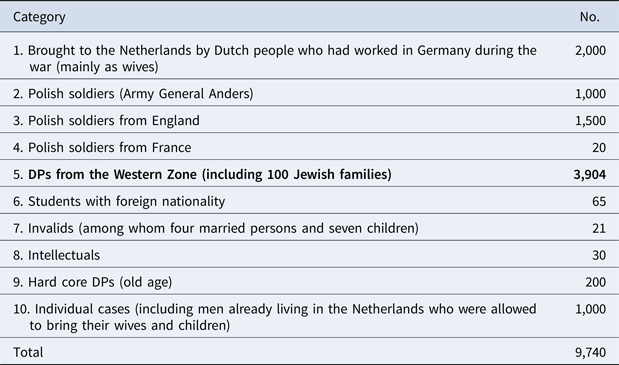
In 1951, the minister of justice presented parliament with an overview of the results of the DP resettlement scheme (Table 2). The total number was 10,000, the minister said, and that was not bad for a country that was economically damaged, overpopulated, had housing shortages, and financed emigration.Footnote 198 The minister manipulated the data he presented because he included groups other than the DPs. Only the 3,904 DPs in Table 2 were the people who were meant when the decision to invite 8,000 DPs was taken; all the others were not.
Overview of DPs and others settled in the Netherlands as presented to Parliament in 1951
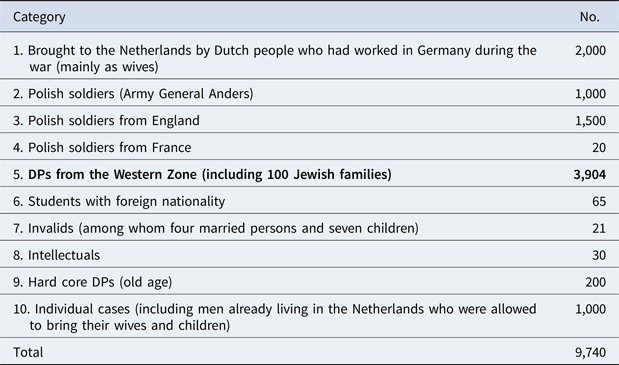
Source: PP Senate 1950, Annex A budget 1950–1951 (1900), iv, 9–16.
In this period, newspapers lost interest and hardly published any more about DP migration to the Netherlands. Employers first presented the recruitment as a success, but later emphasised costs and problems. Authorities claimed success, and tried to mask the low numbers by redefining the group.
12. Comparison
The IRO, in an attempt to find a solution for the ‘last million’ DPs in Europe, emphasised that DPs were excellent workers.Footnote 199 However, not everybody could pass themselves off as a worker. In 1959/1960, the World Refugee Year was organised to find a solution (among others) for the last 150,000 so-called ‘hard core’ DPs (the people who nobody wanted) in Europe, about 25,000 to 28,000 of whom were still in camps, as they had been for the last 15 years.
Of a total of 986,289 DPs, the Netherlands absorbed 3,904 (0.4 per cent), while Belgium received 36,906 DPs (3.7), France 38,000 (3.8), UK 82,000 (8.3), Canada 123,479 (12.5), Israel 132,000 (13.4), Australia 170,000 (17.2), and the US 400,000 (40.5).Footnote 200 Numbers are debatable since, as this article has showed, categories were redefined repeatedly but the figures do give an indication of the share per country.
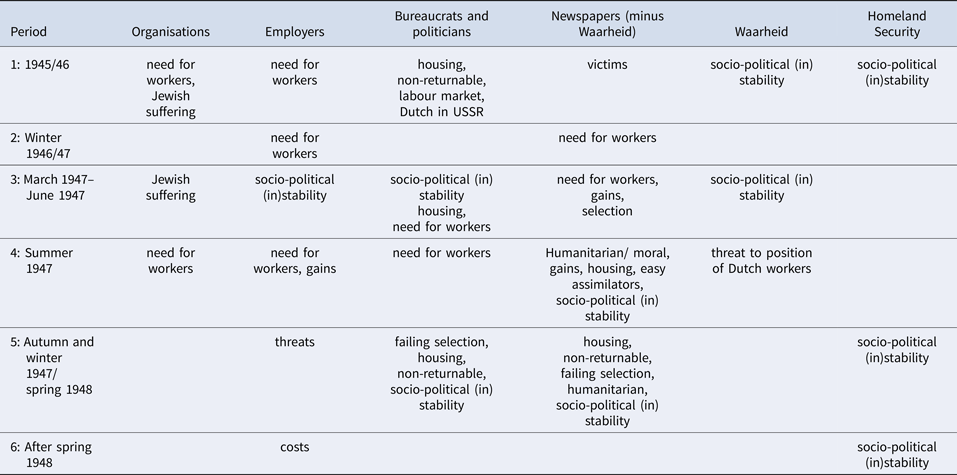
The Netherlands was willing to receive 8,000 DPs, but only 3,904 DPs came (49 per cent of the set target), and 25 per cent returned within two years to camp life in Germany. Other countries also did not meet their targets. Belgium wanted to recruit 32,000 workers, but only 21,906 came (68 per cent of the set target), and 8,000 returned (37 per cent). France wanted 300,000 to 400,000 DPs but only attracted 38,000 persons (9.5 to 12.7 per cent of the set target). The Netherlands differed from Belgium and France because numbers were much lower. The Netherlands, Belgium and France all needed miners, steel workers and textile workers. The DPs, however, proved not to be the workers employers could use. The framing of the DP issue changed within a short period (summarised in Table 3).
Overview of the arguments relating to the DP question used by various actors in each period

Source: See main text.
13. Conclusion
The Dutch DP case showed which actors and factors influenced changes in the discourse. Dutch authorities depended on Allied support for their economic recovery (and the US wanted west European countries to take more DPs). They depended on Soviet support for the return of the Dutch who were still in the Russian Zone and in the USSR (and the USSR favoured DP repatriation). The IRO and Dutch Jewish organisations hoped the Netherlands would take more DPs. The IRO had leverage because it had money and shipping capacity, which the Dutch needed for their large-scale emigration scheme. The IRO's influence is reflected in the arguments used in newspaper articles, but it is seldom acknowledged.
In the first period, organisations stressed Jewish suffering, but soon they dropped this argument since suffering proved not to be sufficient. Employers initially lobbied for permission to recruit DPs because they needed workers, but they stopped when they decided costs outweighed gains. Newspapers (with the exception of De Waarheid) used the need for workers as a strong argument during the cold winter of 1946/1947. Only in the first period did they stress victimhood. Initially all newspapers (except De Waarheid) echoed the gains arguments of the employers more than the government's fears. Employers thus seemed to be the allies of the organisations that were trying to find a solution for the DP problem. The interests of employers and organisations were, however, fundamentally different, and the alliance did not last. Authorities never favoured the recruitment of DPs, continuously raised objections against it, and pointed towards housing shortages, possible unemployment, and non-returnability of ‘unsuitables’. Civil servants said selection was inadequate, and they feared that the arrival of DPs would lead to social unrest. They were, rather surprisingly, copying arguments that were first used in the communist press, which the authorities monitored closely. Newspapers became supportive of the government's restrictive policy after employers had abandoned the idea of deploying DPs. The discourse of the various newspapers (again with the exception of De Waarheid) was rather similar, and papers were never strong supporters of DP rights. The Dutch Homeland Security Department feared socio-political instability, more or less in tandem with the instability De Waarheid predicted. Employers in the end copied this argument, while papers at that point had lost interest in the issue. Rapid changes in the discourse reflected the different stands and interests of claim makers. Eventually all actors moved towards the government restrictive standpoint.
According to the literature, the DP issue in general was solved by ‘selling’ DPs as workers. The analysis of the arguments used by all actors involved in the Dutch case (press, policymakers and politicians, employers, organisations and the Dutch Homeland Security Department), however, showed that the strategy was not as simple as the literature suggests. The argument of ‘selling’ the DPs as workers, which was pushed by the IRO, did not work for the Netherlands, and it may also have been less relevant for other countries than was earlier suggested. The US took 40 per cent of the DPs because it feared destabilisation in Europe, and threatened to withhold Marshall Aid from non-complying European countries. That may well have been the most important factor in explaining the solution to the DP issue. Very strong humanitarian claims could have been made on behalf of the Jewish DPs, but in none of the countries discussed was this claim successful. Frame analysis is an approach that shows strategic shifts from one frame to another. The one that sticks need not be the one that made a difference.