Introduction
Caribou are embedded in northern life and culture, especially for the Indigenous peoples of the tundra and taiga regions (Anderson & Nuttall, Reference Anderson and Nuttall2004; Hummel & Ray, Reference Hummel and Ray2008; Nirlungayuk, Reference Nirlungayuk2012; Pokiak, Reference Pokiak2012; Sangris, Reference Sangris2012; Thorpe, Eyegetok, Hakongak, & Qitirmiut Elders, Reference Thorpe, Eyegetok and Hakongak2001b; Zoe, Reference Zoe2012). Caribou were once an essential component of survival for life on the land, and today they remain an important part of seasonal cycles, hunting culture, diet and health that extends far beyond physical consumption and material culture. Caribou are part of the interconnected web of relationships between people, land and all living beings, as reflected in diverse Indigenous cosmologies, oral histories and values (Bayha, Reference Bayha2012; Beaulieu, Reference Beaulieu2012; Bennett & Rowley, Reference Bennett and Rowley2004; Polfus et al., Reference Polfus, Simmons, Neyelle, Bayha, Andrew, Andrew and Manseau2017; Sangris, Reference Tavalok2012; Thorpe, Reference Wenzel2004; Thorpe et al., Reference Sangris2001b; Zoe, Reference Zoe2012). Hunting caribou is an enactment of cultural identity and self-determination, and occurs according to diverse cultural practices across northern homelands.
Inuit are the Indigenous peoples of Arctic regions, and in Canada Inuit Nunangat (Inuit homelands) are represented today by the four land claim regions of the Inuvialuit Settlement Region (Northwest Territories), Nunavut, Nunavik (Northern Québec) and Nunatsiavut (Northern Labrador) (Inuit Tapiriit Kanatami, 2018). In Inuktut (the Inuit language), caribou are called tuktuit (plural of tuktu), and they have been an important part of seasonal rounds and material culture of Inuit families for generations (Bennett & Rowley, Reference Bennett and Rowley2004; Freeman, Reference Brice-Bennett and Freeman1976). Indeed, tuktuit remain the country food that is consumed in greatest prevalence and quantity across Inuit Nunangat today (Kenny & Chan, Reference Kenny and Chan2017). Country foods are generally defined as traditional foods including wild game or plants, obtained through hunting, fishing or harvesting, and their value goes beyond economic, nutritional and physical health benefits; they are part of maintaining Inuit cultural continuity, identity and well-being (Donaldson et al., Reference Donaldson, Van Oostdam, Tikhonov, Feeley, Armstrong, Ayotte and Shearer2010). As such, tuktuit are also highly interconnected with Inuit values, beliefs and practices, which are passed on through language, land-based learning, and inter-generational knowledge sharing (Bennett & Rowley, Reference Bennett and Rowley2004; Government of Nunavut, 2011; Kendrick & Manseau, Reference Kendrick and Manseau2008; Mearns, Reference Mearns2017; Thorpe, Reference Thorpe1998; Thorpe, Eyegetok, Hakongak, & Qitirmiut Elders, Reference Thorpe, Eyegetok and Hakongak2001a). Through oral histories, hunting culture, careful observation and personal experience, Inuit gain deep knowledge of and connections with tuktuit. This includes understanding of habitat, health and movements of tuktuit, as well as cultural values and skills that are grounded in notions of respect, sharing and relationships (Bennett & Rowley, Reference Bennett and Rowley2004; Ferguson & Messier, Reference Ferguson and Messier1997; Ferguson, Williamson, & Messier, Reference Ferguson, Williamson and Messier1998; Kendrick & Manseau, Reference Kendrick and Manseau2008; Thorpe et al., Reference Thorpe, Eyegetok and Hakongak2001a; Tomaselli, Kutz, Gerlach, & Checkley, Reference Tomaselli, Kutz, Gerlach and Checkley2018). Given the importance of tuktuit to Inuit, involvement of Inuit and considerations of Inuit knowledge are paramount in undertaking any research or wildlife management initiatives in Inuit Nunangat.
Within both research and wildlife management contexts, the depth and value of Indigenous knowledge is increasingly recognised as foundational to a holistic and contextual understanding of social–ecological systems (Adams et al., Reference Adams, Carpenter, Housty, Neasloss, Paquet, Walkus and Darimont2014; Bayha, Reference Bayha2012; Polfus et al., Reference Polfus, Manseau, Simmons, Neyelle, Bayha, Andrew and Wilson2016; Sangris, Reference Sangris2012; Thorpe, Reference Thorpe, Anderson and Nuttall2004; McGregor, Bayha, & Simmons, Reference McGregor, Bayha and Simmons2010). As a knowledge–practice–belief complex (Berkes, Reference Berkes2012), Indigenous ways of knowing and being are inter-generational, ever-evolving, and grounded in experience gained over time in particular places through reciprocal relationships with people, the land/water/ice, and all living beings. In an Inuit context, Natasha Thorpe’s work with Qitirmiut (Kitikmeot Region of Nunavut) Elders provides a valuable description of all that is encompassed within Inuit knowledge:
“Inuit Qaujimajatuqangit (IQ) is “what has always been known” or, in other words, Inuit knowledge, insights, and wisdom that is gained through experience, shared through stories, and passed from one generation to the next. More than just knowledge…IQ includes a finely tuned awareness of the forever changing relationship between Inuit and nuna, hila, wildlife, and the spiritual world…IQ is local in scale, changing, aggregating, iterative, adaptive, based on oral traditional, intergenerational, complex, and spiritual.”
(Thorpe et al., Reference Thorpe, Eyegetok and Hakongak2001a, p. 24)The current prevalence of the IQ expression has its modern roots in both the rise of Indigenous knowledge in contemporary research and governance broadly (e.g. traditional knowledge, traditional ecological knowledge, Indigenous knowledge, among other terminology), and more specifically with the establishment of the Government of Nunavut (GN) as a result of the Nunavut land claims process (McGrath, Reference McGrath2003; Tester & Irniq, Reference Tester and Irniq2008; Wenzel, Reference Wenzel2004). IQ is the Inuktitut translation of “Inuit traditional knowledge”, and became formalised in GN institutional language as a way to ensure that Inuit culture and values would guide the GN in all aspects of government policy and operations (Government of Nunavut, 2013; Tester & Irniq, Reference Tester and Irniq2008; Wenzel, Reference Wenzel2004). Scholars have further suggested that IQ and its “moral philosophy” of relationality is meant to question dominant scientific and economic rationalities (Tester & Irniq, Reference Tester and Irniq2008, p. 49; Wenzel, Reference Wenzel2004). Whatever term is used, challenges remain in defining and conveying the depth and distinctiveness of Indigenous knowledge (Berkes, Reference Berkes2012; Collignon, Reference Collignon2006; McGrath, Reference McGrath2003; Tester & Irniq, Reference Tester and Irniq2008; Usher, Reference Usher2000; Wenzel, Reference Wenzel2004). When referring to “Inuit knowledge” in this paper we draw upon Thorpe et al. (Reference Thorpe, Eyegetok and Hakongak2001a), while acknowledging that there are several other helpful definitions in different contexts.
Through the negotiation of land claims and development of research ethics, it is now an established legal and ethical responsibility to work with Inuit knowledge holders, community members and Inuit organisations in recognition of Inuit rights, and respectful and relevant research (Inuit Tapiriit Kanatami & Nunavut Research Institute, 2007; Inuit Tapiriit Kanatami, 2018). This includes important considerations around appropriate ways of documenting, representing and sharing Inuit knowledge, and ensuring that research is addressing Inuit needs and priorities. Working closely with community members is especially critical when undertaking research on sensitive issues, such as wildlife management, that may influence policy- and decision-making that impacts peoples’ lives. In the realm of wildlife management, it is important to recognise that colonial legacies of research and management practices are particularly entangled.
Scientific research has broadly relied on Inuit knowledge and experience, but with historically little acknowledgement, benefit or compensation for local contributions, and poor reporting and lack of communications with the communities involved (Gearheard & Shirley, Reference Gearheard and Shirley2007; Inuit Tapiriit Kanatami & Nunavut Research Institute, 2007; Inuit Tapiriit Kanatami, 2018). In relation to caribou, management decisions have long been based on available scientific knowledge, even when this knowledge was scarce and decisions were being made far from northern homelands (Campbell, Reference Campbell, Anderson and Nuttall2004; Kulchyski & Tester, Reference Kulchyski and Tester2007; Tester & Irniq, Reference Tester and Irniq2008; Usher, Reference Usher, Anderson and Nuttall2004). Early government interventions in wildlife management ignored Inuit knowledge and instead sought to “educate” Inuit on sustainable harvesting practices out of problematic assumptions about wastage and “wanton slaughter”, and associated concerns for caribou decline stemming from early scientific surveys (Campbell, Reference Campbell, Anderson and Nuttall2004; Kulchyski & Tester, Reference Kulchyski and Tester2007; Tester & Irniq, Reference Tester and Irniq2008; Usher, Reference Usher, Anderson and Nuttall2004). Indeed, some of the earliest government relocation programmes were in response to concerns for starvation cases in inland Inuit societies in the late 1950s, and some of the earliest imposition of government management and regulation of wildlife in the Arctic were in relation to (often unfounded) concerns for declining caribou herds (Campbell, Reference Campbell, Anderson and Nuttall2004; Damas, Reference Damas2002; Kulchyski & Tester, Reference Kulchyski and Tester2007; Tester & Irniq, Reference Tester and Irniq2008; Tester & Kulchyski, Reference Tester and Kulchyski1994; Usher, Reference Usher, Anderson and Nuttall2004). These, amongst other colonial policies and interventions (e.g. residential schools, social support programmes, economic development policy) have thus contributed to devastating inter-generational legacies for many Inuit families.
Through the settlement of the Nunavut Agreement, and the establishment of co-management boards, it is now mandated that Inuit knowledge be considered equally alongside science in decision-making, and that Inuit societal values guide northern governance (Government of Canada & Tunngavik Federation of Nunavut, 1993; Government of Nunavut, 2011, 2013). Fulfilling this mandate is both critical and challenging given the history of paternalism and privileging of science and public policy centred on economic efficiency (Tester & Irniq, Reference Tester and Irniq2008), and understandably provokes much concern and skepticism from Inuit regarding research or government wildlife management practices (Inuit Tapiriit Kanatami & Nunavut Research Institute, 2007; Inuit Tapiriit Kanatami, 2018). As Inuit rights are recognised, government and researcher attitudes have begun to shift along with a growing awareness of the value of Inuit knowledge and collaborative approaches. And yet even with government calls for Inuit knowledge research, community consultations and engagement in wildlife decision-making, there remains uncertainty around how to best support or implement such efforts (Kendrick & Manseau, Reference Kendrick and Manseau2008; Tester & Irniq, Reference Tester and Irniq2008; Thorpe, Reference Thorpe, Anderson and Nuttall2004).
In Uqsuqtuuq (Gjoa Haven, Nunavut), community members have articulated a number of such concerns in relation to (1) past research practices, especially around wildlife research and invasive sampling; (2) the effect of changing lifestyles on connections with caribou, which impacts diet, health, identity, cultural values and skills, and intergenerational knowledge transmission; (3) physical and mental well-being of community members; and (4) potential future imposition of hunting quotas (Laidler & Grimwood, Reference Laidler and Grimwood2010). Accompanying these concerns were many expressions of frustration around feeling ignored by the government and researchers, and feeling that few positive changes seem to result from participation in research (Laidler & Grimwood, Reference Laidler and Grimwood2010). Nevertheless, these concerns provided the rationale for our project, because from initial open-ended discussions in Uqsuqtuuq grew a local desire to develop more community-driven, collaborative research projects that could begin to change the perceived reliance on outside expertise (Laidler & Grimwood, Reference Laidler and Grimwood2010). By working together, it was felt that community voices could be heard more clearly.
Our collaborative project was conceived to address several community-identified priorities around tuktuit, related to their importance in community diet, health, relationships, cultural skills and values, inter-generational knowledge sharing, and general well-being (Laidler & Grimwood, Reference Laidler and Grimwood2010; Ljubicic, Robertson, Mearns, & Okpakok, Reference Ljubicic, Robertson, Mearns and Okpakok2016). One of these priorities was to document Inuit knowledge of tuktuit in an effort to have the knowledge of Uqsuqtuurmiut (people of Uqsuqtuuq) more available for local youth (i.e. to have written materials that could be used in schools) and for researchers and government managers (i.e. to be taken more seriously in making decisions about tuktuit in the region). We have developed this paper to reach the latter audience. Here we provide a synthesis of Uqsuqtuurmiut knowledge with the aim of articulating which types of tuktuit are found on or near Qikiqtaq (King William Island), providing a historical perspective of tuktuit presence/absence on the island, and describing seasonal movements of tuktuit on and off the island. In so doing, we highlight the ways in which Uqsuqtuurmiut think about, speak about, and engage with tuktuit around Qikiqtaq, with particular emphasis on local language, geographical context, and seasonality. We also highlight the potential intersections of our work with Government of Nunavut (2011) efforts to “work together for caribou”, particularly in relation to the objectives of Qanuqtuurniq (information and knowledge acquisition). In this way, we hope that sharing lessons from our collaborative process may also help to inform broader cross-cultural research and co-management efforts in Nunavut.
Methodology
Community context
Uqsuqtuuq means a place of “a lot of fat” in Inuktitut, referring to a nearby lake of the same name (Swan Lake in English) on the southeastern shores of Qikiqtaq (King William Island) that was known for its fatty fish. However, the Hamlet of Gjoa Haven was named after The Gjøa, the ship of the Norwegian explorer Roald Amundsen. He and his crew overwintered in the sheltered bay in 1903–1904 (Brice-Bennett, Reference Brice-Bennett and Freeman1976; Hamlet of Gjoa Haven, 2011), thus Amundsen considered it a “havn” (harbour in Norwegian) for The Gjøa (Hamlet of Gjoa Haven, 2011; Kitikmeot Inuit Association, no date). A Hudson Bay Company trading post was established in Gjoa Haven in 1927, and between the 1950s and the 1970s most families moved into the Hamlet in order to receive government support services (Brice-Bennett, Reference Brice-Bennett and Freeman1976). Today with a population of more than 1279 people (Statistics Canada, 2012), Uqsuqtuuq is home to a diversity of families originally from different traditional homelands, including Nattiligmiut, Iluilirmiut, Utkuhigsaligmiut, Ahiarmiut, Haningarurmiut, Kiluhigturmiut and Ki’linirmiut (Workshop, 2016b; see Ljubicic, Okpakok, Robertson, & Mearns (Reference Ljubicic, Okpakok, Robertson and Mearns2018) for more context on these traditional societies). Accordingly, a number of dialects of Inuktitut and some Inuinnaqtun are spoken in the community today. The community also houses several departments of the decentralised Government of Nunavut, along with the Nunavut Water Board, the Gjoa Haven Continuing Care Centre, and the Nattilik Heritage Centre. Schools in town include the Qiqirtaq High School, Quqshuun Elementary School, and a small campus of the Nunavut Arctic College.
Collaborative process
Our approach to research is guided by principles of community-based participatory research (CBPR), and Indigenous research methodologies (IRMs). We strive to fulfill the “the three R’s” of IRMs through recognition and enactment of respect, reciprocity and relationality (Castleden, Morgan, & Lamb, Reference Castleden, Morgan and Lamb2012; Louis, Reference Louis2007; Wilson, Reference Wilson2008), by engaging in a community–research partnership that spans all phases of a research project, and maintaining accountability beyond funding timelines (Adams et al., Reference Adams, Carpenter, Housty, Neasloss, Paquet, Walkus and Darimont2014; Castleden et al., Reference Castleden, Morgan and Lamb2012; Tondu et al., Reference Tondu, Balasubramaniam, Chavarie, Gantner, Knopp, Provencher and Simmons2014). We do so by (1) accepting and advocating Indigenous knowledge systems; (2) positioning Indigenous communities as collaborators and partners in research; (3) following the research agenda determined by Indigenous community collaborators; and (4) reciprocal sharing of knowledge (Louis, Reference Louis2007). Our commitment to this approach is based on efforts to address the colonial legacy of research, and to respond to the many northern community concerns expressed around how research has typically been conducted (Castleden et al., Reference Castleden, Morgan and Lamb2012; Collignon, Reference Collignon2006; Gearheard & Shirley, Reference Gearheard and Shirley2007; Healey & Tagak, Reference Healey and Tagak2014; Inuit Tapiriit Kanatami & Nunavut Research Institute, 2007; Inuit Tapiriit Kanatami, 2018; McGregor et al., Reference McGregor, Bayha and Simmons2010; Tondu et al., Reference Tondu, Balasubramaniam, Chavarie, Gantner, Knopp, Provencher and Simmons2014). We draw inspiration from the piliriqatigiinniq model developed by Healey and Tagak (Reference Healey and Tagak2014) of “working together for the common good” (p. 1). More specifically, however, we developed our collaborative approach according to the conceptual framework of the Qaggiq Model for Inuktitut knowledge renewal developed by Janet Tamalik McGrath and Aupilaarjuk, a respected Inuk Elder and philosopher from Rankin Inlet, Nunavut. A qaggiq is a large iglu (traditional snow house) that was typically built on several smaller/older ilguit (plural of iglu) to make a large gathering place (McGrath, Reference McGrath2011). McGrath and Aupilaarjuk use the qaggiq as a metaphor for knowledge renewal, including between generations of Inuit and for researchers to understand and improve their accountability and appropriate relationships with Inuit and Inuit knowledge systems (McGrath, Reference McGrath2011). In particular, the model serves to connect Aupilaarjuk’s triad of personhood (individual), peoplehood (collective) and livelihood (productive) with elements of the Indigenous Peoplehood Matrix in the Inuit context of unipkaat (living histories), nuna (land), uqausiq (language) and iliqqusiq (culture) (McGrath, Reference McGrath2011). While these broader principles and frameworks guide our approach through all phases of the collaborative research process, our work takes place within the particular cultural and geographical context of Uqsuqtuuq and has been directed by community-specific principles and priorities from the outset.
A detailed overview of the community engagement process in our early planning meetings of February 2010 is provided in Laidler & Grimwood (Reference Laidler and Grimwood2010). These initial discussions were on invitation from Uqsuqtuuq Elder Bob Konana and facilitated by joint planning and funding applications developed by Gita Ljubicic and Walter Porter (the Community Liaison Officer of the Kitikmeot Inuit Association (KIA) at the time). The workshop led to six guiding principles meant to shape the joint research process:
1. Working together throughout all stages of research, with mutual respect and effort
2. Ensuring local benefits and involvement that value and rely on Inuit knowledge
3. Jointly seeking funding and investing locally to address community research and training priorities
4. Developing appropriate wildlife monitoring techniques that respect Inuit relationships with animals
5. Engaging Elders and youth in research in support of mentoring and training opportunities
6. Sharing results at all stages, and especially reporting those that can contribute to community or government decision-making (Laidler & Grimwood, Reference Laidler and Grimwood2010)
Tuktuit figured prominently in the three days of discussion, and six interconnected research priorities were identified: tuktuit health, tuktuit food (vegetation), Inuit health and diet, cultural values and skills, changing lifestyles, and Elder and youth land camps (Laidler & Grimwood, Reference Laidler and Grimwood2010). To follow up on these locally identified priorities, Ljubicic worked closely with Porter, Simon Okpakok (who had helped to interpret and facilitate the workshop), and Julia Ogina (of KIA in Cambridge Bay) to secure funding for a multi-year project called “Connecting Inuit Elders and Youth: Learning about caribou, community, and well-being in Gjoa Haven, Nunavut”. Following the guiding principles identified in planning meetings, Ljubicic and Okpakok worked together from 2011 to 2016 to jointly coordinate all aspects of the project. Rebecca Mearns joined the team when she began her MA research in 2011. Sean Robertson joined the team as a postdoctoral researcher in 2012. Both subsequently moved into new positions, and continued to be involved with the project. As a cross-cultural team (Okpakok and Mearns being Nunavummiut from Uqsuqtuuq and Panniqtuuq (Pangnirtung), respectively, and Ljubicic and Robertson being Qallunaat (non-Inuit) from southern Canada), we have all played different roles in the research process. Accordingly, we have each taken the lead on different components of the research to address the diverse community priorities identified in 2010. We also received guidance from a local land camp planning committee, which acted as a general project advisory committee as well (Ljubicic et al., Reference Ljubicic, Robertson, Mearns and Okpakok2016). We had tremendous support from the KIA throughout the project, as well as from a number of community organisations (see Acknowledgements).
Ljubicic, Mearns and Robertson travelled in various combinations to Uqsuqtuuq, and spent time working in the community with Okpakok over August 2011, July–August 2012, July–August 2013, February 2016 and September 2017. During these visits we facilitated three Elder–youth land camps (including pre- and post-camp workshops for each), 39 interviews (including participatory mapping), and five verification workshops. Between each visit we developed and mailed trip summary reports to each contributor and supporting organisation that we had engaged with, and in February 2017 a community report (Ljubicic et al., Reference Ljubicic, Robertson, Mearns and Okpakok2016) was mailed to everyone involved over the five-year project. As we all live in different parts of Canada, we continued to be in regular phone and email contact between visits as part of iterative planning and verification efforts, including in the process of drafting this paper. Although we used multiple methods in our collaborative process, below we focus on describing only those that contributed most directly to the articulations of Uqsuqtuurmiut knowledge of tuktuit on and near Qikiqtaq that we present in this paper.
Semi-directed interviews
Interviews were facilitated during the summers of 2012 and 2013 in order to have in-depth discussions and learn about individual experiences with and knowledge of tuktuit in the region (Bennett, Reference Bennett and Shurmer-Smith2002; Huntington, Reference Huntington1998; Wenzel, Reference Wenzel1999). The majority of Uqsuqtuurmiut contributors preferred to be interviewed in Inuktitut, and Robertson and Mearns facilitated the discussions, with Okpakok translating and also helping to facilitate. Leonie Aaluk helped with translation at times when Okpakok was unavailable, and Robertson also conducted some English interviews alone. Okpakok and Porter recommended Elders and hunters who were knowledgeable about tuktuit, while others were involved based on their role with the Gjoa Haven Hunters and Trappers Association (HTA) or the land camps associated with this project. In total, 39 semi-directed interviews were conducted with 27 men and 12 women ranging in age from their early twenties to early eighties. Interviews were conducted in the Qaggivik Building (local Elders’ Centre), the Hamlet Council Chamber or offices, or at peoples’ homes or workplaces, as requested. Interviews ranged from 30 minutes to 2.5 hours in duration, with the majority averaging around 90 minutes. Interviews covered many topics related to broad project objectives, but Uqsuqtuurmiut contributions shared in this paper are based on interpretations of discussions around names and types of tuktuit; timeframes and movements of tuktuit on Qikiqtaq; seasonal rounds of tuktuit; important hunting areas; and changes over time. Interviews are cited throughout this paper to highlight individual contributions to the collective interpretations presented.
Participatory mapping
Participatory mapping was incorporated into interviews and workshops throughout the project, as there is a strong spatial dimension to Inuit knowledge (Aporta, Reference Aporta2009; Collignon, Reference Collignon2006; Laidler & Elee, Reference Laidler and Elee2008). Maps also stimulated discussion during interviews. As Elders and hunters reviewed the map provided, they would begin visualizing particular places as if they were on the land, which would spark memories and stories of particular experiences. Therefore, maps can be effective communication tools during interactive sessions, as well as a visual medium for synthesising diverse observations (Fox, Reference Fox, Krupnik and Jolly2002; Huntington, Reference Huntington1998; Kendrick & Manseau, Reference Kendrick and Manseau2008). Nevertheless, we echo the cautions expressed by Kendrick and Manseau (Reference Kendrick and Manseau2008) and emphasise that maps alone cannot convey the depth and nuance of the knowledge shared.
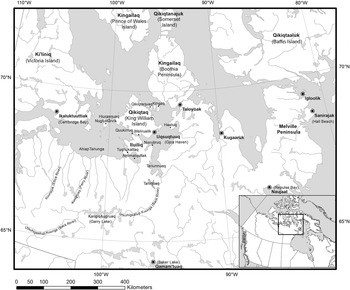
Maps used during interviews consisted of a standard basemap created from a compilation of 1:250,000 National Topographic System (NTS) map sheets from map numbers 56, 57, 66, 67, 76 and 77. This was a customised region of interest determined in planning discussions, and based on the general extent of caribou hunting around Gjoa Haven, to account for the diversity of traditional homelands (Fig. 1). A clear plastic mylar overlay was provided for each person interviewed, although only 32 people chose to use the map during their interviews. The spatial features drawn on the mylar were digitised by scanning individual sheets using a large-format scanner to create a digital image file. Using ArcGIS these were overlain on an electronic Nunavut basemap created using vector files from GeoGratis (Fig. 1). Each of the interview maps were georeferenced to the digital basemaps, and all features drawn were then digitised to create points, lines and polygons representing diverse facets of caribou knowledge or use, as well as other land/ocean/ice uses and important places that may have been indicated.
Regional map showing Uqsuqtuuq (Gjoa Haven, Nunavut) on Qikiqtaq (King William Island), and key place names referred to in the text. Source of basemap for this and other map figures: GeoGratis (North American Atlas - Vector); Coordinate System: GCS_North_American_1983; Datum: North American 1983; Projection: Canada Lambert Conformal Conic. Important places and names as indicated by Uqsuqtuurmiut and mapped according to inuitplaces.org.

Workshops
Workshops have been highlighted as an effective means of research planning, results verification, reporting, and facilitating cross-cultural knowledge exchanges (Huntington et al., Reference Huntington, Brown-Schwalenberg, Frost, Fernandez-Giminez, Norton and Rosenberg2002; Laidler et al., Reference Laidler, Hirose, Kapfer, Ikummaq, Joamie and Elee2011; Nickels, Furgal, Buell, & Moquin, Reference Nickels, Furgal, Buell and Moquin2006). As noted earlier, we used a workshop format to define priorities and initiate our collaborative research process. We also used workshops to validate and refine our interpretations of the knowledge shared by Uqsuqtuurmiut prior to finalising reports and publications.
During the summer of 2013, four map verification workshops were held with ten individuals interviewed in 2012, in order to clarify questions that had come up in the digitising process (i.e. due to lack of clarity of labels or features drawn). All edits made to the original maps were digitised using the same process described above, and features already in the GIS were edited accordingly. Any features about which we remain unsure have not been included in these final compilations, as we are cautious about any potential misunderstanding or misrepresentation until we can get firm confirmation from the individuals involved.
An additional verification workshop was held in February 2016 when Ljubicic, Mearns and Robertson could all join Okpakok again in Uqsuqtuuq. Okpakok organised the meeting by inviting five Elders who had been consistent advisors throughout the project to engage in three days of discussion. This workshop was dedicated to sharing preliminary interpretations, getting feedback on all aspects of the project methodology, and refining our representations of Uqsuqtuurmiut knowledge of tuktuit. We had additional meetings with individual contributors during this time for transcript, quote and map verifications, as needed. We also hosted a community gathering to share preliminary interpretations and maps more broadly, and as a celebration and expression of thanks to all who supported this project over the years. Workshops are cited throughout this paper, to highlight group contributions to the collective interpretations presented.
Inuktitut terminology
Throughout this paper we use Inuktitut terminology and place names wherever possible, to reflect the importance of Inuktitut language emphasised by Uqsuqtuurmiut contributors. Spellings are according to Okpakok’s Utkuhigsaligmiut dialect, and may vary according to other dialects present in Uqsuqtuuq, although the terminology is mutually understood. There are some additional important clarifications on terminology to note at the outset.
In this paper, we use Uqsuqtuurmiut knowledge as a collective reference to the knowledge shared by contributors for two main reasons. First, during interviews it became clear that many contributors did not identify with Inuit Qaujimajatuqangit (IQ) terminology as formalised in GN language; it was considered a word used in reference to Inuit culture but not something that is being practised (Aglukkaq, Reference Aglukkaq2012c; Eleehetook, Reference Eleehetook2013; Hiqiniq, Reference Hiqiniq2012; Nimiqtaqtuq, Reference Nimiqtaqtuq2012; Okpakok, Reference Okpakok2012; Porter, Reference Porter2012; Tavalok, Reference Tavalok2012; Workshop, 2016a). For some Uqsuqtuurmiut, IQ is considered to be the knowledge of their ancestors, which has been passed down over generations (Aglukkaq, Reference Aglukkaq2012a; Kamamalik, Reference Kamamalik2013; Konana, Reference Konana2012; Sallerina, Reference Sallerina2012; Tavalok, Reference Tavalok2012). GN efforts to incorporate IQ into education and all aspects of governance are seen as valuable (Aglukkaq, Reference Aglukkaq2012c; Sallerina, Reference Sallerina2012; Workshop, 2016a). However, IQ was also considered to be a concept coming from elsewhere (i.e. another dialect or government language), it was not terminology used in daily life in Uqsqutuuq; IQ as laid out by the government was seen to be limited by the eight principles and to be referring to the way of life of their ancestors (i.e. in the past) (Aglukkaq, Reference Aglukkaq2012c; Akkikungnaq, Reference Akkikungnaq2013; Arqviq, Reference Arqviq2012; Atkichok, Reference Atkichok2013; Eleehetook, Reference Eleehetook2012, Reference Eleehetook2013; Hiqiniq, Reference Hiqiniq2012; Kamamalik, Reference Kamamalik2013; Porter, Reference Porter2012; Qitsualik, Reference Qitsualik2013; Tavalok, Reference Tavalok2012; Workshop, 2016a). When discussing IQ terminology in Workshop (2016a), Inuit Qaujimaningit was identified as more meaningful terminology, relating to more contemporary and evolving practices of Inuit cultural values. Indeed, this was how Okpakok had been translating “Inuit knowledge” in our various project documents. However, this alternative terminology was not articulated in earlier interviews, and therefore we feel that Uqsuqtuurmiut knowledge is appropriate for referencing the diversity of community contributions in our project. The second reason builds on this, in that we want to be clear that knowledge shared in this paper is based on experiences from Uqsuqtuuq, and people’s travels in surrounding areas. Therefore, by not using “Inuit knowledge” we emphasise that Uqsuqtuurmiut knowledge is specific to the cultural and regional context in which it was acquired, and cannot be extended or generalised to represent knowledge from other Kitikmeot or Nunavut communities. However, we use “Inuit knowledge” at times when writing more generally, and IQ when referencing GN policy or other publications that use this terminology.
We include Inuktitut place names commonly referenced by Uqsuqtuurmiut throughout the text, and on maps, although we include some English names as well to help readers orient themselves. English place names are also used when referring to literature where these names are used. It is important to note that Qikiqtaq is a general term meaning “island” in Inuktitut, and thus there are many islands with this name across Nunavut and other regions of Inuit Nunangat. However, in the context of Uqsuqtuuq this is a specific reference to the island known in English as King William Island, and so all references to Qikiqtaq in this paper relate to King William Island, unless described otherwise.
Interview quotes included in the paper maintain the English used by the interpreter, as we relied on the interpreter to facilitate cross-cultural communication. We have not adjusted tuktuit names or place names in quotes to be in Inuktitut, because we acknowledge and respect the choices made by the interpreter during interviews. However, it was in reviewing translations that Okpakok and Mearns began to notice patterns, and through iterative discussions amongst ourselves we were able to get into the nuances around different names for tuktuit, related terminology and important places. Therefore, it was this process of translation that enabled us all to better understand each other, to more effectively incorporate Inuktitut into this paper, and to consider the implications of translation for communications in broader research or management contexts.
Uqsuqtuurmiut knowledge of tuktuit on and near Qikiqtaq
To facilitate cross-cultural understanding, it was important to learn about different kinds of tuktuit on and near Qikiqtaq. However, the first response of Uqsuqtuurmiut to such questions was that Inuit generally do not distinguish tuktuit as different herds, they are all tuktuit (Akkikungnaq, Reference Akkikungnaq2013; Eleehetook, Reference Eleehetook2013; Putuguq, Reference Sallerina2013; Qitsualik, Reference Qitsualik2013; Workshop, 2013a, b; 2016a). Later, in interviews and workshops discussing more specific experiences of hunting, travel or observations of tuktuit migration, additional descriptors would often be used to relate to places where tuktuit were seen or where they were moving to/from, physical characteristics, and/or age/gender/body condition (Ljubicic et al., Reference Ljubicic, Okpakok, Robertson and Mearns2018). Most notably, tuktuit are primarily distinguished in a collective sense as being (1) from the mainland; (2) from the northern islands; (3) reindeer; or (4) a type of cross-breed.
Iluiliq is a local dialectical reference to “inland” or “mainland” (most commonly referring to Adelaide Peninsula), thus iluiliup tuktuit refers to tuktuit that come from the mainland (Aqslaluk, Reference Aqslaluk2013; Putuguq, Reference Sallerina2013; Sallerina, Reference Sallerina2012; Workshop, 2013b, 2016a). Kingailaq means a “place with no mountains” (Aqslaluk, Reference Aqslaluk2013; Sallerina, Reference Sallerina2012; Workshop, 2013a,b, 2016a), and kingailaup tuktuit refers to caribou coming from the islands north of Qikiqtaq (Aglukkaq, Reference Aglukkaq2012a; Akkikungnaq, Reference Akkikungnaq2013; Aqslaluk, Reference Aqslaluk2013; Putuguq, Reference Sallerina2013; Sallerina, Reference Sallerina2012; Workshop, 2013b, 2016a). Kingailaq was always translated as a specific reference to the island known as Prince of Wales Island in English, although Kingailaq is also the Inuktitut name for Boothia Peninsula (Fig. 1). Iluiliup tuktuit are most commonly translated into English as barren-ground caribou (Rangifer tarandus groenlandicus), whereas kingailaup tuktuit are most commonly translated into English as Peary caribou (Rangifer tarandus pearyi). Uqsuqtuurmiut distinguish these two mainly based on body size and hair colour, with kingailaup tuktuit being smaller and whiter (Ljubicic et al., Reference Ljubicic, Okpakok, Robertson and Mearns2018). Qungniit is the Inuktitut reference to reindeer, and these were described by Kogvik and Siksik in Workshop (2016a) and also referenced by Tavalok (Reference Tavalok2012) as “Alaskan caribou”. Qungniit are distinguished from other tuktuit based on their physical characteristics as well as their movements coming from the Tuktoyaktuk (Northwest Territories) area, and are generally only seen along the northern mainland when they have escaped from herding operations around Tuktoyaktuk (Workshop, 2016a). Some mentions were also made of a potential mixture of iluiliup tuktuit and kingailaup tuktuit (Ljubicic et al., Reference Ljubicic, Okpakok, Robertson and Mearns2018).
We go into greater depth on these community-specific ways of distinguishing tuktuit in Ljubicic et al. (Reference Ljubicic, Okpakok, Robertson and Mearns2018), and argue that understanding these nuances has profound implications for translation and effective communication in management contexts. Herd-specific references used by biologists and co-management boards (e.g. Bathurst, Beverly, Ahiak, Wager, etc.) are not reflected in Uqsuqtuurmiut references to tuktuit, and are mainly used when English translations are required (Ljubicic et al., Reference Ljubicic, Okpakok, Robertson and Mearns2018). However, distinctions between herds and sub-species in biological terms, or geographical and dialectical references in Inuktitut, may or may not effectively translate between languages, depending on the experience of the interpreter and the contextual familiarity of all involved. Therefore, care must be taken when talking about tuktuit in order to understand local terminology so as to minimise any potential misunderstandings.
Timeframes of tuktuit on Qikiqtaq
From personal experience as well as stories passed on from their grandparents, Uqsuqtuurmiut consistently described living through times of tuktuit shortage, to now having tuktuit on Qikiqtaq year-round. Generally these discussions centred around a few key time periods, including before guns, during Elders’ childhood, settlement in Uqsuqtuuq, and the relatively recent return of tuktuit (Fig. 2).
Uqsuqtuurmiut knowledge of long-term presence/absence of tuktuit on Qikiqtaq.

Before guns
Elders in Uqsuqtuuq relayed stories from their own Elders about the time before firearms were introduced, as being a time when there were plenty of tuktuit on Qikiqtaq (Akkikungnaq, Reference Akkikungnaq2013; Eleehetook, Reference Eleehetook2012; Sallerina, Reference Sallerina2012; Siksik, Reference Siksik2012; Workshop, 2016a). This was generally referenced as “before being born” (Aqslaluk, Reference Aqslaluk2013; Atkichok, Reference Atkichok2012; Tavalok, Reference Tavalok2012), roughly approximated to being prior to the 1930s (Fig. 2). Bob Konana shares his version in the following interview excerpt:
“Long ago before they had guns there used to be lots of caribous on King William Island…A ship came into Malirualik and the people that were living there, they started getting guns from the people that came in with the ship and then they start hunting with guns. From there the caribous finish, they finished the caribou on the island…[A] long time [ago]. [B]efore I was born. They started shooting caribous and then from there…they never had caribou for so many years. It’s just been recently [we] start getting caribou…Maybe over 10 years now…We never had caribou or muskox for a long time on the island.”
(Konana, Reference Konana2012)In particular, Roald Amundsen was mentioned as trading, and thus introducing, rifles to Inuit on Qikiqtaq (Eleehetook, Reference Eleehetook2012; Konana, Reference Konana2012; Sallerina, Reference Sallerina2012). As part of his journey to explore the Northwest Passage, Amundsen overwintered in the Uqsuqtuuq area in the early 1900s, and learned a great deal from Inuit (Brice-Bennett, Reference Brice-Bennett and Freeman1976). These exchanges also led to changes in Inuit hunting techniques, such as the shift away from the bow and arrow (Akkikungnaq, Reference Akkikungnaq2013; Sallerina, Reference Sallerina2012). Therefore, the acquisition of guns was described as a major influence on the population of tuktuit on Qikiqtaq (Eleehetook, Reference Eleehetook2012; Konana, Reference Konana2012; Sallerina, Reference Sallerina2012; Workshop, 2016a), improving success rates because Inuit could hunt from further away (Akkikungnaq, Reference Akkikungnaq2013).
“Early in the 1900s, yes I was told that there were plenty of Peary caribou in Gjoa Haven on King William Island…But after the gun was given to Inuit people, they killed many…”
(Akkikungnaq, Reference Akkikungnaq2013)In follow-up discussions as part of Workshop (2016a), Elders confirmed that the use of firearms was a considerable factor in driving tuktuit off the island. However, they cautioned against the interpretation that it was primarily Inuit over-hunting that caused the decline of tuktuit on Qikiqtaq. Certainly hunting success increased dramatically and was influential in reducing numbers and shifting hunting practices. However, the noise of the rifles was also new and disturbing to the tuktuit and scared them away (Workshop, 2016a), especially in those earlier times when the slightest sound would alert tuktuit to run. It is also well understood locally that tuktuit move in accordance with food availability, influence of predators, and to avoid muskox. Therefore, this reference to a period before guns suggests the influence of firearms on tuktuit movements due to hunting success and noise disturbance, as well as being used as a temporal indicator of when changes in caribou presence on Qikiqtaq were identified, which may relate to vegetation conditions and muskox presence. Although the relative strength of these different interconnected influences remains unclear, beginning around the 1930s a long period of absence of tuktuit on Qikiqtaq ensued.
During Elders’ childhood
Several individuals referenced their childhood as being a time of tuktuit shortage (Akoak, Reference Akoak2012; Atkichok, Reference Atkichok2012, Reference Atkichok2013; Putuguq, Reference Sallerina2013; Workshop, 2016a), not only on Qikiqtaq but also around Kuugruaq (Perry River), Utkuhigsaliup Kuunga (Back River) (Fig. 1), and other areas of the mainland (Workshop, 2016a).
“When I was a child, there were not caribou spotted in that area [indicating on map]…I moved to Gjoa Haven back in 1970, and it’s been years before we actually see a caribou on King William Island. Just recently, not too long ago, is when the caribou start moving onto the Island…Once caribou moved onto the Island, there’s been caribou sightings since…Perhaps even before I was born, there were a lot of caribou on that [King William] Island…And then caribou moved off the island for many years and then they are just returning back recently.”
(Atkichok, Reference Atkichok2012)We estimated the “childhood” timeframe to extend from approximately 1930 to 1960 (Fig. 2), based on Elders’ descriptions in interviews of being born between 1928 and 1949. Putuguq (Reference Putuguq2013) and Akoak (Reference Akoak2012) distinctly describe a time of no tuktuit on Qikiqtaq and just south on Iluiliq (Adelaide Peninsula), while Konana (Reference Konana2012) emphasises in the quote presented earlier that there were no tuktuit on Qikiqtaq for a long time after the introduction of firearms.
“[When I] was younger or when I was a kid, I used to hear the older people talking that there’s hardly any caribous in those years. But if they look for, walk around and look for caribous from where their camp is kind of far…they always see caribous [on the mainland]…Long ago when we first moved here, there was no caribou, no living animal like caribou and that…But these years there’s more caribous…I don’t really know why [the caribou came back] but I used to hear the Elders say that there was no caribou here but now there’s caribous coming across to the [King William] Island and there are lots of wolves around on the island.”
(Atkichok, Reference Atkichok2013)In relaying stories of their childhood, Jacob and Martha Atkichok (Reference Atkichok2012, Reference Atkichok2013) also allude to the time when their families moved to Uqsuqtuuq as being a striking period of tuktuit absence on the island.
Moving into Uqsuqtuuq
A milestone referenced by many people was the transition from living on the land to living in a settlement, specifically in relation to moving into Uqsuqtuuq (the Hamlet of Gjoa Haven). Therefore, this was also an important temporal reference point for observations of tuktuit on Qikiqtaq. The timeframes vary, but some of the earliest references to moving into Uqsuqtuuq were in the late 1950s (Eleehetook, Reference Eleehetook2012, Reference Eleehetook2013; Kamamalik, Reference Kamamalik2013), then the mid-1960s (Aqslaluk, Reference Aqslaluk2013; Siksik, Reference Siksik2012) and up until 1970 (Atkichok, Reference Atkichok2012) (Fig. 2).
“Before [I] moved onto [King William Island] [I] heard stories of there being an abundance of caribou on the island, but when [I] moved to King William Island it was the time when there was nothing on the island.”
(Paul Eleehetook in Workshop, 2013a)Although some families were drawn into the area to trade with the Hudson Bay Company, the movement of many families off the land and into permanent settlements began through government interventions and in partial response to starvation (Damas, Reference Damas2002; Tester & Kulchyski, Reference Tester and Kulchyski1994).
“When I was growing up, I can recall at that time we ate anything, because we had gone through shortage of food, we had gone through famine…I can recall a time when I was a child, I remember I was crying from hunger. And also we had some dogs that were starving…So in those days we’d eat anything because food was not [always] available…”
(Aqilriaq, Reference Aqilriaq2012)Most contributors emphasised that when they moved to Uqsuqtuuq they were met with a dearth of wildlife. People shared their first impressions of Uqsuqtuuq and Qikiqtaq as “there seemed to be no animals to hunt, it didn’t have any food to eat” (Qitsualik, Reference Qitsualik2013), “King William Island was deserted” (Akkikungnaq, Reference Akkikungnaq2013), there was “no caribou, no living animal” (Atkichok, Reference Atkichok2013), and “no caribou, no animals, nothing” (Siutinnuaq, Reference Siutinnuaq2012). Not only were there no tuktuit on Qikiqtaq (Akkikungnaq, Reference Akkikungnaq2013; Akoak, Reference Akoak2012; Aqslaluk, Reference Aqslaluk2013; Atkichok, Reference Atkichok2012; Carter, Reference Carter2012; Eleehetook, Reference Eleehetook2013; Hummiktuq, Reference Hummiktuq2012; Qitsualik, Reference Qitsualik2013; Siksik, Reference Siksik2012; Workshop, 2013a, 2016a), there were no muskox, wolverines, wolves, grizzly bears, or even many migratory birds (Puqiqnak, Reference Puqiqnak2012; Workshop, 2013a,b). As there were only foxes, polar bears and ptarmigan on the island (Eleehetook, Reference Eleehetook2012; Workshop, 2013a), people had to survive by hunting seals along the coast, and fishing, or travelling long distances on the mainland to hunt tuktuit (Qitsualik, Reference Qitsualik2013; Workshop, 2016a). Therefore, it was generally acknowledged as a time of country food shortage, with hunting options being highly limited on the island.
“Okay so there was a time that there were no caribou on King William Island, but also here in this area on the mainland [indicating Adelaide Peninsula on the map]…[I’m] not too sure why there weren’t any caribou there, but when I first came to Gjoa Haven it was at a time where people were struggling to obtain food. There were no caribou close by and many people didn’t have boats to go out travelling to go hunting, and so it was a time of shortage for country food in the town…”
(Akoak, Reference Akoak2012)Thus, it was commonly expressed that there were no tuktuit on Qikiqtaq in the 1960s (Aaluk, Reference Aaluk2012b; Aqslaluk, Reference Aqslaluk2013; Arqviq, Reference Arqviq2012; Siksik, Reference Siksik2012; Siutinnuaq, Reference Siutinnuaq2012; Workshop, 2013b, 2016a), and into the 1970s (Arqviq, Reference Arqviq2012). Akkikungnaq (Reference Akkikungnaq2013) also discussed the northern mainland as having a shortage of tuktuit around these times as well.
“In 1957 we moved to Gjoa Haven. There was completely no animals, like no caribou. Nothing there…[only] wintertime we only could see ptarmigan…I think after maybe 10 years later, or 15 years later, caribou started to come around [from] the south from Baker Lake area…there was no caribou on these islands…[but] somewhere in the eighties they started coming around this area – muskox and all that. We got a lot of muskox today, and caribou. Any [kind of] animals are here now…”
(Puqiqnak, Reference Puqiqnak2012)This time of moving into Gjoa Haven was a challenging transition for families on so many levels, and the absence of tuktuit and other wildlife on the island only exacerbated this reality. Nevertheless, about 50 years after people began settling around the Hudson Bay Company post in Uqsuqtuuq, tuktuit began to return.
Tuktuit returning
Similar to what Puqiqnak (Reference Puqiqnak2012) described above, it was said that tuktuit started to come back onto Qikiqtaq around the mid-1970s to early-1980s (Aaluk, Reference Aaluk2012b; Akkikungnaq, Reference Akkikungnaq2013; Akoak, Reference Akoak2012; Arqviq, Reference Arqviq2012; Kamamalik, Reference Kamamalik2013; Siksik, Reference Siksik2012; Workshop, 2013c, 2016a), as well as to Iluiliq (Akoak, Reference Akoak2012; Workshop, 2016a) (Fig. 2). Initially it was kingailaup tuktuit that were seen and hunted, on the northern portion of Qikiqtaq (Akkikungnaq, Reference Akkikungnaq2013; Eleehetook, Reference Eleehetook2013; Putuguq, Reference Sallerina2013; Sallerina, Reference Sallerina2012; Workshop, 2013a, 2016a).
“[They started to come back around] eighty – 1980s, somewhere around that [time]…My uncle did a lot of trapping up north [on the island], and every time they were trapping up north he came back with a Peary caribou. There was no barren-ground [caribou] then. And we’ve been very fortunate on King William Island for the last 10 years, I’ve been hunting there, we’ve always caught caribou.”
(Sallerina, Reference Sallerina2012)Similarly, Eleehetook (Reference Eleehetook2013) recalls the early 1970s, when her husband caught a kingailaup tuktu with thick fur and good fat, in ukiaq (fall) around the northwest portion of Qikiqtaq. Aqslaluk (Reference Aqslaluk2013) distinctly remembers the first time seeing tuktuit back on Qikiqtaq, mapping the sighting of kingailaup tuktuit on the northern portion of Qikiqtaq in 1984/1985. Kamamalik (Reference Kamamalik2013) also remembers tuktuit returning and being fat and good to eat, and references the 1980s for this renewed hunting on Qikiqtaq.
There were no iluiliup tuktuit observed to be part of this early stage of tuktuit returning. It was after these more northerly sightings of kingailaup tuktuit on Qikiqtaq that people started seeing bigger tuktuit, and not as fatty as the previous ones. These were believed to be from the mainland because of their size (Eleehetook, Reference Eleehetook2013). Iluiliup tuktuit were thus described as starting to appear again around the 1990s (Akkikungnaq, Reference Akkikungnaq2013; Eleehetook, Reference Eleehetook2013; Sallerina, Reference Sallerina2012; Workshop, 2016a).
“After we moved to Gjoa Haven, later on people started seeing caribou tracks on the north side [of the island]. Then after they have [started] spotting tracks, that’s when people started seeing caribou…The first caribous that were spotted on the island were Peary caribou…I am not sure exactly what year it is that the mainland caribou started being spotted on the island. It was after people from Back River moved into Gjoa Haven. After that [is] when the mainland caribou started being spotted…When wolves started being easily seen on the mainland, perhaps that’s when the caribou started moving onto the island. That’s my thinking…”
(Putuguq, Reference Sallerina2013)Nowadays (within the last 10–15 years) caribou are on Qikiqtaq year-round and can be found anywhere on the island (Aaluk, Reference Aaluk2012b; Arqviq, Reference Arqviq2012; Carter, Reference Carter2012; Eleehetook, Reference Eleehetook2013; Keanik, Reference Keanik2012; Qitsualik, Reference Qitsualik2013; Workshop, 2013a). Today, mainly iluiliup tuktuit move on and off Qikiqtaq (Akkikungnaq, Reference Akkikungnaq2013; Aqslaluk, Reference Aqslaluk2013; Workshop, 2013a, b, c), while kingailaup tuktuit have not been seen recently on the island (Akkikungnaq, Reference Akkikungnaq2013; Aqslaluk, Reference Aqslaluk2013; Workshop, 2013a, b, c, d). Furthermore, the current proximity of tuktuit is considered within the broader context of long-term population cycles. Paul Eleehetook (Workshop, 2013a) describes having travelled right around Qikiqtaq a few times. He characterises it as a small island and thus figures that tuktuit and muskox will leave the island again at some time in the future.
Seasonal rounds of tuktuit
Seasonal rounds of tuktuit once determined people’s seasonal movements. Families moved camps and covered vast distances walking or travelling by dog team to hunt tuktuit for food, clothing, bedding and many other elements of material culture (Aaluk, Reference Aaluk2012a; Aqslaluk, Reference Aqslaluk2013; Eleehetook, Reference Eleehetook2013; Kamamalik, Reference Kamamalik2013; Keanik, Reference Keanik2012; Nimiqtaqtuq, Reference Nimiqtaqtuq2012) (Fig. 3). The migratory routes of tuktuit have been known for generations. “[I’ve] heard stories that these trails were there before I was born, and they’ll be there after I’m gone” (Paul Eleehetook in Workshop, 2013a). Qitsualik (Reference Qitsualik2013) provides an evocative overview of the importance of tuktuit in so many facets of land-based lifestyles and Inuit hunting culture:
“Many years ago people hunted younger caribou for the purpose of making clothing, as well as caribou bulls that can be used for bedding, as well as during spring and summer seasons, they can also be used for waterproof kamiks [footwear]…Every animal they have killed they cache for winter food as well as [use] the skin for clothing. So in those days, any caribou they see, they kill…Also they took special care of other parts such as back sinew, which is used for thread…as well, the leg sinews are special to Inuit, because they will braid them and make ropes out of it for fishing lines or any other use, for household items…After the sinew is removed from the back, when they’re butchering or taking the meat apart, they use the joints to take the bone off from it, because they take them apart with special care so that nothing is broken…Also the caribou fat is [handled] with special care. When it’s removed they pound it and then cook it. And they use the fat, preserve the fat so they will use it during winter for lighting qulliq [oil lamp].”
Understanding current seasonal rounds is still critical for community members who depend on tuktuit as an important dietary staple, and as part of a web of cultural practices and values that they continue to pass on to younger generations (Aaluk, Reference Aaluk2012a; Akkikungnaq, Reference Akkikungnaq2013; Anavilok, Reference Anavilok2012; Carter, Reference Carter2012; Puqiqnak, Reference Puqiqnak2012; Putuguq, Reference Sallerina2013; Qitsualik, Reference Qitsualik2013). Qitsualik (Reference Qitsualik2013) continues her explanation regarding the ongoing importance of tuktuit and passing on traditional skills and values to Inuit youth:
“It’s changed today…we don’t properly take a caribou apart the way they used to, because we don’t use the sinews anymore, we don’t use caribou fat for the purpose of lighting the iglu [snow house]. So we don’t use them the way they used to…today it’s mostly for consumption. But if we are going to use them for a teaching resource, we need to properly take the sinew off the way it used to be taken off to give a young person an idea how they were used…When they are having a feast in the community…sometimes I would see a broken piece of bone on the caribou. So when I’m having a conversation with someone – a person in the community – we talk about how the caribou should be taken apart without a broken bone…When there’s a celebration, caribou meat is often eaten. But it needs to be properly taken apart because meat attached to the bone is particularly a delicacy to Inuit people…Especially when caribou has fat on it, everybody gets greedy of the meat.”
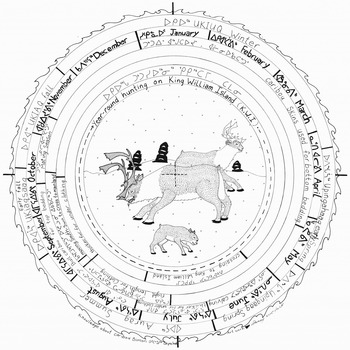
In the Hamlet today food, clothing, shelter, tools and equipment are all available in stores and through local services, and yet people express a craving for a variety of country food, including tuktuit, fish and seal. As such, the importance of learning how to butcher, store and prepare tuktuit meat, body parts and skins is emphasised in order to develop and maintain skills (e.g. in sewing clothing that some people continue to use for winter hunting or travel), to enhance diet and to promote core values (e.g. sharing, and avoiding waste), all of which contribute to Inuit identity (Mearns, Reference Mearns2017). Therefore, knowing when and where to hunt tuktuit at different times of year is still important (Figs 3 & 5).
Uqsuqtuurmiut knowledge of seasonal rounds of tuktuit on Qikiqtaq. Names and descriptions of months are based on a local calendar used in Uqsuqtuuq: January (hiqinnaut) – starting to see the sun a little; February (ikiarpaarvik) – sun coming up just above the horizon; March (avunnivik) – seal pups that are born too early freeze during this month; April (nattialirvik) – when the seal pups are born; May (qavaavik) – when the seal pups are losing their baby fur; June (nurirvik) – caribou calves are born; July (itsavik) – when the feathers are coming off Canada geese/snow geese/swans who didn’t lay eggs, they can’t fly as they get new wings; August (itsavik) – when the feathers are coming off Canada geese/snow geese/swans who did lay eggs and have chicks, they can’t fly as they get new wings; September (amirairvik) – young caribou are losing the velvet off their antlers; October (amirairvik) – bull caribou are losing the velvet off their antlers; November (aquijurvik) – when people retrieve the caribou meat they cached; December (kapirraq) – so cold you can feel the frostbite (burning cold).

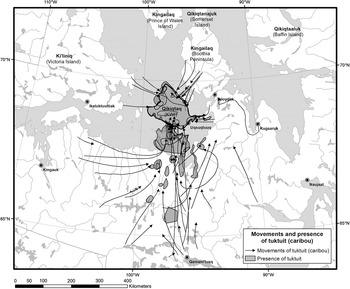
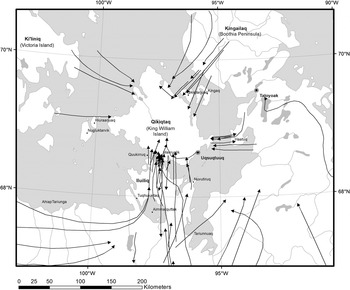
Uqsuqtuurmiut knowledge of regional movements and presence of tuktuit around Qikiqtaq. The directional arrows are shown as they were drawn in interviews. Most of these depict tuktuit moving northwards to Qikiqtaq in upingaaq (spring), but this was in the context of interview discussions where Uqsuqtuurmiut also described seasonal movements on and off the island, with the exception of some tuktuit that remain on the island year-round. Therefore, each of the lines can essentially be considered as having bi-directional arrows, with tuktuit moving towards Qikiqtaq in upingaaq and away in ukiaqsaaq (early fall) (see Fig. 3 for timing).

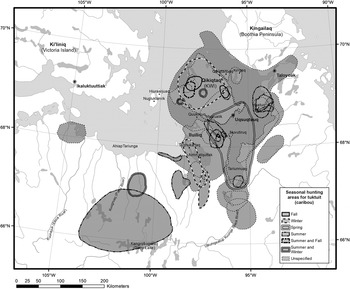
Uqsuqtuurmiut seasonal hunting areas for tuktuit.

Upingaaq (spring)
In upingaaq (spring), as the weather begins to warm and the snow starts to melt at the end of May and early June, tuktuit start migrating towards Qikiqtaq, moving onto the island before the sea ice breaks up (Aglukkaq, Reference Aglukkaq2012a; Aqslaluk, Reference Aqslaluk2013; Eleehetook, Reference Eleehetook2013; Kamamalik, Reference Kamamalik2013; Konana, Reference Konana2012; Workshop, 2013c, d, 2016a) (Fig. 3). Tuktuit can be seen roaming around the sea ice (Eleehetook, Reference Eleehetook2013), and coming to the island from both northerly and southerly directions (Aglukkaq, Reference Aglukkaq2012a; Qitsualik, Reference Qitsualik2013; Workshop, 2013a, 2016a). From the north, tuktuit move southwestwards down from Kingailaq (Boothia Peninsula) over Kingaq and Qikiqtarjuaq (Matty and Qikiqtarjuaq Islands) and onto Qikiqtaq (Aglukkaq, Reference Aglukkaq2012a; Sallerina, Reference Sallerina2012) (Figs 4 & 6). From the south, iluiliup tuktuit move northwards towards the coast (Akoak, Reference Akoak2012; Aqslaluk, Reference Aqslaluk2013; Workshop, 2013b,d), and cross Quukirruq (Simpson Strait) to Qikiqtaq (Akoak, Reference Akoak2012; Eleehetook, Reference Eleehetook2013; Kamamalik, Reference Kamamalik2013) (Figs 4 & 6). This is such a prominent and important seasonal pattern for tuktuit movement that it has its own specific reference in Inuktitut: ataaqtuq, literally meaning “going from inland towards the shore (coast)” (Akkikungnaq, Reference Akkikungnaq2013; Workshop, 2016a). Some people also mentioned atirtut in this context, although this is usually a specific reference used to describe the movement of people “going out to the sea ice (coast) for seal hunting” in upingaaq (Akkikungnaq, Reference Akkikungnaq2013; Workshop, 2013b, 2016a). So it can be used for tuktuit or for people, depending on the context of the conversation, but either way it references movement from inland towards the coast.
Uqsuqtuurmiut knowledge of local movements of tuktuit around Qikiqtaq. This is a zoomed-in view of Fig. 4 for ease of viewing (without the ‘presence of tuktuit’ features), and caption details are the same as Fig. 4.

Elders Jonathan Hiqiniq and Paul Aaluk in Workshop (2013b), discussing their younger days, described the caribou moving north towards Ahiap Tariunga (Queen Maud Gulf) as always being in big herds, travelling along one trail. Akkikungnaq (Reference Akkikungnaq2013) referred to this as amitrat, “when a huge herd of caribou is walking all in one line, walking the same way”. In Workshop (2016a) Siksik and Kogvik, originally from Kuugruaq, described the impressive feeling of the land vibrating under the impact of thousands of tuktuit coming from the west and moving to the east. This thundering of hooves (Thorpe et al., Reference Thorpe, Eyegetok and Hakongak2001b) would indicate the migration of tuktuit 2–3 days before the herd was even visible. These tuktuit arrived in such large numbers they would appear as if a “flowing river across the land” (Workshop, 2016a). These days, although hunters are still often along the coast of Ahiap Tariunga, they do not see these large herd migrations anymore; it seems that once they get near the shore in upingaaq, tuktuit tend to spread out (Workshop, 2013b).
Generally, this movement of iluiliup tuktuit north to the coastal area of Iluiliq (Adelaide Peninsula) and along Ahiap Tariunga is related to female tuktuit moving to their coastal calving grounds (Akkikungnaq, Reference Akkikungnaq2013; Akoak, Reference Akoak2012; Aqslaluk, Reference Aqslaluk2013; Workshop, 2016a), with some also going onto Qikiqtaq for calving (Aqslaluk, Reference Aqslaluk2013; Konana, Reference Konana2012). Indeed nurirvik, the Inuktitut name for June, references when “caribou calves are born” (Fig. 3). Therefore, there can be good hunting on the mainland in upingaaq, as there are plenty of tuktuit that congregate along the coast (Sallerina, Reference Sallerina2012) (Fig. 5). Tuktuit are anticipated on Qikiqtaq when Uqsuqtuurmiut start receiving reports from family or friends in Iqaluktuuttiak (Cambridge Bay) in upingahaaq (early spring) about eastward movements, and in Qamani’tuaq (Baker Lake) about northward movements, usually around late April (Akoak, Reference Akoak2012; Putuguq, Reference Sallerina2013; Workshop, 2013d). By early May, tuktuit move onto Qikiqtaq from the mainland, usually going through Nuvutiruq (Richardson Point) on the northern tip of Iluiliq (Akkikungnaq, Reference Akkikungnaq2013; Eleehetook, Reference Eleehetook2013; Kamamalik, Reference Kamamalik2013). In Workshop (2013b,d), movements of tuktuit towards the northern coastline were described in relation to the timing of seal pup hunting in late May and June, and then they move across to the islands. However, tuktuit movements onto Qikiqtaq seem strongest in the upingaaq and auraq (summer) months of June and July (Workshop, 2016a) (Fig. 3), and during this time they can even be seen swimming across to the island (Eleehetook, Reference Eleehetook2013). When Eleehetook (Reference Eleehetook2013) first moved to Uqsuqtuuq no one had seen tuktuit swimming across, so this is a more recent occurrence. The numbers of tuktuit moving onto the island in upingaaq can be highly variable between years (Workshop, 2013a).
Auraq (summer)
On Qikiqtaq in auraq (summer), the northeastern portion of the island was described as having the highest density of tuktuit around the month of July (Keanik, Reference Keanik2012). Other places where tuktuit spend auraq are indicated by important hunting destinations, including along the northern mainland and coastline, Tuqhukattaq (Sherman Inlet), Kingailaq (Boothia Peninsula), Haatuq, and around Utkuhigsaliup Kuunga, among others (Akoak, Reference Akoak2012; Aqslaluk, Reference Aqslaluk2013; Arqviq, Reference Arqviq2012; Sallerina, Reference Sallerina2012) (Fig. 5). These tuktuit are thought to be primarily coming northwards from Qamani’tuaq, with some coming from the east along the mainland coast (Akoak, Reference Akoak2012) (Fig. 4). From July to August male tuktuit were traditionally hunted for the top layer of bedding, and other skins were used as blankets (Workshop, 2016a) (Fig. 3). Around mid-August, tuktuit hair is considered to be the right length for inner clothing (Workshop, 2016a) (Fig. 3).
Ukiaq (fall)
In ukiaqsaaq (early fall), tuktuit start to move off the island, making their way inland again (Aqslaluk, Reference Aqslaluk2013; Kamamalik, Reference Kamamalik2013; Konana, Reference Konana2012; Putuguq, Reference Sallerina2013; Qitsualik, Reference Qitsualik2013; Workshop, 2013a,c, 2016a) (Fig. 3). When the weather starts getting cold, this movement happens quickly, with tuktuit swimming across the strait or crossing the sea ice right after freeze-up, in order to migrate further south on the mainland (Aqslaluk, Reference Aqslaluk2013; Putuguq, Reference Sallerina2013; Qitsualik, Reference Qitsualik2013; Workshop, 2013d). These southward movements are referred to as kangimukpalliajut in Inuktitut, meaning “moving from the coastal area inland” (Akkikungnaq, Reference Akkikungnaq2013; Workshop, 2016a) or taggaaruq “rushing up to the mainland” (Workshop, 2013b, 2016a), depending on the dialect being used. These southward movements begin in ukiaqsaaq, around late August or early September (Kamamalik, Reference Kamamalik2013; Workshop, 2016a) (Fig. 3). During this time tuktuit hair is also thicker, and is best used for outer clothing (Workshop, 2016a) (Fig. 3). However, until the ice freezes up, good hunting can be found on Qikiqtaq because tuktuit have a hard time moving south while the ocean is unfrozen (Workshop, 2013b). The months of ukiaqsaaq are also named for tuktuit that are losing the velvet off their antlers (amirairvik), occurring for young tuktuit in September and adult males in October (Workshop, 2016a) (Fig. 3). Once on the mainland, tuktuit start moving further south in late September (Workshop, 2013b) for the mating season in October (Workshop, 2016a) (Fig. 3).
Ukiuq (winter)
Iluiliup tuktuit are observed to migrate onto and off of Qikiqtaq in upingaaq and ukiaqsaaq, respectively, but commonly there are also some tuktuit that remain on the island throughout ukiuq (winter) (Aqslaluk, Reference Aqslaluk2013; Arqviq, Reference Arqviq2012; Konana, Reference Konana2012; Putuguq, Reference Sallerina2013; Workshop, 2013a, b, c, d, 2016a) (Figs 3 & 5). Therefore, there are tuktuit present on Qikiqtaq all year round (Aaluk, Reference Aaluk2012b; Aqslaluk, Reference Aqslaluk2013; Arqviq, Reference Arqviq2012; Keanik, Reference Keanik2012; Workshop, 2013b, 2016a), although in smaller numbers (Aqslaluk, Reference Aqslaluk2013; Keanik, Reference Keanik2012; Workshop, 2013d). In ukiuq (late November to early April), hunting tuktuit is mainly focused on Qikiqtaq itself due to close proximity (Arqviq, Reference Arqviq2012; Sallerina, Reference Sallerina2012; Workshop, 2013a,b) (Figs 3 & 5). November (aquijurvik) is also the month when people retrieve the tuktuit meat that they cached in September (Workshop, 2016a) (Fig. 3). Tuktuit used to congregate around Nuvutiruq, and even remained there during ukiuq, so hunting nearby on the mainland was also feasible (Keanik, Reference Keanik2012; Workshop, 2013b). However, this behaviour apparently stopped approximately 10–15 years ago (Keanik, Reference Keanik2012; Workshop, 2013a, b). These days, tuktuit that migrate to the mainland in ukiaqsaaq tend to continue south so there are no tuktuit on Iluiliq in ukiuq (Aqslaluk, Reference Aqslaluk2013; Eleehetook, Reference Eleehetook2013; Keanik, Reference Keanik2012; Workshop, 2013a,b). So hunters in Uqsuqtuuq consider themselves fortunate to have tuktuit on Qikiqtaq throughout ukiuq, whereas it is harder for hunters in Taloyoak or Kugaaruk to hunt tuktuit, as they have moved so far south (Sallerina, Reference Sallerina2012; Workshop, 2013a). In late December and early January it is also common to see tracks of tuktuit coming across the ice from Kingailaq (Boothia Peninsula) onto the northeastern part of Qikiqtaq (Workshop, 2013a) (Fig. 4). Some of the tuktuit that remain on Qikiqtaq throughout ukiuq are identified as iluiliup tuktuit that do not migrate back south to the mainland (Putuguq, Reference Sallerina2013; Workshop, 2013a). Kingailaup tuktuit are known to travel long distances (Workshop, 2013c) and can be found on Qikiqtaq at any time of year, as they do not have a clear migratory pattern (Putuguq, Reference Sallerina2013; Workshop, 2016a).
Movements and crossings of tuktuit
Elders reiterated that tuktuit, as migratory animals, cannot stay in one spot all year (Workshop, 2016a). “The caribou don’t have their own land, so they’re always migrating and moving” (Workshop, 2013d). This was often emphasised in response to questions around seasonal movements or migration routes. Numbers of tuktuit migrating to/from Qikiqtaq are also known to fluctuate between years (Aglukkaq, Reference Aglukkaq2012a; Workshop, 2013a). This natural mobility of tuktuit caused some hesitancy during interviews in relation to drawing any seasonal hunting or migration routes on the maps. Tuktuit come from different directions at different times, depending on the conditions in a given year: “They are not a permanent resident so they are always moving around” (Workshop, 2013a). Qikiqtaq is not considered to have “its own caribou”, but tuktuit cross to and from the island throughout the year, with some remaining year-round (Workshop, 2016a). The migrations of tuktuit onto the island in upingaaq (spring) were most emphasised, based on the fact that the majority of arrows drawn indicate northwards movement (Fig. 4). Importantly, it was clear that these were two-way movements according to seasons, such that the arrows should be considered bi-directional (i.e. also indications of southwards movements in ukiaqsaaq (early fall)).
Drawing of migration routes was also frequently qualified with statements that “tuktuit do not follow these lines” (Workshop, 2013c, 2016a). Therefore, the lines drawn on the maps must be taken as general directional indicators, along with the recognition that these do not delineate specific “trails”, since tuktuit can move anywhere and come from any direction. Uqsuqtuurmiut were sometimes hesitant to indicate important areas on the map because they were concerned about misrepresenting routes by drawing a specific line (Workshop, 2013a, b, d). However, for those who did use the maps to provide indications of general movement patterns, the maps facilitated powerful spatial visualisation and a consistent depiction of tuktuit moving to and from Qikiqtaq from nearly all directions (Fig. 4). Although we did not specifically ask about key crossing points, what emerged from the mapping process was an emphasis on four key crossings: (1) north/south movements between Iluiliq and Qikiqtaq; (2) east/west movements between Kingailaq (Boothia Peninsula) and Qikiqtaq; (3) east/west movements between Haatuq and Qikiqtaq; and (4) east/west movements between Ki’liniq (Victoria Island) and Qikiqtaq (Fig. 6).
It is commonly understood that northwards movements of iluiliup tuktuit in upingaaq result in a congregation in the coastal areas of Iluiliq and Ahiap Tariunga (Figs 4 & 6), and that these are important calving grounds (Ljubicic et al., Reference Ljubicic, Oberndorfer and Smith2017). This is reflected in Fig. 6, with the most frequently mapped crossing being from Iluiliq to/from Qikiqtaq (Fig. 6). Hunting tuktuit is also concentrated on Iluiliq in auraq, as well as generally on Iluiliq and Qikiqtaq (i.e. “unspecified” on the map, meaning it could be any time of year) (Fig. 5). Furthermore, Nuvutiruq is recognised as a key place where tuktuit move through in crossing to or from Qikiqtaq (Akkikungnaq, Reference Akkikungnaq2013; Eleehetook, Reference Eleehetook2013; Kamamalik, Reference Kamamalik2013; Keanik, Reference Keanik2012; Workshop, 2013b) (Fig. 6). The importance of these areas and north/south movements to/from Qikiqtaq are also well recognised in caribou literature (Brice-Bennett, Reference Brice-Bennett and Freeman1976; Gunn & Fournier, Reference Gunn and Fournier2000a; Gunn, D’Hont, Williams, & Boulanger, Reference Gunn, D’Hont, Williams and Boulanger2013; Gunn, Fournier, & Nishi, Reference Gunn, Fournier and Nishi2000; Miller, Reference Miller1991), and have been mainly studied in relation to the Ahiak herd (Ljubicic et al., Reference Ljubicic, Oberndorfer and Smith2017).
The second most prominent crossing relates to frequent Uqsuqtuurmiut descriptions of kingailaup tuktuit moving from Kingailaq (Prince of Wales Island) to Qikiqtaq via Kingailaq (Boothia Peninsula). These movements are clearly illustrated on the maps and serve to highlight the importance of Kingaq and Qikiqtarjuaq for caribou moving east/west between Qikiqtaq and Kingailaq (Boothia Peninsula) (Fig. 6). The movement across these islands was also recognised by Inuit contributions to Johnson, Neave, Blukacz-Richards, Banks, & Quesnelle (Reference Kendrick and Manseau2016). There is considerable research acknowledging inter-island movements of Peary caribou between Prince of Wales Island, Somerset Island and Boothia Peninsula (Gunn & Ashevak, Reference Gunn, Buchan, Fournier and Nishi1990; Gunn, Miller, Barry, & Buchan, Reference Hiqiniq2006; Jenkins, Campbell, Hope, Goorts, & McLoughlin, Reference Kendrick2011; Johnson et al., Reference Johnson, Neave, Blukacz-Richards, Banks and Quesnelle2016; McFarlane, Miller, Barry, & Wilson, Reference McFarlane, Miller, Barry and Wilson2014). However, other than Gunn & Dragon (Reference Gunn and Dragon1998) and Johnson et al. (Reference Johnson, Neave, Blukacz-Richards, Banks and Quesnelle2016), there is little recognition of these movements continuing to King William Island.
The third key crossing includes east/west movements of tuktuit between Haatuq (no known English name) and Qikiqtaq. This area was referenced by Aaluk (Reference Aaluk2012b), Aglukkaq (Reference Aglukkaq2012b), Arqviq (Reference Arqviq2012) and Kamamalik (Reference Kamamalik2013) as being important for hunting tuktuit (Fig. 5), and identified in map drawings by others (Fig. 6). Haatuq was mainly associated with use by iluiliup tuktuit. For biological research this highlights a potential future area of investigation to better understand movements of Beverly, Ahiak or Northeastern mainland herds (Lorillard, Wager Bay, Melville Peninsula), which to date have shown limited connection with King William Island (Ljubicic et al., Reference Ljubicic, Oberndorfer and Smith2017).
The fourth key crossing, mapped by Arqviq (Reference Arqviq2012), Eleehetook (Reference Eleehetook2012), Sallerina (Reference Sallerina2012) and Workshop (2013d), indicates caribou movements east/west between Ki’liniq and Qikiqtaq north of Nugluktarvik and Hiuraarjuaq (the Royal Geographical Society Islands) (Fig. 6). Community members of Ikaluktuuttiak have also mentioned movements of tuktuit between Ki’liniq and Qikiqtaq as part of a recent study on muskox (M. Tomaselli, pers. comm., 18 May 2017). However, Dolphin and Union caribou are most closely associated with Victoria Island in the literature, and research to date focuses mainly on north/south movements between the island and the mainland across Dolphin and Union Strait (for which they are named), Coronation Gulf, Dease Strait, and the westernmost portion of Queen Maud Gulf (Dumond & Lee, Reference Dumond and Lee2013; Dumond, Sather, & Harmer, Reference Dumond, Sather and Harmer2013; Gunn, Buchan, Fournier, & Nishi, Reference Gunn, Buchan, Fournier and Nishi1997; Gunn & Fournier, Reference Gunn and Fournier2000b; Nagy, Gunn, & Wright, Reference Nagy, Gunn and Wright2009; Poole, Gunn, Patterson, & Dumond, Reference Poole, Gunn, Patterson and Dumond2010). Further investigation is warranted about east/west movements, notably through inter-community exchange in order to gain more regional perspectives on Inuit knowledge connections (Tomaselli et al., Reference Tomaselli, Kutz, Gerlach and Checkley2018).
Taken together, Uqsuqtuurmiut depictions of tuktuit crossings serve to highlight Qikiqtaq as an area of convergence for tuktuit. This also raises an important direction for future work in relation to understanding the dynamics and timing of potential herd mixing, as well as the importance of sea ice conditions to tuktuit crossings to/from Qikiqtaq.
Contributions to Qanuqtuurniq (information and knowledge acquisition)
“Use of caribou contributes significantly to the mental and physical well-being of Nunavummiut [people of Nunavut]. Caribou provide a secure and reliable source of healthy and nutritious food for many people. Indirectly, the various social and cultural activities surrounding the use of caribou also promote well-being. To Nunavummiut, caribou have intrinsic value which far exceeds the economics of subsistence harvesting and other activities. The relationship with caribou is a fundamental part of Inuit identity that has been passed from one generation to the next for thousands of years. Hunting caribou is not simply a means of providing food or income. The many activities associated with hunting, such as travelling on the land, holding ceremonies and community feasts are integral to transferring and retaining knowledge about traditional culture and about caribou themselves. These activities are also about spending time with family, teaching younger generations and maintaining healthy communities.”
(Government of Nunavut, 2011, p. 7)This eloquent summary, from the Government of Nunavut’s caribou management strategy entitled “Working Together for Caribou” (Government of Nunavut, 2011), highlights how efforts to synthesise Uqsuqtuurmiut knowledge of long-term and seasonal cycles of tuktuit only begin to scratch the surface of conveying Inuit relationships with and knowledge of tuktuit. Despite these and other limitations (below), our research seeks to contribute to ongoing efforts to encourage greater attentiveness to Inuit knowledge in policy- and decision-making. Recent and evolving approaches to co-management of tuktuit aim to address the tammarniit (mistakes) (Tester & Kulchyski, Reference Tester and Kulchyski1994) of the past, and for Inuit to continue kiumajut (talking back) (Kulchyski & Tester, Reference Kulchyski and Tester2007) regarding the management of tuktuit. Broadly, addressing tammarniit and responding to Inuit efforts of kiumajut could also be considered as a driving force for researchers to engage in, and improve, ethical and respectful research relationships with Inuit communities (Castleden et al., Reference Castleden, Morgan and Lamb2012; Healey & Tagak, Reference Huntington, Brown-Schwalenberg, Frost, Fernandez-Giminez, Norton and Rosenberg2014; Inuit Tapiriit Kanatami, Reference Keanik2018; McGrath, Reference Healey and Tagak2011; McGregor et al., Reference McGregor, Bayha and Simmons2010; Tondu et al., Reference Tondu, Balasubramaniam, Chavarie, Gantner, Knopp, Provencher and Simmons2014). The Government of Nunavut (2011, p. 14) strategy includes five key components: Qanuqtuurniq (information and knowledge acquisition), Piliriqatigiingniq (working together), Avatittinnik Kamatsiarniq (environmental stewardship), Aajiiqatigiingiq (collaborative decision making), and Inuillu Tuktuillu (people and caribou). Here we take the opportunity to reflect on our experiences in working together to document and share Uqsuqtuurmiut knowledge of tuktuit, to consider potential intersections of our work with Government of Nunavut (GN) efforts. We focus particularly on Qanuqtuurniq, as an initial contribution that supports moving towards addressing the other four components.
In outlining the objective of Qanuqtuurniq, developing a solid information base for Nunavut’s caribou populations is described as critical to understanding caribou population health and sustainability (Government of Nunavut, 2011). Although some caribou herds in Nunavut have been studied for decades, there are still many challenges associated with a lack of baseline information and limited capacity for ongoing monitoring. A lack of information can impede the ability of co-management partners to assess herd or habitat status in relation to environmental changes resulting from climatic, development, or other changes (Government of Nunavut, 2011). This may lead to indecision, or to decisions and human activities that could have lasting and irreversible impacts on caribou, their habitat, and the associated economic, social and cultural interests of Nunavummiut (Government of Nunavut, 2011). From available academic and grey literature there is clearly a gap in understanding related to caribou on King William Island (Ljubicic et al., Reference Ljubicic, Oberndorfer and Smith2017). The Government of Nunavut (2011, p. 6) caribou range map itself highlights King William Island as “unknown”, and in various other range depictions King William Island caribou populations are designated as uncertain, unknown, or are simply not considered (Ljubicic et al., Reference Ljubicic, Oberndorfer and Smith2017). In contrast, understanding health, population cycles, and habitat of tuktuit is embedded in the living memory of Uqsuqtuurmiut, and their families have been hunting tuktuit for generations. So while there is no gap from Uqsuqtuurmiut perspectives, there is a lack of mechanisms for community members to consistently share their knowledge and observations with wildlife managers in meaningful ways. Thus decision-makers, researchers and the public have limited understanding of Inuit knowledge of tuktuit, and much work is yet to be done in order to meet the goals of ensuring Inuit knowledge is equally represented alongside science in implementing the caribou management strategy. Reflecting on our collaborative process, we identify several key considerations in support of Qanuqtuurniq policy statements and associated actions, in relation to defining information needs, recognising and valuing Inuit knowledge, and developing and implementing credible research.
Defining information needs
Broadly, the goal of Qanuqtuurniq is to ensure that current and reliable information is available to support management decisions, and that decisions promote long-term economic, social and cultural interests by inviting public participation and confidence, especially amongst Inuit (Government of Nunavut, 2011). Therefore, defining information needs is a critical starting point for this effort, and the GN stresses that this must be achieved through consultation and cooperation with co-management partners and Nunavummiut. This process begins by identifying and prioritising gaps in existing knowledge, which helps to determine future information needs. King William Island has been identified as being uniquely overlooked in caribou research (Ljubicic et al., Reference Ljubicic, Oberndorfer and Smith2017), but most importantly, identification of gaps and future needs must consider community-identified priorities. How these translate to regional or territorial scales, or connect with scientific priorities, is a little more challenging. In articulating iluiliup tuktuit, kingailaup tuktuit, qungniit and a potential cross-breed of caribou on Qikiqtaq, Uqsuqtuurmiut provide a starting point for others to learn about tuktuit in the region. However, Uqsuqtuurmiut also emphasise that their knowledge extends only to timeframes and places of their own experience, or specific stories or observations passed on through oral history. They are generally uncomfortable speaking beyond these areas, and will suggest the need to consult other communities to understand tuktuit in other regions. Gaining a more regional Inuit perspective requires not only more community-driven collaborative research, but more opportunities to meet and share knowledge within and between regions of Nunavut (and beyond). This may be especially critical in relation to overlapping hunting areas, or around areas of mutual community concern regarding the impacts of resource development or environmental change.
Among several research needs identified in Action 1.1a, IQ research on the historical distribution patterns of caribou is included. We have already explained our choice of “Uqsuqtuurmiut knowledge” terminology, as opposed to IQ. This was based on our intention to avoid the sense that Inuit knowledge can be generalised, or somehow belongs only in the past. Accordingly, we encourage readers, researchers and decision-makers to avoid limiting IQ to historical discussions only. We, along with many others (e.g. Healey & Tagak, Reference Healey and Tagak2014; McGrath, Reference McGrath2011; Tester & Irniq, Reference Tester and Irniq2008; Thorpe et al., Reference Thorpe, Eyegetok and Hakongak2001a; Wenzel, Reference Wenzel2004), emphasise the historical and contemporary relevance of IQ, and the evolving individual and collective nature of IQ. This was also evident in our discussions with Uqsuqtuurmiut regarding long-term and seasonal cycles of tuktuit presence, absence and movement to/from Qikiqtaq. Therefore, IQ is more than a source to provide historical perspective; it highlights the interconnections of people, tuktuit, the land, and well-being over generations, as well as through contemporary collective and individual experiences.
Identifying priorities for baseline research and ongoing monitoring is critical, as called upon in Action 1.1b (Government of Nunavut, 2011). According to Uqsuqtuurmiut there is a need to better understand (1) the location and habitat of calving grounds, (2) caribou health based on fur, fat and body condition, (3) abundance of caribou in different seasons, (4) timing and appropriate sea ice/ocean conditions that facilitate caribou crossings, and (5) impacts of disturbance in relation to predators, insects, mine development and contamination (e.g. old Distant Early Warning (DEW) line sites). These were raised through various interview, mapping and land camp discussions, and deserve more focused attention to understand this baseline according to Inuit knowledge (in Uqsuqtuuq and nearby communities). Increased opportunities for inter-community and interdisciplinary collaborations (e.g. Dedats’eetsaa, 2017; Lyver & Łutsël K’é Dene First Nation, Reference Lyver2005; Parlee, Manseau, & Łutsël K’é Dene First Nation, Reference Parlee and Manseau2005; Polfus et al., Reference Polfus, Simmons, Neyelle, Bayha, Andrew, Andrew and Manseau2017; Tomaselli et al., Reference Tomaselli, Kutz, Gerlach and Checkley2018) could serve to develop networked approaches to caribou monitoring that reflect areas, movements, crossings, health indicators, among others, deemed important to tuktuit by Inuit. Developing appropriate approaches to pursue these priorities relates closely to the subsequent policy statement of recognising and valuing Inuit knowledge.
Recognising and valuing Inuit knowledge
It is inspiring to see IQ recognised as a foundation for caribou management in Nunavut. From reading many government reports, as well as interacting with several GN wildlife biologists and managers over the course of this project, it is clear that wildlife managers are consulting regularly with HTAs, hunters and other community members. There is a demonstrated commitment to learning from IQ, and many initiatives have emerged to support the implementation of this policy statement. Such efforts occur informally during routine consultation visits or survey programmes, and formally through occasional workshops. Community consultations and workshops are important opportunities for sharing IQ and informing management decisions. However, they are also limited in the timeframes and people involved, and are often not afforded the priority of being written up into comprehensive reports. We have noticed that Inuit insights tend to be included as anecdotes (referenced as personal communications) in government reports, and are rarely followed up with more in-depth, systematic collaborative efforts to get a broader set of community contributions. From our experience working with Uqsuqtuurmiut we understand the financial, capacity (people’s time and availability), and logistical challenges involved in the kind of long-term, collaborative, intensive approaches needed to adequately reflect Inuit knowledge. Nevertheless, to move beyond anecdotes and to value Inuit knowledge in its own right, greater collective commitment is needed to support community-driven and community-led research, using methodologies deemed locally relevant and respectful of Inuit knowledge transmission and values.
Recommendations to value IQ equally alongside scientific knowledge in decision-making are also emphasised as inherently challenging, due to underlying differences in worldviews and conceptual framings of human–animal relationships (Bates, Reference Bates2007; Kendrick, Reference Kendrick2002; Tester & Irniq, Reference Tester and Irniq2008; Wenzel, Reference Wenzel2004). Incorporating IQ values and knowledge that underpin traditional management systems into bureaucratic regimes (even cooperative ones) is much more difficult and complex than concise policy statements can convey. Foundational to this is social learning, defined by Schusler, Decker, & Pfeffer (Reference Schusler, Decker and Pfeffer2003) as “learning that occurs when people engage one another, sharing diverse perspectives and experiences to develop a common framework of understanding and basis for joint action” (p. 311, also see Kendrick & Manseau, Reference Kendrick and Manseau2008). This involves the recognition of differing ways that Inuit and Western (scientific) worldviews value particular ways of interacting with people and animals, perceiving time, identifying leaders, showing respect, assessing credibility of knowledge or experience, and gaining trust (Bates, Reference Bates2007; McGrath, Reference McGrath2003). We are fully in support of Actions 1.1c and d, which call for the development of guidelines for collecting and incorporating Inuit knowledge into management processes and decisions. However, this may also require some fundamental shifts in how relationships and understanding of caribou are developed, beginning perhaps at the most basic level of identification and naming of caribou (herds). As explored in Ljubicic et al. (Reference Ljubicic, Okpakok, Robertson and Mearns2018), Uqsuqtuurmiut approaches to naming and distinguishing herds are fundamentally different than biological approaches to species and herd classifications. Both are important for a comprehensive picture of caribou populations and health. However, other than general mentions of tuktu, the literature (including the GN management plan) relies on herd names developed through scientific assessments and management practices. Understanding Inuit naming conventions and variations according to local language, geography and homelands would be an important starting point in more effective communications and mutual understanding (Ljubicic et al., Reference Ljubicic, Okpakok, Robertson and Mearns2018). Indeed, developing some broad guidelines would be helpful, but they also need to be implemented with sensitivity to local context and the ability to tailor according to local guidance. Collaborative community-based projects are intrinsically related to the community context and research relationships developed by the individuals involved, and are thus variable across communities. Towards this end, we recommend discussing seasonal rounds and understanding the seasonal calendar in local cultural and dialectical terms at the outset of any community-based caribou research (something we learned the hard way and thus only came to near the end of our work). For example, the seasonal rounds of tuktuit depicted in Fig. 3 are unique to Uqsuqtuuq and cannot be considered broadly applicable to all Kitikmeot communities, much less all of Nunavut.
Methods may also vary, depending on community goals, priorities, and the receptiveness and flexibility of both researchers and community members. We acknowledge our struggles with how to convey this introductory synthesis of Uqsuqtuurmiut knowledge of tuktuit. Its written form and particular characterisations of tuktuit do not represent the seamless definition of IQ presented by Thorpe et al. (Reference Thorpe, Eyegetok and Hakongak2001a) (also see Tester & Irniq, Reference Tester and Irniq2008, and Wenzel, Reference Wenzel2004). There are dangers here of decontextualisation and, accordingly, misunderstandings. We have tried to address these by defining a collaborative process from the outset, underpinned by local principles. We have been careful that the basis for our claims has been checked through our co-authorship process and various iterative verification and validation efforts (both with individuals and in workshops). The constraints of the English language and journal article word limits add further complications. The synthesis shared here does not represent all Uqsuqtuurmiut, but rather the diversity of expertise from contributors involved in the project. This work presents an important foundation that can now be expanded and elaborated as the community sees fit. In our efforts to contextualise the knowledge shared, we have presented Uqsuqtuurmiut voices directly through quotes, citations and narratives presented. We have organised content according to recurring themes (names for tuktuit, timeframes, seasons, movements) that emerged from interviews as opposed to externally determined categories. We also engage in this collaborative effort with full understanding that none of our work would ever replace the need for experiential, land-based, inter-generational learning tied to cultural values, beliefs and practices.
We share our work with the hope that this introductory overview may become more accessible to other researchers and wildlife managers, and to encourage the commitment of time and resources necessary to (1) develop closer working relationships, (2) spend more time learning in communities from local experts, and (3) develop more ways to support local leadership in research and management efforts. In so doing, the challenges of compartmentalisation and decontextualisation may be addressed in the long run, in support of more credible research.
Developing and implementing credible research
The Government of Nunavut (2011) policy affirms that information needed for caribou management must be acquired by means of well-planned and credible research, and this involves a multitude of ethical and methodological considerations. Action 1.1f seeks to ensure that research and monitoring activities are based on validated methods and widely accepted standards or protocols for research. However, what is considered “validated” and “widely accepted” are important points for discussion with community members and local organisations as part of research planning and design. This is important to ensure there are no conflicts with the perceived validity or acceptability of these “standards” in terms of how tuktuit are treated, as well as how Inuit knowledge may be recorded and shared. For instance, participatory mapping can be a powerful tool to communicate Inuit knowledge of caribou to decision-makers and to link to scientific monitoring and assessments (e.g. aerial surveys or satellite collar monitoring) (Kendrick & Manseau, Reference Kendrick and Manseau2008). However, it is imperative to acknowledge and respect the limitations of static maps and finite lines in representing Inuit knowledge, and develop management recommendations cautiously in this respect. The migration routes mapped by Uqsuqtuurmiut could be said to represent the most commonly experienced or anticipated directions of movement by tuktuit (Figs 4 & 5), but these must be considered as always shifting and fluctuating over time in relation to environmental conditions, animal health, seasonal cycles, population cycles and various forms of disturbance. As noted earlier, hunters also emphasised that tuktuit cannot be expected to be found exactly where lines are drawn. So the drawings provide representative indications of directional movements and areas where tuktuit are anticipated to be found, and are not meant to depict precise trails, for example. In addition, the maps only reflect contributions of the individuals involved, and thus are not representative of the knowledge of all Uqsuqtuurmiut, or even all hunters. These limitations are important to acknowledge in communications with biologists, researchers and decision-makers, and could be similarly considered in relation to satellite telemetry or aerial survey methods with regards to representing spatial, temporal and population dynamics. And yet, this mapping also provides important perspective on movements of tuktuit around Qikiqtaq, considering that many current maps of caribou ranges and migration routes do not include King William Island (Ljubicic et al., Reference Ljubicic, Oberndorfer and Smith2017).
Ongoing Inuit contributions based on local observations, values and experiences could be used to complement more logistically and financially intensive, and temporally limited, surveys of tuktuit. Developing and implementing community-based monitoring strategies grounded in interactions via hunting culture would require close collaboration between wildlife managers, HTAs, conservation officers, hunters and Elders in each community to determine what such protocols would entail. Through methods such as participatory mapping, sharing GPS tracks/points indicating hunting travel or observations, reporting sightings or kills of sick tuktuit, defining key harvesting or habitat regions to monitor, administering brief surveys when hunters drop in to the HTA, among others, more sustained Inuit contributions could be supported.
All the elements discussed above would also support the capacity building, strategic partnership, cross-jurisdictional cooperation, funding, research and employment initiatives highlighted in Actions 1.1j–1.1o. These actions convey the value that the Government of Nunavut (2011) places on renewing investment in research and monitoring in order to meet current and future information needs, as well as supporting socio-economic development. In exploring options for Nunavummiut to play a greater role in caribou research and monitoring (Action 1.1o) considerable consultation would be required to ensure effective input, engagement and inclusion of Inuit knowledge and values in caribou management practices in Nunavut. Investments in training and employment would also be necessary to enhance local capacity, as well as to support the HTAs, conservation officers and regional wildlife biologists to play a greater facilitating role in collaborative research and monitoring initiatives.
Moving forward
The underlying goal of our project was to document and synthesise Uqsuqtuurmiut knowledge of tuktuit in order to make it more publicly accessible to younger generations, researchers and wildlife managers. All that we share here is really just an introduction to “what has always been known” by Uqsuqtuurmiut and their ancestors; it is nothing new. Furthermore, we recognise that in written form, and especially within the length constraints of a journal article, we can convey only a very limited and partial account of the depth of Uqsuqtuurmiut knowledge of caribou. Nevertheless, this synthesis contributes an important baseline for understanding tuktuit in the Qikiqtaq region according to Inuktitut terminology, locally meaningful spatial and temporal references, and long-term experiential knowledge. Uqsuqtuurmiut emphasise the year-round importance of tuktuit on Qikiqtaq, along with seasonal rounds that continue to be an integral part of diet, culture and knowledge in the community. Uqsuqtuurmiut knowledge also serves to conceptualise Qikiqtaq as an area of convergence for tuktuit, rather than the blank or “unknown” delineations on most range maps. In terms of both process and outcome, this highlights the importance of community-driven approaches to defining information needs, recognising and valuing Inuit knowledge, and developing and implementing credible research in support of Qanuqtuurniq (information and knowledge acquisition).
Despite a stated commitment to and, in many cases, mandate of ensuring equal consideration of Inuit and scientific knowledge in co-management, a disconnect prevails between community understandings of and approaches to managing caribou (existing primarily through oral histories and hunting practices), and those undertaken by governments or management boards (existing primarily in government policy, regulations and survey practices). Collaborative interdisciplinary research provides important opportunities to bring these realms together in mutual learning and benefit, but is challenging to sustain in terms of financial and capacity requirements without long-term commitments to support continuity. There is an ongoing need to strengthen connections between collaborative research and cooperative management approaches, whether in areas such as Qikiqtaq, where there has been little scientific attention to date, or in regions that have been heavily surveyed.
Addressing the challenge of institutionalising IQ in GN operations and governance involves attention to the colonial legacy of research, wildlife management and other interventions that undermined Inuit self-determination. Community members are often reticent to share their knowledge of wildlife, especially with government, out of concern that their knowledge may be used against them to impose harvest restrictions, quotas or bans (Tester & Irniq, Reference Tester and Irniq2008). Research and decision-making around caribou conservation can thus be contentious, as caribou are deeply connected to cultural identity and practices. Inuit rights must be considered alongside ecological concerns for caribou health and stability of populations. To do this, Inuit organisations at different scales need to be empowered to lead wildlife management research and policy development. Investments in local capacity and Inuit leadership, along with a regionally networked approach, are critical to implementing the collaborative vision set out in Government of Nunavut (2011). For community–research partnerships to contribute to these efforts they must be guided by local priorities and protocols. Although caribou are very important to Inuit, there has been surprisingly little recent research on Inuit knowledge of caribou to build on earlier work by Ferguson, Thorpe, Kendrick and their community partners (with few exceptions. such as Tomaselli et al. (Reference Tomaselli, Kutz, Gerlach and Checkley2018)). Within Dene communities, for example, there have been great strides taken in ensuring that Dene knowledge and values are core to ways of talking about, thinking about and caring for caribou in the Northwest Territories (Bayha, Reference Bayha2012; Beaulieu, Reference Beaulieu2012; Dedats’eetsaa, 2017; InterGroup, 2008; Kendrick, Lyver, & Łutsël K’é Dene First Nation, Reference Kendrick and Lyver2005; Lyver & Gunn, Reference Lyver and Gunn2004; Lyver & Łutsël K’é Dene First Nation, Reference Lyver2005; Nesbitt & Adamczewski, Reference Nesbitt and Adamczewski2009; Parlee et al., Reference Parlee and Manseau2005; Sahtu Renewable Resources Board, 2016; Sangris, Reference Sangris2012; Tłıchı Government, 2008; West Kitikmeot Slave Study Society, 2001; Zoe, Reference Zoe2012). We are inspired by this work, and have much to learn from Dene and other Indigenous initiatives for caribou conservation, cross-cultural collaboration, and biocultural diversity (Adams et al., Reference Adams, Carpenter, Housty, Neasloss, Paquet, Walkus and Darimont2014; Polfus et al., Reference Polfus, Manseau, Simmons, Neyelle, Bayha, Andrew and Wilson2016, Reference Polfus, Simmons, Neyelle, Bayha, Andrew, Andrew and Manseau2017). Uqsuqtuurmiut wanted to share their knowledge in the hope that a collective voice will be heard and more carefully considered in future research and management. This helps to set the stage for engaging in deeper discussions and understandings about Inuit relationships with caribou, and the cultural values and beliefs that frame these relationships. There is much work to be done, however, to ensure regular and ongoing opportunities for Inuit knowledge holders, researchers, managers and biologists to meet and engage in cross-cultural social learning.
Author ORCIDs
Gita Ljubicic http://orcid.org/0000-0002-4382-2093
Acknowledgments
We are grateful to Uqsuqtuurmiut who contributed their time, guidance and insights to this project over the past six years, through early planning meetings, interviews, land camps, and verification workshops. We thank the Kitikmeot Inuit Association, the Elders’ Qaggivik, the Hamlet of Gjoa Haven, Qikirtaq High School, Tahiurtiit (Justice) Committee, the Hunters and Trappers Association, the District Education Authority, the Nattilik Heritage Centre, and the Government of Nunavut for critical in-kind and logistical support. We also extend our thanks to Stephanie Pyne for interview transcription and reference support, to Glenda Smith for creating the base maps used in participatory mapping and for digitising the results, and to Alex de Paiva for creating the map figures in this paper. Thanks also to Erik Val and Darren Keith for help with place name verification and valuable feedback as we refined our analysis. We are grateful to Danny Aaluk for his creation of the seasonal depiction of tuktuit on Qikiqtaq in Fig. 3. We thank two anonymous reviewers for their thoughtful and constructive feedback that helped tremendously to refine and strengthen our paper. Our work was undertaken under Nunavut Scientific Research License #04 058 12N-M and Carleton University ethics protocol approval 12-1439. All trip and results summary reports for this project are available at http://www.straightupnorth.ca/Sikuliriji/Reports.html.
Financial support
We thank the Social Sciences and Humanities Research Council for the Research Development Grant that facilitated early planning meetings, and for the Standard Research Grant that enabled the community-based research that is the foundation of this paper. Northern Scientific Training Program, Nasivvik Centre for Inuit Health and Changing Environments, the Gordon Robertson Scholarship (Carleton University), and the Alain Maktar Heritage Scholarship (Inuit Heritage Trust) funding provided important travel and financial support for Rebecca Mearns during her Master’s research. Additional funding was provided by Carleton University and the University of Alberta to Gita Ljubicic and Sean Robertson, respectively.