Introduction
Claudia apologized for making me wait in the lobby of the apartment building. One of her granddaughters, a six months old baby, had health problems during the night and she was talking on the phone with her daughter to check that everything was fine. The interview was constantly interrupted by phone calls from her daughter, an older granddaughter who needed something from Claudia, and two friends. Claudia's little granddaughter was in the hospital and she offered to go there to visit her and support her daughter. Then Claudia remembered she had also committed to go to her daughter's house to let the cleaning lady in. Immediately, she called Ramon, a friend. Everything worked out well: Ramon would go to look after Claudia's daughter's house so Claudia could go to the hospital. While all these arrangements were made by the phone, I checked the interview documents and noticed that Ramon had not been listed as part of her support network, though Claudia located him almost at the centre of her diagram of close relationships. While apologizing for all the interruptions, Claudia commented what a good friend Ramon was, always available to help her.
This field note excerpt illustrates the challenges of capturing the complex processes through which people exchange support. In this interrupted interview, we could observe: how different forms of support are mobilised and how difficult it is to capture in research the diverse functions and meanings of personal relations. Why was Ramon not listed as part of Claudia's support network? Was it just a methodological issue regarding the questions or were there more subtle functions and meanings at play to make some ties more salient in certain situations? A reflection shared by another participant gave some clues regarding this issue:
…for instance, one day Nancy [daughter] was ill, I took her to the supermarket, but that has nothing to do with it [to ‘help’ Nancy] … if you talk to me about those things [giving help], I would think about bigger stuff … because the other things are daily life stuff. If you are family, if you are ill, you go there, you take her there, but that is like, no, I don't count it [as help]. (Carmen, 66 years old)
Carmen's observation shows the complexities of identifying what is considered as help. It was not only an issue of recalling instances, but a matter of what should be counted as help. The absence of Ramon in Claudia's support network and Carmen's reflection provide several insights into the different functions and meanings of personal relationships in later life. First, regular exchanges of support tend to remain invisible as normal parts of daily life interactions. Second, the fact that some ties are not identified as part of the support network does not mean they are less important. The questions therefore are: how can we capture the ties that have become part of ‘taken-for-granted’ reality and how are these ties relevant to older people?
These questions are both conceptual and methodological. In this paper, we will address them using the conceptual and methodological framework of personal communities proposed by Pahl and Spencer (Reference Pahl and Spencer2010). This framework provides methodological tools that help study participants to reflect on what and how different types of personal ties are important to them. We analysed the personal communities of Chilean older people, examining the diversity of ties that constitute their network of emotionally close relationships and the meanings of these relationships in later life. From a practical perspective, the personal communities framework also enables us to identify the strategies used by the study participants to construct and maintain the activities, links and relationships that form their social worlds (Victor et al., Reference Victor, Scambler and Bond2009).
The literature on social capital, social support and social networks in later life usually describes and measures the resources available in the network of the older person (Bowling et al., Reference Bowling, Banister, Sutton, Evans and Windsor2002; Tomassini and Glaser, Reference Tomassini, Glaser, Pinnelli, Racioppi and Rettaroli2007; Gray, Reference Gray2009; van Tilburg and Thomése, Reference van Tilburg, Thomése, Dannefer and Phillipson2010). Although some studies include the concept of emotional support (Krause and Rook, Reference Krause and Rook2003) or measurements for emotional closeness (Lang and Carstensen, Reference Lang and Carstensen1994; Nyqvist et al., Reference Nyqvist, Gustavsson and Gustafson2006), they rarely recognise the emotional nuances and the subjective meaning of those relationships (Roseneil and Budgeon, Reference Roseneil and Budgeon2004; Forsman et al., Reference Forsman, Herberts, Nyqvist, Wahlbeck and Schierenbeck2013). The functions of relationships in late life go beyond the provision of social support; they contribute on a more symbolic level with shared life events and common social activities (Forsman et al., Reference Forsman, Herberts, Nyqvist, Wahlbeck and Schierenbeck2013). The recognition of nuances in the emotional tone and subjective meanings of relationships could be especially relevant in contexts of rapid cultural change and modernisation, as is the case of Chile, where personal ties gain importance in providing a sense of certainty, continuity and belonging (Fine, Reference Fine2006; Forsman et al., Reference Forsman, Herberts, Nyqvist, Wahlbeck and Schierenbeck2013).
Chile is experiencing a rapid process of population ageing. According to the last Census, Chileans aged 65 and older constituted 11.4 per cent of the population (Instituto Nacional de Estadísticas de Chile (INE), 2018). Projections indicate that this proportion will reach 25 per cent in 2050 (INE, 2018). As other developing countries, Chilean society has to deal with the challenges and requirements of an ageing population while facing other persistent social problems that require attention and resources (Higo and Williamson, Reference Higo, Williamson, Settersten and Angel2011; Calvo, Reference Calvo2014). In addition, the experience of 17 years of dictatorship after the coup d’état of 1973 and the neoliberal social policies induced by the military junta in the early 1980s, negatively affected the social fabric, even to today (Lechner, Reference Lechner, Kliksberg and Tomassini2000; De la Maza, Reference De la Maza2004). As an example of this, Chile ranks among the countries with the lower levels of social trust in the world (Santander and Centro UC Políticas Públicas, 2015) with only 12 per cent of people indicating that ‘most people can be trusted’ and 85 per cent believing that they cannot be too careful in dealing with people (World Value Survey Association, 2012). It is in this context that we explore the ways in which older people manage and signify the ties that form their networks of emotionally close relationships.
Conceptual framework
Diverse family structures are becoming more common and accepted. Cohorts that initiated and experienced changes such as co-habitation, multiple marriages, singlehood, non-marital childbearing and childlessness are now entering old age (Hughes and Waite, Reference Hughes, Waite, Schaie and Uhlenberg2007). These changes were accompanied by transformed family roles and relationships that challenge the definition of what constitutes a family and the obligations among family members (Hughes and Waite, Reference Hughes, Waite, Schaie and Uhlenberg2007; Phillipson, Reference Phillipson2013). In current times the limits of kinship are becoming blurred and the networks of potentially meaningful relationships enlarged (Spencer and Pahl, Reference Spencer and Pahl2006; Phillipson, Reference Phillipson2013). Similarly, Connidis (Reference Connidis2020: 164) recently asked ‘who counts as family in the second half of life?’
Traditional notions of community, solidarity and family have obscured the potential of other types of relationships associated with current demographic and cultural contexts (Phillipson, Reference Phillipson2013). According to Wellman (Reference Wellman2001), community has become embedded in social networks and it is no longer easily observed in specific groups and public spaces (e.g. neighbourhood). The concept of personal communities provides a conceptual insight to understand better the meaning and content of relationships in modern societies:
We use the term ‘personal community’ to refer to a specific subset of people's informal social relationships – those who are important to them at the time, rather than all the people they know no matter how tenuous the connection. Consequently, personal communities represent people's significant personal relationships and include bonds which give both structure and meaning to their lives. (Spencer and Pahl, Reference Spencer and Pahl2006: 45)
Pahl (Reference Pahl2005) has defined personal communities as ‘communities-in-the-mind’, as they are not geographically bound nor directly observed in an identifiable social grouping. Instead, the analysis of personal communities recognises people who are or were important in the person's life. Thus, the concept of personal communities has utility for understanding the array of people with whom older persons relate and the underlying motivations to create and maintain these relationships.
This approach avoids a priori definitions of relevant ties (e.g. based on their ability to provide social support) as they could hide the subjective meaning and experience of the relationships. Assumptions about nuclear family ties exemplify the latter as they are typically assumed to be the more important relationships in later life (Takahashi et al., Reference Takahashi, Tamura and Tokoro1997; Blieszner et al., Reference Blieszner, Ogletree and Adams2019) and ‘just knowing the type of family connection tells us nothing about the quality of the individual tie’ (Spencer and Pahl, Reference Spencer and Pahl2006: 33). These kinds of assumptions obscure the subjective meaning given to relationships, their more subtle functions and the importance of other types of ties, such as friends, fictive kin and extended family members.
With a focus on subjective ways of signifying relationships, Spencer and Pahl move forward from distinctions of kin and non-kin ties and assumptions of proximity based on partnership or biological affiliation (Wall and Gouveia, Reference Wall and Gouveia2014). They argue, we should understand relationships in a context of suffusion (Spencer and Pahl, Reference Spencer and Pahl2006), where boundaries of categories of kin (‘given ties’) and non-kin (‘chosen ties’) ties become blurred. Both types of ties have elements of personal choice and provide – depending on the circumstance – similar resources to a person's life. For instance, some friends are considered as family and provide help usually given by family members, while a sister-in-law is regarded as a friend to whom a person can confide personal issues. Recognising the varied composition and structure of personal networks, Pahl and Spencer (Reference Pahl, Spencer, Phillipson, Allan and Morgan2004) propose different (inductive) typologies of personal communities. Among them:
• Friend-like community: friends have a central role and outnumber family members.
• Friend-enveloped: family members occupy the centre of the map and friends surround that centre.
• Family-like: family members outnumber friends.
• Family-dependent: family members not only outnumber friends but also provide more support.
These categories help us to identify the variety of relationships that form older people's networks and provide us with diagrammatic representations of how people signify emotionally close relationships.
Methodology
This project is part of a larger study that examined the social capital and the subjective meaning of personal relationships of a cohort of older people between 60 and 74 years of age living in the city of Santiago, Chile.
Sampling and recruitment strategy
Forty men and women living in the city of Santiago, Chile, participated in in-depth semi-structured interviews. They were selected using a purposeful and maximum variation sampling strategy (Mason, Reference Mason2002). In a purposive sampling strategy, early sampling decisions are based on the available literature. Gender and cohort criteria were important for the sampling strategy and the process of analysis. Gender was important as the literature shows that personal relationships of men and women are differently structured. While widowers tend to remarry, widows tend to remain single. This also creates cohort differences as widowhood becomes more common among women as they grow old. Also, in the case of the younger cohort, people have recently retired or are in the process of retirement (retirement age in Chile is 60 for women and 65 for men). In addition, studies on personal relationships in later life have shown that women receive more help from and have better relationships with friends and family members than men (Tomassini and Glaser, Reference Tomassini, Glaser, Pinnelli, Racioppi and Rettaroli2007; Cornwell et al., Reference Cornwell, Laumann and Schumm2008).
A maximum variation sampling seeks to engage different types of participants to ensure that a variety of experiences and views are being integrated in the study. We used this strategy to include the perspectives of people who did/did not participate in organised activities, and people with different living arrangements, marital status and socio-economic status. The focus on a young cohort of older people sought to increase knowledge of a cohort that includes baby-boomers; a group that has not been sufficiently studied in Chile yet. A better understanding of personal ties in people of this cohort is of great importance for public policies in Chile as they are experiencing and will experience the consequences of demographic changes that impact the structural availability of traditional means of informal support (i.e. family ties). Finally, this cohort of people lived central lifestages during the period of civic-military dictatorship. During this period, people experienced repression and systematic violence along with drastic changes in socio-cultural context where their relationships were developed and enacted (De la Maza, Reference De la Maza2004; Larrain, Reference Larrain2006). In 1973, study participants who were 60–66 years old at the time of the interviews were initiating their university studies or first jobs. Interviewees of 67–74 years of age, on the other hand, were at the end of their studies, advancing their jobs and/or forming or consolidating a family.
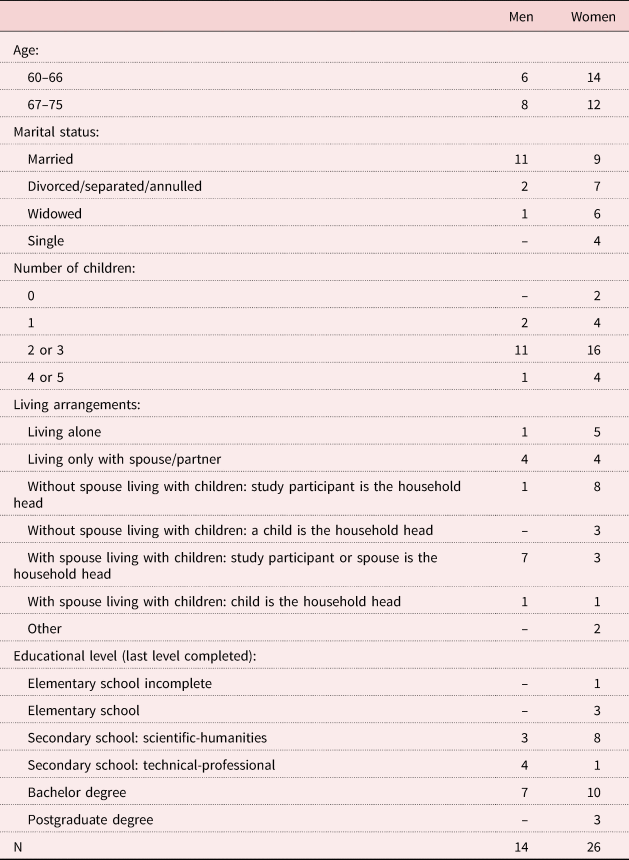
Initially, the sample was selected from among participants of a series of focus groups conducted by the Domeyko Program on Ageing of the University of Chile in 2008 (Bunout et al., Reference Bunout, Osorio, Barrera, Torrejón, Meersohn, Anigstein, Miranda, Espinoza, Hirsch and de la Maza2011). Only those who were aged 60–74 by the time of the study were contacted. Because the focus groups were conducted in 2008, people aged 60–65 were missing from the sample pool. Some eligible participants could not be contacted due to changed phone numbers and others could not participate due to health problems. In total, ten people (seven women and three men) out of 41 people from the Domeyko study who gave consent to be reached for future studies were contacted and agreed to participate in our project. The other 30 participants were reached through older people's clubs and associations, and by the snowball technique. The different recruitment strategies produced a heterogeneous group of participants with respect to their marital status and living arrangements (Table 1). However, the study participants presented a higher than average educational level in comparison with the general Chilean population aged 60 years and older.
Participant characteristics (number of cases)

Interviewing process
Interviews were conducted in Spanish by the first author and consisted of one session of one to two hours length in a place mutually agreed by the researcher and the study participant. The interviews were conducted at people's homes, coffee shops, seniors’ organisations, people's workplace and at the University of Chile.
The interview guide included open-ended questions adapted from a study on personal communities conducted by Spencer and Pahl (Reference Spencer and Pahl2006), and a ‘resource generator’ (Van Der Gaag and Snijders, Reference Van Der Gaag and Snijders2005) to study individual social capital.Footnote 1 The resource generator was used to identify specific types of emotional and instrumental support exchanged with different groups of people (household members, close family, other relatives, neighbours, friends, organisations and other). The interview started with socio-demographic questions (e.g. educational level, living arrangements), followed by the personal communities open-ended questions and then by the resource generator questionnaire.
Adjustments to the interview guide were made after conducting the five initial interviews to improve the scope and clarity of the questions and ensure a good flow of the conversation. In the case of the participants of those five interviews, a short follow-up by phone provided information not contained in the initial interview.
Mapping personal communities
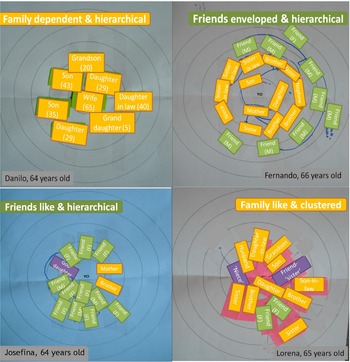
The interviews included a method of mapping personal relationships, as proposed by Spencer and Pahl (Reference Spencer and Pahl2006). Similar to the hierarchical mapping technique (Antonucci, Reference Antonucci1986), concentric circles represent the personal network of the participant. At the centre is the word ‘I’ (Ego, Yo in Spanish), serving as a reference from where participants place the names of emotionally close people (for examples, see Figure 1). For the name elicitation the participants made a list of people ‘who are important to you now’, noting the names or nicknames, kinship, age and geographical distance. This method identified people who were relevant for reasons beyond the support exchanged. It also helped explore the meaning of personal relationships. During the interview, the map helped the flow of the conversation, connecting personal experiences and reflections on the history and qualities of participants’ relationships. Participants could add members on to the map as the interviews developed. All the participants elaborated the list of important people, but three could not draw the maps, due to blindness (two) or illiteracy (one). For these three cases, the participants named the people that were important to them and the interviewer wrote the list. Then, the interviewer asked the participants to rank the people on the list from emotionally closest to less emotionally close. More than one person could share a position in the ranking.
Typology of personal communities.
Notes: Numbers in parentheses represent the person's age. F: female. M: male. YO: I.

Data analysis
Verbatim transcripts of the 40 interviews and fieldnotes were analysed using the software ATLAS.ti. The interviews were first fully read to identify general themes and create initial codes. In a second stage of analysis, codes were used to segment the data. New in vivo and significant codes were added as the analysis developed. The former type of code uses participants’ language to name the analytical categories, while significant codes use the researcher's language to reflect the focus-of-inquiry of the study (King, Reference King and Given2008). In a third stage, we used memos and network views to integrate the data. A network view is a graphic representation of relationships between codes. This tool helps to explore, build and represent conceptual structures. We used memos to describe the properties of our codes, summarise descriptive and conceptual ideas, summarise reflections on the relationship between codes and connect the data with theory-informed concepts.
Socio-demographic information, data from the personal communities diagrams (e.g. type of relationship and its location on the diagram) and data from the resource generator questionnaire were collated in Excel. The maps were classified using Spencer and Pahl's typology, considering the number, type and location of ties included on the map. We also used a visual criterion to classify the diagrams based on the location of the ties in relationship to the centre. A visual example of the typology can be seen in the Findings section (Figure 1).
Findings
The findings are presented in four sections. In the first two sections, we examine the meaning of different types of friendship and family ties included in the personal communities of the study participants. We pay particular attention to how different types of ties are important in their own particular way to them. In the third section, we categorise the diverse composition of the networks using the personal communities typologies. In that section, we describe the composition of the study participants’ networks of close relationships and the rationale they used to include and organise these relationships on the personal communities diagram. Finally, considering the particularities of the Chilean context, we propose a complementary typology of personal communities: clustered and hierarchical personal communities.
Meaning of relationships: friendship ties in personal communities
During the interviews, the study participants explained the nature of their relationship with certain friends and family members. Based on the interviewees description, we identified two type of friendship ties: those with people with whom they have a common history and those with people with whom they have shared interests.
Friends and common history
Fernando (66 years old) distinguishes between ‘long-time’ and ‘short-time’ friends. The former are people who continue to be recognised as friends up to the present, despite the many different lifestages and life experiences not necessarily shared. In that sense, the event or life period they shared in the past was sufficiently important so that the friendship has been carried forward in time. Connidis (Reference Connidis2020) highlights the importance of age peers as friends, as the shared historical time supports self-identity. In this regard, in the case of Chile, shared experiences during the hardest years of the dictatorship were particularly important for interviewees between 60 and 66 years old. That is the case of the friends included in the personal communities of Fernando, Josefina, Blanca and Paulina. Some friendships were developed with university mates before the coup d’état and were nourished by militancy and experiences of prison and exile. Other friendship ties were created during the period of exile and include both Chilean and foreign friends:
Maria is another friend we always get together. Gloria for instance, is going to be a friend for life because we were imprisoned together, so we have, eh, and Javi is a friend from the university and we have all this history together, you see? I mean, with her family, exile, all that. (Paulina, 65 years old)
Only three out of eight male participants of the cohort aged between 67 and 74 years old included friends in their personal communities. A shared event or life experience also characterised friendship for these study participants. In two cases the circumstances that joined these men with their friends were related to the military service.
However, cases in which friendship was created during school or university years, or children's school years, are more common among both men and women of this cohort. The majority of the women of this cohort mention friends they met many years ago (e.g. at school, in their childhood neighbourhood or at their children's school). The relationship with some of those friends has been sporadic, but others included among those ties people who have accompanied them through almost their whole lives:
These are friends from all my life … because I'm from a province [outside the city], so you go to the school, you have worked in the same place together, eh, is like we have grown up together, we don't see [each other] for a while, but we meet again and it's as if we had never been apart. (Catalina, 68 years old)
These types of friendship relationship are good examples of what Kahn and Antonucci (Reference Kahn, Antonucci, Kiesler and Oppenheimer1981) described as a convoy model of relationships, according to which ‘individuals are surrounded by supportive others who move with them throughout the life course’ (Antonucci et al., Reference Antonucci, Ajrouch and Birditt2014: 84).
There is another type of friendship with people known for a relatively long time, one that involves longstanding interaction within a group in which both individuals have participated for a long time (e.g. workplace). These relationships are based on a given space and time that enables a constant interaction from which a different kind of bond is developed:
…short-time friends are those friend that I met I would say in the last ten years, for instance Jose, or Paolo, or Francisco, ok, who are friends I knew at work and there we developed a type of friendship that we are strengthening even more today, because we are more or less on the same page, almost all of us are in the same conditions. (Fernando, 66 years old)
Friends and shared interests
In some cases, new members are incorporated into the network as new interests arise. When asked about people with whom she has more affinity,Footnote 2 more things in common, Loreto (64 years old) reflects on the friends she incorporated in her personal community:
Wow! It's a hard question, a little piece of each one … (sighs) the thing is that in this moment my central friend, with whom I feel more comfortable, is she (pointing to the map) who is relatively new … because today, today for me is the ecological thing, the plants, that, so we are sharing that, the searching of those things.
We can recognise different types of friends who connect with diverse interests and needs: recreational, intellectual, professional, intimate confessions and support. The creation and maintenance of some of these friends depend on sharing a specific place (e.g. civic organisations and work). These context-bound friends are common in men between 60 and 66 years old. Some of these friends are left as context-bound relations because they do not cross the boundaries of the particular setting where they were established. The majority of the interviewees of this age group talked about these types of relationships, but only three of them included these friends in their personal communities.
The younger group of women participants have similar experiences, with cases of context-bound relations and relationships that have overcome the specific setting. Women between 67 and 74 years of age experience something similar with groups formed around a specific area of interest. Whereas in some cases group participation is a good catalyser to develop more permanent friendships, in other cases this type of relationship is bound to specific topics and places without developing into a confidant tie. The latter, however, does not necessarily have a negative connotation, as this type of friendship introduces variety to people's relationships, enabling exploration of emerging areas of interest.
Meaning of relationships: family ties in personal communities
The interviewees also describe their relationship with different family members. Men mainly talk about their relations with children, siblings, nephews and in-laws. Women's closer relationships are usually described with siblings, cousins, children and grandchildren.
Relationship with siblings
Elements of affinity characterise the closeness and intensity of the relationship with given family ties. Interestingly, these elements go beyond the shared experiences that we may expect between siblings and with children. Affinity features in family relationships are similar to those usually associated with chosen ties as they are based on common interests, personality and similar worldviews. This is exemplified by Fernando (66 years old), when describing his relationship with different siblings:
I meet more with him (pointing to the name of one of the brothers) than, for instance, my other brother … with Gabriela less than with the others, because there are affinities that are or are not, even being such close relatives.
Similarly, Pamela (60 years old) describes a good and close relationship with her sisters, but she highlights that her more intimate issues are shared with only one of them, explaining that her other sisters ‘live their lives differently to mine’.
Relationship with children
Most of the participants with children included all their children as members of their personal communities. As in the relationship with siblings, the type of relationship varies from child to child and has some elements of affinity. The emotional closeness depends on having a similar personality and children's lifestages. In some cases, geographical distance and co-residence also play a role in supporting this closeness:
My two daughters are very important for me, ok? Obviously, one lives with me, in the same building, the other lives 15 minutes from here, and obviously I'm closer to them, with the daughters more than the sons, ok? Then comes Lalo … he is a lawyer and sees all that [legal] things … I appreciate him very much but he is more distant, ok? And Andrés, my other son is shyer … he shares with nobody; he is apart, because he is single. (Marisol, 73 years old)
I have much affinity with Carolina, with Graciela too, the thing is that Graciela is too jealous, so she wants me only for her. With Simon yes, we get along, but he is too similar to his mom, so he has her character, he is very reserved with me. (Ramon, 69 years old)
Relationships with children also depend on their stage in life, since the presence of a partner and children influences the time available and the priorities. When children are married or co-habitating, the affinity of the parent with the partner can influence the relationship with the child:
I know they love me as much as I love them but, they're not there when I need them … my daughter, I described her earlier, is quite pretty but unfortunately has a husband who is a troglodyte, mmm … there was a time where we couldn't go to her house, he didn't allow me to call her by phone. (Cristina, 62)
Relationship with spouses and partners
Not all the study participants included their spouses or partners, which did not necessarily reflect a strained relationship. Rather, it represented how participants understood the exercise of naming the people who were important to them or underlying assumptions regarding the relationship. Emilio (71 years old) and Fernando (66 years old) are examples of relationships that were taken for granted. Their wives were unquestionably important ties that did not need to be mentioned. In the case of women who were partnered but not co-habitating, they decided not to include their partners explaining that the relationship was still very casual.
Interestingly, other study participants included in their personal communities partners or spouses despite a strained relationship. In these cases, the relationship with a husband was limited to mutual instrumental help and reception of economic support without an affective connection. Cristina (62 years old) explains:
We still live in the same house. At the beginning it was a very bad relationship, but now is civilised. I mean, there're weekends we can share the lunch or have tea … and since I'm pensioned he took care of all the household expenses because, really, I cannot, not that I do not want, I cannot.
The inclusion of spouses with whom relationships were strained could reflect a moral imperative informing the inclusion of family ties. Under this logic, the inclusion of spouses is done without further consideration as they must be part of the circle in their role of nuclear family member. This is reinforced by the important status of marriage in a country where divorce was legalised in 2004. Also, the role played by the spouse within the household can influence his or her inclusion so as to recognise the degree of dependency towards that person. Some study participants, particularly women between 60 and 66 years old, represent family trajectories that are consistent with patterns of deinstitutionalisation of marriage and family life (Hughes and Waite, Reference Hughes, Waite, Schaie and Uhlenberg2007; Phillipson, Reference Phillipson2013) – with experiences of divorce, singlehood or childless singlehood as a lifelong choice. However, other interviewees have more traditional family arrangements and division of labour that are also reflected in a United Nations’ report about gender equality in Chile:
Underlying the majority representations is the image that the man is the main responsible for providing financial resources through work and ensuring order through their participation in power, while the woman is in charge of the housework, parenting and the performance of the duties of caring for others. (United Nations Development Programme, 2010: 15)
In this context, a woman may include her husband within her personal community, despite the quality of the relationship, because he is the main breadwinner of the house, or a man may include his wife, recognising her role as the main family carer.
Relationship with grandchildren
Most of the participants with children were involved in the care of their grandchildren but not without mixed feelings when issues of physical ability or personality interfered. Half of the female interviewees included their grandchildren in their personal communities, while only two men did so.
Descriptions of grandparenting tend to focus on child-care aspects, without examining the many different types of activities and ways of relating (Moore and Rosenthal, Reference Moore and Rosenthal2016). The experiences of Cristina and Pilar (from the group of 60–66 years old) are particularly interesting, as they represent emergent family roles and obligations in unconventional family structures. They acted as surrogate mothers, taking care of their grandchildren from birth, as their daughters got pregnant at an early age. A grandmother taking care of her grandchildren is not new, but the content of the relationship developed with grandchildren has a strong focus on affective elements that characterise chosen ties. Cristina and Pilar indicate that they keep a special connection with their already grown-up grandchildren, for whom they have become important confidants.
Relationship with extended family members
The conceptual categories of ‘given’ and ‘chosen’ ties (Pahl and Spencer, Reference Pahl and Spencer2010) are also empirical, as the interviewees use this distinction to describe differences between friends and family ties, respectively. Although the study participants generally describe friends as chosen and family as given, their descriptions of the relationship with particular family members include elements of chosen ties. Such is the case of some extended family members. In fact, while some interactions with extended family members are based on customary contexts (e.g. family celebrations), in other cases, people develop friendship ties of deep affection. In male participants, this is particularly visible in their relationship with children's parents in law (consuegros), ‘very very interesting get to know my son's parents-in-law … it has developed into a bond of closeness’ (Rodrigo, 67 years old). Similar experiences are shared by women, although in their case the relationship is with sisters-in-law, cousins, nieces and nephews. Rosa (74 years old) comments on the relationship she has with her sisters-in-law: ‘my sisters-in-law are friends, absolute friends, not only kinship, the sisters-in-law on my husband's side, and two sisters-in-law on my brothers’ side’.
Classifying personal communities
The previous sections examined the meaning of the relationships as identified by the interviewees. They reflected on who should be included in their personal communities while populating the concentric circles of the diagram, and why they should be positioned there. In this second section of the findings, we first examine the rationale used by the interviewees to include specific ties in their personal communities diagrams. Then, we classify the diagrams using the personal communities typology proposed by Pahl and Spencer (Reference Pahl, Spencer, Phillipson, Allan and Morgan2004). This classification offers us a visual snapshot that not only captures different emotionally close ties, as identified by the interviewees, but also facilitates an analysis of the practical implications of having one or another type of personal community.
Inclusion of ties in personal communities diagrams
The personal communities diagrams include chosen and given ties. Friends, children and siblings typically populate personal communities. The decision as to who should be included on the map and how close to the centre any specific individual should be located was based on two complementary dimensions: affection and availability. The latter was based on geographical closeness. The explanation provided by Rodrigo for his map shows how both dimensions work and how much is implied in the notion of people considered as important in one's life:
It has two meanings, an issue more related to the contact through communication and, on the other hand, for the affection that one feels for the person, the closeness … and affection that in some way also means necessity of counting with them. I mean, they are like part of your life; they are accompanying in your own journey … eehh … You feel you need them beside you … I believe that talking about indispensability is going too far, but today, for instance if I stand today, for me they are very important in my life, for my life to have a meaning. (Rodrigo, 67 years old)
Participants differentiate between being geographically close and often in contact (i.e. availability), and being emotionally close (i.e. affection) to someone. Such closeness reflected in the trust constructed over the years or by feelings of love towards nuclear family members. Loreto (64 years old) explains:
It is an intimacy criterion, I would say. I mean, for me to be able to talk about yourself and listen to the other with sincerity … You don't necessarily do that with your children, but the children are the children, they are at the centre of the heart and with these people [the ones on the map], I mean all of them, I speak with an open heart and without limits … here I'm placing the people who really are my friends. I'm not putting people with whom I have to be careful.
The dimension of availability by geographical closeness describes members that were included mainly due to the regularity of face-to-face or phone interaction:
They [brothers] are more distant because we see each other less, talk less … But my brother, Pablo for instance, I would say every other day, every two days I call him by phone or he calls me. (Raul, 67 years old)
Typology of personal communities
The typology of personal communities provides us with a diagrammatic representation of the meaning of personal ties. Figure 1 serves as a visual example of how the categories work.
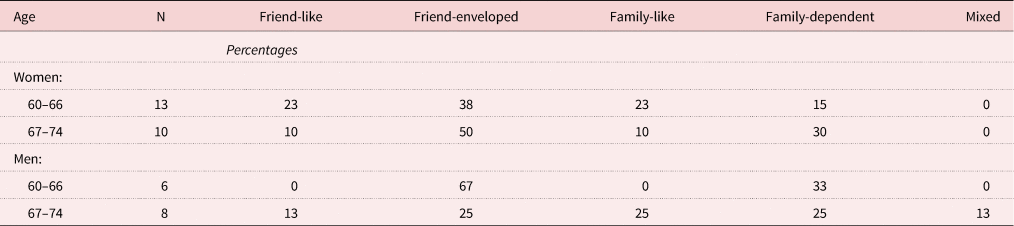
Friend-like and particularly friend-enveloped personal communities are most common among the participants. However, the older group of men have equal distribution of family-dependent, family-like communities, and friend-enveloped communities. The second most common category in the younger group of men and the older group of women is the family-dependent one (Table 2).
Typology of personal communities (based on Spencer and Pahl's typology)

Gender differences are apparent in the composition and size of the interviewees’ personal communities. We found that women's communities were bigger in size (average of 17 members) and more diverse in their composition than those of men (average of ten members). However, we found similarities in the members who are usually included in the communities of male and female interviewees.
Although men and women have similar types of personal communities, with a majority of friend-enveloped and friend-like communities, differences by age interacting with gender are evident. Men between 67 and 74 years old have more family-like and family-enveloped personal communities. The inclusion of mainly workplace friends as part of the men's communities seems to indicate that male interviewees have a lack of opportunities or willingness to connect with people outside the family circle after their retirement. This is similar to the findings of European studies on the confidant networks of older people, where men tended to turn more to family members while women were more likely to increase the size of their network with more friends and fewer family ties (Connidis, Reference Connidis2020). Interestingly, Meersohn Schmidt and Yang (Reference Meersohn Schmidt and Yang2020) found that Chilean older men tended to engage in self-isolation practices such as being hesitant to socialise in organised groups due to uneasiness at participating in activities they had not mastered, and to assumptions of being outnumbered by women in older people's organised groups. After retirement, men have less chances of continuing friendships that are work-bound (i.e. depend on interaction in the workplace and work-related interests). With the discontinuation of the men's preferred type of friendship and their reluctance to resort to organised groups as a means to meet new people, the composition of their personal communities becomes more family centred.
Another explanation for the prevalence of family-like and family-enveloped personal communities in men of 67–74 years of age could be found in the logic used to recognise friends as emotionally close ties. Friends mentioned by this group of participants were characterised as strong bonds created during key lifestages. In that sense, the inclusion of people regarded as friends and, moreover, as emotionally close friends, implies a very selective criterion that cannot be easily achieved or replaced later in life. Additionally, Chilean older men perceive women as more naturally suited than men for social activities due to their skills in domestic and care-giving activities (Meersohn Schmidt and Yang, Reference Meersohn Schmidt and Yang2020). This could restrict older men's opportunities to develop new relationships and different type of friendships.
Our findings align with Sarah Matthews’ (Reference Matthews1983) category of friends as particular individuals and with what she calls a discerning friendship style (Miche et al., Reference Miche, Huxhold and Stevens2013). Friends as particular individuals represents friends acquired early in life –during middle age or before – with whom daily life encounters are important. A discerning friendship style corresponds to individuals who carefully selected a few friends with whom they are deeply committed (Miche et al., Reference Miche, Huxhold and Stevens2013). The cohort of Chilean male interviewees between 65 and 74 years of age seems to match this description. Their preference for particular individuals as friends would have practical consequences as it will result in fewer resources to buffer the effects of old age and an increased risk of isolation (Matthews, Reference Matthews1983). Female interviewees and the younger cohort of male participants would be better prepared to adapt to experiences of change and loss due to their ability to manage their relationships using a variety of strategies. In fact, Meersohn Schmidt and Yang (Reference Meersohn Schmidt and Yang2020) found that Chilean older women utilise different strategies to prevent loneliness, such as creating new acquaintances, resuming friendships, and joining community centres and organised groups. They also found that Chilean older men were slowly opening up to new strategies to become more socially involved (e.g. participating in sports and workshops).
The strategies used by female interviewees and male interviewees of 60–64 years of age include developing relationships that could become a specific type of context-bound friendship that are similar to what Matthews (Reference Matthews1983) described as ‘friends as relationships’. In these friendships, a shared biography is not needed and the benefits available in the relationship are replaceable. Therefore, from a positive stance, these types of relations show that people can develop new relationships in a context that facilitates permanent encounters. Also, context-bound friendships enable sharing with people who have similar interests, which are not necessarily present among family members (Blieszner et al., Reference Blieszner, Ogletree and Adams2019). The downside is that context-bound relationships are difficult to keep if the person ends his or her affiliation to the particular context. Kahn and Antonucci (Reference Kahn, Antonucci, Kiesler and Oppenheimer1981) indicated that people who mainly develop role-linked relationships are at greatest risk if the role is lost. However, as Matthews (Reference Matthews1983) states and the cases of female interviewees show, some people are able to create new roles that link them to others, to capitalise different types of situations to adapt to the changes of old age.
A complementary typology: clustered and hierarchical personal communities
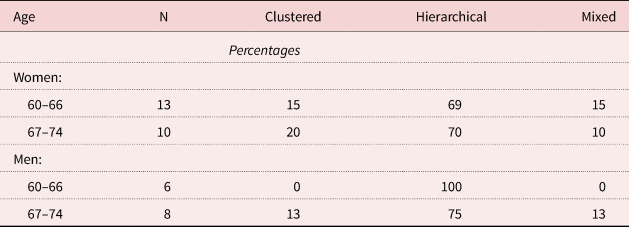
Considering the characteristics of the Chilean context, we suggest a complementary classification to Spencer and Pahl's typology. We distinguish between clustered and hierarchical communities (Table 3). This classification originated from the overall visual difference between maps, and captures the way in which the participants arranged the different ties on it in relationship to the centre.
Proposed complementary typology of personal communities

The majority of participants designed maps with more or less clear hierarchies, i.e. members were clearly located on the different circles. In Figure 1, the maps of Danilo, Fernando and Josefina represent hierarchical maps. However, six cases (one man and five women) have clustered and mixed types of maps. Participants with clustered communities located the majority of the members overlapped at the centre of the map and had their communities composed of a variety of kin and non-kin ties. Lorena's map in Figure 1 is a good example of a clustered community.
This complementary typology helps us to illustrate and define emotional closeness. The decision of some participants to represent their communities by clustering relationships at the centre of the diagram signifies a sharp binary distinction that differentiates between people who are emotionally close and those who are not. Emotionally close people are included in the community without prioritising or segmenting the type or function of the relationship. In combination with Spencer and Pahl's categories, this complementary typology advances representation of the dimension of suffusion of personal relationships. The suffusion process represented in clustered personal communities can be better understood through a consideration of the Chilean socio-cultural context, where social trust is particularly low (World Values Survey Association, 2012). Thus, clustered personal communities seem to mark a distinctive line between those who can be relied upon and those who cannot. Those who can be relied upon are at equal level, blending family and non-family ties.
Conclusion
From a conceptual and methodological standpoint, the study began off with questions of how to capture the ties that have become part of the ‘taken-for-granted’ reality of older people, and how these ties are relevant to them. We have addressed these questions by examining the diversity, quality and characteristics of personal ties as defined by respondents’ subjective experiences.
Despite the targeted scope of the research, the study findings can be compared with similar studies conducted in different socio-cultural contexts. A study of personal communities conducted by Pahl and Spencer (Reference Pahl, Spencer, Phillipson, Allan and Morgan2004) in England found that ties were selected according to three criteria: whether or not the ties were family connections; the quality of the relationship; and the context of the relationship (frequency of contact, duration of the relationship and sense of continuity). Similarly, the Chilean interviewees used criteria of affection – which is connected to the quality of the relationship – and availability given by geographical closeness that facilitates frequency of contact. Interestingly, the inclusion of family ties, especially nuclear family ties, was explained in the context of the relationship (availability and continuity) and not necessarily by a cultural norm of familism. Thus, interviewees use a criterion that is not exclusive to family to include people as part of their communities, which aligns with the definition of chosen and given ties in modern societies, as proposed by Pahl and Spencer (Reference Pahl and Spencer2010). Being available and having continuous relationships are characteristics that can be also found in friends who live geographically close. At the same time, the criterion of affection is used to include and categorise given and chosen ties in personal communities. This criterion not only encompasses a feeling of love or fondness, but also a sense of affinity given by similar personality, interests and/or worldviews.
Related to the latter, the findings indicate a distinctive notion of friendship. While family is ‘given’ and imposed, friendship is a ‘constructed relationship’ as Rosa (74 years old), one of the interviewees, mentioned. This idea highlights the element of personal choice involved in the development and maintenance of personal relationships. We can apply the notion of constructed relationship not only to non-kin friends, but to any personal tie regarded as chosen and developed into a close relationship with features of friendship. This reflects what Spencer and Pahl (Reference Spencer and Pahl2006) describe as suffusion – the blurred boundaries of categories of kin (‘given ties’) and non-kin (‘chosen ties’). The findings also align with descriptions of changes in family roles and relationships that challenge definitions of what family is and what the obligation among family members are (Hughes and Waite, Reference Hughes, Waite, Schaie and Uhlenberg2007; Phillipson, Reference Phillipson2013). The practical implications of this blurring of boundaries are that both types of ties provide (or have the potential to provide) similar resources to the older person, depending on the circumstances.
Consciously or unconsciously, people weigh the amount of involvement needed to keep a relationship and whether such a relationship is worth keeping. In that sense, and in accordance with the idea of convoy (Antonucci et al., Reference Antonucci, Ajrouch and Birditt2014), networks of relationships are not static. These networks, as well as particular relationships, evolve as people evolve. Some ties are important in their quality of ‘particular individuals’ (Matthews, Reference Matthews1983), and are kept in recognition of the similar life paths or the life events that have been shared. Other relationships are further developed when common interests or world perspectives are recognised and, thus, context-bound and interest-specific relations are created. Yet other connections are put on hold or are terminated. Therefore, friendship and family relationships have different shades and functions that need to be recognised and explored. Regarded in this way, the personal community framework proves to be a helpful conceptual and methodological tool to capture ties that would remain otherwise obscured as taken-for-granted interactions, or because they do not supply easily identifiable forms of support. In this manner, the relevance of the findings are conceptual, methodological and practical as the assumed role of family as the first line of support (Shanas, Reference Shanas1979; Phillipson, Reference Phillipson2013) ignores individuals’ own definitions and experiences of family life.
From a practical perspective, the typologies of personal communities as well as the attention to the characteristics of the relationships with different personal ties advance understanding of the strategies used by older people to construct and maintain their social worlds. Our findings also enable us to explore gender and cohort differences in the way in which relationships are managed and defined. Finally, our research in the Chilean context adds a socio-cultural dimension to the investigation of personal communities by proposing the categories of ‘clustered’ and ‘hierarchical’ personal communities.
Ethical standards
Ethical approval was received from the University of British Columbia Behavioural Research Ethics Board (H13-02487).