1. Introduction
The aim of this paper is to address the poorly explored issue of linguistic giftedness (LG) in foreign or second language learners.Footnote 1 In the field of second language acquisition (SLA), little research addressing gifted and exceptionally talented language learners has been conducted, and, consequently, little is known about this population. One possible reason for this is the ‘social turn’ in SLA (Block Reference Block2003), a trend emphasizing the social and cultural context of this process over congenital cognitive factors (see Mercer Reference Mercer2012). The underlying assumption of this position is that it is unfair and undemocratic to differentiate between people with respect to their abilities because it lessens the value of individual effort. As a result, there is no one unitary approach to researching LG or a modern definition of this construct. The phenomenon of LG is worth exploration because thorough study of learners who are capable of achieving very high levels of attainment can provide information about SLA in general. In view of the growing interest in foreign language (FL) aptitude as well as attempts to reconceptualize and update the concept in response to advances in psychology, linguistics and neurology, it seems necessary to take a closer look at the fascinating and complex phenomenon of gifted foreign language learners.
In accordance with this goal, the opening section is intended to present the concept of FL aptitude from a wider perspective of research on human cognitive abilities. Three contemporary models will be outlined: Skehan's (Reference Skehan1998, Reference Skehan and Robinson2002, Reference Skehan, Gass and Mackey2012) Processing Stage Model, Robinson's (Reference Robinson and Robinson2002) Aptitude Complex Model and Sternberg's (Reference Sternberg and Robinson2002) model of FL aptitude as a dynamic concept. In the second section, definitions of talent and giftedness will be presented, as well as methods of identifying gifted individuals and potential selection criteria. Emphasis will be placed on two psychological models of giftedness, that is Gagné's (Reference Gagné2000, Reference Gagné, Sternberg and Davidson2005) Differentiated Model of Giftedness and Talent, and Renzulli's (Reference Renzulli, Sternberg and Davidson1986) Three Ring Model. Subsequently, empirical research on gifted FL learners will be presented. The studies on exceptional L2 learners will be divided into three groups. The first group comprises early research on gifted individuals (Novoa, Fein & Obler Reference Novoa, Fein, Obler, Obler and Fein1988; Schneiderman & Desmarais Reference Schneiderman and Desmarais1988a; Ioup et al. Reference Ioup, Boustagui, El Tigi and Moselle1994). The second group includes research on very advanced L2 postpubescent learners (Moyer Reference Moyer1999; Bongaerts, Mennen & van der Silk Reference Bongaerts, Mennen and van der Silk2000; Birdsong Reference Birdsong, Davies and Elder2004; Bongaerts Reference Bongaerts2005; van Boxtel, Bongaerts & Coppen Reference Van Boxtel, Bongaerts and Coppen2005; Birdsong Reference Birdsong, Bohn and Munro2007; Moyer Reference Moyer2007; Abrahamsson & Hyltenstam Reference Abrahamsson and Hyltenstam2008, Reference Abrahamsson and Hyltenstam2009). The third group includes studies of FL super-learners and polyglots, i.e. individuals who achieve high levels of proficiency in several languages (Smith et al. Reference Smith, Tsimpli, Morgan and Woll2011; Treffert Reference Treffert2011; Erard Reference Erard2012; Hyltenstam Reference Hyltenstam2014a, Reference Hyltenstam2014b; Hyltenstam Reference Hyltenstam and Hyltenstam2016a, Reference Hyltenstam and Hyltenstam2016b forthcoming). This will be followed by discussion of the findings of selected research projects on different aspects of LG, namely the relationship between native ability and L2 aptitude, LG and intelligence, memory, personality factors and language learning strategies (LLS), and neurological advances referring to brain functioning in gifted L2 learners. Finally, the limitations of research on LG will be addressed and future directions of such research will be outlined, both in terms of its focus and methodology.
2. Definitions and models of FL aptitude
FL aptitude is a factor which, next to age of onset (AO), accounts for the largest proportion of variation in the outcomes of FL learning among all individual difference (ID) variables. It concerns a wide variety of cognitively-based learner differences and remains a reliable predictor of success after the closure of sensitive periods (Long Reference Long, Granena and Long2013: 13). A whole gamut of FL aptitudes enclosed in the domain of IDs has attracted the attention of SLA researchers (Abrahamson & Hyltenstam Reference Abrahamsson and Hyltenstam2008; Granena & Long Reference Granena and Long2013; Moyer Reference Moyer2013), with the effect that the construct has been updated and reconceptualized, largely thanks to the developments in the fields of SLA, psychology and neurolinguistics.
The first and the most influential model of FL aptitude was developed by Carroll (Reference Carroll1959, Reference Carroll and Diller1981), who described the construct in terms of four, relatively independent, subcomponents, namely: phonetic coding ability, grammatical sensitivity, inductive language learning ability, and associative memory. The four-component view of aptitude and the famous measurement tool, the Modern Language Aptitude Test (MLAT) (Carroll & Sapon Reference Carroll and Sapon1959), have provided a crucial foundation for all subsequent FL aptitude research, giving rise to the implementation of other instruments, such as those devised, among others, by Pimsleur (Reference Pimsleur1966), Grigorenko, Sternberg & Ehrman (Reference Grigorenko, Sternberg and Ehrman2000), Meara (Reference Meara2005), and Doughty et al. (Reference Doughty, Campbell, Mislevy, Bunting, Bowles, Koeth, Prior, Watanabe and Lee2010, see also Doughty Reference Doughty, Granena and Long2013).
At present, two models can be regarded as the most important: Skehan's (Reference Skehan1998, Reference Skehan and Robinson2002) and Robinson's (Reference Robinson and Robinson2002, Reference Robinson and DeKeyser2007), both of which view FL aptitude as a set of cognitive abilities and describe it from the perspectives of psycholinguistics and cognitive science. In contrast to previous models, which considered FL aptitude to be a self-contained area, Skehan (Reference Skehan1998) proposed a conceptualization, where aptitude consists of components that could be related to different stages of information processing in SLA. Thus, phonetic coding ability corresponds to input processing, language analytic ability, which includes Carroll's (Reference Carroll1959) grammatical sensitivity and inductive language learning, is related to central processing, and memory-as-retrieval is tied to output and fluency. Skehan's (Reference Skehan and Robinson2002) updated model includes attentional control and working memory, both extremely significant in contemporary research on FL aptitude, and identifies four stages of SLA processing: noticing, patterning, controlling and lexicalizing. Such a conceptualization is compatible with a cognitive view on SLA (Dörnyei & Skehan Reference Dörnyei, Skehan, Doughty and Long2003: 596; Linck et al. Reference Linck, Hughes, Campbell, Silbert, Tare, Jackson and Doughty2013a).
Robinson constructed a model in which FL aptitude is seen as consisting of a number of aptitude complexes that are differentially related to FL learning under different conditions, an assumption that is termed the Aptitude Complex Hypothesis (Robinson Reference Robinson and DeKeyser2007: 274). In line with this hypothesis, some FL learners might possess strengths in abilities facilitative under specific learning conditions but less efficient in others. Robinson (Reference Robinson and Robinson2002) identifies four complexes of aptitudes. Primary, or first-order, abilities are directly measured by psychological tests and involve such constructs as working memory capacity, pattern recognition, grammatical sensitivity and speed of processing, implemented by cognitive factors, including attention, working-, short- and long-term memory. Second-order abilities are combinations of primary abilities, which comprise such cognitive constructs as noticing the gap, memory for contingent speech, memory for contingent text, as well as metalinguistic rule rehearsal. While the model is in many respects an extension of traditional research on aptitude in assuming its hierarchical structure (see Carroll Reference Carroll1959, Reference Carroll1993), relating aptitude complexes to instructional options and settings (see Wesche Reference Wesche and Diller1981; Snow Reference Snow, Sternberg and Wagner1994; Skehan Reference Skehan1998), and assigning learners to memory-oriented and analytically-oriented categories (see Skehan Reference Skehan1989, Reference Skehan1998), its unique contribution lies in the complexity and meticulousness of analysis of aptitude-treatment-interactions (ATI) (see Vatz et al. Reference Vatz, Tare, Jackson, Doughty, Granena and Long2013).
In contemporary research on cognitive factors, FL aptitude is retheorised as a dynamic construct, which interacts with the environment, depends on evolutionary development (see Sternberg & Grigorenko Reference Sternberg and Grigorenko2000) and is potentially trainable (see Sternberg Reference Sternberg and Robinson2002; Dweck Reference Dweck2006; Mercer Reference Mercer2012). The most important implication of Sternberg's (Reference Sternberg and Robinson2002) theory is that abilities are not stable but can be developed. Consequently, individual differences with respect to FL aptitude should correspond to appropriate instructional approaches (see Robinson Reference Robinson and Robinson2002). This conviction finds its reflection in a method of testing proposed by Sternberg (Reference Sternberg and Robinson2002), dynamic testing, where learners are given feedback during the test in order to improve their scores. This idea provided a basis for a new FL aptitude test, the Cognitive Ability for Novelty in Acquisition of Language (CANAL-FT) (Grigorenko et al. Reference Grigorenko, Sternberg and Ehrman2000), which incorporates Sternberg's main assumptions with reference to human abilities. Such a dynamic perspective is in line with a position on the development of talent, which was proposed by Dweck (Reference Dweck2006) and later applied to the field of SLA by Mercer (Reference Mercer2012). Drawing upon the interactionist stance and complexity theory (Larsen-Freeman & Cameron Reference Larsen-Freeman and Cameron2008), Dweck questions the traditional view of ability as fixed and stable, and introduces the concept of mindset, which represents a mental attitude that determines how individuals interpret and respond to various situations.
3. Cognitive giftedness: A contemporary psychological perspective
There are many definitions of giftedness in psychology; however, most researchers describe it in rather broad terms, with reference to various cognitive and non-cognitive qualities. The IQ (intelligence quotient) score is considered an indispensable, but inadequate, measure of giftedness. This is because other factors, such as motivation, high self-concept and creativity, are considered to be vital qualities in the development of giftedness into talent (Renzulli Reference Renzulli, Sternberg and Davidson1986; Gagné Reference Gagné2000; Simonton Reference Simonton, John, Robins and Pervin2008; Erard Reference Erard2012). Two models of giftedness are often referred to in psychological literature, those proposed by Gagné (Reference Gagné2000) and Renzulli (Reference Renzulli, Sternberg and Davidson1986), even though terminological problems abound.
Gagné's (Reference Gagné2000) Differentiated Model of Giftedness and Talent elucidates how outstanding natural abilities develop into specific expert skills or talents. Giftedness is an untrained innate ability, evident in no less than one aptitude domain, to a degree that places a child at least among the upper 15% of peers. Talent signifies superior mastery of methodically upgraded abilities, skills or knowledge in at least one domain, which categorizes the individual's achievements within at least the top 15% of peers. There exist five domains of aptitude, that is intellectual, creative, socio-affective, sensorimotor and other factors. Natural abilities are inborn and can be identified in intellectual undertakings, one of which is L2 learning. These abilities can be observed in children, adolescents and adults through their capacity for acquiring new skills and the pace at which this happens. Abilities progressively transform into talents through systematic training, with the caveat that two key conditions have to be met: one is the presence of well-above-average natural ability and the other is systematic effort devoted to training and practising.
In Renzulli's (1986) Three Ring Model, three indispensable clusters of human traits form a gift, namely: above-average ability, high levels of task commitment and high levels of creativity, where above-average ability can be specified as either general or domain-specific cognitive ability. To make the implementation of all three elements successful, an ample variety of educational opportunities is required. Renzulli declares that it is not the ‘strength’ of particular clusters of traits, but rather the interaction occurring between them that shapes the development of talent.
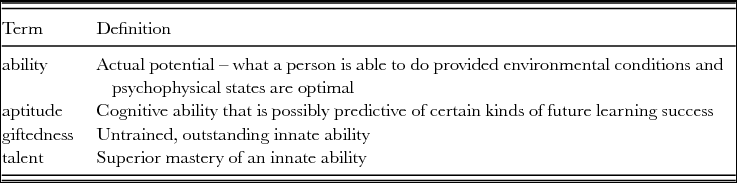
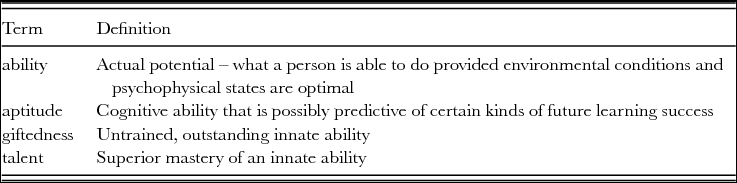
Evidently, the terms ability, aptitude, giftedness and talent are not clearly differentiated in psychology and are often used interchangeably. Gagné (Reference Gagné2000) equates aptitude with giftedness, Renzulli (Reference Renzulli, Sternberg and Davidson1986) does not seem to differentiate between giftedness and talent, and there are those who opt for the term genius (Simonton Reference Simonton, John, Robins and Pervin2008: 683), which is highly controversial and subjective. In SLA research, FL aptitude is identified as a complex set of cognitive abilities, whereas giftedness/talent refers to an extremely high level of aptitude (see Skehan Reference Skehan1998; Robinson Reference Robinson and DeKeyser2007). An attempt at resolving this terminological confusion is made in Table 1.
Classification of terminology (based on Renzulli Reference Renzulli, Sternberg and Davidson1986; Carroll Reference Carroll1993; Gagné Reference Gagné2000)
Irrespective of the specific terms used, in most theories, giftedness is not defined in a dichotomous way, but, rather, as a continuum. Such terms as ‘bright’, ‘able’, ‘more able’, ‘highly able’, ‘gifted’ and ‘talented’, referring to degrees of exceptionality, are present in all definitions of this concept. Procedures for identifying giftedness are varied because there is no conceptual clarity as to what exactly it comprises, with qualitative and quantitative criteria being proposed (see Kerr Reference Kerr2009; Erard Reference Erard2012). Teacher-, parent-, peer-, or self-nomination based upon academic results typically represent the former, while data concerning students’ school history and standardized test outcomes (e.g. intelligence or aptitude) are reflective of the latter. The process of classification of gifted individuals is approached from a number of perspectives, taking into account a variety of factors, such as specific and general cognitive ability together with cultural, gender and language differences (Kerr Reference Kerr2009: xxviii).
An important consideration in selecting talents is a decision as to how gifted individuals differ from what is regarded the norm. The norms proposed in the literature vary, as evident in recommendations that individuals placed within the top 15% (Renzulli Reference Renzulli, Sternberg and Davidson1986; Gagné Reference Gagné2000) or 5% (Selinker Reference Selinker1972) of the normal curve be considered talented. Despite these controversies and relative subjectivity of the discussed terms, researchers generally agree that the most important criterion for talent is remarkable achievement. Evidently, the definitions of talent or giftedness proposed in the field of psychology, although relevant to the domain of LG, are insufficient as a point of reference for SLA researchers who have to develop their own criteria for identifying and measuring linguistic talent. A modified definition of a gifted L2 learner that we propose might read as follows: A gifted FL learner is a person who, owing to his/her exceptional inborn gift for learning languages, especially capacious verbal working memory, as well as expertise in L2 learning, is able to learn any foreign language to a near-native level of competence, given proper motivation, time and conducive environment. Consequently, we will use the terms linguistic giftedness (LG) and gifted foreign language learners with respect to such individuals. However, other terms, such as foreign language high achievers, superlearners, hyperpolyglots and exceptional foreign language learners will be used as well when describing specific studies to give justice to the perspective that particular researchers adopt to refer to this group or the research foci they wish to emphasize.
4. Review of research on gifted FL learners
Recently, there has been a growing interest in gifted FL learners with respect to second or foreign languages. The most promising areas of research are studies examining ultimate attainment of late learners (e.g. Ioup et al. Reference Ioup, Boustagui, El Tigi and Moselle1994; Moyer Reference Moyer1999; Bongaerts, Mennen & van der Silk. 2000; Nikolov Reference Nikolov2000; van Boxtel, Bongaerts & Coppen Reference Van Boxtel, Bongaerts, Coppen, Foster-Cohen and Pekarek-Doehler2003; Birdsong Reference Birdsong, Davies and Elder2004; Bongaerts Reference Bongaerts2005; van Boxtel et al. Reference Van Boxtel, Bongaerts and Coppen2005; Birdsong Reference Birdsong, Bohn and Munro2007; Moyer Reference Moyer2007; Abrahamsson & Hyltenstam Reference Abrahamsson and Hyltenstam2008; DeKeyser, Alfi-Shabtay & Ravid Reference DeKeyser, Alfi-Shabtay and Ravid2010; Granena & Long Reference Granena and Long2013), those investigating the role of social-psychological factors in gifted FL learners (e.g. Moyer Reference Moyer2007; Rota & Reiterer Reference Rota, Reiterer, Dogil and Reiterer2009; Moyer Reference Moyer2010; Forsberg Lundell & Sandgren Reference Forsberg Lundell, Sandgren, Granena and Long2013; Moyer Reference Moyer2013), and those focusing on maximally advanced multilinguals, that is super-learners, polyglots, and savants (e.g. Smith et al. Reference Smith, Tsimpli, Morgan and Woll2011; Treffert Reference Treffert2011; Erard Reference Erard2012; Hyltenstam Reference Hyltenstam2014a, Reference Hyltenstam2014b; Hyltenstam Reference Hyltenstam and Hyltenstam2016a, Reference Hyltenstam and Hyltenstam2016b forthcoming). Particularly interesting is neurolinguistic research (e.g. Golestani, Price & Scott Reference Golestani, Price and Scott2011; Reiterer et al. Reference Reiterer, Pereda and Bhattacharya2011a, Reference Reiterer, Hu, Erb, Rota, Nardo and Grodd2011b; Díaz et al. Reference Díaz, Mitterer, Broersma and Sebastian-Galles2012; Sebastián-Gallés et al. Reference Sebastián-Gallés, Soriano-Mas, Baus, Díaz, Ressel, Pallier, Costa and Pujol2012; Hu et al. Reference Hu, Ackermann, Martin, Erb, Winkler and Reiterer2013), which represents a major advance on sole reliance on behavioral data. Researching exceptional talents is difficult because such talents are quite rare and it is difficult to assemble a group that would be large enough for statistical analysis. Besides, there exist idiosyncratic paths of development of gifted individuals that fall outside any classifications, the criteria adopted for the choice of such individuals are inconsistent, and the research methodology varies (see Abrahamsson & Hyltenstam Reference Abrahamsson and Hyltenstam2008; Long Reference Long, Granena and Long2013).
Studies on gifted L2 learners can be roughly divided into three groups. The first comprises early research on gifted individuals (e.g., Novoa et al. Reference Novoa, Fein, Obler, Obler and Fein1988; Schneiderman & Desmarais Reference Schneiderman and Desmarais1988a, Ioup et al. Reference Ioup, Boustagui, El Tigi and Moselle1994). The second includes research on accomplished L2 post-pubescent learners (e.g., Moyer Reference Moyer1999; Bongaerts et al. Reference Bongaerts, Mennen and van der Silk2000; DeKeyser Reference DeKeyser2000; Nikolov Reference Nikolov2000; Birdsong Reference Birdsong, Davies and Elder2004; Bongaerts Reference Bongaerts2005; van Boxtel et al. Reference Van Boxtel, Bongaerts and Coppen2005; Birdsong Reference Birdsong, Bohn and Munro2007; Moyer Reference Moyer2007; Abrahamsson & Hyltenstam Reference Abrahamsson and Hyltenstam2008; Sáfár & Kormos Reference Sáfár and Kormos2008; Abrahamsson & Hyltenstam Reference Abrahamsson and Hyltenstam2009; DeKeyser et al. Reference DeKeyser, Alfi-Shabtay and Ravid2010; Biedroń Reference Biedroń2011a, Reference Biedroń2012a, Reference Biedroń and Pawlak2012b; Granena Reference Granena, Granena and Long2013; Granena & Long Reference Granena and Long2013). The third brings together empirical investigations of L2 super-learners, or hyperpolyglots (Erard Reference Erard2012), two ongoing studies of savants, those of Christopher (Smith & Tsimpli Reference Smith and Tsimpli1991; Morgan et al. Reference Morgan, Smith, Tsimpli and Woll2007; Smith et al. Reference Smith, Tsimpli, Morgan and Woll2011) and Daniel Tammet (Treffert Reference Treffert2011), and a study on polyglots conducted by Hyltenstam (Reference Hyltenstam2014a, Reference Hyltenstam2014b). The following sections present studies representing these three lines of inquiry.
4.1 Early research on gifted foreign language learners – case studies
Early research on outstanding linguistic abilities focused on the neurological basis underlying linguistic talent (e.g. Fein & Obler Reference Fein, Obler, Obler and Fein1988; Novoa et al. Reference Novoa, Fein, Obler, Obler and Fein1988; Schneiderman & Desmarais Reference Schneiderman and Desmarais1988a, Reference Schneiderman, Desmarais, Obler and Fein1988b). In these studies, linguistic talent was defined as an extraordinary ability allowing achievement of L2 native-like competence L2 after puberty (Schneiderman & Desmarais Reference Schneiderman and Desmarais1988a). In his overview of research on gifted language learners, Skehan (Reference Skehan1998) upheld the position that they are able to master a foreign language relatively quickly, after the closure of the critical period, and to a native-like level. Fein & Obler (Reference Fein, Obler, Obler and Fein1988), in turn, added a comparative criterion, defining an exceptionally talented L2 learner either as outstanding by comparison to peers or as exceptional for the individual under consideration.
Schneiderman & Desmarais (Reference Schneiderman and Desmarais1988a, Reference Schneiderman, Desmarais, Obler and Fein1988b) suggested a neuropsychological substrate for talent tantamount to greater neurocognitive flexibility. From this perspective, talented L2 learners were defined as those basically indistinguishable from native speakers. Following Selinker (Reference Selinker1972),Footnote 2 they claimed that only 5% in a population are able to achieve such a level of proficiency in all L2 domains. They separated phonological talent, which they considered a special capacity for mimicking dialects, from talents for grammar and lexis. It is interesting to note that they associated phonological ability with a personality trait, namely willingness to adopt the identity of – or passing for – a native speaker, which was believed to influence the rate and efficiency of attaining a foreign accent. Other personality factors predictive of perfect pronunciation were high motivation, non-conformism and readiness to take risks.
Schneiderman & Desmarais (Reference Schneiderman and Desmarais1988a) conducted a study of two gifted learners, selected on the basis of their native-like proficiency in at least one L2 attained after puberty, who were 23 and 30 and whose AO was 11 years. Their proficiency in phonetics and grammar was assessed by native speakers, with native-like levels being identified for French and fluency determined for other languages. The researchers mainly focused on memory and IQ measures of ability, applying the Wechsler Memory Index, the Wechsler Digit-Symbol Coding, and the MLAT (parts one, two and five), as well as verbal and performance scales of the Wechsler Intelligence Scale. In addition, they compared the subjects against Geschwind & Galaburda's (Reference Geschwind and Galaburda1985) cluster in order to determine the degree of lateralization. The study found extraordinary memory in the subjects, which was attributed to the ability to employ infrequent strategies in performing standardized verbal memory tasks (e.g. memorizing lists of words). The researchers claimed that adaptable individuals do not need to depend on categorization of items into classes, but bypass them. Therefore, gifted L2 learners are independent of traditional networks because their superior memory underpins high ability to acquire new codes. Moreover, the subjects performed better on verbal than non-verbal tasks, with a difference of 15 points on the intelligence scales. Some of Geschwind & Galaburda's (Reference Geschwind and Galaburda1985) characteristics were observed, which indicated that linguistic talent implies bilateral processing.
Novoa et al. (Reference Novoa, Fein, Obler, Obler and Fein1988) report the findings of a study of CJ – a 29-year-old talented male L2 learner. He was a native speaker of English who had learned six languages: German, French, Latin, Moroccan Arabic, Spanish and Italian. The selection criteria required that he had learned a number of foreign languages post puberty, fast and to a native-like proficiency level. CJ's achievement was evaluated by native speakers who confirmed ease and speed of learning, and declared that he did not have a foreign accent. The study divulged that CJ was born one month prematurely and as a child was slow in reading but he was overall a good student. His AO was 15 years and experience with foreign languages was uneven. CJ studied French and German in high school, French literature in college, and spent one year in France and only a few weeks in Germany. Exposure to other languages was rather brief and involved a few weeks in Spain and Italy, where he ‘picked up’ both languages in ‘a matter of weeks’ in an untutored environment. He presented many factors related to Geschwind & Galaburda's (Reference Geschwind and Galaburda1985) cluster: left-handedness, being a twin, allergies and hives, schizophrenia in the family, homosexuality and poor spatial orientation.
Similarly to Schneiderman & Desmarais (Reference Schneiderman, Desmarais, Obler and Fein1988a), Novoa et al. (Reference Novoa, Fein, Obler, Obler and Fein1988) focused on memory and language abilities but also investigated abstract reasoning, visual-spatial functioning, musical ability and personality. The instruments used included the Wechsler Adult Intelligence Scale-Revised, the Raven Progressive Matrices, the MLAT and the Rorschach Test. With respect to general intellectual functioning, CJ was average, since his WAIS-R IQ score was 107 and there was no significant difference between the verbal and performance IQ scores. More revealing were the scores obtained for tests contained in the WAIS-R (Vocabulary and Digit-Symbol Coding) which are directly linked to FL aptitude. A high score on Vocabulary reflects the ability to define words, whereas Digit-Symbol Coding is a traditional test of short-term memory. Particularly notable was CJ's performance on the latter, in which he managed to recall nine digit-symbol pairs without error immediately after the presentation and after a 20-minute delay. He also performed very well on the Raven Progressive Matrices, scoring at the 95th percentile, while his visual-spatial reasoning was unimpressive. The conclusion was that CJ is profoundly gifted in learning new vocabulary, the acquisition of a new code and the ability to perceive and complete formal patterns.
The most remarkable finding was CJ's scores on memory tests. In general, his performance on verbal memory tasks was excellent in comparison to visual memory, which was average. He was able to retain long sequences of words after 20 minutes, which demonstrated his superior memory capacity. Moreover, his long-term memory, as measured by retention of prose passages, was outstanding and was placed above the 99th percentile. CJ's musical ability was evaluated as average, but his ability to pick up a foreign accent was superior. He also possessed personality features associated with perfect pronunciation, specifically high motivation, non-conformist self-concept and willingness to take risks (see Schneiderman & Desmarais Reference Schneiderman and Desmarais1988a). It was concluded that CJ's LG was caused by two factors: exceptional verbal memory and enhanced perception of formal patterns. Following Schneiderman & Desmarais (Reference Schneiderman and Desmarais1988a), Novoa et al. (Reference Novoa, Fein, Obler, Obler and Fein1988) attributed his outstanding talent to neurological factors: more bilateral organization of the brain for language. From the contemporary perspective, it appears that CJ was profoundly talented with respect to short-term phonological memory and noticing.
Ioup and her co-workers (Ioup et al. Reference Ioup, Boustagui, El Tigi and Moselle1994) report a case study of an adult woman, aged 47, who achieved near-native-like competence in a natural environment without formal instruction. Julie immigrated to Cairo at the age of 21 when she married an Egyptian. Living in Egypt for 26 years, she was immersed in the language, as all her family spoke Arabic and she acquired it very quickly. After six months she was able to communicate well, and after only two-and-a-half years she passed for a native speaker. Phonology was never a problem for her, but she did not learn to read or write because of lack of formal instruction.
The measures employed to assess Julie's target language (TL) competence comprised speech production, grammaticality judgment, translation, anaphoric interpretation and accent recognition tasks. Her scores were compared to those of native speakers and to those of a proficient learner with extensive formal instruction. Native-speaker judges evaluated Julie's Arabic as native with respect to three factors: perceptual abilities, which allowed her to produce accent-free speech, production skills, and underlying linguistic competence. Although she failed to reach native-like norms in syntax and semantics, her grammatical competence did not differ from that of a formally instructed learner. As in the previous studies, Julie's exceptional success was attributed to atypical brain organization and greater neurocognitive flexibility, with the caveat that this interpretation is highly subjective. She also possessed a few features from Geschwind & Galaburda's (Reference Geschwind and Galaburda1985) cluster, namely weak mathematical abilities, left-handedness, allergies, and twins in the family. Another of Julie's interesting attributes that demonstrated her giftedness was that she started to speak in full sentences in the L1 at the age of 18 months. She always had a talent for mimicking accents and was good at grammar, both in the case of English and Latin, which she learned at school. Finally, the researchers emphasized Julie's outstanding noticing ability. Not only did she make an effort to consciously manipulate language structure and attend to form, but also paid attention to morphology and tried to self-correct. An important conclusion was that talented adult FL learners pay conscious attention to form.
The characteristics shared by the subjects of the four case studies include an excellent memory, high phonological abilities, high analytic abilities for dealing with simple codes, and rich vocabulary. Their intelligence is within the average range; nonetheless, they perform higher on verbal than on performance intelligence scales. The researchers unanimously attribute these characteristics to bilateral brain organization. Nevertheless, it appears that most of the criteria applied in evaluating learning speed and proficiency level, are, perhaps with the exception of Julie, exceedingly subjective and imprecise. Moreover, speculations about atypical brain organization lack any scientific evidence. Little information is also given about cognitive and personality factors, or the use of learning strategies. Hence, all this evidence is at least partly anecdotal and thus must be treated with circumspection.
4.2 Group studies
Group studies reported in the literature are, generally speaking, concerned with the problem of ultimate attainment of late learners after the critical period. They frequently examine attainment in L2 morphosyntax (e.g. Coppieters Reference Coppieters1987; Birdsong Reference Birdsong1992; DeKeyser Reference DeKeyser2000; Birdsong Reference Birdsong, Davies and Elder2004; van Boxtel et al. Reference Van Boxtel, Bongaerts and Coppen2005; Birdsong Reference Birdsong, Bohn and Munro2007; DeKeyser et al. Reference DeKeyser, Alfi-Shabtay and Ravid2010; Donaldson Reference Donaldson2011) and pronunciation (e.g. Bongaerts, Planken & Schils Reference Bongaerts, Planken, Schils, Singleton and Lengyel1995; Bongaerts et al. Reference Bongaerts, van Summeren, Planken and Schils1997; Moyer Reference Moyer1999; Bongaerts et al. Reference Bongaerts, Mennen and van der Silk2000; Birdsong Reference Birdsong, Bohn and Munro2007; Bongaerts Reference Bongaerts2005; Moyer Reference Moyer2007, Reference Moyer2010), whereas studies which include tests of lexis and collocations are less common (e.g. Abrahamsson & Hyltenstam Reference Abrahamsson and Hyltenstam2009; Granena & Long Reference Granena and Long2013; Spadaro Reference Spadaro, Granena and Long2013). There are also studies investigating the relationship between FL aptitude and L2 achievement in children (e.g. Muñoz Reference Muñoz, Pawlak and Aronin2014) and in post-pubescent learners (e.g. Sáfár & Kormos Reference Sáfár and Kormos2008), between aptitude and gender (e.g. Moyer Reference Moyer2010), and between aptitude and musical ability (e.g. Nardo & Reiterer Reference Nardo, Reiterer, Dogil and Reiterer2009; Christiner & Reiterer Reference Christiner and Reiterer2013). On the whole, the results of such studies allow two observations: (1) evidence for reaching a native-like level in all aspects of the TL is non-existent, and (2) the methodology seems to be inconsistent, which precludes definite conclusions.
In the research conducted by van Boxtel et al. (Reference Van Boxtel, Bongaerts, Coppen, Foster-Cohen and Pekarek-Doehler2003, Reference Van Boxtel, Bongaerts and Coppen2005), which involved 43 participants, three German, four French and one Turkish learner of Dutch fell within the native-speaker range on two off-line tests: a grammaticality judgment test and an imitation task. It was found that the French-speaking participants performed worse than the German-speakers, which was attributed to an overload of working memory capacity, brought about by considerable differences between French and Dutch. This is because the greater the differences between L1 and L2, the more serious the problems in decoding the surface structure of the TL. Problems in decoding are also more pronounced in auditory than written input, as was corroborated by neurological research. Sabourin (Reference Sabourin2003), for example, examined the processing of L2 grammar by English, Romance and German learners of Dutch, and found that German participants displayed much more native-like event-related-potential (ERP) patterns on a grammaticality judgment test than the other groups. Van Boxtel et al. (Reference Van Boxtel, Bongaerts and Coppen2005) offered another plausible explanation, suggesting that biologically-determined factors, connected with maturation of working memory, constrain the acquisition of L2 syntax, with the effect that non-salient elements are not attended to by late learners. It is possible, though, that linguistic experience, education or high FL aptitude may enable late learners to pay special attention to these non-salient aspects of syntax.
These findings led van Boxtel et al. (Reference Van Boxtel, Bongaerts, Coppen, Foster-Cohen and Pekarek-Doehler2003) to conclude that most of the participants whose performance fell within the native-speaker range had a native language related to the TL. Furthermore, all the native-like achievers had resided in the L2 country for a long time, with a mean of 15 years, the age of arrival was between 19 and 30 years, and they all regularly spoke with native speakers. It is also significant that the participants were highly educated and had received linguistic training, holding degrees in linguistics. It can therefore be hypothesized that education and metalinguistic awareness play a crucial role in native-like performance on off-line tasks in learning FL grammar. The role of the latter factor could be that it facilitates focusing on form, thereby enabling learners to attend to and notice grammatical forms in the input.
Phonological abilities are believed to be the most susceptible to the negative effects of the critical period (see Granena & Long Reference Granena and Long2013). One study that intended to challenge the critical period hypothesis (CPH) (Lenneberg Reference Lenneberg1967) with respect to ultimate attainment in L2 phonology was conducted by Moyer (Reference Moyer1999, Reference Moyer2007). She evaluated the phonological performance of 24 highly motivated, advanced FL learners of German, whose L1 was English, looking into such factors as age, instruction, motivation, suprasegmental training and self-perception of productive accuracy. The findings provided partial support for the CPH as it was found that the subjects’ performance deviated from native speakers’, and a strong, negative correlation was observed between AO and ultimate achievement. However, contrary to the results of previous research, AO and the onset of instruction failed to be significant predictors of success. Regression analysis revealed that motivation and corrective feedback on suprasegmental errors accounted for most of the variance. What is more, one learner of German was described as exceptional. The evaluation of his performance was consistently native-like across all tasks despite the fact that he was first exposed to German at the age of 22, had been immersed for only two years, and received just five years of instruction. Unexpectedly, his performance was evaluated as more native-like than that of native speakers. Moyer (Reference Moyer1999, Reference Moyer2007) concluded that although we are not able to understand why some late learners are better at acquiring a native-like accent than others, certain personality characteristics and behaviours contribute to greater ultimate attainment. These include actively seeking practice opportunities, asking for feedback, developing cognitive and affective LLS, and setting learning goals. In addition, affective and cognitive factors, such as motivation, positive attitudes, and satisfaction with attainment, influence learning outcomes (Moyer Reference Moyer2007, Reference Moyer2010, Reference Moyer2013). However, methodological flaws, such as a very small number of participants in regression analysis, should behoove researchers to exercise great caution in uncritically accepting these assumptions.
In similar studies undertaken by Bongaerts et al. (Reference Bongaerts, Planken, Schils, Singleton and Lengyel1995, Reference Bongaerts, van Summeren, Planken and Schils1997, Reference Bongaerts, Mennen and van der Silk2000), a group of highly motivated and advanced FL learners was chosen specifically for their exceptional abilities, as they were excellent speakers and writers in L2 English. The results provided evidence for high proficiency since the participants matched native-speaker controls with respect to pronunciation skills. These findings led Bongaerts (Reference Bongaerts2005: 262) to assume that ‘native-levels can be attained in a variety of linguistic domains, by individuals who begin to learn an L2 at ages beyond (sometimes well beyond) a purported critical period’. An even more optimistic view is offered by Birdsong (Reference Birdsong, Bohn and Munro2007), who investigated the pronunciation of 22 Anglophone late learners of L2 French and found that about 10% of long-resident, educated participants matched native-speaker controls. He hypothesized a contribution to native-like attainment of such factors as L2 practice, motivation and phonetic training, and suggested that ‘native-like pronunciation is not out of the grasp of late L2 learners’ (Birdsong Reference Birdsong, Bohn and Munro2007: 99). Summing up, both Bongaerts (Reference Bongaerts2005) and Birdsong (Reference Birdsong, Bohn and Munro2007) maintain that native-like attainment is not only possible, but quite frequent for post-pubescent learners and that much empirical evidence is unsupportive of the CPH. However, the methodological limitations of these studies have been pointed out in the literature. First, the results are exceedingly inconsistent and leave much space for subjective interpretations and speculations. Second, the methodology of examining the level of attainment also seems to be unreliable, as the tasks were clearly far too easy (see Abrahamsson & Hyltenstam Reference Abrahamsson and Hyltenstam2009; Long Reference Long2005, Reference Long, Granena and Long2013).
Bongaert's and Birdsong's assumptions stand in sharp contrast with Abrahamsson & Hyltenstam's (Reference Abrahamsson and Hyltenstam2008, Reference Abrahamsson and Hyltenstam2009) conclusions, based on their study of near-native post-pubescent learners and their critical analysis of the relevant research. The researchers’ main aim was to test DeKeyser's (Reference DeKeyser2000) hypothesis that only late learners with a high level of FL aptitude will reach native-like levels of L2 proficiency. Besides, they sought to verify the assumption that early and late learners who pass for native speakers in everyday conversation will consistently attain native-like levels on ten criteria of thorough linguistic analysis. There were 42 subjects, advanced L2 speakers of Swedish with Spanish as L1, 31 speakers with the AO of Swedish between one and 11 years, and 11 late learners, with the AO ranging between 12 and 23 years. A significant fact is that their mean length of residence (LOR) in Sweden amounted to 25 years. Twenty different measures were employed, including pronunciation, speech perception, grammatical intuition, grammatical and semantic inferencing, formulaic language and FL aptitude tests. In order to evaluate grammatical intuition, a grammaticality judgment test was used, which comprised quite long sentences, difficult even for native speakers, with the intention of testing what the subjects cannot do, instead of what they can do.
The researchers confirmed that the learners who passed for native speakers in everyday communication turned out to be less than native-like when their linguistic performance was scrutinized in detail. None of the late learners performed within the native-speaker range and, quite surprisingly, neither did early L2 learners. As Abrahamsson & Hyltenstam explain, ‘when faced with a rather demanding linguistic task, nearly half of those who began to acquire the L2 between ages one and eleven exhibited less than native-like grammatical intuition’ (2008: 496). Moreover, all the near-native subjects with late AO (over12) displayed above-average aptitude. Hyltenstam & Abrahamsson (Reference Hyltenstam, Abrahamsson, Doughty and Long2003) introduced the term non-perceivable nonnativeness to describe apparent native-likeness, or a level of proficiency which cannot be distinguished from native in everyday communication and can only be identified through systematic examination. They concluded that ‘native-like ultimate attainment in adult learners is, in principle, nonexistent’ (Abrahamsson & Hyltenstam Reference Abrahamsson and Hyltenstam2008: 499).
The study has provoked a great deal of controversy concerning the selection criteria and evaluation of near-native participants as well as the interpretation of the results. For instance, Birdsong (Reference Birdsong2005: 322) criticized the methods of evaluation of native-likeness, arguing that ‘individuals who have demonstrated native-likeness in several areas of experimental performance could be subjected to even further poking and prodding, until a betraying shibboleth is found’. As he argued, there are numerous examples of native-like attainment among late learners reported in the literature (see Ioup et al. Reference Ioup, Boustagui, El Tigi and Moselle1994; Bongaerts et al. Reference Bongaerts, Mennen and van der Silk2000; van Boxtel et al. Reference Van Boxtel, Bongaerts and Coppen2005; Birdsong Reference Birdsong, Bohn and Munro2007). Some SLA researchers, however, share Abrahamsson & Hyltenstam's view regarding the impossibility of full native-like attainment after the end of the sensitive period (e.g. DeKeyser et al. Reference DeKeyser, Alfi-Shabtay and Ravid2010; Granena & Long Reference Granena and Long2013; Long Reference Long, Granena and Long2013).
Recently, the focus of attention has shifted from prediction of the rate of progress in instructed settings to the relationship between aptitude and ultimate attainment in naturalistic environments (e.g. Abrahamsson & Hyltenstam Reference Abrahamsson and Hyltenstam2008; DeKeyser et al. Reference DeKeyser, Alfi-Shabtay and Ravid2010, Granena Reference Granena, Granena and Long2013; Granena & Long Reference Granena and Long2013). Granena's (Reference Granena, Granena and Long2013) study examining long-term attainment of high levels of proficiency in a naturalistic environment represents this line of inquiry. She found that FL aptitude correlated with ultimate attainment in morphosyntax, as measured by means of a grammaticality judgment test, only in untimed conditions allowing the subjects to engage in explicit analysis, but not in timed conditions inducing implicit analysis. In particular, it was high-aptitude learners that seemed to benefit from the lack of time constraints, which can be explained by the fact that more gifted learners fall back upon their superior analytical and metalinguistic abilities in such conditions. By contrast, no differences between high- and low-aptitude learners were observed on the timed test, which confirms that post-sensitive period learners rely on explicit learning to a greater extent than early learners.
All of this indicates that although near-native levels of TL proficiency after the end of sensitive periods are attainable in some linguistic areas for highly able and motivated learners, genuine native-like performance in all linguistic domains is extremely rare, or even non-existent (Long Reference Long, Granena and Long2013). In particular, the acquisition of some non-salient phonological and morphosyntactic aspects of L2 appears to be impossible for most learners. The learners who appear to have overcome such limitations are classified as exceptional. It is worth mentioning, however, that their proficiency is often assessed only in selected linguistic areas and that, in many cases, their L1 is similar to L2. Additionally, little is known about their personality, which is unfortunate, as researchers suggest that some personality factors might, in tandem with high aptitude, account for outstanding LG (see Bongaerts et al. Reference Bongaerts, Planken, Schils, Singleton and Lengyel1995; Moyer Reference Moyer1999, Reference Moyer2007). The major problem with the interpretation of the results of group studies is that they do not address LG directly, because their main concern is with providing arguments for or against critical periods or addressing ultimate attainment in various linguistic aspects. Not all late high-achievers have to be necessarily profoundly gifted, although this is what DeKeyser et al. (Reference DeKeyser, Alfi-Shabtay and Ravid2010), Granena & Long (Reference Granena and Long2013) and Abrahamsson & Hyltenstam (Reference Abrahamsson and Hyltenstam2008, Reference Abrahamsson and Hyltenstam2009) suggest.
4.3 Foreign language super-learners
An ongoing study by Smith & Tsimpli (Reference Smith and Tsimpli1991), Morgan et al. (Reference Morgan, Smith, Tsimpli and Woll2007), and Smith et al. (Reference Smith, Tsimpli, Morgan and Woll2011) fits in with research on LG, but the subject named Christopher differs substantially from other talented FL learners described in the literature. Forty-nine years of age,Footnote 3 he is a peculiar example of a polyglot savant, able to speak, read, write and translate in more than 20 languages. What makes this case very exceptional is that Christopher is so severely mentally retarded that he has to be institutionalized as he is unable to take care of himself.
Christopher was the youngest of five children and was diagnosed as brain-damaged at the age of six weeks. In childhood, he was late in walking and talking. In adulthood, he was diagnosed with hydrocephalic brain damage and severe neurological impairment in his motor coordination, resulting in apraxia (Smith et al. Reference Smith, Tsimpli, Morgan and Woll2011: 5). Moreover, he has a number of distinctive characteristics of autism, thus representing an example of a high-functioning autist. As the researchers remark, ‘Christopher is a savant, someone with an island of startling talent in a sea of inability’ (Smith et al. Reference Smith, Tsimpli, Morgan and Woll2011: 1). The most salient attribute of his psycholinguistic profile is the asymmetry between verbal and non-verbal abilities. His verbal IQ level, as measured by the Wechsler Intelligence Scale, is 98, which is an average score, while his performance IQ is 52, which is very low and places him in a moderate retardation category. His English language ability is superior, in excess of 120, a level more than sufficient to enter university (Smith et al. Reference Smith, Tsimpli, Morgan and Woll2011: 1). This anomaly, accompanied by linguistic talent, became the focus of research aimed at determining what constitutes his exceptionality.
Christopher's mastery of various languages is not consistent. He is quite competent in French, German, Greek and Spanish, and fairly good at Norwegian, Polish and Portuguese; however, ‘his other languages are impressive more because of their number, variety and speaker than because of his fluency in them’ (Smith & Tsimpli Reference Smith and Tsimpli1991: 322–323). In addition, Christopher ‘appears sometimes not to care if what he says makes sense’ (1991: 323). It was observed that despite his relatively rich vocabulary he makes many mistakes, both lexical and grammatical in nature, which result in changes in meaning. Christopher has learned all the languages quite quickly and his ability to translate from different languages into English is impressive. On the other hand, he translates mostly word for word and his text lacks cohesion, which stems from the fact that lexical development predominates over other language areas, specifically pragmatics and syntax. His syntactic development is limited, as compared to his vocabulary, which is normal or even above average. This is interpreted as showing that his abilities are only partly linguistic, and that constraints caused by cognitive retardation come into play (Smith et al. Reference Smith, Tsimpli, Morgan and Woll2011: 24).
Christopher's remarkable vocabulary in several languages results from excellent long-term memory, as well as good phonological working memory. He also performs exceptionally well on tests of auditory and visual recognition, in which the subject is first presented with words and then asked to explain whether or not he has recently seen or heard these words. Interestingly, his memory abilities are asymmetrical and the results of memory tests are contradictory. Christopher performs poorly on standard tests of digit span and reading span. These distortions are tentatively attributed to selective impairment of his memory system, in particular, to the damage to his central executive, as a result of which his attentional resources cannot be focused fast enough to encode information (Smith et al. Reference Smith, Tsimpli, Morgan and Woll2011: 16).
Another remarkable case of a linguistic savant is Daniel Tammet. Daniel was born in London in 1979 with congenital child epilepsy and also suffers from Asperger's syndrome. His incredible abilities with respect to memory, arithmetic computation and languages appeared after a series of seizures in early childhood. Consequently, he represents the so-called acquired savants, or individuals whose outstanding abilities emerged as a result of an injury or disease (Treffert Reference Treffert2011). In contrast to Christopher, Daniel is completely self-reliant. He earns his living by producing web-based language tutorials and has also published his autobiography. Daniel is capable of explaining the ways in which he memorizes, learns and computes, which distinguishes him from other savants and makes him an invaluable source of information about savantism. He knows seven languages, including French, German, Spanish, Lithuanian, Esperanto and Icelandic, which he managed to learn in a week (Smith et al. Reference Smith, Tsimpli, Morgan and Woll2011), and also a language invented by himself. Another distinctive characteristic of Daniel is his synaesthetic ability, which enables him to see numbers as colours in his head, as if they were images (Treffert Reference Treffert2011). He assigns a shape and colour to each number. When he recalls the numbers, he can see them as images emerging before him and when he makes calculations, the images merge to create the accurate result.
Daniel, described as a high functioning autistic savant, was examined by psychiatrists and neurologists. They found that, similarly to Christopher, he possesses an extraordinary memory capacity which is very selective. In particular, his short-term memory, as measured by digit-span, is excellent, with the effect that he is able to recall long strings of numbers or symbols and manipulate them with incredible speed, but his memory for faces is impaired. His brain organization is normal. Bor, Billington & Baron-Cohen (Reference Bor, Billington and Baron-Cohen2007) conclude that his abilities might be explained by hyperactivity in the left prefrontal cortex, which stems from Asperger's syndrome and synaesthesia. Savants’ cognitive abilities are asymmetric, with very low general IQ and intact language faculty.
Not all highly talented learners of foreign languages, however, are savants and, in fact, most of them are not. Erard (Reference Erard2012) attempted to obtain information about language super-learners, referred to as hyperpolyglots, that is people who can speak or use in reading or writing at least 11 languages, in order to determine what enables them to achieve very advanced fluency.Footnote 4 Having investigated both late, such as Joseph Mezzofanti or Emil Crebs, and living hyperpolyglots, such as Alexander Arguelles or Johan Vandewalle, he arrived at a number of conclusions, emanating both from his own research and the contemporary state of knowledge on the specificity of linguistic talent in linguistics, psychology, genetics and neurology.
Most likely, the first question asked when we talk about hyperpolyglots is: ‘How many languages do they know?’ In fact, the number of languages they have learnt is impossible to pinpoint in view of the lack of clear-cut criteria as to what counts as knowledge of a language. This number varies from 72, in the case of Mezzofanti,Footnote 5 or even over a hundred, to a more reasonable and testable 22, as is the case with Johan Vandewalle – the winner of the Polyglot of Flanders Prize 1987. Certainly, native-like proficiency in all languages is not the main goal of polyglots, as ‘Each hyperpolyglot has a variety of uses for his or her languages’ (Erard Reference Erard2012: 216). However large their lifetime repertoire of languages might be, not all of them are mastered or maintained to the same level of proficiency. Some polyglots only read or translate in some languages, in some others they strive for oral fluency, and others are studied for pleasure and entertainment. Many of them treat learning languages as a mental exercise, way of life or mission. Therefore, their proficiency varies considerably, from basic to near-native, and for different skills or subsystems. Usually their languages are divided into active and latent, which can be reactivated, if need be. The upper limit of ‘fluently spoken, currently accessible languages’ is from five to nine, which means that they can use them with ease and switch between them. It is possible to perform in a higher number, but this requires extra preparation. Summing up, the linguistic repertoire of polyglots is dynamic. They mostly choose European languages, albeit non-European languages, such as Mandarin, Japanese, Cantonese, Mongolian, Hindi, Hausa, Arabic, Farsi or Sanskrit also appear. As native or near-native criteria do not adequately define the studied hyperpolyglots, Erard (Reference Erard2012) proposes the term contextual and personally relevant level of proficiency to refer to their linguistic targets.
Is multilingualism an asset contributing to LG? The answer is not unequivocal. Most of the hyperpolyglots (two-thirds in Erard's study) grew up in monolingual families and most of them had L1 English. However, among 17 people who claimed to have known more than 11 languages, 11 were raised in bilingual families, which may indicate that bilingualism can make a contribution to the number of accumulated languages. On the other hand, it is speculated that bilingualism and multilingualism are the norm in the world (Crystal Reference Crystal1997), and in countries such as Belgium, Switzerland or India people grow up with three or more languages, irrespective of their linguistic talents. Therefore, most likely, multilingualism as such is not directly linked to LG, but if a person is born with a linguistic talent which is developed through learning subsequent languages, this natural-born gift is enhanced. Consequently, a multilingual can also be a highly linguistically gifted person (see Biedroń Reference Biedroń, Pawlak, Waniek-Klimczak and Majer2011b, Reference Biedroń2012a).
Naturally, hyperpolyglots display a range of FL aptitudes, such as imitation of unknown sounds and extraordinary memory for words, but none of those described by Erard was formally tested in this area. They are especially talented at fast recall of new information after a time interval. Many of them are equipped with analytic abilities since they enjoy discovering grammar rules and ‘cracking the code’. Particularly impressive is their ability to switch between languages without interference, which is feasible thanks to powerful executive functions and makes them ‘linguistic multitaskers’. An unusual ability to monitor their speech, which makes them both fluent and accurate, testifies to the vital role of extraordinary working memory capacity. Capacious phonological loop, an efficient executive system and high brain plasticity, all of which seem to characterize hyperpolyglots, are hereditary, which may suggest that hyperpolyglottism is largely genetically determined.
High motivation is indispensable if an individual wants to achieve proficiency in one foreign language, let alone in 12 (see Hyltenstam Reference Hyltenstam2014b; Hyltenstam Reference Hyltenstam and Hyltenstam2016a, Reference Hyltenstam and Hyltenstam2016b forthcoming). Hyperpolyglots are used to working hard, sometimes many hours a day, in order to master successive languages. They display a variety of motivations for learning, such as being able to read books in the original, translate, go to the TL country and function like a native speaker, decipher hieroglyphs when travelling in Egypt and, naturally, work professionally in these languages. They gain expertise not because they work hard but mainly because they find working hard rewarding. Their motivations to learn languages are varied but almost always intrinsic.
Hyltenstam's (Reference Hyltenstam2014a) research program High-level Proficiency in Second Language Use (AAA), conducted at the University of Stockholm, aimed to study ‘advanced, near-native, or even native-like, levels of proficiency in a second language (L2)’. Its goal was to tap the cognitive, psycholinguistic, linguistic-structural, and socio-psychological factors that affect ultimate attainment. In particular, it focused on these very advanced learners who approach or even cross the boundaries between L1 and L2 users. The subjects included immigrants, their children, proficient users of L2 who do not live in the TL community, advanced FL learners at universities, polyglots, and staff in international call centres. The investigated areas included language structure in both production and perception (grammar, lexicon, pragmatics, and discourse), receptive and interaction skills, and individual and contextual factors affecting proficiency, with the results corroborating those of previous research (Abrahamsson & Hyltenstam Reference Abrahamsson and Hyltenstam2008). Although many of the participants passed for native speakers in everyday communication, they were less perfect when closely examined. Native-like performance was found among many subjects in the specific domains (e.g. grammar, vocabulary), but never across the board. Typically, even the most proficient learners did not reach native-like levels with regard to collocations, vocabulary richness, the use of discourse markers, and socio-pragmatic aspects. As for factors affecting ultimate attainment, the strongest predictors for the participants with an AO of 1–15 were the AO and FL aptitude, whereas for those with an AO of 16–30 FL aptitude was the strongest predictor and the AO was irrelevant. Moreover, only one third of subjects with an AO of 1–15 displayed native-like competence on grammaticality judgment and phonetic measures, and none with an AO beyond 13 was evaluated as fully native-like. As Hyltenstam (Reference Hyltenstam2014a) concludes: ‘This lends support to the view that an entirely nativelike attainment is not possible for late learner.’
A valuable contribution to the discussion of polyglots is also Hyltenstam's (Reference Hyltenstam2014b; Reference Hyltenstam and Hyltenstam2016a, Reference Hyltenstam and Hyltenstam2016b forthcoming) thorough review of the most important studies, as well as his own investigation of ten polyglots. His operationalization of this concept is as follows: ‘A polyglot is a person who, after puberty, acquired/learnt at least six new languages, who commands at least 6 of these languages at an intermediate or advanced proficiency level (minimally B1 in CEF) and who can presently use them relatively unimpededly in oral interaction’ (Reference Hyltenstam2014b). The polyglots under investigation displayed the following characteristics: high aptitude scores, focus on form, preference for explicit learning, average to high systemizing, high general cognitive ability, high degree of autonomy, and extremely strong choice motivation and executive motivation.
It should be emphasized that the studies undertaken by Erard (Reference Erard2012) and Hyltenstam (Reference Hyltenstam2014b; Reference Hyltenstam and Hyltenstam2016a, Reference Hyltenstam and Hyltenstam2016b forthcoming) initiated research on polyglots who evidently constitute the most poorly investigated but at the same time the most promising group of gifted L2 learners. Of the two, Erard's review is partly based on subjective records evidence and partly on scientific data, while Hyltenstam's study represents a more scientific, systematic approach.
Summing up, all linguistically gifted individuals seem to share common cognitive characteristics, such as excellent memory, especially working memory, and very efficient executive functions, which enable them to acquire verbal material faster and easier than less gifted individuals. These characteristics seem to be advantageous in conversation when interlocutors have to constantly monitor their speech and switch attention from task to task. They are very good at recalling learned material even after a long time interval, which indicates good long-term memory as well as application of effective memory strategies. Their phonological short-term memory is extraordinary, which helps them overcome the decline in phonetic abilities after the sensitive period and to acquire new sounds and words successfully. They are also good at analysing patterns and discovering rules, which is helpful in learning L2 morphosyntax. Some talented learners are good speech imitators and ‘have an ear for languages’, which enables them to learn the sounds of even very typologically distant languages. Last but not least, they are experts in learning languages; their experience, devotion and persistence are key to their success.
5. Native language abilities and foreign language aptitude
Since 1973, when Carroll formulated a hypothesis that FL aptitude might be a residue of L1 learning ability, evidence for this suggestion has accumulated. A relationship between aptitudes for L1 and L2 was demonstrated in the Bristol Language Project (Wells Reference Wells1981), which revealed that variation in L1 development in 125 children participants correlated with differences in FL aptitude, examined twelve years later (see Skehan Reference Skehan and Meara1986, Reference Skehan1998). The assumption that native language abilities and FL aptitude are related also lies at the core of Sparks & Ganschow's (Reference Sparks and Ganschow1991, Reference Sparks and Ganschow2001) Linguistic Coding Deficit Hypothesis, based on research findings showing that at-risk FL learners have linguistic coding difficulties, which has a detrimental effect on both L1 and L2 acquisition. As Sparks & Ganschow speculate, ‘Inefficiency of the language processing codes may produce interference resulting in individual differences in FL acquisition. [. . .] We suggest, then, that native language factors are likely to be implicated as the main variable in FL learning’ (Reference Sparks and Ganschow1991: 10). Empirical evidence for this position comes from a number of studies (e.g. Sparks et al. Reference Sparks, Javorsky, Patton and Ganschow1998; Sparks et al. Reference Sparks, Patton, Ganschow, Humbach and Javorsky2006; Sparks Reference Sparks2012), which suggest that native-language skills operate as a basis for L2 learning for phonology, orthography, grammar and semantics, and, consequently, any problems occurring in these areas will have a negative impact on both L1 and L2 learning.
Unfortunately, very little is known about the native language abilities of gifted language learners. We know that the case described by Ioup et al. (Reference Ioup, Boustagui, El Tigi and Moselle1994) – Julia– started to speak in full sentences at the age of 18 months, which may suggest high verbal abilities. In another study, conducted by Biedroń (Reference Biedroń2012a), who aimed to create cognitive-affective profiles of gifted language learners, 14 out of the total of 44 participants declared that they started to speak around their first year of life, and 30 reported starting to read around the fourth or fifth year of life. Such information confirms that FL aptitude and L1 abilities have a common source, with the caveat that the data were obtained through self-reports. A more valuable source of information on the relationship between L1 and L2 abilities is provided by neurolinguistic studies conducted by Díaz and her collaborators (Díaz et al. Reference Díaz, Baus, Escera, Costa and Sebastián-Gallés2008; Díaz et al. Reference Díaz, Mitterer, Broersma and Sebastian-Galles2012), the results of which suggest that native phonetic abilities can predict successful learning of a new phonetic system.
6. Intelligence in gifted FL learners
In research on individual differences, FL aptitude and intelligence have been regarded as separate (Skehan Reference Skehan1998). However, the contribution to FL learning proficiency of a general factor, which seems to underlie all other cognitive abilities, has been recognized by some researchers. Carroll's (Reference Carroll1993) Cognitive Abilities Model classifies language abilities as primary cognitive abilities subsumed under a general cognitive ability factor, that is intelligence. Additionally, as Dörnyei (Reference Dörnyei2005) underscores, both the MLAT (Carroll & Sapon Reference Carroll and Sapon1959) and the Pimsleur Language Aptitude Battery (PLAB) (Pimsleur Reference Pimsleur1966) include a test of L1 vocabulary, which is also a fundamental element in measuring intelligence. Skehan (Reference Skehan1998) claims that there is a relationship between specific language learning ability and general cognitive ability (i.e. intelligence), which is especially strong for analytic abilities and far less evident for memory and phonetic coding ability. The study by Sasaki (Reference Sasaki1996) cast some light on the controversial relationship between FL aptitude and intelligence. She investigated to what extent and in what respects FL aptitude depends on the general factor of intelligence and in what respects it is independent of it, that is language-specific. Sasaki concluded that intelligence and analytic ability are interrelated, while phonetic coding ability and memory factors are separate components of FL aptitude, independent of intelligence (see Skehan Reference Skehan1998).
Very little is known about the IQ of linguistically gifted individuals. All such individuals described in the literature manifested average IQ and they performed higher on verbal than performance scales (see Skehan Reference Skehan1998). The self-reported IQ score for the 172 people who reported having learnt over six languages in Erard (Reference Erard2012) oscillated between 120 and 140. In Biedroń's (Reference Biedroń2012a) study, the general IQ, as measured by Wechsler scale, of the gifted FL learners was 125, with the score on the verbal scale being higher than those on the non-verbal and memory scales (130 as opposed to 118 and 128, respectively). Also Hyltenstam (Reference Hyltenstam2014b) lists high general cognitive ability among the characteristics of polyglots.
Research on the relationship between FL aptitude and intelligence is clearly inadequate, given the importance of this factor for human cognitive abilities in general and FL aptitude in particular (see Carroll Reference Carroll1993; Grigorenko et al. Reference Grigorenko, Sternberg and Ehrman2000). There are two main theories which dominate the discussion. The first reduces the effect of intelligence exclusively to analytic abilities (see Sasaki Reference Sasaki1996; Skehan Reference Skehan1998), while the other, based on early research on gifted L2 learners (see Novoa et al. Reference Novoa, Fein, Obler, Obler and Fein1988), entirely ignores its role in the development of LG. It has to be emphasized that most studies examining the relationship between LG and other cognitive abilities have focused on performance and verbal IQ, neglecting the third IQ domain, memory, which is surprising given its relevance to LG. Contemporary operationalizations of intelligence, such as Wechsler's (Reference Wechsler1997), offer a variety of scales and in interpreting the results much importance is attached to disproportions between particular test scores on particular scales, which enables researchers to conduct in-depth, clinical diagnosis of intellect. Apart from the traditional two-factor solution, three-factor, four-factor and six-factor solutions have been developed. The most up-to-date six-factor solution includes verbal comprehension, perceptual organization, working memory, processing speed, auditory memory and visual memory (Tulsky, Ivnik, Price & Wilkins Reference Tulsky, Ivnik, Price, Wilkins, Tulsky, Saklofske, Chelune, Heaton, Ivnik and Bornstein2003). Applying modern methods of testing may change the long-lasting stereotypical understanding of the role of IQ in the development of LG.
7. Memory in gifted FL learners
Skehan (Reference Skehan1998: 233) argued that very talented learners are not qualitatively different from simply high-aptitude learners. The most significant characteristic of exceptionally successful learners is unusual verbal memory. Indeed, outstanding memory for verbal material was the most striking characteristic of all the described cases of talented individuals (see Novoa et al. Reference Novoa, Fein, Obler, Obler and Fein1988; Schneiderman & Desmarais Reference Schneiderman and Desmarais1988a; Ioup et al. Reference Ioup, Boustagui, El Tigi and Moselle1994; Erard Reference Erard2012). Savants, like Christopher, have selective memory, and what makes them really peculiar is that they are able to recall things after a time interval even with greater accuracy than soon after memorizing them. Working memory (WM) (Baddeley & Hitch Reference Baddeley, Hitch and Bower1974; Baddeley, Gathercole & Papagno Reference Baddeley, Gathercole and Papagno1998; Baddeley Reference Baddeley2003) has recently moved to the top of the research agenda as a significant factor determining learning outcomes and a component of FL aptitude (e.g. Papagno & Vallar Reference Papagno and Vallar1995; Miyake & Friedman Reference Miyake, Friedman, Healy and Bourne1998; Sawyer & Ranta Reference Sawyer, Ranta and Robinson2001; Robinson Reference Robinson, Doughty and Long2003; Doughty et al. Reference Doughty, Campbell, Mislevy, Bunting, Bowles, Koeth, Prior, Watanabe and Lee2010; DeKeyser & Koeth Reference DeKeyser, Koeth and Hinkel2011; Wen & Skehan Reference Wen and Skehan2011; Biedroń & Szczepaniak Reference Biedroń and Szczepaniak2012a; Skehan Reference Skehan, Gass and Mackey2012; Linck et al. Reference Linck, Hughes, Campbell, Silbert, Tare, Jackson and Doughty2013a; Linck et al. Reference Linck, Osthus, Koeth and Bunting2013b).
Biedroń & Szczepaniak (Reference Biedroń and Szczepaniak2012a), for instance, tested short-term and WM abilities in gifted FL learners. Twenty-seven such individuals were compared to 36 mainstream philology students with the help of: (1) three memory subtests of the Wechsler Intelligence Scale, that is Digit-Span, Digit-Symbol Coding and Arithmetic, which comprise the Memory and Resistance to Distraction Index, (2) two short-term memory tests in the MLAT that is Number learning and Paired associates, and (3) a WM test, the Polish Reading Span (PRSPAN), designed by the researchers (Biedroń & Szczepaniak Reference Biedroń, Szczepaniak, Badio and Kosecki2012b). The analysis revealed that short-term memory and WM abilities for gifted FL learners were higher than for mainstream philology students. Moreover, the former obtained higher scores on memory tests based on linguistic material than those based on numbers. The researchers concluded that two components of WM, namely the phonological loop and the central executive, are significant factors in determining FL learning outcomes.
The idea of WM as FL aptitude has been reflected in newly developed measurement tools. The High-Level Language Aptitude Battery (Hi-LAB) (Doughty et al. Reference Doughty, Campbell, Mislevy, Bunting, Bowles, Koeth, Prior, Watanabe and Lee2010; Doughty Reference Doughty, Granena and Long2013; Linck et al. Reference Linck, Hughes, Campbell, Silbert, Tare, Jackson and Doughty2013a) is an innovative, computer-delivered test, designed to predict high-level attainment in post-critical period FL learning. Doughty et al. (Reference Doughty, Campbell, Mislevy, Bunting, Bowles, Koeth, Prior, Watanabe and Lee2010) maintain that the Hi-LAB is the first instrument to incorporate advances in memory functioning, particularly, WM. The test comprises constructs hypothesized to underlie high-level FL aptitude, such as memory, including short-term, long-term and WM, perceptual acuity, speed, primability, induction, pragmatic sensitivity and fluency. Linck et al. (Reference Linck, Hughes, Campbell, Silbert, Tare, Jackson and Doughty2013a) conducted a study aimed at examining whether the cognitive and perceptual abilities measured by the Hi-LAB can predict very high levels of attainment in L2. The subjects comprised two groups of adults: one high-attainment and the other mixed-attainment, with high-level attainment being operationalized as highly proficient L2 performance measured by the Defense Language Proficiency Tests and/or as high-level job performance in single or multiple languages. High-level aptitude was defined as ‘a composite of domain-general cognitive abilities and specific perceptual abilities that, together, can support or constrain one's ability to attain high-level proficiency as an adult learner’ (Linck et al. Reference Linck, Hughes, Campbell, Silbert, Tare, Jackson and Doughty2013a: 535). It was concluded that the test is an efficient tool for distinguishing very successful L2 learners from other individuals, with high-level attainment being positively correlated to WM, associative learning and implicit learning.
WM plays a crucial role in a number of complex cognitive abilities, such as language learning, reasoning, comprehension and cognitive control, and the outcomes of WM measures are indicators of general cognitive ability. Two subsystems of WM are especially significant in SLA: the phonological loop and the central executive. The phonological loop, viewed as an equivalent of a language acquisition device, plays a crucial role in learning phonological forms of new words. The central executive directs attentional processes that create conditions for goal-directed behaviour by maintaining relevant information in an active state or retrieving it under conditions of interference, distraction or conflict. Friedman et al.'s (Reference Friedman, Miyake, Young, DeFries, Corley and Hewitt2008) study on twins indicates that executive functions are among the most heritable psychological traits. WM capacity underlies noticing ability, which facilitates SLA in general. Although WM is generally stable, Juffs & Harrington (Reference Juffs and Harrington2011: 157) suggest that it can be modified through experience, thus constituting a combination of a trait and state variable. Summing up, the extraordinary memory abilities of gifted L2 learners reported in research confirm Skehan's (Reference Skehan1998) assumption that the most significant characteristic of exceptionally successful learners is unusual verbal memory. However, it is not possible to decide on the basis of the available empirical data whether superior memory abilities in gifted L2 learners are inborn or, rather, evolve as a result of multiple experiences of FL learning. Probably the two possibilities are not mutually exclusive.
8. Personality factors in gifted foreign language learners
Two different trends can be distinguished in research on FL aptitude and ultimate attainment in late bilinguals. One adopts a narrow scope, confined to three variables, that is AO, FL aptitude and LOR (see Abrahamson & Hyltenstam Reference Abrahamsson and Hyltenstam2008; DeKeyser et al. Reference DeKeyser, Alfi-Shabtay and Ravid2010; Bylund, Hyltenstam & Abrahamsson Reference Bylund, Hyltenstam, Abrahamsson, Granena and Long2013; Granena & Long Reference Granena and Long2013; Long Reference Long, Granena and Long2013). The other embraces a wider perspective, which can be called socio-psychological, as it extends the scope of research to the role of instruction, motivation, attitudes and other variables believed to explain high levels of L2 attainment (see Nikolov Reference Nikolov2000; Moyer Reference Moyer2007; Rota & Reiterer Reference Rota, Reiterer, Dogil and Reiterer2009; Moyer Reference Moyer2010, Reference Moyer2013, Reference Moyer2014; Forsberg Lundell & Sandgren Reference Forsberg Lundell, Sandgren, Granena and Long2013; Muñoz Reference Muñoz, Pawlak and Aronin2014).
The first stance is clearly represented by Granena & Long (Reference Granena and Long2013), who convincingly argue that non-native-like attainment in L2 learning is typical of most non-native speakers despite favorable conditions, such as very long residence in the TL country, being married to a native speaker, using L2 on a daily basis, as well as absence of any attitudinal or emotional barriers, accompanied by strong motivation. As they point out, the influence of psychological and social factors or the LOR on acquisition of phonology and morphosyntax is minimal, the AO being the sole factor that reliably predicts ultimate attainment. They comment: ‘Age effects are robust, even in situations where the quantity and quality of input available to learners are not at issue, and regardless of learners’ social-psychological profile’ (2013: 312). They concede, however, that for late learners, those who start learning an L2 after the closure of sensitive periods, the decline is more gradual and other factors, such as FL aptitude, motivation, L2 use and exposure, or pronunciation training may play a role.
An opposite view is held by Moyer (Reference Moyer2007, Reference Moyer2010, Reference Moyer2013, Reference Moyer2014), who believes that the role of factors traditionally accepted as critical in the acquisition of near-native pronunciation is overstated. She argues that social-psychological variables, such as identity, motivation, empathy, concern for native-likeness, LOR and contacts with native speakers are as important as aptitude and AO. Although maturational constraints are a function of neurological changes, the rule of linearity of age-related learning outcomes ceases after maturation, at about12, and the deterioration in L2 learning afterwards hinges on the aforementioned factors. Moyer also emphasizes the role of formal instruction and contacts with native speakers, which allow the provision of feedback. Positive attitudes are also among the most significant variables in acquiring L2 pronunciation. Nonetheless, evidence for such claims is less convincing than that offered by her opponents (see Abrahamsson & Hyltenstam Reference Abrahamsson and Hyltenstam2008; Long Reference Long, Granena and Long2013).
There are several studies which have examined the role of personality factors in FL aptitude. For example, an ongoing study on phonetically talented L2 learners, conducted by Reiterer (Reference Reiterer, Dogil and Reiterer2009) and co-workers, has provided remarkable insights into the correlation between phonetic abilities and personality. No correlation was found between pronunciation talent and extraversion, openness to experience or neuroticism, whilst a moderate positive correlation was revealed for conscientiousness and agreeableness. The researchers ascribe this finding to the separateness of phonetic aptitude, which does not require social competence, from other aptitudes affecting oral L2 use (Hu & Reiterer Reference Hu, Reiterer, Dogil and Reiterer2009). Moyer (Reference Moyer2007) examined 50 immigrant learners of English in the USA and found that acquiring authentic pronunciation was a function of reasons for learning English, perceived ability to improve accent, self-confidence in English, assimilation with the TL culture, and an intention to reside in the USA for a long time. Moreover, attitudes towards the TL were more important than those towards culture. Two factors, experience and positive orientation, are particularly important for achieving greater authenticity in accent. Similarly, Rota & Reiterer (Reference Rota, Reiterer, Dogil and Reiterer2009) found positive correlations between talent for pronunciation and such ID variables as empathy, mental flexibility and phonological WM. Hu et al. (2013) discovered that empathy constitutes a better predictor of pronunciation aptitude in advanced learners than phonological short-term memory. Kaufman et al. (Reference Kaufman, DeYoung, Gray, Jimenez, Brown and Mackintosh2010) suggested that openness and intuition are strongly correlated with implicit learning. Biedroń (Reference Biedroń2011a) compared two groups of individuals, 44 gifted L2 learners (highly proficient multilinguals) and 37 non-gifted L2 learners (English philology students) with respect to personality factors, adopting the Five Factors model (Costa & McCrae Reference Costa and McCrae1992). She found that openness to experience was significantly higher in the gifted than in non-gifted learners, but no differences were detected for the remaining four factors, namely neuroticism, agreeableness, extraversion and conscientiousness. Forsberg Lundell & Sandgren (Reference Forsberg Lundell, Sandgren, Granena and Long2013) examined the relationship between production of collocations, FL aptitude and personality in late L2 French learners. The personality dimensions of cultural empathy and open-mindedness were significantly correlated with collocations and Llama D (phonetic memory) (Meara Reference Meara2005). As the researchers explain, both of these factors involve a cognitive capacity to adopt other people's perspective and to be tolerant.
Is anything known about the personalities of hyperpolyglots? Are, as some researchers (see Dörnyei Reference Dörnyei2009) suggest, super-learners more open to new experience? Erard's research suggests that they are indeed. They claim to be good observers and mimics, not only of accent but also of body language and behaviour, which means that they are good at adaptation. As one of the hyperpolyglots put it, ‘The good language learner has the ability to accept the role of a child [. . .]. of being naïve, foolish, stumbling, and inarticulate but also curious, open-minded, and full of energy’ (Erard Reference Erard2012: 238). As far as learning styles are concerned, hyperpolyglots seem to be intuitive sharpeners (see Ehrman Reference Ehrman and Griffiths2008: 68) and systemizers (Baron-Cohen et al. Reference Baron-Cohen, Richler, Bisarya, Gurunathan, Wheelwright, Frith and Hill2003), which means that they tend to organize and systemize the learned material. They like patterns, discovering rules, making predictions and looking for exceptions. Their main characteristics are self-confidence, motivation (Hyltenstam Reference Hyltenstam2014b), perseverance and diligence. Supposedly, they have the ability to engage in flow (Csikszentmihalyi Reference Csikszentmihalyi1990) and actively seek experience of this kind. Flow is a state experienced by people performing at the peak or beyond their limits and it involves experiencing spontaneous joy when individuals become utterly absorbed in a task. It is a state of self-forgetfulness, a prerequisite for mastery in any profession or art, and also in language learning.
SLA researchers recognize the need to investigate personality factors in studies on multilinguals (see Dewaele & Furnham Reference Dewaele and Furnham2000; Deweale Reference Dewaele2002, Reference Dewaele, Ritchie and Bhatia2009) and gifted FL learners (see Hu & Reiterer Reference Hu, Reiterer, Dogil and Reiterer2009; Biedroń Reference Biedroń2012a; Moyer Reference Moyer2013). However, there is very little research on the relationship between FL aptitude and personality traits, possibly due to disappointing correlations between success in L2 and personality dimensions (see Dörnyei Reference Dörnyei2005, Reference Dörnyei2009). Even less is known about personalities of linguistically gifted individuals. Dörnyei (Reference Dörnyei2009, Reference Dörnyei and Macaro2010) addresses the problem of the relationship between cognitive, motivational and emotional processes, and their cumulative impact on human cognitive functioning. He argues that a modular view of individual differences which involves multiple, discrete ID factors has limited value, and suggests that it is possibly more beneficial to focus on higher-order trait complexes that act as integrated wholes (Dörnyei Reference Dörnyei and Macaro2010: 248). In keeping with this position, Dörnyei recommends dynamic systems theory (see Larsen-Freeman & Cameron Reference Larsen-Freeman and Cameron2008) as a paradigm which can best account for individual differences. In his view, tracing individual paths of growth of gifted learners is likely to offer more useful insights into their personalities than traditional quantitative methods. This position, however, is not problem-free, not least because, as Gregg (Reference Gregg2010) claims, Larsen-Freeman & Cameron's (Reference Larsen-Freeman and Cameron2008) perspective on complexity theory lacks any logical or scientific basis in excluding mathematics, refusing to restrict the number of variables and proposing to focus on all possible details. He argues that if complexity theory is to be applied to the domain of language, it must be tested empirically. If such criticisms are accepted, it is difficult to see how dynamics systems theory can offer a basis for investigating the contribution of personality factors to LG.
9. Neurology of linguistic giftedness
In recent years neurolinguistics has become the most revealing and revolutionary source of information about SLA, supplementing earlier reliance on behavioral data (see Long Reference Long, Granena and Long2013: 33). The good news is that the number of studies on neurological substrates of FL aptitude is on the rise and the data obtained allow more in-depth analysis of this domain (e.g. Chee et al. Reference Chee, Soon, Lee and Pallier2004; Golestani et al. Reference Golestani, Price and Scott2011; Reiterer et al. Reference Reiterer, Pereda and Bhattacharya2011a; Reiterer et al. Reference Reiterer, Hu, Erb, Rota, Nardo and Grodd2011b; Díaz et al. Reference Díaz, Mitterer, Broersma and Sebastian-Galles2012; Sebastián-Gallés et al. Reference Sebastián-Gallés, Soriano-Mas, Baus, Díaz, Ressel, Pallier, Costa and Pujol2012; Hu et al. Reference Hu, Ackermann, Martin, Erb, Winkler and Reiterer2013). According to Schumann (Reference Schumann and Schumann2004), FL aptitude might be a result of evolutionary selection processes. Some individuals are better neurologically prepared to respond to rapid changes in the environment, and, thus, to survive and to spread their genes. Anatomical differences in brains, for example hypertrophies,Footnote 6 underpinning specific abilities, are triggered by the environment. If a talented individual with a particular hypertrophy begins learning in a conducive environment, the brain acts in response to such conditions intensifying particular neural connections. This, in turn, aids learning, making it effortless and faster. Accordingly, such an individual might achieve high expertise in a specific field of study. All of this shows that high FL aptitude might result from both inborn functional and structural characteristics, and an individual brain response to a specific experience of learning a language.
Opinion is divided as to whether neural correlates of L1 and L2 are the same or different. For example, Dehaene et al. (Reference Dehaene, Dupoux, Mehler, Cohen, Paulesu, Perani, van de Moortele, Lehéricy and Le Bihan1997) discovered that, in contrast to L1, which always activates the same areas in the left hemisphere, L2 activates a highly variable network of both right and left hemispheres, with this tendency being observed in late L2 learners. Variability in the cortical representation of an L2 can be attributed to AO as well as level of proficiency. Generally, more intensive right hemisphere activation was observed in late, low-proficiency L2 learners, whereas in early, more proficient learners, areas of L1 and L2 activation overlap (Kim et al. Reference Kim, Relkin, Lee and Hirsch1997). Similar results were obtained by Golestani & Zatorre (Reference Golestani and Zatorre2004), Reiterer et al. (Reference Reiterer, Pereda and Bhattacharya2011a, Reference Reiterer, Hu, Erb, Rota, Nardo and Grodd2011b), Sebastián-Gallés et al. (Reference Sebastián-Gallés, Soriano-Mas, Baus, Díaz, Ressel, Pallier, Costa and Pujol2012), and Wong, Perrachione & Parrish (Reference Wong, Perrachione and Parrish2007), who report more extended or bilateral activation in poorer L2 learners. Indefrey & Gullberg (Reference Indefrey, Gullberg, Gullberg and Indefrey2006) postulate that L2 proficiency level, not AO, is the strongest predictor of the degree of similarity between late learners and native speakers, which means that as L2 proficiency increases, the processing profile in L2 becomes similar to that in L1. Recently, a moderate view, referred to as partial overlap (Reiterer Reference Reiterer, Dogil and Reiterer2009: 160), has been gaining popularity. In line with this position, there is an essential core overlap for L1 and L2 processing, with additional brain areas being activated for L2, possibly as a function of fluency or proficiency. The explanation is that increased ‘control effort’ causes higher activation in lower-proficiency L2 speakers (Reiterer Reference Reiterer, Dogil and Reiterer2009; Reiterer et al. Reference Reiterer, Hu, Erb, Rota, Nardo and Grodd2011b) and subsequent automatization lowers it. It is possible that speakers compensate for lower L2 efficiency by driving this region more strongly, or, alternatively, a greater number of neurons might be employed to perform a particular task. Consequently, the efficiency of the neural system might constitute a neurological basis for FL aptitude. Since reduced effort results from higher TL proficiency, it is likely that FL aptitude is an outcome of an interplay between inborn capacities, early experience and training.
Evidence has been provided that native phonetic abilities underlie L2 phonetic abilities. Díaz et al. (Reference Díaz, Baus, Escera, Costa and Sebastián-Gallés2008), using the ERP method, found individual differences between more and less talented learners with respect to phonetic discrimination ability, with those differences being observed in both native and additional languages. The researchers hypothesized that FL phonetic abilities are based on native phonetic abilities; in addition, these abilities result from language-specific rather than general acoustic abilities (see Díaz et al. Reference Díaz, Mitterer, Broersma and Sebastian-Galles2012; Sebastián-Gallés & Díaz Reference Sebastián-Gallés, Díaz, Roberts and Meyer2012; Sebastián-Gallés et al. Reference Sebastián-Gallés, Soriano-Mas, Baus, Díaz, Ressel, Pallier, Costa and Pujol2012). A number of anatomical differences have been found in more proficient L2 learners in comparison to less proficient ones. Golestani and her colleagues (Golestani, Paus & Zatorre Reference Golestani, Paus and Zatorre2002; Golestani et al. Reference Golestani, Molko, Dehaene, LeBihan and Pallier2007; Golestani et al. Reference Golestani, Price and Scott2011; see also Lopez-Barroso et al. Reference Lopez-Barroso, de Diego-Balaguer, Cunillera, Camara, Münte and Rodriguez-Fornells2011) discovered that more phonologically talented learners possess more grey matter and white matter in parietal regions, especially in the left hemisphere. This finding is important, as left parietal cortex has a role to play in phonetic tasks and is the location of phonological verbal WM. The anatomy underlying WM in left auditory cortex predicts phonological aptitude. Greater asymmetry in the amount of white matter in successful learners can be ascribed to greater myelineation,Footnote 7 which results in faster and more efficient neural processing essential in successful learning of phonological aspects of a language. This asymmetry is probably not limited to the ability to learn speech sounds, but to a more general ability to integrate rapidly changing acoustic information. The researchers suggest that this anatomical feature is independent of training; therefore, morphological differences in parietal white matter can predict the effortlessness of learning new sounds. They suggest that the human brain is shaped by the complementary influences of inborn predispositions and experience-dependent brain pliability.
Some neurolinguistic studies have addressed the problem of morphosyntactic attainment in late learners (Lopez-Barroso et al. Reference Lopez-Barroso, de Diego-Balaguer, Cunillera, Camara, Münte and Rodriguez-Fornells2011; Wong et al. Reference Wong, Morgan-Short, Ettlinger and Zheng2012; Wood Bowden et al. Reference Wood Bowden, Steinhauer, Sanz and Ullman2013). Wood Bowden et al. (Reference Wood Bowden, Steinhauer, Sanz and Ullman2013) claim that native-like brain processing (and maybe also ultimate mastery) of syntax can be achieved by university learners. Using the ERP method, the researchers examined 32 late learners of Spanish, who were divided into two groups: low-intermediate, with little experience, and advanced, with more experience. The researchers found that L2 syntactic processing initially differs from L1 processing, but can become native-like as a result of adequate proficiency and exposure. Wong et al. (Reference Wong, Morgan-Short, Ettlinger and Zheng2012) tapped the neurogenetic source of variability in language learning, especially syntax, in particular the role of the dopaminergic system, which is associated with WM, attention and learning in general. The researchers hypothesize that dopamine-related genes are capable of influencing variation in grammar learning.
Summing up, much is known about the neurology of phonological aptitude, whereas scant information is available about morphosyntax, lexis and pragmatics processing in the brains of poor versus successful FL learners, and these areas need to be addressed in future research. Moreover, most researchers suggest that hypertrophies are inborn rather than acquired, but subject to development along with growing expertise in L2 learning (see Perani Reference Perani2005). This suggests the possibility of an increase in FL aptitude thanks to training and practice. Generally, it seems that research on the neurology of FL aptitude, although promising, is still in its infancy.
10. Strategies of gifted foreign language learners
Extremely scant information is available when it comes to the strategies employed by gifted individuals. As we learn from Erard's (Reference Erard2012) study and Hyltenstam's review (forthcoming Reference Hyltenstam and Hyltenstam2016a, Reference Hyltenstam and Hyltenstam2016b), hyperpolyglots are often self-didactics who devise a number of their own learning strategies, even though they appreciate classroom learning. At the same time, teaching methods do not seem to be of great significance to them as very talented individuals seem to succeed no matter what instructional options are employed. Moreover, some learners have negative experiences with formal instruction and their diverse learning activities are undertaken outside institutional education as this gives them the freedom to experiment. On the whole, hyperpolyglots seem to be masters of learning strategies. One of the techniques used by Alexander, a hyperpolyglot examined by Erard, was shadowing, or pronouncing FL sounds simultaneously with hearing them from a recording, which was possible thanks to his excellent memory. Another strategy is to collect and make use of all sorts of dictionaries, books and materials helpful in learning. Hyperpolyglots read a lot. They rely on all the possible types of techniques to enhance their learning, such as playing games, singing, visualizing, talking to themselves, seeking error correction, finding rules and patterns, using recordings to learn sounds and words, following structured reviews, or inventing mnemonic devices. The most prominent among the numerous strategies used by hyperpolyglots are memory strategies. These usually involve repeating patterns many times so that they become internalized, automatic and accessible with little cognitive effort. They demonstrate expertise in learning languages and they are ingenious when it comes to discovering patterns or ‘systems’, especially in learning difficult aspects of a language, such as the tones of Mandarin. This expertise also applies to metacognitive strategies, such as planning and monitoring. They spend many hours a day practising the languages they learn, which might involve performing memory exercises, translating, writing and reading practice, doing grammar exercises and all possible sorts of revisions (Erard Reference Erard2012). Gifted individuals also seem to express a preference for explicit learning strategies (Hyltenstam Reference Hyltenstam2014b).
Although this issue was not specifically investigated by researchers working in the field of LLS, useful insight into the use of these strategies by talented individuals can be derived from studies examining the relationship between the application of LLS and TL proficiency (see, e.g. Takeuchi, Griffiths & Coyle Reference Takeuchi, Griffiths, Coyle, Cohen and Macaro2007; Pawlak Reference Pawlak, Arabski and Wojtaszek2011, for reviews). In their pioneering study, Bialystok & Fröhlich (Reference Bialystok and Fröhlich1978) found that, in the case of high school learners of French, combined use of the strategies of inferencing, practising and monitoring explained attainment in listening, reading and grammar. Subsequent research provided more evidence of a positive relationship between LLS use, either overall, with respect to specific categories, or particular strategies, and attainment, both in general and in specific areas (e.g. Green & Oxford Reference Green and Oxford1995; Dreyer & Oxford Reference Dreyer, Oxford and Oxford1996; Wharton Reference Wharton2000; Pawlak Reference Pawlak2009; Ying-Chun Reference Ying-Chun2009), with estimates that such use may account for between 30% and 70% in achievement (see Oxford Reference Oxford2011). On the other hand, some studies have failed to identify this relationship or indicated the impact of mediating variables, such as learner-related factors, a specific aspect of proficiency, the task, mode of instruction, or educational level (e.g. Politzer & McGroarty Reference Politzer and McGroarty1985; Oxford & Ehrman Reference Oxford and Ehrman1995; Griffiths Reference Griffiths2003; Nisbet, Tindall & Arroyo Reference Nisbet, Tindall and Arroyo2005; Magogwe & Oliver Reference Magogwe and Oliver2007). Another problem is that the relationship between strategy use and proficiency may in some cases be curvilinear rather than linear, because expert learners may automate strategies to such an extent that they are no longer aware of their employment (see Oxford Reference Oxford2011), or fall back on fewer strategies, which, however, trigger deeper processing (e.g. Alexander Reference Alexander, Day and Sternberg2004). The latter point is reflective of the possibility that it is not the sheer quantity of LLS use but, rather, its quality that is responsible for superior achievement in FL learning. More specifically, it is vital that strategies should be matched to task demands, be compatible with learners’ personalities and learning styles, and be adeptly combined into clusters or chains rather than haphazardly applied in isolation (see Ehrman, Leaver & Oxford Reference Ehrman, Leaver and Oxford2003). There is also the question of causality, since correlation and regression analyses cannot tell us whether strategy use impacts attainment or perhaps the other way around, which points to the need for studies based on structural equation modelling. Equally important is research that would seek to tap the use of strategies in the performance of specific tasks and involve reliance on multiple instruments, yielding both quantitative and qualitative findings, as this could shed light on what makes LLS useful in specific contexts for specific learners. Perhaps this approach would be particularly valuable in examining gifted language learners, as it would enable us not only to determine whether they use more strategies but also how exactly they use them, and with respect to different foreign languages.
11. Research on gifted FL learners – limitations, directions, methodological issues
Gifted FL learners comprise a distinctive group of talented individuals that has thus far been poorly scrutinized and described. First of all, there is no transparent definition of what a linguistic talent is, such that would take account of the specificity of SLA. The traditional definition (see Schneiderman & Desmarais Reference Schneiderman and Desmarais1988a; Skehan Reference Skehan1998), describing linguistically talented individuals as those who learn an L2 quickly post-puberty and to a native-like level, is imprecise, vague and untenable. In light of the results of contemporary empirical studies and the discussion concerning the nature of FL aptitude they inspired (see Abrahamsson & Hyltenstam Reference Abrahamsson and Hyltenstam2008, Long Reference Long, Granena and Long2013; Hyltenstam Reference Hyltenstam2014a, Reference Hyltenstam2014b), it is evident that there is a pressing need to reconceptualize the definition of a linguistically talented person. Even though, due to the remarkable paucity of relevant research, redefining exceptional LG poses a considerable challenge, it seems that such an attempt is necessary at least to provoke further discussion of this fascinating phenomenon. After our review of the literature, we are confident that a modified definition of a gifted L2 learner which we proposed in Section 3 – that is: a gifted FL learner is a person who, owing to his/her exceptional inborn gift for learning languages, especially capacious verbal working memory, as well as expertise in L2 learning, is able to learn any foreign language to a near-native level of competence, given proper motivation, time and conducive environment – will contribute to future research on LG. Obviously, this definition should be viewed as tentative, with the effect that further research is necessary to verify and extend it.
Future research on LG should primarily focus on issues that remain highly controversial or have been neglected, such as the development of linguistic talent, the contribution of WM and other types of memory, the role of L1, personality and LLS, as well as the processing of morphosyntax, lexis and pragmatics from a neurolinguistic perspective. There are also other intriguing issues that warrant undertaking more studies of linguistically gifted individuals. One of them is the relationship between LG and intelligence, the latter of which represents a general cognitive ability factor. Traditionally, it is believed that analytic abilities are related to intelligence, while memory and phonetic abilities are independent of it, which indicates that they are language-specific. While the relationship between general, as well as performance (non-verbal) and verbal IQ and FL aptitude has been, on the whole, well described (see Sasaki Reference Sasaki1996; Skehan Reference Skehan1998; Dörnyei Reference Dörnyei2005), there is a marked lack of research on the relationship between different FL aptitude components and other cognitive abilities, both higher-order and primary. This problem is especially perplexing in the studies of gifted L2 learners.
Aptitude for implicit learning (Granena Reference Granena, Granena and Long2013) is also worth further exploration. Another limitation of research on aptitude is the absence of focus on the pragmatic aspect of language, facets of communicative competence other than its systemic component, or patterns of use of LLS. A broader, albeit no less intriguing, issue is the nature of LG, operationalized in terms of FL aptitude, which, as measured by traditional instruments, is considered to be a relatively stable factor. This brings with it the assumption, evident in the concept of mindsets (Mercer Reference Mercer2012), that all abilities can be developed, modified and improved. Therefore, the distinctive characteristics of talented individuals are their passion, dedication, and, first and foremost, the manner in which they identify and tackle their weak points, with the effect that giftedness is neither fixed nor inborn, and cognitive ability is a quality that is modifiable and dynamic (see Sternberg Reference Sternberg and Robinson2002). Consequently, Mercer (Reference Mercer2012) argues that it is necessary to deconstruct the myth of a natural-born genius and replace it with an explanation of success as a joint product of the world an individual lives in and affordances resulting from the environment (see Aronin & Singleton Reference Aronin and Singleton2012). This, of course, calls for other types of research on LG than those predominantly used, and, perhaps, also studies that would seek to integrate the two opposing views, as this would allow us to examine more precisely the idiosyncratic paths of development of linguistically gifted learners.
This last point brings us to methodological issues, as it indicates the need to reconcile various theoretical perspectives in the study of individuals endowed with exceptional talent for L2 learning. Such reconciliation or integration could reasonably take place within a single study, where quantitative data could be collected by means of well-established instruments, and qualitative data could be obtained through recordings, interviews or stimulated-recall sessions. It could also occur through conducting separate studies, longitudinal in nature, the results of which could be synthesized with a view to generating a multi-faceted picture of LG. As regards more detailed recommendations, it is clear that more uniform criteria for selection of linguistic talents should be adopted. There needs to be more consistency in measurements of ultimate attainment or, more generally, FL mastery, and even in studies which adhere to the quantitative paradigm, data should routinely be gathered about L1 learning experiences, personality types, learning styles or LLS. Particularly promising is the use of data collection tools representing a neurolinguistic approach, although such research needs to be extended to cover not only phonology, but also morphosyntax, lexis and pragmatics. Studies conducted in such ways can help us better understand the nature of LG, the requirements for its occurrence, and the steps that can be taken to stimulate its development.
Adriana Biedroń received her doctoral and postdoctoral degrees in applied linguistics from Adam Mickiewicz University in Poznań, Poland, in 2003 and 2013 respectively. She is a professor in the English Philology Department at the Pomeranian University in Słupsk, Poland. Her fields of interest include applied psycholinguistics and SLA theory. Her research focuses on individual differences in SLA, in particular, on foreign language aptitude and cognitive and personality factors in gifted L2 learners. Her most important publications are ‘Working memory and short-term memory abilities in accomplished multilinguals’ (with Szczepaniak, 2012, The Modern Language Journal), Cognitive-affective profile of gifted adult foreign language learners (2012, Wydawnictwo Naukowe Akademii Pomorskiej w Słupsku) and ‘Neurology of foreign language aptitude’ (2015, Studies in Second Language Learning and Teaching).
Mirosław Pawlak is Professor of English in the English Department, Faculty of Pedagogy and Fine Arts of Adam Mickiewicz University, Kalisz, Poland, and Department of Research on Language Learning and Teaching, Faculty of Philology, State University of Applied Sciences, Konin, Poland. His main areas of interest are SLA theory and research, form-focused instruction, pronunciation teaching, classroom discourse, learner autonomy, communication and learning strategies, grammar learning strategies, motivation and willingness to communicate. His recent publications include Error correction in the foreign language classroom. Reconsidering the issues (2015, Springer) and several edited collections on learner autonomy, language policies of the Council of Europe, form-focused instruction, speaking in a foreign language, classroom-oriented research and individual learner differences. He is editor of the journals Studies in Second language Learning and Teaching and Konin Language Studies, as well as the book series Second Language Learning and Teaching, published by Springer.