In recent years, a growing body of research has provided evidence of the impact of pain-related cognitive/affective and behavioral responses on the development and maintenance of chronic musculoskeletal pain (Hasenbring & Verbunt, Reference Hasenbring and Verbunt2010). Catastrophizing, anxiety and pain-related fear have been identified as important mediators of pain and disability (Linton, Reference Linton2000). The fear-avoidance model (FAM; Vlaeyen & Linton, Reference Vlaeyen and Linton2000) is a relevant theoretical approach, which postulates a pathway between these pain responses, physical disuse (to decrease physical effort) and chronic pain. Specifically, it suggests that catastrophic interpretations of pain may lead to avoidance with physical deconditioning (the decrease of physiological adaptation to normal conditions; decondition may result from decreased physical activity), disability, and depression as long-term consequences.
It is often assumed that patients with pain-related disability due to back pain will have reduced physical activity levels (the time-weighted average of the physical activity ratios), but recent studies have provided results that challenge this assumption (Hasenbring, Plaas, Fishbein, & Willburger, Reference Hasenbring, Plaas, Fishbein and Willburger2006; Hasenbring et al., Reference Hasenbring, Hallner, Klasen, Streitlein-Böhme, Willburger and Rusche2012; Plass, Sudhaus, Willburger, & Hasenbring, Reference Plaas, Sudhaus, Willburger and Hasenbring2014; Sudhaus et al., Reference Sudhaus, Held, Schoofs, Bültmann, Dück, Wolf and Hasenbring2015). There has also been growing evidence for a second, potentially opposite, pathway that might also lead to the development and maintenance of chronic pain. This alternative pathway is based on endurance-related responses (ER) and includes physical overuse (based on repetitive movements) or overload (based on ongoing static strain postures) as the main mediators. The avoidance-endurance model (AEM) was constructed to address the issue of ER in the maintenance of pain besides fear-avoidance responses (FAR; Hasenbring, Reference Hasenbring, Sandkühler, Bromm and Gebhart2000); thought suppression (TS) represents a cognitive response that suppresses the perception of pain as well as the interruption of daily activities normally demanded by pain. Furthermore, pain-related endurance behavior despite severe pain although often associated with a positive mood (Hasenbring et al., Reference Hasenbring, Hallner, Klasen, Streitlein-Böhme, Willburger and Rusche2012; Hasenbring & Verbunt, Reference Hasenbring and Verbunt2010). Patients resist the interruption of daily activities at the expense of an increase in pain. Moreover, research has found a negative association between endurance behavior and self-reported disability (Hasenbring, Hallner, & Rusu, Reference Hasenbring, Hallner and Rusu2009). Specifically, the AEM suggests specific sub-groupings of patients with homogenous patterns of pain responses and differential pain and disability outcomes. Patients with fear-avoidance tend to show elevated emotional distress and avoidance following pain catastrophizing and fear. One group of endurance patients often responds with thought suppression, distress, and significant endurance behavior, while a second group responds with endurance, more focused cognitive distraction, and positive mood despite pain. The AEM further suggests an adaptive group that achieves a healthy balance between avoidance and endurance. Therefore, according to Hasenbring and Verbunt (Reference Hasenbring and Verbunt2010) the basic assumptions underlying the AEM are three. First, based on psychophysiological model of anxiety, loose relations are hypothesized for the cognitive, affective and behavioral responses to pain. Furthermore, an opposite pattern of FAR (i.e., fear of pain-related movement, catastrophizing or fear-avoidance beliefs) and ER (i.e., thoughts of suppression, distraction from pain, or minimization, with task persistence and positive mood despite of severe pain), is expected to exist on distinct dimensions, implying that opposite features can be activated independently. Second, there are different subgroups of patients with maladaptive response patterns (FAR and ER) influencing the maintenance of pain and disability. Third, an adaptive response pattern is characterized by a high degree of flexibility between FAR and ER to pain, supporting the effect of biomedical treatments. However, research on the relations between persistence behavior and disability and well-being has yielded mixed results (Hasenbring et al., Reference Hasenbring, Hallner and Rusu2009; Huijnen et al., Reference Huijen, Kindermans, Seelen, Peters, Smeets, Serroyen and Verbunt2011; Kindermans et al., Reference Kindermans, Roelofs, Goossens, Huijnen, Verbunt and Vlaeyen2011; McCracken & Samuel, Reference McCracken and Samuel2007). Specifically, factor analyses on several persistence items from different self-report questionnaires indicated three factors underlying persistence behavior namely, task contingent, pain contingent, and excessive persistence. Only excessive persistence was associated with higher levels of disability and depressed mood.
Due to the relevance of FAR and ER responses in the chronic pain experience, it is important to identify these subgroups using an appropriate measure to develop treatments tailored to the different profiles in order to improve secondary and tertiary prevention in back and neck pain. Thus, Hasenbring and colleagues developed the Avoidance-Endurance Questionnaire (AEQ; Hasenbring et al., Reference Hasenbring, Hallner and Rusu2009). The AEQ is a self-report measure based on the AEM to assess FAR and ER distinguishing between affective, cognitive and behavioral responses. In this sense, principal components analysis (PCA) was used to explore the factor structure of a pool of 60 items, derived from the Kiel Pain Inventory (Hasenbring, Reference Hasenbring1994) for the affective, cognitive and behavioral responses separately. This questionnaire is composed of 10 affective items, 16 cognitive items, and 23 behavioral items. Affective and cognitive scales range from 0 (never) to 6 (always), and behavioral scales range from 0 (never) to 5 (always). Principal components analysis (PCA) revealed five AEQ-FAR scales named anxiety/depression (7 items), catastrophizing (3 items), helplessness/hopelessness (9 items), avoidance of social activities (6 items), avoidance of physical activities (5 items), and four AEQ-ER scales named positive mood (3 items), thought suppression (4 items), pain persistence behavior (7 items), and humor/distraction (5 items). All the scales have high internal consistency (α ranging from .76 to .91). Additionally, the high internal consistency of all the AEQ scales has been shown in several studies (Hasenbring et al., Reference Hasenbring, Hallner, Klasen, Streitlein-Böhme, Willburger and Rusche2012; Rusu, Burghardt, Kreddig, Wittenberg, & Hasenbring, Reference Rusu, Burghardt, Kreddig, Wittenberg and Hasenbring2011; Scholich, Hallner, Wittenberg, Rusu, & Hasenbring, Reference Scholich, Hallner, Wittenberg, Rusu and Hasenbring2011) as well as measurement stability at a 6-month follow-up (Hasenbring et al., Reference Hasenbring, Hallner, Klasen, Streitlein-Böhme, Willburger and Rusche2012). The AEQ has shown suitable criterion-related and content validity. Regarding the criterion-related validity, the FAR scales showed positive associations with pain, disability and other variables related to the pain experience, such as depression, anxiety and fear-avoidance beliefs (ranging between r = .26 and r = .58), whereas the ER scales showed negative associations with these variables (ranging between r = –.19 and r = –.48). The only exception was positive correlations between both FAR and ER and pain intensity (Hasenbring et al., Reference Hasenbring, Hallner and Rusu2009). In relation to content validity, most AEQ scales revealed associations in the expected direction. Thus, the affective responses showed the highest correlations with Beck Depression Inventory (BDI)-Depression and Pain Anxiety Sensitivity Scale (PASS)-anxiety with positive relationships for anxiety/depression scale (r = .50 and r = .54) and negative for positive mood scale (r = –.49 and r = –.45). Furthermore, anxiety/depression was positively correlated with work-related fear-avoidance beliefs (r = .41) and to beliefs of kinesophobia (r = .19). There were also negative medium correlations between the positive mood scale and fear-avoidance beliefs (r = –.29 and r = –.31). In addition, there were medium to high correlations between most of the cognitive and behavioral scales of the AEQ and BDI, PASS, Fear-Avoidance Beliefs Questionnaire (FABQ) and Tampa Scale for Kinesophobia (TSK), with positive correlations for FAR and negative for ER. The thought suppression was only related to depression (r = .26), but not to other fear-avoidance variables (Hasenbring et al., Reference Hasenbring, Hallner and Rusu2009). Moreover, a recent study of Hasenbring et al. (Reference Hasenbring, Hallner, Klasen, Streitlein-Böhme, Willburger and Rusche2012) provides preliminary evidence for the construct and prospective validity of the AEQ identifying AEM-based subgroups of patients with subacute, nonspecific back pain.
In summary, the AEQ has proven to be a reliable and valid measure to assess patterns of fear-avoidance and endurance-related responses to pain. Both aspects seem to play a role in the maintenance of back pain and it would be of great interest to elucidate the conditions under which both FAR and ER may contribute to the development of disability. For these reasons, both aspects should be assessed in patients suffering from different pain syndromes. However, although Spanish is the second most spoken language in the world, there is no Spanish version of the AEQ available. Therefore, the aims of this study were twofold: first, to analyze its factorial structure and psychometric properties; second, to validate the AEQ-SP by reporting further relevant pain-related variables, such as functional impairment, daily functioning and general anxiety — which were not investigated in the original study — in a sample of Spanish patients diagnosed with chronic back and neck pain.
Methods
Participants
The sample consisted of 150 patients with chronic musculoskeletal pain, who were referred by physicians and physiotherapists from different pain clinics in Málaga (Spain). The patients’ mean age was 48.27 years (SD = 13.30) and mean pain duration was 7.70 years (SD = 6.70). Sixty-two percent of the patients were female, 62% were married or cohabited, and 52.7% were employed. In total, 18.6%, 34.7%, and 46% had, respectively, a low (8 years of schooling), intermediate (10 years) or high (13 years) level of education. Demographic characteristics did not differ from those found in other chronic musculoskeletal pain populations (Breivik, Ventafrida, Cohen, & Gallacher, Reference Breivik, Collett, Ventafrida, Cohen and Gallacher2006).
Inclusion criteria were: age between 18 and 60 years; spinal pain of non-oncologic origin; six or more months duration; pain intensity 3 or above on the Numerical Rating Scale of Composite Index of 10 points (Jensen, Turner, & Romano, Reference Jensen, Turner, Romano and Fisher1999); continuous or intermittent pain that appears 5 or more days a week; pain area: neck, mid-back, and lower back, including the sacral and coccygeal areas; and medical referral after completing the diagnostic criteria. Exclusion criteria were: severe injuries requiring immediate surgery; major psychiatric illness; the presence of other chronic diseases involving disability; insufficient knowledge of the Spanish language; and concurrent involvement in a legal process for receiving a pension related to pain.
All patients filled out the questionnaires at their clinic, while waiting to be seen by their physicians. Prior to participation patients gave their written informed consent. Patients were aware that the information collected was confidential. The study protocol was approved by the Medical Ethics Committee of both the Distrito Sanitario de Málaga (Málaga City Health District) and the Universidad de Málaga (Spain).
Measures
Demographic and clinical characteristics of the participants were recorded. Subjects completed a questionnaire assessing demographic and pain variables, including age, gender, employment status, marital status, educational level, as well as their medical history, including the circumstances of pain onset, diagnoses, medication and other medical treatment, medical consultations, and surgery related to pain.
The Avoidance-Endurance Questionnaire (AEQ; Hasenbring et al., Reference Hasenbring, Hallner and Rusu2009)
To assess both FAR and ER, we use the Avoidance-Endurance Questionnaire (AEQ). The AEQ assesses fear-avoidance as well as endurance-related affective, cognitive and coping responses to pain. The forward-backward translation method was used to obtain the final Spanish version. First, the original version of the AEQ was translated into Spanish by two native Spanish speakers. Both were clinical psychologists familiar with the terminology of the area covered by the instrument, and had clinical experience with patients with chronic pain. Thus, two Spanish versions were obtained, which were compared for inconsistencies. These inconsistencies were taken into account, and a new Spanish Version was produced based on the corrections. This Spanish version was then translated into German by a native speaker familiar with psychological terminology. This German translation was then compared to the original German AEQ and checked for inconsistencies. The inconsistencies were then corrected in the final Spanish Version.
The Numerical Rating Scale of Composite Index of 10 points (Jensen, Turner, Romano, & Fisher, Reference Jensen, Turner, Romano and Fisher1999)
We use the Numerical Rating Scale of Composite Index of 10 points for assessing pain intensity. Thus, patients were asked to rate their lowest, medium, and strongest pain during the previous week, as well as their current pain, on a scale ranging from 0 (Not at all) to 10 (Extremely painful). The mean of these four scores was calculated to obtain the average pain intensity.
The Spanish version of the Roland Morris Disability Questionnaire (RMDQ; Kovacs et al., Reference Kovacs, Llobera, Gil del Real, Abraira, Gestoso and Fernández2002)
The RMDQ is a 24-item questionnaire that asks the respondent to rate the degree to which pain interferes with functioning in different areas of life. Ratings range from 0 (no disability) to 24 (maximum disability). This questionnaire shows suitable reliability (α = .84) and validity.
The Impairment and Functioning Inventory (IFI; Ramírez-Maestre & Valdivia, Reference Ramirez-Maestre and Valdivia2003)
The IFI is composed of 37 items each referring to an activity related to one of the following areas: household, autonomy behaviors, leisure and social relationships. One advantage of the IFI is that it takes into account the distinguishing features of Spanish culture. The instrument gives an index of functioning, on a scale ranging from 1 (Not performs) to 4 (Performs many times a week or month), an index of impairment, on dichotomous ranging (0 if not performs before onset of pain and 1if yes) and scores for each of these areas. The subscales and the global scales show suitable reliability (α = .84 for functional status, and α = .85 for functional impairment) and validity.
The Spanish version of the Hospital Anxiety and Depression Scale (HADS; Quintana et al., Reference Quintana, Padierna, Esteban, Arostegui, Bilbao and Ruiz2003)
It is a 14-item scale designed to rate depression (HADS-D) and anxiety (HADS-A). Ratings range from 1 (almost always) to 4 (almost never). It was developed with brevity in mind and excludes items, which might reflect somatic complaints; thus, it could improve the measurement of anxiety and depression in patients with pain. This version shows suitable reliability (α = .82) and validity.
The Pain Anxiety Symptoms Scale (PASS; McCracken, Zayfert, & Gross, Reference McCracken, Zayfert and Gross1992)
The PASS is a 40-item self-report measure designed to assess anxiety and fear responses related to the experience of chronic or recurrent pain. Ratings range from 0 (never) to 5 (always). Only the total score was used in this study. It is calculated by summing individual items. Due to the fact that a Spanish Version of the PASS has not been available up to now, the questionnaire was specifically translated (forward-backward method) into Spanish for this study. The internal consistency of this Spanish version based on the study sample data was α = .87.
The Spanish version of the Fear-Avoidance Beliefs Questionnaire (FABQ; Kovacs, Muriel, Abraira, Medina, & Olabe, Reference Kovacs, Muriel, Abraira, Medina and Olabe2006)
The FABQ is a 16-item self-report questionnaire focusing on patients´ beliefs about how physical activity (FABQ-activity) and work (FABQ-work) affect low back pain. Each item is answered on a 7-point Likert scale ranging from 1 (strongly agree) to 7 (strongly disagree). This questionnaire shows high internal consistency (α = .93) and validity.
The Spanish version of the Tampa Scale for Kinesophobia (TSK-11; Gómez-Pérez, López-Martínez, & Ruiz-Párraga, Reference Gómez-Perez, López-Martínez and Ruiz-Párraga2011)
It is a 11 items scale designed to assess more specific cognitions regarding fear of movement/injury. Ratings range from 1 (strongly disagree) to 4 (strongly agree). The TSK-11 has shown to be reliable (α = .79) and valid.
Procedure
All patients filled out the questionnaires at their clinic, while waiting to be seen by their physicians. Prior to participation patients gave their written informed consent. Patients were aware that the information collected was confidential. The study protocol was approved by the Medical Ethics Committee of both the Distrito Sanitario de Málaga (Málaga City Health District) and the Universidad de Málaga (Spain).
Data analyses
All analyses were performed using the SPSS statistical package, version 20.0 for Windows.
A series of analyses was performed to develop the Spanish Version of the AEQ, involving the following steps. First, in order to guarantee the validity of further analyses, normal distribution was evaluated and eighteen cases were identified as multivariate outliers based on elevated Mahalanobis distances and these were therefore excluded from the analyses. Second, the Kaiser-Meyer-Olkin test (KMO) measure of sampling adequacy and the Bartlett test of Sphericity were used to determine items that were appropriate for Principal Components Analysis (PCA; Tabachnik & Fidell, Reference Tabachnik and Fidell2001). Third, the factor structure of the remaining AEQ items was calculated separately for the affective, cognitive and behavioural responses using three PCAs as suggested in the development of the original AEQ (Hasenbring et al., Reference Hasenbring, Hallner and Rusu2009). For each PCA, examination of eigenvalues, plot scree test, and parallel analysis related with the theory and assumptions under which the AEQ was developed were used to determine the number of factors that were appropriate to interpret (Horn, Reference Horn1965). As expected, low to moderate correlations between the factors were obtained; therefore subsequent oblique rotations (Promax) were used. Fourth, only items with factor loadings greater than .40 were used. The items should not show cross loading (i.e. a second loading greater than .35). Item-total statistics guided the removal of items that did not correlate with the overall score of the questionnaire. Finally, the PCAs were repeated. Fifth, internal consistency was calculated using Cronbach’s alpha coefficients. Values of Cronbach´s alpha higher than .70 were considered adequate (Tabachnik & Fidell, Reference Tabachnik and Fidell2001) to examine the scale intercorrelations between the scales of the AEQ, a series of Pearson correlations were calculated. Concerning criterion-related validity, correlations were computed between the AEQ scales and typical outcome variables (such as pain intensity and disability). Finally, correlations between AEQ scales and measures that are conceptually related to pain (functional impairment, daily functioning, depression, pain-related anxiety, general anxiety, and fear-avoidance beliefs) were inspected to examine construct validity. Bonferroni correction was used to exclude the possible false positive results.
Results
Factorial structure
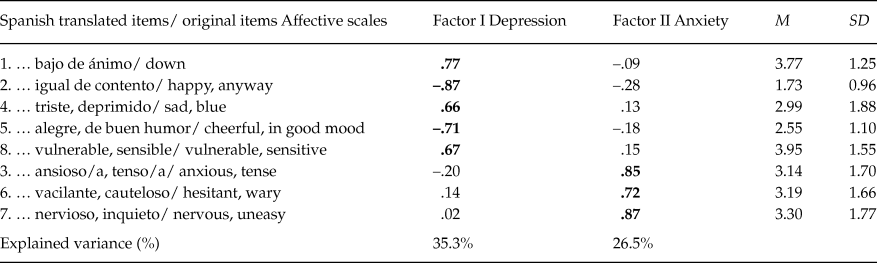
For the remaining 10 affective items, the KMO measure of sampling adequacy was .60 and Bartlett’s Test of Sphericity was significant (χ2 = 806.76; p < .01), indicating that the affective items were appropriate for PCA (31). A PCA yielded a three-factor solution, with eigenvalues exceeding one (3.03, 2.82 and 1.43, respectively). Together, these factors accounted for 73% of the total variance of the original items. Factor I (items 5, 8 and 9) accounted for 30.3% of the variance, Factor II (items 4 and 10) for 28.25% and Factor III (items 3, 6 and 7) for 14.2%. Inspection of the rotated solution did not show a clear distribution of items.
A second PCA forced to a two-factor solution yielded a clear distribution of items, which accounted for 58.54% of the total variance. Inspection of the rotated solution showed that Factor I (items 1, 2, 4, 5 and 8) comprised five items, of which three items referred to feelings of depression and two items (with negative loading) referred to positive mood. Factor II (items 3, 6, 7 and 9) was composed of four items, three items comprised feelings of anxiety and one item (with negative loadings) referred to positive mood. Item 10 (“…pessimistic/negativistic”), showed a double loading of more than .35 in both factors, and was therefore excluded. Although this two-factor solution differs from the original AEQ emotional scale (in which one factor was related to anxiety and depression and the other one referred to positive mood), it represents a two-dimensional model as well.
Therefore, a third PCA analysis was conducted, without item 10 and forced to a two-factor solution. Inspection of the rotated solution again showed the same distribution of items. Results showed that the eigenvalues of the two factors were 3.00 and 2.29. Factor I (items 1, 2, 4, 5 and 8) accounted for 33.32% of the variance, and Factor II (items 3, 6, 7 and 9) accounted for 25.43%. Subsequent analyses to calculate the reliability of the resulting scales indicated that item 9 (“…as optimistic”) had to be removed in order to reach adequate internal consistency in the second factor. For this reason, a fourth PCA without this item was conducted, forced once more to two-factor solution. This analysis yielded results indicating that the eigenvalues were 2.82 and 2.12 for Factor I and II, respectively. The first factor accounted for 35.30% of the total variance, whereas the second factor accounted for 26.50%. Inspection of the rotated solution again showed that Factor I was created by five items (items 1, 2, 4, 5 and 8), three of which comprised feelings of depression and the other two items (with negative loading) referring to positive mood. Factor II was composed of three items (items 3, 6 and 7) related to feeling of anxiety. In summary, the Spanish Version of the AEQ (AEQ-SP) affective scales included a Depression Scale (DS) and an Anxiety Scale (AS) and therefore consisted of 8 items (see Table 1).
Final factor solution with factor loadings for the affective items, mean and standard deviation (SD) for each item

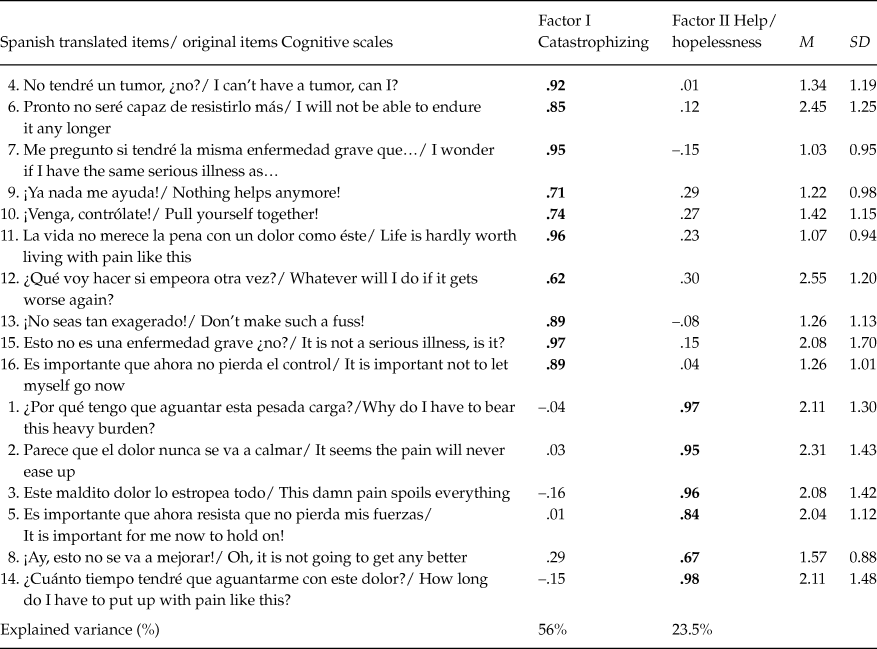
The results of the KMO test (.88) and Bartlett’s Test of Sphericity (χ2 = 2967.60; p < .01) for the 16 cognitive items justified conducting the PCA, which yielded two factors with eigenvalues exceeding one (8.96 and 3.80, respectively). Together, these factors accounted for 79.4% of the total variance of the original items. Factor I accounted for 56% of the variance and Factor II for 23.5%. Inspection of the rotated solution showed that the first factor (items 4, 6, 7, 9, 10, 11, 12, 13, 15 and 16) was composed of all the catastrophizing items, three helplessness/hopelessness items, and three thought-suppression items. Factor II (items 1, 2, 3, 5, 8 and 14) comprised six helplessness/hopelessness items and one thought-suppression item. These results differed from the three-factor solution of the original AEQ cognitive scales: catastrophizing, thought suppression and helplessness/hopelessness. In summary, the AEQ-SP cognitive scales includes two scales totaling 16 items: a catastrophizing scale (CS) and a helplessness/hopelessness scale (HHS) (see Table 2).
Final factor solution with factor loadings for the cognitive items, mean and standard desviation (SD) for each item

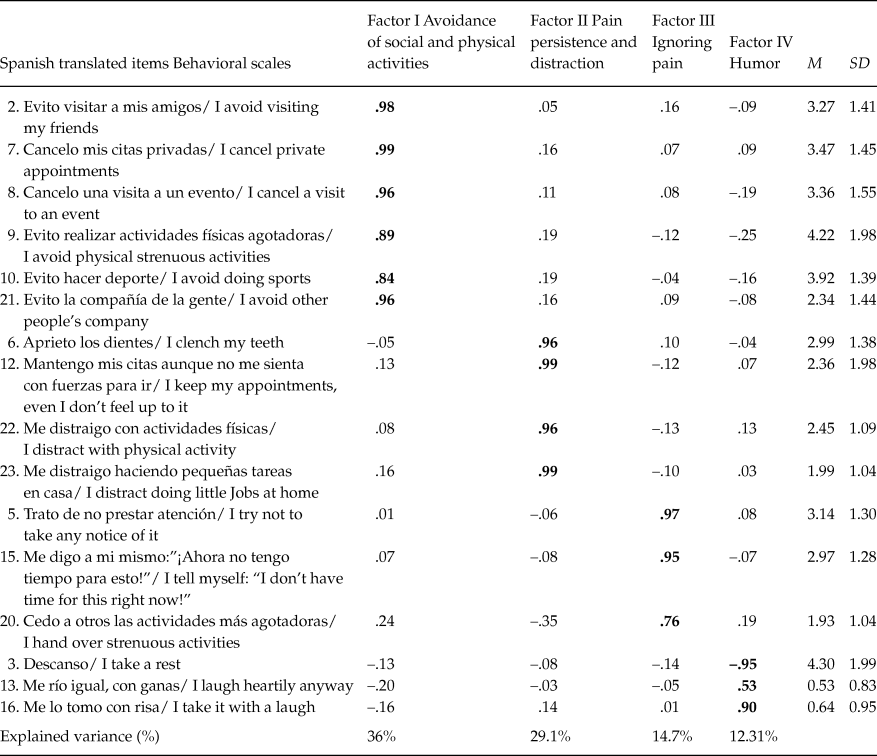
The results of the KMO test on the 23 behavioral items (.78) and Bartlett’s Test of Sphericity (χ2 = 8266.41; p < .01) justified conducting the PCA, which yielded five factors with eigenvalues exceeding one (7.22, 6.11, 5.10, 2.80 and 1.31, respectively). Together, this factor solution accounted for 97.95% of the total variance of the original items. Factor I accounted for 31.39% of the variance, Factor II for 26.55%, Factor III for 22.14%, Factor IV for 12.14% and Factor V for 5.73%. Inspection of the rotated solution showed that the first factor (items 2, 7, 8, 9, 10 and 21) was composed of items related to the avoidance of social and physical activities. Factor II (items 6, 12, 19, 22 and 23) comprised items related to pain persistence responses and distraction, and Factor III (items 4, 5, 15, 18 and 20) included the distraction items of the original AEQ behavioral endurance scale more related to patient’s ability to ignore pain (e.g. item 15 “I tell myself: I don’t have time for this”). Factor IV (items 3 and 16) included items related to humor and item 3 (“I take a rest”) with negative loading. Factor V was only composed of item 13. Due to the fact that items 1, 4, 11, 14 and 17 showed multiple loading of more than .35, and that items 18 and 19 showed a double loading of more than .35, a second PCA without these items forced to a four-factor solution was conducted. The analysis yielded four factors that accounted for 92.06% of the total variance, and whose eigenvalues were 5.75, 4.66, 2.35 and 1.97, respectively. Factor I (items 2, 7, 8, 9, 10 and 21) accounted for 35.95% of the variance, Factor II (items 6, 12, 22 and 23) for 29.10%, Factor III (items 5, 15 and 20) for 14.70% and Factor IV (items 3, 13 and 16) accounted for 12.31%. Inspection of the rotated solution again showed that Factor I was composed of items related to avoidance of social and physical activities, Factor II comprised items related to task persistence and distraction, Factor III was composed of items related to ignoring pain, and Factor IV included items related to humor and item 3 with a negative loading. Therefore, the resulting AEQ-SP behavioral scales were labeled as Avoidance of social and physical activities scale (ASPAS), Pain persistence/distraction scale (PPDS), Ignoring pain scale (IPS) and Humor scale (HS; see Table 3).
Final factor solution with factor loadings for the behavioral items, mean and standard deviation (SD) for each item

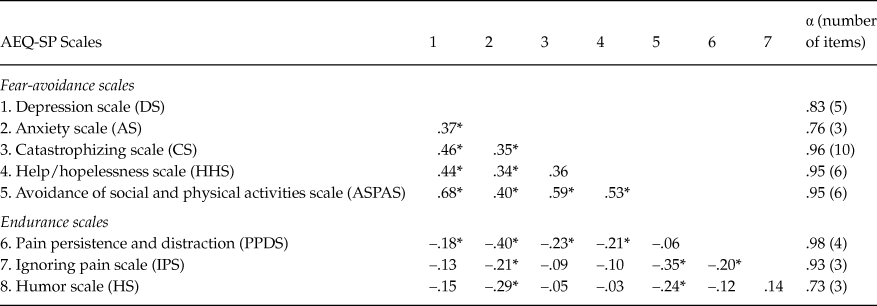
Similar to the original AEQ scales, all the factors of the AEQ-SP showed low to moderate inter-scale correlations, with the exception of the DS, which showed a highly significant correlation with the ASPAS (r = .68). In particular, the lowest correlations were found between the affective, cognitive and behavioral scales. These results are shown in Table 4.
Intercorrelations of the AEQ-SP scales and internal consistency (α) of the AEQ-SP

Reliability
In order to calculate the reliability of the resulting scales, internal consistency (α) was tested. Table 4 shows the results of the internal consistency for all scales of the AEQ-SP. Internal consistency was above r = .83 for all scales except for Anxiety (AS; α = .76) and Humor (HS; α =.73).
Criterion-related validity
In order to compare the findings of the AEQ-SP with the results of a reference criterion, self-reported pain intensity and disability were used as criterion-related variables, as they are the most frequently used outcome variables in back pain studies (Linton, Reference Linton2000; Ostelo et al., Reference Ostelo, Deyo, Stratford, Waddell, Croft, von Korf and de Vet2008). As it is assumed that the FAR scales (DS, AS, CS, HHS and ASPAS) and the ER scales (PPDS, IPS and HS) indicate maladaptive responses to pain that lead to the maintenance of pain and promote the development of chronic pain problems, it was expected that both aspects would correlate with pain intensity; however, it was assumed that the FAR scales would be positively associated with disability, whereas ER scales would be negatively associated with this variable.
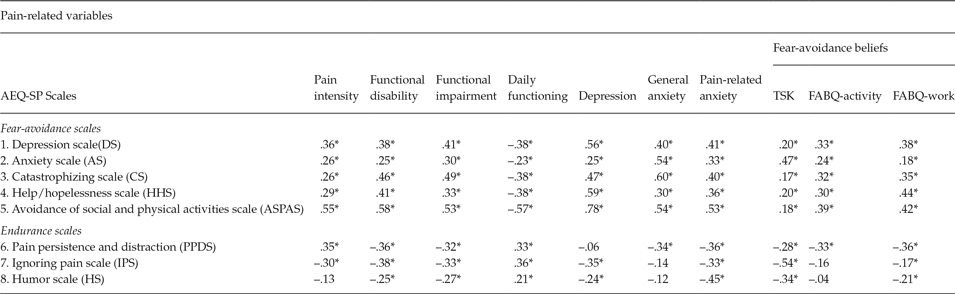
The results of the bivariate correlations using Bonferroni correction showed that all the FAR scales and the PPDS (ER scale) were positively related to pain intensity, although these correlations were low to moderate (between r = .26 and r = .55). On the other hand, the IPS and the HS (ER scales) were negatively associated with pain intensity (r = –.30 and r = –.13, respectively). Regarding functional disability, low to moderate correlations were obtained for both the FAR and ER scales. In the case of FAR scales, correlations range from .25 to .58, with positive values. The ER scales were negatively associated with functional disability (between r = –.25 and r = –.38).
Construct validity
Correlations using bonferroni correction between AEQ scales and measures that are conceptually related to pain (functional impairment, daily functioning, depression, pain-related anxiety, general anxiety, and fear-avoidance beliefs) were inspected to examine construct validity. There were moderate to high correlations between most of the emotional, cognitive and behavioral scales and the pain-related variables considered in the analysis (functional disability, functional impairment, daily functioning, depression, pain-related anxiety, general anxiety, and fear-avoidance beliefs as measured FABQ-activity, FABQ-work, and TSK-11) with positive correlations for the FAR scales and negative for the ER scales (see Table 5). In addition, low to moderate correlations were observed between both the FAR and ER scales and daily functioning. The FAR scales were negatively associated with daily functioning (between r = –.23 and r = –.57), whereas the ER scales were positively correlated with daily functioning (between r = .21 and r = .36).
Bivariate correlations between the AEQ-SP scales and the pain-related variables used for validation

Note: TSK, Tampa Kinesiophobia Scale; FABQ-activity, Fear-avoidance Beliefs Questionnaire (activity scale); FABQ-work, Fear-avoidance Beliefs Questionnaire (work scale).
**Bivariate correlations that remained significant after Bonferroni adjustment (p < .05).
Discussion
The goal of this study was to analyze the factorial structure and psychometric properties of the Spanish version of the Avoidance-Endurance Questionnaire (AEQ; Hasenbring et al., Reference Hasenbring, Hallner and Rusu2009) using data from a sample of Spanish patients with chronic back and neck pain. The results obtained using PCA with oblique rotation indicated that the proposed scales were largely supported. Nevertheless, the factor structure of the original AEQ could not be exactly replicated. Thus, the results indicated that depression and anxiety formed two different scales, the Depression scale (DS) and the Anxiety scale (AS). Despite large studies indicating an association between anxiety, depression and the occurrence of back pain the differentiation of anxiety and depression in patients with chronic back and neck pain has been supported by research in this area (McWillians, Cox, & Enns, Reference McWillians, Cox and Enns2003).Thus, Polatin, Kimey, Gatchel, & Mayer (Reference Polatin, Kimey, Gatchel and Mayer1993) found that certain pain conditions (e.g. back pain) are more strongly associated with several anxiety disorders than with depression.
On the other hand, all the positive mood items, with the exception of item 9 — which was removed as it decreased reliability — were the inverse of items on the DS. This observation can be supported by the Dynamic Model of Affect (DMA; Davis, Zautra, & Smith, Reference Davis, Zautra and Smith2004), which proposes that under conditions of uncertainty (including pain and stress), the affect also becomes strongly inversely related (Davis et al., Reference Davis, Zautra and Smith2004). Supporting this hypothesis, Pincus, Rusu, and Santos (Reference Pincus, Rusu and Santos2008) found that opposite affects were uncorrelated in healthy students, whereas highly negative correlations were reported in patients with chronic pain. In fact, Hasenbring et al. (Reference Hasenbring, Hallner and Rusu2009), during the development of the original AEQ, found highly negative correlations between the Anxiety-Depression scale and the Positive Mood scale (r = –.70).
The cognitive items were distributed on the Catastrophizing scale (CS) and the Helplessness/Hopelessness scale (HHS). The CS included three items, which were considered as helplessness/hopelessness in the original AEQ. This result could be explained in the light of Sullivan, Bishop and Pivik (Reference Sullivan, Bishop and Pivik1995) conceptualization of catastrophizing. These authors proposed three dimensions of catastrophizing: rumination, magnification, and helplessness. This aspect may explain why some helplessness/hopelessness items have been understood by patients in the same way as catastrophizing items. Nevertheless, the high internal consistency of the Catastrophizing scale and Helplessness/hopelessness scale (α = .96 and α = .95, respectively), as well as the moderate correlation between them (r = .36), supports differentiating these scales in line with the original AEQ. This differentiation is mainly theoretically based on the idea that thoughts of helplessness/hopelessness more specifically reflect the secondary appraisal of coping abilities (Jensen, Turner, Romano, & Karoly Reference Jensen, Turner, Romano and Karoly1991). Additionally, the thought-suppression items of the original AEQ were distributed between the Catastrophizing scale and Helplessness/hopelessness scale. Thus, accordingly to Wegner´s ironic process theory of mental control (Wegner, Reference Wegner1994) the efforts to suppress thoughts are generally unsuccessful and increase the likelihood that catastrophizing or helplessness/hopelessness thoughts will intrude into consciousness. In fact, Sullivan, Rouse, Bishop, & Johnston (Reference Sullivan, Rouse, Bishop and Johnston1997) examined the effects of thought suppression and catastrophizing in an experimental pain procedure on subsequent pain experience. The results showed that both cognitive processes had the same effects on the pain experience, that is, they both increased pain.
Regarding the behavioral items, these formed four scales after seven items were removed (1, 4, 11, 14, 17, 18 and 19) due to their double or multiple loading greater than .35 on two or more scales. The resulting four scales were: (1) the Avoidance of Social and Physical Activities scale (ASPAS), referring to social and physical activities that were avoided by patients without differentiation between either type of activity; (2) the Pain Persistence and Distraction scale (PPDS), referring to pain persistence behaviors understood as an attempt by patients to distract themselves. This assumption would be supported by the cognitive theory of dual task processing (Kahneman, Reference Kahneman1973), which postulated how a phenomenon can occur in two different processes: an implicit (automatic) unconscious process (pain persistence), and an explicit (controlled) conscious process (distraction); (3) the Ignoring Pain scale (IPS) composed of the distraction items of the original AEQ, which are related to the tendency to minimize the meaning of a pain experience despite severe pain. Thus, ignoring pain is conceptually similar to distraction but focuses more on blocking out the pain as well as with perceptions that pain is controllable (Haythornthwaite, Menefee, Heinberg, & Clark, Reference Haythornthwaite, Menefee, Heinberg and Clark1998). Moreover, ignoring pain seems to be more frequently related to patients with longer pain duration (Peters et al., Reference Peters, Sorbi, Kruise, Kerssens, Verhaak and Bensing2000), suggesting that this strategy may be one that increases as individuals gain experience dealing with the challenges of chronic pain. With regard to distraction, it should be noted that distraction may be more useful for the management of acute pain than chronic pain (Boothby, Thorn, Stroud, & Jensen Reference Boothby, Thorn, Stroud, Jensen, Gatchel and Turk1999). Even with acute pain, however, distraction may not relieve the severe levels of pain often seen in clinical settings; and (4) Humor (HS) which, in this sample, was a separate factor in addition to distraction and ignoring pain, perhaps because humor involved cognitive, emotional, behavioral, psychophysiological, and social aspects which are not necessarily implicit in the mere ability to distract oneself or ignore pain.
Briefly, the results of the Spanish version of the AEQ revealed five fear-avoidance scales named the Depression scale (DS), Anxiety scale (AS), Catastrophizing scale (CS), Helplessness/Hopelessness scale (HHS), and Avoidance of Social and Physical Activities scale (ASPAS), and three endurance-related responses scales: Pain Persistence Behavior and Distraction scale (PPDS), Ignoring Pain scale (IPS), and Humor scale (HS). The analyses of internal consistency showed a high Cronbach´s alpha for all the scales of the Spanish-AEQ version (AEQ-SP). All the scales of the AEQ-SP showed low to moderate inter-scale correlations, except for the Depression scale, which showed a moderate correlation with the Avoidance of Social and Physical Activities scale (r = .68). Consistent with this result, some studies have found a relationship between the avoidance of activities and a depressed mood in patients with back-pain (Weickgenant et al., Reference Weickgenant, Slater, Patterson, Atkison, Grant and Garfin1993). Moreover, the Fear-Avoidance Model of Pain postulated by Vlaeyen and Linton (Reference Vlaeyen and Linton2000) points out several routes by which fear of pain may lead to disability. Regarding one of these routes, the model suggests that catastrophizing and activity avoidance can lead to disuse, disability, and depression, thereby creating a vicious circle. This proposal has been tested empirically in several studies (Asmundson, Norton, & Norton, Reference Asmundson, Norton and Norton1999; Crombez, Vlaeyen, Heuts, & Lysens, Reference Crombez, Vlaeyen, Heuts and Lysens1999; Jensen, Karpatschof, Labriola, & Albertsen, Reference Jensen, Karpatschof, Labriola and Albertsen2010; Leeuw et al., Reference Leeuw, Goossens, Linton, Combrez, Boersma and Vlaeyen2007; Swinkels-Meewisse et al., Reference Swinkels-Meewisse, Roelofs, Schouten, Verbeek, Oostendorp and Vlaeyen2006; Vlaeyen, Kole-Snijders, Boeren, & van Eek, Reference Vlaeyen, Kole-Snijders, Boeren and van Eek1995). This means that physical inactivity (reduced physical activity levels), when maintained over a long period, has a detrimental impact on the cardiovascular and musculoskeletal system, and might lead to a “disuse syndrome” which may further aggravate the problem of pain. So, “disuse syndrome” is described as a physiological, psychological and social adaptation to long-lasting pain (Verbunt et al., Reference Verbunt, Seelen, Vlaeyen, van de Heijden, Heuts, Pons and Knottnerus2003; Verbunt, Smeets, & Wittink, Reference Verbunt, Smeets and Wittink2010). Moreover, according to Vlaeyen and Linton (Reference Vlaeyen and Linton2000), some patients with chronic pain develop a severe “disuse syndrome” such as sitting in a wheelchair, being restricted to bed or not being able to move a body part. Furthermore, severe pain behavior, such as severe medication use, psychological dysfunction, depression, restrictions in social activities and social adaptation, such as not being able to work, are often present (Gatchel, Peng, Peters, Fuchs, & Turk, Reference Gatchel, Peng, Peters, Fuchs and Turk2007; Verbunt et al., Reference Verbunt, Seelen, Vlaeyen, van de Heijden, Heuts, Pons and Knottnerus2003). Therefore, it also means to avoid the withdrawal of essential enhancers, which might increase mood disturbances such as irritability, frustration and depression. Moreover, other underlying processes from biological perspective have been proposed in order to explain the relationship between FAR/ER and pain. For example, one of them highlighted the role of FAR and ER patterns in the central sensitization (CS). CS is a condition of the nervous system that is associated with the development and maintenance of chronic pain. So, the nervous system goes through a process called “wind up” and gets regulated in a persistent state of high reactivity (Wolfe, Reference Woolf2011). On the other hand, ignoring pain and humor are not associated with pain persistence and distraction. The Avoidance-Endurance Model propose a sub-group of patients with ER called Eustress Endurance Response Pattern which show a pattern of ignoring pain sensations and marked task persistence behavior (i.e. any task that involves doing too much, not respecting one’s physical, performing repetitive movements or ongoing static strain postures) often accompanied by high scores on positive mood despite pain (Hasenbring & Verbunt, Reference Hasenbring and Verbunt2010). However, longitudinally, patients with ER might be at risk for a decrease of task persistence in order to avoid discomfort, and an increase of avoidance behaviour which is in connection with the long duration of pain (about 8 years) in our study sample.
The analysis of criteria and content validity provide further evidence for differentiating between the FAR and ER scales, which is consistent with the AEM (Hasenbring et al., Reference Hasenbring, Hallner and Rusu2009) and the results of the original AEQ. All the FAR scales were positively related to pain intensity, functional disability, functional impairment, depression, pain-related anxiety, general anxiety, and fear-avoidance beliefs. These results are very similar to those obtained in the development of the original AEQ. In this study daily functioning was also assessed and the results showed that all the FAR scales were negatively related to daily functioning. These data are consistent with the AEM and are similar to previous results on the relationship between FAR, pain, and functional disability (Vlaeyen & Linton, Reference Vlaeyen and Linton2000). In addition, the various pathways proposed in the Fear-avoidance model of pain were also supported by the positive associations between the Depression scale, Anxiety scale, Catastrophizing scale, and Avoidance of Social and Physical Activities.
Concerning the ER scales, the AEM suggests a positive association between ER and pain intensity. The current findings support this postulate for the Pain Persistence Behavior and Distraction scale. However, the Ignoring Pain scale and Humor scale were negatively related to pain intensity. These results are consistent with studies investigating the relationship between these variables and pain; they suggest that ignoring pain and using humor to manage it are associated with lower pain ratings (Boothby et al., Reference Boothby, Thorn, Stroud, Jensen, Gatchel and Turk1999). Moreover, increases in the use of these strategies in patients, as seen following multidisciplinary treatment (Jensen et al., Reference Jensen, Turner and Romano2001), are consistent with the cognitive-behavioral formulation that considers these strategies as generally adaptive and that they contribute to the patient´s perception that pain is controllable, therefore leading to reports of less pain intensity. It is probable that the Ignoring Pain scale and Humor scale include characteristics from the adaptive responses groups. As expected, and in line with the AEM, most of the ER scales were negatively related to functional disability, functional impairment, depression, pain-related anxiety, general anxiety, and fear-avoidance beliefs, and positively related to daily functioning. However, in contrast to the original AEQ, in this study neither specific affective (positive mood despite pain) scales nor cognitive (thought suppression) scales were obtained for ER. In fact, the items of these scales were distributed on the Affective and Cognitive FAR scales. In this Spanish sample of patients with chronic back and neck pain, the association between pain-related endurance-behavior despite severe pain seems to be more correlated to lower scores in emotional distress (depression and anxiety) and negative thoughts (catastrophizing and helplessness/hopelessness) rather than, for example, a special positive mood despite pain. These results may be due to the sample characteristics given that the most recent and most extensive survey regarding pain-experience conducted in Europe (Breivik, Ventafrida, Cohen, & Gallacher, Reference Breivik, Collett, Ventafrida, Cohen and Gallacher2006) showed that Spanish patients tend to report more pain intensity, as well as more pain duration compared to other European citizens. Consistent with these findings, Spain has the highest rate of depression among patients with chronic pain in Europe (Breivik et al., Reference Breivik, Collett, Ventafrida, Cohen and Gallacher2006).
This study has a number of limitations that should be noted. The most relevant is that the sample only consisted of patients with chronic pain. Therefore, the findings of the principal components analysis must be taken with caution and should be replicated in a larger sample with different patients with pain (acute, sub-chronic, and chronic). Second, a larger sample would also allow a confirmatory factor analysis to be conducted. Third, regarding diagnoses, the original AEQ was developed with a sample of patients suffering from low-back pain alone. However, in this study, the sample consisted of patients with a diagnosis of spinal pain. Fourth, given the cross-sectional design, no predictions could be made regarding the predictive power of the FAR and ER scales regarding long-term adjustment to pain. Five, self-report measures alone were used in this study. Future research should explore the types of activities that are avoided by patients by employing physical performance tests (to assess strength and power, speed, endurance, flexibility, balance and proprioception, agility and, functional and safe movement patterns). Finally, the study did not control for the possible influence of pain interventions (e.g., medication, physiotherapy, activity-related instructions).
Despite these limitations, the results of this study have shown that the Spanish version of the AEQ (AEQ-SP) is a valid, reliable and useful tool for the identification of fear-avoidance and endurance-related responses to pain in Spanish patients with chronic back and neck pain. This instrument will probably help clinicians to identify patients at a high risk of chronicity and to develop treatments tailored to the different profiles in order to improve secondary and tertiary prevention in back and neck pain. Thus, according to the recent motivational reformulation of the fear-avoidance model (Crombez, Eccleston, Van Damme, Vlaeyen, & Karoly, Reference Crombez, Eccleston, Van Damme, Vlaeyen and Karoly2012) as well as the recommendations of Hasenbring and Verbunt (Reference Hasenbring and Verbunt2010), treatments of these patients should focus on promoting flexible response pattern (high degree of flexibility between FAR and ER to pain, supporting the effect of biomedical treatments). In this line, Acceptance and Commitment Therapy (ACT; Hayes, Strosahl, & Wilson, Reference Hayes, Strosahl and Wilson1999) would be an interesting option inasmuch as is one of the treatments that has shown more effectiveness in patients with chronic pain. Moreover, Schrooten, Vlaeyen, and Morley (Reference Schrooten, Vlaeyen and Morley2012) have recently highlighted the importance of developing psychological interventions in chronic pain in the context of achieving goals. Specifically, they suggest that we should start integrating pain treatments intended to promote flexible achieving goals, such as self-regulation skills training or cognitive flexibility.