Introduction
When governments create international organisations (IOs), they face questions of representational design. Choices such as how to select the decision-makers in international bodies inevitably trigger tense conflicts. Unsurprisingly, therefore, crucial decisions in the creation of intergovernmental bodies have been widely discussed – such as the choice between majority voting and keeping the national veto.Footnote 1 However, in recent decades, IOs have become more complex.Footnote 2 They have increasingly created representative bodies for civil society and other stakeholders as well as for parliamentarians.Footnote 3 Yet, paradoxically, we still know little about the representational design of these international bodies even though they most explicitly serve the purpose of representation.
We explore the representational design of International Parliamentary Institutions (IPIs). IPIs are transnational arenas of delegates of national parliaments or elected representatives. As formal organisations, IPIs differ from a wider universe of parliamentary diplomacy, friendship groups, networks, and conferences.Footnote 4 IPIs have been given many labels, such as international parliamentary organ or assembly,Footnote 5 and generic names such as representative assembly or body. Yet, despite subtle differences, IPI is the most common and general term and will be used here alongside more generic terms.Footnote 6, Footnote 7 Although their authority often remains weak, IPIs have become a common feature of IOs.Footnote 8
IPIs are often cursorily described as mechanisms of citizen representation in IOs and thus as different from intergovernmental IO bodies that represent national governments.Footnote 9 We do not object to this perspective but note that it leaves open questions. In particular, which actors and concerns IPIs can be expected to represent depends partly on representational design. For example, recent studies highlight design alternatives such as whether IPIs should be directly elected, how seats should be allocated, or whether they should create national or transnational factions.Footnote 10 While institutional choices such as these do not determine behaviour in IPIs, scholars believe that they influence whether IPIs might represent different actors, concerns, and conflict lines than intergovernmental IO bodies, and thus whether they are likely to contribute to or challenge the legitimacy of such bodies and their strong role in many IOs.Footnote 11
This study contributes to the development of this literature, first, by conceptualising ideal-typical representational design alternatives for IPIs. Specifically, we argue that IPIs could adopt a citizen-centred representational design but also a more state-centred alternative. They could implement direct elections, distribute seats according to votes, and organise the parliament into ideological factions or, instead, favour national delegations, equal seats per state, and national political groups. Depending on these choices, IPIs might give rise to a bicameral structure in IOs, akin to the situation in the European Union, or stay closer to the idea that IO bodies represent states and state-based communities. While representational design alternatives should not be expected to determine the behaviour of IPIs or their members, they might render it more or less probable that IPIs would behave similarly to, for example, the European Parliament – that is, independent of and regularly in conflict with national governments.Footnote 12
We furthermore contribute new data and evidence by describing the distribution and correlates of the representational design of IPIs on a global scale. Covering all 38 IPIs that exist within IOs from 1945–2019, we show that state-centred representational design has remained the norm in IPIs. Only two existing parliamentary bodies are strongly citizen-centred: the European Parliament and the parliament of Mercosur. While half of all IPIs display at least one citizen-centred trait, the overall picture is that they adopt state-centred designs predominantly. We then show that citizen-centred IPIs – and direct elections and cross-border factions in particular – are a near exclusive phenomenon of a few democratic regional integration projects including the European Union and major Latin American IOs. In contrast, in parts of the world in which IOs as well as domestic politics remain state-centred, so do IPIs.
In the following, we first embed our study in the literature on IPIs. Second, we elaborate the distinction between citizen-centred and state-centred representational design and, third, map the empirical distribution of these designs over time and IOs. Fourth, we highlight arguments often made about the contexts in which citizen-centred IPIs are likely to be found and, fifth, present corresponding empirical evidence of the correlates of citizen-centred IPIs.
As discussed further in the conclusion, our results do not mean that IPIs fail to expand the range of representation mechanisms of existing IOs. Yet, their potential to represent different cross-border communities, concerns, and conflict lines than intergovernmental IO bodies remains institutionally limited not only due to their commonly weak authority but also given the prevalence of state-centred representational designs. We also highlight avenues of further research with a focus on examining the behavioural effects of representational design further.
Representational design and International Parliamentary Institutions
Representational design focuses on rules that shape descriptive and substantive representation: the classes of actors and concerns that are made present by the participants in international decision-making.Footnote 13 Thus conceived, representational design is hardly a new problem. Any IO reform brings controversy over voting rights in key organisational bodies.Footnote 14 Many IOs have faced conflicts over the participation and power of weaker and stronger, richer and poorer, nearer and farther, or bigger and smaller states.Footnote 15
Yet, the representational design of IOs is not limited to intergovernmental bodies. IOs have grown more complex in recent decades,Footnote 16 as governments have established bodies for the representation of stakeholders (for example, civil society organisations or private companies) and parliamentarians.Footnote 17 As explained further below, almost forty IPIs now exist within IOs.Footnote 18 As organisations of representatives delegated by their national parliaments or elected directly, IPIs differ fundamentally from diplomatic assemblies or independent agencies. IPIs do not formally consist of states, as the UN General Assembly, nor of national governments or the diplomats representing them in the UN and intergovernmental organs of IOs around the world. As representative bodies, IPIs also differ from hierarchical international bureaucracies and their unelected officialsFootnote 19 as well as from the stakeholder bodies now found in many IOs and other international contexts, which are composed of selected or self-selected organisations and policy practitioners employed by these organisations.
The creation of these bodies is a representational design choice in itself and part of wider efforts to ‘open up’ executive-dominated IOs.Footnote 20 While stakeholder bodies could be said to foster function-centred representation, IPIs have been seen as potential sources of citizen representation beyond the state.Footnote 21 Some regard them as sources of legitimacy ‘because as parliamentarians, their members are the only actors that are directly accountable to their voters’.Footnote 22 Even critics that highlight the weaknesses of existing IPIs consider them a potential source of citizen representation.Footnote 23 Andrea CofeliceFootnote 24 notes that although most IPIs have only a consultative role in IO decision-making, they have the ability to promote legitimating civic dialogue. Consequently, one would expect the representational design of IPIs to have received significant attention.
Yet, surprisingly little attention has been devoted to the representational design of IPIs. A substantial part of the existing literature on these bodies focuses on explaining their existence rather than their design. Early studies already tried to account for IPIs as institutional innovations within specific international domains.Footnote 25 In one of the first comparative studies on IPIs, Einar LøchenFootnote 26 states: ‘The first question which may be raised is why a parliamentary association with European co-operation has come into existence at all.’ When a research agenda on IPIs began to emerge, authors explored new questions such as the role of IPIs in regional politicsFootnote 27 or the relationships between the EP and other IPIs.Footnote 28 However, most contributions still focused on the emergence of IPIs, from a comparative perspective,Footnote 29 or within a specific case or region.Footnote 30
To some extent, scholars have also examined the decision-making authority of IPIs.Footnote 31 Yet, the general conclusion of this literature is that, despite their remarkable spread, almost all IPIs remain weak in terms of authority, and the European Parliament an exception that has gained legislative competences on the basis of mechanisms so far not observed elsewhere.Footnote 32 In line with this view, we take the weak authority of IPI as indication that, at present, their relevance might rather lie in their ability to represent in ways that differ from the representation that governmental organs in IOs already provide.
Starting from this premise, several studies have examined the representational design of IPIs more directly. Clarissa Dri,Footnote 33 for example, explores the organisation of Parlasur and stresses, among other features, the allocation of seats, electoral mechanism, and whether members divide into ideological or country groupings. Similarly, Davor JancicFootnote 34 does not only study the authority of four African IPIs, but also their electoral mechanisms and, to some extent, whether they foster ‘cross-border political alignment and the formulation of common transnational political platforms’. In addition, Michael GiesenFootnote 35 and Andrea CofeliceFootnote 36 present more extensive, systematic data on the design of IPIs. As Dri and Jancic, both authors allude to a distinction between ‘country’ and ‘trans-national’ representation and relate this to mechanisms for elections and the distribution of seats between countries. While we build on the valuable insights of these studies,Footnote 37 we also note that they all have a more heuristic interest in the organisation of IPIs. Consequently, despite an emerging focus on core factors – notably elections, seat allocation, and some element of non-country-based parliamentary groups – not all of these factors are examined consistently across studies. Moreover, design characteristics that are not linked to representation are commonly considered in addition. In this respect, it is a logical next step for the literature to discuss more explicitly which IPI characteristics are essential parts of representational design, and to compare these characteristics more systematically.
Finally, an emerging literature on IPIs and the legitimacy of IOs is relevant here. Legitimacy can be understood either as compatibility of an IO's design or practices with normatively defined standards such as accountability or as ‘beliefs within a given constituency or other relevant audience that a political institution's exercise of authority is appropriate’.Footnote 38 Critics object that, without significant authority, IPIs are irrelevant for IOs and their legitimacy – irrespective of their representational design. To some extent, this is a valid concern. For example, Beat HabeggerFootnote 39 argues that the ability of IPIs to foster accountability of IO decision-makers, especially governments, depends on their competences in the legislative process. Christine Kraft-KasackFootnote 40 considers IPI influence on decisions and appointments in IOs an important – and typically unfulfilled – criterion for democratic legitimacy. And JancicFootnote 41 observers a ‘striking mismatch between the normative framework and the practical functioning of regional parliaments [in Africa]’ in part due to weak decision-making powers. At first, the ability of IPIs to affect the legitimacy of IOs thus seems limited.
However, the conclusions of this literature are more nuanced. Even without authority, IPIs still contribute to the representation of different groups of actors and concerns. IPI members can also actively advocate continuity and change in an IO, and thus contribute to or erode the legitimacy of the organisational status quo in the eyes of audiences such as citizens or political elites. For example, HabeggerFootnote 42 argues that IPIs might represent different actors, concerns, and conflict lines than governmental organs.Footnote 43 JancicFootnote 44 suggests that IPIs could lend attention to regional problems, alliances that cross-cut national borders and, more generally, the existence of a cross-border or transnational political community. If IPIs do so, they contribute to weakening the legitimacy of organisations in which inter-state bargaining and intergovernmental organs dominate, but strengthen the legitimacy of organisations that aim to achieve a transnational political community.Footnote 45
Importantly, however, IPIs do not necessarily have these implications. Rather, we share Kraft-Kasack'sFootnote 46 view that design influences whether actors in IPIs are likely to challenge or support the legitimacy of different IOs. Some design choices make it more likely that IPIs offer different representation than intergovernmental IO bodies. For example, it is intuitively plausible that the literature, despite examining diverse IPI characteristics, often shares a focus on elections, seat distributions, and cross-border parliamentary groups. These design elements, as we explain below, can plausibly be expected to shape whether IPIs align with or challenge intergovernmental bodies. For example, the European Parliament's directly elected members and transnational groups have long been advocates of a federalist trajectory for the European Union and opponents of an intergovernmental model.Footnote 47 In contrast, critics of a federal European Union have suggested to turn the European Parliament into a Senate of delegates of national parliaments instead – in part motivated by the belief that such an institution would be less likely to promote federalism and more supportive of the Council of Ministers.Footnote 48 The broader implication is that, to fully appreciate which change in IOs, if any, IPIs might encourage, we also need to know more about their representational design in addition to their existence and authority.
In sum, there is growing interest in the representational design of IPIs, not least because it is believed that alternative design choices could foster support for or challenges to the legitimacy of the status quo of different IOs. Clearly, however, significant research is still required to fully elaborate these claims, both in terms of conceptualising and mapping representational design alternatives systematically and for more cases than has been done so far, and in linking them to political behaviour. The first of these tasks, which we pursue here, can be considered a prerequisite for further progress in the literatures outlined so far.
Citizen-centred and state-centred International Parliamentary Institutions
What are the main alternatives for the representational design of IPIs? We build on the interest in the literature, as discussed above, in more country-oriented or more transnational designs, which we label state-centred and citizen-centred, respectively. Our discussion excludes a function-centred alternative because function-centred representation is the domain of stakeholder bodies.Footnote 49 Indeed, empirically, none of the IPIs in our analysis has adopted what could plausibly be considered a function-centred representational design. We further stay in line with the literature by treating elections, seat allocation, and cross-border groups as core attributes of our ideal-typical design alternatives. Yet, whereas existing research develops these distinctions inductively based on mapping diverse organisational characteristics of IPIs, we highlight that they can be derived from a wider literature on parliamentary design. We believe this to be important since this body of work has long examined implications of alternative design choices and can thus inform the study of IPIs.
The design of parliaments is a core concern of scholars of representation in domestic politics. From the outset, it needs to be stressed that parliamentary design offers a seemingly infinite variety of choices – from basic questions about parliamentary architecture, sources, and distribution of resources, to the fine details of committee assignments, information rights, and investigative procedures.Footnote 50 Moreover, all of these choices could conceivably influence whose concerns and interests find representation, as is evident in extensive debates about the distributional implications of different committee rules in the US Congress, European national parliaments, and the European Parliament.Footnote 51
However, rather than covering all choices, we take inspiration from Powell'sFootnote 52 analysis of the representational principles underlying national parliaments and focus on three crucial issues: the rules for the selection of parliamentarians, the apportionment of seats between different groups of IPI members, and the factional organisation of the IPI. We limit our focus for two reasons. First, unlike many other choices, the ones we study have direct and clear implications for the actors and concerns that obtain parliamentary representation. As G. Bingham Powell, we suggest that such fundamental choices are indicative of a wider range of detailed choices. Second, focusing on major design choices is also a practical necessity. A lot of the detailed information that we might have for widely known bodies cannot be obtained for a global sample of IPIs over time.Footnote 53
Different representational design choices create different ideal-typical parliaments (Table 1). If IPIs were similar to lower houses of national parliaments, which represent a country's citizens, they would be elected, allocate seats proportional to population, and divide into ideological factions. We call this design citizen-centred. In contrast, many upper houses represent jurisdictions or communities, especially in federal and multinational political systems akin to the environments in which IOs operate.Footnote 54 Since, in the international realm, these jurisdictions are states, we call this design state-centred. State-centred IPIs feature delegated representatives, seat allocation by territorial unit, and factions that follow territorial boundaries. Both citizen-centred and state-centred IPIs are composed of parliamentarians and in this sense different from intergovernmental organs, yet their representational reference points differ. State-centred IPIs build on the assumption that states and state-based communities require representation at the international level whereas the citizen-centred institutions focus on the representation of citizens directly irrespective of the borders between the member states of an IO (see Francis ChenevalFootnote 55 for a broader discussion of these alternative assumptions about representation at the international level).Footnote 56
Representational designs for International Parliamentary Institutions.

IPIs do not necessarily follow either ideal-typical design entirely. Rather, the three dimensions of representational design divide IPIs into more citizen- or more state-centred types. Direct elections create a new delegation chain that bypasses governments and limits their control over the actors and concerns represented in international decisions.Footnote 57 If, instead, IPIs are composed of delegates from national parliaments, controlled by the domestic majority, they will preserve the domestic balance of power or even consist of government loyalists entirely. Among the IPIs in our data that consist of delegated members, some explicitly recommend that delegations respect the domestic distribution of power. For example, the statutes of the Baltic Assembly state that the members must be elected by national parliaments ‘in accordance with the approved rules of procedure and the principle of proportional political representation’.Footnote 58 The IPI of the Community of Portuguese Language Countries is more explicit and stipulates that the national delegations should be constituted ‘in accordance to the electoral results’.Footnote 59
Policymakers fully understand the importance of choosing an electoral mechanism. It took the European Parliament until 1979 to convince governments to hold the direct elections envisaged in the 1951 Treaty on the European Coal and Steel Community. Elsewhere governments discovered the risks involved in direct elections after the fact. Venezuela ended direct elections to the Latin American Parliament after the domestic opposition had come to dominate the parliamentary delegation.Footnote 60 Colombia also abolished direct election to the Andean Parliament after a governmental controversy in 2011. Elections can also cause problems between large and small countries. In the case of the Eurasian Economic Union, Russia proposed direct elections to the Eurasian Parliament, while Kazakhstan and Belarus objected, fearing Russian ambitionsFootnote 61
Representational design also involves decisions on the allocation of IPI seats. Many allocation principles are conceivable, but two alternatives exist empirically: to distribute seats proportional to population or equally to each country.Footnote 62 Proportional representation is the citizen-centred choice since it gives large groups of citizens many representatives and makes attention to their concerns likely. Minority interests, such as of the citizens of small states, are de-emphasised by design unlike in state-centred alternatives that give equal parliamentarians to each country. Proportional seat allocation need not go against every government's interests. Governments of large countries could benefit if other countries are small. Proportionality also loses relevance if jurisdictions are equally large. However, as most IOs involve small states and require unanimous institutional decisions, citizen-centred seat allocation is, in principle, likely to encounter resistance. A case in point is the discussion that emerged in 2003 during the design of the parliament of Mercosur, a South American IO. The two largest states, Brazil and Argentina, championed the idea that the IPI should have proportional representation. This did not fare well with officials from Paraguay and Uruguay, which have populations dozens of times smaller than their neighbours. The disagreement was only resolved when Uruguay elected the integrationist President Vazquez.Footnote 63
Finally, IPIs differ in the organisation of factions: groups that facilitate collective action among representatives. Factions rely on working groups and party leaders to establish a party line.Footnote 64 As ‘competing principals’, they demand loyalty besides other principals.Footnote 65 If principals disagree, politicians experience cross-pressure as, for instance, members of ideological groups that also have territorial constituencies.Footnote 66 Congruence between legislative bodies – such as in a bicameral parliament – helps avoid cross-pressures.Footnote 67 In the case of IPIs, the main question is whether parliamentarians will sit in ideological or national groups. The contemporary European Parliament is an example of the former model and, consequently, members regularly face tensions between the European party groups and national governments.Footnote 68 Even before direct elections, the European political groups contributed importantly to the evolution of a transnational outlook among its members that often led to conflicts with national governments.Footnote 69 More generally, ideological factions that cross-cut territorial boundaries are at odds with the representation of territorial state interests.Footnote 70
Mapping the representational design of International Parliamentary Institutions
How are citizen- or state-centred and state-centred IPIs distributed empirically? We created a dataset on the representational design of 38 IPIs within IOs from 1945 to 2019 (for a full list and further discussion of the selection, see the appendix). The number of IPIs in existence depends on how we distinguish these bodies from looser parliamentary networks. Not making this distinction overestimates the number of IPIs significantly. For example, a widely noted list by Claudia KisslingFootnote 71 incorporates over one hundred cases while other studies cover varying numbers of fewer cases.Footnote 72 We focus on a smaller number because we are interested in bodies that are, as parliamentary bodies at the national level, formal organisations. IPIs are organisations in the sense of having an establishing treaty laying out their structure and functioning, a bureau or secretariat, and one or, as in the example of the European or the Benelux Parliament, very few permanent locations. IPIs also need to meet our criteria of being arenas with members elected directly or delegated by national parliaments. Our list focuses on IPIs that, as national parliaments, are affiliated with a wider political structure – IOs in our case.Footnote 73 For these cases, the analogy to national parliaments on which our conceptual discussion draws is most plausible although it might also apply to IPIs that are not affiliated with IOs. It would, however, be a category mistake to assume that design choices derived from national parliaments can or should be applied to looser gatherings such as parliamentary networks.
Our data capture whether parliamentary bodies are directly elected, allocate seats by population or equally by country, and organise into state or ideological factions. While often straightforward, there are grey areas in this classification. For example, in the case of direct elections, some IPIs have declared their intention to hold elections but have not done so. This is the case in four African IPIs, the Latin American Parliament, and the parliamentary body of the Union between Russia and Belarus.
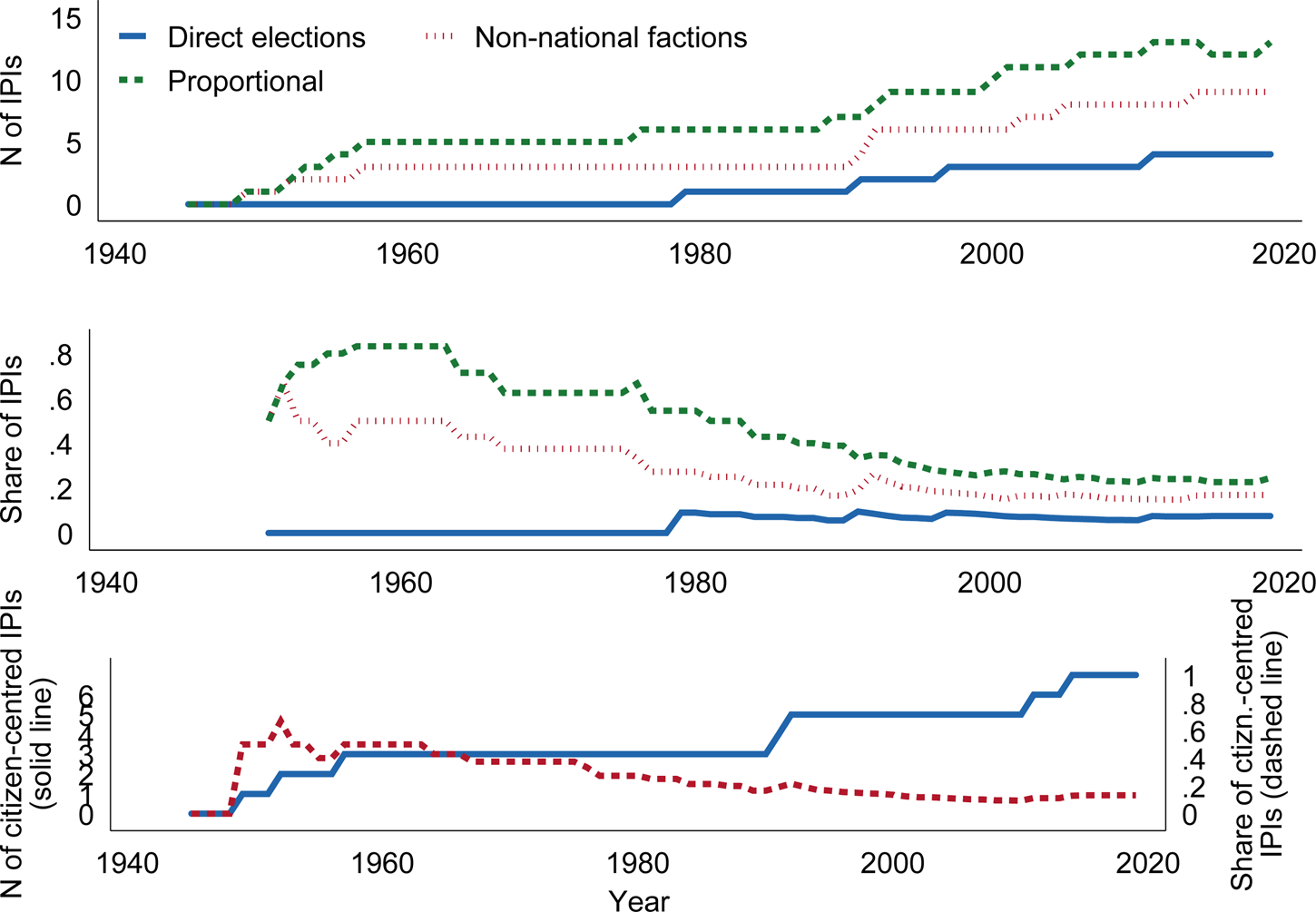
Figure 1 charts the evolution of citizen-centred representational designs over time. Today, around 45 per cent of existing IPIs within IOs have the intention to hold direct elections, or to allocate seats in proportion to member state populations, or to organise into ideological factions (17 out of 38 existing in 2019).Footnote 74 However, this percentage drops to 34 per cent if we discount IPIs that intend to but have not actually held elections. It falls further to 15 per cent if we only count IPIs that have two or more citizen-centred characteristics. Only six IPIs meet this standard: the European Parliament and the Mercosur Parliament (both fully citizen-centred) as well as the Council of Europe Parliamentary Assembly, the Nordic Council, the Benelux Inter-Parliamentary Council, and the Central American Parliament. Overall, citizen-centred designs remain relatively rare. The small group of (partly) citizen-centred IPIs emerged in two decades, the 1950s and the 1990s. In fact, during the 1950s most of the IPIs were created with proportional representation. It was only during the late 1980s and 1990s, at the height of IPI growth, when the Mercosur and Central American parliaments moved towards citizen-centred designs.
Citizen-centred designs in International Parliamentary Institutions.

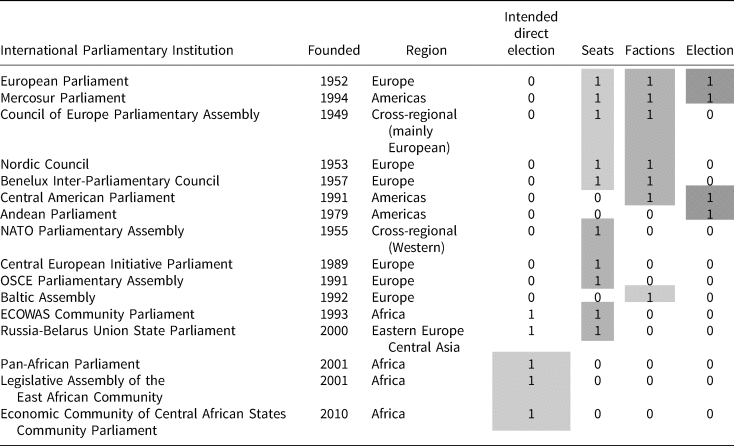
Table 2 provides an overview of the cases. Direct elections are the least common citizen-centred design, with only four directly elected IPIs, most partially. IPIs with the goal of holding direct elections began to emerge in the late 1980s – only the European Parliament set itself this goal already in the 1950s. The spread of direct elections stalled in the mid-1990s. Besides the EP, the three major Latin American integration schemes feature elected international representatives, although they remain partially elected.
International Parliamentary Institutions affiliated with international organisations and with at least one citizen-centred characteristic in 2019.
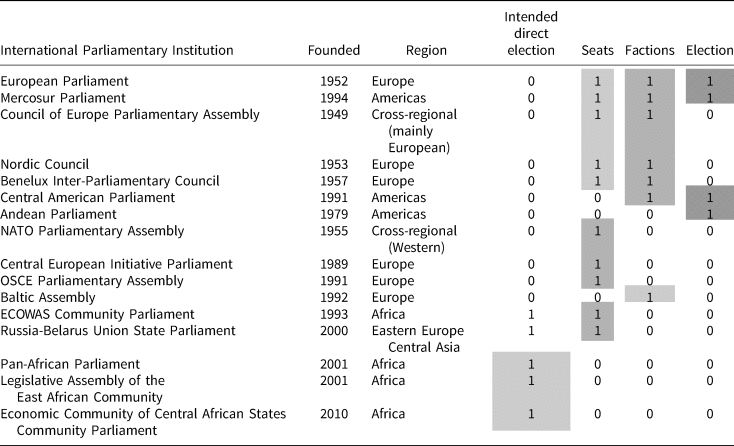
Note: See the appendix for a discussion on the sampling and particular cases.
In all cases, including the European Parliament, elections were not implemented at once or in all countries. In general, governments consider elections costly and have delayed agreed starting dates on multiple occasions. For instance, the Central American presidents agreed to direct elections for their regional IPI in 1986, while most countries did not implement them until at least a decade later. And still, during the last election to this chamber, Panama questioned the vote arguing that the organisation would be logistically difficult.Footnote 75 The most developed IPI of Latin America, the parliamentary body of Mercosur, had a plan to introduce direct elections in phases until the first simultaneous elections in 2015. However, the deadline was first postponed and in April 2019 governments decided to cancel the plans for direct elections altogether. This, however, has been challenged by the IPI itself and by Argentinian parliamentarians.Footnote 76Preferring to err on the side of the rarer citizen-centred designs, we consider a case to have direct elections even if only one of the member states holds them.
Turning to the two remaining dimensions of representational design, proportional seat allocation is more common than ideological groupings. Moreover, while almost all of the early IPIs opted for ideological factions and proportional seat apportionment, these designs have since not been conventional in newly emerging IPIs. In particular, the spread of IPIs in African regional organisations has contributed to this relative decline.Footnote 77 Nowadays, 30 per cent of the parliamentary bodies of IOs have ideological groups or allocate seats in proportion to population.
Finally, examining the few IPIs that combine two citizen-centred traits suggest some affinity between ideological factions and the proportional allocation of seats. Five out of the six cases with two citizen-centred designs (without counting the intent to hold elections) feature this combination. Possibly, whereas distributing equal seats per state encourages politicians to think about their role in terms of state representation, proportional allocation creates incentives to form transnational alliances – for example, for politicians from small countries that would otherwise have little weight.
Overall, Table 2 suggests that the world of IPIs may be divided into Europe-Latin America and Africa-Asia clusters. Europe (including the Eurasian region) and Latin America comprise all IPIs with citizen-centred designs. In contrast, the reason for the stagnation of citizen-centred IPIs is that, since the 1990s, most of these assemblies have emerged in African regional organisations. While these organisations have often been said to have imported European institutional templates,Footnote 78 they have not followed the representational design of the European Parliament. Nearly all IPIs in Africa and Asia feature state-centred designs. While several African IPIs have committed to direct elections formally, the last one being the Pan-African Parliament in 2014, they remain far from this goal in practice.Footnote 79
This overview suggests that the probability that IPIs promote cross-border political communitiesFootnote 80 or represent concerns and conflict lines that differ from those represented in intergovernmental organs of IOsFootnote 81 is presently low. Of course, as we noted earlier, representational design does not determine the behaviour of IPIs and their members. However, design choices such as direct elections or ideological factions create favourable structural conditions for the above patterns of behaviour. In contrast, the design of most contemporary IPIs is aligned with an intergovernmental model of international cooperation in which IOs represent states and state-based communities of citizens.
The regional and organisational contexts of International Parliamentary Institutions
Even though fully or even partly citizen-centred IPIs have remained rare, one might ask whether they emerge in IOs and parts of the world in which they could be particularly relevant. We would consider this to be the case if citizen-centred IPIs were commonly found in contexts in which IOs and even domestic politics could otherwise be considered predominantly state-centred. In these contexts, citizen-centred IPIs, even if lacking authority, could illustrate an alternative to the prevailing model of representational design. The potential of citizen-centred design to foster representation of actors, concerns, and cross-border alignments other than intergovernmental organs of IO would be most relevant in contexts in which the potential for this pattern of representation is otherwise especially low. Simply put, IPIs might be islands of citizen representation.
The debate about whether this is the case involves descriptive claims about the environments of IPIs as well as the causal processes shaping policymakers’ representational design choices. As our goal is to explore the relevance of our conceptual distinction, we focus on the descriptive side of the debate by first discussing and then examining empirically the national and international context in which citizen-centred IPIs are likely to be found. Even though our goals are mainly descriptive, this discussion nevertheless requires awareness of the range of institutional decision-makers involved in creating and designing IPIs. Existing work has found that the proponents of IPIs differ from case to case. Densua MumfordFootnote 82 describes how experts used the design leeway that governments granted them to propose the creation of the ECOWAS IPI. In another recent study, Alexander VerdoesFootnote 83 provides evidence of how members of national parliaments were the crucial actor behind the creation of the Benelux Parliamentary Assembly. In the well-known case of the European Parliament, design choices often followed advocacy by national and European parliamentarians.Footnote 84 It is important to note, however, that in all of these cases governments remained critical decision-makers due to their formal authority over the design of IOs and IO bodies – other actors matter in many cases, but as a source of pressure on, rather than alternative to, governmental decision-makers.
The idea that IPIs could introduce citizen-centred representational designs in otherwise state-centred contexts has indeed played a role in academic and political discourse. For instance, campaigners for a UN parliament hope that even an initially weak and state-centred IPI would eventually evolve.Footnote 85 In this vein, state-centred parliaments could gradually become more citizen-centred. Yet, in empirical terms, IPIs almost never change design.Footnote 86 However, they might introduce new representational designs in world regions that otherwise exclude citizens from national and international political authority. For example, the 1979 Caracas Declaration in which parliamentary delegations from Bolivia, Colombia, Ecuador, and Venezuela – most of which were undemocratic regimes at the time – first proposed the Andean Parliament, reflects this idea:
there is a struggle to keep the values of representative democracy, to give to the people legitimate participation in making their own destiny. Hence, the parliament is the genuine representation of the popular sovereignty and the conscious vigilance of the acts of our governors. Without its existence our countries would not conceive the validity of democracy. This philosophy inspires us to propose the creation of the Andean Parliament … Footnote 87
Yet, counter-arguments suggest that citizen-centred representational designs are more likely in IOs and countries that are already committed to, or are at least compatible in terms of goals and structures with, citizen representation in domestic politics and at the international level. Existing studies suggest that a range of institutional outcomes that encourage representation other than by governments are most common if democratic norms at the domestic level are strong. For example, IOs with democratic member states are also most likely to allow for the representation of civil society and to have IPIs in the first place.Footnote 88 Democratic governments might be ideologically in favour of, institutionally familiar with, or politically under pressure from citizens to support citizen-centred representation in IOs. It seems likely, therefore, that citizen-centred representational designs in IPIs would be most likely in IOs run exclusively or predominantly by democratic governments.
Other arguments indicate that citizen-centred representational designs might mainly exist in IOs that pursue regional integration projects. In contrast, these representational designs might be less compatible with or useful for other IOs. Regional integration projects are commonly assumed to require a sense of regional identity and community and, therefore, institutions that promote these outcomes.Footnote 89 Regional integration projects have a plausible use for institutions that could broaden representation beyond governments and enable the formation of cross-border alignments such as party groups. The creation of citizen-centred IPIs is one of the main institutional strategies that governments could pursue so as to help their IOs promote regional integration.
IOs that pursue regional integration are likely to create citizen-centred IPIs for a second reason. They often have enhanced legitimation needs because their legislative agendas tend to be less predictable. This renders the creation of additional legitimation mechanisms, including citizen-centred parliaments that broaden representation beyond intergovernmental organs, potentially attractive for governments. This argument builds on Tobias Lenz et al.Footnote 90 who suggest that regional integration projects can be characterised as so-called general-purpose organisations. This means that they are not only defined by region-building ambitions, such as the EU's effort to create an ‘ever closer union among the peoples of Europe’.Footnote 91 They also have open-ended goals to enact region-building. Of course, as all IOs, general-purpose IOs list their goals in treaties, and some start with a short list such as the European Coal and Steel Community. It is also true that general-purpose IOs often have stronger competences in the area of economic integration than in other domains. However, even then general-purpose is visible in the goal to grow into a regional organisation, develop an open-ended legislative agenda, and rely on generical procedures such as the EU's ‘ordinary legislative procedure’ that applies whenever the treaties do not explicitly provide for another procedure. While citizen-centred IPIs are not the only enhanced legitimation strategy for general-purpose IOs, they are one prominent strategy that governments might pursue.
Another line of reasoning focuses on the IO membership. Many state-centred regions and IOs are at the same time heterogeneous in terms of socioeconomic conditions. For example, many African regional organisations bring together rather different countries. Yet, the creation of more citizen-centred bodies at the international level is often said to be easier in homogenous environments.Footnote 92 Even in the comparatively wealthy and homogeneous European Union, diversity is often considered an obstacle for the common elections, shared public debate, and transnational alliances that form the core of citizen-centred parliaments.Footnote 93 In light of this, IPIs might be found in socioeconomically homogenous environment rather than in state-centred regions and organisations that often are more heterogeneous.
Finally, it has been suggested that IOs in general and IPIs in particular learn from the institutional design of other prominent organisations – most importantly, the European Union.Footnote 94 The European Union is the most authoritative IO and the European Parliament the most authoritative and most visible IPI in the world.Footnote 95 This has not always been the case, however. The European Parliament started as a weak assembly and relatively marginal part of the early European integration organisations. It has always had citizen-centred traits – cross-border factions, proportionally allocated seats and, since 1979 direct elections – but only began to gain significant legislative authority with the 1986 Single European Act.Footnote 96 It is likely that the growing authority of the EP has, over time, increased its visibility and status. This might have motivated IOs elsewhere to examine and potentially import not only its legislative authority but also its citizen-centred representational design. Moreover, Julien NavarroFootnote 97 suggests that the European Parliament might use its authority to demand greater influence on the EU's policy towards other regional integration projects and might thus promote the export of its own representational design to interlocutors such as the Pan-African Parliament. On the other hand, some doubt is warranted based on the fact that the EP's authority has increased the most during a time period, since 1986, when predominantly state-centred IPIs emerged. The Pan-African Parliament on which Navarro focuses has remained state-centred except for the intention to hold direct elections in the future. Some Latin American parliamentary bodies also committed to direct elections in this period.Footnote 98
Correlates of citizen-centred IPIs
Variables and data
We start from our sample of 38 IPIs. For each, we identified a limited number of moments in which we take stock of their environment. We focused on the foundation of IPIs, when they reformed their fundamental documents (such as when they reform internal rules), and on periods in which the IOs to which they belong changed their treaties. This yields 116 observations. This approach serves two purposes. First, it avoids focusing only on the contemporary or foundational context of IPIs, which might have changed. Second, we zoom in on moments in which the representational design of IPIs might have been under scrutiny and their environment especially relevant. Of course, we could have considered all years of the existence of an IPI. Not doing so means that we miss changes in their environment outside of their foundation and IO treaty reform. Yet, restructuring our data to encompass all years does lead to very similar results (see appendix).
We measure four variables corresponding to the arguments made in the previous section. First, the level of democracy of the member countries of an IO is measured as their mean score on the Polity V index.Footnote 99 Below and in the appendix, we also consider alternative operationalisations: the share of democratic countries instead of the mean as well as mean democracy measured with the Varieties of Democracy (V-Dem) ‘Polyarchy index’.Footnote 100
Second, we argued that IOs engaged in region-building might differ from other IOs because of their distinct goals and general-purpose character. As no systematic data is available for this distinction, we manually coded the treaties and subsequent reforms of all IOs to which the IPIs in our data belong. Following Lenz et al.Footnote 101 we identified IOs with treaties that state region-building ambitions or contain an open-ended list of goals and objectives. These may also be contained in the preamble – for example, as the European Union's mandate to build an ‘ever closer union’ – while the treaty allows the members to set new objectives in the future. We refer to these organisations as regional integration projects and general-purpose organisations interchangeably.
Third, measuring the homogeneity of IO member states on a global scale requires simplification and indicators that are comparable and available across regions. Our assumption is that a country's level of economic development to some extent captures the types of problems and conflicts that it faces and the political organisations it gives rise to. We operationalise economic homogeneity as diversity in economic development as measured by the standard deviation (SD) of the GDP per capita of IO members. We additionally examine the SD of IO member state populations. Similar populations might, in particular, facilitate agreement on proportional seat allocation in IPIs. Homogeneity could, of course, be measured differently. We consider alternatives in the appendix.
Finally, to test the idea that the development of the European Parliament holds a relationship with the designs of other IPIs we created a measure of decision-making authority for IPIs on the basis of their prerogatives on IO decision-making, which we coded on a 0 to 5 scale from no rights to sole decision-making over IO legislation.Footnote 102 We use the EP values of this measure in the analysis below. In the EP case, the cooperation instituted in the Single European Act of 1987 and the co-decision of the Maastricht Treaty in 1992 were the two major advancements of its authority. They respectively mandated the IO to respond to the consultations of its IPI and to obtain its consent. This gave the EP veto right in most policy areas, which only one other IPI has, the East African Legislative Assembly.
Bivariate relationships
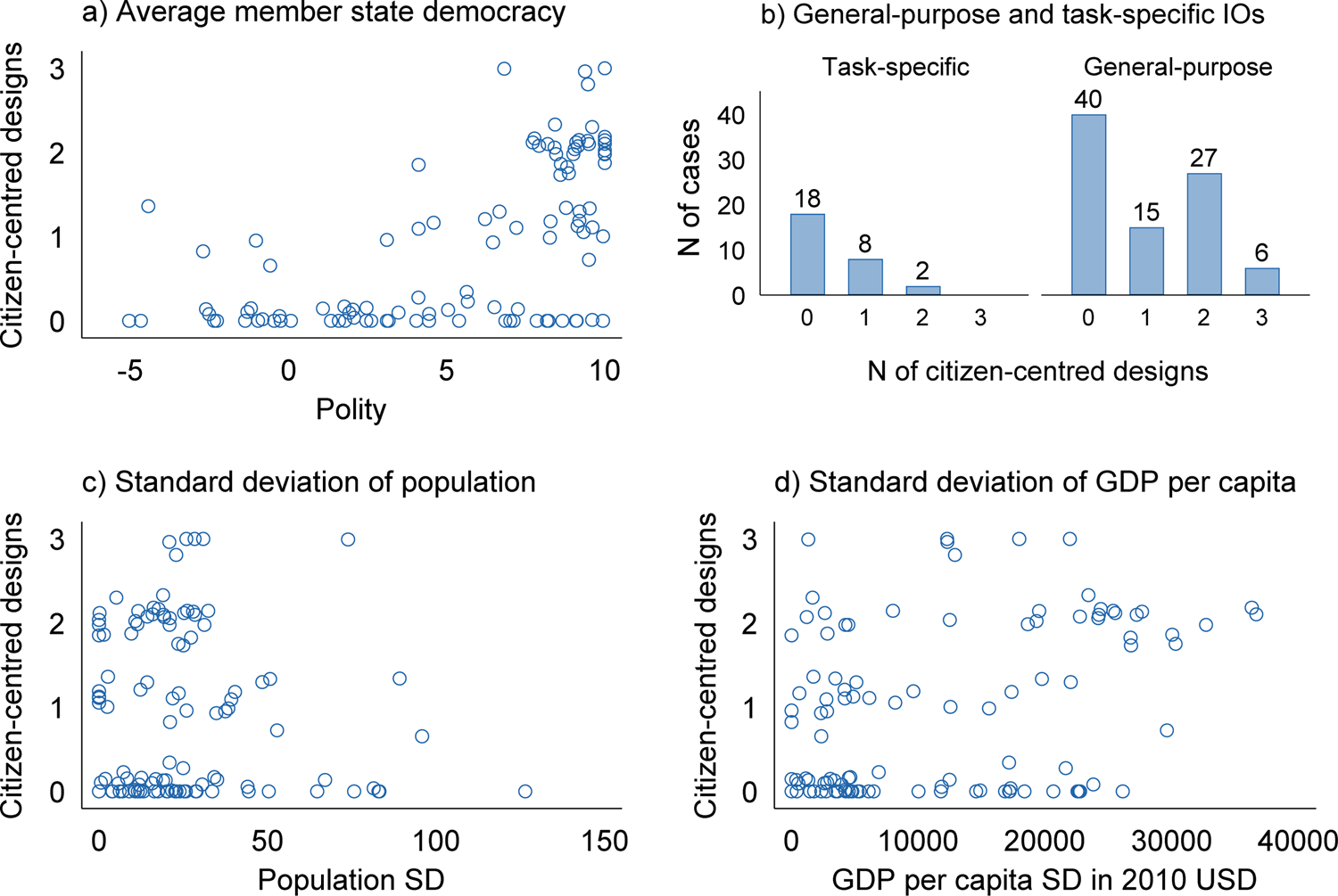
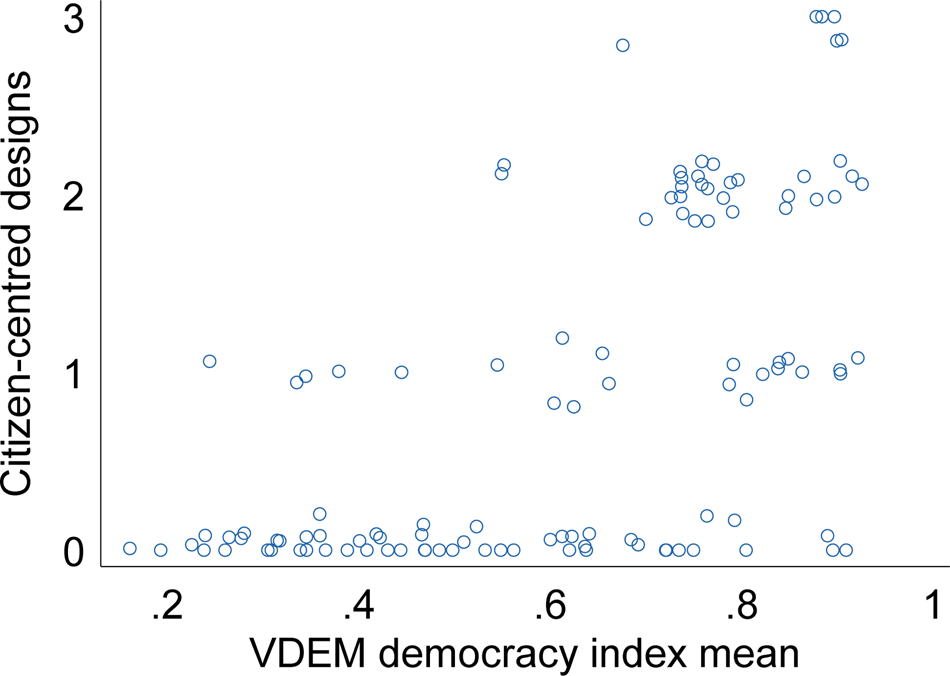
In Figure 2, we examine how the variables discussed in the previous section relate to citizen-centred representational designs. As explained, the cases in the figure correspond to observations of IPIs at their foundation and in years with treaty reforms of the IOs to which they belong. Panel (a) shows that almost all wholly or partly citizen-centred IPIs can be found in democratic IOs. Democracy, in fact, comes close to a necessary condition in the absence of which IO member states almost invariably create state-centred parliamentary bodies. In contrast, however, democracy is not a sufficient condition for citizen-centred representation. There are several democratic IOs without citizen-centred IPIs. Alternative democracy measures result in similar impressions (see Figure A1 in the appendix).
Explanatory variables and citizen-centred representational designs in the analysis sample.

Panel (b) of Figure 2 focuses on the purpose of IOs. Like democratic IOs, the general-purpose organisations typically associated with regional integration appear prone to establishing citizen-centred parliaments. Most such IPIs, including all wholly citizen-centred ones and all with direct elections, can be found in general-purpose IOs. However, as member state democracy, general organisational purpose is not sufficient. There are exceptional positive cases. The assemblies of BENELUX and the OSCE are (partly) citizen-centred IPIs in task-specific IOs. There also are fairly many cases of general-purpose IOs with state-centred parliaments.
Panels (c) and (d) focus on homogeneity in the populations and economic development of IO member states. Here, the associations are less clear, but citizen-centred IPIs do seem more common in homogenous IOs. Nevertheless, there are outliers including, in Panel (c), the case of the Russia-Belarus Union State, which allocates seats proportionately despite the fact that Russia is 15 times larger than Belarus. However, our preference to err on the side of citizen-centred designs overstates this discrepancy as Russia only receives 2.6 times more seats.
The legislative authority of the European Parliament in the EU is negatively correlated with the number of citizen-centred designs in our analysis sample (r -0.28). This is largely due to the fact that in most of our observations (those starting in the 1990s and later) when the legislative powers of the EP were already high, most IPI still have 0 or only 1 citizen-centred design.
Overall, citizen-centred representational designs are mainly a feature of the most democratic regional integration projects. They also seem to be more common in economically homogenous organisations, making the comparatively democratic, wealthy, and ambitious European integration project the paradigmatic example of an organisation with a citizen-centred parliament. Elsewhere in the world, where international as well as domestic affairs are more state-centred and fragmented, parliamentary bodies are more state-centred as well. Considered in conjunction with our earlier description of the historical development and distribution of the characteristics of IPIs, we thus see that citizen-centred representational designs have not only remained relatively rare overall, but have also rarely spread to the state-centred national and international contexts in which they might have proved most relevant.
Multivariate relationships
We examine these patterns further on the basis of a logistic regression analysis in which the outcome is whether an IPI is citizen-centred or not. We understand this to mean that it has at least two citizen-centred characteristics. In a second step, we examine each design feature separately. The structure of our data remains as discussed. Our goal is to deepen the systematic description of the contexts in which IPIs exist.
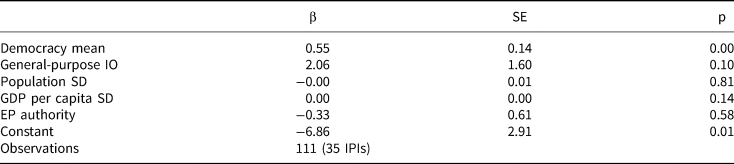
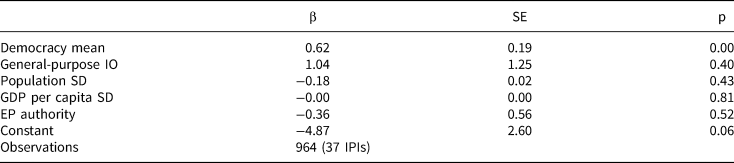
Table 3 shows the results of the first analysis. The results are generally in line with the impressions obtained so far. There is a positive and significant association between the average level of democracy of IO member states and the existence of citizen-centred IPIs. Beyond this, the evidence is more uncertain, however. The coefficient of IO purpose points in the direction seen in the bivariate analysis, albeit with a high p value. Whether IOs are homogenous or heterogeneous in wealth and population does not seem to relate to citizen-centred designs with any degree of strength or certainty. The model also contains the index of the EP decision-making authority as a covariate. The inconclusive results, in conjunction with the fact that citizen-centred designs have remained the exception, does not warrant confidence in the idea that the EP's legislative authority shapes representational design around the world.
Correlates of citizen-centred designs.

Note: Standard errors are clustered by IPI. SE: Standard error.
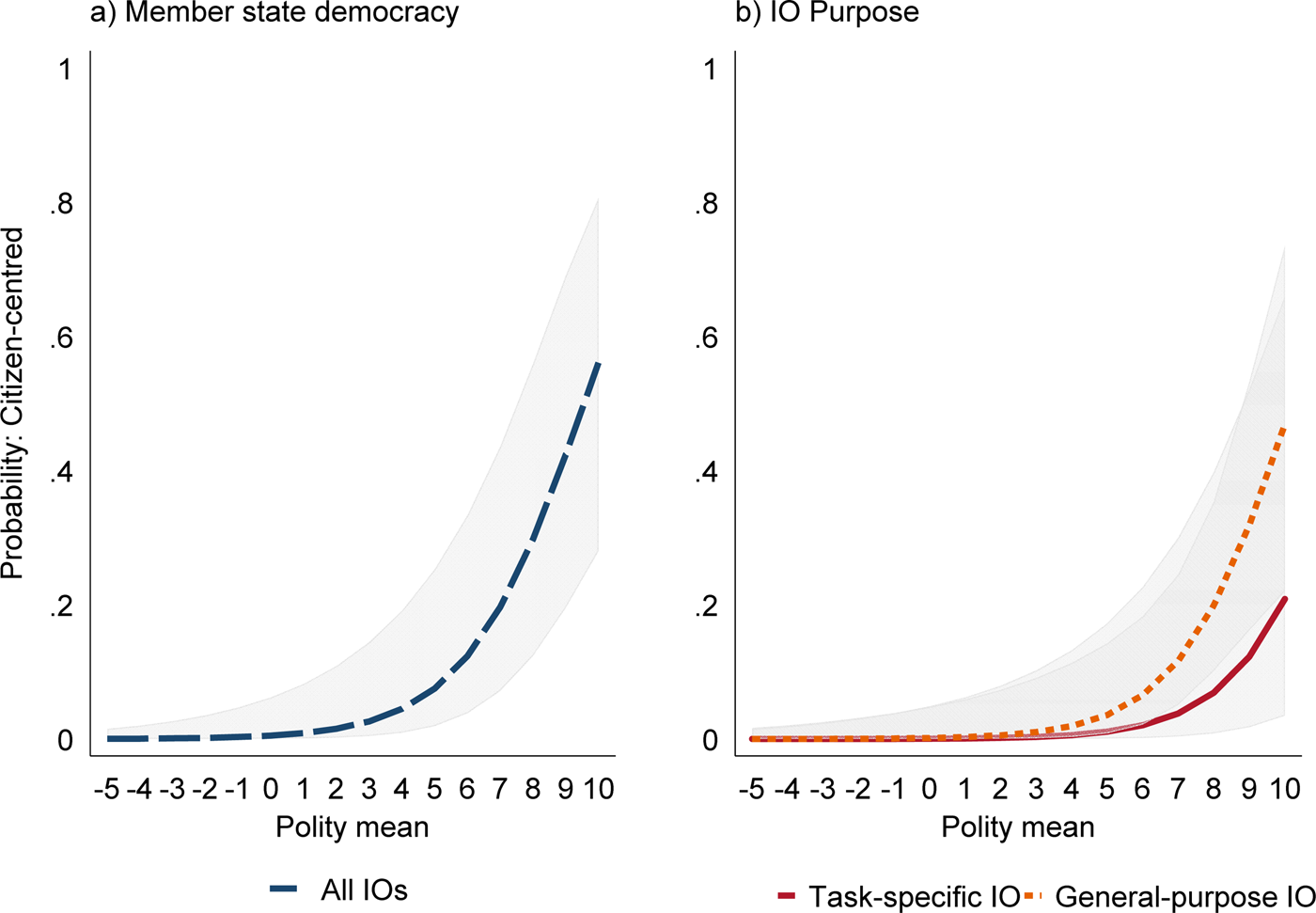
Figure 3 visualises the strength of two of these relationships, for member state democracy and IO purpose. We estimate that the probability to observe a citizen-centred IPI is about 60 per cent in the most democratic and nearly absent in the least democratic IOs. General-purpose IOs are more likely to have citizen-centred IPIs although, in line with the fact that this relationship is not significant, the confidence intervals are wide.
Predicted probabilities.

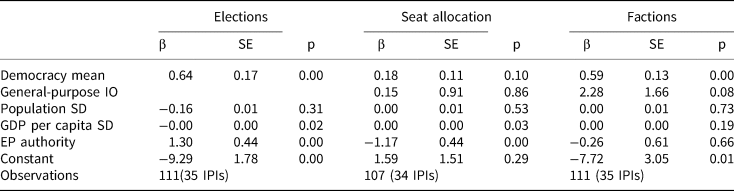
Table 4 summarises the results of an analysis with the presence or absence of each citizen-centred design as the outcome. While one could have imagined differences in the typical contexts of different designs, the findings are similar to the previous analysis. There is a positive relationship between the level of democracy of IO members and direct elections or the non-territorial organisation of the IPI, but proportional seat allocation seems to be a characteristic that also non-democratic IPIs have. Second, the associations between citizen-centred designs and general-purpose IOs are also different between designs. While belonging to a general-purpose IOs seems to matter for citizen-centred parliamentary factions, it does not matter for seat allocation, a design that IPIs adopt more easily. Our categorisation of the purpose of IOs is not included in the first model because there are no task-specific IOs that hold elections. We also observe similar, albeit mostly insignificant, relationships between homogeneity in economic development and different citizen-centred design dimensions. One additional insight of the disaggregated analysis pertains to population size. Although the most heterogeneous IOs today have IPIs with seats in proportion to population, considering all cases in our analysis sample this is not necessarily the case. For instance, out of the five time points at which we observe the IPI of Mercosur, three of those correspond to the time at which the IPI still had an equal number of seats per country. Consequently, the coefficient in the regression is close to 0.
Disaggregating citizen-centred designs.

Note: Standard errors are clustered by IPI. The first model excludes the general-purpose variable because all elected IPIs are found in general-purpose IOs. SE: Standard error. The model on seat allocation has fewer observations, corresponding to the IPI of the Union for the Mediterranean, which has an allocation system that is not captured by our category.
Citizen-centred designs might have become more widespread as the European Parliament has gained prominence. However, as in the previous analysis, we find no or reverse relationships between citizen-centred design and EP authority. However, we find an association between the legislative authority of the EP and direct elections in other IPIs. Given that this relationship is limited to direct elections, caution is warranted before interpreting this association as potentially causal. For example, direct elections could be the result of global expectations or norms for the design of parliamentary bodies that have evolved in parallel to the growing legislative authority of the EP. Yet, as our goal is not to test causal claims, it holds true descriptively that direct elections, but not other citizen-centred traits, appear to have become more common as the most prominent citizen-centred IPI, the European Parliament, has gained authority.
In sum, the multivariate analysis reinforces the impression from the previous sections that citizen-centred international parliaments are primarily a feature of the world's most democratic, general-purpose IOs. While these patterns might be causal or starting points for causal claims, our goal here has been to examine whether citizen-centred representational designs are likely to be found in otherwise state-centred context where their potential to foster representation of alternative actors, concerns, and cross-border alignments than intergovernmental organs might matter most. However, our results warrant scepticism. The IPIs that exist in such environments have state-centred characteristics almost invariably.
Conclusion
In contemporary IOs, IPIs are not only increasingly common but also often regarded as mechanisms for democratic representation.Footnote 103 Yet, their representational design varies. This variation is likely to foster the representation of different actors and concerns. This study has developed this idea further by delineating important representational design alternatives – state-centred and citizen-centred representational designs – and mapping their existence and correlates in IOs around the world. Drawing on new data, we found that citizen-centred IPIs have remained a rare and a near-exclusive phenomenon of a few democratic and advanced regional integration projects. Democracy among IO member states and the general organisational purpose associated with regional integration appear to be especially typical contexts for direct elections and cross-border IPI factions, as for example the transnational ideological groups of the European Parliament. These conditions are less regularly associated with allocation of IPI seats in proportion to population, however.
These results do not imply that IPIs fail to add to the channels of representation existing in IOs. Irrespective of their representational design, IPIs bring together directly or indirectly elected political actors and thus different actors than the agents of national governments found in intergovernmental IO bodies. However, our findings suggest that the actors and concerns represented in IPIs might prove more similar to intergovernmental bodies than they could be if citizen-centred representational designs were more widespread. Existing literature indicates that different design choices could enhance the likelihood that IPIs give expression to cross-border political communities, concerns, and conflict lines that differ from those represented in intergovernmental IO bodies.Footnote 104 The literature on the European Parliament similarly suggests that its cross-border factions, direct elections, and population-oriented seat allocation foster legislative behaviour independent of, and frequently in conflict with, the Council of Ministers.Footnote 105 Yet, these citizen-centred representational designs remain the exception in global comparison and are especially rare in otherwise state-centred domestic contexts and IOs. Most IPIs are thus unlikely to challenge intergovernmental IO bodies in the same sustained way as the EP has frequently done not only because they often lack institutional authority, but also because of their predominantly state-centred representational designs.
Further research could build on these results. As noted earlier, the claim the representational design influences the actors and concerns represented in IPIs requires conceptualising and mapping relevant design alternatives as well as testing their behavioural implications. In this study, we have focused on the first of these steps, which is a prerequisite for testing the consequences of variation in design on representation-related behavioural outcomes such as the characteristics and ideological orientation of or representational claims made in speeches by IPI members. Similarly, future research could further test the causes and mechanisms leading to the creation of IPIs with different representational designs. We focused on describing the typical environments of state-centred and citizen-centred IPIs but more systematic analysis, including potentially case studies of causal mechanisms or qualitative comparative analysis of the configurations of causes leading to design choices, might allow causal claims.
We conclude with two broader observations. While state-centred IPIs remain the rule, advocates of citizen-centred representational designs might hope that this might change over time. Yet, is it likely that more citizen-centred parliaments might emerge over time? If we take our results as indication of possible causal drivers of representational designs, they suggest that the future of citizen-centred IPIs depends on the success of democracy and the general-purpose IOs associated with regional integration projects. Against this background there is reason to be sceptical. First, there is little room for more citizen-centred designs in favourable contexts. Consider all IOs with IPIs in 2017. Of these only six (the Central American Integration System, Mercosur, the Organization of Eastern Caribbean States, Benelux, European Union, and the Andean Community) had a general-purpose and were democratic (with a Polity V average above 6) – yet, only the parliaments of the Caribbean States and Andean Community had fewer than two citizen-centred characteristics already. Second, if there is no growth potential given the existing IOs, the further spread of citizen-centred designs would require that more IO member states become democracies and more regional integration projects emerge. However, the opposite actually appears to be in process. Many observers identify a risk of a ‘democratic recession’,Footnote 106 not least in the European and Latin American heartlands of citizen-centred IPIs. Others highlight the politicisation and contestation of regional integration and multilateral institutions, although here the picture is mixed and some argue that more rather than less citizen representation could be the result.Footnote 107 Given these trends, the representational designs of international parliaments are likely to remain mainly state-centred for the foreseeable future.
Finally, we have focused on IPIs and concluded, albeit bearing in mind several open questions, that these bodies might not promise as different representation from intergovernmental IO bodies as superficial observation might indicate at first. What does this imply for policymakers, activists, and scholars seeking to broaden representation in IOs and beyond? Our analysis suggests two arguments. On one hand, if the goal is to broaden representation, then there might seem to be greater potential in function-centred bodies and processes. IOs have expanded representation not only by creating IPIs but also by strengthening the representation of civil society organisations and, more broadly, stakeholders.Footnote 108 Even beyond IOs, ‘multistakeholder’ governance processes have become widespread.Footnote 109 On the other, some caution is warranted. In a similar way that the concept of representational design has led us to a careful view as to the potential of IPIs to represent new actors and concerns in IOs, this concept could also contribute to a more systematic assessment of the nature of representation that multistakeholder governance in and beyond IOs could actually be expected to offer.
Acknowledgements
We gratefully acknowledge financial support from the Swiss National Science Foundation and the NCCR Democracy, research assistance by Jana Lipps, Kata Szabó, and Siyana Timcheva, and comments by the members of the European Politics Research Group at ETH Zurich and at the Swiss Political Science Association annual conference and Dreiländertagung (ETH Zurich, 14–16 February 2019).
Appendix
The sampling of IPIs
The latest publications on IPIsFootnote 110 explain that sampling IPIs yields different results depending on the terms of the definition and how high one places the cut-off point that separates institutions from looser associations of parliamentarians. To define our sample we adopted a strict perspective on the main elements of our definition: collegiality, membership, and institutionalization. IPIs are collegial and have their members directly or indirectly elected. The first condition rules out regular meetings of parliamentarians but which are not designed to take decisions collegially, such as the Parliamentary Conference on the WTO. The second condition rules out cases that would otherwise be considered IPIs because of their institutionalisation, but fail to pass the selection criterion. This is the case, for instance, of associations that have their membership constituted by self-selected parliamentarians. The Global Legislators Organisation (GLOBE International) is a case in point. Lastly, there is a long list of parliamentary networks that do not fit any of the three criteria, because they are not institutionalised, have self-selected membership, and do not act collegially.
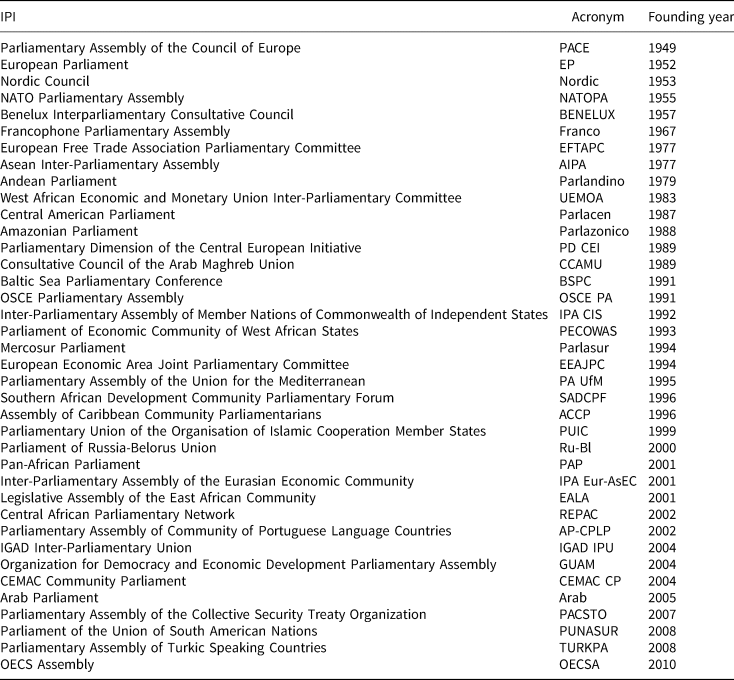
Table A1 lists our sampling of all 38 IPIs that are part of an international organisation. This may be formally, when an IPI is an organ inside the IO, or through other arrangements, such as in the case of the Nordic Council, the Baltic Assembly or the Amazonian Parliament, where IO and IPI are separate legal entities, each with its own sructures. We have excluded the Latin American Parliament from our sample because although it has manifested its will to be part of the Community of Latin American and Caribbean States (CELAC), the states themselves have not acknowledged the parliament in any official document, unlike the case, for instance, of the NATO Parliamentary Assembly. Another notable exclusion is the Inter-Parliamentary Union, which is informally aligned with the United Nations (and holds observer status) but not part of it or acting as its parliamentary body. The The ACP-EU Joint Parliamentary Assembly and Euro-Latin American Parliamentary Assembly are recognised by the European Union in so far as they are partidipated by the European Parliament. They are IPIs in their own right, but we have excluded them from the sample of IPIs within international organisations because the nature of the EP participation does not constitute them as IPIs of the EU.
International Parliamentary Institutions within international organisations.

Summary statistics.

Another case to remark is The Parliament of the Union of South American Nations (UNASUR). Although the IPI was created with the IO itself, it has not started to function in practice.Footnote 111 Currently, the IO is on hold after seven of the 12 member states exited the union, formally or de facto.Footnote 112 We opt, however, to maintain this IPI within our sample for two reasons. First, because our theoretical perspective takes into account IPIs that are connected to IOs. Their design has, in consequence, been approved by governments. Given that our interest lies in governmental consent to representational designs that allow for alternatives to governmental representation, we maintain IPIs in the database as long as they exist formally. Second, because even institutions that have been abandoned in practice can be brought back to activity if it suits the political interest of an actor. A case in point is the Amazonian Parliament, which has been without activity for most of its life, but has proposed to be reactivated by a political group at the Brazilian Senate.Footnote 113 Lastly, we include the IPI of the Eurasian Economic Community until its dissolution in 2014.
Additional analyses
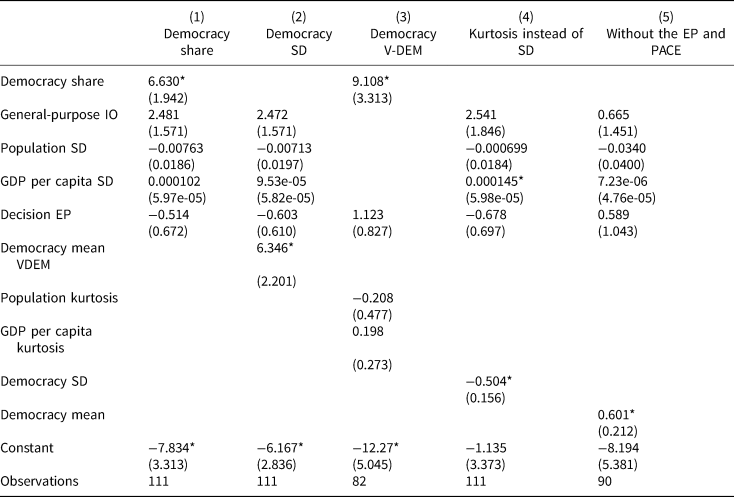
We explored alternative model specifications to establish that different measures of the same concepts produce results that are substantially comparable to those of the analysis in the main text. Table A3 shows the coefficients of five alternative regressions that deviate from the model described in the body of the article.
Alternative models.

Relationships of citizen-centred designs with the alternative democracy index from the V-DEM Project.

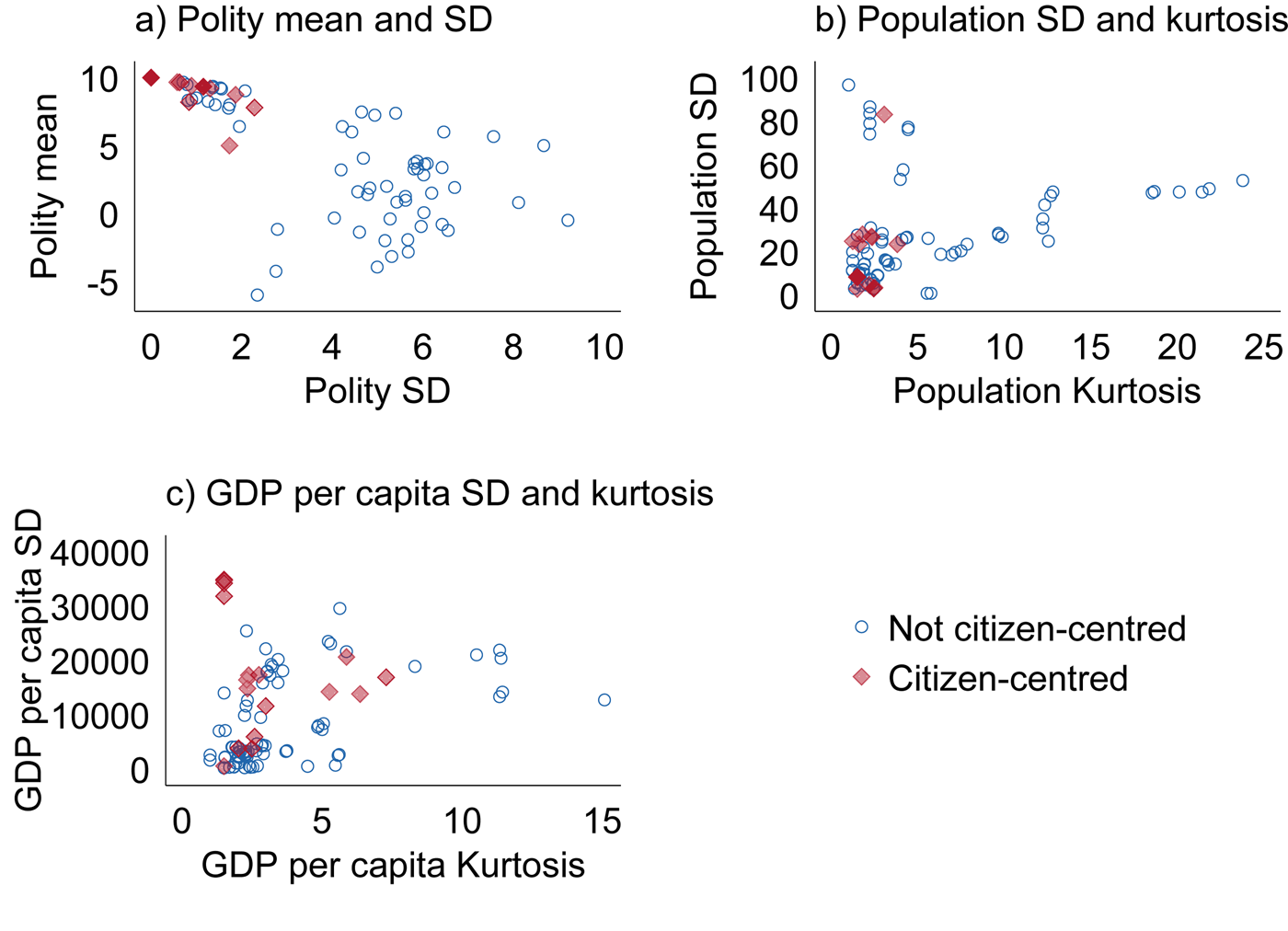
Features of variables distributions.

First, we explore different democracy indicators, as it is the most relevant variable in our model. The share of democracies of an IO (model 1 in Table A3, as the share of countries with more than 6 in the Polity index) instead of the mean of the index gives results that reinforce the findings of our main model, while other variables stay virtually unchanged. We also take the standard deviation of the Polity index,Footnote 114 which captures the spread of the democracy scores in an IO membership. Panel (a) in Figure A2 shows that the correspondence between the mean and the standard deviation of the Polity V index. The results are coherent with the idea that more homogenous membership is linked to citizen-centredness (model 2). The third alternative democracy measurement is the mean of the V-Dem democracy index.Footnote 115 In model 3 of Table 3 the results show that this also increases the intensity of the relationship between democratic memberships and citizen-centred designs, compared to other measures.
Second, as our results were most ambiguous when it comes to the homogeneity of IOs, we explored additional dimensions of homogeneity. In the main text, we use the standard deviation of the GDP per capita (in thousands of 2010 US dollars) and the population (in millions of people). As an alternative, we considered the kurtosis of these two indicators. This operationalisation emphasises the extremes of the distributions, and hence the possibility that outlier countries are influential. Furthermore, this statistic is not strongly correlated with the standard deviation used so far (see Figure A2, panels (b) and (c), which warrants a further reason to explore it. The results are only partially in line with the expectation that homogenous IOs are more prone to citizen-centred designs than heterogeneous ones. Model 4 in Table A3 shows the results.
Finally, we further test the influence of the European Union by excluding it from the analysis sample (model 5 of Table A3). In this model, we also exclude the Parliamentary Assembly of the Council of Europe. As we have included in our analysis sample only the years in which IPIs were created, had changes in their fundamental documents, or the treaty of their IO was modified, some IPIs have more observations than others. This is expected as part of the design. However, the Parliamentary Assembly has a disproportionately high number of reforms to its rules of procedure (13 while the average is 0.8). We have only kept those refoms that are substantive, and not part of the changes it applies at member accession. Removing the IPI from the model makes sure we are not overrepresenting this particular IPI's characteristics in the sample. The results, however, are in line with the regression presented in the main text in all variables.
The other area where we can explore the resilience of our conclusions to model changes is in the selection of our sample. Critically, we restricted our sample to those years at the start of the IPI within the IO or when either went through periods of instability that could have potentially resulted in changes of design: IO treaty changes and the reform of the IPI main formal documents. Repeating the analysis with every IO-year available increases observations by one order of magnitude, but keeps results stable, with some deviations, such as increasing uncertainty in the estimate effect of general-purpose IOs. The results are shown in full in table A4.
Correlates of citizen-centred designs with all IPI-years.

Measuring decision-making authority of IPIs
We used a measure of the decision-making authority of IPIs to inspect the relationship between the powers of the EP and the designs of other IPIs. This measure takes a 0 to 5 scale, depending on the formal procedures established in the documents of the IO or the IPI that regulate which rights it has to demand or receive information from the IO on its decision-making: (0) no formal rights; (1) right to information about IO agenda; (2) obligatory consultation; (3) right to a response to consultation; (4) veto rights; (5) exclusive IPI decision.