Over the last two decades, authoritarian regimes in Asia have increasingly experimented with controlled forms of political participation and deliberation, producing a variety of “hybrid” regimes. These regimes mix authoritarian rule with political devices including elections, consultative forums, political parties, and legislatures that we would normally associate with democracy.Footnote 1 China is a particularly important case; though it remains an authoritarian country led by the Chinese Communist Party (CCP), its government is now permeated with a wide variety of participatory and deliberative practices.Footnote 2 Two decades ago, leaders introduced village-level elections. Other innovations have followed, including approval and recall voting at the local level, public hearings, deliberative polls, citizen rights to sue the state, initiatives to make government information public, an increasing use of Peoples' Congresses to discuss policy, and acceptance of some kinds of autonomous civil society organizations. While very uneven in scope and effectiveness, many of these innovations appear to have genuinely deliberative elements, from which political leaders take guidance, and upon which they rely for the legitimacy of their decisions.Footnote 3 Typically, however, deliberation is limited in scope and focused on particular problems of governance. Curiously, these practices are appearing within an authoritarian regime led by a party with no apparent interest in regime-level democratization. We refer to this paradoxical phenomenon as authoritarian deliberation, and its associated ideal-type regime as deliberative authoritarianism. In the Chinese case, we argue, authoritarian deliberation is conceptually possible, empirically existent, and functionally motivated. Authoritarian deliberation is normatively significant—but, as the concept implies, it is also normatively ambiguous.
Although we focus on the Chinese case, our analysis should be understood as a contribution to comparative political theory, an emerging style of political theory that elaborates normatively-significant concepts in ways that are both attentive to contexts, particularly non-Western contexts, while enabling comparisons across contexts.Footnote 4 Our primary aim is not to provide new empirical knowledge of China, but rather to develop the concept of authoritarian deliberation from within democratic theory by combining two familiar concepts into an unfamiliar concept, and then to argue that this concept helps to both explain and illuminate a distinctive set of normative potentials and risks for democracy within Chinese political development.
Our first claim is oriented by democratic theory. We argue that authoritarian deliberation is theoretically possible. Democracy, as we conceive it, involves the empowered inclusion of individuals in matters that affect them by means of votes, voice, and related rights. Deliberation is mode of communication in which participants in a political process offer and respond to the substance of claims, reasons, and perspectives in ways that generate persuasion-based influence.Footnote 5 There are important structural and institutional relations between democratic empowerment and deliberative influence: democratic empowerments ensure that actors are able to resolve conflicts by means of arguments and votes. However, it is possible for deliberative influence to affect political decision-making in the absence of democratic empowerments, assuming that (authoritarian) elites have other kinds of incentives, such as functional needs for cooperation and legitimacy. That is, the linkages between democracy and deliberation are contingent rather than necessary, leaving open the theoretical possibility of authoritarian deliberation as a form of rule.
Following this logic, we then develop the ideal type of deliberative authoritarianism—a regime style that makes frequent use of authoritarian deliberation. In developing this ideal type, we depart from much of the literature on hybrid regimes. The literature has focused extensively on incomplete democratic transitions, especially those involving regime change from authoritarian to electoral democracy, while retaining many of the elements of authoritarian rule, including weak rights and uncertain freedoms, weak rule of law, on-going patronage relationships, weak civilian control of the military, and corruption.Footnote 6 Viewed in these terms, the Chinese case is distinctive: to date, there has been no regime-level democratization. Lacking this kind of regime trajectory, China is not an “incomplete,” “pseudo,” or “illiberal” democracy, terms often applied to dynamic cases.Footnote 7 Nor do the terms “competitive” or “electoral” authoritarianism describe its distinctive one-party rule. The regime exhibits, rather, a resilient form of authoritarianism that, as Nathan argues, draws its strength from reforms that increase “the adaptability, complexity, autonomy, and coherence of state organization.” The regime is achieving these capacities through an increasingly norm-bound succession process, an increasing use of merit-based considerations in top leadership selection, an increasing functional differentiation and specialization of state organizations, and new participatory institutions that enhance the CCP's legitimacy.Footnote 8 We agree with Nathan. In ideal-typing features of the Chinese case as deliberative authoritarianism, however, we are focusing our analysis on mechanisms of conflict management and decision-making rather than regime nature and classification as such. Thus we intend the concept of deliberative authoritarianism to compare to those concepts of “hybrid” authoritarian regimes that identify supplements to command and control decision-making. These supplements include limited elections and institutional consultations, some citizens rights and protections, some local and autonomy, and segmentation by level policy and level of government. They result in regime identifiers such as “competitive authoritarianism”,Footnote 9 “consultative Leninism”.Footnote 10 and “conditional autonomy within authority structures”.Footnote 11 These kinds of classifications are distinct from those based on leadership types, such as personalist, military, and single-party hegemonic authoritarianisms,Footnote 12 as well as from concepts that describe consequences, such as “resilient” authoritarianism,Footnote 13 although China is most certainly a single-party hegemonic system that is proving to be extraordinarily resilient. By developing the concept deliberative authoritarianism, we are ideal-typing an apparently paradoxical supplement to authoritarian decision-making—deliberation—that appears to be assuming an increasing important role in Chinese political development.
As we develop the concepts of authoritarian deliberation and deliberative authoritarianism as they apply to the Chinese case, we also extend the ideal-typical analysis to identify the complex ways in which deliberative features of political development mix with other kinds of institutions and practices, including protests, some rights, and elections. The analysis we offer here ideal-types a regime strategy of channeling political conflict away from regime-level participation, such as multi-party competition, and into “governance-level” participation, segmented into policy-focused, often administratively- or juridically-organized venues. We then survey some of the emerging deliberative features of these governance-level venues in order to indicate that authoritarian deliberation is empirically existent and (we believe) an important feature of recent Chinese political development. We next discuss a key methodological problem: under authoritarian conditions, it is not always easy to distinguish forms of participation common under authoritarianisms that mobilize people for shows of support .as in the former Soviet Union, Cuba, and Maoist China, from those that generate deliberative influence. We argue, however, that the theoretical categories developed here show us where to look for empirical indicators that would distinguish deliberative influence from, say, coerced participation.
We then return to theory to ask why would an authoritarian regime resort to deliberative politics. Our initial take is functional: problems of governance in complex, multi-actor, high-information, high-resistance environments may provide elites with incentives to rely on deliberation in the absence of democratic empowerments, thus producing a systemic (though contingent) relationship between authoritarianism and deliberation. These functionally-driven deliberative developments are not unique to China: governments in the developed democracies have been innovating with new forms of governance over the last few decades in response to many of the same kinds of pressures. Winning elections is often insufficient to provide legitimacy for particular policies, leaving administrative agencies with the problem of manufacturing legitimacy through stakeholder meetings, consensus conferences, hearing and comment periods, partnerships with non-governmental organizations, and other kinds of “governance” devices.Footnote 14 What distinguishes China is that governance-level participation is developing in the absence of regime-level democratization, combined with a high degree of experimentalism with consultation, deliberation, and limited forms of democracy.Footnote 15
Finally, we speculate that authoritarian deliberation is contingently dynamic. We illustrate the claim by stylizing two possible (but not exhaustive) trajectories of political development. One possibility is that deliberative mechanisms will transform authoritarianism supportively in ways that are compatible with complex, de-centered, multi-actor market societies, thus forestalling regime democratization. Although the challenges are significantly greater in China due to geographic size and vast population, we believe this scenario to be the most likely in the short term. A second possibility, however, is that the CCP's increasing reliance on deliberative influence for its legitimacy effectively locks it into incremental advances in democratic empowerments, just because they provide a means of broadening and regularizing deliberative influence. Under this scenario, democracy would be driven by functional problems of governance and led by deliberation, in contrast to regime change following the more familiar “liberal” model, in which autonomous social forces propel regime-level democratization—the pattern most evident in the democratic transitions of the last three decades. We conclude by identifying several possible mechanisms of such a transition.
The Concept of Authoritarian Deliberation
Since deliberation is often seen as an element of democracy, authoritarian deliberation is not part of our arsenal of concepts within democratic theory. The concept is, however, theoretically possible and—as we suggest below—identifies an empirically existent phenomenon. The theoretical possibility follows from a distinction between democracy and deliberation. Democracy, as we conceive it, involves the inclusion of individuals in matters that potentially affect them, realized through distributions of empowerments such votes, voice, and related rights. Deliberation is mode of communication in which participants in a political process offer and respond to the substance of claims, reasons, and perspectives in ways that generate persuasion-based influence.
Under most circumstances democracy and deliberation are structurally related. On the one hand, deliberation needs protection from coercion, economic dependency, and traditional authority if it is to function as a means of resolving conflict and making decisions. Democratic institutions provide these protections by limiting and distributing power in ways that provide the inducements and spaces for persuasion, argument, opinion, and demonstration. These spaces allow for the formation of preferences and opinions, enable legitimate bargains and, sometimes, consensus. On the other hand, though highly imperfect, established democracies have a high density of institutions that underwrite deliberative approaches to politics, such as politically-oriented media, courts, legislatures, advocacy groups, ad hoc committees and panels, and universities. Relative to other kinds of regimes, democracies are more likely to have institutions that enable deliberative influence in politics. Whatever their other differences, all theories of deliberative democracy presuppose this close and symbiotic relationship between democratic institutions and deliberation.Footnote 16
It is because of this theoretically and empirically robust connection between democracy and deliberation that democratic theorists have typically not focused on the more difficult problem of identifying and theorizing deliberative influence under authoritarian circumstances—with the exception that increasing attention is being paid to deliberation within (nominally authoritarian) bureaucracies in the established democracies.Footnote 17 For good reason, authoritarian systems such as China have seemed unpromising terrain for political deliberation.Footnote 18 Countries with authoritarian regimes are, on average, unfriendly to deliberative approaches to conflict, evidenced not only by the (typically) closed nature of decision-making itself, but also in limits on spaces of public discourse and its agents—the press, publishing houses, the internet, advocacy groups, and universities. The ideal means of authoritarian rule is command, not deliberation. The ideal outcome is—to use Max Weber's terms—legitimate domination, in which the conduct of the ruled “occurs as if the ruled had made the content of the command the maxim of their conduct for its very own sake”.Footnote 19 When authoritarian rule is legitimate, the ruled accept commands because they originate in an authoritative source such as traditions, leaders, or because the ruled accept the reasons provided by rulers.
Yet democratic empowerments are contingently rather than necessarily linked to deliberative politics. Theoretically, deliberation can occur under authoritarian conditions when rulers decide to use it as a means to form preferences and policies, but do so without institutionalized distributions of democratic powers to those affected. To identify the theoretical possibility of deliberative politics under authoritarian conditions, then, deliberation should identify persuasive influence about matters of common concern under a wide variety of non-ideal settings. In contrast, democracy should identify empowerments such as votes and rights that function to include those affected by decisions in making those decisions.
When successful, deliberation generates what Parsons calls influence, which he conceives as a
generalized symbolic medium of interchange in the same general class as money and power. It consists in the capacity to bring about desired decisions on the part of the other social units without directly offering them a valued quid pro quo as an inducement or threatening them with deleterious consequences. Influence must operate through persuasion, however, in that its object must be convinced that to decide as the influencer suggests is to act in the interest of a collective system with which both are solidary.Footnote 20
Following Parsons, we understand deliberation broadly, as any act of communication that motivates others through persuasion “without a quid pro quo”—that is, in ways that are not reducible to threats, economic incentives, or sanctions based on tradition or religion. As we use the term, “deliberative influence” is generated by the offering and receiving of claims and arguments, where the inducements follow from the acceptability of the claims and arguments themselves. Deliberation does not encompass all communication, and in particular it excludes communications which simply convey incentives or threats that are not, in themselves, cognitively persuasive. Persuasive influence in this sense can include bargains and negotiations, but only if they depend upon the commitments of parties to fair procedures and their outcomes—that is, to rules that can themselves be justified by reference to claims to fairness or other normative validity claims.Footnote 21 We also understand styles of deliberation broadly, as any kind of communication—demonstrations, rhetoric, or story-telling—that is intended to persuade without resort to coercion or quid pro quos.Footnote 22
Importantly, deliberation excludes two other kinds of communication, a distinction that will become important later. Deliberation excludes communications that are purely instrumental, and intended to convey information about, say, the content of a command and the incentives for obedience. In this kind of case, the communication motivates only because it references incentives that are external to the content of the communication. An ideal-typical example of an instrumental communication would be a coercively-enforced command. Deliberation also excludes communications that are purely strategic, in the sense that the party offering the claim does so to induce a response to the content of the claim that furthers goals external to the cognitive content of the claim. An ideal-typical example would be a promise made by a candidate solely for the sake of gaining a vote.
In contrast, democracy refers not to communication, but a distribution of powers of decision to those potentially affected by collective decisions. Democratic means of empowerment include the rights and opportunities to vote for political representatives in competitive elections, and sometimes to vote directly for policies, as in referendums and town meetings. In addition, democratic means of empowerment include representative oversight and accountability bodies; the rights to speak, to write, and to be heard; rights to information relevant to public matters; rights to associate for the purposes of representation, petition, and protest; as well as due process rights against the state and other powerful bodies.Footnote 23
Considered generically then, democracies disperse these kinds of empowerments in ways that those affected by decisions have some influence over them. The conceptual opposite of democracy is “authoritarianism”. Authoritarian systems concentrate the power of decision, typically in the hands of a ruler who dictates, a military structure, or at the apex of a single organization structure, such as a hegemonic political party.
In making the distinction between kinds of communication and distributions of decision-making powers, then, we follow Habermas and GoodinFootnote 24 rather than Thompson and Cohen, both of whom view democratic deliberation as a kind of deliberation oriented toward the making of binding decisions.Footnote 25 While there are very good reasons for this kind of stipulation—to distinguish political deliberation from other kinds of deliberation for example—our purposes are different. Because we want to identify the conceptual possibility of authoritarian deliberation, we need to sort out kinds of communication from locations of decision-making power. Within democratic settings, the distinction is straightforward: deliberation often leads to a decision. But the decision itself is (typically) a consequence of voting or consensus—procedures that assign each member of the decision-making unit a piece of binding decision-making power, or authorize representatives to make decisions—whether or not members have successfully persuaded others of the merits of the decision. However important deliberation may be to the legitimacy of a vote-based decision, deliberation, as Goodin argues, is about discovery and persuasion, and is not in itself a decision-making procedure: “First talk, then vote.”Footnote 26 In democracies, decisions are typically the consequence of voting or vote-based authorization of representatives, not deliberation. Even in cases of consensus, voting still stands as an implicit part of the process—the moment in which the work of deliberation is transformed, unanimously, into a collectively binding decision.
Once we distinguish between deliberative influence and decision-making, we can then conceptually describe contexts within which deliberation is followed not by democratic decisions, but rather by the decisions of (unelected) political authorities—party officials or bureaucrats, for example. Thus, for example, participants in a process might deliberate an issue, influencing one another through persuasion and generating a common position which all find acceptable. An authority might then make a decision that reflects and accepts the substance of the deliberation, or defers to the weight of opinion developed within a deliberative process. The authority retains the power of decision, but the decision borrows, as it were, its legitimacy from deliberation.
If deliberation and democracy are distinct in theory—the one a kind of communication, the other a distribution of powers to decide—they have often been distinct in practice as well. Historically, deliberation has appeared in numerous nondemocratic contexts, as in the many instances in which palace courts and religious institutions sought to legitimize their political rule through consultative and deliberative means, just as early legislative institutions with narrow representative bases engaged in deliberation.Footnote 27 Indeed, deliberation within representative institutions has often been thought to trade off against democracy: the more accountable representatives are to constituents, the less room they have for deliberative judgments, a trade-off evident in majoritarian, strong-party legislatures.Footnote 28 Likewise, today's democracies have many spaces of deliberative decision-making that are not democratic in a robust sense because they exclude those affected or their representatives. Closed jury sessions and hearings, Supreme Court decisions, expert panels, and many deliberative public forums all fit into this category.Footnote 29 These non-democratic deliberations may be entirely justified by other reasons—just not by their origins in democratic empowerments, at least as we use the term here. And democracy, famously, can be non-deliberative, as it is with any inclusive decision-making mechanism that simply aggregates preferences such as voting-based majoritarianism.
Deliberative Authoritarianism as an Ideal Type
These observations can be ideal typed. If deliberation is a phenomenon different in kind from democracy, then (in theory) it might combine with non-democratic (authoritarian) distributions of power. We illustrate the ideal types in Table 1, where the terms “authoritarian” and “democratic” refer to the relative dispersion of means of empowerment (dispersion, by implication, provides more opportunities for the affected to exercise power), while communication can vary from “instrumental” to “strategic” and “deliberative.”. The combinations produce five familiar types, and one unfamiliar type, deliberative authoritarianism.
Deliberative authoritarianism

Working across the table, the term instrumental communication refers to the use of communication to express preferences, without regard to the preferences of others. Aggregative democracy describes situations in which decisions reflect preferences that are aggregated (typically) by voting, and communication is primarily about expressing preferences. Instrumental communication combined with concentrated powers of decision produces command authoritarianism, in which power holders use communication solely to indicate the content of commands.
Strategic communication refers to the use of communication to express preferences, with the aim of maximizing an agent's preferences while taking into account the preferences of others. Bargaining-based democracy describes a form of rule in which participants use communication to express their preferences and to negotiate, and in which they are able to use powers such as votes and rights induce others to take their preferences into account. But when strategic communication combines with concentrated powers of decision, we might refer to consultative authoritarianism, a form of rule in which power holders use communication to collect the preferences of those their decisions will affect and take those preferences into account as information relevant to their decision-making.
Deliberative communication, as suggested above, refers to the use of communication to influence the preferences, positions, arguments, reasons, and justifications of others. Deliberative democracy refers to the form of rule in which powers of decision are widely dispersed in the form of votes and rights, but the legitimacy of the decision is based on the persuasive influence generated by communication, or the acceptability of the process. Following this logic, deliberative authoritarianism describes a form of rule in which powers of decision are concentrated, but power holders enable communicative contexts that generate influence (responsiveness to claims and reasons) among the participants. Power holders are influenced in their decisions by the reasons generated by communication among participants and/or by the legitimacy of the process of reason-giving. Although both democratic and authoritarian deliberation make use of persuasive influence, the ideal type implies that authoritarian control of decision-making involves not just concentrated control over decisions that may have been widely deliberated, but also—and importantly—control over the agenda. In an ideal democracy, citizens have the powers necessary to introduce deliberative claims into any issue area, and any level of government. In an authoritarian regime, elites control the domain and scope of deliberation, and limit citizens' capacities to put issues onto the political agenda. Authoritarianism thus implies that elites control not just what policies or issues are deliberated, but also the forums, levels of organization, timing, and duration.
In short, these combinations produce three familiar types of democracy: aggregative democracy, bargaining-based democracy, and deliberative democracy, as well as two familiar types of authoritarianism: traditional (command) authoritarianism, and consultative authoritarianism—a type increasingly recognized in the literature, and evidenced by political tactics in Singapore, Malaysia, and Vietnam,Footnote 30 certain features of the old Soviet Union,Footnote 31 as well as in contemporary China.Footnote 32 The unfamiliar possibility, deliberative authoritarianism—rule via authoritarian deliberation—is an ideal type of regime that combines concentrated power—that is, power not distributed to those affected by collective decisions—with deliberative communication.
For authoritarian deliberation to exist, deliberative influence must also exist, in the sense that it could be shown (in principle) that elite decisions respond to persuasive influence, generated either among participants, or in the form of arguments made by participants to decision-makers. This point underwrites the distinction between authoritarian deliberation and consultation—a distinction that is subtle but important for our argument. Consultation, in which decision-makers take into account the preferences of those their decisions will affect, is pervasive in most kinds of regimes—including authoritarian regimes. In China, “consultative” processes often shade into “deliberative” processes. As ideal types, however, the processes are distinct. Whereas “consultation” implies that decision-makers ask for, and receive information from those their decisions will affect, “deliberation” implies that decision-makers will do more than solicit input; they will enable (or permit) space for people to discuss issues, and to engage in the give and take of reasons, to which decisions are then responsive. While many instances of public deliberation in China today are continuations of Maoist consultation, they also have distinctive features. Maoist consultations lacked deliberative element as well as any procedural elements that might ensure fair and equal discussion. They served primarily as tools for ideological political study imposed from above. In contrast, many public deliberations in China today focus on conflicts surrounding concrete governance issues. There are often norms and procedures that promote deliberative virtue and ensure equality and fairness. Some deliberative forums like deliberative polling have direct impact on decision-making. Finally, as we will argue below, these new deliberative processes may have the potential to set in motion dynamics that are potentially democratic even under authoritarianism, owing to the fact that its norms and procedures that are more reciprocal and egalitarian than those in which decision-makers merely consult, as well as to the fact that persuasive influence requires more deliberate protection.
Ideal Types and the Chinese Case
Ideal types do not, of course, describe empirical cases. But they do help to identify features of cases of normative interest. The Chinese case exhibits a mix of types; command and consultative authoritarianism are clearly evident, as are some forms of democracy. Indeed, as we shall argue, it is in part because elites do not possess all the resources necessary to command or even consultative authoritarianism, so that the third form of authoritarianism—deliberative authoritarianism—has been emerging. Its development should be understood within the context of a political and administrative system within which the powers of decision are too dispersed to support command authoritarianism alone. The dispersions are consequences of numerous factors, including a political culture with Confucian and Maoist roots that holds leaders to moral standards; patterns of economic development that multiply veto players; insufficient administrative capacity to rule a huge, complex country; and—last but not least—political institutions that decentralize huge numbers of decisions. In addition, there are some voting powers, as in village elections and an increasing number of intra-party elections.Footnote 33 Citizens have more and more rights, though the extent to which they are actionable varies widely owing to the relatively new and uneven development of supporting judicial structures. There are some kinds of accountability mechanisms, as with the right to vote on the performance of village-level officials, as well as some kinds of legal standing enabling citizens to sue officials, although such standing is highly uneven. And there are powers of obstruction and de facto petition; Chinese citizens are often insistently ingenious in organizing protests or engaging in public discussions in ways that work around official controls, while leveraging official rules and promises.Footnote 34
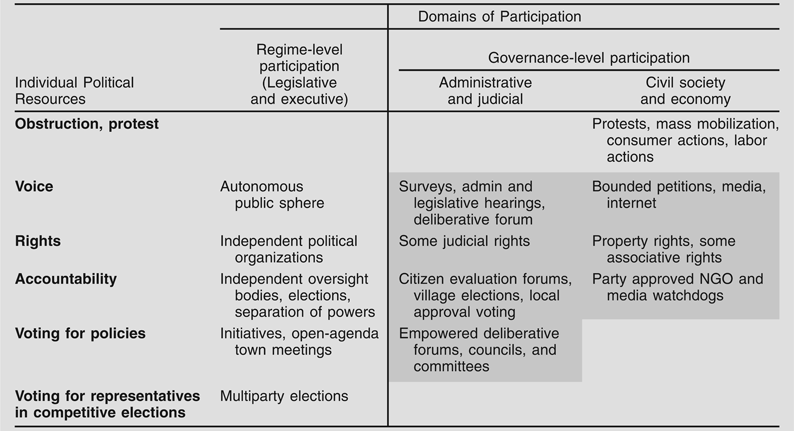
Thus, as a first rough take on the Chinese case, we should note that the most obviously applicable ideal type, command authoritarianism, is not descriptive of the regime capacities, largely owing to these broad dispersions of powers. But it does not follow that the CCP response to these dispersions maps onto the democratic ideal types. What we do see, rather, is a strategy of channeling political demand that makes selective use of consultation, deliberation, voting, and other forms of controlled participation that, for the time being, appear to be compatible with, and perhaps expand the capacities of, authoritarian rule—a point to which we return later.Footnote 35Table 2 maps this story. Here we are assuming that political demand is, in large part, a function of dispersed powers, which we can class into types of participatory resources—obstruction, protest, voice, rights, accountability mechanisms, voting for policies, and voting for representatives in competitive elections—identified in the left-hand column of the table. The top row identifies the domains over which these mechanisms are operative. Thus, we can find many political devices in China that are familiar in the developed democracies. The difference is that, in contrast to the developed democracies, the CCP seeks to channel political participation into the domains of administrative decision-making, the economy, the judiciary, and—to a very limited extent—a nascent civil society. Let us call this domain “governance level” political participation, reflecting its problem-focused, issue and domain segmented nature.Footnote 36 At the same time, we find little or no development of political participation at what might be called the “regime level”; powers of dicision have not dispersed to the extent that they produce autonomous public spheres, independent political organizations, independent oversight bodies or oversight through separations of powers. Nor have they produced open-agenda public meetings, citizen initiatives, or—most obviously—multiparty elections. These limited governance-focused empowerments do not add up to regime democratization. But they do contribute to the overall pattern of authoritarian deliberation by empowering domain and scope-limited forms of voice, and there exist functioning pockets of democracy constrained by geographical scope, policy, and level of government. The conjunction of these resources with domain constraints maps the spaces of authoritarian deliberation now emerging in China.
Regime strategies by domain and individual-level resources
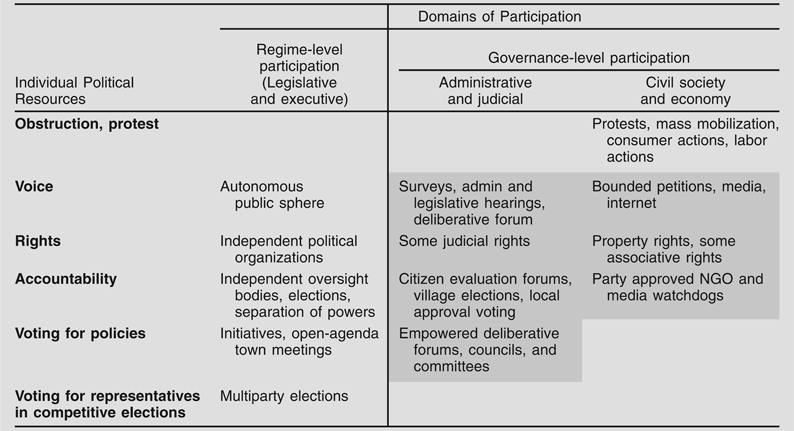
Table 2 also ideal types a regime strategy to channel the baseline political resources—obstruction and protest—into functionally-specified, controlled arenas of participation, typically within the administrative and judicial domains of government, as well as issue-specified discourse in civil society (the shaded cells), while seeking to avoid regime-level democratization. In short, Table 2 specifies modes of participation that have deliberative—and sometimes democratic—dimensions, but which occur in the absence of independent political organizations, autonomous public spheres, independent oversight and separations of powers, open-agenda meetings, and multiparty elections.
These distinctions help to identify apparently contradictory developments in the Chinese case. On the one hand, we agree with Pei's observation that regime-level democratic change has stalled in China.Footnote 37 Nor should we identify these developments as political liberalization. The Freedom House index for political and civic liberties shows that China's record has remained almost unchanged over the last decade. On the other hand, when we look outside of regime-level institutions, we find significant changes in governance, producing a regime that combines authoritarian control of domains and agendas with just “enough” democratization—“orderly participation” in Chinese official terminology—to enable controlled deliberation.Footnote 38 Indeed, what distinguishes China from the established democracies is not the emergence of governance-level participation in itself: as noted above, governance-level participation is evolving rapidly in the established democracies as well.Footnote 39 What distinguishes China is that these modes of participation, among them deliberative forms of politics, are evolving in the absence of regime-level democratization. Indeed, they are sometimes justified as an alternative to “western” adversarial, multiparty democracy.Footnote 40
The Development of Deliberative Politics in China
The distinctive features of deliberation—responsiveness to reasons, discussion, and attentiveness to what others are saying—have deep roots within Chinese political culture.Footnote 41 Some are traditional, building on Confucian practices of consultation and common discussion.Footnote 42 Centuries ago Confucian scholars established public forums in which they deliberated national affairs.Footnote 43 Though elitist, the Confucian tradition took seriously elite duties to deliberate conflicts, as well as certain duties to procedures of discussion.Footnote 44 These traditions are alive today, expressed in the high value intellectuals and many leaders place on policy-making through combinations of reasoned deliberation, scientific evidence, and experimentation-based policy cycles.Footnote 45 In modern China, the Ziyiju (Bureau of Consultation and Deliberation) played a significant role in deliberating and advocating constitutional reform before the 1911 Revolution in China. During Mao's time, elites were indoctrinated into the “mass line”—a method of leadership that emphasized learning from the people through direct engagement with their conditions and struggles. That said, as suggested above, while today's public deliberation is a continuation of Maoist consultation and contains elements of consultation, it has distinctive features. Maoist consultation lacked infrastructures of procedures and rights, and for the most part failed to achieve deliberation of high quality. For the most part, they were elite-directed exercises in ideological political study. In contrast, public deliberation in China today tends to be focused on concrete issues of governance, often in direct response to conflict. And, as we will note later, unlike Maoist consultation, contemporary forums are increasingly regulated by procedural guarantees to promote equal voice and fairness, as well as norms inculcating deliberative virtues. Moreover, as we will also note, in direct contrast to Maoist consultation, some processes are directly empowered. But there are also continuities. The Maoist mass line emphasized inclusiveness, equality, and reciprocal influence between the people and political elites. Indeed, like the Maoist mass line, the current system remains justified by the Confucian notion of minben (people-centric) rule. According to this ideal, elites express the voice of and serve the people. No doubt these inheritances help to explain why “deliberative democracy” is now a common topic in academic and policy circles within China, indeed, so much so that the CCP has developed a system of rewards for party officials who develop new deliberative processes.
The contemporary wave of deliberative practices dates to the late 1980s, concurrent with the introduction of village elections and other participatory practicesFootnote 46 and administrative reforms.Footnote 47 Indicative evidence includes changes in official terminology. In Maoist China, for example, participatory activities were called “political study”, and they were ideologically oriented and politically compulsory. Deliberative forums are now often called kentan (heart-to-heart talks), or other names with deliberative connotations. In 1987 General Party Secretary Zhao Ziyang outlined a “social consultative dialogue system” as one major initiative in political reform in the Thirteenth Party Congress, followed by a comprehensive scheme of popular consultation to be implemented in a number of areas across China. These experiments were derailed by the events of Tiananmen Square in 1989, which resulted in a period of authoritarian repression and retrenchment. Nevertheless, they survived as ideational precursors of institutionalized deliberative practices, not least because CCP elites were keenly aware of the damage wrought by Tiananmen, and quite consciously sought ways of channeling dissent even as they engaged in repression.
In 1991 President Jiang Zemin stressed that China needs to develop both electoral and “consultative democracy,” identifying the National People's Congress as the proper location of former, and Chinese People's Political Consultative Conference (CPPCC: a body which engages in often lengthy deliberations, but lacks either the power of decision or veto) as the site of the latter.Footnote 48 In 2005 Li Junru, Vice President of the Central Party School, openly advocated deliberative democracy—as did the Central Party School's official journal Study Times, which published an editorial endorsing a deliberative polling experiment in Zeguo, Wenling.Footnote 49 In 2006, “deliberative democracy” was endorsed in the People's Daily, the official document of the Central Party Committee, as a way of reforming the CPPCC.Footnote 50 And in 2007, the official document of the 2007 Seventeenth Party Congress specified that all major national policies must be deliberated in the CPPCC. More generally, deliberative venues have become widespread, though they are widely variable in level, scale, design, and frequency. They exhibit a variety of forms such as elite debates in different levels of Peoples' Congress, lay citizen discussions via the Internet, formal discussions in the public sphere, and informal debate in non-governmental domains. The more formal events can be, and often are, held monthly, bimonthly, or even quarterly in streets, villages, townships and cities.
In rural areas, deliberative politics have emerged alongside empowerments such as village elections, village representative assemblies, independent deputy elections for local Peoples' Congresses, and similar institutions. Beginning in the 1990s, many villages developed meetings in which officials deliberate village affairs with citizens, an innovation probably encouraged by imperatives of election, re-election, and approval voting.Footnote 51 Indeed, the meaning of township elections was not that elections would produce majority rule—as we might assume in the West—but rather that they would serve as a mechanism of consultation—though in practice they can induce deliberation, particularly when issues are contentious.Footnote 52 Electoral empowerments are often buttressed by protests, obstruction, and “rightful resistance” movements that have generated pressures for elites to consult with the people,Footnote 53 but which can, in practice, shade into deliberation.
There are some indications that these trends are widespread, though by no means universal. In 2004, the total number of meetings with deliberative elements at village level was estimated to be 453,000, a number considerably higher than the governments estimated number of protests (74,000) for the same year.Footnote 54 The 2005 National Survey provided some indications as to the (uneven) penetration of village level democratic institutions that we might expect to generate deliberation.Footnote 55 Ten per cent of respondents (298) reported that decisions on schools and roads in their town or city over the last three years were decided by an all-villagers' meeting attended by each household. By contrast, 616 (20.7 percent) said these decisions had been made by village representative meetings, and 744 (25 per cent) by villager leaders. The largest fraction—1,318 (44.3 percent)—were not sure. The same survey also found that the 547 (18.8 per cent) of respondents reported that decisions on village land contracts were made by an all-villagers' meeting; 524 (18 percent) by village representatives; 650 (22.3 percent) by village leaders; while 1,192 (40.9 percent) were not sure. The survey also found that 28.3 percent reported that their villages held two village representative meetings in 2004 (while 59.3 percent were unsure).Footnote 56 Such findings indicate that penetration of deliberative devices such as the all-villagers' meeting is at least broad enough for demonstration effects, and probably broad enough to begin to alter the incentives of the 3.2 million village officials in the 734,700 villages in China.Footnote 57
While broad data about the uses of deliberative venues are not available, some cases in rural areas exhibit an impressive density. From 1996 to 2000 within Wenling City, a municipality with almost a million residents, more than 1,190 of these deliberative and consultative meetings were held at the village level, 190 at the township level, and 150 in governmental organizations, schools, and business sectors. Wenling has by increments developed a form of democracy that combines popular representation with deliberation.Footnote 58 As case in point is Zeguo township in Wenling, where in 2005 officials introduced deliberative polling, using the device to set priorities for the township's budget. Deliberative polling uses random sampling in order to constitute small (typically a few hundred) bodies of ordinary citizens that are descriptively representative of the population. These bodies engage in facilitated processes of learning and deliberation about an issue, typically over a period of one or two days, and can produce results that represent considered public opinion.Footnote 59 Officials in Wenling altered the device by elevating the outcomes of the deliberative poll from its typical advisory function to an empowered status, committing in advance of the process to abide by the outcomes.Footnote 60 In 2006, ten out of twelve projects chosen through deliberative polling were implemented. The device has also evolved: in the most recent uses (February–March 2008, 2009, 2010, and 2011), the government opened every detail of the city's budget to participants.
Whereas deliberative venues in rural locales are often related to village elections, in urban locales deliberative and participatory institutions are more likely to emerge as consequences of administrative rationalization and accountability.Footnote 61 Some of these accountability measures generate deliberative approaches to conflict. Local leaders are increasingly using devices such as consultative meetings and public hearings designed to elicit people's support for local projects. Observations from Hangzhou, Fujian, Shanghai, Beijing, and other urban areas suggest that such deliberative practices are becoming more widespread, with more than a hundred public hearings per year being held in each district.Footnote 62
The practice of holding public hearings—a consultative institution that may sometimes produce deliberation—has also developed within the area of law. In 1996, the first national law on administrative punishment introduced an article stipulating that a public hearing must be held before any punishment is given. More than 359 public hearings on administrative punishment were held in Shanghai alone between 1996 and 2000.Footnote 63 Another example is the well-known Article 23 of the Law on Price passed by China's National People's Congress in December 1997, which specified that the price of public goods must be discussed in public hearings. At least eleven provinces developed regulations to implement this provision with ten referring specifically to the idea of transparency and openness, and nine to the idea of democracy.Footnote 64 More than 1000 public hearings on prices were held across China between 1998 and 2001.Footnote 65 The Legislation Law, passed in 2000 by the National People's Congress, requires public hearings to be an integral part of decision-making process for new legislation.Footnote 66 More than 39 public hearings on new legislation were held at the provincial level between 1999 and 2004,Footnote 67 including, for example, a national public hearing on income taxes. In Hangzhou, the government has developed a web-based public hearing process for comment on the various drafts of laws or regulations.Footnote 68
Finally, there are some emerging practices that include elements of democracy or deliberation, but which are quite limited in scope. They are nonetheless worth mentioning because they help to fill out the broader picture of a polity permeated by a diversity of highly uneven deliberative practices. In one state-owned factory, allocations of apartments were decided after an intense deliberation among ordinary workers and managers.Footnote 69 Intra-party elections with secret ballots were held in Ya'An in 2002. There has also been a trend toward publicly-visible deliberation in the National Legislature, as was evident in the deliberations over the Draft New Labor Contract Law in 2006–07. In addition, there have been experiments with participatory budgeting with varying degrees of participation as well as consultation—ranging from a highly constrained process in Wuxi to more inclusive and consultative processes in Xinhe and Huinan from 2004 to 2008 (He Reference He2011). There also instances of deliberation among government bodies, as in the case in which a committee of Municipal Peoples' Congress now examines the budget submitted by Shenzhen City. Instances of rights-based representation are beginning to induce deliberation as well. In 1999, for example, the official trade union in Yiwu City began to actively represent workers, producing effective rights, which in turn led to broader forums on workers' rights. And in 2006, the government funded the Poverty Reduction Foundation, which invites international non-governmental organizations (NGOs) to not only to invest, but to engage recipients' ideas for poverty reduction.
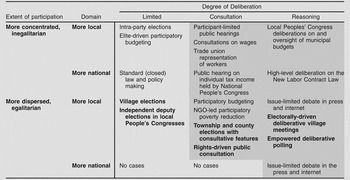
We can make some sense of this high diversity of participatory, consultative, and deliberative practices by mapping them according to the characteristics relevant to identifying authoritarian deliberation. Table 3 distinguishes practices by level (local versus national), the extent of participation, the likelihood that deliberation exists, and (in bold) the extent of democratic empowerment. Most practices combine a high degree of government control of the agenda with either consultation or deliberation (indicated by the shaded cells). Participation is likely to be encouraged in the more local venues rather than in higher-level venues, though deliberation is increasingly a characteristic of higher-level bodies such as National Peoples' Congress. Some of the local practices combine with limited empowerments—rights to vote, rights to initiate meeting and organize agendas, rights to equal concern, and rights to express one's voice—to produce highly robust instances of deliberative influence.Footnote 70 The overall pattern suggests authoritarian deliberation: that is, a high density of venues in which deliberation seems to exert influence, but within the context of government-defined agendas and formal government control of outcomes.
Kinds and locations deliberative politics in China

A Methodological Issue
Although we can point to instances of deliberative politics in China, our analysis has been primarily theoretical, driven by our interests in democratic theory, and related to the Chinese case primarily by means of theoretically-derived ideal types. The evidence is primarily indicative, and not sufficient to generalize about the occurrence of authoritarian deliberation relative to other forms of rule.
Identifying authoritarian deliberation faces another significant problem of evidence as well. Because the concept identifies situations in which persuasive influence (the effects of deliberation) combine with authoritarian decision-making, it will often be unclear as to whether any particular decision reflects the influence generated by deliberation or the (authoritarian) power of decision-making.
Identifying the “authoritarian” part of the concept is not difficult, as the evidence is well known and self evident. The Chinese state still maintains a Leninist political structure.Footnote 71 Most power remains in the hands of unelected elites, operating within the structures of one-party domination, and without the kinds of empowerments and protections necessary for democratic inclusion.Footnote 72 Party officials still decide whether or not to introduce deliberative meetings; they determine the agenda as well as the extent to which the people's opinion will be taken into account. They seek to avoid spillover onto non-approved topics, holding deliberations to specific topics. Democracy, Premier Wen Jiabao has said, is “one hundred years away”—possible only when China becomes a “mature socialist system.”Footnote 73
But precisely because of the authoritarian context it will often be difficult to know whether talk counts as deliberation. Does the context produce subtle forms of intimidation? Do participants self-censor, anticipating the powers of authorities? Under authoritarian circumstances, it is also difficult to know whether authorities are merely consulting with citizens, or whether they are influenced by their deliberations.
The other ideal types we develop here suffer from fewer ambiguities. In the cases of the democratic ideal types, the relative influence of communication and powers of decision can be inferred from outcomes; the modes of empowerment align with the influence of communication, such that, for example, dissent can be inferred from minority votes, while winning arguments are reflected in majority votes. Likewise, the outcomes of command authoritarianism can be inferred from the powers of decision. In the case of authoritarian deliberation—and, to a lesser extent, consultative authoritarianism—researchers must look for evidence of communicative influence on decisions.
This methodological problem reflects a problem of normative significance: authoritarian and totalitarian regimes have, historically, mobilized participation to provide legitimacy for command-based decisions. There are numerous examples, from Franco's corporatist authoritarianism to Cuba today. The most obvious comparison, however, is with the former Soviet Union prior to glasnost, which can be broadly characterized as a form of dictatorship with a high level of institutionalized participation, as well as the involvement of officially recognized groups in the initial stages of decision-making.Footnote 74 Stalin, like many dictators, used professional groups as information “transmission belts,” primarily to convey information about decisions. More substantive consultation with groups existed under Khrushchev, particularly with key technocratic elites,Footnote 75 while under Brezhnev, numerous councils were created to draw the citizens into public life.Footnote 76 But as Hough notes, even when Lenin, Stalin, and Khrushchev used consultative procedures, they “were ruthless in overriding society's preferences on important matters.”Footnote 77
In the authoritarian and post-authoritarian regimes in Southeast Asia, particularly Singapore, consultation is now a regularized feature of rule.Footnote 78 These regimes seek to generate legitimacy for policies through public consultations; they understand the economic benefits of transparent, competent, and clean public administration, and they show an increasing openness to various forms of NGO participation within state-sponsored institutions—processes Rodan and Jayasuriya appropriately term “administrative incorporation.”Footnote 79 It is likely that consultation is fully consistent with, and probably functional for, consolidated authoritarianism.
But at the level of broad comparisons, Chinese authoritarianism differs from cases of mobilized participation: most Chinese people now have opportunities to exit participatory pressures, effectively blunting this political strategy. China's Maoist past also favors decentralizing judgment to the people to a degree not found in the Soviet and Southeast Asian cases. We also find widespread inducements for deliberation such as village elections; there are increasing numbers of relatively large-scale deliberative experiments, such as deliberative polling in Wenling City. Deliberation as an ethos is now widely pursued within representative and governmental bodies.
And yet, as suggested, identifying instances in which deliberation rather than mere consultation exits suffers from the difficulties of inferring sources of influence under authoritarian conditions. But it is not impossible. Although the burden of evidence for generalization across China is higher than we can meet here, in principle it can be met in the following ways. First, cases sometimes generate counterfactuals from which causality can be inferred. In the case of the Wenling City deliberative poll, for example, city officials changed their previously held infrastructure priorities in response to the deliberations, suggesting an influence that could only be accounted for by the outcomes of the deliberative process.Footnote 80 Second, researchers are developing indicators of the quality of deliberation,Footnote 81 some of which have been applied to the Wenling case.Footnote 82 Finally, in-depth case studies, including participant observation, ethnographic techniques, and interviews can document the generation of deliberative influence—all techniques used to document deliberation in the Wenling case.Footnote 83 Such techniques are resource intensive. But to fail to frame the evidence through the concept of authoritarian deliberation owing to these methodological challenges risks missing what may be a normatively important dynamic in Chinese political development.
Why Would an Authoritarian Regime Use Deliberative Mechanisms?
Problems of evidence aside, let us now turn to another question implied in the concept of authoritarian deliberation: Why would elites in an authoritarian regime ever resort to devising and encouraging deliberative practices and institutions? We should not rule out normative motivations, of course: the post-Maoist, neo-Confucian culture of China imposes moral responsibilities on leaders to rule in accordance with the common good, to demonstrate virtue and to attend to the well-being of the communities they oversee.Footnote 84 Contemporary Confucians sometimes argue that democracy is a second-best route to wise rule, given the failures of guardianship.Footnote 85 And a lasting effect of the Maoist “mass line” is the norm that elites should listen to the people.
But even where such motivations exist, they would also need to align with the strategic interests of powerful elites and with established institutions for such practices to evolve. From a strategic perspective, Table 2 identifies the CCP's gamble, that opening the participatory venues at the governance level will channel political demand into deliberative and some highly constrained democratic venues, while containing popular obstruction as well as demand for regime-level democratization. Behind this gamble is a functionalist story, one that, in its broad outlines, is common to developing contexts. In using the term “functionalist,” we are not proposing causal explanations—that is not what functionalist frames do. Rather, they identify broad classes of problems by calling attention to the social environments to which a political regime must adapt on pain of losing capacity, legitimacy, and power.
In the Chinese case the environments conducive to deliberative experimentation are largely the result of rapid market-oriented economic development, which has increased the size of the middle class, pluralized sources of tax revenue, created new demands for development-related administrative systems, generated extreme inequalities and environmental problems, produced internal migrations, and reduced the overall capacities of the state to engage in command and control government.Footnote 86
While there is no necessary relationship between the legitimacy and capacity needs of authoritarian elites and deliberation (as the history of authoritarian regimes amply illustrates), there may be contingent relationships under conditions that limit the effectiveness of command authoritarianism. For example, the relationship between legitimacy and deliberation is sometimes evident in international diplomacy and, increasingly, within global civil society. In global relations, for example, power is not distributed democratically. But there is often a plurality of powers that limit the capacities of powerful states and other actors to impose their wills without incurring high costs. In many cases, the perceptions of costs are sufficient to motivate deliberation, despite the absence of democratic mechanisms of inclusion.Footnote 87 By analogy, under authoritarian circumstances at the domestic level, states are rarely powerful enough to control all means of opposition. When they do (as in North Korea), they pay a high economic penalty, which subsequently limits a regime's power simply through resource constraint. In contrast, owing to its rapid economic development, sources (and resources) of power in China are rapidly pluralizing. Under these conditions, rule through command and control is likely to be dysfunctional because it is insensitive to information and learning, and will fail to generate legitimate agreements that motivate participants. Deliberation may simply function more effectively to maintain order, generate information, and produce legitimate decisions.
Under these circumstances, some of the incentives for deliberative politics will be negative, following from the dispersion of veto players that accompanies development, as well as from controlled distribution of political powers, such as village elections. Where there are many veto players, development-oriented elites will have incentives to deliberate: to gather information, to bring conflicting public and private parties to the table, and to forge coalitions sufficient to governance.
Other kinds of incentives are more positive. Deliberation should be functional for governance, enabling bargaining, negotiation, and learning, and it should enable the legitimate forms of cooperation that underwrite collective actions in politically complex situations. Development-oriented elites such as China's CCP need not merely compliance, but the willing compliance of multiple actors. Thus if deliberation generates legitimacy, even in the absence of democratically dispersed empowerments, then elites will have incentives to pursue deliberation. If these conditions exist, then we might expect to see the emergence of what might be called “governance-driven deliberation”—that is, the use and encouragement of deliberative mechanisms by elites for the purposes of expanding the governance capacities of the state.
That there are functional reasons why an authoritarian regime pursuing a development agenda might use deliberative mechanisms does not mean, of course, that it will do so. But in China's case, these functional pressures are real and immediate. In order to maintain its legitimacy based on development, the CCP must provide basic living standards and social services for a population of over 1.3 billion, which requires, according to the CCP's own calculations, a minimum annual economic growth of around seven or eight percent. Internally, it manages 74 million party members, a number which—if it were a country—would be the seventeenth largest in the world. It faces myriad political, social, and economic problems, ranging from daily peasant and labor actions to collecting taxes from the newly wealthy, environmental issues, security problems, and corruption. These functional demands do not immediately explain authoritarian deliberative responses. But they do suggest a series of more specific hypotheses as to why Chinese political elites might adopt deliberative mechanisms.
First, and perhaps most importantly, deliberative mechanisms can co-opt dissent and maintain social order. Following Hirschman's typology of exit, voice, and loyalty, the CCP faces functional limits in two of the three means of controlling dissent. Currently, the CCP controls high profile political dissent with an exit strategy, allowing dissidents to immigrate to the US and other countries to minimize their domestic impact. Internally, the CCP buys the loyalty of party members with senior positions, privileges, and grants. But simply owing to their numbers, neither strategy can be applied to the hundreds of millions of ordinary Chinese, who are quite capable of collective forms of dissent.Footnote 88 Suppression is always possible and often used selectively against internal dissidents. But like all overtly coercive tactics, overuse produces diminishing returns.Footnote 89 In the case of China, suppression risks undermining the increasing openness that supports its development agenda, as well as generating international attention that may also have economic consequences. Thus voice is the remaining option for controlling dissent and maintaining order. The CCP has for some time pursued a policy of channeling dissent onto a developing court system,Footnote 90 as well as into low level elections.Footnote 91 But CCP officials are discovering, often through trial and error, that regular and frequent deliberative meetings can reduce dissent, social conflict and complaints, while saving money, personnel, and time.Footnote 92 As Hirschman has noted, relative to multiparty systems, one-party systems may even increase voice incentives, since limited options for exit options are more likely to increase internal pressures for voice. There are “a great many ways in which customers, voters, and party members can impress their unhappiness on a firm or a party and make their managers highly uncomfortable; only a few of these ways, and not necessarily the most important ones, will result in a loss of sales or votes, rather than in, say, a loss of sleep by the managers.”Footnote 93 Indeed, just because the CCP cannot claim legitimacy based on electoral victories, it must be attentive to other ways of generating legitimacy.Footnote 94
Second, deliberative mechanisms can generate information about society and policy, and thus help to avoid mistakes in governing. As noted, authoritarian regimes face a dilemma with regard to information. Under conditions of rapid development, authoritarian techniques are often at odds with the information resources necessary to govern—information about operational and administrative matters, as well as the preferences of citizens and other actors. Command-based techniques, however, limit communication and expression, while increasing the incentives for subordinates to husband and leverage information. Controlled deliberation is one response to this dilemma. And as we have been suggesting in China we in fact see an increasing number of policies subjected to deliberation within controlled settings such as in the National and local Peoples' Congresses, within university centers, and within the Party Schools. The CCP also commonly uses the mass media and internet to test policy ideas or new policy by encouraging debate and discussion on specific topics.Footnote 95
Third, deliberation can function to provide forums for and exchanges with business in a marketizing economy. In China, market-style economic development is dramatically increasing the number and independence of business stakeholders with veto powers not only over new investments, but also over tax payments, which can make up the bulk of revenues for many locales.Footnote 96 Pressures for deliberation can and do come from an increasingly strong business sector. Consultations among public and private interests are increasingly institutionalizedFootnote 97—a process reminiscent, perhaps, of the early history of parliaments in England and Europe in which the middle classes bargained with monarchs for liberty and political voice in exchange for their tax revenues.Footnote 98
Fourth, open deliberative processes can protect officials from charges of corruption by increasing credible transparency. In a context in which local government revenues increasingly depend upon business, almost all officials are regarded as corrupt, not only in public opinion but also often by superiors. Officials may learn to use transparent and inclusive deliberative decision-making to avoid or reduce accusations that their decisions have been bought by developers and other business elites.Footnote 99
Fifth, in cases where decisions are difficult and inflict losses, deliberative processes enable leaders to deflect responsibility onto processes and thus avoid blame. In China, elites are recognizing that “I decide” implies “I take responsibility.” But “we decide” implies that citizens are also responsible, thus providing (legitimate) political cover for officials who have to make tough decisions. In Wenling City, to take one example, it is now common for local officials to begin a decision-making processes by asking a governmental organization to establish a deliberative meeting or forum.Footnote 100 The government then passes the results of the meeting to local legislative institutions, which then replicate the results in legislation.
Finally, to summarize the preceding points, deliberative processes can generate legitimacy within a context in which ideological sources are fading for the CCP, while development-oriented policies create winners and losers. Legitimacy is a political resource that even authoritarian regimes must accumulate to reduce the costs of conflict.Footnote 101 While we do not have broad-based evidence to support the claim that deliberation is an important source of legitimacy in China, there is some indicative evidence: the results of annual deliberative polling suggest that deliberative polling has enhanced citizens' trust in the local government in Zeguo.Footnote 102
The Developmental Logic of Authoritarian Deliberation I: Deliberative Authoritarianism
Our argument is that the apparently puzzling combination of authoritarian rule and deliberative influence—authoritarian deliberation—is conceptually possible, empirically existent, and functionally motivated in the Chinese case. But the concept also highlights two important structural instabilities: deliberative influence tends to undermine the power of authoritarian command, and deliberation is more effective as a legitimacy-generating resource for elites when it flows from democratic empowerments. These instabilities are currently bridged in China through internal differentiations among the scope, domain, and levels of government authority, some limited democracy, deliberative venues within authoritarian institutions, and the authoritarian leadership of the CCP. The standard expectation is that the CCP has developed a form of rule that is relatively stable and highly resilient.Footnote 103 The instabilities identified by the concept of authoritarian deliberation are important, however, because they frame two possibilities of normative interest from the perspective of deliberative democratic theory that are consistent with Chinese political development, though not exhaustive of other possibilities. It is certainly possible, for example, for China to evolve into a clientist- or crony-style capitalist state based on the successive cooptation of stakeholders into the governing structures of the CCP—a scenario that would follow from the continuing transference of state assets into private hands, combined with the CCP's encouragement of wealthy stakeholders to join the party.Footnote 104 It is also possible for the CCP to use more coercive powers to maintain its rule in spite of costs performance and legitimacy: the habits and resources for command authoritarianism are deeply entrenched in China. The government does not hesitate to use these resources if it sees the stakes as high enough—as evidenced by the centralization surveillance in the period leading up to the 2008 Beijing Olympics, as well as more recent attempts to suppress dissent by Uighur minorities.
Here, however, we style two possibilities, which we call simply, deliberative authoritarianism and deliberation-led democratization. These two possibilities focus on strategies of political conflict management and decision-making rather than patterns of economic ownership and influence or coercive state power. In the short term we expect deliberative authoritarianism to prevail, though we believe deliberation-led democratization is a longer-term possibility.
The first possibility, deliberative authoritarianism, implies that deliberative influence can stabilize authoritarian rule, which in turn is increasingly bounded in such a way that it is compatible with processes that generate deliberative influence.Footnote 105 Under this scenario, authoritarian political resources are used to mobilize deliberative mechanisms. Deliberative influence is limited in scope and agenda, and detached from political movements and independent political organizations. Deliberative experiments are localized and well-managed so as to prevent them from expanding beyond particular policy areas, levels of government, or regions. Following this logic, if deliberation is successful at demobilizing and co-opting opposition while generating administrative capacity, then it will enable the CCP to avoid regime-level democratization. Under this scenario, authoritarian rule will continue to transform in ways that channel and manage the political demands generated by economic development in such a way that authoritarian rule is maintained and strengthened. More specifically, we might expect the following, all of which can be observed in China today.
Coercion is targeted and limited
While state power is still ubiquitous, the way in which the power is exercised is modified in ways that both enable and require deliberative approaches to political contestation. Under deliberative authoritarianism, the use of coercion continues to be tamed and regulated. Coercive force is carefully and selectively used to eliminate organized political dissidents,Footnote 106 while governance-related forms of conflict are channeled into deliberative problem-solving venues.
Power is regularized through rights and deliberation
The CCP continues to incrementally grant rights to citizens including rights to own property, to consent to transfers, and to consent to public projects with individual impacts; rights to elect local committees and officials, and to manage local funds; and certain welfare rights. Limited rights of private association are institutionalized. Importantly, China is likely to continue to incrementally but systematically establish a judicial system that institutionalizes the rule of law, enabling these rights to have autonomous effects.Footnote 107
The CCP gives up some power as a political investment its future
The CCP calculates that giving over some powers to local and administrative processes will generate specific policy- or problem-related solutions to problems, thus forming a piecemeal but resilient basis for its continued legitimacy—a process Pierre Rosanvallon has called “destructive legitimation” that can be more generally observed in the governance strategies of complex societies.Footnote 108 These local and segmented sites of legitimacy shore up the global legitimacy of the party in the face of weaknesses of the official ideology, which in turn increases its political capacities.
Under this scenario, then, the functional effectiveness of authoritarian deliberation substitutes for regime-level democratization. The current nascent form of deliberative authoritarianism in China would evolve into a more consistent and developed type of rule, under which cruder exercises of power are replaced with more limited, subtle, and effective forms. Political legitimacy would be generated by deliberative means, locale by locale, and policy by policy. The CCP continues to encourage local officials to develop participatory and deliberative institutions to curb rampant corruption, reduce coercion, and promote reason-based persuasion. It invites ordinary citizens, experts, and think tanks to participate in decision-making processes. But ultimate control over agendas as well as outcomes remains with the Party and beyond the reach of democratic processes. Of course, this kind of softening, regularizing, and civilizing of power remains contingent on the wisdom of the CCP elites and local leaders, who must be sufficiently enlightened as to be motivated by the legitimating effects of deliberation. Where these conditions hold, however, it is theoretically possible for deliberative political processes to become an important ingredient in the reproduction and resilience of authoritarian rule—a possibility that remains under-explored in the literatures on regime transitions as well as the literature of deliberative democracy.
The Developmental Logic of Authoritarian Deliberation II: Deliberation-led Democratization
Democratic transitions from England in the eighteenth and nineteenth centuries to Spain in the 1970s have mostly been society-led, often conjoined with market-driven development. These transitions were “liberal” in the sense that autonomous social forces propelled democratization. The democratic transitions of the late 1970s and 1980s tended to be driven by regime-level changes from authoritarian to multi-party electoral rule, and accompanied by constitutional changes that institutionalized legislative power and judicial independence, as well as the rights that secured social freedom and autonomy. The Polish Solidarity model of democratic transition, for instance, involved a strong opposition from civil society that forced government to the negotiating table.
Most students of China focus on democratization through regime change from one-party rule to multi-party electoral democracy. Reforms below the regime level—at the local level, in administrative and policy processes, and in the judiciary—are unlikely to lead to broader democratization of the political system.Footnote 109 Yet an increasing number of Chinese intellectuals see the development of deliberative processes within authoritarian institutions as a pathway to democracy. Some hold that democratization could develop from within one-party rule, if the kinds, level, and density of reforms alter its character in ways that produce the functional effects of democracy.Footnote 110 If this trajectory were to materialize, it would be unique: we know of no examples of regime democratization as a consequence of progressively institutionalized deliberation. Nor, indeed, is such a possibility conceptualized in the transitions literature.
But we can theorize the possibility. If authoritarian elites increasingly depend upon deliberation as a source of legitimacy for their decisions, then it is also possible for the democratic empowerments to grow incrementally, driven in part by the fact that deliberation provides legitimacy only if has the space and inclusiveness to generate influence.Footnote 111 This kind of development would have the effect of layering new institutions over old ones for the purpose of enhancing their effectiveness, while also transforming their character in democratic directions.Footnote 112 Deliberation might then serve as a leading edge of democratization, possibly through the following mechanisms.
Deliberative legitimacy tends toward inclusion of all affected
When other sources of legitimacy fail—ideology, traditional deference, or economic benefits—deliberation provides a means of generating legitimacy. However, deliberation generates legitimacy that is “usable” by the state primarily when those whose cooperation the state requires have been included in the deliberations, either directly or through credible representation mechanisms, and participants believe they have had influence or accept the legitimacy of the process. Because the tactics of obstruction (both rights-based and protest-based) and exit are widely available in China, elites have incentives to expand institutions to include those affected by policies. For example, local officials in Wenling required each household to send one family member to attend public hearings about land appropriation or house demolition. When this tactic failed to include all they believed to be affected, they resorted to random selection methods to ensure wide representation.Footnote 113
Experiences of consultative and deliberative engagement change citizen expectations
Closely related, democratic institutions are easier for regimes to initiate than to retract.Footnote 114 Once voice and rights are granted by the state, they become part of the culture of expectations, transforming supplicants into citizens, and making it difficult for regimes to dial back democratic reforms.Footnote 115 The party secretary of Wenling City, for example, reported that he regularly receives complaints from peasants when local officials make decisions without first holding deliberative meetings. Officials in Zeguo, a township in Wenling, continue to repeat deliberative polling in part because they worry that not to do so would violate expectations created by earlier experiments. The anecdotal evidence is backed by poll results which suggest that citizens of Zeguo expect their government to conduct annual deliberative polls on the budget, and trust them to do so. The mean response to the question “Will the government take deliberative polling seriously”, on a 0 to 10 scale, where one is “unlikely” and 10 is “the most likely” was 7.55 in the 2005 survey, but increased to 8.43 in the 2006 survey. With regard to the question “Do you think the government will use the results of the Deliberative Democracy meeting”, the mean score increased from 7.33 in 2005 to 8.16 in 2006.Footnote 116 Zegui officials are now working on a regularized annual procedure for budgeting through deliberative polls.
Deliberation tends towards institutionalized decision-making procedures
When deliberation is regularized, it tends toward institutionalization. Institutionalization can be driven by citizen expectations. But it can also be driven by elite desires to retain control of political demand by channeling into scope- and domain-specific venues. This kind of tendency is visible in the government's concern with creating a non-arbitrary, constitutionally-regulated judicial system, the existence of which is a condition of democratization.Footnote 117 China seems to be changing, gradually, from an instrumental “rule by law” to a normative “rule of law” which binds not only citizens but also government officials.Footnote 118 The institutionalization of decision-making procedures is also visible more directly; in 2004, for example, the government of Fujian Province issued requirements that each village hold at least four public meetings a year and detailed procedures for selecting participants and conducting the meetings, the role of chairperson, note-taking, and linking meetings with village decision-making processes.Footnote 119 As early as 2002, Wenling City ruled that townships must hold four democratic roundtables each year. In 2004, the city further specified the procedures of these meetings, with the apparent aim of deepening their democratic credentials.Footnote 120 In July 2008 the State Council issued a national regulation requiring all county and city level governments to hold open public hearings when making major social policies. Importantly, the regulation specified procedures, apparently intending to secure legal, “scientific,” and democratic legitimacy for the hearings. In 2010 the State Council drafted three National Guidelines regulating public participation. One provision requires parties to present the supporting argument first, followed by all opposing arguments. Another procedure focuses on encouraging and managing open debates in public hearings. Interestingly, such provisions reflect and institutionalize the principles of deliberative democracy, emphasizing equality, fairness, and openness to public participation.Footnote 121
The logic of deliberative inclusion leads to voting
Political elites in China often emphasize the relationship between deliberation and consensual decision-making, consistent with authoritarian deliberation. However, when interests conflict even after deliberation, elites may find that if they nonetheless claim, counterfactually, that their preferred decisions are the result of “consensus,” they erode the legitimacy of their decisions. It is increasingly common for officials to respond to contentious deliberation by holding votes in public meetings, by submitting decisions to the community through referendums, or by deferring to voting by the deputies of local people's congresses. More generally, the notion that deliberation and voting should function together within political processes is now more common in China; of the 27 projects awarded national prizes for local political innovations with deliberative elements between 2000 and 2005, ten involved various kinds of elections.Footnote 122
While all of these processes can be described as CCP strategies to co-opt opposition and expand state capacities, each can also result in lasting democratic transformations in the form of rule. As Tilly notes, “trajectories of regimes within a two-dimensional space defined by degree of governmental capacity and extent of protected consultation significantly affect both their prospects for democracy and the character of their democracy if it arrives.”Footnote 123
Conclusion
Our argument should not be taken as a prediction that should China democratize, it will be governance-driven and deliberation-led. Instead, our argument is both more modest and speculative. By conceptualizing authoritarian deliberation and exemplifying its existence in China, we are identifying a trajectory of democratization that is conceptually possible and normatively significant. While our theoretical speculations do align with observed developments in China, our aims are primarily theoretical. The key distinction—between democratic empowerments and deliberative influence—allows us to frame democratizing tendencies as the legitimacy-producing capacities of deliberation. In so doing, we are pushing the democratic imagination beyond familiar democratic institutions and toward the transformative practices out of which democratic innovations arise. It is in non-ideal cases such as China that democratization is likely to give the biggest payoff in human well-being—which is why normative democratic theory must be able to meet them halfway. Last but not least, we hope to expand the domain of comparative political theory by setting western concepts into conversation with non-western concepts and contexts.Footnote 124