In September 1963, forty-five Puerto Rican parents penned a letter to Irving Rosenblum, the principal of P.S. 140 on the Lower East Side.Footnote 1 Organized by a new federal antidelinquency agency called Mobilization for Youth (MFY), the parents, who dubbed themselves Mobilization of Mothers (MOM), asked Rosenblum about the school’s homework policies and academic requirements. “We want to know,” MOM wrote, “what we, as parents, can do to help our children stay in school and get a good education.”Footnote 2 The group also invited Rosenblum to a meeting at P.S. 140 the next month.Footnote 3 The conference did not go as planned. At the meeting, Rosenblum attributed his students’ academic struggles to language difficulty and “culturally deprived” homes. “Look at how hard it is for me to talk to you,” Rosenblum barked at MOM. “Imagine how difficult it is . . . for a teacher to handle a class full of children who can’t speak English.”Footnote 4 After several exchanges, other parents told MOM to “organize” to prevent Rosenblum from “walking all over you.”Footnote 5 Henry Specht, an MFY staffer in attendance, agreed. At the end of the meeting, Specht accused Rosenblum of alienating P.S. 140 parents and warned him that MOM would soon “be justified in taking action outside of the school.”Footnote 6
In recent years, historians have written a number of case studies dissecting race relations in the postwar urban north. These scholars examine how municipal leaders and constituencies implemented and interpreted federal housing, employment, and education initiatives at the local level. In so doing, these authors show that the deterioration of interracial coalitions in northern cities predated a white rejection of racial liberalism in national and presidential politics after 1968. Thomas Sugrue, for example, argues that “urban elected officials and voters played a crucial role in implementing New Deal policies” in postwar Detroit.Footnote 7 In so doing, he posits, white Detroiters transferred the racial inequities embedded in these policies down to local areas and reshaped “urban geography by class and race.”Footnote 8 In American Babylon, Robert O. Self similarly argues that “local politics in places like Oakland and the East Bay . . . became contests over the nature and expression of the American welfare state” after World War II.Footnote 9 Self’s work shows how these contests fractured along racial lines, leading African Americans and whites to engage in a “struggle over control of urban resources in the late 1950s and 1960s.”Footnote 10 Wendell Pritchett similarly assesses how Community Action Programs impacted race relations in Brownsville, Brooklyn.Footnote 11 While Pritchett argues that these initiatives represented the “high point of optimism surrounding the civil rights movement,” he suggests that long-standing national and municipal housing policies made Brownsville a “segregated ghetto” and fostered black-Jewish political conflict.Footnote 12
Despite this historiographical trend, however, few scholars have examined the intersection between MFY, a significant program funded with federal and city dollars, and Lower East Side politics. Instead, most work on the agency either utilizes a sociological framework to dissect the theoretical underpinnings of social conflict or focuses on national politics and the War on Poverty.Footnote 13 The lack of attention to the local political context within which MFY operated stems from the fact that few writers have analyzed post-1945 Lower East Side race relations and politics. Instead, most work on New York’s civil rights movement and, in particular black-Jewish relations, centers on the city’s outer boroughs, relegating the Lower East Side to studies of early twentieth-century immigrant life.Footnote 14 It is true that the Lower East Side’s white ethnic, particularly Jewish, populace had declined significantly by 1945.Footnote 15 As Jerald Podair contends, it was in Ocean Hill–Brownsville where Jews ultimately embraced the “unambiguous expressions of white identity” and grasped the “benefits . . . of white privilege” after the neighborhood’s 1968 teacher strikes.Footnote 16 After this pivotal moment, Podair argues, Jews rejected calls for community control and aligned themselves with other, more conservative, Catholic voters in local elections. For Podair, this process shifted “the electoral politics of the city rightward” in the 1970s.Footnote 17
This article, however, suggests that this process played out on the Lower East Side in the early- to mid-1960s. It shows how Jewish elected officials, as well as Jewish and other white ethnic voters, responded to MFY’s efforts to organize Puerto Ricans, and to a lesser extent African Americans, around local school issues in 1963 and 1964. These responses appear through the policies and electoral strategies of Representative Leonard Farbstein, a first-generation Jewish Democrat and lifelong Lower East Side resident who served the racially diverse 19th Congressional District, the only such district to encompass the Lower East Side in the 1960s (Map 1).Footnote 18 Congressional politicians like Farbstein represent important, if overlooked, lenses into local politics. Unlike their presidential and/or mayoral counterparts, these officials serve specific neighborhoods and, as such, take positions that both reflect and influence differences between local constituencies. As such, Farbstein’s relationship to MFY and the initiatives it embraced offers an important, yet overlooked, window into the trajectory of postwar urban liberalism and Lower East Side politics. By 1964, white ethnics, blacks, and Puerto Ricans on the Lower East Side embraced different notions of education reform and racial inequality. These divisions did not produce the heated conflict that enveloped Ocean Hill–Brownsville in 1968. However, they did impact local politics. Publicly and privately, Farbstein embraced national civil rights legislation and disagreed with white ethnic constituents who believed the new laws would enact reverse discrimination. This stance, often justified by connecting Jewish, black, and Puerto Rican interests, allowed him to sustain a viable interracial coalition in the 19th district. At the same time, however, Farbstein, sometimes by alluding to particular notions of American Jewish success and advancement, remained skeptical of local grassroots protest and race-based initiatives that challenged the deeper structures of racial stratification on the Lower East Side. This skepticism led the congressman, along with several ideologically sympathetic municipal officials, to call for scaling back MFY’s community organization program in 1964 and left him increasingly, though not entirely, out of touch with black and Puerto Rican voters.Footnote 19 Farbstein’s 1966 primary campaign against reform-minded challenger Theodore Weiss exposed this subtle, yet growing, disconnect. That election, the first after city and state authorities investigated MFY for its involvement in local protests, highlighted Farbstein’s reliance on Jewish and Italian voters and suggested that Jews and Catholics had entered into an electoral alliance on the Lower East Side before 1968. In this way, the primaries foreshadowed Jewish–black–Puerto Rican conflict over community control in the late 1960s and 1970s.Footnote 20
Map 1. 19th Congressional District and the State Assembly Districts Therein.Footnote 22
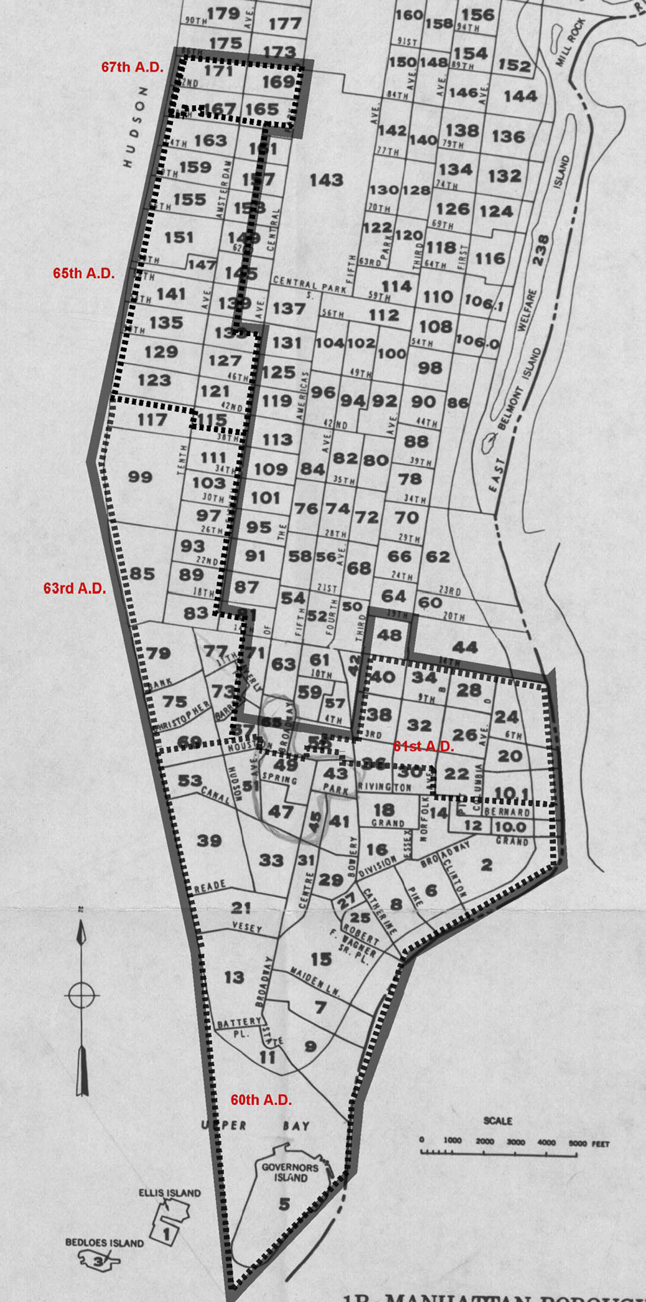
The 19th Congressional District
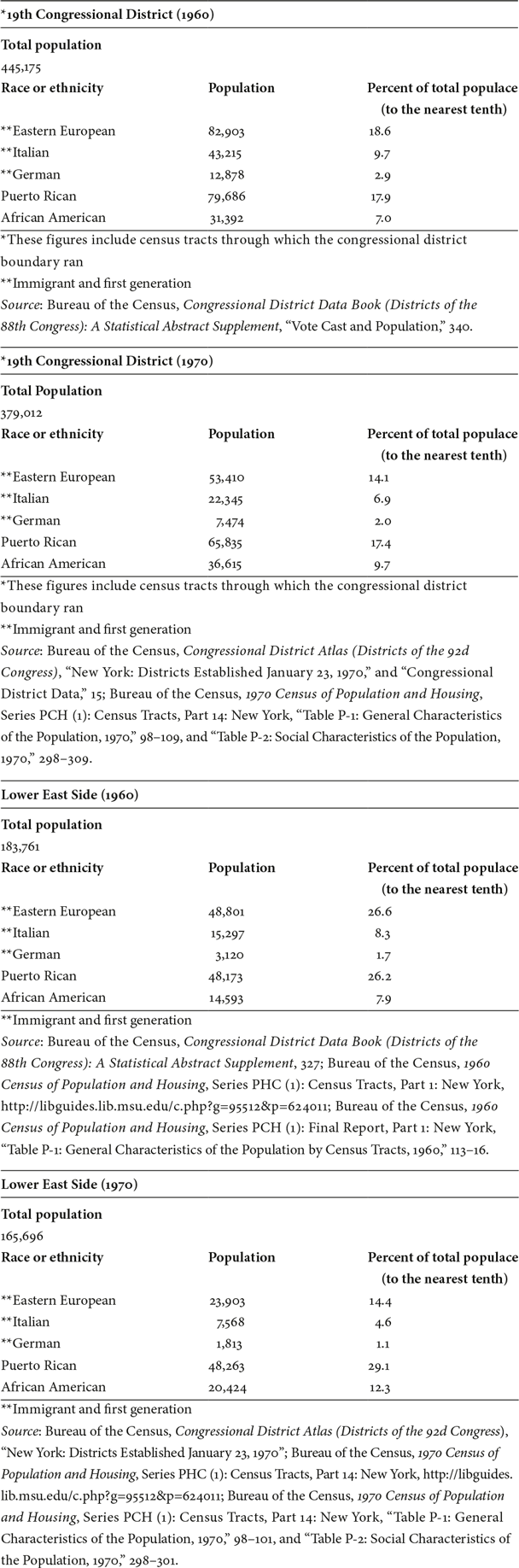
Three distinct areas comprised New York’s 19th Congressional District: western Manhattan, lower central Manhattan, and the Lower East Side.Footnote 21 The district was racially diverse. Immigrant and first-generation Eastern Europeans comprised nearly 19 percent, with Italians nearly 10 percent more, of the 19th district’s population in 1960 (Table 1). Puerto Ricans and African Americans also comprised nearly 18 percent and 7 percent, respectively, of the district’s population at this time. Furthermore, the Lower East Side possessed a disproportionate share, roughly 41 percent, of the 19th district’s residents and about 60 percent of the district’s Puerto Rican and Eastern European populaces in 1960. As I will later show, these statistics meant that political developments on the Lower East Side impacted the 19th district as a whole.
Racial and Ethnic Breakdowns of the 19th Congressional District and Lower East Side

Despite this diversity, however, the Lower East Side’s two major constituencies—Jews and Puerto Ricans—occupied different spaces within the neighborhood’s political economy. While two-thirds of Jews had left the neighborhood by 1905, many remained to operate Jewish-owned schools and businesses and live in Jewish-owned housing complexes.Footnote 23 In the mid-twentieth-century, groups such as the Amalgamated Clothing Workers of America (ACW) and the International Ladies Garment Workers Union (ILGWU) constructed the Amalgamated, Hillman, East River, and Seward Park co-ops. These complexes, lined along Grand Street, possessed a substantial middle-class Jewish population.Footnote 24 Indeed, Farbstein lived in the Amalgamated Houses as an elected official, joined local Jewish institutions like the Bialystoker Synagogue, one of the oldest in the neighborhood, and served on the board of a local Talmud Torah Hebrew school.Footnote 25 While providing a physical space for Jewish settlement, these structures also strengthened Jews’ cultural ties to the Lower East Side. In the postwar period, Jews viewed the Lower East Side as a marker of American Jewish success and survival and reimagined the past neighborhood, despite its past diversity, as wholly Jewish. As one scholar notes, the neighborhood became “the locus for an American Jewish founding myth” after World War II, a place where Jewish immigrants, through individual effort, “triumphed, becoming educated, middle-class Americans.”Footnote 26
On the other hand, Puerto Ricans’ economic prospects steadily declined on the Lower East Side after the war.Footnote 27 At this time, Puerto Rican garment industry jobs increasingly relocated offshore or went to outside contractors, leading to depressed wages and unemployment.Footnote 28 Puerto Ricans also attended segregated schools and classrooms and, in the MFY area specifically, read at significantly lower levels than their white peers.Footnote 29 In addition, Lower East Side public housing also had become heavily Puerto Rican by the late 1960s due partly to urban renewal initiatives.Footnote 30 In the MFY area specifically, Puerto Ricans comprised over one-third of the residents who lived in and around the Wald and Riis houses, an area that possessed high rates of poverty and juvenile delinquency.Footnote 31
Mobilization for Youth
MFY attempted to address these trends by organizing black and Puerto Rican residents within a distinct target area that ran down the portion of the Lower East Side east of Avenue B.Footnote 32 The agency formed in 1958, when the Henry Street Settlement, concerned about local gang violence and juvenile crime, received $500,000 to form a new antidelinquency program from the National Institute of Mental Health (NIMH).Footnote 33 Henry Street leaders based MFY’s mission on a new sociological theory penned by two Columbia University sociologists, Lloyd Ohlin and Richard Cloward. In their book, Delinquency and Opportunity, Cloward and Ohlin posited that juvenile crime occurred when a gap existed between an adolescent’s aspirations and his or her opportunities for socioeconomic advancement. The theory offered several measures to reduce delinquency.Footnote 34 Driven partly by curiosity regarding the psychological roots of prejudice after World War II, “opportunity theory” accepted individual and behavioral remedies to reduce crime.Footnote 35 However, the theory also suggested that societal structures and institutions limited opportunities available to the poor.Footnote 36 The idea thus provided MFY with the basis to reduce delinquency through institutional, not solely individual, change. MFY staffers believed that achieving this change required the poor to articulate concrete political interests by organizing themselves. On the Lower East Side, this meant that the agency would encourage blacks and Puerto Ricans to confront local authorities using a “collective expression of discontent and alienation.” Doing so, MFY argued, would at once steer potential delinquents toward legal behavior and alleviate the stresses that provoked juvenile delinquency in the first place.Footnote 37 The federal government conferred further support upon this mission when the President’s Committee on Juvenile Delinquency (PCJD), organized by the Kennedy administration to oversee local antidelinquency programs, pledged $2 million to MFY in 1962. At a ceremony held to celebrate the contribution, federal officials called MFY the “most advanced program yet devised to combat delinquency on a broad scale.”Footnote 38
The agency’s top “institutional target” was the public school system.Footnote 39 MFY leaders argued that school reform would provide preventive, rather than rehabilitative, services to the Lower East Side nonwhite poor. At a 1963 meeting with Charles Tenney, the city administrator under Mayor Robert Wagner, Richard Cloward noted that MFY had to choose between “serving those who are damaged and preventing future damage.”Footnote 40 For Cloward, “preventing future damage” required government leaders to redistribute municipal resources to low-income minorities and, in education, make schools more attuned to the racial backgrounds of their students. At the meeting, he claimed that Lower East Side schools were “the cause of many of our problems” and had “never succeeded in engaging the low-income youngster.”Footnote 41 According to Cloward, schools relied too heavily on services such as reading clinics and guidance programs that, while important, ducked more holistic, and potentially race-based, remedies to black and Puerto Rican underachievement. “We can organize rehabilitative services until the public coffers are exhausted,” Cloward told Tenney. “But the origins, the pressures, must be removed.”Footnote 42
While Cloward did not define what he meant by “origins,” MFY leaders soon began arguing that black and Puerto Rican parents deserved more decision-making power in the city’s schools. During congressional hearings on juvenile delinquency, MFY board members testified that they needed to “find some way by which people can begin to control their schools so the schools can develop programs for different groups.”Footnote 43 In another memorandum, MFY leaders argued that the agency had to make school administrators more responsive to “critical” parents.Footnote 44 In other meetings, MFY argued that public schools prioritized “security” for teachers and espoused a “Dick-and-Jane” celebration of “the homogenized life of white, middle-class children in the suburbs.”Footnote 45 At another MFY-sponsored school board meeting, black and Puerto Rican residents criticized Lower East Side schools for hiring only white principals and encouraging nonwhite students to take vocational classes.Footnote 46 In 1963, MFY’s Community Organization (C.O.) program, which initiated many of the agency’s social action activities, also took control of MFY’s Parent-Ed Program, which aimed to adjust parents to schools’ expectations through home visits and in-service lectures.Footnote 47 In a December 1963 meeting, C.O. staffers told Parent-Ed aides to stop establishing “service relationships” with parents and instead compile specific grievances that would allow the C.O. program to “develop a position with regard to altering the educational system.”Footnote 48 This shift meant that Parent-Ed aides would encourage parents to take “necessary social action when their problems and concerns are not heard and resolved.”Footnote 49 By the end of 1963, the aides also promised to help parents achieve changes “in housing laws, in securing better schools, in increasing job opportunities, and in the distribution of power.”Footnote 50
MOM’s actions emblemized this ideological and strategic shift. By the end of 1963, the group, which had initially requested information about P.S. 140’s homework policy, called for Assistant Superintendent Florence Becker to fire Principal Rosenblum for a “lack of feeling for minority parents.”Footnote 51 Soon thereafter, MOM circulated flyers around the Lower East Side telling residents to join the group if they had “a complaint with the manner in which your children are treated and taught in the public school.”Footnote 52 Around this time, the MFY-backed Council of Puerto Rican and Hispanic Organizations (CPRHO) also called upon Becker to resign for comparing MOM to disobedient children and telling the group that “civilized people” worked toward “cooperation” when resolving conflicts.Footnote 53 Then, at a 1964 school board meeting held to discuss the MOM incident, the National Association for Puerto Rican Civil Rights (NAPRCR) demanded that the city’s Board of Education (BOE) offer more Spanish-language courses, require teachers to learn Spanish, and hire more Puerto Rican administrators.Footnote 54
The MOM incident, in short, led Puerto Ricans to call for new race-based reforms in Lower East Side schools. These calls, backed by MFY, tapped into Puerto Ricans’ broader understandings of race in the 1960s. As historian Lorrin Thomas notes, Puerto Ricans at this time asserted “particular group rights, like ballots and civil service tests in Spanish and bilingual education” and called upon the BOE to hire more Puerto Rican school officials.Footnote 55 Underlying these calls was a growing belief that Puerto Ricans, like African Americans, represented victims of racial discrimination and, as such, needed a coherent political agenda that sought benefits for Puerto Ricans specifically.Footnote 56 Often, this goal fostered black–Puerto Rican collaboration on civil rights issues. This collaboration notably occurred during the 1964 New York City school boycott, launched by the New York Citywide Committee for Integrated Schools. In 1963, the committee set a deadline of December 1 for the BOE to implement new school pairing and transfer mandates that would integrate city schools by race.Footnote 57 While the BOE had enacted some new reforms in the early 1960s, the committee criticized them as piecemeal and voluntary measures that did not desegregate the school system, which by 1964 was over 40 percent black and Latino and possessed increasingly segregated student bodies and teaching staffs.Footnote 58 When the BOE failed to meet this deadline and selected only a few schools for pairing, the committee launched a student boycott on February 3, 1964, that kept more than 460,000 children out of class.Footnote 59
At the behest of Bayard Rustin, one of the boycott’s organizers, Manny Diaz, MFY’s director of Community Affairs, and Gilberto Gerena-Valentin, a labor organizer, recruited Puerto Rican parents to support the boycott and ran pro-boycott ads in El Diario, a large Spanish-language newspaper.Footnote 60 MFY became further involved when the Lower East Side Civil Rights Committee (LESCRC), comprised mostly of black and Puerto Rican parents, asked the agency to endorse the boycott.Footnote 61 In response, MFY organized a Civil Rights Committee to alert parents to “collective protest—such as rent strikes, boycotts, petitioning, picketing, [and] mass marches.”Footnote 62 The committee then drafted a formal statement that, while attributing school segregation to residential patterns, called upon the BOE to “exercise the necessary social engineering” and integrate schools by implementing new pairing initiatives, construction strategies, and bilingual programs.Footnote 63 Two days after the boycott, which kept over 75 percent of Lower East Side students home, MFY reiterated its commitment to change, through mass action, the “political and economic policies which regulate access to opportunities in our society.”Footnote 64 As a result of these activities and statements, MFY became an almost exclusively black and Puerto Rican program. While blacks and Puerto Ricans comprised only about one-third of MFY’s target area at this time, they represented between 75 and 90 percent of the agency’s clientele.Footnote 65 On the other hand, Jews and Italians comprised nearly 40 percent of MFY area residents, but fewer than 15 percent of MFY clientele during this same period.Footnote 66 These statistics suggest that, by 1964, MFY had both tied itself to and helped spark organized black and Puerto Rican activism on the Lower East Side.
Local Responses to MFY
These ties, however, coincided with white New Yorkers’ growing skepticism of both the strategies and objectives of civil rights protest. In September 1964, the New York Times reported that more than one-half of all whites in the city thought that the civil rights movement had gone “too far” and would enact “reverse discrimination.” An even greater majority, about 80 percent, disagreed with school pairing plans. Importantly, the poll also suggested that religious background had become an increasingly irrelevant factor in one’s position on racial issues. As such, the poll suggested that Jews, Catholics, and Protestants had all begun to embrace common interests and coalesce around a “white” identity by the mid-1960s.Footnote 67
The political responses to MFY and the causes it embraced suggest that this trend developed on the Lower East Side. By 1964, MFY programs exposed a growing ideological gap between white ethnics, blacks, and Puerto Ricans in the neighborhood. These gaps became apparent through the positions maintained by Representative Leonard Farbstein, a Lower East Side resident and longtime congressman for the 19th district. Farbstein embraced the key tenets of postwar liberalism. Confident that government should promote equality of opportunity and protect individual citizens from both racial and religious discrimination, he linked Jewish, black, and Puerto Rican interests as racial and religious minorities. However, Farbstein remained skeptical of the kind of local activism and race-based initiatives backed by MFY and its nonwhite base. These positions weakened Farbstein’s political standing in black and Puerto Rican sections of the Lower East Side (and district). This electoral shift became evident during the congressman’s 1966 primary race against Councilman Theodore Weiss, a candidate who openly courted the Puerto Rican vote, supported community activism, and backed race-conscious social policy.
These changes were only barely visible when looking at Farbstein’s congressional voting record. The congressman earned high marks on the American for Democratic Action’s (ADA) “Liberal Quotient” and secured endorsements from Democratic leaders such as President Lyndon Johnson.Footnote 68 While he remained committed to New Deal policies like the minimum wage and Social Security, he also backed federal civil rights legislation.Footnote 69 In a 1962 speech, Farbstein called upon Congress to enforce the Brown ruling and recognize racial segregation as a “total national problem.”Footnote 70 In letters to constituents, the congressman also emphasized his ties to national civil rights leaders and causes, describing his speech at a Lower East Side rally for Martin Luther King Jr. and pointing out that he supported picketing Woolworth’s for racial discrimination.Footnote 71 In 1965, Farbstein similarly assured the Greenwich Village NAACP that he opposed seating Mississippi House members, due to the state’s history of voting discrimination.Footnote 72
Farbstein also linked his own Jewish background with the civil rights agenda. He assured several Jewish organizations, including the Jewish Labor Committee and the Jewish War Veterans, that he backed the 1964 Civil Rights Act.Footnote 73 He also believed, as a “member of a religious group that has been the object of persecution for over twenty centuries,” that the law should protect individuals from both religious and racial discrimination.Footnote 74 At the same time, Farbstein rejected arguments from his white ethnic constituents that the Civil Rights Act would lead to reverse discrimination. In February 1964, a Jewish Lower East Sider named Esther Lubin complained to the congressman that the Civil Rights Act would lead employers to hire employees based on race, not merit, and to busing, which existed “to prove to the Negroes, that we will do things to suit their rabble rousing leaders.”Footnote 75 In her opinion, African Americans had nothing to “complain about” because they have “gotten and helped [sic] much more than Jewish people.”Footnote 76 Farbstein disagreed with this assessment. “Frankly, I am unable to reply to the problem of civil rights,” he wrote, “except that there is no question but that the Negro has been given inferior education in our schools.”Footnote 77 In another letter, an Italian constituent told Farbstein that he would vote against the congressman “in any future elections” if he backed the ‘64 act. In response, Farbstein stated that “as a member of a minority race and as the son of an immigrant,” he sympathized with victims of discrimination and believed it was “about time that the rights of the Negro as American citizens be recognized.”Footnote 78
Farbstein also remained attentive to Puerto Ricans in his district. In 1959, he introduced a bill asking the Foreign Affairs Committee to investigate the impact of Puerto Rican migration to the United States.Footnote 79 Several years later, he told El Diario that he supported abolishing the state’s English-language literacy test for citizens who had obtained a sixth-grade education.Footnote 80 The congressman also supported MFY. In 1962, he introduced a bill to create a Domestic Peace Corps to reduce juvenile delinquency across the country. After the Kennedy administration established a committee to study the proposal, Farbstein told federal officials, including the president, that his experience with MFY made him understand “the need for some manner in which a well-trained organization can be established.”Footnote 81 Shortly thereafter, Farbstein expressed hope that the Domestic Peace Corps would “expand the Mobilization for Youth program on a national scale.”Footnote 82 During election season, Farbstein also used rhetoric that seemed to embrace “opportunity theory.” One Democratic club newspaper, for instance, claimed that Farbstein brought “opportunity, not charity to the people of his district,” remained “a product of the Lower East Side throughout his career of public service,” and stood for “grassroots democracy.”Footnote 83 These statements suggested that Farbstein backed community activism and more structural solutions to local poverty. As such, these statements served to foster ideological ties between his white ethnic, black, and Puerto Rican base.Footnote 84
Nevertheless, Farbstein remained more skeptical of grassroots activism and race-based reform than his black and Puerto Rican constituents. Despite his support for MFY, for example, Farbstein did not fully embrace the agency’s social action activities. Farbstein’s ties to MFY stemmed largely from his relationship with the Henry Street Settlement House. He donated money to Henry Street and often solicited feedback from director Helen Hall, who chaired his reelection committee.Footnote 85 Henry Street, however, remained a tepid supporter of MFY’s community organization initiatives. According to Hall, the settlement house viewed MFY as a larger embodiment of traditional settlement house work, one that would “saturate a whole poverty area with services enough to change its living conditions.”Footnote 86 However, NIMH rejected Henry Street’s initial funding request for MFY because it neither planned to reform local institutions nor promised to organize local residents.Footnote 87 In turn, NIMH required Henry Street to lodge MFY programs in new social science theory. It was this mandate, and not Henry Street’s own initiative, that led the settlement house to link up with Professors Ohlin and Cloward, the authors who developed “opportunity theory.”Footnote 88 As such, if Henry Street had assumed total control of MFY, the new agency likely would have downplayed its emphasis on collective action and institutional change. Henry Street’s Chairman of the Board, Winslow Carlton, acknowledged as much in one interview when he recalled that the settlement house was “not accustomed to being enablers of continuous protests” and remained unconvinced that “people should go on their own—should feel that they had some power.”Footnote 89
Farbstein’s ties to Henry Street foreshadowed his support for MFY’s more conventional services that shied away from social activism, de-emphasized institutional change, and, in the words of one historian, made MFY appear “more like a social service agency than a political group.”Footnote 90 In congressional speeches, Farbstein backed MFY by highlighting its Homework-Helper initiative, the only MFY program, according to one survey, that white residents used more than Puerto Ricans or African Americans.Footnote 91 He also supported training courses that aimed to increase workers’ “cleanliness, politeness, [and] punctuality” to maximize their “amenability to supervision” and the Adventure Corps program, which promised to inject discipline into teenage boys by organizing them into “paramilitary” squads.Footnote 92 At times, MFY’s black and Puerto Rican base criticized these programs. In 1963, for instance, Puerto Rican teenagers claimed that the agency’s counseling services had nothing “to do with getting a job” and that “some of our counselors and bosses don’t understand our problems.”Footnote 93 The comment exposed the possible disconnect between programs geared toward traditional settlement work and the more politicized goals of black and Puerto Rican youth.
Farbstein also remained skeptical of local school integration mandates. While he backed the Brown decision, the congressman did not seek to apply the decision, unlike some civil rights groups, to northern schools. In a speech praising Brown, Farbstein argued that only local school boards could implement school pairing plans and warned his listeners not to “be guilty of having ‘pipe dreams.’”Footnote 94 Farbstein echoed these comments at a 1964 school board meeting on the Lower East Side. A representative from the Lower East Side Democratic Association, with Farbstein’s backing, worried that school pairings in the neighborhood would force students to make “desolate walks” around run-down areas and remove students from their schools at a “tender and sensitive age.”Footnote 95 A local rabbi echoed these claims, noting that a pairing plan for P.S. 110, whose student body was roughly two-thirds non-Black and non-Puerto Rican, would prevent Jewish children from attending neighborhood Hebrew schools and hurt academic achievement.Footnote 96 Some Puerto Rican parents at the meeting agreed. One mother, for example, noted that insufficient reading programs—the lack of a “proper education”—for Puerto Rican students remained a larger problem than racial imbalance.Footnote 97 Others, however, linked segregation on the Lower East Side with the Jim Crow South, calling local schools “Birmingham, Alabama on Grand Street.”Footnote 98 The PTA chairman at P.S. 134, a school with a 75 percent black and Puerto Rican population, similarly encouraged local residents to “have courage here—not in Mississippi.”Footnote 99
Farbstein reemphasized these claims in letters to white ethnic constituents, often the same ones who criticized the Civil Rights Act. In his reply to Esther Lubin, for instance, Farbstein argued that blacks’ “inferior education” would improve if “the teaching that the Negro children have been getting” got better, but that this development would not occur “overnight.”Footnote 100 To justify this gradual approach, Farbstein wrote that he had worked hard as a child and attended night school to earn his law degree. He then contrasted this work ethic with that of black and Puerto Rican youth. Arguing that “people are not satisfied to work the way we did when we were young,” the congressman told Lubin that “we are living in an era of a revolution in rising expectations and we are trying to cope with it the best we can.”Footnote 101 Two days later, Farbstein repeated this line to another writer, who identified himself as an Italian American and told the congressman that he had overcome past discrimination not through “‘boycotts’ and demonstrations and ‘crying,’” but by “showing the people that we deserve to be treated as Americans . . . hard work and teaching [my] children right from wrong.”Footnote 102
These exchanges exposed Farbstein’s complicated relationship with white ethnics in his district who objected to black and Puerto Rican activism. While Farbstein did not equate protest with “crying” and “rabble-rousing,” he nonetheless attributed mass social action—specifically that which endorsed race-based initiatives like busing or affirmative action—to people not being “satisfied to work the way we did when we were young.” In making this connection, he suggested that the “rising expectations” of blacks and Puerto Ricans represented a shortcut to merit-based, individual advancement, a claim more vociferous opponents of community control would make in the late 1960s. Such arguments, however, downplayed the basis for racial protest on the Lower East Side, as well as the hostile ways in which white authorities like Principal Rosenblum and Superintendent Becker responded to black and Puerto Rican parents who sought even minor decision-making power in the public schools. Federal officials acknowledged as much, characterizing the responses to MOM as defensive attacks against “newly vocal elements of the Negro and Puerto Rican communities” whose children attended schools where “the problems are more severe, the deprivation is more massive” than those in middle-class areas.Footnote 103
Despite Farbstein’s penchant for citing his own background as a religious minority to appeal to these “newly vocal elements” and legitimize civil rights law, the congressman struggled to connect with his Puerto Rican residents’ political priorities. During a 1964 visit to the Puerto Rican Community Development Project (PRCDP), the city’s first Puerto Rican antipoverty agency, for instance, Farbstein told his Puerto Rican audience that “my people came at the turn of the century and faced some of the poverty problems that Puerto Ricans know” and expressed optimism that Puerto Ricans would rise economically in a fashion similar to Jewish immigrants.Footnote 104 This message, however, ignored the PRCDP’s overall goal to distinguish the “story of the Puerto Ricans” from the “story of the immigrants who came before.”Footnote 105 Rather than collaborate with white ethnics politically, PRCDP officials believed that their clientele had to embrace a specific “ethnic identification” that would provide them with “opportunities for jobs, prestige, and power at the middle levels of the city’s organizational life.”Footnote 106 As Sonia Song Ha-Lee notes, this belief in “ethnic identification” closely mirrored black strategies to frame politics along racial lines.Footnote 107 In this way, groups like the PRCDP symbolized Puerto Ricans’ tendency, in the mid-1960s, to model the black civil rights movement and push for policies that would benefit Puerto Ricans as a distinct political group. Farbstein’s comments and letters approached, but did not fully embrace, this understanding. Paralleling white ethnic and Puerto Rican history and interests justified civil rights initiatives and enunciated a common message for a racially and economically diverse constituency. However, this practice did not align perfectly with an increasingly assertive brand of Puerto Rican politics.
For this reason, Farbstein offered a middle-of-the-road position on MFY’s community organization programs. Circumstances required him to speak publicly on MFY in August 1964, when the Daily News characterized the agency as a “Red honeycomb for leftists.”Footnote 108 MFY reports indicate that this accusation resulted from months of secret FBI and NYPD investigations, as well as a telegram sent by twenty-six Lower East Side principals accusing the agency of employing “full time paid agitators and organizers for extremist groups” and launching a “war against individual schools and their leaders.”Footnote 109 The telegram seemed to have made an impression on Mayor Wagner. Shortly thereafter, the mayor allegedly told MFY chairman Winslow Carlton that the organization was “filled with Communists, from top to bottom.”Footnote 110 After the Daily News article appeared in August 1964, Paul Screvane, chairman of the city’s Anti-Poverty Operations Board, which oversaw local poverty programs, and John Marchi, a Republican state senator from Staten Island, conducted two investigations on MFY. Both issued their findings in late 1964.
Support for the agency split along racial lines. Given MFY’s clientele, it was not surprising that black and Puerto Rican groups unequivocally backed the agency. The CPRHO, for example, viewed the inquiries as “detrimental to the best interest of the community served by MFY.”Footnote 111 Some members also accused city authorities of red-baiting MFY to discredit Puerto Rican activism. “Not very long ago,” one CPRHO member said, “these same principals said we did not participate because we didn’t care. Now that we do, they call us Communists.”Footnote 112 Black groups made similar claims. In a letter to Mayor Wagner, the NAACP’s Greenwich Village–Chelsea Branch argued that MFY “[raised] the morale of the neighborhood,” and New York CORE accused the city of investigating MFY because it upset “don’t-rock-the-boat, Papa-knows best” social welfare.Footnote 113
While federal officials backed MFY, the Wagner administration took a more nuanced position.Footnote 114 An initial draft of the Screvane report argued that MFY, despite some administrative gaffes, remained a beneficial program under an unnecessary “cloud of suspicion and allegation.”Footnote 115 The Wagner administration also called Marchi’s report, which portrayed the agency as a front for Communism and black nationalism, “chop suey” that lacked “sober thought, digestions, checking and evaluation.”Footnote 116
Nevertheless, MFY minutes from meetings with Wagner officials suggest that the administration worried about the political ramifications of MFY’s community organization initiatives. In one meeting, Deputy Administrator and MFY liaison Henry Cohen accused MFY officials of alienating local institutions and making city officials feel like “snooks.”Footnote 117 At another meeting, Cohen told MFY staffers that he wanted “a better sense of what is happening” in the agency’s C.O. program and, as such, worried “where the hell the thing [MFY’s community organizing] is going to break on me.”Footnote 118 Shortly thereafter, city officials informed MFY leaders that Mayor Wagner remained “very concerned about what MFY was doing in the neighborhood, and what stands MFY was taking on crucial local issues.”Footnote 119 Wagner reiterated these statements later to Winslow Carlton, telling the MFY chairman that he was “concerned about MFY’s C.O. program, especially in relation to the schools.”Footnote 120 One anonymous Lower East Side Democrat expressed a balder political concern to agency staffers: that MFY’s voter registration program would “create a complete political upheaval down here and throw us out of power.”Footnote 121
Screvane’s report expressed a similar skepticism of MFY’s social action program. It noted that some MFY grassroots campaigns did not achieve “real goals and benefits for the people of the neighborhood” and instructed MFY to tether itself to “social realities rather than irrelevant but inflammable trivialities.”Footnote 122 These considerations led Screvane to place MFY under the control of the Anti-Poverty Operations Board to oversee the agency’s activities more closely. Scholars differ on the degree to which this action impacted the agency.Footnote 123 However, the more important aspect of the report involved its view of black and Puerto Rican activism. The report characterized MFY’s involvement in local protests as trivial and suggested that organizing the poor did not provide real “benefits” to local residents. As such, the report implicitly criticized programs that aimed to address racial inequality through mass action and direct confrontation, a tactic embraced by MFY and its black and Puerto Rican base.
Farbstein took a similar position on MFY. To the House, he denied that the agency represented a Communist front.Footnote 124 Nevertheless, Farbstein implied that the agency needed to reduce or eliminate its C.O. program, and called rent strikes and school boycotts “divisive and harmful” while praising officially sanctioned protests like the March on Washington.Footnote 125 While Farbstein claimed that he did not want to “stifle the creativity or initiative of the people who benefit most directly” from Mobilization, he argued that the agency needed to “maintain a sense of responsibility to the whole community . . . and to the maintenance and peace and lawful activity.”Footnote 126 The statement exposed Farbstein’s attempt to balance the interests of the Lower East Side’s black and Puerto Rican residents, those who benefited most directly from MFY, with those of the “whole community,” or the Lower East Side’s white ethnic populace. Differences clearly remained between Farbstein’s stance on MFY and those offered by John Marchi, a conservative Republican who represented outer-borough Catholic voters. Unlike Marchi, Farbstein neither suggested that MFY would overturn “law and order,” nor viewed the agency as an organized black nationalist conspiracy. Nevertheless, the congressman’s more veiled critiques of MFY—and the local empowerment it engendered—foreshadowed conflicts within postwar American liberalism over how to address racial inequities in the urban north even after the passage of important federal civil rights legislation. Farbstein’s position also suggested that Lower East Side white ethnics, particularly Jews, might later resist black and Puerto Rican efforts to gain control over neighborhood resources and institutions. In all, the MFY investigations showed that Farbstein presided over a Lower East Side constituency increasingly divided on racial issues.
These divisions soon manifested themselves in electoral politics. In 1966, the first election cycle after the MFY investigations, Farbstein eked out a primary victory over Councilman Theodore Weiss, a Reform Democrat who immigrated to the United States from Hungary in 1938 and later served as an Assistant District Attorney.Footnote 127 Weiss’s challenge represented the Reformers’ third attempt to wrest the 19th district from Farbstein.Footnote 128 The Reform movement, which had organized against the remnants of the Tammany machine in the 1950s, routinely criticized Regular Democrats for being out of touch and squelching intraparty debate.Footnote 129 By the mid-1960s, Reformers had gained standing in municipal politics, highlighted by Mayor Wagner’s split from the Regulars in 1961.Footnote 130 Weiss’s candidacy drew upon this momentum. Several liberal newspapers, including the New York Post, the New York Times, and the Village Voice, endorsed Weiss on the grounds that he was “alert, aware, and creative,” while Regular candidates were “clubhouse hacks” exhibiting the “sloth of incumbency.”Footnote 131 The Weiss campaign embraced a similar strategy, telling audiences that Farbstein had “long ago lost touch with this city and its people.”Footnote 132 On specific policy, Weiss’s primary criticism was that Farbstein backed the Vietnam War at the expense of addressing local issues. The congressman defended himself as a persistent, albeit private, critic of the war, but did little to dispel this criticism. For example, when one constituent asked him about “dirty streets” during a speech on Vietnam, he told her to alert a “local representative” because he was occupied with “international problems.”Footnote 133 Weiss highlighted the exchange in an ad—entitled “What About These Dirty Streets?”—pledging that the candidate would pay attention to “community problems” such as “housing, education, and unemployment.”Footnote 134 Weiss, who backed a unilateral withdrawal from Vietnam, also promised to reallocate military funds to the War on Poverty, called the 19th district “forgotten,” and promised to forge a “strong urban coalition . . . to look out for the terrible areas of the cities.”Footnote 135
In addition, the left-wing councilman embraced positions taken by MFY’s C.O. program during the election. While Farbstein backed national civil rights law, Weiss unequivocally supported grassroots black and Puerto Rican activism, arguing that “tenants must be taught how to fight slumlords and City Hall,” that “the poor must be given a policy role in local poverty programs,” and that the city had to create “community-centered” urban renewal initiatives.Footnote 136 The Weiss campaign tied these positions to addressing “civil rights in the north” and “civil rights problems here—jobs, schools, housing.”Footnote 137 Unlike Farbstein, Weiss also called for the BOE to integrate public schools.Footnote 138 One Weiss ad, for example, called upon the BOE to pair P.S. 199, where whites made up roughly 62 percent of all students, with P.S. 191, whose students were almost entirely black and Puerto Rican.Footnote 139 Weiss’s most notable position, however, involved police reform. In 1964, the councilman introduced a bill that would have created an all-civilian review board to investigate allegations of police brutality.Footnote 140 Although the City Council’s City Affairs Committee voted 4–1 against the bill, Weiss’s dissenting report argued that a new board would staunch urban unrest and help police regain the trust of black and Puerto Rican New Yorkers.Footnote 141 The report mirrored MFY’s stance on police issues. Less than a year earlier, the agency supported a CORE-led demonstration in Harlem after an off-duty policeman shot James Powell, a black teenager, on the Upper East Side.Footnote 142 During the protest, the Progressive Labor Movement, a Communist group, handed out signs reading “Wanted For Murder—Giligan the Cop,” allegedly printed with MFY equipment.Footnote 143 While the demonstration led to riots in Harlem and Bedford Stuyvesant, Weiss’s ads nevertheless stressed his support for civilian review and celebrated his defense of MFY during the city and state investigations.Footnote 144 This record generated Weiss endorsements from Puerto Rican civic leaders, including Humberto Aponte, who served on the MFY Board of Directors; Manuel Diaz, a former MFY community worker; and Gilberto Gerena-Valentin, a labor organizer who worked with Diaz to recruit Puerto Ricans to the March on Washington and 1964 school boycott.Footnote 145 Herman Badillo, the Bronx Borough president who would become the nation’s first Puerto Rican–born congressman in 1970, also endorsed Weiss, since the councilman had “worked very hard on behalf of the Puerto Rican community.”Footnote 146
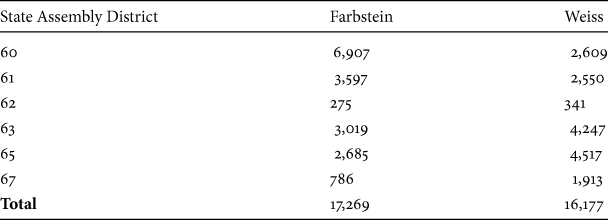
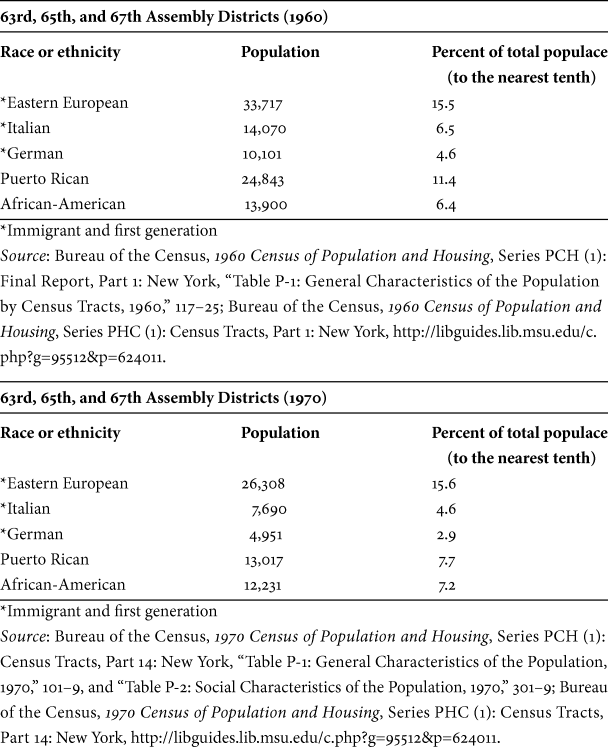
Statistical evidence suggests that these positions and endorsements gave Weiss’s candidacy some traction among Lower East Side black and Puerto Rican voters. New York’s 1966 annual election report broke down the Farbstein-Weiss results by State Assembly District (A.D.). Six A.D.s, either in whole or in part, lay within the 19th district in 1966. According to the 1966 election report, Weiss earned majorities from voters who lived within the 63rd, 65th, and 67th A.D.’s (Table 2). These voters resided within the western portion of the 19th district, the base of Reform Democrats’ power since the late 1950s.Footnote 147 This area possessed fewer white ethnic, black, and Puerto Rican residents and more affluent, second- and third-generation Jews than both the 60th and 61st A.D.s, which covered the Lower East Side and lower Manhattan (Table 3).Footnote 148
Democratic Primary Between Leonard Farbstein and Theodore Weiss, September 1966

Source: “1966 Annual Report of the Board of Elections in the City of New York,” 30, New York Board of Elections.
Racial and Ethnic Breakdowns for the 63rd, 65th, and 67th Assembly Districts

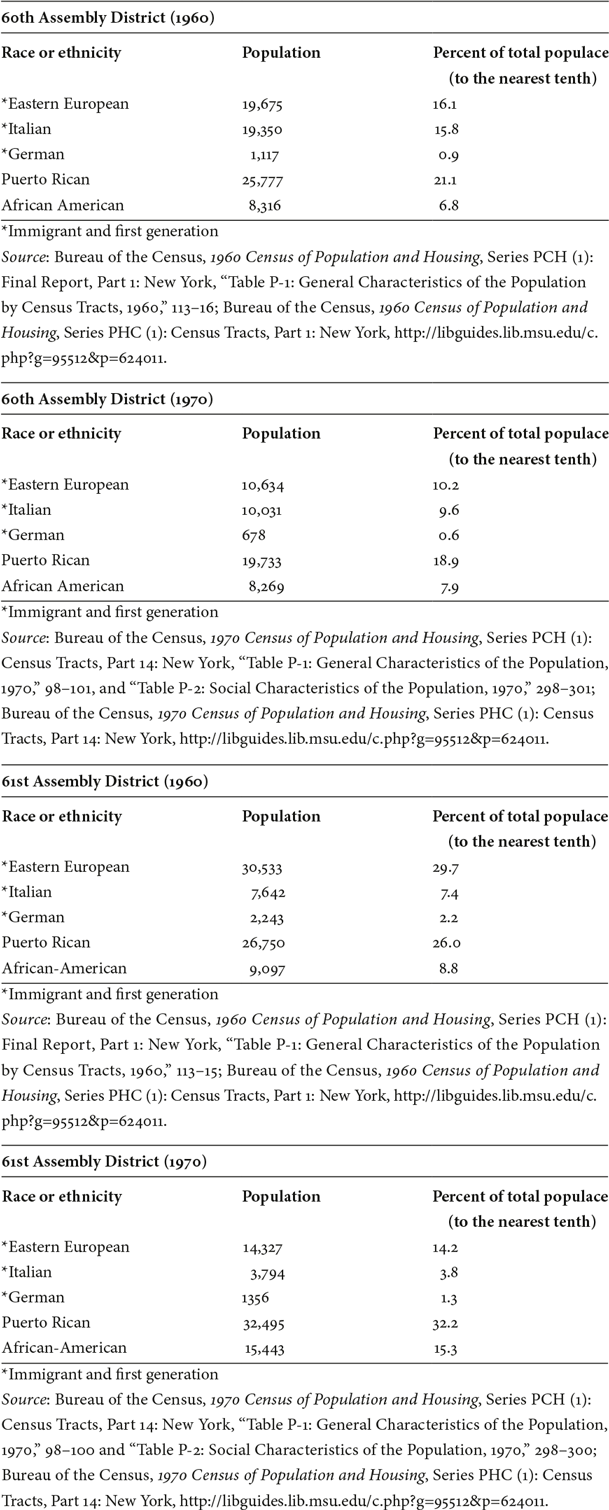
Farbstein, however, won a greater majority of voters in the 60th A.D. than Weiss did in the three western A.D.s combined. The 60th A.D., which covered parts of the Lower East Side and lower Manhattan, possessed a roughly 28 percent black and Puerto Rican populace and a roughly 32 percent immigrant and first generation Eastern European and Italian populace in 1960 (Table 4). In addition, the Lower East Side portion of the 60th A.D., where most of the A.D.’s residents lived, contained the heavily Jewish Grand Street co-ops, Farbstein’s synagogue, and P.S. 110, the school Farbstein defended against busing initiatives 1964.Footnote 149 By 1966, these white ethnic voters, like their outer-borough counterparts, had become wary of new civil rights initiatives. That year, a referendum sponsored by the Patrolman’s Benevolent Association, asked voters whether the city should maintain an all-police review board.Footnote 150 Nearly 60 percent of 60th A.D. voters said “yes.”Footnote 151 While no evidence suggests that Farbstein directly addressed this issue, the returns suggested that his supporters remained less critical of policing than black and Puerto Rican groups.Footnote 152 As such, the returns foreshadowed white ethnics’ susceptibility to citywide and national calls for “law-and-order” in response to urban unrest. In this way, the 60th A.D. returns provide a microcosm of the larger racial divisions that emerged within the New Deal coalition at the national level in the late 1960s.Footnote 153
Racial and Ethnic Breakdowns for the 60th and 61st Assembly Districts

Weiss had a better showing in the 61st A.D. According to census data, Eastern Europeans and Italians comprised about 37 percent of 61st A.D. voters in 1960 (Table 4). Contrary to what one might expect, however, 61st A.D. voters backed Farbstein by about 1,000 votes, a much smaller margin than 60th A.D. voters did (Table 2). In addition, 61st A.D. voters said “no” to the police referendum, meaning that they backed a review board comprised of both civilians and police officers, a position closer to Weiss’ original bill in 1964.Footnote 154 Despite its large white ethnic base, however, blacks and Puerto Ricans comprised nearly 35 percent of 61st A.D. residents, a larger percentage than they did in the 60th A.D. In addition, the 61st A.D. possessed a sizable chunk of the MFY target area, including MFY headquarters, P.S. 140, the scene of MOM’s confrontation of Irving Rosenblum, and the heavily Puerto Rican Wald and Riis houses.Footnote 155 Most important, the 61st A.D.’s white ethnic population declined dramatically between 1960 and 1970. Eastern Europeans and Italians comprised about 37 percent of the 61st A.D. in 1960, but only roughly 18 percent of 61st A.D. residents in 1970.Footnote 156 On the other hand, the 61st A.D.’s black and Puerto Rican populace rose from about 15 percent in 1960 to nearly 50 percent ten years later. This growth did not occur in the 60th A.D., which heavily backed Farbstein. There, the Eastern European and Italian population declined by about 12 percent between 1960 and 1970, while the black and Puerto Rican population remained virtually the same. Farbstein thus depended upon the Jewish and Italian vote in lower Manhattan and the Lower East Side to remain in power. Support for the congressman clearly waned in areas that lost white ethnic voters and gained black and Puerto Rican voters. The returns further suggest that Jewish and Italian voters and interests had merged in Lower East Side electoral politics by 1966. For Weiss, the exact opposite occurred: he gained support in areas where the black and Puerto Rican populace increased and the white ethnic populace decreased between 1960 and 1970. This trend suggests that black and Puerto Rican voters on the Lower East Side had begun to identify common political interests and become more permanent factors in local politics at this time.
The returns did not indicate that Farbstein had completely lost his black and Puerto Rican base. Indeed, he still defeated Weiss in the 61st A.D., albeit more narrowly than he did in the neighboring 60th A.D. Nevertheless, the primary suggested that the congressman’s positions on race and civil rights did not precisely match those embraced by black and Puerto Rican voters on the Lower East Side. Farbstein, unlike some of his white ethnic constituents, embraced national civil rights legislation, linked Jewish, black, and Puerto Rican interests as racial and religious minorities, and remained committed to racial pluralism. At this time, however, African Americans and Puerto Ricans, with MFY’s assistance, began to organize an alternative political agenda, particularly within the public school system, that advocated race-based reform, as well as systemic change. Emphasizing the effects of institutional racism, MFY and its black and Puerto Rican base wanted to integrate neighborhood schools, diversify curricula and teaching staffs, and attain concrete decision-making power within the education system. Farbstein’s political views approached, but did not fully embrace, this vision. While the congressman’s positions hardly embodied a white “backlash” against civil rights, he situated black and Puerto Rican residents within a narrative of Jewish advancement centered on individual hard work and responsibility. This framework appealed to white ethnic voters and foreshadowed their growing belief that race-conscious policies represented illegitimate shortcuts to socioeconomic advancement. These arguments foreshadowed Jews’ more vocal opposition to “community control” in the late 1960s, reflecting and then reinforcing Jewish–black–Puerto Rican conflict in local politics.