1. Introduction
In the introduction to this edition, Schofield discusses Brenner and Kosminsky's comments that appropriation of peasant land can only take place after a transition to capitalism, which entails institutional change; and that this expropriation occurs rapidly against market incentives. In Palestine, the order of events was different. The peasant economy operated within a capitalist system, and market incentives for land transfer from peasants were already substantial. However, the institutional change that enabled a vast transfer of plots of land occurred only later, as is discussed in this essay. In addition, in Palestine, in contrast to Brenner, wage labour did not overtake sharecropping as the dominant mode of employment. This serves as a reminder that knowledge derived from theory or experience from another period and region may assist in analysing historical processes, but cannot replace intensive study of each specific case.
Most of the literature on Palestine in the late Ottoman period discusses peasantFootnote 1 property rights in legal terms, an approach that effectively blocked historiographic discussion of Palestinian peasants and land ownership prior to the mid-nineteenth century. Descriptions of peasants at that time are often couched in terms of medieval European history – with little justification – such as the erroneous description of peasants as ‘tenants’ and the tax farmer as a kind of ‘feudal lord.’Footnote 2 A common argument is that the new Ottoman Land Code of 1858 offered peasants the opportunity to become landlords of their own land, but many of them failed to register the land in their own names. It is argued below, however, that the historical reality and process was very different. Although no formal registration of mīrī land (state-owned; the vast majority of agricultural land in Palestine) existed before 1858, peasants were informally the de facto owners of the plots that they cultivated. They and their heirs could not be evicted as long as they paid taxes, usually in kind, and the land had been habitually cultivated. In fact, it was often the status of the tax farmers and their heirs that was insecure, as their right to collect taxes was only granted for a fixed, and often short, period.
The Land Code of 1858 placed peasants in a precarious position. Their informal ownership of the mīrī lands they had long cultivated was legally questioned and (for the first time) non-cultivators were also permitted to own land – including ‘non-registered’ land. This formal registration meant that peasants could suddenly lose traditional land, which became registered as ‘uncultivated’ and were transferred to wealthier individuals in exchange for payment. Later, even land registered in formal peasant ownership was at risk of transfer to non-peasants for various reasons. The commonest recorded reason was that in times of need peasants took loans from crop merchants. After receiving a loan, a peasant often had little choice but to sell his crops to the merchant lender, because it was an interlinked transaction. In the case of default, crops were the first security; but the second was the land. When a piece of land was transferred to the creditor, who typically became the official landlord, the peasant became a tenant who received one-quarter of the crops from the land he had previously owned. Furthermore, as discussed below, there is evidence that rich individuals sometimes seized land when peasants were about to default on their taxes, and paid these in exchange for land ownership.
In addition, especially in cases of large estates and individually registered land, further transfer of Arab lands was possible to Jewish buyers, who typically offered tempting sums that were much higher than the agricultural value of the land. In practical terms, intensive purchase by Jews did not begin until a quarter century after the Land Code came into effect, in response to the demand created by the first wave of Jewish immigration to Palestine known as the First Aliya (1882–1903). At that time it was still possible for peasants to remain tenants on land purchased by Jews. But after nearly another quarter century, Zionist policies giving preference to employing Jews of the Second Aliya (1904–1914) made such land much less available for Arab tenancy and wage labour. Finally, further registration of land under the British Mandate through the Land Settlement program was an additional dynamic for its transfer from Arab to Jewish hands.
The above statements will be addressed in the following sections, based on secondary sources, primary publications, archival sources, and the author's first-hand interviews with former peasants, village leaders, and moneylenders.Footnote 3 The integration in this paper between informal and formal property rights; the focus on mīrī land that comprised the vast majority of agricultural lands in Palestine; the coverage of the entire country while paying attention to evidence from specific locales and to incorporating cross-era discussions (1800s–1940s), are uncommon in the literature on Palestine.
2. The era of informal peasant landowners
Economists largely agree on the importance of secured property rights for investment and development. While discussing formal property rights is still the dominant discourse, a growing body of literature is developing on the importance of informal property rights, whether or not coupled with formal rights. Claudia R. Williamson and Carrie B. Kerekes, for example, suggest that informal (cultural) institutions are the underlying channels that establish secure, well-defined property rights, while formal institutions are less important for securing such rights.Footnote 4 Jean-Philippe Platteau, discussing landownership and land tenure in rural Africa in the context of policy-making, argues that local communities tend to have informal (customary) systems for allocating and enforcing land rights efficiently, while formal state-enforced laws that go against the informal institutions often militate against efficiency, increase disputes and mismanagement of labour, and drive peasants out of agriculture.Footnote 5 In his empirical study of Madagascar since the 1960s, Marc F. Bellemare claims that the provision of formal land rights had no impact on rural productivity; conversely, when informal rights were recognised, landowners were motivated by the understanding that their children would inherit the rights, and invested more in the plots, etc.Footnote 6 Unlike formal property rights, informal property rights – such as the tradition in a particular village – are less likely to be apparent in written primary sources. Their existence may be inferred through historical analysis, and records of on-the-ground activities, even when we do not know the specific tradition that obtained. If, for example, we see in a market economy peasants whose income directly depends on continuous yield from a field, who make short- and long-term investments in that field (e.g. sowing, planting, terracing), although no particular rights have been formally granted to them (e.g. no deed letters, no sketch maps referencing owners), we may still infer that property rights existed, or at least that the peasants believed they existed even without documentary evidence of ownership, and were convinced that no one would dare to confiscate that land from them.
While studies on Palestine often discuss diverse categories of land, causing some confusion to non-specialists and often also to Middle Eastern specialists, it is suggested here that focusing on the most important category of cultivated land in Palestine, mīrī land, will clarify the major trends. From the beginning of the Ottoman era, most agricultural land in Palestine were classified as state land (mīrī). Other classifications for rural land were rare,Footnote 7 a situation that persisted throughout the Ottoman era and later under British rule from 1918 to 1948.Footnote 8 Hence, a cross-era discussion of this land category is valuable for identifying the key areas under cultivation. It will also benefit readers who are not expert in the complex system of land classification during these years.Footnote 9
In regard to formal legal ownership of land in Palestine, neither peasants nor non-peasants were given options for official ownership of state-owned (mīrī) land. Mundy and Smith's review of the juristic status of land use by peasants in Greater Syria (including Palestine), confirms that no formal land ownership by peasants had existed since the Ottoman occupation began in the sixteenth century, and that even when some juristic evidence was found for the eighteenth century, it was clear that neither the peasant, nor his village, nor the tax farmer, nor anyone else had formal land ownership rights.Footnote 10 Only after the Land Code of 1858 did peasants have an opportunity to acquire formal rights to the mīrī lands they cultivated – but this right was not restricted to peasants.Footnote 11 Then, as discussed below, even though these plots of land were officially termed state-owned and the legal right was usufructuary, in practical terms the law granted private ownership to peasants and/or also to non-peasants.
Still, as argued above, because peasants made continuous short- and long-term investments in the lands they cultivated, they most likely believed that they had informal property rights to them. A range of evidence from the hill country indicating long-term investment, such as was found in archeological excavations near Jerusalem revealing a continual building of agricultural terraces from the sixteenth to the nineteenth centuries, i.e. throughout most of the Ottoman period;Footnote 12 or in nineteenth-century maps of rural Palestine showing multiple plots planted with fruit trees, especially in mountainous areas, reflected a form of active investment.Footnote 13 Fruit trees, in particular the predominant olive, had been planted in the region long before the nineteenth century, some dating back many centuries.Footnote 14 Accounts of travellers in the coastal plain, such as Charles Leonard Irby and James Mangles, who in October 1817 travelled nearly 40 kilometres from Deir al Balah, via Gaza, to Majdal, also describe such long-term investments:
[9 October 1817]:
From Esdier [i.e. Dier al Balah] to Gaza, which latter place we reached at 4 p.m. there are fine extensive plains prettily cultivated; and the neighbourhood of Gaza itself is richly wooded with the olive, sycamore, mulberry, cedar, fig, and other trees. The country is inclosed by hedges of prickly pears, the hills gently rising to the view beyond each other, and the whole has a beautiful appearance.
[10 October 1817]:
At 4 a.m. we left Gaza; the road for two hours was through beautiful groves of olive trees. Then entering an open country, partly cultivated, we passed some villages on each side of us, and the dry torrent of the Escol over a bridge of two high arches. About noon we had on our left Majudal [i.e. Majdal], a large village with a mosque, situated in a valley, surrounded by groves of olives.Footnote 15
Hence, it is argued here that any discussion about land rights in Palestine prior to 1858 must be skeptical of the assertion that there was no private ownership before that date. Instead, there is a need to identify and trace the various types of formal and informal ownership that were customary in different areas and eras.
From the fifteenth to the mid-seventeenth centuries, as shown in Ariel Salzmann's study, the Ottomans used to charge tax on mīrī land; rural administrators were tasked with collecting taxes from the peasants and paying part of the surplus to the government. In practical terms, this tax-farming (iltizām) relationship appeared to grant the peasants a kind of informal land ownership, or, as Salzmann puts it:
Rural administration was … based on a barter of service: a free peasantry whose rights to usufruct of land were guaranteed and a services cavalry who contributed administrative and protection duties in exchange for rent/tax from cultivators.Footnote 16
Moreover, the Ottomans seemed to assure the peasants that their property rights, albeit unofficially, were also secured, as explained by Salzmann and Amy Singer:
Salzmann:
By guaranteeing peasant tenures and offering the tax-paying population a means of redress against administrative abuses through the judicial system, the state balanced the long-term claims of the peasantry (and secured the fiscal interests of the state) against the temporary rights of their immediate overlords.Footnote 17
Singer:
Peasants had the right to live on, work, and enjoy the fruits of certain lands (taşarruf) and could transfer this right to their children, but could not sell these lands or endow them.Footnote 18
Tax farming was usually granted for short terms of three years, but starting from the seventeenth century, lifetime levying was also granted to tax farmers willing and able to pay in advance sums representing future income from longer periods.Footnote 19 This seemed to benefit both parties, guaranteeing long-term relationships: it assured tax farmers of long-term collection, while at the same time possibly reducing the exploitation of peasants.Footnote 20 Either way, the peasants’ position appeared to be strong, bearing in mind the tradition of strong mutual responsibility in villages to assist individual villagers in trouble.Footnote 21 Amnon Cohen, for example, mentioned that throughout the Ottoman period, as long as peasants tilled the land and paid taxes such as their standing annual payment (čift resmi), together with the tithe (ʿushr), ‘no one could interfere with their holdings or with the right of their descendants to inherit them’Footnote 22 – which means informal ownership. While Cohen and others correctly note that these taxes were not necessarily fixed and that the Ottoman administration often levied heavier taxes in times of crisis,Footnote 23 this did not in itself affect land ownership or rights, as long as the peasants continued cultivating lands. This unofficial yet practical ownership strongly secured the possession of land by peasants, yet simultaneously confirmed that land was not a commodity that could be easily transferred.
Although such informal peasant ownership was strongly embedded in Palestinian society, there were exceptions. Beshara Doumani cites a case from 1724, where two peasant families defaulted on payments to a moneylender and were rendered temporary tenants of sorts, with their rights being made subject to their ability to pay (i.e. a temporary landlord–tenant relationship until repayment). He cites another case from 1837, under the Egyptian occupation of the country (1831–1840), when a villager testified that he gave up his land to the ‘pride of [the] honourable princes’ (i.e. the new landlord), who compensated him with 700 piasters.Footnote 24
Mahmoud Yazbak states that in the first half of the nineteenth century, when Jaffa was growing into a major city with a flourishing international port, a number of people – often newcomers – purchased urban real estate, including buildings, as well as agricultural land in the rural areas of the city. In many cases the purchasers developed the lands into cash-crop citrus orchards. This phenomenon was especially common under the Egyptian occupation. In addition, Yazbak mentions documents in the Jaffa court registrations on the operations of a leading merchant-moneylender, Qusṭandī ʾIsrāfīm, who during the Egyptian occupation often loaned money to hill country peasants in exchange for repayment in kind at harvest time – especially in olives and olive oil (i.e. a salam advance purchase, discussed below). But, unlike previously, in 1838 the lender began to advance loans while taking peasants’ land as additional collateral in case of default, and the Jaffa court usually approved transfer of ownership in cases of default. Yazbak comments that this was against Ottoman law, yet he seems to suggest that under Egyptian rule the attitude of the Jaffa court became more lenient.Footnote 25 Kenneth M. Cuno discusses juridical differences within the Ḥanafī school (one of the four legal systems in Sunnī Islam) in Ottoman Syria and Palestine, and presents lively debates on the status of agricultural land in which mīrī land would sometimes be discussed as mulk (private) land and vice versa.Footnote 26 On a local level, it seems that demand for change from those with available capital was somtimes effective in delivering land ownership in Palestine, especially under Egyptian rule.
But the desire of non-peasant merchants to own land could not progress on a large scale until an exogenous change occurred, in this instance a new law that officially permitted such ownership. One known hypothesis suggests that land transfer was significant in Palestine prior to the 1858 Land Code, but there is little evidence to support this. Originally it was postulated while discussing the area of Jabal Nablus,Footnote 27 but further in-depth research suggests this was not the case. Land registration records from two neighbouring regions, Hebron in the south and ʿAjlūn in the east, where many villages were surveyed in full in order to register the (usually informal) ownership that existed prior to the Land Code, indicate that much land was in the name of comparatively small landholders, many of whom were identified as villagers, or was held in common by entire communities (mushāʿ)Footnote 28 and not by non-villagers. The phenomenon of transfer to wealthier owners was therefore probably very limited prior to the Land Code of 1858. Overall, it seems that prior to the Land Code of 1858 peasants were the de facto owners of the mīrī land they cultivated. Although there were some exceptions, especially under Egyptian rule, the widely recognised status for the vast majority of land was informal peasant ownership.
Securing mīrī property rights was sometimes conducted via the Muslim religious endowment of property for public purposes known as waqf (also transliterated as waḳf; pl. awḳāf), especially on non-cultivated land. Officially, waqf was only permitted on mulk land, unless rare state permission (tamliīk sulṭānī) was granted. In practice, however, endowments were also founded illegally on mīrī land, without the consent of the relevant authority or even without notifying the state. In case questions should arise about the legality of this ‘waqf’, Ron Shaham explains that the founders used to circumvent civic law by appealing to a religious court on the matter.Footnote 29 Various studies of Palestine reveal this method of establishing ‘untrue’ waqf on mīrī land in towns and villages (habitually but not exclusively for securing rights of communities or for a village establishment such as a school), sometimes even by non-Muslim minorities, who evidently hoped that endowing property as waqf would better secure their rights. Still, such dedications on mīrī land were infrequent, and seemed to be uncommon in villages.Footnote 30 Finally, it is worth noting that while the literature often distinguishes between communally held (mushāʿ) land and individually held (mafrūz) land, informal ownership was secured for the cultivators on both types of land.Footnote 31 On the whole, albeit with occasional exceptions, in the pre-Land Code era, peasants had de facto ownership of the land they cultivated.
3. When peasants’ informal ownership was challenged
Between 1839 and 1876, the Ottoman Empire initiated a series of reforms known as Tanẓīmāt, broadly aimed at strengthening the central government in various administrative fields. For example, it was decided to introduce fixed taxes, which would be collected directly from landowners, cutting out tax farmers as middlemen. It was also decided to regulate the forms of land tenure and to require registration of ownership and title deeds (sened ṭapus),Footnote 32 which essentially erased the difference between mīrī and mulk land, according to Cohen: ‘The distinct and clear establishment of the differences between mīrī and mulk could not change the historical trend involving the transformation of the former into the latter.’Footnote 33 Michael Fischbach describes the Land Code as ‘a more European-style vision both of land tenure and of the state's role in managing tenure regimes,’Footnote 34 one outcome of which was a decision to form cadastral-linked documentation of land. Registration was not implemented immediately in Palestine or elsewhere throughout the Ottoman Empire, but in places where it was conducted, map-linked cadastral records were usually created with detailed information on land and landholders.Footnote 35 Mīrī land in the village was customarily either registered in the name of owner/s or, in cases of neglect or absence of heirs, as ‘vacant’ (maḥlūl) land. Such vacant land could either be cultivated by a person who decided to do so (and if cultivated for ten years could claim ownership), or they could be sold or taken over by the government.Footnote 36 The state could then transfer/sell land to landlords outside the village – even to absentee landlords.Footnote 37
The result was that, although before the Land Code peasants informally owned the lands they cultivated, after the reform much land passed into the hands of owners who were not farmers, but could afford to buy or acquire land. In commenting on this, Roderic Davison, for example, argues that ‘some customary peasant cultivators were reluctant to register in their own names, fearing increased taxation. Therefore, the opportunity for big landowners to acquire more property remained open.’Footnote 38 Other explanations have been offered for land registration in the name of a person other than the cultivators, including ignorance, or fear that proper registration would lead to conscription.Footnote 39 However, Haim Gerber, Martin Bunton and other scholars argue that historical evidence for these explanations is insufficient.Footnote 40
The scattered historical evidence is of diversity, but an overall process of privatization of mīrī land following the 1858 Land Code. In villages where the Ottomans conducted registration in the name of peasants, land was either registered in common or as individual holdings. Recent comprehensive research by Susynne McElrone on the Ottoman implementation of the Land Code in the Hebron area of Palestine shows that only six of this area's 50 villages registered all their agricultural land to individuals (i.e. mafrūz) or to a small number of partners, while the remaining 44 villages retained significant amounts of land registered in common (i.e. mushāʿ).Footnote 41 In the village of Muqeible in the vicinity of Jenin (Palestine) during the Ottoman period, plots of land were registered in the names of their multiple owners, while those who could not afford to pay the Ottoman registration fees borrowed money and mortgaged their land until they could payFootnote 42 (mortgages on registered land are discussed below). Such findings for Palestine are commensurate with other findings in the region, as in Syria and Jordan, about land registration in the name of peasants.Footnote 43
But not only was land in the region registered in the names of villagers; the more studies on registration that are done, the more diversity is found. Outside of Palestine, in the area of the city of Homs in Syria under the Ottomans, peasants lost land to notables and the courts tended to rule to the benefit of the latter, who managed to convince judges that specific mīrī land was in effect mulk (private); or – while attending court with official documents, unlike the peasants – that mīrī land which the peasants insisted they had continuously cultivated were ‘vacant’ (maḥlūl). These lands were then auctioned by a notable in charge of registration, and were purchased by other notables.Footnote 44
Not all the villages in the region were surveyed in the Ottoman period. Those that were are known, for example near DamascusFootnote 45 or the village of Qālūnya in Palestine. In Qālūnya, even though no survey appears to have been conducted, formal registration of transfer of ownership from one person to another, whether by inheritance or sale, was recorded in a special register.Footnote 46 In a particularly detailed memoire-based study of 1993 about that village, Rajā Sumrīn, the author and a native of the village,Footnote 47 mentioned Qālūnya's furthermost plots of land, some 640 dūnams, 30 kilometers from the village, that were provided to the village by the Ottoman authorities (probably before the Land Code), due to a shortage of land there. Later, however, the formal ownership of these lands was by several landlords, which Sumrīn mostly attributes to: (1) the Ottoman preference to provide land to those Qālūnya villagers who were perceived as better able to pay the heavy taxation prevalent at that time; and (2) the event in one specific year when the owners from the village did not have enough income to pay the Ottoman taxes and transferred 50 per cent of the land to a local urban notable, Saʿīd al-Ḥusaynī, who established a mansion in the village, located northwest of the entrance to Jerusalem, in exchange for payment of that year's taxes.Footnote 48 Sumrīn's information was primarily gathered from the oral testimonies of former villagers (the village was occupied and depopulated in the war of 1948). The distance of more than a century from these events might suggest a need of skepticism about the third-party thoughts or interests (here the Ottomans); but perhaps less skepticism about former villagers’ accounts of their traumatic loss of land in a bad year. If, prior to 1858, the inability to pay taxes was unlikely to cause permanent loss of land ownership (though informal), after 1858 the loss of ownership was inherent, permanent, and formal.
Another account about the same village is found in a memoir published in 1924 by Yahushua Yellin, aged 81. Yellin, from the neighbouring Jewish village of Motza, mentioned the notable Saʿīd al-Ḥusaynī as someone with whom he had close relations. Two interesting cases of land transfer to the rich are described by Yellin for Qālūnya: (1) During the 1880s, or at the very beginning of the 1890s,Footnote 49 al-Ḥusaynī proposed a land purchase to one of the older peasants of the village, but that peasant refused. Al-Ḥusaynī, who was described as having very good ties with the Ottoman authorities in Jerusalem, then asked that the peasant be arrested for unjust allegations. Next, al-Ḥusaynī was willing ‘to assist’ that peasant and get him released from jail in exchange for receiving his land at a very low price.
(2) In a later case, according to Yellin, he and al-Ḥusaynī wished to obtain from some of the peasants of the village 184 dunums of land that they had not cultivated for a while. Al-Ḥusaynī arranged a visit of the Ṭapu (Tabu) land registry officers to survey maḥlūl lands in that particular area of the village. The villagers understood the message and were willing to sell the lands for a low price to al-Ḥusaynī, who was regarded as the only person from whom the Ṭapu officers would not dare to take that maḥlūl land (and indeed they did not, nor from his counterpart Yellin).Footnote 50 Skepticism is also appropriate for this story. Still, not only do these accounts explore in-village and neighbour narratives that differ from those prevalent in the academic literature, they also point to the same conclusion; that following the passing of the Land Code, land was purchased or seized from peasants, even non-surveyed land. Overall, after the Land Code, the obstacles to fully commodifying and securing peasant land by non-villagers were effectively removed; and the practice of formal ownership by villagers began, but also the transfer of village farmland to non-peasants.
From the first wave of Jewish immigration to Palestine from 1882, known as the First Aliya, until the end of the Mandate period, Jewish land purchases in Palestine were significant in scope. Their most important aim was to establish ownership in order to enable settlement. The land was regarded by Zionist organizations – the main purchasers – as Jewish national assets.Footnote 51 Jews preferred to buy large estates, such as would ultimately enable the establishment of settlements, and therefore sought to buy plots from big landowners. For the latter, who were usually non-cultivator owners, the reserve price (the lowest at which a seller is willing to sell) was lower than for the owner cultivators, who saved transaction costs by consuming their own produced staples.Footnote 52 Large landowners, who gained their land post-1858 after buying them directly from the Ottoman government, such as the Sursuck, Karkabi and Farah families who held large agricultural areas in the Jezreel Valley and the vicinity of Acre, sold big estates to Jews. Later, this trend was followed by smaller Arab non-cultivator landowners.Footnote 53 But, unlike the settlers of the First Aliya, those of the Second Aliya (1904–1914) and subsequent waves of Jewish immigrants preferred to employ Jews.Footnote 54 Throughout the years of British rule, the Histadrut (General Federation of Jewish Labour) established a near-monopoly on labour in the Jewish sectorFootnote 55 and imposed effective restrictions on the employment of Arabs in Jewish enterprises. Jewish farmers were obligated to give priority to Jewish labourers, and to pay them much more than Arab labourers; farmers who violated Histadrut instructionsFootnote 56 would be intimidated, even beaten.Footnote 57 The rationale behind the Histadrut's policy was to provide Jews with jobs and high wages in order to encourage further Jewish immigration to Palestine.Footnote 58 For Palestinian peasants, this meant less chance of being employed on farmland, as reported in a secret British memorandum in 1933:
In former years when one Arab sold land to another, the landowner changed, but the tenants remained, and those who laboured on the land for a regular or seasonal wage still continued to earn that wage. To some extent this practice was, and is, maintained by some organisations such as the Palestine Jewish Colonisation Association. But the Zionist Policy is different. When the Jewish National Fund purchases land, not only the landlord is changed, but the tenants and all the wage-earning labourer class are compelled to move; for the Zionist policy is not only to acquire ownership, but also to ensure that all the work required on the land shall be carried out by Jews only … The result is the growth of a body of ‘landless’ Arabs, who may be divided into three classes: (a) Tenants; (b) Small owner-occupiers; (c) Labourers.Footnote 59
Already in the early years of the Mandate, Zionist organizations were required to compensate peasants who had been evicted from lands they had been cultivating, but this usually did not include the provision of alternative land.Footnote 60 Thus, in the first stage, the peasants of Palestine lost their informal ownership of land but usually remained tenant-farmers on their lands; in the second stage, when the land was transferred to Jews, the peasants were evicted.
Gradually the availability of large estates diminished and Jews had to seek smaller estates; at the same time, the British authorities intervened strongly in order to curb Jewish land purchase.Footnote 61 Not surprisingly, Jewish propaganda tried to counter this, and the Jewish Agency for Palestine claimed that selling land to Jews would stimulate the Arab rural economy and increase Arab prosperity on their farms.Footnote 62 This was followed by speculation that Jewish land purchase was a mechanism for developing peasant farms, because peasants with an average plot of about 50 dunums would sell about 20 dunums and plant citrus trees on other parts of their land. However, no evidence was found to support such claims.Footnote 63
The British authorities claimed to have poor registration records from the Ottoman period, but nevertheless asserted continuity of ownership over some forms of registration from Ottoman records. They then announced a ‘Land Settlement’ of rural land (registration of land accompanied by agrarian reform), which was not the Ottoman practice. In fact, according to Martin Bunton, the British took liberties with Ottoman law when it suited their land registration policies:
A great deal of discretion was left to the British legal administrators to align the rules relating to property rights in mandate Palestine with the administrative necessities of the colonial state, and to ensure that post-Ottoman land-law should suit the exigencies of colonial rule. The effort required to digest the ‘Ottoman law in force’ – an unruly collection of laws, provisional laws, and administrative orders – not only ensured that a new, Palestinian law would emerge, it also obliged British officials to decide how they would interpret Ottoman law.Footnote 64
Bunton's argument was later reinforced in a study by Geremy Forman and Alexander Kedar on the land laws of Mandate Palestine.Footnote 65
In a most significant deviation from Ottoman law, the British decided to abolish mushāʿ land, meaning land held communally.Footnote 66 In fact, as R. C. Tute, the President of the Land Court in Jerusalem under the British Mandate demonstrated in his book, it was only changes in legislation from 1911 by the Young Turks that enabled the British to infer – and even this is on shaky ground – the abolition of communal holding.Footnote 67 But Tute's view was that this was wrong:
When registration was first introduced the authorities were faced with the fact that large areas of mirie land [mīrī lands] were, de facto, held in common. The ownership of these lands had to be registered so as to show the facts, and at the same time comply with the provisions of the law contained in Art. 8. The two requirements are often contradictory. In the result, two methods for the registration of ‘Masha’ [mushāʿ] lands were adopted. Some of these lands were registered as held in common by all the de facto co-owners, each being shown as holding a stated proportional share. Others were registered, as being owned by the heads of the families, whose members were the actual co-owners.Footnote 68
This position allowed a continuation of the Ottoman registration practices.Footnote 69 However, Tute's approach was followed for only a short period. In 1928, a year after his book was published, he left officeFootnote 70 and the British moved away from his stance and from Ottoman practice. They began with a reform aimed at cancelling mushāʿ, arguing that this would increase investment and productivity on land, because, it was claimed, as long as mushāʿ existed, ‘no one has any inducement to improve his land’, and that ‘it is useless to expect that land will be weeded or fertilised, that trees will be planted, or, in a word, that any development will take place.’Footnote 71 They were wrong. The level of investment in the mushāʿ communal agricultural holdings proved to be similar to investment on individually held plots. The only difference was that the division of communal land into individual plots enabled the separation into plots to be sold to Jewish purchasers.Footnote 72 In fact, Jewish land purchase reached a peak during the time of the British Land Settlement policy (land registration accompanied by anti-mushāʿ reform), as described by ʻArrāfFootnote 73 and Stein:
Jewish buyers often bought musha‘ shares during the land-settlement process. Often the schedule of rights to musha‘ shares was posted to allow potential claimants the opportunity to challenge the schedule before it was structurally recorded. At that point, land was sometimes transferred into Jewish ownership. When time came for official registration of the shares or the designation of right to those shares, these unofficial transfers were entered in the Land Registry books and legalised, since they now appeared in the posted schedule.Footnote 74
4. Moneylenders and the liquidation of peasant land
The literature is comparatively rich in evidence of mortgaged land being transferred from peasants to non-peasants in the case of defaults; this section focuses on the transfer of land through such a mechanism: in particular, it examines the business relations between merchant-moneylenders and peasants, and how these ultimately led to increased liquidation of peasant land by merchant-moneylenders, who became the landlords.
As the Ottoman Empire expanded its international trade during the nineteenth century, the merchants of the Levant prospered;Footnote 75 transforming from a comparatively small sector into a significant one.Footnote 76 Merchants who traded with the peasantry, whether marketing their agricultural produce or trading with village markets, often also functioned as moneylenders. This was particularly true where trade took the form of an interlinked transaction, meaning that selling goods simultaneously produced a contract in the credit market (note that the term ‘credit’ is not necessarily provided in cash, and may refer to money, goods or services that are to be paid later by any of these means).Footnote 77 In examining the double role of merchants and moneylenders, one must bear in mind that peasants had little opportunity to receive formal credit under either Ottoman or British rule. Credit was virtually non-existent for peasants in Ottoman times, and was not much more accessible later when the British Mandate moved to enable formal credit to peasants through banks, credit societies or directly from the government. One key problem was that banks in particular preferred to receive money on loans rather than produce, commodities or other goods used by merchants as collateral, and the legal interest was too low for the risk that lending to peasants carried. This resulted in marginal formal credit for the vast majority of peasants, and most had to resort to the informal option, i.e. moneylenders, who provided credit with high yet hidden interest rates.Footnote 78
The interlinked transaction was especially practiced in Palestine via salam (advance purchase) arrangements. In these, the merchant-moneylender would advance the borrower the money immediately, in return for later repayment. Since the loan was regarded as a purchase, it allowed for the hiding or disguise of substantial – and formally illegal – interest rates.Footnote 79 British officials such as C. F. Strickland and F. G. Horwill, who were involved in planning formal credit in Palestine, described money provision by salam as the leading credit mechanism for peasants in the 1930s:
C. F. Strickland, 1930:
Since the Turkish Law prohibits a rate of interest in excess of 9 per cent the pro-note is drawn up in a form concealing the exact nature of the transaction; either it shows that the borrower has received a larger sum than that which was actually paid, e.g. £P15 instead of £P10, or a fictitious sale of goods is included in the terms, and if the goods change hands at all they are immediately returned to the lender. The case of a cat which carried two tablets of soap across a table from the creditor to the debtor, who thereupon agreed to buy for £P50 ‘the load of soap borne by this animal’ may be mythical, but indicates a common method of evading the law.Footnote 80
F. G. Horwill, 1936:
[The peasant is] cajoled into selling his next crop to the moneylender at a figure well below the market price under the threat that no further assistance from the latter will be forthcoming if he does not do so.Footnote 81
Another mode of transaction involved an immediate advance of products (i.e. not of money) by the merchant-moneylender, a loan usually repaid with money. The preference for cash in this kind of transaction may be related to the fact that it was given by merchants who needed money rather than staples for operating their business,Footnote 82 unlike the cases in which they preferred securing produce from the peasants at a sub-market price. Beshara Doumani's well-documented book on merchants and peasants in Palestine's Jabal Nablus region during the eighteenth and nineteenth centuries provides a glance into these transactions between textile merchants, who provided peasants with textile products but had to wait until harvest time to be paid:
Upon arrival [to a village hoping to collect loan dues], textile merchants usually tied their horses next to the oil press (badd) or the threshing floor (baydar), symbolically signaling their intention to collect their due. Practically, they could keep an eye on the economic health of both the overall harvest and the individual peasant household. Sometimes they would remain steadfast in this prime location until the entire debt was paid. Larger and richer merchants, such as the Arafats, employed horsemen (khayyala), each referred to as aljabi (collector), who would ride into these villages and demand payment. The collectors, often peasants themselves, were well suited for this task, for they were keenly attuned to possible evasive tactics and tricks. Often the peasants could not or would not pay. But the collectors prolonged their stay, thus taking advantage of the peasant tradition of hospitality (diyafa), whereby the village collectively provided lodging, food, and other services to visitors in a special room in the village square (madafa). To maximize their returns while maintaining some flexibility, the textile merchants – like tax collectors, politicians and subdistrict chiefs – played the ‘good cop/bad cop’ game. According to Najib Arafat, his half-brother Ahmad and Ahmad's sons, including Tawfiq, relied heavily on horsemen to collect debts, whereas his other brothers were less strict with the peasants. Because a peasant's ability to pay fluctuated widely, depending on a number of factors from weather conditions to tax burdens, bankruptcies were not uncommon in the ranks of textile merchants who operated on a system of credit. The estate of Abd al-Razzaq Arafat is a case in point. More than a century later, two of Hajj Isma'il Arafat's sons also went bankrupt, when they were unable to collect from peasants.Footnote 83
Beyond textiles, this type of loan, in which products were advanced to peasants who did not have available cash, was seen in village shops where basic commodities such as tea, coffee, sugar and rice were sold. The same took place in larger villages as well, where shops offered a wider variety of goods, such as shoes, furniture, and agricultural tools, for example sickles. There, peasants usually deferred payment until harvest time, especially the main harvest between April and June of wheat, barley, olives and more.Footnote 84
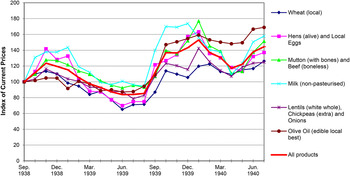
Harvest time was more plentiful also for animal produce and dairy farming. Spring brought the birthing season of farm animals and livestock; milk was more available, as were young animals for trade or for meat.Footnote 85 The coinciding of harvest and animal birthing cycles and outputs meant a greater abundance of agricultural produce at this time of year. According to the available data from the Mandate era, this relative ‘flooding’ of the market would reduce many commodities to an annual low price during this season, as shown in Figure 1:
Index of changes in agricultural commodity prices.
Source: Government of Palestine. Office of Statistics, General Monthly Bulletin of Current Statistics (Jerusalem, various years).
Note: the same measurements of quantity and quality were taken for each product throughout the period examined.

In practice, then, credit for peasants by immediate advance of money was more expansive than the stated interest rate. A peasant who owed a certain amount of money to a moneylender and had to repay it in kind at harvest time, provided his produce at the lowest prices available in the market at that year. Indeed, as can be seen from the trends in the above Figure 1, repayments at harvest time would get the lowest price. But at this time, when the produce could be seized as collateral, everyone demanded repayment of their loans; whether they had advanced products or cash, the merchant-moneylenders demanded their dues immediately.
In addition, it is also likely that the merchants themselves were under pressure to make payments right after the harvest, as some often took low interest (and legal) short-term loans from banks in order to provide high interest (and illegal) loans to peasants. Such interlinked transactions were usually hidden and undocumented, yet an exception to this was found in records of discussions held by the Local Board of the Anglo-Egyptian Bank about the financial strength of several significant borrowers in 1927.Footnote 86 At that time, the Anglo-Egyptian Bank provided around two-thirds of its loans to Egyptians, while the rest were given in the neighbouring countries of Sudan and Palestine (in the latter, it was overwhelmingly citrus export companies that received credit, rather than farmers).Footnote 87 The 1927 document details a discussion about major borrowers and includes information on the additional activities of some as moneylenders. One such borrower was Sayed Soulim, listed as a ‘cultivator and moneylender’, who borrowed from the Mansoura branch of the bank in Egypt. Since he owned 683 feddans (approximately 2,869 dūnams or 709 acres), he was most likely a landlord who employed peasants on his land. The records contain a note on him being a lender to peasants: ‘The Branch state[s] that this land is worth about £E.70,000 and is free of mortgage. Customer is also said to have money owing to him by the fellaheen [peasants].’ Another person named Traboulsi (first name unclear in that document) is listed as a moneylender as well as ‘an irrigation inspector and reported to own 270 feddans of land worth £E.200 per feddan of which about 100 feddans are mortgaged.’Footnote 88 Such large estates were presumably cultivated by a considerable number of peasants, and this man too was most likely a landlord as well as a moneylender. Although it is difficult to know the exact scope of the practice, it is clear that high-interest lending to peasants was somtimes backed by low-interest short-term loans from banks.
Studies of moneylending in the Ottoman and Mandate periods suggest that merchant-moneylenders often specialised in particular niches such as textiles, wholesale foodstuffs and shopkeepers, and that they used to have a near-monopoly as credit providers in their niches for specific villages.Footnote 89 In one of the interviews I conducted with descendants of a foodstuff merchant-moneylender who used to travel with him between villages, villages were defined as ‘others’ or ‘ours’ – among them the village of Mashhad near Nazareth.Footnote 90 Later, in the village of Mashhad, I was shown its ‘Register of Land Settlement’ from 1943. This listed six parcels of land as mortgaged, all to the same foodstuff merchant-moneylender, ‘Abdallā Yūsuf Yaʿqūb,Footnote 91 who was also described as the village's moneylender by the son of a mukhtār (village headman) at that time.Footnote 92 In case of default on the loan, this merchant-moneylender would of course receive ownership of the mortgaged land.Footnote 93
It is not entirely clear why the villages tended to work with just one or a few moneylenders. One hypothesis is that there was a moneylenders’ cartel. If this were true, one would expect that merchant-moneylenders would unite to ‘exploit’ and ‘extract surpluses’ from peasants, and that interest rates would rise in periods when peasants had more available income. But interest rates by wholesale foodstuff merchants on immediate advances of money appear to have remained virtually unchanged throughout British rule. According to British reports, the most common nominal interest rate in the informal credit sector was 30 per cent;Footnote 94 and the regular answers in my interviews with villagers and moneylenders who lived in the Mandate period were the same – ʿashara thalāth ʿashar (thirteen for ten), namely an interest of 30 per cent.Footnote 95 A cartel, therefore, does not seem likely, and a more likely hypothesis is that this market was in fact competitive. In this scenario, the village money market is contestable, meaning that if a moneylender charged excessively high rates, competition would enter and clients were free to choose. On the other hand, no newcomer would intrude lightly. For one, they would have to invest time and money in horsemen/strongmen to collect, as noted earlier; more importantly, however, newcomers would lack the incumbent's detailed knowledge of the village. When a merchant-moneylender developed close connections with borrowers in a village, he could lend at a competitive rate of 30 per cent, partly because he had already obtained good information that allowed categorising potential borrowers – as stated in an interview:
A good man received a loan ‘by giving his word’, without signing a document. An average man received a loan after signing a document. A bad man did not receive any loan.Footnote 96
In several interviews, it was claimed, merchant-moneylenders did not wish peasants to default and preferred being repaid in kind rather than gaining the land which had been offered as collateral.Footnote 97 In the words of the son of one merchant-moneylender:
Q: Why did merchants give loans to fallāḥīn?
A: It was worth doing so. The merchant had the power to get the money back. If a peasant would not repay his debt at harvest time, the merchant came with his strong men and took the debt [in kind] by the use of force. Hence, when the merchant gave a loan he secured himself to get wheat, barley, etc. But if the merchant could not get his loan back, he would take the land. My family also received some lands in this way.Footnote 98
Although land was the second security (the first being the crops), the acquiring of either crop or land in case of default served the same interlinked motivation. When land was given in place of unpaid debt, the debtor usually continued to cultivate it, although ownership passed to the merchant. From then on, the supply of produce was even better secured by the merchant from his new sharecropper.Footnote 99
Having a second (and desirable) form of security reduced the moneylender's risk of total loss, and may have enabled reducing interest rates. Still, receiving the second security was not always straightforward. In one case, for example, when olive trees were given as security but not the land they were on, the moneylender found that a ‘mysterious’ arson attack had occurred on the plantation, and that all his (the moneylender's) trees were destroyed. Accordingly, the peasant who owned the land continued to cultivate it with no further obligation to the moneylender.Footnote 100 Also, when merchant-moneylenders gained land, they also ‘gained’ the tenants, meaning they had to deal with their peasants. For example, tenants were usually not responsible for engaging additional labour or for providing equipment.Footnote 101 Generally speaking, tenants’ credit requirements for direct agricultural purposes were negligible. They may, however, have needed loans for other or personal needs. In such cases, they would typically seek loans from merchant-moneylenders who advanced them products, such as the shopkeeper. However, if this avenue failed, they could turn to their moneylender-turned-landlord, who had an interest in his tenants’ general well-being; in some cases landlords would even give them food and clothes.Footnote 102
While there is less clear information on the practice of advancing money during the Ottoman period, the evidence suggests a gradual diminishing of interest rates. Doumani cites a Jabal Nablus court record from 1828, in which peasants claimed to have received from a merchant-moneylender an advance of 1,025 piasters in exchange for 100 jars of oil over a ten-month period at 10.25 piasters per jar, when the market price stood at 23 piasters per jar.Footnote 103 Such a transaction represents an interest rate of nearly 125 per cent for the deal, or 150 per cent per annum. There are few records of loans from this period, and most records of interest reflect the late nineteenth and early twentieth centuries. Among these, the highest interest of 60 to 70 per cent is mentioned along with a note that this was ‘probably applied for loans not secured against collateral.’Footnote 104 One living witness with possible knowledge of the very last years of the Ottoman period reported 30 per cent interest on loans;Footnote 105 another reference reported that in Jabel Nablus, ‘in the late nineteenth and early twentieth centuries all soap factory owners lent [salam – immediate advance of money for the receipt of olives in harvest time] widely to peasants and small traders and charged 15 to 35 per cent interest.’Footnote 106
If this was the case, and we assume the market was contestable, then two factors seem to account for the reduced interest rates in the informal credit market. The first is credit risk. Creditors presumably sought to secure themselves against default; higher security meant lower risk, which in turn enabled creditors to cut interest rates.Footnote 107 This article has already demonstrated that following the Land Code of 1858, using land as collateral became a widespread practice, and that such security reduced the risk to lenders in case of default. In a contestable market, this in itself is expected to significantly reduce interest rates. The second factor assumed to impact interest rates is credit flow, meaning the availability of more credit in the market. The growth of mercantile activity in the region seemed to increase the availability of money for lending and this – presumably – was another factor that drove interest rates lower. When more credit and better collateral were available in this contestable market, peasants could expect more loans at much better and tempting rates than in the past.
Peasants, according to Doumani, ‘usually borrowed money out of dire necessity: to pay taxes, to recover from a bad harvest, to purchase goods for a wedding, or to meet a myriad of other needs.’Footnote 108 This was also my impression for the later period while speaking with former peasants, such as one who said that ‘the peasant was very poor and occasionally went hungry. He did not have enough money to buy food which was very expensive. He needed to grow his own food in order to survive.’Footnote 109 While there is little way of knowing what would have befallen peasants in need if loans had not been available, questions abound. Would peasants have been taxed as hard as they were by tax collectors if they had not had the option to take out a loan or sell land to the rich to cover obligations, as was the situation prior to 1858? Could they have survived without loans? Would they have been better off without the loan but still remaining owners of their land? The answer to these and many other questions is, of course, that we do not know, because we have been left – at best – with some facts, but not with personal accounts of borrowers describing why they took which loan and when. Still, when it comes to taking high interest loans, one can only assume that they believed it was necessary.
For the role of merchant-moneylenders in transferring plots of land into Jewish hands in Palestine, literature cites evidence of some who functioned as land brokers. However, this does not appear to have been widespread, but rather another element in the already complicated and multifaceted situation of transferring land from peasants to non-peasants.Footnote 110 Within the interviews, one case was mentioned of two merchant-moneylender brothers from Nazareth who sold their land to Jews and then moved to Jordan (possibly fearing retribution).Footnote 111
This section has explored and analysed the interaction between merchant-moneylenders and peasants, and the reasons why this mode of operation caused more liquidation of peasant lands by merchant-moneylenders (and in some cases from them to Jewish hands). The transfer of lands as a result of peasant insolvency was, as noted, only one of several modes of land transfer from peasants after the Land Code of 1858. As early as 1930, a British report on 104 Arab villages described as fairly representative of Palestine, suggested that only 23 per cent of the peasants owned the lands they cultivated; 43 per cent cultivated both the land in their possession and land owned by others, and 34 per cent possessed no land at all (5 per cent of the last category were listed as ‘owners of trees only’).Footnote 112 Between 1858 and 1930, most of Palestine's peasants moved from being informal owners of the lands they cultivated to becoming formally landless, whereas around three-quarters of the Arab peasants cultivated land they did not own. Yet others were pushed to migrate to the cities.
5. Conclusion
It must be recognised that prior to the Ottoman Land Code of 1858, peasants were informally yet in practical terms the owners of the unregistered state lands (mīrī) that they cultivated and on which they paid taxes, and they could neither be evicted nor made tenants. In practice, the new law introduced private registration of mīrī land, and the fact that the land continued to be classified as government-owned is largely semantic, since landowners were granted long-term leases that were effectively unlimited. The law enabled peasants to register the land they cultivated in their own names, which was often the case, but some land was also registered in the name of non-village personages, most likely without direct permission from peasants. Additional pieces of land remained completely unregistered. Many of these were offered for sale by the Ottoman government, while other lands were retained in government hands. In practice, the 1858 Land Code enabled people other than farmers to profit from the leasing of cultivated land if registered in their names, which motivated many to obtain such land. Practically, registration transformed many peasants and their descendants from informal landowners into formal tenants, diminishing their potential gain from farming compared to their previous status. Such registration also increased the desire of non-cultivators to drive peasants to transfer land to them, and the willingness of non-cultivators to provide loans to peasants if land was given as collateral. This was especially the case for foodstuff merchants, who used to receive agricultural produce as payment for loans, thereby securing desired commodities at a relatively cheap price as well as securing the land themselves in case of default and becoming landlords of the indebted peasant family. It was also the case that intensive Jewish national acquisitions were boosted by processes of privatization. If until 1858 peasants were informally, yet practically, the owners of the unregistered state land (mīrī) they cultivated, by 1930 around three-quarters of the peasants cultivated mīrī land that was formally not in their possession.