Implications
The results of this study demonstrate that maize silage or all-concentrate diets can be used as substitutes for grass silage in pregnant ewe rations, provided the supply of metabolizable protein is non-limiting. Including maize silage in the diet, either as the sole forage or mixed with grass silage, also increases forage intake, which offers some potential to reduce concentrate inputs. When feeding maize silage to ewes as the sole forage, cereal-based concentrate supplements should supply 290 to 300 g CP/kg DM to ensure protein supply is non-limiting, which is significantly higher than levels typically found within the industry (210 to 250 g CP/kg DM). However, the need to feed additional soya bean meal is likely to erode any economic benefits from reduced concentrate inputs. A higher incidence of dystocia in ewes fed maize silage as the sole forage is also a concern and requires further investigation.
Introduction
Grass silage is the most common forage offered to pregnant ewes in the United Kingdom and Ireland and a significant amount of research has been undertaken in the last 20 years to develop optimal feeding strategies for ewes offered grass silage-based diets. However, the need for high inputs of agricultural fuel and artificial fertilizer makes the production of high nutritive value grass silage more sensitive to fuel and fertilizer costs compared with other forages such as whole-crop wheat silage or maize silage (Keady et al., Reference Keady, Kilpatrick, Cushnahan and Murphy2002). For indoor-lambing sheep systems to be economically sustainable, there is a need to investigate alternatives to grass silage for pregnant ewes.
Development of earlier maturing maize (Zea mays) cultivars and improved methods of crop establishment, such as the use of plastic mulch, have significantly increased the yield potential (up to 17 t dry matter (DM) per hectare) and nutritional value (up to 340 g starch/kg DM) of forage maize in areas that where previously considered marginal for maize production (Easson and Fearnehough, Reference Easson and Fearnehough2000). These developments, combined with the potential to reduce forage costs (Keady et al., Reference Keady, Kilpatrick, Cushnahan and Murphy2002), have led to a 60% increase in the area of forage maize grown in the United Kingdom since 2000 (Department of Environment, Food and Rural Affairs (DEFRA, 2010)). Inclusion of maize silage in the diets of beef (Keady et al., Reference Keady, Lively, Kilpatrick and Moss2007) and dairy (Kliem et al., Reference Kliem, Morgan, Humphries, Shingfield and Givens2008) cattle, either as the sole forage or in combination with grass silage, has been shown to increase forage intake and improve animal performance. However, there is a paucity of published information on the performance of breeding ewes offered maize silage-based diets. This may be due to the fact that more than 90% of breeding ewes in the European Union-25 are found in upland farms (European Commission, 2006) where climatic conditions are marginal for forage maize production (Easson and Fearnehough, Reference Easson and Fearnehough2000). However, maize silage is becoming increasingly accessible to sheep flocks in Western Europe and there is an urgent need to develop feeding strategies for pregnant ewes offered maize silage-based diets.
Sheep systems in the United Kingdom and Ireland are labour-intensive. Survey data from Ireland indicates that lowland flocks require 5 to 10 man hours per ewe per annum, with proportionately 0.19 of total labour inputs required during the lambing period (Connolly, Reference Connolly2001). Adopting silage-based feeding systems contributes to these high labour requirements, with Flanagan (Reference Flanagan2003) estimating that silage feeding accounts for proportionately 0.31 of total labour inputs at lambing time. Substituting grass silage by feeding higher levels of concentrates to ewes offers some potential to reduce feeding times and increase labour efficiency. Growing lambs fed all-grain diets typically achieve growth rates 30% to 100% higher than those offered forage-based diets (Speijers et al., Reference Speijers, Carson, Dawson and Gordon2009; Annett et al., Reference Annett, Carson, Dawson and Kilpatrick2011b). However, there is little comparable published information on the performance of breeding ewes fed all-grain diets.
The objectives of the current study were to evaluate alternatives to grass silage-based diets for breeding ewes and to examine their effects on dystocia, lamb output and performance.
Materials and methods
Animals
One hundred and four twin-bearing multiparous ewes, predominantly Texel × Greyface and Lleyn × Greyface, were involved in this study. The ewes were mated in single sire mating groups to a range of ram breeds (Suffolk, Texel, UK × NZ Suffolk, Lleyn, Belclare, Highlander) in October/November 2007, giving a predicted mean lambing date of 5 April 2008. The ewes were housed in mid-January and fed grass silage until the study commenced. Litter size was predicted by trans-abdominal ultrasound scanning.
Dietary treatments
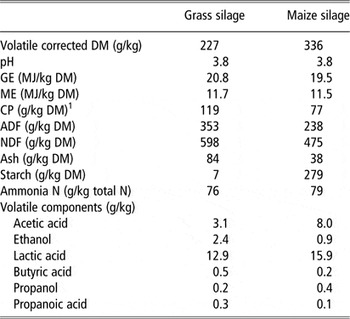
Seven weeks before their predicted mean lambing date, ewes, with a mean (±s.d.) live weight (LW) and body condition score (BCS) of 80 ± 10.6 kg and 3.8 ± 0.21, respectively, were allocated to four treatment groups (n = 26 per treatment) balanced for LW, BCS, crossing sire breed and, where possible, age and breed. Half of the ewes from each treatment group were housed in individual pens while the remainder were housed in groups of 4/5 ewes of similar BCS per pen. For the final 6 weeks of pregnancy, ewes were offered one of four diets: precision-chop grass silage + 0.55 kg/day concentrates (GS); maize silage + 0.55 kg/day concentrates (MS); a 1 : 1 mixture (on a dry matter basis) of grass silage and maize silage + 0.55 kg/day (GSMS) or 1.55 kg/day concentrates + 50 g/day chopped barley straw (C). The grass silage was harvested from the primary growth of a predominantly perennial ryegrass sward on 15 May 2007 following a 24-h wilt, using a John Deere 6850 (John Deere Ltd., Langar, Notts., UK) self-propelled precision-chop forage harvester. The grass was treated before ensiling with a bacterial inoculant (Ecosyl ULV, Ecosyl Products Ltd, Stokesley, UK) applied at the rate of 20 ml/t fresh herbage. Forage maize (Z. mays cv. Goldcob and Kroesus) was sown under plastic mulch on 13 April 2007 at the rate of 105 000 seeds/ha. The crop was harvested on 8 October 2007 using a John Deere 6850 self-propelled precision-chop forage harvester fitted with a kemper header, and a bacterial inoculant (Solomaize, Biotal Ltd, Cardiff, UK) was applied before ensiling at the rate of 2 l/t fresh material. Both forages were stored in concrete silo pits and the material was covered with two layers of heavy gauge polythene weighted down with tyres. The average chemical composition of the silages is outlined in Table 1.
Chemical composition of the silages used in the study

DM = dry matter; GE = gross energy; ME = metabolizable energy; N = nitrogen.
1Total N × 6.25.
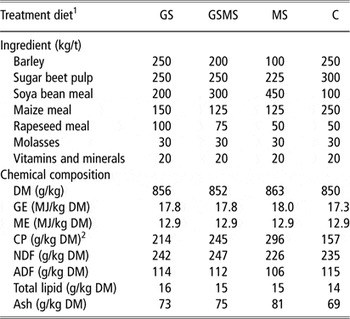
All silages were offered ad libitum with a target 10% refusal rate on a fresh weight basis. Ewes on silage-based diets were offered their daily concentrate allocation in a single feed at 0930 h, while C ewes were offered concentrates in two equal-sized meals at 0930 and 1630 h to minimize the risk of acidosis. Supply of CP from the concentrates was varied between treatments with the aim of achieving a total daily intake of metabolizable protein (MP) circa 130 g/ewe per day for all treatments. The ingredient and average chemical composition of the concentrates used in the study are described in Table 2. Immediately after lambing, ewes were moved to individual straw-bedded pens and offered grass silage plus 0.5 kg/day concentrates for 24 to 72 h. Ewes were then turned out with their lambs to perennial ryegrass-based pasture without concentrate supplementation.
Ingredient and average chemical composition of the concentrates used in the study

DM = dry matter; GE = gross energy; ME = metabolizable energy.
1GS, precision chop grass silage + 0.55 kg/day concentrates; GSMS, 1 : 1 mixture (on a DM basis) of grass silage and maize silage + 0.55 kg/day concentrates; MS, maize silage + 0.55 kg/day concentrates; C, 1.55 kg/day concentrates + 50 g/day chopped barley straw.
2Total N × 6.25.
Measurements
DM intake (DMI) of silage and concentrates were recorded daily for ewes housed in individual pens. For group-housed ewes, daily DMI was recorded for the entire pen and used to estimate individual animal intake. Representative samples of fresh silage and silage refusals were obtained daily for determination of oven DM concentration. Fresh silage samples were obtained weekly for determination of pH and the concentrations of gross energy (GE) and volatile fatty acids. Dried silage samples were bulked weekly, milled through a 1 mm screen and analysed for total nitrogen (N), neutral detergent fibre (aNDFom), ADF and ash concentrations. Representative samples of fresh concentrates were bulked daily and analysed weekly for DM concentration. Dried concentrate samples were milled through a 1 mm screen and analysed for GE, total N, aNDFom, ADF and ash concentrations. Metabolizable energy (ME) concentration of each silage was estimated from the absorption of GE in four castrated male sheep (46 ± 3.3 kg) fed at maintenance energy level (Steen, Reference Steen1986) using the method described by Annett et al. (Reference Annett, Carson, Dawson and Kilpatrick2011b). ME supply from the concentrates was estimated from tabulated energy values for each of the concentrate ingredients (Agriculture and Food Research Council (AFRC), 1993).
Ewe LW (to the nearest 0.5 kg) and BCS (Russel et al., Reference Russel, Doney and Gunn1969) were recorded 6, 4 and 2 weeks pre-lambing, within 24 h of lambing, 6 weeks post-lambing and at weaning. Within 24 h of birth, lambs were tagged and the tag number was recorded alongside the dam tag number, date of birth, sex and birth weight (to the nearest 0.1 kg) of the lamb. Lambs were weighed again (to the nearest 0.5 kg) at ∼7 weeks of age (52 ± 7.0 days) and at weaning (115 ± 6.9 days), and their daily LW gain (LWG) from birth was determined. Lambing difficulty (LDS) was scored on a four-point scale described by Annett et al. (Reference Annett, Carson, Dawson and Kilpatrick2011a).
Jugular blood samples were obtained from all individually housed ewes (n = 13 per treatment) at 6, 4 and 2 weeks pre-lambing using heparinized vacutainers. Whole blood samples were analysed for glutathione peroxidase (GPx) activity, then centrifuged and the plasma was analysed for albumin, globulin, total protein, urea, non-esterified fatty acids (NEFA), β-hydroxybutyrate (BHB) and selenium (Se) concentrations.
Chemical analysis
Chemical analysis of silage samples were undertaken using the methods described by Steen (Reference Steen1986). Composition of the concentrate, urine and faeces samples was determined using the methods of Speijers et al. (Reference Speijers, Carson, Dawson and Gordon2009), with total N expressed as CP (6.25 × total N). All NDF analyses were carried out using both α-amylase and sodium sulphite in the assay (ISO 16472:2006) and values are expressed exclusive of residual ash. Whole blood GPx and plasma Se concentration were determined using the methods of Muñoz et al. (Reference Muñoz, Carson, McCoy, Dawson, Irwin, Gordon and Kilpatrick2009). Plasma BHB concentration was determined using a clinical analyser (Olympus AU640, Olympus UK Ltd., Southall, Middlesex, UK) according to the method described by McMurray et al. (Reference McMurray, Blanchflower and Rice1984). NEFA concentrations were measured on a clinical analyser (Olympus AU640) using WaKo (Wako Chemicals, Neuss, Germany) kits. Plasma concentrations of total protein, albumin and urea were determined on a clinical analyser (Olympus AU640) using Roche (Roche Diagnostics, Mannheim, Germany) kits. Globulin concentration was calculated by subtracting albumin from the total protein concentration.
Statistical analysis
All data were analysed using Genstat v12.1 (2009). Owing to the unbalanced nature of the design, residual maximum likelihood (REML) analysis was used to analyse linear models for continuous variables. Where overall effects were significant (P < 0.05), pairs of means were compared using the least significant difference. Feed intake and lamb performance data were analysed using linear mixed models with fixed effects (where appropriate) for age of ewe, lamb sire breed, sex of lamb, age of lamb, litter size and late pregnancy diet. Pen number and ewe ID were included as random effects to account for pen and within-litter variation, respectively. Blood biochemistry data were analysed using REML analysis with repeated measures to take account of correlations between observations on the same animal. Lamb mortality data were analysed using a generalized linear model, assuming a binomial distribution with a logit-link function, to estimate the proportion of dead lambs. The proportion of ewes achieving each LDS was analysed using a generalized linear model, assuming a multinomial distribution with a logit-link function.
Results
Diets
The average chemical composition of the silages and concentrates fed in this study are presented in Tables 1 and 2, respectively. Both silages were well preserved, as shown by their low pH (3.8) and ammonia N (<80 g/kg total N) concentrations. The maize silage had high ME (11.5 MJ/kg DM) and starch (279 g/kg DM) concentrations but a low CP (77 g/kg DM) concentration. The grass silage had a high ME content (11.7 MJ/kg DM) and a moderate CP concentration (119 g/kg DM). All of the concentrates had similar levels of GE, NDF, ADF, total lipid and ash but varied in terms of their CP content (157 to 296 g/kg DM).
Feed intake and nutritional status
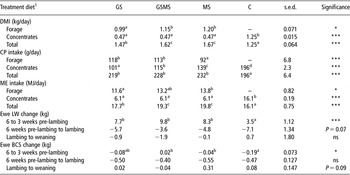
When compared with ewes fed GS, total DMI of ewes fed MS and GSMS was 0.20 kg/day and 0.15 kg/day higher (P < 0.001), respectively, due to their increased (P < 0.05) forage DMI (Table 3). MS ewes achieved a higher (P < 0.05) forage ME intake but a lower (P < 0.001) forage CP intake compared with those fed GS. The incidence of concentrate refusal was negligible in this study, and therefore treatment effects on the intake of DM, CP and ME from the concentrates, which were all highest (P < 0.001) in C ewes, reflected the differences in daily concentrate allowance and CP content. The total DM intake, total CP intake and total ME intake of C ewes were all lower (P < 0.001) than those offered the silage-based diets. Although total CP intake did not vary significantly between silage-based treatments, total ME intake was higher (P < 0.001) in ewes fed MS (+2.1 MJ/day) and GS : MS (+1.6 MJ/day) compared with those fed GS.
Effects of diet in late pregnancy on feed intake, LW and BCS of ewes

LW = live weight; BCS = body condition score; DMI = dry matter intake; ME = metabolizable energy.
1GS, precision chop grass silage + 0.55 kg/day concentrates; GSMS, 1 : 1 mixture (on a DM basis) of grass silage and maize silage + 0.55 kg/day concentrates; MS, maize silage + 0.55 kg/day concentrates; C, 1.55 kg/day concentrates + 50 g/day chopped barley.
*P < 0.05, ***P < 0.001.
a,b,c,dMeans within the same row sharing the same letter in their superscript are not significantly different (P > 0.05).
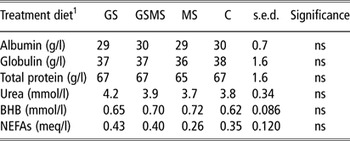
Ewes fed silage-based diets gained more (P < 0.001) LW between 6 and 3 weeks pre-lambing and tended (P = 0.07) to lose less LW between 6 weeks pre-lambing and 24 h post-lambing compared with those fed C (Table 3). However, there were no significant dietary effects on ewe LW change between lambing and weaning. Between 6 and 3 weeks pre-lambing, C ewes lost more (P < 0.05) BCS than GSMS or MS ewes but there were no significant dietary effects on BCS of ewes between lambing and weaning. There were no significant dietary effects on plasma metabolite concentrations during the final 3 weeks of pregnancy (Table 4).
Effects of diet in late pregnancy on plasma metabolite concentrations of ewes 3 weeks pre-lambing

BHB = β-hydroxybutyrate; NEFA = non-esterified fatty acids; DM = dry matter.
1GS, precision chop grass silage + 0.55 kg/day concentrates; GSMS, 1 : 1 mixture (on a DM basis) of grass silage and maize silage + 0.55 kg/day concentrates; MS, maize silage + 0.55 kg/day concentrates; C, 1.55 kg/day concentrates + 50 g/day chopped barley.
Level of dystocia
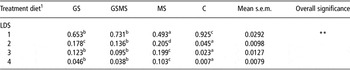
Diet in late pregnancy had a significant effect on dystocia score (Table 5). A higher (P < 0.01) proportion of ewes fed C lambed down unassisted (LDS 1) compared with diets GS, GMSM or MS. As a result, the proportion of ewes requiring minor (LDS 2), moderate (LDS 3) or major (LDS 4) assistance at lambing were lower (P < 0.01) for C ewes compared with those fed silage-based diets. A lower (P < 0.01) proportion of MS ewes lambed down unassisted compared with GS or GSMS, and the proportions of MS ewes given minor, moderate or major assistance were higher (P < 0.01) than those fed GS or GSMS. A higher (P < 0.01) proportion of GS ewes required minor assistance compared with GSMS but otherwise the incidence of dystocia was similar for diets GS and GSMS.
Effects of diet in late pregnancy diet on the proportion of ewes achieving each lambing difficulty score

LDS = lambing difficulty score.
1GS, precision chop grass silage + 0.55 kg/day concentrates; GSMS, 1 : 1 mixture (on a DM basis) of grass silage and maize silage + 0.55 kg/day concentrates; MS, maize silage + 0.55 kg/day concentrates; C, 1.55 kg/day concentrates + 50 g/day chopped barley.
**P < 0.01.
a,b,c,dMeans within the same row sharing the same letter in their superscript are not significantly different (P > 0.05).
Ewe and lamb performance
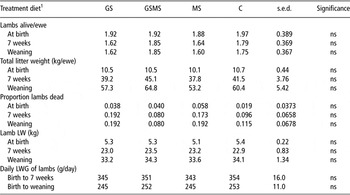
Overall, lamb mortality at birth, 7 weeks and at weaning was proportionately 0.039, 0.135 and 0.145 of lambs born, respectively (Table 6). Diet in late pregnancy had no significant effects on lamb mortality, lamb LW or the daily LWG of lambs at any stage of the study. As a result, the number of lambs reared per ewe and total lamb output per ewe at birth, 7 weeks and at weaning was similar for all late pregnancy treatments.
Effects of diet in late pregnancy on ewe and lamb performance

LW = live weight; LWG = live weight gain.
1GS, precision chop grass silage + 0.55 kg/day concentrates; GSMS, 1 : 1 mixture (on a DM basis) of grass silage and maize silage + 0.55 kg/day concentrates; MS, maize silage + 0.55 kg/day concentrates; C, 1.55 kg/day concentrates + 50 g/day chopped barley.
Discussion
The nutritional value of maize silage is determined mainly by its starch content, which increases as the plant matures (Phipps, Reference Phipps1994). The few studies investigating maize silage for pregnant ewes (Brown and Thomas, Reference Brown and Thomas1989; O'Doherty et al., Reference O'Doherty, Maher and Crosby1997) have fed silage harvested from immature maize crops resulting in low starch and ME concentrations. In the current study, maize silage had DM, starch and ME concentrations of 336, 279 g/kg DM and 11.5 MJ/kg DM, respectively, which are more typical of the levels recommended for optimum performance in lactating dairy cattle (Keady et al., Reference Keady, Kilpatrick, Mayne and Gordon2008). The grass silage had an ME concentration of 11.7 MJ/kg DM, which is considerably higher than levels commonly found in silages fed to breeding ewes in the United Kingdom and Ireland (10.0 to 11.0 MJ/kg DM, R. Park, personal communication).
Silage intake of ewes averaged 0.99 kg DM/day and was typical of the level observed when shorn ewes are fed good quality grass silage (Black and Chestnutt, Reference Black and Chestnutt1990; O'Doherty et al., Reference O'Doherty, Maher and Crosby1997). Including maize silage in the ration increased forage DM intake by 21% when fed as the sole forage, and 16% when mixed with grass silage. These improvements in forage intake are comparable with responses reported recently for cattle (Juniper et al., Reference Juniper, Browne, Fisher, Bryant, Nute and Beever2005; Kirkland and Patterson, Reference Kirkland and Patterson2006), although the intake of maize silage can be up to 60% higher when compared with grass silage of low nutritive value (Burke et al., Reference Burke, Murphy, O'Donovan, O'Mara, Kavanagh and Mulligan2007). Previous studies comparing grass and maize silage in pregnant ewe rations have reported forage intakes which were higher (Crosby et al., Reference Crosby, Boland, Brophy, Quinn, Callan and Joyce2004), similar (O'Doherty et al., Reference O'Doherty, Maher and Crosby1997) or lower (Brown and Thomas, Reference Brown and Thomas1989) than those in ewes fed maize silage. Much of this variation can be explained by quite large differences in nutritive value of the grass and maize silages being compared. To minimize these effects, only high quality forages were offered in the current study. The increased forage intake observed here with the maize silage is more likely to result from a higher rumen outflow rate due to its higher starch content, which is more rapidly fermented in the rumen. The net result was that ME intake was ∼2.2 MJ/day higher than ewes fed grass silage, which is equivalent to feeding an additional 200 g/day concentrates. On the basis of the feeding levels offered in the current study, feeding maize silage has potential to reduce the volume of concentrate inputs in late pregnancy by up to 38%.
Although all-grain diets for finishing lambs have been studied extensively (Speijers et al., Reference Speijers, Carson, Dawson and Gordon2009; Annett et al., Reference Annett, Carson, Dawson and Kilpatrick2011b), there is a paucity of published information on all-grain diets for breeding ewes. Annett and Carson (Reference Annett and Carson2006) reported acceptable lamb birth weights whenever ewes were fed grass pellets throughout pregnancy but highlighted that supplementation with soya bean meal was needed to ensure ewes produced sufficient colostrum. For this reason, cereal-based concentrates were formulated in the current study to help ensure the supply of rumen microbial protein was not compromized by an inadequate supply of fermentable metabolizable energy (AFRC, 1993). Ewes fed the all-grain diets had a lower total DMI compared with those fed silage-based diets, which was mainly due to their restricted daily feed allocation. There was a low incidence of feed refusals during the first 10 days of the study, equivalent to 0.08 of the total feed allowance, as ewes became conditioned to the diet. Thereafter, the incidence of feed refusals was almost negligible.
Ewes fed the all-concentrate diets lost significantly more LW and body condition during the first 3 weeks of the study. However, there was no significant difference in the LW of ewes at lambing, which would indicate that this treatment effect was primarily due to reduced gut fill. Ewes lost on average 0.48 units of BCS during the final 6 weeks of pregnancy, which is marginally higher than levels previously reported for twin-bearing ewes (Annett et al., Reference Annett, Carson and Dawson2008 and Reference Annett, Dawson, Edgar and Carson2009) but considered acceptable by Russel (Reference Russel1984). Consistent with the absence of a dietary effect on BCS, there were no dietary effects on plasma BHB concentrations, which were all well below the critical level for pregnancy toxaemia of 1.1 mmol/l (Russel, Reference Russel1984), indicating that ewes had a satisfactory energy status.
Level of dystocia is a key factor affecting labour inputs in sheep flocks, both directly due to the need to intervene, and indirectly due to the need for increased neonatal lamb care. Overall, proportionately 0.30 of ewes required assistance at lambing, which is typical of the levels reported when lowland ewes are crossed with terminal sire breed rams (Dawson and Carson, Reference Dawson and Carson2002; Carson et al., Reference Carson, Dawson, Irwin and Kilpatrick2004). However, the level of dystocia varied widely between diets, with proportionately 0.51 MS ewes requiring assistance compared with just 0.07 C ewes. Lamb birth weight is often a key factor influencing dystocia levels in sheep (Speijers et al., Reference Speijers, Carson, Dawson and Gordon2009; Annett et al., Reference Annett, Carson, Dawson and Kilpatrick2011a). Although MS ewes achieved a higher daily ME intake than C ewes (19.8 v. 16.1 MJ/day), there was no significant effect of diet on lamb birth weight, and there was no evidence of higher levels of body fat in MS ewes, which could predispose them to increased lambing difficulties. The lower incidence of dystocia in C ewes could be explained by differences in lamb behaviour in utero. The foetal lamb is known to change its orientation within the uterus on the final day of gestation in preparation for birth (reviewed by Fraser and Terhune, Reference Fraser and Terhune1977). As discussed previously, ewes consuming bulky, silage-based diets experienced a greater degree of gut fill than those fed the all-grain diet. It is possible that a forage-filled rumen restricted uterine volume in ewes fed the silage-based diets, making it more difficult for lambs to assume their normal birth presentation, although further research is needed to confirm this.
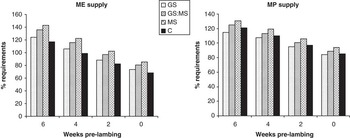
Supply of MP in late pregnancy is a key factor affecting colostrum output and subsequent milk production of ewes. O'Doherty et al. (Reference O'Doherty, Maher and Crosby1997) reported a reduction in colostrum production and subsequent lamb growth rate when ewes were fed protein-deficient maize silage-based diets. To help offset the variation in CP content of the basal forages, the concentrate supplements were formulated to supply between 157 and 296 g CP/kg DM, which was largely successful in maintaining total dietary MP supply close to the target level of 130 g/day (130, 138, 144 and 134 g/day for treatments GS, GS : MS, MS and C, respectively). On this basis, all diets were predicted to supply adequate dietary protein up to the final 2 weeks of gestation, when only MS ewes consumed adequate protein (see Figure 1). The absence of any dietary effects on plasma albumin concentration, which was within the normal range of 24 to 30 g/l reported for healthy sheep (Blood et al., Reference Blood, Radostits and Gay1994), would also indicate that dietary protein supply was adequate. It is therefore not surprising that feeding regime in late pregnancy had no significant effects on lamb mortality, growth rate or weaned lamb output.
Daily supply of metabolizable energy (ME) and metabolizable protein (MP) from experimental diets1,2 relative to predicted requirements3 at 6, 4, 2 and 0 weeks pre-lambing. 1Calculated using the equations of AFRC (1993) and the feed composition data in Tables 1 and 2. 2Predicted for an 80 kg ewe (AFRC, 1993) using the lamb birth weight data presented in Table 7. 3GS, precision-chop grass silage + 0.55 kg/day concentrates; GSMS, 1 : 1 mixture (on a dry matter basis) of grass silage and maize silage + 0.55 kg/day concentrates; MS, maize silage + 0.55 kg/day concentrates; C, 1.55 kg/day concentrates + 50 g/day chopped barley.

The requirement to feed a high level of soya bean meal to meet the protein requirements of the MS ewes is likely to erode considerably any economic benefits of their lower concentrate inputs discussed previously. Furthermore, concerns have been raised about the social and environmental implications of the EU livestock sector's reliance on imported soya bean meal as a protein source (Friends of the Earth, 2008). Feeding maize silage in combination with a high protein home-grown forage, such as good quality grass silage (GSMS), provides an opportunity to reduce concentrate inputs while utilizing lower protein by-products as an alternative to soya bean meal. In the long term, this approach to feeding pregnant ewes is likely to be more sustainable than feeding maize silage as the sole forage.
Acknowledgements
The authors wish to express their sincere thanks to the Department of Agriculture and Rural Development (DARDNI) for funding this project; the staff of the Sheep Unit at AFBI Hillsborough for their hard work, and Mrs R. Park and the laboratory staff for undertaking the feed analysis.