

Introduction
The process by which governing institutions change or remain stable has been a central concern of many political scientists over the last decade (see, for example, Greif and Laitin, Reference Greif and Laitin2004; Hacker, Reference Hacker2004; North, Reference North1998; Orren and Skowronek, Reference Orren and Skowronek2004; Pierson, Reference Pierson2000 and Reference Pierson2004), following a widespread “turn” to institutional frameworks for understanding and explaining public policy-making (see, for example, Hall and Taylor, Reference Hall and Taylor1996; March and Olsen, Reference March and Olsen1989; Steinmo, Thelen and Longstreth, Reference Steinmo, Thelen and Longstreth1992).
One particularly important, and growing, area of research concerns the question of why and when non-radical change occurs. Recent scholarship has described how existing institutions can drift away from their original purposes, have other institutions layered on top or underneath them or, indeed, may become displaced or exhausted or be converted to serve new purposes (Streeck and Thelen, Reference Streeck and Thelen2005). Such changes need not simply reflect external pressures, and thus reflect a “functionalist” response to changing circumstances (Skowronek, Reference Skowronek1982). While they may be impelled by exogenous forces, they can, equally, derive from processes internal to the institutions concerned.
This article focuses on one type of such institutional change: conversion. Institutional conversion refers to the process whereby “institutions are not so much amended or allowed to decay as they are redirected to new goals, functions, or purposes”. Such institutional conversion involves existing institutions being “redeployed” in new, often unanticipated, directions (Streeck and Thelen, Reference Streeck and Thelen2005: 26). It thus concerns the adoption of “new goals or bringing in [of] new actors that alter the institutional role or the core objectives of an institution” (Béland Reference Béland2007: 22). Importantly, institutional conversion constitutes “an analytic point of departure for understanding how institutions created for one set of purposes come, in time, to be turned to wholly new ends”. Recognising that institutions can be converted is more sophisticated than simply assuming that institutional architects can “mess up” and that they have designed faulty institutions (Thelen Reference Thelen2004: 36). Both Béland (Reference Béland2007) and Thelen (Reference Thelen2004) convincingly underscore the significance of institutional conversion as a mechanism of policy change through their examinations of US social security reform and skills formation in Germany, Britain, the US and Japan, respectively.
The article focuses on one particularly significant recent case of institutional conversion: that of the UK's National Reporting and Learning System (NRLS), created to improve safety within its National Health Service (NHS). The NRLS can appropriately be described as an “institution” qua a set of rules and norms (North, Reference North1990), since it combined guidelines on information to be provided within incident reports, as well as a particular set of norms around patient safety (such as, for example, that individuals could report anonymously without being blamed and that individuals, organisations and the NHS as a whole should try to learn from their mistakes).
When the NRLS was established, it was only the second national-level reporting system to be created globally (following Denmark), and is now the largest in the world in terms of the number of incident reports it contains. Many other European countries (including Austria, Belgium, Czech Republic, France, Ireland, Netherlands, Norway, Spain, Sweden and Switzerland) have either installed similar systems or are currently thinking of following suit. With information concerning over five million incidents lying within the NRLS (Woodward, Reference Woodward2009), it constitutes a massive information resource. The question – how the institution, originally created to increase patient safety, has converted into another for promoting market-led competition within a decade – is therefore highly intriguing internationally and beyond health care.
More broadly, the UK NHS is frequently adduced, both positively and negatively, in debates about health care reform in other countries (Darzi, Reference Darzi2009; Kerr and Scott, Reference Kerr and Scott2009). Policy-making within the NHS has been the subject of numerous case and comparative studies (Burau and Vrangbaek, Reference Burau and Vrangbaek2008; Ham, Reference Ham2008; Harrison, Reference Harrison2004; Klein, Reference Klein2006; Moran, Reference Moran1999; Tuohy, Reference Tuohy1999; Walshe, Reference Walshe2003). Under the UK's Labour governments of 1997–2010, health service governance underwent major changes, including the introduction of tighter regulation through the creation of a large number of arm's-length bodies. This was in line with developments in many other countries, where quangos and executive agencies proliferated (Alvarez-Rosete and Mays, Reference Alvarez-Rosete and Mays2008; Greer and Jarman, Reference Greer and Jarman2007; Pollitt et al., Reference Pollitt, Bathgate, Caulfield, Smullen and Talbot2001; Storey, Reference Storey2011; Wright, Reference Wright2009). The abolition of the National Patient Safety Agency (NPSA), the body that ran the NRLS, thus goes against the grain of policy developments elsewhere.
The NRLS also offers an example of the attempted transfer of a policy instrument across sectors (in the NRLS’ case, from other safety-critical industries, such as aviation, to public health care). The contradictions and tensions that can result from the imposition of policy tools from one area into another area, in the context of the pre-existing institutional framework, have been widely observed in other countries and sectors (Grant, Reference Grant2010; Hood and Margetts, Reference Hood and Margetts2006; Kassim and Le Galès, Reference Kassim and Le Galès2010). It is therefore pertinent to review and analyse the development and conversion of the NRLS. This case study contributes to theoretical debates on both institutional conversion and neo-institutionalism more widely.
Conversion as a form of non-radical institutional change
In its investigation of institutional conversion, this article follows James Mahoney and Kathleen Thelen's injunction to take the “next step” of investigating “the sources of institutional change: sources that are not simply exogenous shocks or environmental shifts” (Reference Mahoney and Thelen2010, 3). The NRLS has been chosen as a “critical case” of institutional conversion, allowing “for direct assessment of received wisdom on causal mechanisms or linkages” (Mahoney and Thelen, Reference Mahoney and Thelen2009: 1). Mahoney and Thelen have, usefully, promoted the merits of examining institutions within the context of distributional power conflicts. They suggest that institutions often represent compromises between different power-seeking groups, and hence should often be viewed as inherently unstable.
While this approach has much to offer, it arguably fails to accord sufficient importance to the activities of internal institutional actors. These actors may be allied to powerful groups that are rooted outside the institution but, equally, they may fail to possess such connections (or at least, it may not be possible to “read off” their actions from the preference of such power coalitions) (Woll and Jacquot, Reference Woll and Jacquot2010). The article argues that, if we are truly to understand institutional change, it may be necessary to examine the activities of internal actors (the stuff, traditionally, of organisational analyses) as well as adopt a “political coalitional approach” (Thelen, Reference Thelen2009: 476), which examines the influence of broader power coalitions and how these have impacts internal to institutions.
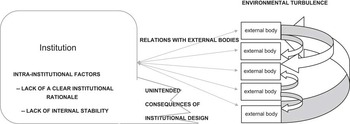
The figure below outlines different factors promoting institutional conversion: intra-institutional factors, the unintended consequences of institutional design, relations with external bodies and environmental turbulence.
The importance of intra-institutional factors in explaining the stability and growth of agencies has not been extensively examined in neo-institutional work, but it has been the focus of much of the “bureaucratic politics” literature. This literature suggests that bureaucrats “are politicians, and bureaucracies are organizations of political actors” (Carpenter, Reference Carpenter2001: 352; see also Carpenter, Reference Carpenter2010; Teles, Reference Teles2008). As such, the growth or contraction of agencies does not result merely from functional pressures (Skowronek, Reference Skowronek1982), nor are agencies merely “passive actors” buffeted by external processes (Maor, Reference Maor2010: 154). According to these works, agencies’ jurisdictions will expand or contract depending not only on their relationship with other agencies (ibid.) but also on their leaders’ ability to “practice a politics of legitimacy” (Carpenter, Reference Carpenter2001: 352). Success within the “politics of legitimacy” involves agencies’ relationships with external actors, in particular, their ability to network with a “diverse [supportive] coalition wrought from the multiple networks in which they are engaged” (Carpenter Reference Carpenter2001: 352). Bureaucratic politics, and in particular the assertion and maintenance of bureaucratic autonomy is, then, a matter of “coalition” (Carpenter Reference Carpenter2001: 354) and “reputation” building (Maor, Reference Maor2010). This literature also notes that the capacities of agencies are often judged by the reputations of their chief executives – despite the fact that limits exist to the impact that even the most senior actors can have on highly complex organisations (Derthick, Reference Derthick1990: 187).
The article argues that intra-institutional factors can help explain why institutional conversion occurs, as well as the other factors identified by neo-institutional authors such as Streeck and Thelen (Reference Streeck and Thelen2005) and Mahoney and Thelen (Reference Mahoney and Thelen2009). These authors suggest that three factors may promote institutional conversion: the unintended consequences of institutional design, relations with external bodies, and environmental turbulence.
The results demonstrate that all three factors contributed to the institutional conversion of the NRLS. While it is, in many ways, no surprise that a particular type of institutional design might lead to unintended consequences – as with the undertaking of any purposive social action (Merton, Reference Merton1936) – this factor is often overlooked. Both policy-makers and, indeed, academics, often fail to appreciate the possibility for gaps between the rules that constitute institutions and the behaviour that follows from and contextualises them, gaps that may offer opportunities for political contestation (Thelen, Reference Thelen2009).
The creation, development and conversion of the NRLS highlights the influence of predispositions towards what could be described as quantitative rationalism (Porter, Reference Porter1995; Power, Reference Power2004) and negativity bias (Soroka, Reference Soroka2006) amongst some UK politicians and media. Here, quantitative rationalism refers to the tendency of actors to privilege quantitative over qualitative sources of information and to assume that quantitative information is in some way objective. Negativity bias refers to the phenomenon whereby “negative information more strongly influences people's evaluations than comparably extreme positive information” (Ito et al., Reference Ito, Larsen, Smith and Cacioppo1998: 887).
Both quantitative rationalism and negativity bias appear to have undermined the NRLS’ original, formative, role and were not, it appears, anticipated when the NRLS was created. For example, many commentators appeared determined to view incident reports lodged within the NRLS as a measure of patient safety, hence engaging in quantitative rationalism. These commentators presented incident reports as “objective” measures indicative of safety “levels”, and presented increasing numbers of reports as “evidence” of increasingly unsafe care. In contrast, the NPSA and a small number of other expert commentators were keen to emphasise that the NRLS database offered only a very partial indication of patient safety incident rates, given that only a small proportion of incidents tended to be reported to it (Vincent et al., Reference Vincent, Aylin, Franklin, Holmes, Iskander, Jacklin and Moorthy2008); and that rising incident rates were likely to be indicative of greater proclivity to report, rather than of increasingly unsafe care. The greater political and media resonance of quantitative rationalism and negative news compared with the expert position does not appear to have been anticipated by institutional founders, yet in the long-run led to the NRLS being undermined.
Streeck and Thelen (Reference Streeck and Thelen2005) and Thelen and Mahoney (Reference Mahoney and Thelen2009) have also suggested that the rules and norms constituting institutions often represent both initial and ongoing compromise between different power coalitions. As such, institutions may be shaped over time by changing power balances amongst cognate and competing institutions and, hence, by their relationship with external bodies. The NRLS (and its home agency, the NPSA) was faced with a highly dynamic institutional context where a variety of institutions arguably shared its focus on promoting patient safety. While the agency was able to cooperate with some of these and the processes they set in train, this arguably confused the NPSA's initial, formative, role to aid NHS organisations to learn from patient safety incidents (as opposed to providing, or helping to provide, summative measures of “safety”). As Mahoney and Thelen suggest (Reference Mahoney and Thelen2009: 22), “short-run behaviours” can be distinguished from “long-run strategies”, where “immediate rule-conforming behaviour” can conflict with “the overall goal of institutional maintenance”.
Finally, Streeck and Thelen (Reference Streeck and Thelen2005) and Thelen and Mahoney (Reference Mahoney and Thelen2009) have suggested that institutional change rarely results solely from external pressures (apart from under certain rather specific circumstances). Nonetheless, they do suggest that the changing balance of power between different groups can affect internal institutional dynamics, by offering more (or less) succour to particular intra-institutional elements. Hence, environmental turbulence can promote institutional conversion. While a change in the partisan composition of the UK government towards a more market-friendly coalition certainly appeared to encourage the use of NRLS data to drive resource allocation decisions, many of the processes that led to this were already in train under the previous government.
Mahoney and Thelen do consider how the “over-time distributional effects of institutions” can “trigger divisions among institutional power holders”, and how “subordinate groups” can organise and attempt to effect change after being undermined by existing institutional arrangements (2009: 9–10). However, such change processes tend to focus on different groups as part of power coalitions that have a life beyond the institution in question, rather than internal institutional dynamics. Yet, the case of the NRLS suggests that, in addition to the extra-institutional factors specified above, intra-institutional factors were important in explaining institutional conversion: in particular, the lack of a clear institutional rationale and the lack of internal stability. Hence, for example, the NPSA's leadership frequently appeared to alter the agency's approach to patient safety and failed to articulate a clear, consistent and resonant rationale for the agency's continued existence, which differentiated it from other institutional actors. This appeared to be less a result of external power coalitions than of internal issues such as successive changes in leadership.
Method
The article is based on the analysis of content, produced between 2001 and 2010, from parliamentary reports (from the UK's Hansard), institutional reports from the NPSA (including minutes of meetings, press releases and rapid response alerts) and press reports (across the broadsheet, tabloid and specialist press). First, relevant parliamentary discussions and press reports were collected by conducting a keyword search for “patient safety” and “NRLS” and/or “National Reporting and Learning System” and/or “National Reporting and Learning Service” (a misnomer frequently used in discussions of the NRLS), using Hansard (the UK database of parliamentary debates) and the relevant full-text websites for high-circulation UK newspapers. The discussions and press reports were then examined in detail to ascertain the manner in which data from the NRLS was used by authors and/or speakers. This process of inductive content analysis led the authors to identify the various key themes discussed below.
The findings presented here have been extensively discussed with a number of key actors from this policy area, including staff from the NPSA (who remain anonymous), to check our interpretation of events. These discussions have been undertaken rather than formal interviews given the low likelihood of staff being willing to go on the record whilst they were in the process of attempting to salvage their employment within the health service. The discussions corroborated the key findings presented here. However, any errors or omissions are the unique responsibility of the authors.
The National Reporting and Learning System
After the publication of an Institute of Medicine report in the US in 1999 on patient safety, many countries began to discuss plans for establishing national patient safety reporting systems in the framework of quality of care, risk management and clinical governance (Runciman et al., Reference Runciman, Sellen, Webb, Williamson, Currie, Morgan and Russell1993; Scally and Donaldson, Reference Scally and Donaldson1998; World Health Organization, 2005). In the UK, the NPSA was created in 2001 as a special health authority following the Kennedy inquiry into the Bristol Royal Infirmary scandal, where abnormally high death rates in babies receiving heart surgery were detected (Lyall, Reference Lyall2006). The NRLS enables UK health care staff (doctors, nurses, surgeons, etc.) to report information about patient safety incidents, including both “near-misses” and instances where a patient was directly harmed, into a national database. In July 2001, a pilot for an NRLS started in 28 NHS organisations, running until June 2002. This followed a number of NHS hospitals in England and Wales developing their own incident reporting (IR) systems from 1995 after the publication of national risk management standards promoting this (Sari et al., Reference Sari, Sheldon, Cracknell and Turnbull2007).
This was followed by development work with 39 NHS organisations (Parker, Reference Parker2004), with the NRLS being officially launched across the UK in February 2004. The NRLS was only the second national-level incident reporting system (British Medical Journal, 2004). By just April 2002, the pilot NRLS was “the biggest patient safety database in the world” (Greenwood, Reference Greenwood2003). The NPSA was initially described as analysing data from the NRLS to “develop national solutions that will make it easier to do things right and more difficult to do things wrong”. (Health Services Journal, 2003b).
The voluntary and confidential nature of the NRLS was initially presented as promoting more reporting of incidents by health care staff, and thus leading to greater effectiveness. The NPSA drew lessons from the data collected in the NRLS and, on the basis of this information, issued safety alerts to UK hospitals and other NHS organisations (as well as undertaking a wide variety of other safety-related activities).
However, the UK's new Conservative-Liberal Democrat coalition government announced in July 2010 that it would abolish the NPSA, following a review of quangos (non-departmental public bodies) (Smith, Reference Smith2010). This review concluded that the functions of the NPSA “do not of themselves need to be performed at arm's length of the Department [of Health]” (Department of Health, 2010: 26). The NRLS is to be shifted to a Patient Safety Subcommittee of a new NHS Commissioning Board. The new NHS Commissioning Board is to provide oversight of the new quasi-market within the NHS, whereby general practitioners (GPs, family doctors) will be able to commission services for their patients, in conjunction with other health professionals. In addition, the NHS Commissioning Board will itself commission some of the services that currently report patient safety incidents into the NRLS, including primary care and related services, and national and regionally specialised services.
The proposed Patient Safety Subcommittee” will cover “the whole function from getting evidence to working up evidence-based safe services” and thus, it is claimed, provide “an opportunity to preserve the synergy between learning and operational practice that already exists in the system” (ibid.), whilst other parts of the NPSA will be shifted elsewhere. The new NHS Commissioning Board is due to assume all its responsibilities by April 2013. The responsibilities of some other UK quangos with quasi-regulatory or regulatory roles (such as the National Information Governance Board for Health and Social Care) will be passed to the Care Quality Commission, an existing “super-regulator” (Department of Health, 2010).
The shifting of the NRLS’ functions to a new NHS Commissioning Board, following a move to compulsory reporting of serious untoward incidents, and the abolition of the NPSA suggest that the grounding principles of the NRLS have been entirely abandoned. The move suggests that, henceforth, the NRLS will be mainly used not as a source of information for the NHS to learn from itself but as a means for commissioners and patients to assess services’ safety as part of a newly emerging quasi-market for health services. In sum, the NRLS, rather than being a tool to support professional improvement, is becoming a mechanism to facilitate resource allocation.
The change in the location and function of the NRLS signals a quite remarkable institutional conversion. Initially, the NRLS’ role was entirely separate from resource allocation, with patient safety being seen as best promoted by a voluntary reporting scheme. Gradually, patient safety data such as that on “serious untoward events” (including deaths and surgery on the wrong side of the body, for example) was incorporated into funding decisions until, in July 2010, it was proposed that the entire NRLS should be subordinated to the commissioning system.
The following sections consider the role of a variety of factors promoting institutional conversion. Although downplayed in many accounts, we suggest that, first, intra-institutional factors were important in explaining the conversion of the NRLS. This was alongside factors that are more commonly identified such as the unintended consequences of institutional design, relations with external bodies and environmental turbulence.
Intra-institutional factors within the NRLS: instability and lack of clarity
The NRLS lacked a clear institutional rationale and was extremely unstable in its internal organisation over time, for reasons not reducible to external pressures. The analysis presented below focuses on two intra-institutional factors: the lack of a clear institutional rationale for the NRLS, and the lack of stability within the NPSA. Both of these internal factors increased the vulnerability of the NRLS to institutional conversion and, inter alia, its ability to build a strong reputation amongst external audiences.
Lack of a clear institutional rationale for the NRLS
Initially, the NPSA's leadership appeared primarily focused on producing comparative information to be used formatively by trusts to enable improvements. Indeed, at first, the agency was circumspect about the potential scope of its activities. Hence, the agency's leadership stated explicitly following the pilot of the NRLS in 2003 that there “is no quick fix” (Osborn and Williams, Reference Osborn and Williams2003). Indeed, one of those job-sharing as the first chief executives of the agency, Sue Osborn, described the agency's work as sometimes “acting as a confessional”, with the agency wanting “to be a haven for those experiences” of adverse incidents that continued to cause health care staff distress (Greenwood, Reference Greenwood2003). Soon after, however, Susan Williams, the other chief executive, stated that the agency was “working with the new Commission for Healthcare Audit and Inspection to help them make a judgment about how hospitals and trusts are doing with regard to patient safety” (Katikireddi, Reference Katikireddi2004). Thus, virtually from the introduction of the NRLS there was a lack of clarity over whether data from it was to be used in a formative or summative manner, i.e. over whether it would be used to aid health care organisations to learn from previous incidents, or alternatively to aid summary judgements by regulators or funders.
This continued over the life of the agency. Hence, two years later, the joint chief executives of the agency stressed the fact that the NRLS was “not a regulatory or mandatory system as it relies on the willingness of NHS staff to report to achieve a clearer national picture of the issues affecting patient safety” (Osborn and Williams, Reference Osborn and Williams2006). Yet this was contradicted by members of the NPSA board, who criticised the agency publicly for failing to include targets in its business plan for “numbers of lives saved and associated cost savings” (Lyall, Reference Lyall2006). The lack of clarity over the agency's rationale and appropriate jurisdiction was rather surprising, since it has been noted that agencies may be reluctant to expand their activities if this comes at the cost of a muddying of the institutional sense of mission, increased costs or reputational risk (Ting, Reference Ting2002).
The NRLS’ role was, in summary, unclear from its creation and was marked by ambiguity over the next seven years of its existence. The agency's leadership collectively failed over time to articulate a consistent or clear rationale for the NRLS, which might have legitimated a formative approach to the use of patient safety incident report data. This was surprising, given that moves away from a voluntary system, in particular, could be seen as reducing the perceived legitimacy of the NRLS amongst health care practitioners. At the time when the NRLS was being created, it was suggested that GPs might fear releasing safety information to the bodies that funded them (Primary Care Trusts, PCTs) (Health Services Journal, 2003a) and thus reduce the extent to which they reported incidents. It is arguable that just such a reduction in reporting levels is highly likely with the move of the entire NRLS to the new NHS Commissioning Board, as proposed.
Lack of stability within the NPSA
The NPSA, the home agency for the NRLS, arguably also suffered from a lack of intra-institutional stability, as well as a lack of clarity over its aims, particularly in the second half of its life. For example, the first two (joint, job-sharing) chief executives of the agency were suspended on full pay to facilitate an investigation into managerial issues (Kmietowicz, Reference Kmietowicz2007) after five years in post, before a succession of four new chief executives and acting chief executives were appointed, each with apparently slightly different views of what they believed data from the NRLS should be used for. This lack of stability at the top of the institution was compounded by successive changes within it. While some were promoted by external bodies (considered in more detail in subsequent sections), others were driven by internal considerations.
For example, in 2005 the remit of the NPSA was expanded, following a governmental review of arm's-length organisations. Henceforth, the NPSA assumed responsibility for national confidential inquiriesFootnote 1 as well as for the activities of certain specialist bodies within the UK NHS such as its National Clinical Assessment Services and Central Office for Research Ethics Committees. By 2006, the NPSA's annual budget had doubled to £35million, and the agency had a staff of over 300 people (Lyall, Reference Lyall2006). That year, the agency was heavily criticised by the Public Accounts Committee of the House of Commons for insufficiently accurate information on deaths in the NHS, a lack of concrete learning outcomes and a failure to build on local initiatives developed by individual NHS organisations (Public Accounts Committee, 2006).
In 2007, the role of the NPSA was altered again when it was urged to “refocus its objectives” and concentrate its activities on collecting and analysing incident reports through the NRLS, as well as on making the NRLS more user-friendly (Kmietowicz, Reference Kmietowicz2007). This followed the production of the report Safety First: a report for patients, clinicians and healthcare managers, which had also urged the creation of a national campaign on patient safety issues (Health Services Journal, 2006).
Rather than being uniquely impelled by external forces, this particular reorganisation was also due to an internal review by the NPSA, which suggested more responsibility should be devolved to regional levels (Health Services Journal, 2007). This was part of a longer-term internal plan to slim down the core functions of the NPSA to those that could only be performed nationally (Clews, Reference Clews2007). It was paralleled by a greater avowed focus from the NPSA to work “closely with clinicians”. Hence, the NPSA started to support anaesthetists in developing their own reporting system that was separate from the NRLS (White, Reference White2007). The work with anaesthetists was described as a prototype that could be followed for other distinct professional groups (ibid.). This was despite the fact that, until this stage, a national reporting and learning system covering all disciplines had been prioritised as a more effective means of generating information on organisation- and system-wide problems than a succession of separate systems.
Overall, therefore, there is considerable evidence that factors internal to the NPSA (in particular, the lack of any consistently and clearly articulated rationale for the NRLS, and internal turbulence) undermined the NRLS’ role as a formative dataset and facilitated its institutional conversion to support commissioning decisions. These were in addition to matters more commonly identified as leading to institutional conversion: the unintended consequences of institutional design, relations with external bodies, and environmental turbulence.
The unintended consequences of institutional design
The view that incident reporting can drive up safety has informed the creation of incident reporting systems in industries including military, nuclear energy, oil, and rail and aviation (Macrae, Reference Macrae2008; Smith and Mahajan, Reference Smith and Mahajan2009). Experience from these sectors has informed the view that “for all practical purposes, a safe culture [can] be equated to an informed culture”, which itself results from a “reporting culture” whereby incidents are recorded and learned from (Reason, Reference Reason1998: 302). Given estimates that around 10 per cent of hospital admissions lead to the patient suffering from an adverse incident of some kind (Department of Health, 2000: 11), it was anticipated that analysis of these incidents would then enable the NHS to learn from its mistakes and make its systems, processes, equipment and practices safer. However, despite strong initial support from government and academic commentators, in practice the NRLS suffered severely from unintended consequences resulting from its institutional design, particularly those arising from what is described here as quantitative rationalism and negativity bias.
Quantitative rationalism and the NRLS
Data drawn from the NRLS were frequently presented as representing appropriate estimates of incident rates, as part of a narrative that health care was unsafe. For example, the Daily Mail newspaper suggested in 2005 that the NRLS had “estimated (sic.) that around 840 deaths could be linked to safety incidents” (Daily Mail, 2005) whilst The Times newspaper talked of “[t]en thousand safety alerts (sic.) over medication given to children […] being issued annually in the NHS” (Lister, Reference Lister2009). The NRLS was described, erroneously, as a “monitoring programme” (Lister, Reference Lister2006) instituted to “collect trustworthy data” (The Times, 2006). This was paralleled in discussions of particular types of adverse incident. Hence, a rapid response report on drug errors was described (wrongly) as an “official warning” by the Observer newspaper (Campbell, Reference Campbell2008). The Sunday Times newspaper spoke of more “than 200 errors with epidurals in 12 months” having “been detected” by the NRLS, even though these errors were revealed through voluntarily given information (Oakeshott, Reference Oakeshott2006). Such misinterpretation also, albeit less frequently, occurred in the UK specialist health press. Hence, for example, the British Medical Journal reported in 2005 that more “than half a million errors are made in patient care in acute NHS hospitals each year, according to the National Patient Safety Agency”, apparently ignoring the fact that within the same article, an NPSA spokesman had stated that “it was difficult to be precise on numbers” (Coombes, Reference Coombes2005).
One case study of this bias towards quantitative rationalism comes from the area of the physical safety of mental health patients. The NPSA commissioned a detailed analysis of the reports of rapes, sexual assaults and incidences of sexual harassment of mental health patients that had been reported to the NRLS, following the incorporation of mental health organisations into the reporting system. This research was part of a programme of work that allegedly constituted “the first time in the world that an agency has used a national incident reporting system to look at the safety of mental health patients” (Kmietowicz, Reference Kmietowicz2006).
However, two high-circulation UK daily newspapers, The Times and the Daily Mail, reported in July 2006 that the report had been held up for a number of months by the Department of Health due to its sensitivity (Craven and Merrick, Reference Craven and Merrick2006; The Times, 2006). The UK Department of Health, for its part, maintained that “some information remains unclear and work is underway to clarify this and ensure the report reflects the most complete picture” (Craven and Merrick, Reference Craven and Merrick2006). This was criticised by the political Opposition for the length of time it had taken (eight months) to verify a small number of cases (ibid.). The report was eventually published on the 17 July 2006, with the caveat that an additional enquiry was being carried out into those most serious incident reports (Lister, Reference Lister2006).
The NPSA was criticised by some commentators for failing to challenge the delay in publication, given that the report suggested some very serious failures to protect vulnerable women, including in particular the suspected occurrence of 19 rapes in mental health wards (The Times, 2006). However, it later transpired that of those 19 reported rapes, 13 allegations were subject to “serious doubt” (Hawkes, Reference Hawkes2006). As such, the delay in publication was arguably justified; yet this went unacknowledged by the press. This case illustrates the apparent tendency of both UK politicians and the press to try to present data from the NRLS as offering a picture of patient safety within the NHS, even when the quality of this data was highly questionable.
Factors promoting institutional conversion

The NPSA continually attempted, unsuccessfully, to emphasise publicly the partiality of incident reports as a measure of patient safety. As one of many examples, the NPSA's nursing lead for patient safety stressed publicly that “variation in reporting of patient safety incidents varied vastly, with higher reporting from community nurses and mental health staff than clinicians in general practice settings” (Carlowe, Reference Carlowe2009). This cautious and nuanced approach was also reflected in the NPSA's own presentation of data from the NRLS. Rather than presenting absolute numbers of patient safety incidents as some kind of measure of safety, the NPSA developed and promoted more sophisticated approaches as means of measuring patient safety. The most detailed of these was the NPSA's development of what it described as a Harm Susceptibility Model (Pham et al., Reference Pham, Colantuoni, Dominici, Shore, Macrae, Scobie, Fletcher, Cleary, Goeschel and Pronovost2010). This used the relative number of reports falling into certain categories in 20 high-reporting hospitals (known as trusts) in order to develop a model that could be used for inter- and intra-trust comparison. The model suggested that most variability in “harm”, as indicated by the NRLS, “occurred among trusts (55%), with differences in odds of harm across work areas within a trust accounting for 30%” (ibid., 2). The Harm Susceptibility Model related “the probability of near-miss events to the probability of harmful events”, and in doing so offered “a simple quantifiable measure of a hospital of work area's ability to catch and defend against errors” (ibid., 4).
Even the Harm Susceptibility Model was subject to a range of caveats identified by its creators. Most significantly, it was acknowledged that the ratio of harmful to non-harmful errors reported in different units might vary dependent on reporting biases, differences in coding errors as harmful or non-harmful, and a range of other related factors (ibid., 5). In addition, by viewing “non-harmful” incidents as related to resilience, the authors acknowledged that they discounted the potential importance of “mere chance or luck on the day” (implying completely degraded risk resiliency; the “as bad as it gets but somehow we didn't hurt anyone” situation) (ibid.).
In summary, whilst the NPSA continually refrained from describing NRLS data as indicative of safety levels without further qualification, this was effectively ignored by external commentators. Whilst the superior expertise and information-gathering capacity of the NPSA might have been expected to have strengthened its autonomy in relation to external actors (Carpenter, Reference Carpenter2001: 364), it was unable to control the use made of such information once it was released into the public domain.
Negativity bias and the NRLS
Understandably, given the widespread (erroneous) assumption that NRLS data offered a “true” measure of patient safety, many commentators also assumed that increasing numbers of incident reports signified increasingly unsafe care. For example, the UK Liberal Democrat party, in press releases on this issue, argued on the basis of NRLS data that the “number of patients who have died in hospital as a result of incidents including medical errors and healthcare acquired infections has risen by 60 per cent since 2005”, despite the fact that the figures could well have reflected better reporting rather than more unsafe care (Dent, Reference Dent2009).
This misunderstanding was also on occasion repeated in the specialist press. Hence, a widely read UK nursing journal, the Nursing Times, stated on the basis of NPSA figures that the “number of patients who have been involved in safety incidents while undergoing NHS treatment has risen by 12% in six months” in August 2009 (Nursing Times, 8.10.09). Within the same article, the Nursing Times reported the NPSA's statement that “the rise was due to improved reporting”, yet this did not, apparently, inform the rest of the article (ibid.). As before, the NPSA attempted to underline the fact that higher numbers of incidents being reported may have reflected greater willingness to be open about incidents, both to the trade press (Osborn and Williams, Reference Osborn and Williams2003), and in NHS guidance (Hairon, Reference Hairon2008; National Patient Safety Agency, 2008), but to apparently little effect.
Relations between the NRLS and external bodies
The NPSA operated within an almost suffocatingly complex and competitive institutional context, which changed considerably over time. Lacking formal powers to enforce the safety alerts it produced from NRLS data, the NPSA was dependent on the support of outside institutions for the success of its activities (Lyall, Reference Lyall2006). However, both the institutional ecology and organisational priorities of these bodies altered almost continually. This made it more difficult for the agency to articulate a clear identity that was separate from, but complementary to, such other bodies.
First of all, the creation of the NPSA coincided with the intensification of regulatory mechanisms covering the NHS. These included, for example, the development of new regulatory regimes covering medical staff, such as the revalidation scheme run by the General Medical Council (the body that registers doctors to practice in the UK), which required doctors to be able to indicate a capacity to learn from significant events. This paralleled the development and increasing importance of inspection-based organisations such as the (then) Commission for Healthcare Audit and Inspection (now an element of the Care Quality Commission super-regulator). In order, apparently, to demonstrate its utility in the regulatory context, the NPSA developed a standard for safety that was incorporated into this commission's inspections process (Katikireddi, Reference Katikireddi2004). However, as discussed above, the leadership of the NPSA never precisely articulated the degree to which the agency's activities could or should be viewed as summative as opposed to formative.
It is also arguable that some of the NPSA's role came to be undertaken by a new Patient Safety First Campaign, which focused on interventions relating to the highest-risk areas as identified by the NRLS. This campaign was formally supported by the NPSA in addition to other institutions, and ran from June 2008 (Creamer, Reference Creamer2008). The English campaign was described as based on the “principles of social movements”, was run by NHS staff and occurred in tandem with the creation of similar campaigns in Wales, Scotland and a number of other nations (Woodward, Reference Woodward2009). Its approach was similar to that of the US Institute for Healthcare Improvement, which differed fundamentally from that of the NPSA given the latter's focus on incident reporting. While the NPSA formally supported the Patient Safety First Campaign, the campaign formed yet another (competing) element of an already crowded institutional context.
Another potentially competing body was the NHS Information Centre, which was established as a “special health authority” in April 2005. The NHS Information Centre did not suggest that incident data itself could be used to measure safety. However, the centre developed a different measure of safety based on the NRLS, within its set of voluntary Indicators for Quality Improvement, based on the degree to which health care organisations had made reports to the NRLS within the preceding period.
The NPSA's development was also concurrent with an increasing focus on safety and quality within governmental health care funding decisions. In some, but not all, cases, the NPSA supported decision-making in this area, despite the fact that this involved legitimising the view that safety could be measured in some way through the collection of incident data. As mentioned, in some cases, the NPSA was not deeply involved in the creation and operation of these funding processes. For example, in order to gain funds through the Quality and Outcomes Framework within primary care, following the concluding of a new GP (family doctor) contract between GPs and the UK government in April 2004, general practices (groupings of family doctors) were required to carry out 12 “significant event audits” over a three-year period and submit reports of these (Gould, Reference Gould2008). Significant event audits differ from investigations of adverse incidents, since “significant events” can have positive as well as negative outcomes. “Significant events” therefore were not generally reported to the NRLS, nor was data from the NRLS used for the purpose of significant event audits. The development of the significant event audit system, apparently at one remove from the NPSA, was perhaps surprising given the fact that the agency was in theory meant to cover the entire NHS, and yet very few incidents within primary care appeared to be reported to it (only 1 in 200 reports to the NRLS in 2008 were made from primary care, despite this sector delivering the bulk of health care services for the general population) (Hoffman et al., Reference Hoffman, Beyer, Rohe, Genishen and Gerlach2008).
In contrast, the NPSA was instrumental in developing the concept of “never events”, which was adopted as part of commissioning arrangements by Primary Care Trusts (PCTs)Footnote 2 following the New Labour Minister Lord Darzi's recommendation to do so as part of his report, High Quality Care for All. The concept of a never event was popularised in the US, where it is linked to insurance systems. Hence, Medicare, and some private health care insurers in the US, will not now pay out to hospitals for the costs of dealing with “never events” (nor for hospital-acquired infections such as MRSA) where these occurred (or were contracted) as part of an inpatient stay.
Eight “core” never events were selected to form a Never Events Framework 2009/10, ranging from wrong site surgery to inpatient suicide using non-collapsible rails. The NPSA helped promote this framework, to work as a pilot initially, to later be developed for use by commissioning PCTs (Fletcher and Huehns, Reference Fletcher and Huehns2009). Initially, PCTs were urged to simply discuss never event rates with providers from whom they commissioned services; in return, PCTs were to be informed of the occurrence of never events by their providers. PCTs were then to be encouraged to report, publicly, on the occurrence of never events, meaning that their role extended from that of commissioning to publicising safety information. It was anticipated that rates of never events would then, at some point in the future, be used to inform commissioning decisions by PCTs. The Never Events Framework clearly prioritised the use of incident reports as summative measures of safety that could be used to drive funding decisions, in departure from the NPSA's initial formative use of the incident database.
In summary, the NRLS (and its home agency, the NPSA) was faced with a highly dynamic institutional context where a variety of institutions arguably shared its focus on promoting patient safety. While the agency was able to cooperate with some of these and the processes they set in train, this arguably confused the NPSA's initial, formative, role to aid NHS organisations to learn from patient safety incidents (as opposed to providing, or helping to provide, summative measures of safety). While cooperation with regulators and the commissioning system may have had the short-term impact of ensuring that the NRLS was seen as a relevant and useful information resource, it may have undermined over the longer term the case for maintaining the NRLS as a formative (as opposed to summative) data resource.
The NRLS’ external conditions – constantly changing over time
The coming to power of a new core executive in the UK, which strongly supports radical (as opposed to partial) marketisation of the UK NHS, driven by patient choice and GP commissioning, could be seen as an example of a particularly significant change in the power resources of external coalitions. Whilst the NPSA possessed a patient experience and public involvement directorate and promoted the reporting of incidents by patients and their involvement in resolving safety issues (Health Services Journal, 2003a), it had not linked providing information on patient safety (via the NRLS) to facilitating patient choice in the manner proposed by the new UK government.
Nonetheless, it is arguable that external pressure even before this point had led to information from the NRLS being used in a summative manner, against the NPSA's original rationale of formatively aiding NHS organisations to learn from patient safety incidents. Hence, in 2006, a report from a committee within the UK Parliament, the Public Accounts Committee, suggested that the Department of Health should consider the publication of safety data for different NHS trusts (hospitals, collections of GP surgeries, community services, etc.) “as part of the NHS choice agenda”, given that the NRLS was not currently “tooled up” to do so (Clews, Reference Clews2007). It was also suggested that “a collapse in public confidence” was starting to “force politicians to take a more draconian approach”, and that this had allegedly been the case with “repeated errors and associated fatalities in the administration of intravenous/intrathecal chemotherapy”, over which the Department of Health had “resorted to threats of high-level retribution” (Burns, Reference Burns2007).
These factors appear to have motivated a major change in the use of NRLS data in April 2010. After this point, reporting of serious untoward incidents became mandatory. Incidents had to be reported to the NRLS, which would then pass on the data to the Care Quality Commission, which would then use the data for its registration process (National Patient Safety Agency, 2010). The decision to require the NPSA to be involved in mandatory reporting in this way appears to have been made by government with minimal involvement from the NPSA itself.
While the external context may, therefore, have changed considerably with the election of a new government, the previous UK government also appeared to have moved towards the view that NRLS data could, and should, be used for summative as well as formative purposes. It is, therefore, arguable that the shifting of the NRLS to the new NHS Commissioning Board represents the end of a long process of institutional conversion rather than an abrupt and dramatic change.
Conclusion
This analysis has considered one critical case of institutional conversion: the UK NRLS. This system was initially created as a means whereby health care staff could report patient safety incidents voluntarily and anonymously and, collectively, learn from these reports to increase the safety of their teams and organisations. With the introduction of mandatory reporting of serious untoward incidents, and shifting of the NRLS to a new NHS Commissioning Board, the NRLS’ function appears to have changed to providing a summative measure of patient safety that will, in the future, help drive funding decisions. This institutional conversion is particularly interesting given that the NRLS has previously been viewed highly favourably by experts beyond the UK (Legido-Quigley et al., Reference Legido-Quigley, McKee, Walshe, Suñol, Nolte and Klazinga2008).
While external factors played some part in explaining this institutional conversion, they do not tell the entire story. The fact that quantitative rationalism and negativity bias appeared to drive the use of NRLS data by the media and politicians was arguably an unintended consequence of a reporting system that understandably failed, initially, to include information on all patient safety incidents and, again understandably, only gradually began to grow as more health care staff became involved. This indicates a wider governance issue concerning transparency and the use of information in the public domain (Fung et al., Reference Fung, Graham and Weil2007). In addition, the NRLS was developed in a context of intense institutional competition and turbulence. While the NPSA was required to demonstrate its utility to different institutional development processes (such as the growth of regulation and increasing use of patient safety data in funding decisions), such participation arguably undermined the rationale for the NRLS’ formative (rather than summative) role. Finally, the changing balance of power amongst different coalitions existing externally to the NRLS arguably increased support for a summative as opposed to a formative approach.
Yet, while such factors were undoubtedly important, internal dynamics within the NPSA were shown to have played an important part in explaining the process of institutional conversion. While the NRLS’ initial, formative, rationale was inconsistently and weakly articulated, the agency also lacked internal continuity. This prevented a clear strategy in relation to issues such as whether incident reports should be used formatively or summatively, which were closely tied to the NRLS’ perceived legitimacy and effectiveness.
As such, the institutional conversion of the NRLS is arguably over-determined: that is, more than one plausible explanation could account for its occurrence. It is impossible to state that any one of the different factors mentioned above constituted a necessary condition for the NRLS’ institutional conversion. Instead, this article has followed a “process tracing” approach (Mahoney, Reference Mahoney2000: 412–415), detailing how the NRLS was converted and considering various explanations for this. Overall, it has suggested that while external factors were important in relation to the NRLS, they coexisted with internal problems that were not reducible to those identified by Streeck and Thelen (Reference Streeck and Thelen2005) and Thelen and Mahoney (Reference Mahoney and Thelen2009). This article therefore suggests the need for analysts of institutional change to be prepared to closely examine factors that might otherwise be described as organisational, such as the degree to which leadership and organisational structures are consistent in their shape, identity and vision, as well as viewing institutions as the arenas for power distributional conflicts.
Such internal factors might also be viewed as administrative or indeed political. To that extent, this article heeds recent calls for a closer alignment between political science and the study of bureaucracies and public administration (Lodge and Wegrich, Reference Lodge and Wegrich2012). Agencies may not be “infinitely pliable”, but are subject to both practical limitations (Derthick, Reference Derthick1990: 175) and, as this article has indicated, to internal organisational/political dynamics, which may be highly consequential.
Acknowledgements
The authors would like to thank all the interviewees and all those who gave comments and feedback on earlier versions, particularly four anonymous reviewers.