Introduction
The success rate of assisted reproductive technology (ART) may be directly dependent on oocyte quality, as determined cytologically and morphologically by examination using an inverted microscope. The use of intracytoplasmic sperm injection (ICSI) techniques provides a good opportunity to evaluate denuded oocytes before fertilization and to analyze the correlation between oocyte morphology and embryo viability(Rienzi et al., Reference Rienzi, Balaban, Ebner and Mandelbaum2012).
Central cytoplasmic granulation (CCG) is a morphological feature of oocytes, in which granulation is located centrally within the cytoplasm and with clear borders, easily distinguishable from normal cytoplasm by its darker appearance (Van Blerkom, Reference Van Blerkom1990; Serhal et al., Reference Serhal, Ranieri, Kinis, Marchant, Davies and Khadum1997). CCG dysmorphism is thought to be most likely due to cytoplasmic immaturity associated with mitochondrial disturbance (Kahraman et al., Reference Kahraman, Yakin, Donmez, Samli, Bahce, Cengiz, Sertyel, Samli and Imirzalioglu2000; Gilchrist et al., Reference Gilchrist, Lane and Thompson2008).
CCG has a negative effect on ART outcomes, being negatively correlated with embryo quality and ongoing pregnancy rate (Serhal et al., Reference Serhal, Ranieri, Kinis, Marchant, Davies and Khadum1997; Kahraman et al., Reference Kahraman, Yakin, Donmez, Samli, Bahce, Cengiz, Sertyel, Samli and Imirzalioglu2000; Kahraman et al., Reference Kahraman, Benkhalifa, Donmez, Biricik, Sertyel, Findikli and Berkil2004; Balaban and Urman, Reference Balaban and Urman2006; Balaban et al., Reference Balaban, Ata, Isiklar, Yakin and Urman2008; Rienzi et al., Reference Rienzi, Ubaldi, Iacobelli, Minasi, Romano, Ferrero, Sapienza, Baroni, Litwicka and Greco2008; Merviel et al., Reference Merviel, Cabry, Chardon, Haraux, Scheffler, Mansouri, Devaux, Chahine, Bach, Copin and Benkhalifa2017). However, few studies to date have assessed the effects of different stimulation protocols on CCG (Balaban and Urman, Reference Balaban and Urman2006; Fancsovits et al., Reference Fancsovits, Tothne, Murber, Rigo and Urbancsek2012), and methods of overcoming CCG remain unknown.
Clinicians have used the GnRH antagonist protocol for assisted reproduction in recent decades as an alternative to the GnRH agonist protocol. More recently, a GnRH agonist trigger has been utilized in GnRH antagonist cycles to induce the final stage of follicular maturation while reducing the risk of ovarian hyperstimulation syndrome. This protocol is successful because GnRH agonists have a greater affinity for the GnRH receptor than GnRH antagonists. However, GnRH agonist triggering can induce the release of endogenous luteinizing hormone (LH) and follicle-stimulating hormone (FSH), which mimics the natural cycle surge and is therefore considered more physiologic. In addition, GnRH antagonist may sensitize the pituitary response to GnRH. Oocyte yield in patients with immature oocyte syndrome has been reported to be improved with GnRH agonist triggering than with hCG triggering (Engmann et al., Reference Engmann, Benadiva and Humaidan2016).
This case series describes the use of GnRH agonist triggering in four patients with CCG of the oocytes. The results enable an evaluation of different stimulation protocols and triggering strategies in women with repeated ICSI failure in our institution.
Materials and methods
This study describes four patients who failed initial in vitro fertilization (IVF)/ICSI and subsequently underwent repeat ICSI procedures at Kaohsiung Chang Gung Memorial Hospital between June 2012 and January 2014. Baseline demographic and clinical characteristics were obtained from these patients at their initial visit, including infertility history and records of IVF/ICSI procedures.
Initial IVF/ICSI treatment: GnRH agonist protocol with hCG trigger
The four women in this study received the long protocol with pituitary downregulation using leuprolide acetate (Lupron®; Takeda, Tokyo, Japan) as first choice. All patients received Luprolide acetate: 1 mg (age < 35) or 0.5 mg (age ≥ 35) subcutaneously daily, beginning on day 21 of the previous cycle and lasting until cycle day 3, when pituitary downregulation was evaluated by determination of serum estradiol (E2) concentration and transvaginal sonography (TVS) of the ovaries. If the serum E2 level was less than 35pg/ml and no follicles greater than 10 mm in diameter were noted on TVS, LA was decreased to half a dose and continued until and including the day of hCG administration. The initial dose of gonadotropin and either human menopausal gonadotropin (hMG) and/or recombinant FSH was individualized for each patient depending on age and ovarian reserve (age < 35: 225 IU/day; age ≥ 35: 300 IU/day). Further dose adjustments were based on each individualʼs ovarian response, as assessed by serum estradiol (E2) concentration and ultrasonographic monitoring of follicular growth. When the leading follicle reached 18–20 mm in diameter, recombinant hCG (r-hCG) 6500 IU (Ovidrel®; Serono, Modugno, Italy) was administered. Oocytes were retrieved 36 h after hCG administration.
Latter ICSI treatment: GnRH antagonist protocol with hCG trigger or GnRHa trigger
In the flexible GnRH antagonist protocol, patients were administered gonadotropin stimulation, followed by suppression with 0.25 mg of cetrorelix acetate (Cetrotide®; Serono, Baxter Oncology GmbH, Halle, Germany) when the leading follicle was 14 mm in diameter. GnRH antagonist protocol and the same controlled ovarian hyperstimulation (COH) agents (hMG plus recombinant FSH). When the leading follicle reached 18 mm in diameter, r-hCG 6500 IU (Ovidrel®; Serono, Modugno, Italy) was administered.
If denuded oocytes showed evidence of CCG, the patients underwent the next cycle of ICSI using the flexible GnRH antagonist protocol. However, hCG triggering was replaced by 0.2 mg GnRH agonist (Decapetyl; Ferring, Wittland, Germany).
Oocyte and sperm preparation
After 2 days of abstinence, semen samples were collected from the male partner by masturbation into a sterile container. Motile spermatozoa were selected using a discontinuous two-layer density gradient technique (SupraSperm 80/55; Origio, Malov, Denmark). The retrieved oocytes were inseminated 4–6 h later with 50,000 spermatozoa in Nunc four-well culture dishes, with each well containing 700 µl universal IVF medium. After 16–18 h, the cumulus cells were removed with pipettes of internal diameter 170 µm and fertilization was checked. For ICSI procedures, cumulus cells were removed 2 h after oocyte retrieval using 80 IU/ml hyaluronidase (H-3757; Sigma Chemical, St Louis, MO, USA) in HTF. ICSI was performed 2–4 h after denuding. The nuclear maturation grades of the oocytes were classified as metaphase II (MII) or non-MII, with the latter including metaphase I and prophase I (PI) oocytes. The denuded oocytes were cultured in universal IVF medium and examined for the presence of the first polar body, with ICSI performed after the first polar body was confirmed. The oocytes that did not develop to MII after 8 h of incubation were discarded.
Assessment of fertilization, embryo culture and zygote and embryo grading
Fertilization was confirmed 16 to 18 h subsequent to IVF or ICSI. The embryos were evaluated on days 1, 2, 3 and 5. Embryos were cultured in G1™ medium (VitroLife Sweden AB, Vastra Frolunda, Sweden) on days 1–3 and in G2™ medium (VitroLife Sweden AB) on days 3–5 or 6. The incubator (Thermo Scientific HERACELL 150i) maintained the O2 level at 5% and the culture medium pH at 7.27 ± 0.07 (Swain, Reference Swain2012), and the CO2 was at approximately 6.3% per the recommendation of the medium provider (VitroLife Sweden).
Day 1 zygotes were scored as described (Lan et al., Reference Lan, Huang, Lin, Kung, Hsieh, Huang, Tan and Chang2003; Lan et al., Reference Lan, Lin, Chang, Lin, Tsai and Kang2019). Day 3 embryos were evaluated (66–68 h post insemination/ICSI, respectively) and were classified using a modification of Veeckʼs morphologic grading system (Lan et al., Reference Lan, Huang, Lin, Kung, Hsieh, Huang, Tan and Chang2003; Lan et al., Reference Lan, Lin, Chang, Lin, Tsai and Kang2019). Grade I was defined as eight cells, with blastomeres of equal size and no cytoplasmic fragments; Grade II as eight cells, with blastomeres of equal size and <20% cytoplasmic fragments; Grade III as eight cells with unevenly sized blastomeres sizes and no cytoplasmic fragments; Grade IV as four or eight cells with >20% fragmentation; and Grade V as pre-embryos with few blastomeres of any size and with major or complete fragmentation. Blastocysts were scored based on their state of expansion and on the consistency of the inner cell mass and trophectoderm cells (Lan et al., Reference Lan, Huang, Lin, Kung, Hsieh, Huang, Tan and Chang2003; Lan et al., Reference Lan, Lin, Chang, Lin, Tsai and Kang2019). After 2 days of culture in G2TM medium, blastocyst formation was evaluated (114–116 h post insemination/ICSI, respectively) in day 5 embryos, with scoring based on the expansion state of the blastocyst and on the consistency of the inner cell mass and trophectoderm cells. Class 1 consisted of full blastocysts onward; an inner cell mass with many tightly packed cells; and a trophectoderm with many cells forming a cohesive epithelium; class 2 as an inner cell mass with loosely packed cells and/or a trophectoderm with loose cells forming a cohesive epithelium, or a day 5 morula with compaction; class 3 as an inner cell mass with few loosely packed cells and/or a trophectoderm with loose cells forming a cohesive epithelium, or a day 5 morula without compaction; and class 4 as arrested embryos. Embryo survival was assessed based on morphology and cleavage speed. Embryos with the same number of blastomeres at two consecutive observations, and zygotes that remained blocked at the pronuclear stage, were considered to be developmentally arrested.
A single team of embryologists coordinated all procedures, thereby ensuring that both the culture protocols and the embryo assessment were standardized.
Luteal phase support
During the luteal phase, each patient received 800 mg/day of intravaginal micronized progesterone (Utrogestan; Piette International Laboratories, Brussels, Belgium) or 90 mg of progesterone vaginal gel once daily (Crinone 8%; Serono Pharmaceuticals Ltd, UK), starting on the day after oocyte retrieval. However, for intensive luteal phase support, hCG was administered on the day of oocyte retrieval, following GnRH agonist triggering of final follicular maturation.
Results
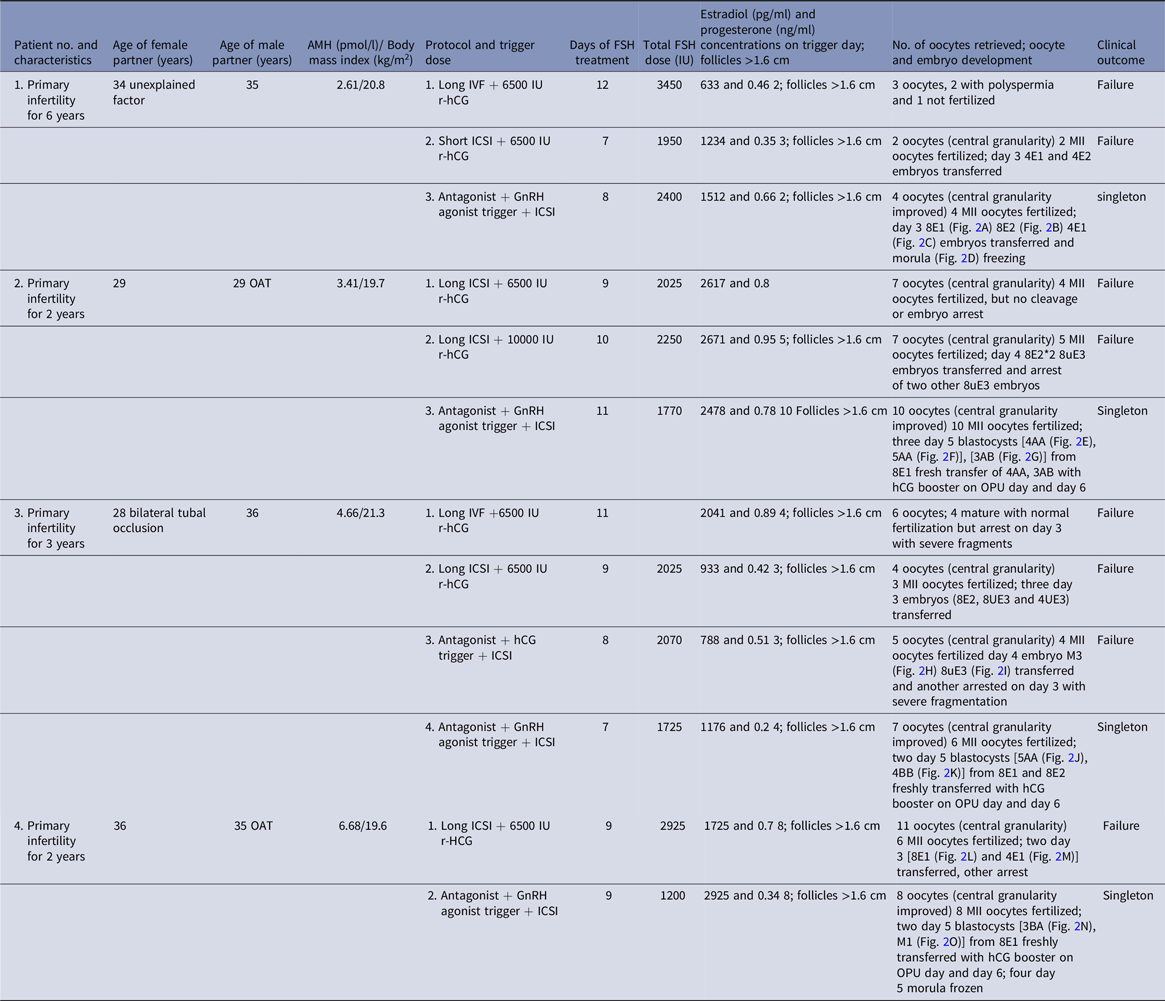
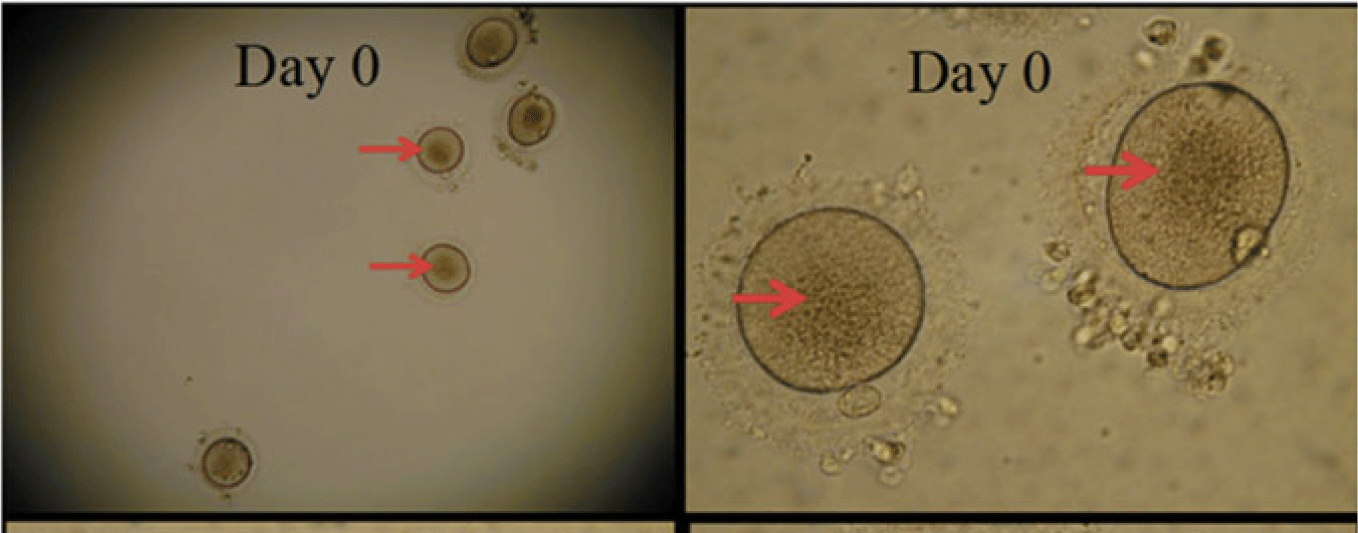
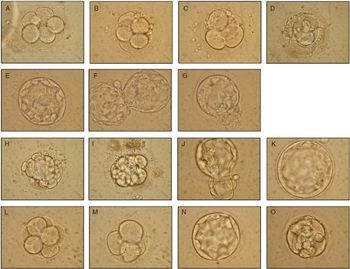
Demographic and clinical characteristics of the four patients in this case series with CCG of the oocytes, ranging in age from 28–34 years, are summarized in Table 1 and Figs 1 and 2.
Demographic and clinical characteristics of the four patients with central cytoplasmic granulation of the oocytes

AMH, anti-Müllerian hormone; MII, metaphase II; r-hCG, recombinat human chorionic gonadotropin; OAT, oligo-astheno-teratospermia; OPU, oocyte pick up.
Oocyte with excessive granularity concentrated (arrows) observed by light microscopy (magnification: left, ×40; right, ×200).

Embryo morphology on transfer day in four patients (magnification: ×400). Patient 1 (A) 8E1, (B) 8E2, (C) 4E1, (D) M2. Patient 2 (E) 4AA, (F) 5AA, (G) 3AB. Patient 3 (H) M3, (I) 8uE3, (J) 5AA, (K) 4BB. Patient 4 (L) 8E1, (M) 4E1, (N) 3BA, (O) M1. Morula 1 (M1) was defined as a top-quality morula, with >90% of its cell mass compacted and <10% fragmentation. M2 has 70–90% compaction and 10–30% fragmentation, and M3 has 50–70% compaction and >30% fragmentation.

Initial IVF/ICSI treatment: GnRH agonist protocol with hCG trigger
Patients 1 and 3 initially underwent IVF with normal sperm from their husbands, whereas patients 2 and 4 initially underwent ICSI using oligo-astheno-teratospermia sperm from their husbands. Patient 1 showed slow follicular growth under controlled ovarian hyperstimulation and low oocyte production, even with a normal ovarian reserve marker. Patients 1–3 lacked day 3 available embryos, whereas patient 4 had lower available embryos. All four patients failed initial ICSI and were diagnosed with CCG of the oocytes (Fig. 1). The four patients underwent ICSI using the GnRH agonist protocol with an hCG trigger, but the embryos were of poor quality in general. Patient 3 using the antagonist protocol with an hCG trigger failed again due to still poor embryo quality.
Successful ICSI treatment: GnRH antagonist protocol with GnRHa trigger
Treatment strategy was subsequent altered in all four patients. Finally, the agonist protocol using hCG to trigger ovulation was replaced in all four patients by an antagonist protocol using GnRH agonist as a trigger. This protocol resulted in improved ooplasm and embryo quality in all four patients. All four patients became pregnant and gave birth to live infants. As of this writing, all four children have shown normal clinical development.
Discussion
The optimal protocol for women undergoing IVF remains widely debated in the literature (Al-Inany et al., Reference Al-Inany, Youssef, Ayeleke, Brown, Lam and Broekmans2016; Engmann et al., Reference Engmann, Benadiva and Humaidan2016; Pacchiarotti et al., Reference Pacchiarotti, Selman, Valeri, Napoletano, Sbracia, Antonini, Biagiotti and Pacchiarotti2016). Although the long GnRH agonist regimen is one of the oldest and most commonly used protocols to suppress ovulation and luteinization, this type of protocol requires a longer course of ovarian stimulation, usually accompanied by high doses of exogenous gonadotropin. The benefits of GnRH antagonists include shorter stimulation times, requirements for lower gonadotropin dosages, reduced patient costs, and shorter downtimes between consecutive cycles, as well as the ability to assess ovarian reserve immediately prior to stimulation (Engmann et al., Reference Engmann, Benadiva and Humaidan2016). Although it is still accompanied by some disadvantages, GnRH antagonists protocol have become well accepted in clinical ‘patient friendly’ practice (Reh et al., Reference Reh, Krey and Noyes2010).
Although GnRH receptors are expressed on human ovaries, the effects of GnRH agonists and antagonists on ovaries, as well as on oocyte morphology and quality, remain unclear (Cota et al., Reference Cota, Oliveira, Petersen, Mauri, Massaro, Silva, Nicoletti, Cavagna, Baruffi and Franco2012). Moreover, little information is known about the extremely complex process that generates a developmentally competent oocyte. During folliculogenesis and oogenesis, the oocyte is surrounded by granulosa cells. The two cell types communicate bidirectionally through the secretion of steroid hormones and paracrine factors (Kidder and Vanderhyden, Reference Kidder and Vanderhyden2010). This communication plays a key role in folliculogenesis and is essential for an oocyte to achieve fertilization and undergo embryogenesis (Matzuk et al., Reference Matzuk, Burns, Viveiros and Eppig2002). Simultaneously, however, intrafollicular and/or extrafollicular effects may disturb oocyte maturation, leading to immaturity and aneuploidy (Plachot, Reference Plachot2001). Therefore, oocyte meiosis is very sensitive to endogenous and exogenous factors. This finding may result in the generation of oocytes with chromosomal abnormalities and, therefore, abnormal zygotes.
Gonadotrophin-releasing hormone receptors are found in the luteal and granulosa cells of the antral follicles, but not in primordial and pre-antral follicles (Brus et al., Reference Brus, Lambalk, de Koning, Helder, Janssens and Schoemaker1997; Cheung and Wong, Reference Cheung and Wong2008). The correlation between expression of GnRH receptors and the stage of follicular development suggested that GnRH directly affects folliculogenesis and oocyte development. To date, however, few studies have assessed the possible effects of GnRH analogues on oocyte phenotype (Otsuki et al., Reference Otsuki, Okada, Morimoto, Nagai and Kubo2004; Rienzi et al., Reference Rienzi, Ubaldi, Iacobelli, Minasi, Romano, Ferrero, Sapienza, Baroni, Litwicka and Greco2008; Murber et al., Reference Murber, Fancsovits, Ledo, Gilan, Rigo and Urbancsek2009; Cota et al., Reference Cota, Oliveira, Petersen, Mauri, Massaro, Silva, Nicoletti, Cavagna, Baruffi and Franco2012), and these studies have yielded contradictory results. For example, one randomized study showed no difference in oocyte morphologic quality between the antagonist multidose protocol and the long-term agonist protocol (Cota et al., Reference Cota, Oliveira, Petersen, Mauri, Massaro, Silva, Nicoletti, Cavagna, Baruffi and Franco2012). Moreover, the prevalence of oocyte dysmorphisms was similar when GnRH agonists and antagonists were used for pituitary suppression in IVF cycles (Cota et al., Reference Cota, Oliveira, Petersen, Mauri, Massaro, Silva, Nicoletti, Cavagna, Baruffi and Franco2012).
The results of our case series showed that use of a GnRH agonist triggers improved outcomes in patients with CCG of the oocytes. For example, in patient 3 using the antagonist protocol, the switch from an hCG trigger to a GnRH agonist trigger improved outcomes. GnRH agonist triggering is more physiological, resembling the natural mid-cycle surge of gonadotrophins, without the prolonged action of hCG, resulting in luteal phase steroid levels closer to those of the natural cycle and retrieval of more mature oocytes than observed with hCG triggering (Imoedemhe et al., Reference Imoedemhe, Sigue, Pacpaco and Olazo1991; Humaidan et al., Reference Humaidan, Kol, Papanikolaou and Copenhagen Gn2011).
Another possible advantage of GnRH triggering over hCG triggering of final oocyte maturation is the simultaneous induction of an FSH surge, comparable with the surge of the natural cycle (Dosouto et al., Reference Dosouto, Haahr and Humaidan2017). Although the role of this mid-cycle FSH surge remains incompletely understood, FSH has been shown to induce LH receptor formation in luteinizing granulosa cells, optimizing the function of the corpus luteum (Zeleznik et al., Reference Zeleznik, Schuler and Reichert1981). Moreover, FSH has been reported to specifically promote oocyte nuclear maturation, including the resumption of meiosis (Zelinski-Wooten et al., Reference Zelinski-Wooten, Hutchison, Hess, Wolf and Stouffer1995; Yding Andersen et al., Reference Yding Andersen, Leonardsen, Ulloa-Aguirre, Barrios-De-Tomasi, Moore and Byskov1999) and cumulus expansion (Strickland and Beers, Reference Strickland and Beers1976; Eppig, Reference Eppig1979).
This study had several limitations, especially including those associated with a small patient sample. However, oocyte CCG is a rare morphological phenomenon. The use of GnRH agonist triggering in the GnRH antagonist protocol and luteal phase insufficiency may also constitute limitations (Fauser et al., Reference Fauser, de Jong, Olivennes, Wramsby, Tay, Itskovitz-Eldor and van Hooren2002; Casper, Reference Casper2015). All of our patients were administered booster hCG on the day of oocyte retrieval for luteal phase support.
In conclusion, an antagonist protocol with a GnRH agonist trigger may improve ooplasm granularity and embryo quality. Additional studies, including a larger number of patients, are required for further confirmation. Our findings present a novel alternative protocol for overcoming oocyte CCG.
Consent for publication
Informed written consent was also taken from the four patients for presentation of the case series.
Availability of data and material
The datasets during the current study are available from the corresponding author upon reasonable request.
Competing interests
The authors declare that they have no competing interests.
Acknowledgements
We thank all the patients for participating in the study.
Authors’ contributions
KCL and YCC carried out project development, data collection, and manuscript writing. YCL was the laboratory procedures coordinator. YRT performed data analysis; All authors read and approved the final manuscript.
Financial support
This study was supported by CMRPG8G0071-73 from the Chang Gung Memorial Hospital.
Ethics approval
Approval was obtained from the Institutional Ethics Board (CGMH201701639B0) for publishing this case series.