Introduction
There has been a paradigm shift in the management of locoregionally advanced laryngopharyngeal cancers towards non-surgical treatment over the last two decades based on the findings of two pivotal trials. 1 , Reference Forastiere, Goepfert, Maor, Pajak, Weber and Morrison 2 This has led to an increased number of salvage laryngectomies. It is well established that post-operative complications are higher in post-radiotherapy or post-chemoradiotherapy settings.Reference Sassler, Esclamado and Wolf 3 , Reference Johansen, Overgaard and Elbrønd 4 The incidence of pharyngocutaneous fistulae could be as high as 14–57 per cent following salvage laryngectomy, as opposed to 9–25 per cent in the primary setting.Reference Papazoglou, Doundoulakis, Terzakis and Dokianakis 5 – Reference Qureshi, Chaturvedi, Pai, Chaukar, Deshpande and Pathak 10 An intuitively attractive option is to introduce non-irradiated, vascularised tissue into the irradiated bed. Of the various methods described, the pectoralis major myofascial flap is the most common and widely accepted.Reference Paleri, Drinnan, van den Brekel, Hinni, Bradley and Wolf 11 Opinions in the literature are divided whether it has a definite role in salvage settings. This study aimed to review fistula rates in patients undergoing salvage laryngectomy and to assess the impact of onlay vascularised flap use in reducing its frequency and severity.
Materials and methods
A retrospective analysis of patients who underwent salvage total laryngectomy between January 1999 and December 2014 was performed. Patients for whom primary pharyngeal closure was not possible and those who required pharyngeal mucosa augmentation were excluded. The study comprised 172 patients who underwent primary pharyngeal closure in two groups: a primary closure group (110 patients) and an onlay pectoralis major muscle flap group (onlay flap group; 62 patients). Thirteen patients requiring spiral pectoralis major myocutaneous flaps were included in the onlay flap group.
Patient data were extracted from the Hospital Information System and electronic medical records, a comprehensive synoptic electronic database maintained by clinicians in the multidisciplinary treatment team and updated at each follow up, thus ensuring effective, correct data capture. Demographic, clinical, biochemical, surgical and histological data, and post-operative complication details were obtained. The time to development and duration of fistula, length of hospital stay, and re-hospitalisation rates were recorded.
Surgical technique
Standard salvage total laryngectomy with primary pharyngeal closure was performed as previously described.Reference Dudley, Carter, Russel, McGregor and Howard 12 The decision to use a pectoralis major myofascial flap was made by the operating surgeon. For this procedure, the pectoralis major muscle was harvested without a skin paddle, and fascia over the muscle was kept intact. The flap was delivered into the neck through a tunnel below the skin and used to buttress the suture line. The flap was anchored to the base tongue superiorly and to the pre-vertebral fascia medial to carotid artery on both sides.
A total of 156 patients had a Provox voice prosthesis (Atos Medical, Horby, Malmö, Sweden) inserted. The procedure was not carried out in 16 patients for various reasons such as financial issues or poor local tissue condition.
Statistical analysis
Statistical analysis was performed using IBM SPSS Statistics software version 20.0 (Armonk, New York, USA). Chi-squared and Fischer's exact test were used in univariable analyses. Cox regression analysis using the binary logistic forward regression method was used for multivariable analyses. Unpaired Student's t-tests were used to compare the means of fistula duration between groups.
Results
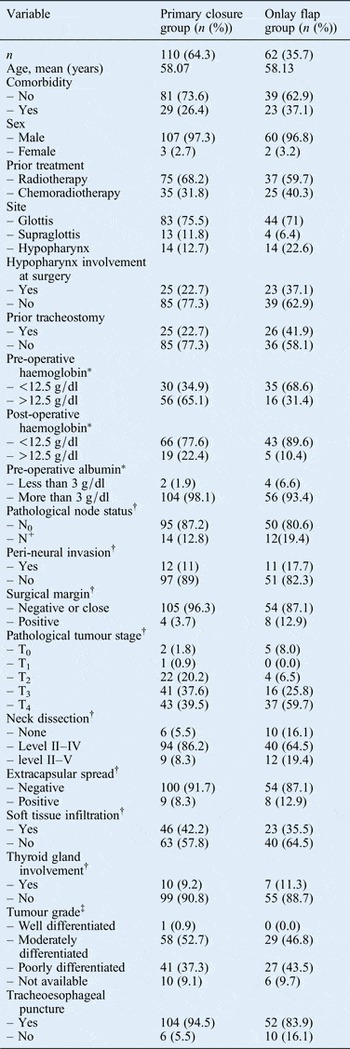
The median patient age was 58 years (range 30–89 years) and most patients (97.1 per cent) were men. In all, 127 patients (73.8 per cent) had glottic cancers, 17 (9.9 per cent) had supraglottic cancers and 28 (16.3 per cent) had hypopharyngeal cancers. Data on pre-treatment staging were not available for 12 patients because they received primary treatment elsewhere. Of the remaining 160 patients, 99 (61.8 per cent) had tumour–node–metastasis stage T1–2 tumours, 58 (36.3 per cent) had T3 tumours and 3 (1.9 per cent) had stage T4 tumours. A total of 112 patients (65.1 per cent) had received prior radiotherapy and 60 (34.9 per cent) had received chemoradiotherapy. The suture line was reinforced in 62 patients. Compared with the primary closure group, a higher proportion of patients in the onlay flap group had hypopharynx involvement (22.7 per cent vs 37.1 per cent), a higher prior tracheostomy rate (22.7 per cent vs 41.9 per cent), more pathologically staged T4 disease (39.5 per cent vs 59.7 per cent), more patients with pre-operative haemoglobin levels of less than 12.5 g/dl (34.9 per cent vs 68.6 per cent), more positive tumour margins (3.7 per cent vs 12.9 per cent) and more patients who underwent extended neck dissection (8.3 per cent vs 19.4 per cent). Fewer patients in the onlay flap group had a tracheoesophageal puncture (94.5 per cent vs 83.9 per cent). All other variables were equally distributed between groups (Table I).
Patient details

*Data missing for some patients. †Data missing for one patient. ‡No residual tumour in seven patients, tumour grade not mentioned for eight patients and data missing for one patient
Pharyngocutaneous fistulae
A total of 74 patients developed pharyngocutaneous fistulae, corresponding to an overall fistula rate of 43 per cent: 48 patients (43.6 per cent) in the primary closure group and 26 patients (41.9 per cent) in the onlay flap group. The difference was not statistically significant (p = 0.8). Sixty-five fistulae (87.8 per cent) healed with conservative management. Nine patients (12.2 per cent) required surgical exploration: seven from the primary closure group (6.3 per cent) and two from the onlay flap group (3.2 per cent). Although the primary closure group had a higher incidence of fistulae requiring surgical intervention (6.3 per cent vs 3.2 per cent), the difference was not statistically significant (p = 0.48).
The time to fistula manifestation was similar for both study groups. The median and meantime to fistula formation was 15.0 days and 18.8 days, respectively, in the primary closure group, and 15.5 days and 16.9 days, respectively, in the onlay flap group (p = 0.5, 95 per cent confidence interval (CI), 4.281 to 8.076).
The median and mean fistula duration were 37 and 55 days, respectively, in the primary closure group and 20 and 25 days, respectively, in the onlay flap group. Thus, fistulae took longer to heal in the primary closure group than in the onlay flap group; this difference was statistically significant (p = 0.008, 95 per cent CI, 8.059 to 52.016).
The mean hospital stay was longer for patients with a fistula than those without (18.8 days vs 10.5 days, p = 0.001, 95 per cent CI, 5.26 to 11.29). However, the length of hospital stay was similar for both the primary closure and onlay flap groups (19.56 days vs 17.38 days, p = 0.52; 95 per cent CI, 8.9 to 4.6). The rates of re-hospitalisation did not differ between groups (37.5 per cent vs 34.6 per cent, p = 0.8).
Voice outcome
Data on physician's opinions of voice outcome were retrieved from the hospital electronic medical records. The voice was considered satisfactory in 150 patients (96.2 per cent) over a mean follow-up period of 34 months. Similar voice outcomes were obtained for both the groups.
Discussion
The incidence and severity of pharyngocutaneous fistula are higher in patients who have received prior radiotherapy. Radiotherapy-induced tissue damage in the form of tissue fibrosis and obliterative endarteritis may therefore be an important contributory factor.Reference Teknos and Myers 13 Pharyngocutaneous fistula is a common complication of laryngectomy, causing considerable post-operative morbidity. It increases the length of hospital stay, delays oral feeding and may lead to serious vascular complications. In the long term, it may lead to an increased incidence of pharyngeal stenosis that affects swallowing and the voice. Over the years, the focus of research has been to provide a suitable surgical solution to this morbidity. The use of vascularised tissue flaps appears a logical method to reduce fistula rates in post-irradiated patients. Flaps can be either interpositional or onlay (i.e. over the suture line). Interpositional flaps are usually used to augment inadequate pharyngeal mucosa. The use of free flaps (interpositional and onlay) has been shown to decrease the incidence or severity of fistula.Reference Withrow, Rosenthal, Gourin, Peters, Magnuson and Terris 14 – Reference Higgins, Ashford, Erovic, Yoo and Enepekides 16 Although free flaps provide vascularised tissue, they require surgical expertise, a compatible infrastructure, prolonged surgery, and special monitoring of flap; they also carry a risk of flap failure. The sternocleidomastoid muscle or infrahyoid musculature is within the radiation field, which precludes their use in local flaps.Reference Albirmawy 17 , Reference Kadota, Fukushima, Kamizono, Masuda, Tanaka and Yoshida 18
-
• The pectoralis major myofascial flap is commonly used to reduce fistula rates in salvage settings
-
• Evidence for its efficacy comes from retrospective studies
-
• In this study, it did not reduce fistula incidence, promoted faster healing and prevented major complications
-
• Its drawbacks are shoulder dysfunction, an unsightly appearance at the neck and possible long-term complications
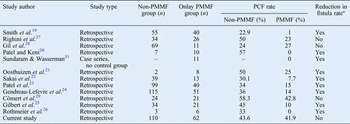
Use of a pectoralis major myofascial flap as an onlay flap over the suture line is the most widely accepted option. Advantages of this technique are the ease of flap harvest and the ability to be performed simultaneously with primary closure of the pharynx, thus reducing the overall surgery time. Initial reports generated great enthusiasm due to the considerable decrease in fistula rates.Reference Smith, Burrage, Ganguly, Kirby and Drover 19 , Reference Patel and Keni 20 Patel and Keni reported no fistula formation with the use of a pectoralis major myofascial flap in a series of 10 patients.Reference Patel and Keni 20 Various studies subsequently reported significant reductions in fistula rates.Reference Oosthuizen, Leonard and Kinsella 21 – Reference Rothmeier, Bergmann, Mattheis, Weller and Lang 26 Righini et al. reported a reduction in fistula rates from 50 per cent to 23 per cent with the use of pectoralis myofascial flaps compared with the no flap group, although the difference was not significant.Reference Righini, Lequeux, Cuisnier, Morel and Reyt 27 A few of the others failed to show a reduction in fistula rates (Table II).Reference Gil, Gupta, Kummer, Cordeiro, Kraus and Shah 28 , Reference Cömert, Tunçel, Torun, Kiliç, Cengiz and Sencan 29 The present study, which is one of the largest, also did not show a significant difference in fistula rate between groups (43.6 per cent in the primary closure group vs 41.9 per cent in the onlay flap group). However, more patients in the onlay flap group had known risk factors for fistula formation such as low pre-operative haemoglobin levels, prior tracheostomy, T4 tumours, positive tumour margins and hypopharyngeal involvement. Thus, despite including more at-risk patients, the fistula rate was not higher in the onlay flap group than in the control group. This could be considered indirect evidence to support the use of onlay flap in salvage settings. Patients in the onlay flap group healed faster, leading to early fistula closure. Fistula severity was also reduced in the onlay flap group, although the difference was not significant, probably due to a low incidence of major fistula (nine patients). This important endpoint has also been reported in other studies.Reference Gil, Gupta, Kummer, Cordeiro, Kraus and Shah 28 , Reference Cömert, Tunçel, Torun, Kiliç, Cengiz and Sencan 29 The increased bulk provided by the onlay flap may theoretically decrease vibrations of pharyngoesophageal segment, thus affecting voice outcomes. In the present study, all but one patient in the onlay flap group had satisfactory voice outcomes. This finding is in accordance with the results of Fung et al., who found that onlay free flaps caused no deterioration in speech.Reference Fung, Teknos, Vandenberg, Lyden, Bradford and Hogikyan 15 Two published systemic reviews favour the use of onlay flaps in salvage laryngectomy.Reference Paleri, Drinnan, van den Brekel, Hinni, Bradley and Wolf 11 , Reference Sayles and Grant 30 However, they included only retrospective studies, most had small patient numbers and there was significant asymmetry between studies. One review found onlay flaps to be beneficial following chemoradiotherapy; however, the benefit was smaller in the radiotherapy-alone group, and authors doubted the benefit of flap use in this group.Reference Sayles and Grant 30 Besides, use of the pectoralis major myofascial flap has its own drawbacks: it may lead to the development of long-term disabling complications such as dysphagia, and may be associated with an unsightly appearance at the neck, shoulder dysfunction, local discomfort, additional surgical costs (due to an additional procedure) and problems related to tracheoesophageal puncture such as prosthesis migration and peri-prosthetic granulations.
Onlay PMMF and their outcomes: published studies

*Statistically significant. PMMF = pectoralis major myofascial flap; PCF = pharyngocutaneous fistula
Limitations of the study
A weakness of this study was its retrospective nature, similar to all other previously published studies on the subject. There may be selection bias because objective criteria were not used when deciding on the use of the pectoralis major myofascial flap. The decision was made by the operating surgeon, and it is likely that the surgeon used an onlay flap for patients with a severe reaction to radiotherapy, and a primary closure used to close healthier looking tissues. In this study, time to oral feeding and nasogastric tube duration between the onlay flap and primary closure groups could not be compared because these data were not always recorded. This is attributable to the retrospective design of the study. In addition, the impact of pectoralis major myofascial flap on shoulder dysfunction was not analysed, and this should be explored in future studies.
Conclusion
The onlay pectoralis major myofascial flap technique is a useful adjunct for improving the outcome of salvage laryngectomy. It promotes faster healing of fistula and prevents major complications. Although many studies have also found it useful for reducing the fistula rate, it should be remembered that all of the published evidence comes from retrospective studies. Recommendations for its routine use in salvage settings should be based on level I evidence. A well-designed randomised-controlled trial to eliminate confounding factors is therefore required to establish its usefulness in salvage settings.