




No CrossRef data available.
Article contents
Normative seeds for deadly martyrdoms
Published online by Cambridge University Press: 27 August 2014
Abstract
Even if Lankford's biographical examination of perpetrators of suicidal attacks serves to alert us on the role played by individual factors in their recruitment, psychological frailties, distress, or coercion do not exhaust the causal pathways to deadly martyrdom. Normative personality attributes must be explored further in order to ascertain plausible roots of murderous sacrifice. We have advanced (Tobeña 2004b; 2009; 2011) a template of normative temperamental traits that could lead activists to the threshold of volunteering for murderous missions.
Information
- Type
- Open Peer Commentary
- Information
- Copyright
- Copyright © Cambridge University Press 2014
Footnotes
1. A note on Madrid 11-M (2004) suicidal “escapists”:;>Lankford uses the Madrid, March 11th, 2004 suburban train bombings (resulting in 199 deaths and 1,000 wounded) in his discussion of “escapist” suicidal attacks as a nodal instance of this “type” of murderous suicide. Those bombings, performed by a self-organized jihadist clique helped by local delinquents (Rodriguez Reference Rodriguez2004), are usually excluded from worldwide records of suicide attacks because the perpetrators left the explosive backpacks on the trains and ran. They continued afterwards with their normal lives and occupations for several weeks, to the point of celebrating feasts with their families, over the weekends, at the rural hut where the bombing logistics had been laid out. The terrorist cell, however, had a further agenda of a series of actions with the aim (recorded on videos) of changing Spain's alignment as a United States ally in Iraq's war, and with suicide as an option: three weeks and a half later, seven members blew themselves up, killing one officer and destroying a residential condominium when they were surrounded by police. Those who escaped the ambush blew themselves up later in Iraq (Atran Reference Atran2010a; Rodriguez Reference Rodriguez2004). Lankford uses a cherry-picking approach which pervades his entire research, selecting notes and traces left by three members of the band who might conform, perhaps, to the picture of “troubled,” “marginal,” or “tumultuous” jihadists ready to use suicide as a “glorious” escape when the enemy arrives, but he excludes the rich biographies and whereabouts data of other, prominent members of that cell who do not conform, at all, with such a portrait (http://www.elmundo.es/documentos/2004/03/espana/atentados11m/index.html, Atran Reference Atran2010a).
References
American Psychiatry Association. (2000) Diagnostic and statistical manual of mental disorders (DSM-IV). Fourth Text Revision. American Psychiatry Association.Google Scholar
Atran, S. (2003) Genesis of suicide terrorism. Science
299:1534–39. Available at: http://www.sciencemag.org/content/299/5612/1534.full.CrossRefGoogle Scholar
Atran, S. (2010a) Talking to the enemy: Faith, brotherhood, and the (un)making of terrorists. ECCO/HarperCollins.Google Scholar
Baumgartner, T. H., Götte, L., Gügler, R. & Fher, E. (2012) The mentalizing network orchestrates the impact of parochial altruism on social norm enforcement. Human Brain Mapping
33:1452–69.Google Scholar
Benmelech, E., Berrabi, C. & Klor, E. F. (2012) Economic conditions and the quality of suicide terrorism. The Journal of Politics
74(1):113–28.CrossRefGoogle Scholar
Bereczkei, T., Deak, A., Papp, A., Perlaki, G. & Ors, G. (2013) Neural correlates of Machiavellian strategies is a social dilemma task. Brain and Cognition
82(1):108–16.Google Scholar
Berman, E. (2009) Radical, religious and violent: The new economics of terrorism. MIT Press.CrossRefGoogle Scholar
Bernhard, H., Fischbacher, U. & Fehr, E. (2006) Parochial altruism in humans. Nature
442:912–15.Google Scholar
Bruneau, E., Dufour, N. & Saxe, R. (2012) Social cognition in members of conflict groups: Behavioural and neural responses in Arabs, Israelis and South Americans to each other's misfortunes. Philosophical Transactions of the Royal Society B
367(1589):717–30.CrossRefGoogle ScholarPubMed
Choi, J. K. & Bowles, S. (2007) The coevolution of parochial altruism and war. Science
318:636–40.Google Scholar
De Dreu, C. K., Greer, L. J., Handgraaf, M. J. J., Shalvi, S., Van Kleef, G. A., Baas, M., Velden, F. S. T., Van Dijk, E. & Feith, S. W. W. (2010) The neuropeptide oxytocin regulates parochial altruism in intergroup conflict among humans. Science
328:1408–11.CrossRefGoogle ScholarPubMed
De Dreu, C. K., Greer, L. L., Van Kleef, G. A., Shalvi, S. & Handgraaf, M. J. (2011) Oxytocin promotes human ethnocentrism. Proceedings of the National Academy of Sciences USA
108(4):1262–66.Google Scholar
De Neve, J. E., Mikhaylov, S., Dawes, C. T., Christakis, N. A. & Fowler, J. H. (2013) Born to lead? A twin design and genetic association study of leadership role occupancy. Leadership Quarterly
24(1):45–60.CrossRefGoogle ScholarPubMed
Ebstein, R.P., Israel, S., Lerer, E., Uzefovsky, F., Shalev, I., Gritsenko, I., Riebold, M., Salomon, S. & Yirmiya, N. (2009) Arginin vasopressin and oxytocin modulate human social behavior. In: Values, empathy and fairness across social barriers. Annals of the New York Academy of Sciences, vol. 1167, ed. Atran, S., Navarro, A., Ochsner, K., Tobeña, A. & Vilarroya, O., pp. 87–102. The New York Academy of Sciences.Google Scholar
Gill, P. (2012) Terrorist violence and the contextual, facilitative and causal qualities of group-based behaviors. Aggression and Violent Behavior
17:565–74.Google Scholar
Ginges, J. & Atran, S. (2009) What motivates participation in violent political actions: Selective incentives or parochial altruism? In: Values, empathy and fairness across social barriers. Annals of the New York Academy of Sciences, vol. 1167, ed. Atran, S., Navarro, A., Ochsner, K., Tobeña, A. & Vilarroya, O., pp. 115–23. The New York Academy of Sciences.Google Scholar
Hatemi, P. K. & McDermott, R. (2012) The genetics of politics: Discovery, challenges, and progress. Trends in Genetics
10:525–33.Google Scholar
Knafo, A., Israel, S., Darvasi, A., Bachner-Melman, R., Uzefowski, F., Cohen, L., Feldman, E., Lerer, E., Laiba, E., Raz, Y., Nemanov, L., Gritsenko, I., Dina, C., Agam, G., Dean, B., Bornstein, G. & Ebstein, R. P. (2008) Individual differences in allocation of funds in the dictator game associated with length of arginin vasopressin 1a receptor RS3 promoter region and correlation of RS3 and hippocampal mRNA. Genes Brain and Behavior
7(3):266–75.Google Scholar
Lankford, A. (2013c) The myth of martyrdom: What really drives suicide bombers, rampage shooter, and other self-destructive killers. Palgrave Macmillan.Google Scholar
Merari, A., Diamant, I., Bibi, A., Broshi, Y. & Zakin, G. (2010) Personality characteristics of “self martyrs”/“suicide bombers” and organizers of suicide attacks. Terrorism and Political Violence
22(1):87–101.Google Scholar
Mertins, V., Schte, A.B., Hoffeld, W., Griessmair, M. & Meyer, J. (2013) Genetic susceptibility for individual cooperation preferences: The role of monoamino oxidase A gene in the voluntary provision of public goods. PLoS One
6(6):e20959.Google Scholar
Morishima, Y., Schunk, D., Bruhin, A., Ruff, C. & Fher, E. (2012) Linking brain structure and activation in temporoparietal junction to explain the neurobiology of human altruism. Neuron
75:73–79.Google Scholar
Pape, R. A. (2005) Dying to win: The strategic logic of suicide terrorism. Random House.Google Scholar
Piazza, J. A. (2008) A supply-side view of suicide terrorism: A cross-national study. Journal of Politics
70(1):28–39.CrossRefGoogle Scholar
Reuter, M., Frenzel, C., Walter, N. T., Markett, S. & Montague, C. (2011) Investigating the genetic basis of altruism: The role of the COMT Val158Met polymorphism. Social Cognitive and Affective Neuroscience
6:662–68.CrossRefGoogle ScholarPubMed
Rodriguez, J. A. (2004) La red terrorista del 11-M. Revista Española de Investigaciones. Sociológicas
107:155–79.Google Scholar
Settle, J. E., Dawes, C. T. & Fowles, J. H. (2009) The heritability of partisan attachment. Political Research Quarterly
63(3):601–13.Google Scholar
Takahashi, H., Takano, H., Camerer, C. F., Ideno, T., Okubo, S., Matsui, H., Tamari, Y., Takemura, K., Arakawa, R., Kodak, F., Yamada, M., Eguchi, Y., Murai, T., Okubo, Y., Kato, M., Ito, H. & Suhara, T. (2012) Honesty mediates the relationship between serotonin and reaction to unfairness. Proceedings of the National Academy of Sciences USA
109(11):4281–84.Google Scholar
Tobeña, A. (2004a) Individual factors in suicide terrorism. Science
304(5667):47–49.CrossRefGoogle ScholarPubMed
Tobeña, A. (2004b) Mártires mortíferos: Biología del altruismo letal [Deadly martyrs: The biology of lethal altruism]. PUV-Bromera.Google Scholar
Tobeña, A. (2009) Lethal altruists: Itineraires along the dark outskirts of moralistic prosociality. In: Values, empathy and fairness across social barriers. Annals of the New York Academy of Sciences, vol. 1167, ed. Atran, S., Navarro, A., Ochsner, K., Tobeña, A. & Vilarroya, O., pp. 5–15. The New York Academy of Sciences.Google Scholar
Tobeña, A. (2011) Suicide attack martyrdoms: Temperament and mindset of altruistic warriors. In: Pathological altruism, ed. Oakley, B., Knafo, A., Madhavan, G. & Wilson, D.S., pp. 207–44. Oxford University Press.Google Scholar
Van Vugt, M. (2009) Sex differences in intergroup competition, aggression and warfare: The male warrior hypothesis. In: Values, empathy and fairness across social barriers. Annals of the New York Academy of Sciences, vol. 1167, ed. Atran, S., Navarro, A., Ochsner, K., Tobeña, A. & Vilarroya, O., pp. 124–34. The New York Academy of Sciences.Google Scholar
Van Vugt, M., Hogan, R. & Kaiser, R. B. (2008) Leadership, followership and evolution: Some lessons from the past. American Psychologist
63(3):182–96.CrossRefGoogle ScholarPubMed
Victoroff, J., Quota, S., Adelman, J. R., Celinska, B., Stern, N., Wilcox, R. & Sapolsky, R. (2011) Support for religio-political aggression among teenaged boys in Gaza: Part II. Neuroendocrinological findings. Aggressive Behavior
37:121–32.CrossRefGoogle Scholar
Wilson, D. S., Near, D. & Miller, R. R. (1996) Machiavellianism: A synthesis of the evolutionary and psychological literature. Psychological Bulletin
119(2):285–99.CrossRefGoogle Scholar
Wrangham, R. W., Wilson, M. L. & Muller, N. M. (2006) Comparative rates of violence in chimpanzees and humans. Primates
47:14–26.Google Scholar
Zhong, S., Israel, S., Shalev, I., Xue, H., Ebstein, R. P. & Hong Chew, S. (2010) Dopamine D4 receptor gene associated with fairness preference in ultimatum game. PLoS One
5(11):e13765.Google Scholar
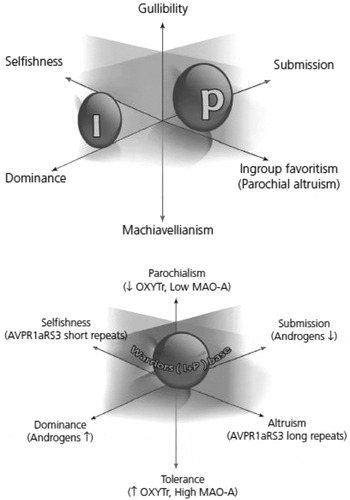
Figure 1 A temperamental workspace to distinguish warriors' proneness to martyrdom. Top: Hypothetical space for agonistic clusters defining combative activists across three temperamental traits: dominance–submission, Machiavellianism–gullibility, and selfishness–altruism. Bottom: Neurohormonal and genetic polymorphisms that may foster temperamental attributes encompassing distinctive clusters of warriors. Relative distributions along these biological traits would distinguish between generous warriors (P) and selfish warriors (l) who put themselves near or far away, respectively, from the high-risk/martyrdom frontier.I = inducer; P = performer; OXYTr = oxytocin receptor; MAO-A = monoamine oxidase A; AVPr = vasopressin receptor variants. Arrows denote activity.From Tobeña, A. (2004b). Mártires mortíferos: Biologia del altruismo letal. Valencia (Spain): PUV-Bromera Ed., with permission of the publisher.
By accruing traces of psychological frailties in suicidal attackers through their diaries, manifestos, or recollections, in The Myth of Martyrdom Lankford has uncovered 130 cases that may fulfill criteria of “conventional suicide” due to mental problems, bereavement after significant losses, and other personal crises (Lankford Reference Lankford2013c). That figure is not compelling as a base rate from a worldwide total of around 3,000 of these attacks, over the last two decades (wits.nctc.gov/reports/analytical). The shortcomings of retrospective enquiries to uncover psychopathology are a weakness that also affects the detailed “psychological autopsies” of prominent attackers such as Mohamed Atta, which Lankford performs by applying DSM IV criteria (American Psychiatry Association 2000) on similar inputs. He compares the profiles of perpetrators in all attacks categorized as “suicidal” on U.S. homeland between 1990–2010, including terrorist actions and rampage, and school/workplace shooters who killed many bystanders before killing themselves or sought to be terminated (“suicide by cop”). There are parallels as well as discrepancies among the profiles, but oddities of the grouping criteria preclude any conclusion. The exceptionality and peculiarities of these “domestic” terrorist acts makes them an implausible model for sustained campaigns of suicidal missions at “hot spots” across the world.
Despite these shortcomings, Lankford warns that psychological disturbances, deep crises, and glory-craving or self-deprecating traits should be scanned as potential factors in some suicidal attacks. The fraction of attackers with such traits, however, remains not fully known, and, anyhow, erasing the notion of altruistic martyrdom is unjustified. We think that attributes within the normal tapestry of human character must be explored to ascertain the roots of exceptional acts of murderous sacrifice in war. Most suicidal attacks occur within the context of insurgency campaigns during transnational or local confrontations. After dissection of incidents, consequences, and chronological trends across regions and organizations, there is still no firm explanation for the willingness to engage in suicide missions (Gambetta Reference Gambetta2006; Gill Reference Gill2012; Pape Reference Pape2005), though observed regularities permit a swift tactical depiction: Suicide attacks are a cost-effective weapon for insurgents in asymmetrical contests, if a suitable recruitment line is fostered and defection rates are low (Berman Reference Berman2009; Piazza Reference Piazza2008). Waves of suicidal launchings have appeared and disappeared in recent times, with no clear answers regarding why they have arisen at particular points and why some individuals are eager to abruptly put an end to their future. The requirement of their mission (death by exploding themselves, as weapon carriers) imposes a burden only mirrored by “no-escape” lethal missions, in ordinary wars.
Pro-communal altruism to the point of ultimate sacrifice is a trait that appears to operate behind such engagements (Berman Reference Berman2009; Bernhard et al. Reference Bernhard, Fischbacher and Fehr2006; Tobeña Reference Tobeña2004a; Reference Tobeña, Oakley, Knafo, Madhavan and Wilson2011). Combined with parochialism (hostility towards out-groups), it may function as a source of martyrdom candidates from crops of normative people (Choi & Bowles Reference Choi and Bowles2007; Ginges & Atran Reference Ginges, Atran, Atran, Navarro, Ochsner, Tobeña and Vilarroya2009). In this view, a substantial segment of volunteers for murderous martyrdoms would not be unhealthy or tortured “outliers,” but gullible souls with a “beneficent” pro-communal disposition that nevertheless fails to prevent them from turning scores of out-group targets into victims. The strategic goals of rebellion provide the setting in which the personalities of volunteers feeding the pipelines for sacrifice (motivated radicals), need to be differentiated from the attributes of their inducers (commanders, trainers, helpers), because these handlers rarely give their lives for their group.
We have developed a template (Tobeña Reference Tobeña2004b; Reference Tobeña, Atran, Navarro, Ochsner, Tobeña and Vilarroya2009; Reference Tobeña, Oakley, Knafo, Madhavan and Wilson2011) for the normative traits that could lead engaged activists near the threshold for volunteering for murderous missions. Strength of partisanship, degree of fanaticism, intensity of commitment, and vengeful mood are high within rebellious bands, without distinctions between commanders, dispatchers, and operational activists. These attributes respond to indoctrination and tend to be homogenous in tightly knit groups. Temperamental traits can be more closely linked to the different roles that each individual assumes within a bellicose group. Altruistic parochialism seems an essential precondition for lethal violence toward foes, although it cannot be the full story. Such tendency should be analyzed in conjunction with traits fueling the agonistic and high-risk lifestyles led by volunteers entering combative bands pursuing territorial, profit-making feuds or political-religious goals (Tobeña Reference Tobeña2004b). Bold, ambitious, dominant, adventurous, and callous young males form a characteristic cluster of band recruits in both apes and humans (Wrangham et al. Reference Wrangham, Wilson and Muller2006). Combatants in insurgencies and rebellious factions, whether male or female, share these masculine tendencies (Van Vugt Reference Van Vugt, Atran, Navarro, Ochsner, Tobeña and Vilarroya2009). By adding to such agonistic attributes the dimensions of selfishness versus altruistic groupishness and Machiavellianism versus gullibility, distinctions could be drawn between leaders and followers.
Figure 1 depicts a space outlined to distinguish between potential clusters of inducers and perpetrators of murderous martyrdoms. We selected these dimensions because there is a solid tradition of measuring dominance and leadership versus submission/conformity in personality research (De Neve et al. Reference De Neve, Mikhaylov, Dawes, Christakis and Fowler2013; Van Vugt et al. Reference Van Vugt, Hogan and Kaiser2008), as well as the continuum of Machiavellianism versus gullibility/honesty (Bereczkei et al. Reference Bereczkei, Deak, Papp, Perlaki and Ors2013; Takahashi et al. Reference Takahashi, Takano, Camerer, Ideno, Okubo, Matsui, Tamari, Takemura, Arakawa, Kodak, Yamada, Eguchi, Murai, Okubo, Kato, Ito and Suhara2012; Wilson et al. Reference Wilson, Near and Miller1996). Such space is a conjectural frame and other traits such as callousness (vs. empathy), aggressiveness, narcissism, religiosity, or messianism may be required. Neurohormonal signatures or particular genetic markers related to these dimensions (see Fig. 1), should be explored in activists in the same way as has been done in ordinary people and in partisanship preferences (De Dreu et al. Reference De Dreu, Greer, Handgraaf, Shalvi, Van Kleef, Baas, Velden, Van Dijk and Feith2010; Reference De Dreu, Greer, Van Kleef, Shalvi and Handgraaf2011; Ebstein et al. Reference Ebstein, Israel, Lerer, Uzefovsky, Shalev, Gritsenko, Riebold, Salomon, Yirmiya, Atran, Navarro, Ochsner, Tobeña and Vilarroya2009; Hatemi & McDermott Reference Hatemi and McDermott2012; Knafo et al. Reference Knafo, Israel, Darvasi, Bachner-Melman, Uzefowski, Cohen, Feldman, Lerer, Laiba, Raz, Nemanov, Gritsenko, Dina, Agam, Dean, Bornstein and Ebstein2008; Mertins et al. Reference Mertins, Schte, Hoffeld, Griessmair and Meyer2013; Reuter et al. Reference Reuter, Frenzel, Walter, Markett and Montague2011; Settle et al. Reference Settle, Dawes and Fowles2009; Zhong et al. Reference Zhong, Israel, Shalev, Xue, Ebstein and Hong Chew2010). Establishing neuroimaging profiles among the more informative clusters seems also mandatory (Baumgartner et al. Reference Baumgartner, Götte, Gügler and Fher2012; Bruneau et al. Reference Bruneau, Dufour and Saxe2012; Morishima et al. Reference Morishima, Schunk, Bruhin, Ruff and Fher2012). This approach could be more productive than postulating hidden “self-destructive tendencies” for the bulk of attackers who defy being classified as “mentally unhealthy,” “tormented,” “coerced,” or “escapist”Footnote 1 suicides. Clusters with normative traits may help in discerning, among engaged activists, the distinctive profiles of those who do not exclude self-immolating options.
A temperamental workspace to distinguish warriors' proneness to martyrdom. Top: Hypothetical space for agonistic clusters defining combative activists across three temperamental traits: dominance–submission, Machiavellianism–gullibility, and selfishness–altruism. Bottom: Neurohormonal and genetic polymorphisms that may foster temperamental attributes encompassing distinctive clusters of warriors. Relative distributions along these biological traits would distinguish between generous warriors (P) and selfish warriors (l) who put themselves near or far away, respectively, from the high-risk/martyrdom frontier.
I = inducer; P = performer; OXYTr = oxytocin receptor; MAO-A = monoamine oxidase A; AVPr = vasopressin receptor variants. Arrows denote activity.
From Tobeña, A. (Reference Tobeña2004b). Mártires mortíferos: Biologia del altruismo letal. Valencia (Spain): PUV-Bromera Ed., with permission of the publisher.
In sum, declaring lethal martyrdom a myth may be tempting for counterterrorism propaganda, but needs better data to be a solid assertion. Lankford's restoration of individual factors in suicidal terrorism can be useful, however, if it erodes the relevance assigned to purely contextual triggers (Atran Reference Atran2003; Gambetta Reference Gambetta2006; Sageman Reference Sageman2004). We concur that individual traits have been wrongly discarded (Tobeña Reference Tobeña2004a) and data from different approaches have opened seminal paths (Benmelech et al. Reference Benmelech, Berrabi and Klor2012; Merari et al. Reference Merari, Diamant, Bibi, Broshi and Zakin2010; Victoroff et al. Reference Victoroff, Quota, Adelman, Celinska, Stern, Wilcox and Sapolsky2011). Combined with biographical dissections, they could grant a finer depiction of the role that nuances of human temperament (and mood vagaries) play in extreme decisions during warlike confrontations.