

1 Introduction
Since 1997 Mexico began a structural transition of its pension system: the main public systems have been reformed into defined-contribution (DC) schemes, with a private administration of funds and benefits linked to deposits in individual accounts. The objective was to construct financially viable pension schemes, with portability of pension resources among them. However, social security in Mexico is still fragmented as there are several pay-as-you-go and individual account (IA) contributory schemes run by different social security institutions, which do not operate in an integrated way. Currently, the main contributory pension systems cover around 39.9% of the economically active population (EAP)Footnote 1, with the most important being the Mexican Social Security Institute (IMSS), to which formal workers in the private sector contribute, with a coverage of 32.9% of the EAP; and the Social Security Institute for Public-Sector Workers (ISSSTE) for government workers which covers 5.6% of the EAP. The two pension systems were reformed in 1997 and 2007, respectively, and operate with DC schemes based on individual accounts whose resources are managed by the Pension Fund Administrators (Afores). There are as well, the state government pension systemsFootnote 2, those of public universities and state-owned companies, which are mainly defined-benefit (DB) schemes. About 1.3% of the EAP contributes to state schemes, while the pension systems of state-owned companies and public universities cover about 0.7% of the EAP.
Regarding independent workers, they are not legally obliged to contribute to a pension scheme, so 60% of the working population is excluded from the mandatory pension system.Footnote 3 In addition, in recent years numerous non-contributory pension schemes have been created at the state level, as well as welfare-type transfers targeted at the elderly adult population with low incomes. However, these efforts have not been coordinated, so the coverage gap in the country's pension systems in still significant.
When the pension systems reforms in Latin America began and DC systems were introduced in a number of countries in the region, it was expected that in the medium term the bulk of the labour force would be covered by these systems.
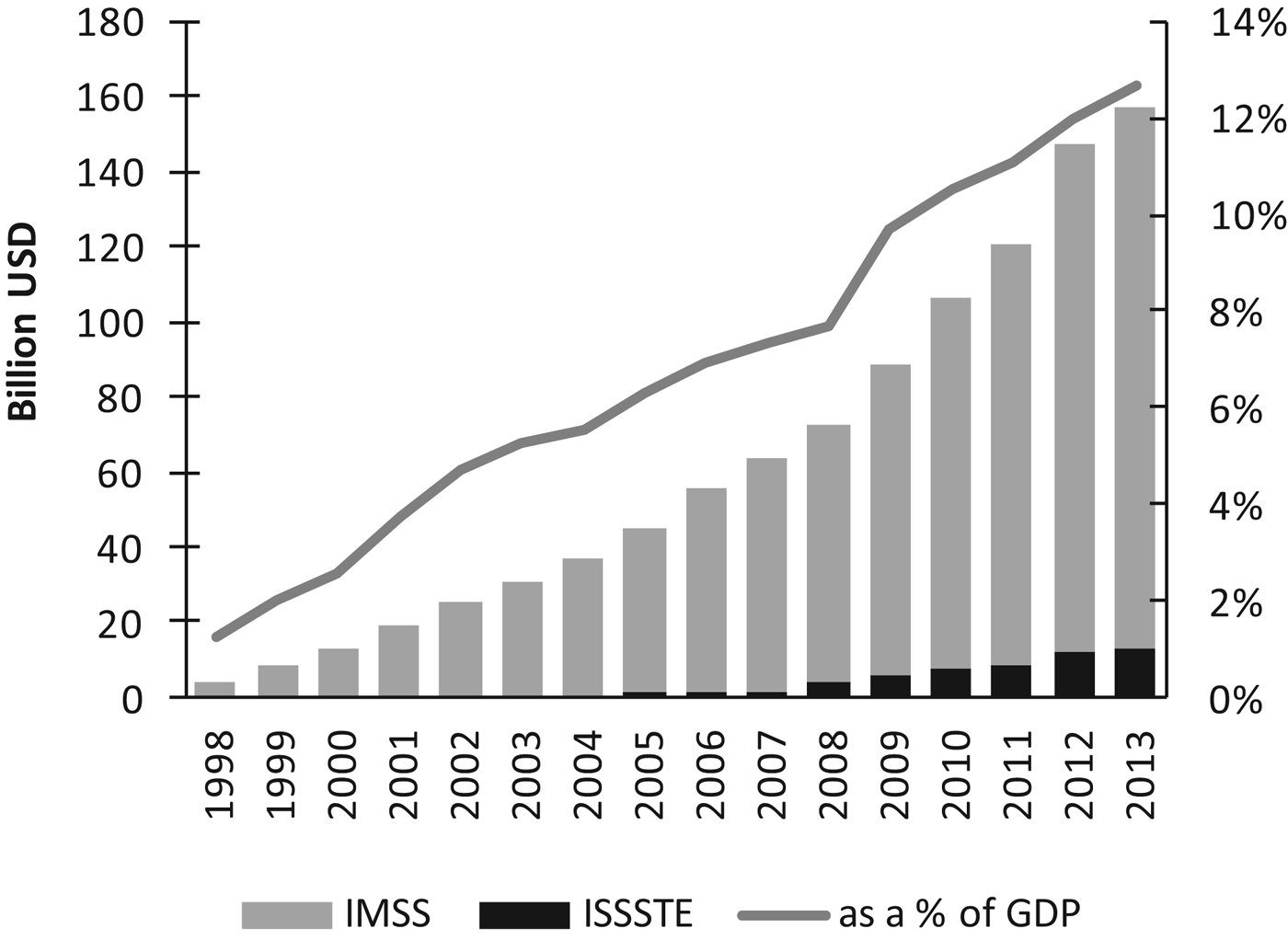
Sixteen years after its creation, the Retirement Pension System (SAR) administers USD 157 billion (12.7% of Gross Domestic Product, GDP) from the pension savings of 49.8 million of individual accounts. However, the pension coverage levels are far from ideal, and most of the labour force is without any old-age protection.
The high level of informality in the labour market, as well as the limited financial literacy and retirement planning, have not encouraged the increase of coverage significantly over recent years. Additionally, global demographic trends point to an ageing of the population due to greater life expectancy and a reduction in the birth rates. As a result, over the coming years financially viable pension systems will be a key element in the public finances of different countries. According to the Organisation for Economic Cooperation and Development (OECD, 2011) pension policies must maintain an adequate balance between benefits (adequate income for retirement) and the financial sustainability of pension systems. This balance has been more difficult to achieve, apart from the major challenge posed by an ageing population, as a result of the recent economic and financial crisis, which has had a profound impact on the economy and public finances around the world.
All these problems require more detailed quantification, both in terms of depth and time. By profundity we mean disaggregated estimates at the level of representative individuals, as the exposure of each of them to pension systems and their consequences are very different in each case depending on their individual socioeconomic characteristics. With respect to the length of time of the estimates, we consider that the behaviour of the system has to be observed not only in the current period but also in terms of its development over the coming decades, given the interaction of various demographic and macroeconomic factors.
There are some works focused on the Mexican pension system: Grandolini and Cerda (Reference Grandolini and Cerda1998) estimate the fiscal cost of the IMSS pension reform, Sinha (Reference Sinha2003) explores the performance of the SAR during 1997–2000, Gill et al. (2004) and Mesa-Lago (Reference Mesa-Lago2004 and Reference Mesa-Lago2008) provide a general view of Mexican pension system in the Latin American context. Aguila (2008) studies the crowding-out effect of SAR on household savings, Aguila et al. (Reference Aguila, Hurd and Rohwedder2008) assess how pension fund management fees affect pension accumulations, and Aguila et al. (Reference Aguila, Attanasio and Quintanilla2010) analyse the coverage of the pension systems in Mexico, Chile and Colombia. Finally, Levy (Reference Levy2008) and Antón et al. (Reference Antón, Hernández and Levy2012) propose a universal pension system, presenting empirical contribution densities for Mexico.
Nevertheless, there are practically no projection models for Mexico's pension system that provide detailed simulations on coverage and replacement rates (RR). Even though the OECD regularly publishes comprehensive analysis of the performance of the pension systems of various countries including Mexico, the RR are calculated for average workers assuming a contribution density of 100%. The inclusion of the observed contribution density when projecting RR, is a very important issue when simulations are carried out, since Mexico has a labour market characterised by a high informality. In this respect, only Albo et al. (Reference Albo, González, Hernández, Herrera and Muñoz2007) conduct projections of pension coverage and RR, developing the so-called Pension Predictive Analysis Model (MAPP, for its acronym in Spanish), considering four different groups of contributors in terms of their density of contributions, gender and three income categories, using statistical information on the affiliates of the SAR provided by CONSAR as of 2004. In fact, our model is called MAPP2 since it is an extended and more detailed version of the model developed by Albo et al. that takes into account the observed contribution densities of the administrative data provided by CONSAR as of 2011. This is why we consider that our study may help fill the existing gap on the analysis of the expected performance of IMSS pension system.
The main objective of this study is to develop a projection model through 2050, within the framework of a demographic and economic forecast that will allow a detailed diagnosis of the current conditions of the components of the system, the effective coverage level for different groups of contributors and the existing potential under current conditions for providing adequate pension levels. To do so, the model manages a database of 4 million individuals, classified into 60 types of each age.
Specifically, we classify individuals according to age, gender, level of studies and deciles of income distribution; each type of individual may be in a different position according to employment situation (salaried, unemployed, independent) or position in the pension system (affiliate, regular or irregular contributor). The advantage of this level of detail is that it allows us to simulate the parametric or structural reforms that are proposed, and calculate the respective impacts on specific segments of the population. The results reveal the unpromising scenario that the pension system has and will continue to have in the long term, with limited improvements in coverage rates. The possibility of obtaining adequate pensions will be restricted to those who have a long employment history and contribute regularly to their individual accounts.
This work is organised as follows. After the introduction, Section 2 describes the IMSS pension system. Section 3 describes the projection model in detail. Section 4 provides a diagnosis of the socioeconomic characteristics of workers who participate in the pension system and the consequences for the system's profile. Section 5 presents the projections of the model's baseline scenario, estimates the coverage of the pension system, as well as the amount of the pension and the RR obtained if the current conditions of the system were maintained. At the same time, it evaluates the effect that different economic variables and key parameters in the system have on the level of pensions and the corresponding fiscal cost. We also evaluate a set of proposals for increasing the coverage of pension systems and obtaining higher income at retirement; these are presented in Section 6. Finally, Section 7 presents the main conclusions of our work.
2 General description of the pension system
2.1 Reform of the IMSS pension system
The IMSS is the main social security institution in Mexico to which workers in the private sector contribute to, and it is financed by contributions from the workers, the employers and the Government. The old-age pension scheme was reformed in 1997 by introducing a DC system based on individual accounts (IA) managed by dedicated pension fund managers (Afores)Footnote 4, supervised by the National Commission of the Retirement Pension System (CONSAR).
The following rules were applied in the transition to the new schemeFootnote 5:
1. Pensions granted by the previous scheme (L73) are financed by the Government.
2. All the contributors have an IA in an Afore, in which the contributions for old-age pensions are made.
3. Active workers at the time of the reform (transition generation (GT)) have the choice, at the time of retirement, of choosing between receiving a pension either from the previous DB scheme or the new DC scheme (L97).
4. Workers who began contributing after July 1997 (Afore Generation (GA)) can only receive a pension under the DC scheme.
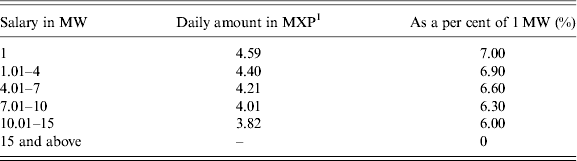
The transition rules involve maintaining at the same time two different pension schemes for a long transition period: L73 and L97. All current and future pensions granted by L73 represent a liability for the government, whereas the L97 pensions are financed from the individual accounts. In addition, L97 establishes the right to an inflation-indexed minimum guaranteed pension (MPG), equivalent in 2013 to MXP 2,501 (USD 192)Footnote 6 for workers who meet the requirements for an old-age pension, but whose savings are not sufficient to finance a pension that is greater than the MPG. The contributions to old-age account are equivalent to 6.5% of the base contribution salary of workers, with a ceiling of 25 times the minimum wage (MW). In addition, the government makes a contribution called Cuota Social Footnote 7 on a sliding scale for workers with a salary below 15 MW (Table 1).
Cuota Social as of December 2013
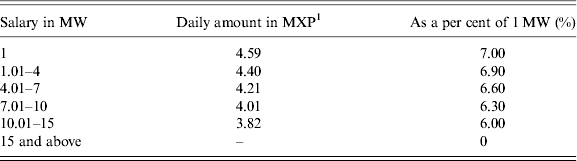
1 Indexed quarterly according to inflation.
The Cuota Social is a very important component for low-income workers: a worker who earns 1 MW receives a contribution of 13.5% of the salary (6.5% of the obligatory contribution plus 7% of the Cuota Social). It is important to note that L73 requires only 500 weeks of contribution (9.6 years) for an old-age pension, whereas the L97 requires a minimum of 1,250 weeks (24 years). Both laws establish 60 years of age as the minimum for early retirement and 65 years for the old-age pension. Regarding the payroll of pensions, L73 benefits are paid through the IMSS payroll, while L97 pensions can be paid either through programmed withdrawals (administered by the Afores) or life annuities, paid through a pension insurance companyFootnote 8.
Given that the benefits of the DB scheme are more generous than those obtained by the DC scheme, so far the retirements have been only via DBFootnote 9. Moreover, L73 pensions are financed by the GovernmentFootnote 10, so there will be an impact on the country's public finances as long as there are workers or pensioners in the GTFootnote 11. Another important element is the way in which the different actors deal with longevity risk: in the L73 pensions, the risk is directly assumed by the government, while in L97 pensions-except for the MPG-longevity risk is borne by the workers (programmed withdrawals) or the pension insurers (life annuities), depending on the form in which the pension is paid.
2.2 The current situation of the retirement savings system
At the end of 2013, assets under management by the Afores totalled USD 157 billion, while the number of accounts managed was over 49.8 million, of which 97% belong to IMSS workers. Pension funds in Mexico represent 12.7% of GDP (Figure 1). Over the last four years, the growth of assets under management has picked up pace, about 1% of GDP per year. This growth has been encouraged by the incorporation to the DC scheme of public-sector workers (ISSSTE) as well as by the returns obtained during this period. The average annual growth of assets under management by Afores over the last 10 years has been 18.4%.
Afores’ Assets under management.

Between 1997 and 2004 there was only one type of investment fund (SieforeFootnote 12), whereas in 2005 a family of funds or Basic Siefores (SB) was created, according to the age of the worker, with a more conservative investment scheme as the worker approached retirement age. Currently, there are four funds: SB4 for workers up to 36 years, SB3 for workers between 37 and 45 years, SB2 for workers between 46 and 59 years, and SB1 for workers over 60 years. The investment rules defined by CONSAR, have been made more flexible over the years: at the beginning there was a strong concentration of investment in government debt instruments, then the rules allowed more exposure to equity assets, structured instruments and commodities.
2.3 Levels of participation in the system and protection for old age
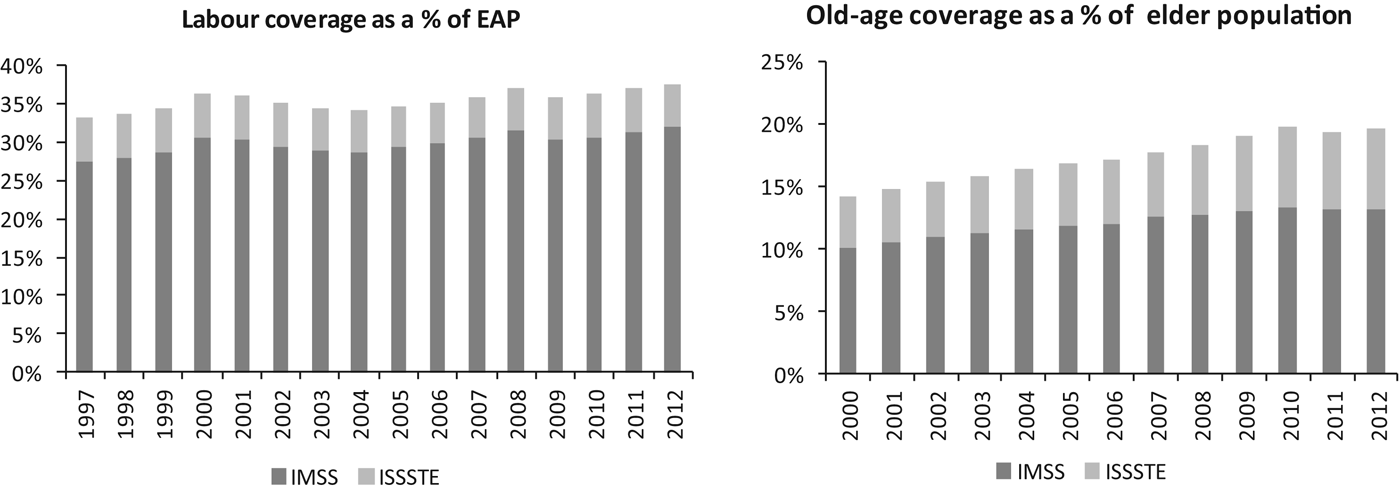
According to official dataFootnote 13, although in the last 10 years the number of contributorsFootnote 14 in the federal pension systems (IMSS and ISSSTE) has grown by 17%, the effective coverage (contributors as a percentage of the EAP) is still below 39%. The same is true in the case of old age pension coverage (pensioners as a percentage of the population over the age of 65), which has remained practically constant at about 20%. This situation is particularly worrying if we consider the change in the population structure (ageing population) that will take place in the medium term. The two indicators can be seen in Figure 2.
IMSS and ISSSTE: labour and old-age coverage.
Since 2005 independent workers who do not contribute to any social security institution may open an IA in an Afore and make contributions for their retirement. However, it is not mandatory to contribute a fixed amount or percentage of their income, or with any regularity. Despite the tax incentivesFootnote 15 for voluntary pension savings, as of 2013 there were only 238,000 accounts of independent workers (0.5% of the managed accounts).
2.4 Non-contributory pensions
There are several non-contributory old-age pension schemes at federal and state level. With respect to coverage and budget, the most important is the ‘Pension para Adultos Mayores’ (Pension for the elderly), financed by the Government and managed through the Secretariat for Social Development (SEDESOL). In the beginning, this programme was called ‘Pension 70 y mas’ and provided a pension for everyone aged 70 or over who lived in towns with populations up to 30,000 inhabitants.
From 2012, this programme was extended to all the country, and it is granted to all those people who did not receive an old-age pension from a social security institution. The amount consists of MXP 525 (USD 40) per month, paid every 2 months, and a one off-payment of MXP 1,000 (USD 77) if the beneficiary dies. In accordance with the National Council for the Evaluation of Social Development Policy (CONEVAL, 2012), at the end of 2011 the programme benefited 2.1 million elderly adults, with total spending of MXP 12,816 million (USD 986 million). Starting in 2013 the programme was extended to include people aged 65 and over, and its name was changed to ‘Pension para Adultos Mayores’.
Additionally, 13 states have already implemented their own non-contributory pension schemes for elderly adults that vary in the type of benefits granted (monetary or in kind), the age of eligibility (between 60 and 70) and the amount paid (from USD 38–70 per month). In general, these programmes require the beneficiary to live in the state for a number of years that ranges from 3 (Federal District) to 20 (Veracruz), and do not receive any other pension. In 2011, the population benefiting from non-contributory state pensions amounted to 1.4 million elderly adults. However, the amount of pension granted by most of these programmes is lower than the cost of a basic food basket, which is equivalent to the minimum welfare basket defined by CONEVALFootnote 16.
3 A model for the IMSS pension system
3.1 Overview
The main objective of pension systems is to provide coverage against a variety of risks (old age, survival, disability), sufficient resources for retirement and, in some cases, to be an additional mechanism for income distribution.
The economic literature includes proposals for different methods to evaluate the capacity of the pension systems to carry out these three functions successfully. Broadly, there are two types of models. Based on the seminal work of Auerbach and Kotlikoff (Reference Auerbach and Kotlikoff1987), various extensions of a type of model have been proposed called ‘overlapping generations and dynamic general equilibrium’ models. Typically, this type of model introduces two or more sectors (e.g., households, the State, companies) that maximise a value function, subject to certain budgetary restrictions. The general equilibrium is found when all the agents maximise their returns given equilibrium prices (interest rate and wages). The main virtue of these models is that they allow to model the behaviour of agents given the macroeconomic restrictions at any time (for example, how much to consume, how much to work, how much to produce, etc.), and thus the effects they would have on the pension systemsFootnote 17. From the point of view of economic theory, this kind of model is impeccable. However, from the point of view of economic policy, it has numerous disadvantages. The need to find a general equilibrium means adopting some necessary and sufficient conditions for functional relations that at times have no relationship with reality, and thus require an enormous simplification. In addition, the computational needs increase to an extraordinary extent as greater heterogeneity is introduced into the agents, or exceptions or legal conditions are introduced that alter the behaviour between generations to a substantial extent. For this reason, these models are not useful when the aim is to simulate policies with a strong institutional component. At the same time, another type of model has arisen based on the works of Auerbach et al. (Reference Auerbach, Gokhale, Kotlikoff and Bradford1991), (Reference Auerbach, Gokhale and Kotlikoff1994) called ‘generational accounting’. These models did not aim to find the components of general equilibrium and the behaviour of the agents; they modelled the system based on the maximum institutional information possible. In these cases, the agents would behave in accordance with past statistical evidence and the preparation of different plausible scenarios. Some international institutions such as the European Commission (1999) and the World Bank itself (with the PROSTFootnote 18 model) have carried out projections of the different pension systems in the world using this type of model.
It should be stressed that generational accounting models do not make predictions, their function is to answer questions of the type: ‘What would happen in the pension system if all the elements of the macroeconomic scenario occurred and the agents behaved according to the assumptions stated?’ The richness of the analysis increases as various sensitivity exercises are carried out. The model we propose for the IMSS fits into this second group; this methodology has been used in recent literature for instance, Berstein et al. (Reference Berstein, Larraín and Pino2005), Bernal et al. (Reference Bernal, Muñoz, Perea, Tejada and Tuesta2008), Bucheli et al. (Reference Bucheli, Forteza and Rossi2010) and Forteza et al. (Reference Forteza, Apella, Fajnzylber, Grushka, Rossi and Sanromán2011).
3.2 The heterogeneity of representative individuals
Ideally, projection models of pension systems should detail the operation of the system to the highest level permitted by the available information. This balance is difficult to achieve, and that is why there are not many works of this kind in the literature. In our model we have aimed to characterise the representative individuals with the main determining characteristics of their relationship with the pension system. Specifically, the model works with populations differentiated by gender, age and three levels of education (primary, secondary and tertiary). These permanent characteristics will determine key elements such as the rate of affiliates, density of contributions, salary, etc. We thus introduce heterogeneity for 60 types of individuals, at each age of the population pyramid. As we will see later, individuals may be in a variety of employment situations (working, unemployed, inactive) or contribution situations (affiliate, regular/irregular contributors). The advantage of this level of detail is that it allows us to simulate most of the parametric or structural reforms that are proposed, and calculate their respective impacts on specific segments of the population. The downside is that the model reaches a high level of complexity in terms of programming.
3.2.1 Education and income as relevant factors for representative agents
The education variable as an indicator of human capital is a very significant and explanatory element of the main factors such as informality, salary, contribution density, etc. Alonso (Reference Alonso2003) showed that in the Spanish case, education was a very relevant variable for including transition dynamics in which the changing composition of the level of studies achieved by a population could vary the projections for the pension system significantly. In the case of Mexico, other authors (Gill et al., Reference Gill, Packard and Yermo2004) consider that the density of contributions is 100% regardless of the levels of education and income, is clearly an inadequate assumption since, as the authors themselves and other researchers like Levy (Reference Levy2008) show that the probability of contributing in Mexico increases with income and schooling level. In our analysis we conclude the same, as the potential salary profiles observed for men and women and by age groups are notably different, as seen in the following sections, depending on the difference between the levels of studies achieved. The characterisation of representative individuals is particularly important when there is a major transition in their educational level – the level of studies reached by young generations is much higher than the one reached by people close to retirement age-. The relevant characteristics (coverage ratio, salary, contribution density) observed now may be modified in the future, and this event is included in the model. Although education is a clearly differentiating element in the behaviour of workers with respect to the pension system, income distribution is another one. Within each educational level there are important income differences, especially between the highest and lowest deciles in the distribution. As mentioned before, since Mexico has a labour market characterised by a high informality, taking into account the observed density of contributions when evaluating pension rights of future generations is a crucial issue. This has been a trend in recent analysis of pension systems in emerging countries (Berstein et al., Reference Berstein, Larraín and Pino2005; Bernal et al., Reference Bernal, Muñoz, Perea, Tejada and Tuesta2008; Bucheli et al., Reference Bucheli, Forteza and Rossi2010; Forteza et al., Reference Forteza, Apella, Fajnzylber, Grushka, Rossi and Sanromán2011).
3.3 Description of the model
Our model uses a database with information on the socioeconomic profiles of each individual, processed with the GAUSS computer software, which manages high-volume data efficiently. Our model projects a great number of variables form 2012 to 2050, for a random sample of 4 million individuals. The base year is 2011, and the projection generates the calculations needed to determine the situation of the pension system in the future if the hypotheses made explicit in the model are confirmed.
3.3.1 The population and the EAP
Based on the population forecasts of the Economic Commission for Latin America and the Caribbean – ECLAC – (2012) for Mexico, we have the population pyramids for the period 2010–2050 (t) by age (y) between 0 and 100 years, and by gender (g) In addition, we use the EAP forecasts proposed by ECLAC with the same dimensions of gender (g), age (y) and year described in the population pyramid (P g,yt). For the base year, we distribute each population cohort of (EAP g,yt). According to the probability of having reached a determined level of studies (primary, secondary, tertiary), (Pedu g,y,e2011) for each gender, and obtain the population pyramid by level of studies reached (e) in the base year
 $$EAPedu_{g,y,e}^{2011} = P_{g,y}^{2011} \times Pedu_{g,y,e}^{2011}. $$
The dynamic for the projection years of the population from 2010 to 2050 would use the ECLAC projection exogenously. With respect to level of studies, the dynamic of the transition uses the assumption that successive generations that enter the labour market will achieve the same level of studies as current generations that have just ended their educational cycle at the age of 25.
3.3.2 Affiliates, contributors and informality
Considering the (EAPedu g,y,e2011) of each projection year t, we establish a probability of being an IMSS affiliate (Pafil g,y,et), and thus obtain the number of affiliates as
 $$Af_{g,y,e}^t = EAPedu_{g,y,e}^t \times Pafil_{g,y,e}^t. $$
Although there are many definitions of what is considered the informal economy according to the subject being studied (labour market, taxation, etc.), in our case, we will consider workers to be informal if they are carrying out an economic activity, and therefore form part of the EAP but are not members of any pension system.
Thus the calculation of the informal labour force (INF g,y,et) by age, gender and level of studies of each will be determined by
 $$INF_{g,y,e}^t = EAPedu_{g,y,e}^t - Af_{g,y,e}^t. $$
For the purposes of this model, we will classify affiliates into three groups: workers who made their last contribution in the period 2009–2011 are considered regular contributors; those who contributed last in the period 2006–2008 are considered irregular contributors; and those who have not made any contributions since 2005 are considered non-contributing affiliates.
Of the total 48 million accounts managed by the SAR as of 2012, only 21 million received at least one contribution in the last 3 years. They are considered regular contributors and are calculated as
 $$Cont_{g,y,e}^t = Af_{gy,e}^t \times Pcont_{g,y,e}^t, $$
where Pcont g,y,et is the probability of being a regular contributor by gender, age and level of education.
The 27 million remaining accounts can be classified as irregular contributors and non-contributors. In accordance with the data of Afore Bancomer, of those affiliates who are not regular contributors, 42% are irregular contributors Irr g,y,et and 58% are non-contributors NCont g,y,et. So we will assume that this proportion remains constant over the projected period. Thus, the irregular contributors are calculated as
 $$Irr_{g,y,e}^t = (Af_{g,y,e}^t - Cont_{g,y,e}^t )\ast . 42$$
and the non-contributors are calculated as
 $$Ncont_{g,y,e}^t = Af_{g,y,e}^t - Cont_{g,y,e}^t - Irr_{g,y,e}^t. $$
The non-contributors are workers who joined the IMSS at some time but currently do not contribute to the institution as they are carrying out an activity in the informal labour market, or because they contribute to another pension system. If these people do not resume their contributions, they will not accumulate the necessary contribution period to be entitled to receive a pension; however, at 65 years of age they may withdraw their accumulated savings from the individual account. These workers must be differentiated from the rest of the affiliates in order not to distort the behaviour of those who make contributions.
The irregular contributors are people who enter and exit situations of formality and thus have lower contribution densities than those who make regular contributions. These kinds of affiliates may have a pension, depending on their educational level and income (for example, with a high-income level and studies).
So far, we have dealt with affiliates without distinguishing the generation they belong to. On the one hand, those workers who joined the IMSS before July 1997, the GT, have the right to obtain a DB pension on retirement, and form a closed group, with no new entries and it will be extinguished gradually as the workers die, receive pensions or stop their contributions to the IMSS. On the other hand, the GA includes all those workers who entered the IMSS after July 1997 and who can only receive L97 pensions. This is an open group, as new contributors will be joining this population.
Thus, the pension rights of workers depend on the generation to which they belong, so we must distinguish each population in our model. We obtain the regular GA contributors (ContGA) by deducting from the total contributor group (Cont) those regular GT contributors (ContGT) by age, gender and level of studies:
 $$ContGA_{g,y,e}^t = Cont_{g,y,e}^t - ContGT_{g,y,e}^t. $$
The irregular GA contributors (IrrGA) are the result of deducting from the total irregular contributors (Irr) the irregular GT contributors (IrrGT):
 $$IrrGA_{g,y,e}^t = Irr_{g,y,e}^t - IrrGT_{g,y,e}^t. $$
Equally, the GA non-contributors (NContGA) are obtained as
 $$NcontGA_{g,y,e}^t = Ncont_{g,y,e}^t - NContGT_{g,y,e}^t, $$
where NCont are the total non-contributors and NContGT the non-contributors of the GT. The characterisation of representative individuals in the model includes the dimension of income by age, gender and level of studies. We have distributed all the contributing groups (regular and irregular contributors) by income deciles, so the affiliates will incorporate an additional dimension: the income decile to which they belong (r).
3.3.3 Calculation of contributions
Contributions are defined by four main elements: potential income, contribution density, the contribution rate and the Cuota Social. The income of each representative agent will depend on gender, age, educational level and the income decile to which he/she belongs W = f(g, y, e, r) the contribution density DC = f(g, y, e, r, l) will depend on gender, age, education, the income decile and the employment situation of the individuals (l). The Cuota Social CS = f(r) will depend on income. Finally, the contribution rate (cr) will depend on the government's political decisions.
In our model, each representative individual may be in one of three employment situations: a salaried worker, independent worker or unemployed. The contribution density is greater among men with a higher level of studies and greater income level (top distribution deciles); while young women with a low level of studies and low-income levels have a low contribution density. As is to be expected, the contribution density of people who are working is greater than that of the unemployed.
It is important to recall that independent workers who do not belong to any social security institution may open an IA and make contributions to it; however, the amount and frequency of these contributions depend on the worker and is not linked in any way to the income they receive. Since there is no information on their salaries or contribution densities, so to project the balance of this type of worker, the amount of the average contribution made in 2011 is taken into account.
Finally, the total contributions of each type of individual (there are 60 types in each population cohort) will be determined as follows:
For regular contributors:
 $$\eqalign{ C_{cont,g,y,e,l,r}^t = & Cont_{g,y,e,l,r}^t \times DC_{cont,g,y,e,l,r}^t (\,psal_{g,y,e,l}^t, pu_{g,y,e,l}^t ) \times cr\;\cr & \times \; W_{g,y,e,l,r}^t + CS_r. $$
For irregular contributors:
 $$C_{irr,g,y,e,l,r}^t = Irr_{s,y,e,l,r}^t \times DC_{irr,g,y,e,l,r}^t \times cr\; \times \; W_{g,y,e,l,r}^t + CS_r. $$
For non-contributors:
 $$C_{ncont,g,y,e,l,r}^t = NCont_{g,y,e,l,r}^t \times DC_{ncont,y,e,l,r}^t \times cr \times W_{g,y,e,l,r}^t + CS_r. $$
For independent workers:
 $$C_{indep,g,y}^t = Indep_{g,y}^t \times ACI_{g,y}^t, $$
where C is the contributions (differentiated by type of worker);
DC the contribution density (differentiated by type of worker); Psal the probability of being salaried; pu the probability of being unemployed; W the potential salary (differentiated by type of worker); ACI the average contribution for independent workers; CSr the Cuota Social corresponding to the worker's income; Cr the contribution rate, currently 6.5% of the basic contribution salary.
Each type of individual by age, gender, educational level, income decile and whether regular/irregular contributor or non-contributor, GT or GA, capitalises the accumulated fund and totals the contributions made in each year. The capitalisation is carried out at the interest rate specified in the macroeconomic scenario set out below. The balances for regular contributors are thus calculated as:
 $$(F_{g,y,e,l,r}^t ) = F_{g,y,e,l,r}^{t - 1} \times (1 + i) + C_{g,y,e,l,r}^t, $$
where F is the balance of the IA for each group (regular or irregular contributors, non-contributors, independent workers), and i is the Interest rate.
According to the contribution density of each individual, the months of contributions are aggregated to the initial length worked by each type of worker. This will determine the retirement age if the pension saver has contributed for sufficient weeks to be eligible or not to an old-age pension.
3.4 Calculation of pensions
Current pensioners from the GT receive a DB pension; however, future pensioners from the GA will receive DC pensions. Given that each type of pension has different sources of finance, we must consider two types of pensioners in the projection: P73 and P97. For each year of projection, we calculate the number of new pensioners (NewGA g,y,e,lt, NewGT g,y,e,lt) using the observed IMSS retirement profile (RnewGT yt, RnewGAyt), which will be applied to the contributors who meet the age and time of contributions for retirement
 $$NewGT_{g,y,e,l}^t = ContGT_{g,y,e,l}* RnewGT_y^t, $$
 $$NewGA_{g,y,e,l}^t = ContGA_{g,y,e,l}^t * RnewGA_y^t. $$
Once the number of new pensioners in each generation has been obtained, the amount of pension is calculated according to each scheme. In the case of the GT, both the L73 and the L97 pensions are calculated, and the bigger of the two is allocated. In addition, in each year of the projection, surviving current pensioners have to be calculated (P73, P97) applying the probability of survival according to ECLAC (Ps g,y)
 $$P73_{g,y}^t = (P73_{g,y}^{t - 1} \times Ps_{g,y}^{t - 1} ) + NewGT_{g,y,e,l}^t, $$
 $$P97_{g,y}^t = (P97_{g,y}^{t - 1} \times Ps_{g,y}^{t - 1} ) + NewGA_{g,y,e,l}^t. $$
L73 pensioners who die each year generate in turn widow's pensions (Pwid):
 $$PWid_{g,y}^t = P73_{g,y}^{t - 1} (1 - Ps_{s,y}^{t - 1} ).$$
It is not necessary to calculate the number of widows generated by L97 pensioners, as at the time of retirement survivor's insurance is purchased from a pension insurer, transferring the risk and the corresponding premium to this institution.
3.4.1 Calculation of L97 pensions
The L97 requires at least 1,250 weeks of contributions to be entitled to receive and old-age pension or early retirement pension (65 and 60 years old, respectively). At the time of retirement, the worker must buy survivor insurance from a pension insurer, which will pay the pension to their heirs if the pensioner dies. The amount of the pension (Pen97x) is obtained by dividing the accumulated balance in the IA – previously discounting the survivor's insurance premium (SI x,y) – by the actuarial present value of the pensioner's life annuity  $(\ddot a_x )$, taking into account the fee charged by the insurer (f).
The actuarial present value is calculated according to the dynamic mortality tables in force and the actuarial discount rateFootnote 19. For the calculation, we assume an actuarial discount rate equal of (3%)Footnote 20. If the balance of the IA is insufficient to fund a pension bigger than the guaranteed minimum pension (MPG), the pensioner will have the right to receive a MPG. In this case, the survivor's insurance is not bought at the time of retirement. At the death of the pensioner, a pension for the widow or orphans is bought with a pension insurer. When the funds in the IA are used up, the MPG is paid by the government.
 $$Pen97_x = Max\left[ {MPG,\displaystyle{{IA - SI_{x,y}} \over {\ddot a_x* (1 + f)}}} \right].$$
At the same time,
 $$\ddot a_x = \mathop \sum _{k = 0}^{\omega - x} v^k * {}_kP_x - \displaystyle{{m - 1} \over {2m}},$$
 $$SI_{x,y} = \left[ {0.9\; BI_{iv} * (m + 1) * \mathop \sum _{k = 0}^{\omega - y} (1 - {}_kP_x ) * {}_kP_y * v^k} \right] * (1 + f),$$
where Pen97x is the amount of life annuity for a pensioner aged x; IA is the balance of the individual account. SI x,y is the actuarial present value of the survivors’ insurance for the spouse aged y of the pensioner aged x. In the case of female pensioners, SI x,y = 0. BI iv is the amount of basic indemnity for disability and life insurance, defined as the maximum between the MPG and 35% of pensionable salaryFootnote 21.  $\ddot a_x $ is the present actuarial value of the life annuity of the pensioner aged x, and f is the fee charged by the pension insurer, equal to 2%.
 $${}v^k = {1\over {1 + i}} , $$
where i is the actuarial discount rate, m is the number of payments per year, equal to 12, ω is the last age of the mortality table, equal to 110 years, kPx is the probability that an individual aged x reaches age x + k, calculated as
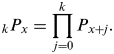 $${}_kP_x = \mathop \prod \limits_{\,j = 0}^k P_{x + j}. $$
P x is the probability of survival of an individual aged x at age x + 1, obtained from the EMSSA 2009 dynamic mortality tables.Footnote 22
3.4.2 Calculation of L73 pensions
GT workers can choose between a L73 pension and a L97 pension. The L73 pension (Pen73) is financed by the government and the amount depends on the wage level and weeks of contributions in addition to the required minimum of 500 weeks, in accordance with the following:
 $$Pen73 = Min\left\{ {MW,AS * (BA + AI * N)} \right\},$$
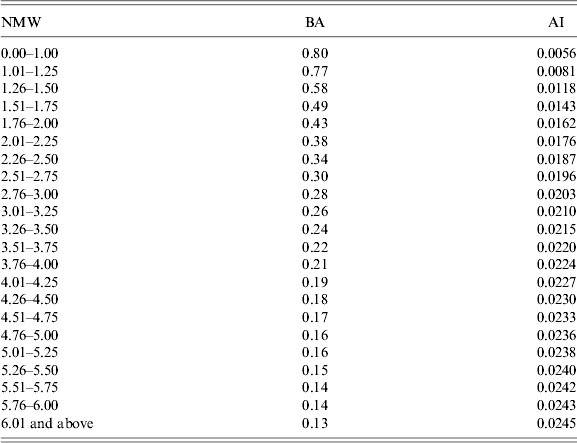
where MW is the minimum wage; AS the average salary of the last 250 weeks of contributions; BA the factor of basic amount, according to table 2; AI the factor of annual increment, according to table 2; N the number of weeks contributed in excess of 500; NMW the Min {25, AS/MW}.
Factors for calculating L73 Pension (Article 167 of the L73)
The balance of the IA is transferred to the government. Early retirement is allowed since the age of 60, applying a reduction of 5% in the amount of the pension, for each year prior to 65. Once the amount of pension has been calculated, it will be increased by 11%Footnote 23. At the death of the pensioner, a widow's pension (PenWid) is granted, equivalent to 90% of the holder's pension.
3.4.3 Calculation of the new average pension
In the base year (2011) only L73 pensions are being paid; however, over the period of the projection L97 pensions will be generated (MPG and pensions above this amount). Given that each type of pension is different in terms of amount and finance – IA funds or Government funds – it is important to distinguish between L73 pensions and L97 pensions. The new pensioners generated each year in the projection are assigned to the corresponding group, classified by pension income (i). Within each group, the new average weighted pension is recalculated by incorporating the amount of the pension for new cases (ANPGT g,y,e,lt, ANPGTg,y,e,lt). The average pension (AP73g,y,it, AP97g,y,it) will be:
 $$AP73_{g,y,i}^t = AP73_{g,y,i}^{t - 1} \times \left( {\displaystyle{{P73_{g,y,i}^{t - 1}} \over {P73_{g,y,i}^t}}} \right) + ANPGT_{g,y,e,l}^t \times \left( {\displaystyle{{NewGT_{g,y,i}^{t - 1}} \over {P73_{g,y,i}^t}}} \right),$$
 $$AP97_{g,y,i}^t = AP97_{g,y,i}^{t - 1} \times \left( {\displaystyle{{P97_{g,y,i}^{t - 1}} \over {P97_{g,y,i}^t}}} \right) + ANPGA_{g,y,e,l}^t \times \left( {\displaystyle{{NewGA_{g,y,i}^{t - 1}} \over {P97_{g,y,i}^t}}} \right).$$
3.4.4 Fiscal cost
The fiscal cost of the IMSS pension system is made up of three components:
i) Financing of L73 old-age and widow pensions;
ii) Financing of the MPG, when the funds in the IA are used up;
iii) Cuota Social;
iv) Government contributions to the individual account, equivalent to 0.225% of the worker's salary.
The fiscal cost of L73 (FC73) is calculated as the average pension (AP73) multiplied by the number of pensioners (P73) plus the average widow's pension (APWid73), multiplied by the number of widows (Wid73):
 $$FC73_{g,y,i}^t = (P73_{g,y,i}^{t - 1} \times AP73_{g,y,i}^t ) + (Wid73_{g,y,i}^{t - 1} \times APWid73_{g,y,i}^t ).$$
The cost of MPG (FCmpg g,yt) is calculated as the actuarial present value of MPG life annuity payments and the survivors’ insurance (SI) for the widow minus the balance recovered from the individual account, multiplied by the number of cases of MPG generated each year.
 $$FCmpg_{g,y}^t = CasesMPG_{g,y}^t * (MPG * \ddot a_x + SI_{x,y} - IA),$$
where
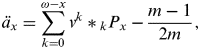 $$\ddot a_x = \mathop \sum _{k = 0}^{\omega - x} v^k * {}_kP_x - \displaystyle{{m - 1} \over {2m}},$$
 $$SI_{x,y} = \left[ {0.9\; MPG * (m + 1) * \mathop \sum _{k = 0}^{\omega - y} \left( {1 - {}_kP_x} \right) * {}_kP_y * v^k} \right] * (1 + f).$$
The cost of the Cuota Social (FCcs g,y,rt) is calculated as:
 $$FCcs_{g,y,r,l}^t = Cont_{g,y,r,l}^t * DCt_{g,y,r,l}^t * CS_{g,y,r}^t. $$
Finally, the cost of government contributions to the IA (Cgov g,y,rt) amounting to 0.225% of the worker's salary (Sal cont,g,y,rt) take into account the contribution density of each type of worker:
 $$Cgov_{g,y,r}^t = 0.00225 * Cont_{g,y,r}^t * DC_{cont,\; g,y,r}^t * Sal_{cont,g,y,r}^t. $$
Thus, the total fiscal cost for each year in the projection t is given by:
 $$TFC^t = FC73_{g,y,i}^t + FCmpg_{g,y}^t + FCCS_{g,y,r,l}^t + Cgov_{g,y,r}^t. $$
3.4.5 The macroeconomic scenario
The macroeconomic scenario is based on a standard growth model proposed by Solow (Reference Solow1957) through an accounting method. It proposes a Cobb–Douglas production function which complies with the properties of perfect competition, balance in all the markets and constant returns to scale for all the productive factors, and decreasing returns to scale for each of them. Factor prices are determined according to their marginal productivity.
 $$Y(t) = A(t)K^\alpha (t)L(t)^{^{1 - \alpha}}, $$
 $$A_t = A_{t - 1} (1 + g),$$
where Y is the GDP; L the labour input, which is exogenous and corresponds to the EAP of the ECLAC projection; K the capital input; A the total factor productivity (or the Solow residual); α the output elasticity of capital; 1−α the output elasticity of labour; t the year of projection; and g the constant rate of growth.
Capital accumulation follows the dynamic equation:
 $$K_t = sY(t) + K_{t - 1} (1 - d),$$
d is the capital depreciation; s the saving rate/total investment in the economy given by
 $$s = \displaystyle{{F_{t - 1}} \over {Y_{t - 1}}}, $$
where F t is the gross fixed capital formation at year t.
The calculation of the growth rate of wages for updating the wage profiles is as follows:
Given that the constant return to scale aggregate production can be expressed as
 $$r_t K_t + w_t L_t = F(A,K,L),$$
then
 $$w_t = \displaystyle{{F(A,K,L)} \over L} - r\displaystyle{K \over L},$$
where w is the wages; r the interest rate, which will be considered exogenous and equal to a real interest rate of 4%Footnote 24, therefore the salary growth rate (Δw) will be:
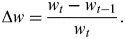 $${\rm \Delta} w = \displaystyle{{w_t - w_{t - 1}} \over {w_t}}. $$
3.5 Sources of information and construction of the database
Our model uses different initial data matrices of the IMSS affiliates, separated by generations (GA and GT) as well as for each type of individual. The data of regular contributors correspond to a random sample of 2 million workers with contributions in 2009 and 2011, provided by CONSAR, and complemented with data from the National Occupation and Employment Survey (ENOE). For irregular contributors and non-contributors, the data used correspond to the affiliates in Afore Bancomer.
The information has been classified by generation, gender and educational level (primary, secondary and tertiary), and organised in matrices by age and income decile.
All the relevant variables in the model are generated as matrices of this type, i.e., there are matrices for total number of affiliates, regular contributors, irregular contributors, potential salary, balance of the individual account, contribution density, probability of being employed, etc.
The base year for data has been December 2011. The databases have information on gender, age, balance in the individual account, year of entry into the IMSS and contribution salary of each pension saver. The education variable is the only one not in the original database, but given that it is an important factor for developing the model, we assign the educational level for each individual based on the characteristics of each group in the 2011 ENOE Survey. We calculate the probabilities of having primary, secondary or tertiary education, given the age, gender and wage level, for affiliates; then these probabilities are applied to the databases to assign the corresponding educational level.
The information on pensioners is obtained from the 2009 National Employment and Social Security Survey (ENESS). It contains data on gender, age, educational level, date of retirement and pension amount for 2.6 million of IMSS old-age pensioners.
3.5.1 Demographic data
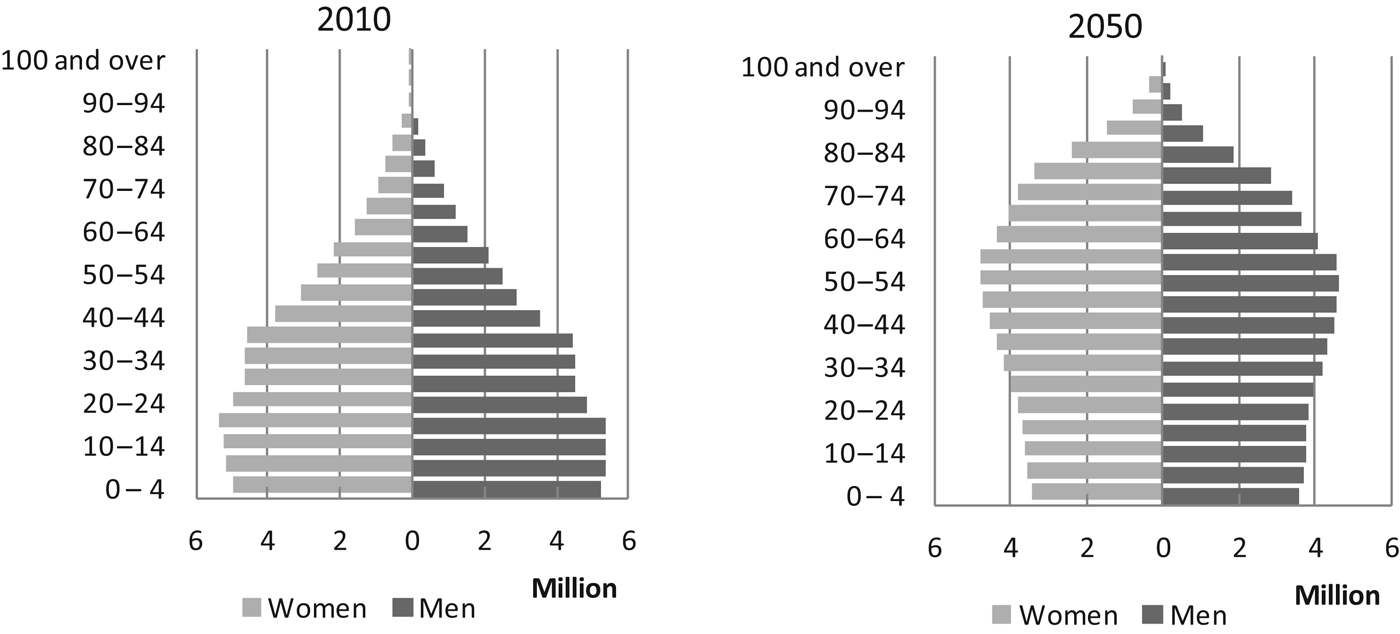
The annual population forecasts classified by gender and age have been taken directly from those made by ECLAC for 2012–2050. The demographic factor is a core element given that the growth of the population will considerably increase the potential participants in the pension system. The total population will increase from 113.4 million in 2011 to 137 million in 2050 (a growth of 20.9%). The population growth trends for 2050, show an increasingly pronounced drop in the fertility rate, confirming the results of national censuses showing the decline in the number of children per woman over the last two decades. The overall fertility rate will fall from 2.06 in 2010–2015 to 1.77 between 2045 and 2050. The change in the population pyramid, according to ECLAC projections, will continue to be significant, since the median age of the population will rise from 27 years in 2010 to 43 in 2050 (Figure 3).
Population pyramids in 2010 and 2050, ECLAC projections.
Moreover, the life expectancy at birth will increase from 76.5 years in 2010 to 81.2 in 2050, while the dependency ratio of older adults (people over 65 compared with the population aged 15–64) will rise from 10.5% in 2013 to 34.9% in 2050.
3.6 Diagnosis and projections based on the model
3.6.1 Main socioeconomic characteristics of the IMSS affiliates using the database constructed
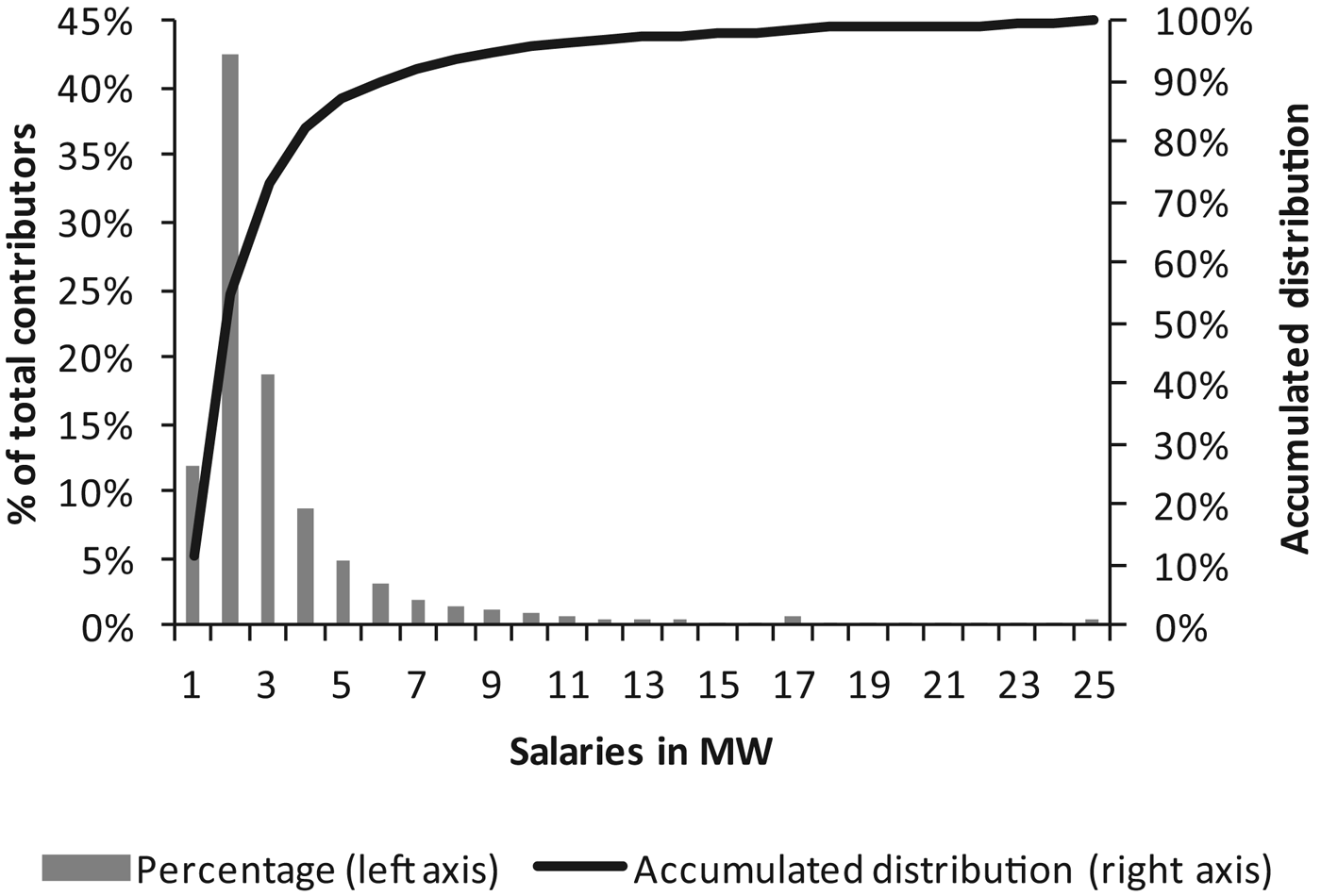
At the end of 2012, the SAR managed 48 million individual accounts, of which 97.4% belong to the IMSS and 2.6% to the ISSSTE. According to CONSAR (2012), 21.3 million accounts received at least one mandatory contribution over the last 3 years. The average wage of regular contributors was 3.48 MW and 75% of these workers receive an income below 4 MW, whereas 93.6% receive an income of 8 MW or less (Figure 4).
Salary distributions of regular contributors.
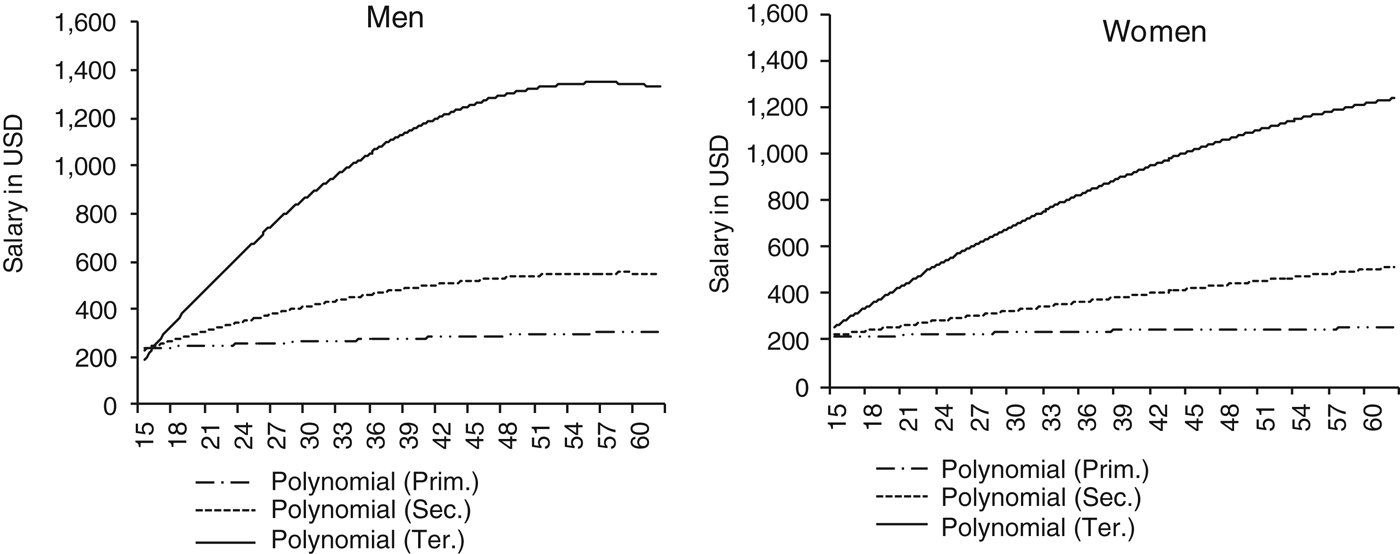
The database presents evidence that educational level is a key variable for obtaining greater income. Figure 5 shows that this effect is greatest in the case of men; by way of example, the income of a man aged 50 is 69% greater if he has had secondary rather than only primary education and 117% greater if he has had tertiary education. The growth slope for income of the most educated groups is steeper: individuals with tertiary education reach their highest incomes at around 54, while those with secondary education do so at 44, and in the case of primary education there is no productivity gain (at wage path). However, the above description does not correspond to a longitudinal data base (the same worker in each period), so the positive income slope at early ages could also be influenced by the fact that new generations have a higher educational level than older generations, so the inflection point of the curve could vary over time.
Monthly income in USD, by age and educational level (regular contributors).
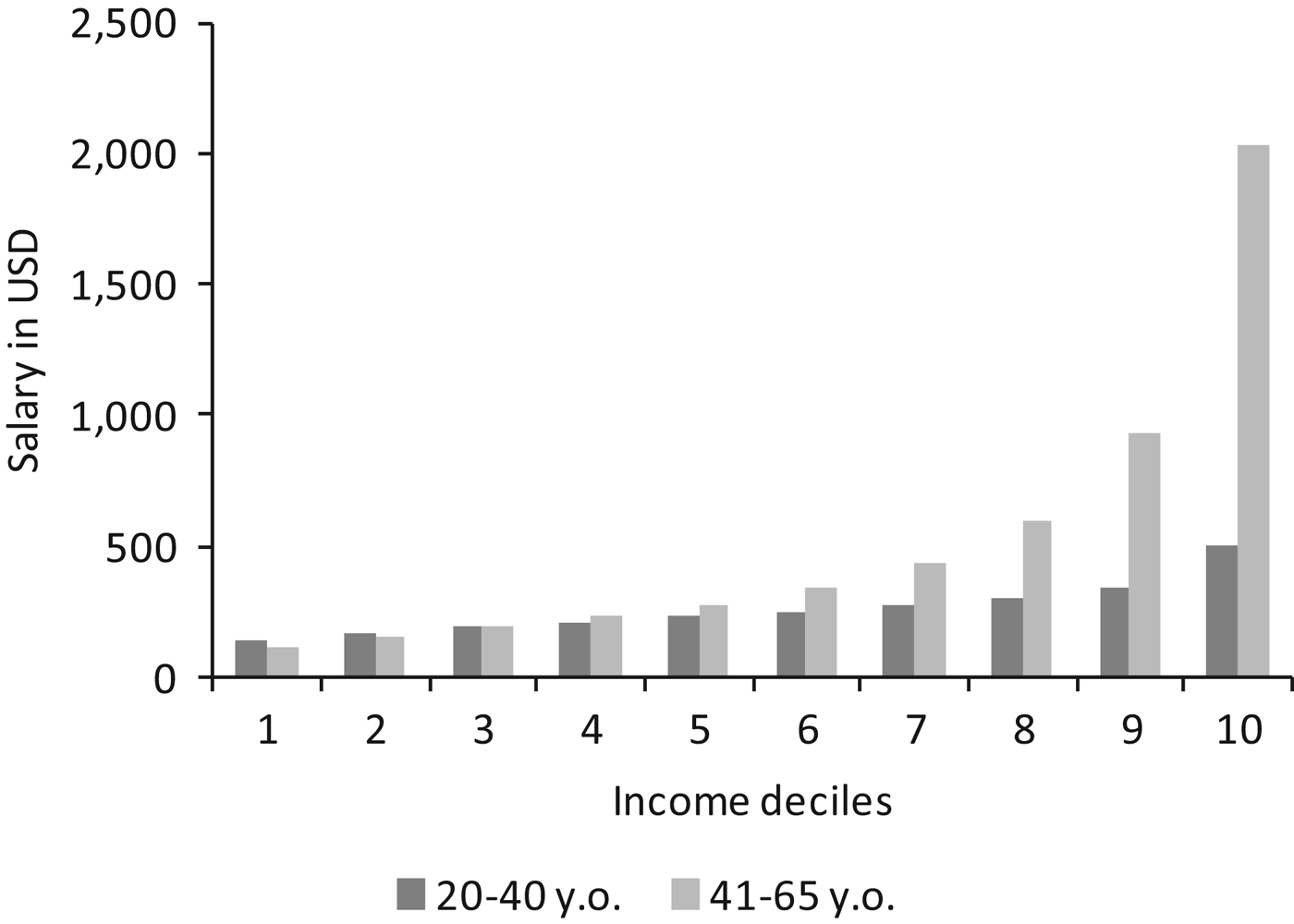
Analysing the information broken down into income deciles and separating them into two age groups, 20–40 and 41–65 years, the youngest group has higher average incomes compared with the older age group between deciles 1 and 2 (Figure 6).
Income by deciles and by age groups (USD).
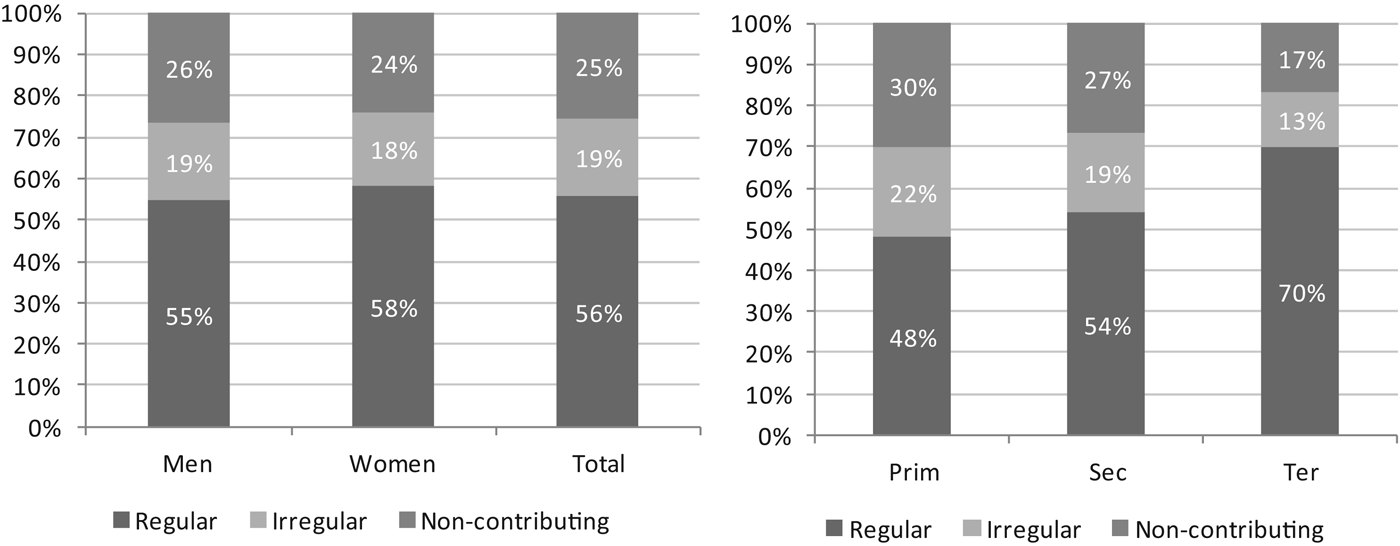
It is from decile 4 on that it can be seen that the people in group aged 41–65 begin to have higher incomes than the younger group. This behaviour could indicate an association between higher income and permanence for more years in the labour market, in the case of those in the richest deciles. This fact is also linked to more years of education in the higher-income deciles. The socioeconomic characteristics are reflected in the participation profiles of workers in the pension system. About 47% of affiliates are irregular contributors or non-contributors, so at the time of retirement, they would not have contributed enough to be eligible to a pension. Within the group of affiliates with tertiary education, 70% are regular contributors (Figure 7).
Distribution of regular, irregular and non-contributors by gender and educational level.
Thus, regular contribution is very closely related to the socioeconomic characteristics of their groups: a higher educational level generates greater income during the active lives of workers, a higher contribution density and therefore increases the probability of obtaining a better pension.
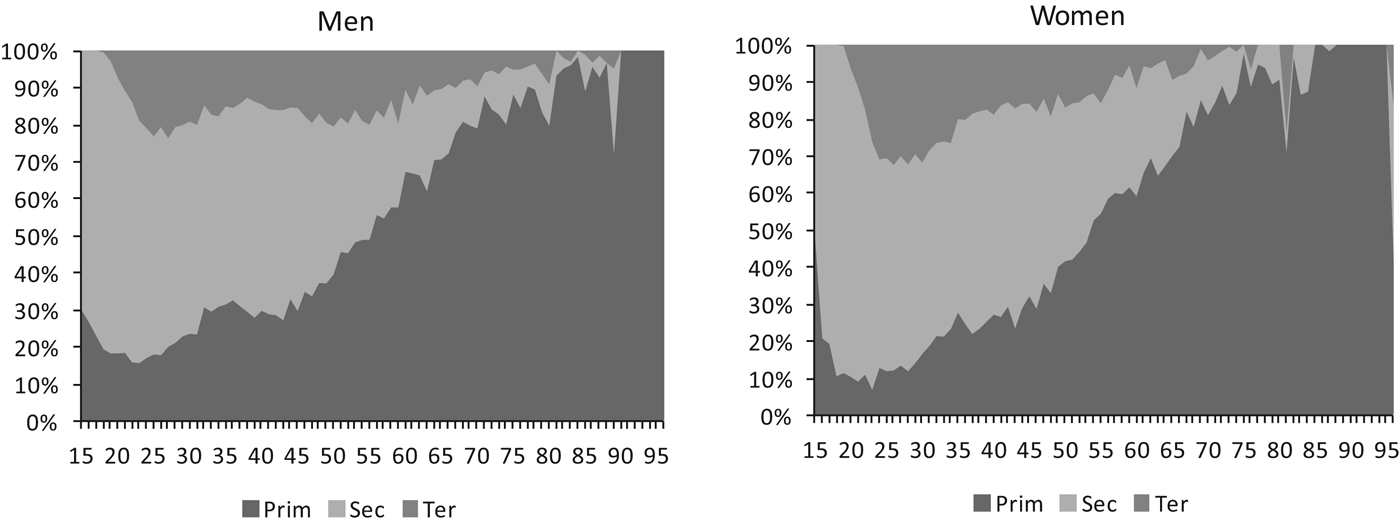
Although the low participation and contribution levels respond to the current educational and income conditions, this could change in the future. Figure 8 shows the educational levels of affiliates between the ages of 15 and 95, younger generations now have more years of education than the educational levels of generations that are now older. This suggests that the probability of young people in the future having a higher retirement pension will increase, given the greater accumulated human capital among both men and women.
Distribution of EAP by age and educational level.
3.7 Diagnosis of the pension systems
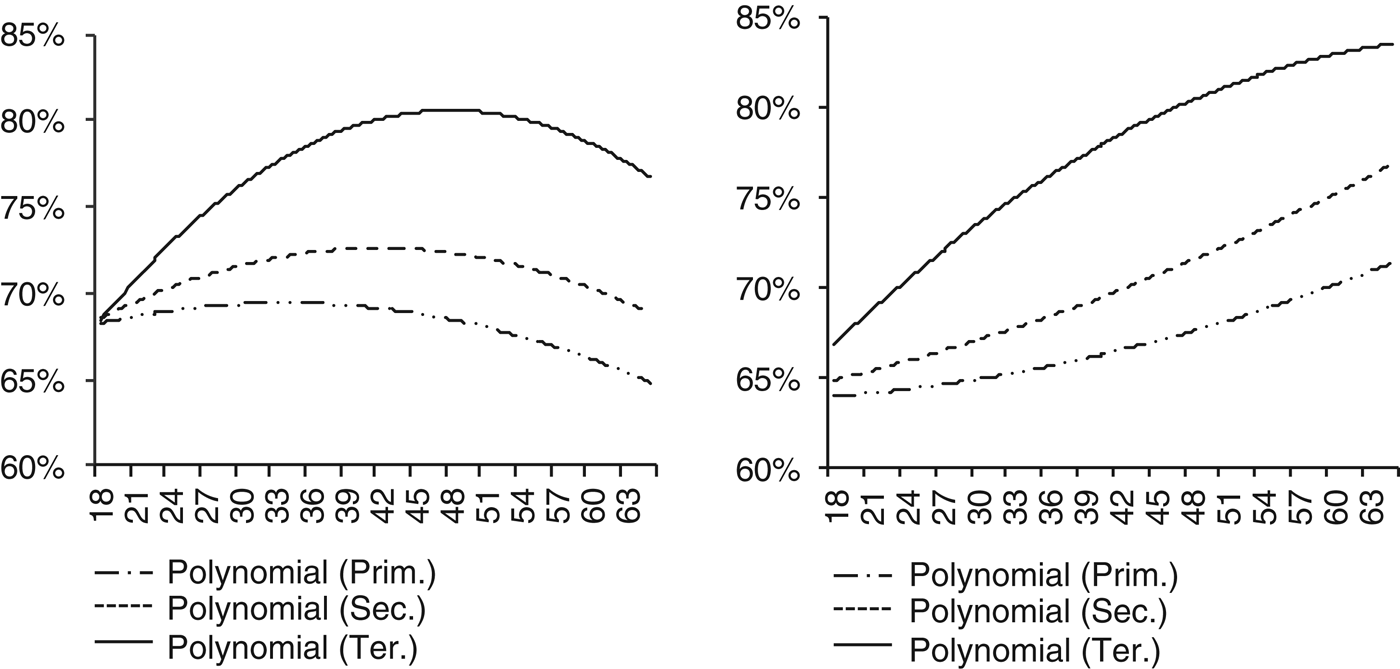
An initial factor to highlight is the low levels of contribution density in the system. Regular contributors, register contribution densities that on average are near 70%. Differences can also be seen depending on gender and the educational level achieved (Figure 9).
Contribution density by age and educational level (regular contributors).
The contribution density of irregular and non-contributors, on average are barely 17% and 14%, respectively. However, a growing trend can be seen as the age of the worker is near the retirement age. This could be due to the intention of accumulating the 500 weeks required by L73 to have the right to a pension, since voluntary contributions are allowed.
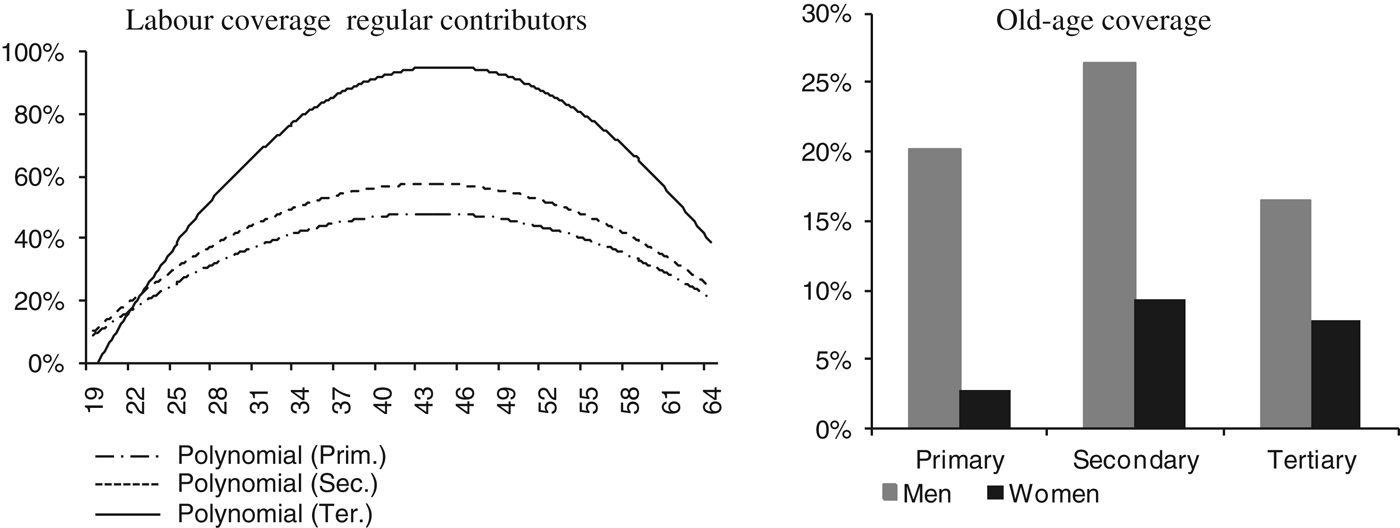
The income and education variables are key factors in achieving greater levels of employment coverage. In Figure 10 (left), regular contributors as a percentage of EAP are shown, and we notice that coverage rates are higher for high-income groups. A similar situation is observed regarding education: the regular contributors with primary education have coverage rates of around 20% of the EAP, this percentage increases to 30% and 60% for secondary and tertiary education, respectively. The labour coverage rate for women compared with men is lower for those with only primary education, but higher for women with secondary and tertiary educations.
Labour and old-age coverage by educational level.
Coverage in old age (Figure 10, right) among men is 21% for primary education, 25% for secondary and 16% for tertiary. In the case of women, the secondary and tertiary educational levels have a coverage of 9%, while only 3% of women with primary education have pension coverage in old age.
3.8 Projections of the baseline scenario
The baseline scenario is the projection obtained based on current conditions and on agents behaving the same way in the future as in the present, with information as of 2011. The profiles of each individual representing the rate of affiliates and the labour market remain constant. The methodology does not explicitly model the behaviour of informality or make explicit assumptions regarding the future, but the mathematical functions included in the model suggest that this is adjusted endogenously, through the trend in education level in the methodology employed and its impact on the coverage and pension levels in the future.
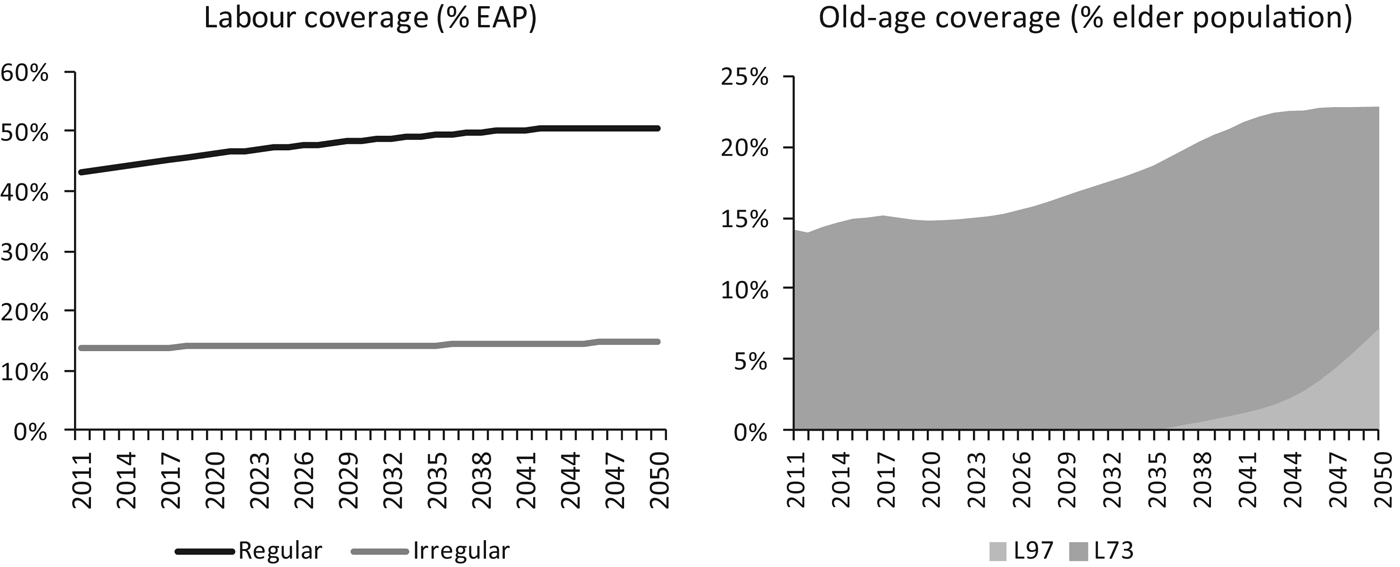
The projected employment coverage rates for regular contributors will be still low, with levels of close to 50% in 2050. The problem is more serious among the groups of low-income young people, who are affected by a high level of informality in the labour market, the low level of contributions and the poor attitude to retirement savings and preference for immediate consumption. Figure 11 shows that pension coverage for those aged over 65 will increase from 14% in 2011 to 22% in 2050.
Projected labour and old-age coverage.
After 2037 the first L97 pensions will be paid to the GA. The main reason why the old-age coverage rate does not increase significantly is the low level of participation during active life. This has a negative effect on the capacity to accumulate the resources and years of work required for eligibility to a pension. The situation is even worse in the case of the lower-income deciles. It is important to observe this situation in a context where the population aged over 65 will increase sharply in the coming decades from 6.6% of the population to 21.8% in 2050, according to ECLAC projections. This implies that the social problems involved in not taking action may be more difficult and clearer than it is now. Given the strong relation between coverage of active workers and future pension coverage, the most sustainable way of ensuring that more people obtain pensions in the future is to create incentives for active workers to save, as well as to focus resources on elderly groups in a situation of poverty.
3.9 Replacement rates
The RRs are calculated as:
 $$RR73 = Pen73_x {\rm /}W_{g,y,e,l,r}^t, $$
 $$RR97 = Pen97_x /W_{g,y,e,l,r}^t, $$
where RR73 is the replacement rate of L73 pension; RR97 the replacement rate of L97 pension; W the salary by type of worker.
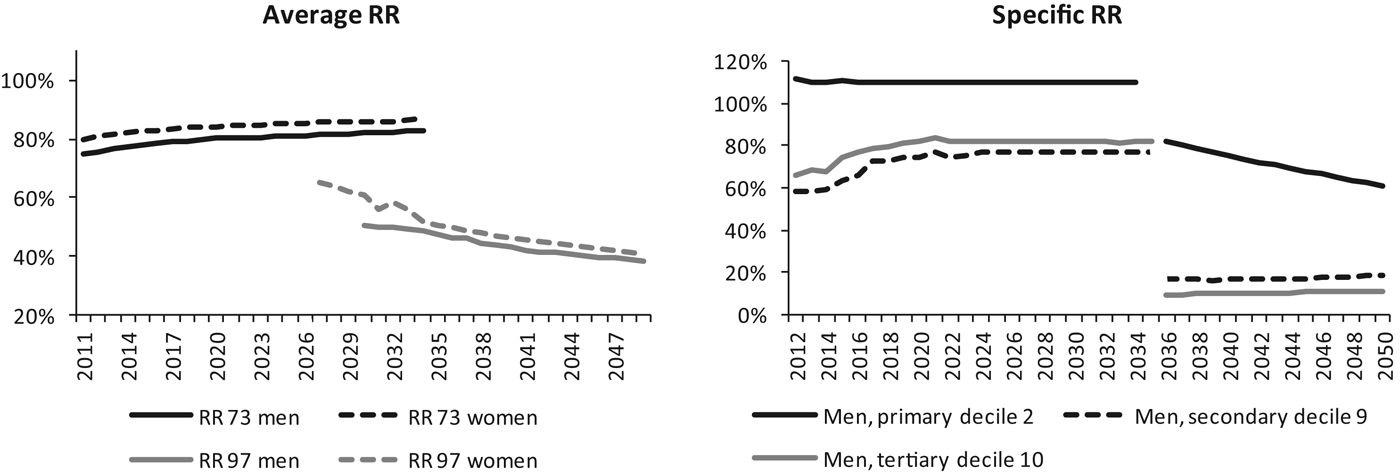
The RR projected to 2050 show a varied behaviour: from 2012 to 2035 workers in the GT are expected to choose the L73 pension, because its RR is generous and only requires 500 weeks of contributions.
Starting in 2035 the first workers of the GA begin to receive L97 pensions, whose RR will be considerably lower compared with the L73, due mainly to factors exogenous to the pension system (low contribution rates and low contribution densities).
The average RR calculated in our model is shown on Figure 12, left. The average RR of L73 is growing, because in the future, cohorts with a higher educational level and higher density of contribution retire, will obtain better pensions. The average RR of L97 is declining, because the balance of individual accounts would be insufficient to provide a pension greater than the MPG, and most of the pensioners will get this guarantee. Thus, as the MPG represents a constant amount in real terms, while wages will grow in real terms, the RR of L97 calculated with formula number (41), will decrease in time. In both cases, the RR for women is slightly higher than for men (41% and 38%, respectively, in 2050), thanks to the greater contribution density of women and the fact that female pensioners from L97 do not have to buy a survivors’ insurance for their husbands.
Projected Average and Specific Replacement rates for L73 and L97.
However, a key fact to take into account is the increased life expectancy of the population, as the retirement age is constant and the balance of the IA is distributed between an increasingly large numbers of years. Finally, another factor affecting the future RR will be the natural downward trend of returns, as in the following decades there will be lower and less volatile returns, in line with the lower country risk, and the strength of economic activity, which will be closer to its potential growth rate. Analysing the projected RR of L97 for different types of workers, a variety of different behaviour can be seen (Figure 12, right), as workers in lower deciles who receive a MPG have a higher RR than workers with high incomes; this is because workers with salaries of more than 15 MW do not receive the Cuota Social, so their contributions as a percentage of their salaries are lower than the contributions of workers in lower deciles. The generous RR of L73 for low-income workers, should not be compared directly with the RR of L97, given that the L73 represented a growing deficit that was financially unsustainable, while the system of DC is fully financed from the individual accounts.
3.10 Fiscal cost
The fiscal cost includes the payment of L73 pensions, MPG, as well as the Cuota Social and other government contributions to the individual accounts of active workers.
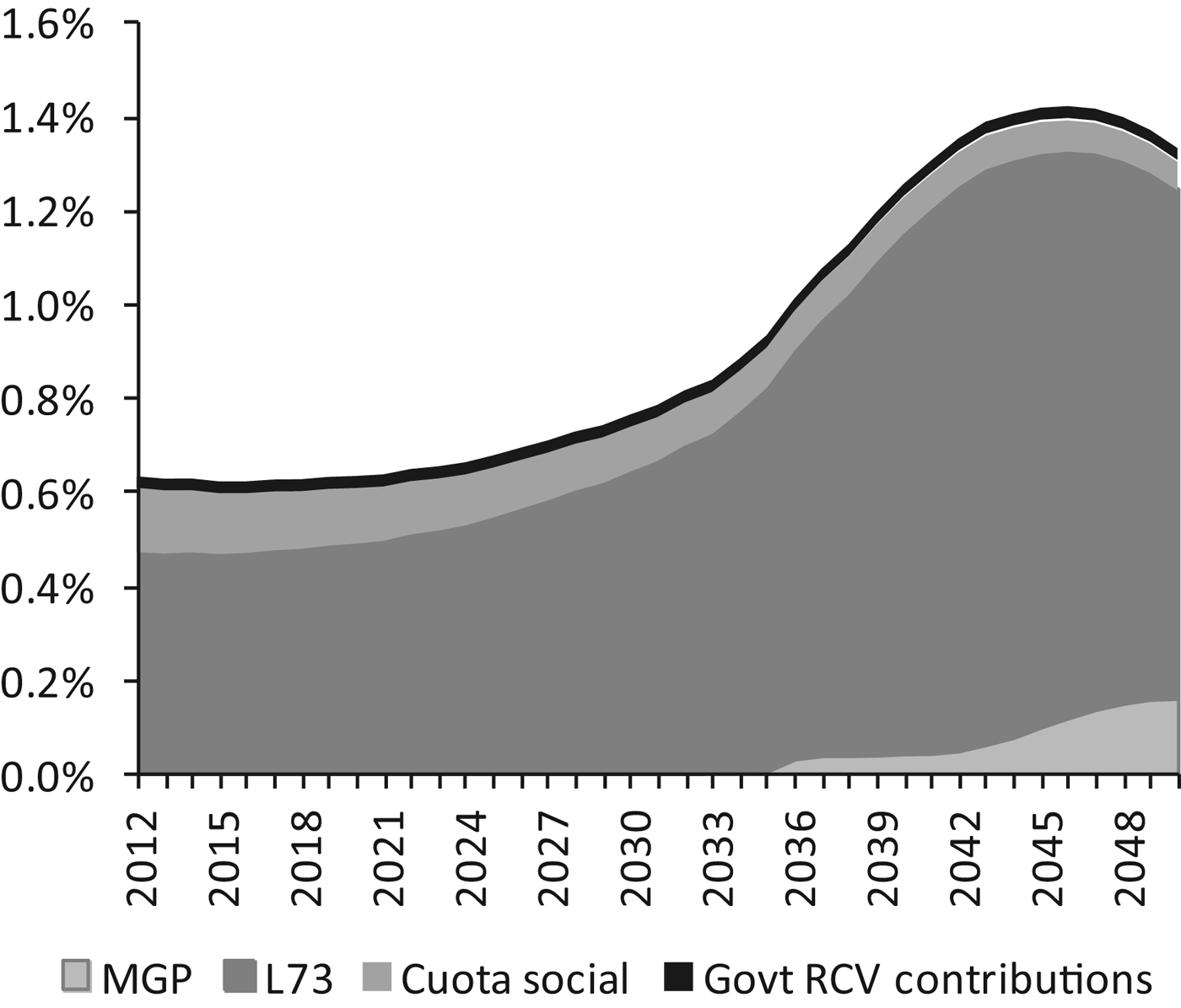
Most of the fiscal cost is due to the L73 pensions and it is projected to increase, as more workers receive L73 pensions. The fiscal cost hits a maximum of 1.4% of GDP around 2045, and then begins to fall, as the pensioners belonging to the GT die (Figure 13).
Projected Fiscal Cost as a % of GDP.
The present valueFootnote 25 of the fiscal cost in 2012–2050 in the baseline scenario is 32.9% of nominal 2012 GDP. The most important components of this cost are L73 pensions (27.4% GDP) and the Cuota Social (3.6% GDP).
3.11 Balance of the results of projections in the baseline scenario
Our model projects the evolution of the pension system in the long term and identifies the main problems and the most vulnerable groups. Based on this, policy proposals can be focused on specific subjects or groups. A core factor is the need to increase formality in the labour market and generate adequate incentives that create significant improvements in the level of labour and pension coverage. The results of the baseline scenario show that in 2050, the labour coverage will be still low (50% of the EAP). Similar behaviour is expected for the level of old-age pension coverage, which will barely change from that observed currently and in 2050 (about 20%). The situation is worse among the low-income young, who are the most affected by levels of informality, due to their limited capacity of accumulation and attitude to saving. It is precisely on these kinds of groups that policies of incentives and social welfare programmes should focus their attention. The low levels of contribution densities – which over the projection horizon will only increase due to the increased educational levels of affiliates (more people with tertiary education) – increased life expectancy, and the natural downward trend in returns, are factors that explain the reduction in the average RR over the projection, despite the increase in pensions. Although these variables are different according to the income decile, educational level and gender of the workers, a policy based on improving contributions over the working life (increasing contribution densities, generating incentives to contribution by adjustments in the contribution rates according to life expectancy, etc.) would help provide better retirement benefits in old age.
4 Proposals for reform
4.1 Increase the mandatory contribution rate
The contribution rate is a key variable in accumulating the balance of the individual account, and on the RR obtained at retirement. Given that life expectancy at age 65 is becoming increasingly long, the amount of pension obtained with the balance of the IA will fall. Thus, increases in the contribution rate will be required in order to obtain an adequate retirement income in a longer life expectancy scenario. Countries with similar life expectancies to Mexico have contribution rates of over 10% of the salary.
In the long term, the ideal would be to adjust the contribution rate automatically in accordance with increased life expectancy. This would enable decisions on parametric adjustments to be isolated from political decisions. International experience shows us that countries such as Germany, Italy and PeruFootnote 26 have already incorporated this adjustment criterion.
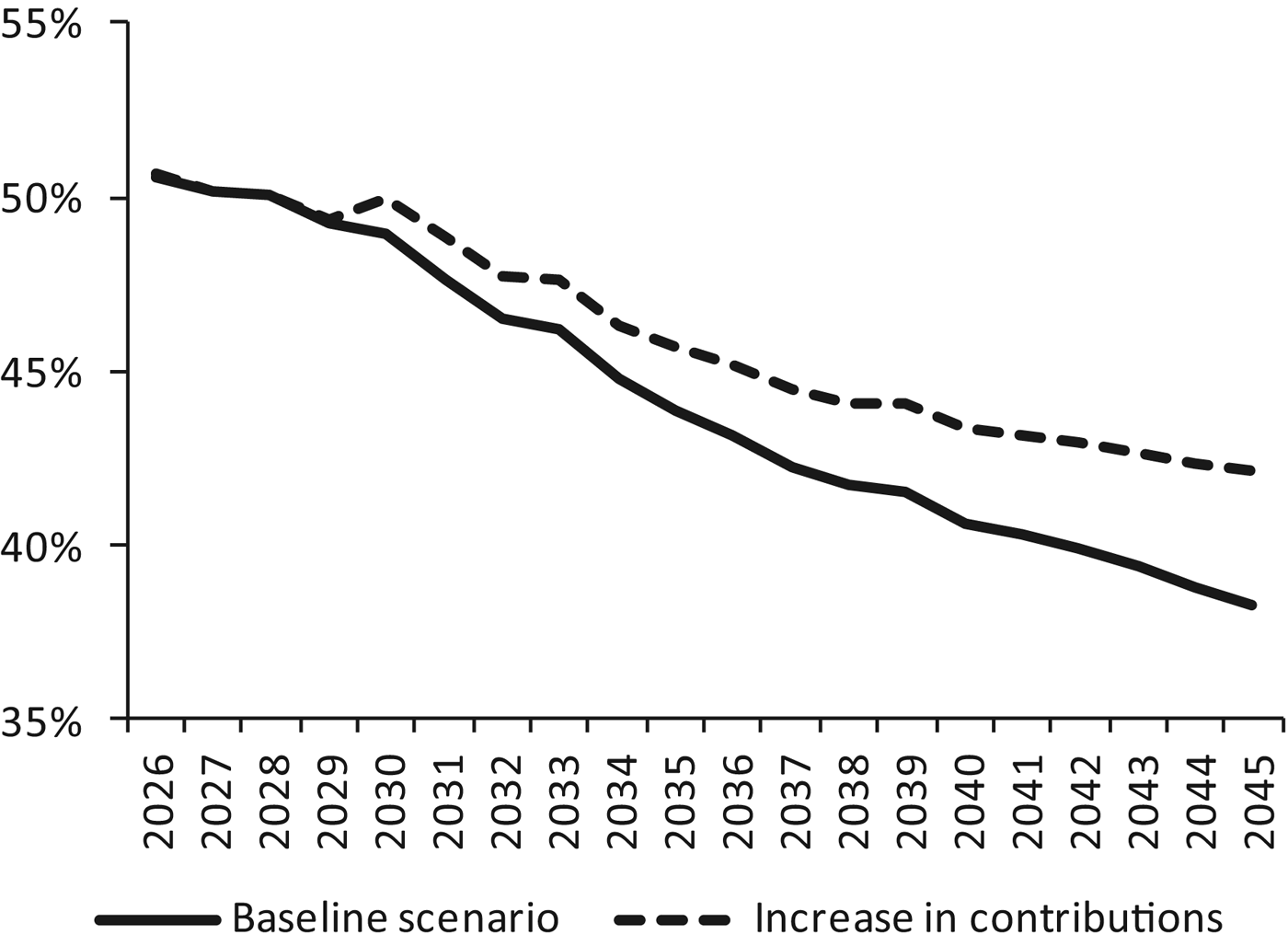
It is also worth noting that the IMSS contribution rate of 6.5% of the salary, is one of the lowest in Latin America. It includes a contribution from the government of 0.225%, while the employer pays 5.15% and the worker's contribution is 1.215% of the salary (equivalent to 4 days of salary per year). In order to deal with the low contribution levels in the pension system, we propose an increase in the contribution rate of 100 basis points each year, from 2013 to 2017, so as to have a contribution rate of 11.5% in 2017. We simulated the effects of this proposal (Figure 14), and the results are that the average RR of L97 in 2050 would increase by 4 percentage points (from 38% to 42% for men, and from 41% to 45% for women).
Average Replacement Rates L97 in Baseline scenario and with increases in contributions.
In addition, the scenario with increases in contributions would generate fiscal savings, due to the greater balance recovered by the government from individual accounts of workers in the GT who receive L73 pensions, and a lower number of MPG financed by the government. The present value of fiscal saving for the period 2012–2050, is estimated at 2.9% of nominal 2012 GDP.
4.2 Gradual elimination of early retirement before 65
Currently, early retirement is allowed both under L73 and L97, so workers may retire at age 60 with 500 weeks of contributions (1,250 weeks for L97). According to IMSS statistics, 78% of current pensioners have opted for early retirement, and 95% of those aged 60 choose an early retirement. In accordance with ECLAC projections, life expectancy at age 60 in Mexico will increase from 22.7 years in 2010 to 26.1 years in 2050, so in a scenario of longevity risk with higher life expectancy, the option for early retirement should be eliminated. The policy measure we propose is for the steady elimination of early retirement, increasing the age eligibility requirement by one year annually until in 2017 it disappears. As a result, the fiscal cost of L73 pensions will decrease by 5.6 percentage points, as the affiliates will contribute for a longer period and pensions will be paid for a shorter time.
4.3 Non-contributory pensions
In 2011, only 14% of people over the age of 65 have an old-age IMSS pension. This percentage is reduced considerably if we consider the low-income group. Projections carried out on the baseline scenario show that this situation does not improve in the long term. In fact, it becomes more worrying if we consider the ageing population expected over the coming years: people over the age of 65 currently represent 6.5% of the population, while within 40 years they will account for 21.8%, according to ECLAC projections. Thus by 2050, 78% of the population aged over 65 will not have any form of coverage. Although the long-term solution to ensure pension coverage in old age depends on increasing participation levels in active life, from a social perspective this is a subject that has to be addressed now, particularly in the case of disadvantaged groups that are in a situation of extreme poverty.
We estimated the fiscal cost of the ‘Pension para Adultos Mayores’ programme, under the following assumptions: (i) A pension of MXN 525 per month is granted to the population aged over 65 who do not have any social security pension; (ii) The population not receiving contributory pensions, is calculated with the pension coverage of IMSS, ISSSTE and the state pension institutions, the latter two are equal to 6% of adults aged over 65; (iii) The ‘Pension para adultos mayores’ programme achieves a total coverage of the target population; (iv) The financing of the programme is carried out ex post, i.e., it is paid once the population reaches the required age and there is no pre-finance of the benefit that would allow a capitalisation of the contributions to the programme. The results obtained indicate that the fiscal cost of the programme for 2013 is MXN 40,439 million (USD 3.1 billion), whereas in 2050 the figure will be more than MXN 133,000 million (USD 10.2 billion). The average annual expenditure flows amount to 0.28% of GDP. The present value of the fiscal cost of the programme for the 2013–2050 period represents 10.4% of GDP.
Our proposal is to integrate all the existing non-contributory pension schemes into the ‘Pension para Adultos Mayores’ programme, with an ex ante financing scheme, so the government contributions could be made into a fund, run by financial institutions, in order to guarantee transparency in the management of the funds and to obtain financial returns that reduce the total fiscal cost.
4.4 Matching DC scheme for young people
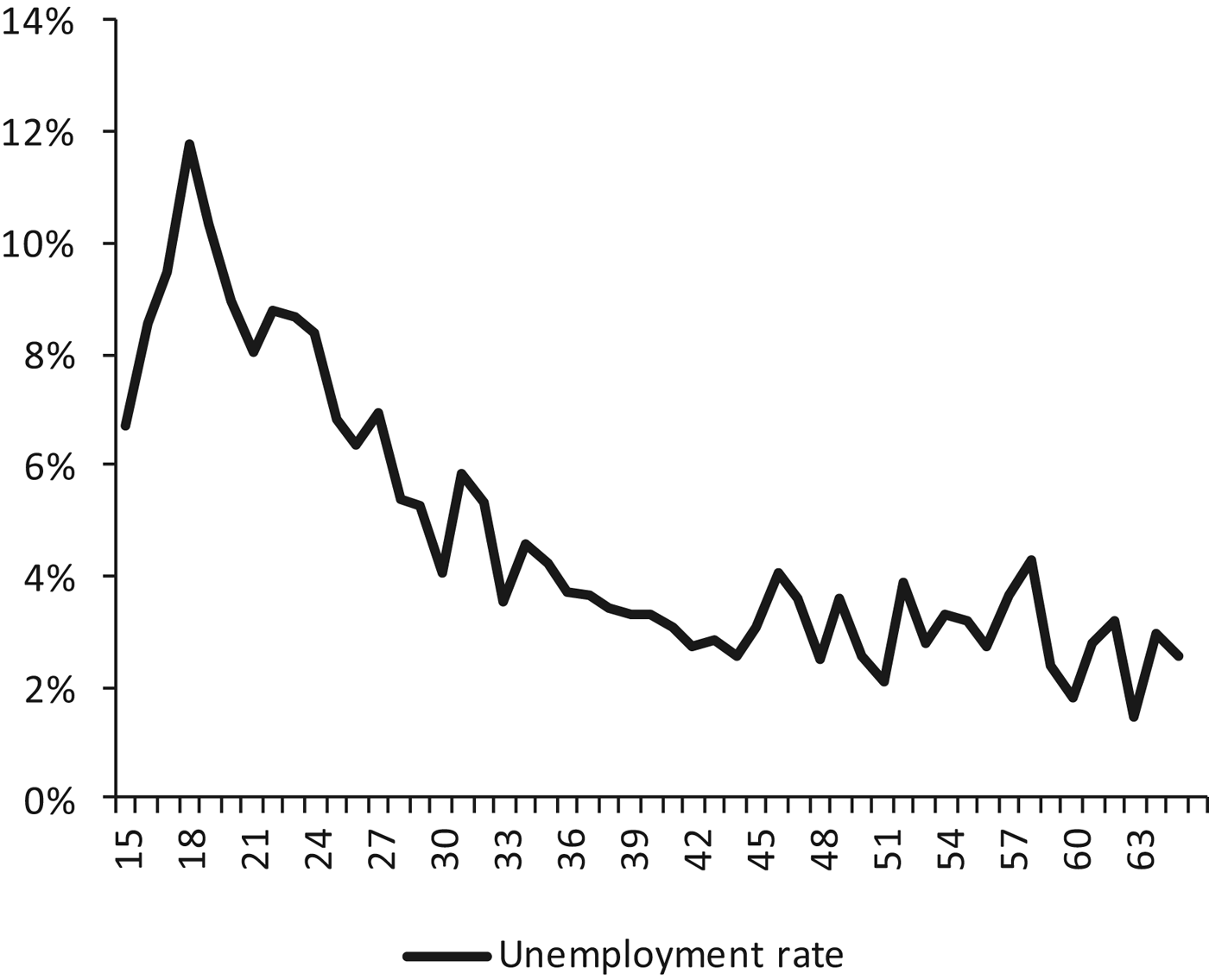
The problem of coverage largely depends on structural aspects, which go beyond the design of a pension system. One proposal would be to focus incentives on contributions of young people. This population group is one of the most vulnerable in the labour market, given that near 40% of workers aged between 20 and 25 are informal. In addition, according to the ENOE 2012 survey, the unemployment rate is higher among the young (see Figure 15). The importance of making contributions to the system at an early age is a key factor in receiving higher pensions in the future, particularly in the case of workers with lower incomes and low educational levels. This is why it is important to promote pension savings among this group of the population.
Unemployment rate by age.
In this scenario, a mechanism that allowed not only incentives for savings at an early stage, but also the formal hiring of young workers, would be necessary. We propose a matching-contribution scheme aimed at the young, which helps combat two basic problems: (i) lack of consistency over time, due to the short-sighted point of view with respect to pension savings at the early age of employment life; and (ii) capture the potential for saving of these groups: the people with fewest resources can also save. The matching would have two subsidies: one for the worker's contribution-although it only amounts to 4 days of salary per year, and another subsidy to the employer contributions, which promotes the hiring of young workers and reduces the cost of increasing the level of formal employment. This matching contribution would only apply to young people who earn up to a minimum wage, and the scheme would be progressive, so that the government would contribute 100% of the worker's and employer's contribution (i.e., the whole contribution, equivalent to 6.5% of the salary, would be from the government) for workers aged between 14 and 20. This percentage would then be reduced gradually to 0% at the age of 30. This 100% contribution to the IA is equivalent to MXN 121 (USD 9) per month, according to the average salary of this age group, and the aid would be reduced to zero at the age of 30. This type of scheme would not only increase employment coverage for the group of young workers, and thus raising the balances in the individual accounts at a key period of accumulation, and with it, future pensions. It would also encourage formal employment in companies that want to enter the programme. However, a number of factors have to be taken into account for this programme to operate successfully: (i) first, a proper focus on the context of application, the objective to be reached, the incentive and the costs incurred. If it does not function well, it could lead to a bad use of the programme's resources and not reach the target group; (ii) an adequate cost/benefit ratio for participating in the programme, both for the company and the worker, to ensure the interest of both parties to participate in the scheme; and (iii) a good handling of the operational aspects, including the administrative capacity of firms, savings mechanisms, spread of participation and compliance.
4.5 Reform of the DB pension systems
At present there are state, municipal and state-owned companies DB pension systems. Although some states have reformed their pension systems through structural reforms (changing to DC or hybrid schemes) or parametric reforms (increasing contributions or requirements for receiving a pension, although preserving the pay-as-you-go scheme), as of 2009 the present value of the deficit of the State pension systems amounted to 11% of GDPFootnote 27. These pension systems represent a contingent liability that could compromise their financial viability in coming years. The recommendation is therefore to undertake reforms to state and municipal pension systems in order to guarantee their financial sufficiency in the long term, converting them into sustainable systems with full portability of pension benefits among them.
4.6 Mandatory incorporation of independent workers
Regardless of employment condition (salaried or independent), all workers should contribute to a pension system. Although the SAR allows independent workers to open an IA and make voluntary contributions, their levels of membership and contribution are very low. This could be due to inadequate incentives, the short-sightedness of workers or lack of resources. According to ENOE data from 2012, 60.1% of the working population (29.3 million) works in the informal economy, either independently or without a contract. Considering that 29.3 million workers are not formal, only 0.75% of them have an IA in the SAR.
Therefore, in order to increase the coverage of the social security system, the proposal is to make it mandatory for independent workers to contribute to the SAR. However, given the employment conditions of these kinds of workers move, often informal, it would be difficult to make all the target group join; particularly if we consider the lack of mechanisms to identify these kinds of workers and make them comply with obligatory contribution. If an adequate control mechanism could be established, such as the one introduced in Chile in 2008, which obliged independent workers who receive income subject to income tax to make contributions to the mandatory system based on their annual income. The introduction of this measure in Chile was gradual, in the following stages: (1) Information period (3 years): Independent workers are only obliged to notify their annual income. (2). Opt-out period (3 years after stage 1): Obliged to make contributions on a percentage of declared annual income, against the tax withholdings owed to workers, unless these workers explicitly state their desire not to make contributions. The default option shall be to contribute to the system, which makes it possible to maintain the voluntary character of the contribution, but requiring the participant to make an active decision. (3) Mandatory period: Obligation to contribute on 100% of taxable income without exceptions.
This scheme could be implemented in Mexico, together with a matching contribution system from the government, so to create incentives for participation. In order to quantify the effects of implementing this measure, an estimate is required of the number of independent workers that are obliged to fill an income-tax declaration, – which is beyond the scope of this work –, as well as coordination between the tax administration and IMSS.
4.7 Greater tax incentives for voluntary savings
Voluntary savings become more relevant in a context of low coverage and low RR in pensions systems. The international trends are toward the strengthening of voluntary savings pillar, so as to diversify retirement income sources. In Mexico, there are tax incentives for individual voluntary savings that make it possible to deduct pension contributions from income tax (however, only high-income workers (earning above MXN 400,000 (USD 30,769) per year and file an income-tax declaration) benefit from these incentives.
New schemes of tax incentives could be developed in order to offer benefits to lower-income workers. First, to promote voluntary saving at the individual level, we could take the example of Chile, which introduced two schemes of tax benefits in 2008, depending on whether it was at the time of making the savings or withdrawing them:
(1) Upon making contributions: amounts are deduced from the taxable base (as in Mexico). (2) On receiving the pension: the worker's contributions are not deducted from the taxable base. When the fund is received in the form of a pension, for the purpose of payment of income tax, the proportion from the voluntary savings will be deducted. This option is targeted at lower-income workers, who do not have to file income-tax returns, and would not benefit from tax deductions when making contributions. In addition, to promote voluntary saving through occupational pension schemes, we propose increasing the limit to joint tax-deductible contributions. For example, in 2013 Turkey increased the limit of income-tax deductible contributions to 15% of the salary for employer's contributions and 10% of the salary for the worker's contributions.
5 Conclusions
Beyond the general knowledge of the difficulties in aggregate terms facing the IMSS pension system in Mexico, this work has tackled the problem in two dimensions: depth and time. With respect to depth, it has shown at the level of individuals, the problems of coverage and access to a pension, depending on the socioeconomic characteristics of employment, income, education, gender and the generation to which the worker belongs (GT or GA). With respect to time, the profiles of the trends that could be presented in the different groups of individuals were projected in the long term. Based on this, we could diagnose the conditions of the pension systems until 2050.
To do so, our projection model uses databases with information on the socioeconomic profiles of nearly 4 million individuals, with 40 variables in the period 2010–2050. These data are organised into 60 types of representative individuals, who are then projected following a generational accounting model based on the use of actuarial techniques and macroeconomic estimates for projection scenarios. These permanent characteristics will determine key elements such as the rate of affiliation, rate of contribution, contribution salary, etc. The model also includes a dynamic element: the education variable affecting the probability of contribution, salary profiles and contribution densities.
In fact, the diagnosis of representative individuals points to various interesting conclusions to be taken into account. The socioeconomic characteristics are reflected in the participation profiles of workers in the pension system, such as the salaries and contribution densities over their employment cycle, which will determine the level of pensions they will receive. About 47% of affiliates would not obtain a pension when they retire, as they have made irregular contributions, although they would recover the amount accumulated in their account. The educational level is a key variable for obtaining higher income, given that within the group of affiliates with tertiary education, 70% make regular contributions.
Regular contributors – those who have contributed at least once in the period 2009–2011 – have contribution densities that on average are at round 70%. In the case of irregular contributors, the densities are on average only 17%, which increases the risk of not having a sufficient retirement income. Analysing the groups of affiliates by income deciles, the lowest-income groups have coverage rates of about 39%, while they increase to 48% for high deciles. Equally, the youngest groups (under 30) present lower levels of coverage and work informally. This will have a very negative impact on the future of their pensions.
Regarding coverage in old age, the levels for men are higher than for women. In addition, men receive on average higher pensions than women, which are reflected in their respective RR. Apart from this, up to now, old-age pensions have only been granted under the pre-reform DB system (L73). The projected RR show a very different trend: from 2012 to 2035 workers of the GT are expected to choose the L73 DB pension and the average RR will grow in the projection horizon, because as the generations with a higher educational level who contributed over a longer employment history retire, they will receive higher pensions. Starting in 2035 the first workers of the GA begin to receive pensions funded with the individual accounts (L97).
The RR they obtain are considerably lower compared with the L73, due mainly to factors exogenous to the pension system, such as low contribution rates and low contribution densities.
The average RR for L73 pensions is 88%, whereas for L97 pensions it is 44% during the projected period. However, in the case of DC pensions, notable differences can be seen in the RR obtained by different groups: the lowest deciles that receive the MPG have higher RR than the middle and higher deciles who do not have the support of the Cuota Social.
In the scenario projected to 2050, the employment coverage rates of regular contributors continue to be very low, at levels of close to 50%. This problem is worse among the youngest low-income groups. Meanwhile, with respect coverage in old age, the results will barely change between those observed now and 2050, at about 22%. This is explained by the limited participation in the active life, greater restrictions that will exist on accessing a pension compared with past generations (1,250 weeks of contributions versus 500 weeks required by the former law) and the fact that the number of people over the age of 65 is growing significantly as a result of demographic changes.
The L97 RR show a very strong tendency downward, as a result of nearly 75% of the pensioners receive a MPG (which is constant in real terms, while wages show a real growth), the increased life expectancy of the population, as well as the downward trend in returns. The conditions change in accordance with the socioeconomic conditions of the representative individuals, as the pensions received by the lower-income groups receive the Government subsidy by both the MPG and the Cuota Social.
The fiscal cost of the IMSS pension system includes the payment of L73 pensions, the MPG, the Cuota Social and other government contributions to the IA of active workers. The present value of the fiscal cost in the period 2012–2050 in the baseline scenario is of 32.9% of nominal 2012 GDP. The most important component of this cost is the L73 pension.
The baseline scenario projections show a difficult future for the protection in old age. In this case, one of the most important factors are the negative consequences of having an informal labour market on the conditions of contributions and thus on the possibility of obtaining adequate pensions. The situation is dramatic among the young and those with low incomes, due to their limited capacity of accumulation, which is much more obvious in the case of groups with less education. In addition, the low levels of contribution densities, increased life expectancy, and the natural downward trend in returns, are all factors that would explain the reduction in the RR over the projection horizon.
With respect to non-contributory pensions, we analysed the ‘Pension para Adultos Mayores’ programme, implemented in 2013 and financed by the Government, which grants a monthly pension of MXN 525 (USD 40) to adults over the age of 65 who are not eligible for a social security pension, through ex post subsidies without any pre-financing mechanism. In order to reduce the fiscal cost of this programme, whose present value we estimate at 10.4% of nominal 2013 GDP, it is proposed that contributions should be made to a trust or fund administered by financial institutions, in order to guarantee the transparency in the accumulation and use of resources, as well as taking advantage of the financial returns that could reduce the fiscal cost of the measure. This programme would allow all elderly people to have at least a minimum income in old age.
Taking into account this base projection scenario as a starting point, we simulate the expected effects of a applying a set of proposals with the aim of tackling the main problems, such as the low coverage, low RR, and low level of participation by young people in the system. The first proposal consists of increasing the rate of contributions to the individual account, which currently is equivalent to 6.5% of the contribution salary. Countries with a similar life expectancy to Mexico currently have contribution rates of more than 10%. A scenario considering an increase in the contribution rate of 100 basis points per year, from 2013 to 2017, results on a contribution rate of 11.5% of the salary in 2017; the average RR could be increased by 4 percentage points in 2050 on the figure in the base scenario. Thus, the fiscal cost would be reduced by 2.9% of GDP. It would be ideal to implement an institutionalised mechanism, so that the contribution rate was adjusted in the future, taking into consideration the indicators of life expectancy, long-term returns of the pension funds and the contribution density of workers.
From the parametric point of view, we analysed how the early retirement mechanisms have no rational relation to the concept of pension saving, and the greater longevity risks arising from them. According to IMSS statistics, 78% of current pensioners receive the early retirement pension for which they are eligible at 60 years of age. Thus, the second proposal is to gradually eliminate early retirement, by steadily increasing the minimum age for retirement until it disappears in 2017. The simulation shows that with this measure, the fiscal cost for L73 pensions will fall by 5.6% of GDP, with respect to the results obtained in the baseline scenario.
The third proposal refers to the integration of non-contributory pension programmes at state and federal level into a single universal pension programme, pre-financed with contributions to a trust or fund, and handled by independent financial institutions, in order to guarantee transparency and benefit from financial returns on the contributions made to the fund.
Fourth, we propose a matching contribution scheme for young people, through which the government would contribute 100% of the contributions to the IA for workers aged between 14 and 20, and then this percentage would be steadily reduced until 0% at 30 years. This would support young workers, and provide subsidies for both workers and employers. The scheme would not only increase the employment coverage among the group of young workers, but also promote formality in companies that entered the programme. A fifth proposal refers to the need to reform the current DB pension schemes that exist at state level, in state-owned companies and public universities, which are financially unviable in the future and represent a problem for the public finances. In this respect, we propose that these schemes should be reformed into DC systems, in order to have complete portability of pension benefits for workers.
Regarding the mandatory contribution to the SAR for independent workers, this measure could be applied similar to that introduced in Chile in 2008, which obliged independent workers subject to income-tax declaration to make contributions based on their annual income, under a gradual scheme consisting on an informative stage, followed by an opt-out stage in which the workers can explicitly state their desire not to make contributions, and a final mandatory stage. This scheme could be implemented in Mexico, together with a matching contribution system from the government, in order to create incentives for participation.
The final proposal is to design new schemes of tax incentives for voluntary savings, in order to benefit lower-income workers at the time of withdrawing these resources to obtain a pension. Currently, only high-income workers with annual earnings above MXN 400,000 (USD 30,769), who are obliged to make an income-tax declaration, can take advantage of tax incentives at the time of making contributions.
By way of conclusion we could state that the reform of the IMSS pension system in 1997 limited the growing fiscal cost under the previous pay-as-you-go scheme. Sixteen years on from its creation, the SAR has had favourable macroeconomic effects for Mexico (see Villagómez et al., Reference Villagómez and Hernández2010), as it has significantly increased financial saving, encouraged the development of local financial markets and led to the creation of new asset classes in which Afores invest pension savings. However, the coverage and RR of this pension system are far from ideal, due to problems exogenous to the pension system, such as low contribution rates, low contribution densities and informal labour markets.
The measures proposed in this document aim to help resolve the weak points of the SAR, increasing projected replacement levels and reducing the fiscal cost associated with the pension reform. With respect to the problem of pension coverage, the existence of a universal pension or one targeted at the population that does not have social security, such as the ‘Pension para Adultos Mayores scheme, can provide a retirement income for all the elderly. However, the Government will have to pay particular attention to ensure that this measure is financially sustainable and does not put public finances at risk, as well as implementing pre-financing measures to reduce the associated fiscal cost. Last, but not least, it is important to increase the financial literacy of workers in order to be better prepared for their retirement, and to promote the growing importance of making voluntary savings to obtain an adequate retirement income.