Introduction
In recent years, numerous initiatives have been taken to improve the protection of human rights and dignity of people suffering from mental disorders and to implement the necessary legislation in order to empower them to participate fully and equally in society. In the first place, the United Nations Convention on the Rights of Disabled People (United Nations, 2006; Callard et al. Reference Callard, Sartorius, Arboleda-Flórez, Bartlett, Helmchen, Stuart, Taborda and Thornicroft2012) has to be mentioned here, which has been ratified by the German parliament in 2009. In 2005, the WHO European Ministerial Conference on Mental Health issued the ‘Mental Health Declaration for Europe’ (World Health Organization, 2005), which provides basic rules and guidelines for promoting citizenship and fighting the violation of rights of persons with mental health problems. In 2004, the Council of Europe has published two specific ‘Recommendations of the Committee of Ministers to Member States’ for the ‘Protection of the Human Right and Dignity of Persons with Mental Disorders’. In addition, several projects of the European Union were devoted to human rights issues such as ‘The right to political participation of persons with mental health problems and persons with intellectual disabilities’, run by the European Union Agency for Fundamental Rights (FRA, 2010), the project ‘Institutional Treatment, Human Rights and Care Assessment’ (ITHACA Group & WHO, 2008), the ‘Compulsory Admission Study’ (Salize & Dressing, Reference Salize and Dressing2004, Reference Salize and Dressing2005) and the EUNOMIA Study (Kallert & Torres-Gonzalez, Reference Kallert and Torres-Gonzalez2006), which aimed at assessing the legal frameworks and varying practices of coercive treatments of mentally ill persons across the European Union Member States.
Apart from these activities on the European level, efforts were made in Germany in recent years to fight against the stigma attached to mental disorders. In 2000, Germany has joined the programme against stigma and discrimination because of schizophrenia (‘Open the doors’) initiated by the World Psychiatric Association (Sartorius & Schulze, Reference Sartorius and Schulze2005). Since then, an ever increasing number of anti-stigma and awareness programmes have been implemented in Germany. A recently conducted survey yielded 126 projects, most on a local level but some also on a regional or national scale (Gaebel et al. Reference Gaebel, Ahrens and Schlamann2010). Although the primary target of these programmes was to reduce the individual stigma attached to people with mental illness there might have been some cross-over effects on public attitudes to infringements of civil rights.
Attitude research has so far paid more attention to other forms of discrimination than to restrictions on the rights of mentally ill people (Angermeyer & Dietrich, Reference Angermeyer and Dietrich2006; Holzinger et al. Reference Holzinger, Floris, Schomerus, Carta and Angermeyer2012; Lakeman et al. Reference Lakeman, McGowan, MacGabhann, Parkinson, Redmond, Sibitz, Stevenson and Walsh2012; Angermeyer et al. Reference Angermeyer, Matschinger, Holzinger, Carta and Schomerus2013b). Only few studies address this form of structural discrimination (Corrigan et al. Reference Corrigan, Markowitz and Watson2004). A population survey conducted in the ‘new’ German States (former German Democratic Republic) in 1993 had revealed considerable agreement of the public with restrictions on mentally ill persons (Angermeyer & Matschinger, Reference Angermeyer and Matschinger1995). For instance, only half of respondents agreed to the right of mentally ill persons to vote at federal elections and three out of four consented to temporary or permanent disqualification from driving. Similar findings were reported a few years later from Switzerland where, depending on the linguistic area, between 59.5 and 75% of respondents accepted the withdrawal of the driver's license from people with schizophrenia or depression (Lauber et al. Reference Lauber, Nordt, Sartorius, Falcato and Rössler2000, Reference Lauber, Nordt, Falcato and Rössler2002). In a survey conducted in the USA in 1996, 49% of respondents agreed with the use of legal means to force a person with schizophrenia to get treatment at a clinic or from a doctor, and 42% condoned coercion to force a person with schizophrenia to take a prescription medication to control his or her behaviour (Pescosolido et al. Reference Pescosolido, Monahan, Link, Stueve and Kikuzawa1999).
It is unknown whether the anti-discrimination activities that have taken place in the meantime have helped sensitising the public to the issue of civil rights of people with mental illness and whether public attitudes to restrictions on people with mental illness have changed. We therefore repeated the survey among the East German population in 2011, using the same sampling procedure and the same interview as in the previous survey, which provided the unique opportunity to examine the evolution of public attitudes over a time period of 18 years. Based on a comparison of data from both surveys, we will address the question how attitudes to infringements of the rights of people with mental illness have developed since 1993.
Methods
Surveys
The study is based on data from two population surveys among German citizens aged 18 years and over, living in the ‘new’ German States. The first was conducted in 1993 (n = 2094, response rate 71.2%), the second in 2011 (n = 3642, response rate 64.0%). In both surveys the samples were drawn using a random sampling procedure with three stages: (1) sample points (electoral wards), (2) households and (3) individuals within the target households. Target households within the sample points were determined according to the random route procedure, that is, a street was selected randomly as starting point from where the interviewer followed a set route through the area (Gabler & Hoffmeyer-Zlotnik, Reference Gabler and Hoffmeyer-Zlotnik1997). Target persons were selected using random digits. Informed consent was considered to have been given when individuals agreed to complete the interview. The study has been approved by the Ethics Committee of the University of Greifswald.
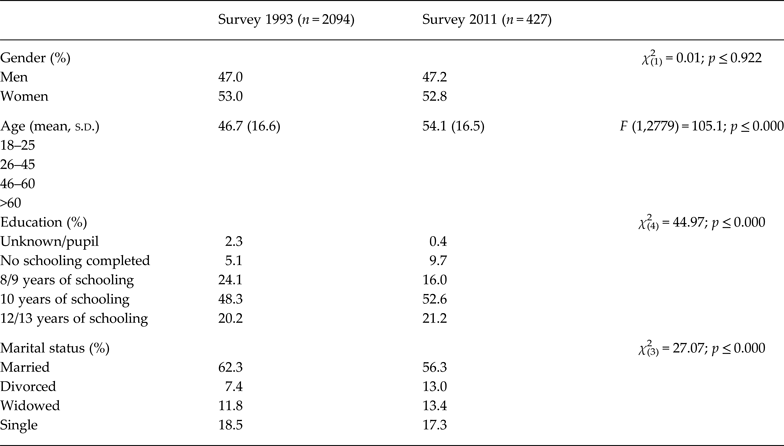
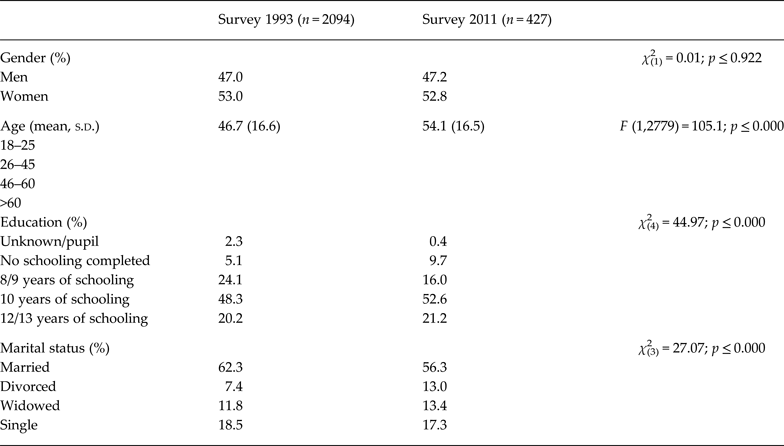
Socio-demographic characteristics of both samples are reported in Table 1. While the sex composition of both samples is the same, in 2011 respondents were older and less frequently married, reflecting similar trends in the general population. The differences in educational attainment may be in part due to changes in the educational system in the eastern part of Germany after reunification.
Socio-demographic characteristics of study samples
Interview
In both surveys, face-to-face interviews were conducted by trained interviewers using pencil and paper. On both occasions, the interview was identical as concerns wording and sequence of questions. In the first part, which is not subject of the present paper, we asked questions related to a case-vignette of a person with mental illness. The second part covered issues unrelated to the case-vignette. In 1993, the total sample (n = 2094) and in 2011 a randomly drawn subsample of respondents (n = 427) received questions regarding attitudes towards restrictions on persons with mental illness. First, we asked whether respondents did agree, under certain conditions, with the compulsory admission of persons with mental illness to a psychiatric hospital. If so, we offered eight different situations and asked whether or not a mentally ill person should be admitted against his or her will. The situations are: suffering from persecutory delusions, non-adherence to prescribed medication, public disturbance, neglect of oneself, violent behaviour, social isolation, request of the patient's family, suicidal ideation. Next came questions referring to revocation of the right to vote and disqualification from driving as well as questions about respondents' opinion about abortion and sterilisation. If respondents had agreed with having people with mental illness sterilised or had answered to this question with ‘don't know’ they were asked about their opinion on compulsory sterilisation. Except for the question about disqualification from driving (where four response categories were offered, see Table 4), always three response categories (‘yes’, ‘no’ and ‘don't know’) were provided. Other variables used for our analyses include age, gender and educational attainment.
Statistical analysis
In order to examine the probability for change of public attitudes, multinomial logit regressions were calculated. To adjust the year effect for demographic changes across samples, the regression analyses controlled for respondents’ gender, age, and educational attainment. To illustrate the magnitude of changes, discrete probability changes were calculated for all attitude items. A discrete change coefficient is the difference in the predicted probability of a given outcome between 1993 and 2011, calculated with controls held at their means for the combined sample. Ninety-five per cent confidence intervals were computed with the delta method. To make adjusted predictions comparable with unadjusted predictions, probabilities and discrete changes were multiplied by 100 and can thus be read as percentages (e.g., 0.74 becomes 74%) (Pescosolido et al. Reference Pescosolido, Martin, Long, Medina, Phelan and Link2010). The calculation of probability changes and the testing for differences in probabilities between two time points were carried out by means of the modules prvalue and prchange (Xu & Long, Reference Xu and Long2005; Long & Freese, Reference Long and Freese2006) in Stata, release 12 (Statacorp, 2011).
Results
Relationship between attitudes towards restrictions on persons with mental illness and socio-demographic characteristics of respondents
Multinomial logit regressions including data from both surveys revealed that agreement with compulsory admission did not vary according to gender, age or educational attainment when the person to be admitted behaved violent against others, threatened to commit suicide, or caused public nuisance. Respondents with higher level of educational attainment were in general more in favour of compulsory admissions (probability change 13.5%). At the same time, however, they less frequently agreed with this measure when the person suffered from persecutory delusions (−31.8), withdrew from his social environment and lived in total isolation (−10.9), or did not take the prescribed medication (−17.0). They were also more opposed to admitting a patient when the family wanted that (18.0%). Agreement with compulsory admission increased with age in case of public nuisance (16.5%), non-compliance with medication (22.6%) and social isolation (15.6%). There were no significant differences between both genders.
Opposition to the revocation of the driver's license, abortion and voluntary as well as compulsory sterilisation decreased with age (probability change −7.0, −25.0, −28.8 and −8.9%, respectively) and increased with level of educational attainment (6.3, 18.3, 18.3 and 11.0%, respectively). Agreement with the right to vote decreased with age (−12.1%) and increased with the level of educational attainment (23.9%). Women were more opposed to abortion (5.6%) and forced sterilisation (9.5%).
Trends of attitudes towards restrictions on persons with mental illness over time
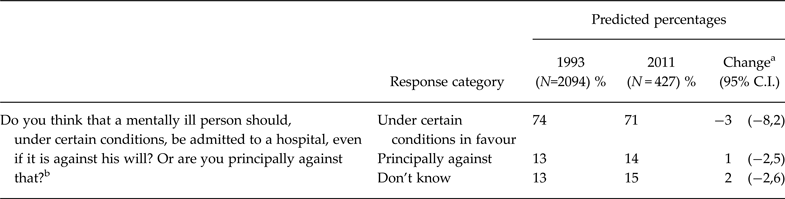
As shown in Table 2, attitudes towards compulsory admission of mentally ill persons remained unchanged over the study period; in 2011 as in 1993, about three out of four respondents agreed with it under certain conditions.
Public attitudes towards involuntary admission of people with mental illness to a psychiatric hospital 1993 and 2001 (multinomial logit regression)

aDue to rounding figures shown will not always equal the difference between predicted probabilities for 1993 and 2011.
bIn both surveys, only the male wording was used.
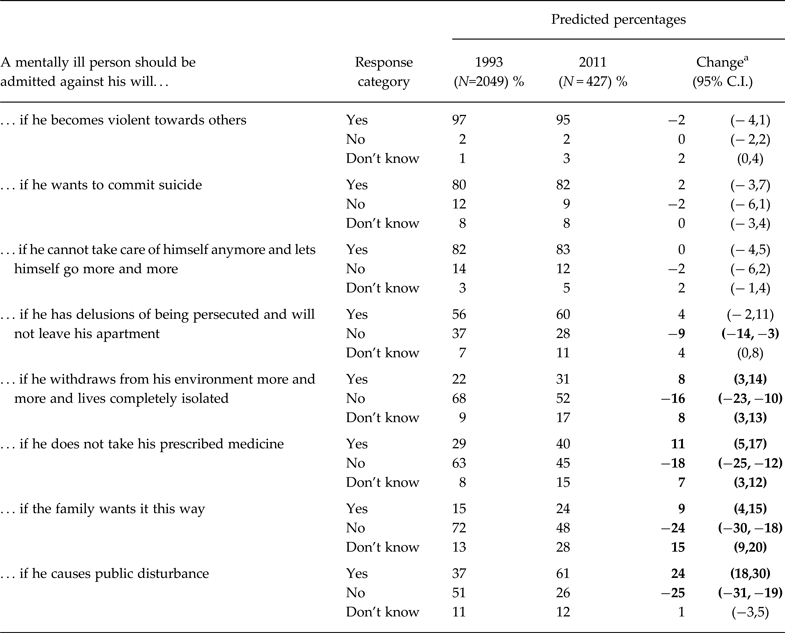
Compulsory admission was accepted by almost everybody when the person became violent against others. Also the vast majority recommended compulsory admission when the person threatened to commit suicide and when the person could not take care of himself. In all three occasions, attitudes of the public showed no significant change. In contrast, in the five remaining situations opposition against compulsory admission was less in 2011 than 18 years before. Respondents were now less reluctant to use legal means to force a mentally ill person to hospital admission if he suffered from persecutory delusions and did not dare to leave his apartment, if he pulled himself away from his environment and lived in complete isolation, if he did not take the prescribed medication, or of the family wanted him to be admitted. The increase of agreement with coercive measures was particularly pronounced when it comes to public nuisance; in this case, the proportion of respondents supporting compulsory admission jumped from 37% in 1993 to 61% in 2011 (Table 3).
Conditions under which a person with mental illness should be admitted to a hospital, even against his will, in 1993 and 2001 (multinomial logit regressions)
aDue to rounding figures shown will not always equal the difference between predicted probabilities for 1993 and 2011.
Statistically significant changes in bold figures.
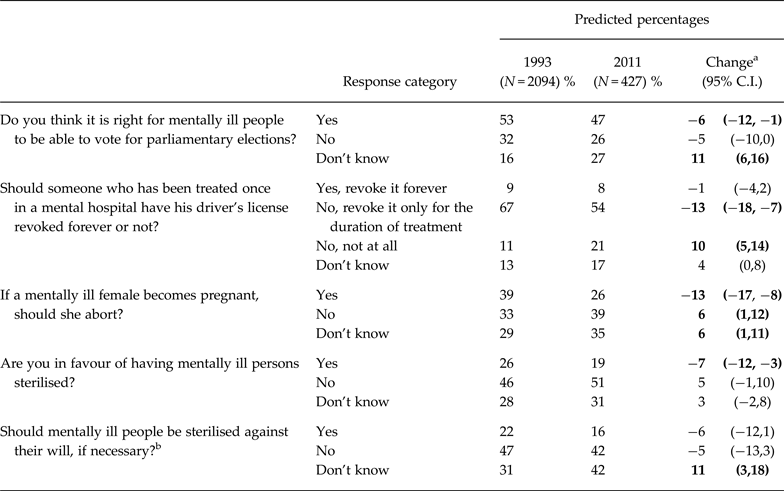
As concerns other infringements of the rights of people with mental illness two different trends can be observed. On the one hand, in 2011 respondents were more opposed to permanently revoking the driver's license than in 1993. Also fewer respondents supported abortion and (voluntary) sterilisation. On the other hand, when it comes to the right to vote or to compulsory sterilisation most marked increases occurred in the group of those who did not give their views (Table 4).
Public attitudes towards infringements of civil rights of people with mental illness 1993 and 2011 (multinomial logit regressions)
aDue to rounding figures shown will not always equal the difference between predicted probabilities for 1993 and 2011.
b1993: N = 1097; 2011: N = 216.
Statistically significant changes in bold figures.
Discussion
In some respects (driver's license, abortion, voluntary sterilisation) people in East Germany have become more willing to grant mentally ill persons the same rights as everyone else. However, it cannot be decided at this point to what extent the change for the better can be in fact attributed to the aforementioned initiatives aimed at improving the protection of the rights of the mentally ill. It is also conceivable that anti-discrimination efforts and attitude changes are both reflections of a change in the prevailing Zeitgeist rather than being causally connected with each other. As concerns the right to vote and compulsory sterilisation the proportion of respondents in favour of and opposed to these measures slightly decreased, resulting in the most marked change occurring in the group of respondents who did not give their opinion.
Despite the progress made in recent years there remains a hard core of the population still supporting infringements of the rights of mentally ill people. For instance, in the 2011 survey one out of four respondents expressed the opinion that a mentally ill female should abort when she becomes pregnant; and one out of five was in favour of having mentally ill persons sterilised. A particularly disturbing finding is that in 2011 8% of all respondents still shared the view that mentally ill persons should, if necessary, be sterilised against their own will. Thus, there is much room left for further improvement of public attitudes towards the rights of mentally ill people.
While the percentage of people endorsing compulsory admission in general remained unchanged over the years, the opposition to compulsory admission on grounds that in Germany are not sanctioned by law (persecutory delusions, withdrawal from environment, non-adherence to medication, on request of the patient's family, public nuisance) has decreased since 1993 rather than increased. When trying to explain this rather unexpected finding we should remind us that the first survey had been conducted in the ‘new’ German States right after reunification. At that time many people might have been aware of the misuse of psychiatry for political purposes that had occurred in the former German Democratic Republic. In fact, in the 1993 survey 55% of those questioned agreed with the statement that, at that time, it had been possible to be admitted to a psychiatric hospital for political reasons, and 41% of them shared the view that this had happened frequently or very frequently (Angermeyer & Matschinger, Reference Angermeyer and Matschinger1995). Among the latter group, opposition against involuntary admissions was particularly pronounced. Thus, it is seems possible that over the years recollection of what had happened in the past may have weakened, resulting in the public becoming less opposed to compulsory admissions not sanctioned by law. Another reason may be seen in the deinstitutionalisation process that started in the eastern part of Germany after reunification, resulting in many patients being discharged from psychiatric hospitals (Salize et al. Reference Salize, Rössler and Becker2007). This may have resulted in the public seeing an increasing need for rehospitalisation of patients whose condition made in their eyes more intensive treatment necessary.
Apart from the specific situation in the ‘new’ German states, the results of our study may also reflect a more general trend as similar findings have been reported from the USA, where between 1996 and 2006 the proportion of those who agreed with forcing persons with schizophrenia by law to take prescription medication or to be admitted to a hospital for treatment has significantly increased (Schnittker, Reference Schnittker2008). The reduced opposition to compulsory admission under conditions not sanctioned by law may be interpreted in two ways. On the one hand, one might consider it as an indication of the public's increasing need for protection from people with mental illness, which is also manifested in the finding from a study conducted in the ‘old’ German States showing in 2011 a stronger agreement with the notion that psychiatric hospitals are necessary to protect society from persons with mental illness than 21 years before (Angermeyer et al. Reference Angermeyer, Matschinger and Schomerus2013a). Nowadays, people may tend to distance themselves from mentally ill persons even more than in the past. This view is supported by the results of recent trend analyses conducted in the ‘old’ German States, showing an increase in the public's desire for social distance from people with schizophrenia (Angermeyer et al. Reference Angermeyer, Matschinger and Schomerus2013c; Schomerus et al. Reference Schomerus, Matschinger and Angermeyer2012).
An alternative explanation has been proposed by Lauber et al. (Reference Lauber, Nordt, Falcato and Rössler2002) who maintain that acceptance of compulsory admission may not express agreement with restrictions but rather express a positive attitude to psychiatry ‘indicating the level of trust in psychiatry’. Thus, the decreasing opposition to compulsory admission to a psychiatric hospital, for instance in case of persecutory delusions or non-adherence to prescribed medication, may also be seen as sign of an increasing readiness to seek help from this kind of services. In fact, in a recent study we found that the German public is now more inclined to regard psychiatric hospitals as similar to other hospitals, more ready to expect effective treatment in psychiatric hospitals, and less ready to endorse the stereotype that psychiatric hospitals are primarily places where patients are locked away (Angermeyer et al. Reference Angermeyer, Matschinger and Schomerus2013a; Schomerus & Angermeyer, Reference Schomerus and Angermeyer2013; Schomerus et al. Reference Schomerus, Matschinger and Angermeyer2013).
In general, respondents' reluctance to accept infringements of the rights of people with mental illness decreased with age and increased with level of educational attainment, while hardly any gender differences were observed. This is in line with results of a review of population studies on attitudes related to individual discrimination of mentally ill people (Angermeyer & Dietrich, Reference Angermeyer and Dietrich2006). As concerns gender, in the majority of cases no association was found, whereas age was in most cases positively associated with negative attitudes. Persons with a higher educational level tended to distance themselves less from mentally ill persons and expressed more liberal views. In this study, only when it came to violence, no matter whether against the person himself or against others, socio-demographic characteristics did play no role. In this case, the majority of respondents unanimously agreed with compulsory admission.
Our findings have to be seen in the light of our study's limitations. First, as our study started in the early 1990s it focuses on so-called negative rights, such as the protection from involuntary detention or coerced treatment, and does not include social rights and civic participation, which in the meantime have increasingly gained importance (Stuart, Reference Stuart2012). Second, as another limitation may be seen that we compared two cross-sectional assessments at different points in time and did not follow up a panel drawn from the general population. However, since we were primarily interested in monitoring changes of people's attitudes on a collective rather than on an individual level, the study design chosen appears appropriate, nothing to say of problems inherent to panel studies such as the lack of representativeness of the follow-up assessment due to the huge attrition rate to be expected over a time period of 18 years. Third, another limitation may be seen in the fact that an inventory of theoretically derived items has been used and not a psychometrically tested instrument. Last, a potential limitation of our study is its national focus. A replication in other countries would certainly be desirable.
In conclusion, we have to state that since the early 1990s there have been two divergent trends in public attitudes towards restrictions on people with mental disorders: while people's views on patients’ rights have by and large become more liberal, the opposition to restricting their freedom in case of deviant behaviour has decreased.
Financial Support
This work was supported by the Fritz-Thyssen-Stiftung (grant number 10.11.2.175).
Conflict of Interest
None.
Ethical Standards
The authors assert that all procedures contributing to this work comply with the ethical standards of the relevant national and institutional committees on human experimentation and with the Helsinki Declaration of 1975, as revised in 2008.