BACKGROUND
Dynamic mathematical models are important tools in epidemiology and public health. They are used to understand the epidemiology of infectious diseases (IDs), to target interventions appropriately, and to evaluate their health and economic impact.Reference Vynnycky and White 1 – Reference Bonten, Austin and Lipsitch 4 ID transmission has been modeled extensively in the hospital setting for these purposes.Reference van Kleef, Robotham, Jit, Deeny and Edmunds 5
Likewise, mathematical modeling can provide insight into the transmission of infections in long-term care facilities (LTCFs), otherwise known as care homes or nursing homes.Reference Nicolle 6 , 7 In particular, LTCFs have been shown to be an important reservoir of antimicrobial-resistant bacteria. 7 – 13 Like hospitals, LTCFs form enclosed environments, and LTCF residents are more likely than the general population to be older, frailer individuals with chronic conditions that might warrant invasive devices such as catheters and frequent visits to hospitals, which increase the risk of contracting an infection. 14 However, LTCFs offer further opportunities for ID transmission than hospitals via many more shared objects and spaces, higher contact between residents, and longer lengths of stay, which favor prolonged exposure to the organisms residents might be carrying.Reference Smith, Bennett and Bradley 15 – 17 Hence, existing insights from mathematical models of ID transmission in the hospital may not apply in LTCFs.
Dynamic mathematical models describe changes in processes over time,Reference Vynnycky and White 1 and infection in a population is one of these processes. Population dynamic models of ID generally represent changes in infection states (eg, being susceptible to infection, being infected, or being infectious). Changes between these states depend on parameters that vary over time. These models can be either deterministic or stochastic and either individual-based or compartmental. In a deterministic model, model output is simply determined by its parameters and, as such, this output remains the same every time the model is run. Stochastic models, however, consider randomness or variations that occur by chance, producing different model outputs every time they are run.Reference Vynnycky and White 1 , Reference Doan, Kong, Kirkpatrick and McBryde 3 Compartmental models group individuals into categories (eg, infectious individuals). All individuals within a category are assigned the same set of parameter values. They then transition through infectious states as groups. Individual-based models (IBMs), however, model individuals as separate entities, and infection states are recorded for each individual.Reference Vynnycky and White 1 , Reference Opatowski, Guillemot, Boëlle and Temime 2 Ideally, models should be fit against empirical data to make them more realistic. This fit is achieved through the statistical calibration of model parameters.Reference van Kleef, Robotham, Jit, Deeny and Edmunds 5 Sensitivity analyses explore the impact of varying parameter values on model outputs. This process can also encompass the sensitivity of the model outputs to assumptions surrounding the biology of the infection and transmission which might impact on the model structure. Sensitivity analyses are important tools to check for errors in models, test their robustness, increase our understanding of the underlying dynamics, and determine uncertainty in model parameters, structure, and therefore, outputs.Reference van Kleef, Robotham, Jit, Deeny and Edmunds 5 Validation involves comparing the model output to a secondary dataset.Reference van Kleef, Robotham, Jit, Deeny and Edmunds 5
Dynamic mathematical models allow better assessment of the long-term impact of any intervention that aims to prevent infection by resistant bacteria in LCTFs than do static models because patient movement dynamics are complex and their impact on control measures are not intuitive. Elderly residents in LTCFs are frequently admitted directly from their LTCF to a hospital and then discharged back to the LTCF.Reference Smith, Sherlaw-Johnson, Ariti and Bardsley 18 This process may occur repeatedly and is known as the “revolving door syndrome.” 14 Patients might acquire infections or might be colonized by resistant strains of bacteria present in hospitals, which they may then transmit to other residents upon their return to the LTCF. In this scenario, infection control measures in LTCFs may fail to decrease the prevalence of infection due to the constant readmission of infected or colonized residents to the hospital, coupled with high rates of transmission within LTCFs. Infection control measures in hospitals could also be hampered by this amplification of transmission through LTCFs. The “revolving door syndrome” can be simulated using a dynamic mathematical model that incorporates transmission and patient movement.
A previous systematic review focused solely on transmission of healthcare associated infections (HCAIs) and antimicrobial resistance (AMR) within the hospital setting.Reference van Kleef, Robotham, Jit, Deeny and Edmunds 5 To our knowledge, no systematic review of mathematical models of ID transmission in LTCFs has been conducted. Mathematical models are increasingly being used to inform policy at a local or national level, and consensus is growing regarding the desirable elements in model design, parameterization, and reporting.Reference Bilcke, Beutels, Brisson and Jit 19 , Reference Jit, Levin and Brisson 20 Despite this agreement, no practical guide has summarized best practice for clinicians, infection control specialists, and policy makers working in LTCFs who need to interpret the validity of findings from mathematical modeling in this setting to aid in decision making.
In this study, we systematically searched the published peer-reviewed literature describing dynamic mathematical models relating to ID transmission in LTCFs. We critically evaluated the methods employed to model interventions against MRSA in this setting; we identified ideal practices; and we developed a checklist to help infection control specialists and policy makers discern good quality models of AMR on which decision making in the LTCF setting can be based.
METHODS
The CINAHL, EMBASE, Global Health, MEDLINE and Scopus databases were systematically searched for studies of dynamic mathematical models of LTCFs on December 27, 2013. This search was updated on February 19, 2016, using the same search criteria. A full description of the search strategy is provided in Online Appendix A. Abstracts and titles that included terms relating to “model” AND “long-term care facility” AND “mathematical” were reviewed. All peer-reviewed dynamic mathematical models describing ID transmission in LTCFs written in English were included. Those describing animal work, statistical models, or within-host models were excluded. We then summarized the methods and research themes of the 18 selected papers.
We critically compared all models that explicitly evaluated interventions to reduce resistant bacterial infections in LTCFs. Models that explored altering transfer rates between hospitals and LTCFs were not included because this was not considered a realistic intervention. The remaining 3 studies described models that targeted their interventions against MRSA. Using our results from this critical evaluation, we developed a checklist to help clinicians and other decision makers appraise mathematical models of AMR in LTCFs.
RESULTS AND DISCUSSION
Evidence Base of Mathematical Modeling in LTCFs
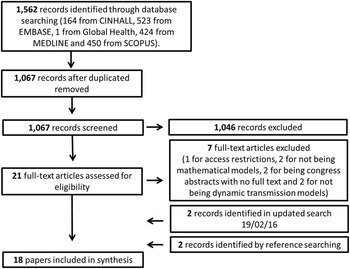
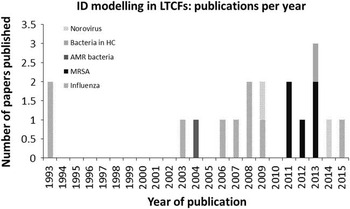
A full description of results of the systematic search is provided in Online Appendix A. In total, 1,067 abstracts were screened and 23 papers were read in full text. Among them, 18 papers examined 15 different dynamic models of ID transmission in LTCFs (Figures 1 and 2).Reference Chamchod and Ruan 21 – Reference Wendelboe, Grafe, McCumber and Anderson 38 Six of these simulated the transmission of AMR in LTCFs.Reference Chamchod and Ruan 21 – Reference Lesosky, McGeer, Simor, Green, Low and Raboud 24 , Reference Smith, Dushoff, Perencevich, Harris and Levin 26 , Reference Barnes, Harris, Golden, Wasil and Furuno 34 Among these studies, 5 described MRSA transmission,Reference Chamchod and Ruan 21 – Reference Lesosky, McGeer, Simor, Green, Low and Raboud 24 , Reference Barnes, Harris, Golden, Wasil and Furuno 34 1 described a generic non–species-specific resistant bacteria,Reference Smith, Dushoff, Perencevich, Harris and Levin 26 and none quantified the transmission of resistant gram-negative bacteria. More detailed descriptions of the structures and purposes of the models are provided in Online Appendix A.
Flow chart of the review process. 1,562 records were identified through the CINAHL, EMBASE, Global Health, MEDLINE, and Scopus databases. After all duplicates were removed, 1,046 records were excluded through abstract screening, 7 full-text articles were excluded through full-text assessment, 2 additional papers were identified through reference searching, and 2 papers were identified through in an updated search on February 19, 2016. Finally, 18 papers were selected for review.

Infectious disease modeling in LTCFs: publications per year. Overall, 9 studies modeled influenza (5 seasonal, 3 pandemic and 1 both); 5 studies modeled methicillin-resistant Staphylococcus aureus (MRSA); 2 studies modeled norovirus; 1 study modeled antimicrobial resistant (AMR) bacterial transmission and 1 study modeled non-species-specific bacterial transmission (bacteria in healthcare (HC)). In addition, 2 papers on the same model were published in 1993. There were no further publications until 2003. From 2003 onward, a small but regular number of studies have been published on this subject.

Gaps Identified in the Literature
Very few mathematical models have characterized the spread of IDs in LTCFs. The scope of the organisms studied is also limited. Although a single study modeled resistant gram-negative bacteria in long-term acute care hospitals,Reference Davies 39 no study has modeled resistant gram-negative bacteria in the LTCF setting. These organisms are increasingly becoming problematic in hospitals and LTCFs, and interventions to prevent their spread are being trialled.Reference Knudsen and Andersen 40 – Reference Tacconelli, Cataldo and Dancer 43 In addition, more solid methodology that is fully described is required. Ideally, models should be made available in open source code online to provide greater transparency of the assumptions underlying the model and to allow models to be reproduced or adapted. Models should be formally fit to data to estimate transmission parameters with greater certainty, and the full uncertainty surrounding the parameters should be presented. If possible, models should be validated using other available data to ascertain the generalizability of their findings.
How Have Interventions Been Modeled? Critical Evaluation of Models of Interventions Against MRSA in LTCFs
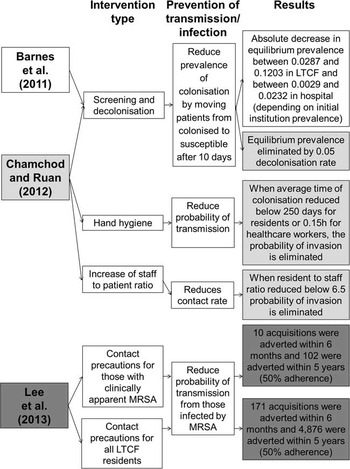
In our review, 3 studies assessed interventions against MRSAReference Barnes, Harris, Golden, Wasil and Furuno 34 , Reference Chamchod and Ruan 21 , Reference Lee, Singh and Bartsch 23 in LTCF settings. They found 4 interventions to be effective in reducing MRSA prevalence: (1) screening and decolonization, (2) hand hygiene, (3) contact precautions, and (4) increasing the staff to patient ratio. Figure 3 describes the interventions assessed, how their action was simulated in each model, and the results observed. Detailed descriptions of each intervention studied are provided in Online Appendix B.
Assessing the effects of interventions against MRSA in LTCFs through modeling. Overall, 3 papers have published models of interventions against methicillin-resistant Staphyloccocus aureus (MRSA) in long-term care facilities (LTCFs). The models have assessed 5 types of interventions in this setting. Two reduced the probability of transmission, 1 reduced the prevalence of colonization, and 1 reduced the contact rate. The results from the interventions modeled are shown on the right.

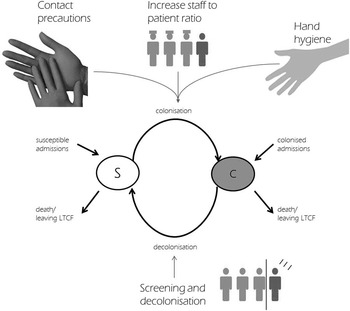
The model pathways that are targeted by an intervention, the parameters associated with it, and the assumptions behind it are important because they determine the likely outcome of the intervention. Screening and decolonization reduces the prevalence of colonization by moving patients from a colonized state (eg, for Barnes et al,Reference Barnes, Harris, Golden, Wasil and Furuno 34 both persistently colonized and transiently colonized) to a susceptible state (ie, uncolonized). Transmission is also reduced as the pool of infectious individuals decreases. The other 3 interventions aimed only to prevent or decrease the probability of transmission. These interventions will take longer to reduce the prevalence of colonization if patients are frequently admitted to the LTCF who are colonized on admission. The impact of MRSA interventions on a generic susceptible-infected-susceptible (SIS) model structure is depicted in Figure 4.
Impact of MRSA interventions on a generic susceptible (S)–colonized (C)–susceptible (S) model structure in the long-term care facility (LTCF). While hand hygiene, increase in staff-to-patient ratio, and contact precautions decrease the rate of colonization, screening and decolonization interventions reduce the prevalence of colonization, therefore increasing the rate of decolonization.

Dates, setting and methodology
The models that assessed interventions against MRSAReference Chamchod and Ruan 21 , Reference Lee, Singh and Bartsch 23 , Reference Barnes, Harris, Golden, Wasil and Furuno 34 in LTCFs were recent (ie, 2011–2013); however, some parameters used by Barnes et alReference Barnes, Harris, Golden, Wasil and Furuno 34 and Chamchod and RuanReference Chamchod and Ruan 21 were based on older estimates that might be outdated. The model built by Chamchod and Ruan only involved 1 LTCF and neglected the “revolving door syndrome” of patient transfer between hospital and LTCFs, which might be important in driving transmission. The IBM model developed by Lee et alReference Lee, Singh and Bartsch 23 was the most complex; it incorporated LTCF, hospital, and community settings, and it also accounted for stochasticity. The model built by Barnes et alReference Barnes, Harris, Golden, Wasil and Furuno 34 was the simplest: a deterministic compartmental model.
Patients were assumed to mix homogeneously within LTCFs across all models. A strength of the model developed by Lee et alReference Lee, Singh and Bartsch 23 was that it used data to parameterize patient flow between healthcare facilities, whereas the other models did not. Barnes et al differentiated between persistently and transiently colonized individuals. Evidence for these different types of colonization by S. aureus is mixed.Reference Shenoy, Paras, Noubary, Walensky and Hooper 44 Chamchod and RuanReference Chamchod and Ruan 21 and Lee et alReference Lee, Singh and Bartsch 23 distinguished, respectively, between healthcare workers and residents and between residents taking contact precautions and residents that did not, adapting the disease states in their model to fit the questions addressed.
Parameter validity, estimation, and uncertainty
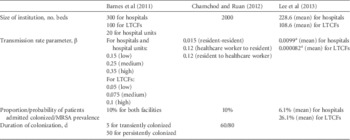
Table 1 summarizes the key parameters used by Barnes et al,Reference Barnes, Harris, Golden, Wasil and Furuno 34 Chamchod and Ruan,Reference Chamchod and Ruan 21 and Lee et al.Reference Lee, Singh and Bartsch 23 The parameters used by the models, including the LTCF size, the transmission rates, the prevalence of colonization, and the duration of colonization, varied considerably between models and often involved different units of measurement that did not allow for comparison across models. In addition, many parameter estimates were based on expert opinion rather than data, which compromised the quality of the models.
Comparison of Key Parameters Used by Barnes et al (2011),Reference Barnes, Harris, Golden, Wasil and Furuno 34 Chamchod and Ruan (2012),Reference Chamchod and Ruan 21 and Lee et al (2013)Reference Lee, Singh and Bartsch 23

NOTE. LTCF, long-term care facility.
a Rate of transmission per person per day (vs effective contact [ie, resulting in transmission] rate averaged per day).
Some factors, such as antibiotic prescription, were not simulated in any of these models. Antibiotic prescribing is a main driver of resistance; it increases the risk of colonization and subsequent infection by resistant bacteria. Antibiotic stewardship is, therefore, a very important strategy for reducing antibiotic resistance and should be one of the main interventions modeled.Reference van Buul, van der Steen and Veenhuizen 45 However, antibiotic prescribing data for LTCFs are scarce and therefore were not incorporated in the models.
The 3 research groups chose different sizes of LTCFs, ranging from 100 bedsReference Barnes, Harris, Golden, Wasil and Furuno 34 to 2,000 beds.Reference Chamchod and Ruan 21 However, the average number of beds in care homes registered in England by the Care Quality commission (the regulator of health and social care in England) on April 1, 2014, was 37 beds. 46 Only 116 care homes (1.3%) could accommodate >100 residents, and the largest registered LTCF had 215 residents. In the United States in 2013, the average nursing home size was 106 beds (range, 2–1,389) and the average capacity for residential care communities was 38 beds (range, 4–582).Reference Harris-Kojetin, Sengupta and Park-Lee 47 A LTCF with 2,000 residents is, therefore, highly implausible in the English and American settings.Reference Chamchod and Ruan 21
No models estimated MRSA transmission parameters directly from appropriately collected LTCF datasets. Thus, each of the parameters was taken from the literature and contained untested assumptions. For example, Chamchod and RuanReference Chamchod and Ruan 21 assumed resident-to-resident transmission was 8 times lower than that between healthcare workers and residents. Barnes et alReference Barnes, Harris, Golden, Wasil and Furuno 34 and Lee et alReference Lee, Singh and Bartsch 23 assumed that transmission rates for hospitals were much higher than those for LTCFs.
Other assumptions, like the assumption that the prevalence of MRSA on admission is broadly equal to the population prevalence of MRSA in the United StatesReference Barnes, Harris, Golden, Wasil and Furuno 34 , Reference Chamchod and Ruan 21 at 10%,Reference Gorwitz, Kruszon-Moran and McAllister 48 may be incorrect because age is a risk factor for MRSA infectionReference Viallon, Marjollet and Berthelot 49 – Reference Laupland, Church, Mucenski, Sutherland and Davies 52 and because this rate may not be generalizable across settings. For example, Lee et alReference Lee, Singh and Bartsch 23 estimated LTCF MRSA prevalence at 26.1%, which is in line with most of the published literature (eg, 21% in Leeds, 23% in Northern Ireland, 17% in Spain, and 22% in Hong KongReference Horner, Parnell, Hall, Kearns, Heritage and Wilcox 53 – Reference Cheng, Tai and Wong 55 ). Two studies carried out in US LTCFs, however, have reported double this prevalence (59% and 40%, respectively).Reference Stone, Lewis and Lowery 56 , Reference Mody, Kauffman, Donabedian, Zervos and Bradley 57
Interventions
Barnes et alReference Barnes, Harris, Golden, Wasil and Furuno 34 and Chamchod and RuanReference Chamchod and Ruan 21 did not clearly report their intervention outcomes, and their relevance for clinical practice was not easy to interpret. Barnes et alReference Barnes, Harris, Golden, Wasil and Furuno 34 reported prevalence at equilibrium (a theoretical state of model stability) in numerical and graphical form, whereas Chamchod and RuanReference Chamchod and Ruan 21 reported prevalence at equilibrium only in graphical form. For this reason, it was only possible to derive the threshold at which an intervention would eliminate MRSA at equilibrium prevalence or would eliminate the probability of invasion. More usefully, Lee et alReference Lee, Singh and Bartsch 23 reported the median percentage decrease in MRSA prevalence at equilibrium and calculated the acquisitions of MRSA adverted under certain adherence conditions, which facilitated the interpretation.
Overall, Barnes et alReference Barnes, Harris, Golden, Wasil and Furuno 34 and Chamchod and RuanReference Chamchod and Ruan 21 described the assumptions related to the interventions they modeled in very little detail. Barnes et alReference Barnes, Harris, Golden, Wasil and Furuno 34 assumed that, on average, 2 cycles of 5-day “decolonization” treatments were necessary for patients to be successfully decolonized (10 days). After these 10 days, therefore, the intervention was assumed to be 100% effective. Neither adherence to this protocol nor the impact of this assumption on the results was reported. Chamchod and RuanReference Chamchod and Ruan 21 merely reported the thresholds of decolonization rate, duration of colonization, and resident-to-staff ratio reduction that were necessary to eliminate the equilibrium of prevalence and the probability of invasion. They did not report the effectiveness of or adherence to the interventions or the time necessary for the interventions to be successful in achieving these thresholds. In addition, they did not propose a realistic intervention to reduce the resident-to-staff ratio. Therefore, the results from these analyses could not be used to inform policy because their validity could not be assessed adequately.
In contrast, Lee et alReference Lee, Singh and Bartsch 23 evaluated the effect of contact precautions in LTCFs under 3 different levels of adherence (25%, 50%, and 75%). This method allowed comparison across a spectrum of scenarios that were realistically parameterized when compared to other studies.Reference Clock, Cohen, Behta, Ross and Larson 58 , Reference Manian and Ponzillo 59 Their findings were also comparable to those of models within hospitals, which imply that focusing interventions on the small minority of clinically apparent MRSA cases might be ineffective.Reference Cooper, Medley and Stone 60 Therefore, the findings from this study are more robust that those of the 2 other studies. However, this model was not formally fit to data, and it used the assumption that transmission was much higher in hospitals than in LTCFs, without appropriate sensitivity analysis to examine the impact of this assumption. Therefore, we do not consider this model appropriate to inform policy.
Summary and critical evaluation
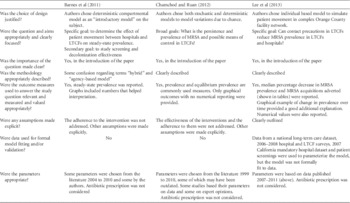
The results from this critical appraisal are summarized in Table 2. The choice of design was justified in all 3 studies, and the importance of the question being investigated was made clear in each introduction. Barnes et alReference Barnes, Harris, Golden, Wasil and Furuno 34 and Lee et alReference Lee, Singh and Bartsch 23 set clearly focused questions and aims for their paper. In contrast, Chamchod and RuanReference Chamchod and Ruan 21 set broad objectives, and the evaluation of the interventions was purely theoretical and derived from the model behavior a-posteriori.Reference Chamchod and Ruan 21
Critical Appraisal of Barnes et al (2011)Reference Barnes, Harris, Golden, Wasil and Furuno 34 , Chamchod and Ruan (2012),Reference Chamchod and Ruan 21 and Lee et al (2013)Reference Lee, Singh and Bartsch 23

NOTE. LTCF, long-term care facility; MRSA: methicillin-resistant Staphylococcus aureus.
Chamchod and RuanReference Chamchod and Ruan 21 only presented their outcomes in graphical form, which made comparison with other studies challenging. Model assumptions governing structure and transmission were explicitly presented, but the assumptions behind the interventions were not explained completely. None of the models was formally fit to the data or validated, which reduced their credibility. Most of the parameters employed in these 3 studies were chosen from the literature. Parameters chosen from older literature might have been outdated. Some parameters from the literature were based on data but others were based on expert opinion.
What Makes a Good Mathematical Model for the Evaluation of Interventions?
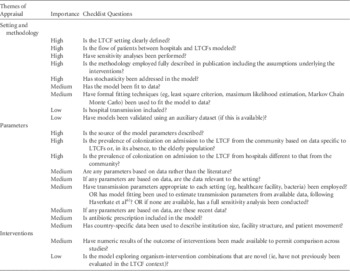
Dynamic mathematical models of ID transmission are important tools that can help explain the impact of interventions in facilities such as hospitals and LTCFs. We have developed a practical guide in the form of a checklist that can be used by infection control specialists and policy makers for the appraisal of mathematical models of AMR in LTCFs (Table 3). Appropriate models for policy making should define their setting and methods and neither neglect the influence of hospital visits by LTCF residents (ie, the “revolving door syndrome”) on driving transmission in LTCFs nor neglect the influence of LTCFs on hospital transmission, as LTCF residents are very frequently admitted to hospitals.Reference Smith, Sherlaw-Johnson, Ariti and Bardsley 18 Models should also employ formal fitting techniques and should carry out sensitivity analyses and validation (if an auxiliary dataset is available) to ensure that the model accurately represents the data and is sufficiently robust to produce sound conclusions. They should also address stochasticity in some form because resistant infections in LTCFs, which are small, contained environments, are heavily influenced by chance events. Haverkate et alReference Haverkate, Bootsma and Weiner 61 and Obadia et alReference Obadia, Silhol and Opatowski 62 applied these methods to the analysis of transmission of Klebsiella pneumoniae carbapenamase-producing bacteria in long-term acute care hospitals and the transmission of Staphylococcus aureus in long-term care hospitals, respectively. Model parameters should be, as far as possible, based on recent data from the particular setting and organism investigated. In addition, results should be made available in numeric form to facilitate comparison across studies. Multiple examples of the high-quality models that have evaluated interventions in the hospital setting can be found in the literature.Reference Opatowski, Guillemot, Boëlle and Temime 63
Checklist for the Critical Appraisal of Mathematical Models of AMR Bacteria in LTCFsFootnote a

NOTE. AMR: antimicrobial resistance; LTCF, long-term care facility; ID, infectious disease.
a Ideally, all high importance criteria should be addressed in a high-quality model to permit the evaluation of interventions, generate and test hypotheses, and explore long-term scenarios of AMR transmission and control in LTCFs. For the evaluation of interventions where a high level of certainty is required from clinicians or policy makers, all important criteria should be present in models. In both cases, criteria of medium and low importance increase the quality of the model.
It is challenging to parameterize mathematical models of AMR transmission in the LTCF setting. First, these facilities vary considerably in their patient populations and sizes and in the type of care they provide. In addition, many epidemiological parameters in this setting remain unknown, and few data are available for fitting and validation purposes. However, it is increasingly apparent that the threat of AMR is an important concern in LTCFs; therefore, robust models are needed to guide policy making in this area. There is room for improvement in the description of MRSA transmission and its control in LTCFs through mathematical modeling, as the models assessed here are not considered robust enough to test policy. Infections by gram-negative bacteria are becoming more frequent in both hospitals and LTCFs; therefore, there is an urgent need for models that simulate their transmission in these settings. Further research is needed to validate the checklist proposed. Future work should also focus on understanding the effectiveness of decolonization in the LTCF setting and the impact of antibiotic prescribing on the carriage of resistant bacteria.
ACKNOWLEDGMENTS
Financial support: This work was funded by Public Health England.
Potential conflicts of interest: All authors report no conflicts of interest relevant to this article.
SUPPLEMENTARY MATERIAL
To view supplementary material for this article, please visit https://doi.org/10.1017/ice.2016.286