Implications
Tail biting has been classified as an abnormal behavior that is a consequence of multiple defects in a pig's life. Some of the suggested stressors inducing this behavior, which is detrimental to both welfare and economy, can be easy to control by man, including feeding aspects. A better understanding of the role of nutrition in tail biting might allow recognition of early signs leading to tail-biting behavior and formulation of appropriate remedial strategies. Such early warnings might be growth-retarded piglets or individual pigs or whole pens changing their feeding behavior even before tail-biting incidents.
Introduction
There are many possible risk factors causing tail biting among pigs, with several of these related to nutrition. Pigs that start tail biting are sometimes said to be smaller than others in their group (Schröder-Petersen and Simonsen, Reference Schrøder-Petersen and Simonsen2001). This might be a consequence of reduced feed intake, with or without health problems, inability to use nutrients efficiently or growth retardation at some point of their life. Therefore, tail biting could be a way for compensating nutrient deficiency resulting from inadequate intake or poor absorption. Geers et al. (Reference Geers, Berckmans, Goedseels, Maes, Soontjens and Mertens1985) linked easy access to feeds with high feed intake and low tail-biting prevalence, indicating a strong association between feeding behavior, growth and tail-biting behavior.
At least some forms of tail-biting behavior might be redirected toward foraging or exploration behavior (Schröder-Petersen and Simonsen, Reference Schrøder-Petersen and Simonsen2001). Fasting (food deprivation) in itself increases time spent on rooting objects through increased foraging motivation (Day et al., Reference Day, Kyriazakis and Lawrence1995). Beattie et al. (Reference Beattie, Breuer, O′Connell, Sneddon, Mercer, Rance, Sutcliffe and Edwards2005) also pointed out that the relationship between nutrient inadequacy and increased foraging behavior expressed as tail biting. However, even ad libitum feeding does not completely remove the motivation to forage, and feeding at more restricted levels increases such behaviors (Day et al., Reference Day, Kyriazakis and Lawrence1995). Therefore, reduced ability to digest and absorb nutrients would also be expected to increase foraging and exploration behaviors, as animals seek to realize their genetic growth potential. Whether this motivational background will lead to tail biting is still uncertain. Understanding why only some individuals start biting is important in understanding the whole problem and crucial in the development of preventive and remedial strategies (Edwards, Reference Edwards2006).
Villus morphology correlates with the absorptive capacity of the intestine (van Beers-Schreuers et al., Reference Beers-Schreuers van, Nabuurs, Vellenga, Kalsbeek-van der Valk, Wensing and Breukink1998). Diminished gastrointestinal ability can be seen morphologically as reduced villus height (villus atrophy) and increased crypt depth (crypt hyperplasia), changing the villus to crypt ratio. Fasting for feed, energy or protein may cause villus atrophy through reduced cell division in the crypts (Pluske et al., Reference Pluske, Hampson and Williams1997; van Beers-Schreuers et al., Reference Beers-Schreuers van, Nabuurs, Vellenga, Kalsbeek-van der Valk, Wensing and Breukink1998). Defects in intestinal cell wall structure can lead to poor nutritional state of the animal. Some plasma metabolite concentrations, such as those of decreased calcium (Ca), inorganic phosphorus (Pi) and magnesium (Mg) levels, and changes in several AA levels, can be used as an indicator of protein malnutrition (Pond et al., Reference Pond, Ellis and Schooknecht1992; Lu et al., Reference Lu, Schoknecht, Ellis, Shypailo, Su and Pond1996; Wykes et al., Reference Wykes, Fiorotto, Burrin, del Rosario, Fraser, Pond and Jahoor1996), trauma (Wannemacher, Reference Wannemacher1977; Ševaljević and Zunic, Reference Ševaljević and Žunić1996) or fasting for feed (Richardson et al., Reference Richardson, Hale and Ritchey1965) in pigs or rats.
This study investigated whether there were any associations between tail-biting-related behavioral phenotypes (tail biters, victims, controls) and gut cell wall structure of grower–finisher pigs that could have predisposed individuals to abnormal foraging/feeding behavior resulting in tail biting. Our hypothesis was that tail biters may suffer from the inability to absorb nutrients, which can be observed by decreased villus height or changed crypt depth, and by changes in plasma AA and mineral concentrations, compared with non-tail biters or non-bitten pigs.
Material and methods
Management and feeding
Pigs in this experiment were raised in south-western Finland in a commercial finisher farm with altogether 900 pigs in six rooms, which were filled on an all-in all-out basis. Finnish Yorkshire, Landrace, Duroc and Hampshire mixed pigs, with undocked tails in accordance with Finnish legislation, were sourced from several grower pig farms at 20 to 30 kg. In two out of six rooms, feed was offered twice a day according to appetite from a trough with space for all the pigs to eat at the same time (at least 30 cm per pig). In pens with meal feeding in troughs, there were 7 to 10 pigs per pen. Four out of six rooms had an ad libitum feeder with space for one to two pigs (based on their size) to eat simultaneously and feed present at all times. In pens with automated ad libitum feeding, there were 11 to 26 pigs per pen. As there were multiple pigs for one feeder resulting in competition for feed space, and this has been shown to differentially affect individual pigs’ performance and feed intake depending on animal characteristics (Botermans et al., Reference Botermans, Georgsson, Weström, Olsson and Svendsen2000; Georgsson and Svendsen, Reference Georgsson and Svendsen2001), this type of feeding is subsequently called free access feeding instead of ad libitum. Pens within the farm and also inside one room varied in size and structure; however, all pens had partly slatted floors, and the animal density was in accordance with Finnish law. The housing has been previously described in detail (Brunberg et al., Reference Brunberg, Wallenbeck and Keeling2011).
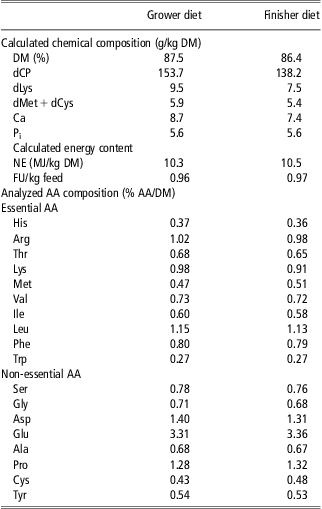
Two different diets were offered to the pigs according to a phase feeding regimen. Grower diet was fed for 4 weeks after arrival, at ∼10 to 14 weeks of age, and finisher diet for the following weeks until slaughter. The feeds were fed dry and consisted of ground barley, protein–mineral concentrate (A-Rehu, Atria, Finland) and vegetable oil. The amount of protein–mineral concentrate declined from 21% to 14% as fed basis, in grower and finisher diets, respectively. Diets were formulated to fulfill Finnish feeding recommendations for finishing pigs (MTT, 2011). Calculated chemical composition of the diets is presented in Table 1. Feed samples were taken four times during the trial from the mixing container and stored at −20°C until analyzed, and results of the feed analyses are shown as the mean for grower and finisher diets.
The chemical composition, AA composition and energy content of the grower and finisher diets

AA = amino acids; DM = dry matter; dCP = digestible crude protein; Ca = calcium; Pi = inorganic phosphate; NE = net energy; FU = feed unit.
Experimental design and selection of the experimental animals
A total of 55 pigs between 26 and 83 kg liveweight (LW) were selected through behavioral observations carried out on 2 to 3 consecutive days, including a total of 742 pigs observed and using the ethogram by Brunberg et al. (Reference Brunberg, Wallenbeck and Keeling2011). First, the whole pen was observed two times for 30 min for 1 to 2 consecutive days after first signs of tail biting (bitten tails or tail-biting behavior) appeared in that pen. At the same time, a control pen without any tail-biting behavior was identified using the same protocol. The tail-biting pen and control pen with no tail biting were similar in design, in feeding system, in group size (the difference at maximum two pigs) and situated in the same room. Second, pens having the highest amount of performed and received tail bites were selected for behavioral observations of individual animals eight times for 15 min in 2 to 3 days. Performed and received tail bites and the magnitude of the reaction to being bitten were counted for individuals, as well as some additional behaviors not used to select the pigs. Pigs selected and euthanized in this study for the sampling of intestines are the same as sampled for health indicators in the study by Munsterhjelm et al. Reference Munsterhjelm, Simola, Keeling, Valros and Heinonen(2013).
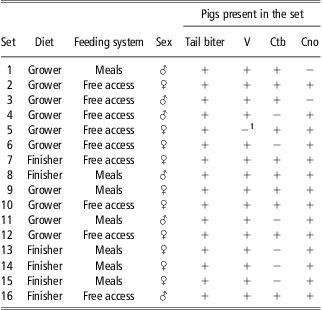
Pigs were selected in 16 sets within four different time periods between May and October 2009, each set containing four pigs. One tail-biting pig (TB, pig performing the most tail bites) and one victim pig (V, pig receiving the most tail bites) were chosen from the biting pen. One control pig from the biting pen (Ctb) and one control pig from the control pen (Cno) were chosen for each set. Control pigs were neither performing nor receiving any bites. In some cases, a set is missing Ctb or Cno if suitable animals were not found. Pigs were selected purely on the basis of the behavioral observations. The animals selected appeared clinically healthy except for the tail-biting signs. General information about the sets is presented in Table 2. All pigs within each set were of the same sex, and age of the pigs within each set was approximately equal as they came at the same time to the farm. In addition, feeding system (free access feeding for nine sets or meal feeding for seven sets) and number of animals per feeder space was constant within the set. Six sets of pigs ate the grower diet and 10 sets of pigs ate the finisher diet at the time of selection.
General information on diet, feeding system, gender and status of pigs in the matched sets

V = victim; Ctb = control in tail-biting pen; Cno = control in non-tail-biting pen.
1Pig was removed from all the analyses because of possible clinical disease.
There were eight experimental groups according to the behavioral status of the pigs (TB, V, Ctb or Cno) and feeding system (free access or meal fed). The experimental design was therefore a 4 × 2 factorial arrangement with unequal sample sizes (n = 9, 9, 7 and 8 pigs for free access feeding and n = 7, 7, 2 and 6 pigs for meal feeding for TB, V, Ctb and Cno, respectively).
Data collection
Pigs were sedated by intramuscular injection of midazolam (0.5 mg/kg estimated LW), butorphanol (0.2 mg/kg LW) and ketamine (10 mg/kg LW) and euthanized by intracardial injection with pentobarbital (20 mg/kg LW). Immediately before euthanasia, blood was taken from the jugular vein into heparinized and non-heparinized tubes and centrifuged at 3000 r.p.m. for 10 min. The plasma and serum were transported in dry ice and frozen at −80°C for storage. Plasma sampling could not be standardized according to the time of latest feed intake because of the difference in the feeding systems.
Within 15 min after death, two segments of jejunum, 5 cm each, were cut from 50 cm (S50, as proximal jejunum) and 100 cm (S100, as mid-jejunum) posterior to the bile duct. These segments were chosen because the jejunum is known as the main site of intestinal absorption in pigs, and poor intestinal morphology in the mid-jejunum is expected to cause deficiency in the absorption capability of the pig (Cera et al., Reference Cera, Mahan, Cross, Reinhart and Whitmoyer1988). Segments were opened longitudinally, rinsed in physiological saline, pinned to a wooden chip and fixed in 10% buffered formalin. After at least 24 h, each sample was cut, embedded in paraffin, stained with hematoxylin and eosin and sectioned to 4 μm slices. A light microscope connected to a camera was used to take one to four pictures from each sample, depending on the quality of the sample. Cell^P software (Olympus) was used to measure the height of one to two well-oriented villi and the depth of one to two well-oriented crypts from each picture taken. Samples that were damaged by handling, so that morphometry could not be reliably done, were marked as missing cases for that particular measurement. Therefore, the final data represent the mean of one to seven measurements (median = 2.5 for villi and 3.0 for crypts) from each jejunal location of each pig. The carcasses of the pigs were transported to the Department of Pathology in the University of Helsinki for necropsy and measurement of BW.
All feed and plasma AA analyses were carried out in the University of Helsinki, Department of Agricultural Sciences. Standard methods were used for dry matter (DM) analyses (Association of Official Analytical Chemists (AOAC), 1990). Essential AA histidine (His), arginine (Arg), threonine (Thr), lysine (Lys), methionine (Met), valine (Val), isoleucine (Ile), leucine (Leu), phenylalanine (Phe) and thryptophane (Trp), and non-essential AA serine (Ser), glycine (Gly), asparagine (Asp), alanine (Ala), proline (Pro), cysteine (Cys) and tyrosine (Tyr) were analyzed from blood plasma and acid-hydrolyzed diets (base hydrolyzed in the case of Trp). Ten microliters of thawed plasma/acid- or base-hydrolyzed feed sample or standard were transferred to a 1.5 ml amber glass vial with teflon-lined septum, 70 μl of borate buffer were added and the solution was briefly vortexed. Then, 20 μl of reconstituted AccQ•Fluor reagent (3 mg/ml in acetonitrile) was added and the mixture was immediately vortexed for several seconds. The vial was closed and left to stand for 1 min at room temperature. It was then heated in a heating block at 55°C for 10 min. UPLC was performed on an Acquity system (Waters Finland, Helsinki, Finland), equipped with an Acquity photodiode array optical detection system. The column used was BEH C18 column (100 mm × 2.1 mm i.d., 1.7 μm) from Waters. The flow rate was 0.7 ml/min and the column temperature was kept at 55°C. The injection volume was 1 μl and the detection wavelength was set at 260 nm. The solvent system consisted of two eluents: (A) AccQ•Tag ultra eluent A concentrate (10%, v/v) and water (90%, v/v) or only water in feed samples; (B) AccQ•Tag ultra eluent B. The following gradient elution was used: 0 to 0.54 min, 99.9% A to 0.1% B; 5.74 min, 90.9% A to 9.1% B; 7.74 min, 78.8% A to 21.2% B; 8.04 min, 40.4% A to 59.6% B; 8.70 to 10 min, 99.9% A to 0.1% B. Empower 2 (Waters) software was used for system control and data acquisition.
Colorimetric methods were used for the determination of serum Ca (Bauer, Reference Bauer1981) and Pi (Daly and Ertigshausen, Reference Daly and Ertigshausen1972) and concentrations of Na+, K+ and Cl− were measured directly by ion-selective electrodes. The analyses were performed by an automatic chemistry analyzer (Konelab 30i, ThermoFisher Scientific, Vantaa, Finland) using the manufacturer's reagents and adaptations for serum. Samples were analyzed as the mean from duplicate samples at the University of Helsinki, Central Laboratory of the Department of Equine and Small Animal Medicine.
Statistical procedures
Statistical analyses were carried out using PASW 18 software (SPSS Inc., Chicago, IL, USA). The individual pig was used as the experimental unit. The GLM univariate procedure was used to identify possible differences between the experimental groups for the fixed factor of status (tail-biting category) and a random factor of feeding system. Diet (grower or finisher diet) was confounded with the age of the pigs (days since arrival at the farm), which was added as a covariate in all the models. As there was no interaction of status and feeding system for any of the parameters, this interaction term was not included in any final models.
Statistical outliers, defined as having studentized residuals over ±3, were excluded from the analyses as follows: one pig from S50 villus height analyses (pig V in set 7), one from S100 crypt depth analyses (pig TB in set 2) and two from S100 V : C ratio analyses (pig Cno in set 13 and TB in set 13). In addition, one pig (pig V in set 5) was totally removed from the final data because it was very thin (26 kg at the age of ∼14 weeks) and its morphological data differed from all the other pigs suggesting clinical disease. Normality tests and test for homogeneity of variances were applied. Natural logarithm transformation was applied to morphological measures because assumptions were not met.
To study the differences between status groups, four contrasts were applied using the difference method: C1 (Cno v. Ctb) for the effect of tail-biting presence or absence in the pen, C2 (TB v. Cno + Ctb) for the effect of being a biter, C3 (V v. TB + Cno + Ctb) for the effect of being bitten and C4 (free access v. meal feeding) for the effect of feeding system. Statistical significance was defined as P < 0.05 and tendencies at P < 0.1 level.
Results
Behavioral observations
Medians of tail-biting frequency per pig per 8 × 15 min were 36, 0, 0 and 0 (performed) and 1, 11, 0 and 0 (received) for TB, V, Ctb and Cno, respectively; further details of behaviors are presented in a study by Munsterhjelm et al. Reference Munsterhjelm, Simola, Keeling, Valros and Heinonen(2013).
Intestinal histology
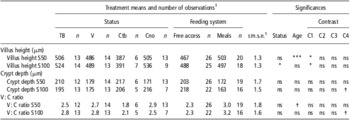
Mean villus heights, crypt depths and villus to crypt ratios according to status and feeding system, statistical analyses for group means and contrast tests are shown in Table 3. S50 villus height was affected by type of pen (P = 0.035); villus height was greater in controls in pens without tail biting (Cno) than in tail-biting pens (Ctb). S100 villus height was affected by status (P = 0.047) and type of pen (P = 0.012); villi were higher in controls in pens without tail biting than in tail-biting pens. Status had no statistically significant effect on crypt depth or villus to crypt ratio. Feeding system tended to affect S100 crypt depth (P = 0.056) and S100 villus to crypt ratio (P = 0.064); free access-fed pigs had deeper crypts and decreased villus to crypt ratio compared with pigs fed meals.
Effect of treatments (status and feeding system) on mean villus height, crypt depth and villus to crypt (V : C) ratio measured from two sections of jejunum (S50 and S100), number of observations in treatment groups, root mean square error (r.m.s.e.) and statistical significance of the difference (P-values)

TB = tail biter; V = victim; Ctb = control in tail-biting pen; Cno = control in non-tail-biting pen; S50 = 50 cm post bile duct; S100 = 100 cm post bile duct.
C1: Ctb v. Cno for the effect of pen.
C2: TB v. Ctb + Cno for the effect of biter.
C3: V v. TB + Ctb + Cno for the effect of been bitten.
C4: free access v. meals for the effect of feeding system.
1Means and r.m.s.e. are from back transformed ln-values.
*P < 0.05; **P < 0.01; ***P < 0.001; †P < 0.1.
Blood concentration of minerals
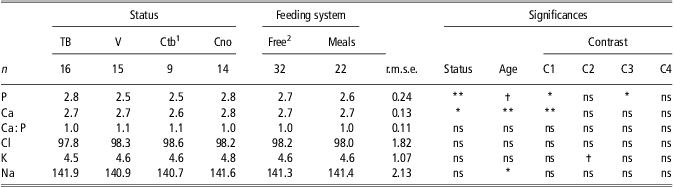
Mean blood serum concentration of minerals and statistical significance of differences between experimental groups are shown in Table 4. Pigs of different status differed in their concentration of inorganic phosphate (Pi; P = 0.007) and calcium (P = 0.022); Pi and Ca were higher in controls in pens without tail biting compared with controls in tail-biting pens. In addition, V had lower levels of Pi than other pigs (P = 0.045). There were no differences in blood minerals associated with the feeding system.
Effect of status (TB, V, Ctb and Cno) and feeding system (free access or meal feeding) on blood serum concentration of inorganic phosphorus (Pi), calcium (Ca), chloride (Cl), potassium (K), sodium (Na) and Ca : Pi ratio
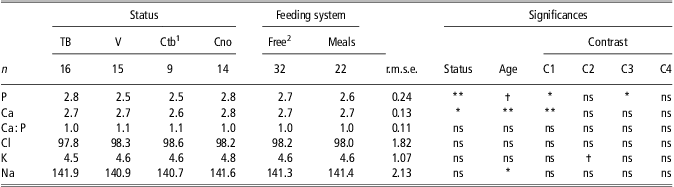
TB = tail biter; V = victim; Ctb = control in tail-biting pen; Cno = control in non-tail-biting pen.
Group mean (mmol/l), root mean square error (r.m.s.e.) and statistical significance of the difference (P-values) are shown.
C1: Ctb v. Cno for the effect of pen.
C2: TB v. Ctb + Cno for the effect of biter.
C3: V v. TB + Ctb + Cno for the effect of been bitten.
C4: free access v. meals for the effect of feeder type.
1For Cl and Na, n = 8.
2For Cl and Na, n = 31.
*P < 0.05; **P < 0.01; ***P < 0.001; †P < 0.1.
Blood concentration of amino acids (AA)
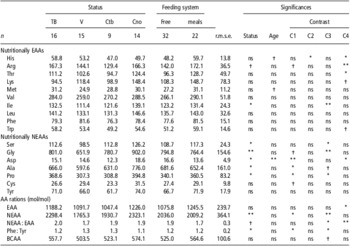
Mean blood plasma concentration of AA and statistical significance of differences between experimental groups are shown in Table 5. Status was associated with differences in levels of Ile (P = 0.019), Ser (P = 0.030), Asp (P = 0.018), Ala (P = 0.029), Pro (P = 0.021), Gly (P = 0.001), total non-essential amino acids (NEAA; P = 0.002) and ratio of phenylalanine to tyrosine (Phe : Tyr) (P = 0.026), and a tendency for differences in the level of Arg (P = 0.082) and total NEAA : essential amino acids (EAA; P = 0.074). Plasma AA level of Ile, Ser, Gly and Pro, total NEAA and total NEAA : EAA were lower, and those of Ala and branched-chain amino acids (BCAA) tended to be lower, in V than in all the other status groups. Conversely, the ratio of Phe : Tyr was higher in V than all the other status groups. TB had higher His levels than both groups of control pigs (P = 0.039), but this difference was only significant in the contrast test. There was an association between tail-biting presence in the pen and Pro, Asp, Ala and total NEAA concentrations, and a tendency for association with Arg, Gly and Cys concentrations, with these being higher in controls from pens without tail biting (Cno) than controls from tail-biting pens (Ctb). The Phe : Tyr concentration was lower in Cno than Ctb.
Analyzed plasma concentration of AAs according to status (TB, V, Ctb and Cno) and feeding system (free access or meal feeding), root mean square error (r.m.s.e.) and statistical significance of the difference (P-values) are shown

AA = amino acid; TB = tail biter; V = victim; Ctb = control in tail-biting pen; Cno = control in non-tail-biting pen; EAA = essential amino acids; NEAA = non-essential amino acids; BCAA = branched-chain amino acids.
C1: Ctb v. Cno for the effect of pen.
C2: TB v. Ctb + Cno for the effect of biter.
C3: V v. TB + Ctb + Cno for the effect of been bitten.
C4: free access v. meals for the effect of feeder type.
*P < 0.05; **P < 0.01; ***P < 0.001; †P < 0.1.
Feeding system was associated with the concentrations of His (P = 0.013), Arg (P = 0.007), Thr (P = 0.027), Asp (P = 0.036), total EAA (P = 0.019) and total NEAA : EAA (P = 0.004) and tended to associate with Lys and Trp concentrations (P = 0.090 and 0.070, respectively). Free access-fed pigs had lower concentrations of His, Arg, Thr, Lys, Trp and total EAA, and higher concentrations of Asp and total NEAA : EAA than meal-fed pigs.
Discussion
Our hypothesis was that tail biters may suffer from the inability to absorb nutrients, which could be observed as decreased villus height or changed crypt depth compared with non-tail biters or non-bitten pigs. However, results showed no signs of decreased villus height or changed crypt depth in tail biters. Furthermore, tail biters did not have indications of digestive malfunction on the basis of BW, which was measured in the same sample of pigs (Munsterhjelm et al., Reference Munsterhjelm, Simola, Keeling, Valros and Heinonen2013). In contrast, we found the control pigs in tail-biting pens and control pigs in non-tail-biting pens to differ from each other in many of the investigated parameters, possibly related to a different pen environment, the presence of tail biting in the pen or difference in feeding behavior. In addition, bitten pigs differed from other pigs on the basis of their levels of NEAA in blood.
Effects of tail-biting status
Biters
There was no statistical difference in intestinal villus height or crypt depth in TB compared with control pigs. Although our results failed to support the hypothesis of TB having defects in their ability to absorb nutrients, causing increased foraging behavior connected theoretically to tail biting, there is still the possibility that TB pigs might previously have had problems with intestinal capability or growth. In the retrospective study by Sinisalo and Niemi (Reference Sinisalo and Niemi2010), biter pigs were found to weigh 1.9 kg less than other pigs at arrival to the finisher unit, before they even started tail-biting behavior. The pigs in this study might have experienced a period of compensatory growth and intestinal adaptation before they were sampled and killed, as this phenomenon is possible in pigs of all ages (Williams, Reference Williams2003). It is not possible to estimate the effects of compensatory growth in this kind of a non-longitudinal study.
Victims
Being bitten was associated with having a different AA composition in blood compared with non-bitten pigs. In the present study, the essential AA Ile and NEAA Ser, Gly, Ala and Pro, total BCAA and NEAA were lower in V compared with other pigs. Moreover, the ratios of Phe : Tyr and NEAA : EAA were affected by being bitten. The reason for low NEAA in V is difficult to interpret without knowledge of individual feed intake and needs further studies. In general, inflammatory challenge affects AA metabolism in several species (Le Floc'h et al., Reference Le Floc'h, Gondret, Matte and Quesnel2012), for example, through synthesis of acute phase proteins. Pigs are shown to develop an acute phase reaction after being tail bitten (Heinonen et al., Reference Heinonen, Orro, Kokkonen, Munsterhjelm, Peltoniemi and Valros2010), and some evidence of inflammation was found in the V pigs in this study (reported in Munsterhjelm et al., Reference Munsterhjelm, Simola, Keeling, Valros and Heinonen2013).
Control pigs and the tail-biting pen environment
The contrast test showed decreased villus height in Ctb compared with Cno. This may be a consequence of a stressful environment or decreased feed intake in tail-biting pens, which we were unable to measure. It is possible that endocrine secretion in stressful conditions may have an effect on the jejunal surface (Moeser et al., Reference Moeser, Klok, Ryan, Wooten, Little, Cook and Blikslager2007). In the work by Yu et al. (Reference Yu, Yin, Liu, Cheng, Guo, Lu, Zhu, Luan and Xu2010), increased cortisol concentrations were associated with decreased villus height and crypt depth during and after heat stress. In pigs, the weaning time induces shortening of the villus and deepening of the crypts, connected both to decreased feed intake and elevated stress (van Beers-Schreuers et al., Reference Beers-Schreuers van, Nabuurs, Vellenga, Kalsbeek-van der Valk, Wensing and Breukink1998). Furthermore, in sheep, restraint and isolation stress cause depressed Ca concentration in serum (Apple et al., Reference Apple, Minton, Parsons and Unruh1993). In this study, Ctb had both lowered villus height and decreased Ca level compared with Cno, as did all tail-biting pen pigs compared with Cno. It is difficult to attribute cause and effect in any association; stress increases the restlessness and movements of pigs and can lead to tail biting, and tail biting can lead to increased general activity in the pen (Zonderland et al., Reference Zonderland, Schepers, Bracke, den Hartog, Kemp and Spoolder2011), which might cause stress to all the pigs in that pen.
In general, there seemed to be an effect of pen tail-biting environment in addition to the effect of status in this study, with control pigs in pens with biting differing from pigs in pens without biting. Even though we only tested the difference between Ctb and Cno pigs for statistical significance, there were, on many occasions, similar effects when looking for the difference between all the tail-biting pen pigs (TB + V + Ctb) compared with non-tail-biting pen pigs (Cno). Our findings therefore seem to indicate that the tail-biting pens are somehow a different environment for the pigs to live in compared with ‘normal’ finisher pig pens, affecting the physiology of the pigs.
Effect of feeding system
We were unable to measure daily feed intake in this study. Pigs were fed at, or close to, their appetite level. This is a general procedure used with finisher pigs in Finland, where in most cases the daily amount feed offered is calculated to be close to the voluntary intake of pigs. However, because of the two different feeding systems, it is possible that feed intake differed between the systems. We found meal feeding to be associated with shallower crypts and therefore higher V : C ratio in mid-jejunum. Deeper crypts might be related to lower feed intake in free access-fed pigs (van Beers-Schreuers et al., Reference Beers-Schreuers van, Nabuurs, Vellenga, Kalsbeek-van der Valk, Wensing and Breukink1998). In addition, the villi were somewhat shorter in free access-fed pigs compared with meal-fed pigs, without the difference being statistically significant. It might be that, although feed was present all the time in free access-fed pens, the competition for feeding places was high. There were only one or two feeding places in the pens of 11 to 26 finisher pigs. This might lead to a situation where some pigs are not eating enough because of avoiding the aggression at the feeder. The situation in meal-fed pigs might have been better because, although feed was offered twice a day, there was space for all pigs to eat simultaneously as pigs prefer to do.
Levels of the EAA His, Arg, Thr, Lys, Trp and total EAA were, or tended to be, higher and levels of Asp and NEAA : EAA ratio were lower in meal-fed pigs compared with free access-fed pigs. Wykes et al. (Reference Wykes, Fiorotto, Burrin, del Rosario, Fraser, Pond and Jahoor1996) observed lowered AA levels, of especially the essential AA, in the blood of protein-deficient pigs, but there was no lack of protein in diets as analyzed from the mixing container before delivery to different feeding systems. Furthermore, all pens, independent of feeding system, should have received the same diet. Further speculations without feed intake data are not useful.
Indicators of nutritional state in relation to feeding behavior
Enteral nutrient uptake per se affects villus morphology in pigs (see Pluske et al., Reference Pluske, Hampson and Williams1997 for review), although this has mostly been studied in younger pigs than those in our study. In rats and pigs, villus height has been reported to correlate with DM intake (Pluske et al., Reference Pluske, Hampson and Williams1997), and daily weight gain, independently of BW (Zambonino Infante et al., Reference Zambonino Infante, Rouanet and Besancon1993), although the extent of weight gain response is also dependent on age. Therefore, low feed intake can lead to reduced villus height followed by diminished absorption capacity and poor nutritional state of the animal. There are contradictory findings on whether crypt depth is seen to increase, decrease or not react to poor nutritional state. Other indicators of nutritional state connected to malnutrition or macronutrient restriction in pigs include BW (Ferraris and Carey, Reference Ferraris and Carey2000), feed intake, growth, body protein and fat deposition (Lu et al., Reference Lu, Schoknecht, Ellis, Shypailo, Su and Pond1996) and several changes in blood chemistry. Reduced intestinal surface resulting from malnutrition can lead to overall reduction in the absorption of minerals (Ferraris and Carey, Reference Ferraris and Carey2000). Levels of free AA in plasma after 12 h of total fasting in pigs were decreased, but stated to be influenced by many factors in the animal and diet (Richardson et al., Reference Richardson, Hale and Ritchey1965). Signs of dietary protein malnutrition measured from blood include decreased levels of total protein, serum urea, EAA (Wykes et al., Reference Wykes, Fiorotto, Burrin, del Rosario, Fraser, Pond and Jahoor1996), Ca and inorganic P (Pond et al., Reference Pond, Ellis and Schooknecht1992; Lu et al., 1996). Protein restriction is thought to affect intestinal surface only if chronic (Ferraris and Carey, Reference Ferraris and Carey2000). An elevated level of urea in plasma can also indicate increased protein catabolism (Formigoni et al., Reference Formigoni, Piva, Pezzi, Castellani and Biagi2006). Only intestinal cell wall structure, BW and blood metabolites were measured in this study as signs of the nutritional state.
None of the above-mentioned signs of decreased feed intake, protein malnutrition or poor nutritional state were found in the blood chemistry of TB pigs. The Ctb pigs might have suffered from some degree of defect in their absorption capacity because of depressed villus height, and therefore might have experienced short-term lack of nutrients compared with Cno pigs. The blood serum mineral concentrations seem to support this conclusion as, besides shortened villi, depressed levels of Ca and Pi were found in Ctb compared with control pen pigs. In a study by Holmgren et al. (Reference Holmgren, Keeling and Lundeheim2004), pigs in tail-biting pens also had decreased serum Ca levels compared with control pen pigs. However, signs of long-term defects such as significantly lowered BW were not observed in Ctb (Munsterhjelm et al., Reference Munsterhjelm, Simola, Keeling, Valros and Heinonen2013), although they were numerically somewhat lighter than other pigs. Therefore, we presume that the state of malnutrition (semi-starvation) was not long or severe enough to affect growth and that it might have been the outcome of decreased feed intake (not measured). It is suggested that malnutrition for more than 24 h affects mucosal mass and BW in pigs (Ferraris and Carey, Reference Ferraris and Carey2000).
The feeding situation is one where the tail is unprotected against biting (Zonderland et al., Reference Zonderland, Bracke, den Hartog, Kemp and Spoolder2010), and therefore reduced visits to the feeder might be a normal consequence of protecting the tail. In the study by Palander et al. (Reference Palander, Valros, Heinonen and Edwards2012), half of the observed tail biting happened within the feeder region of the pen when there was ad libitum feeding and only one single-space feeder for 9 to 11 pigs. Although Zonderland et al. (Reference Zonderland, Schepers, Bracke, den Hartog, Kemp and Spoolder2011) did not find any differences in general behaviors such as feeding or drinking between tail-biting, tail-bitten or control pigs, in pens with 10 ad libitum-fed pigs and two feeding spaces, on the basis of our morphological data non-eating might be associated more with the control pigs (Ctb) than with biters or victim pigs. Thus, many of our findings suggest the state of short-term undernutrition being present in Ctb pigs, perhaps because of depressed voluntary feed intake associated with ‘staying as a control’ inside the tail-biting pen. This highlighting of control pigs inside the tail-biting pen is in accordance with Brunberg (Reference Brunberg2011), who classified the neutral pigs (Ctb) to differ from other categories. Our suggestion is that this might happen through inactivity and not approaching the feeders, thus suffering from elevated stress as a consequence.
Taylor et al. (Reference Taylor, Main, Mendl and Edwards2010) highlighted the fact that tail-biting behavior might arise from more than one motivational cause. The data reported in this study suggest that the access to feed might have been an initial causal factor, with a possible scenario being that TB pigs successfully accessed feed by using tail biting as a strategy, and thus maintained growth and intestinal capacity, V pigs continued to try and feed and received consequential damage and Ctb pigs avoided such damage by reducing feeding behavior relative to pigs in non-biting pens.
Sources of error
In this study, we only had nine Ctb pigs, of which six were younger and thus eating the grower diet and three of them were older and thus eating the finisher diet. This rather low sample size needs to be taken into account when interpreting the results. In addition, there was only one Ctb in meal-fed pens of younger pigs and one of the older pigs. This unbalanced structure of diet and age might have affected the means for status, age and feeding system results. However, as there were no interactions of status and feeding system, and age was used as covariate in all the models, it is unlikely that this imbalance between feeding system, status and age (confounded with diet) substantially increased the error in these results.
Conclusions
There were no signs of nutritional defects in tail biters on the basis of their intestinal morphology or blood metabolites. Data suggest differences in relation to the tail-biting environment and being bitten, which were both associated with changes in gut morphology and blood composition of minerals and AA. Free access feeding with restricted feeding space, compared with feeding twice a day with unrestricted feeding space was associated with an overall reduction in EAA levels in blood and deepened crypts in the jejunum. Observed differences might be linked to reduced feed intake (not measured), sickness reaction or a stressful pen environment and differ according to the behavioral role of pigs in a tail-biting pen during the outbreak.
Acknowledgments
This study was a part of the NKJ (Nordic Joint Committee for agricultural and food research)-funded project ‘Tail biting and tail docking in the pig: biological mechanisms, prevention, treatment and economic aspects’. The authors thank the farm for enabling the sampling of pigs for this study and all the researchers and technicians involved. P. A. Palander was supported by Oiva Kuusisto Säätiö and European Regional Development Fund (EAKR) Project A31342.