Introduction
Modern representative democracies are shaped around the centrality of the legislatures for the political system. Unthinkable without a body of directly elected representatives, the domestic arrangements inspired the transnational project of the European Union (EU). The gradually increased powers and position of the European Parliament (EP) among the European political institutions1, Reference Hix, Noury and Roland2 balance the control mechanisms and diminish the democratic deficit. In such a setting, the activity of the members of parliament (MEPs) gains increasing weight compared with the previous decades. In 2004 and 2007 the new member states sent approximately 200 representatives, expected to actively contribute to the EP legislation and decision-making. Previous research focuses on the socialization of the newcomers, leading to a more pro-integration perspective and support for the greater role of the EP in this process,3–Reference Scully6 and on the possible impact that MEPs from the post-communist countries may have.Reference Hix, Raunio and Scully7–9
However, the degree of activity of those MEPs originating from the new democracies, who are not used to working at supranational level, is scarcely if at all examined. The general ranking of the MEPs (www.parlorama.eu) indicates stark differences in their activity both cross-countries and cross-party groups. The latter increases when looking at the new joiners. It is not clear what can explain this variation. Given the lack of research on this issue, we aim partially to solve the puzzle by an exploratory study that focuses on the representatives of the most recent EU member state. We analyse the activity of the 67 Romanian MEPs from the beginning of 2007 until March 2009. Romania is chosen as a representative case for investigation among the new member states for two related reasons. First, the country’s representatives greatly vary in terms of their activity: they are widely dispersed in the ranking of the MEPs (www.parlorama.eu). Second, as is the case with the other new joiners, the country has little experience in matters related to the European Parliament (EP). The first full mandate for its MEPs started in June 2009, with the previous one running only 18 months. Thus, it is an appropriate environment in which we can test several institutional and individual characteristics, including the representatives’ professionalization and socialization. In doing so, we try to answer the following question: what factors determine the level of MEPs’ activity? Our model tests the explanatory potential of five variables (plus age for control) – (1) the background of the MEPs; (2) their political experience; (3) their belonging to a European party group; (4) the duration of their mandate; and (5) their status (i.e. elected versus appointed) – in determining attendance rates, number of speeches given, and number of drafted and amended reports submitted. The disaggregation of our dependent variable (i.e. MEPs’ activity) allows a detailed analysis of the determinants for multiple dimensions and avoids the dilemma of weighting problems when putting together these indicators. The consistency of these results indicates that the patterns detected are obvious at aggregate level as well.
The direct scientific contribution of this research rests on two bases. On the one hand, it complements the existing literature on MEPs’ behaviour by explaining differences that occur in the extent of their activities. Although we may be accused of a single-sided quantitative approach, it is relevant to cover such issues in order to understand the nature and quality of the MEPs’ work. On the other hand, starting from existing theoretical and conceptual frameworks, we combine individual-level and institutional features and develop a model that can also serve for further investigations. As the current research design focuses solely on the linear relationships for a reduced number of MEPs, there is plenty of room for improvement and testing in different settings.
Our article continues with a theoretical framework that helps formulate the hypotheses and conceptualizes the variables included in the analysis. The third section explains the data and the methodology, whereas the fourth section elaborates on general features of the Romanian representatives in the EP. The fifth section includes the results of the bivariate and multivariate analysis. The conclusions of the article elaborate on the implications of our findings and provide ground for further research.
Shaping activity within the legislature
There is a wide consensus in the legislative behaviour literature regarding the aims of MPs: policy influence, office perks, and vote-seeking.Reference Muller and Strom10 In fact, the latter is decisive as without continued presence in the legislature it becomes highly problematic to achieve policy outcomes and office positions. Whenever elections take place on blocked party lists (i.e. the EP case for most of the countries), the MPs have to make sure they fulfil, as much as possible two, conditions in their relationship with the party. On the one hand, they have to persuade the party leaders that they are the appropriate nominees for eligible positions and that they are able to gather votes for the party. In doing so, they have to make sure that their image in the eyes of the electorate is fairly positive. The best way to do this is to show intense activity within the representative body. In this respect, Norris (Ref. Reference Norris11, p. 1) points to the motivation and political capital of the candidates as one of the four components of the legislative recruitment.
On the other hand, the MEP has to maintain a good relationship with the party. This controls, to various degrees (Ref. Reference Gallagher12, p. 4) the candidate selection that shapes the access of the MPs to re-nomination. These interactions between individuals and institutions are analysed through a complex system of legislative roles (Ref. Reference Wahlke, Eulau, Buchanan and Ferguson13, p. 14): consensual roles (formal and informal rules), representational roles (the decision-making and voting processes), and purposive roles (aims and goals of MPs). The latter are consistent with the earlier-mentioned connection with the voter and represent the starting point of this study. Following this logic, increased activity represents an asset for the MEPs for following elections. The stakes are raised when these elections are held earlier than the regular term: those appointed in January 2007 had the perspective of elections in November 2007, whereas those elected at the later date knew that for them further elections would follow in approximately 18 months.
In a nutshell, when MEPs seek re-election, their performance becomes a central point of the electoral campaign with opponents criticizing their alleged passivity and incumbents defending their positions. At a national level, great emphasis is put on the ideological distance of preferences between voters and representatives.Reference Budge, Robertson and Hearl14, Reference Budge and Laver15 There are instances in which voters’ preferences differ from party stances and the MP has to make a choice.Reference Denzau, Riker and Shepsle16 The imminent result of such a situation is a defection from either constituency or party. None of this happens for the representatives of the new member states in the EP as decisions are European groundedReference Scully6 rather than national, the adaptation and socialization process requires time, and the communication between voters and representatives is not direct, but solely mediated. Consequently, parliamentary activity appears to be one of the few tools at hand for the MEPs to gain visibility and thus pursue re-election. In the absence of previous systematic investigations on the amount of activity undertaken by MEPs, our analytical framework focuses on their characteristics and rests on logical parallels drawn with the legislative behaviour literature. By accounting for the objective components of activity, our analysis is not influenced by the manner of voting of the MEPs – a choice in line or not with the EP party group. The only issue that may make a difference is the maintenance of good connections with the national party.
Adaptation and work in the EP: background and political experience
The MEPs of the late joiners have two advantages and face at least one major challenge with respect to their activity and adaptation within the European legislature. First, their prerogatives and positions are shaped by three decades of full-time political activity dedicated to European issues, once the simultaneous national mandates were eliminated in 1979. Thus, they have access to an environment with no procedural and formal barriers for European level responsibilities (Ref. Reference Corbett17, p. 66). However, as in the case of their countries, which suffer pressures for adaptation considerably greater than those of previous applicants due to the European Union’s advanced development (Ref. Reference Grabbe18, p. 305), the new MEPs have to integrate in a strong parliament with institutionalized procedures and working mechanisms.
All those used to the proceedings of a legislature, or with political mechanisms in general, have clear advantages in the new environment. The political experience and networks of valuable counsellors appear fundamentally relevant for the new European challenge of the Romanian MEPs in their process of adaptation. Previous research indicates a similar pattern at the beginning of the direct election era for the EP. KirchnerReference Kirchner19 finds a strong correlation between a high level of domestic political experience and a leadership role in the EP. Consequently, MEPs holding formal national offices and representation functions play a more important role in the EP than other MEPs. Corbett (Ref. Reference Corbett17, p. 71) argues that many former high officials from domestic politics that sat in the EP have contributed greatly to the debates. Drawing a parallel with what Miller and WattenbergReference Miller and Wattenberg20 argue with regard to presidential candidates, we argue that for the MEPs past political experience is decisive in enhancing activity and provides the ground for performance.
Hooghe and Marks (Ref. Reference Hooghe and Marks21, p. 4) argue that the competencies of political actors are not separated at national and European levels, being characterized by complex interrelationships. The multi-level governance modelReference Marks22, Reference Hooghe23 that considers authority and policy-making shared across three layers (i.e. subnational, national, and transnational) leads to a reasoning at elite level beyond interdependence. Officials involved in political issues at the national level are more likely than outsiders to participate actively in European politics, especially in the short term. Their capacity for adaptation is enhanced by the environment in which they acted so far and by the experience gained. As all Romanian MEPs appointed or elected in 2009 had only a short time to adapt to the workings of the EP, we expect those with a political background to perform better than their colleagues:24
H1: MEPs with political background are more active than the rest.
We have sorted the background of the MEPs into five categories, coded on a 0–4 scale: political, administrative, business, academic, and religious. We have labelled as having a political background all those MEPs that at some time sat in the national parliament, or served as ministers, and all politically appointed or elected representatives in local politics. Administrative stands for those individuals that held positions in public administration or worked as counsellors for political or administrative figures. The business, academic, and religious profiles do not need further specification. Two methodological issues have to be solved here. On the one hand, these categories being nominal variables, it is quite difficult to include them in a statistical causal analysis (see the section on Data and Method). However, given the direction of our hypothesis we ranked these categories on a scale where the criterion was proximity to the political background. Thus, we have assigned the political background an extreme score closest to the representative activity (0) and the religious background is coded 4 as it is the furthest from the political background. The administrative background is classified immediately after the political one as some close linkages are visible, followed by business and academic backgounds. One supplementary issue strengthens our methodological choice: there are no combinations of background components except those in the immediate proximity. For example, there are numerous MEPs that combine administrative with political experience. However, there are isolated cases that display combinations of experience in business and politics, or academe and politics. On the other hand, and related to the latter issue, whenever MEPs have experience that includes them in more than one category, we have always selected the dominant experience. For example, an MEP with six years of political activity and three of administrative activity is included in the political background category. The distribution of backgrounds is graphically represented in Figure 1 for all 67 MEPs. At a glance, almost two thirds belong to the political background and equal percentages to the administrative and business backgrounds (13%). Approximately one in ten Romanian representatives in the EP has an academic background and only 2% fit in the religious category.
The background of the Romanian MEPs before joining the EP

This domination of the political background among the background of the MEPs leads us to formulate a more specific hypothesis that differentiates between the individuals with such a profile. We focus on the number of years of political experience, accounting for the period elapsed between the beginning and end of a job with a political profile. Thus, the new measurement is sensitive also to those cases outside the political category, but with a few years of experience in this field. Consistent with our previous arguments and the first hypothesis, we expect that individuals with an increased number of years of relevant background to also be more active than their colleagues:
H2: An MEP having long political experience favours increased activity in the EP.
The political experience of MEPs ranges from 0 years to 17 years, the maximum possible for a person in post-Communist Romania (i.e. if they started in 1990) at the moment of the 2007 nomination/election. The number of years was considered solely until the beginning of a mandate as an MEP and it was rounded off to the closest exact figure. For example, an MEP with six years and nine months of political experience has been deemed equal with one that has seven years and three months of such experience, both being allotted seven years. We have chosen this compromise also because of the difficulty in accounting for the precise duration of MEPs’ previous workplaces because of a lack of detailed data sources. When checking for the relationship between independent variables, the background and the political experience revealed the strongest connection (0.55 at a 0.01 level of significance). It is quite normal to have such a correlation as those with a political background have more chances to have political experience compared with the rest. We decided to leave both variables in the model as they target fairly different particularities and their relationship is not so strong as to allow rejection on the basis of multicolinearity.
Institutional determinants of activity
Strøm (Ref. Reference Strøm25, p. 158) emphasizes two institutional features relevant in the processes of decision making by legislators: the legislature itself as an arena for action and MPs’ political parties. Based on the similarities between the national and European legislatures we make similar inferences regarding the activity of legislators in the EP. We do not focus on the content and consequences of decision-making, but on the level of MEPs’ activity, the logical connections being developed in the following lines. The EP as an arena for action can influence the level of MEPs’ activity through the socialization process. It has been argued that the EU institutions exert a strong socializing impact on those units that act within its framework (Ref. Reference Scully6, p. 4). At elite level, previous research tries to illustrate the transformative impact that the European integration has on the behaviour of constituent members.Reference Bellier26–Reference Hooghe29 Special attention was dedicated to the influence that the process of socialization into the EP has on the level of party cohesion,30, Reference Kreppel31 with rather weak results.
Following a similar logic of attitudinal change as a result of socialization, Katz,Reference Katz32 Franklin and Scarrow,Reference Franklin and Scarrow5 and ScullyReference Scully33 investigate whether the duration of service in the EP is associated with support for closer integration. They expected that longer service provides the grounds for a better understanding of the parliamentary workings, and that the debates enact more pro-European perspectives and more support for the increased role of the EP. Although the evidence does not allow us to draw relevant conclusions to explain the behaviour towards integration, the logical consequences potentially resulting from socialization are useful to explain the level of MEPs’ activity. A longer presence in the EP allows legislators to get better accustomed with the workings of the parliament, understand its procedures, and hence to develop a more intense activity. Other than that, it is quite normal to expect that individuals spending more time within an institution are more active in absolute terms than those with an episodic or reduced presence. Consequently, we expect those Romanian MEPs that spent more time in the EP to display higher rates of activity than their colleagues with a shorter length of service in the European legislature:
H3: A longer presence of MEPs in the EP favours their increased activity.
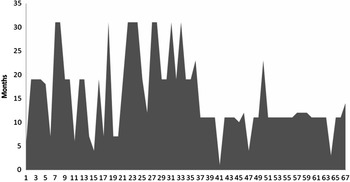
The duration of mandate is calculated as the number of months that pass from an MEP’s appointment/election to his or her resignation, or to new elections in which they are not re-elected. The minimum is one month and the maximum is 31 months. There is a single MEP that stayed in the European legislature for a single month, whereas ten MEPs served the maximum of 31 months, approximately 15% of the total number. The distribution of the Romanian representatives according to their time spent in the EP is displayed in Figure 2. The horizontal axis represents the number of MEPs, whereas the vertical axis stands for the number of months in office.
The time spent by the Romanian representatives in the EP

Given the specificity of the context (i.e. three different cohorts of candidates in two and a half years), we consider the appointment and election of representatives to play a crucial role in their activity. Quite a few MEPs stayed in office for the 11 months that correspond with the period between nomination on January 1, 2007 and the first European elections of November 2007. These MEPs were never truly elected and only had the benefit of a short period of time in the EP. Some of them did not stand in the European elections, whereas some did so unsuccessfully. At this point, we hypothesize the existence of a relevant distinction between the elected MEPs and the appointed ones. We expect those individuals that never were truly elected to have had a lower level of activity than the truly elected MEPs, and this for two reasons. First, we may suspect the lack of activity and/or interest for the European issues as causes for their short activity. They see their presence as appointees in the EP as the sole experience of this kind and are not motivated to develop abilities and activities in order to gain re-election. Concurrently, on a rational voting maximization basis, political parties that observe a low activity of the appointed MEPs may not be willing to include those individuals on eligible list positions. Second, the appointed MEPs do not have a mandate to represent anyone, and their accountability is thus highly reduced. At the same time, the expectations vested in these ‘interim’ MEPs are reduced both from the part of the European institutions and the national political parties. With the elected MEPs the expectations are, on the contrary, quite high as they are the first to represent Romania in the EP with a regular (shorter) mandate. Following these two arguments, we hypothesize that:
H4: Elected MEPs show more intense activity compared with their appointed colleagues.
The status of the MEPs is a dichotomous variable (elected coded 1 versus appointed coded 0). All those MEPs initially appointed that are elected in the first European contests are included in the ‘elected’ category as they did not limit themselves to being appointed only.
Usually seen as agents serving multiple principals, the MEPs have the double task of representing their national electorates and parties, but also of developing their activity within European party groups (Ref. Reference Raunio34, p. 87). As previously shown, the process of candidate selection generates a powerful connection between the MEPs and national parties. Given their increased weight in the recent history of the EU,Reference Hix35, Reference Hix and Lord36 the European party groups create a more stable framework in which the action of their MEPs can be embedded and analysed. With a minimal role in elections, the EP party groups are the sole organizational structure in the European legislature’s arena. They are in charge of the general parliamentary activity: they draw up the plenary agenda, select and appoint members in committees, make decisions, elaborate and vote on legislation. Although they share similar types of organization and office structures, the European party groups vary considerably in size, with two dominant groups – the European People’s Party (EPP) and the Party of European Socialists (PES) – numbering almost two third of the total number of MEPs.
Usually, large organizations have fewer interactions between their members, and the means to control them in terms of activity are weaker, than for small-size organizations. The latter also typically achieve a better centralization of component activities and allow for a more personal approach toward members. A similar logic applies to the EP party groups, where small parties enact more frequent interactions among their MEPs and create a more demanding framework for activity compared with the larger entities. For example, it is quite easy for the European Greens EFA group (the fourth largest in the EP) to monitor and make accountable its approximately 40 MEPs in terms of activity and voting behaviour through internal meetings and individual contact whenever things do not go as planned. At the other extreme, the approximately 250 MEPs belonging to the EPP do not have the benefit of such arrangements, and the number of free-riders may be higher than in the smaller parties. Consequently, we expect to observe a difference in the level of activity of MEPs belonging to different groups.
H5: MEPs belonging to small-sized party groups show more intense activity compared with their colleagues.
All EP party groups are ranked according to the number of MEPs that they have, ranging from EPP as the highest (coded as 1) to the independents’ group (coded as 9). For methodological purposes, this nominal scale with nine values is treated as the interval. Thus, one basic assumption is made: the distance between the parties is equal. We acknowledge that the distance between the first two party groups or between those situated on positions five and six (35 versus 30 MEPs) is much lower than that between the second and the third party group (more than 200 versus 100 MEPs). However, given the number of MEPs’ affiliations to the first two EP party groups, such a scaling and assumption is necessary in order to show up differences both among these individuals and between these MEPs and their colleagues who belong to other party groups.
Data and Method
The data used for this analysis include information on all 67 Romanian MEPs collected until March 2009. To test the formulated hypotheses we employ bivariate and multivariate OLS regressions. The bivariate analyses indicate the relationships between the specified independent variables and each of the components corresponding to one dimension of the dependent variable, generally labelled ‘activity’: plenary attendance, number of drafted reports, number of amended reports, and number of speeches. All of them are measured as the number of occurrences (ratio variables). The step of conducting multivariate analysis is justified by our willingness to observe the explanatory potential of all five variables in a single model:

Age is added as a control variable (operationalized as number of years) as it may influence the activity of the MEPs. There is no clear direction in which age makes a difference, two opposed arguments being equally plausible. On the one hand, some of the MEPs originate in the old national elite, at the dawn of their career. If the old MEPs correspond to this profile, they have increased chances to be more active than their younger colleagues as they are already familiarized with part of the procedures. Following this path, there is an obvious overlap between age and political experience. On the other hand, there is the possibility for younger MEPs to be more active than their older colleagues as they are willing to show their potential for further European or domestic careers. Age is operationalized as the number of years the MEPs have at the beginning of their mandate.
Romanian representatives in the EP and their activity
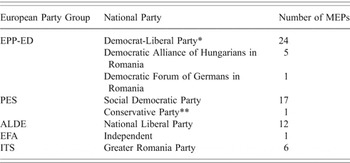
At 1 January 2007 Romania appointed to the EP 35 MEPs, out of which approximately one third had had observer status in the previous years. Political parties represented in the national parliament appointed representatives on a proportional basis. One third of these MEPs subsequently successfully stood for election in December 2007. Table 1 reflects the distribution of the Romanian MEPs in the EP party groups and their national party affiliation.
Affiliation of the Romanian MEPs

*In the 2007 European elections the Democrat Party and the Liberal-Democratic Party competed separately. In the aftermath of the elections the two merged and formed the Democratic-Liberal Party.
**This differentiation between the Social-Democratic and Conservative Party existed only until December 2007 when they run on common lists in the European elections.
Up to the European elections in 2009, Romania had 35 MEP seats, and when Romania joined the EU on 1 January 2007, just as many members of the Romanian parliament were also delegated to serve as MEPs, until the elections of November 2007. They were affiliated to the three major European Political Groups: the Democratic– Liberal Party (previously known as the Democrat Party), the party of the Hungarian minority in Romania (UDMR), and one representative of the German minority joined the EPP-ED group; the Social-Democratic Party joined the PES, while the National Liberal Party and the Conservative Party joined the ALDE group. The members of the Greater Romania Party began their mandate as non-affiliated, but soon joined forces with other extreme-right parties in EU to form the Independence Tradition Sovereignty group. However, the life of this group was short (a few months), as it fell apart when the Greater Romania Party decided to break away, following fierce disagreements with their Italian colleagues, led by Alessandra Mussolini, over the treatment of Romanian migrants by the Italian government.
Following the November 2007 elections, the first European elections held in Romania, the Conservative Party, the Greater Romania Party and the representative of the German minority lost their EP seats. On the other hand, one independent candidate, belonging to the Hungarian minority, reached the required threshold and got a seat. However, he did not join the rest of the representatives of the Hungarian minority in Romania within the EPP-ED group, and chose to join the Greens/EFA group. All three Romanian delegations in the EPP-ED, PES and ALDE group managed to obtain a position of vice-president of the political group, due to the fact that they were strong in numbers. For the same reason, they managed to secure a number of vice-presidential posts in parliamentary committees, but no chairmanship in any committee. Perhaps the most important strategic position gained by a Romanian MEP was the chairmanship of the EU-Ukraine bilateral EP delegation: the Ukraine is the Romania’s largest neighbour and not a member of the EU.
Before proceeding to a detailed analysis, a few rough descriptions of the employed variables – reflecting features and activity of the Romanian MEPs – are relevant. The average age of the MEPs that represent Romania in the 2007–2009 period is quite high, slightly over 46 years. The youngest representative was 28 years old when joining the EP, whereas the oldest was 73. The average number of drafted reports is 0.4. Such a small number implies that, on average, the Romanian MEPs draft less than half of one report during their stay. Although the average does not say much about the individual performance of those in office, it says quite a lot about the general activity of the Romanian delegation. If we mention that there is one MEP that drafted seven reports one can easily imagine the amount of MEPs that drafted no reports at all during their stay in Strasbourg and Brussels. The average number of amended reports is considerably higher (11.6), showing a generally active delegation. However, if we consider that the first two performers in this category have 110 and 53 amended reports, the number of MEPs with no or very few amended reports is also considerable. The average number of speeches given by a Romanian MEP is 25, with extremes values at 252 and 0. Regarding the latter, there are seven Romanian MEPs that never took the stand. Finally, presence in plenary sessions is very high: the average is 82.87% with extremes values of 19.79% and 100%. Two Romanian MEPs never missed a plenary session during their mandate. With these general figures clear, we can now delve into the differences that occur at individual level. In doing so, we first use bivariate statistics complemented afterwards by complex models meant to explain how all explanatory factors predict the variation of activity.
Bivariate analyses
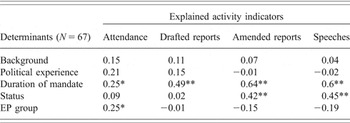
Table 2 includes all results obtained from the bivariate analysis for all four components of MEP activity. Although this is not a sample but the entire universe of Romanian MEPs and there is thus no need for generalization, we provide the level of significance to indicate if the relationship is more or less accidental. A level closer to 0.01 indicates that the relationship holds in many situations, whereas one above 0.05 casts doubt on the robustness of the linkage. We should also mention that some levels of significance are close to the mentioned levels, one cause for exceeding them being the relative small number of cases.
Determinants of the MEPs activity – bivariate relationships

*Significant at 0.05 level.
**Significant at 0.01 level.
Reported coefficients are standardized (β).
According to the first hypothesis, we expect activity to be proportionally higher for those MEPs that have a political and administrative background as compared with their colleagues operative in other fields until their first appearance in the EP. Evidence weakly supports this hypothesis: background performing best in explaining the amount of activity with respect to attendance (0.15) and number of drafted reports (0.11). In other words, one in ten MEPs from a political or administrative background attends the plenary sessions more than his or her colleagues and he or she drafts more reports than these same colleagues. As a result, the benefits resulting from the background are quite scarce. This image is also reflected in the amended reports where background is seen to play a minimal role, although it does tend in the hypothesized direction. The speeches are a clear example of where MEPs’ background makes no difference.
The second hypothesis argues in favour of increased activity from those MEPs with large political experience. This hypothesis is likewise weakly supported by our evidence for the same two components of activity (attendance and drafted reports). As expected, a relationship detected for background is strengthened in the case of experience. The latter catches details that increase the variation in activity and transcend the boundaries of the background. This is the reason for which, in the case of political experience, one in five MEPs displaying greater experience is more likely to attend the plenary sessions compared with her colleagues with less experience. In addition, the proportionality between the amount of drafted reports and political experience increases compared with what registered for the background. For the amended reports and the speeches there is no difference between the MEPs with and without political experience. Still, this would appear to tend in a different direction than hypothesized, with MEPs with less or no political experience amending more reports and having slightly more speeches than their experienced colleagues. The direction is relevant in this case, but the very low value of the coefficient makes further discussion redundant.
The hypothesis that involves the duration of the mandate is heavily supported by evidence with respect to the two components of activity where the previous explanations failed. Powerful significant relationships are found between the duration of the mandate and the number of amended reports and speeches. In fact, the length of stay in the EP explains almost two thirds of the variation in speeches, those with more months spent in the legislature amending, on average, more reports than those with less time spent in the EP. The same situation is registered for the speeches where the MEPs with more months in the EP are more likely (coefficient = 0.6, statistically significant at 0.01) to give more speeches. The stay in office significantly explains half of the variation regarding the amount of written reports: MEPs with longer terms are more likely to draft more reports compared with the rest. However, they do so less prominently than with amended reports or speeches. Attendance is explained by this variable to a medium extent (0.25, statistical significance at 0.05) in the same hypothesized direction: MEPs with longer terms tend to attend the plenary sessions more than the rest. Although the duration variable explains, of all components, worst attendance, it still performs very well compared with the other variables where only belonging to an EP group explains the same amount of variation (see the sub-section on Multivariate Analysis).
Similar to duration, the status of the MEPs explains, to a high extent, the variation of the amended reports and speeches. Unlike the previously described variable, status does a better job of explaining the amount of speeches than the amount of amended reports. The correlation coefficient (0.45, significant at the 0.01 level) indicates that the elected MEPs are more likely to give speeches than the appointed MEPs. The elected MEPs give, on average, 0.4 times more speeches than the appointed MEPs. At this point, observing the high consistency between the results displayed for the duration of mandate and status, we have thought the latter may be a spurious relationship mediated by the duration. The calculus of correlation between status and mandate (0.4, significant at 0.01) indicates there is no colinearity between these two variables and thus explains different parts of the variation in amended reports and given speeches. Their joint effect will be tested within the multivariate subsection. Attendance is quite poorly explained by status, with a slight tendency of the elected MEPs to participate more in the plenary sessions than their appointed colleagues. There is no difference with respect to drafted reports, the appointed and the elected MEPs writing an equal number of reports.
Belonging to an EP group better explains attendance: MEPs belonging to larger EP groups are more likely to participate in more plenary sessions compared with their Romanian colleagues from smaller EP groups. In fact, this is the only piece of evidence that goes against the hypothesized relationship in which a stricter control coming from the small EP groups enhances activity. Activity in the form of speeches and amended reports is explained more poorly than is attendance, but tends in the expected direction: MEPs of small groups give more speeches (coefficient of 0.19) and amend more reports (correlation of 0.15) than their colleagues from larger EP groups.
The bivariate analyses indicate mixed evidence for the formulated hypotheses. Overall, with a few exceptions, from which only belonging to the EP group in relationship with attendance is notable, there is support in the expected direction. MEPs with a background closer to politics, with more experience in politics, who stay longer in the EP, who are elected rather than appointed, and who belong to smaller EP party groups show more activity than the others. The relevant exception indicates that MEPs belonging to large EP party groups attend plenary sessions more frequently or regularly. Such a situation may be explained by specific interactions within the EP group, with larger parties having the capacity to better mobilize attendance of their members in support of the party’s initiatives within the legislature.
The most relevant conclusion to be drawn after this analysis is that there are three variables with relevant explanatory potential (duration of the mandate, status, and belonging to the EP group) and two (background and amount of political experience) that explain a relative small amount of variation, and whenever they do so it is not statistically significant. To better observe the impact of these determinants on the political activity of the MEPs we construct four different models (one for each component of party activity) and we introduce age as a control variable. We have tested for multicolinearity both with correlation between the independent variables on a one to one basis and with the variance inflation factor that accounts for the dependence on one independent variable on the rest of the independent variables from the model. The results of the colinearity statistics (correlation plus ViF) indicate that no independent variable is a linear function of other independent variables. Consequently, we have no methodological obstacles in including any independent variable into our models.
Multivariate analysis
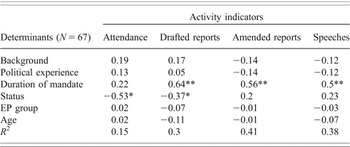
Table 3 includes the regression coefficients and the explained variance for all four dependent variables. The models are identical and explain, to various extents, the variation. The amount of amended reports (R 2 = 0.38) is best predicted by the independent variables, a similar performance being registered in the case of the number of speeches (R 2 = 0.38). Attendance is poorly explained both in relative and absolute terms, only 15% of its variance being predicted by the employed variables. The number of drafted reports is weak to medium explained: in three out of ten instances the model can predict the profile of MEPs who will write more reports than others.
Determinants of the MEPs activity – OLS models

*Significant at 0.05 level.
**Significant at 0.01 level.
Reported coefficients are standardized (β).
Three major conclusions can be drawn on the basis of this table. First, complementing the evidence from Table 2, it is quite clear that there are a few variables that do not seem to have any influence at all on the amount of activity shown by MEPs. In the multivariate models, belonging to the EP group appears to have no relevance, and along with this the control variable does not indicate any difference between old and young Romanian MEPs with respect to their activity. One explanation can be formulated for the absence of the relationship between belonging to the party group and activity shown. The large political groups (EPP and PES) have a high number of representatives who do not behave homogeneously. Some are more active than others: differences in activity also occur within the same national party. Consequently, within large parties there are MEPs that are as active as their colleagues from smaller parties. Regarding the latter, they are not characterized solely by active MEPs. For our study it is relevant to note that the medium relationship between this belonging and the attendance observed in the bivariate relationship vanishes in the presence of other variables. This leads us to conclude that the variance is explained by other indicators and in the multivariate models the latter cover what the party affiliation explained in the bivariate relationship.
Second, the impact of background and political experience on all activity components is similar, but low in both relative and absolute terms. Unlike with bivariate relationships, where the explanatory potential of experience is larger than that of background, the latter equals or exceeds experience in all models. What is striking here is that for amended reports and speeches our evidence goes against the hypothesized relationship, whereas in the bivariate relationships it was either supporting the expected direction or close to zero. Consequently, the figures in Table 3 indicate that, to a low extent, MEPs that do not have a political or administrative background and with less political experience amend more reports and give more speeches than their colleagues. This finding can be explained from the fact that the representatives with political background prefer to be involved in work that is closer to their formation (i.e. drafting reports) rather than spending time on speeches and on modifying documents.
Third, from Tables 2 and 3 we conclude that there are two variables that account for most of the difference with respect to MEP activity: duration of mandate and elected/appointed status. First, duration is positively related with the amount of activity. It explains best the amount of drafted reports, followed by the amount of amended reports. Such a situation is explained by the benefits brought by the socialization process. Once the MEPs get used to the workings of the parliament they are able to do more work. The statistical analysis supports this: MEPs socialized in the EP invest time in long duration activities such as drafting and amending reports. This outcome does not come as a surprise for Romania given the low level of expertise of its representatives. Second, the appointed MEPs are more likely to attend more plenary sessions than the elected MEPs and to draft more reports. Such a turn of the indicators may be given by the interaction with the duration of mandate. When taken separately (Table 2), status has almost no effect on attendance and number of drafted reports. The presence in the same model of the duration partially covers possible discrepancies between those that preferred to leave the EP after their time of appointment expired and those that continued. In this situation, status solely refers to the performance of those that had a relatively small duration and, among those, the appointed were more active than the elected in attendance and drafted reports.
Summing up, both bivariate and multivariate analyses indicate that age, background, political experience, and the size of the EP group to which the MEPs belong have little if any impact on the MEPs’ activity. The variables that make the difference are the duration of mandate and the status of the MEPs. The impact of the latter is different on some parts of the activity when analysed alone and in combination with the duration. Bluntly put, irrespective of training and environment in which they work, those MEPs that are elected by popular vote rather than directly appointed by the parties, and who stay in the EP for a longer period of time, show more activity than their colleagues. As previously explained, things are actually more nuanced, and even belonging to a certain EP group influences to a certain extent the level of attendance. For example, the level of activity is explained to a quite satisfactory level by our models. Adjusting the multivariate analysis to the most important variables appears to provide even better predictions of activity. In a nutshell, the general picture is that only two variables make the difference in any context.
Two related explanations can be provided for the general results. First, the Romanian MEPs did not have enough time to put to use their previous experience at the European level. Their activity started in the middle of the 2004–2009 legislature, as Romania only joined the EU in 2007, and they thus had to learn to cope with the procedures and mechanisms of the EP along the way. In such a context, one can easily intuit that the continuity and the degree of socialization in the EP are the main source of difference in activity. The MEPs that stayed longer better integrated themselves and were more active irrespective of affiliation, age, or background. Second, there are only a few Romanian MEPs with previous experience in international organizations. Consequently, the lack of experience in dealing with the decision-making process at the EU level affects all of them to a relatively similar extent. Although at the national level clear differences may occur, their specific type of political experience does not help the MEPs to show more intense activity at the European level than their colleagues. The same applies to the difference in background. Summing up, the necessary time to integrate and the lack of European experience are the contextual factors that enhance the explanatory potential of the duration of mandate and status of the MEPs. The analysis of the second elected term of these MEPs (2009–2014) may reveal a different situation in which integration is already achieved to a high extent (i.e. socialization in the EP) and the various degrees of European experience achieved by incumbent MEPs may explain differences in their level of activity.
Conclusions
By looking at the first mandate of the Romanian MEPs, our bivariate and multivariate analyses indicate two factors that determine the extent of the MEPs’ activity: the number of months in office and their status (elected versus appointed). Although we have disaggregated the level of activity in four components, the results are highly consistent. Thus, the affiliation to the EP group partially explains attendance, a relationship that disappears when we check for all other variables. Aware that the time period is very short, these results indicate the behaviour of legislators at the beginning of their mandate, when facing a wholly new experience.
The major implications of our results are both theoretical and empirical. First, there is the importance of socialization and continuity for a sustainable activity. Drafting and amending reports and giving speeches are heavily influenced by this variable. Thus, MEPs and leaders of their national parties should consider fighting for longer terms in office in the EP if they want to become more visible through their activity. Second, elected MEPs usually perform better than those appointed. It is true that the blocked PR list system that works for the EU elections in Romania diminishes the difference between appointment and election. Major parties, after observing election polls, decide the order of the candidates and basically appoint specific individuals to the eligible seats. However, we may argue that at a psychological level the responsibility of an elected MEP is greater than that of an appointee, and that this will lead them do be more active. Third, we have set the empirical bases for further research in the unexplored field of MEPs’ activity. The two variables that explain differences in the performance of Romanian MEPs may be successfully employed in comparative studies. By adding more similar cases (countries) to the picture and conducting a comparative study, the robustness of these relationships can be tested. Thus, the limits of socialization for activity in office can be asserted and identified if the difference made by the election is valid solely for the inexperienced MEPs.
Sergiu Gherghina is a PhD researcher at the Department of Political Science, University of Leiden. He received an MA in Political Science from Central European University Budapest and an MPhil in Institutional Analysis from the Department of Political Science, University of Leiden. His major fields of interest are political parties (party organizations) in new democracies, legislative behaviour, and democratization. He has also edited three national volumes on EU institutions and policies, and their impact on pre- and post-accession Romania.
Doru Frantescu is co-founding director of the London based NGO VoteWatch.eu and director of the European Institute for Participatory Democracy – Qvorum (Bucharest). He has worked in civil society and has coordinated several research projects focusing on the activity of members of the Romanian and European Parliaments. He holds academic degrees in political science and journalism, and has expertise in e-democracy projects, having contributed substantially to the creation of innovative online tools aimed at making the decision-making process more transparent.