





William Feller was a mathematician and probabilist of high repute. His An Introduction to Probability Theory and Its Applications (1968) set the standard as an introduction to the subject. He was drawn into a topic by Th. Dobzhansky, equally famous in his field of evolutionary biology, to comment on Haldane’s ‘cost of natural selection’. Feller acknowledged also Wyatt W. Anderson. This note deals with the two papers published by Feller. Feller (Reference Feller1967) writes: ‘The loss in population size is called selective death by Haldane, and substitutional (or evolutional) load by Kimura’ (p. 2).
Feller (Reference Feller1967, p. 1) comments on the role of models in science, including the opinion ‘Mendelian populations cannot have a constant rate, of increase, that is, it cannot be Malthusian’. This appears to be a criticism of the use of constant measures of fitness, for example.
Haldane (Reference Haldane1957, p. 514) introduces the model as follows:
Let the nth generation, before selection, occur in the frequencies
 ${p_{n}\, \textbf{A}, q_{n}\, \textbf{a}, {\text{where}}\, p_{n} \, + q_{n} = 1.}$
If 1 – k of a survive for every one of A, then the fraction of selective deaths in the nth generation is d n = kq n. Also
 ${q_{n + 1}} = (1 - k){q_n}/(1 - k{q_n})$
. Haldane proceeds to find that the total of the fraction of selective deaths is
 $$D = k\sum\limits_{n = 0}^\infty {{q_n}.}$$
Feller (Reference Feller1967, p. 14) writes: ‘Questions relating to the cost of natural selection, the nature of an unstable equilibrium, the survival of genes, etc. cannot be treated without regard to absolute population sizes.’ This indicates how Feller missed the point of Haldane’s simple but imaginative notion of estimating how many individuals would fall by the wayside when a gene, starting from low frequency, replaces the original gene.
Feller’s exploration of Haldane’s notion had little influence, but he made comments on standard population genetics methodology.
Crow (Reference Crow1986, p. 90) writes: ‘In 1937 the British polymath J. B. S. Haldane asked the question, How much does mutation impair the average fitness of the population?’ Haldane gives a long account of factors involved in measuring impairment of fitness. In this article, the focus is on another way of looking at fitness.
H. J. Muller (Reference Muller1950) was a notable contributor about load due to mutation. Fraser and Mayo (Reference Fraser and Mayo1974) consider genetic load in humans.
The next section has brief accounts of the relevant research of the main protagonists. The following section is the version of Haldane’s model proposed by Crow and Kimura (Reference Crow and Kimura1970) and can be taken as Kimura’s interpretation. Feller’s two articles are an outright criticism of standard population genetics methodology, as followed by Wright, which is the subject of the final section.
The Protagonists
Allen (Reference Allen2013) is the transcript of the conversation that Allen had with Dobzhansky in 1966 at Rockefeller University. The main topic was Dobzhansky’s views of T. H. Morgan, but he acknowledges the key role of Haldane (along with Fisher and Wright) in developing the ‘biological theory of evolution’ (p. 99).
Dobzhansky seems to have had a blind spot with regard to all the studies done by British scientists, such as Francis Galton, Karl Pearson and Lancelot Hogben.
Haldane (Reference Haldane1957) is referred to as ‘his seminal paper on the “cost of selection”’ by Charlesworth (Reference Charlesworth2017), who gives a concise summary of ‘cost’ and the associated concept ‘load’ (p. 778).
Haldane (Reference Haldane1937, p. 338) defines the fitness of any genotype as half the mean number of progeny left by that genotype. He derives the frequency of a mutant with low fitness as
 $2\mu /(1 - f + \mu )$
where f is the fitness of the mutant and
 $\mu $
is the mutation rate.
Lewontin (Reference Lewontin, Lewontin, Moore, Provine and Wallace1981, p. 94) explains the two generalizations of biology, the first being that of molecular biology. The second is that ‘there is a ubiquitous genetic variation among members of populations of the same species’. Lewontin says that this recognition is due largely to Dobzhansky and work inspired by him. Lewontin is the first editor of the collection of Dobzhansky’s papers entitled Dobzhansky’s Genetics of Natural Populations I-XLII (GNP series).
Dobzhansky (Reference Dobzhansky, Le Cam and Neyman1967, p. 295) accepted the population genetics methodology of the kind espoused by Wright: ‘The composition of the gene pool can be described in terms of the numbers or of the frequencies of the genes and linked gene complexes.’
Dobzhansky elaborates without mentioning Haldane by name: ‘The magnitude of the genetic load which a population carries can be estimated, as well as the numbers of the <<genetic deaths>> which the population will suffer.’ Dobzhansky pours scorn on Haldane and his ilk. Feller takes up some of Dobzhansky’s specifications of more realistic models.
Dobzhansky’s only reference to Haldane by name is to Haldane and Jayakar (Reference Haldane and Jayakar1963) with respect to their model of selection in varying directions.
Wright et al. (Reference Wright, Dobzhansky and Hovanitz1942) used samples of D. pseudoobscura from Mt. San Jacinto, California to study the breeding structure of the populations. Their summary reveals the difficulty of interpreting data from field and laboratory work. For example, they could not separate the effects of inbreeding from the level of selection against heterozygotes of lethals.
First Course in Population Genetics by Li (Reference Li1978) is a systematic presentation of the topic, much of which was established by Sewall Wright. Wright collaborated extensively with Dobzhansky, as is shown by Wright et al. (Reference Wright, Dobzhansky and Hovanitz1942), for example. Wright’s analysis of the data used his grasp of population genetics theory.
There are hints in the introduction to GNP VIII (Lewontin et al., Reference Lewontin, Moore, Provine and Wallace1981, p. 274) of earlier interest [1942] in heterosis: ‘Dobzhansky could have at this time referred to Haldane (Reference Haldane1937) and (anticipating genetic load calculations) calculated the effect of deleterious mutations on the fitness of D. pseudoobscura populations.’
William Feller was known widely as a mathematician and probabilist. His address and that of Dobzhansky are given as Rockefeller University. This suggests that Dobzhansky was instrumental in arranging Feller’s stay at the university. Feller’s usual address was Princeton University. Dobzhansky was of the view that Haldane’s cost of natural selection needed critical analysis. However, it appears that Feller’s analysis was far short of a serious attempt to understand Haldane’s concept.
Feller (Reference Feller1966) does not provide an abstract of the paper’s aim and achievement. In the beginning he cites Haldane and M. Kimura as authors who introduced respectively ‘selective death’ and ‘substitutional load’ as titles for the concept. Feller claims that the findings of Haldane and Kimura are invalid because of errors in their logic.
In the most straightforward setting, the number of selective deaths accumulates generation by generation. This is the point that Feller appears not to have noticed.
Motoo Kimura’s Definition of Cost
Kimura (Reference Kimura1983, p. 25) compares the rates of evolutionary change then emerging from molecular studies with comparable estimates made by Haldane (Reference Haldane1957). He writes: ‘His [Haldane’s] estimate was based on his concept called ‘cost of natural selection’ which I later called “substitutional load”’.
Ewens (Reference Ewens2004, p. 79) sets out to prove that ‘the (implicit) arguments of Haldane, Dobzhansky and Kimura are all unjustified’. The argument using multiple loci goes beyond the scope of this paper.
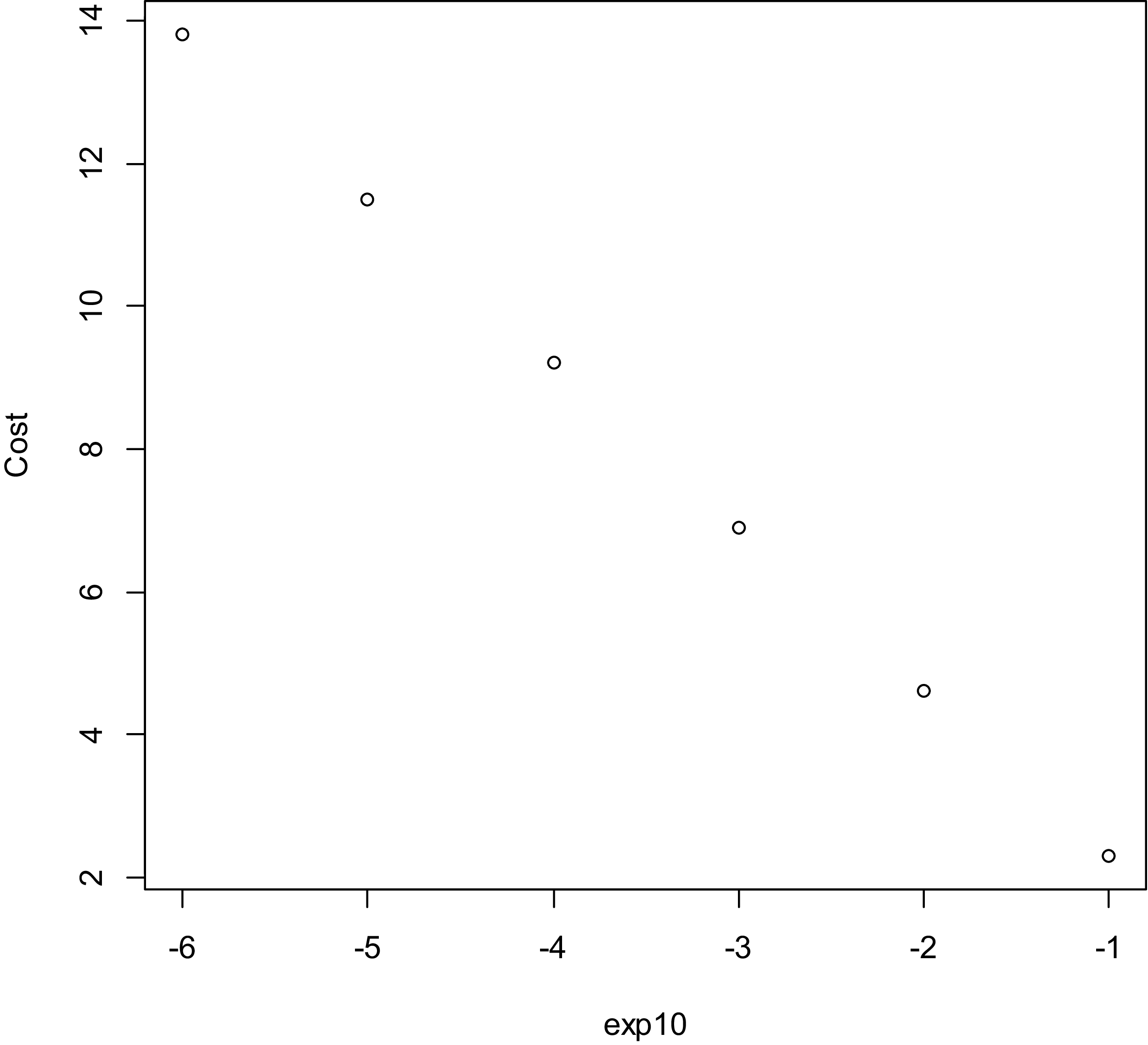
Crow and Kimura (Reference Crow and Kimura1970, pp. 244−252) give a summary of Haldane’s cost of natural selection. Their text is pitched at the level suitable for trainees in theoretical population genetics. They show that cost is largely independent of selection differential but depends on the initial frequency, being the negative logarithm of p 0, as displayed in Figure 1.
Cost defined as the negative logarithm of the initial gene frequency. The horizontal axis gives the starting frequency of the advantageous allele as an exponent of 10.

It appears that Feller misunderstood Haldane’s cost of natural selection. Haldane assumed that the size of a population could remain essentially unchanged by compensating reproductive rates, for example.
Using Haldane’s symbolism, a is replaced by A, which is assumed to start at a very low level; Crow and Kimura (Reference Crow and Kimura1970, p. 245) define the cost increments as
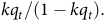 $k{q_t}/(1 - k{q_t}).$
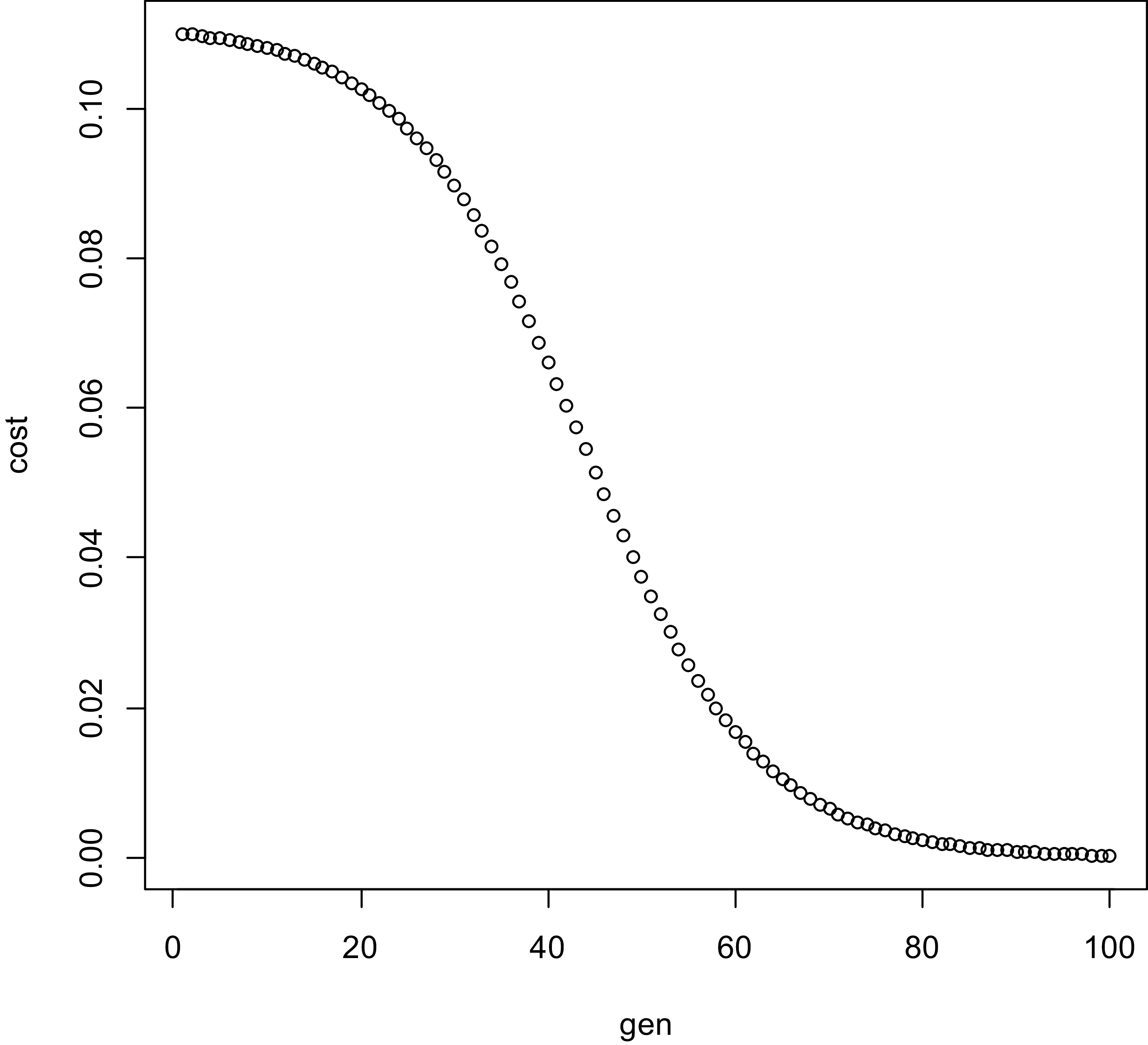
The series for s = 0.1, starting from p 0 = 0.01, is displayed in Figure 2. Crow and Kimura define the total cost as
 $$C = \sum {{{k{q_t}} \over {1 - k{q_t}}}.} {\mkern 1mu} {\mkern 1mu} {\mkern 1mu} $$
Cost increments by generation for s = 0.1, starting from p 0 = 0.01. The increments contribute to cost as defined by equation (2).

The total cost coming from the sequence displayed in Figure 2 is approximately 4.8.
William Feller is Led Up the Garden Path
The summary of Haldane (Reference Haldane1937) is a foretaste of his paper of 1957:
In a species in equilibrium variation is mainly due to two causes. Some deleterious genes are being weeded out by selection at the same rate as they are produced by mutation. Others are preserved because the heterozygous form is fitter than either homozygote. In the former case the loss of fitness in the species is roughly equal to the sum of all mutation rates and is probably of the order of 5 per cent. It is suggested that this loss of fitness is the price paid by a species for its capacity for further evolution.
A characteristic of Haldane is that his grand statements about natural phenomena are often backed up by detailed algebra. Dobzhansky also had a grand vision but not the algebra to support it. His (1967) response to this is seen in his paper to the Berkeley symposium where he reveals the complexity of Nature against the naivety of Haldane’s cost of natural selection.
Feller was drawn into Dobzhansky’s attempt to discredit Haldane’s reputation but, instead of going directly to Haldane (Reference Haldane1957), he gave formulae for the size of a population under various assumptions. He calculates the ‘ultimate’ population size N ∞. To reach N ∞, Feller starts with various initial A frequency values.
In the course of this, he dismantled the conventional population genetics methodology espoused by Sewall Wright.
The last part of Feller (Reference Feller1967) is a discursive attack on standard population genetics methodology that cannot be answered briefly. To quote: ‘Formulas neglecting the changes in population size introduce an error which is negligible under ordinary circumstances but whose cumulative effect over long periods may be disastrous’ (p. 14).
Acknowledgment
Eugene Seneta suggested that I should look at the history of Feller’s involvement in Haldane’s cost of natural selection. He provided the reference to Dobzhansky (Reference Dobzhansky, Le Cam and Neyman1967). He suggested ways to improve the presentation. A referee’s challenging comments required major corrections.
Competing interests
None

 Open access

