INTRODUCTION
In tropical lowland rain forest, most tree species are self-incompatible (Bawa et al. Reference BAWA, PERRY and BEACH1985), so that selection for long-distance pollen transfer is more intense in this species-rich community. Approximately 98–99% of flowering plants in tropical lowland forest are pollinated by animals (Bawa Reference BAWA1990). Most plants in this community have evolved adaptations to attract specific pollinators, and although most species are also visited by a diversity of insects, some are thought to depend exclusively on bats for pollination (Kress & Beach Reference KRESS, BEACH, McDade, Bawa, Hespenheide and Hartshorn1994, Momose et al. Reference MOMOSE, YUMOTO, NAGAMITSU, KATO, NAGAMUSU, SAKAI, HARRISON, ITIOKA, HAMID and ANDINOUE1998). Such bat-pollinated plants have specific floral traits, the so called ‘bat-flower syndrome’ with white or cream-coloured, strongly scented, bell-shaped flowers which are presented in an exposed position, last only for the single night on which they open, and produce large quantities of pollen and nectar (Faegri & van der Pijl Reference FAEGRI and Van Der PIJL1979, Marshall Reference MARSHALL1983).
The concept of the pollination syndrome implies the specialization of plants to a particular pollinator or a set of pollinators, and it was long believed that specialization is the dominant evolutionary trend in plant pollination systems (Johnson & Steiner Reference JOHNSON and STEINER2000). However, empirical evidence has recently challenged this generalization (Ramirez Reference RAMIREZ2004, Waser et al. Reference WASER, CHITTKA, PRICE, WILLIAMS and OLLERTON1996). In addition, some authors have observed that without a sceptical approach, the syndrome might obscure rather than illuminate the pollination system evolved by particular plant species (Heithaus Reference HEITHAUS and Kunz1982, Marshall Reference MARSHALL1983, Ollerton Reference OLLERTON1998). Other animals, apart from fruit bats, visit chiropterophilous plants (Gribel et al. Reference GRIBEL, GIBBS and QUEIROZ1999, Grünmeier Reference GRÜNMEIER1990, Ibarra-Cerdeña et al. Reference IBARRA-CERDEÑA, IÑIGUEZ-DÁVALOS and SÁNCHEZ-CORDERO2005), some of which are pollinated by these agents as well as by bats. These diurnal visitors are as important as fruit bats in the pollination of Agave and columnar cacti, chiropterophilous plants of the arid Neotropics (Fleming et al. Reference FLEMING, SAHLEY, HOLLAND, NASON and HAMRICK2001, Ibarra-Cerdeña et al. Reference IBARRA-CERDEÑA, IÑIGUEZ-DÁVALOS and SÁNCHEZ-CORDERO2005, Molina-Freaner & Eguiarte Reference MOLINA-FREANER and EGUIARTE2003). The syndrome is therefore best regarded as a hypothesis and field observations and pollination experiments are required before firm conclusions can be reached about the relative importance of different potential pollinators (Johnson & Steiner Reference JOHNSON and STEINER2000, Ollerton Reference OLLERTON1998).
Parkia, one of the largest genera of chiropterophilous plants, has a pantropical distribution. Among 35 recognized species, 12 occur in the Indo-Pacific region, distributed from India to Fiji (Hopkins Reference HOPKINS1994). Several species of Parkia including P. speciosa Hassk. and P. timoriana (DC.) Merr. are economically important in South-East Asia. Most Parkia species are assumed to be chiropterophilous, and only a few species are thought to be pollinated by insects diurnally or nocturnally, or by lemurs (Birkinshaw & Colquhoun Reference BIRKINSHAW and COLQUHOUN1998, Hopkins Reference HOPKINS1983, Reference HOPKINS1984, Reference HOPKINS, Hopkins, Huxley, Pannell, Prance and White1998; Hopkins et al. Reference HOPKINS, HOPKINS and SOTHERS2000, Luckow & Hopkins Reference LUCKOW and HOPKINS1995). Fruit bats were postulated to be the principal pollinators of Asian Parkia, by Hopkins (Reference HOPKINS1994), and this was also suggested for African and South American species (Baker & Harris Reference BAKER and HARRIS1957, Grünmeier Reference GRÜNMEIER1990, Hopkins Reference HOPKINS1983, Reference HOPKINS1984). The first published report of visits by bats to the flowers of Parkia was from Java, in 1929 (Hopkins Reference HOPKINS1994). Several authors have observed fruit bats visiting the flowers of Parkia speciosa (reviewed by Hopkins Reference HOPKINS1994), and the pollen of Parkia is an important component of the diet of E. spelaea in Malaysia (Start Reference START1974, Start & Marshall Reference START, MARSHALL, Burley and Styles1976). However, other vertebrates and a wide array of insects also visit Parkia throughout their distribution (Grünmeier Reference GRÜNMEIER1990, Hopkins Reference HOPKINS1983, Reference HOPKINS1984, Reference HOPKINS1994, Reference HOPKINS, Hopkins, Huxley, Pannell, Prance and White1998). Whether Parkia depends exclusively on fruit bats for pollination is important, since such bats are declining in abundance in many areas and this may result in pollination failure in these plants. Although a high pollen:ovule ratio in Parkia suggests that obligate outcrossing is likely (Cruden Reference CRUDEN2000, Hopkins Reference HOPKINS1984), selfing may also occur (Hopkins Reference HOPKINS1983), but no intensive field investigation of the breeding system has been undertaken. The present study thus aimed to determine the breeding system of two species of Parkia and to test the hypothesis that fruit bats are the principal pollinator of them.
METHODS
Study species
Parkia speciosa and P. timoriana are canopy trees which are relatively common in lowland tropical rain forest as well as upland evergreen forests in the Indo-Pacific region (Hopkins Reference HOPKINS1994). Parkia speciosa is also currently semi-wild, grown from seed in gardens, or by grafting of selected wild trees. This species has a long flowering period (April–October) in southern Thailand and many trees flower twice a year. In contrast, P. timoriana has a short flowering period, from December to mid-January (Bumrungsri unpubl. data). When flowering, inflorescences or capitula are present mostly at the edge of the tree crown. In both Parkia species, up to 70 capitula open in a night, and flowering of each tree generally lasts for 4–5 wk. The capitula of both species are comprised of three types of flowers, fertile, nectar-secreting and staminodial, closely packed in a biglobose head on a long thick peduncle (Hopkins Reference HOPKINS1994, Nielsen & Santisuk Reference NIELSEN and SANTISUK1985, Wee & Rao Reference WEE and RAO1980). The number of flowers per capitulum in P. timoriana (3860 ± 393, n = 15) is much greater than in P. speciosa (2422 ± 314, n = 18) but in both species 70–75% are fertile (Bumrungsri unpubl. data). Pollen is released in polyads (16 grains), and an ovary contains 16–19 ovules. Fertile flowers are structurally hermaphroditic but some are functionally staminate, characterized by short pistils which are not exposed beyond the anthers. In hermaphrodite flowers, the style generally elongates to exsert the stigma beyond the anther shortly after anthesis. In a capitulum, fertile flowers are either functionally staminate, or hermaphroditic, or a mixture of both. The proportion of hermaphrodite capitula (having hermaphrodite flowers) to functional staminate capitula ranged between 1:3–1:6 (Bumrungsri unpubl. data, Wongchana et al. Reference WONGCHANA, WUNNACHIT and BUMRUNGSRI2006). Anthesis occurs between 19h30–20h00 in P. speciosa and at 18h30 in P. timoriana and the stigma is receptive 30 min later. Nectar secretion starts at the same time as anthesis and secretion volumes are highest at 20h00–21h00, with a concentration of 8–14% sucrose by weight. Total nectar volume secreted overnight averaged 7.7 (P. speciosa) to 12.4 ml (P. timoriana). Secretion ceases at 01h00–02h00. Each capitulum functions for one night, and 50% of polyads are still viable 24 h after anthesis (Bumrungsri unpubl. data).
Study sites
Pollination experiments and the study of pollinator activity at P. speciosa trees was carried out mainly in Trang Horticulture Station, Trang Province and to a lesser extent at Prince of Songkla University (PSU), Hat Yai Campus, Songkhla Province. The horticultural station (7°30′N, 99°25′E) is on flat terrain (384 ha) at an elevation of 50 m asl with mean annual rainfall of 2196 mm. It is bordered by a small hill (c. 1 km long × 0.5 km wide) covered with secondary forest. The station maintains plantations of crop plants including P. speciosa, Cocos nucifera L., Areca catechu L., Anacardium occidentalis L., Aquilaria malaccensis Lam. and Elaeis guineensis Jacq. This station is a collection centre for P. speciosa in southern Thailand, and includes a number of trees from different localities. Two plantations of Parkia cover areas of 5 ha each comprised of about 600 selected grafted trees (8–15 m high), each tree planted in 10 × 10-m plots. The study plantations are 8 and 15 y old.
Parkia timoriana was studied on the campus of PSU, Hat Yai Campus, (07° 00.4′N, 100° 30.7′E.) where ten isolated individuals are found. The campus is at the edge of Hat Yai City, and at the base of Kor Hong Hill, which is about 6 km long and at an altitude of about 30–140 m asl. A large patch of old-growth mixed with secondary forest and a rubber plantation covers most of the hill. The 10-y average shows that the climate is hot (average 28.3 °C) and relatively humid (average 72%) with 2118 mm annual rainfall (for detailed site description see Bumrungsri et al. Reference BUMRUNGSRI, SRIPAORAYA and LEELATIWONG2006).
Pollination experiments
Flowers of P. speciosa were accessed by an aluminium ladder and towers. Trees of P. timoriana are taller, and flowers can only be accessed by towers or climbing gear. Since each flower is small and closely packed, the capitulum is treated as a unit of pollination. A preliminary study carried out in PSU indicated that only hermaphrodite capitula can set fruit (n = 29), and all experiments were conducted only on such capitula. All accessible open capitula in sampled trees were checked to see whether they were hermaphrodite from late afternoon till evening. Several fertile flowers were selected, and dissected to locate the style and stigma. The capitulum was classified as hermaphrodite if hermaphrodite flowers were present, and functionally staminate capitula were excluded. The pollination experiments comprised of: (1) open pollination: all potential pollinators were allowed access to the capitula, (2) spontaneous self-pollination: all pollinators were excluded by bagging capitula from 15h00–17h00, before anthesis occurred, (3) insect pollination: capitula were covered with plastic nets (16 mm mesh size) allowing access by insects but not bats. Most of the observed insects (bees and moths) were small and could pass through the insect net and access the flower except large moths with a wingspan larger than 3 cm, (4) hand-crossed pollination: fertile flowers were rubbed directly with fertile ones from a different tree and bagged, and (5) self-induced pollination: pollen from a capitulum was rubbed with cotton wool around that capitulum and it was then bagged. Capitula subjected to hand-cross pollination and self-induced pollination were bagged before anthesis. Flowers were subjected to hand-cross pollination and self-induced pollination between 21h00–22h00 when stigmas were already receptive. Large semi-permeable cloth bags (diameter 20 cm, 35 cm high) with a plastic net inside to stop the flowers touching the cloth were used for bagging capitula. In most sampling trees, three replicates per treatment were conducted, and each sampling tree had at least a replicate of each treatment when few capitula were available. Fruit set was checked 5–7 d after the experiments. A capitulum was scored as ‘set fruit’ when green pods were present, regardless of their number. Field observations showed that unpollinated capitula were shed within 3 d.
Abundance and activity of visitors
Nocturnal visitors were observed using a night shot video (Sony Digital 740E) with its infra-red light source. Observations were made on 30 capitula on two nights from 19h30–23h30 during the peak of flowering of P. speciosa. Each capitulum was observed for 10 min, during which visitor taxa and duration of visits were recorded. Percentage frequency of visits was calculated as: total number of visits by a particular taxon × 100/total number of visits by all taxa. The average duration of the visit was also calculated for each species of visitor.
Diurnal observations were made between 06h30–09h00 on 42 trees of P. speciosa at Trang for 3 d, during which diurnal insects were recorded. Each capitulum was observed for 1 min using binoculars and the part the insects visited noted. Insects were collected from flowers using a cloth bag placed over capitula. Pollen found on the bodies of the insects was removed and placed on a glass slide for identification. Captured insects were killed and mounted on a polystyrene platform for later identification.
Fruit bat sampling
Fruit bats were captured using 2.6 × 9 or 2.6 × 6-m mist nets set at the same height as capitula at the flowering trees of P. speciosa and P. timoriana. Sampling began at 18h00–18h30 and lasted until 23h00 when fruit bats are most active. Mist nets were checked every 30 min. When bats were caught, nets were lowered, and the bats carefully removed and placed in a numbered bag. Captured bats were identified following Corbet & Hill (Reference CORBET and HILL1992), and pollen was collected from their fur. Mist-netting was conducted for eight nights. Bats avoided our mist nets extremely well, so that an alternative method of determining species and the relative frequency of visits was adopted. A set of flowers was photographed with an SLR camera (Nikon FE2 with 70–210 mm lens, flash SB24, SB 50×) and later with a digital camera (Nikon D70, 28–70 mm lens, and flash SB-600, Nikon Corp., Japan) when bats visited flowers for 10 nights. Photographed bats were identified from the shape of their rostrum, body size, body colour and other morphological features, compared with captured specimens. Photographs which were unclear or did not show diagnostic characters were excluded.
Data analysis
Nested ANOVA was applied to compare the number of flowers with successful pollination between treatments, and it was also used to test the variation of pollination success and number of fruit between those treatments with successful pollination. Flowers and fruits were nested within trees. All values are presented as means ± SD. All statistical analyses were performed with SPSS 11.0.
RESULTS
Pollination experiments
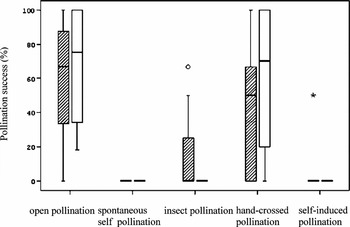
A total of 404 capitula of P. speciosa from 29 trees and 93 capitula of P. timoriana from four trees were included in pollination experiments. The average number of sampled capitula per tree in P. speciosa and P. timoriana was 13.9 ± 4.9 (range = 5–24) and 23.2 ± 13.5 (range = 9–38). Mean (±SD) number of capitula in each treatment per sampling tree was 2.8 (±1.2, range = 1–8) in the former and 4.6 (±3.2, range = 1–11) in the latter. There were significant differences in pollination successes among treatments (P. speciosa, Nested ANOVA, F = 2.55, df = 105, P < 0.001, P. timoriana, Nested ANOVA, F = 6.55, df = 14, P < 0.001) but not among trees in both species (P. speciosa, F = 0.60, df = 26, P = 0.93, P. timoriana, F = 1.50, P = 0.25). Open pollination had the greatest average pollination success with 59.9% of capitula from sampled trees (n = 29, median = 66.7%) setting fruit in P. speciosa, and 67.0% in P. timoriana (n = 4, median = 75%). Hand-crossed pollination was the next most successful with 47.9% (median = 50%) setting fruit in the former and 60.0% (median = 70%) in the latter (Figure 1), and was not significantly different from open pollination (P. speciosa, Nested ANOVA, F = 1.14, df = 27, P = 0.32, P. timoriana, Nested ANOVA, F = 2.02, df = 4, P = 0.11) in both species. Insect pollination resulted in 12.3% (median = 0%) fruiting in P. speciosa only and was significantly different from open (Nested ANOVA, F = 2.20, df = 27, P = 0.002) and hand-crossed pollination (Nested ANOVA, F = 1.81, df = 27, P = 0.02). Very low pollination success resulted from self-induced pollination (1 in 70 capitula). In one capitulum with self-induced pollination, two pods were set and remained on the tree for 3 d. They fell later but the receptacle remained green for a few weeks. In P. timoriana, flowers subjected to open pollination and hand-crossed pollination set fruits whereas the others set no fruit.
Pollination success in experiments carried out in 29 Parkia speciosa (hatching) and four P. timoriana (blank) trees during September 2002–January 2004. The box represents lower quartile, median, and upper quartile. The whiskers, small circle and star represent minimum and maximum, mild outlier and extreme outlier value, respectively.

In P. speciosa, hand-crossed pollination produced the highest average number of fruit per capitulum (mean ± SD = 9.0 ± 6.5, range = 1–27 pods, n = 30) compared to open pollination (mean ± SD = 6.1 ± 4.4, range = 1–19, n = 62) and insect pollination (mean ±SD = 4.2 ± 3.2, range = 1–11, n = 11). The number of fruit per capitulum in both hand-crossed pollination (Nested ANOVA, F = 2.69, df = 27, P < 0.001) and open pollination (Nested ANOVA, F = 1.69, df = 27, P = 0.03) was significantly higher than in insect pollination, but was not significantly different between hand-crossed pollination and open pollination (Nested ANOVA, F = 1.15, df = 27, P = 0.11). For P. speciosa, bats accounted for at least 80% and insects for a maximum of 20% of pollination success in open pollination.
Abundance and activity of visitors
Infra-red digital video observations on 30 capitula of 18 individuals of P. speciosa showed that nearly all were visited by at least one nocturnal visitor. From a total of 252 visits, bats showed the highest percentage frequency (58%) followed by moths (33.3%), mainly in the family Arctiidae, and giant honey bees (Apis dorsata Fabricius) (8.7%). Visits by bats were transient (mean ± SD = 2.0 ± 0.7 s, n = 146) while moths and bees stayed longer (24.7 ± 141 s, n = 84 and 28.4 ± 68.4 s, n = 22, respectively). Moths often landed on fertile flowers whereas most bees visited nectar-secreting flowers. However, very little pollen was found on the bodies of moths but was present on all voucher specimens of bees. Additional field observations revealed that moths are the major nocturnal insect visitors to flowers on dark nights while during light nights, giant honey bees frequently visited capitula, especially the nectar-secreting flowers of P. speciosa.
Diurnal observations made on 289 capitula in 42 trees of P. speciosa, indicated that in about half of all capitula at which visitors were observed, the majority of insect visitors were stingless bees (Trigona spp.) (74.4%), followed by dwarf honey bees (Apis florea Fabricius) (13.5%), while Asian honey bees (Apis cerana Fabricius), flies, unidentified insects and moths were minor visitors (1.5–4%). Most stingless bees (75.6%) and all other insects observed (except moths) visited nectar-secreting flowers. The pollen of Parkia was identified from the bodies of stingless bees. Other vertebrate visitors are loris (Nycticebus coucang Boddaert), olive-backed sunbird (Nectarinia jugularis L.) and house gecko (Hemidactylus sp.).
Sampling of fruit bat
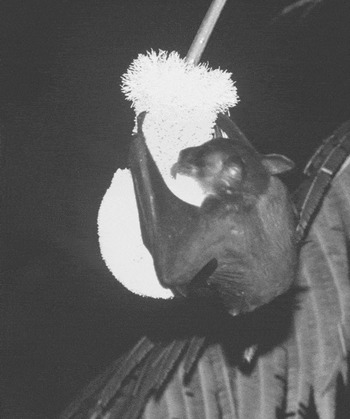
Fruit bats were observed at the flowering trees of P. speciosa and P. timoriana. Bats arrived at the flowering P. speciosa after 20h00 and at Parkia timoriana after 19h30. Groups of bats (5–15), identified from photographs as E. spelaea, approached capitula from any direction and visited well-exposed capitula as well as those hidden under leaves. The pattern of visits reflected both solitary foraging and flock foraging – a few bats continuously moved around the trees while a group of many bats intermittently visited flowers for 10 min, and then disappeared. Bats landed on capitula briefly, for 1–2 s, occasionally for 5 s. When approaching a capitulum, bats landed head upright, feet gripping fertile flowers, their mouths at nectar-secreting flowers, and their wings covering the whole capitulum with their thumb claws at staminodial flowers (Figure 2). As a consequence, pollen from fertile flowers dusted the chest, abdomen and wings. Sometimes two bats collided with each other when approaching a capitulum. In P. speciosa, far fewer bats visited flowering trees, compared with P. timoriana, although occasionally, up to 30 bats visited P. speciosa during a short period. Visits by bats were frequent and continuous throughout the night till 02h00 when nectar secretion ceased.
Eonycteris spelaea licking nectar from a capitulum of Parkia timoriana. Its chest, abdomen and wings contact the fertile flowers during foraging.

Although mist nets were set at flowering trees of both Parkia species, only a few bats were captured. Seven bats in two species were captured at flowering trees of P. speciosa. These were six Eonycteris spelaea and a lactating female Cynopterus brachyotis. Pollen of Parkia was found on the body and in the faeces of captured bats. A juvenile E. spelaea was caught at the flowering trees of P. timoriana. In addition, photographs showed that Eonycteris spelaea was the only bat visiting both P. speciosa (100%, n = 154 photos from eight trees) and P. timoriana (100%, n = 54 photos from three trees). Eonycteris spelaea can be recognized from its very short chocolate brown hair, relatively naked ear without any white rim, large eyes and long slender snout. Occasionally, the long tongue was also seen when the bat licked nectar. This bat often emits high pitched ‘tseets’ during flying. When clinging on capitula, the bat's length, from head to feet, is almost equal to the length of the capitulum.
DISCUSSION
Breeding system and effective pollinators
The present study is the first intensive investigation of the breeding system of Parkia. It is clear that P. speciosa and P. timoriana are self-incompatible plants. Outcrossing is common among tropical forest plants (Heithaus et al. Reference HEITHAUS, OPLER and BAKER1974, Kress & Beach Reference KRESS, BEACH, McDade, Bawa, Hespenheide and Hartshorn1994). This breeding system provides a higher quantity and quality of fruit set (Bawa Reference BAWA1990, Gribel et al. Reference GRIBEL, GIBBS and QUEIROZ1999, Lim & Luders Reference LIM and LUDERS1998). The results of the pollination experiments from the present study demonstrate that fruit bats are the principal pollinators of some species of Parkia, as suggested by previous researchers (Baker & Harris Reference BAKER and HARRIS1957, Grünmeier Reference GRÜNMEIER1990, Hopkins Reference HOPKINS1984), although they also demonstrate that bats are not the only pollinators.
Fleming & Sosa (Reference FLEMING and SOSA1994) suggested that nectarivorous bats are legitimate and effective pollinators of many tropical plants as they deposit pollen on conspecific stigmas, and contribute significantly to successful fertilization. The present study has revealed that the nectarivorous bat, E. spelaea, is the principal pollinator of Parkia since it visits when the flower is in optimal condition to receive pollen. It makes brief but frequent visits for nectar by landing on a capitulum and as a result dusting its thorax, abdomen and wings with pollen, which can then be transferred to another capitulum. A recent study confirmed that most of netted bats at the flowering trees of P. speciosa were E. speleae (Sripaoraya unpubl. data). The mean number of visits per night of E. spelaea to P. speciosa and P. timoriana was 98 and 112 times per capitulum, respectively and the highest visit frequency occurs when nectar production is at a peak (Sripaoraya unpubl. data). Eonycteris spelaea is also a reliable pollinator for these trees as it regularly visits their flowers despite the availability of other food plants. In the study area, Parkia is one of the major food sources of E. spelaea, as indicated from faecal analysis, accounting for 17–74% of its diet (average 34%) in every month throughout the year (Bumrungsri unpubl. data). Nectar of both species of Parkia contains high concentrations of calcium and sodium (Sripaoraya unpubl. data). Eonycteris spelaea was reported to feed on plants of many tree species in South-East Asia including those in the genus Durio, Parkia, Artocarpus, Eugenia, Duabanga, Oroxylum and Sonneratia (Bumrungsri unpubl. data, Kitchener et al. Reference KITCHENER, GUNNELL and 1990, Start Reference START1974, Start & Marshall Reference START, MARSHALL, Burley and Styles1976). With its capacity for long-distance foraging flights, up to 38 km (Start & Marshall Reference START, MARSHALL, Burley and Styles1976), E. spelaea is an effective pollen vector for these plants, and thus potentially responsible for gene flow over a large area. Further investigation on the foraging behaviour of this bat, as well as pollen-mediated gene flow of these plants is required. However, since this bat and other nectarivorous bats usually visit different plant species during a single night (Kitchener et al. Reference KITCHENER, GUNNELL and 1990), pollen may not always be deposited on a conspecific stigma. Thus, nectarivorous bats can be regarded as inefficient pollen vectors as they deposit less pollen onto conspecific stigmas than they lose or consume (Fleming & Sosa Reference FLEMING and SOSA1994), although plants can reduce this waste if pollen makes contact with different parts of the bat's body (Howell Reference HOWELL1977). Therefore, further investigation of the degree of flower constancy in which individual bats visit flowers of only a single tree species (Chittka et al. Reference CHITTKA, THOMSON and WASER1999) is recommended.
Other fruit bat species such as Cynopterus brachyotis and Pteropus hypomelanus also visit Parkia (Hopkins Reference HOPKINS1994), but are likely to be less effective pollinators than E. spelaea, since they feed mainly on fruits, supplemented with nectar and pollen when available (Bumrungsri & Racey Reference BUMRUNGSRI and RACEY2007). Although they are not common visitors to these plants, at least in our study site, their contribution to pollination success remains to be determined.
The role of E. spelaea in pollination of P. speciosa and P. timoriana is comparable to that of Phyllostomus discolor in pollinating neotropical Parkia in Amazonia (Hopkins Reference HOPKINS1984), and to Nanonycteris veldkampii and Megaloglossus woermanni pollinating Parkia in Africa (Baker & Harris Reference BAKER and HARRIS1957, Grünmeier Reference GRÜNMEIER1990, Hopkins Reference HOPKINS1983). However the behaviour of landing on a capitulum of Parkia is significantly different between Old world and New world fruit bats. The former land head upright, and the latter head down and may also hover (Hopkins Reference HOPKINS1984). It is apparent that the head-down approach is more suitable for collecting nectar which is hidden below a much larger staminodial fringe of capitula in neotropical Parkia, or from the nectar zone on the apex of the pendulous capitula in neotropical species of Parkia section Platyparkia.
Chiropterophily and/or entomophily?
Of the two studied species, it is only in P. speciosa that insects, either or both nocturnal and diurnal, are also responsible for fruit set although to a much lesser extent than fruit bats, with respect to both fruiting percentage and number of fruits. Generally, most insects visit nectar-secreting flowers rather than fertile flowers (Baker & Harris Reference BAKER and HARRIS1957) and they also often spend proportionally longer on the same plants. The frequency of nocturnal insect visits is much lower compared with bats, while diurnal insects visit in the morning when most of the pollen has gone, and the stigma is starting to wilt (S. Wongchana, pers. comm.) or in the early evening when nectar secretion is just beginning but before anthesis and stigma receptivity. The pollination success of insects in P. speciosa in the present study is probably over-represented, since experiments were conducted in plantations where individual trees are so close to each other that there is more chance of pollen being transferred by insects than in a more natural situation where conspecific trees are more isolated. However, it shows that insects are capable of pollinating this plant. Additionally, it resembles the rural situation in Thailand, where P. speciosa is commonly planted in gardens and orchards. The pollination success by insects in African Parkia was previously recorded by Hopkins (Reference HOPKINS1983). Insect pollination in these chiropterophilous Parkia could also reflect its evolutionary biology since chiropterophily in Parkia possibly derives from entomophily (Hopkins et al. Reference HOPKINS, HOPKINS and SOTHERS2000, Luckow & Hopkins Reference LUCKOW and HOPKINS1995). The fact that insects have a facultative role in pollination of P. speciosa implies some degree of generalization within the specialized pollination system postulated in the genus Parkia.
Although it is still not clear which insects are responsible for pollination success in P. speciosa, moths appear to be potential candidates since many plants that are primarily pollinated by bats are also pollinated by moths (Baker Reference BAKER1960, Ramirez Reference RAMIREZ2004). Nocturnal and diurnal insects, especially moths, giant honey bees and stingless bees, could be more important pollinators where the fruit bat population is low, since E. spelaea populations are threatened by hunting, and their distribution depends on the availability of large caves with high ceilings (Bumrungsri unpubl. data, Start Reference START1974). Thus, further investigation of which insects are the most effective pollinators of this plant are required. Although other non-volant mammals and birds were also reported to visit flowers of Parkia (Grünmeier Reference GRÜNMEIER1990, Hopkins Reference HOPKINS1984, Reference HOPKINS1994), their contribution to reproductive success is still unknown. From previous observations, it is quite likely that they are mainly nectar thieves rather than pollinators (Grünmeier Reference GRÜNMEIER1990).
Since E. spelaea is the major pollinator of these self-incompatible and economically important plants, the conservation status of this bat cannot be ignored. Eonycteris spelaea has greatly declined in numbers in some areas, such as Java and the Lesser Sundas (Mickleburgh et al. Reference MICKLEBURGH, HUTSON and RACEY1992). The major threats are hunting and cave destruction. Since they almost exclusively depend on caves for roosting, these bats are easy to exploit for food. In Thailand, some local people are still under the misapprehension that they destroy flowers of durian when they visit, so they are killed (S. Bumrungsri, pers. obs.). Although they are able to reproduce twice a year (Heideman Reference HEIDEMAN1987), their population in one study cave has decreased, from 20 000 to 500 individuals in 5 y (Bumrungsri unpubl. data). Eonycteris spelaea is also regarded as the major pollinator of economic and ecological importance trees such as durian (Durio zibethinus Murr.) (Bumrungsri unpubl. data, Soepadmo & Eow Reference SOEPADMO and EOW1976), Oroxylum indicum Vent. (Gould Reference GOULD1978, Start Reference START1974) and mangrove Sonneratia spp. (Start & Marshall Reference START, MARSHALL, Burley and Styles1976). The ecological and economical impact of pollinator declines is of worldwide concern, since it affects global biodiversity loss, and crop production stability (Allen-Wardell et al. Reference ALLEN-WARDELL, BERNHARDT, BITNER, BURQUEZ, BUCHMANN, CANE, COX, DALTON, FEINSINGER, INGRAM, INOUYE, JONES, KENNEDY, KEVAN, KOOPOWITZ, MEDELLIN, MEDELLIN-MORALES, NABHAN, PAVLIK, TEPEDINO, TORCHIO and WALKER1998, Kevan & Phillips Reference KEVAN and PHILLIPS2001). Assessment of population changes of nectarivorous bats and the ultimate consequences of these declines on plant reproduction are necessary. Thus, more protection, and increases in community-level education on the significance of bats to crop yield of a number of ecologically and economically important food plants are vital for their conservation. Likewise, conservation of the genetic integrity of these self-incompatible plants by preserving their natural populations is vital for their long-term reproductive success.
ACKNOWLEDGEMENTS
The authors thank D. Pongmanawuti, S. Wongchana, B. Wongchana and staff of The Trang Horticulture Station, and S. Thong-Aree and staff of Bala-Hala Wildlife Research Station for permitting us to carry out field work there, and their hospitality and support. Thanks are also due to S. Sotthibundhu and C. Satasuk for logical support, P. Poonsawad for training in tree climbing techniques, E. Sripaoraya, T. Srithongchuay and S. Karnphun for assistance in the field, and S. Wongchana, C. Wilcock, S. Sotthibundhu and C. Satasook for valuable discussion especially at the beginning of the project. Thanks are due to three anonymous reviewers for comments and constructive suggestions. This research was supported by the Thailand Research Fund, The Carnegie Trust for the Universities of Scotland and The British Council.