Introduction
Passive death wishes are a common occurrence in old age. For instance, a recent study has shown that as many as 7% of primary care patients with no depression report death ideation (Raue et al., Reference Raue, Morales, Post, Bogner, Have and Bruce2010). Although passive death wishes are not synonymous with suicidal ideation, suicidal acts or suicide, they are correlated (Dennis et al., Reference Dennis, Baillon, Brugha, Lindesay, Stewart and Meltzer2007). Nonetheless, passive death wishes are a troublesome occurrence in their own right as they have been shown to be a risk for all-cause mortality, unrelated to depression and death by suicide (Raue et al., Reference Raue, Morales, Post, Bogner, Have and Bruce2010).
Given the negative consequences of passive death wishes, it is important to identify potential predictors in order to identify at-risk populations and develop potential interventions to alleviate passive death wishes. The present study evaluates the role of one such potential variable – loneliness – as a predictor of passive death wishes. Loneliness is described as a painful and unpleasant emotional experience (Peplau and Perlman, Reference Peplau and Perlman1982). According to the cognitive model of loneliness, loneliness represents the discrepancy between one's ideal social relations vs. one's perceived relations (de Jong-Gierveld, Reference de Jong-Gierveld1987). This approach emphasizes the subjective nature of loneliness. Although, loneliness is argued to be associated with objective social circumstances, it is not synonymous with social isolation or aloneness. Thus, people can feel lonely in the company of many others or be alone without feeling lonely (Peplau and Perlman, Reference Peplau and Perlman1982). The subjective nature of loneliness was further emphasized by a recent study that pointed to the important role of subjective indicators of the social relationship rather than objective indicators in determining one's sense of loneliness (Shiovitz-Ezra and Leitsch, Reference Shiovitz-Ezra and Leitsch2010).
Research has demonstrated the detrimental effects of loneliness on physical health (Hawkley et al., Reference Hawkley, Masi, Berry and Cacioppo2006) as well as on mortality (Shiovitz-Ezra and Ayalon, Reference Shiovitz-Ezra and Ayalon2010). Loneliness was also found to be associated with poorer mental health. Specifically, increased feelings of loneliness were found to be associated with higher levels of psychological distress (Paul et al., Reference Paul, Ayis and Ebrahim2006) and helplessness (Steptoe et al., Reference Steptoe, Owen, Kunz-Ebrecht and Brydon2004), and with lower levels of emotional well-being (Lee and Ishii-Kuntz, Reference Lee and Ishii-Kuntz1987). In addition, loneliness was shown to have a stronger association with quality of life measures relative to objective social circumstances (Ekwall et al., Reference Ekwall, Sivberg and Hallberg2005). With regard to passive death wishes, the limited research to date has found loneliness to be associated with increased suicidal and para-suicidal acts as well as with increased death wishes (Rowe et al., Reference Rowe, Conwell, Schulberg and Bruce2006; Pompili et al., Reference Pompili2008; Chang et al., Reference Chang, Sanna, Hirsch and Jeglic2010). It is also important to note that, like passive death wishes (Dennis et al., Reference Dennis, Baillon, Brugha, Lindesay, Stewart and Meltzer2007), loneliness is correlated with but differentiated from depression (Cacioppo et al., Reference Cacioppo, Hughes, Waite, Hawkley and Thisted2006).
Informative but limited attention has been given to the relationship between loneliness and passive death wishes in different age groups. This is despite the fact that a complex relationship between loneliness and age has been noted in past research; studies have found age to be both a protective factor (Victor et al., Reference Victor, Scambler, Bowling and Bond2005) and a risk factor (Savikko et al., Reference Savikko, Routasalo, Tilvis, Strandberg and Pitkälä2005) for loneliness. Plausibly, this inconsistency might be explained by a non-linear relationship between age and loneliness. Indeed, a meta-analysis based on 149 articles, published between 1948 and 1999, revealed a U-shaped relationship with loneliness significantly increasing in those aged over 80 (Pinquart and Sorensen, Reference Pinquart and Sorensen2001). Similarly, when changes in loneliness over a 10-year period were examined among men aged 65 to 85, loneliness was found to increase with age, but only for the oldest age group (Tijhuis et al., Reference Tijhuis, Jong-Gierveld, Feskens and Kromhout1999).
The overall goal of this study was to determine the relative importance of loneliness relative to a variety of objective social indicators as a predictor of thoughts of death. Given the U-shaped relationship between loneliness and age (Pinquart and Sorensen, Reference Pinquart and Sorensen2001), we examined whether the relationship between loneliness and passive death wishes can be stratify into three different age groups (50–65, 66–75, and >75). We expected loneliness, but not objective indicators of one's social standing, to predict passive death wishes. Because of the relatively high prevalence of loneliness in the very old (Tijhuis et al., Reference Tijhuis, Jong-Gierveld, Feskens and Kromhout1999), it is possible that this group of older adults is the least affected by loneliness, as loneliness may be perceived as an almost “normal” experience in their lives. On the other hand, it is possible that because individuals in the older age group have lower social and physical reserves, the experience of subjective loneliness is even more strongly associated with passive death wishes in this age group.
Methods
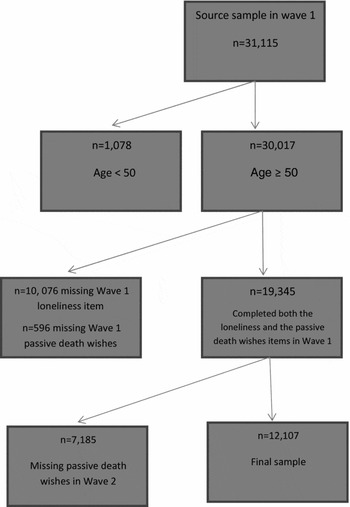
The Survey of Health, Ageing and Retirement in Europe (SHARE; Börsch-Supan et al., Reference Börsch-Supan2008) is modeled on the American Health and Retirement Study (HRS). It is the first European dataset to combine cross-national with longitudinal information on health, health behaviors, financial status, and social relationships. The target population is defined as all individuals born in 1954 or earlier, who speak the official language of the country and are not living abroad, and includes their spouse/partner independent of age. The present study is focused on those 11 countries that contributed to the first wave of SHARE in 2004 and to the second wave in 2006–2007. Analysis is limited to those individuals who answered the computer-assisted personal interview, the supplemental drop-off questionnaire in wave 1 as well as the Euro-D question concerning passive death wishes in wave 2. This resulted in a total sample of 12,107 respondents over the age of 50. See Figure 1 for study flow.
A flow chart of study participants.

Measures
All predictors were gathered in wave 1. Passive death wishes were gathered in waves 1 and 2.
Outcome Variable: Passive death wishes. Based on an item taken from the Euro-D, a face-to-face administered measure of depression (Prince et al., Reference Prince1999): “in the past month, have you felt that you would rather be dead?” Response options are: “yes” (1)-participant has mentioned passive death wishes versus “no” (0)-no thoughts mentioned. A similar question was used in past research as an indicator of passive death wishes (Ayalon, Reference Ayalon2010; Raue et al., Reference Raue, Morales, Post, Bogner, Have and Bruce2010).
Predictor: Loneliness. Respondents are asked to indicate how frequently they felt lonely in the past week. Response options are almost all the time, most of the time, part of the time, not at all (range between 1 and 4, with a higher score indicating greater loneliness). This item was taken from the Centre for Epidemiological Studies of Depression questionnaire (CES-D) (Radloff, Reference Radloff1977). The use of this item as an indicator of loneliness is common in epidemiological studies of this sort (Shiovitz-Ezra and Ayalon, Reference Shiovitz-Ezra and Ayalon2010).
Demographic Indicators: age (50–65, 66–75, >76), gender, education, and geographic region (North, Central, or South Europe).
Mental Health Indicators: Depressive Symptoms. The Euro-D is a 12-item measure concerning depressive symptoms over the past month (Prince et al., Reference Prince1999). Five items are phrased in a positive way (e.g., what are your hopes for the future) and the remaining items are phrased in a negative way (e.g., were you sad or depressed in the past month). Response options were ‘yes’ or ‘no.’ We reverse-coded positive items, so that a higher score would indicate greater depression. As already noted, this measure also contains a single item concerning passive death wishes. This item was not included in the total depressive score of the first wave, because passive death wishes in wave 1 served as an independent predictor of passive death wishes in wave 2. Range is between 0 and 11.
Hope. The measure of hope was comprised of 7 questions concerning one's expectations and beliefs about the future and perceived ability to cope with the future. Questions originate from the Life Orientation Test-Revised and from the Hope scale (Scheier et al., Reference Scheier, Carver and Bridges1994; Snyder et al., Reference Snyder, Sympson, Ybasco, Borders, Babyak and Higgins1996). Items are ranked on a 5-item agree-disagree scale. The range of scores is 7 to 35, the higher the score, the greater one's sense of hope is.
Health Indicators: Medical Status. Respondents were asked whether a physician had told them they suffer from any of 12 chronic conditions common in old age, such as heart attack, high blood pressure, high cholesterol, stroke, or diabetes. A composite score of overall number of medical conditions was constructed with a higher score representing more medical conditions (range 0–12).
Activities of Daily Living (ADL). Respondents were asked whether they are limited in performing every day activities, such as dressing up, walking across the room, showering, using the restroom, eating, or getting in and out of bed. A composite score ranging from 0 to 6 was calculated, with a higher score representing greater impairment.
Instrumental Activities of Daily Living (IADL). Respondents were asked whether they are limited in performing instrumental activities of daily living, such as reading a map, shopping for groceries, or taking medications. A composite score ranging from 0 to 7 was calculated, with a higher score representing greater impairment.
Social Indicators: marital status (married/partnered vs. not), whether at least one of the parents is still alive, number of living children, number of living siblings, and household composition (alone, couple, family/other), were evaluated based on self-report.
Activity Level. Respondents were asked whether they participated in any of the following over the past month: voluntary or charity work, educational or training course, gone to sport, social or other kind of club, religious organization, or political or community organization. A composite score ranging from 0 to 5 was calculated, with a higher score indicating greater activity level.
Statistical analysis
We conducted descriptive analysis of all variables gathered in wave 1 by age group: Chi-square analyses were conducted for categorical variables and One Way Analysis of Variance (ANOVA) for continuous variables. Next, the interaction between loneliness and age in relation to passive death wishes was examined in order to evaluate whether the relationship between loneliness and passive death wishes varies by age group. There was a significant interaction between age and loneliness as predictors of death wishes (OR = 0.98, 95%CI: 0.96–0.99). Hence, all analyses were stratified by age. There was no evidence for multicollinearity between predictors. Logistic regression analyses by age group were conducted with death wishes in wave 2 as the outcome variable and all variables gathered in wave 1 as potential predictors (passive death wishes in wave 1 were also included in order to adjust for respondents’ baseline level). Analyses were conducted in several steps in order to examine the relative contribution of loneliness. First, loneliness was evaluated as a sole predictor. Next, the effect of loneliness was adjusted for demographic variables (e.g. education, gender) and geographic origin (e.g. North, Centre, and South of Europe). In the third step, health (e.g. chronic conditions, ADL, IADL) and mental health indicators (e.g. depression, passive death wishes in wave 1, hope) were entered into the model. Finally, the effect of loneliness was adjusted for all social indicators (e.g. marital status, whether or not parent is alive, number of living children, number of living siblings, and living arrangement) and activity level in addition to demographic, health and mental health variables. All analyses were conducted using STATA 8 complex survey commands to account for design characteristics of SHARE, including sample weights and clustering.
Results
The sample consisted of 12,107 (unweighted) respondents over the age of 50, who completed the drop-off and main questionnaire in wave 1 and the suicide item in wave 2. Overall, 7,155 respondents were between the ages of 50 and 65, 3,263 were between 66 and 75, and the remaining 1,689 were over the age of 75.
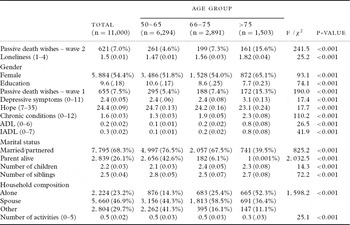
Both loneliness and passive death wishes were the highest in those over the age of 75. In addition, there were significant differences between the three age groups on all demographic and clinical variables, as evaluated in wave 1. As shown in Table 1, the group of respondents over the age of 75 was less likely to be married/partnered and to have a parent alive. Individuals over the age of 75 also were more likely to live alone and to engage in fewer social activities. They were also more likely to report depressive symptoms and to suffer from chronic conditions and functional impairments.
Demographic and clinical characteristics by age group

ADL = activities of daily living; IADL = instrumental activities of daily living.
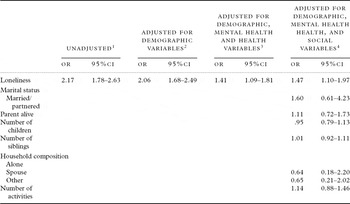
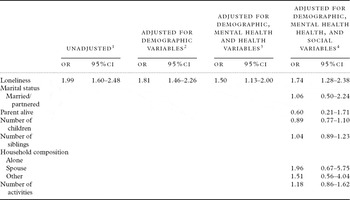
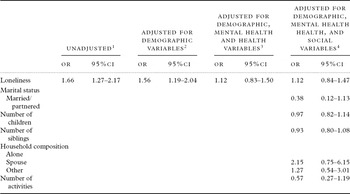
Tables 2–4 summarize the results of the hierarchical logistic analyses by age group. In the unadjusted model, loneliness was a significant predictor of passive death wishes in all three age groups, so that those reporting greater loneliness in wave 1 were also more likely to report passive death wishes in wave 2. Results remained similar once adjusted for demographic variables. Once adjusted for health and mental health variables, in addition to demographic variables, loneliness remained a significant predictor of passive death wishes in those aged between 50 and 65 and in those aged between 66 and 75, but failed to predict passive death wishes in the group of respondents aged over 75. Results were consistent once adjusted for objective indicators of social engagement in addition to demographic, health, and mental health indicators. Hence, in the final model, greater loneliness was a significant predictor of passive death wishes only for those aged 50–65 and 66–75, but not for those over 75. None of the objective social indicators was a significant predictor of passive death wishes.
Hierarchical logistic regression with passive death wishes as an outcome and loneliness as a predictor for age 50–65 (n = 6,294)

1 F(1;242) = 62.4, p<0.001.
2 F(5;238) = 12.7, p<0.001; adjusted for gender, education, and geographic region.
3 F(10;233) = 17.1, p<0.001; adjusted for gender, education, geographic region, chronic conditions, ADL, IADL, depression, passive death wishes, and hope.
4 F(17;226) = 11.2, p<0.001; adjusted for gender, education, geographic region, chronic conditions, ADL, IADL, depression, passive death wishes, hope, marital status, whether parent was alive, number of living siblings, number of living children, living arrangement, and activity level.
Hierarchical logistic regression with passive death wishes as an outcome and loneliness as a predictor for age 66–75 (n = 2,891)

1 F (1;242) = 38.7, p<0.001.
2 F (5;238) = 9.5, p<0.001; adjusted for gender, education, and geographic region.
3 F (10;233) = 10.3, p<0.001; adjusted for gender, education, geographic region, chronic conditions, ADL, IADL, depression, passive death wishes, and hope.
4 F (17;225) = 7.8, p<0.001; adjusted for gender, education, geographic region, chronic conditions, ADL, IADL, depression, passive death wishes, hope, marital status, whether parent was alive, number of living siblings, number of living children, living arrangement, and activity level.
Hierarchical logistic regression with passive death wishes as an outcome and loneliness as a predictor for those over 75 (n = 1,503)

1 F (1;242) = 14.1, p<0.001.
2 F (5;238) = 5.7, p<0.001; adjusted for gender, education, and geographic region.
3 F (10;233) = 7.8, p<0.001; adjusted for gender, education, geographic region, chronic conditions, ADL, IADL, depression, passive death wishes, and hope.
4 F (16;227) = 5.2, p<0.001;adjusted for gender, education, geographic region, chronic conditions, ADL, IADL, depression, passive death wishes, hope, marital status, number of living siblings, number of living children, living arrangement, and activity level; whether or not parent was alive was not included as this variable showed no variability.
Discussion
Past research has shown that passive death wishes are a significant risk for all-cause mortality independent of death by suicide or depression (Raue et al., Reference Raue, Morales, Post, Bogner, Have and Bruce2010). Passive death wishes have also been shown to be associated with increased use of health and mental health services (Bartels et al., Reference Bartels2002). To date, research on the role of loneliness as a predictor of passive death wishes in older adults has not evaluated thoroughly loneliness vs. objective indicators of the social realm as potential predictors of passive death wishes. Such an evaluation is important as it may guide the development of interventions for older adults. The focus on three different age groups of Europeans in order to evaluate whether loneliness carries a different effect in different age groups is a major strength of this study. The most notable findings of the present study concern the significant associations between loneliness and passive death wishes in the two younger age groups, in the absence of an association between loneliness and passive death wishes in the oldest age group. The fact that none of the objective indicators of social interaction was significant is another remarkable finding of the present study.
Our findings reveal that, as in previous research (Raue et al., Reference Raue, Morales, Post, Bogner, Have and Bruce2010), about 7% of the sample reported passive death wishes. Nevertheless, this finding clouds the fact that although in those aged 50 to 65, nearly 5% reported passive death wishes; this rate tripled in those aged over 75. Consistently, the highest levels of loneliness and the lowest levels of objective indicators of social support were reported in those over 75. Hence, this group over the age of 75 is particularly vulnerable to both objective and subjective experiences of inadequate social interactions as well as to increased passive death wishes.
Our findings reveal that although loneliness served as a major risk for passive death wishes in the younger age groups, it did not carry such an effect in those aged over 75. It is important to note that even though the sample size of the latter group is substantially smaller than that of the other two groups, the size of the relationship, as indicated by the odds ratio, is small, suggesting that lack of significance is not due to reduced sample size in that group, but more likely represents lack of a relationship. Hence, it is possible that for this age group the experience of loneliness is so prevalent and so well justified given the many objective losses of social support (as was also evident in the present study) that loneliness does not carry the same detrimental effect in this age group, because it is considered an “on-time” event. In the younger age groups, on the other hand, loneliness may be an “off-time” event that is more strongly associated with other indicators of well-being, such as passive death wishes. Further qualitative research might be justified to evaluate whether the experience of loneliness is, indeed, of different qualities in this group of individuals over the age of 75 relative to younger age groups. Nevertheless, because we examined only a single outcome (passive death wishes) in the present study, it is still possible that loneliness carries many detrimental effects in the oldest age group.
Interestingly, whereas perceived loneliness was a significant predictor of passive death wishes in those aged 50–65 and 65–75, none of the objective indicators of social support was associated with passive death wishes in any of the age groups evaluated in this study. Our findings show that marital status, household composition, number of siblings, number of children and whether or not one's parents were still alive made no difference in determining passive death wishes. Moreover, even activity level showed no association with passive death wishes in any of the age groups evaluated in the present study. These findings have important implications for clinical interventions. Apparently, any intervention to alleviate passive death wishes in older adults should address the subjective perception of inadequate social ties, rather than the objective availability of social ties. Given the present findings, such an intervention may be particularly beneficial to those younger than 75 years of age.
Several limitations should be acknowledged. First, despite the relative large number of social indicators evaluated in the present study, most were indicators of the potential availability of social relations rather than actual social interaction. Hence, further research is needed to evaluate additional objective indicators of social support and interaction. Another limitation concerns the fact that both passive death wishes and loneliness were evaluated using a single item. Nevertheless, this is a common practice in epidemiological studies of this sort. In addition, in the current study we did not distinguish between two forms of loneliness that are classified based on the duration of time over which loneliness is experienced, i.e. chronic vs. situational loneliness (de Jong Gierveld and Raadschelders, Reference de Jong Gierveld, Raadschelders, Peplau and Perlman1982). Whereas the former indicates long-term loneliness, characterized by long-term interpersonal difficulties that harden the creation of meaningful and intimate relationships (Young, Reference Young, Peplau and Perlman1982), the latter is considered to be a result of life events and transitions that involve losses in one's social network. A recent study emphasized that both types of loneliness are risk factors for all-cause mortality in later life. Yet higher odds for all-cause mortality were found for the chronic state of loneliness (Shiovitz-Ezra and Ayalon, Reference Shiovitz-Ezra and Ayalon2010). Future research should employ this classification with regard to passive death wishes as an outcome. Finally, it is important to acknowledge that passive death wishes are not synonymous with active attempts or death by suicide (Kuo et al., Reference Kuo, Gallo and Tien2001). Hence, further research is recommended in order to evaluate the relationship between loneliness and these outcomes. In addition, it is important to acknowledge that both loneliness and passive death wishes tap into a similar construct of quality of life or distress, yet are distinguished from each other (Dennis et al., Reference Dennis, Baillon, Brugha, Lindesay, Stewart and Meltzer2007; van der Weele et al., Reference van der Weele, Hawkley, Thisted and Cacioppo2011).
Despite its limitations, the present study highlights the importance of a perceived differential role of loneliness in the different age groups. The fact that objective indicators of social interaction were not associated with passive death wishes is remarkable. This suggests that any intervention to alleviate passive death wishes in the general population will benefit from addressing the subjective sense of loneliness more so than objective indicators of social interaction.
Conflict of interest
None.
Description of authors' roles
Both authors were responsible for the concept and study design. Dr Ayalon took responsibility for the data analysis and interpretation, and preparation of the paper. Dr Shiovitz-Ezra made critical revisions to the paper.
Acknowledgments
This paper uses data from SHARE release 2.3.0, as of 13 November 2009. SHARE data collection in 2004–2007 was primarily funded by the European Commission through its 5th and 6th framework programs (project numbers QLK6-CT-2001-00360; RII-CT- 2006-062193; CIT5-CT-2005-028857). Additional funding by the US National Institute on Aging (grant numbers U01 AG09740-13S2; P01 AG005842; P01 AG08291; P30 AG12815; Y1-AG-4553-01; OGHA 04-064; R21 AG025169), as well as by various national sources, is gratefully acknowledged (see http://www.share-project.org/).