1. Introduction
Eurypterids, also known as sea scorpions, are aquatic carnivorous chelicerates. Their fossil record dates back to the early Middle Ordovician, with the clade going extinct in the Late Permian (Tetlie, Reference Tetlie2007; Lamsdell et al. Reference Lamsdell, Briggs, Liu, Witzke and McKay2015; Lamsdell & Selden, Reference Lamsdell and Selden2017; Hughes & Lamsdell, Reference Hughes and Lamsdell2020; Poschmann & Rozefelds, Reference Poschmann and Rozefelds2021). They include some of the largest arthropods known to have existed, growing to 2 m or more in length (Kjellesvig-Waering, Reference Kjellesvig-Waering1964; Chlupac, Reference Chlupáč1994; Braddy et al. Reference Braddy, Poschmann and Tetlie2008; Lamsdell & Braddy, Reference Lamsdell and Braddy2010). The family Pterygotidae is the most diverse clade of the order Eurypterida, with about 56 species in five genera (Lamsdell, Reference Lamsdell2022; Lamsdell & Selden, Reference Lamsdell and Selden2017). Pterygotidae originated in the Llandovery (early Silurian), went extinct in the Middle Devonian (Tetlie, Reference Tetlie2007; McCoy et al. Reference McCoy, Lamsdell, Poschmann, Anderson and Briggs2015) and were characterized by the possession of a laterally expanded pretelson, with most species having enlarged chelicerae with elongated proximal podomeres (Tetlie & Briggs, Reference Tetlie and Briggs2009). Pterygotids attained a nearly global distribution (Poschmann & Tetlie, Reference Poschmann and Tetlie2006; Miller, Reference Miller2007; Tetlie & Briggs, Reference Tetlie and Briggs2009; Lamsdell & Legg, Reference Lamsdell and Legg2010; Wang & Gai, Reference Wang and Gai2014) and were ecologically diverse predators with a range of visual acuity and a variety of cheliceral morphologies indicating adaptations towards a variety of benthic and actively swimming prey (Anderson et al. Reference Anderson, McCoy, McNamara and Briggs2014; McCoy et al. Reference McCoy, Lamsdell, Poschmann, Anderson and Briggs2015).The superfamily Adelophthalmoidea represents the most common eurypterids in the Late Palaeozoic, with about 46 species in seven genera (Tetlie, Reference Tetlie2007; Shpinev, Reference Shpinev2012; Lamsdell et al. Reference Lamsdell, Simonetto and Selden2014; Poschmann, Reference Poschmann2015, Reference Poschmann2020; Shpinev & Filimonov, Reference Shpinev and Filimonov2018). Taxonomically they are the second most diverse of all eurypterid clades, after the Pterygotoidea, their putative sister group (Tetlie & Poschmann, Reference Tetlie and Poschmann2008).
Eurypterids were first reported from Yunnan province by the Yunnan Geological Survey (1973). The specimens were collected near the Siying coal mine at the base of the Devonian Xiaxishancun Formation. No additional study of the material was undertaken and the samples have been lost, with no additional eurypterid material reported from Yunnan province until the 21st century. Besides the eurypterids from Yunnan province, a number of eurypterid groups have been reported from the South China Block (Tetlie, Reference Tetlie2007; Zong et al. Reference Zong, Gong, Wei and Liu2017; Wang et al. Reference Wang, Dunlop, Gai, Lei, Jarzembowski and Wang2021), including pterygotoids, adelophthalmoids and mixopteroids. Wang & Gai (Reference Wang and Gai2014) recently reported the presence of Pterygotidae in the Lower Devonian Xitun Formation, based on an isolated chelicera with its two rami preserved. However, these authors left this specimen under open nomenclature, due to the poor preservation of the material and the fact that cheliceral morphology may be influenced by ontogeny and mode of life. Ma et al. (Reference Ma, Selden, Lamsdell, Zhang, Chen and Zhang2022) erected the new species Erettopterus qujingensis based on a chelicera, metastoma and several tergites from the Late Silurian Yulongsi Formation, as well as describing an incomplete carapace of Slimonia (Ma et al. Reference Ma, Selden, Lamsdell, Zhang, Chen and Zhang2022). Here, we report two new eurypterids from the Lower Devonian (Lochkovian) Xiaxishancun Formation of Yunnan, China, belonging to the pterygotid Pterygotus (Agassiz, Reference Agassiz and Murchison1839) and adelophthalmoid Parahughmilleria (Kjellesvig-Waering, Reference Kjellesvig-Waering1961).
2. Geological setting and stratigraphy
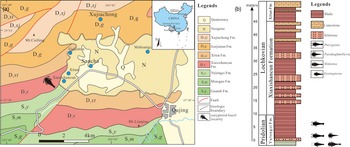
Silurian – Lower Devonian deposits are well developed in the Qujing area. The Silurian layers are assigned to the Miaogao and Yulongsi formations while the Xiaxishancun, Xitun, Guijiatun and Xujiachong formations belong to the Devonian. The strata in Qujing are well exposed and show a successive transition from the shallow marine facies of the Upper Silurian Miaogao Formation to the non-marine facies of the Xujiachong Formation. Our study outcrop of the Xiaxishancun Formation is c. 5 km west of Qujing city near Xiaxishan reservoir (coordinates 103.698351° N, 103.698351° E; Fig. 1a). The Xiaxishancun Formation is c. 51 m thick and the bottom conformably overlies the black fissile shale of the Yulongsi Formation; its top is also conformable with a purple sandstone of the Xitun Formation. The Xiaxishancun Formation consists mainly of continental deposits characterized by yellow sandstone and green shale, which yield abundant fish remains (Lu et al. Reference Lu, Giles, Friedman and Zhu2017), some primary plant fossils (Xue, Reference Xue2012) and euchelicerates (Lamsdell et al. Reference Lamsdell, Xue and Selden2013 b; Selden et al. Reference Selden, Lamsdell and Qi2015)
(a) Generalized map showing geological features of the Qujing area and the eurypterid fossil locality (modified from figure 1 of Hao et al. Reference Hao, Xue, Liu and Wang2007). (b) Schematic stratigraphic column for Xiaxishancun Formation showing distribution of eurypterids at localities in the Qujing area.

Based on palynological data and carbon isotope (δ13Corg) analyses, the Xiaxishancun Formation is considered to be of Lochkovian age (Hao et al. Reference Hao, Xue, Liu and Wang2007; Zhao et al. Reference Zhao, Wang, Zhu, Mann, Herten and Lücke2011, Reference Zhao, Jia, Min and Zhu2015, Reference Zhao, Zhang, Jia, Shen and Zhu2021). The miospore assemblage identified is the Streelispora newportensis – Chelinospora cassicula Assemblage Zone (Fang et al. Reference Fang, Cai, Wang, Li, Gao, Wang, Geng and Wang1994; Hao et al. Reference Hao, Xue, Liu and Wang2007) which approximately corresponds to the Emphanisporites micrornatus – Streelispora newportensis Assemblage Zone of the Lochkovian age (Richardson & McGregor, Reference Richardson and McGregor1986; Fang et al. Reference Fang, Cai, Wang, Li, Gao, Wang, Geng and Wang1994; Hao et al. Reference Hao, Xue, Liu and Wang2007). Furthermore, carbon isotope (δ13Corg) analyses reveal positive δ13Corg shifts happening and reaching peak values as heavy as −25.2 % at the base of Xiaxishancun Formation (Zhao et al. Reference Zhao, Wang, Zhu, Mann, Herten and Lücke2011, Reference Zhao, Jia, Min and Zhu2015, Reference Zhao, Zhang, Jia, Shen and Zhu2021). These results replicate a globally known positive shift in δ13Corg from the uppermost Silurian to the lowermost Devonian. Hence, the eurypterid beds, which are near the base of the Xiaxishancun Formation, were deposited in the early Lochkovian (Fig. 1b).
3. Materials
The specimens (GMG20211001001–10) described in this paper were collected from the lower part of the Xiaxishancun Formation. Being preserved in siltstones, the material is flattened and shows some tectonic distortion. The fossils were prepared using pneumatic chisels. All photographs were taken with a Sony ILCE-7M3 digital camera with a FE 24–105 mm f/4 G OSS lens. Photographs were processed and arranged into figures using image editing software (CorelDRAW 2018 and Adobe Photoshop CS). Morphological terminology follows Tollerton (Reference Tollerton1989), with denticle terminology following Miller (Reference Miller2007). All specimens examined in this study are deposited in the Geological Museum of Guizhou (GMG), Guiyang, Guizhou province, China. The IVPP (Institute of Vertebrate Palaeontology and Palaeoanthropology)-I4593 measurement data were collected from Wang & Gai (Reference Wang and Gai2014).
4. Systematic palaeontology
Order Eurypterida Burmeister, Reference Burmeister1843
Suborder Eurypterina Burmeister, Reference Burmeister1843
Infraorder Diploperculata Lamsdell et al. Reference Lamsdell, Hoşgör and Selden2013
Superfamily Pterygotoidea Clarke & Ruedemann, Reference Clarke and Ruedemann1912
Family Pterygotidae Clarke & Ruedemann, Reference Clarke and Ruedemann1912
Genus Pterygotus Agassiz, Reference Agassiz and Murchison1839
Type species Pterygotus anglicus Agassiz, Reference Agassiz1844
Diagnosis. Pterygotidae of larger size, with a subtrapezoid prosoma; free ramus of chelicera terminating in a curved denticle; denticles curved posteriorly, without marginal serrations (emended from Miller, Reference Miller2007).
Pterygotus wanggaii new species (Figs 2–3)
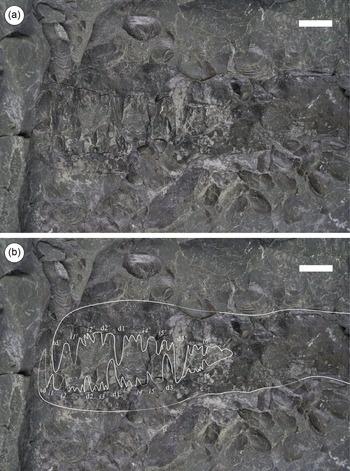
Pterygotus wanggaii n. sp. (a) Holotype GMG20211001003 ramus of chelicera; (b) interpretive drawing of ramus of chelicera GMG20211001003. Scale bar = 10 mm.

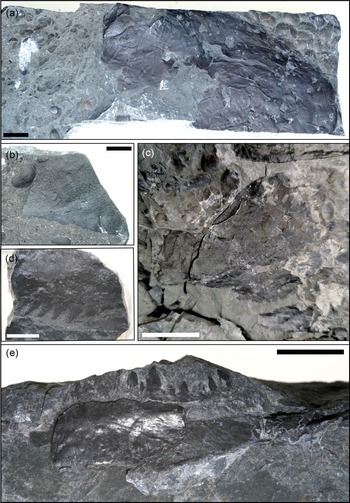
Pterygotus wanggaii n. sp. (a) Partial carapace GMG20211001004; (b) partial isolated tergite GMG20211001008; (c) isolated coxa of prosomal appendage VI, GMG20211001007; (d) a portion of the coxa (gnathobase) of the walking leg, GMG20211001006; (5) partial isolated ramus specimen, GMG20211001005. All scale bars = 10 mm.

2014 Pterygotidae gen. et sp. indet. Wang & Gai, p. 297.
Type material. Holotype GMG20211001003; paratypes GMG20211001004–8; additional material IVPP-I4593.
Diagnosis. Pterygotus with chelicera bearing three principal denticles and about six intermediate denticles; cheliceral denticles exhibiting size differentiation and with longitudinal striations on the surface; all denticles upright with slightly posterior curvature; first primary denticles (d1,d1′) located on the middle part of ramus; third primary denticles (d3,d3′) elongate, even longer than first primary denticles.
Occurrence. Lower part of the Xiaxishancun Formation and Xitun Formation (Wang & Gai, Reference Wang and Gai2014; Lochkovian) Xiaxishan Reservoir near Qujing city, Yunnan, SW China.
Description. Specimen GMG20211001003 (Fig. 2) is an isolated chelicera comprising the fixed and free ramus and elongate basal podomere, total preserved length 96.4 mm. The fixed ramus is slightly longer than the free ramus. Both rami preserve fine detail of denticles. Denticles with fine longitudinal striations, without marginal serrations.
Fixed ramus preserved length 71.4 mm, maximum preserved width 16.4 mm. Terminal denticle (td) incomplete; however, the gentle curvature of the preserved ramus margin suggests the denticle may have been curved rather than angular in morphology. Primary denticle (d1) is more robust than others, length 9.0 mm, width at base 4.7 mm, upright with posterior curvature. Anterior principal denticle (d2) length 5.2 mm, width at base 1.8 mm, upright with posterior curvature. Third principal denticle (d3) length 8.2 mm, width at base 4.2 mm, upright with weak posterior curvature. Six intermediate denticles are interspersed between the primary denticles and a multitude of smaller denticles; the first (i1) occurs just posterior to the terminal denticle, only denticle base preserved, width at base 1.9 mm. Second intermediate denticle (i2) occurs 11.2 mm anterior of the primary denticle, length 1.3 mm, width at base 1.7 mm, upright. Third intermediate denticle (i3) located posterior to primary denticle, length 2.5 mm, width at base 1.3 mm, upright. Fourth intermediate denticle (i4) located 4.3 mm posterior to primary denticle, height 2.1 mm, width at base 1.2 mm, upright with posterior curvature. Fifth intermediate denticle (i5) with base obscured by brachiopods, located 4.4 mm anterior to third primary denticle, preserved height 3.6 mm, denticle slightly angled towards ramus distal termination. Sixth intermediate denticle (i6) located 9.3 mm posterior to third primary denticle, height 2.6 mm, width at base 2.0 mm, upright with posterior curvature.
Free ramus preserved length 66.8 mm, maximum preserved width 23.4 mm. Terminal denticle (td′) robust, angled slightly away from the ramus, height 9.2 mm, width at base 2.7 mm. The third principal denticle (d3′) is the most robust denticle, length 12.1 mm, width at base 4.8 mm, upright with slight posterior curvature. Denticle morphology and arrangement on free ramus is similar to that of fixed ramus.
GMG20211001005 (Fig. 3e) Partial isolated ramus, preserving partial appendage with third principal denticle and several intermediate denticles. Ramus total length 46.3 mm, width 13.8 mm. The third principal denticle only preserves the basal 5 mm. All denticles with fine longitudinal striations.
GMG20211001004 (Fig. 3a) Partial carapace, preserving left margin, lateral compound eye and portions of anterior margin. Carapace preserved length 47.9 mm, width 104.4 mm. The weak crumples on the surface suggest that the specimen represents an exuvium. The lateral eye is flattened and positioned anterolaterally, abutting the carapace margin, and is oval in shape with a length of 12.0 mm.
GM20211001006 (Fig. 3d) A portion of the coxa (gnathobase) of a walking leg. The length of the coxa is 29.4 mm, 33.9 mm across the eight denticles on the gnathobase. The full gnathobasic surface is not preserved but at least eight teeth are present, generally uniform in shape and decreasing regularly in size from anterior to posterior.
GMG20211001007 (Fig. 3c) An almost completely preserved isolated coxa of appendage VI. The coxa is broad, expanding distally with a marked constriction between the gnathobase and the distal expansion. The length of the coxa is 80.7 mm from the distal portion of the expanded posterior to the gnathobasic edge. The maximum width of the coxa, located towards the posterior of the expanded region, is 57.2 mm; the gnathobasic surface is incomplete, with a preserved width of 22.5 mm, and the subsequent constriction is 18.5 mm wide at its narrowest point. The full gnathobasic surface is not preserved but at least nine teeth are present, generally uniform in shape and decreasing regularly in size from anterior to posterior. The coxa surface is ornamented with broad lunule scales grading to small tubercles at the coxa midline.
GMG20211001008 (Fig. 3b) Partial tergite, length 26.3 mm, preserved width 42.7 mm, ornamentation of dense lunule scales across the tergite anteriorly to posteriorly.
Etymology. Named after the family names of Professors Wang Bo (王博) and Gai Zhikun (盖志琨), who reported the first specimen.
Remarks. The holotype (GMG20211001003) of Pterygotus wanggaii n. sp. shares an almost identical denticle morphology and arrangement with specimen IVPP-I4593, which was described by Wang & Gai in Reference Wang and Gai2014. Hence, IVPP-I4593 and our new material can be attributed to the same species. However, due to the poor preservation and without any other specimens, Wang & Gai (Reference Wang and Gai2014) did not assign IVPP-I4593 to any genus or species (Wang & Gai, Reference Wang and Gai2014). Based on our new specimens it is clear that several characteristics of the species, such as the free ramus of chelicera terminating in a curved denticle, denticles curved posteriorly without marginal serrations, and an ornament of dense lunule scales across the tergite anteriorly to posteriorly, indicate an assignment to Pterygotus. We erect Pterygotus wanggaii n. sp. based on the robust ramus with first primary denticles (d1,d1′) located on the middle part of ramus and elongate third primary denticles (d3,d3′) which are even longer than first primary denticles and all primary denticles with slight posterior curvature.
The new species closely resembles other well-known Pterygotus species, particularly Pterygotus cobbi Hall, Reference Hall1859 and Pterygotus barrandei Semper, Reference Semper1898 with the elongated and broad primary denticles of the chelicera. However, the free ramus of P. cobbi exhibits thinner, fewer and more widely spaced primary denticles and intermediate denticles are very rare (see Hall, Reference Hall1859; Leutze & Heubusch, Reference Leutze and Heubusch1963). In P. barrandei, the primary denticles are further apart and located more proximally on the ramus (Semper, Reference Semper1898; Chlupac, Reference Chlupáč1994). The cheliceral morphology of P. wanggaii is distinct from that of E. qujingensis, from the Upper Silurian Yulongsi Formation of Yunnan Province, which exhibits a thinner ramus and less differentiation between the cheliceral denticles.
Superfamily Adelophthalmoidea Tollerton, Reference Tollerton1989
Family Adelophthalmidae Tollerton, Reference Tollerton1989
Genus Parahughmilleria Kjellesvig-Waering, Reference Kjellesvig-Waering1961
Diagnosis. Adelophthalmidae of small size; carapace semicircular; lateral eyes small, reniform and in centrilateral position of carapace; metastoma with deep triangular notch anteriorly; telson wide, lanceolate shape (Kjellesvig-Waering, Reference Kjellesvig-Waering1961; Tollerton, Reference Tollerton1989).
Type species Parahughmilleria salteri Kjellesvig-Waering, Reference Kjellesvig-Waering1961
Remark. Størmer (Reference Størmer1973) reported two Parahughmilleria species from the uppermost Lower Emsian of Alken: P. hefteri and P. major. The latter species was separated from the former mainly because of its larger size coupled with a more slender body and slight differences in the morphology of the genital appendage. However, based on recent studies indicating that the differences between both supposed species are due to ontogeny and preservational variation, some authors consider P. hefteri and P. major to be synonymous (Poschmann & Tetlie, Reference Poschmann and Tetlie2006; Lamsdell & Selden, Reference Lamsdell and Selden2013; Poschmann, Reference Poschmann2015). Here, we are inclined to regard P. major as a synonym of P. hefteri.
Parahughmilleria fuea new species (Fig. 4)
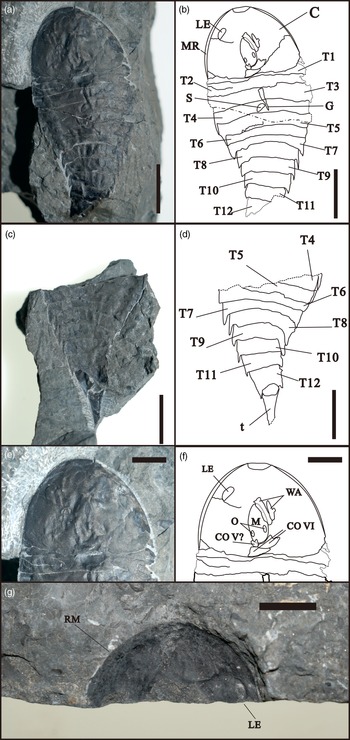
Parahughmilleria fuea n. sp. (a) Holotype GMG20211001001a, nearly complete specimen, scale bar = 20 mm; (b) interpretive drawing of Holotype GMG20211001001a, T = tergite, LE = lateral eye, C = carapace, MR = marginal rim, G = genital appendage, S = spatulae, scale bar = 20 mm; (c) holotype GMG20211001001b, counterpart of GMG20211001001a, scale bar = 20 mm; (d) interpretive drawing of holotype GMG20211001001b, T = tergite, t = telson, scale bar = 20 mm; (e) details of carapace of holotype GMG20211001001a, scale bar = 10 mm; (f) interpretive drawing of carapace of holotype GMG20211001001b, M = metastoma, O = ocelli, LE = lateral eye, CO V = coxa V, CO VI = coxa VI, WA = walking appendage, scale bar = 10 mm; (g) incomplete carapace GMG20211001002, LE = lateral eye, MR = marginal rim, scale bar = 10 mm.

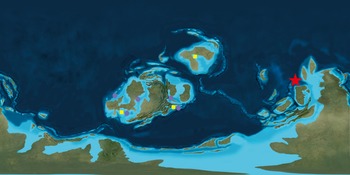
Palaeogeographic distribution of Pridolian to Lochkovian Pterygotus and Parahughmilleria. Global palaeogeographic reconstruction for the Pridolian to Lochkovian (420 Ma) is after Blakey (Reference Blakey2020). Circles represent localities of previously described Pterygotus; squares represent localities of previously described examples of Parahughmilleria (Tetlie, Reference Tetlie2007); star shows location of the Chinese eurypterids.

Type material. Holotype GMG20211001001a and GMG20211001001b (counterpart of GMG20211001001a); paratype GMG20211001002.
Diagnosis. Large Parahughmilleria with strongly developed lateral epimera from tergites T4 to T12.
Occurrence. Lower part of the Xiaxishancun Formation; Xiaxishan Reservoir near Qujing city, Yunnan, SW China.
Description. Two specimens are attributable to this species. GMG20211001001 (preserved as part and counterpart; Fig. 4a–f) consists of an articulated prosoma and opisthosoma but lacks the distal part of the telson; the prosomal appendages are partially preserved. The total length of the specimen is more than 110 mm and the maximum width is 39.4 mm. Carapace semicircular, length 28.2 mm, width at base 37.4 mm (L/W 0.75, lateral angle 107°). The carapace is arched and surrounded by a narrow marginal rim. The posterior margin of the carapace is crumpled weakly, but the available undistorted margins suggest it may be slightly convex. The lateral eyes are relatively small, 4.4 mm long, 2.2 mm wide, reniform and positioned centrilaterally. The median ocelli are small and rounded, positioned on the central part of carapace, with a diameter of 2.1 mm.
Metastoma 10.9 mm long, 5.4 mm wide (L/W 2.0), lateral part partially covered by podomeres from a walking leg, lateral angle c. 80°. Based on the wrinkle line and the uncovered left part, we suspect the metastoma is paraelliptical in shape (Tollerton, Reference Tollerton1989). A pair of coxa VI are located at the posterior of the metastoma. The coxa are roughly triangular in shape, expanding distally with a marked constriction at the gnathobase. The length of coxa VI is 5.6 mm, the maximum width is 3 mm. Walking leg podomeres appear non-spiniferous. On the part (GMG20211001001a), the slender type-A genital appendage extends to the posterior margin of the fourth tergite, total length 8.9 mm. One smaller structure with a length of 3.3 mm and situated on the left side of the appendage is interpreted as a spatula.
The opisthosoma is widest at the third tergite. Each of the tergites curves anteriorly along the mid-line. The first tergite is slightly reduced, 3.8 mm long, with the succeeding preabdominal tergites 4.7–5.5 mm long. Only the first and second tergites lack posterolateral epimera, possibly weakly developed on the third tergite with small posterolateral corners. Fourth tergite with strongly developed triangular epimera, about 3.5 mm long. Seventh tergite c. 30.2 mm wide, tergite eight (first postabdominal tergite) 24.1 mm wide. Eighth to eleventh tergites with an almost constant length of c. 6.0 mm, becoming narrower posteriorly, with well-developed posterolateral epimera. The twelfth tergite (pretelson) and proximal part of the telson are preserved on the counterpart (GMG20211001001b), pretelson with a length of 9.5 mm and width of 13.6 mm. The telson is lanceolate, preserved length 15.0 mm, width at base 6.3 mm. The distal part of the telson is not preserved.
GMG20211001002 (Fig. 4g) preserves an incomplete carapace, damaged on the posterior side, preserved length of 14.7 mm and width of 30.3 mm. The carapace is arched and surrounded by a narrow marginal rim. Centrimesially positioned lateral eye preserved on the right side. The lateral eye is relatively small, 4.3 mm long, 2.2 mm wide, reniform in shape.
Etymology. Named after the family name of Ms Fu Lihong (付丽红) in recognition for her support of our research.
Remarks. Parahughmilleria fuea n. sp. is relatively large compared with the other well-known species of Parahughmilleria, exhibiting a size much more typical of the largest adelophthalmoid Adelophthalmus. However, the L/W ratio of the metastoma, and the position of the compound eyes strongly indicate the Chinese adelophthalmoid can be assigned to Parahughmilleria. (Kjellesvig-Waering, Reference Kjellesvig-Waering1961; Tollerton, Reference Tollerton1989). Parahughmilleria fuea n. sp. shares many similarities with the P. hefteri, such as the elongate type-A genital appendage, the L/W ratio of metastoma, and the position of compound eyes (Størmer, Reference Størmer1973; Braddy, Reference Braddy2000; Poschmann & Tetlie, Reference Poschmann and Tetlie2006; Poschmann, Reference Poschmann2015). However, there are some differences between Parahughmilleria fuea n. sp. and Euramerican Parahughmilleria, with P. fuea n. sp. possessing strongly developed lateral epimera on the fourth to twelfth tergites whereas epimera are only observed on the seventh to twelfth tergites in the Euramerican species, even in larger specimens (Kjellesvig-Waering, Reference Kjellesvig-Waering1961; Kjellesvig-Waering & Leutze, Reference Kjellesvig-Waering and Leutze1966; Størmer, Reference Størmer1973; Poschmann & Tetlie, Reference Poschmann and Tetlie2006; Tetlie & Poschmann, Reference Tetlie and Poschmann2008; Poschmann, Reference Poschmann2015, Reference Poschmann2017, Reference Poschmann2020). The developed lateral epimera are unlikely to be an ontogenetic difference because epimera can also be observed in the different ontogenetic stages of the closely related Adelophthalmus (Shpinev & Filimonov, Reference Shpinev and Filimonov2018).
5. Discussion
The eurypterid community from the Xiaxishancun Formation shares many similarities with that of the famous Willwerath Lagerstätte of Rhineland-Palatinate, Germany (Poschmann & Tetlie, Reference Poschmann and Tetlie2006; Poschmann, Reference Poschmann2017, Reference Poschmann2020). The Willwerath Lagerstätte includes six eurypterid species referrable to the genera Jaekelopterus, Rhenopterus, Erieopterus, Adelophthalmus, Pruemopterus and Parahughmilleria (Kjellesvig-Waering, Reference Kjellesvig-Waering1961; Poschmann, Reference Poschmann2020), some plant fossils (Alling & Briggs, Reference Alling and Briggs1961) and the putative euchelicerate Willwerathia (Anderson et al. Reference Anderson, Poschmann and Brauckmann1998; but see Lamsdell, Reference Lamsdell2020). Like the Willwerath Lagerstätte, beside the eurypterids Pterygotus wanggaii n.sp. and Parahughmilleria fuea n. sp., the euchelicerate Houia yueya (Lamsdell et al. Reference Lamsdell and Selden2013; Selden et al. Reference Selden, Lamsdell and Qi2015) and plant Zosterophyllum xishanense (Hao et al. Reference Hao, Xue, Liu and Wang2007; Xue, Reference Xue2012) are also present in the Xiaxishancun Formation. The Willwerath Lagerstätte is characterized by grey silty mudstones and muddy siltstones interbedded with fine sandstones, and the palaeoenvironment is considered as marginal marine; the lithological combination and marine tidal flat habitat of the Xiaxishancun Formation concurs with this. The discoveries from the Xiaxishancun Formation provide strong evidence that eurypterids formed comparable communities globally and give insight into the similarity of ecosystem structure across the Early Devonian world.
In addition, all of the 20 previously known species of Pterygotus are described from Europe, North America and Australia (Tetlie, Reference Tetlie2007), and four of five Parahughmilleria species are from Europe and North America, with the exception of Parahughmilleria matarakensis from Khakassia, Russia. The specimens described here broaden the distribution of Parahughmilleria and Pterygotus and represent the first Gondwanan record of Parahughmilleria. Moreover, the discoveries further support the notion that pterygotoids and adelophthalmoids had superior dispersal abilities leading to a more cosmopolitan distribution because of streamlined body form and substantial swimming abilities (Tetlie, Reference Tetlie2007). These new discoveries from China not only provide a broader picture of the biogeography of the group but also demonstrate that species in Gondwana occupied similar environments to their Laurentian relatives Fig. 5.
Furthermore, it is very exciting to find new eurypterids in Gondwana, especially during the Silurian–Devonian boundary interval. As one of the most important geological–biotic events, the Silurian–Devonian boundary event was marked by a major positive excursion of δ13C (Małkowski & Racki, Reference Małkowski and Racki2009; Zhao et al. Reference Zhao, Wang, Zhu, Mann, Herten and Lücke2011, Reference Zhao, Jia, Min and Zhu2015, Reference Zhao, Zhang, Jia, Shen and Zhu2021), global sea-level regression (Małkowski & Racki, Reference Małkowski and Racki2009), graptolite extinction (Urbanek et al. Reference Urbanek, Radzeviius, Kozowska and Teller2010) and a decrease in cephalopod species diversity (Laptikhovsky et al. Reference Laptikhovsky, Rogov, Nikolaeva and Arkhipkin2013). Lamsdell & Selden (Reference Lamsdell and Selden2017) suggested that eurypterids ended the Silurian on a bust, experiencing marked extinction during the Silurian–Devonian boundary interval. This phenomenon can also be confirmed in the Silurian–Devonian strata of the South China Block. The upper part of the Yulongsi Formation, which is considered as latest Pridolian in age (Qie et al. Reference Qie, Ma, Xu, Qiao, Liang, Guo, Song, Chen, Lu and Agassiz2019; Rong et al. Reference Rong, Wang, Zhan, Fan, Huang, Tang, Li, Zhang, Wu, Wang, Wei and Agassiz2019; Zhao et al. Reference Zhao, Zhang, Jia, Shen and Zhu2021), is dominated by the Erettopterus–Slimonia association (Ma et al. Reference Ma, Selden, Lamsdell, Zhang, Chen and Zhang2022), whereas in the Xiaxishancun Formation the Erettopterus and Slimonia community suddenly disappeared and was replaced by Parahughmilleria and Pterygotus. Beside the turnover of eurypterids, other organisms also undergo major shifts, such as the increased diversity of fishes (Zhao & Min, Reference Zhao and Min2010; Lu et al. Reference Lu, Giles, Friedman and Zhu2017) and abundance of plants (Xue, Reference Xue2012). In terms of environment, the Yulongsi Formation is considered lagoonal based on the dark, organic, intensely laminated silt–mudstone (Wang, Reference Wang2000). With the global sea-level regression during the Silurian–Devonian boundary interval, the Xiaxishancun Formation appears to consist of more siltstone layers and is considered a shallow tidal flat environment (Wang, Reference Wang2000). These shifts in sea level and depositional environment are synchronous with the positive excursion of δ13C (Zhao et al. Reference Zhao, Zhang, Jia, Shen and Zhu2021). This discovery not only strongly supports the previously observed turnover of eurypterids at the end of the Silurian, experiencing marked extinction during the Silurian–Devonian boundary interval, but also indicates the environment experienced great change during the interval.
Acknowledgements
Thank to Dr Jason A. Dunlop and Dr Peter Van Roy for helpful comments on the manuscript. We are grateful to Ms Fu Lihong (付丽红) for help with figures, assistance with our work and collection of fossils and Dr Zhang Huihong (张晖宏) (Yunnan University) for fossil collecting and useful suggestions during the early stages of the manuscript. This work was supported by the National Natural Science Foundation of China (No. 41972120; 42172129) and also supported by the State Key Laboratory of Palaeobiology and Stratigraphy (Nanjing Institute of Geology and Palaeontology, CAS) (No. 173131)