


In Citizens without Nations, Maarten Prak brilliantly shows how urban citizenship has long survived, and even thrived, in diverse settings.Footnote 1 Prak demonstrates that citizenship was not a relic of ancient times that was only revived in the American and French Revolutions. Rather, urban citizenship remained an active and widespread part of European life from the medieval era through the early modern period.
Prak also argues that the continued vigor of urban citizenship played an important role in the “Rise of the West”. Reviewing the economic success of the Italian city-states, the United Provinces, and then England, Prak claims that, in these societies, the influence of associations of urban citizens on state politics, by providing support and protection for commercial interests, enabled northwest Europe to break through to new economic frontiers. In contrast, although Asian empires and Central European states also had cities with active civic associations and a fair measure of self-government, their national and imperial regimes were not greatly influenced by them. Rather, their national governments were far less attentive to commercial interests, providing a poor framework for sustained economic growth.
On this argument, I take issue with Prak. The economic achievements of the Western civic-dominated societies he mentions were, in fact, not at all exceptional. Their growth did not produce GDP/capita levels that exceeded long-standing global historical norms for highly commercial and urbanized societies. What enabled England to break through to unprecedented levels of output per head after 1750 was a different aspect of citizenship rights – not commercial protections, but the intellectual and religious freedoms underwritten by the Parliamentary Acts of 1689. Yet, Prak points us in the right direction, as it is unlikely that these freedoms, which were critical to the technological advances that enabled the industrial revolution, would have been possible without the long history of citizen association and civil rights in Europe.
URBAN COMMERCE AND ECONOMIC GROWTH
Many scholars have argued that economic progress in Western Europe was driven by a succession of urbanized commercial societies that grew increasingly prosperous. The emergence of industrialization in Great Britain after 1750 was therefore the outgrowth of a long and cumulating process of advances that started in the Middle Ages in the Low Countries and North/Central Italy. Footnote 2
This view is nicely summed up in Figure 1. This diagram, from Bas van Bavel's The Invisible Hand?, based on data from the Maddison Project, shows how four commercial, urbanized societies – Iraq under the Abbasid Caliphate, Renaissance Italy, Holland, and the United Kingdom – experienced successive episodes of GDP/capita growth. Although in the first three cases GDP/capita peaked and turned downward, the peaks rose ever higher until the UK after 1800 finally achieved sustained income growth. Prak grants that industrialization was not solely “the result of citizenship arrangements; […] However, insofar as the invention of the steam engine was part […] of a much broader set of changes, institutions in general and urban citizenship in particular do seem to have been significant factors behind the Industrial Revolution; the chronological coincidence [with the commercial interests represented in Parliament gaining national power from 1689 onwards] is too striking to overlook”.Footnote 3
An older view of growth of GDP/capita in the West.
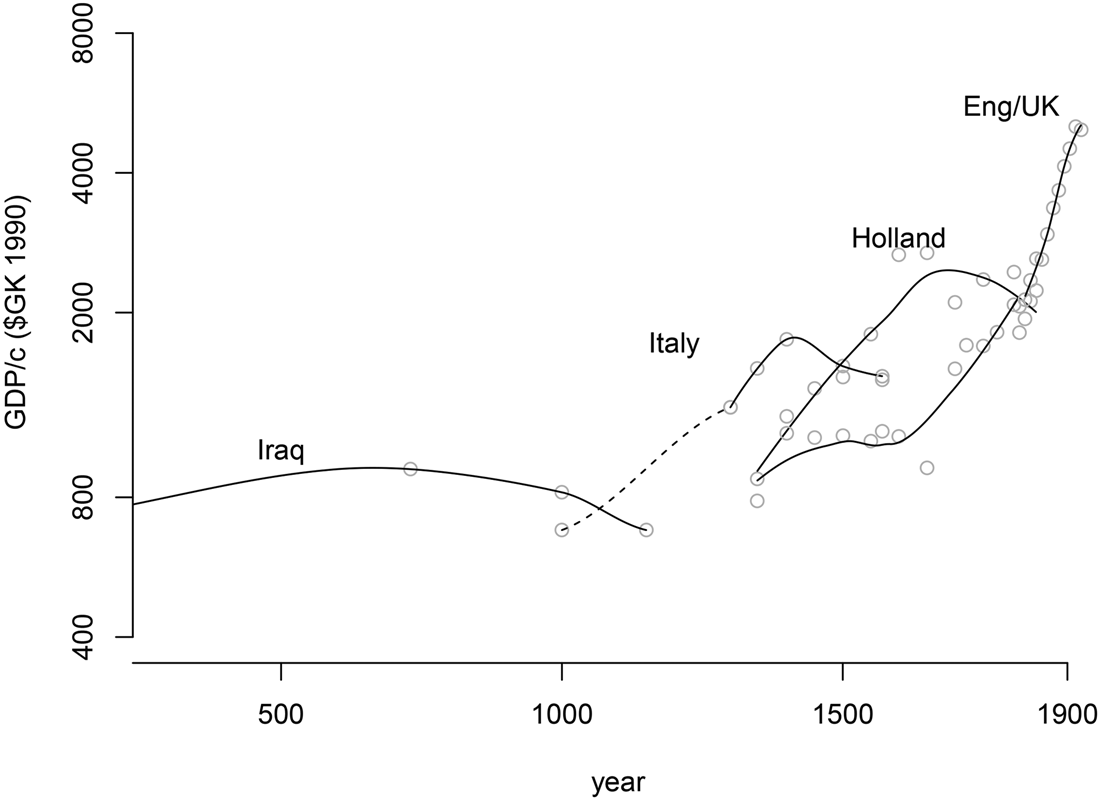
Yet, new data is constantly emerging, and the latest research paints a very different picture. First, the apparently high levels of national GDP/capita achieved by Holland are misleading, because Holland was a province, not a country. At the time of its peak GDP/capita c.1600, Holland's population remained under 500,000,Footnote 5 rather less than the population of many individual cities in Asia at that time. If we take instead the GDP/capita for the Netherlands as a whole – still a small unit, but one more comparable to North/Central Italy or the United Kingdom – its growth curve is rather flatter. More importantly, GDP/capita for the Netherlands as a whole even in the 1750s remained not significantly greater than the peak GDP/capita reached in North/Central Italy in the 1450s, three centuries earlier (see Table 1).
Estimates of GDP/capita in advanced regions of Europe and China in 1990 international dollars.Footnote 4

Second, if we look further in space and time, additional estimates of GDP/capita challenge the notion that ascending income peaks led the way to Britain's breakthrough. Stephen Broadberry, Hanhui Guan, and David Daokui Li have offered new estimates of GDP/capita for Imperial China. They provide estimates for China as a whole, with its population of tens to hundreds of millions, and for an imputed more advanced, highly commercialized and urbanized area, such as the lower Yangzi delta. This “high China” region, with putative population of around ten million, would correspond to all of China as the Netherlands or North/Central Italy do to all of Europe. Broadberry, Guan, and Li set their estimate for GDP/capita in this more commercial “high China” region as 1.75 times their estimated GDP/capita for China as a whole. They find that Imperial China reached a GDP/capita in its most advanced region in the early Qing (c.1700) that exceeded that achieved anywhere in Europe prior to 1750.Footnote 6
Figure 2 shows these new estimates for GDP/capita in Europe and China graphed from 1400 to 1800. As can be seen, this now gives a very different impression of the pattern of pre-industrial income growth. (I am omitting GDP/capita in Great Britain in 1800, because, by then, its economy is no longer, strictly speaking, pre-industrial, steam engines having been deployed since 1712 and spinning machinery, coking coal, and puddling and rolling of steel all having been used for several decades prior to 1800.)
A current view of GDP/capita in the West and China, in 1990 international dollars, showing Peak Pre-industrial Income (PPI) 1400–1800. Data from Table 1.

The trajectory of output per head in these countries from 1400 to 1800 (or to 1750 for Great Britain), shows no pattern of escalating achievement. Rather, we see periods in which different states achieved a high level of GDP/capita but then stagnated or levelled off at what appears to be a “limit” in output per head at around $1,900 in 1990 international dollars. Indeed, all the movements in output per head through this period seem “trapped” below that level, which we label as “Peak Pre-Industrial Income (PPI)”.
Odd as this may seem, it becomes even more striking when we extend our view further back in time. It has long been known that China during the Northern Song, c.1000–1100 CE, had made extraordinary achievements in iron production.Footnote 7 Broadberry, Huan, and Li estimate the “high China” GDP/capita in this period at $1,600–$1,700 in 1990 international dollars – the third time that China was bumping up against the PPI level of $1,900 per capita.
We can go back further still. Advances in archeology and classical history have given us much better insights into the nature and achievements of the economies of ancient Greece and Rome. Scholars now recognize that, at their peak, these were both highly commercialized and urbanized economies.
We have two separate estimates for the GDP/capita of Italy during the early Roman Empire. Italy was then at the center of a vast land and maritime empire; it drew the wheat for its daily bread from abroad (Sicily, Anatolia, and Egypt), while specializing in high value crops and manufactures – not unlike Italy in the Renaissance or the Netherlands in the seventeenth century. Elio Lo Cascio and Paolo Malanima, after examining various estimates for economic output and population, conclude that “it may even be contended that Italian per capita GNP [c.14 CE] was higher than per capita GDP in 17th century England”.Footnote 8 They estimate a level of GDP/capita in 1990 international dollars of $1,400 for Augustan Italy.
Their estimates are complemented by those of Peter Temin. Temin shows that the early Roman Empire had extensive and well-functioning markets for labor, land, and grain, as well as sophisticated financial markets. Its engineering achievements included the development of weather-resistant roads, aqueducts that conveyed water through exacting measurements of slope over tens of kilometers, highly stable concrete, and the wide use of supporting arches in construction. All of these allowed the Empire, and Italy in particular, to reach a high level of urbanization, with Rome the largest city in the world and hundreds of sizeable cities throughout Italy, Europe, northern Africa, and western Asia. Temin argues that output per capita in Italy at its peak in the second century CE was at the same level as the Netherlands in the late sixteenth century. That would place GDP/capita in Roman Italy at just under $1,600 in 1990 international dollars.Footnote 9
While it is surprising to find roughly the same level of output per head in Italy during the Renaissance as in the early Roman Empire, over a thousand years earlier, we can go back another several centuries. Scholars have been reconstructing the economy of classical Greece, c.800–300 BCE. According to new estimates, GDP/capita in the Greek world began a rapid rise around 700 BCE. During the next four centuries, the core of classical Greece – the mainland south of Thessaly plus the Ionian and Cycladic Islands – became both densely settled and highly urbanized, while creating numerous colonies around the Mediterranean that developed an extensive and specialized trading network.
Josiah Ober estimates that the population density of the core Greek region in the late fourth century BCE was comparable to that of Holland in the sixteenth century or England and Wales in the late seventeenth century.Footnote 10 He describes core Greece as having a “dense, healthy and urbanized” population of 3–3.5 million people at this time.Footnote 11 That is greater than the population of England and Wales in 1500, and about the same as the population of the Netherlands in 1850. Ober also estimates that in the fourth century BC, about thirty-two per cent of this population lived in towns of 5,000 people or more, and that a quarter to a third of the Greek population – almost all of which lived close to the sea – lived on “imported rather than locally grown food”.Footnote 12
Greek cities in this period not only expanded and sent out colonies, they also invested in public works (temples, theaters, sports arenas), supported large navies and/or armies, mined silver and traded for copper and tin to manufacture bronze arms, and exported huge amounts of pottery, wine, and olive oil. Based on censuses and surveys of housing, it appears that income was distributed more equitably than was common in medieval and early modern Europe.
Ober argues that from 750 BCE, at which point Greece was quite poor, to the fourth century BCE, at which time he considers Greece to have been “wealthy” by pre-modern standards, income per capita roughly doubled. Wealth grew even more rapidly, judging from the sizes of houses, which archeologists note increased five-fold during this period. By 350 BCE, the average Athenian house was the same size as current American middle-class homes (2500 sq. ft.), with stone foundations, bathrooms, tile roofs, clay drains, and often two stories.Footnote 13
If output per capita in Greece c.750 BCE was comparable to the lowest levels found in the world by Broadberry, Guan, and Li – i.e. roughly $675 per head – then by 350 BCE it would have grown to $1,350 per head, just below the level of Augustan Italy.
This estimate is also supported by the research of Alain Bresson. Bresson claims that the trade in commodities and even luxury goods by Greeks was far higher than had been previously understood. Moreover, he argues that in classical Greece “there was per capita growth, at a level unprecedented before the early modern period”.Footnote 14 If we accept that classical Greece at its height, c.350 BCE, had a GDP/capita of $1,350, that would be comparable to that of the Netherlands in 1550, and a bit greater than that of Britain in 1670. Again, we find that for almost two thousand years, income per head on many occasions approached, but did not exceed, a level of $1,900 per year.
Figure 3 repeats the exercise in Figure 2, but this time over two thousand years. It is striking to see how many times societies have enjoyed periods of growth in output per capita. Elsewhere, I have called these “efflorescences”.Footnote 15 But on every occasion up to 1750, such periods led to no further breakthroughs. Rather, every society that came up to that level subsequently saw income growth level off or even reverse.Footnote 16
GDP/capita in the West and China, in 1990 international dollars, showing Peak Pre-industrial Income (PPI), 550 BC–1800 AD; data from Table 1 plus estimates for Greece and Rome as given in the text.

What does it mean if GDP per capita in Greece c.350 BCE and Rome c.100 CE was thirty to fifty per cent higher than that of Britain in 1600? It may mean that the estimates of output per head in Great Britain c.1600 are, as Greg Clark has argued, far too low, and that output per head was rather higher in 1600, and growth to 1700 more gradual.Footnote 17
It may also be the case, as argued by Kent Deng and Patrick O'Brien, that comparing output per head in widely diverse regions and time periods via such an artificial and anachronistic measure as 1990 international dollars is simply a fiction, which conveys no useful information whatsoever.Footnote 18
Scholars might prefer to look to other data, such as that of wages, or heights. However, the data on wages is also scattered, diverse, and hard to interpret. Unless we know who was receiving wages, what portion of total family income was represented by wages, and what portion of total national income was paid through wages, any inferences of GDP/capita from daily wage payments may be misleading. John Hatcher and Judy Z. Stephenson have edited a devastating critique of such inferences, aptly titled Seven Centuries of Unreal Wages: The Unreliable Data, Sources and Methods that Have Been Used for Measuring Standards of Living in the Past.Footnote 19
It might be argued that data on heights is a better measure of standards of living, inasmuch as adult stature is a simple measure of the outcome of lifetime health and nutrition levels, and human biology is much the same across time and space. The problem here is that, if we accept the rough outlines of the data presented above, GDP/capita varied by a factor of three from relatively poor pre-industrials levels of approximately $650/yr to the peak pre-industrial level of approximately $1,900/yr, while estimated heights varied by only a few centimeters across Northern Europe for centuries.Footnote 20 Moreover, differences in climate across time and space matter greatly: colder weather diverts more energy to body maintenance rather than growth. And the genetic character of populations varies as well – a study of 10,000 ancient Roman skeletons found that long bone length, the favored proxy measure for height, varied more in the sample than height did, and inconsistently, so that no formula for deriving stature estimates from long bone measurement can be deemed reliable.Footnote 21
Given that data on neither real wages, nor heights can be considered trustworthy, we are left with no better guide to development across time than the efforts of economic historians to estimate the total output of societies in agriculture, manufacturing, and services, as well as total population, and then estimate GDP per capita. While this method no doubt has its flaws, it is striking that the disparate efforts of diverse scholars, working with very different data sources and examining societies both millennia and continents apart, have converged on similar results. That is, the study of societies that were widely considered the richest of their day, were known for their architectural, administrative, artistic, and technical accomplishments, and were the centers of widespread commercial networks and had well-functioning markets, all agree in determining their GDP/capita to have been in the range of $1,350 to $1,900 per year in 1990 international dollars. None exceeded this level, and many attained it in one or more periods.
In the next section we consider why this might be a plausible result.
THE LIMITS TO GROWTH IN THE PRE-INDUSTRIAL ERA
E.A. Wrigley has long insisted on the “limits to growth that were common to all organic economies”.Footnote 22 Organic economies relied wholly on wind, water, animal, and muscle power for tasks requiring mechanical work: lifting; hauling; transporting; grinding; cutting, etc. Organic societies thus faced strict energy limits: human and animal power depended on food, which depended on organic inputs of seed, fertilizer, and labor to produce. Wind and water power provided additional energy for transportation, grinding, cutting, and other processing tasks; but wind and water power were inefficiently captured, varied over the days and seasons, and were impossible to concentrate beyond modest limits. These limits to the energy available to a society, no matter how advanced in other ways, according to Wrigley “prevented sustained growth”.Footnote 23
We would still expect that pre-industrial economies might make considerable progress in income per head by using their resources more efficiently. This could include better tools to utilize human and animal power, or to capture wind and water energy; better organization to more efficiently deploy human and animal workers; and perhaps most importantly, extensive specialization and trade to acquire Smithian gains from comparative advantage in the production of particular products. But, at some point, because all such societies depended on the extractable flow of organic energy from their environment, they would come up against limits to further growth.
One index that Wrigley uses of such efficiency is urbanization. The more efficient the extraction of organic products from agriculture, husbandry, and forestry, the more population can be supported to work in manufacturing and services, thus boosting total output per head. Both the larger the major cities, and the larger the fraction of the population living in cities, the higher, he estimates, is the GDP/capita of that society.
It is thus striking that, as with GDP/capita, we find almost exactly the same pattern of widespread societies achieving the same “peaks” of urbanization across history. Just as there appears to be a peak pre-industrial level of output per capita for the entire era from 500 BCE to 1750 CE, so there appears to be a peak level of urbanization and urban size. This is true in regard to both the size of the largest pre-industrial cities, which seems fixed at just over one million, and the level of overall urbanization, which seems to peak at 25–30 per cent in the most advanced pre-industrial societies (see Table 2). (The one exception to this limit on primate city size is Hangzhou in 1300, but we have no GDP/capita estimate for that period with which to compare it.)
Urbanization and Primate City Size for various societies.Footnote 24

Based on the preceding data, one might say that the difference between what Wrigley calls “advanced organic societies” and what we might call “poor” pre-industrial societies is achieving a GDP/capita of two to three times the level of the latter, plus urbanization rates of over twenty per cent in their most advanced regions, and – in empires with large administrative centers – primate cities in the order of one million people.
Prak, Ober, Temin, and Wrigley all essentially agree on the conditions that enable pre-industrial societies to move from relatively “poor” to relatively “advanced”. Advanced organic societies had commercial centers that “were at the center of an extensive trading network, enjoying both gains from trade and income from the management of the trade”.Footnote 25 If each agricultural region could concentrate on the crops in which it was most productive; if producers of textiles, ceramics, metals, tools, and artwork could concentrate their efforts, reaping benefits of scale in training and production; if sophisticated financial systems allowed efficient deployment of capital and spreading of risk, then even pre-industrial societies could produce at levels far above “subsistence”. Gains in scale and market profits could support more extensive investments in windmills, ships, canals, and water wheels; more sophisticated crop rotations; and larger luxury goods markets whose profits could promote deeper capital markets and future investments.
How could pre-industrial societies move so far above “subsistence” levels? We know that in most pre-modern societies, it is common for poor peasants to face payments or sharecropping shares that give half of output to landlords and/or the government for rent and taxes. If even in poorer societies, the producing peasantry consumed roughly half of total output for their subsistence, then in richer organic societies, with perhaps three times the output per person, retaining one sixth of total output would suffice to sustain the life of the bottom stratum. This is precisely consistent with the findings of Peter Lindert and Jeffrey Williamson, who estimate from contemporary social tables that in Britain in 1688–1759 the bottom forty per cent of the population – which roughly corresponded to the bulk of the low-level agricultural producers – had an income share of fifteen per cent of total output.Footnote 26
If, therefore, in the most advanced organic societies eighty-five per cent of total output is available to support non-agricultural producers, an enormous amount of additional productive activity can be supported. A society that could sustain this level of output for a century or more would accumulate substantial resources for large-scale construction (temples, cities, public works, mansions, navies) and luxury consumption. This would produce the many “efflorescences” that occur throughout history, which supported urban centers from Chang'an and Tenochtitlan to Carthage and Constantinople, along with rich cultures and their literary and artistic peaks.
Such episodes are dependent on a core region emerging in a large area that is reasonably secure, and served by diverse and well-functioning markets. Wars, plagues, climate change, and internal strife could all disrupt such conditions, leading economies to fall from peak pre-industrial levels. Shifts in major trade routes, and continued population growth in the absence of further productivity gains, would also cause GDP/capita to stagnate or decline.
Given the interplay of all these factors across regions and time periods, one could reasonably expect multiple cases in diverse times and places of societies enjoying a coincidence of favorable conditions, moving upwards toward the peak pre-industrial income frontier, and when the constellation of factors changed, subsequently stalling near that level or falling away from it. In the most advanced regions, we would see GDP/capita reach nearly $1,900 per person in “core regions” during their most prosperous period, falling to $1,200 during less prosperous periods, and to $675 or less in relatively poor periods. Thus, we concur with Lo Cascio and Malanima: “A stability of past agrarian economies, together with cycles within a relatively narrow range of values, seems more convincing to us than the view of long-term slow growth spanning the period from antiquity until the 19th century”.Footnote 27
BREAKING THROUGH – FREEDOM AND INNOVATION IN KNOWLEDGE AND TECHNOLOGY
If the preceding data survey is correct, then the economies of Western Europe prior to 1750 were in no way exceptional in their levels of attained output per capita, or their patterns of growth. This therefore poses in stark terms the problem of how one of those economies – that of Great Britain – suddenly broke free of the limits on organic societies after that date.
We have no space here to fully answer that question. But we can point to Prak's answer as part of the solution. We do so by tracing the factors that were necessary to transition from organic to inorganic sources of energy and materials.
The critical breakthrough was the ability to convert heat energy to mechanical energy. It was an ability that no society, prior to Newcomen's invention of the atmospheric engine in 1712, had been able to achieve. Coal-fired steam power allowed the bottleneck of animal and human, wind and water power to be slowly expanded and then broken. After Newcomen, energy use per capita in England blew past organic limits, increasing almost five-fold from 1650 to 1850.Footnote 28
The development of the steam engine is sometimes taken to be a simple function of advanced tinkering, or of responding to the particular problem of clearing water from mines. Thomas Newcomen and his partner John Calley in this view are pictured as uneducated provincial craftsmen who had the luck and skills to develop a working engine. Nothing could be further from the truth.
The novel approach to pumping water deployed in the Newcomen engine relied on manipulating atmospheric pressure. Prior to the discoveries of Pascal and Torricelli, who used instruments to measure variations in atmospheric pressure, no society had developed the apparently absurd notion that, just like fish in the ocean, human beings live at the bottom of an ocean of an invisible fluid called “air” that creates a uniform pressure of roughly fifteen pounds per square inch – in other words, if I hold out my open palm, it is supporting a column of air weighing approximately 300 lbs!
With this knowledge, it was possible to conclude that if one could cool steam in a chamber of roughly one foot in diameter to create a vacuum, and open one end, then atmospheric pressure would force air (or other fluid, like water) into that chamber with a force equal to 1700 lbs. This opened a dramatic new approach to pumping fluids.
The approach was first developed by the trained military engineer Thomas Savery, who patented “an Engine to Raise Water by Fire” in 1698 and demonstrated it to the Royal Society the following year. Savery's design did not use pistons, but rather a set of interlinked chambers to suck in water then expel it by moving water and steam alternately in the chambers. Newcomen and Calley then improved Savery's engine by using atmospheric pressure to drive a piston into a vacuum chamber created by injecting and cooling steam. The motion of the piston supplied reciprocating mechanical power that could be used to drive a conventional pole pump located at the base of deep mines.
Newcomen was not an isolated provincial, but through his family had connections to the Hartlib circle and thence to the Royal Society.Footnote 29 He surely had learned of Savery's “Fire Engine” before embarking on his invention. Indeed, if not for the general circulation of scientific ideas in seventeenth and eighteenth century England, including discussion of vacuums and air pressure,Footnote 30 it would have been impossible to simply “tinker” one's way into the wholly novel mode of transferring heat into mechanical power that developed into the Newcomen engine.
Thus, the breakthrough that removed the energy constraint on organic societies depended on the development of a scientific culture including instrumental experimentation, public demonstrations, and wide dissemination of new scientific research.
Of course, many other societies throughout history had engaged in experimentation and made scientific advances. Yet, such advances were always constrained by the need for authorities to maintain unity and order, which they did not solely by coercion, but by promoting an official ideology and religion that legitimated their authority. Whether that ideology and religion were based on the Koran, the Bible, the Analects of Confucius, the Sanskrit Vedas, or other sources, it was dangerous to challenge ideas of nature contained in those sources. In the West, the house arrest of Galileo, and the flight of Descartes from Holland to Sweden, are only the best-known cases in which state and religious authorities sought to suppress the public dissemination of novel scientific ideas. But almost all societies acted similarly.
It is here that we return to Prak's arguments about the importance of citizenship rights. Efforts to suppress or at least limit the spread of radical ideas such as the movement of the Earth, the reality of vacuums, and other novel results of experimental science were undertaken by the Jesuits to good effect throughout much of Europe in the seventeenth and eighteenth centuries. Even in the Netherlands, where urban freedoms had produced a great variety of religious and intellectual pluralism in the sixteenth and early seventeenth centuries, the heavy hand of the Dutch Reformed Church was already throttling free thinking by the 1640s;Footnote 31 hence the need for Spinoza and Descartes to limit their publications. In Great Britain, however, from the 1690s, a thriving urban commercial and scientific culture was engaged in learning about, adopting, and spreading the new ideas associated with Newton and the Royal Society.
This was possible only because in two seventeenth century revolutions the British had fought to preserve the liberties of citizens in matters of politics and religion. The result, written into law in 1689 in the English Bill of Rights and the Toleration Act, was a permanent limitation on the ability of the king and Church to control the spread of ideas, including novel scientific thought.
Prak is therefore correct in noting that the emergence of the steam engine in Britain a few decades after the Revolution of 1688 was related to institutional changes. But it was not merely that Parliament gave a national voice to commercial interests. Rather, it was that the new institutional arrangements guaranteed freedom of thought, and supported ongoing trends in the promotion of a widespread scientific and experimental culture.Footnote 32
Without the continuous tradition of urban citizenship in Europe underpinning efforts to constrain the authority of kings and popes in 1000–1789, Britain's freedom of thought and wide dissemination of scientific ideas would have been unlikely. Without those freedoms, and a culture of innovation based on novel ideas about nature, Newcomen's invention of the atmospheric engine would not have been possible, and the limits to growth that bound organic societies almost certainly would not have been broken. We would still be writing our academic texts on pounded paper with quill pens, and living in societies with a peak GDP per capita of roughly $1,900 per year.



