INTRODUCTION
Agriculture plays an essential role in Pakistan's economy, as it represents a 21% share in the national gross domestic product and about 60% in total export earnings (Farooq, Reference Farooq and Wasti2012). About 45% of the total labour force is dependent on agriculture and about 65% of the population is directly or indirectly related to this field. Livestock is the most important subsector in agriculture and adds more than 50% value to it. While other development sectors experienced a decline, the livestock sector increased in recent years. In view of the country's fast growing population, an improvement in the agricultural sector is very important for national food security and economic development. In many locations the area and production of forages is declining due to rapid urbanisation and competition of cash crops with forages, which increases the need to enhance the productivity on the remaining area to meet the increasing demands. Particularly in irrigated areas livestock farmers rely on non-conserved fodder for animal feeding and 85–90% of the nutritional requirements of livestock are met by it (Sarwar et al., Reference Sarwar, Khan and Iqbal2002). Poor availability of nutrients is considered a major constraint in livestock farming which is deficient by 38% and 24% with respect to crude protein and total digestible nutrients (Devendra and Sevilla, Reference Devendra and Sevilla2002; Sarwar et al., Reference Sarwar, Khan and Iqbal2002). Pakistan has two major cropping seasons, winter (from October-November until April-May) and summer (from May-June until September-October). Choice of crop species varies with climate and season. In irrigated areas the most important forage crops are Egyptian clover (Trifolium alexandrinum L.) in winter and corn (Zea mays L.) and sorghum (Sorghum bicolor Moench) in summer.
Fertilisation and irrigation are the two most important practices in crop and resource management and much research effort concentrates on the improvement of forage production with different fertiliser and irrigation intensity (Bibi et al., Reference Bibi, Sadaqat, Tahir, Usman and Ali2012; Ross et al., Reference Ross, King, O’Donovan and Spaner2004). Amanullah and Stewart (Reference Amanullah and Stewart2013) found that excessive nitrogen (N) application (200 mg N kg−1 of soil) has a negative effect on growth and yield of oat (Avena sativa L.), while nitrogen and phosphorus (P) applied together (100 mg of each kg−1 of soil) can lead to large increases in final dry matter yield. Continuous use of farm yard manure (FYM) along with inorganic fertilisers increased soil fertility and ultimately forage crop yield (Ahmad et al., Reference Ahmad, Qadir and Naeem2007). These authors therefore, suggested an integrated use of organic and inorganic fertiliser to enhance fodder production. For decades Pakistan has been facing problems with water scarcity due to less and erratic rainfalls and unavailability of irrigation water at critical stages of crop growth e.g. at tillering or flowering stage etc. (Cheema et al., Reference Cheema, Farooq, Ahmad and Munir2006; Qureshi, Reference Quershi, Mirza and Ahmed2005). Under limited water availability farmers often have to choose either to fully irrigate only parts of their land or to partially irrigate the whole land. Also from a global perspective, future agriculture will be increasingly affected by water scarcity and, thus, research emphasis will rather be on the increase of production per unit of water than per unit of area (Blum, Reference Blum2009; Jalota et al., Reference Jalota, Vashisht, Kaur, Arora, Vashist and Deol2011; Payero et al., Reference Payero, Tarkalson, Irmak, Davison and Petersen2009). In this respect dry matter yield of oat and Sudangrass was less reduced under water and nutrient limited conditions than Egyptian clover and corn (Bibi et al., Reference Bibi, Sadaqat, Tahir, Usman and Ali2012; Soler et al., Reference Soler, Hoogenboom, Sentelhas and Duarte2007). However, these experiments were conducted in individual seasons or with single crops and to the best of our knowledge there is no experimental study, which simultaneously tested the effect of crop type, fertiliser type and irrigation on forage yield over a whole year.
The response of crop plants to water deficits has been investigated with a wide range of techniques (Payero et al., Reference Payero, Tarkalson, Irmak, Davison and Petersen2009; Singh et al., Reference Singh, Aggarwal, Aulakh and Hundal2012) and there is ample knowledge that water stress results in chlorophyll losses mainly in the mesophyll cells of crops (Li et al., Reference Li, Bao and Wu2011; Sikuku et al., Reference Sikuku, Netondo, Onyango and Musyimi2010) which accounts for the reduced functional organisation and efficiency of the photosynthetic unit. A multitude of studies confirm the accuracy of the chlorophyll meter across species but calibration is specific for each crop/species (Chang and Robison, Reference Chang and Robison2003; Markwell et al., Reference Markwell, Osterman and Mitchell1995). Chlorophyll meters allow the determination of the relative amount of chlorophyll by comparison of transmittance of a leaf at two wave lengths i.e. 650 nm and 940 nm (Manetas et al., Reference Manetas, Grammatikopoulos and Kyparissis1998). Many studies have shown the relationship between N and chlorophyll concentration in plants (Cai et al., Reference Cai, Mi, Chen, Zhang and Gao2010; Hokmalipour and Darbandi, Reference Hokmalipour and Darbandi2011), but more research is required to explore the relationship between crop yield and leaf chlorophyll concentration.
The objectives of this study, therefore, were to (i) evaluate effects of crop species, fertiliser type and irrigation level on forage yield and total annual yield, (ii) determine the irrigation water use efficiency of these treatments and (iii) study relationships between chlorophyll concentrations and forage yield as a basis for a simple sensor-based prediction of crop yield.
MATERIALS AND METHODS
Experimental site and treatments
A field experiment was conducted at the research station of the University of Agriculture Faisalabad, Pakistan (73° to 74° E and 30° to 31.5° N) from 2010 to 2012. Another part of the studies has been recently reported (Ul-Allah et al., Reference Ul-Allah, Khan, Fricke, Buerkert and Wachendorf2014). The experimental area is located in a sub-tropical climate with a long-term average annual rainfall of 375 mm and temperatures extremes ranging from 0 °C in winter to 50 °C in summer (Rasul and Mahmood, Reference Rasul and Mahmood2009). Rainfall and temperature data for the experimental period (Figure 1) were taken from the meteorological station of the University of Agriculture Faisalabad, located 500 meters away from the experimental site. The soil was a sandy loam and has been characterised as Aridsol derived from alluvial river deposit sand. A three-factorial field experiment comprising four replications was established with (i) fertiliser type (farm yard manure (FYM), mineral fertiliser (MIN) and an unfertilised control (C)), (ii) irrigation level (recommended irrigation (RI) and half recommended irrigation (HRI)) and (iii) cropping system (common cropping system (CCS) (Egyptian clover followed by corn) and drought-adapted cropping system (DACS) (Oat followed by Sudangrass) as experimental factors. Main plots had an area of 51.9 m2 with four sub-plots of 11.7 m2 area each, out of which only two were concerned for this study.
Monthly total rainfall and average temperature in Faisalabad (Pakistan) during 2010–12.

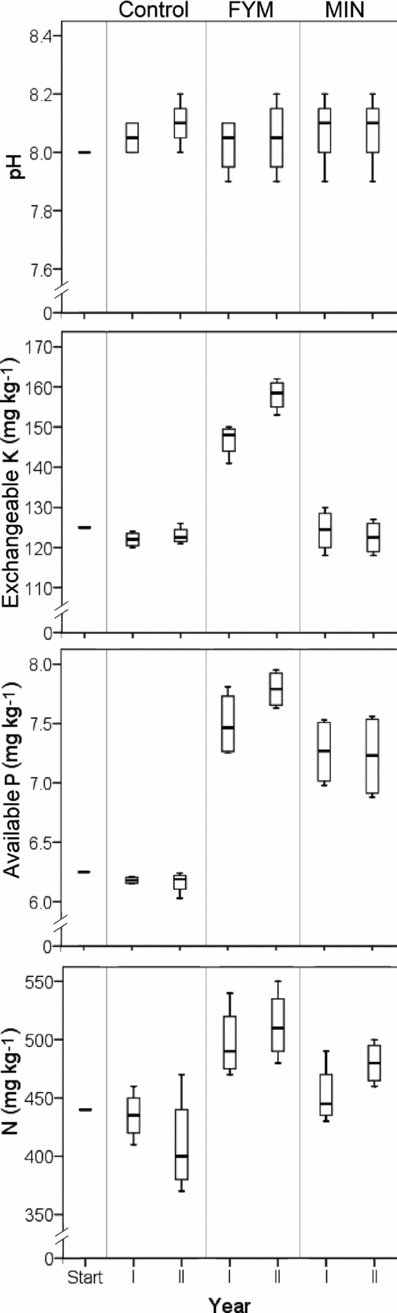
Crops were grown in two consecutive growth periods within one year, i.e. winter (November to April) and summer (May to August). Winter crops (Egyptian clover and oat) were sown on the 24 and 26 November in 2010 and on 22 and 21 November in 2011, respectively, while summer crops (corn and Sudangrass) were sown on the 30 May 2011 and on 23 and 27 May in 2012, respectively. Both FYM and MIN (urea and di-ammonium phosphate) were applied with 107 kg N ha−1 and 60 kg P2O5 ha−1. Whole FYM and P was applied at the time of each sowing, whereas N application was split, half at the time of sowing and half with the second irrigation. Potassium (K) was not applied, as the soil was rich in K prior to the experiment and K did not decline during the two experimental years (Figure 2). The government recommendation for irrigation in the area is at 600–800 mm per season (Critchley and Siegert, Reference Critchley and Siegert1991). Actual total irrigation applied for Egyptian clover, oat, corn and Sudangrass under RI was 840, 729, 689 and 689, respectively. Irrigation water was applied through water channels between the subplots, releasing 70–75 mm per irrigation. A 91.44 cm cutthroat flume meter with an 20.30 cm wide throat was installed at the entry point of the water to measure the amount of irrigation water applied (Siddiqui et al., Reference Siddiqui, Lashari and Skogerboe1996). To accomplish RI, irrigation interval was kept at two weeks in winter and one week in summer. HRI was done by doubling the irrigation interval i.e. doubling the amount of time between the consecutive irrigations.
Development of nutrient status and pH in soil of fertilised (farmyard manure, FYM; mineral fertiliser, MIN) and unfertilised (control) treatments as obtained in a factorial on-station experiment in Faisalabad, Pakistan. Data shown are averages of cropping systems. Vertical bars represent median ± quartile and whiskers show minimum and maximum values.

Soil and plant sampling and analysis
Prior to the start of the experiment and at each harvest, five soil sub-samples were taken at two depths (0–20 cm and 21–40 cm) from each plot using an auger and pooled at each depth to obtain composite samples. Samples were air-dried, ground and stored until analysis. Soil pH was measured with a glass electrode in a 1:2.5 soil/water suspension. Soil N was determined as described by Bremner and Mulvaney (Reference Bremner, Mulvaney and Page1982) and available P was measured according to the procedure of Olsen and Watanabe (Reference Olsen and Watanabe1957). Exchangeable K was measured by flame photometry (Dean, Reference Dean1960).
Egyptian clover was harvested in three cuts, while the other crops were cut only once within a growing period. Final yield data of all crops were recorded in vegetative stages, with Egyptian clover, oat and Sudangrass in the flowering stage and corn in the milk ripeness stage. First cut of Egyptian clover was taken 67 days after sowing (DAS), while subsequent cuts were harvested after 48 days each.
Yield development within each cut was measured by taking samples during growth of crops. Data were recorded four times for each cut of Egyptian clover, whereas for oat, corn and Sudangrass, it was noted five times during growth. Initial sampling took place 27, 46, 21, and 21 DAS for Egyptian clover, oat, corn and Sudangrass, respectively. Subsequent samples were taken every 12, 21, 14 and 14 days for Egyptian clover, oat, corn, and Sudangrass respectively. Samples of aboveground biomass were taken at a stubble height of 2.5 cm from 0.25 m2 quadrats and weighed and dried at 55 °C for 48 h. At the time of each crop sampling, relative chlorophyll concentration of leaves was estimated with a SPAD-502 meter (Spectrum Technologies, Inc., Plainfield, IL, U.S.) by measuring in the middle of 15 randomly selected leaves per plot (Hoel, Reference Hoel1998). Data for all parameters were recorded for two years except SPAD data that was taken only in second year.
Irrigation water use efficiency (IWUE) was calculated by using the formula of Singh et al. (Reference Singh, Aggarwal, Aulakh and Hundal2012):
 \begin{equation*}
{\rm IWUE} = \frac{{Y_i - Y_d }}{{I_i }}
\end{equation*}
Where Yi is the yield at irrigation level i, Yd is the yield at total dry conditions, which was assumed to be zero according to Howell (Reference Howell2001) and Payero et al. (Reference Payero, Tarkalson, Irmak, Davison and Petersen2009), and Ii is the total amount of water applied at irrigation level i including rainfall water.
Statistical analysis
Fertiliser and irrigation were completely randomised as main-plot factors, within which cropping systems were arranged as sub-plots. The experimental treatments were identically located in both years. As the main focus was on the evaluation of annual cropping systems with respect to fertiliser and irrigation, total annual yield as average of two years was used in statistical analysis following Ul-Allah et al., (Reference Ul-Allah, Khan, Fricke, Buerkert and Wachendorf2014). Yield and IWUE data were analysed with the software package MSTAT-C (Russell, Reference Russell1994), considering the split-plot design of the experiment and Tukey's HSD test was used for the comparison of means. Dry matter development and SPAD data taken during growth was analysed with the mixed models procedure in SPSS (George, Reference George2003), considering growth stage as a random factor. Linear regressions were calculated with Sigma plot (Systat Software, Inc., 2008).
RESULTS
Analyses of soil for N, P, K and pH before start of the experiment and after each season indicated a small nutrient decline in the control during the study years (Figure 2).
Dry matter yield
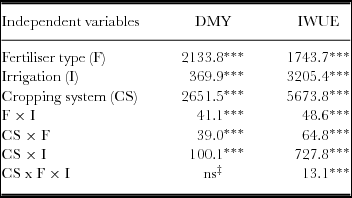
Cropping system (CS) effects were always significant and depended both on fertilisation and irrigation (Table 1, Figure 3). In case of total annual yield, proportion of summer crops was 50.3 and 53.9% in CCS and DACS respectively. Overall DACS produced 14.8% more than CCS and the yield difference was bigger with HRI than with RI (17.8% vs. 11.7%, respectively). Similarly overall performance of both CS was better in RI than HRI but the difference for CCS was bigger (9%) than DACS (2%).
Significance† of the effects of cropping system, fertiliser type and irrigation on dry matter yield (DMY) and irrigation water use efficiency (IWUE) averaged over 2010 and 2011 as obtained in a factorial on-station experiment in Faisalabad, Pakistan.

*Significant at the 0.05 probability level.
**Significant at the 0.01 probability level.
***Significant at the 0.001 probability level.
†F-values.
‡ns, not significant.
Dry matter yield of winter crops (Egyptian clover, E and oats, O) and summer crops (corn, C and Sudan grass, S) and total annual yield of common (CCS) and drought adapted cropping systems (DACS), as affected by fertiliser (control, farmyard manure, FYM; mineral fertiliser, MIN) and amount of irrigation as obtained in a factorial on-station experiment in Faisalabad, Pakistan. Vertical bars represent ± standard error (n = 2 year × 4 replications; see Table 1 for statistical analysis). Means of the total annual yield are compared with Tukey's HSD test for three fertiliser and two irrigation levels.

Fertiliser effects were positive for CS and were significant (p < 0.05), whereas interactions with CS and irrigation, although statistically significant, were of minor magnitude. Tukey's HSD test revealed no significant yield difference between the fertilised treatments, whereas compared to the control, fertilisation increased the yields by 20.9% (average across all crops and irrigation levels). Fertiliser effects on total annual yield were stronger with RI (23.3%) as compared with the control, while with HRI the yield difference was only 18.4%.
Irrigation water use efficiency
Overall CS effects in the present study were generally significant and interacted both with fertilisation and irrigation (Table 1, Figure 4). The effects were identical in direction, but stronger in HRI (0.61 kg DM m−3) than in RI (0.29 kg DM m−3). IWUE of the DACS was 22 and 28% higher than of the CCS in both RI and HRI conditions respectively. Fertiliser effects, although there were significant interactions, were very similar within both cropping systems. IWUE of the fertilised treatments were significantly higher than the control, i.e. 17.9% in the CCS and 22.3% in the DACS but there was no significant difference between the two fertilised treatments (Figure 4). Irrigation effects in our study showed the same tendency in all treatments. The CCS and DACS were 63.7% and 74.4% more efficient in HRI than in RI respectively.
Irrigation water use efficiency (IWUE) of common cropping system (Egyptian clover, E and corn, C and total annual, CCS) and drought adapted cropping system (oats, O and Sudan grass, S and total annual, DACS) as affected by fertiliser (control, farm yard manure, FYM; mineral fertiliser, MIN) and amount of irrigation as obtained in a factorial on-station experiment in Faisalabad, Pakistan. Data are averages observed for the two study years 2010 and 2011 (n = 2 year × 4 replications; see Table 1 for statistical analysis). Means of the cropping system are compared with Tukey's HSD test for three fertiliser and two irrigation levels. Vertical bars represent median ± quartile and whiskers show minimum and maximum values.

SPAD values
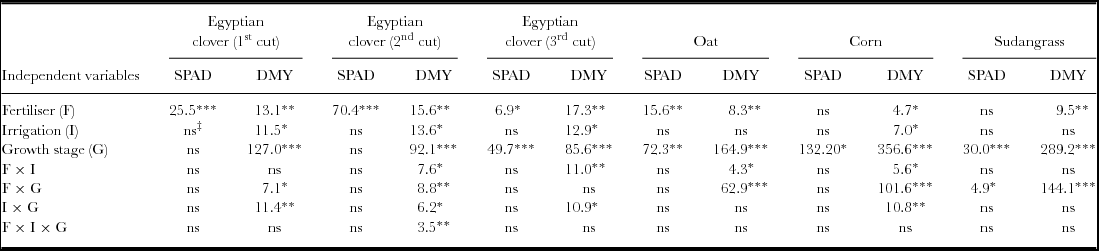
SPAD values during growth of crops ranged between 38 (in leaves of seedlings of Egyptian clover in the 2nd cut, oat and corn) and 59 (for Egyptian clover at harvest of the 3rd cut). The values increased with increasing crop maturity, as indicated by a significant effect of growth stage for almost all crops (Table 2; data not shown). Fertiliser effects were significant (p < 0.05) for winter crops, indicating an increased greenness of leaves (SPAD values) when more N was available. No irrigation effect was found in our study for crops both in winter and in summer. Positive linear relationships were found between SPAD value and DMY for all crops with r2 values (0.63–0.96) (Figure 5), indicating a proportional increase in leaf greenness during growth of the crops. Although the relationship for fertilised oat differed from that for the unfertilised control, differences were minor and contrasts revealed that models did not differ between the fertilised treatments. Contrarily to winter crops, common models could be fitted to corn and Sudangrass data. The lower fit in summer crops was mainly due to the chlorophyll breakdown in mature corn and Sudangrass, which increased the residuals at higher levels of SPAD value. The analysis with a reduced dataset comprising only data from vegetative growth stages increased (r 2 0.95–0.78) for corn and Sudangrass, respectively (data not shown).
Significance† of the effects of fertiliser type, irrigation and growth stage on SPAD value and dry matter yield (DMY) data of different crops as obtained in 2011 in a factorial on-station experiment in Faisalabad, Pakistan.

*Significant at the 0.05 probability level.
**Significant at the 0.01 probability level.
***Significant at the 0.001 probability level.
†F-values.
‡ns, not significant.
Relationship between dry matter yield and SPAD value recorded at successive growth stages of different crops in 2011 in a factorial on-station experiment in Faisalabad, Pakistan (each data point is an average of four replications and for Egyptian clover and oat data points of the fertilised treatment are average values of farm yard manure and mineral fertiliser).

DISCUSSION
In the literature there is a wide variation in irrigation effects reported for the crops investigated in the present study (Lazaridou and Koutroubas, Reference Lazaridou, Koutroubas and Fischer2004; Soler et al., Reference Soler, Hoogenboom, Sentelhas and Duarte2007). Lazaridou and Koutroubas (Reference Lazaridou, Koutroubas and Fischer2004) and Soler et al. (Reference Soler, Hoogenboom, Sentelhas and Duarte2007) reported a 65 and 25% reduction in yield for Egyptian clover and corn, respectively, under water stress imposed by reducing irrigation by 50% in semi-arid conditions while the effect of irrigation was comparatively low in our study. Considering the actual environmental conditions during our study, there were 169 and 45 mm additional precipitation in the summer and in winter seasons, respectively, which may have contributed to lower drought effects in HRI. Relatively low irrigation effects were reported for oat and Sudangrass under water stress ranging from zero to full drought conditions (Bibi et al., Reference Bibi, Sadaqat, Tahir, Usman and Ali2012), which support our findings.
Unlike for legumes in temperate climates, where no yield increases were observed when additionally N fertilised (Frame et al., Reference Frame, Harkess and Hunt1976), Egyptian clover in the present study responded strongly to fertilisation (21.2% on average). This may be due to poor nodule formation at the roots of the establishing legumes in the first and second cut, which was also found by Clark (Reference Clark2007) for Egyptian clover. But this increase in the yield partly may also be due to ‘P’ in the fertiliser. Stronger response of RI compared to HRI to the fertiliser treatment in our study is supported by the other findings with corn and sorghum under comparable climatic conditions (Mubarak et al., Reference Mubarak, Ragab, Ali and Hamed2009). Some researchers reported higher yields of sorghum and mott grass (Pennisetum purpureum S.) with the use of mineral fertiliser than with organic fertiliser (Ahmad et al., Reference Ahmad, Qadir and Naeem2007). However, the reason for that may partly be that the amount of available nutrients in the mineral fertiliser treatment were much higher than in the organically fertilised treatment.
The IWUE further highlights the effectiveness with which crops are able to make use of this essential resource. Positive effect of fertiliser on water use efficiency (84% average across all treatments) of pearl millet (Pennisetum glaucum L.) was also reported by Sivakumar and Salaam (Reference Sivakumar and Salaam1999) which support our findings. The irrigation effects found in our study are supported by findings of Payero et al. (Reference Payero, Tarkalson, Irmak, Davison and Petersen2009) who worked on corn under different climatic conditions, using irrigation levels from 60% to 100% of the recommended. Their results indicate that water limitation on growth does not necessarily increase even if it is reduced to 40%. Singh et al. (Reference Singh, Aggarwal, Aulakh and Hundal2012) reported that applying less water than recommended at a proper time can be a way to enhance the IWUE. Since optimal timing for irrigation varies depending on the distribution of rainfall and other environmental conditions, it should be adjusted according to local conditions.
Regarding the nutritive value, DACS has been reported more productive with respect to metaboliseable energy than CCS, whereas CCS was more productive with respect to crude protein. But crude protein of DACS was also in acceptable range (Ul-Allah et al., Reference Ul-Allah, Khan, Fricke, Buerkert and Wachendorf2014), which makes it more suitable for areas with limited availability of water and fertiliser.
Chlorophyll contents estimated by SPAD meter give a good idea of crop growth. In our study SPAD values increased with the vegetative growth but with the onset of reproductive stage, the values decline for corn and Sudangrass although crop yield still increased. This was also found by Sanger (Reference Sanger1971), Bokari (Reference Bokari1983) and Costa et al. (Reference Costa, Dwyer, Dutilleul, Stewart, Ma and Smith2001), who reported that in mature plants fibrous components were accumulating while chlorophyll-proteins were breaking down. Nitrogen has a close relationship with chlorophyll contents and ultimately with photosynthesis and dry matter accumulation (Abbasi et al., Reference Abbasi, Khaliq, Shafiq, Kazmi and Ali2010 and Rorie et al. Reference Rorie, Purcell, Mozaffari, Karcher, King, Marsh and Longer2011). Effect of the nitrogen was non-significant on SPAD values for summer crop which might be due to Interactions of climate with SPAD values and fertiliser treatment and correlations between temperature and chlorophyll contents (Bredemeier and Schmidhalter, Reference Bredemeier and Schmidhalter2003; Talebi, Reference Talebi2011). We found no irrigation effect on SPAD values but there is some evidence of positive effects of irrigation on SPAD value in the literature (Bredemeier and Schmidhalter, Reference Bredemeier and Schmidhalter2003; Széles et al., Reference Széles, Megyes and Nagy2012). However, much more severe water stress of up to 80% was applied in these studies, whereas in our study water stress in HRI was still moderate.
Relationship between DMY and SPAD value can be a helpful tool in determining the standing crop biomass. However, for Egyptian clover, different relationships were found for each cut, which limits the applicability of the technique. It seems that insufficient information is provided with the two wavelengths used (650 and 940 nm) in the SPAD meter. Investigations on a multitude of temperate legumes showed that, by including more wavelengths or by hyper-spectral measurements crop-specific or even common models were found which allowed an accurate prediction of biomass and quality characteristics across several cuts within one year (Biewer et al., Reference Biewer, Fricke and Wachendorf2009). Positive relationships between yield and chlorophyll contents were also reported by other researchers who worked on different warm season grasses (Bokari, Reference Bokari1983) and pearl millet (Gérard and Buerkert, Reference Gérard and Buerkert2001), which supports our findings. However, low correlations were found by Costa et al. (Reference Costa, Dwyer, Dutilleul, Stewart, Ma and Smith2001) between grain yield and SPAD readings for corn, and the authors concluded that ‘maize researchers using SPAD should use caution when transferring published relationships to other hybrids.’ Thus, based on our results there appears some scope that for vegetative forage crops, DMY can be predicted fairly accurately with a commercial SPAD meter.
CONCLUSIONS
Results of our experiment suggest that in the semi-arid climate of Pakistan, water use efficiency of forage production can be improved by reducing the amount of irrigation water to an appropriate level. With only 721 mm of irrigation water, a cropping system with oat and Sudangrass proved to be more productive than the common cropping system with a generally recommended irrigation of 1530 mm. Fertilisation increased production and water use efficiency irrespective of the cropping system. Thus, Pakistan's agriculture could be more profitable with use of animal manures, as their effect on crop productivity is similar to mineral fertiliser but available at much lower costs. The use of chlorophyll meters may facilitate a quick and reliable assessment of crop yield, contributing to a sufficient and constant daily feedstock supply, but more information is needed regarding calibrations for further crop species under varying environmental conditions. As Pakistan and other countries in this climate zone are facing an increasing water scarcity, additional work targeted on developing strategies for water efficient cropping systems can master the challenges of feeding a growing population.
Acknowledgements
We are grateful to the University of Agriculture Faisalabad, Pakistan for providing experimental facilities and to the German Academic Exchange Service (DAAD) for a providing scholarship to the first author under the International Center for Development and Decent Work (ICDD) at University of Kassel, Germany.