Introduction
Chronic rhinosinusitis is one of the most common chronic diseases in North America.Reference Lethbridge-Cejku, Schiller and Bernadel1 Approximately 13.5 per cent of Canadian adults are affected by this condition.Reference Durr, Desrosiers and Dassa2 The pathophysiology and mechanism of chronic rhinosinusitis remain elusive. Multiple aetiological factors contribute to the heterogeneity and complexity of the disease. However, the common denominator is sinonasal mucosal inflammation.Reference Benninger, Ferguson, Hadley, Hamilos, Jacobs and Kennedy3
The incidence of asthma in chronic rhinosinusitis patients is estimated to be 20 per cent. However, this number increases to 50 per cent in patients that have chronic rhinosinusitis with nasal polyposis.Reference Senior, Kennedy, Tanabodee, Kroger, Hassab and Lanza4 The link between asthma and chronic rhinosinusitis has long been studied. This relationship has been defined in terms of one disease which affects both upper and lower airways, giving rise to the so-called unified airway concept.Reference Krouse5 Both disease entities are characterised by similar histopathological changes,Reference Gaga, Lambrou, Papageorgiou, Koulouris, Kosmas and Fragakis6 the same primary effector cell (the eosinophil) and common inflammatory mediators.Reference Braunstahl, Kleinjan, Overbeek, Prins, Hoogsteden and Fokkens7 In addition, the presence of both diseases results in more severe pathophysiological changes than either alone.Reference Passalacqua, Ciprandi and Canonica8 Another fact that supports the unified airway concept is that treatment of chronic rhinosinusitis decreases the severity of asthma.Reference Batra, Kern, Tripathi, Conley, Ditto and Haines9–Reference Ragab, Scadding, Lund and Saleh11
Treatment of chronic rhinosinusitis in the asthmatic patient is similar to that of other subgroups of chronic rhinosinusitis. It begins with medical therapy in the form of topical and/or systemic corticosteroids and/or antibiotics. If medical therapy fails, functional endoscopic sinus surgery (FESS) is indicated. Chronic rhinosinusitis tends to be more severe in asthmatic than non-asthmatic patients.Reference Bresciani, Paradis, Des Roches, Vernhet, Vachier and Godard12, Reference Pearlman, Chandra, Chang, Conley, Tripathi-Peters and Grammer13 However, FESS has been shown to reduce the severity of asthma symptoms and the number of hospital admissions for asthma.Reference Batra, Kern, Tripathi, Conley, Ditto and Haines9–Reference Ragab, Scadding, Lund and Saleh11 In this study, we present the outcomes and cost benefits of FESS for chronic rhinosinusitis patients with severe asthma.
Materials and methods
Study design
This paper describes a prospective, non-randomised, longitudinal study, with a retrospective review of chart data, conducted in a tertiary care rhinology centre. All patients were treated by the senior author (MS).
Patient selection
The study comprised consecutive asthmatic patients referred by an asthma clinic specialising in severe, difficult-to-treat asthma, who were diagnosed with chronic rhinosinusitis according to the criteria set forth by the Sinus Allergy and Health Partnership Task Force in 2003.Reference Benninger, Ferguson, Hadley, Hamilos, Jacobs and Kennedy3 Medical therapy had failed in these patients, and FESS was indicated for the management and control of chronic rhinosinusitis and asthma. Medical therapy in our centre consisted of oral prednisone for 14 to 21 days, oral broad-spectrum antibiotics for 14 days and topical corticosteroid therapy twice daily for a minimum of 2 months. Patients were re-evaluated at a follow-up visit two to three months following medical therapy. Medical therapy failure was defined as no subjective symptomatic improvement, or as worsening symptoms, in the absence of an objective improvement on endoscopic evaluation. A surgical option (FESS) was offered to affected patients.
Outcome measures
A general health quality of life (QoL) survey and a disease-specific QoL survey were used as the clinical outcome tools.
The Short Form 12 (standard version) health survey (QualityMetric, Lincoln, Rhode Island, USA), which is derived from the widely used Short Form 36 QoL outcome measurement tool, was used to evaluate general health outcomes.Reference Ware, Kosinski, Turner-Bowker and Gandek14 It assesses the same eight domains of general health status found in the Short Form 36 survey (i.e. vitality, physical functioning, bodily pain, general health perceptions, physical role functioning, emotional role functioning, social role functioning and mental health).
The disease-specific QoL tool used was the Chronic Sinusitis Survey, also known as the Nasal Health Survey.Reference Gliklich and Metson15 It is a six-item, duration-based questionnaire, which specifically targets nasal and sinus symptoms. It is divided into two sections. The first section contains three symptom-based questions while the second consists of three medication-based questions (Table I).
Chronic sinusitis surveyReference Gliklich and Metson15

Patients completed these questionnaires at a pre-operative visit and post-operatively after a minimum follow-up period of three months. The Short Form 12 survey data were scored using an online scoring system (QualityMetric) and standardised to normative data. The Chronic Sinusitis Survey data were scored by converting the data to percentages.Reference Gliklich and Metson15, Reference Gliklich and Metson16
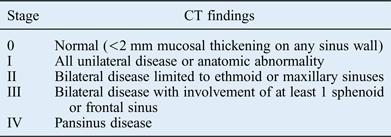
All patients underwent pre-operative computed tomography (CT) of the sinuses and were staged using the Harvard CT staging system (Table II).Reference Metson and Gliklich17 Pre-operative endoscopic findings were recorded, as was the presence of other co-morbidities and smoking habits.
Harvard CT staging system for chronic rhinosinusitis
CT = computed tomography
Cost estimation
Costs attributable to FESS were tabulated from hospital figures. The cost of the initial evaluation included the consultation fee, the CT scan and any other tests. Pre-operative clinic costs were provided by the hospital. Operative costs included the surgical and anaesthesia fees, and operating theatre fees, which incorporated sterilisation, disposable and reusable material, and support and nursing staff costs. Post-operative care costs included those associated with clinic visits and debridement. In addition, costs for regular, comprehensive asthma clinic visits were estimated. The number of out-patient visits to such a clinic was recorded for the 12 months preceding surgery and 12 months post-operatively.
Statistical analysis
The pre- and post-operative data for both QoL surveys (Chronic Sinusitis Survey and Short Form 12) were compared using SAS version 9.1 software (SAS Institute, Cary, North Carolina, USA), employing confidence intervals (CIs) with 95 per cent confidence levels.
Results
Demographics
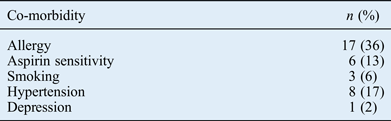
A total of 47 asthmatic patients with chronic rhinosinusitis who underwent FESS over a 7-month period were enrolled in the study. There were 20 males (42.6 per cent) and 27 females (57.4 per cent), with a mean age of 48 years (range, 20–86 years). The most common co-morbid condition was environmental allergy, in 36 per cent of patients. Samter's triad (asthma, aspirin sensitivity and nasal polyps) was present in 13 per cent of patients. Other co-morbid conditions included hypertension (17 per cent), smoking (6 per cent) and depression (2 per cent) (Table III).
Patient co-morbidity data*
* For those with asthma and chronic rhinosinusitis who underwent functional endoscopic sinus surgery.
With regard to CT scan staging (as per the Harvard CT staging system (Table II)), no patients were stage 0, 11 per cent were stage I, 23 per cent were stage II, 34 per cent were stage III and 32 per cent were stage IV. Pre-operative endoscopic examination revealed nasal polyps in 53 per cent of patients.
The mean follow-up period was 7 months (range, 3–21 months).
Quality of life surveys
Chronic Sinusitis Survey
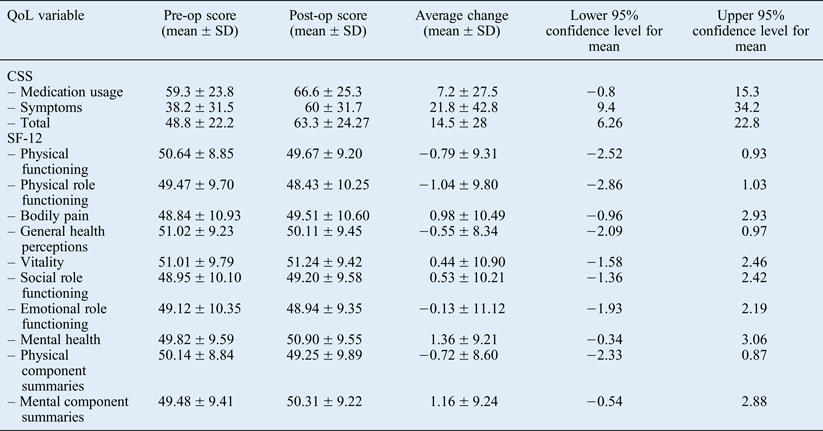
There was a significant improvement in Chronic Sinusitis Survey scores following FESS (Table IV and Figure 1). The average score increases were as follows: 7.2 points for the medication usage score (CI = −0.8–15.3), 21.8 points for the symptoms score (CI = 9.4–34.2) and 14.5 points for the total Chronic Sinusitis Survey score (CI = 6.26–22.8).
Pre-operative (pre-op) and post-operative (post-op) Chronic Sinusitis Survey (CSS) mean scores.
Chronic sinusitis survey and short form 12 results
QoL = quality of life; pre-op = pre-operative; SD = standard deviation; post-op = post-operative; CSS = Chronic Sinusitis Survey; SF-12 = Short Form 12
An improvement of eight points or greater was used as a cut-off to indicate clinical improvement, as originally described by Gliklich and Metson.Reference Gliklich and Metson16 An eight-point change in the Chronic Sinusitis Survey score requires improvements in symptom duration or medication usage over four out of eight weeks, or a 50 per cent change. Using this 8-point cut-off, the Chronic Sinusitis Survey results indicated that 60 per cent of chronic rhinosinusitis patients with asthma who underwent FESS improved, 21 per cent worsened and 19 per cent remained unchanged over 3 to 21 months (mean of 7 months) following FESS.
A comparison between patients according to the season they were operated on did not yield any differences in terms of outcome.
Short Form 12
Pre- and post-FESS comparisons of the Short Form 12 subscale scores, and the 12 physical and 12 mental component summaries, demonstrated no statistically significant improvement in any of the subscales (Table IV and Figure 2). A statistically significant improvement in the Short Form 12 was defined as a difference of 6.6 points for the physical component summaries and 7.5 points for the mental component summaries at a 95 per cent confidence level.
Pre-operative (pre-op) and post-operative (post-op) Short Form 12 (SF-12) survey mean scores. PF = physical functioning; RP = physical role functioning; BP = bodily pain; GH = general health perceptions; VT = vitality; SF = social role functioning; RE = emotional role functioning; MH = mental health
Cost benefits
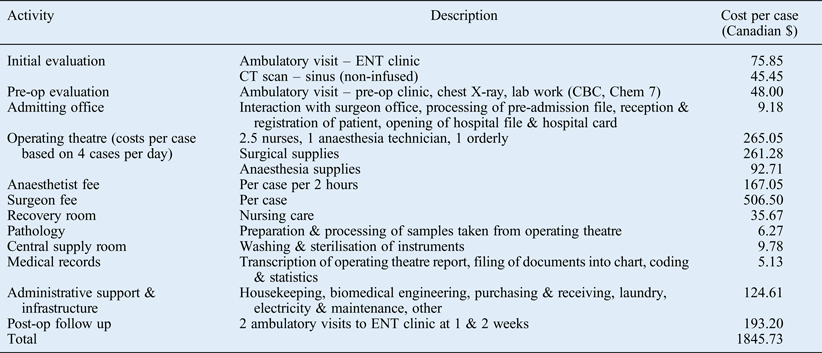
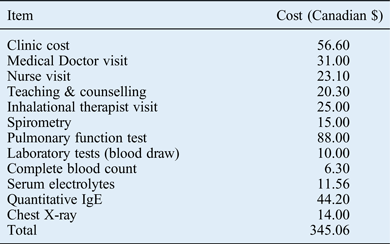
The total cost for the initial evaluation, pre-operative assessment, operative costs, post-operative care and follow up was calculated at $1846 Canadian dollars (Table V). The cost of a comprehensive asthma clinic visit was $345 Canadian dollars. This included the services of the physician, registered nurse and inhalation therapist. The costs of pulmonary function testing, laboratory blood tests and chest X-rays were also calculated (Table VI).
Estimated cost of endoscopic sinus surgery
CT = computed tomography; pre-op = pre-operative; lab = laboratory; CBC = complete blood count; Chem 7 = basic metabolic panel; post-op = post-operative
Estimated cost of out-patient visit to a comprehensive asthma clinic
IgE = immunoglobulin E
The average number of visits to the comprehensive asthma clinic in the 12 months prior to surgery was 6 (range, 1–8). For the 12 months following surgery, this number decreased to 3 (range, 1–9). Thus, there was an average reduction of 3 (50 per cent) visits per year (range, 0–8). The reduction in asthma clinic visits following surgery resulted in an average cost saving of $1035 (3 × $345) Canadian dollars per year.
Discussion
The association between asthma and chronic rhinosinusitis is well recognised. Epidemiological, clinical and immunohistological studies demonstrate an important link between the two disease entities.Reference Fasano18 Rhinosinusitis and asthma are believed to be inflammatory processes in which eosinophils and the airway epithelium play a central role. Specifically, eosinophils are thought to damage the epithelium by releasing cytokines and other proinflammatory proteins. The damaged epithelium reacts by releasing cytokines and chemokines that further attract eosinophils, thus creating a cycle of actions and reactions that activates and sustains inflammation.Reference Baroody, Hughes, McDowell, Hruban, Zinreich and Naclerio19
Using objective and subjective sinonasal and asthma outcome measures, studies have demonstrated significant clinical improvement following FESS.Reference Batra, Kern, Tripathi, Conley, Ditto and Haines9, Reference Awad, Fasano, Lee and Graham20–Reference Uri, Cohen-Kerem, Barzilai, Greenberg, Doweck and Weiler-Ravell24 In patients with asthma and nasal polyps, FESS was shown to improve asthma severity scores, reduce the need of inhaled corticosteroids and reduce the frequency of asthma-related emergency room visits.Reference Awad, Fasano, Lee and Graham20 In a retrospective study of 17 patients with asthma and chronic rhinosinusitis who underwent FESS, Batra et al. demonstrated that FESS improved the post-operative forced expiratory volume in 1 second (‘FEV1’) value and decreased the requirement for systemic steroids.Reference Batra, Kern, Tripathi, Conley, Ditto and Haines9
The current study consisted of patients referred from a clinic that specialises in treating patients with severe, difficult-to-treat asthma. All available costs related to patients' hospital costs were included. However, the figures obtained were underestimates, as additional costs that contribute to the economic impact of asthma were not calculated. These include emergency room visits, phone call consultations, prescriptions and over-the-counter medications, and absenteeism or loss of productivity.
All patients had two post-operative follow-up visits at one and two weeks. Thorough endoscopic debridement was carried out during these visits, and patients were placed on topical corticosteroid therapy after the first visit (one week post-operatively). Systemic corticosteroids were not routinely prescribed, unless it was part of tapering following a peri-operative supplemental (‘stress’) dose. Peri-operative systemic steroids, including a post-operative 7–10 day tapered dose, were administered to patients who had received 3 or more doses of systemic steroids in the 12 months preceding surgery, or to those who were taking oral steroids for their asthma at the time of surgery.
Functional endoscopic sinus surgery resulted in a 50 per cent reduction in out-patient clinic visits, which translates to an average cost saving of $1035 Canadian dollars per year per patient. Laurier et al. estimated the average cost per hospitalisation for asthma in Quebec in 1995 to be around $1676 Canadian dollars.Reference Laurier, Kennedy, Malo, Par, Labb and Archambault25 Ragab et al. showed that FESS reduced the number of hospitalisations for asthma from 7 admissions in the pre-operative 12 months to 2 admissions post-operatively.Reference Ragab, Scadding, Lund and Saleh11 Using these figures, we estimate that FESS (costing $1846 Canadian dollars per year per patient) could save $8380 ($1676 × 5) Canadian dollars per year.
Quality of life was assessed using a disease-specific questionnaire and a general health survey. The Chronic Sinusitis Survey has established statistical reliability and validity.Reference Gliklich and Metson15 In addition, it is very sensitive to clinical changes over time, with no significant difference in post-operative scores compared at 3, 6 and 12 months.Reference Gliklich and Hilinski26 The significant improvement in the Chronic Sinusitis Survey scores found in the current study is consistent with previously published results for chronic sinusitis patients.Reference Gliklich and Metson15
• Chronic rhinosinusitis and asthma are considered as one disease affecting both upper and lower airways: the unified airway concept
• Chronic rhinosinusitis treatment decreases asthma severity
• Chronic rhinosinusitis is often more severe in asthmatics than non-asthmatics
• Functional endoscopic sinus surgery can reduce asthma severity and number of hospital admissions for asthma
• This treatment results in a 50 per cent reduction in out-patient clinic visits
• It is a cost-efficient treatment modality for asthmatic patients with chronic rhinosinusitis
The Short Form 12 survey is a derivative of the Short Form 36, which sets the standard in general health QoL assessment. The Short Form 12 was selected because it is shorter and therefore less laborious for patients to complete. In addition, the reliability and consistency of Short Form 12 scores (compared to the Short Form 36) have been established.Reference Bessette, Sangha, Kuntz, Keller, Lew and Fossel27, Reference Gandek, Ware, Aaronson, Apolone, Bjorner and Brazier28 However, the brevity and ease of use of the Short Form 12 are offset by a decrease in precision compared to the Short Form 36. A larger sample size is necessary to achieve the same degree of statistical significance.Reference Ware, Kosinski, Turner-Bowker and Gandek14 In the current study, the change in results were not statistically significant for any of the subscales, or for the physical and mental component summaries. Previous studies using the Short Form 36 questionnaire showed a modest but statistically significant improvement in scores.Reference Gliklich and Metson15 Detection of a modest improvement may not have been possible in the current study because of the loss in precision associated with the use of the Short Form 12 compared with the Short Form 36 questionnaire.
The severity of patients' asthma may have affected the results of this study. These patients may not derive the same general health benefits following the surgical treatment of sinus disease as those with less severe asthma.
Conclusion
Functional endoscopic sinus surgery for chronic rhinosinusitis in patients with severe asthma has a positive impact on asthma. As well as improving sinonasal symptoms, FESS helps optimise the management of bronchial asthma, resulting in reduced healthcare utilisation by these patients. Functional endoscopic sinus surgery is a cost-effective treatment modality for asthmatic patients with chronic rhinosinusitis. This information is important for: the distribution and planning of resources, prioritising health programmes, and establishing practice guidelines.