Introduction
While consanguineous marriage is strongly favoured in many human populations (www.consang.net), historical data suggest a longstanding suspicion of consanguineous unions in most European populations (Bittles, Reference Bittles2003). In the Roman Catholic Church third cousin marriages and closer, equivalent to a coefficient of inbreeding (F≥0.0039), were subject to dispensation requirements from late 6th century AD, and during the 11th to the 13th centuries marriages as biologically distant as sixth cousins (F=0.00006) were included within these dispensation regulations (Bittles, Reference Bittles2009). The restrictions on first, second and third cousin unions were confirmed by the 4th Lateran Council in 1215 AD, although couples within these prohibited consanguinity categories could apply for a fee-based Diocesan dispensation to allow their marriage to be solemnized in Church (Goody, Reference Goody1983). While Church dispensation remains a requirement for first cousin marriages or closer (F≥0.0625), the regulations governing third and second cousin unions were sequentially removed in the early 20th century (Cavalli-Sforza et al., Reference Cavalli-Sforza, Moroni and Zei2004).
The various Protestant denominations generally permitted first cousin marriages, citing the Mosaic regulations specified in Leviticus 18, 12–18, but the Lutheran State Church of Sweden was an important exception with first cousin unions proscribed until 1680 (Bittles & Egerbladh, Reference Bittles and Egerbladh2005). Thereafter a dispensation to permit first cousin marriage could be granted by the King in Council, but this was expensive as it involved the payment of fees both to the Crown and to the Commissioners who acted as intermediaries in the dispensation application. The requirement for royal dispensation lasted until 1844, when the Riksdag formally revoked the regulation leaving first cousins free to marry should they wish (Egerbladh & Bittles, Reference Egerbladh, Bittles, Mineau and Bengtsson2008).
Detailed investigations in the rural Skellefteå region, located on the Gulf of Bothnia in north-east Sweden, conducted over the period 1720–1899 revealed an increase in first cousin marriages from 0.2% to 2.9% after removal of the dispensation requirement for such unions (Bittles & Egerbladh, Reference Bittles and Egerbladh2005). There also was a significant increase in the overall proportion of marriages among more distant kin-linked spouses, with approximately every fifth marriage contracted between couples related as sixth cousins or closer.
The pattern of development of marriages among biological kin in the Skellefteå region was quite typical of Sweden as a whole, with a countrywide increase in the prevalence of first cousin marriages from 0.2% in 1750 to 1.5% in the mid-19th century (Alström, Reference Alström1958). This trend was already apparent prior to the legislative reform in 1844, as evidenced by the increasing numbers of applications for first cousin marriage dispensations from approximately 30 per year during the mid-18th century to over 200 by the 1820s (Gaunt, Reference Gaunt1983; Göransson, Reference Göransson1990). A distinct north–south cline existed with respect to consanguinity, with the highest rates of cousin marriage in the most sparsely populated inland northern regions abutting Finland, which are home to many of the Swedish Sami (Lapp) community (Alström, Reference Alström1958). The north–south cline of first cousin marriage persisted during the first half of the 20th century (Fraccaro, Reference Fraccaro1958), with an upper prevalence of 6.8% first cousin unions in a remote northern parish (Böök, Reference Böök1948), compared with 1.7% and 1.3% in the southern and western rural regions of the country (Böök & Måwe, Reference Böök and Måwe1955; Larson, Reference Larson1956).
Specific structural factors contributed to the cline of consanguineous marriages in Sweden and to their temporal growth during the 19th century. As in Italy (Cavalli-Sforza et al., Reference Cavalli-Sforza, Moroni and Zei2004), consanguineous marriage was promoted by restricted accessibility to potential spouses, and typically occurred in small, isolated communities with low population density, high residential stability, and restricted population transfer with other areas. Changes in the availability of relatives caused by the demographic transition in Western societies also exerted a positive impact, with an increase in consanguineous marriage during the phase of strong population growth that accompanied decreasing mortality and continued high fertility in Sweden during the latter half of the 19th century. Conversely, a decline in consanguineous marriage was observed with decreasing fertility in the last phase of the demographic transition, characterized by improved communication possibilities and the changes in social attitudes that accompanied the modernization process (Cavalli-Sforza et al., Reference Cavalli-Sforza, Moroni and Zei2004).
The aim of the present investigation was to investigate consanguineous marriage, and in particular first cousin marriages, in the Skellefteå region of northern coastal Sweden during the 19th century to determine whether they were: (i) part of a conscious marriage strategy steered by family interests, or (ii) predominantly represented individual responses to changing public attitudes towards consanguineous marriage, facilitated by the removal of dispensation costs in 1829 and subsequent cancellation of the royal dispensation requirement in 1844.
Socioeconomic and legal backgrounds to the study
Socioeconomic influences on consanguinity
The most common explanations for consanguineous marriages in non-Western societies are: a family tradition including the strengthening of family ties, the maintenance of family structure and property, financial advantages relating to dowry or bride wealth payments, ease of marital arrangements, and greater marriage stability (Bittles, Reference Bittles1994, Reference Bittles2008; Hussain, Reference Hussain1999). In Roman Catholic regions and communities, dispensation for consanguineous unions could be granted with respect to the particular personal circumstances of individuals and couples, for instance, economic hardship or physical problems, pregnancy and older age. Illegitimacy or being an orphan also were accepted by the Roman Catholic Church as causes for consanguinity dispensation (Cavalli-Sforza et al., Reference Cavalli-Sforza, Moroni and Zei2004).
Apart from limited accessibility of spouses, in Sweden economic motives for consanguineous marriage were dominant, at least before the repeal of prohibitory legislation on first cousin marriages in the mid-19th century. Due to the costs involved in applying for consanguinity dispensation, first cousin marriages were principally, although not exclusively, contracted among the nobility and farmers (Alström, Reference Alström1958; Gaunt, Reference Gaunt1983), with marriage to a relative seen as an important strategy in preserving or increasing economic resources. Thus in Blekinge in southern Sweden in late 18th century, both consanguineous marriages and exchange marriages between groups of siblings were utilized to exclude landless families from becoming land-owners (Gaunt, Reference Gaunt1983). Likewise, in Dalecarlia in mid-western Sweden, where in contrast to other parts of the country there was a longstanding tradition of partible land inheritance among all offspring, consanguineous unions were used to consolidate land resources (Sporrong & Wennersten, Reference Sporrong and Wennersten1995; Wennersten, Reference Wennersten2002). Elsewhere in mid-Sweden, sibling exchange marriages rather than consanguineous unions were favoured by land-owners (Axell-Bonow, Reference Axell-Bonow2005).
By comparison, among burghers, i.e. well-to-do non-agrarian families, the strategy of marrying relatives was principally motivated by access to capital, credit and business networks. With the introduction of Limited Liability Corporation legislation in 1848 this strategy was no longer required, resulting in a subsequent decrease in cousin marriages among the offspring of factory-owners and merchants (Göransson, Reference Göransson1990).
Legal influences on consanguinity
The increased prevalence of consanguineous marriage during the 19th century may also have reflected changes in public attitudes towards such unions. According to Protocols from Discussions in the Swedish Riksdag (Parliament) from 1809, several unsuccessful attempts had been made to remove the requirement for royal first cousin marriage dispensation, with various reasons for a legal change presented (Protocols of the Swedish Riksdag 1809–1810, 1828–1829, 1840–4, Reference Lindstedt1844–45). The changes were mainly proposed by members of the Estates of Peasantry and Burghers on the grounds that first cousin marriages could neither be regarded as sinful nor truly forbidden, given the existence of the royal dispensation mechanism, and the fact that almost all applications were successful. Yet contrary opinions existed, especially among members of the Estates of Clergy and Nobility and, for example, opponents of dispensation reform alleged that consanguineous marriages among members of the Swedish nobility had resulted in increased rates of deaf-mutism and ‘unskilfulness’.
Although the financial costs of dispensation were removed in 1829 and the application procedure simplified, the government refused to sanction a general change in consanguinity legislation until 1844. This despite earlier exceptions to the requirement for dispensations granted to two smaller sub-populations: the Swedish Caribbean colony of St Barthélemy in 1799 and the Swedish Sami (Lapp) population in 1805 (Almquist, 1953).
Arguments against the removal of dispensation for first cousin marriage were basically moral in character, with a formal application routine perceived as helping to preserve moral standards among younger first cousin couples. By 1844 the main reasons advanced for allowing first cousin marriages without dispensation were that marrying a first cousin was no longer regarded as deviant behaviour by the general public, and since dispensation applications had effectively become a formality the administrative work entailed would be better directed to other duties. A political motive also had been introduced into the debate in the early 1840s, expressed as a desire for independent decision-making and the self-management of private property and personal/family affairs, rather than such matters continuing to be subject to regulation by a public authority.
The overall change in attitudes towards first cousin marriages can also be seen in the context of a more general attitudinal shift within Swedish society. Before the end of the 18th century both church and civil laws reflected strongly negative views towards extra-marital sexuality, adultery and fornication, with the death penalty for adultery only repealed in 1779. Formal and informal control exercised by both sets of authorities made it difficult to escape punishment if the relationship resulted in pregnancy. But these older, intolerant views on sexual matters in Sweden were undermined by a succession of reforms from the mid-18th to mid-19th centuries, which in turn gradually influenced popular attitudes towards sexuality (Lindstedt Cronberg, Reference Lindstedt1997).
Subjects and Methods
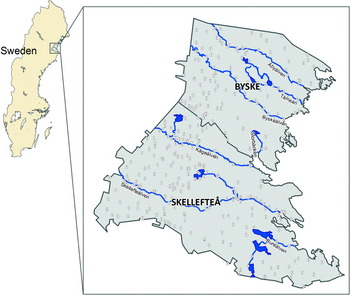
Data on a total of 10,980 first cousin (F=0.0625), second cousin (F=0.0156), third cousin (F=0.0039) and non-consanguineous marriages (F=0) contracted from 1780 to 1899 between spouses born in the Skellefteå region were collated for analysis (Egerbladh & Bittles, Reference Egerbladh, Bittles, Mineau and Bengtsson2008), with complete demographic and social data available on 9743 of these unions. The investigation was based on information abstracted from six complementary sources: (i) the catechetical registers for the parishes within the Skellefteå region (Fig. 1) digitized by the Demographic Data Base (http://www.ddb.umu.se/ddb-english/); (ii) examination registers for 1720–1899, which were similar to censuses but with current recording for time periods; (iii) birth registers 1699–1899; (iv) death registers 1815–1901; (v) marriage registers 1891–1895; and (vi) migration registers 1831–1895. Individual records were linked into biographies, with individuals linked to biological relatives, to parents, spouses and children, and to non-biological relatives. As more distant kin links were generated from the basic links derived, some underestimation of family relationships for the population resident in the region in the early 18th century was inevitable.
Map of the Skellefteå study area.

Individuals were studied throughout their period of residence in the Skellefteå region, which truncated the period of observation of people who married towards the end of the 19th century. The population was quite stable in that in- and out-migration were both negligible (Bittles & Egerbladh, Reference Bittles and Egerbladh2005). The notable population growth between 1749 and 1900 from approximately 3650 to 26,500 inhabitants was mainly caused by high marital fertility, low illegitimacy and low mortality. However, causal adverse impacts on both mortality and fertility occurred at the turn of the 18th and 19th centuries due to wars, and in the late 1860s from crop failures following repeated years of cold summers (Alm-Stenflo, Reference Alm-Stenflo1994; Bittles & Egerbladh, Reference Bittles and Egerbladh2005; Egerbladh & Bittles, Reference Egerbladh, Bittles, Mineau and Bengtsson2008).
Individual attributes previously identified as important were investigated, i.e. socioeconomic conditions as indicated mainly by occupation and family size, and demographic factors such as age, parity and spatial mobility (Bittles & Egerbladh, Reference Bittles and Egerbladh2005; Egerbladh & Bittles, Reference Egerbladh, Bittles, Mineau and Bengtsson2008). Family interests and traditions in marriage strategies were then investigated, focusing on consanguineous marriages among parents and their children, remarriages, uninterrupted consanguinity across three generation of ancestors, and sibling exchange marriages. Binary logistic regressions were applied to uncover differences between males in consanguineous versus non-consanguineous marriages, and in different types of consanguineous union. In addition, the geographical distribution of consanguineous marriages was analysed to detect possible spatial clusters, indicative of a cultural impact that otherwise would have been difficult to measure.
Results
There was a major increase in the combined numbers of marriages contracted throughout the study period, from 979 in 1780–1799 to 3826 in 1880–1899. The percentages of consanguineous marriage also increased significantly, from 2.3% first, second and third cousin marriages in 1780–1799 to 8.8% in 1880–1899, and for first cousin marriages alone from 0.5% to 2.9% (Egerbladh & Bittles, Reference Egerbladh, Bittles, Mineau and Bengtsson2008).
Socioeconomic factors
The high age at marriage and the pre-industrial character of the area during the study period indicated that inheritance and family economic arrangements could have been important factors for marital unions in general (Hajnal, Reference Hajnal, Glass and Eversley1965; Mosk, Reference Mosk1983), and for consanguineous marriages in particular. An economic perspective on marriage was quite common in the Skellefteå region and, for example, it was believed that a future farmer should not marry beyond his social status, which according to a local historian contributed to a higher occurrence of consanguineous marriages in some villages (Westerlund, Reference Westerlund1973). However, it seems that the marriage market for a farmer to marry a farmer's daughter was quite good, since the research area was dominated by freeholders with relatively small family farms. Even by 1900, 81.5% of the population belonged to the agrarian sector with almost two-thirds of farmers' sons married to farmers' daughters in the 18th century, reducing to approximately 45% in the 19th century (Brändström, Reference Brändström2001).
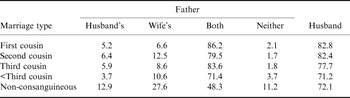
As in other parts of Sweden (Gaunt, Reference Gaunt1983; Sporrong & Wennersten, Reference Sporrong and Wennersten1995; Wennersten, Reference Wennersten2002), consanguineous unions in this predominantly rural population were favoured by farming families. The fathers of both spouses were farmers in 86.2% of first cousin marriages, as opposed to 48.3% of non-consanguineous unions (Table 1). This implied preference for first cousin unions among freehold and tenant farmers also was apparent from the data on husband's occupation, with 82.8% of first cousin husbands listed as farmers versus 72.1% of male non-consanguineous spouses. The difference between the husbands and their fathers reflected the growth of the proletariat during the latter half of the 19th century. Among pre-1844 marriages, 92.7% of first cousins and almost as many second and third cousins became land-owning farmers, as opposed to 77.7% of men married to non-relatives. After 1844 these percentages diminished to 78.4% in first cousin marriages and 66.2% in non-consanguineous marriages.
Consanguinity and occupation: percentage male freeholders/tenants by type of marriage

The number of siblings was of potential economic importance, especially after 1845 when regardless of sex all children inherited equivalent shares of the total family property, but with sons having precedence in the inheritance of land. Thus as the number of siblings increased, each individual's share of the family inheritance diminished. At the same time, the cost for a property inheritor to buy out other siblings grew, which eventually could have promoted consanguineous marriage. This possibility was examined in adults at twenty years of age. However, regardless of the date of marriage and irrespective of the number of brothers per family, only small differences were observed between the numbers of siblings of males who married first, second or third cousins, versus those marrying non-relatives (data not shown).
To some extent social vulnerability, manifested as economic disadvantage and restricted spouse potential, may have encouraged consanguineous marriage in the Skellefteå region, with illegitimacy a specific example. The traditional view has been that having an illegitimate child in Sweden was associated with social vulnerability (Frykman, Reference Frykman1975, Reference Frykman1977), and decreased the prospects of a woman marrying. In Skellefteå, approximately half of the women giving birth before wedlock subsequently married, compared with two-thirds in the adjacent more industrialized Sundsvall region to the south (Brändström, Reference Brändström1996; Brändström et al., Reference Brändström, Edvinsson and Rogers2002).
Religiosity was more pronounced in Skellefteå and was heightened by the Free Church movements initiated in the mid-19th century. Formal clerical control of women with a pattern of sexual behaviour that deviated from the accepted norms was strong, as reflected over their life-time in repeated ‘marks’, i.e. written comments by clergymen in the church examination registers about violations of the Sixth Commandment on adultery and extra-marital sexuality. Until 1855 the women concerned had to perform a purification ritual during which the mother admitted her sin to the minister, and illegitimacy itself was a criminal offence until 1865. ‘Marks’ on extra-marital relationships were still being made by clergymen in Skellefteå in the 1890s, which reinforces the potential social vulnerability of unmarried women who had given birth.
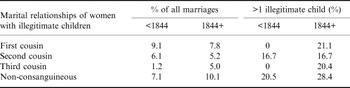
As indicated in Table 2, pregnancy before marriage was not especially unusual. However, marriage within one year of a birth may simply have reflected the postponement of an intended marital commitment with the father of the child, with greater consequent social acceptance of the offspring. Before 1844, 5.9% of women in this group married first cousins, compared with 2.1% and 3.4% who married second and third cousin spouses, and the 3.9% of women who married a non-relative. This trend may have been influenced by the requirement for consanguinity dispensation, since after 1844 the proportion of first cousin marriages in which a child had been born within the preceding year decreased to 2.9%, a level comparable with second and third cousins and even lower than for unrelated wives. Both pre- and post-1844, women who married first cousins were less likely than non-relatives to have more than one illegitimate child.
Women with illegitimate children delivered more than one year before marriage

For some males who were physically or mentally disabled or had poor health, consanguineous marriage may have been a means of overcoming potential problems in obtaining a spouse. Physical or mental disability was reported by clergymen for 6.6% of males in marriages between second cousins or closer, and 8.0% for first cousins. In addition, a small percentage of males in first cousin unions (1.0%) were listed in parish records as having been punished for civil crimes.
Demographic influences
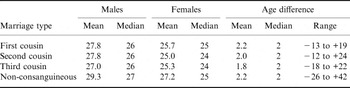
As in other populations (Bittles et al., Reference Bittles, Grant, Sullivan and Hussain2002; Bittles & Black, Reference Bittles, Grant, Sullivan and Hussain2010a), marriages between first cousins occurred at somewhat younger male and female ages, and this also applied to second and third cousin unions. But from an overall perspective there appeared to be little significant variation in spousal ages and age differences at different levels of consanguinity or with non-consanguineous spouses (Table 3). When remarriages were excluded, the difference in mean ages at marriage between first cousin and unrelated spouses remained only for those married pre-1844, and more particularly for females (24.7 versus 26.1 years), compared with 26.6 and 27.8 years respectively for males. After 1844, second cousins of both sexes married at a younger age than first cousins.
Age at marriage in years by sex and age difference and by type of marriage

Before 1844 first cousins were more likely both to be the oldest married son (60.0%), and occasionally the only son who married (27.3%), by comparison with men marrying other categories of spouse. After 1844 the proportion of first-born sons marrying first cousins declined to 45.0%, and to some extent it appears that the freedom to marry first cousins post-1844 meant that it was younger brothers who more often contracted such marriages. In first cousin marriages, the spouses of males who were only sons were themselves often the only daughter in a family, a pattern more frequent before than after 1844. No consistent trends with respect to parity or time existed in the other types of consanguineous marriages, and no temporal changes were observed among men marrying non-relatives.
In Continental Europe, consanguineous marriages have been associated with residential stability (Cavalli-Sforza et al., Reference Cavalli-Sforza, Moroni and Zei2004), a feature also observed in the Skellefteå region. The general pattern was that spatial mobility increased concomitantly with modernization in the latter half of the 19th century, at least with regard to more distant migrations. But long-distance migrations were uncommon compared with the more local movements typical of the customary, mainly annual, rural servant system of employment in the Skellefteå region. Employment-based migrations decreased in frequency after the mid-19th century, resulting in increased residential stability and more consanguineous marriages.
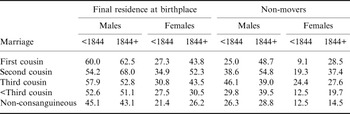
Spatial mobility differed according to the type and date of marriage. As indicated in Table 4, prior to 1844 male first cousins moved as often as non-relatives, but their migrations were more often casual and they subsequently became the largest group permanently settled at their birthplace (60.0%), compared with unrelated male spouses (45.1%). During this time-period men who married second cousins (38.6%) and third cousins (46.1%) were the most stable in terms of zero migrations during their life-time. From 1844 onwards there was a major general increase in the percentage of non-movers, with the exception of males marrying third cousins. However, apart from second cousins, the proportions of men finally resident in their village of birth did not change significantly. Overall, men marrying non-relatives and more distant relatives showed greater spatial mobility throughout the entire study period.
Final residence at birthplace and non-movers by sex and type of marriage (%)

In marital terms, women were more mobile than men and they were less likely to finally settle in their birthplace (Table 4), probably reflecting the tradition in agricultural economies for females to move to their husband's residence at marriage. Large variations in spatial mobility were, however, observed among females, with first cousins the most mobile before 1844. After 1844 sedentary behaviour increased among first and second cousins in particular, with a greater probability that women who married consanguineous spouses would have the same birthplace and final residence than non-relatives. The pattern of decreasing personal mobility through time also was reflected in the higher proportion of weddings between spouses born in the same village. After 1844 marriages between couples from the same village increased in prevalence, especially among second and first cousins (by 73% and 68% respectively) who were the least mobile. But an opposite trend was observed among the most mobile men and women, who mainly married non-relatives born in other places (78%).
Regardless of biological relationships, marriage with a spouse from the same village usually resulted in continued residence in that location. If spouses had different birthplaces, settlement at the birthplace of the husband was preferred, especially among first cousin spouses pre-1844. Post-1844 this trend was largely apparent among biological relatives, with the highest rates among first and second cousins. The final settlement of couples outside their birthplace was more common among spouses married pre-1844, an observation that might have been influenced by the greater opportunities which then existed to become settlers in newly available plots of land.
Family characteristics
In general, marriage in the pre-industrial era reflected family interests and an economic rationale. Individual marriage choice became more obvious with modernization (Mosk, Reference Mosk1983), although geographical and economic factors, and possibly also family interests, remained important. A further significant factor was that until 1872 unmarried women who wished to marry still required the formal approval of a parent or guardian, despite the establishment of a minimum legal age of marriage for women of 25 years in 1863, subsequently reduced to 21 years in 1881 (Strömholm, Reference Strömholm1981; Inger, Reference Inger1983).
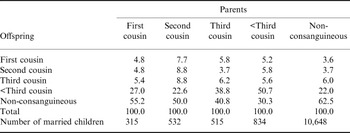
Family interests may have been more pronounced in consanguineous marriages, as demonstrated in present-day non-Western societies (Hussain & Bittles, Reference Hussain and Bittles1998; Bittles, Reference Bittles2002; Bittles & Hamamy, Reference Bittles, Hamamy and Teebi2010). In Sweden and elsewhere in Europe the influence and extent of family traditions behind consanguineous marriage have been sparingly investigated, other than among the nobility. The present study clearly indicates a family-based pattern of consanguineous marriage in the Skellefteå region. The children of parents who were biological relatives more frequently married spouses who themselves were born to kin-linked parents, and this probability increased the closer the parental relationship, i.e. to 8.7% when the parents were first cousins, 7.6% for second cousins and 4.5% for third cousin marriages, compared with 0.9% among the children of unrelated spouses (Table 5).
Consanguineous marriages (%) contracted by the offspring of parents in consanguineous marriages

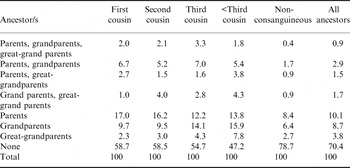
Small differences were observed in the prevalence of kin-linked marriages across generations between couples related as first, second or third cousins, with some evidence that more distantly related spouses were even more likely to have kin-linked ancestors (Table 6). Related ancestors for at least one spouse in all three generations, i.e. parents, grandparents and great-grandparents, were rare, and in most consanguineous marriages kin-linked ancestors existed in only a single generation, most commonly involving either parents or grandparents.
Ancestors (%) who were biological relatives of at least one spouse by marriage type

In keeping with the increasing popularity of consanguineous marriages across the study period, but also probably reflecting the nature of the data collection, multi-generational consanguinity increased over time. During 1800–1824, 11–13% of spouses in first, second and third cousin marriages had at least one related ancestor in the three prior generations, but this percentage increased five-fold in the last generation of marriages studied (1875–1899). There also was a temporal increase of marriages in which both spouses had kin-linked ancestors. This practice seldom occurred before the mid-19th century, but in the last marriage generation the proportion was as high as 25.0% in first cousin marriages and 20.0–22.0% in second and third cousin marriages, compared with 13.3% for more distantly related couples and just 4.6% among unrelated spouses. There were few sex differences among spouses with kin-linked ancestors, although males rather than females were more likely to be represented among first cousin couples and in marriages between non-relatives.
Although it has been generally supposed that remarriage would be less influenced by family interests, examination of the small number of remarriages contracted suggested that in such cases consanguineous unions were not random events. Among males 47% of first cousins and 36–39% of second and third cousins opted for a consanguineous union on remarriage, usually to a more distantly related partner, and among the even fewer female first and second cousins who remarried 25% chose a second consanguineous union. Remarriage with a consanguineous partner was actually more popular among more distantly related males and females (53–54%), and mostly involved a closer kin partner. Even among individuals first married to an unrelated spouse, some 15% of remarriages were with relatives, mostly at large kin distances but, unexpectedly, in some cases with a first cousin.
Consanguinity appeared to be a family and/or sub-population characteristic. Regardless of the type of parental consanguineous marriage, the percentages of families in which either all or none of their children married a biological relative were quite similar: 33.3% and 29.8% respectively for first cousin parents, 23.3% and 27.0% for second cousins, and 34.8% and 21.0% for third cousins. Families in which all children married a relative were mainly small in size and comprised just one or two married children, and in 42.2% of families with a single child the marriage was consanguineous. However, all marriages were consanguineous in almost 10% of families with five or more children, and in 0.6% of families with ten children.
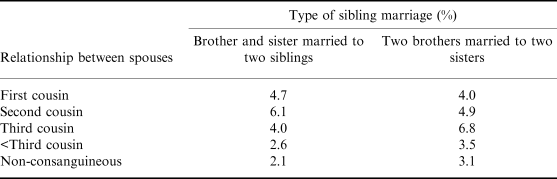
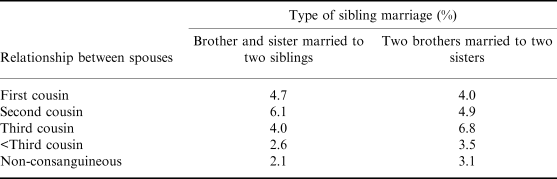
As shown in Table 7, sibling exchange marriage was more common among consanguineous than non-consanguineous couples, and in about 20% of sibling exchange marriages the parents of at least one of the spouses, and occasionally both, were related as third cousins or closer. In Skellefteå it appeared that sibling exchange unions were infrequently adopted as an alternative to consanguineous marriage to consolidate economic resources and to create and maintain alliances or family bonds (Sabean, Reference Sabean1990; Wennersten, Reference Wennersten2002). Across the study period sibling exchange unions accounted for 5.9% of all marriages, occurring mainly in the mid-19th century at a rate of about 10% per decade and decreasing to 4% by the end of the century.
Sibling exchange marriages (%) in the Skellefteå region 1780–1899
Binary logistic regression analysis
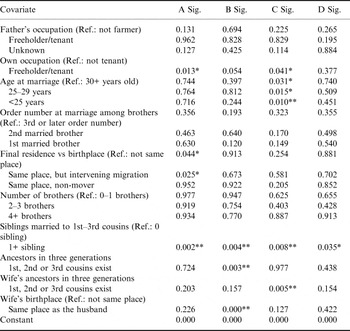
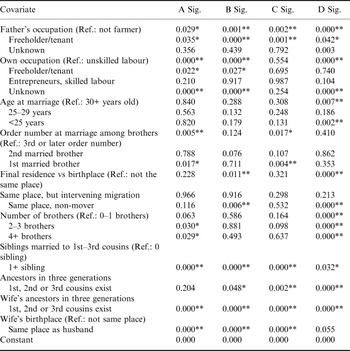
Several variables were excluded from the binary regression analyses of male first marriage pre- and post-1844, due either to few cases or to interaction with chosen variables. The results demonstrated a clear difference between males married before 1844 when dispensations for consanguinity were required and first cousin marriages seemed to be more random, and post-1844 when stronger family traditions in consanguineous marriages were apparent (Table 8).
Binary logistic regressions for consanguineous versus non-consanguineous marriages; males in first marriages contracted pre-1844

Model A: first cousin (Y) versus non-consanguineous male spouses.
Model B: second cousin (Y) versus non-consanguineous male spouses.
Model C: third cousin versus (Y) versus non-consanguineous male spouses.
Model D: beyond third cousin (Y) versus non-consanguineous male spouses.
* p<0.05;
** p<0.01.
Logistic regression confirmed that prior to 1844 males in first cousin marriages were more often tenant farmers. These men were more than twice as likely to have had at least one sibling married to a spouse related as third cousin or closer, and to permanently settle in their birthplace after one or more migrations (Table 8). In other types of consanguineous marriages the family attribute of siblings marrying relatives also was significant (p<0.01). In addition, second cousins had at least one ancestor in three generations (p<0.01) and were married to wives born in the same place. On average, wives whose spouses were their third cousins and with a history of consanguinity in previous generations were younger at marriage, and they were more often tenant farmers.
After 1844 males in all types of consanguineous marriage differed significantly from men married to unrelated spouses in terms of consanguinity among ancestors and within the family in the same generation (Table 9). In first cousin marriages the family bonds usually involved their wives' forebears rather than their own. Occupation had a strong impact, with consanguineous marriage more frequent among the sons of tenant farmers. Consanguinity was also more prevalent among males whose occupational status had not been entered in church records, a finding principally associated with the sons of freehold farmers married towards the end of the observation period.
Binary logistic regressions for consanguineous versus non-consanguineous marriages; males in first marriages contracted from 1844 to 1899

Model A: first cousin (Y) versus non-consanguineous male spouses.
Model B: second cousin (Y) versus non-consanguineous male spouses.
Model C: third cousin versus (Y) versus non-consanguineous male spouses.
Model D: beyond third cousin (Y) versus non-consanguineous male spouses.
* p<0.05;
** p<0.01.
In contrast to men marrying other relatives, significant differences also were apparent among male first cousins in that they were the first male in the family to marry, their spouse was usually from the same birthplace, and they were less likely to have more than one married brother. However, these men did not differ from their peers married to a non-relative in terms of frequency of final residence in their birthplace, which contrasted with males married to a second cousin who often never moved. Age at marriage was not significantly lower in males in first to third cousin marriages, but only among men in more distant relationships.
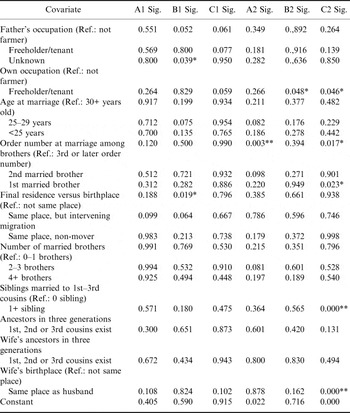
Assessed by level of consanguinity, after 1844 the only significant difference observed between first and second cousins was in the order number at marriage, and between first and third cousins in the occupations of the husbands (Table 10). However, significant differences were observed between male first cousins and males married to more distant relatives in terms of siblings married to closer relatives, husband's occupation, order number at marriage and birthplace of the spouses.
Binary logistic regressions for males in first marriages pre- and post-1844: first cousin versus other consanguineous marriages

Model A1: first cousin (Y) versus second cousin pre-1844.
Model B1: first cousin (Y) versus third cousin pre-1844.
Model C1: first cousin (Y) versus beyond third cousin pre-1844.
Model A2: first cousin (Y) versus second cousin post-1844.
Model B2: first cousin (Y) versus third cousin post-1844.
Model C2: first cousin (Y) versus beyond third cousin post-1844.
* p<0.05;
** p<0.01.
Spatial patterns of consanguinity
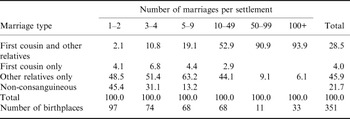
Given the high and increasing level of village endogamy across time and the patrilocal nature of the society, spatial patterns in consanguineous marriage were investigated based on the birthplaces of the husbands. The number of marriages per settlement varied widely, from 1 to 439 marriages, reflecting settlement age and structure. In the mid-19th century 74.5% of the population were resident in the large, older villages located mainly along the coast and in the major river valleys, in particular the valley of the Skellefteå River (Fig. 1). In the forested areas between these valleys and in the inland part of the region, colonization from the late 18th century to the mid-19th century, mainly by men born in the region, had resulted in the establishment of many small scattered settlements with mean populations of just fourteen inhabitants (Egerbladh, Reference Egerbladh and Layton1995). Only one or two marriages had taken place in 27.6% of all settlements, with fewer than five marriages recorded in 48.7% of settlements (Table 11).
Marriage type (%) by size of birthplace

Consanguineous marriages were recorded in 78.0% of the 351 villages/hamlets, with an absence of consanguinity mainly in the smallest settlements, probably due to a lack of available biological relatives (Table 11). First cousin marriages occurred in 32% of all villages, most commonly in the larger settlements, although occasionally in the smallest. Where first cousin marriages were recorded other types of consanguineous union were also typically contracted, but in some settlements consanguinity was restricted to first cousin marriages only. In more than half of the villages/hamlets there had been a single first cousin marriage, representing 0.6–100% of all marriages in those settlements. Conversely, there was a high proportion of first cousin marriages in a limited number of settlements. As a result, 53% of first cousin marriages were reported in 20 villages each with five or more such unions, and there were three settlements with 12–18 first cousin marriages in each, accounting for 15% of all first cousin marriages in the region.
Spatial clustering of consanguinity was apparent in 46 of the 351 settlements (13.1%) when information on two or more first cousin marriages was considered in combination with second and third cousin unions and consanguinity in the ancestors of spouses. Eleven of these settlements accounted for 50% or more of all consanguineous marriages, with eight clustered in the area covering the surroundings of Kåge River and the Storbäcken watercourse (Fig. 1). Two other settlements with high rates of consanguinity were located to the north of this area and the final settlement with a high prevalence of consanguinity was located in the southernmost part of the region. In another eight settlements 11–43% of marriages were between biological kin.
The main geographical characteristic of most of the villages/hamlets with a high level of consanguinity was their location at some distance from the coastline and major rivers, as well as remoteness from major roads, although there were some exceptions to this generalization in the Kåge/Storbäcken area. In contrast, consanguineous marriages were uncommon in most of the villages along the Skellefteå River. The impact of location was even more pronounced among first cousin marriages before 1844, with 28% of the 40 birthplaces of first cousin spouses in the most peripheral hamlets of the sparsely populated inland areas redistributed from the Skellefteå region to a new legislative area before the mid-19th century. In these hamlets first cousin unions accounted for 4.8% of marriages before 1844 compared with 1.5% in other parts of the region. Unfortunately, no information is available on the later circumstances in these locations, but a high proportion of first cousin unions could probably be expected, as in other thinly populated inland parts of northern Sweden colonized late in time and with restricted access to potential spouses. With few exceptions, the remaining first cousin marriages were reported in settlements of differing sizes where first cousin marriages also were observed after 1844: in particular within the Kåge/Storbäcken spatial cluster, characterized by a high degree of consanguinity throughout the study period, which thus supported the concept of sub-communities in which consanguinity was preferential.
Discussion
Other than some rural isolates, prior to 1844 when royal dispensation for first cousin marriages was required, consanguineous marriages in general, and first cousin marriages in particular, were seemingly quite random events. Therefore in terms of most of the individual and family attributes examined, consanguineous unions did not differ significantly from non-consanguineous marriages in the logistic regressions (Tables 8–10). Yet there was some suggestion of an intra-generational custom favouring consanguinity, and first cousin males were more likely than other spouses to become freehold farmers and settle permanently at their birthplace after having undertaken local migrations. Separate analysis of each attribute, however, indicated that first cousins were more often younger at marriage, had the lowest parity, and married first among the sons of a family. In addition, the spatial analysis revealed some influence of limited access to potential spouses among men born in the most remote, recently established settlements.
Just as the prior removal of dispensation fees in 1829 had encouraged first cousin marriages, abolition of the consanguinity dispensation requirement in 1844 contributed to a substantial increase in the numbers of consanguineous marriages in the Skellefteå region during the ensuing 50 years, e.g. from 51 first cousin unions in 1780–1843 to 245 in 1844–1899, a 4.8-fold increase, by comparison with the 2.3-fold increase in total marriages across the two time periods (Egerbladh & Bittles, Reference Bittles2008). Apart from changing attitudes towards consanguineous marriage, their growing prevalence can be associated with a rural pre-industrial milieu, low population density, and the increasing availability of relatives as potential spouses following a natural increase in population. During the latter half of the 19th century, decreasing spatial mobility within the region and increasing endogamy contributed to an even larger growth of consanguineous marriages.
A common motive for consanguineous marriage in Sweden was to consolidate resources by preventing the partition of land-holdings. From the mid-19th century, further financial incentives may have been provoked by the change of inheritance laws in 1845, which gave all children equal rights to inherit, in contrast to earlier legislation under which sons inherited twice as much in property terms as daughters. Sons also had the legal right of precedence to inherit farms until 1890, but at the same time they would have been faced with increasing potential costs in compensating their female siblings. Within the Skellefteå region the subdivision of farms increased, a change stimulated by the Enclosure Acts adopted in the mid-19th century which included the privatisation of forest land previously held on a communal basis by the farmers of each village.
Given the legal obligations of social support between parents and children in times of need, and the local tradition of caring for poor and disabled relatives, the growing numbers of children without prospects of inheriting land, exacerbated by smaller farm sizes following subdivisions, may have contributed to the changing patterns and prevalence of consanguineous marriage before and after the mid-19th century. Sibling exchange marriages, an alternative marriage strategy which was perhaps more economically advantageous and strengthened family ties even further, likewise increased from the mid-19th century. Although the prevalence of sibling exchange marriages was smaller in Skellefteå than in other contemporary rural areas in Sweden, these unions were common even among relatives, thus reinforcing the potential economic advantages and social bonds.
The preference for the sons of farmers to marry relatives was more obvious after 1844, with an over-representation of tenant farmers in first cousin unions. Yet intra-generational as well as inter-generational family traditions, measured across three generations of ancestors related as third cousins or closer, had the strongest impact on all types of consanguineous marriages. Before the abolition of compulsory dispensation for first cousin marriages in 1844, only a limited number of parents who were third cousins or closer had children who also married biological relatives. But through time consanguineous marriage in successive generations became quite common, accounting for 31.8% of all consanguineous marriages post-1844 by comparison with 13.6% before 1844. The growing acceptance of consanguinity appeared to be primarily due to female spouses in first cousin marriages, which suggests that within families successful ancestral first cousin unions might have reduced possible suspicions regarding the adverse biological effects of consanguinity.
In the logistic regressions significant differences between male first cousins and unrelated spouses who married post-1844 existed in most covariates. The first male in the family more often married a first cousin, but only if he had few brothers. Somewhat surprisingly, after controlling for all other variables, males in a first cousin union were more likely to marry a partner from the same birthplace and move out, rather than marry a partner from elsewhere and remain in their birthplace. However, this overall conclusion was not sustained when the analyses were conducted variable by variable. Given previous findings in other populations (Bittles et al., Reference Bittles, Grant, Sullivan and Hussain2002), it also was surprising that males in first cousin unions did not marry at younger ages. Although comparisons between different types of consanguineous relatives resulted in few significant results, there were differences between males in second and third cousin unions and unrelated male spouses.
Even after 1844 some consanguineous marriages appeared to be random events, in that they occurred in the absence of family traditions of consanguinity. However, spatial analysis of the birthplaces of husbands indicated a sub-culture of consanguineous marriage in a distinct part of the Skellefteå region. Within this area many villages/hamlets exhibited an over-representation of marriages between third cousins or closer, involving both first cousin unions and ancestral consanguinity. The villages involved were often quite large in size but located somewhat apart from neighbouring settlements and from major routes of communication by land and water.
Additional explanations are, however, required since other large villages with the same human and geographical characteristics showed a more random spatial pattern of consanguinity. Consanguineous unions possibly were associated with high village autonomy and a more pronounced rural character, which in turn necessitated marriage strategies aimed at preserving and rebuilding farms when sub-division had reduced their viability and the possibilities to clear new land became restricted. Although this type of development was observed in other parts of Sweden, it resulted in different marriage strategies, in particular sibling exchange unions, which also were more popular than first cousin or affinal marriages among contemporary Protestant communities in rural areas of The Netherlands (Bras et al., Reference Bras, van Poppel and Mandemakers2009).
The present detailed portrait of marriage in rural 19th century Sweden emphasizes the diverse nature of the influences on consanguineous marriage and helps to explain why, at a particular point in time and in a specific location, cousin marriage increased in popularity. It also serves to reinforce the warning that sweeping generalizations as to whether or not consanguinity is beneficial or disadvantageous need to be treated with caution and investigated in an appropriately multidisciplinary manner (Bittles, Reference Bittles2001; Bittles & Black, Reference Bittles, Grant, Sullivan and Hussain2010b).
Going forward, it will be interesting to determine what influence the residual effects of the 19th century patterns of consanguineous and sibling exchange marriages may have exerted on the present day gene pool of the region. In this respect, it is noteworthy that a study of Y-chromosome diversity in the current Swedish population (Karlsson et al., Reference Karlsson, Wallerström, Götherström and Holmlund2006) indicated a significant difference between the Y-chromosome haplotype profile of Västerbotten, the county in which Skellefteå is situated, and the rest of the country. Whether, as suggested by the authors, this division is indicative of Sami and Finnish male admixture, or was due to a local shortage of males from the 17th to the 19th centuries, it does reinforce the impression of small and often isolated breeding pools in which founder effect, drift and consanguinity could be significant influences.
Acknowledgments
Dr Inez Egerbladh died during the preparation of this paper, which is dedicated to her memory with admiration and respect. Invaluable advice and assistance was provided by Dr Maria J. Wisselgren in the final preparation of the paper. The technical support and financial assistance given by the Demographic Database, Umeå University, is acknowledged with gratitude.