Introduction
An important accompaniment of the European colonization of the tropical countries of the world from the eighteenth century onwards was the unprecedented globalization of commodity production, exchange, and consumption, especially the import and processing of tropical produce in the emergent industrial countries of the northern hemisphere. Oilseeds and fats were critical to this development, especially with the emergence of margarine as a global food product within decades of its invention in 1869.Footnote 1 The soap and detergent industry, too, was a major player in the oils and fats business during the first third of the twentieth century. Soap had originally been manufactured from alkali and animal fats (tallow), but palm oil and coconut oil were later substituted for tallow. Industrial soap-making in the United States, centred on the city of Cincinnati, Ohio, flourished with the rise of cities and the manufacturing industry. In particular, Americans' increasing preoccupation with cleanliness made soap a necessity (with a mass market) rather than a luxury. By the 1920s, the industry had come into its own with the following features: the emergence of three dominant manufacturing firms: Procter and Gamble, Lever Brothers (a British firm), and Colgate-Palmolive-Peet; product branding; the introduction of new varieties of toilet soap using exotic raw materials (palm oil and coconut oil); and intense competition, which involved heavy investment in advertising on the radio, in newspapers, and on public transport.Footnote 2 As we shall see, the relative stability of the market, at least in the early 1920s, was to give way to the oilseeds and fats crisis of the late 1920s and early 1930s.
This article fills a gap by analysing the complexity and implications of the two-dimensional inter-product competition in the oils and fats sector of the global economy during this period. There was, on the one hand, the vertical (north–south) competition between West African oil palm produce (tropical, colonial exports, generated by upwards of a million peasant producers), and whale oil (produced by a handful of whaling companies, originating from the metropolitan countries of the north). The picture was further complicated, on the other hand, by horizontal (south–south) competition between West African and Asian oilseeds (Indian Coromandel groundnuts and Dutch East Indies palm produce). Whale oil was a particularly complicating factor given the blurring of the dividing line between British and foreign – essentially Norwegian – ownership of the whaling industry in the late 1920s and early 1930s. Central to this discussion is the often contradictory role of Britain, a major imperial power, in the global oils and fats business during this period. This is demonstrated by the repeated refusal of British metropolitan authorities to act in defence of West African trade in oleaginous products, the mainstay of many colonial economies, in the face of adverse circumstances, aggravated by the protectionist policies of major players in the global economy.
This article is situated at the interface between economic and imperial history, while being grounded in the specificity of the Great Depression of the 1930s.Footnote 3 The latter significantly disrupted the global oils and fats business, as it was structured in the aftermath of the First World War. The discussion in this paper, from the perspective of West African oilseeds exports, dwells on the intersection of local and global forces in the United Kingdom, the United States, Norway, India, the Dutch East Indies, and West Africa in shaping global movements and transactions in the oleaginous products business. The article stresses the synchronic interplay of forces operating in both south and north (roughly, the producing and consuming nations), as well as globally; the official measures taken by affected countries in an era of worldwide protectionism; and the United Kingdom's dilemma in the face of the clash between its national interest and interwoven imperial and colonial commitments in Africa and Asia. Informed by data from contemporary newspapers and official sources in Nigeria and the United Kingdom, the discussion is grounded in a three-dimensional relational framework linking the colony with global markets through the imperial or metropolitan economic clearing house.Footnote 4
The global oils and fats business in the aftermath of the First World War
The First World War and its aftermath reinforced the irreversible interdependence of the societies and economies of the nation-states of the world. The war-ravaged European states had become indebted to the United States by both wartime loans and the burden of post-war reconstruction. More pointedly, the commodity trades in industrial raw materials, many from colonial territories, had further bound the leading industrial countries, while also engendering competition for resources and markets. The effects of the First World War, not least wartime and post-war protectionist measures, which survived into the 1920s, affected the produce export trade of the colonial territories. For example, the British colonial government had imposed a differential export duty of £2 per ton on Nigerian palm kernels exported outside the empire from 1919 to 1922, in order to divert the kernel export trade dominated by the Germans in the pre-war period to British crushing mills.Footnote 5 So successful was the measure that German crushers were compelled to import copra in place of kernels. In Britain itself, the depression of 1920–22 resulted in the collapse of prices of palm kernels, like other oilseeds, leading to a fall in the price of margarine to pre-war levels. This benefited the metropolitan economy and society, at the expense of West African producers.Footnote 6
Apart from the prevailing global economic vicissitudes and official protectionist policies during this period, the interchangeability of the oils and fats products had serious implications for the economies of the primary-producing colonial territories of the south.Footnote 7 The discussion in the remainder of this article revolves around the complexity of the global oils and fats business.Footnote 8 As aptly summarized in 1933 by Philip Cunliffe-Lister, the British Secretary of State for the Colonies, the commodities that are examined in this article (whale oil, palm kernels, and palm oil), as well as other vegetable oils and oilseeds, derived their importance from their use as raw materials in the manufacture of margarine, soap, and other products. Consequently, there was a close connection in their prices because they were largely interchangeable as substitutes. In this connection, these products could be grouped into three: all oilseeds, nuts, and vegetable oils, including copra, cotton seed, groundnuts, and soy beans, as well as palm kernels, in the first group; whale oil in the second; animal products such as tallow and lard (which were wholly or largely interchangeable with the oils listed above and their products) in the third.Footnote 9
To be sure, these commodities were not always fully interchangeable, as they had different properties, while the soap and margarine manufacturers had different demands corresponding with their products and market niches.Footnote 10 First, there were fundamentally two types of oleaginous products and fats: those which were basically raw materials and those which were actual oils. Copra (the raw material for coconut oil) and palm kernels (the raw material for palm kernel oil) typified oleaginous products that were primarily raw materials, from which oil was extracted using heavy crushing machinery. Second, a distinction can also be drawn between oils that solidified at room temperature (such as coconut oil and palm kernel oil) and others which retained their liquid form (such as palm oil, whale oil, linseed oil, cottonseed oil, and groundnut oil) but could be solidified through hydrogenation. Third, there was a difference between ‘soft’ and ‘hard’ palm oil, representing higher and lower qualities respectively. High-grade palm oil was characterized by the absence, or low percentage, of free fatty acids (FFA).
That said, a high degree of interchangeability and interdependence of these commodities remained a critical element in the political economy of the oils and fats business during the 1930s. The interlocking relationships among these products were reflected in their relative prices, which were often determined, among other things, by the volume traded on the world market. For example, an ‘extraordinarily big’ cotton crop in the United States in 1926 depressed the world market prices of cotton seed, palm oil, and palm kernels, which continued to fall during the first half of 1927. However, following indications that the American cotton crop for the year was going to be smaller, the prices of these products stabilized, and then began to rise from August 1927.Footnote 11
Nigerian palm oil exports and US protectionist tariffs, 1929–34
As could be expected, governments and business communities in affected territories sought to defend their interests, within the ambit of metropolitan and colonial territorial spaces. This is amply illustrated by the pressure exerted by American interest groups to get their government to impose import duties on palm oil, palm kernels, and kernel oil, which came mainly from West Africa in the late 1920s. The American lobby recommended a protectionist tariff of 1 cent per pound weight on palm oil imports.Footnote 12
The clamour for the proposed duty was started by American farmers, who wanted tariff protection against foreign produce. They had made representations to the House Committee that was holding hearings on vegetable oils and fats. Non-Farm Organizations had also joined them in demanding a 45% duty on all oils and fats, irrespective of country of origin. The American lobby had laid emphasis on palm oil, palm kernel oil, and coconut oil, and was intent on getting the legislation passed by 1 October 1929. The proposed tariff was expected to increase the price of soap but the Americans were willing to bear the burden of higher consumer prices, which would fall more heavily on urban consumers. In absolute terms, palm oil represented less than 4% of the total world consumption of vegetable oils in 1929. However, the Americans had realized that palm oil was suitable for soap-making and other industrial purposes. Hence, US imports of West African palm oil increased steadily, reaching a peak figure of 60,000 tons, four times the volume imported from Sumatra, in the Dutch East Indies.
The proposed tariff elicited stiff opposition from foreign business interests that would be hurt by it. Accordingly, it was the Niger Company, the leading British firm in the produce export trade, which soon amalgamated with others to form the octopus known as the United Africa Company (UAC), that sounded the alarm over the prospect of the US tariff. West African colonial governments also feared that the recent surge in their exports to the US would be checked by any heavy import duty. The producers would have to endure the resultant depression for a ‘considerable period’, until alternative markets could be found. In the spirit of reciprocity, British and West African mercantile bodies suggested that their government could pressure the US through the threat of retaliatory protectionist tariff measures.Footnote 13
But the clamour for a considered British response on such lines was received with caution in London. Even the Director of the Niger Company acknowledged that it was a ‘delicate subject’ for West Africa to interfere with the domestic policy of the US. He suggested the possibility of discriminatory tariffs on US exports such as cars and lorries, thousands of which were imported annually into British West Africa by the late 1920s. This response was bound to hurt the American automobile industry, because the internal market had become saturated and the automobile manufacturers were seeking foreign outlets for their products. Consequently, they would resent any measures, such as a threat of discriminatory duties, that might curtail their aspirations. American flour exports could also be targeted with similar results; indeed, American farmers who would thus be affected might turn on their counterparts in the oils and fats business. The British business lobby, therefore, suggested that hints of British reprisals might be given through a question in the House of Commons, or by some other means that would convey the message to the US House Committee.Footnote 14
There were also hostile reactions to the proposed American tariff policy in Nigeria. A Lagos-based newspaper, The Nigerian Daily Times, issued a bellicose editorial on the subject, which articulated views similar to those expressed above. It is likely that this was a ventilation of the views of the business interests behind the newspaper, although an element of African economic nationalism was also inherent in it.Footnote 15 The United States, the newspaper charged, ‘has always been a great protectionist country’, and the proposed policy might have been intended to protect the lard and cottonseed oil produced in the US, as well as the coconut oil imported from the Philippines, against which Nigerian, and more widely West African, palm oil often competed. The proposed tariff would, therefore, have ‘a most disturbing effect on the world market in palm oil and palm kernels and this in turn will seriously affect prices of palm products in this country’. The newspaper emphasized that such a situation would further impoverish the ‘poor overburdened African producer who will pay ultimately’. From the perspective of the colony's foreign trade profile, the Nigerian Daily Times noted the ‘astonishing rapidity’Footnote 16 with which US consumption of Nigerian palm oil and palm kernel oil had grown in the previous decade, from 8,000 tons valued at £236,000 in 1918 to 41,000 tons valued at £1,215,000 in 1927, with higher returns for 1928.Footnote 17 The newspaper, therefore, put pressure on the Nigerian government to make it clear to the American government that, if the latter proceeded with its proposed tariff, ‘we shall retaliate by imposing a duty on American cars and lorries, and American timber in both of which we are doing a large and growing business with the United States’.Footnote 18
Officials of the British government took a more restrained view of the matter. The British envoy in Washington posited that an official protest was unlikely to deter the Americans. It was better, he opined, for the concerned British interests to arrange with American importers of their produce to make a representation to the Congress. That move would be bolstered by a ‘carefully worded’ memorandum from the embassy to the Congress Committee, through the State Department, detailing ‘the relative production costs and the extent to which tariff increases might injuriously affect any particular trade’.Footnote 19 The Board of Trade buttressed this position with reference to a comprehensive memorandum prepared by the British Ambassador to the United States. The tariff revision being proposed by the Americans had been designed to ‘satisfy in some measure the demands of the agricultural interests’. Given the power of that lobby, the British envoy did not expect that protests by exporting interests would avail anything. Still, the importers and consumers of vegetable oils were making ‘an organised effort’ to counter the moves of the agricultural lobby. The Board of Trade submitted that it was this kind of action that could ensure that palm oil and palm kernel oil remained on the Free List or, alternatively, that the duty being proposed was ‘not excessively burdensome on the trade’. The British Ambassador expressed his readiness, however, to support the palm-oil-producing and -exporting interests in Nigeria if they insisted on submitting a ‘brief’ to the embassy through the Colonial Office to the Foreign Office, for transmission to the US government.Footnote 20
Meanwhile, officials of the Colonial Office, who were directly involved in the formulation of policies relating to the colonies, were less enthusiastic about the wisdom or prospects of British government intervention. Their confidential comments betray the resentment and exasperation of certain officials whenever ‘Big Business’ invited the home government to intervene on its behalf in matters that were primarily of private economic interest. However, it was an article of faith that it was the duty of the government to implement policies that favoured the legitimate aspirations of its business community.Footnote 21 While deploring the self-serving clamour by that community, J. E. W. Flood, a senior official at the Colonial Office, acknowledged that, if the American tariff was imposed, it would harm trade relations between West Africa and the United States as far as palm oil was concerned. He singled out the Niger Company as the firm likely to be worst hit, since it had lately invested heavily in installations at Lagos and Port Harcourt to facilitate the handling of palm oil exports in bulk rather than in casks.Footnote 22
On the issue of the deterrent effect of threatened retaliation, Flood demonstrated that US commercial interests in Nigeria were not substantial enough to make reprisals effective.Footnote 23 Taking automobiles – the major US export to Nigeria – as an example, he noted that, up to the end of November 1928, most of the 790 cars and 1,132 lorries imported into Nigeria were British. Of the 254 cars imported from the US, only 120 of these were Ford vehicles, which were likely to have been produced in Canada. While the US did export the bulk (948) of the lorries, which were Ford and Chevrolet brands, they too probably came from Canada. In the British West African colony of the Gold Coast, the US accounted for 2,261 of the 2,914 automobiles imported in 1927. These apparently high US import figures notwithstanding, Flood doubted that any ‘formidable weapon against the US’ could be found in taxing their products. In any case, it was an established fact that the US lorry was ‘a better thing for the roads in the Colonies than the British’. Hence, it would be counter-productive to drive it out in defence of other economic interests. Regarding the suggestion to tax American flour imports, he commented that such a step would contravene the policy of the British West African colonies to take taxes off imported foodstuffs, and it would be ‘a very invidious’ policy to now put such tariffs on American flour. Consequently, the imposition of the proposed differential duty was out of the question in Nigeria and the Gold Coast. It was therefore futile to expect help from the Board of Trade, and even more so from the Foreign Office, which would baulk at interfering in the domestic politics of the United States.Footnote 24
In the final analysis, the matter was resolved by the non-intervention of both the Board of Trade and the Colonial Office, on the grounds stated above. A further consideration was that Clause 9 of the Anglo-French Agreement of 1928 had foreclosed the imposition of any differential duties in either the Gold Coast or Nigeria.Footnote 25 In addition, asymmetrical power relations between Nigeria (and, for that matter, British West Africa) and the United States, put paid to any thoughts of retaliatory action. Flood likened that possibility to ‘attacking an elephant with a pea-shooter’. Any official action from London would, in any case, be viewed with suspicion in some circles in the United States, and might end up defeating its own objective.Footnote 26
This was the last word on this saga, and it is significant that this development took place even before the full-blown outbreak of the Great Depression. However, if this was a dress rehearsal of the intricacies of the politics of the global oil and fats business, more concrete manoeuvrings came when the global adversity of the 1930s got into its stride. During that crisis, analysed in detail in subsequent sections of this article, the protectionist policies of the United States of America were similar to those of other global powers. They promoted domestic production of oils and fats, and reserved the balance of import requirements for their overseas territories and dependencies, in particular the Philippines, an important source of copra.
Accordingly, a Tariff Act of 1930 levied a tax of 14 cents per pound weight on imported margarine and a 1% duty on edible palm kernel oil.Footnote 27 This was followed by an Act of Congress of 1934, which imposed ‘an almost prohibitive’ processing tax, of 1 cent per pound weight, on the principal vegetable oils derived from imported raw materials.Footnote 28 This was the culmination of the process alluded to in the preceding discussion. However, the American government repaid the Philippines government any amount levied on Philippine copra. In practical terms, the US market was closed to all but the Philippines.
These measures immediately depressed Nigerian palm oil exports to the US from 61,145 tons in 1930 to 6,334 tons in 1934,Footnote 29 reflected in the steep drop in the value of Nigerian palm oil exports to the United States from £555,716 in 1931 to £51,287 in 1934.Footnote 30 In his reaction to the biting effect of this tax on Nigerian palm oil exports, a European member of the Nigerian Legislative Council urged the British government to negotiate the reduction of the import duty on Nigerian palm oil. But the colonial government explained that the tax was a question of ‘world economics in which the interest of Nigeria unfortunately must play a very subordinate part, and it is a matter for world measures rather than local measures’.Footnote 31 This assertion was particularly true of the 1930s economic depression, when West African palm produce faced competition from other colonial exports and, especially, whale oil.
The United Kingdom, whale oil, and West African oilseeds during the Depression
As previous studies have shown, the late 1920s and early 1930s were a critical turning point in the economic history of the twentieth century, specifically because of the disruptive impact of the Great Depression of 1929–33, which was signalled by the collapse of the New York stock market. That event had a reverberating effect on the world economy and called for various remedial strategies by the leading industrial and political powers. A common response, which characterized the economic policies of the big powers, was the recourse to protectionist trade policies.Footnote 32 Protectionism was driven by the national economic interest in relation to competing countries, and in response to the vagaries of the world economy and the political realities of the day. Various industrial countries enacted legislation to protect their national economic interests, with severe consequences for the primary producing countries.Footnote 33 For instance, the German government issued decrees dated 23 March 1933, which placed all foreign oils and fats imports under government monopoly control, and restricted the manufacture of margarine, edible artificial fats, and oils to production quotas of between 50% and 60% of the total output for the period from 1 October to 31 December 1932. The provisions of the decree applied to all imported oilseeds, nuts, kernels, and oil cake.Footnote 34
The protectionist policies of the leading nations of the world complemented the rapid collapse of the produce markets, as prices of and demand for primary produce fell steadily. Consequently, there was a growing clamour in West Africa and Britain, especially in the newspapers, for drastic government intervention. Accordingly, merchants involved in the groundnut export trade pressed for British government assistance to alleviate the problems caused by falling prices. The clamour found an extenuating circumstance in the prevailing international economic situation, particularly the abundance of competing oilseeds, which had made marketing the Nigerian groundnut crop ‘a very difficult proposition’. Thus the Kano Chamber of Commerce pleaded that the government should alleviate the great burden imposed on Nigerian groundnuts by reducing the high rail freights charged for transporting the commodity over several hundred miles to the coast.Footnote 35
Compared to Indian Coromandels – a variety of groundnuts originally introduced from Mozambique in the late nineteenth century, which became dominant across India within a few decadesFootnote 36 – it was argued that Nigerian groundnuts were dearer to market in Liverpool, because of the transport cost differentials. While it cost just £3 18s 11d per ton to ship Coromandels to England, Nigerian groundnut marketing costs were £6 13s 2d in 1933 and £6 6s 11d in 1934, the reason being that Nigerian groundnuts had a longer railway haul and shorter sea haul, with the reverse being true for Coromandels. However, as freight reduction had implications for their revenue, the railway authorities advised the groundnut merchants to secure concessions from the shipping companies, though they readily reduced freights on cotton for the reason of its imperial significance.Footnote 37 The point is that groundnut interests in Nigeria did not clamour for protectionist measures, which in any case were obviously not feasible, considering the wide range of producers of groundnuts in French West Africa and British India.
The West African oil palm industryFootnote 38 was in an even more precarious situation, as it had to contend with formidable competition from both the Indonesian oil palm industry and whale oil, over which the colonial governments had practically no control. By 1933, whale oil had become a serious threat to West African oilseeds, and this issue provoked a lively controversy in the press (West Africa and Manchester Guardian, both published in the United Kingdom) and government circles in the mid 1930s. In a series of letters to the editor of West Africa, anonymous readers had raised the issue of the danger that British imports of Norwegian whale oil posed to West African palm oil exports.Footnote 39 This point is better appreciated by examining the structure of the whaling industry in the first three decades of the twentieth century, for it was in this context that the whale oil imports controversy of the early 1930s took place.
The nationality of the whalers had become blurred with the emerging transnational mobility of capital and labour in the North Sea region during the opening decades of the twentieth century. This was aptly illustrated by the Christian Salvesen whaling enterprise, established in Scotland in 1846 by Norwegian émigrés from Mandal. The company's foray into Antarctic whaling in 1907 from its home port of Leith culminated in its emergence as the leading whaling company at the South Pole by the early 1930s, even at the height of the Great Depression.Footnote 40 The dominant role played by the firm of Salvesen (already the world's leading whaling firm by 1910) in Antarctic whaling was a critical factor in its development up to the outbreak of the Second World War. Moreover, British entrepreneurs had made both direct and indirect investment in the whaling industry, especially following a boom in 1929–30. The author of the Salvesen whaling saga recalled the investment climate generated by the boom as follows:
The fever which had gripped the Norwegian industry spread to London, where there were financiers ready to back the ambitions of the entrepreneurs across the North Sea, so a number of the new expeditions were backed by British capital, and some sailed under the British flag. … But the management of the companies, even that of the two Unilever expeditions … remained almost entirely in Norwegian hands. Salvesen was still the only company whose management was firmly based in Britain.Footnote 41
However, the industry experienced a slump in 1930–31. The record production of the preceding season was too much for the main whale oil buyer, Unilever, to absorb, and this led to the collapse of prices from £25 to £12 per ton (actually between £10 and £14 in 1931–33).Footnote 42 Norwegian whaling companies pulled out of Antarctic whaling in 1931–32 because it had become unprofitable to continue in the business at the prevailing prices. Worse, they were compelled to sell their stock at rock-bottom prices to pay off the bank loans taken to finance their late 1920s expansion. The point is that, in 1931–32, the withdrawal of Norwegian whalers left the field to British companies, Salvesen and Unilever, which were under no financial pressure to sell at a loss to offset bank loans. To that extent, British capital combined with Norwegian labour to dominate the industry, and this explains the dilemma of the British in the face of calls for protectionist legislation against ‘foreign’ whale oil imports. In practical terms, the ousting of Norwegian competitors meant that imports into Britain were actually largely the product of a national industry, a fact that was lost on certain commentators in Britain and West Africa, as we shall see in the following passages.
That said, the perceived threat to West African palm produce exports posed by whale oil imports into Britain during the Great Depression generated a great debate both in the press and within the confines of the Colonial Office. ‘The enormous expansion of the whale oil industry of recent years’, ‘D’ noted, ‘has had a most pernicious influence on all oilseeds and fats, but most important of all is the effect it is having on palm products, which represent a high proportion of the exports of Sierra Leone and Nigeria.’ The writer cleverly aligned private profit with public interest by pointing out that a drastic reduction in West African palm oil exports would impoverish the African producers, who would not be able to purchase imported merchandise, the reduced sales of which would lead to a fall in government revenue. He asked whether it was not in the interest of the West African colonies, the colonial subjects, and England, especially Lancashire and the home government, ‘to put the brake on whale importations, and protect British subjects and their products?’Footnote 43 Moreover, since Sierra Leone had granted preferential treatment to British goods, it was fair that the United Kingdom should reciprocate by giving preferential treatment to palm products. Apart from one or two ‘combines’, it did not seem to him that anyone in Britain would benefit from ‘this enormous production of whale oil [which was], mostly foreign’. The writer was categorical in the assertion that neither the West African farmer nor ‘the working man in England’ stood to benefit from it. A Colonial Office bureaucrat asked, in reaction to the claim that the English working class did not benefit from the unfolding situation, ‘Does cheap margarine & soap mean nothing to him?’Footnote 44
A number of fundamental questions were raised by each of the aforementioned commentators, who endorsed the position that whale oil imports were harmful to British and West African interests. ‘Economist’, for instance, was interested in the question of taxation. He noted that whale oil of British provenance did not pay any duty, whereas Norwegian catches paid only 10% ad valorem duty. ‘Why’, he asked, ‘should the products of our Colonies (on which millions are dependent) be taxed while whale oil is allowed freedom in this respect?’ He recommended that, for equity, whale oil of British catch should pay £3 10s per ton, while its foreign counterpart should pay £6 per ton. The ‘enormous production of whale oil’, he contended, was to the benefit of ‘mostly foreign “combines”’ and it still enjoyed some form of official protection, which the West African trade in general was denied. He therefore enjoined the Africa sections of the London, Liverpool, and Manchester Chambers of Commerce to take steps to ‘avoid further injustice’. ‘D. K. G.’ inveighed against the ‘dumping’ of whale oil imports, in consequence of which millions of West African producers were suffering because of the ‘extremely low prices’ offered for their produce, which did not cover the cost of production.Footnote 45 Their depreciated earnings would also weaken their purchasing power, with consequences for the import trade, importers' profits, and government revenue.
The refrain was taken up by a certain A. S. Cann, who posited first that, ‘if whale oil importation is to continue, the trade of the West African Colonies will suffer, which will affect the home trade, especially Lancashire’. Second, if a British (colonial) industry were to be replaced by an American oil industry, more British capital would flow to America, and this would not allow Britain to recoup its losses. ‘Can the Empire’, he asked, ‘afford to neglect an important industry of its West African Colonies by importing a substitution of its own palm product, which means diminution of the revenue?’ Third, whale oil was not as adaptable as palm produce, which yielded a basic raw material for the production of soap, candles, and pomade (from palm oil); fuel oil, margarine, butter, hair oil, and toilet requisites (from palm kernels); and cattle feed (from the residue). Fourth, if the British government was serious about its ‘Buy British, sell British, British goods are the best’ campaign,Footnote 46 it had to support British industry and reduce unemployment. He concluded that the influx of American whale oil was affecting the prices of palm products, which reduced the earnings of the producers, with the natural depressing effect on British manufactured goods (especially from Lancashire). He solicited the intervention of the British Chambers of Commerce to avert a ‘trade disaster’.Footnote 47
A similar campaign was launched in the Manchester Guardian, where a commentator supplied figures to show a steady decline in British imports of West African palm oil, concurrent with an impressive increase in whale oil imports to Britain.Footnote 48 While the volume of whale oil production had increased from 417,000 barrels in 1921 to 3,700,000 barrels in 1931, imports of whale and fish oils into the United Kingdom were 32,000 tons in 1921 and 130,000 tons in 1931. In 1930–32, average annual imports of whale oil into the UK were 104,500 tons. In contrast, palm oil imports had plummeted from 101,600 tons in 1921 to 49,000 tons in 1931, the lowest figure in twenty years. Palm kernel imports had declined from 287,600 tons in 1924 to 146,000 in 1932. A striking feature of the rising profile of whale oil imports was the stagnation since 1924 in the annual production of both palm oil and palm kernels in the British Empire. That is, since whale oil production reached the one million barrel mark, palm kernel exports had remained at about 325,000 tons and palm oil at about 130,000 tons per annum. He argued, in effect, that the unlimited production of whale oil had severely depressed the prices of all oils and fats, and especially those of West African palm produce, between 1931 and 1933.Footnote 49
However, the anonymous writer focused on reasons for the lack of competitiveness of West African products in the global oils and fats business. First, he asserted that transport charges and export duties made West African palm produce less competitive. As an illustration, at the current (May 1933) market prices, the export duty of £1 per ton on palm kernels in Nigeria amounted to more than 20% of the prices paid to the producers, while in Sierra Leone the export duty of £1 10s per ton was more than 33% of the producer price. These figures indicated that the charges and export duties levied on West African oil palm products were out of proportion to their current value on the world market. Second, the situation was compounded by the ‘unlimited’ production and ‘unrestricted competition’ of whale oil, which, if unchecked, was bound to lead to the complete collapse of West African trade. He pointed out that such a prospect would be disastrous to British trade, for the ‘vanishing purchasing power’ of West African producers was bound to have an adverse effect on British manufactures, especially cotton goods. He enjoined the British government to emulate American and German countermeasures against the ‘disturbing influence’ of whale oil on their home products. The USA had imposed a prohibitive duty on it, while Germany had restricted its importation, either of which policies he asked the UK to adopt in defence of the West African oil palm industry.Footnote 50
Ironically, shortly after the alarm was sounded in the Manchester Guardian, Britain signed a trade pact with Norway which imposed an ad valorem duty of 10% on Norwegian whale oil, the same as that levied on other foreign whale oil, with provision for future free entry of Norwegian whale oil. This development was decried by the Sierra Leone Chamber of Commerce, which considered it inimical to the interests of West African palm produce. It argued that the duty was of no effect if the quantity of whale oil imports was not restricted and, therefore, called for the retention of the 10% duty and a general review of the agreement with Norway. The Chamber acknowledged that certain British interests, such as the coal industry, would largely benefit by the agreement, which would nonetheless ‘deal a severe blow’ to the West African oil palm industry. ‘The unrestricted and free importation of whale oil’, it argued, ‘will result in the U.K. becoming a closed area for palm products from West Africa.’Footnote 51
The Colonial Office reacted to calls for effective British action by acknowledging that whale oil was ‘something of a menace to palm and palm kernel oil, just as it is to other oil-seeds and vegetable oils’. However, it pointed out that ‘matters were more complex than they seemed’.Footnote 52 In the first instance, there had to be the exhaustion of whaling through ruthless exploitation, restriction of catch by regulations, or prevention of a glut (as in 1930–31) by joint action on the part of the producers, for oil palm exports to attain previous levels. In any case, whale oil was not altogether a foreign product, since Britain herself had a substantial share of world production: 33.3% in 1925, 41% in 1930–31, 85% in 1931–32, and 52% in 1932–33. Moreover, over four-fifths of the ships engaged in whaling were British-built. By extension, annual extensive repairs of these vessels, which operated in extreme weather conditions, gave valuable work to British shipyards. Virtually all the floating factories were British-built, with the firms of Swan Hunter & Richardson and Harland & Wolfe being the most prominent. Whale-catchers were constructed in large numbers by the Smith's Dock Company, and the extensive repairs required after a whaling season were frequently carried out on the Tyne.Footnote 53 In effect, Britain had equally vital interests in both the West African palm produce and the whale oil industries. In each case, it controlled half of world production but its share in production greatly exceeded empire consumption of the commodity. It was thus difficult to assist one at the expense of the other.
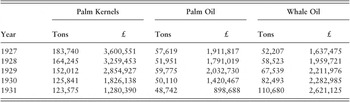
Consequently, tariff action was bound to boomerang, since the prices of these commodities were determined by the dynamics of international trade. Britain was neither the only nor even the largest consumer. If a prohibitive duty were to be imposed on whale oil entering the United Kingdom, it would simply divert it to other markets, where it would dislodge other oils and oilseeds.Footnote 54 The dilemma faced by Britain is indicated in Table 1, which shows a steady decline in UK imports of palm produce, concomitant with a proportionate rise in whale oil imports between 1927 and 1931.
British imports of whale oil and palm produce, 1927–31.

Source: NAI, CSO 26 28659, ‘Whale oil’, enclosed in G. L. M. Clauson to Donald Cameron, 22 June 1933.
As the imperial government declined to intervene on behalf of the West African oil palm industry, Governor Donald Cameron of Nigeria suggested that, since the presence of foreign whale oil in UK markets contributed to further impoverishment of the ‘poor producers’, they ‘should not be debarred from buying cheaper imports offered by non-British traders’.Footnote 55 But, in a comprehensive analysis of the question from the imperial perspective, the Secretary of State pointed out that there was a great interdependence of the prices of oils and oil-producing substances. Hence, one could talk of a single world market for all of them. In that case, tariff action could only benefit the producers of a particular commodity if it could create conditions within a national market that enabled the commodity to be sold there at a price higher than the world price.Footnote 56
In summary, insofar as whale oil competition was concerned, the British government declined to intervene on the side of the oil palm producers. In a situation where imperial and colonial interests clashed, the former prevailed: there was no question of Britain cutting her whale oil production or imports to ensure greater importation of West African produce. Even though it was admitted that ‘whale oil is one of the oils competing most effectively with palm oil and whale oil prices are an important element in the determination of palm oil prices’, British interest would not permit any hostile act against whale oil imports. The interest of the British Empire in whaling was ‘considerable’, for British companies produced about half the world total, amounting to about £4 million.Footnote 57
Significantly, in 1933 the Nigerian government proposed a punitive 50% ad valorem import duty on soap containing whale oil, in place of the existing duty of 4s per 100lbs of soap. The onus of proof that the soap did not contain whale oil was placed upon the importer. The colonial governor acknowledged that this measure would have only a ‘negligible’ effect on Nigerian revenue, but he contended that ‘Nigeria would be merely recording in an emphatic manner that it refused to facilitate the importation of goods in the manufacture of which products in competition with her own products had been employed, an example which might be followed by other countries similarly affected. The same policy might be expected in connexion with margarine.’Footnote 58 It is not clear whether London approved this measure, but it was clearly a significant, though merely symbolic, defiant gesture by the colonial government to get at the whale oil menace. Retaliatory measures like this one were common during this period but they were hardly more than futile gestures, which did not alter the overall picture. This produced an attitude of resignation on the part of palm oil interests in the United Kingdom. ‘There is one grim consolation’, one of them declared despondently, ‘and that is the slaughter of whales cannot go on for ever’.Footnote 59
The ‘Eastern menace’ and Nigerian oil palm exports
Meanwhile, apart from whale oil imports into Britain, an equally potent threat to the Nigerian oil palm industry on the world market was the product of the oil palm plantations of Southeast Asia, which was referred to in official circles as the ‘Eastern menace.’ This phenomenon illustrated the horizontal (south–south) dimension of oil nuts and seeds competition on the word market, which compounded the woes of Nigerian and West African palm produce exports in the ongoing struggle against whale oil competition.
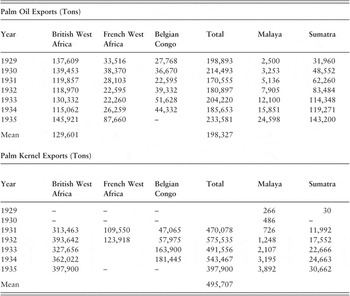
The oil palm industry in the Dutch East Indies and Malaya, which posed such a great threat to West African palm produce exports, was, ironically, developed with seed introduced from West Africa. This improved seed, the Deli variety, had undergone special selection and breeding to increase average yields and the ratio between oil and seed.Footnote 60 Hence, Sumatra, with only 170,000 planted acres, exported more oil in 1935 than Nigeria which, thirty years earlier, had an estimated 16 million trees.Footnote 61 The disparity between British West African and Southeast Asian palm oil exports is shown in Table 2. It should be noted, however, that export figures did not capture the total volume of production in West Africa. As palm oil was an indispensable component of the people's diet, exports represented the balance after local consumption needs had been met.
Comparison of African and Far East palm produce exports, 1929–35.

Source: Compiled from NAI, CSO 26/3/29777, vol. 2, ‘Conditions of world trade in palm products: report of a discussion concerning the probable developments in the African and Malayan oil palm industries’, 24 September 1936.
In contrast, except for a small quantity of oil used locally in manufacturing soap, Malayan exports were practically equivalent to production. Moreover, the Malayan–Indonesian oil palm variety had a significantly higher proportion of pericarp, and therefore produced more oil, than its West African counterpart. In addition, the plantation-based Malayan palm-oil-extraction technology was far more efficient than the peasant-based traditional methods of West Africa.Footnote 62 Southeast Asian producers also developed an edge in the 1930s, with the introduction of bulk shipments to Europe and North America. While West African exporters were still using expensive wooden barrels and metal drums, the Asian producers had switched to large tanks, ‘which gave economies of scale and minimized losses from leakage’. For good measure, United States ports were already well equipped to handle bulk shipments.Footnote 63
The stark reality of the threat posed to the Nigerian oil palm industry by palm oil of higher quality from the Far East generated debate in government and business circles in the UK and West Africa. The Association of West African Merchants (AWAM) drew attention to indices of the superiority of the Far East oil palm industry: average heads of fruit per tree there were twelve to thirty as against three in West Africa, and FFA content was a mere 4%, as opposed to 12–40% for West African oil. Consequently, the Association enjoined the Nigerian government to initiate a comprehensive long-term policy for ensuring the improvement of west African palm produce so that they could compete on equal terms with their Far East counterparts. Two issues were identified for immediate action – the institution of systematic cultivation of the oil palm, and scientific and up-to-date processing of the fruit – as the best means of protecting Nigeria's position during the transition period.
AWAM recommended the use of model plantations to instruct the peasant producers in ‘superior’ methods of production. The Association stressed that ‘the final solution of the great problem’ lay in the hands of the peasant producers. On palm oil processing, the body called for ‘another and more effective effort, to provide for up-to-date milling of palm fruit’.Footnote 64 Finally, AWAM contended that, had the same attention devoted to cotton and mixed farming in northern Nigeria been given to the oil palm, the crisis facing the industry would have been averted. It hinted that the colonial government, especially the Department of Agriculture, had contributed to underdeveloping the oil palm industry through acts of omission or commission.
The Department of Agriculture replied that it had done its best to ‘develop’ the industry, by striving to increase production of fruit and by preventing the waste of oil through the adoption of an improved method of extraction, which combined the local soft oil method and the use of a hand press. The thrust of government policy towards ensuring increased production of fruit was: ‘treating the oil palm as a crop … [by inducing] the farmer to make plantations of oil palms grown from selected seed … [giving] these plantations proper attention … [and also] demonstrating methods by which wild palm groves can be economically developed into plantations’.Footnote 65
On the whole, established government policy since the preceding decade had explicitly rejected the Southeast Asian model of plantation agriculture, though it supported the establishment of model plantations.Footnote 66 Accordingly, in 1930, it permitted the UAC to establish a 5,000-acre oil palm plantation near Sapele in southern Nigeria. The Nigerian colonial government was, however, more forthcoming on the issue of palm oil processing. It promoted the use of hand presses as a ‘satisfactory and complete alternative to the system of central factories’.Footnote 67 The latter system was rejected because it required some form of government subsidy, and the government was wary of the prospect of coercing the producers through the Native Administration, or by any other means, to sell their crop at a particular mill or at a price that was unacceptable to them.
If the efforts made by the colonial government to mechanize the extraction of palm oil did not have an immediate or a remarkable impact on the industry, its tariff policies did. Realizing that its fiscal policies could burden trade, the government reviewed them periodically in the interests of trade. For instance, it removed the export duty on groundnuts in 1931, and granted a further concession by reducing railway freights on the commodity for six months.Footnote 68 The decision to reduce the tariff burden on the palm produce export trade appears to have achieved the desired results, at least from the perspective of government and expatriate business interests. The Lagos Chamber of Commerce, in a farewell address to Governor Cameron in 1935, lauded it as ‘a bold move’ made in the face of the colonial government's financial constraints, which had enhanced the value of Nigeria's primary produce industries.Footnote 69 However, it is debatable whether the relief was passed on to the producers.
Protectionism in importing countries
After all is said and done, West African palm produce faced multiple perils, not only competition from whale oil and Sumatran palm produce exportsFootnote 70 but also the protectionist policies of the countries that were its actual or potential markets. The threat of protectionism was clearly revealed in a comprehensive analysis of the contemporary fiscal and import trade policies of the United States, Germany, France, Italy, and the Netherlands in October 1934.Footnote 71 The analysis provided a bleak outlook for West African produce in those markets.
German policy towards foreign oils and fats imports, including those from the British Empire, was informed by three considerations. First, the government operated a policy of self-sufficiency, which hinged upon the wholesale development of domestic sources of animal and vegetable oils and fats. This succeeded to some extent in increasing domestic supplies and diminishing foreign imports. Second, the German government had concluded an arrangement with its Dutch counterpart to reserve a large proportion of the import trade for Dutch East Indies products, in return for certain commercial privileges for German products in that colony and in the Netherlands itself. Third, as Germany was contending with a scarcity of foreign exchange to pay for imports of oils and fats, it was expected that she would reduce imports from British colonies. However, by Article 2 of the Anglo-German Payments Agreement of 1 November 1934, the Germans pledged to maintain existing levels of transactions with the United Kingdom and its colonies in commodities that Germany customarily purchased from them.Footnote 72
For their part, the French had embarked on developing the resources of their own colonial empire and deployed preferential tariffs and bounties to stimulate the production of oilseeds and nuts, especially groundnuts and copra, in those territories. The success of that policy was already evident by the mid 1930s, and this meant a steady reduction in France's reliance on foreign, including British, products.
Other importers faced a slightly different mix of constraints. Italy was committed to reducing her imports of oils and fats, partly to protect her domestic olive oil and animal industries and partly to conserve foreign exchange, given the financial straits of the times. The government thus prohibited all imports of oil products, except under licence. The Netherlands already had difficulties in disposing of the produce of the Dutch East Indies in foreign markets and could not possibly permit the entry of foreign produce into the domestic market.
As already indicated in the discussion on the one-cent duty on palm oil imports earlier in this article, the United States had also become protectionist by the early 1930s, and the experience of the Great Depression merely confirmed this tendency. Thus, the flow of colonial produce in global markets was constrained by a worldwide regime of protectionist policies during this period.
Conclusion
This article has examined, from an essentially Nigerian and West African perspective, an interplay of global transactions. On the one hand, there was fierce competition between Norwegian whale oil, British West African and Indian Coromandel groundnuts, West African palm produce, and Malayan and Dutch East Indies palm oil exports. On the other hand, the tariff, foreign trade, and agricultural policies of the United States, the United Kingdom, and other European countries from the late 1920s to the mid 1930s impinged in significant ways on the situation. The article has highlighted the competing interests of British colonial territories (Nigeria, Malaya, and India), and the contradiction between British national economic interests in the whale oil industry and her imperial interests in the colonial oil-producing and oilseeds industries of the global south. The United Kingdom sought to resolve these contradictions in her national interest.
It is significant that metropolitan and colonial territories (such as Nigeria) adopted protectionist measures of various descriptions, which compounded rather than resolved the interwar crisis. Still, it is worth noting that the burden of these measures fell more on processed or semi-processed imports than on raw materials as such. Metropolitan countries were quick to raise barriers against processed oils such as palm kernel oil or coconut oil, but were less inclined to ban raw materials, such as copra or palm kernels, which gave work to their own factories.Footnote 73 Thus, the United States prohibited imports of coconut oil from the Philippines but continued to let in copra from that territory for crushing in American mills.
From the colonial Nigerian perspective, this study amply demonstrates how West African palm oil producers suffered both from the protectionism of the United States and Germany and from the refusal of the United Kingdom to protect oilseeds producers in her own West African colonies against whale oil imports from the Antarctic (specifically, the Falklands) into the United Kingdom. It also underscores the vulnerability of both the imperial power and its colonies in the political economy of global commodity flows in an era of depression and protectionism. Such a reality foreclosed any recourse to asymmetrical trade wars or retaliatory tariffs, for example the one proposed against the United States by Nigerian mercantile interests. But such defiant and desperate proposals were not the preserve of these interests. It is striking that the odds against such quixotic adventures did not appear forbidding enough to deter Governor Cameron of Nigeria from proposing a punitive import tariff on soap containing whale oil. As an official of the Colonial Office brutally remarked,
The real fact is that West Africa is a pretty small pawn in the oil-seed and vegetable oil tangle which we are just beginning to consider from the point of view of the World Economic Conference, but West Africa is in a stronger position than most places if the market crashes; her producers will not starve or indeed be particularly inconvenienced … but in other places it might mean complete disaster.Footnote 74
This aptly projects in bold relief both the vulnerability and the capacity for survival of small pawns in an inherently lopsided global-exchange system. Yet it is worth emphasizing that, as exemplified by the United Kingdom, the imperial powers themselves were often too helpless to cushion the effect on their colonies of the brutal forces of global markets, over which the ‘mother’ country had little or no control and to which it was itself subject.