Many people make the journey between the Torres Strait Islands and mainland Australia for various reasons. Twenty years ago my family and I made such a journey. We took my grandmother back to Thursday Island for the first time in over 50 years. She and her younger siblings were sent to Mossman with their mother to escape World War II. Her father was left behind as part of the Torres Strait Light Infantry Battalion, formed in 1941 to defend the coastline to the North of Australia. Being in the Torres Strait community gave me a privileged access to these people and their way of life, and the chance to compare the lives of young women in those communities who had access to education with that of my grandmother.
My first impressions of this community helped me make sense of my grandmother's way of life both socially and culturally. She and her family grew up in a predominantly Caucasian society in regional Queensland, very different to what she knew as a little girl. However, in both communities family came first. Looking after her younger siblings far outweighed the importance of getting an education and, although she did have access to an education, her family obligations came first. My grandmother did what was expected culturally; being the eldest she helped out where needed. It is likely that by taking on this role she helped some from later generations to attend school:
Flying along the coastline to the Torres Strait Islands, I take in the crystal clear blue water and the beauty of the reef. I reflect on the last time I visited the region more than 20 years ago. Nothing had changed; even the type of aircraft is still the same. We land at the airport. The intense heat of the sun reflected from the airport tarmac of Horn Island hits me directly in the face.
I board the shuttle bus that takes me from the airport to a ferry, which will then take me across to Waybeni (Thursday) Island – the hub of the Torres Strait Islands. Sitting around me are a large number of school children. Immediately my thoughts are directed to my reason for being in the Torres Strait. I look at the children laughing and chatting, joking and listening to music. Everyone around me seems to be carefree and comfortable, enjoying each other's company and – of course – the air – conditioning in the bus.
I think about how soon their experience of school will change. For some it might be next year, for others it may happen a few years later; however, for most of the students sharing the bus ride to the ferry with me, the next few years will bring some sort of change. The reality is that most of these children are going to finish Primary School (now at Year 6) within their community and then leave for a boarding school somewhere in Queensland (Observation, 2015, FB).
Storytelling in an Indigenous Context
The term ‘Indigenous’ as used within this article, refers to both Australian Aboriginal and Torres Strait Islander people as defined by the Commonwealth working definition. These include a person who is of:
-
• Aboriginal or Torres Strait Islander descent
-
• Who identifies as being of Aboriginal or Torres Strait origin and
-
• Who is accepted as such by the community with which the person associates (Australian Bureau of Statistics, 2010)
In terms of Indigenous education research, the area of ‘transition to boarding’ for girls specifically from the Torres Strait Islands is underrepresented. Hence, this study presents an opportunity to hear the first-hand accounts of the experiences and challenges faced through the transition process from girls who attend boarding school. This ethnographic research study utilises three different data gathering methods including observations, focus groups and individual interviews. In each method used, stories emerged identifying threads common to the stories of all Indigenous female boarders and their journey to attend school:
Stories remind us of who we are and of our belonging. Stories hold within them knowledge while simultaneously signifying relationships. In oral tradition, stories can never be decontextualized from the teller (Kovach, Reference Kovach2012, p. 94).
This paper utilises two different means of storytelling: story: as told by the researcher (through observation and immersion) and story: as told by the participants (through focus groups and individual interviews). For me personally, telling stories or ‘yarning’ was part of my experience growing up within my Indigenous culture, and still is very much a part of my life and cultural experience, while also forming a major part of my current research. ‘An individual's story is powerful. Story telling . . . the perspectives of women have become an integral part of all Indigenous research’ (Smith, Reference Smith2012, p. 145). Informal conversations that take place within a casual setting can provide a wealth of information. Through this process the participants are able to draw on the traditions of storytelling in a way that is unique to Indigenous culture. Traditionally stories of experience are passed along to the next generation and encompass the good and bad of what has been lived. Contextually, the data collected in this research embrace this tradition. This project captures the perceptions, stories and experiences relating to the transition processes undergone by its participants, offering a valuable insight into these processes and uses the findings to create a textual archive for future reference, while also reinforcing the cultural identities of its participants.
The framework for this research study is ethnographic. Through the process of immersion and observation, I developed a deep understanding of the type of community from which the participants originated and the school communities to which they travelled. In the context of girls from the Torres Strait Island communities attending boarding school, it was essential to build rapport with the participants and credibility with their communities both at home and at school.
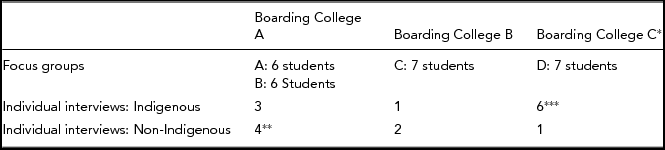
One should not classify all Indigenous people or groups as one and the same. All Indigenous communities differ considerably in their own right. They often have characteristics specific to geographic locations that hold significant variations in themselves (Price-Robertson & McDonald, Reference Price-Robertson and McDonald2011, p. 1). These character differences according to geographic location are evident across urban, rural and remote communities. While there are similarities, no two communities are identical. Kovach (Reference Kovach2012, p. 97) suggests that these characteristics have potentially profound implications for the explanation of story within research. Walter & Anderson (Reference Walter and Anderson2013, p. 59) note that storytelling (yarning) figures strongly within qualitative Indigenous methodologies as a form of communication, and as a means of transporting traditional knowledge. Russel Bishop (Smith, Reference Smith2012, p. 146) suggests that storytelling is a useful and culturally appropriate way of representing the ‘diversities of truth’, within which the storyteller rather than the researcher retains control. The stories narrated in this article are those of the following participants in my research as listed below, with the addition of one past student ‘Lisi’ whom I also interviewed, and who is not included in the table. For research purposes, all people mentioned in this article have taken on a pseudonym in order to preserve anonymity. The language used in this article is Kala Lagaw Ya. Kala Lagaw Ya is used in the Western Torres Strait Islands. A majority of the girls who participated in this study are originally from this region of the Torres Strait Islands. This language is considered endangered. There are less than 4000 people left in the world who can speak this dialect. ‘Outside the language area those younger than 30 are likely to speak Torres Strait Creole’ (SIL, 2016). Table 1 indicates a breakdown of students and staff, both Indigenous and non-Indigenous, who participated in the research project.
Boarding College Participant Information

*Boarding College C had a higher percentage of Indigenous staff. It was an all Indigenous, co-educational boarding college.
**One of the teaching staff pulled out of the research project after she had finished her interview. She was not comfortable going on record with what she had said during the interview process.
***One of the teaching staff did not send back the permission forms that allowed me to use what had been said in the interview.
Three boarding colleges participated. Boarding College A was an all-girl boarding college affiliated with a specific religion. Boarding College B was an all-girl, nondenominational boarding college and Boarding College C was an all-Indigenous coeducational facility.
In all, 26 girls of 7– 12 years participated in four focus groups across the three boarding colleges. These girls represented different communities in the Torres Strait Region. There were 18 individual interviews consisted of both teaching and nonteaching staff, boarding staff and ex-students associated with each college. Of the 18, one teacher did not want to be a part of the project postinterview and other one did not return any paperwork. These two had earlier decided to sign off to take part in the interview; however, once the transcript was completed, they changed their decisions.
Initially, a questionnaire was distributed to all participants in the focus groups. This questionnaire involved 10 general questions on perceived academic, cultural and social challenges. The answers to these questions directed what specific questions would be asked within the focus groups. Participation was voluntary with participants free to withdraw at any time.
As agreed to in the ethics application process, parental permission was required in order for the students to participate. This was obtained verbally during telephone conversations made with parents by staff contact personnel at each school who explained the project in full before formally asking for permission; parents then authorised Indigenous Liaison Officers (ILO) to sign on their behalf. Of all the parents of the Torres Strait Island students contacted, only one refused to allow her child to participate, fearing that this participation would affect her daughter's school work. However, the interviews and focus groups were held outside the class and did not affect class attendance.
Throughout the course of the project, participants were able to express their feelings freely in telling their stories about the process of transition between community and school. The participants, and particularly the girls from the Torres Strait Islands, were reminded throughout the entire process that what they had to say was important; and that their story was unique and their own. For me to be able to capture a true sense of how this process was for the participants, it was necessary that to make sure that they were comfortable so that we could maintain our connection throughout the interview process. I felt it necessary to gain a good rapport with the students so they were comfortable in sharing. I met with the girls on several occasions outside of the classroom environment, often socialising with them at lunchtimes in the ILO's office or joining them for dinner in the dining room.
Talking about family can reinforce a sense of identity and helps the speakers find common ground. A number of the girls were members of extended family groups and had relatives in common. When it came time for the interview, they were relaxed and opened up. We treated the focus groups like yarning circles, where girls could talk informally about any given subject.
The Journey Begins
Attaining an education usually has a positive economic impact on an individual—particularly in the areas of employment, income and health. This was evident in the outcomes for Indigenous peoples in the 2006 Australian Census. It was symptomatic that Indigenous peoples aged 15 years and over with higher levels of schooling were more likely to attain full-time employment than those with lower levels of education (Australian Bureau of Statistics, 2010).
Indigenous students represent 3.3% of the total student population. School attendance decreases as remoteness increases. For example: attendance at school for 17-year old students living in major cities was 44%; in very remote areas of Australia that figure dropped to 16%. At the time of the census 16,600 Indigenous students were reportedly attending school. Among these students, rates of attendance dropped from 73% at 15 years of age to 36% at 17 years of age (Australian Bureau of Statistics, 2010). This indicates that some students require assistance and support to address challenges that may be preventing them from staying in school and completing year 12. For some parents, boarding school is seen as an option in this instance; for others, it is the only option.
When you begin your quest for an education by starting school in the Torres Strait Islands you become part of a unique education system. Tagai State College (an Independent Public School that provides education and training services to the Torres Strait Nation) has 17 different campuses spread across 15 islands. It begins with early childhood education and continues on into adulthood with a TAFE facility attached to the school (Department of Education and Training, 2016).
While a secondary education is provided at Tagai's Waybeni (Thursday) Island campus, every year students of 7–12 years leave their Torres Strait Island communities for boarding colleges spread throughout Queensland. This ‘Rite of Passage’ to further one's education has now become generational; from conversations with the girls, I came to understand that it is expected; it takes place in most remote Indigenous communities across the region at the beginning of each school year.
The transition process begins even before a student turns up to school on the first day. Parents must select a school, contact ABSTUDY, which is a sector of the Australian Government's Human Services Department that assists with costs for Indigenous students who are studying or undertaking an Australian apprenticeship (Human Services Department, 2016), to organise payment for school fees and airfares, and then prepare their child to make the transition. For most students, the ability to attend boarding school is made possible due to the efforts of an entire family. For first time families, it can be an overwhelming experience; for many students, the day they leave for boarding school will be the first time that they have been on a plane.
Receiving a quality education while being so far removed from the security of a home community comes with a personal cost. When the girls from the Torres Strait Islands leave the comfort and familiarity of their communities for the ‘unknown’ of boarding schools, they are confronted with many academic, social and cultural challenges.
Boarding School
Historically, boarding schools have been used by colonising nations as a means of assimilating Indigenous people into dominant societies. The practice of assimilation involved the removal of Indigenous children from their families and placing them into mainstream institutions who would then instill the world-views of the dominant culture. Boarding and residential schools were highly valued. In order to rid the students of their ‘native ways’, they combined education with the physical separation from family, culture and language. Smith (2009, as cited in Benveniste, Disbray & Guenther, Reference Benveniste, Disbray and Guenther2014) discusses the focus of boarding schools in many areas being focused on training in domestic work or manual labor taking away the opportunities for Indigenous children to assimilate into higher levels or classes of society. Today in Australia, boarding schools still exist; however, these are not compulsory. They are, however, necessary for those students who live in remote communities such as the Torres Strait Islands and who wish to pursue secondary education and who have limited access to full Secondary Schooling within their own communities (Benveniste et al., Reference Benveniste, Disbray and Guenther2014 pp. 2–4).
This study took place at three different boarding colleges in regional Queensland. Boarding College A is an all-girls boarding college with a religious affiliation; Boarding College B is nondenominational, and an all-girls institution and Boarding College C is a coeducational, all-Indigenous college. While interviewing a diverse group of staff members from each of these boarding colleges, all of whom interact with boarders from the Torres Strait, it became clear that the nature of student/staff relationships is varied. This diversity likely affected the way that the staff understood the girls and the challenges they face, in terms of the transition process. From my observation, some seemed to be more empathetic than others to the nature of the journey that each girl takes from community to school.
At Boarding College B, one non-Indigenous staff member who is support person to the ILO (who at the time of the interview was also the Head of Boarding) is closely involved with the academic, social and cultural affairs of the Indigenous students. This relationship was strong and productive in terms of assisting Indigenous students in all aspects of their life. From the outset of the interview, it became clear that this staff member was open to learning best practice in terms of assisting with the transition process from the community to school. She made the following comment:
It's a big ask to ask a little 12 - going on 13-year-old girl to leave her home and her family and everything behind and . . . . unless people realise the depth of travel they've got to do to actually even come to our school and face a traditional Caucasian boarding school environment . . .
As stated previously, boarding college is not the only option; however, some parents see this as the only option. For Indigenous girls, life in the community presents various challenges, from poor health, teenage pregnancies, exposure to domestic violence and high rates of suicide.
Uini from Boarding College A speaks of her reason behind going to boarding school:
I've been to a state school before . . . I was terrible. I wagged school every day. Catch a bus to town. Yeah but then I realised that's not the path I want to take so I had to make a change and my mum didn't want me to go there [to the state school].
Gina, also from Boarding College A shares some advice her mum left with her:
My mum always tells us never to give up because she failed . . . she didn't go to University and she has high expectations for us (Bobongie, Reference Bobongie2016, p. 6).
Over the course of the interviews, it became clear that most students from remote communities of the Torres Strait Islands would experience a number of challenges when making the transition from community to school and that these could be grouped into three main areas: Academic, Social and Cultural.
Academic Challenges
Generally speaking, for some Indigenous Australians still at school, it can be difficult to see any connection between the curriculum and their life and opportunities beyond school. Peers and community members may not value school-based learning and so may not encourage a focus on study; therefore, regular attendance is not encouraged and consequently Indigenous children have fallen behind non-Indigenous students in areas of numeracy and literacy (Purdie & Buckley, Reference Purdie and Buckley2010). As well, many such communities deal with ongoing negative social attitudes of mainstream Australia (Skwirk, 2014); this further contributes to poor school attendance and educational achievement.
In many remote communities like the Torres Strait Islands, it is not uncommon for children to be competent in more than one language, with English not their primary language; for most, in fact, the English language is rarely heard outside the classroom (Osborne & Guenther, Reference Osborne and Guenther2013, p. 119). Lisi, a past student, spoke about overcoming her biggest academic challenge: speaking, listening to and understanding English:
Lisi: We were taught in broken English because we had an Islander teacher. Then Year 6 and 7 we had a white [Caucasian] teacher but most of the time we couldn't understand her. So we had a teacher aide there . . . translating into our broken English and then yeah, we'd understand it then.
My biggest challenge was speaking English because I didn't – I 've had a few sentences here and there in primary school but I've never actually spoken a whole paragraph of English . . . I knew my native tongue and Creole, which is broken English. There are a little bit of English words in there but not enough for you to understand a teacher (Bobongie, Reference Bobongie2016, p. 3).
Purdie & Buckley (Reference Purdie and Buckley2010, as cited in Bobongie, Reference Bobongie2016) emphasise that struggling with low language literacy levels can potentially affect all facets of academic learning. Being behind academically contributes significantly to the social and emotional issues affecting student learning.
Janie, a Year 11 student from Boarding College A commented:
English is my fourth language. [In class] I can't keep up. I dropped down from OP; it was so hard. I failed the first time. All the other girls in my class they understand but I don't want to keep the class behind so I just dropped out (Bobongie, Reference Bobongie2016, p. 3).
Betty from Boarding College B related her initial shock of transitioning from community to school:
Primary school is so easy. I came to Grade 8. I was so dumb. I didn't even know how to write a paragraph, I didn't know what an assignment was. The only thing I was good at was Math. That's about it. We barely did English. When I first came here I just wanted to go back home because I didn't know what I was doing half the time. I'd never used . . . I didn't even have a laptop . . . I could barely type . . . it was just different.
Some schools enjoy a more abundant range of resources than others. Assistance in English is not always readily available, which can be disadvantageous for those students who need the extra help. Tracey, from Boarding College C, felt that support was lacking at this school: ‘There is no help from the Teachers and the Teacher Aides don't do anything’. In contrast, in Boarding College A and Boarding College B tutored sessions in English were available after school.
Boarding College B has a number of students on scholarship who appear to thrive on the academic component of school. With a scholarship there comes an expectation of achievement in order to keep the scholarship. These girls were driven and expressed a desire to achieve:
Deidre: I reckon they [the teachers] should push us more. Even if you don't want it they should keep pushing us even if you come up with excuses.
Thus, the initial experience of school is different for every girl, depending largely on the resourcing and support made available to them. As well, their prior experience of school has a direct impact on their ability to settle in at one of the boarding colleges. Those who have been adequately supported within their own communities and have acquired a good knowledge of English, or who are well supported once at boarding school find it easier to manage the transition. Those who lack community support and further targeted support at their particular boarding college struggle to survive the process.
Social Challenges
Missing family and having family support continues to be one of the biggest challenges when making the transition to a boarding college, as can be seen from the experiences of past and present students including Lisi, who made the transition 10 years before the other students interviewed:
Lisi: I think I missed my family the most and my best friend because we couldn't go to school together, yeah . . . we didn't have mobile phones back then. The three wall phones that we did have had lines of seven people waiting so it [communication] wasn't as much as I wanted to, yeah . . . . It was hard. I stuck to myself for a good few months. I didn't speak to anybody. If I had to go somewhere, we had a Big Sister/Little Sister program. When we went somewhere I was always with my Big Sister but yeah, it was – I didn't make friends for the first couple of months.
Landi, from Boarding College C commented:
I was nervous and afraid. I didn't know what to do [when I first arrived]. There was this one girl who came with me at the same time, but then she went home on holidays and she didn't come back in the second term.
It is not unusual to find that some students do not return to school after going back to the family home for school holidays. Many students experience homesickness and are simply unable to bring themselves to return once they arrive home. However, life in these home communities, particularly for Indigenous girls, comes with a unique set of challenges. These include: high levels of family unemployment, poor housing, domestic violence, teenage pregnancies, bullying and racism and low expectations (Driscoll & Lea, Reference Driscoll and Lea2011). It is difficult for many Indigenous parents to imagine a life free from disadvantage when that is all that their family has known for generations (Australians Together, 2016) and thus the girls are not always encouraged to return to school. Challenges that further impact negatively on one's experience of school include absenteeism and a lack of educational achievement.
It is not uncommon for these challenges to transfer from the community to school.
Gandra from Boarding College C was open about what she has observed at school:
At night when girls run away to the school grounds and stuff, like for boyfriends, smoking weed, smoking drugs and drinking. They go buy it because they know where to sell it. They are strict here so the younger kids do what they're told, but once they become older kids . . . they learn how to sneak out.
Indigenous students are at risk of poor school attendance and not completing year 12. As stated previously, boarding college is not the only option. Education for these girls, however, is not limited only to what is learned at school. An individual's entire social environment will contribute to his or her educational outcomes. And the capacity to learn will be affected by circumstances such as living conditions and the presence of influential people or characteristics that shape each individual and establish identity. As mentioned, negative social attitudes of mainstream Australia can and do affect community attitudes toward education and affect the way the girls relate to non-Indigenous students at their boarding schools (Skwirk, 2014).
During the course of the data collection, phase I had the opportunity to sit with a number of girls from Boarding College B. During one informal conversation, two of the girls started randomly talking about friendships:
Geraldine: I've got a question. How come an Indigenous student makes friends with the other Indigenous kids first at school?
Betty: Because they feel more comfortable around their own people. Yeah, it's just like to start off with. Like with me when I first came here I was just with all the other Island girls and then after a while my sister told me, try and make other friends. You don't know, maybe you'll turn out liking them. Then I've been with the same girls for ages now.
The interview process gave me the opportunity to ask some of the girls if they had ever felt ‘left out’ in class. Dorcas, from Boarding College A, made this observation about how she feels in class:
I'm the only black in the class. They ask me [questions] but I don't know what to say. Sometimes I'm afraid to give the wrong answer. They [the other people in the class] laugh at you. I don't know what's funny. I laugh because I don't know what they are laughing about so I laugh because they laugh. They think I laugh because of myself.
This comment led to further comments from two of the other girls present:
Joan: If you're in a class and you're the only Indigenous one in there, everyone gets into groups and you're the only one left out. You want to be included in the group. You feel like you should have another black person in the class with you. I always feel that way.
Kay: If I'm the only one [Indigenous person] I don't feel included. Its like they don't want you to be there, like I'm different. I'm not saying they're racist but I just don't feel like they want me there. They'll talk but they just leave you out from the talk when you're in a group with them. I just sit and listen to them, I don't want to look like an idiot or try ruin their conversation (Bobongie, Reference Bobongie2016, p. 3).
Cultural Challenges
Understanding the deep cultural and customary traditions that establish a community contributes to the identification of factors that shape attitudes and values expressed in a multitude of ways in daily life that are the foundation of current cultural practices. Indigenous Australians come from different cultural groups and have beliefs and values, or styles of communication that are different from non-Indigenous Australians (Commonwealth of Australia, 2005). For teachers and support staff to deal effectively with the Island girls, it is important to understand something of the cultures from which the girls originate, how beliefs and practices in the Islands may differ from those carried out in mainstream Australia, and how encountering those differences may be experienced by the girls.
The responses of the interviewees showed that cultural implications impede the transition process in three main areas: family and food, culture and language. They also indicate that there is a long way to go in terms of closing the gap as far as educating people and gaining a widespread understanding about Indigenous culture in Australia, as is evidenced by a number of responses from girls who participated in the study discussed below:
Lisi: I was really homesick but I was excited to experience something different. Well my parents were strict so I never really had the freedom that I wanted. My father's a priest so whatever we did outside of home reflected back on him, so it wasn't really I can do whatever I want, whenever I want. The most we'd do at home is go fishing. I think that was the one thing that I missed the most is walking down to the beach and then going fishing.
Lisi's comment spoke to the fact that she saw fishing as ‘her’ cultural thing and that her religion contextualised it and that it was an important aspect of her personal freedom and that it held a cultural meaning far beyond the simple act itself. Torres Strait Island culture is not all about fishing of course; however, that is a significant part, an integral aspect of community that students leave behind when they go to boarding school.
There may be traditions or taboos about certain issues. Some Indigenous Australians avoid saying the name of a person who has recently died. For others, eye contact with another person during a conversation is a sign of disrespect. When someone has experienced a bereavement, or ‘Sorry Business’, there will be a resulting rise in absenteeism at school, which can create difficulties for the student if not understood in the cultural context from which they originate. If the teaching and support staff are not familiar with these and other significant aspects of Indigenous culture, and therefore fail to respond appropriately, culture becomes an obstacle to mutual understanding and the formation of supportive relationships.
Adequate cultural education is of course key; when this is lacking, the students encounter many misconceptions and stereotypes concerning Indigenous culture and communities. The participants from Boarding College A were able to laugh most of them off. For example:
Janie: [sometimes people ask me] . . . ‘can you ride dugong?’ Yeah I'm riding them all the time.
Dorcas: They say: ‘Do you catch boats to each other's islands or is there a ferry service?’
However, not all comments and questions can be laughed away:
Judy: They ask me silly questions: ‘Do they get raped over there? Do they get robbed?’ I said there are only 200 people [on the island]; we all know each other. Well, she [my teacher] told us to write about agriculture and then she turned to me and this other girl and she said: ‘because you're not from Australia, write [about] from where you come from, like your are’. All the other colare [white] girls said Australia is – Torres Strait it is a part of Australia but she just said, ‘no it isn't and . . . do your work’, and she had a grumpy tone.
Family and Food
Indigenous Australians see the family structure as providing all the psychological and emotional support they need. Anything needed doing is accomplished through the Indigenous kinship system. Children are not the sole responsibility of their biological parents, but of the entire extended family. It is not uncommon to see grandparents and even great grandparents raising children (Musswelbrook Shire Council: Walking Together Reconciliation Committee, 2016). Education is seen as an investment. Everyone plays an important role. Often the whole entire family will work together to ensure that any children attending school will be provided for.
This sometimes places a burden on those attending school and they may feel guilty for using the family resources this way:
Lisi: I don't really know. . . [how my family could afford to send me to school]. . . It's not a question that I asked. My two older sisters took care of it. I don't know how they did it but I found that they were working a lot. When we'd have functions down at school, they could never afford to come. Yeah, not even for Year 10 grad. Even when my younger siblings started coming, they couldn't even escort them down. We had to – well, they jumped on the same flight as us so.
Betty from Boarding College B was very aware of the sacrifices her parents made so that she could attend school. ‘I feel so bad coming to school. Its so expensive, I just feel so bad’.
Traditional food is something the girls away from Island homes miss the most, and they describe adjusting to unfamiliar foods as one of the most difficult processed of transition. Food, both the preparation of and eating, is integral to the Torres Strait Island way of life. Research in this area is very limited, but I know from my own knowledge and personal experience of this particular culture, that this is the case. Every event both minor or major revolves around food: family visitors, yarning, births, deaths and celebrations. The type of culturally traditional food eaten in the Islands is very different to that traditionally eaten on the mainland of Australia:
I took a moment to sit in the office of the Indigenous Liaison Officer at Boarding College A. As I sat catching up on work, a student came into the office groaning. She had a stomach-ache. She proceeded to tell us [the ILO and I] that she thinks it's the beef that she had for dinner the night before. She said it wasn't the first time it had happened, as she wasn't used to eating beef (Observation, 2015, FB).
This was not the only time that the subject of food was raised. During each of our focus groups, the participants were asked what they missed the most about home and each time food was discussed at length, as well the girls made reference to some of the misconceptions non-Indigenous people held regarding traditional Indigenous food, as mentioned in the excerpt below, taken from Bobongie (Reference Bobongie2016, pp. 3–4).
Boarding College A:
Janie: I miss eating island food: fish, crayfish and turtle and not being able to see my mum and dad every day.
Clara: We miss seafood . . . we carry it down [from home] but it's kind of hard for us. It's easy to carry it down but it's hard to cook it because they [the other boarders] get put off [by the smell] and we've got nowhere to cook it.
Judy: We always get lectured about our food from our boarding supervisor, you know. She's says: ‘I don't know how you people can do that [eat turtle and dugong]. That's disgusting. That's cruel’, and I'm like, well, that's our culture.
Boarding College C:
Gandra: Last night we had mince. It was supposed to be shepherd's pie and it just tasted awful and looked like dog food.
Landi: We don't eat meat often in the boarding. We have chicken, roast whatever that is . . . lamb?
Tomsana: It depends how the food comes out. It depends how it tastes, how they cook it and like [sometimes] it's half raw, not even cooked through.
Gandra: Last year we used to have like an Indigenous cook. She cooked really good food.
Culture
A study conducted by Mander (Reference Mander2015 p.184) revealed that education was perceived by Indigenous parents as a means of meeting the expectations of past generations. They wanted their children to retain ‘a strong sense of connect to culture and identity’ and they thought that the more time that was spent away from home focussing on their education, the more cultural disconnect may occur. Gollan and Malin, (2012, as cited in Mander, Cohen & Pooley, Reference Mander, Cohen and Pooley2015a, p. 325) states that: ‘Schools that work effectively with Aboriginal students are characterised by strong leadership that is committed to confronting and working against covert discourse that disenfranchise Aboriginal studies and families’. The way that cultural practices and principles are incorporated into the practices of each school practices varies between schools, and the way that each culture is shared or displayed is dependent on who drives the sharing process within that particular school.
Clara and Janie, from Boarding College A, shared their experiences of maintaining a sense of her own culture while at school:
Clara: I don't feel like I belong here because it's just - it feels like - it just feels like that we can't display our culture in any way.
Janie: There was one time where another girl was island dancing and the boarding supervisor told us not to do it and we were like why? She's like, ‘because you can't do that’. And we said: ‘Everybody has a right to culture’. She said: ‘But you can't do it here’ . . . we were offended. (Bobongie, Reference Bobongie2016, p. 4)
Boarding College C is an all-Indigenous school, and the Torres Strait participants are only a small minority in comparison with the members of so many other Indigenous cultures attending the school. They shared a number of the difficulties they have in expressing their own culture, feeling that their culture was underrepresented:
Tomsana: Yeah, well the teachers respect our cultures, but we're not too sure about the students. I think our traditional dance . . . needs to be shown often and its not.
The participants at Boarding College B feel that they are always encouraged to share and express their culture:
Geraldine: They [the teachers and students] ask us questions where we come from and what it looks like. They ask us to show them pictures and also they let us display it at NAIDOC (see National NAIDOC committee, 2016) assembly.
However, a number of the older girls get upset with the younger girls if these do not contribute when they have the opportunity:
Deidre: It's sometimes annoying though because when we get asked to do it we have some girls who are so proud of their culture but they won't perform or anything. It just annoys me.
Language
(Arbon 2007; Ford, 2010; Herbert, 2006b; Patrick et al. 2008; Yunupingi, 1993, in Bat & Guenther, Reference Bat and Guenther2013, p. 128) portray the roles that land, family story and language play in the formation of identity and how it is integral to the learning context as part of the education system. Being able to speak ‘language’ with each other while away from home was of great importance to the participants. In most cases, they had permission to speak to each other in their own language; however, for some this was not encouraged. Every student interviews alluded to the fact that speaking, listening to and understanding English was the hardest adjustment academically when making the transition to boarding school. They all felt unprepared and struggled at first. For those students with access to tutoring and extra support the transition process was less stressful. The students who had no access to tutoring and extra support continued to struggle; they felt that this impacted on their overall grades:
Judy: When we speak in broken English [Creole]. . . when we're speaking our language we're not allowed to. We understand that others can't understand us. One stage we were out here. We were studying and speaking our language and then the boarding executive walked in and then she said something to [a student] and then she [the student] said ‘I sabe’ [I understand] and then the head of boarding told her ‘speak in English don't speak in your language because I don't know what you are talking about’. The boarding supervisor came up this close and said ‘Speak English!’ Yeah she was in her face and the student got upset and angry, but she calmed herself down.
As mentioned, the initial experience of school is different for every girl, depending largely on the resourcing and support made available to them. A lack of community support and cultural understanding can make it very difficult to negotiate the transition process successfully.
Conclusion
I first met Lisi, 10 year ago; she had already attended boarding school for a year. At that meeting she did not present any obvious signs of being shy or anxious. However, when I spoke with her 10 years later, she explained that initially she did experience those feelings of anxiety and nervousness that many of the girls felt even today. The shyness eased as she became more confident and familiar with what was expected at the boarding school.
Lisi, who now is a young mother with three children, lives in one of the communities of the Torres Strait Islands. At the time of the interview she worked in retail on the mainland supporting her husband and three children. She has only just returned to take up a local government position after spending 6 years living on the mainland once she had completed boarding school in regional Queensland in 2009. She is grateful for the opportunity she was given to go to boarding school:
Lisi: It was better for me to go away to boarding school. It helped. It made me want to learn English and speak English. . .In a way it made me feel independent. . .I think going to boarding school was better than Thursday Island. I've got a fiancé and three kids - a son who's eight, a daughter who's seven and another daughter who's five. [Working in retail]. . . It's not something that I want to do for a long time. It's just a job that pays the bills and looks after the kids. Boarding school's done me good. I don't regret anything.
To attend university has always been a dream for Lisi. She wants to be a social worker and give back her services and skills to her community. She has seen firsthand the negative challenges of living and staying in the community, and understands how certain issues might be better navigated by those with a good education:
Lisi: I have finished Year 12. I went back home. I was supposed to only have a couple of months' break but then my parents got sick. So I've put my life on hold to look after them. . .[If I could do anything I would go to university] and study to become a social worker. . .In the Torres Strait I've seen a lot of kids get taken away from their families. . .[because of] alcohol, domestic violence in the household. . .
Lisi's story highlights the potential long-term advantages of boarding school. Her experiences, good and bad, continue to drive her quest to seek further education so as to be able to better provide for her family and also contribute to creating social change in her community.
However, even though 10 years have passed since she was a student; students leaving the Torres Strait Island communities for Boarding School currently are still experiencing issues similar to those faced by Lisi. This indicates that more comprehensive and targeted strategies are needed to help with the transition process. It is imperative that the girls actually making this transition now are listened to and their narratives are used as the basis to create appropriate changes for the future.
The debate about the advantages and disadvantages of leaving communities for boarding school will no doubt continue until a broad and responsive mix of strategies to assist with the transition process is in place. The diverse range of resources available on hand to assist with the transition process affected the outcomes experienced by the girls, particularly in how the needs of each student were attended to, and the level of informed and appropriate staff interaction. The girls participating in the research keenly felt the importance of education and did not want to disappoint their families, but conveyed clearly the difficulties of the transition process and its impact on their ability to achieve. It can only be hoped that once there is a more extensive range of strategies in place be identified to alleviate the transition process, other girls who travel from their communities in the Torres Strait to attend can experience similar results.
About the Author
Based at the Indigenous Research Unit at Griffith University, Francis Bobongie is a Postdoctoral Research Fellow working with Griffith Institute for Education Research (GIER). Completing her Doctorate of Professional Studies at CQ University in 2011, Francis's focus is on Pacific and Indigenous Studies concentrating on gender and education. She has Australian South Sea Islander and Indigenous ties to the Mackay Community in North Queensland. Francis's Postdoctoral Fellowship is looking at the academic, social and cultural challenges affecting girls who leave their communities in the Torres Strait Islands for boarding schools in regional Queensland.