1. Introduction
Sinters are siliceous hot-spring deposits typically developed in topographically low areas of active terrestrial volcanic regions (Sillitoe, Reference Sillitoe and Kirkham1993), originating from near-neutral pH, alkali chloride or acid–sulphate–chloride waters produced from crustal circulation of magmatic fluids with variable inputs of groundwater (e.g. Fournier, Reference Fournier1985; Schinteie et al. Reference Schinteie, Campbell and Browne2007). At the Earth’s surface, spring vents emit thermal fluids which cool (~100 °C to ambient) as they discharge along channels into pools, and over aprons and terraces, finally spreading out in their distal reaches to create geothermally influenced wetlands, all the while precipitating opaline silica that entombs the in situ biota and preserves a record of the local geothermal landscape (e.g. Walter, Reference Walter and Walter1976; Jones et al. Reference Jones, Renaut and Rosen1997; Guido & Campbell, Reference Guido and Campbell2009, Reference Guido and Campbell2011, Reference Guido and Campbell2014; Guido et al. Reference Guido, Channing, Campbell and Zamuner2010; Campbell et al. Reference Campbell, Guido, Vikre, John, Rhys and Hamilton2019). This gradient in temperature, together with pH and fluid composition, collectively controls the formation of the various sinter facies associations representing vent-to-marsh (palaeo)environments, many of which are microbially dominated, especially in mid-slope and distal apron areas (e.g. Cady & Farmer, Reference Cady, Farmer, Bock and Goode1996; Jones et al. Reference Jones, Renaut and Rosen1998; Channing et al. Reference Channing, Edwards and Sturtevant2004; Schinteie et al. Reference Schinteie, Campbell and Browne2007; Guido & Campbell, Reference Guido and Campbell2011). Over time, with structural water loss and sometimes little to no burial, opaline sinter diagenetically transforms to cristobalite–tridymite and then to microcrystalline quartz, in some cases encasing and preserving associated organisms in exceptional detail (Trewin, Reference Trewin1994, Reference Trewin, Bock and Goode1996; Lynne & Campbell, Reference Lynne and Campbell2003; Guido et al. Reference Guido, Channing, Campbell and Zamuner2010; Guido & Campbell, Reference Guido and Campbell2014; Campbell et al. Reference Campbell, Guido, Gautret, Foucher, Ramboz and Westall2015 a, b). The biotextures produced by rapid and in situ silicification of the mainly microbial communities are generally robust and may be found in palaeo-geothermal fields back to the Archaean (Djokic et al. Reference Djokic, Van Kranendonk, Campbell, Walter and Ward2017), and potentially also in >3-Ga-old sinters on Mars (Ruff & Farmer, Reference Ruff and Farmer2016; Ruff et al. Reference Ruff, Campbell, Van Kranendonk, Rice and Farmerin press). Thus, study of younger analogue sinters and their biosignatures is warranted in order to better understand the nature, distribution and preservation of microbes, including extremophiles, into the ‘deep time’ geological record on Earth and perhaps elsewhere (Walter & Des Marais, Reference Walter and Des Marais1993; Farmer & Des Marais, Reference Farmer and Des Marais1999; Westall et al. Reference Westall, Campbell, Breheret, Foucher, Gautret, Hubert, Sorieul, Grassineau and Guido2015, Reference Westall, Hickman-Lewis, Hinman, Gautret, Campbell, Bréhéret and Brack2018; Cady et al. Reference Cady, Skok, Gulick, Berger and Hinman2018).
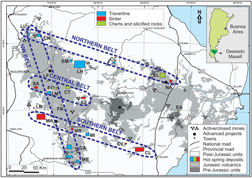
The Deseado Massif geological province, located in Argentine Patagonia, is a 60,000 km2 region characterized by an extensive (>30 000 km2), Middle to Late Jurassic, bimodal volcanic event known as the Bahía Laura Complex (Echeveste et al. Reference Echeveste, Fernández, Bellieni, Tessone, Llambias, Schalamuk, Piccirillo and De Min2001; Guido, Reference Guido2004). It marks crustal thinning during initiation of the opening of the South Atlantic Ocean (Pankhurst et al. Reference Pankhurst, Riley, Fanning and Kelley2000). This extensive volcanism is associated with regional epithermal gold and silver mineralization and numerous hot spring occurrences (Schalamuk et al. Reference Schalamuk, Zubia, Genini and Fernández1997). Deseado Massif hot-spring related deposits comprise 23 localities over a 230 × 230 km area (Guido & Campbell, Reference Guido and Campbell2011), consisting of 9 sites with travertines (some subsequently silicified), 8 reported sinter deposits, and 6 chert and/or silicified rock occurrences (Fig. 1), together hosted in tuffs and reworked volcaniclastic sediments within fluvial and/or lacustrine settings (Guido & Campbell, Reference Guido and Campbell2019 a). This study constitutes a detailed analysis of the Deseado Massif sinter deposits, which enabledconstruction of a more comprehensive facies model for sinters of the region, including geographically adjacent, hydrothermally influenced, silicified fluvial and lacustrine strata, that are broadly associated in time and space (cf. Des Marais & Walter, Reference Des Marais and Walter2019; Hamilton et al. Reference Hamilton, Campbell and Guido2019; Djokic et al. unpub. data; Teece et al. unpub. data). Importantly this contribution also confirms, using petrography and Raman spectroscopy studies, that microbial life abounds across the full range in temperature gradient (vent to distal apron) of a Jurassic hot-spring system, the signatures of which can be compared to other similar hydrothermal deposits of different ages and locations, where conditions for quality preservation have been met.
Summarized Deseado Massif geological map with location and discrimination of hot spring deposits, and Au–Ag mines and advanced projects. Hot spring deposits were analysed in detail for this contribution (see text) and are divided here into travertine (blue), sinter (red), and cherts and silicified rocks (green). Inset with location of the Deseado Massif geological province in Argentina (modified from Guido & Campbell, Reference Guido and Campbell2011). LU: La Unión, CN: Cerro Negro, CC: Cerro Contreras, LL: La Leona, NA: Cañadón Nahuel, EM: El Macanudo, LH: La Herradura, EA: El Águila, SA: San Agustín, LF: La Flora, LM: La Marcelina, EO: Esperanza Oeste, CT: Cerro Tornillo, LJ: La Josefina, FN: Flecha Negra, LB: La Bajada, MA: La Marciana, MR: La María, MI: Monte Illiria, CV: Cerro Vanguardia, CL: Claudia, CA: Cerro 1 Abril, ME: Manantial Espejo). Four major linear belts are shown (dashed lines), as identified in Guido & Campbell (Reference Guido and Campbell2011) – Northwestern (NW), Northern, Central and Southern – based on alignment of five or more hot spring deposits.

2. Deseado Massif sinter distribution and facies model
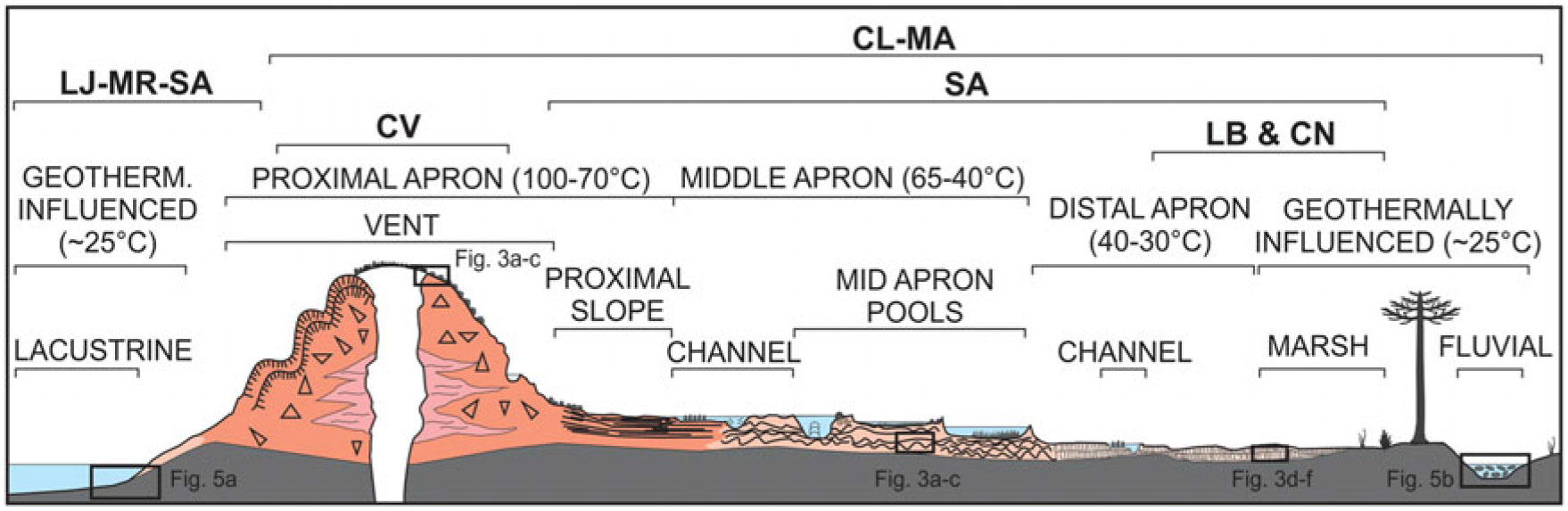
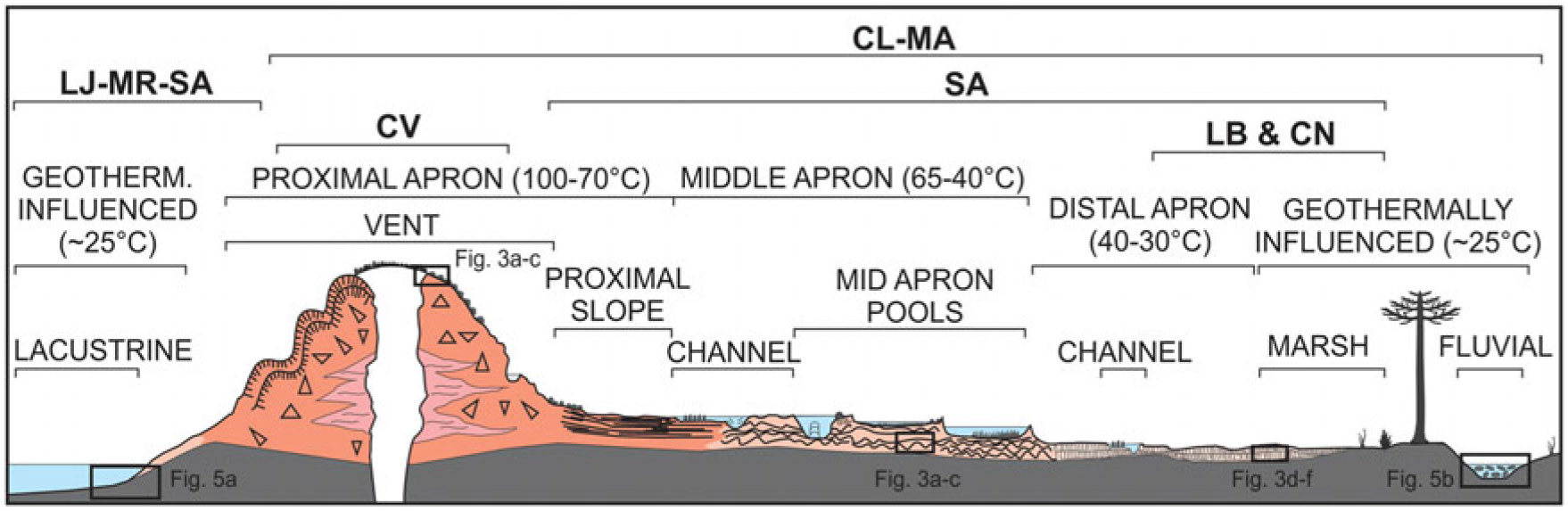
There are a total of eight deposits reported as sinters in the Deseado Massif: La Josefina, La Marciana, La María, San Agustín, Claudia, La Bajada, Cañadón Nahuel and Cerro Vanguardia (Guido & Campbell, Reference Guido and Campbell2011 (and references therein), Reference Guido and Campbell2014; García Massini et al. Reference García Massini, Escapa, Guido and Channing2016, Reference García Massini, Escapa, Guido, Nunes, Savoretti and Bippus2017). Most of these deposits were visited for this study, and all their published information analysed in detail to identify those containing a complete facies gradient and which also are well preserved – i.e. showing rapid and early silicification with minimal to no signs of late-diagenetic overprinting processes – thus maximizing potential for retention of primary biofabrics and/or body fossils. From this analysis, a summary of facies and facies associations is presented for the reported sinters of the Deseado Massif, including geographically associated hydrothermally influenced settings (Fig. 2). This extended facies model is based on updating of the spatial distributions and characteristics of the fossil alkali chloride sinter facies, and also adding the affiliated spring-related lacustrine and fluvial environments that we identified in detailed study of the larger palaeo-hydrothermal system at Claudia (Guido & Campbell, Reference Guido and Campbell2019 b) and at La Josefina (PhD thesis study in progress). Details of the sinter apron facies are not shown in Figure 2, as the schematic diagram has recently been published elsewhere (Guido & Campbell, Reference Guido and Campbell2019 a); therefore, the model presented here is rather intended as a broad reconstruction of the varied hydrothermal settings of the Deseado Massif. The complete updated suite of the now >20 sinter apron textures with palaeoenvironmental significance is illustrated in Teece et al. (in press?). A summary of our findings (Fig. 2) is that La Josefina (LJ) and La María (MR) represent lacustrine-influenced, Fe-rich hot spring deposits, with local travertine occurrences and acid overprinting in places. In the case of La Josefina, the hydrothermalism includes an Au-rich mineralization event (Fernández et al. Reference Fernández, Pérez, Moreira, Andrada, Albornoz and Penzo2005). Furthermore, La Bajada (LB, García Massini et al. Reference García Massini, Escapa, Guido and Channing2016) and Cañadón Nahuel (NA, García Massini et al. Reference García Massini, Escapa, Guido, Nunes, Savoretti and Bippus2017) are considered as distal marsh, plant-rich sinter facies. Moreover, Cerro Vanguardia (CV) is interpreted as representing acid overprinted, Fe-rich silica vents. Most of the above-mentioned deposits are undergoing further study, outside the scope of this contribution. From this regional evaluation, we found that the most complete sinter aprons preserved in the Deseado Massif are present at the San Agustín (SA), La Marciana (MA) and Claudia (CL) localities (Fig. 2).
Schematic cross-section of the Deseado Massif sinter deposits with location of the eight reported sinters (see text) with respect to their broad sedimentary facies associations (modified from Guido & Campbell, Reference Guido and Campbell2011), in particular, the sinter apron (proximal, middle and distal apron), and geothermally influenced lacustrine and fluvial palaeoenvironments. Black rectangles represent the relative location of the studied samples into this facies model. See Figure 1 for locality names affiliated with these abbreviations. See Teece et al. (in press?) for detailed distribution of microbial textures on sinter aprons.
3. Carbonaceous material in sinter
Following discrimination of the sinter aprons from other hydrothermally influenced deposits in the Deseado Massif (Fig. 2, Section 2), more detailed assessment was conducted on the preservation of primary lithofacies and biofacies (cf. Walter et al. Reference Walter, Des Marais, Farmer and Hinman1996; Farmer, Reference Farmer2000) of the sinters at three localities: San Agustín, La Marciana and Claudia. From this perspective, Claudia, specifically the Loma Alta sinter outcrop, shows the best-preserved textures within early diagenetic rock samples (see Guido & Campbell, Reference Guido and Campbell2014). This outcrop was therefore selected for more detailed study of its petrography, along with a Raman spectroscopy determination of the presence, proportion and specific location of carbonaceous material (representing fossilized microbial remains) across the entire palaeo-temperature gradient of the sinter apron: i.e. proximal vent, mid-apron and distal apron (Fig. 3 and online Supplementary Material at https://doi.org/10.1017/S0016756819000815).
Raman spectroscopy compositional maps were made at the Centre de Biophysique Moléculaire, Orléans, France, using a WITec Alpha500 RA system and a Nd:YAG frequency doubled green laser (excitation wavelength 532 nm). Large scans were carried out using an objective Nikon E Plan 20× (N.A. 0,40). The detailed parameters of each map are displayed in the figure captions (see Foucher et al. Reference Foucher, Guimbretiere, Bost, Westall and Maaz2017 for detailed Raman mapping description).
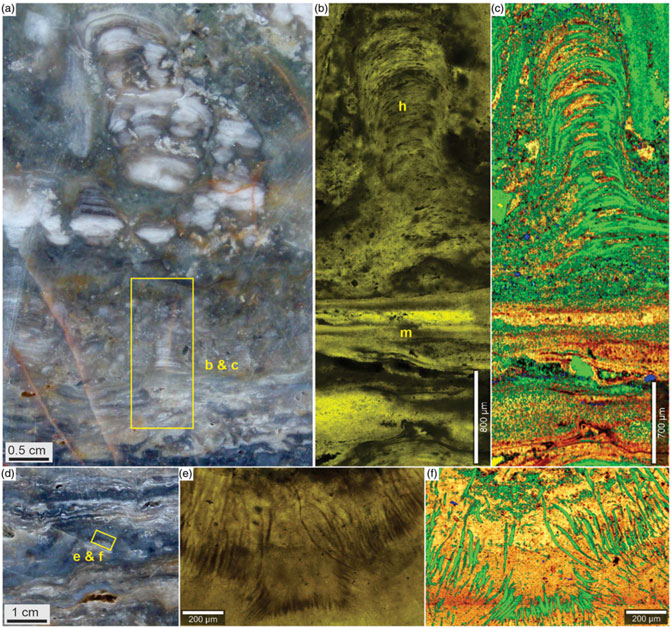
Two selected Loma Alta sinter samples are described and evaluated here from the Raman spectroscopy determinations, as they have the most impressive preservation of microbial textures compared to all the sinters we have examined in the Deseado Massif. The first sample comprises textures that show a stratigraphic transition from mid- to high-temperature sinter facies (Fig. 3a) with, respectively, grey and black-to-brownish coloured, wavy laminated fabrics overlain by whitish geyserite with spicular to nodular textures. The textural transition between the inferred two temperature regimes was the selected location for focused petrographic observations, with typical digitate geyserite textures overlying mid-temperature bubble mats and wavy laminated fabrics (Fig. 3b) (see Cady & Farmer, Reference Cady, Farmer, Bock and Goode1996; Guido & Campbell, Reference Guido and Campbell2011; Lynne, Reference Lynne2012 for detailed descriptions of environmentally significant, temperature-dependent sinter textures). The matrix surrounding the geyseritic spicule is darker in colour, and represents low- to mid-temperature silica that infilled the spaces between spicules as the spring discharge cooled, following waning of vent geyser activity, a common occurrence in geothermal areas (cf. Campbell et al. Reference Campbell, Guido, Gautret, Foucher, Ramboz and Westall2015 a, Reference Campbell, Guido, Vikre, John, Rhys and Hamilton2019). Raman spectroscopy shows the presence of carbonaceous material in the three different temperature-dependent facies studied from the Loma Alta sinter (Fig. 3c). The high-temperature geyseritic texture contains abundant kerogen between the stromatolitic laminae (online Supplementary Material at https://doi.org/10.1017/S0016756819000815), and is especially rich in the darker-coloured silica. The mid-temperature fabrics have less abundant kerogen, and this is also related to the darker, grey to black coloured silica laminae. The low-temperature sinter matrix draping and filling in around the geyserite spicule has an abundance of carbonaceous material. Besides silica and kerogen, the Loma Alta samples contain dispersed grains of anatase in all three temperature-related silica fabrics and rare calcite in the transition between the mid- and high-temperature facies. Anatase is a low-temperature polymorph of titanium dioxide, which may indicate local tuffaceous and aeolian inputs within volcanic–hydrothermal terrains (e.g. Trzcinski et al. Reference Trzcinski, Humayun, Gibbons, Zanda, Colas, Egal, Maquet, Reich and Sanchez Yañez2018).
Detailed petrographic and Raman spectroscopy studies from the complete temperature range of facies (~100 °C to ambient) for the well-preserved, Jurassic sinter apron at the Loma Alta locality, Claudia deposit, Deseado Massif, Patagonia, Argentina. (a) Photograph of a polished rock slab with location of the studied area (b, c) shown by a yellow box. (b) Photomicrograph of the transition from middle- (m) to high- (h) temperature sinter facies. (c) Raman spectroscopy compositional map of (b), with quartz in orange, kerogen in green, anatase in dark blue, calcite in light blue and resin in yellow (scan parameters: 4000 × 1500 µm, 520 × 195 spectra, laser power 8 mW). (d) Photograph of another polished rock slab with location of the studied area (e, f) shown by a yellow box. (e) Photomicrograph of microbial filaments in palisade fabric interpreted as representing the low-temperature sinter facies. (f) Raman spectroscopy compositional map of (e) with quartz in orange, kerogen in green and anatase in dark blue (scan parameters: 1200 × 800 µm, 480 × 320 spectra, laser power 5 mW).

The second Loma Alta sample shows interbedded mid- to low-temperature sinter fabrics (Fig. 3d), with a wavy laminated texture and preserved (not recrystallized) bubble mats in creamy to grey coloured laminae, together with thicker (to ~0.5 cm thick) and, in places, massive layers of a darker, grey to black coloured silica inferred as low-temperature sinter (cf. Campbell et al. Reference Campbell, Sannazzaro, Rodgers, Herdianita and Browne2001, Reference Campbell, Lynne, Handley, Jordan, Farmer, Guido, Foucher and Perry2015 b). These layers were studied at the microscale and show a vertical arrangement of black coloured, tubular micro-pillars (to ~1 mm in length), densely packed in places and aligned perpendicular to the lamination (Fig. 3e). These features are interpreted as microbial filaments similar in morphology and geometry (with respect to laminae) to those displayed by the Calothrix cyanobacterium in distal sinter aprons, and therefore they represent a palisade fabric with excellent preservation (cf. Campbell et al. Reference Campbell, Lynne, Handley, Jordan, Farmer, Guido, Foucher and Perry2015 b and references therein). Raman spectroscopy confirmed that these fossil microbes still contain internal remnants of carbonaceous material, detected as kerogen (Fig. 3f), together with small amounts of anatase disseminated in the siliceous matrix.
4. Discussion
Raman spectroscopy (Section 3) confirms the presence of kerogen (organic matter) and silica (quartz), with small amounts of anatase (titanium dioxide) and calcite in the matrix (online Supplementary Material at https://doi.org/10.1017/S0016756819000815) in the Claudia sinter of the Deseado Massif. The co-location of carbonaceous material with varied textures considered microbial in origin was found across the complete inferred palaeo-temperature facies range of the Jurassic Claudia sinter apron, including within geyserite laminae. While geyserite was once considered to be abiogenic owing to its temperature of formation thought to be too high for life to flourish, more recent molecular and other studies of geyserite have indicated a biogenic component, whereby the silica forming under splashing and surging conditions at the spring vent becomes coated in extremophile biofilm (e.g. Cady et al. Reference Cady, Farmer, Des Marais and Blake1995; Cady & Farmer, Reference Cady, Farmer, Bock and Goode1996; Blank et al. Reference Blank, Cady and Pace2002; Jones & Renaut, Reference Jones and Renaut2003; Gibson et al. Reference Gibson, Talbot, Kaur, Pancost and Mountain2008; Campbell et al. Reference Campbell, Guido, Gautret, Foucher, Ramboz and Westall2015 a). Figure 3c vividly illuminates the nature of this stromatolitic build-up of alternating silica–carbon–silica laminae within the studied Jurassic geyserite spicules. Overall, the results of this study confirm occupancy by microbial communities along the entire length of the fluid flow paths in Deseado Massif palaeo-geothermal fields, from the highest-temperature conditions for life on land (i.e. microbial biofilms in >75 °C spring vents) (cf. Brock, Reference Brock1978), to the cooler settings of their distal portions where prokaryotes and eukaryotes have flourished since at least the Devonian (Trewin, 1996; Walter et al. Reference Trewin, Bock and Goode1996).
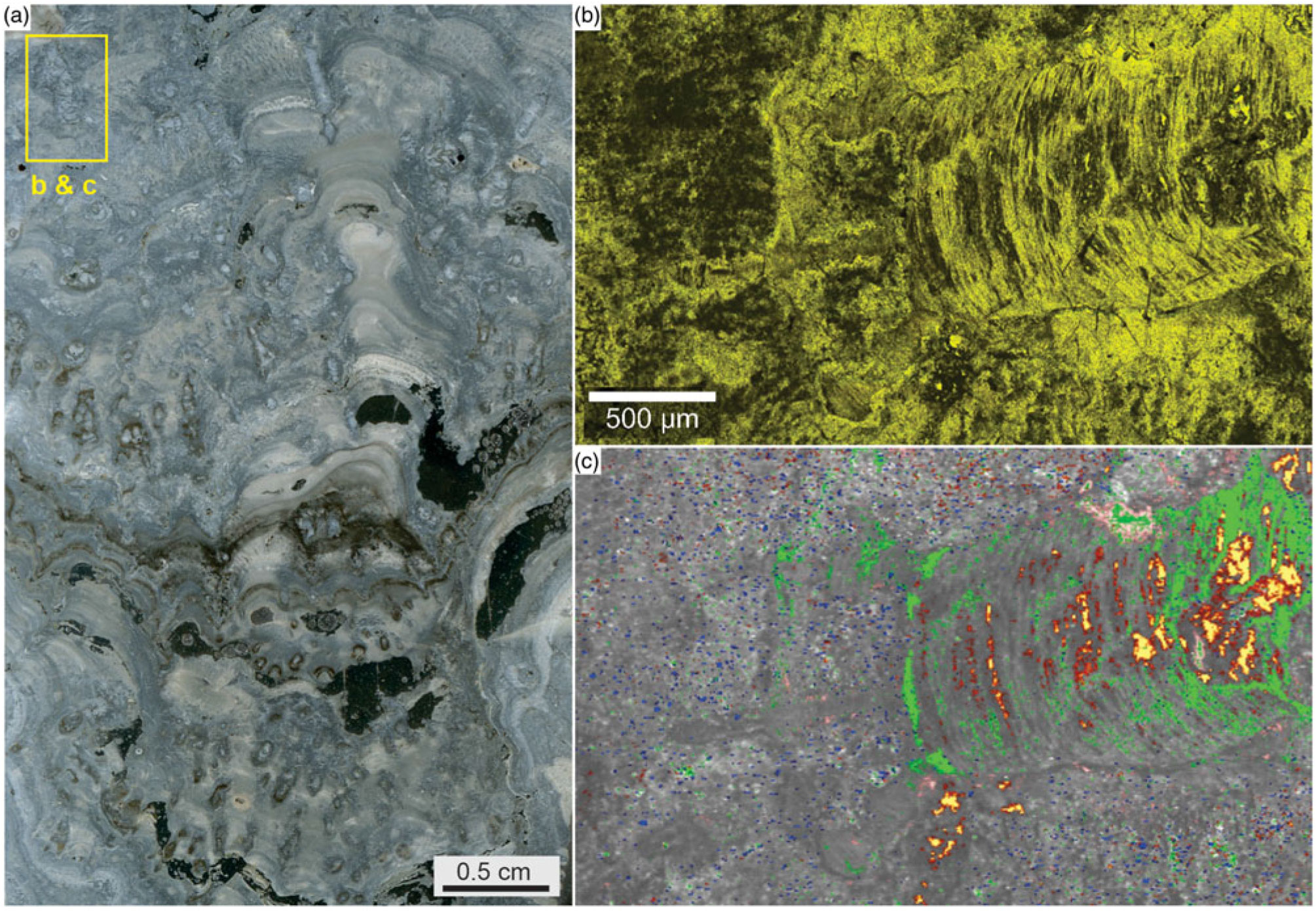
Herein, the presence of biogenic textures in sinter deposits is not under discussion, as there are many works referring to the biofabrics produced by microorganisms over different temperature ranges in hot springs (e.g Walter, Reference Walter and Walter1976; Brock, Reference Brock1978; Cady & Farmer, Reference Cady, Farmer, Bock and Goode1996; Pentecost, Reference Pentecost2005; Guido & Campbell, Reference Guido and Campbell2011; Lynne, Reference Lynne2012; Hamilton et al. Reference Hamilton, Campbell and Guido2019). Rather we focus on the preservation of carbonaceous material in geyseritic sinter from the ancient geologic record, which represents strong confirmation that the digitate, spicular and nodular stromatolite-like textures are indeed produced by the interactions of microorganisms with silica precipitation at high temperatures. In order to further strengthen this observation, a ~5150-year-old sample of geyserite (B. Murphy, unpub. MSc thesis, Univ. Auckland, 2013) from the Te Kopia sinter area in the Taupo Volcanic Zone, New Zealand, was also studied by petrography and Raman spectroscopy. The results (Fig. 4 and online Supplementary Material at https://doi.org/10.1017/S0016756819000815) agree with the Claudia Jurassic sinter findings, with clear presence of kerogen in the same style of preservation: alternating silica–carbon–silica laminae in the younger spicular geyserite texture. The carbon is interpreted in both fossil cases to be preserved ancient biofilm of microbes, probably thermophilic due to their inter-laminated distribution within vent geyserite, which is also supported from study of biologically fixed modern samples (Cady & Farmer, Reference Cady, Farmer, Bock and Goode1996). The organic matter content in very young (modern to Subrecent) sinter rocks is so high that fluorescence masks the Raman spectrum in the lower-temperature sinter fabrics (pers. observations; Campbell et al. Reference Campbell, Lynne, Handley, Jordan, Farmer, Guido, Foucher and Perry2015 b).
Detailed petrographic and Raman spectroscopy study of ~5150-year-old geyseritic sinter from Te Kopia, Taupo Volcanic Zone, New Zealand. (a) Photograph of an entire polished thin-section with location of the studied area (b, c) shown by a yellow box. (b) Photomicrograph of the high-temperature sinter facies, spicular geyserite. (c) Raman spectroscopy compositional maps of (b) with quartz in orange, kerogen in green, anatase in blue and resin in pink. The grey part is associated with a high-fluorescence signal obscuring the Raman spectroscopy signal (scan parameters: 3900 × 2100 µm, 435 × 315 spectra, laser power 8 mW).

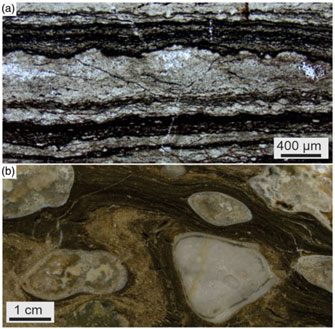
In addition to the microbial biofabrics preserved across the Claudia sinter apron that are characterized in this contribution, carbonaceous material and inferred microbial fabrics also can be found in laterally adjacent, hydrothermally influenced lacustrine and fluvial settings of the Deseado Massif (Fig. 5). For example, crenulated microbial laminites are present in hydrothermally influenced lacustrine sediments of the La Josefina locality (Fig. 5a). Furthermore at the Lote 8 site, Claudia, white, rounded quartz pebbles that once had the consistency of toothpaste (detailed descriptions in Guido & Campbell, Reference Guido and Campbell2019 b) are embedded in a finely laminated microbialite (Fig. 5b). They have been interpreted to represent a mat-stabilized fluvial conglomerate of hot silica-gel clasts in a thermal palaeo-channel, situated c. 5 km from the main Claudia sinter apron, as recently described by Guido & Campbell (Reference Guido and Campbell2019 b). These additional observations therefore extend the record of the influence of hot-spring silica–biotic interactions beyond the sinter apron to hydrothermally influenced fluvial and lacustrine settings.
Presence of carbonaceous material (dark) in hydrothermally influenced lacustrine (a) and fluvial (b) settings in the Deseado Massif. (a) Photomicrograph of the silicified lacustrine deposits at the La Josefina locality, with detail of crenulated, black carbonaceous laminae interlayered with clastic (light-coloured) layers. (b) Photograph of a polished thin section from the Lote 8 locality (Claudia sinter) showing abundant carbonaceous material (dark laminae) comprising the matrix and entombing clasts of a silica-gel conglomerate (grey rounded clasts) (see Guido & Campbell, Reference Guido and Campbell2019 b).

Consequently, the presence of definite organic signatures from in situ sedimentary textures akin to those produced by living hot-spring microbes, found across all the different temperature-dependent facies of sinter formed in a Jurassic geothermal field, enhances the importance of this type of deposit for studies of early life in hydrothermal settings of the early Earth, where Phanerozoic analogues aid palaeoenvironmental reconstructions (e.g. Westall et al. Reference Westall, Campbell, Breheret, Foucher, Gautret, Hubert, Sorieul, Grassineau and Guido2015; Djokic et al. in press?). Because preservation state is often a major barrier to establishing biogenicity in very ancient rocks, systematic field-to-laboratory identification of the highest-quality potential biosignatures – i.e. using the Pyramid of Life Detection method (MJ van Kranendonk et al. Reference Van Kranendonk, Campbell, Barlow, Baumgartner, Djokic, Duda and Teece2019) followed here – is needed to locate the best samples from the often vast areas of rock exposure, in order to subsequently obtain conclusive results. Finally, this study has relevance for the potential comparisons that could be made in the future with returned Martian samples, such as the digitate sinter fabrics identified by Spirit rover in Gusev crater (Ruff et al. Reference Ruff, Farmer, Calvin, Herkenhoff, Johnson, Morris, Rice, Arvidson, Bell, Christensen and Squyres2011, in press; Ruff & Farmer, Reference Ruff and Farmer2016; iMOST, 2019).
5. Conclusions
A detailed analysis of the reported sinters of the Deseado Massif has generated a more comprehensive facies model for these Jurassic deposits, extending recognition of the influence of hydrothermal activity to adjacent fluvial and lacustrine settings, as well as revealing the most complete (in terms of facies associations, i.e. the vent-to-marsh palaeo-temperature gradient) and best-preserved sinter apron in this unique, geographically extensive region of Mesozoic geothermal activity. Identification of high-quality sinter preservation led to further petrographic and Raman spectroscopic study of the Loma Alta outcrop at the Claudia locality, in order to define the presence, relative proportion and location of well-preserved carbonaceous material from the low-temperature (<~40 °C), mid-temperature (~40-65 °C) and high-temperature (>70 °C) portions of the sinter apron.
This contribution definitively shows that biogenic textures are present and can be preserved across all parts of ancient terrestrial hydrothermal systems, even in the highest-temperature niche known on the Earth’s land surface – the geysers of the hot-spring vent area – and that this abundance of life can be tracked deep into the geologic record in places where quality preservation persists through time. This finding favours the notion that life is everywhere in sinters, increasing interest in hot spring deposits for early life studies on Earth and in their potential to help discover possible life on other planets.
Author ORCID
Diego Guido 0000-0003-4696-5644
Supplementary material
To view supplementary material for this article, please visit https://doi.org/10.1017/S0016756819000815.
Acknowledgements
We acknowledge financial support from the National Geographic Society Grant 8357-07 (field trips), SeCyT-UNLP (Raman in France), PICT 2014-1704, and the Faculty Research Development Fund, Science Faculty, University of Auckland.