


There are many questions we can ask about time and some of these questions get more and more puzzling the harder we think about them. But there is one question which seems pretty fundamental and also seems to be one on which most people have confident views, namely what significant differences there are, if any, between past, present and future events. It seems obvious to many, especially those working in physics, that there can be no objective ground for distinguishing between these three categories: all are equal, the universe consists in a solid block of events spread out through time and space. Call this view eternalism. It seems equally obvious to others, usually those with a more humanist inclination who are interested primarily in what we can and cannot change, that the future hasn't happened yet, and thus that future events are less real than present or past events, all of which have happened. On this view, the universe does consist of a solid block of events, but it is a growing block: as more future events become present and then past, they are added to the block. Call this view gradualism. Finally, and perhaps less obviously, there is the view that only the present is real, that the future has not happened yet and that the past has irrecoverably departed. As St Augustine famously put the point: ‘Those two times then, past and to come, how are they, seeing the past now is not, and that to come is not yet?’.Footnote 1 Call this view presentism. Ignoring the possibility of futurism, pastism and shrinking blocks, none of which have ever been held by anyone, these three views are exhaustive and exclusive.
It is not my objective in this paper to argue for one side or another in this debate. In fact, it is quite striking how entrenched most people's views are on this matter. Rather I want to cast doubt on our confidence that we really understand the question or how to answer it. It is possible that our sense that there is a disagreement about time here may be stronger than our grasp on what that disagreement consists in.
1
It will simplify some of the discussion if we focus on a binary debate and it seems that the disagreement between the eternalist and the others is more significant than the disagreement between the gradualist and the presentist. At least, it is more significant when we think of the debate as an ontological one. A presentist believes that our ontology (ontology, n.: theory or statement of what there is) should only include what exists right now, i.e. at the time we draw up the list. A gradualist believes that our ontology should also include what used to exist even if it does not exist now, so the British Empire is part of our ontology but my great grandson is not. An eternalist goes one step further and also includes what will exist even if it does not exist now, so both the British Empire and (I hope) my great grandson are included.
Initially it appears that we have a clear and substantial metaphysical debate here, however, the appearance of disagreement can be made to vanish very quickly. To see this consider the following statement of presentism:
(P1) What there is only includes what exists now.
This sentence of English is straightforwardly ambiguous between:
(P2) What there is now only includes what exists now.
(P3) What there is, was and will be only includes what exists now.
Taken in their normal senses, (P2) is analytic and (P3) is an uncontroversial contingent falsehood. The problem is that the English verbs ‘to exist’ and ‘to be’ must always be tensed: we cannot say that something exists without saying more specifically that it does, has or will exist. Of course, sometimes we use the grammatical present tense to express the conjunction or disjunction of the past, present and future tenses, but that is not true tenselessness: thus while ‘Mary laughs at midday on the 14th July 2006’ conveys no information about whether the date in question is before, after, or contemporary with the utterance, it is not thereby tenseless because it is simply elliptical for ‘Mary laughs, laughed or will laugh on the 14th July 2006’. Such constructions just give us reading (P3). Since exactly similar problems will beset any attempt to state eternalism and the growing block theory, it would seem that the English language, at least as she is used outside the philosophy seminar, is incapable of stating a thesis on which these three metaphysicians disagree. This is intended to be a purely grammatical point.Footnote 2
It is, however, a common view amongst philosophers that tensed verbs can sometimes be used to express tenseless predications. Now it might seem that the essence of tensed predication is that information is conveyed about the relative temporal ordering of the situation described and the present.Footnote 3 For example, ‘Mary laughed’ tells us that there was a laughing by Mary prior to the assertion of that sentence. Consequently, one might think that the failure to convey such information would be sufficient for tenseless predication. But this would be a mistake, for a disjunction of tenses conveys no such information, but is not the sort of tenseless predication required to state the conflicting theses of presentism and eternalism.
Another bad reason for thinking that tensed English verbs can be used to express tenseless predication comes from thinking it essential to tensed predication that sentences expressing tensed predication change their truth values when uttered at different times.Footnote 4 If this were right, then we would find two types of tenseless predication in English: dated predications and sempiternal ones. Dated predications are those constructed by taking a tensed predication and specifying the date at which the situation described occurred, for example turning ‘Mary is laughing’ into ‘Mary laughed on 14th July 2007’. But this is not true tenselessness, for it will not do to articulate the debate between the presentist and the eternalist: both agree on dated existence statements such as ‘The British Empire existed in 1850’ and ‘The British Empire did not exist in 2007’. We can see what has gone wrong from the fact that the verb in these expressions is not merely grammatically tensed, but can have its tense varied to express different things: suppose we have a bet about Mary laughing on 14th July 2007, then my saying ‘Mary will laugh on 14th July 2007’ and ‘Mary is laughing on 14th July 2007’ will prompt quite different reactions from you, especially if you are unsure of the date as we speak. To avoid this, many philosophers claim to discern a special, tenseless interpretation of ‘Mary laughs on 14th July 2007’, but it is not clear that this is anything other than the disjunction of tenses noted above. Furthermore, it seems that the most natural semantics for dated sentences will actually treat them as compounded from tensed sentences, e.g. ‘On 14th July 2007: Mary is laughing’.Footnote 5 So dated sentences do not give us the grip on tenseless predication which we need.
Sempiternal predications, such as ‘Socrates is self-identical’, certainly do not change their truth value at different times.Footnote 6 But nor do disjunctions of tenses, such as ‘Socrates is, was and always will be self-identical’. There does not seem to be anything to stop us using clearly tensed predications of sempiternal properties (‘Socrates is right now self-identical – though of course I do not mean to imply that he was or will be non-self-identical at some other time!’), so this phenomenon does not compel us to accept the existence of tenseless predication, in the sense needed for the presentism-eternalism debate.
One might instead think that the eternal propositions of arithmetic or logic give us clear examples of tenseless predication: if ‘3 is prime’ is elliptical for the sempiternal ‘3 was, is and will be prime (forever)’, then ‘3 was prime’ ought to make perfect sense, but it does not.Footnote 7 Of course, the fact that the necessary properties of eternal objects can be predicated of them tenselessly does not show that we can understand the tenseless predication of contingent properties, such as existence, to ordinary objects, such as sea battles. But it would show that English has the semantic resources to express tenseless predication. However, this is a case where we need to be careful with our Gricean implicatures. In some contexts ‘a was F’ carries the implicature that a is no longer F, so the unacceptability of ‘3 was prime’ could be due to this. This implicature is easily cancelled, for we can say ‘3 was prime last year and of course it still is’ – but that still sounds unacceptable. So instead of trying to cancel the implicature, we should look for contexts in which it is not carried at all. One such context is when we are engaged in historical description, that is when we are talking exclusively about how things were in the past. So imagine that we are talking about Pythagoras, then we might quite intelligibly say ‘√2 was irrational, though he did not know it’.Footnote 8 So tensed predication of necessary properties to numbers does make sense and we have no compelling reason to think that ‘3 is prime’ is an uncontroversial example of tenseless predication.Footnote 9
It has been claimed that English has actual tenseless verb forms (as opposed to tensed ones used to express tenseless predication, which is what we have been just considering). Thus we find Zoltan Szabó writing
The claim that predication in English is inherently tensed is in any case exceedingly implausible. Consider the sentence ‘Jack considers Jill fortunate’. According to plausible syntactic views the complement of ‘considers’ in this sentence is a so-called small clause – ‘Jill fortunate’. This clause is not tensed. Assuming competent speakers understand this sentence by understanding their syntactic constituents and the way those constituents are combined, we have evidence that tenseless predication is meaningful.Footnote 10
Setting on one side the fact that ‘Jack considers Jill fortunate’ is ungrammatical in my idiolect, this sort of argument can show at most that there are allowable syntactic forms which contain no tense markers. It does not follow that these express tenseless predication and we can see in the particular case Szabó offers that his sentence can be paraphrased without loss as the clearly tensed ‘Jack considers Jill to be fortunate’. If you think this paraphrase adds to the original, then try ‘Jack considers that Jill is, was or will be fortunate’. So we are left with the bare possibility that there are languages with verb forms which cannot be translated into tensed English and which native speakers regard as expressing tenseless predication. The easiest way to consider that possibility is to imagine adding to English so that such verb forms can be translated. The prospects for this and other extensions of English are considered in the next section.
2
One response to the claim that all English predications of existence are tensed is to say ‘So much the worse for English’: the alleged dissolution of the debate relies on a feature of English, that the verbs of existence must be tensed, but we understand perfectly well what the metaphysicians are disagreeing about, namely what there tenselessly is. So, it seems, all we need to do is to modify the grammar of English and allow a tenseless use of the verbs ‘to exist’ and ‘to be’. The idea that we can introduce and understand such new usage is almost a commonplace in philosophy, thus using italics and the infinitive to denote the new usage, we might say ‘There be a sea-battle off Naupactus on February 29th 2000’.Footnote 11 But it is far from clear that we understand this new usage as tenseless rather than elliptical for ‘There was, is or will be a sea-battle off Naupactus on February 29th 2000’, which removes all implications about whether the statement is made before, after or on the day of the battle while using the ordinary tensed English verb (imagine a timetraveller who knows the date of the battle but does not know the date now). Hence changing (P1) to ‘What there be only includes what exists now’ would merely fix its interpretation as the uncontroversially false (P3).
What is needed to capture the tenseless sense of existence which the presentist and eternalist are using is not grammatical reform but vocabulary extension. We must introduce a new verb, ‘to exist*’, to express belonging to our most fundamental ontological category, the extension of which is the subject matter of ontological debate. Thus the disagreement between the presentist and the eternalist is not over whether dinosaurs did exist, nor over whether they exist now, but over whether they exist*.Footnote 12 If this is the correct way to construe the debate, then the disagreement between our three metaphysicians boils down to a disagreement about the relation between existence and existence*: they agree about what exists, and they agree that everything which exists* must also exist (tensed) at some time, but they disagree about which tensed existence claims entail existence* claims. Predication of existence* would be tenseless because otherwise the disagreement would collapse again, since even a presentist can accept that my great grandson will (hopefully) exist*.
So construed, the debate faces three worries (in this context, a philosophical worry is not quite an objection, rather it is the pointing out of an assumption or commitment which is controversial):
(1) The claim that our most fundamental ontological concept is tenseless requires metaphysics to take a ‘View from Nowhen’, the intelligibility of which is doubtful. Some presentists will claim that this is only a commitment of eternalism, and that they only take the view from now, which is obviously intelligible. But this is not correct, for if the presentist claim is neither (P2) nor (P3), then it requires the intelligibility of an ontological concept other than our ordinary tensed concept of existence. Someone who is sceptical of the view from nowhen will be equally sceptical of the existence of a genuine debate here.
(2) In order for there to be genuine disagreement, the parties must not be equivocating on the neologism ‘exists*’. But the disagreement consists in a systematic difference of opinion about the extension of that term, which would normally be taken as evidence of ambiguity. Of course, the extensions overlap, and all parties agree that the extension of ‘exists*’ can be defined in terms of ‘exists’, but the definitions are different. Put differently: why think that there is just one fundamental ontological concept?
(3) Why should we think that existence* is more fundamental than existence? What could be more fundamental, ontologically speaking, than existence? Well, the crucial feature of ‘exists*’ which is lacked by ‘exists’ is the metaphysician's claim that it can be predicated tenselessly. All three parties to the debate agree that ‘x exists’ (present tense) entails ‘x exists*’, that ‘x exists*’ entails ‘x does, has or will exist’, that every present tense predication entails ‘x exists*’ and every predication of any sort entails ‘x does, has or will exist’. What is distinctive about ‘x exists*’ is that there is an intelligible debate about whether it is entailed by ‘x was F’ or ‘x will be F’. There could be no such debate about ‘x exists’, so the concept of existence* is definitely richer than the concept of existence, but we might still wonder why that makes it more fundamental.
The third worry suggests a full-blown objection:
(4) Given that English predication is always tensed, can we really understand the notion of tenseless predication used in the debate?
And this objection has a fairly standard answer: the semantics of first-order predicate logic has given us a clear understanding of tenseless predication, so there should be no problem adding such terms to English and giving them a familiar semantics. Note that if we also accepted a Quinean programme of regimentation, this would give us a reason for thinking existence* is more fundamental than existence. However, the objection cannot be dealt with so easily. To see this, remember how the semantics for predicate logic goes: for each predicate ‘F’, the semantic theory assigns a set S as its extension and then uses the rule ‘Fx is true iff x ∈ S’. The claim is then that ‘exists*’ can be given such a semantics, whereas the tensed predicate ‘exist’ needs a different treatment. The extension of ‘exist’ will be a series of sets R1, … , Rj and the rule will be: ‘x exists’ as uttered at ti is true iff x ∈ Ri (plus variants for past and future tense utterances). So it seems that there is a genuine contrast between the semantics for tensed and tenseless predication and that the latter is simpler and possibly more fundamental.
But before we accept this contrast as completely clear, we should note that such a semantic theory presupposes a set of objects from which the extensions of the predicates can be drawn. This is the domain. So the semantics of first-order predication is not complete until we have specified the domain.Footnote 13 Now, in the toy cases used by logicians, it is often possible to specify the domain extensionally, but if we want our formal language to have the expressive power of English, we will need to specify the domain intensionally, and that is going to involve predication in the metalanguage. Suppose we are trying to specify the maximal domain, the one that contains everything. Should we say that it contains everything which exists now? Or everything which exists or has existed or will exist? Or everything which exists*? If we take either of the first two options, then our semantics for predication is not in fact tenseless, since the extension we assign to the predicate F is the set of things which is F now (alternatively which has been, is or will be F). We would only have genuinely tenseless predication if the domain was everything that exists*. However, since we are trying to use this semantics to show that we do understand tenseless predication, we cannot appeal to tenseless predication in the metalanguage. The problem is that first-order formal languages certainly give us the means for syntactically tenseless predication, but it does not follow that we have semantic tenselessness.
It will not help to try to capture the meaning of ‘exists*’ using the existential quantifier of first-order logic, instead of predication. The standard semantics for ‘∃xFx’ states that it is true iff the set S, which is the extension of F, is not empty. And that condition is met iff the extension of F includes at least one member of the domain. The ontological commitment of ‘∃x’ is not existence, but domain membership, so the metaphysical interest of existential quantification depends upon the domain, and since any interesting domain is not going to be extensionally specified, we again run up against tensed predication in the specification of the domain. Thus ‘∃x’ only expresses a concept both metaphysically interesting and tenseless if we can already use tenseless predication to specify our domain. It seems that objection (4) really does have bite: it is not easy to show that we understand tenseless predication.
A Brief Aside on Special Relativity:
Special Relativity teaches us that events which are future (in the future light cone of the event of speaking about them) in one frame of reference are past (in the past light cone of the event of speaking about them) in another frame of reference. It also teaches us that there is no such thing as absolute simultaneity. Consequently, nothing is really past, present or future and while we may continue to talk with the vulgar, we should think with the learned. But you need vulgar talk to formulate presentism, so we should all be eternalists.
This argument is at best enthymematic, needing the additional claims that tense is not relative to a frame of reference and that nothing is both past and future. Let us grant those. We still don't have an argument for eternalism unless we can show that it can be formulated without ‘vulgar’ tensed talk, which in turn requires us to be able to think and speak with the learned in a tenseless way. And that is exactly what I have been arguing against here.
But this leaves us in a quandary: we have no choice but to think and talk using tenses which appear to presuppose a notion of absolute simultaneity, which SR tells us is incoherent. The way out of this quandary is to note that while there is no absolute simultaneity, there is a privileged frame of reference for each person, namely the one which takes their own trajectory as the inertial frame. The existence of such a privileged frame of reference gives rational grounds for talking as if there is a uniquely correct simultaneity relation. Furthermore, since near-light-speed travel is exceptionally rare, the privileged frames of reference of all the people we communicate with are similar enough to ours that we can talk as if this simultaneity is intersubjective. Which means that we can talk as if there is absolute simultaneity.
How then can we do physics, where there is no privileged frame and near-light-speed travel is commonplace? We still use our ordinary language with its presupposition of absolute simultaneity, but we just take care never to exploit its tensed features, that is, thinking with the learned is not thinking in a special tenseless way but simply a matter of ignoring anything to do with what is past, present or future and only paying attention to what is in the past or future light cone of an event.
3
The argument of sections 1 and 2 should lead us to be sceptical that there is a genuine metaphysical dispute between the eternalist and the presentist. Is it just the illusion of a disagreement fuelled by beguiling metaphors and pictures? Perhaps it is, but in this section I want to canvass a way of construing the disagreement purely in terms of the tensed English verb ‘to exist’. First we must see how to change the debate from the material mode of ontology to the formal mode of metaphysics. Using the dubiously intelligible concept of existence*, presentism is the claim that only what exists now exists*. Ignoring positive free logics, any true predication ‘x is F’ strictly implies that ‘x exists*’, so presentism can be reformulated as a claim about truth:
(P4) If the truth of <p> entails the existence* of some object which does not exist now, then <p> is not true now.Footnote 14
Given (P4) the presentist must either deny that <There was a British Empire> is true or give a semantics according to which its truth neither presupposes nor entails the existence* of the British Empire. The latter may be difficult, but it looks like it is an unavoidable commitment for a presentist who wants to preserve our intuitions. Setting that aside, we can see that even though (P4) still uses the dubious tenseless concept of existence*, it does reveal something important: the disputants disagree about the relation between what exists now and what is true now. (P4) states a particular set of commitments about the relation between truth and existence, and as such needs to be formulated in terms of existence*. But there is a different relation between what is true and what exists embodied in the now familiar truthmaker principle:
(TM) If <p> is true, then there exists some object x, such that the existence of x strictly implies the truth of <p>.
The discussion of the previous section should make clear that the present tense use of ‘exists’ in the antecedent of (TM) is ambiguous between:
(TM1) If <p> is true, then there now exists some object x, such that <x exists> strictly implies <p>,
and:
(TM2) If <p> is true, then either there exists some object x, such that <x exists> strictly implies <p>, or there existed some object x such that <x existed> strictly implies <p>, or there will exist some object x such that <x will exist> strictly implies <p>.
Assuming one accepts the truthmaking principle, (TM2) is obviously true, but (TM1) is not obviously false, so this formulation of the debate is an advance over the previous one, since the presentist and the eternalist can disagree on whether to accept (TM1). This looks like a substantive disagreement: the defender of (TM1) is saying that for a proposition to be true it needs a truthmaker now.Footnote 15
We began with three positions on temporal ontology, presentism, eternalism and gradualism, but have so far only discussed the first two in any detail. This is because it is easy to adapt what we have been saying about presentism to gradualism, which becomes
(TM3) If <p> is true, then there is or was some object x, such that the past or present existence of x strictly implies the truth of <p>.
The eternalist denies both (TM1) and (TM3), or to be precise, denies that either is true for all propositions. Rather, he has to accept a truthmaking principle which shows there to be strict equality of status between past, present and future events:
(TM4) If <p> is true, then either there is, was or will be some object x, such that <x exists> strictly implies <p>.
This is appears to be a genuine disagreement about the relationship between ontology and time which can be formulated using the ordinary English tensed existence predicate. So if, and perhaps only if, the presentist, gradualist and eternalist all accept some form of the truthmaker principle (TM), there can be a substantive metaphysical debate between them.
4
Many philosophers perceive there to be a connection between eternalism and determinism, for both seem to say that there is only one possible future, both deny the open future. But in fact the situation is rather more complex than this.
We should begin by noting the logical independence of the views. Eternalism clearly does not entail determinism: that <this coin will land heads> is made true now by a future event does not entail that the landing of the coin is logically or physically determined, since there can be no inference from what will happen to what must happen. Nor is it obvious how determinism might entail eternalism, for determinism is the thesis that the facts about the present plus the laws of nature entail the facts about the future, which says nothing yet about the reality or otherwise of that future. Thus it might seem possible to hold that future items are not part of our ontology while maintaining that their (future) existence is entailed by the present plus the laws of nature. The current formulation of the presentist-eternalist debate allows us to understand this point much better. Suppose there was a determinist presentist. That person would hold that everything which is true has present truthmakers, but also that the truths about the present, plus the laws of nature, entail the truths about the future. Assuming that she can find present truthmakers for the laws of nature, she can then use Armstrong's ‘entailment principle’, which says that if <p> entails <q> and T is a truthmaker for <p>, then T is a truthmaker for <q>, to find truthmakers for propositions about the future.Footnote 16 Consequently the determinist presentist or gradualist can agree with the eternalist about which propositions have truthmakers (given that most laws of nature display temporal symmetry, they also agree about the past), and yet there is a substantive ontological disagreement, for only the presentist accepts (TM1).
This point also shows that the presentist and the gradualist have the option of agreeing with the eternalist on the question of the bivalence of future contingent propositions, just so long as they can find a present (or past) truthmaker for those propositions. So bivalence for future contingents does not entail eternalism, though of course the converse entailment does hold: the eternalist cannot deny bivalence for future contingents merely in virtue of their being future.
What eternalism and determinism do have in common is the following claim, which some might take to be a denial of the open future: given what is true now, the future is fixed. The sense in which it is fixed is semantic, but it turns out that the explanation which each gives for it is significantly different. The determinist thinks the future is fixed because what is true now, allowing that to include the laws, entails what is true in the future and thus fixes how the future must be. The eternalist thinks that what is true now includes what is true in the future and thus also fixes how the future must be. But this similarity is achieved by an equivocation. The determinist is claiming that what is true of the present, i.e. the true present tense propositions, entail what is true of the future, whereas the eternalist is claiming that what is true at the present, i.e. the propositions which are presently true, include and thus entail the propositions which are true of the future. Thus both can identify a set of propositions by reference to the present and claim that those propositions entail the propositions true of the future, but each identifies a different set and is thus making a different claim. That is why the truth of determinism is sensitive to the character of the laws of nature and the truth of eternalism is not. We have still not found anything important in common to eternalism and determinism.
As a starting point, we could take the claim that the future is open to mean that there is more than one possible future. The difficulty here is to formulate this claim in a way which avoids triviality. Everyone can accept that there are other possible worlds which are identical to this world up to and including the present time (excluding, for the determinist, the laws of nature) and yet which differ in their futures. So the open future must consist in more than this. Define a history as a maximal series of events which can be ordered by the before/after relation, then the eternalist and the determinist can agree that each possible world has a unique history (or, if we admit the deterministic nature of laws to be contingent, that there is a set of possible worlds each of which has only one history and the actual world is a member of that set). In effect they claim that we can individuate possible worlds by their histories, because those histories are unique and essential. The trouble with treating this as a significant common feature of eternalism and determinism comes from trying to understand what it is to deny it.
Suppose one thinks that some possible worlds have more than one history. Take W to be such a world. By hypothesis, in W it is not ‘settled’ at t0 whether I have lunch at t1 or not, so W has at least two histories, one in which I lunch at t1 and one in which I do not. Suppose I do have lunch at t1 in W, then there is another possible world W', identical with W up to t0, in which I do not. Do W and W' have all their histories in common? We have assumed that they do at t0, but at t1 it seems they differ, for once the moment of lunching has passed, all the W histories are lunch histories and all the W' histories are non-lunch histories. (Note that someone who accepts multiple past histories must still accept that, at the moment of lunching, all W histories are lunch histories.) We should conclude that assignment of multiple histories to a world is relative to a time. So we can say that W has a lunch and a non-lunch history at t0 but at t1 it does not, which creates an apparent disagreement with the eternalist and determinist who think that at all times there is only one history. However, if it is to capture a significant conception of the openness of the future, this form of words needs some careful explaining, for it has to be saying something different from the claim that if we only consider what happens up to t0, W is indistinguishable from W', but if we also consider what happens at t1, then they differ, which is a claim that the eternalist and determinist can agree with.
Both the eternalist and the determinist are committed to saying that at W (at t0) only one of the possible futures will happen and at W' only one will happen and that these are different ones. But if saying that is denying the open future, then no one should accept the open future, for so long as we make sure we are talking about all the possible futures, it is not possibly false that only one will happen.Footnote 17 Even the presentist can accept that.
In order to a get a disagreement of substance over the open future, we must see that the multiple histories assignable to worlds are ontological hybrids: they consist of all events that are actual (=everything in the ontology of the world in question at that time) and some, perhaps none, of the events which are merely possible (=things in ontology of other worlds but not the world in question at that time), and we can then use our view of truthmaking to determine what is and is not in the ontology of a world at a time. Which merely possible things can be included in a history is constrained by the joint requirements of consistency and ordering by the before/after relation. Because the presentist and gradualist think that which propositions have truthmakers changes over time, they think that which histories can be assigned to a world is relative to a time, in particular, the gradualist thinks that as the body of truthmakers increases, the number of assignable histories decreases (assuming it was finite to start with). In contrast, the eternalist thinks that the available truthmakers are not relative to a time, and thus all histories at all times contain the same set of actual events, which with consistency narrows it down to just one history of only actual events. Since a determinist may be a presentist or an eternalist, his commitment to each possible world being individuated by its history does not commit him on the ontological character of that history.
When looked at in this way, we can see that the disagreement about the open future is fundamentally ontological. The eternalist can recognize all the multiple histories as hybrid entities, but thinks that the multiplicity of the histories derives from only requiring consistency with a subset of what there is. When one requires consistency with everything in one's ontology, the multiplicity disappears and one of those multiple histories turns out not to be an ontological hybrid after all. To accept the open future is to say that all the histories assignable to a particular time are equally ontologically hybrid, which is equivalent to a denial of eternalism. In which case, the ontological disagreement between the eternalist and the presentist or gradualist determinist is sufficient for some determinists to lay claim to an open future: while all that will happen is entailed by the present and the laws, it has not yet happened, the events and their constituents do not yet exist and thus are not truthmakers.
So the failure of bivalence for future contingents and the open future come apart. A presentist can be a determinist and thus think that the present plus the laws of nature entail that there will be a sea-battle tomorrow. But they must hold that the truthmaker for the proposition <there will be a sea-battle tomorrow> is not the same as the truthmaker there will be tomorrow for the proposition <there is a sea-battle today>. Suppose we said that T is a proper truthmaker for <p> only if there is no distinct proposition <q> such that T is a truthmaker for <p> only because T is a truthmaker for <q> and <q> entails <p>,Footnote 18 then the determinist presentist holds that future contingents do have truthmakers but not proper truthmakers: only propositions about the present (and the past for a gradualist) can have proper truthmakers.
We can summarize the results of this section in a table, with ‘E’ for entailment, ‘C’ for consistency and ‘I’ for inconsistency (if we only consider the future, presentism and gradualism can be taken as one):
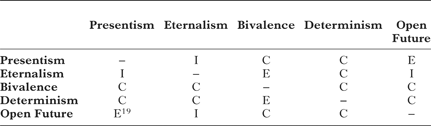
This table makes clear that accepting the bivalence of future contingent propositions is the weakest of the family of views we are considering, since it rules out none of the others. In contrast, eternalism is the strongest, entailing bivalence and ruling out the open future. If nothing else, this should provide a gentle corrective to the way that eternalism has come to seem, to many physicists and metaphysicists, the obvious position deviations from which need to be defended. And if one is not inclined to accept the Truthmaker Principle, then the whole debate between presentist and eternalist collapses.Footnote 20


