In early May 1921, Kevin O'Higgins, the assistant minister for local government, complained bitterly that ‘while the young men [of Ireland] were giving up their lives for their country the women folk and their families were filling the War Chest of the enemy.’Footnote 1 His statement was made at the height of one of the First Dáil's largest mass-mobilisation campaigns, the Belfast Boycott (1920–22). O'Higgins unequivocally blamed female consumers for the boycott's shortcomings, yet he clearly understood that the campaign's success was inextricably tied to their participation. Expressing such sentiments at a covert meeting of the Dáil, O'Higgins did not seem to realise the incongruity of his critique. Men filled the ranks of the I.R.A., I.R.B. and the Dáil, and their contributions to Irish freedom were generally furtive in nature — from underground Dáil meetings to the actions of Collins's elite squad — but in contrast O'Higgins expected Irish women to challenge Ireland's enemies overtly and publicly through their role as consumers.Footnote 2 However, this strategy sat uneasily aside other nationalist rhetoric that dictated that a woman's place was in the home. As Erika Rappaport has argued in an earlier English context, shopping was an activity that, while performed in public, was still seen as domestic in nature and allowed women a form of socially-acceptable access to the marketplace.Footnote 3 Irish women on both sides of the border sought to fulfil their civic duty through their role as consumers by making political statements through their economic actions. However, they often fell victim to intense male scrutiny when their efforts failed.
Apart from general elections and the establishment of Dáil courts, the boycott served as one of Sinn Féin's few attempts to promote sustained public mobilisation during the revolutionary period. Study of the Belfast Boycott, a subject long relegated to historical obscurity, provides a wider context to revolutionary resistance that incorporates a more representative cast of characters than male gunmen and political elites. In addition to exploring the contributions of large numbers of Irish women to both the boycott and the north's subsequent counter-boycott, this article also examines perceptions and expectations of Irish womanhood in Belfast Boycott and counter-boycott rhetoric.
By deploying an economic, rather than a military, weapon, the Belfast Boycott allowed a wider portion of the Irish nationalist population and diaspora to involve themselves in the fight to end partition and economic reliance on Britain. However, mass mobilisation required the public participation of Irish women. Both boycott and counter-boycott rhetoric presented the act of consumption as what Lisa Tiersten has called the ‘domestic responsibility’ of Irish women, even though it was by its very nature a public and highly visible task.Footnote 4 Female consumers were seen as the linchpin to boycott success, but it was assumed that their participation in the marketplace needed to be monitored and directed because their failure could have island-wide consequences. The implementation of the boycott was a major risk for Sinn Féin leadership as any perception of failure would have proved a tremendous source of public embarrassment for the revolutionary movement. It would also demonstrate that the Dáil had neither widespread public support nor the ability to direct the Irish population. This risk was exacerbated by the fact that Irish women — the majority of whom existed outside of revolutionary structures such as Cumann na mBan and Sinn Féin — comprised the bulk of the nation's consumers, and it was to them that boycott success and ultimately the Dáil's credibility was beholden.
Many recent works have focused on the role of female revolutionaries in Ireland, especially those involved in Cumann na mBan. Margaret Ward's groundbreaking Unmanageable revolutionaries was one of the first to focus exclusively on the contributions of women to Irish nationalism.Footnote 5 Cal McCarthy has also examined the lives of women active in Cumann na mBan, as has Anne Matthews in her book Renegades, which explored the ways that nationalist women participated in the Irish Revolution through 1922.Footnote 6 Leanne Lane has also published biographies of Irish public women, including historian and activist Dorothy Macardle and Irish author and republican Rosamond Jacob.Footnote 7 This growing body of literature continues to situate the lives of organised nationalist women into the broader revolutionary narrative, yet it does little to incorporate the many Irish women who existed outside of nationalist organisational structures.
While the current historiography of the revolution has become more inclusive of female actors, very little work has been done to understand the role that women played in the politicisation of consumption and the attempted reconfiguration of the Irish economy. Ciara Breathnach has looked at women's role in the economy of the west of Ireland at the turn of the twentieth century, but as her focus was predominately on women as breadwinners she did not explore the political ramifications of or expectations placed upon female consumption.Footnote 8 The few works that have examined the intersection between Irish consumerism, patriotism and gender do so in an eighteenth-century context. Padhraig Higgins states that Irish women were expected to contribute as consumers to the promotion of Irish industry and, in this way, prove their patriotism and loyalty in significantly gendered terms.Footnote 9 Meanwhile, Kenneth L. Shonk Jr has explored the intersection of consumerism, gender and nationalist political rhetoric in post-revolutionary, 1930s Ireland. Under Fianna Fáil's leadership women were expected to purchase Irish goods as part of their domestic contribution to the growth of the emergent nation, a task designed to complement the implicitly more important role of masculine state creation.Footnote 10
Despite remaining understudied in an Irish context, the subject of women and consumerism has received significant attention in western European historiography. In Shopping for pleasure Erika Rappaport explores views of shopping as a feminised activity in late-eighteenth and early-nineteenth-century London, even though it removed women from their private sphere within the home.Footnote 11 Similarly, Katie Jarvis examines the concept of ‘economic citizenship’ in relation to female consumers in revolutionary France. She defines economic citizenship as ‘the ways in which an individual's economic activities, such as buying goods, selling food or paying taxes, position him or her within the collective social body’.Footnote 12 Lisa Tiersten analyses French men's concerns that shopping provided women with too much freedom and needed to be monitored and controlled.Footnote 13
Even though many of the Belfast Boycott workers and boycott and counter-boycott participants were female, the boycotts of 1920–22 are absent from literature on nationalist and unionist Irish women and female revolutionary participants in general. This is emblematic of the greater dismissal of cultural histories of the revolution in favour of military and political ones. Ward is one of the few scholars who has discussed the contributions of Irish women to the Belfast Boycott at all. She notes that the boycott provided work that ‘the women could largely direct themselves’. She further states that ‘woman the consumer had formally become woman the activist’, though the female consumer remains the subject of little historical research.Footnote 14 Cormac Moore's recent The birth of the border devotes a chapter to the boycott and is one of the few works to also discuss the counter-boycott, but he only briefly mentions the contributions of Irish women.Footnote 15
The boycott is largely absent from more general narratives of the Irish Revolution as well. David Fitzpatrick's Politics and Irish life 1913–1921 and Michael Hopkinson's Green against green mentioned the boycott only in passing.Footnote 16 A noteworthy pattern emerges in the sparse literature on the boycott. Boycotting, whether in the nineteenth century against Protestant landlords or during the Belfast Boycott, is often portrayed as an act of violence, rather than an economic weapon reliant heavily on peaceful protest. Terence A. M. Dooley has highlighted the boycott's overall inefficiency due to the lack of proper enforcement everywhere outside of County Monaghan. The county's close proximity to the border made it an opportune locale for raiding trains and traffic on country roads in order to confiscate goods coming from Belfast.Footnote 17 Gemma Clark includes boycotting alongside ‘crop burning, cattle maiming … and the servicing of threatening notices’ as forms of ‘social violence’.Footnote 18 Brian Hughes has also noted the breadth of violence that accompanied boycott enforcement. Those who continued to trade with Belfast were sometimes expelled from their homes and forced to quit their jobs. One businessman admitted to receiving numerous threats to ‘be shot on sight’.Footnote 19 Peter Hart says the boycott ‘was enforced with threats, guns, and kerosene’.Footnote 20 Thus, analysis of the objectives, rhetoric and organisation of the boycott has been largely ignored in favour of examining the physical manifestations of ‘social violence’. By looking at the inevitable consequences of boycotting — from looting trains and businesses to burning newspapers and smashing shopfronts — the Belfast Boycott appears as nothing more than another example of the tit-for-tat violence exemplified in Hart's work on sectarianism and the I.R.A.Footnote 21 This approach writes women out of the history of the boycott almost entirely. However, contemporary Irish nationalists did not view the boycott as a form of violent opposition. The intentional visibility of the boycott, in stark contrast to revolutionary violence that was often performed covertly, as examined by scholars such as Emilie Berthillot, is one of the key ways in which the boycott differed from other forms of nationalist resistance.Footnote 22 Examination of the propaganda surrounding its promotion — and that of the counter-boycott — brings together many understudied actors in Irish history, including women of all social classes on both sides of the border.
Since the term was coined during the Land War, boycotting had become a common means of attacking tangible aspects of British power.Footnote 23 During the revolution Sinn Féin saw the strategy of boycotting as an effective economic weapon against colonialism. In April 1919 Éamon de Valera proposed a boycott of the Royal Irish Constabulary (R.I.C.), the British-run police force in Ireland. The intent of the R.I.C. boycott was to ostracise its officers socially and economically.Footnote 24 The I.R.A. was active in this campaign, and, while the purported goal was social ostracism, altercations between the I.R.A. and the R.I.C. often turned violent and, at times, lethal. Frustrated by the social, economic and physical attacks on the R.I.C., over 5,000 unionist workers met on 21 July 1920 outside of the Workman, Clark and Company shipyard in Belfast in response to posted flyers targeted at ‘all Unionist and Protestant workers’.Footnote 25 These employees refused to work alongside perceived supporters of Sinn Féin, whom they blamed for the attacks on R.I.C. officers.Footnote 26 As a result, approximately 6,700 workers were expelled from their positions, mostly Catholics but also other ‘labour activists’ or Protestant workers who did not identify as unionists and were labelled ‘rotten prods’.Footnote 27 Roughly 1,800 of those expelled were women.Footnote 28
Following the shipyard expulsion Seán MacEntee, the Sinn Féin T.D. for Monaghan South, vice-commandant of the Belfast brigade of the I.R.A. and a former trade union representative in the Belfast shipyards, submitted a statement in the Dáil requesting support for a boycott of Belfast. For many nationalists, the expulsion was more than another outbreak of violence; they viewed this as a pogrom against Catholics.Footnote 29 Further, they claimed that such actions directly targeted the political goals of Sinn Féin and the Dáil. MacEntee called the displacement of Catholic workers ‘the first direct attack made upon the Irish Republic’.Footnote 30 MacEntee's proposed boycott applied to goods from Belfast, as well as the use of Belfast-based banks. The Dáil never officially sanctioned the boycott but chose to leave its implementation in the hands of the cabinet, which set up committees to manage it.Footnote 31 Businesses found with contraband goods were fined by these committees. A volunteer network also watched train stations and shipping yards to ensure that goods from Belfast were not being smuggled. Businesses that refused to comply with the boycott might be blacklisted. In March 1921 the boycott was extended to Great Britain. The boycott of Britain was approved as a ‘piece-meal’ boycott, first ensuring native supplies of goods before trade was cut off with Britain.Footnote 32 Both boycotts continued even after a truce was declared between the United Kingdom and the nascent Irish Free State in 1921.
The goals of the boycott were multifaceted. Sinn Féin's immediate objective was to punish Belfast businessmen for unfair treatment of Catholics and to return those Catholics to their positions in the shipyards. However, the larger, long-term goal of the boycott was to unite Ireland and end partition by reminding Belfast merchants and unionists that they were culturally, politically and economically bound to the south. Drawing on the influences of Arthur Griffith, Irish nationalists had long attempted to eliminate not only British political control but also the entirety of Britain's economic system as it had been implanted in Ireland.Footnote 33 De Valera hoped to use existing, and often apolitical, ‘buy Irish’ campaigns to promote and bolster support for the boycott as a nation-wide concern. He told Ernest Blythe, the Dáil minister of trade and commerce, that support for Irish manufacturing should be used to help popularise the boycott. He stated in a March 1921 letter that
The boycott as you know has been undertaken with a political rather than an industrial objective as the main one, but to make it a success we must supply substitutes for the boycotted goods … We will be killing two birds with one stone by widening out the negative cry of “No Carsonia or no English goods” into the more positive one ‘Irish goods only.”Footnote 34
While de Valera attempted to politicise Irish consumption through alignment with supporters of Irish industry, these groups often had very differing goals. Irish industrialists often attempted in contrast to depoliticise the endorsement of Irish goods or fashion rather than promote it.
The politicisation of consumption and the promotion of Irish manufacturing had long been reliant on controlling and monitoring the purchasing habits of a diverse group of Irish women. The Cumann na mBan constitution stated that members of the organisation were ‘honour bound to give preference when purchasing goods of Irish manufacture’.Footnote 35 However, even women outside of organisations like Cumann na mBan or Sinn Féin were expected to understand the importance of promoting Ireland's economy. In the decades leading up to the revolution, the Gaelic League promoted Irish industry while simultaneously reinforcing traditional gender roles. Timothy McMahon has demonstrated that ‘league members openly called for women to ‘Irishize’ Ireland through their positions in the home rather than by challenging established gender roles in the public sphere’, and notes that ‘exhortations to patronize native enterprises became almost as frequent within [Gaelic] league branches as calls to speak Irish’.Footnote 36 It was widely acknowledged that economic decisions played an important role in the creation of an idealised Irish revolutionary home. Aligning the boycott with these pre-existing efforts became a common means of promoting the boycott to women in both Ireland and the United States.
The role of women as consumers allowed them to engage with the economy as active political participants, but this must be differentiated from abstract notions of Irish femininity exemplified in Irish advertising in general and boycott promotion in particular. As in Germany during World War I ‘the image of the female consumer served increasingly as a filter for public conceptions of actual women’.Footnote 37 Irish advertisements played off existing expectations regarding women's spaces and promoted an idealised image of femininity that was consistently subservient to male desires and objectives. An advertisement in the Irish Times in April 1921 stated, ‘If you want to see your country prosperous and keep your men at home YOU MUST BUY IRISH’.Footnote 38 The cause of emigration, the advertisement implied, was female consumers who were purchasing foreign goods instead of items manufactured in Ireland that would help create stable male employment. While gender-neutral advertisements or those specifically aimed at men simply implored readers to ‘buy Irish’, propaganda aimed at women generally reinforced traditional gender roles by seeking to either criticise or guide the consumption decisions of Irish women.
In general, advertisements printed during this period focused on the practical, economic and less controversial aspects of buying Irish goods. This allowed shopkeepers and advertisers to adhere to the guidelines of the Belfast Boycott without seeming openly punitive or overtly sectarian toward Britain or the north. For example, organisations like the Irish Products League (I.P.L.) sought to separate support for Irish manufacturing from political affiliation, taking care to distance themselves from the boycott without explicitly denouncing it.Footnote 39 The league was created in 1921 and membership hinged upon the signing of a promise that declared the member would purchase only Irish-made goods whenever possible.Footnote 40 Members were expected to wear a pin with the letter ‘e’ for ‘Éire’ as a visual representation of their commitment to the support of Irish manufacturing. The Freeman's Journal in May 1922 noted that the I.P.L. urged consumers to ‘buy [Irish goods] intelligently, not for sentimentally patriotic reasons’.Footnote 41 The league attempted to separate itself from political, and potentially divisive, association with the Dáil, while still admitting to the economic goals that both shared. An article in the Cork Examiner in November 1921 stated that
There are still some people who are not quite clear as to the significance of the “e” badge, and a few are under the impression that its wearers are pledged to assist in carrying on the Belfast boycott … But it simply means that its wearers are members of the Irish Products League and are pledged to support, wherever necessary, Irish made goods.Footnote 42
The role of Irish women as consumers blurred the lines between what constituted public and private space, just as Erika Rappaport has argued was done during the previous two centuries in London's West End.Footnote 43 The very nature of shopping required that women be given some form of autonomy outside of the home. Tiersten notes that early-twentieth-century French men were also unsure about how to reconcile the seeming dichotomy between public and private spaces for women but that they ‘underscored the probity of shopping by portraying consumption as a domestic responsibility’.Footnote 44 Since women carried out the bulk of shopping duties for their families, their adherence to the boycott was vital to its success. As a result, female participation in the boycott was both expected and monitored. Many advertisers targeted women specifically.Footnote 45 Women were expected by both Sinn Féin and shopkeepers to make purchasing decisions that would promote national interests. A short-lived, pro-Irish newspaper called The Sinn Féiner, based out of New York city, often featured writings on women's issues regarding their role as consumers.Footnote 46 One contributor to the paper, a woman named Elizabeth June, argued in a piece on boycotting in June 1921 that:
A woman goes to a store alone to shop. There is no one to applaud when she stands by her principle and rejects British-made goods. To reject an article that is right at hand and to go perhaps a long distance to get it somewhere else calls for decision and determination.Footnote 47
This article not only acknowledged, but actively encouraged, women acting independently within the public sphere in their capacity as shoppers. Not only was the patron of June's piece alone, but she was applauded for her willingness and ability to travel long distances unsupervised in order to make economic decisions to promote the national interest. However, in addition to nodding to women's freedom of movement and purchasing power, June's article also highlighted that female contributions were often ignored. ‘There is no one to applaud’ a supporter of Irish manufacturing — particularly if that supporter was a woman.
However, as the quote by Kevin O'Higgins at the beginning of this article shows, blaming women when boycott efforts and consumer choices failed to meet expectations was common. Advertisers often attempted to paint support of Irish industry as an easy, obvious and accessible choice for the average Irish housewife. Since the success of the Belfast Boycott and other ‘buy Irish’ campaigns, and the expected rehabilitation of the Irish economy were often tied to female action, their purchasing decisions, both real and perceived, often fell under scrutiny. In March 1921 a Cork merchant wrote to the editor of the Evening Telegraph (Dublin) noting some hypocrisies of the boycott.Footnote 48 While his list of grievances was not exclusively aimed at female participants, he described a woman who bought butter from England while wearing a pin which signified that she was a member of the Irish Products League. He criticised this woman for openly proclaiming support for Irish manufacturing, while making a purchase that had an easily accessible Irish alternative.
In addition to garnering domestic support, the Sinn Féin leadership saw the importance of framing their cause on a larger scale as part of a global, anti-colonial campaign.Footnote 49 Politicians such as de Valera and Mary MacSwiney toured the United States in the hopes of gathering financial support from Irish-Americans. Cumann na mBan member Áine Ceannt noted in her witness statement that ‘the Propaganda Department had contacts in various countries, Spain, Italy, France, South America, etc., and to these countries were sent copies of the “Irish Bulletin” and other pamphlets. England, of course, got a big share of propaganda leaflets. In this way, especially in foreign countries, our aims were known.’Footnote 50 Boycott propaganda was no exception and Irish revolutionaries often attempted to compare the boycott to similar international campaigns, particularly in India. Ireland and India regularly looked to one another for inspiration when it came to the fight against British imperialism. Michael Silvestri has argued that ‘the Irish experience thus provided a heroic model of anti-colonial resistance’ to Indian revolutionaries.Footnote 51 This was a reciprocal relationship, as the Irish also highlighted the cause of Indian freedom in newspapers such as the Sinn Féiner. As in Ireland, the use of civil disobedience in India allowed for a broader segment of the population to participate in a revolutionary movement. The paper's correspondent noted specifically the vast age range of participants in a similar Indian boycott, in order to show the diversity of its nationalist support base and their ability to participate in anti-British movements. He stated:
We have enrolled Volunteers to picket the liquor shops and foreign cloth shops, and you can understand the intensity of our campaigns when I relate to you the fact that about 20,000 of our people, young and old, are ‘His Majesty's Guests in His Hotels’ (jails). You know we have non-violence as the basis of our movement. We deplore the deaths and condemn the excesses of mob frenzy. We must control the mob energy, and in that direction Gandhi sets to work now.Footnote 52
Though he warned his readership about the potential and implicitly violent, ramifications of ‘mob energy,’ the writer's main focus in the piece was on the positive ways in which a diverse population could be mobilised toward non-violent protest and thereby deal a lasting blow to the empire. The attempt to link themselves with other nationalist boycotts around the world also underscored the inclusivity of non-violent forms of protest which allowed for the participation of a larger portion of the nationalist community, including women and children. While many colonised people often did not have the means to engage their oppressors in a military sense, all members of the population regardless of gender or age could use economic or other passive forms of resistance against colonial power. Highlighting the success of Indian boycotts to the Irish helped demonstrate their validity as an economic weapon that revealed the vulnerabilities of the British empire. A Sinn Féiner editorial republished from the Islamic News asserted ‘India can ruin Britain in one year. She can increase unemployment in England; she can raise the price of bread in England; she can create a revolution in the whole of the Island.’Footnote 53
The republican leadership also attempted to encourage the Irish diaspora to support the boycott on a global scale. Unlike in Ireland, where refusal to comply with the boycott was theoretically punishable by the Dáil, American consumers had to be alternatively incentivised. However, just like the half-hearted attempt at a British boycott in Ireland, the anti-English campaign in America bore little fruit. England was portrayed as the key target of the boycott, rather than Belfast unionists. This was due largely to the fact that individual American consumers were far more likely to purchase goods, food or other common items from England rather than Northern Ireland. In a Dáil debate in August 1921, de Valera described the differences between the boycott campaign in Ireland and the United States, noting the limitations of the American boycott campaign. He stated, regarding the current boycotting efforts:
The boycott of English goods was an example of how little could be done. It was only by appealing to the Irish as Irishmen and the anti-English section as Americans to help American industry to oust British manufactures that it could be worked up. In America they could afford to do things they could not afford to do in other countries simply because there was a certain amount of sympathy on which they could count; but there were limits and narrow limits on which they could operate.Footnote 54
Garnering sympathy from Irish-Americans had long been, and continued to be, a tactic of Irish nationalists.Footnote 55 It was assumed that the large Irish-American population in the United States could be counted on to alter their consumption habits for the sake of their homeland. Irish nationalists also hoped that Americans would sympathise with Ireland's plight and come to its aid both politically and economically. However, given scant resources and geographical limits, boycott campaign efforts in the United States were largely ineffective.
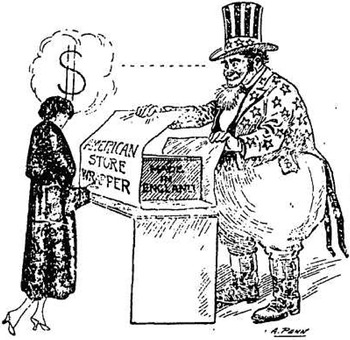
Like Irish women, American women, either as members of the Irish diaspora or simply those sympathetic to the Irish cause, were encouraged to make personal sacrifices by refusing to purchase goods from Britain. Boycott propaganda urged consumers, regardless of location, gender or age, to unite in support of Irish freedom. By June 1921 the Sinn Féiner proclaimed that ‘The spirit of the boycott is spreading swiftly all over the United States … The people of America of all types have become utterly disgusted with the English propaganda in these United States.’Footnote 56 One story recounted that ‘a woman of eighty-five, keen, alert, active, interested’ worked at the boycott headquarters.Footnote 57 Elizabeth June's column entitled ‘The Shopper’ in the New York-based Sinn Féiner newspaper discussed the impacts of the British boycott in the United States.Footnote 58 Each edition of the column featured a cartoon of a woman purchasing a box filled with goods from England (see figure 1). The box was disguised in a paper that read ‘American store wrapper’. The male personification of England, John Bull, appeared as a portly merchant who was deceivingly dressed as America's Uncle Sam.Footnote 59 As he wrapped up the purchase, a thought bubble with a large dollar sign radiated from his head, which was adorned in a top hat, elaborately decorated to resemble the American flag. This image, which recurred in several of June's columns, showcased John Bull masquerading as a voracious American fat cat, willing to swindle his customers for a profit. The female consumer did not notice that she was being duped, something that June highlighted specifically in a mid-1921 column. June relayed in detail the story of an American businesswoman ‘with no intimate knowledge of the intricacies of Irish politics; nevertheless, she has a broad understanding of the principles underlying the Irish fight for independence and a large sympathy with the long struggle of the Irish people’. The woman had restrained herself for months from patronising her favourite restaurant because it refused to purchase a brand of Worcestershire sauce other than Lea & Perrins, which was made in England. June wrote:
Contrast this attitude with that of another woman, who although she can be found at most of the large meetings and gives generously enough to the support of the movement for the recognition of the Irish Republic, still buys Lipton's teas because as she says — ‘I got used to it before I came here and no other kind tastes right to me. Besides I don't buy much because there is only myself to drink it.’ This is not lack of sincerity. All are equally sincere. If one could measure the depth of feeling in this matter it is very probable that the woman who is still buying Lipton's tea feels more acutely the atrocities of the Black and Tans than does the woman who refused to use Lea & Perrin's sauce. But she does not think acutely enough, consequently she does not feel the necessity of making a personal sacrifice.Footnote 60
June chose not to doubt the sincerity of female consumers, but rather their ability to ‘think acutely enough’ when it came to making purchases with the intended political statement.
‘The Shopper’, The Sinn Féiner, 16 April 1921. With thanks to the Irish Newspaper Archives and The Sinn Féiner. This image is copyrighted and was used with permission.

June's role as a female news correspondent provided her with a unique platform from which to champion boycott adherence openly. While some of her writing reiterated the masculine idea that women were ill-informed and passive shoppers, the majority of her commentary on female consumers emphasised female agency and capacity. June did warn women of the dangers of making heedless purchases, but the majority of women discussed in her features were portrayed as knowledgeable and proactive consumers. Another edition of ‘The Shopper’ from April 1921 recounted a conversation June had allegedly overheard in a Fifth Avenue shop in New York City between a male and a female shopper.Footnote 61 The man stated that he believed Northern Ireland was forced to bear the bulk of Ireland's tax burden, asking ‘The people in the south are poor and shiftless, aren't they now?’ The woman assured him that this was not accurate and was ‘smiling and well poised, [in] answering every question clearly and convincingly.’ The man asked the woman if she believed it was really possible to defeat the world's largest military power. The female shopper replied, ‘We are hitting her [Great Britain] commercially through the boycott. We women who sympathize with the struggle that is going on over there are refusing to buy any goods made in England.’ Not only was the woman in June's article actively supporting Ireland by participating in the boycott, but she was able to articulate her reasons for doing so in a ‘well poised’ way, ‘briefly but clearly’. June praised her for being well-informed about the global economic and political ramifications of her actions, and applauded her for being more abreast of world events than her male counterpart. At the end of their exchange, June wrote that ‘The man had the queer look of one who suddenly finds to be really serious that which beforehand he had treated lightly.’ Although the male shopper is not persuaded to alter his consumption habits, the woman's well-informed worldview and commitment to boycotting British or Ulster goods forced the man to take her assertions regarding the boycott as ‘serious’. This rational consumer was presented by June as someone whose knowledge about Ireland and its industries should be aspirational to Irish women worldwide.
Women's contributions to the boycott in both the U.S. and Ireland extended beyond their role as consumers as many became active Belfast Boycott committee volunteers. Such efforts harked back to the early days of the Ladies’ Land League, the feminised branch of the 1870s revolutionary movement designed to secure more rights for Irish tenants. As Marie O'Neill has noted, despite the Ladies’ League's close ties to the Land War the role that women played in the league conformed to traditional gendered subsidiary tasks, such as providing relief to Irish families who were the victims of eviction.Footnote 62 In much the same way, women serving on Belfast Boycott committees also took on various traditional female roles, such as working as typists or buying supplies.Footnote 63 Cumann na mBan member Moira Kennedy O'Byrne recalled that when Joseph MacDonagh took over operations for the boycott, she was responsible for purchasing furnishings for his new office.Footnote 64
Women were particularly active in the implementation and organisation of the boycott at its central Dublin location, 83 Middle Abbey Street.Footnote 65 Though their numbers fluctuated over time, women comprised the majority of staff in the boycott office. In August 1921 a member of the boycott staff declined a meeting with Michael Collins. ‘We should like to attend but there are only ladies in the Department at present and the place is not quite suitable.’Footnote 66 Áine Ceannt recalled that Lily O'Brennan was in charge of the boycott for the Dublin area. Ceannt also noted that four other women worked alongside her and ‘there were others sent throughout the country’. She recounted that those working for the office were expected to inform any shopkeepers caught violating the boycott to suspend the sale of northern goods immediately. According to Ceannt, if they refused, this information was ‘sent to the I.R.A., who sent a raiding party to remove the boycotted goods. Heavy fines, in some instances up to £50, were inflicted for flagrant breaches of the boycott.’Footnote 67 Ethne Coyle recalled that members of Cumann na mBan ‘canvassed every sweet and tobacco shop in the city’ in order to promote and ensure the enforcement of the boycott, also noting that ‘Most of the people were co-operative they just did not think’.Footnote 68 While the I.R.A. was usually responsible for conducting raids on local businesses, women often took an active role in these operations as well. Margaret Browne, who later married Seán MacEntee, the Dáil member who had originally proposed the boycott, was involved in these volunteer operations.Footnote 69 Browne was one of the Dublin branch's chief organisers, and she was trusted with access to the boycott's account at the National Land Bank.Footnote 70 Like many women who also took part in raids, Browne and her largely female colleagues were often ‘on the run’ to avoid capture by the R.I.C.Footnote 71 Joseph MacDonagh informed the Dáil in May 1921 that in his opinion ‘women were the best workers on all the Boycott Committees’.Footnote 72
The dual role that women played as enforcers as well as expected participants in the Belfast Boycott is best illustrated in an account by Cumann na mBan member Florence McCarthy. McCarthy attempted to pressure Switzers, a Grafton Street luxury department store, to discontinue the sale of banned goods.Footnote 73 The store's employees ‘told our members that called on them that they would not sell Irish manufactured goods. A few nights afterward three manly stones went right through their plate glass windows, a few days afterward a notice appeared in these windows, “WE SELL IRISH MANUFACTURED GOODS HERE.” This reference to ‘manly stones’ is likely underscoring that such attacks on physical property were borrowed from suffragette practices and viewed as feminised forms of violence.Footnote 74 In an advertisement published in the Freeman's Journal in late January 1922, it was evident that Switzers had reversed its policy, opting to praise ‘the enterprise of Irish Manufactures’ which allowed them to sell affordable tweed garments.Footnote 75 Such advertisements allowed businesses to comply with the Dáil's demands, while avoiding the condemnation of Belfast or Britain and presumably alienating elements of their customer base. Women played a critical role in both pressuring and patronising such businesses throughout Ireland.
A counter-boycott in the north also had much to reveal about the role of women in the Irish economy. Southern nationalists were not alone in their efforts to pressure the population to alter consumption habits for the sake of the national interest. The Ulster Traders’ Defence Association (U.T.D.A.) started the counter-boycott in response to the Belfast Boycott. Anti-boycott efforts in the north attempted to harness the support of unionist, Protestant consumers in refusing to purchase goods from ‘southern’ Ireland. The U.T.D.A. published several flyers denouncing the Belfast Boycott and promoting their counter-boycott. These publications reveal how boycotting on both sides of the border reinforced gendered assumptions. One pamphlet published by the U.T.D.A. spoke directly to unionist men by stating ‘Men of Ulster! You have never failed to do your duty in the past. You can be trusted now to help break down The Boycott of Belfast By Buying only BELFAST or ULSTER goods.’Footnote 76 Unionist men were portrayed in this circular as reliable consumers who had proved themselves trustworthy in the past to protect Ulster. In contrast, a pamphlet targeting northern women proclaimed
Housewives of Belfast! EVERY PENNY spent on goods produced in Belfast is helping to provide work for the men and women of the City. Have you ever thought that YOU have it in your power to break down this infamous BOYCOTT OF BELFAST and at the same time to provide WORK FOR OUR UNEMPLOYED?Footnote 77
While unionist men were applauded for their previous heroism and assured that they had never before failed to do their duty, unionist women, who were not referred to as women but as housewives, were addressed as if they were oblivious to their economic responsibilities. The question ‘have you ever thought?’ implies that women needed to be enlightened on how to make purchasing decisions to help remove the boycott and contribute to lower unemployment rates throughout the north. The notice implies that women were expected to observe the precedent for protecting the interests of unionists and Protestants, set for generations before them by almost exclusively male actors.
Many counter-boycott pamphlets concluded with the phrase ‘not a penny to the boycotter’ next to a drawing of a British coin. Though the front of the penny in 1922 was a profile image of the king, the U.T.D.A. chose instead to highlight the reverse of the coin, an image of Britannia. In her left hand she held a trident, in her right she grasped a shield that bore the image of the Union Jack, and she was looking off into the distance. Joan B. Landes in her work on gender in the French Revolution described similar images of women as ‘vehicles for political values, not illustrations of specific women or types of women’.Footnote 78 By excluding the temporal image of the male monarch, the U.T.D.A. attempted to highlight its perennial connection to Great Britain. Britannia, confined to the coin, surrounded by emblems of British colonialism and power and looking toward the future, was symbolic of both the social and economic union between Northern Ireland and the rest of the United Kingdom. One flyer bearing this image was also bordered by shamrocks. This juxtaposition of a fundamentally Irish emblem with an undeniably pro-British one speaks to the nuanced way in which northern unionists saw their identity as both British and Irish.
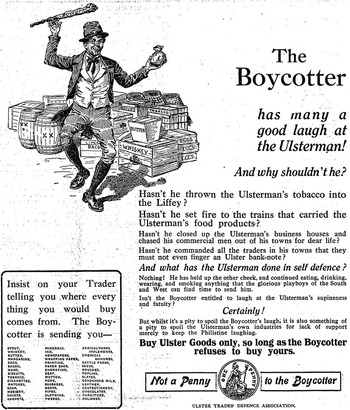
While Britannia was chosen as the symbol for the counter-boycott, the U.T.D.A. selected a masculine image to represent the Sinn Féin boycotter. The boycotter was consistently referred to as an abstract male figure, despite women's role in domestic shopping, and the fact that it was primarily women who ran the boycott from Dublin.Footnote 79 In an advertisement published by the association in a 30 May 1922 issue of the Belfast News Letter, the boycotter appears to be caught in mid-dance, gleefully extending a shillelagh bearing the word ‘boycott’ in one hand and a sack full of money in the other (see figure 2). Behind him are crates of southern Irish merchandise, including boxes marked as eggs, butter, biscuits, tobacco and whiskey, decorated with shamrocks and a harp. The illustrator's incorporation of the shillelagh not only represents southern nationalist violence, but specifically an archaic, illogical and primitive approach to violence.Footnote 80 The portrayal of Irishmen as wild, irrational and violent was a common British trope.Footnote 81 The advertisement also referred to Irishmen as ‘glorious playboys’. Famously, The playboy of the western world's main character became wildly popular with women in County Mayo when he began to brag that he had murdered his own father. His reputation was ruined when the truth was revealed that his father was not actually dead. By referring to Irishmen as playboys, the advertisement reiterates the deeply-imbedded English perception of Irish masculinity as intrinsically mendacious, violent, disorderly and uncivil.
‘The Boycotter’, Belfast News Letter, 30 May 1922. With thanks to the Irish Newspaper Archives and the Belfast News Letter. This image is copyrighted and was used with permission.

As in the advertisements for the Belfast Boycott in the southern counties, though economic success was viewed as being contingent on male actors, women were expected to take on an auxiliary role in making purchases for the good of the nation. A Belfast News Letter advertisement from 16 January 1922, stated ‘Housewives of Ulster! Support Ulster Industries. You are the keepers of the family exchequers. You are the chief money spenders. The money you receive from your husbands, sons, and daughters to spend in the purchase of food and other necessaries of life for the household, is earned in Ulster industrial concerns.’Footnote 82 This advertisement assumed that the majority of married women were not wage-earners, but that they were reliant on the support of their husbands or children. In explaining that this money was earned in Ulster, and, therefore, should be spent on Ulster goods, the U.T.D.A. was again perpetuating the notion that women gave little thought to their role in the economy and needed guidance in order to perform it successfully. However, the Belfast Boycott affected working women as well. On 17 May 1922 a clerk named Isobel M. Hegarty wrote a letter to an official at Stormont seeking employment. She stated that ‘Owing to the Belfast Boycott, I'm afraid our Firm will be closing down very soon, otherwise I would not trouble you’. In addition to concluding her letter by identifying herself as a Protestant, Hegarty attempted to demonstrate her unquestioning loyalty to the crown. ‘I may say I have had two Brothers in the late War, one was killed, and the other remained fighting until peace was declared.’Footnote 83 Hegarty noted her religion and familial contribution to the war as added assurance of her qualifications to work for the northern parliament. In the advertisement as well as in Hegarty's letter, male employment was prioritised. While the advertisement assumed a female population reliant on men's (or an unmarried daughters’) incomes, Hegarty's letter reiterated this same narrative in her attempt to link her qualification for employment to the implicitly more important and patriotic work of her male relatives during the war.
Unlike the Belfast Boycott, there does not appear to be evidence that women played an active role in managing or running the counter-boycott. However, women could still show support for the counter-boycott by altering consumption habits or attempting to encourage others to do so. On 24 April 1922, a woman named Marie H. Stewart wrote to Northern Irish Prime Minister Sir James Craig regarding the sale of southern butter. She stated that ‘During my round of shopping in the City to-day, I was amazed to find so much Butter being sold, all coming from the Southern Ireland and people buying it freely — without asking any questions.’ This letter provides insight into the perceptions of a Northern Irish woman as a consumer. Stewart went on to state that ‘I myself make a point of buying only Northern manufactures if they can be had; and I influence everyone I can’.Footnote 84 Stewart's assertion reiterates the claim that boycotting should be an activity undertaken by the unionist community in its entirety. Women played an important role in encouraging such decisions. A response to Mrs Stewart's letter came two days later from Sir Wilfrid Bliss Spender, the secretary to the government of Northern Ireland, reassuring her that the government was monitoring the situation. Spender wrote that ‘it is very difficult for people to exhibit patience in view of the situation, but sometimes deliberate action is more effective than more hasty steps.’Footnote 85 The letter's tone, while cordial, reiterated that Belfast consumers — generally women — were prone to irrationality and haste, and should leave economic decisions to the male-controlled government of Northern Ireland.
Recalling her involvement in the revolution, Áine Ceannt, a Cumann na mBan activist and the widow of the martyred Irish republican and 1916 Easter Rising participant Éamonn Ceannt, stated that the ‘[Belfast] boycott had a big effect on subsequent events in Ireland’.Footnote 86 Yet, in spite of Ceannt's assertion regarding the boycott's importance within Irish history, it has been the subject of limited research and is usually only briefly mentioned in accounts of the revolution. In contrast to so many of Sinn Féin's operations, which relied almost exclusively on male politicians, gunmen and journalists, the Belfast Boycott forced nationalists to acknowledge and actively rely on the widespread grassroots mobilisation of consumers.
These consumers, the vast majority of them women, were viewed as necessary allies in order to achieve the Dáil's ultimate goals of ending partition and securing Irish independence. Unlike many male revolutionary actors, these women were expected to confront British power publicly and openly. While neither the boycott nor the ensuing counter-boycott were intended to challenge traditional gender norms, both boycotts did serve as a means of breaking down barriers to female participation in Irish politics. Mundane consumer choices made by women in buying basic supplies like butter and eggs for their households acquired an elevated political significance. Consumer habits could give both southern and northern women (and those overseas) broader access to political and economic engagement, allowing them the opportunity to assert political agency in a more visible way than previously afforded to them. The Belfast Boycott, and responses to it, provide valuable insights into the roles and expectations of Irish women of all classes and across borders during the Irish revolutionary period.Footnote 87