Very few African American soldiers in the First World War ever saw combat. Drafted into the United States military at higher rates than white men, the military’s leaders consigned the majority of Black enlistees to labor units to work the docks, build roads, dig trenches, and bury the dead. Only one-fifth of the roughly 200,000 Black soldiers sent to France ever saw combat, compared to two-thirds of the overall American Expeditionary Forces.Footnote 1 The fact that Black soldiers were drafted, many against their will, to carry out hard labor evokes some unsettling parallels with other forms of compulsory labor that African Americans have been forced to perform in American history.Footnote 2 This article, drawing on recent research about the centrality of sexuality within the American War Department’s motivational strategies of the First World War, and extending a historiographical approach that explores the deep interconnectedness of racial and sexual discourses, practices, and identities, demonstrates that sexual racism was a central part of the military’s decision to relegate Black soldiers to non-combat roles. While historians have explored the way that sexual stereotypes about African Americans affected how they were perceived and treated during the First World War, scholars have not fully accounted for the role of sexualized assessments of motivation in the placement of African Americans in labor roles.Footnote 3 Military leaders’ belief that African Americans were sexually unrestrained directly informed their assessment that these men lacked the capacity to be motivated to fight, since the War Department’s “morale” programs relied upon a “parasexual” condition of enforced chastity paired with pressure from women and propaganda that the sexually frustrated men be chivalrous heroes. In concluding that most African Americans were irredeemably licentious, the war planners both drew upon and reinforced sexual racism and racist sexual desirability hierarchies. This sexual racism operated in two fundamental ways. In the first place, the exclusion of Black soldiers from combat roles deprived them of the honor and status (at the most intimate scale, in the eyes of many women) that these dangerous roles conferred upon those that filled them. In the second place, the placement of Black soldiers into labor roles where they would perform the bulk of the military’s logistical labor freed up more white soldiers to train and fight and, thereby, to hoard the honor of these roles. The Black soldiers’ low status within the hierarchical rank system was crucial for motivating white soldiers in combat roles, because it gave substance to the propaganda-backed notion that the combat infantryman was in a glamorous, privileged and sought-after position. This notion, which appeared in much of the propaganda circulated by the Morale Branch and the Committee on Public Information, was clearly calculated to motivate white soldiers to lean into combat roles, obscuring in the process the damaging and exploitative nature of those roles. In the framing of racialized and sexualized status attainment, combat roles became something to be strived for, rather than something to be avoided. Moreover, the low status of labor roles—filled disproportionately by Black soldiers—served as a disciplining and motivating humiliating demotion zone that combat soldiers should fear being relegated to if they shirked their dangerous, difficult, and damaging duties. In all of these ways, the exclusion of African Americans was not merely incidental, but structurally necessary, in the eyes of many military leaders for the motivation of the predominantly white servicemen in combat roles.
This article is part of a growing literature on the centrality of sexuality in the construction and maintenance of racial hierarchies. Numerous scholars have demonstrated the ways in which American constructions of whiteness in the late nineteenth and early twentieth centuries depended upon the stigmatization and othering of African Americans’ supposed sexual desires and proclivities. Elite proponents of so-called civilization regularly cited the sexual behavior of ethnic minorities as evidence of their supposed savagery, and it was this sexual othering that gave meaning to their distinctions between savagery and civilization. As historian Jacquelyn Dowd Hall has argued, “in a culture that insisted upon work, instinctual repression, and acquisitive behavior, men struggled to separate themselves from nature,” and projections about the sexual behaviors of African Americans “became the repositories for those parts of the self which, in the process, had to be conquered and repressed.” Ethnic minorities, and African Americans in particular, served as cautionary and structurally necessary stigmatized figures who symbolized the hazards of succumbing to the passions. Their supposed lasciviousness both frightened the elite guardians of civilization and seemed to justify their positions by offering an ever-present threat to the sexual foundations of their project.Footnote 4 Similarly, historian Gail Bederman has shown how sexual restraint was central to turn-of-the-century civilizational discourses that imagined white—and especially Anglo-Saxon—Americans as being more advanced than African Americans and other ethnic minorities. And scholar Beryl Satter has shown how racial hierarchies in the United States in the late nineteenth and early twentieth centuries were fundamentally predicated on beliefs about sexual self-restraint: that white Anglo-Saxon women, as the supposedly most sexually restrained group in society, sat atop a moral hierarchy.Footnote 5 Historian Julian Carter has demonstrated how “normality” discourses in the first half of the twentieth century, which celebrated monogamous marriage and nuclear family groupings as being inherently superior to other patterns of sexuality and kinship, created a depoliticized racial hierarchy that quietly placed African Americans (and other racial minorities) in an inferior position vis-à-vis European Americans within a widespread cultural consciousness.Footnote 6 In all of these ways, sexuality—and sexual restraint in particular—sat at the heart of formulations of race and racial hierarchy.
Sexual politics have also long been a vehicle for maintaining and policing racial hierarchy. As Ida B. Wells-Barnett demonstrated around the turn of the twentieth century, the lynching campaigns in the South following the Civil War, which were fundamentally about maintaining social, political, and economic control over African Americans following Emancipation, depended heavily upon discourses and cultures of white chivalry and accusations of rape and sexual impropriety on the part of Black men toward white women. According to Jacqueline Jones Royster, these campaigns drew upon and reinforced gender stereotypes of white women as symbols of racial purity, Black men as incorrigible brutes with unquenchable sexual appetites, Black women as lacking the sexual respectability to keep Black men’s sexuality in check, and white men as defenders of white women and of civilization more broadly.Footnote 7 Lynching operationalized these discourses and translated sexual racism into politically stifling mob violence.
Lynching campaigns were not only about policing African Americans, but also about shoring up whiteness as an identity, justifying the relative status of whiteness, and protecting that identity from perceived threats. As Dowd Hall has pointed out, the “false chivalry” of lynching was less about protecting white women than it was about protecting white men’s honor within a system that depended on this honor system to concentrate wealth and power away from Black populations. That “false chivalry” was also a strategy for preventing Black political, economic, and social ascendency and redirecting white working-class disenchantment away from elites. As Philip Dray has pointed out, while “the most sensational and commonly repeated excuse for a lynching was a sexual assault by a black man against a white woman, the instigating reasons were actually wide-ranging.”Footnote 8 But even when those who carried out lynchings did not cite rape as their motivation, sexual politics were often at play. According to Wells-Barnett, the “crime” that motivated white mobs to lynch Black men (and occasionally women and children) in the South was the charge of Black impropriety leveled at politically active and economically successful Black denizens. As Dowd Hall puts it, this system “translated every sign of black self-assertion into a metaphor for rape.”Footnote 9 Any gain that African Americans made could be interpreted as a profound violation of white prerogative, and in a culture that fixated on the supposed dangers that Black sexuality posed to white femininity, the consequences were often deadly.
In the leading historiography on race during the First World War, the military’s assessment of African Americans’ sexuality for the purpose of determining their susceptibility to being motivated is conspicuously absent. The prevailing explanations that historians have offered for Black soldiers’ relegation to labor roles have centered mostly on white society’s fear of the risk posed by armed Black military regiments and military leaders’ abstract claims about the moral and biological inferiority of Black soldiers.Footnote 10 A likely reason for this absence is the fact that, as I have argued elsewhere, historians have generally misinterpreted the main objective of the military’s social policy during the war. The main reason for the military’s social policies, which resulted in the policing of soldiers’ (and many civilians’) sexual behaviors, was not sexual health or morality, but motivation. This is why the military and the civilian agencies that it directed did not merely stifle the sexual activity of soldiers, but rather went out of their way to stimulate and entice the soldiers through dances, propaganda featuring women, and deliberately hiring women whom they believed were conventionally attractive to staff its canteens. As I explain elsewhere, “[t]his motivational aspect of the CTCA’s work involved using enforced sexual abstinence and the exposure of soldiers to innocuous forms of sexual stimulation simultaneously as interlocking parts within a ‘parasexual’ social strategy where, to borrow sociologist Peter Bailey’s definition of the term, ‘sexuality [was] deployed but contained, carefully channelled rather than fully discharged,’ relying on simultaneous enticement and enforced distance to motivate a particular kind of action.”Footnote 11 Because historians have not, until recently, recognized the centrality of motivation within the military’s social policy, they have not been able to fully connect the dots between these programs and the relegation of African American soldiers to labor roles.
A key event cited by historians for the assignment of segregated African American units to non-combatant roles is the outbreak of a deadly riot in Houston, Texas, on August 23, 1917, when a group of more than 100 soldiers from Company I of the Third Battalion of the all-Black Twenty-Fourth Infantry, stationed at Camp Logan, participated in a rebellion against discrimination and provocation on the part of the nearly all-white Houston police. Roused by a combination of insults from white police and civilians, witnessing the mistreatment and brutalization of Black civilians at the hands of the police, the beating and arrest of two African American military personnel (one of whom was attempting to intervene when the police were brutalizing and arresting a Black civilian woman), the circulation of rumors that the police had killed one of the arrested soldiers, and that a white mob was descending on the camp, a group of more than 100 soldiers marched into downtown Houston with rifles intending to engage the Houston police in combat. Seventeen people were killed in the firefight that ensued, only four of whom were the rebelling soldiers.Footnote 12 The violence, besides horrifying white civilians, many of whom—especially in the South—were already uneasy about the idea of having armed, combat-trained African American regiments stationed in and near population centers, also had the effect of solidifying defensive plans for Black troops among the War Department leadership.
Historians have been clear about the consequences of the riot. Even before the riot, many white southerners had been deeply apprehensive about what they saw as the insurrectionary risks of arming and training Black soldiers and stationing them near white communities.Footnote 13 The riot seemed to vindicate their fears and provided the material needed to turn prejudice into policy. According to scholar Chad Williams, “[t]he Houston violence produced a seismic shift in [the] national debate on the potential place of African American soldiers in the U.S. military,” and helped to solidify plans—which were already underway—to use Black soldiers primarily as laborers during the war.Footnote 14 Historian David Kennedy has pointed out that the violence had the effect of “scrambling” the calculations of War Department officials, who had been looking for tenable ways to draft, train, and utilize Black soldiers in the war. In the wake of the violence, the War Department temporarily suspended all Black enlistment—a policy that many white southern leaders pushed to be made permanent—and in late September 1917 implemented a policy whereby Black soldiers would be scattered to many different camps, with assurances given that there would be two white soldiers for every one Black soldier stationed in any given camp, in order to deter or quell any potential insurgency. In addition to this, the War Department’s leaders divided the army’s only Black combat division into seven parts, assigning each part to a different camp--ostensibly to prevent any further unrest.Footnote 15 As one key War Department advisor on race relations reported at the end of the war, “after the Houston riot … [t]here was a fear, ill-concealed in the North as well as in the South, that if Negro soldiers, in large numbers, were sent into any particular camp they would be a menace to the surrounding population and to peace and order.”Footnote 16
The events in Houston were caused by conflict over sexual conduct and also later interpreted by the white press as evidence of Black sexual excess.Footnote 17 The cascading incidents that led to the uprising in Houston were, after all, initially triggered by a Black soldier’s protectiveness of an African American woman who was illegitimately being arrested by the white police. As Williams explains, Lee Sparks—the leading white police officer in the incident—arrested Sara Travers on unfounded suspicions that she was harboring two Black teenagers who had allegedly been illegally gambling. When “[s]he professed her innocence,” Lee Sparks “responded by demeaning [her] womanhood and respectability” with a slew of racist and sexually demeaning derogations, slapping her in the face, and “forc[ing] her into the street only partially clothed” as he arrested her. When the young private Alonzo Edwards intervened in front of a “crowd of black onlookers who witnessed the disturbing scene” (resulting in Sparks pistol-whipping Edwards and placing him, too, under arrest), the man’s actions were simultaneously an act of chivalry and a threat to white power and prerogative.Footnote 18 The white press blamed the events in Houston on sexual and moral depravity, rather than discrimination and humiliation. Three weeks after the riot, the Atlanta Constitution claimed, for example, that “[f]indings of the citizens’ board of inquiry into the causes leading up to the recent riot … [found] that the mutiny had been planned days in advance by those participating in it; and that dissolute women were permitted to mingle with the colored troops, day and night, in camp, and supply them with liquor”—conditions that the editors thought were “nothing short of astounding.”Footnote 19 According to the press, the soldiers had rioted because their morale had been diminished by a lack of sexual discipline and moral restraint. This was standard fare for the white civilian press in the South that framed Black soldiers’ presence in training camps near towns and cities as an affront to social and sexual norms.Footnote 20
These local assessments about the sexual corruption of Black soldiers’ morale paralleled those of key military leaders, who insisted that the problem of low morale affected most if not all Black enlistees, and that this should disqualify them from combat roles. In August 1917 the Chief of Staff Tasker Bliss recommended that Black soldiers be “used exclusively as service troops.”Footnote 21 Several months later, in an important memorandum, Colonel E. D. Anderson, who was chairman of the Operations Branch of the General Staff, argued that the majority of Black soldiers—those who came from what he called “the ignorant illiterate day laborer class”—were not only unfit for combat, but also that they would be benefitted by being kept “busy at useful work” that would prevent them from “laying around camps accomplishing nothing of value, getting sicker and sicker and in trouble generally.” A benefit of putting them to work, he explained, was that they would free up other men—presumably white soldiers—for combat duty.Footnote 22
Historians have drawn important conclusions about the motives behind these officials’ recommendations. According to Chad Williams, their recommendations, which the Secretary of War Newton D. Baker approved and implemented, were informed by “[a] combination of biological racism and historical fears of armed black men,” rooted in white supremacist convictions that Black people were inherently inferior, and reflected many white military officials’ desire “to replicate the practices, customs, and hierarchies of white supremacy as closely as possible in the army.”Footnote 23 Historian Jeanette Keith similarly cites “white supremacy on the national level” and “[t]he prerogatives of white power” in her explanation.Footnote 24 As illuminating as these historians’ accounts are, there is more to say about the motives behind the War Department and military officials’ decision to relegate most Black soldiers to non-combat units. An under-explored aspect of these men’s assessments, equally rooted in white supremacy, was their perception that Black soldiers could not be motivated to fight, since they supposedly lacked the sexual self-restraint that the War Department’s morale programs relied upon.
The motivational strategy of the American military was pioneered, refined, and implemented by a group of elite psychologists, academics, social reformers, military medical officers, and propagandists, who eventually founded the Military Morale Section and the Morale Branch of the General Staff of the army. Among these figures were the prominent psychologist G. Stanley Hall; the army physician and educator of preventive and sanitary medicine Edward Lyman Munson; the Harvard University philosophy professor William Ernest Hocking; the YMCA (Young Men’s Christian Association) leader and co-founder and president of the Parks and Recreation Association of America Luther Halsey Gulick Jr.; and the social hygienist Max Joseph Exner. These figures wrote and published a series of books and pamphlets that theorized how to motivate American soldiers to fight in the war. This literature can be referred to as morale theory. Nearly all of the American social reformers, psychologists, and university professors who theorized morale had some connection to the War Department’s morale programs. But their studies of morale were not an entirely coherent or coordinated project. Their writings on morale were part of a broader academic conversation that these well-connected figures were having with one another and with the wider civil society about how to motivate men. At the center of this conversation was, of course, the drive to win the war against Germany. But the morale theorists all had wider ambitions and concerns. The need to move social discipline and social authority—especially that targeting young men to do dangerous, traumatizing, unfulfilling, or boring work—away from moralizing and onto a new foundation is a key theme in the morale theorists’ writings. Historian Daniel Ussishkin has demonstrated how for the theorists of morale writing during World War I and the 1920s, the concept offered “both a form of discipline and an interiorization of disciplinary codes.” In an era in which academics were increasingly aware of human instincts, morale offered, for figures such as G. Stanley Hall, a “vitalist” form of power and influence—a way to move beyond externally-imposed forms of moral authority, and toward “a new foundation for civilized life.”Footnote 25 Morale, in other words, offered a compelling alternative to morality. Whereas morality had primarily been concerned with spiritual obligation and religious sanction, morale was concerned with motivation. Rather than seeking to compel people not to do things, the morale theorists sought a reliable way to motivate them to do things—happily, efficiently, and effectively.Footnote 26
The way to motivate young men, the morale theorists generally agreed, was to prevent them from accessing sexual gratification and then to steer them, in their sexually frustrated state, toward productive activities and tasks. Any solution to the problem of motivation, the morale theorists agreed, would require the soldier’s enforced separation from “baser” pleasures, particularly sex.Footnote 27 According to these theorists, men—and especially soldiers—must maintain what they called “sexual continence” as a precondition for building and maintaining motivation and drive. All of these theories of morale shared a “hydraulic” understanding of sexuality in which motivation and “vigor” could be conserved or “dissipated” through ejaculation.Footnote 28 The way to motivate men, they argued, was to block and then redirect their sexual instinct, using women’s appeals and encouragement to help channel it. For morale theorists such as Luther Gulick and Ernest Hocking, civilization itself could be characterized as a complex structure built out of the deferred gratification of the sexual instinct—an arduously achieved lengthening of the circuit path of desire, from immediate gratification to an elaborate labyrinth of romantic and chivalric striving.Footnote 29 The morale theorists believed that if men could either be kept away from, or convinced not to consort with, the “wrong sort” of women (“easy” or “promiscuous” women who would engage in sexual relations with them outside of a long-term, committed relationship), and other women could be convinced to be highly selective and to uphold high expectations of the men with whom they were romantically involved, then these latter women could be the most effective motivators of men.Footnote 30
All of these insights became key components of the motivational aspect of the Commission on Training Camp Activities’ (CTCA) work. The CTCA, which was the War Department agency in charge of shaping the social lives and environments of soldiers, cleared the training camps of sexual opportunities with women by barring their entry except under supervised conditions. State and federal authorities pressured local police to shut down red light districts, police social gathering spaces, and to round up and incarcerate women who they suspected of being sexually active with soldiers.Footnote 31 At the same time, the CTCA’s constitutive organizations such as the YMCA and the War Camp Community Service organization (WCCS) intentionally brought women who they deemed to be conventionally attractive into the war camps to entertain and allure the soldiers. Alongside these practices, the Morale Branch and its predecessor, the Military Morale Section, quietly took over a series of YMCA-run newspapers to ply the soldiers with propaganda that simulated women’s voices and appearances to encourage the men to fight bravely. The implicit message of propaganda targeting men and women was that the “slacker” who shirked military duties was undeserving of love or attention, whereas the heroic, upstanding soldier was the epitome of desirability in the eyes of admiring women. The leaders of the morale programs believed that sexually deprived men, if presented with the appeals and encouragement of women—whether real acquaintances or simulated in propaganda—would be more suggestible to carrying out the military’s objectives, since they would be more energetic, enthusiastic, and eager to prove their sexual worth. The combination of enforced sexual abstinence, the deliberate exposure of soldiers to the “right kind” of women in the “right kind” of circumstances, and the implication that women in general would only be attracted to a brave soldier who uncomplainingly shouldered his duties clearly matches the definition of parasexuality coined by the sociologist Peter Bailey. Parasexuality, in his definition, uses the allure of sex to motivate people (usually men) to spend money or perform labor, usually with the implicit goal of obtaining access to sex, but not always.Footnote 32 This formula was clearly at work in the writings of the morale theorists. Consistent with the formulations of the morale theorists, the CTCA and the morale agencies operated on the belief that sexually restrained soldiers, in striving to meet women’s approval, would enthusiastically embrace their roles in the war.
Proceeding with an understanding of the morale theorists’ formulations on motivating men, and the morale programs that operationalized their findings, it is possible to draw new insights into the military’s decision to relegate Black soldiers to labor roles. Given the centrality of sexual restraint and sublimation within the motivational strategies of the War Department, the widespread belief that African Americans were sexually unrestrained would have been devastating for their prospects of becoming full-fledged combat soldiers within the expeditionary forces.
War Department leaders’ assessments of Black soldiers’ susceptibleness to being motivated are evident in the reports and memos of military commanders and in the published findings and statements of the Morale Branch and its predecessor agency, the Military Morale Section, as well as in the War Department’s policies and practices. As the Morale Branch’s first, widely-distributed “Morale Circular” explained, “relatively large numbers of negroes are in labor battalions and ‘service’ units”—a fact that the morale agency clearly linked to what its leaders perceived to be Black soldiers’ subjective and intersubjective predispositions. The circular explained that, while African American soldiers were generally affected by the same problems that affected white soldiers and their morale, “the colored recruit [also] has his own peculiar difficulties.” The two chief reasons cited by the morale agency were the belief that African Americans lacked discipline, especially sexual discipline, and that they were not supported by their communities the same way white soldiers were. As to the first of these, the Circular claimed that, “[b]ecause of his habits of life and environment, the gap between civil and military life is likely to be greater in his case than in that of the average white soldier. The negro is frequently not accustomed to orderliness, sanitation and the degree of moral or physical discipline required in the army.” The stresses of military life “interfered with easy-going habits and may lead to resentments,” the circular continued, and this was unique among Black soldiers as compared to their white counterparts.Footnote 33 According to the morale theorist and the chief of the Morale Branch, E. L. Munson, in the motivation campaigns directed at soldiers, “different methods of management will be required for negro troops than for white troops,” since, as he vaguely put it, “[t]he colored soldier presents morale problems of a special nature.” He believed that Black soldiers were “pleasure loving and particularly appreciative of opportunities for enjoyment,” and that they were “by nature relatively emotional and impulsive”—characteristics that made them difficult to discipline or motivate.Footnote 34 Here, the Morale Branch and its leader echoed a May 1918 memo addressed to the War Department by Colonel E. D. Anderson of the army’s General Staff, which stated that “[t]his will be the first time in their lives that 9 out of 10 negroes ever had any discipline, instruction, or medical treatment, or lived under sanitary conditions.” For this reason, Anderson claimed, Black soldiers ought to be withheld from combat roles and instead placed in labor roles.Footnote 35 The Morale Branch’s emphasis upon “moral discipline” was a thinly-veiled reference to Black soldiers’ supposed promiscuous sexual habits, which would have been anathema to the morale planners who founded and ran the War Department’s morale agencies, and who, as we have already seen, predicated their entire motivational apparatus on the parasexual condition of sexual deprivation paired with stimulating and expectation-laden female appeals.
The other factor cited in the Morale Circular and influencing military officials’ beliefs that African American men made poor soldiers was the assessment that they lacked support from their communities, particularly the women in their lives. As the Morale Circular stated, the Black soldier “does not have the support of his home people to the same extent as does the white soldier”—an assertion that they attributed to several causes. While it perhaps would have been reasonable for the morale officials to fret about African American communities’ deep divisions about support for the war—a fact that was reflected in the press, as African Americans debated the desirability of fighting for a country that failed to protect them and their rights—the officials blamed illiteracy, unintelligence, and the moral “character” of these populations.Footnote 36 “For a large proportion [of the colored population],” the circular insisted, “the mental and physical strain of the act of writing is too great to make the interchange of letters between the soldier and the home ties frequent and satisfactory in character.”Footnote 37 Elsewhere, the agency stressed the importance of soldiers’ correspondence with their “home folks” to provide a “steadying” and motivational effect, which the Committee on Public Information promoted in public-facing propaganda.Footnote 38 Because of prevailing stereotypes about African American women being lascivious, morale officials believed that Black women could not be relied upon to exercise the same kind of sexually discerning “moral” influence that white women could. If they were as sexually assertive as the stereotypes held them to be, then the basic starting point for parasexual motivation—sexual deprivation—could not be established, and therefore the motivational “circuit path” of desire would be, in the terminology of the morale theorists, “short circuited.”Footnote 39 In all of these ways, the charge that African American soldiers did not have the support of their so-called home people would have been devastating to their prospects for developing good morale, since the morale agencies placed significant emphasis on the necessity of familial, social, and sexual pressure within their motivational strategy.
The belief that Black men could not be motivated by the usual means, and that Black women would be useless as parasexual motivators anyway, led to the War Department neglecting to provide the same kind of social facilities for Black soldiers as they did for white soldiers. For white soldiers, the CTCA’s constitutive organizations intentionally organized opportunities for soldiers to mingle, in curated and chaperoned conditions, with local girls and women. The YMCA also intentionally hired women who they believed to be conventionally attractive as canteen workers to serve coffee and snacks to soldiers in their huts. They deliberately chose women who were slightly older than the soldiers and who had religious convictions or social reputations that would prevent them from having sexual relations with the soldiers. The Young Women’s Christian Association (YWCA) opened “Hostess Houses” where soldiers could meet female friends, family, and acquaintances under the watchful eye of YWCA “hostesses.” The WCCS hosted chaperoned dances, where, according to the morale theorists and the organization’s leaders, soldiers’ heavily-regulated physical contact with members of the opposite sex would be especially effective for increasing the soldiers’ sexual desire, which, if harnessed and not “dissipated” through sexual intimacy, would drive their motivation for the fight.Footnote 40 The CTCA made very little effort to provide similar experiences or sources of motivation for Black soldiers. Whereas the YMCA sought “to provide one hut for every 3,000 soldiers,” an October 1918 report on the situation addressed to the Morale Branch’s Chief E. L. Munson admitted, “[t]he Y.M.C.A. has not been able, in many instances, to reach this standard of equipment for the colored soldiers.”Footnote 41 Inside the training camps, the welfare organizations that were placed in charge of erecting and operating recreational huts—the YMCA, the Knights of Columbus, and the Jewish Welfare Board—struggled to provide an adequate number of huts for African American trainees, especially when camp facilities were strictly segregated according to race. Part of the reason for this was that, after the uprising in Houston, the War Department delayed the drafting and permanent placement of many African American soldiers, and, by the time Black draftees were finally called up in September 1917, many camps had already developed their recreation systems without provisions made for these soldiers. In addition, because of the War Department’s protective strategy of spreading out the placement of Black soldiers to ensure that they were significantly outnumbered by white soldiers in each camp, and because many camps varied in size, equal provisions in the segregated facilities for African Americans were often lacking in size and quality, if they existed at all.Footnote 42
Another CTCA service that was severely lacking for Black soldiers was the YWCA’s provision of Hostess Houses. Eventually, the YWCA elected to create Hostess Houses specifically for African Americans, but the first of these facilities did not open until April 1918. Seven months later, when the armistice was signed, there were only nine Hostess Houses for Black soldiers and their female guests.Footnote 43 Consequently, and much to the chagrin of African American proponents of racial “uplift,” women visiting with African American soldiers were received in the tents and other living quarters of the men. The Tuskegee Institute’s Charles Williams—himself one of the proponents of “uplift”—reflected after the war’s conclusion on what he perceived to be the social consequences of this lack of arrangements made for Black soldiers and their guests, dwelling especially on how it affected both the convenience and the reputations of African American women. When “the War Department made formal provision for the American soldiers to have the gentle and civilizing influence of women” in the camps, Charles Williams explained, “little thought was given at first to the Negro soldier and to the entertainment of his women-folk.” Not only did mothers and sweethearts lack provisions or accommodation for their visits with soldiers, but, he claimed, so did other women “who had no such innocent mission,” and who came to camps “for the purpose of forming acquaintances” (as Williams euphemistically referred to non-committal sexual activity and relationships), entering and exiting the camp freely, “from early morning until late in the evening, with no restrictions whatever.”Footnote 44 Whether or not this claim was accurate, the significant point is that the military’s morale agencies were less concerned with guarding and steering the romantic and sexual sentiments of Black soldiers than they were with white soldiers in the war camps.
Outside of the camps, the situation was similar. Whereas the WCCS made broad efforts to receive and entertain white soldiers in towns adjacent to the training camps and to even provide opportunities to interact with local women and girls within “wholesome” and chaperoned environments, in most cases, these spaces were off-limits to African American soldiers. The hostility of many white civilians toward Black soldiers prevented them from entering the de facto white spaces set up by the WCCS, and in many cities, the organization struggled to raise the funds to set up parallel facilities for the exclusive use of African Americans. Because of the delayed and inadequate implementation of WCCS facilities, a September 1918 report by the WCCS explained, many African American soldiers were permitted to engage in what the service organization deemed to be licentious sexual behavior, and this, they claimed, had a direct connection with racial tensions and conflict. The report detailed that prior to the creation of a WCCS Red Circle club in the port city of Newport News, Virginia—where thousands of Black stevedores were stationed to load supplies onto ships bound for France—“[v]ice conditions in the community were unspeakably bad. Soldiers were openly mingling with prostitutes. They were also dissatisfied and growing rebellious.” Interracial tensions between white soldiers and civilians and Black soldiers, as well as intra-racial conflict between Black soldiers and Black civilians, were pervasive there, the report explained, and it blamed this on the lack of WCCS facilities to host the large influx of soldiers.Footnote 45
The morale of African American soldiers was neglected overseas as well. On the transportation to Europe, these passengers were sometimes passed over by the YMCA and other volunteers. As one YMCA secretary on board the Orizaba in September 1918 reported to his superiors, while he secured 220 subscriptions to the YMCA magazine Association Men, he did not attempt to get “the colored men from the south forming a labor Bat[talion]” to subscribe.Footnote 46 Upon their arrival in France, African American soldiers fared no better. Of the 9,850 YMCA workers sent to France, only eighty-seven were Black, and only nineteen were Black women—only three of which were there prior to the Armistice. (The others were sent overseas in order to look after the African American laborers in the non-combatant Services of Supply, whose logistical work continued well after the conflict was over.) As Charles Williams explained, “There were hardly ever more than 75 Negro [YMCA] secretaries in France at one time, and these were scattered among nearly 200,000 Negro soldiers.”Footnote 47 The rarity of encountering Black women abroad is evidenced in the testimony of Columbus Morris—a Black member of a labor battalion stationed in western France. According to Morris, it was one of the “greatest thrills of [his] life” to see “colored women” on a boat anchored near the port where he was assigned to unload ships and load trains. He was so moved by the sight of these women that he jumped into the water and began to swim toward their boat.Footnote 48
Black soldiers were frequently barred from entering YMCA huts in France, and when and where they were admitted, the white staff generally treated them with a coldness that contrasted significantly with the encouraging and alluring treatment that white soldiers typically received. As one soldier assessed, in France, “[a]bout 25 per cent of the white [YMCA] secretaries served the colored troops gladly, about 25 per cent served them half-heartedly, and about 50 per cent either refused to serve them or made them feel they were not wanted.”Footnote 49 As Addie Hunton and Kathryn Johnson—two African American women who served with the YMCA among the American Expeditionary Forces in France—observed in their retrospective book, white women in the organization who were assigned to work in huts for Black soldiers did so in a “perfunctory” way, preventing themselves from bringing the same spirited encouragement and care that was generally provided to white soldiers. As Kara Dixon Vuic documents in her book about female canteen workers and nurses serving the American Expeditionary Forces, women played an important part in making the soldiers feel at home on the battlefronts and along the supply lines, bringing warmth and excitement to the enlisted men, and often forming sincere bonds with some of these men. However, she explains, “[w]hile many white women [serving in the YMCA and other welfare organizations with the American Expeditionary Forces] were willing to embrace friendships with a charming Irish boxer or a doughboy as a sign of their openness to new experiences, they were much less willing to cross the deepening divides of race.”Footnote 50 In all of these ways, the Black soldiers were neglected by the white women who the military’s morale agencies brought over to motivate the soldiers (the so-called “girls behind the man behind the gun”). All of these examples speak to the overall way that the service organizations that the War Department deputized for looking after soldiers’ morale neglected to utilize the same parasexual motivational strategies for Black soldiers that they used for white ones. The reason for this neglect was a prevailing belief that Black soldiers could not be motivated in this way because the same forms of sexual manipulation that worked on white soldiers would not work on them.
The military’s morale strategies also shed new light on the ways that biological racism informed War Department policy. A clear place to look is in the scientific literature and psychological tests that validated Black soldiers’ placement. Arthur E. Barbeau and Florette Henri have argued that military leaders were “supported in their opinion … by the bulk of scientific thinking of the war period, which held that the Black American civilian was neither physically nor mentally capable of performing the duties of a combat soldier.”Footnote 51 Reflecting a tendency among social historians of World War I that centers sexual health and sidelines morale, Barbeau and Henri cite a series of studies about the incidence of venereal disease among Black soldiers, but they do not analyze the specific ways in which scientific opinion evaluated the prospects for Black motivation.Footnote 52 Key medical reports that lent scientific support for the decision to relegate Black soldiers to non-combat units were more concerned with the supposed psychological failings of Black draftees than they were with their physiological conditions. The highlight of a study entitled “A Comparison of White and Colored Troops in Respect to Incidence of Disease,” presented to the National Academy of Sciences in November 1918, which used data gathered from 531,445 white soldiers and 15,186 African American soldiers who had been treated for illness within the U.S. military camps, was that medical data could be interpreted as evidence of social behaviors and attitudes. While the study reported that Black soldiers were “19% more liable to go on sick report than the white troops,” and that this was partially due to a higher incidence of venereal disease, that the main takeaway from this was “a difference in social pressure” and “a difference in ability to control the sex instinct” between white and Black soldiers.Footnote 53 The concern of the authors of the study was not the physiological damage or transmissibility of venereal disease itself, but what higher incidences of venereal infection might mean about Black soldiers’ social and cultural attitudes. Such rates were taken as evidence that these would-be soldiers lacked the social and psychological foundations necessary for combat.
These anxieties were reflected in Colonel Anderson’s memo to the War Department concerning the “Disposal of the Colored Drafted Men,” in which he emphasized that his primary concern was not the physical health of Black soldiers, but instead their lack of “moral sturdiness” and “mental stamina,” which he believed would make them ineffective “in the line against opposing German troops who consist of men of high average education and thoroughly trained.” In Anderson’s formulation, good health on the part of African American soldiers did not fundamentally change the role that they should play in the war; it merely changed where they should play it. If a Black draftee was physically healthy, Anderson thought, he should be sent overseas as a laborer, whereas if a man was infected with venereal disease, he should be kept in the United States as a laborer.Footnote 54 Here, the thinking went, white combat preparedness was contingent upon Black relegation to labor, and such a dynamic was justified by the military leadership’s assessment of moral and psychological dispositions, of which poor physical health was merely a symptom.
The primacy of this concern about social disposition and psychological capacity is evident in the aptitude testing programs to which draftees were subjected upon arriving in training camps. From the beginning of the draft, new arrivals in the camps were screened for physical fitness, skills, and qualifications, to determine where to place them as personnel. Six months after the United States’ entry into the conflict, the War Department added psychological testing to its personnel screening process, and by the beginning of 1919, 1,726,000 soldiers had been evaluated using these so-called “intelligence tests.”Footnote 55 Intelligence tests were designed by psychologists in the National Research Council’s Psychology Committee—specifically the subcommittee on the Classification of Army Personnel—an agency headed by Walter Dill Scott. Scott was an applied psychologist whose research before the war centered on the use of psychology in advertising to manipulate consumer suggestibility, and he was one of the key attendees at the Informal Conference on Morale that eventually led to the founding of the Military Morale Section and the Morale Branch. The program for intelligence testing was expanded under the leadership of Robert M. Yerkes, who was head of the Psychological Committee (a committee that included Scott as well as G. Stanley Hall, author of Morale: The Supreme Standard of Life and Conduct), and who, under the auspices of that organization, initiated, with E. L. Munson, the Informal Conference on Morale in April 1918 that led to the founding of the Military Morale Section.Footnote 56
Like medical examinations and skill qualification exams, these noncommissioned officers believed psychological tests would “increase military efficiency and … lessen the cost of training and maintenance,” as Yerkes put it. They achieved this goal, he explained, by detecting, in particular, “intellectual deficiency, psychopathic tendencies, nervous instability, and inadequate self-control.”Footnote 57 While the actual impact of intelligence tests on how draftees were assigned within the ranks was negligible, the tests, designed as they were to “aid in segregating the mentally incompetent,” as Yerkes explained in his 1919 report on the tests’ findings, nevertheless offer some insight into the thinking of the noncommissioned officers who staffed the War Department’s morale agencies. As Stephen Jay Gould has explained, the primary impact of the testing program was the meaning that leaders made of the data both during and after the war.Footnote 58 Yerkes devised three tests: Alpha (for literate draftees), Beta (for illiterate and non-English speaking draftees), and an individual test, modeled on Lewis Terman’s adaptation of the Binet scales (a precursor to the modern IQ test), which would evaluate the intelligence of draftees who scored exceptionally low on either of these tests.Footnote 59 Very few Black draftees were tested using the Alpha test, but some Black soldiers from Virginia, West Virginia, Pennsylvania, North and South Carolina, and the District of Columbia were tested with Alpha; the findings of these so-called “intelligence” tests, like those of the medical tests, showed a large disparity between white and African American soldiers—disparities that Yerkes asserted he believed were “inborn.”Footnote 60 Yerkes concluded from this finding that “[a]ll officers without exception agree that the negro lacks initiative, displays little or no leadership, and cannot accept responsibility.”Footnote 61
Yerkes’s methodologies and conclusions have been thoroughly discredited by subsequent analysis. The conclusion that test score disparity was due to inborn qualities was overturned by Ashley Montagu in 1945 when, using Yerkes’s same data, he demonstrated that, while in general, Black test-takers scored lower than white test-takers, Black draftees from northern states outperformed white draftees from several southern states, suggesting that environment, not biology, was the critical determining factor affecting scores.Footnote 62 Stephen Jay Gould has demonstrated that, in addition to altogether ignoring environmental factors in his conclusions, Yerkes did not account for the strained environmental conditions in which the tests themselves were performed. Tests were regularly administered in crowded rooms without furniture and with poor lighting, where instructions were sometimes inaudible. In addition to this, the tests, which supposedly measured intelligence, contained many questions that required specific cultural knowledge—such as an understanding of what a particular brand of shortening was, or who a particular writer was—a fact that almost certainly impeded the attainment of high scores among test-takers whose backgrounds were less culturally integrated than the average white, urban, middle-class draftee.Footnote 63
One immediate and indisputable finding of the intelligence tests was the high rate of illiteracy among rural African Americans from the South.Footnote 64 This discovery had a major impact on the assessed prospects of Black soldiers to fight effectively. As the military historian Jennifer Keene has explained, literacy mattered much more in the First World War than it had in the past because reading and writing skills were necessary for “communicating within an increasingly bureaucratic organization.” But from the standpoint of morale, illiteracy presented another important problem. Illiterate soldiers, as Keene explains, “were more isolated from their families than soldiers who could write letters home and more insulated from camp morale workers who used camp newspapers to distribute wartime propaganda among its civilian soldiers.”Footnote 65 As the “Morale Circular” made clear, the potential impact of illiteracy upon correspondence with family members and sweethearts presented a problem for the morale of Black troops, since this correspondence with an encouraging and witnessing home front represented a pillar of their strategy for motivating men to fight. In addition, newspapers, bulletins, and other vectors of instruction and propaganda that were meant to have a cumulative positive effect on the morale of soldiers would have been unavailable to the illiterate soldier. Without the ability to read and write, all of these means of influencing the morale of soldiers would have been ineffective.
Military intelligence tests, in addition to evaluating reading and writing competency, also tested for self-control. In a chapter assessing the efficacy of the intelligence tests, G. Stanley Hall asserted in his book on morale that, while the tests did not explicitly “measure courage, personal leadership, loyalty, [and] the emotional traits that make men ‘carry on,’” “superior intelligence” was “perhaps the most important single factor” in predicting the presence of these motivation-giving traits in a soldier. Hall endorsed what he called “nature’s aristocracy of the ablest and the best.” It was on this basis that he endorsed placement tests: “It is in the light of such considerations that we must rate very highly the value of all such tests, not only in war but in all departments of life in times of peace.”Footnote 66 In the framing of other military psychologists, too, there was a close relationship between “intelligence” and capacity for self-control—especially sexual self-control—a relationship that was, in many ways, inherent in the meaning of “intelligence” as used by these experts. Intelligence tests were designed, in part, to determine whether recruits possessed adequate “self-control,” and toward this end, centered much of their attention on the perceived capacity of soldiers to absorb moral messaging, and to resist “sex suggestion.” As Keene has explained, psychologists would observe the effects of “social hygiene” materials on draftees to check for their capacity to attain the preconditions of good morale, recording whether or not “they are … susceptible to social hygiene instruction,” as one report from Camp Grant put it. As this report, entitled Study Value of “ Damaged Goods” as a Morale Agent demonstrates, the conclusions not only conflated sexual restraint with intelligence, and sexual suggestibility with unintelligence, but also associated the latter of these with African Americans, whom the report’s authors clearly regarded as less civilized than their white peers. “[T]he colored men being more primitive and of lower intelligence [are] more easily distracted and excited by sex suggestion and less permanently impressed with moral and social restraints,” the report concluded of one set of experimental test subjects.Footnote 67 In this sense, the study’s findings collapsed the distinction between mental capacity and sexual motivational capacity.
Such studies lent credibility to the white supremacist belief that Black soldiers should be excluded from combat units. They also help to demonstrate how the Jim Crow policies of the military were part of a broader sexual economy. Sexual racism was an indispensable part of the zero-sum competition for status within the scarcity-oriented sexual economy that War Department leaders fostered as part of their parasexual motivational strategy. Morale, as conceptualized by military and military-adjacent civilian leaders, was not a universal good in which all could partake, but rather a relational status requiring moral superiority vis-à-vis a seeming Other, and existing in a zero-sum affective universe. A major part of the military’s morale strategy was designed around convincing white soldiers that their roles in the war conferred a certain status upon them. If white soldiers were going to be motivated to risk their lives fighting in a faraway war whose geopolitical significance was unknown to most of the country, they would need to be convinced that what they were doing was heroic and honorable. The promise and legibility of white social status was fundamentally underpinned by Black subjugation, because the looming threat of the loss of social status—which a white soldier would face if he became a so-called “slacker” or failed to fight gallantly—was modeled and demonstrated by the unappreciated Black enlistee. The Black soldier’s lowly status simultaneously gave a comparatively high status to white soldiers’ roles, and served to mobilize anxiety concerning the loss of that status—particularly as they imagined being judged by women.Footnote 68
This is why the mere existence of African American soldiers complicated the narratives that the War Department used to make white soldiers feel exceptional. In their efforts to establish both military and civilian morale, the War Department’s propagandists—in the Committee on Public Information, the morale agencies, and in the service organizations of the Commission on Training Camp Activities—used the racialized and sexualized terminology of the “Hun” to describe Germans and to justify the righteousness of American belligerency. Such a framing not only had parallels with the way that African Americans were frequently described by white racists, but also would have made the full inclusion of Black soldiers in the racialized struggle against the Germans seem contradictory, since the presence of Black soldiers would have subtracted from the mobilizing sense of racial supremacy.
And yet, the neglect and mistreatment of Black soldiers by the civilian authorities and morale agencies contrasted with their treatment by the French civilian population. While, as historian Richard Fogarty has demonstrated, racism played an important role in the French military’s administration of, and attitudes toward French-African colonial troops (revealing the contradictions in France’s claims of universal equality), the broader French society—particularly in the countryside—did not have the same racial biases or observe the same racial taboos as American civilians.Footnote 69 Therefore, a striking feature of the wartime experiences of many African American soldiers who were sent overseas with the American Expeditionary Forces was their encounters with the French civilian population. Numerous Black soldiers commented on the way that French civilian women treated them kindly and without the same degree of prejudice they faced in the United States. One soldier remarked in his diary with a degree of incredulity that he had been “told by cultured women that I have made wonderful progress in learning French.”Footnote 70 As Robert Sweeney, a Buffalo Soldier who served in the 92nd Division, explained, “Negro soldiers fraternized with the French girls just like the white soldiers did.” He described his own interactions with the civilian “madamoiselles [sic]” as “friendly” and explained that he “got along very nicely with them.” According to him, “that was the only time that I was a full-fledged American citizen because they treated the Black soldiers just like they treated the white soldiers. No difference whatever.”Footnote 71 Columbus Morris remarked that he too had been treated well by French women, but also pointed out how white soldiers sought to undermine the friendliness between African American soldiers and French women by casting doubt upon their humanity—perhaps in order to bolster their own position in the French women’s eyes. According to Morris, white soldiers told French civilians that Black soldiers had tails. This misinformation resulted, he explained, in bizarre, and likely humiliating, social dynamics in which, as he put it, “some of them [French] women walked up to me and looked all behind me … believing that niggers [sic] had tails like a dog.”Footnote 72 Although Morris did not specify whether this was the case, it is likely that these rumors came from white laborers who worked alongside the Black service members of the labor battalion—men who would have also been taking their leave in seaside towns near the ports. These men, who themselves would have felt threatened by the sexualized hierarchy between laborers and combatants, likely would have wanted to distinguish themselves from the Black laborers in the eyes of French women.
Within the hierarchical ranks of the segregated military, as elsewhere in a competitive and exploitative society, white chivalry and Black chivalry were entirely at odds with each other. As historian Andrew Huebner has pointed out, Black chivalry was perceived by many white military figures as “threatening … to white social space and comfort.” In a stratified culture where whiteness defined its virtuosity in direct opposition to Blackness, Huebner rightly claims, “the black soldier’s masculine prerogative to gain was the white man’s to lose.”Footnote 73 When Black soldiers appeared to threaten the racial pecking order by standing up to white discrimination or pursuing sex with white women, French or otherwise, their confidence prompted outrage.Footnote 74 Where the morale agencies motivated white soldiers to lean into the war by playing up the narrative that to do so was to defend women, chivalry among Black soldiers was commonly perceived to be threatening, because African American women were so often victimized by white individuals and institutions. It is in this sense that, as historian Adriane Lentz-Smith has argued, “[a]s an ideological system, Jim Crow tried to settle gender roles for white people by diminishing black humanity.”Footnote 75
While causation can be difficult to prove in the discipline of history, a clear consequence of African Americans’ exclusion from combat roles is that they lost an opportunity to attain status within the flawed and exclusionary status competition that American wartime leaders framed the conflict as being. This loss was perceived as a tremendous insult by many Black civic leaders and civilians who saw the war as a chance to earn civic equality. While some of these leaders hoped that African Americans could bypass social equality on the path to gaining civic equality, the history of morale during the First World War shows how deeply intertwined the two really were.Footnote 76 As the sociologists Dana Kaplan and Eva Illouz have recently argued, sexual capital is highly convertible into other forms of capital.Footnote 77 The same is true for sexual stigma.
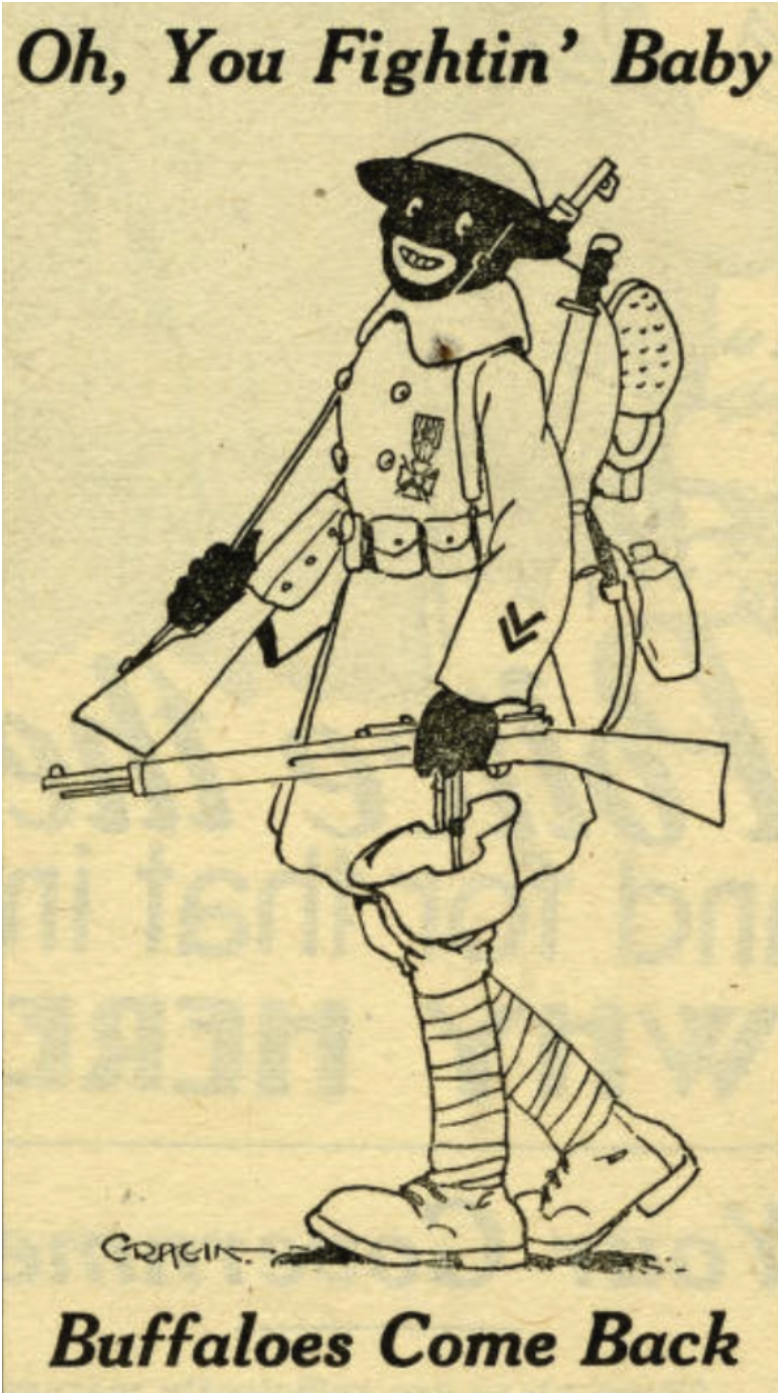
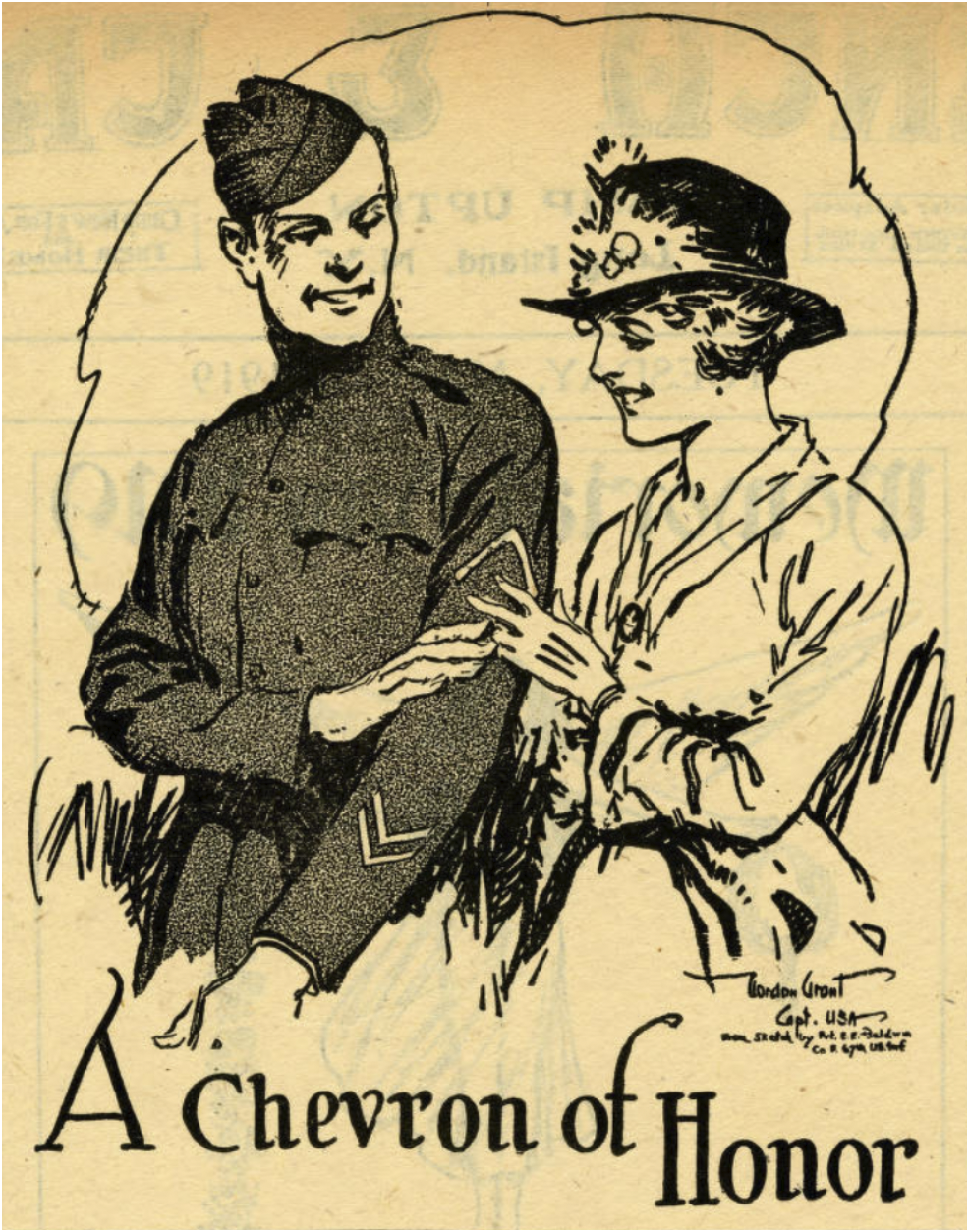
Military newspapers and propaganda—much of which was designed and circulated by the Morale Branch and the Military Morale Section—depicted white soldiers as heroes, but never did the same for Black soldiers.Footnote 78 The morale agencies’ depictions of white soldiers showed these men as upright, uniformed, and admired by women. Yet Black soldiers, when they were depicted at all, were rendered as cartoonish minstrel figures with large lips and eyes, usually engaged in a clumsy behavior (Figure 1). Most Black soldiers, on Colonel E. D. Anderson’s suggestion, were also deprived of military uniforms, which, in propaganda targeted at white soldiers, the military’s propagandists positioned as symbols of virtuosity and heroism, and the mediated focus of women’s admirationFootnote 79 (Figure 2). Morale leaders used media representation to depict military uniforms and insignia in a way that would instill a motivating aspirational fantasy in soldiers that they were being observed and admired by women. The fact that they made no similar effort with Black soldiers can be seen as a testament of the degree to which these men were not considered to be worthy of the morale agencies’ motivational efforts.
“Oh You Fightin’ Baby—Buffaloes Come Back.” From the Young Men’s Christian Association (YMCA)-run military newspaper, Trench and Camp (Camp Upton, Long Island, New York edition), February 25, 1919, p. 1.

“A Chevron of Honor.” Illustration by Gordon Grant in Trench and Camp (Camp Upton, Long Island, New York edition), May 27, 1919, p. 2.

Some African American leaders embraced discourses of morale as part of their strategy for assimilating Black people into wider American society. This was the case for the Tuskeegee Institute’s Emmett J. Scott, whom Secretary of War Newton Baker appointed as Special Assistant to the Secretary of War in October 1917, in order to ease tensions and provide for the welfare of African American soldiers after the uprising in Houston. In a clear example of “respectability politics,” Scott, who had previously been Booker T. Washington’s personal assistant and who embraced a racial uplift approach to improving African Americans’ lives, hoped that the war could make Black soldiers into full-fledged, disciplined, and self-respecting men, modeled after white, bourgeois masculinity.Footnote 80 In exchange for this service, he hoped that the United States would dispense with discrimination and unequal treatment of Black citizens.Footnote 81 Of course, this equality never came—partially because the motivational strategy that he himself embraced was so deeply predicated on sexual racism and the exclusion of Blackness. As Kimberley A. Reilly states in her article on the sexual politics of citizenship during the First World War, “[t]he exclusion of African Americans was fundamental, not exceptional, to the constitution of a unified national identity.”Footnote 82
Like race itself, morale proved to be a condition that was both socially constructed and materially consequential; it was imposed by powerful institutions, yet also claimed and leveraged as a means of gaining recognition and social legibility. In a related sense, the combat roles to which white men gained by virtue of being deemed capable of being motivated parasexually, and that Black civic leaders wished access to for their own people, were similar to the competition between Black laborers and white yeoman farmers over the “rights to peonage” that historian Lawrence Goodwyn described in his history of Populism.Footnote 83 While the combat roles in the war were dangerous, psychologically damaging, and destructive, the competition for these roles was rational, given the stakes for both social and civic inclusion. To be excluded from the roles—however manipulative and exploitative they were—was to be excluded from full social, political, and cultural participation and recognition. It is in this way that morale—as a sexually hierarchical mode of evaluating motivation susceptibility—must be taken seriously in historians’ analyses of racialized disparity during and after the First World War.