INTRODUCTION
Aegina was a centre of pottery production, and exportation, from as early as Early Helladic II, and perhaps even from the Neolithic period onwards (Gauss and Kiriatzi Reference Gauss and Kiriatzi2011, 241–57). The greatest expansion of its pottery industry coincides with the flourishing of the major centre of Kolonna, located at the north-west tip of the island, next to the modern town of Aegina, and covers most of the Middle Helladic (MH) period and the beginnings of the Late Bronze Age (LBA). During this long period, local potters produced a wide variety of pots in a number of distinct classes, and those products were widely distributed across the Aegean. Towards the middle of the LBA, there is a marked decline in the exports of Aeginetan pottery, which is most acute with regard to the decorated pottery. The latter is clearly losing ground to the omnipresent fineware Mycenaean pottery, and ceases to be exported, and most likely produced, by the Late Helladic (LH) IIIA2 period (Gauss and Kiriatzi Reference Gauss and Kiriatzi2011, 244–5). From that time onwards, the only class of that potting tradition that continues to be produced and widely traded is cooking pottery, and this production will carry on for the next 200 years. By the beginning of the post-palatial period, or LH IIIC Early (around 1200 bcFootnote 1), this extremely long-lasting tradition comes to an end.Footnote 2
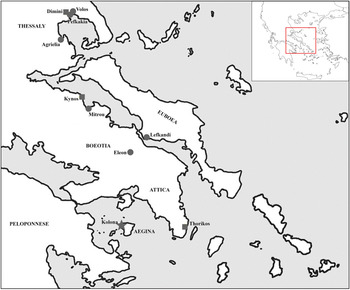
It is these final episodes of Aeginetan cooking pottery production that will constitute the focus of this article. As will be argued in detail below, the end of the thirteenth and the beginning of the twelfth centuries bc (end of LH IIIB and beginning of LH IIIC) witness the appearance of Aeginetan-type cooking pots along the entire Euboean Gulf and as far north as the Pagasetic Gulf (Fig. 1), produced in non-Aeginetan fabrics. We believe that the crucial aspect of this pottery is its manufacturing process, which follows the ‘ways of doing' practised on Aegina from at least the MH period onwards, and on the whole is very different to the chaîne opératoire involved in the production of contemporary cooking pottery in other areas. This distinctiveness enables us to advance a hypothesis of a technology transfer that required mobility of potters trained in the context of the Aeginetan potting tradition, who start producing cooking pots at a number of sites along the Euboean Gulf and even further north.
Map of the area with sites mentioned in the text (circles – sites with material sampled for petrographic and elemental analyses; squares – other sites with Aeginetan-tradition cooking pottery; asterisk – Kolonna on Aegina).

This paper aims to outline the available evidence in support of such a hypothesis. Furthermore, by setting this phenomenon in a broader socio-political and economic context, it seeks to provide a possible reconstruction of the motivations, scales and modes of potters’ mobility.
AEGINETAN COOKING POTTERY
During the LBA, there are several features of cooking pots produced on Aegina that separate them from what can be referred to as Mycenaean cooking pots, and, taken together, they constitute a very distinct potting tradition. This distinctiveness is partly derived from its conservative character, and certain features can be traced back to the MH period. Although some of the characteristics can be found in contemporary Mycenaean cooking pots (Lis, Rückl and Choleva Reference Lis, Rückl, Choleva, Gauss, Klebinder-Gauss and von Rueden2015, 67), it is their combination that makes Aeginetan pottery so distinct and easy to distinguish.
Probably the most distinct aspect of Aeginetan cooking pottery production is the vase-building method. In contrast to the majority of Mycenaean cooking pots (see below), no potters’ wheel is used in the manufacturing process. This notion, however, is the subject of some controversy among scholars, as Aeginetan cooking pottery is sometimes considered wheel-fashioned (i.e. reflecting a technique that combines the use of coils with the potters’ wheel; see most recently Marabea Reference Marabea2019). This view results from the observed regularity of the pots and presence of parallel, usually horizontal striations (see below for their description). Such features are indeed among those listed as characteristic for various wheel-fashioning methods. However, we should be careful in both (a) checking if other features that define such methods are present and (b) remembering that particular surface features can be polysemic, i.e. result from different forming techniques and their combinations (Courty and Roux Reference Courty and Roux1995, 18; Rice Reference Rice1987, 134). Regarding point (a), it is clear that other surface features indicative of wheel-fashioning, in particular parallel and tightly spaced undulating ridges and grooves (rilling),Footnote 3 are not present on Aeginetan cooking pots, while they are consistently present on contemporary Mycenaean cooking pots (see below). As for point (b), it does seem likely that regular horizontal striations can be caused by wiping of the vessel walls with a hand or a wet cloth when it is turned, even very slowly, on a rotative device that does not have to be a potters’ wheel.Footnote 4 Their parallel, horizontal orientation, which is observable predominantly close to the rim, is achieved when the potter's hand can use the vessel's rim as a resting surface. The same slow rotation can be used to regularise the walls of a vessel.
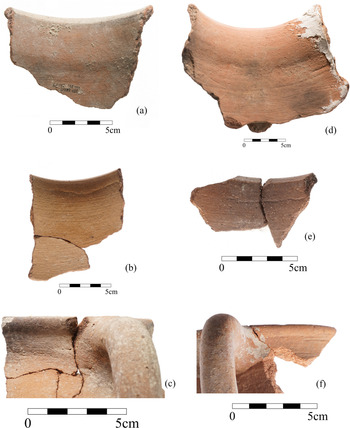
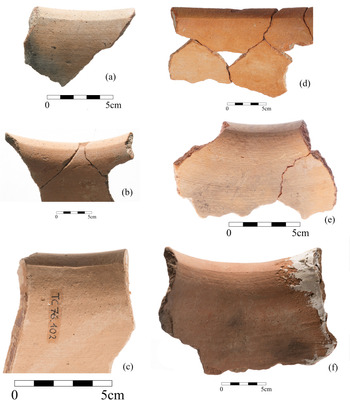
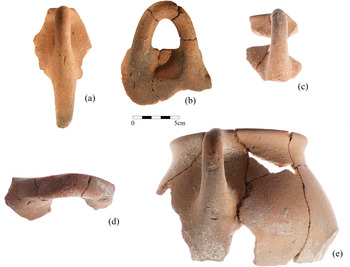
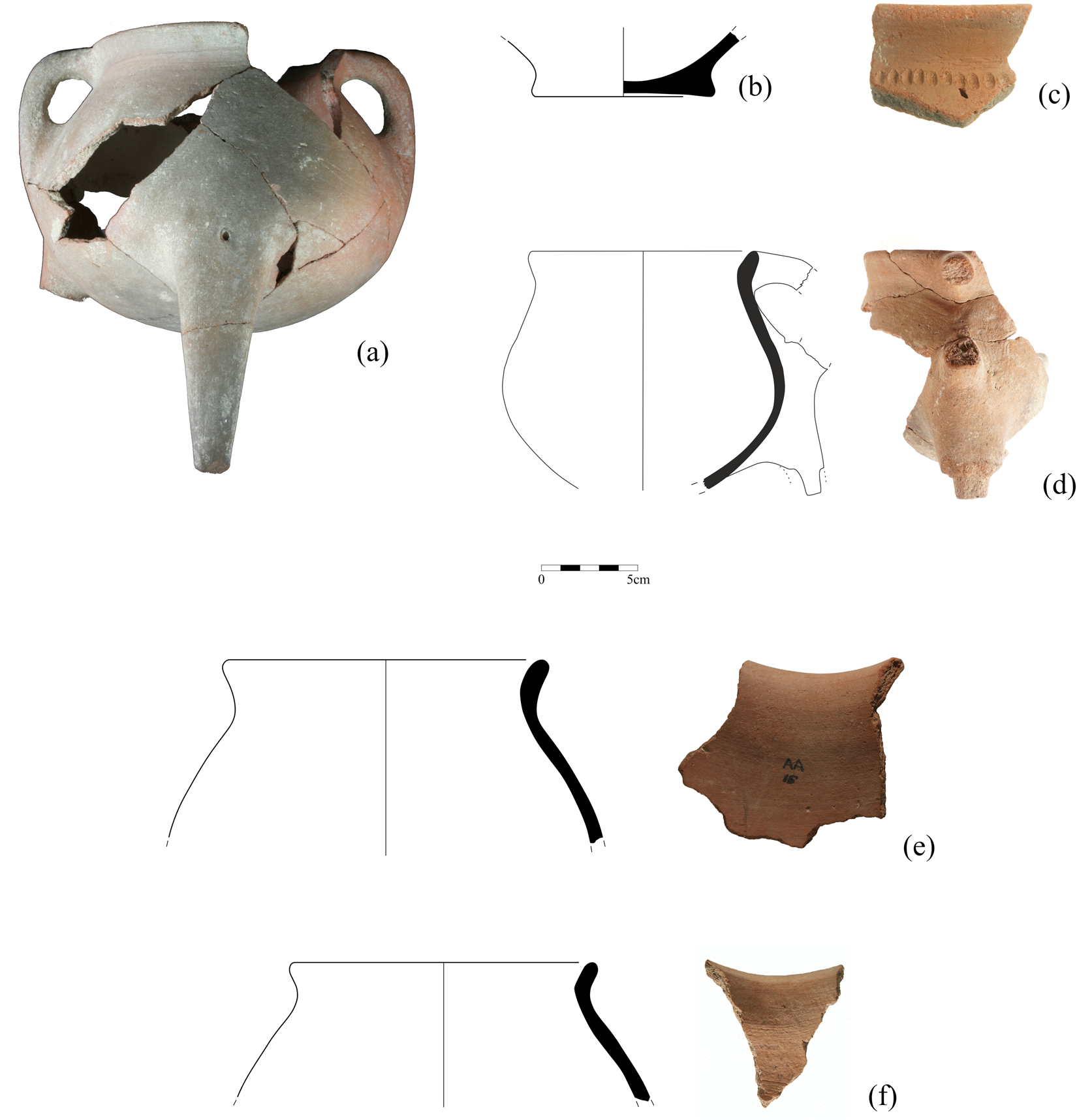
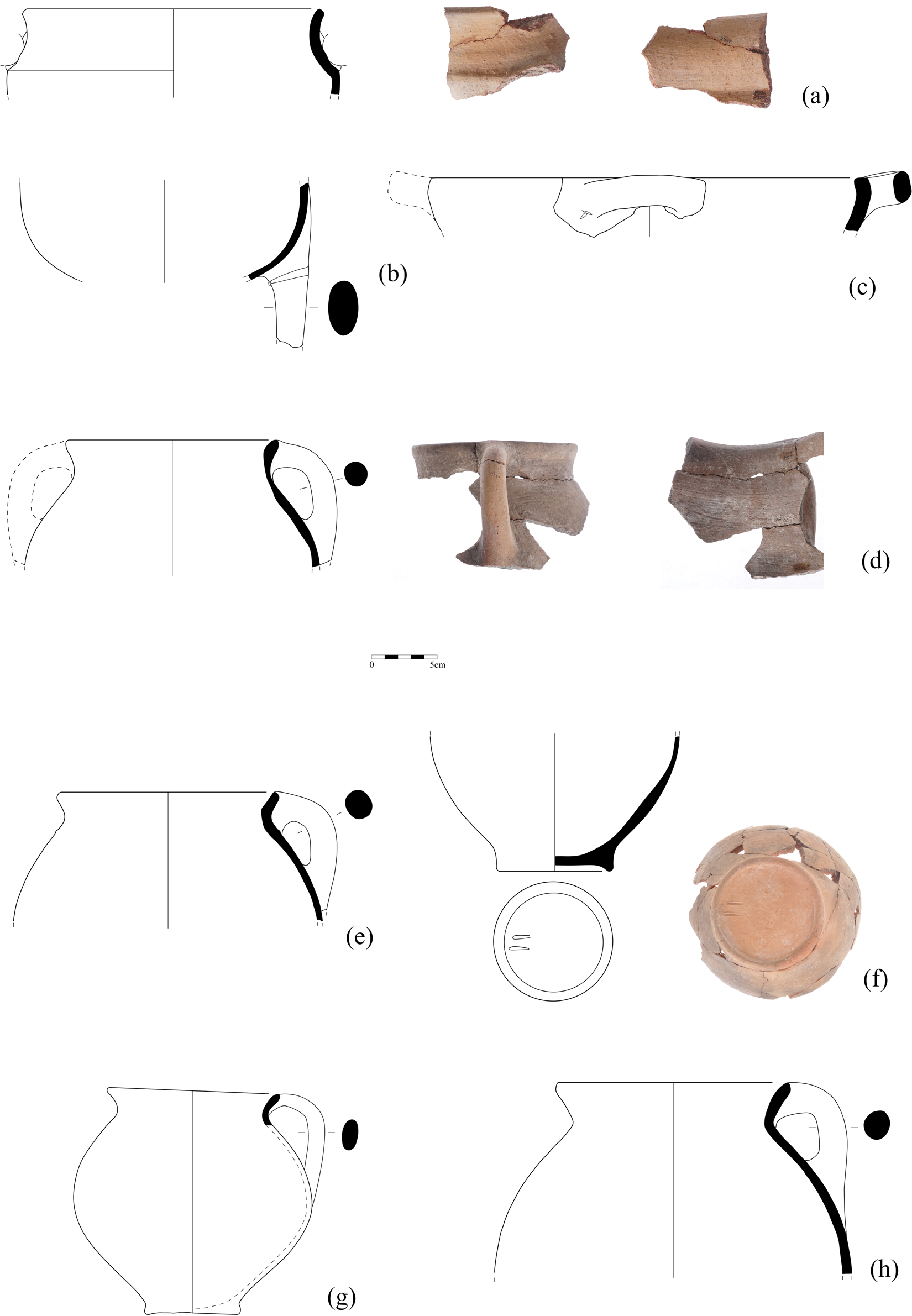
It appears from macroscopic examination that the vessels are built from a number of coils. Owing to the subsequent surface treatment, their traces are usually obliterated. However, some traces are often preserved at the area of the rim and close to it. Most commonly observed is a thickening, or a gentle ridge, c. 3–4 cm below the internal carination, which should represent a coil join (Fig. 2a). A few fragments preserve clear surface discontinuities in the form of either a roughly horizontal groove or a series of short grooves at roughly the same height (Fig. 2b). They most likely indicate coil joins that have not been entirely smoothed at a later stage. In a few instances, the coil join could be traced also in the break. Generally similar traces are sometimes visible on the rim's exterior, just below its rounded tip, although in most cases this area is very well smoothed. These traces take a form of a flattened ridge, which might indicate a coil join on the exterior side or, perhaps more likely, an addition of a thin coil/strip of clay on the rim's exterior in order to give the rim its final shape and strengthen it (Fig. 2c). Traces of coils are virtually non-existent in the convex bases of tripods. Either they were entirely obliterated or the bases were built in a different way, perhaps using a mould. This would enable construction of very thin walls, an advantageous feature with regard to cooking and heat conduction.Footnote 5
Evidence for coil joins: (a) LP782-028-013 [Mitrou]; (b) PEF_40 [Pefkakia]; (c) LM785-008-020 [Mitrou]; (d) TC 190 [Thorikos]; (e) PEF_59 [Pefkakia]; (f) PEF_30 [Pefkakia]. Courtesy of Mitrou Archaeological Project, Belgian School at Athens (Thorikos), © Ephorate of Antiquities of Magnesia, Hellenic Ministry of Culture and Sports (Pefkakia).

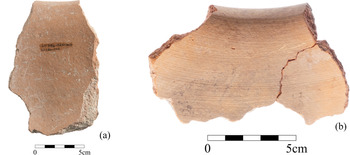
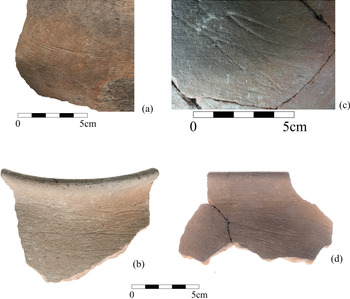
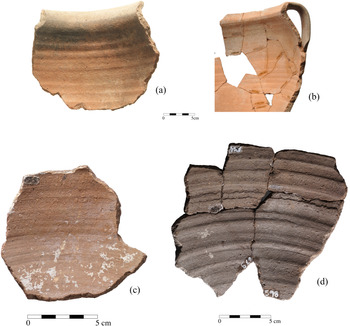
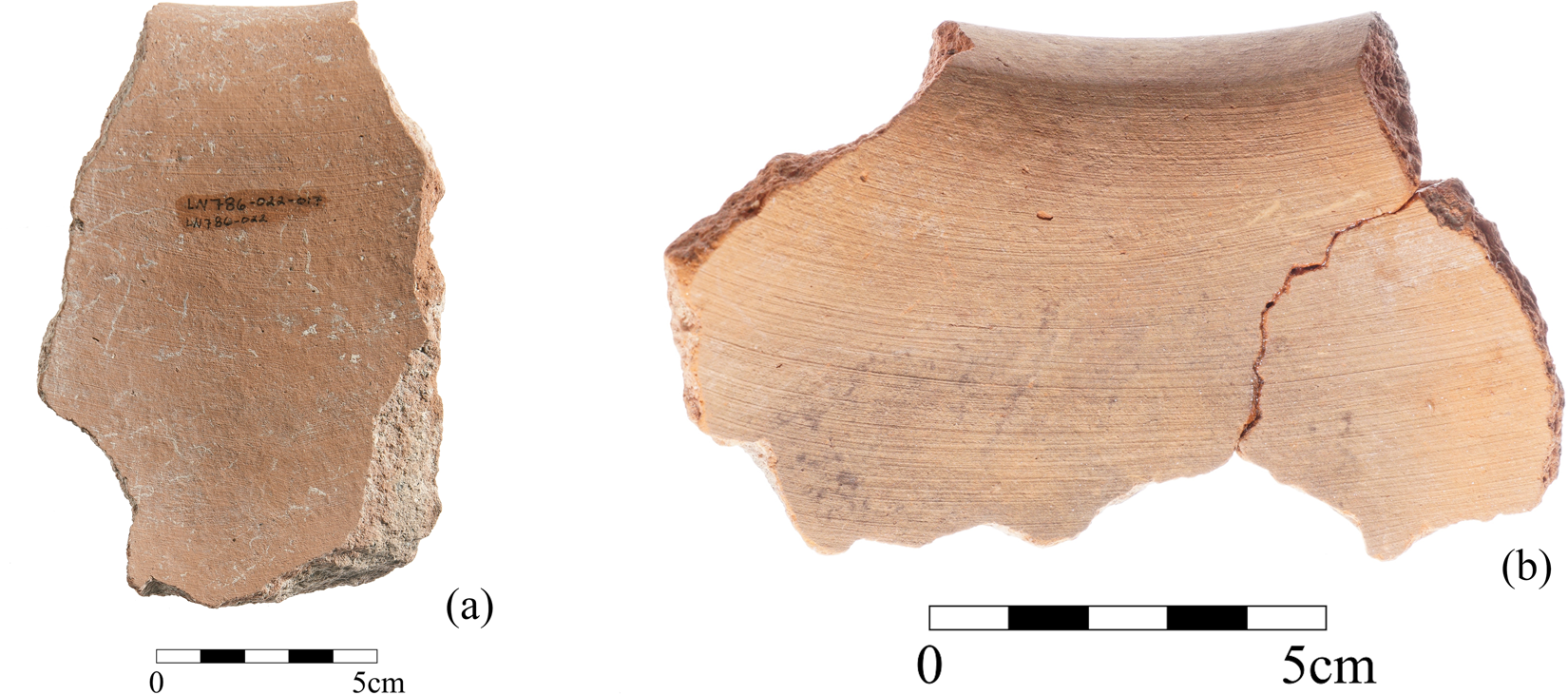
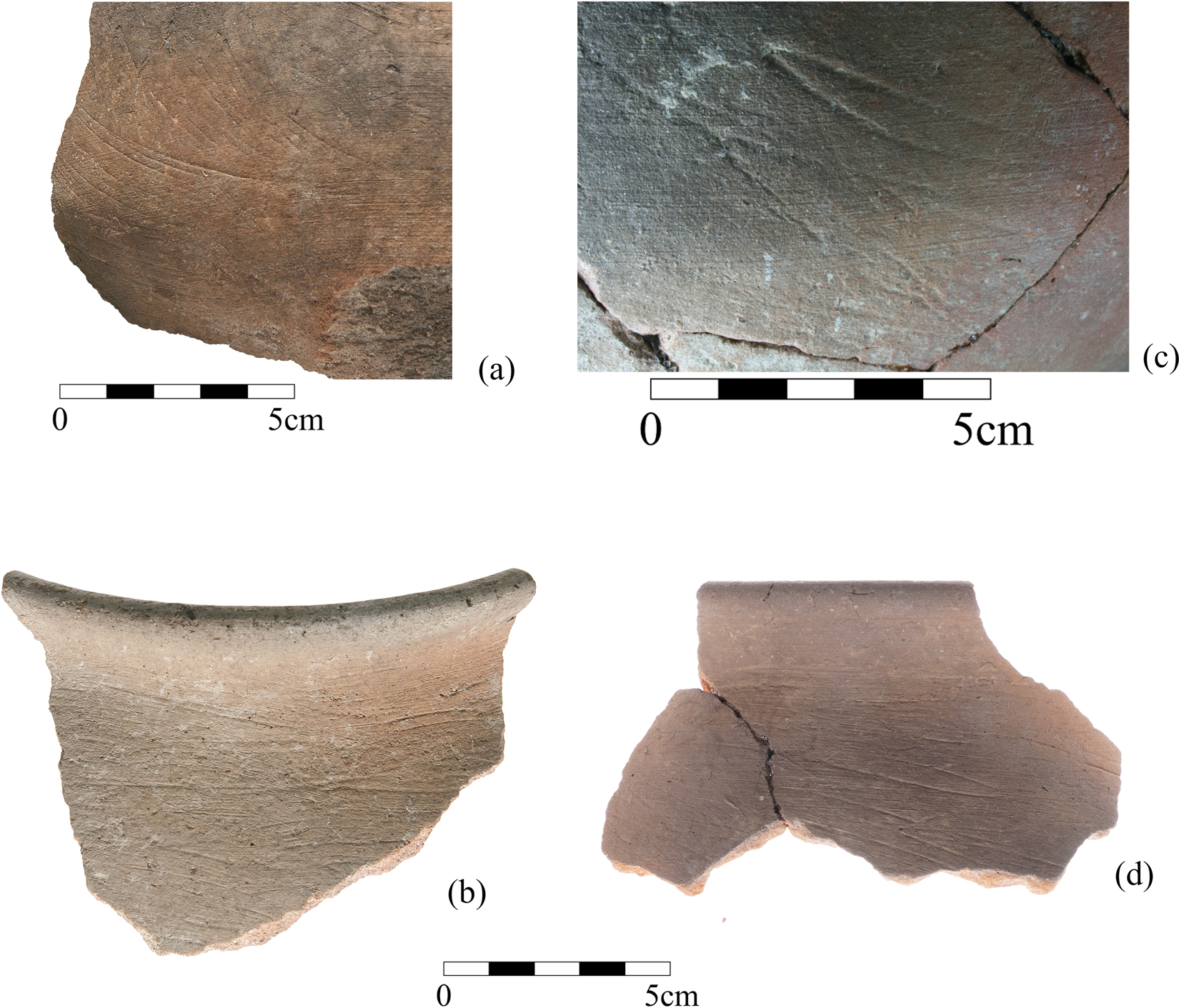
Thorough and consistent surface treatment is another feature that sets Aeginetan pottery apart from the rest of the contemporary cooking pottery produced on the mainland (Fig. 3a). Although a careful treatment can be postulated for a number of other cooking pots, the density of striations and their regularity on Aeginetan pottery do not find close parallels. This might be due both to the tool used for wiping of the surfaces and its labour intensity, as well as to the properties of the clay itself. The striations are horizontal at and close to the rim, and they become more oblique towards the lower part of the body. On the rounded tripod bases they take a circular form. More randomly dispersed deeper grooves are another surface feature (Fig. 4a, b). They do not have the sharp edges typical of the horizontal grooves left by inclusions dragged on the surface during surface treatment. However, this might be owing to the fact that they derive from a stage prior to the final wiping, which then regularised the walls and smoothed the deeper grooves.
Surface treatment – wiping: (a) LN786-022-017 [Mitrou]; (b) PEF_53 [Pefkakia]. Courtesy of Mitrou Archaeological Project, © Ephorate of Antiquities of Magnesia, Hellenic Ministry of Culture and Sports (Pefkakia).
Surface treatment – deeper grooves with smooth edges: (a) BE 41669 [Pefkakia]; (b) LP782-028-013 [Mitrou]; (c) LEF_02 [Lefkandi]; (d) PEF_53 [Pefkakia]. Courtesy of Mitrou Archaeological Project, reproduced with the permission of the British School at Athens (Lefkandi), © Ephorate of Antiquities of Magnesia, Hellenic Ministry of Culture and Sports (Pefkakia).
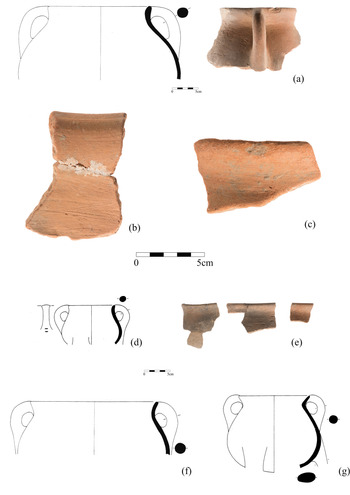
In order to deepen our analysis of manufacture, we can examine the execution of particular features. We should stress that this is not a purely morpho-typological discussion. Certain morphological characteristics, typical of Aeginetan cooking pottery, seem to reflect specific actions during the manufacturing process, related to particular motor habits internalised during the early stages of learning. These actions, being deeply embedded in the learning process of how an Aeginetan cooking pot should be made, do not change easily over time, nor do they change because of various external pressures.Footnote 6 This could explain why, despite the wide circulation of Aeginetan cooking pottery for centuries, the shape of the rim or tripod legs remained unchanged and unique to this potting tradition. Perhaps the most distinct aspect are the rims, which can be described as thickened, short and everted. The thickening, as discussed above, may be a result of the addition of an extra coil/strip of clay on the exterior. The internal carination, one of the ‘signatures’ of Aeginetan tradition, does not always have the same appearance, indicating that there were slight differences between the potters. Often it looks quite pronounced, with straight surfaces both above and below the carination (Fig. 5a), suggesting the use of a sharp tool to produce such a profile. In other instances, the internal course of the wall is more convex (Fig. 5b), and the carination is more of a gentle ridge (Fig. 5c). It could have resulted from final wiping of only the upper part of the rim.
Interior rim carination: (a) cooking pot from trench LP782 [Mitrou]; (b) LP782-020-017 [Mitrou]; (c) TC 76 [Thorikos]; (d) PEF_46 [Pefkakia]; (e) PEF_53 [Pefkakia]; (f) TC 190 [Thorikos]. Courtesy of Mitrou Archaeological Project, Belgian School at Athens (Thorikos), © Ephorate of Antiquities of Magnesia, Hellenic Ministry of Culture and Sports (Pefkakia).

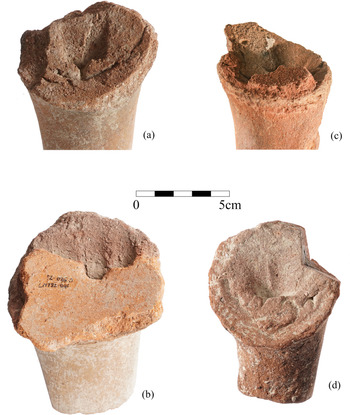
Tripod legs are perhaps most striking in terms of their standardisation and regularity. They have an invariably oval section and they taper towards a flat and thin end. An interesting aspect of their manufacture is their attachment to the body. Most of the legs show broad vertical grooves on the attachment surface, most likely left by fingers (Fig. 6a, b), perhaps in order to roughen the area and facilitate the bonding of the two parts. In addition to that, there is always a strip of clay placed at the lower internal side of the leg attachment, in order to strengthen the attachment from below. When broken off from the wall, which can be observed relatively rarely even among fragmented material, these two features give a very characteristic result (Fig. 6a). Nevertheless, not all Aeginetan tripod legs show the finger impressions. Examples from Thorikos, Agrielia and Pefkakia demonstrate that only the latter feature, the strengthening strip of clay at the lower part of the attachment, is consistently present throughout the entire Aeginetan assemblage. Leg scars, i.e. parts of the body where legs were attached, expose unfinished surfaces with an interesting texture, covered with a multitude of grooves of different length and more irregular dents that do not seem to be a result of scraping or any similar action.
Finger marks on attachments of tripod legs: (a) LM782-046-012 [Mitrou]; (b) LP782-032-011 [Mitrou]; (c) AGR_13 [Agrielia]; (d) PEF_06 [Pefkakia]. Courtesy of Mitrou Archaeological Project, © Ephorate of Antiquities of Magnesia, Hellenic Ministry of Culture and Sports (Agrielia, Pefkakia).

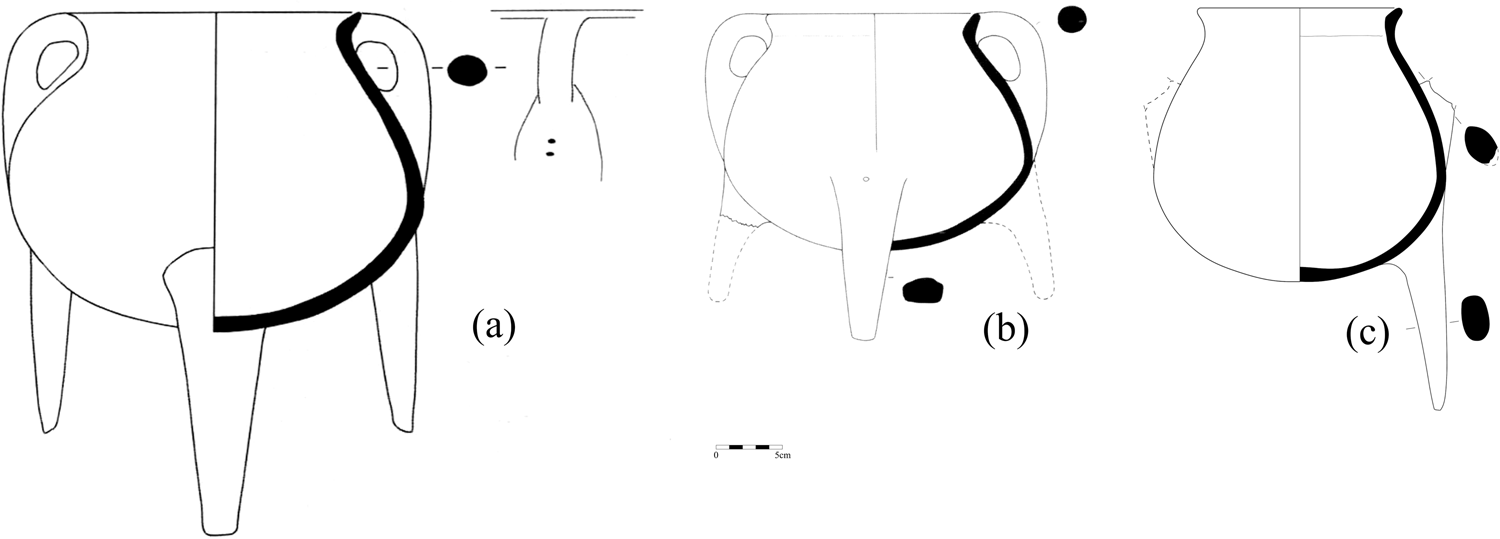
The general proportions of the cooking pots, especially the tripods, are quite distinct for the Aeginetan tradition, too. Such aspects could be easily manipulated by potters in the manufacturing process, but as these are consistent features of Aeginetan assemblage, they might be a reflection of certain motor habits and methods of vase building. Aeginetan tripods tend to have a squat, relatively shallow lower profile (Fig. 7a). This profile is the result of a sharp angle between the convex base and the wall of the tripod. It might indicate that the coil forming the beginning of the tripod's upper wall was added to the base that was shaped separately, perhaps in a mould. Nevertheless, there are exceptions, as highlighted by a deep-bodied shape of a well-preserved Aeginetan tripod from Pefkakia (PEF_40; Fig. 7c) and a recently published tripod cooking pot from Kanakia (No. 20 in Marabea Reference Marabea2019, 463, fig. 12).
General morphology of a tripod with short everted rim: (a) BE 35805 [Dimini]; (b) LEF_02 [Lefkandi]; (c) PEF_40 [Pefkakia]. BE 35805 after Adrimi-Sismani Reference Adrimi-Sismani2014, 379; LEF_02 after Evely Reference Evely2006, 210, fig. 2.35:1. Reproduced with the permission of the British School at Athens (Lefkandi), courtesy of Vassiliki Adrimi-Sismani (Dimini), © Ephorate of Antiquities of Magnesia, Hellenic Ministry of Culture and Sports (Pefkakia).

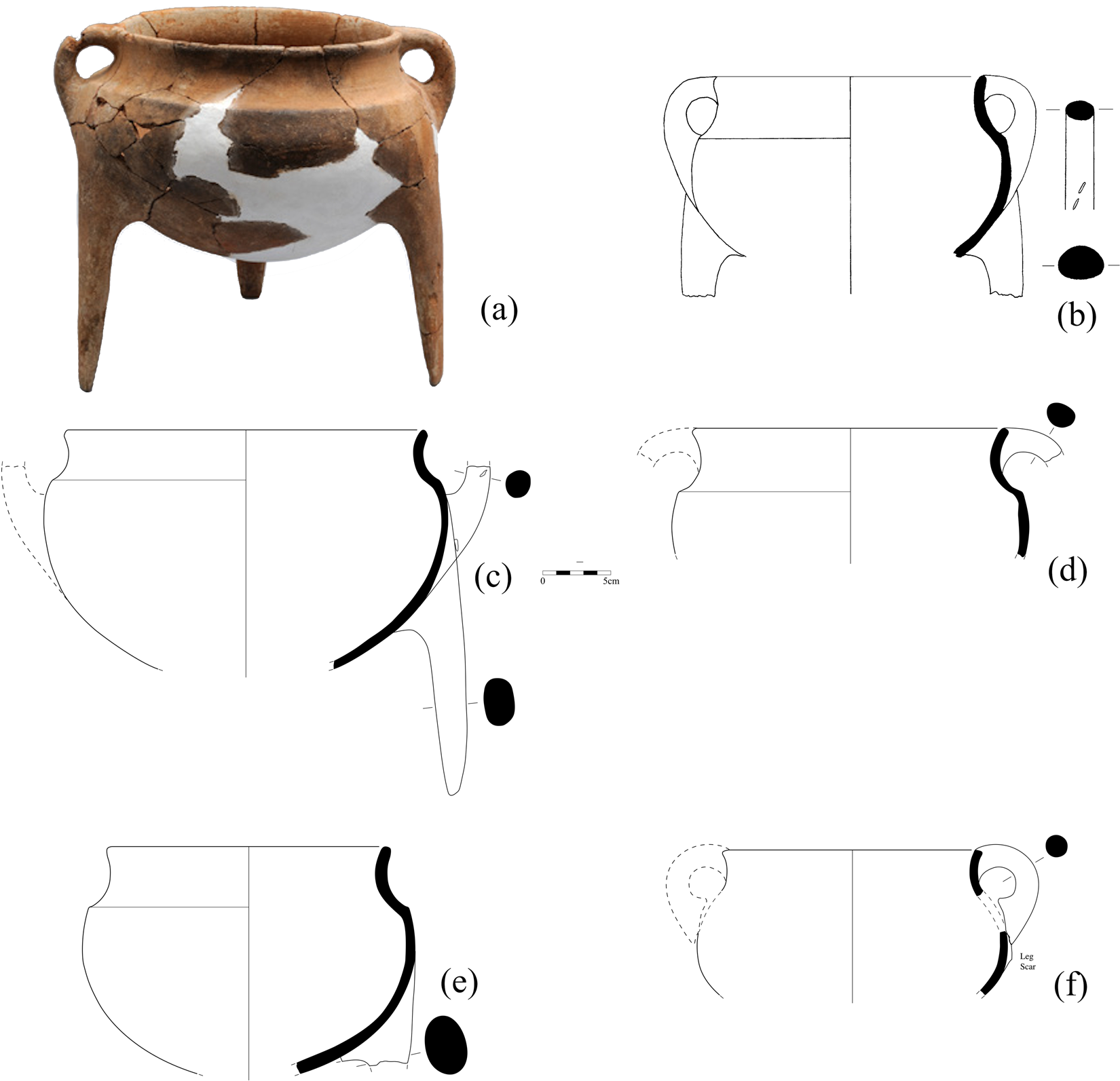
The most distinct Aeginetan cooking pot in terms of morphology is probably the carinated tripod. As far as can be said, it enters the repertoire of Aeginetan pottery at a late stage, towards the end of the thirteenth century bc (end of LH IIIB). Definitely, there are as yet no published examples of such tripods from LH IIIB1 (first part of thirteenth century bc) contexts from any site.Footnote 7 Carinated Aeginetan tripods have a concave upper profile and a deep body (in comparison with non-Aeginetan carinated tripods, see for example tripods from Lefkandi; Evely Reference Evely2006, 29, 36, fig. 2.35:4,5). A very characteristic feature is a gentle flare of the rim, which can also be slightly flattened at the top. The diameter of the rim is slightly smaller than the diameter at carination, giving such tripods a distinct profile (Fig. 8a, b). Legs do not differ from those of other tripods, while handles can have an oval section, which sets them apart from other Aeginetan cooking pots that invariably have handles with round sections. Nevertheless, it appears from published examples from Kanakia (Marabea Reference Marabea2019, 465, fig. 14) that there is a considerable variability both in terms of the handle section and their general morphology. This lack of standardisation is perhaps related to its late introduction to the repertoire.
Carinated tripods: (a) No. 27 [Kanakia]; (b) AP 2576 [Athens]; (c) BE 50905 [Pefkakia]; (d) PEF_37 [Pefkakia]; (e) PEF_23 [Pefkakia]; (f) PEF_50 [Pefkakia]. Kanakia No. 27 after Marabea Reference Marabea2019, 465, fig. 14; Athens AP 2576 after Lindblom Reference Lindblom2001, pl. 51:1043. Courtesy of Christina Marabe and the Trustees of the American School of Classical Studies at Athens (Kanakia), Michael Lindblom (Athens), © Ephorate of Antiquities of Magnesia, Hellenic Ministry of Culture and Sports (Pefkakia).

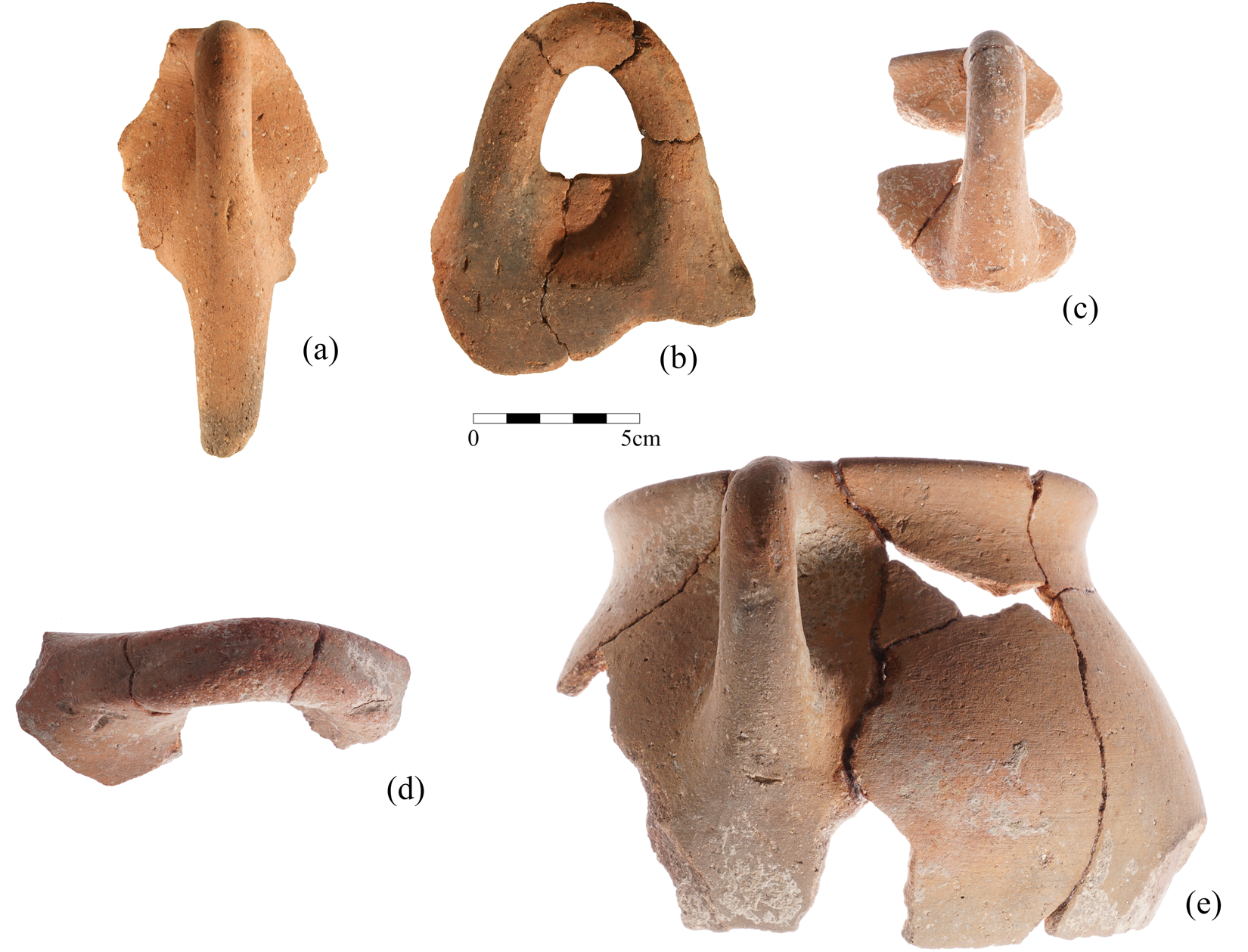
Aeginetan cooking pottery is sometimes marked before the firing, which is a feature that goes back to the MH period and is most likely related to the organisation of the manufacturing process, for instance communal firings in the kiln (Lindblom Reference Lindblom2001, 132). Potters’ marks during the LH III period are placed on the lower handle attachments (Figs 7a, 8b), although single instances of marks on tripod legs or bases are also attested.
Last but not least, Aeginetan cooking pots stand out – also during pottery sorting – for their fabric, which derives from the volcanic formations of the island. Petrographically, this fabric was characterised by Gauss and Kiriatzi (Reference Gauss and Kiriatzi2011, 93) as
coarse (25–40% inclusions) and relatively porous (5–15% voids) fabric with a noncalcareous clay matrix, containing predominantly fragments of volcanic rocks or their constituent minerals. The volcanic rocks are of intermediate composition and porphyritic texture. In most cases, they range from andesite to dacite and are compatible with an Aeginetan origin, being associated mainly with the lavas of the early volcanic activity on the island. Beyond the inclusions related to the volcanic rocks, lumps of micrite are present in most cases.
In macroscopic terms, it is characterised by the presence of flakes of golden mica, most readily identifiable on the surface, and abundant black and shiny elongated ‘spikes’. There are also transparent, colourless inclusions, as well as grains of carbonate material and rock fragments of usually pale colour. These can be matched with inclusions identified petrographically: biotite, hornblende, plagioclase, micrite and volcanic rock fragments respectively.
AEGINETAN-TRADITION COOKING POTTERY
All these features that define and distinguish Aeginetan cooking pottery have been identified macroscopically among cooking pottery found at several sites located along the Euboean Gulf and further north, up to the modern city of Volos, but combined with clearly non-Aeginetan fabrics. Most importantly, these features do not show up in isolation, but several are identified in a single cooking pot, just as it is the case for Aeginetan cooking pottery. This is considered by us as a clear indication that these cooking pots, even though not made of Aeginetan fabric, are products of the same Aeginetan tradition. From now on, we will thus refer to them as Aeginetan-tradition cooking pottery (ATCP). Instead of repeating the description of features, each of the aspects of manufacture described and illustrated for Aeginetan pottery is matched on the same figures by examples of ATCP (see Figs 2d–f; 3b; 4c, d; 5d–f; 6c, d; 7b; 8c–f; 9).
Potmarks on Aeginetan-tradition cooking pots: (a) AGR_17 [Agrielia]; (b) AGR_14 [Agrielia]; (c) cooking pot from trench 53, depth 2.04–2.14 m [Pefkakia]; (d) ELE_06 [Eleon]; (e) PEF_39 [Pefkakia]. © Ephorate of Antiquities of Magnesia, Hellenic Ministry of Culture and Sports (Agrielia, Pefkakia), courtesy of Eastern Boeotia Archaeological Project (Eleon).
MYCENAEAN AND AEGINETANISING COOKING POTS
We will be using the term ‘Mycenaean cooking pots’ to refer to the vast majority of cooking pottery produced on the mainland during the later part of the LBA. It is commonly agreed that by the LH IIIA2 period, most of the regions of the mainland had been Mycenaeanised.Footnote 8 This process, among a number of distinct changes in material culture and cultural practices, is also manifested by the disappearance of all local pottery traditions that often have their roots in the MH period (Lis Reference Lis2017a). The only major exception seems to be the Aeginetan cooking pottery. The Mycenaean cooking pots by no means represent a coherent group, as they are subject to a strong regionalism, which gives way to partial uniformity only by the twelfth century bc (i.e. beginning of LH IIIC; Lis Reference Lis, Hruby and Trusty2017b). Perhaps the only universally common feature of this group is the fact that they were made with the use of the potter's wheel (Fig. 10). There are definitely some exceptions, i.e. handmade pots (for instance at the twelfth century bc [LH IIIC Early–Middle] Lefkandi), but still it can be considered a common denominator. Formally, each region developed its own particular shapes of cooking pots, although the variability is relatively limited, as we consider here mostly differences in rim shapes or location of handles (either at the rim or on the shoulder). Nevertheless, none of these Mycenaean cooking pots comes morphologically close to the Aeginetan cooking pots of the later LBA. Also, in terms of surface treatments, or execution of features like rims or legs, despite the variability within the Mycenaean cooking pots, none of them displays close similarities to Aeginetan cooking pots.
Manufacturing marks on interiors of Mycenaean cooking pots: (a) cooking pot from Room 11, West House, phase 1b [Lefkandi]; (b) LN784-062-020 [Mitrou]; (c) P1241 [Eleon]; (d) P1422 [Eleon]. Reproduced with the permission of the British School at Athens (Lefkandi), courtesy of Eastern Boeotia Archaeological Project (Eleon) and Mitrou Archaeological Project.

The last cooking pot category that we will be using in this article is ‘Aeginetanising cooking pots’. They are best described as hybrids between Aeginetan and Mycenaean cooking pots, mostly because they combine features characteristic of Aeginetan pottery with the use of the potter's wheel in the manufacturing process. They are generally rare and appear in chronologically specific contexts (in relation to the appearance of ATCP, see below), and for these reasons they should not be considered to offer evidence against a distinct division between Mycenaean and Aeginetan cooking pots.
After this introductory section, what follows is a detailed, site-by-site presentation of the evidence pertaining to ATCP. This comprehensive account will also provide an opportunity to present any observed divergences from the manufacturing traces outlined above.
SURVEY OF SETTLEMENTS
Thorikos
The site and its chronology
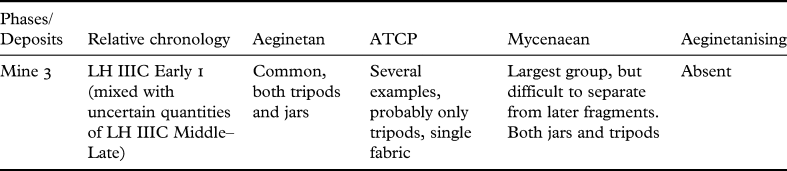
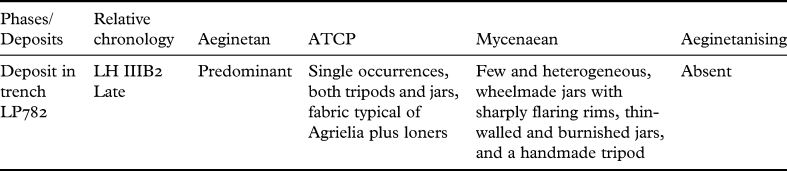
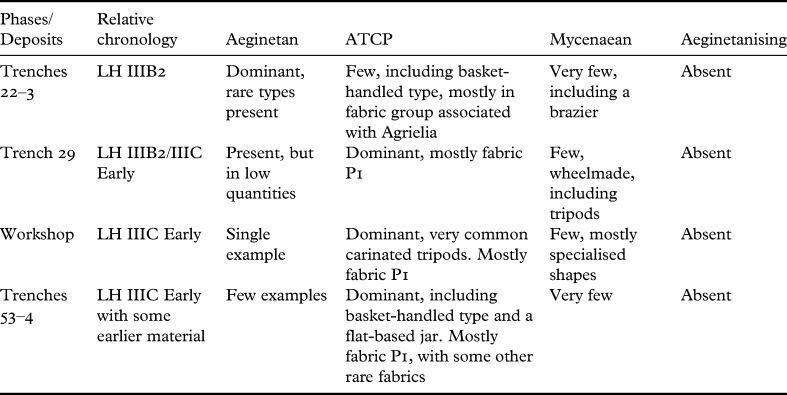
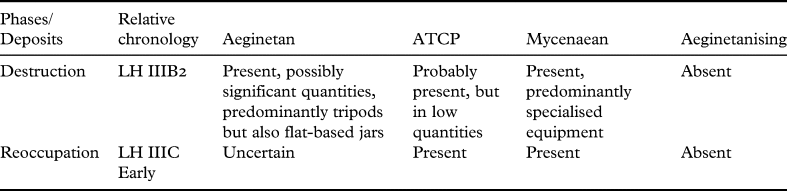
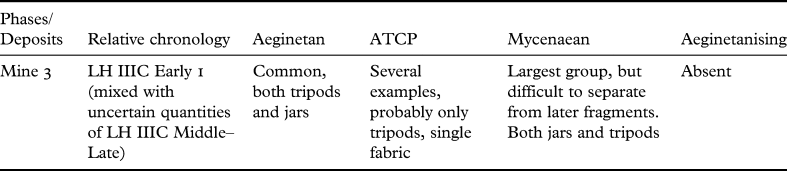
We will start with Thorikos, which is not a settlement in the Euboean Gulf, but it is the one closest to Aegina (Fig. 1), at which the phenomenon of ATCP has been confirmed. The relevant material comes from Mine No. 3. The deposit is unstratified and contains a mix of pottery dating to two discrete phases – one that P. Mountjoy termed transitional LH IIIB2/IIIC Early and another that is either LH IIIC Middle or even LH IIIC Late (Mountjoy Reference Mountjoy1995a). This introduces an uncertainty when dealing with undecorated pottery, as it cannot be readily assigned to any of those periods. However, at least with regard to Aeginetan pottery, it seems very likely – also in the light of the finds at other sites discussed below – that it all belongs to the earlier horizon. In his reassessment of the Thorikos material, based mostly on decorated finewares, S. Vitale argues that this earlier horizon at Thorikos is better seen as belonging to the very beginning of the LH IIIC period (Vitale Reference Vitale2006, 195–6, table 2; see also Table 1).
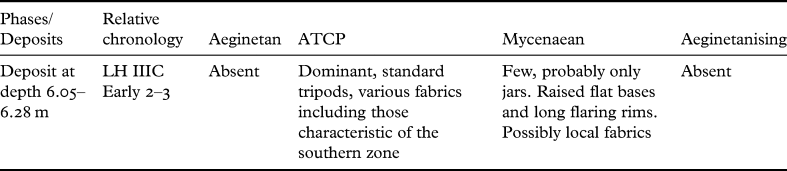
Synchronisation table for the sites and deposits discussed in the text.

Aeginetan-tradition cooking pottery
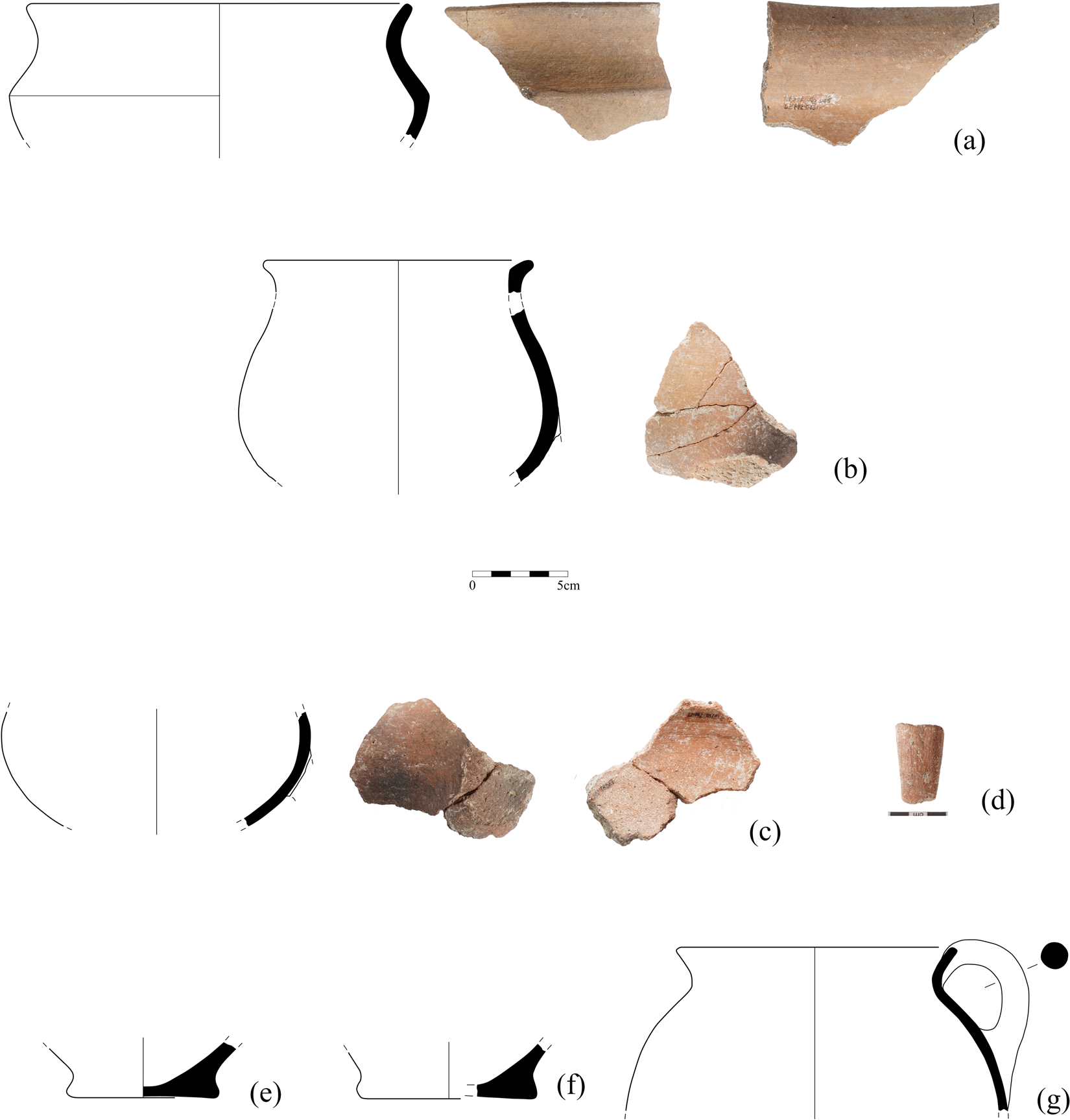
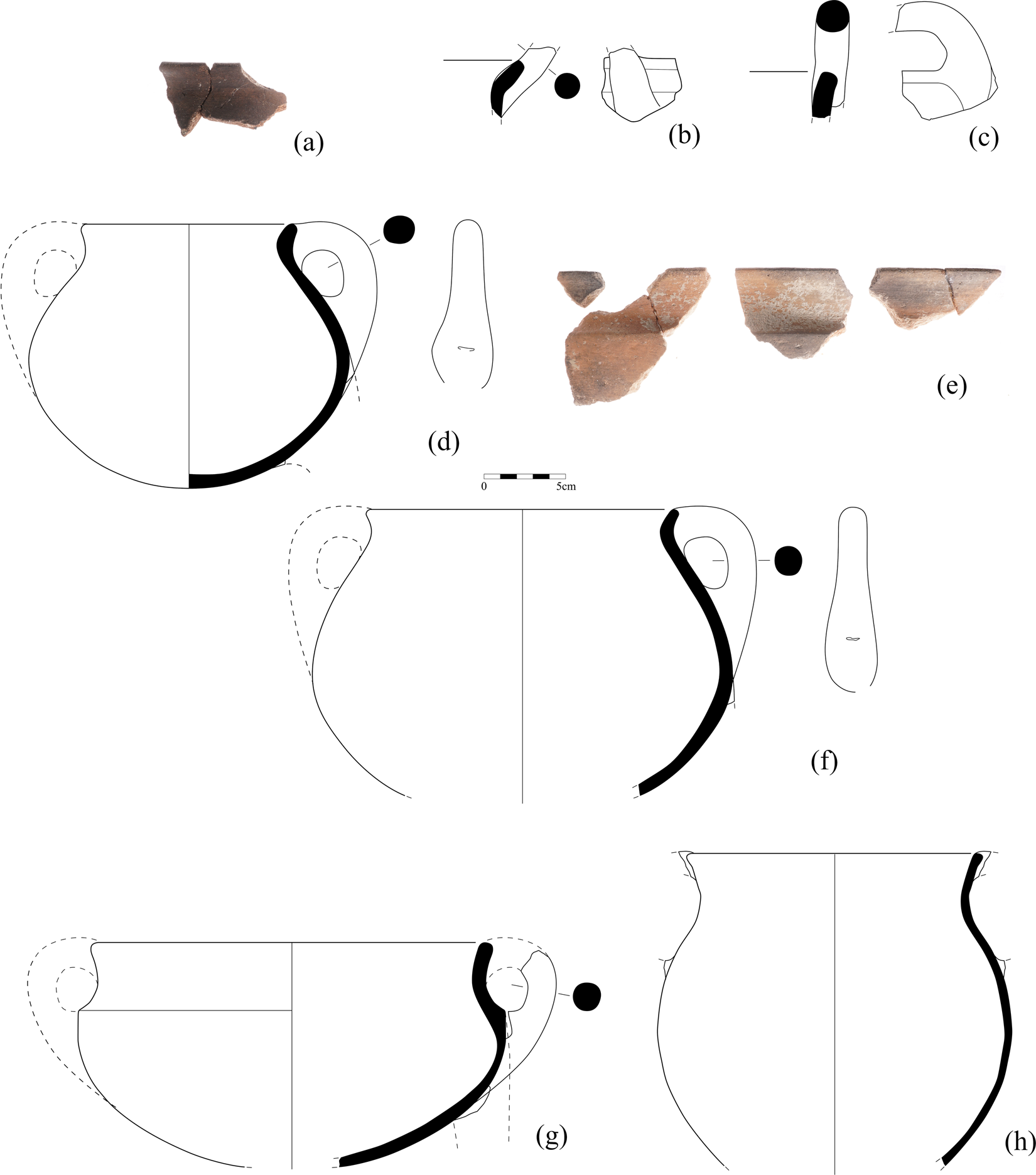
In terms of Aeginetan-tradition cooking pottery (Table 2),Footnote 9 there are rim fragments of three cooking pots with the standard short-everted rim (Fig. 11a–c), in addition to two legs without preserved attachments. Tripods are thus surely attested, while there is no evidence for flat-based jars. One of the pots (No. 190, TC 80,Footnote 10 Fig. 11a) is better preserved, with a substantial part of the rim (66 per cent, diameter 18 cm) down to the lower handle attachment. A number of non-joining sherds might derive from the same pot, among which there is a single leg scar suggesting that No. 190 might have been a tripod. In terms of manufacturing traces, it has a very gentle carination with a smooth ridge (Fig. 5f). A few centimetres below this, there is a very clear coil join (Fig. 2d). The surfaces are wiped, with shallow oblique grooves starting below this coil join. On the exterior, there is a shallow groove just below the rim top, possibly indicating addition of clay (or a coil) on this side.
Examples of ATCP, Aeginetan and Mycenaean cooking pottery from Thorikos, Mine 3: (a) TC 190; (b) rim to a cooking pot; (c) rim to a cooking pot; (d) TC 193; (e) fragments of a small cooking pot; (f) TC 191; (g) TC 192. TC 190-193 after Mountjoy Reference Mountjoy1995a, figs 18–19. Courtesy of Belgian School at Athens.

Summary of information on cooking pottery from Thorikos
Aeginetan cooking pottery
There are several Aeginetan cooking pots manufactured in Aeginetan fabric. Exact statistics cannot be obtained, as a selection of pottery was available for the study. Nevertheless, a simple count of mendable cooking pots provides at least some approximation. In this respect, the Aeginetan cooking pots clearly outnumber those belonging to ATCP. There were nine mendable cooking pots of the former category compared to only two mendable pieces of the latter. The mendable examples, when identifiable, belong to tripods with short everted rims, including a small tripod with a potter's mark (No. 193, TC 84, Fig. 11d). Other tripods illustrated in the Mountjoy Reference Mountjoy1995a publication are No. 200 (TC 86) and No. 204 (no TC number). Nos 194 (TC 83), 198 (no TC number) and TC 76 (not illustrated in Mountjoy Reference Mountjoy1995a) are only rim fragments (Fig. 11e). Among the sherd material, there are two flat bases belonging to Aeginetan jars.
Mycenaean cooking pottery
Mycenaean cooking pottery is composed of wheelmade flat-based jars and tripods, with profiles different from the Aeginetan cooking pots (Fig. 11f, g, although tripod No. 192 on Fig. 11g has a leg profile similar to Aeginetan). It is the most frequent group according to the number of mendable fragments, but it is impossible to filter out the later examples belonging to the LH IIIC Middle/Late horizon. An interesting detail of manufacture is that tripod legs seem to be frequently pierced (Nos 192 and 201).
Fabrics of ATCP
No petrographic analysis has been undertaken on material from Thorikos, and thus only macroscopic observations will be mentioned here. All three rim fragments, as well as the two legs, are in a similar fabric containing predominantly schist and quartz, with some possible phyllite inclusions. Silver mica is common, especially on the surfaces, but also visible in the breaks.
Lefkandi
The site, deposits and chronology
The site of Lefkandi is located on the eastern coast of the Euboean Gulf, only a few kilometres south of the narrowest part of the Gulf, the Euripus Strait (Fig. 1). It was excavated by the British School at Athens in 1964–9 (Evely Reference Evely2006) and more recently from 2003 to 2008 under the directorship of I. Lemos (Reference Lemos2014, with further bibliography), and is one of the most crucial sites for our understanding of the developments in the LH IIIC period (and beyond), as well as of the phenomenon discussed here. The main site at Lefkandi is Xeropolis, a tell site of considerable size. Material under consideration here derives from the first excavations at the site. They included trenches in the main sector located in the north-east part of the site, as well as a series of trial trenches scattered around the site. In particular, the main sector provided a stratigraphic sequence that, together with copious and well-preserved pottery, constitutes one of the most robust ceramic sequences for the LH IIIC period in the Aegean. As a reflection of that, from the publication of the first preliminary report in 1968, Lefkandi was one of the key sites for defining the periodisation of LH IIIC (Rutter Reference Rutter1977). Three main phases of occupation have been identified, labelled 1–3, and each of them has been subdivided into two sub-phases, labelled a and b. Pottery that is of interest for this study derives predominantly from the first two subphases, 1a and 1b. In particular, the position of phase 1a in relative chronology is important here. In contrast to the bulk of Thorikos material, this phase at Lefkandi does not represent the beginning of LH IIIC Early but should be seen as a slightly later sub-phase of that period – perhaps by a generation or so (Table 1). J. Rutter (Reference Rutter1977) assigned it to his phase 2, and this appears to be correct in the light of the final publication of the site in 2006 (Evely Reference Evely2006); the decisive indications are the appearance of painted carinated cups and the rarity of linear conical kylikes. The next subphase at the site, Lefkandi 1b, ended in a fire destruction that left very thick deposits full of fairly complete pottery. Despite such circumstances, there is an uncertainty regarding the date of this destruction. Mountjoy (Reference Mountjoy1999, 39, 696, table II) suggested that the pottery has features of the incipient LH IIIC Middle (subphase termed as Developed), but on the basis of a thorough analysis of all the retained material, as well as the evidence from the site of Eleon where numerous imports from Lefkandi are present in a good stratigraphic sequence, we are inclined to see it as still belonging to the LH IIIC Early period.
Aeginetan-tradition cooking pottery
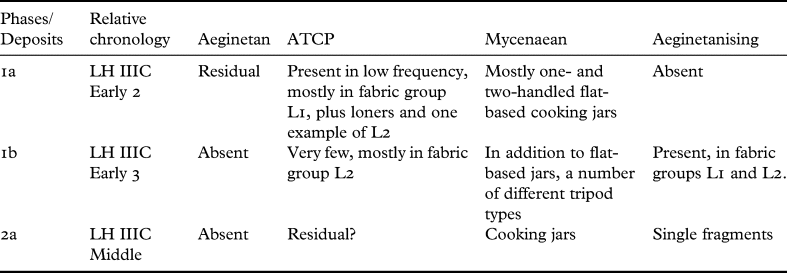
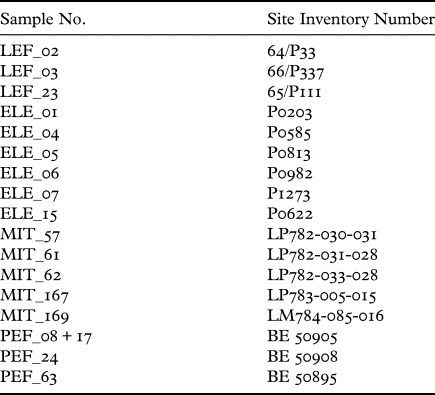
The single very well-preserved example of ATCP (Table 3) derives from a phase 1a pit in Trial P (LEF_02,Footnote 11 Figs 7b, 12a). It is a two-handled tripod with a short everted rim, representing probably the single most common cooking pot type from the repertoire of late Aeginetan production. It displays all the characteristics of Aeginetan manufacture in a truly remarkable way, with only a single difference: the legs are pierced, which was never the case for the Aeginetan tripods produced on Aegina but is a feature of some of the Mycenaean tripods at Lefkandi and, as we have already mentioned, at Thorikos. The pit produced only a limited number of (retained) mendable pottery, and the tripod is one of the three cooking pots recovered from it.
Summary of information on cooking pottery from Lefkandi

Examples of ATCP from Lefkandi: (a) LEF_02; (b) LEF_06; (c) LEF_71; (d) LEF_03; (e) LEF_16; (f) LEF_11. Reproduced with the permission of the British School at Athens.

Other ATCP derives either from phase 1a levels in the main excavation sector, in particular the West House, and Trial IV/V, where a substantial structure dated to phases 1a and 1b has been partially exposed. These are also the major phase 1a contexts at the site. Fragments of ATCP are, with a single possible exception discussed below, single sherds. Given that there are a number of mendable, or even fairly complete, Mycenaean cooking pots from the same contexts of phase 1a, we may suggest that some ATCP might be residual, i.e. earlier than phase 1a proper.
The majority of fragments seem to derive from standard tripods, of the type known from Trial P. There is a single example of a carinated tripod (LEF_13), a type that, as we will see below, is a very important constituent of ATCP. Two instances of flat bases (LEF_06, Fig. 12b, and LEF_12) show that, in contrast to Thorikos, also flat-based jars are represented among ATCP. Finally, there is a rim fragment of a larger jar (LEF_71, Fig. 12c) with a decoration consisting of a row of impressed ovals on the shoulder. This is a type of a larger Aeginetan cooking pot that is known only from the site of Kanakia and from numerous, but as yet unpublished, examples from the settlement of Lazarides on Aegina.Footnote 12 Therefore the Lefkandi assemblage, albeit small, shows a substantial formal variety.
In addition to those fragments, there is a small, one-handled tripod cooking pot deriving from Room 11 of the West House (LEF_03, Fig. 12d). It preserves an almost complete profile and has a number of features that associate it with ATCP, including a very gentle carination on the rim's interior. However, two features of this cooking pot are somewhat atypical. First is the general body profile, which is deeper than in the standard Aeginetan cooking pot. The second is the peculiar breakage pattern of the leg (Fig. 12d), which has not been registered on any Aeginetan cooking pot. It appears as though the leg had a core, which was coated with an additional layer of clay. Nevertheless, a similar pattern of flaking is observed on some leg fragments from Agrielia, and it may be related to different clay properties and its diverse behaviour in the drying stage in comparison to the Aeginetan fabric rather than to a different manufacturing method. Regarding the deep profile, an example of a very well-preserved imported Aeginetan cooking pot found at Pefkakia (PEF_40, Fig. 7c) shows beyond a doubt that there was a certain variability in this respect among Aeginetan cooking pots as well.
In the deposits dating to the next settlement phase (Lefkandi 1b), there are only three fragments of ATCP – two standard rims (LEF_ 11 and LEF_16, Fig. 12e, f) and a body wall with handle scar, which, judging by the profile, derives from a tripod (LEF_72). Since, as mentioned above, this phase ends in a fire destruction that has left a large number of fairly complete vessels (including numerous cooking pots), these fragments most likely represent cooking pots that were not in use at the time of the destruction.
There are also two fragments of ATCP in phase 2a levels, again represented by single sherds. They belong to the very early part of that phase, but, owing to their fragmentariness, cannot be considered contemporary. A rim to a carinated tripod (LEF_74) is an isolated find from the phase 2b level and most likely represents another kick-up.
Aeginetan pottery
In terms of actual imports from Aegina, in the entire retained assemblage of pottery from phase 1 at Lefkandi there are only two fragments of such cooking pots (LEF_09 and LEF_73, single sherds). Again, they could be considered residual, suggesting that even in phase 1a the settlement had no access to imported pottery from Aegina.
Mycenaean cooking pots
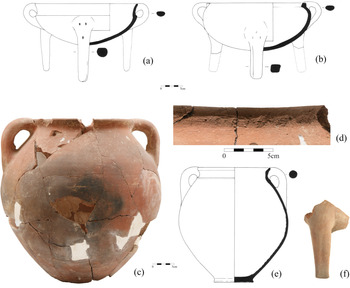
Lefkandi phase 1 deposits yielded a substantial amount of well-preserved Mycenaean cooking pots. Smaller one-handled and larger two-handled jars on a simple raised base constitute the majority of this assemblage. In contrast to Aeginetan cooking pots, they have longer flaring rims. The larger ones are invariably wheelmade, but some of the small specimens do not have traces of wheel use. There is also a significant quantity of tripods, representing a number of types. The substantial number of wheelmade carinated tripods is worth noting; this seems to be the most popular type among tripods. The similarities with carinated ATCP tripods are mostly on a general level and concern mainly the form (Fig. 13a). It can also be pointed out that the upper walls of such tripods do not seem to be finished on the wheel, in contrast to their lower bodies. Another tripod type is represented by 64/P73 (Evely Reference Evely2006, 101, pl. 14:4), which has a simple flaring rim. Finally, there is a cauldron type of tripod, attested elsewhere only at Mitrou, with plastic features on the rim at handles’ attachments aimed at mimicking the metal counterparts. One such tripod also has squared legs (Fig. 13b).
Mycenaean and Aeginetanising cooking pottery from Lefkandi: (a) 65/P194; (b) 66/P133; (c) 65/P49; (d) cooking pot from the West House, phase 1b; (e) 69/P25; (f) LEF_67. 65/P194, 66/P133, 69/P25 after Evely Reference Evely2006, figs 2.35:5,2; 2.34:2. Reproduced with the permission of the British School at Athens.

Aeginetanising cooking pottery
Among the many cooking pots recovered from the West House in the destruction of phase 1b, there are at least three that appear to preserve certain features of Aeginetan pottery while being different in the most essential aspect: they are all manufactured with the use of the wheel. Their Aeginetan features are notable in the distinct rim building and the general proportions (65/P49, Fig. 13c). In the case of a cooking pot from the West House Room 11 (no inventory number, Fig. 13d), this similarity in rim form is achieved by apparently intentional trimming of its interior, which has not been followed by any further treatment. Careful surface treatment also sets them apart from other contemporary cooking pots. Another such Aeginetanising wheelmade cooking pot is 69/P25 (Fig. 13e) from the large building excavated in trench IV/V.
Fragment LEF_67 (Fig. 13f), which derives from phase 2a, belongs to a tripod. It differs from Aeginetan cooking pots in the shape of the lower leg as well as in the fact that it might have been wheel-finished. It is thus best described as Aeginetanising.
Regarding the Aeginetanising cooking pottery at Lefkandi, we should stress that their appearance coincides with the last secure examples of ATCP or even, if the fragments from settlement phase 1b indeed pre-date the destruction, chronologically follows ATCP.
A very similar phenomenon of a combination of Aeginetan features with manufacture on the wheel has been traced at Tiryns in a roughly contemporary horizon (Lis, Rückl and Choleva Reference Lis, Rückl, Choleva, Gauss, Klebinder-Gauss and von Rueden2015, 72, fig. 8).
Fabrics of ATCP
The initial appearance of ATCP is associated mainly with a single fabric group (FG) L1.Footnote 13 The best-preserved tripod LEF_02 is made in this fabric. It is considered as non-local to the site, with a possible source further south, in Attica. In fact, the fabric of Thorikos ATCP appears, on a macroscopic level, to be closely associated. At least a single fragment deriving from phase 1a (LEF_13) is produced in another fabric (L2), which is attested also in most of the ATCP fragments from phases 1b an 2a early. It is also the fabric associated with Aeginetanising cooking pots attested already in phase 1b, as well as with the majority of Mycenaean-type cooking pottery sampled from Lefkandi. Therefore, it could represent local production of ATCP at Lefkandi or its vicinity. In addition to those two fabrics, there are also several loners deriving from phase 1a. One of the Aeginetanising cooking pots that were not sampled (69/P25, Fig. 13c) appears to be made in a fabric similar to L1, at least on the macroscopic level.
Eleon
The site, deposits and chronology
Eleon is the only site included in the project located at a considerable distance from the sea. It is situated in the region of Boeotia, at an equal distance of c. 15 km from the major Mycenaean centre at Thebes and the shores of the Euboean Gulf (Fig. 1). While the links with the former must have been particularly strong in the thirteenth century bc (LH IIIB), as is also evidenced by Linear B texts (Aravantinos, Godart and Sacconi Reference Aravantinos, Godart and Sacconi2001), during the twelfth century bc (LH IIIC Early–Middle) the site seems to be very well connected with the Euboean Gulf (Burke and Burns Reference Burke, Burns and Driessen2016). According to the evidence of painted ceramics, links to Lefkandi are particularly close (Van Damme Reference Van Damme, Tankosić, Mavridis and Kosma2017).
The early stage of the LH IIIC period is well evidenced by a sequence of stratified deposits in the two main areas of excavation, the Southwest (SW) and Northwest (NW) sectors. The earliest relevant deposit in the SW represents a mix of latest LH IIIB2 with earliest LH IIIC ceramics, while the second one, associated with Structure B, covers the early stage of LH IIIC Early. The two deposits in the NW belong to the middle and the end of that phase. The first one is referred to as an unburnt destruction; the later one is associated with extensive burnt destruction. In terms of their synchronisation with the phases at Lefkandi, the two SW deposits and the earlier NW deposit pre-date phase 1a at Lefkandi, while the later deposit from the NW (the burnt destruction) dates prior to the destruction of Lefkandi 1b (Van Damme Reference Van Damme, Tankosić, Mavridis and Kosma2017, 174–5, table 1; also Table 1 here). As we will see, such a synchronisation is crucial for a better understanding of the developments in Lefkandi itself.
Aeginetan-tradition cooking pottery
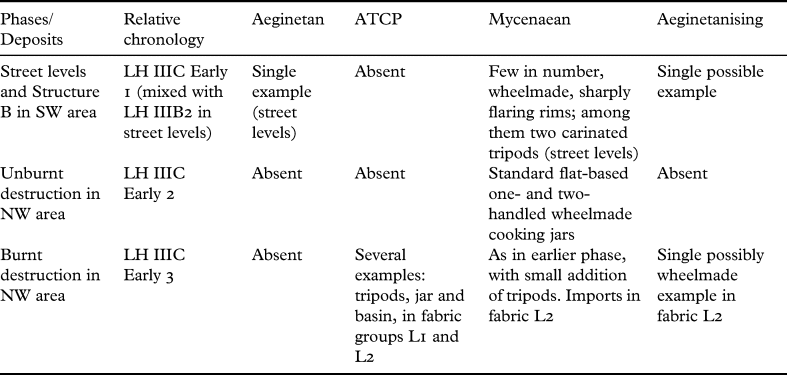
There are four examples of ATCP (Table 4) that derive from the burnt destruction (NW), and thus chronologically fall between Lefkandi phases 1a and 1b. Among them there is a carinated tripod (ELE_04, Fig. 14a), showing a slightly flattened rim and a slight ridge above the carination that could be a trace of a coil join. There is a tripod leg (P1926, Fig. 14b) that initially was considered as part of carinated tripod ELE_04, but detailed fabric analysis excluded this. It is pierced, which is a feature that we already know from Lefkandi. A shallow basin with a flattened rim and a horizontal handle (ELE_06, Figs 9d, 14c) is a new shape in the discussion. Such basins with flattened rims, sometimes spouted, form part of the repertoire of Aeginetan potters. Examples made in Aeginetan fabric are well attested at Kanakia (Marabea Reference Marabea2019, 479, fig. 22) and at Lazarides (personal investigation of material by B. Lis). The basin from Eleon has a potter's mark on the handle attachment, consisting of two incised lines arranged at a wide angle. Finally, there is an upper body fragment of a cooking pot that preserves a short everted rim and a complete vertical handle (ELE_05, Fig. 14d). There is a thickening on the interior wall c. 3 cm below the carination, which is a typical feature of cooking pots produced on Aegina and most likely represents a coil join. An additional manufacturing feature is a slight groove on the interior rim, which seems to indicate another coil join.
Summary of information on cooking pottery from Eleon

ATCP, Aeginetanising, other and Mycenaean cooking pottery from Eleon: (a) ELE_04; (b) P1926; (c) ELE_06; (d) ELE_05; (e) ELE_15; (f) P1773; (g) P0019; (h) P0385 (ELE_12). Courtesy of Eastern Boeotia Archaeological Project.

The deposits of LH IIIC Middle, present in the SW sector, contain cooking pottery that does not display any Aeginetan features.
Aeginetan cooking pottery
Imported Aeginetan cooking pottery was never common at Eleon, in contrast to, for example, another inland site in Boeotia – Schimatari.Footnote 14 The LH IIIB2 deposit in the SW sector yielded a single rim fragment, and so did a mixed LH IIIB2/LH IIIC Early street level in the same area. Such pottery is not present in any later deposits, including the earliest pure LH IIIC Early contexts.
Mycenaean cooking pottery
In the levels preceding the burnt destruction, cooking pots of any type are surprisingly rare. In the street levels in the SW sector that represent a mixed LH IIIB2/IIIC Early fill, there are two carinated tripods; one of them (ELE_01) is clearly wheelmade. In Structure B, there are a few wheelmade cooking pots, one of them with a sharply flaring rim.
Mycenaean cooking pottery of the burnt destruction horizon, i.e. the context that yielded all the examples of ATCP at Eleon, is very limited in terms of forms (Fig. 14g, h). Basically, there are only small one-handled and larger two-handled cooking pots. They are wheelmade, although some handmade specimens may be attested too, and show only small differences among each other regarding shape of the rim, base or section of the handle. There are only two instances of tripods attested, one of them surely of a carinated type, but otherwise this form is much rarer than at contemporary Lefkandi. Finally, there is a small fragment of a perforated brazier, a unique form on the Greek mainland.
Aeginetanising cooking pottery
Within the burnt LH IIIC Early destruction horizon that yielded the four Aeginetan-tradition cooking pots discussed above, there is a cooking pot that can be considered as Aeginetanising (ELE_15, Fig. 14e), but is clearly closer to the original Aeginetan tradition than the wheelmade Aeginetanising cooking pots from Lefkandi, apart from No. 69/P25 (Fig. 13c). Unfortunately, owing to the poorly preserved interior, it is impossible to say whether a wheel was used in its manufacture; yet a thickening below the carination visible on the interior is probably an indication of a coil join and thus a feature identical to Aeginetan cooking pots. Also, the rim has a very Aeginetan appearance. The only clearly distinct feature is a narrow ridge below the rim on the exterior, which is something we observe on both Mycenaean and Aeginetanising cooking pots from Lefkandi 1b (Fig. 13e).
An interesting cooking pot (ELE_07) was found in Structure B of the earliest LH IIIC Early at the site, before the first attested appearance of ATCP. It is pale-surfaced, and as far as can be inferred from a single preserved rim fragment, it is of a short everted type with a vertical handle of round section. It appears to be handmade, but the wiping marks on its surfaces are distinctly different from that on Aeginetan cooking pots. Its fragmentary preservation makes its full comprehension and interpretation difficult, so its identification as Aeginetanising cooking pottery is provisional.Footnote 15
Other cooking pottery
The last vessel from Eleon to be discussed is a well-preserved jar (P1773, Fig. 14f) deriving from the final season of excavations at the site (2018) and the burnt destruction level. It initially appeared to be one of the most interesting pieces of ATCP, but after conservation, drawing and more detailed analysis it had to be reclassified. Nevertheless, it does represent an intriguing phenomenon. It is a handmade jar with a flat base that has almost vertical outer sides and a slight hollow on the underside, shaped in a way that creates a sort of ring base. The surface treatment is a combination of fine wiping with oblique deeper grooves, and as such is indistinguishable from that found on Aeginetan cooking pots. Even more confusingly, the base bears a potter's mark of two parallel impressions rather than cuts. However, the base form is completely non-Aeginetan, and the potter's mark is executed in a way that is not observable among Aeginetan cooking pots of the late LBA. Also, its location is problematic. Although not unattested,Footnote 16 it is clearly not in a place where Aeginetan potters would most likely put it. We are inclined to consider it a product of an as yet undefined tradition. Some of the LH IIIC cooking pots from Phylakopi can be suggested as a possible point of reference, as they combine surface treatment very similar to Aeginetan pottery with non-Aeginetan shapes and features.Footnote 17 Potters’ marks are, however, unattested on such pots from Phylakopi. Another possibility is that it represents a product of Aeginetan tradition that had already altered by that time.
Fabrics of ATCP
It is significant that the two fabric groups attested at Lefkandi (L1 and L2) constitute the only fabrics of ATCP at Eleon. Fabric group L1, considered to be non-local to Lefkandi, is identified in the basin ELE_06 from a burnt destruction level. The two other pieces sampled from that level (carinated tripod rim ELE_04 and mendable jar with short everted rim ELE_05) are executed in FG L2 and constitute the best examples of ATCP in that fabric at both sites. They most likely represent imports from Lefkandi, which is hardly surprising in light of the numerous imports from Lefkandi recognised macroscopically among the fine painted pottery. Also, within the Mycenaean-type cooking pots that were sampled, there are fragments in the FG L2, the most common fabric for cooking pots at Lefkandi.
ELE_15 (Fig. 14e), which is an Aeginetanising cooking pot from the burnt destruction, is made of a variant of fabric L2 that is also well attested among Mycenaean-type cooking pots at Lefkandi.
In the discussion of the evidence from Lefkandi, we have suggested that some of the ATCP manufactured in fabric groups L1 and L2 might in fact pre-date the respective phases in which they show up, i.e. 1a and 1b. ATCP from Eleon, despite its scarcity, seems to provide very secure grounds for such a claim concerning fabric L2. The burnt destruction, which yielded two mendable cooking pots in fabric L2, is indeed earlier than Lefkandi phase 1b (Table 1), and this stage of LH IIIC Early could represent the peak of ATCP production in L2 fabric, chronologically falling between Lefkandi phases 1a and 1b.
Mitrou
The site, deposits and chronology
Mitrou is a coastal site in East Lokris, in the Gulf of Atalanti (Fig. 1), currently located on a small tidal island, but in prehistory it occupied a strategic position on a small peninsula. The settlement was inhabited through most of the Bronze Age and appears to have been a regional centre of power that later came under some sort of control by an outside power, presumably one of the Mycenaean palaces in Boeotia (Van de Moortel and Zachou Reference Van de Moortel, Zachou and Mazarakis Ainian2012; Vitale Reference Vitale and Mazarakis Ainian2012; Reference Vitale, Caloi and Langohr2018, table 8.2; Van de Moortel and Vitale Reference Van de Moortel, Vitale, Karantzali and Kounouklasforthcoming). The deposit that is of most interest for this study is an extensive assemblage of pottery, representing either a dump or contents of a pit, excavated within the trench LP782. It dates to the LH IIIB2 Late period (Vitale Reference Vitale and Mazarakis Ainian2012; Reference Vitale, Caloi and Langohr2018). Even though the site continues to be occupied in the subsequent LH IIIC period, there are no deposits from the early part of that period that would be suitable for our investigations.
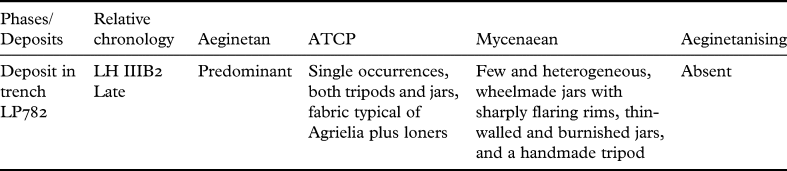
The cooking pottery recovered from trench LP782 is characterised by staggering amounts of Aeginetan pottery, which occupies a dominant role in this subset of the entire assemblage. Its share has been estimated with a simple sherd count at 45 per cent, and with a method using estimated vessel equivalents (EVE) for rims at c. 60 per cent (Lis Reference Lis2012, table 7). At no other period does the share of this pottery come even close to such a number. Even in the Early Mycenaean levels, when Mitrou received substantial amounts of all sorts of Aeginetan pottery, its share within the cooking pottery did not go over 30 per cent.
Aeginetan-tradition cooking pottery
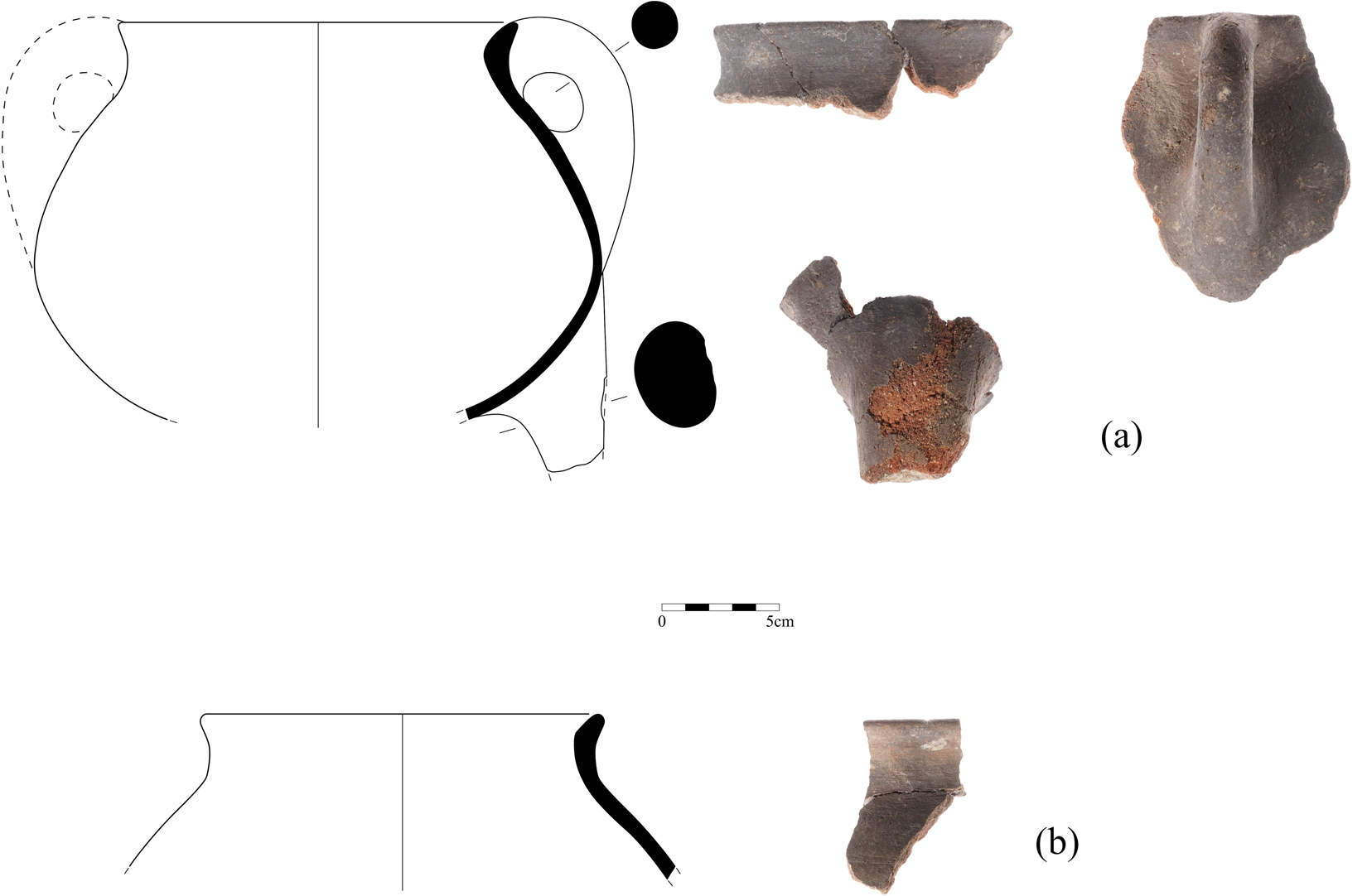
Within this assemblage there are a few fragments of ATCP (Table 5). The best-preserved fragment is a carinated tripod (MIT_62, Fig. 15a), which has a typical flattened rim and regular striations. Its profile seemed to diverge somewhat from typical Aeginetan tripods of that type, but a recent publication of a large corpus of Aeginetan pottery from Kanakia provides a good parallel (Marabea Reference Marabea2019, 465, fig. 14, especially No. 25). A small, most likely one-handled tripod, LP782-031-039, consists of a mendable lower body fragment preserving a leg scar and a non-joining short everted rim (Fig. 15b). Another fragment likewise preserves a leg scar (MIT_61, Fig. 15c) and is possibly associated with a non-joining tip of a small leg (LP782-024-042, Fig. 15d), to judge from the similarity in fabric. It would be another small tripod, yet its ascription to Aeginetan pottery is less secure, as it is not well preserved and much of its surface is worn. There is also a single base fragment (MIT_57, Fig. 15e) preserving a profile and surface treatment typical for Aeginetan cooking pottery and ATCP. However, its poor preservation means that this ascription must remain tentative.
Summary of information on cooking pottery from Mitrou
ATCP and Mycenaean cooking pottery from Mitrou: (a) MIT_62; (b) LP782-031-039; (c) MIT_61; (d) LP782-024-042; (e) MIT_57; (f) MIT_169; (g) LP782-030-032. Courtesy of Mitrou Archaeological Project.

The frequency of ATCP in the LP782 deposit can be estimated at 6 per cent based on the counts of rim preservation (EVE). It thus represents a small presence in comparison with Aeginetan pottery.
There are three additional fragments of ATCP deriving from unstratified contexts. One of them is an already published upper fragment of a cooking pot (LM785-006-020, Lis, Rückl and Choleva Reference Lis, Rückl, Choleva, Gauss, Klebinder-Gauss and von Rueden2015, 68, fig. 6) with short everted rim, belonging either to a tripod or a flat-based jar, with a potter's mark at the lower handle attachment consisting of a double horizontal incision. In addition, there is another fragment of a base (MIT_169, Fig. 15f) and a small section of a tripod leg with typical shape and surface treatment (MIT_167).
Aeginetan cooking pottery
The dominant part of the assemblage from the deposit in trench LP782, made up of Aeginetan pottery, is composed primarily of standard tripods with short everted rims and, in smaller quantities, flat-based jars with upper body and rim profiles identical to those of the tripods. No other shape has been recognised among the large quantities of such pottery.
Mycenaean cooking pottery
In the LP782 deposit, Mycenaean cooking pottery represents a minority, while it is formally and technologically quite varied. A fairly homogenous group within this assemblage is made up of thin-walled, wheelmade and burnished cooking pots with very long flaring rims, vertical strap handles and only slightly raised bases (Lis Reference Lis, Spataro and Villing2015, 110–11, fig. 9.7d). There are two other wheelmade cooking pots which preserve flaring rims of medium length, equipped with vertical handles of round section (Fig. 15g). Finally, there is a handmade tripod of a rare cauldron type (Lis Reference Lis, Caloi and Langohr2018a, 143, fig. 7.5), otherwise attested only in later contexts at Lefkandi (Evely Reference Evely2006, 32, pl. 22:2, fig. 2.35:3) and possibly also at Kanakia in Aeginetan fabric (Marabea Reference Marabea2019, 467, fig. 16).
Fabrics of ATCP
Regarding the fabrics of ATCP identified at Mitrou,Footnote 18 each sampled fragment represents a different fabric, and only MIT_61 and MIT_169 seem to be associated more closely. This variety is definitely partly a result of a small sample size, but it is nevertheless striking. It should also be stressed that, with the possible exception of MIT_57, all their fabrics are different from those attested among the sampled cooking pottery assemblage from Mitrou (almost 180 pieces).
Kynos
Kynos is a major settlement in the middle of the northern Euboean Gulf region, some 10 km north of Mitrou (Fig. 1). Despite a limited excavated area, the site has produced a wealth of evidence, with a sequence of strata covering the LH IIIB2 period, several stages of LH IIIC and the beginning of the Protogeometric period. Importantly, it has been a production place of pictorial and other types pottery during the LH IIIC period (Dakoronia Reference Dakoronia, Deger-Jalkotzy and Zavadil2007; Dakoronia and Kounouklas Reference Dakoronia, Kounouklas, Deger-Jalkotzy and Bächle2009; Kounouklas Reference Kounouklas2011). As pottery deriving from Kynos phase 8, dating to LH IIIC Early, is still under study, for the purpose of this project we have analysed a carinated tripod deriving from rescue excavations carried out in 1979 at the south-east part of the site. Judging from the fully monochrome deep bowl with distinct use-wear found in the same excavation, it could date to the LH IIIC Early period (Dakoronia Reference Dakoronia1979, pl. 64αγ).
The tripod is an interesting example of a pot that is close to ATCP, but it has a number of features that make its unequivocal classification difficult. The gently flaring upper wall ends in a flattened lip. The well-shaped carination is not too sharp. Handles have an oval section in a typical Aeginetan manner for such tripods. The vessel is clearly handmade, with regular horizontal wiping on the upper wall. The exterior, below the carination, bears some oblique deeper grooves with otherwise smooth edges, also typical of Aeginetan pottery. However, the general profile, as can be judged from the published photograph (Dakoronia Reference Dakoronia1979, pl. 64α), diverges from the typical Aeginetan carinated tripod in that its upper wall is much taller, the rim has basically the same diameter as at the carination and the lower body is slightly shallower.Footnote 19 There are other features that are not consistent with ATCP. The legs are all broken off close to the attachment, so it is difficult to make a proper judgement on their shape. They are pierced, which is a feature that we have seen among ATCP from Lefkandi and Eleon. However, neither their shape nor their manufacture, as far as can be judged on the basis of limited preservation, fits well with Aeginetan tradition. The section appears to be more rounded than is typical for Aeginetan tripods. Furthermore, two legs show relatively large irregular voids in their break, a feature never seen in the case of Aeginetan tripod legs, which are always extremely compact. The handles have the typical oval section, yet the way they are attached suggests either lack of care or lack of experience. The attachments are irregular, and do not adhere well to the surface of the pot.
This single tripod has a number of intriguing features, yet we should refrain from any far-reaching interpretations until its context and other cooking pottery of a similar date from Kynos are fully published.Footnote 20 It is nevertheless possible that this tripod represents a more advanced stage when the Aeginetan tradition undergoes changes, best exemplified at Lefkandi.
Petrographic analysis has not been performed on the tripod from Kynos, yet according to macroscopic analysis its fabric appears to be unique, not attested at any other site discussed so far. Its most distinct feature is the presence of calcareous inclusions, sometimes exploded on the surface.
Agrielia
The site, deposit and chronology
The site of Agrielia, located close to Hellenistic Halos in the Almyros plain c. 3 km from the shore (Fig. 1), consists of a Protogeometric cemetery. However, within its confines there is a broad (c. 4.50 m) and shallow (only c. 0.90 m) pit, containing mostly material of Late Mycenaean date with some later sherds of Protogeometric and Archaic date. There is no stratification of the remains within the pit. Inside it, there was also an undisturbed burial of a young woman, dating probably to the Early Iron Age; however no grave goods were found with it. The Mycenaean fineware pottery from the pit covers a broader chronological range, from LH IIIA2 to LH IIIC Early, which provides also the chronological limits for the rest of the pottery that cannot be dated on its own (Tournavitou Reference Tournavitou and Ainian2012).
Aeginetan-tradition cooking pottery
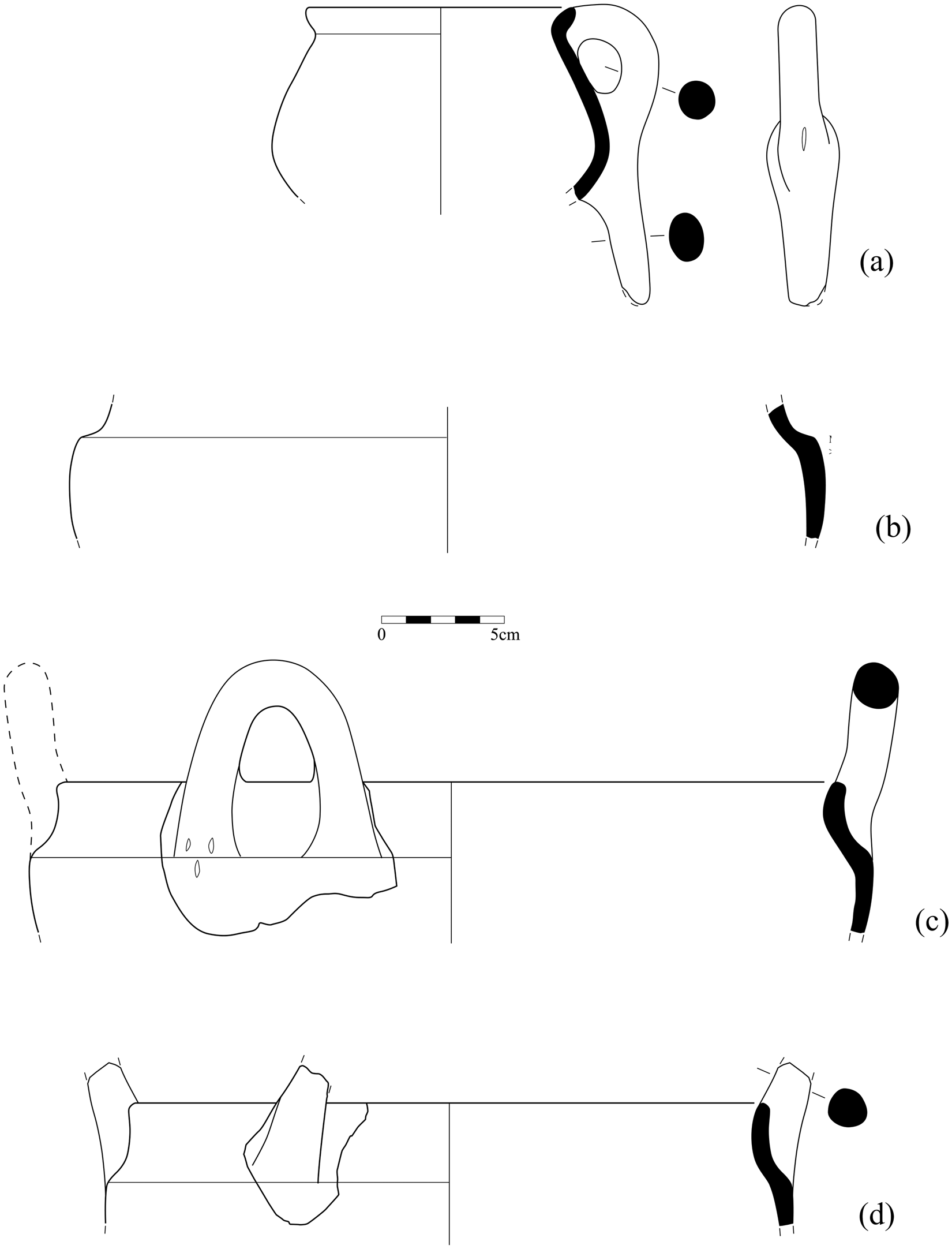
The material from the pit is fragmentary, and the surfaces are usually poorly preserved. Therefore, the discussion of cooking pottery (Table 6) has to be limited to morphology and special features like potters’ marks. There are numerous rims of the short everted type, and a comparably large number of tripod legs. In the absence of any identifiable bases, we can assume that the majority of ATCP at Agrielia belongs to tripods. The only well-preserved tripod (but still consisting of a single sherd) is AGR_17 (Figs 9a, 16a), which is a small one-handled specimen. It has a simple potter's mark at the lower handle, consisting of a single vertical incision.
Summary of information on cooking pottery from Agrielia

ATCP from Agrielia: (a) AGR_17; (b) AGR_19; (c) AGR_14; (d) AGR_01. © Ephorate of Antiquities of Magnesia, Hellenic Ministry of Culture and Sports.

There are fragments of carinated tripods too (AGR_19, Fig. 16b), but those preserving handles attest to the existence of a peculiar type, with a horizontal loop handle reaching above the rim, that can be referred to as a basket-type handle. A single well-preserved example of such a tripod (AGR_14, Figs 9b, 16c) has a potter's mark consisting of three vertical cuts arranged in a reversed triangle scheme; another example is AGR_01 (Fig. 16d). The only exact parallels for this shape in Aeginetan fabric derive from Kanakia (No. 29 in Marabea Reference Marabea2019, 466, fig. 15, confirming that the shape in question is a tripod) and, perhaps quite surprisingly, Pefkakia (PEF_58, Fig. 18c, see below).Footnote 21 At both Kanakia and Lazarides similar basket-type handles are sometimes placed on basins (Marabea Reference Marabea2019, 479 fig. 22:67; Efstratiou and Polychronakou-Sgouritsa Reference Efstratiou and Polychronakou-Sgouritsa2017, 106, fig. 133), yet these have different rim profiles.
In terms of manufacturing details, at least one of the legs shows finger marks on the attachment part (AGR_13, Fig. 6c).
One of the important findings of the study of Agrielia material is the likely extension of the chronological range for ATCP. Given the substantial amounts of ATCP, which seem to be only slightly lower than those of imported Aeginetan pottery,Footnote 22 it appears unlikely that the former would belong exclusively to the LH IIIC Early period, as pottery of this period is supposedly limited in quantity in the pit. These conclusions thus corroborate what the very limited evidence from Mitrou suggests, i.e. the production of ATCP prior to 1200 bc.
Aeginetan cooking pottery
Cooking pottery made of Aeginetan fabric found at Agrielia consists mostly of standard short everted rims, together with tripod legs,Footnote 23 and, in contrast to ATCP discussed above, also flat bases belonging to jars. There are also at least two fragments of carinated tripods, yet no handles are preserved.
Mycenaean cooking pottery
At Agrielia, there is no readily identifiable Mycenaean cooking pottery. There might be some fragments of such pots which have not been differentiated due to their similarity in morphological terms to other classes of pottery (like medium-coarse closed shapes), but even so they would be very rare. There are, however, two wheelmade cooking pots, AGR_08 and AGR_10, both apparently belonging to carinated tripods. Their shapes diverge from those attested among both Aeginetan pottery and ATCP. They could perhaps be termed Aeginetanising, but due to poor preservation it is difficult to say.
Fabrics of ATCP
Agrielia is also an interesting case regarding the fabrics of ATCP. A single major fabric group (A1) has been distinguished, and it seems fairly consistent with local geology and analysed clay samples. Only one fragment clearly stands out, AGR_03, and could be classified as a loner. The fabric of samples MIT_61 and MIT_169 from Mitrou seems closely associated with the A1 group at Agrielia.
Pefkakia
The site, deposits and chronology
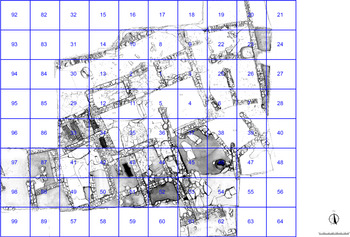
Pefkakia is one of the three major Mycenaean sites within the modern Gulf of Volos (part of the Pagasetic Gulf), the other two being Dimini and Kastro Palaia (Volos). The site consists of a tell (magoula), occupied for almost the entire Bronze Age, and a flat area of unknown extent, where excavated remains date predominantly to the later part of the LBA (Fig. 17). Material under discussion here derives from the final occupational episodes during the LBA, which can be dated to LH IIIB and the LH IIIB2/LH IIIC Early transition (Batziou-Efstathiou Reference Batziou-Efstathiou, Weilhartner and Ruppenstein2015).
Pefkakia – plan of the site with trench grid.

The exact chronology of particular contexts at Pefkakia and their synchronisation with regions to the south is not easy to establish. It is in part due to the current stage of research, as the full study of the pottery deposits has not been accomplished yet. However, the main obstacle is the very limited development of pottery between later LH IIIB and the beginning of LH IIIC Early, aggravated in the case of Thessaly by distinct ceramic conservatism. Furthermore, in contrast to Dimini (see below), the stratigraphy for the period around 1200 bc that we are dealing with at Pefkakia is more of a horizontal rather than of a vertical nature, meaning that particular rooms or spaces within the uncovered architectural complex might have been destroyed or abandoned at slightly different moments during the LH IIIB and LH IIIC Early periods, without any evidence of reoccupation within the same space that would provide vertical stratigraphy. Throughout our study, it appeared that the percentages of fabrics for Aeginetan pottery and ATCP might provide the key to dealing with the complexities of relative chronology and pottery sequence at the site. This rests on an assumption that Aeginetan cooking pottery gradually gives way to ATCP in non-Aeginetan fabrics, which is a scenario built upon the results of the entire project. Additional support comes from fabric analysis of ATCP, as the fabrics also show chronological patterning. It seems that the preliminary comparison of fineware pottery from relevant trenches is in strong agreement with the proposed scheme.
The presentation of the very rich evidence will follow this provisional chronological sequence and will discuss material from each trench/room separately.
Trenches 22–23 (Fig. 17)
These two trenches overlap with a single architectural space that is defined by two parallel walls belonging to a different structure from the main complex further to the west. Its slightly different orientation may point to a different chronology, a suggestion confirmed by slightly earlier material found in this trench. Aeginetan cooking pottery is dominant in these two trenches, while quantities of ATCP and wheelmade pottery are much smaller. The material consists of relatively small fragments, rarely joining.
Aeginetan-tradition cooking pottery
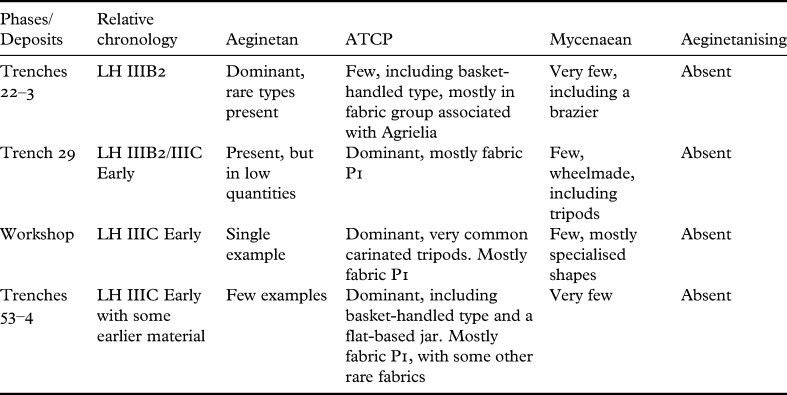
ATCP (Table 7) is rare in these two trenches and is attested mostly in the shape of a standard tripod with short everted rim (PEF_59, Figs 2e and 18a, PEF_06, Fig. 6d). In addition, there are two examples of a basket-handled shape, most likely a carinated tripod (PEF_57, Fig. 18b), a form known among ATCP only from Agrielia. In one instance, the lower part of the handle bears a simple potter's mark consisting of a single vertical incision. A single body sherd derives from a carinated tripod.
Summary of information on cooking pottery from Pefkakia
ATCP, Aeginetan cooking pottery, and handmade jar from Pefkakia: (a) PEF_59; (b) PEF_57; (c) PEF_58; (d) PEF_39; (e) PEF_41; (f) PEF_30; (g) PEF_13-16; (h) PEF_32. © Ephorate of Antiquities of Magnesia, Hellenic Ministry of Culture and Sports.

Aeginetan cooking pottery
Imported Aeginetan pottery is mostly represented by tripods with short everted rims. The number of tripod legs in pottery lots is very high, and there are no examples of flat bases. Interestingly, there are also a few fragments of other rare shapes made in Aeginetan fabric. One of them (PEF_58, Fig. 18c) is a carinated tripod with a basket handle. As mentioned in the discussion of Agrielia pottery, such a cooking pot type in Aeginetan fabric is otherwise known only from Kanakia. The small part of the preserved upper body profile of the example from Pefkakia suggests a slightly different morphology, with a taller concave wall. Other single fragments belong to shallow basins (two rims, for the shape see Marabea Reference Marabea2019, 478–84, figs 22–3), a shape with a tall neck, perhaps a jug or an amphora (for the shapes, see Marabea Reference Marabea2019, 478, 487, figs 21, 30), and a rim to what was initially described as a bowl with incurving rim, but which could also belong to a cauldron-type tripod (see No. 30 in Marabea Reference Marabea2019, 467, fig. 16).
Mycenaean cooking pottery
Mycenaean cooking pots are very rare. The only registered feature sherd is a handle to a brazier.
Trench 29 (Fig. 17)
This trench appears to belong to the exterior of the main structure, perhaps a widening of a street/corridor running to the north of it. This context is where the cooking pottery evidence changes quite dramatically. Imported Aeginetan cooking pots are still present, including one very well-preserved example of a standard tripod, yet the ATCP, together with examples of local wheelmade cooking pottery, make up the majority of the assemblage.
Aeginetan-tradition cooking pottery
Only tripods seem to be attested among ATCP, and they come in two types. One is the standard type with a short everted rim, exemplified by PEF_39 (Fig. 18d) that also features a simple potter's mark consisting of a single horizontal incision. The other is the carinated tripod, which, as we will see, appears to be the hallmark of ATCP assemblage at Pefkakia. It is attested with at least two mendable examples, PEF_41 (Fig. 18e) and No. 08_27 (not sampled).
Aeginetan cooking pottery
Aeginetan cooking pottery also consists exclusively of tripods. The well-preserved PEF_40 (Fig. 7c) has a simple potter's mark at the base. Its profile, showing a deep body, is quite unusual for Aeginetan tripods. The presence of a tripod leg with a square, as opposed to oval, section is worth noting, a peculiarity not known from any other site, including those on or very close to Aegina (Lazarides, Kanakia).
Mycenaean cooking pottery
This class of material constitutes a small addition to the assemblage. Among the better-preserved fragments, there are a tripod, a brazier and a lower body of a cooking pot, either a tripod or jar. All these examples are wheelmade.
The workshop (trenches 41–2, 49–50, Fig. 17)
The workshop area, with its well-preserved assemblage, is the best context documenting the very final stage of the LBA occupation at the settlement, most likely already in the twelfth century bc (LH IIIC Early). The study of its architectural features and movable finds suggests that it might have been a workshop for processing of woollen fabrics (Batziou-Efstathiou Reference Batziou-Efstathiou, Weilhartner and Ruppenstein2015, 69). In terms of the cooking pottery representation, it does show differences from the assemblage recovered from trench 29, but this might still be a difference related to a specialised function of the space rather than chronology.
Aeginetan-tradition cooking pottery
In a typical fashion for Pefkakia, ATCP is attested exclusively by tripods. Again, there are the two varieties, the standard type with a short everted rim and the carinated type. One of the standard tripods (PEF_30, Fig. 18f) has a potter's mark consisting of a single horizontal incision (just as in the case of PEF_39 from trench 29, Fig. 18d). Also, the carinated tripod PEF_08 + 17 (Fig. 8c) may have had a simple potter's mark at the lower handle. Interestingly, the carinated tripods at Pefkakia appear to have usually rounded or only slightly flattened rims, and their handles have round sections (PEF_13-16, Fig. 18g) as opposed to the slightly oval sections attested further south.Footnote 24 The only exceptions are PEF_50 (Fig. 8f), with a flattened rim, an early example (from trench 12) executed in a rare, probably imported fabric, and PEF_37 (Fig. 8d), from trench 53 (see below), exhibiting an oval handle.
Aeginetan cooking pottery
Aeginetan cooking pottery is attested by only a single mendable lower body fragment (PEF_25); otherwise only single sherds belonging to this category have been identified.
Mycenaean and other cooking pottery
The highly specialised nature of the space is reflected also in the assemblage of non-Aeginetan cooking pottery. There are a number of wheelmade shapes that are found only rarely in contemporary contexts on the mainland. Among these rare cooking utensils, we could list a large spouted basin, a brazier, a large dipper executed in a cooking pot fabric and a torch holder (Batziou-Efstathiou Reference Batziou-Efstathiou, Weilhartner and Ruppenstein2015, figs 12, 14, 41). Interestingly, all these shapes are wheelmade and in their manufacture do not show any features of the Aeginetan tradition.
In addition, there are two cooking pots that seem to belong to more ordinary shapes. One of them (PEF_24) is a tall two-handled jar on a flat raised base. In terms of its fabric and surface treatment it is reminiscent of hard-fired and often monochrome-washed closed shapes (amphoras or jugs) that constitute a very common category at Pefkakia from at least the LH IIIA2 period. However, both its different morphology and the traces of burning on this pot make its ascription to cooking pottery most likely. The other fragment (PEF_27) is a lower body of a wheelmade cooking pot.
An interesting part of the assemblage of the workshop, not present in trench 29, is made up of handmade and mostly burnished pottery in the form of jars with flaring rims and strap handles (Fig. 18h). One of the preserved bases is of a simple flat type (PEF_34); the other may be described as slightly convex (PEF_63, Batziou-Efstathiou Reference Batziou-Efstathiou, Weilhartner and Ruppenstein2015, 67, fig. 46). Their identification as cooking pots is only tentative, as their surfaces do not preserve obvious burning marks derived from use in or close to fire. They could have been used also as storage vessels. It should be stressed that they bear no similarity to Handmade Burnished Ware, typologically and technologically linked to southern Italy, found in quantities at the site of Dimini (Adrimi-Sismani Reference Adrimi-Sismani and Ainian2006).
The good preservation of the pottery in this context, as well as the fact that it has been entirely excavated, invites statistical evaluation. Even when considering all handmade and burnished pots, together with the special shapes executed in cooking pot fabric, as regular cooking pottery, and in this way decreasing the frequency of ATCP, it still constitutes slightly more than half of the assemblage (53 per cent based on the EVEs for rims). Wheelmade cooking pots constitute c. 30 per cent, while handmade and burnished pottery constitutes 10 per cent of the assemblage.
Trenches 53–4 (Fig. 17)
These trenches cover part of a courtyard with a surface made of stone slabs. The assemblage recovered from this space at first glance appears to be identical in its composition to the workshop area. ATCP holds a dominant position among the cooking pottery and is supplemented by wheelmade cooking pottery and handmade and burnished pots. However, certain aspects of the fineware pottery found together with these cooking pots, as well as the presence of a basket-handled shape (known only from an earlier deposit in trenches 22–3) and of some rare fabrics of ATCP (see below), all lead us to suggest that at least part of the pottery in this deposit is slightly earlier than the final episode of habitation at the site. The fact that the deposit is most likely a dump lends further support to the hypothesis that the pottery represents a chronological mix, but still belongs to the broadly defined final stages of the settlement, spanning the final part of the LH IIIB period and the beginning of LH IIIC Early.
ATCP
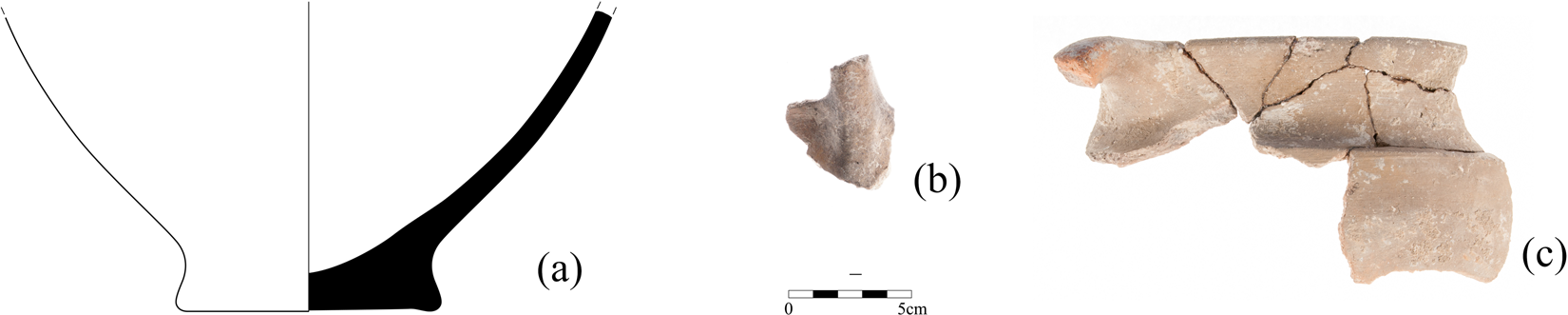
As regards the ATCP assemblage, the deposit provides the first unequivocal evidence for flat-based jars at Pefkakia. There are at least two examples. The first (PEF_53, Fig. 19a) is also the best-preserved example of ATCP from these two trenches, with a complete base, part of a lower body and a non-joining rim. The other example is a single sherd preserving half of the base. The same pottery lot yielded also a cooking pot fragment with a basket handle (not sampled, Fig. 19b), a rare type already mentioned above and present elsewhere (among ATCP) only at Agrielia. There are examples of both carinated tripods (PEF_37, Figs 8d and 19c, with a handle of oval section) and standard tripods with, most likely, a short everted rim (PEF_47). An upper fragment of a cooking pot with a short everted rim (not sampled, Fig. 9c) preserves a complete vertical handle featuring a potter's mark consisting of two horizontal incisions.
ATCP from Pefkakia: (a) PEF_53; (b) cooking pot from bag no. 64, trench 54; (c) PEF_37. © Ephorate of Antiquities of Magnesia, Hellenic Ministry of Culture and Sports.

Aeginetan cooking pottery
Aeginetan pottery is present too, although no mendable fragments have been identified. More work on pottery from this trench is needed to get a better idea of the frequency of such pottery.
In accordance with the evidence from the workshop area, there are a few examples of handmade and burnished pots with strap handles.
Other trenches
Regarding the Aeginetan pottery found at the site, we should mention also two finds from trench 2, as they highlight the presence of other shapes executed in Aeginetan fabric. One is a shallow basin, a shape known from trenches 22–3, but this example is equipped with legs. Once again, the only parallel comes from Kanakia (Marabea Reference Marabea2019, 479, fig. 22:64–6). The other appears to be a rim of a carinated tripod, a type very well attested among ATCP, but not present in Aeginetan fabric at Pefkakia, except for the fragment with a basket handle from trench 22. The example from trench 2 has a distinctly flattened rim.
Looking at ATCP from the entire site, we should stress the presence of a substantial number of potters’ marks (Figs 8c; 9c, e; 18d, f). Their number is surely related to the amount of such pottery recovered. However, it is worth noting that these are all very simple in nature, consisting of not more than two parallel incisions. Marks on Aeginetan pottery found at the site include some more elaborate types.
In terms of execution of particular features, we have already mentioned the predominance of rounded rims and round-section handles among the carinated tripods. As far as it can be judged, the leg attachments of ATCP tripods do not have finger marks, with an exception of an early example from trench 34 (PEF_06, Fig. 6d).
Fabrics of ATCP
Fabrics of ATCP at Pefkakia present us with a complex, but at the same time very interesting and highly informative picture. The situation at the very end of the settlement's existence is relatively simple, but there is a greater differentiation in the earlier deposits. The latest contexts, in particular the workshop area, are dominated by a single and homogenous fabric group (P1), which can be considered local in the light of the results of raw material prospection in the area. However, this fabric is virtually non-existent in only slightly earlier deposits at the site. In contrast, a range of different fabric groups is present, which are most likely non-local and are represented by either single fragments or at most only a few examples. One of these fabric groups (P4) is consistent with the main fabric from Agrielia; examples derive mostly from trench 22, with single instances from trenches 12 and 53. Trench 34, an LH IIIA2/B1 context, yielded a tripod leg (PEF_06, Fig. 6d) executed in a fabric very similar to the main Agrielia fabric.Footnote 25 Another fabric group, P3, is attested in single examples deriving from the workshop and trenches 53 (PEF_53, the flat based jar, Fig. 19a) and 29, showing therefore a distribution in the latest contexts at the site. There is also an exceptional fabric that characterises a carinated tripod which comes from the workshop area (PEF_13-16, Fig. 18g) but most likely belongs to the make-up of a clay structure there and is perhaps an earlier piece. Therefore, even though these rare fabrics do appear in the latest deposits at the site, they seem to be more characteristic of the earlier phases of occupation, provisionally assigned to LH IIIB2, during which the presumably local fabric group for ATCP (P1) has only a very limited appearance. Another aspect worth commenting upon is that many examples of ATCP executed in those varied and rare fabrics came from contexts that yielded substantial amounts of Aeginetan cooking pots, like trench 22/23 or trench 2 (Fig. 17).
Dimini
The site of Dimini (Fig. 1) is well known for its extensive Neolithic remains, but also for its Mycenaean settlement, including a complex with two main megaron-type buildings, Megaron A and B, a broad street running through the settlement, and a number of ordinary houses (Adrimi-Sismani Reference Adrimi-Sismani2013; Reference Adrimi-Sismani2014). It suffered wholesale destruction at the end of LH IIIB, which is followed by an LH IIIC Early reoccupation attested only in certain sectors of the site. Despite such circumstances, vertical stratigraphy covering this transition with reoccupation levels overlying the destruction dated to the LH IIIB2 period is attested only in some cases (most prominently in the South Megaron; see Adrimi-Sismani Reference Adrimi-Sismani2014, 173–6, 268–9), and the relevant material is not sufficiently published. Elsewhere, as is the case of Megaron A, destruction debris has been cleared and rooms were reoccupied using roughly the same floor levels as in the previous phase (Adrimi-Sismani Reference Adrimi-Sismani2014, 253–4). Nevertheless, the nature of the burnt debris dating to the LH IIIB2 period and the presence of new classes of pottery such as Handmade Burnished Ware and Grey Ware in the reoccupation levels (Adrimi-Sismani Reference Adrimi-Sismani and Ainian2006) are features distinct enough to confirm the proposed phasing even in cases without stratigraphic evidence. Another important issue regarding Dimini is the synchronisation of the destruction dated by the excavator to LH IIIB2 with pottery sequences for the rest of the Greek mainland. In many aspects pottery from the destruction deposits resembles more LH IIIC Early than LH IIIB2 pottery, at least with regard to pottery from Argolid. However, we need to take into account strong local idiosyncrasies, like predilection for monochrome interiors on open shapes or apparent continuity in the use of decorated kylikes, and understand better the local development of pottery from LH IIIA2 onwards before any more precise judgement can be made. For the moment, we are following the published account with the reservation that the placement of Dimini horizons in the synchronisation table (Table 1) may be subject to change.
Even though the relevant material from the site has not been extensively studied within the current project, preliminary observations on its cooking pottery convey a very clear picture. The destruction deposits seem to contain predominantly Aeginetan pottery (Table 8). Three well-preserved tripods, one larger two-handled (BE 35805, Fig. 7a) and two smaller one-handled examples (BE 35817 and BE 35818), as well as a small one-handled flat-based cooking pot (BE 35884) are all made of Aeginetan fabric (Adrimi-Sismani Reference Adrimi-Sismani2014, 377–80). The latter is a very rare specimen, as most flat-based jars known from elsewhere appear to be two-handled. All of these well-preserved examples bear potters’ marks and derive from Megaron B. Cooking pottery from Megaron A is much more fragmentary, but also features Aeginetan tripods, including the carinated type, in addition to Mycenaean pottery of specialised function, like griddles or souvlaki stands (Adrimi-Sismani Reference Adrimi-Sismani2014, 449–54). Even though the presence of ATCP is not excluded in these destruction levels, as suggested by sherd material associated with this phase, it had a limited presence at most. Mycenaean cooking pottery is rare and features specialised shapes, in a manner typical for Pefkakia.Footnote 26 In the reoccupation phase, ATCP seems to be well represented. Sherd material from Room 7 of Megaron A contained short everted rims, one with a handle bearing a simple potter's mark, and a rim to a carinated tripod. A basket handle has also been noted, yet its contextual association was not clarified.
Summary of information on cooking pottery from Dimini
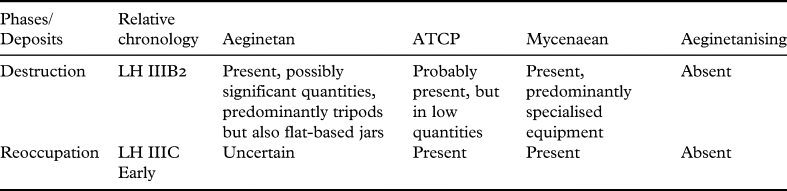
Dimini therefore provides much-needed confirmation of the chronological sensitivity of the changing frequencies of Aeginetan cooking pottery versus ATCP. Thus it seems legitimate to synchronise the destruction deposits at Dimini with trenches 22–3 at Pefkakia, while all the later deposits (trench 29, the workshop) should post-date the destruction and be roughly contemporary with the reoccupation phase at Dimini (Table 1).
Kastro Palaia/Volos
Excavations of D. Theocharis
The settlement at Kastro Palaia/Volos (Fig. 1) was excavated by D. Theocharis in the 1960s, but this work has never been fully published. Recent restudy of the remaining material brought to light fragments of two Linear B tablets, the first such documents to be found north of Boeotia, confirming the importance of the settlement (Skafida, Karnava and Olivier Reference Skafida, Karnava, Olivier, Carlier, de Lamberterie, Egetmeyer, Guilleux, Rougemont and Zurbach2012). Material kept from these excavations provides evidence for certain phenomena. The partially preserved carinated tripod (fully restored with gypsum), K 628, is an interesting example that might be related to ATCP. It has both a flattened rim and an oval section of the handle, features typical of Aeginetan carinated tripods. It is handmade and has carefully wiped surfaces. The divergent features include a more rounded section of the leg and the upper body profile. The carination is very pronounced, forming almost a flat ledge on the exterior at the onset of the upper wall. On the interior, part of the wall below the rim has a slight hollow. All these characteristics are quite unusual for Aeginetan carinated tripods. Nevertheless, the more rounded leg section makes this example similar to the carinated tripod from Kynos. Macroscopically, also, the fabrics of the two tripods show some similarities.
Study of the sherd material from this excavation provided evidence for the presence of both Aeginetan imports and ATCP. Box no. 31 contains a number of short everted rims and tripod legs belonging to both classes.
Rescue excavations at A. Kokotsika plot
Deposit and chronology
Rescue excavations conducted in 1988 at the nearby A. Kokotsika plot provided both good stratigraphy and abundant material to work with (Malakasioti Reference Malakasioti1988). A deposit of pottery recovered at the depth of 6.05–c. 6.28 m, above a plaster floor, dates to LH IIIC Early and appears to be either contemporary or slightly later than the reoccupation phase at Dimini (Table 1).
ATCP
The LH IIIC Early deposit contains only a limited amount of cooking pottery (less than 8 per cent), but the majority belongs to ATCP (Table 9), as it makes up almost 60 per cent of the entire cooking assemblage according to EVE counts for rims.Footnote 27 There is a mendable tripod cooking pot (VOL_01, Fig. 20a), most likely two-handled, with a standard short-everted rim. Legs do not have finger marks on their attachments, in a typical fashion for the ATCP in this area. In the assemblage there is another mendable cooking pot with a short everted rim (VOL_3, Fig. 20b) and a single rim sherd representing the same type. No other shapes, like for instance carinated tripods, were attested in the material, which is admittedly limited and cannot be compared with the vast quantities of pottery recovered from Pefkakia or Dimini.
Summary of information on cooking pottery from Volos – Kokotsika plot
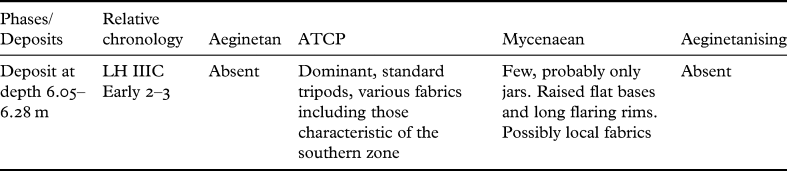
ATCP from Kastro Palaia/Volos: (a) VOL_01; (b) VOL_03. © Ephorate of Antiquities of Magnesia, Hellenic Ministry of Culture and Sports.

Other cooking pottery
There are no Aeginetan cooking pots, which is in accordance with the chronology of the deposit; in the Pagasetic Gulf, Aeginetan pottery seems to be replaced by ATCP at the turn to the twelfth century bc (beginning of LH IIIC). There are a few fragments of Mycenaean wheelmade cooking pots, characterised by raised flat bases and long, sharply flaring rims.
From the levels stratified above the LH IIIC Early deposit, datable to LH IIIC Middle–Late, there comes a single handle belonging to ATCP that might be considered intrusive, as other cooking pottery from these deposits does not seem to have any Aeginetan features. The situation is therefore different from that at Lefkandi, where one can see some traits of Aeginetan tradition in cooking pottery that post-dates the appearance of ATCP. However, while in the case of Lefkandi the sequence of settlement phases is relatively dense during the earlier part of the LH IIIC period, with major destructions/rebuildings taking place at short temporal intervals, the time span between the LH IIIC Early levels in the Kokotsika plot and the next phase dated to LH IIIC Middle/Late is significantly longer, and this could account for the absence of Aeginetanising pottery in this excavation plot.
Another rescue excavation on Kastro Palaia was conducted in the Georgali plot, at a considerable distance from the two excavations previously discussed. It does preserve a similar sequence to that recovered in the Kokotsika plot, with a layer datable to LH IIIC Early followed by an LH IIIC Middle/Late one. Nevertheless, the LH IIIC Early pottery appears to document a slightly later stage of that phase, as some pottery types, like linear conical kylikes, are not present in the Kokotsika plot but show up here. The most important observation from these levels is that there is no trace of either ATCP or any Aeginetan features among the otherwise Mycenaean cooking pottery, in sharp contrast to the material from the other excavations on Kastro Palaia. Hence, either we are dealing with a selective distribution of such pottery within a single settlement, which could be reinforced by the generally different appearance of pottery from the Georgali plot, or the slight chronological difference mentioned above is responsible for the lack of ATCP.
Fabrics of ATCP
Four sampled fragments of ATCP from the Kokotsika plot turned out to be manufactured in four different fabrics. Importantly, none of these fabrics is attested at nearby Pefkakia. Sample VOL_01 is related to a loner fabric at Agrielia (sample AGR_03), VOL_03 has a counterpart at Lefkandi, while sample VOL_04 belongs to fabric group L1 attested at Lefkandi and Eleon and considered to be non-local there. Only sample VOL_02 is of metamorphic composition and could be considered possibly local. Therefore, the very small assemblage from the Kokotsika plot is extremely varied and represents the only group in the area north of the Euripus Strait to show links with the southern part of the Euboean Gulf. Importantly, the main fabric from Pefkakia is not present in this assemblage. This might be fortuitous, but it may also show clear chronological patterning, as the site of Pefkakia would have been abandoned by the time that the Kokotsika plot deposit was formed (see Table 1).
Summary
We would like to summarise this presentation of evidence with a formulation of the main hypothesis and a few general observations that reveal patterns which will be crucial for the following discussion and the interpretation of the entire phenomenon.
In the light of the evidence presented above, we would like to advance a hypothesis that the appearance of Aeginetan-tradition cooking pots in this broad geographical area is indicative of a technological transfer related to the mobility of potters trained in a tradition associated with the island of Aegina. This interpretation is based on a widely accepted notion that a particular technology, with associated chaîne opératoire, cannot be copied by observing a completed product, but requires a prolonged learning process and direct interaction between master and apprentice (Gosselain Reference Gosselain and Stark1998; Reference Gosselain2000). This is true not only for such aspects of manufacture as vase-building methods, stressed by many authors, but also for the execution of features like rims or legs, as they reflect a certain set of motor habits, unique to a given tradition. Finally, certain aspects of manufacture are simply invisible even to an experienced observer, like the finger marks at tripod legs’ attachments. In order for such an entire technological package to be transferred, a movement of craftspeople is necessary. Therefore, we think that around 1200 bc potters trained in the Aeginetan tradition spread along the Euboean Gulf and manufactured distinctly Aeginetan-tradition cooking pots using local clays.
The wealth of data presented here allows us to lay out some general observations and patterns. The first concerns the existence of two broad regions, or zones, on both sides of the Euripus Strait. ATCP appears earlier north of the Strait, apparently already in the LH IIIB2 period, and coexists with significant amounts of imported Aeginetan cooking pottery. This represents the first stage of the analysed phenomenon. South of the Strait, ATCP is limited to the LH IIIC Early period, and its presence is not associated with imported Aeginetan pottery, with the possible exception of Thorikos. Another interesting difference is that Aeginetan pottery, either as imports or ATCP, or a combination of both, assumes a dominant position in the cooking assemblages of settlements in the northern zone, while at the two sites in the southern zone – Eleon and Lefkandi – it plays a much less significant role. We should remark, however, that we have no data for earlier levels at Lefkandi and that the situation at Thorikos is unclear due to the mixed nature of the deposit from Mine 3.
The second observation concerns Lefkandi and Pefkakia, two sites that show the presence of ATCP in more than a single settlement phase. They seem to have been initially only recipients of ATCP produced elsewhere. The presumed local production of such pottery began only in the later stage of the discussed phenomenon. There is better evidence for this pattern at Pefkakia, as at Lefkandi a single piece in a presumably local fabric came already from phase 1a deposits.
Third, the variety of fabrics attested for ATCP indicates a significant number of production units and production localities of such pottery. Therefore, although we are dealing with a phenomenon of a limited duration, both its geographical extent and the number of potters involved were most likely considerable. Importantly, with the course of time, the number of production units does not seem to decrease significantly, but some of the fabrics assume a dominant position, and new production sites, as evidenced by new fabrics, continue to appear.
Fourth, Aeginetan tradition does not seem to be static through time. This is something we could probably expect from a craft that has to be adjusted and adapted to new landscapes and new social circumstances of production. The deep finger marks on the interior of tripod legs are given up, seemingly gradually. At some places, potters decide to additionally pierce the legs of tripods, which is probably telling us something about insecurity regarding the performance of new clays in drying and firing. Also, potters’ marks, in their execution, are slightly different from those found on Aeginetan pottery or early examples of ATCP, and seem to be more often executed with a fingernail (Fig. 9e).
SOCIO-POLITICAL BACKGROUND OF POTTERY PRODUCTION ON AEGINA (FOURTEENTH TO EARLY TWELFTH CENTURY BC)
In order to place this rich evidence pointing towards mobility of potters trained in the Aeginetan tradition into proper context, we need to understand the socio-political developments on the island itself.
The palatial period (fourteenth and thirteenth centuries bc, LH IIIA2–B)
The main settlement on the island is Kolonna, located at the north-western tip, with a very long history of habitation. The palatial period appears to be a time in which this once powerful centre in the Aegean gradually declined. Yet we are considerably hindered when discussing the role of Kolonna in the region by the limited amount of evidence from the site pertaining to this period. However, both the recent finds from excavations at the site and the evidence from the cemetery at the Windmill Hill most likely associated with the settlement prove continuing activity during the LH IIIA2 and at least part of the LH IIIB period (Deger-Jalkotzy Reference Deger-Jalkotzy, Reinholdt, Scherrer and Wohlmayr2009). The evidence relating to the later stages of the thirteenth century bc (and of LH IIIB) becomes very scanty, possibly representing a further decline in activity at the site.
Nevertheless, Kolonna is not the only site that witnessed activity during the palatial period on Aegina. A significant settlement of that period, with an associated cemetery, has been recently excavated at Lazarides (Sgouritsa Reference Sgouritsa and Danielidou2009), in the eastern part of the island and therefore overlooking, and perhaps also controlling, a completely different area than that visible from the site of Kolonna. It has excellent views towards the eastern part of Attica, including the metal-rich Lavrion area (Kelder Reference Kelder, Strootman, van den Eijnde and van Wijk2019), the eastern part of the Saronic Gulf and the western Cycladic Islands. Material revealed so far points to involvement in trade, some craft activities and, based on a substantial number of pithoi, intensive agricultural production, perhaps reaching beyond simple subsistence. Activity at both the cemetery and the settlement ceases at the transition to the post-palatial period (Efstratiou and Polychronakou-Sgouritsa Reference Efstratiou and Polychronakou-Sgouritsa2017; Sgouritsa Reference Sgouritsa, Schallin and Tournavitou2015), i.e. around 1200 bc.
Another important site of this period is located on the highest peak of the island, Mount Oros, only a few kilometres south of Lazarides. An almost fully preserved female figure attests to cult activities, yet the possibility that the site also served as a place of refuge cannot be excluded. Mycenaean pottery found there points to the end of the palatial period (LH IIIB2) and perhaps even the beginning of the post-palatial period. A bronze hoard is also worth mentioning (Gauss Reference Gauss, Lang, Reinholdt and Weilhartner2007a).
Another site related to cult activities is located at the place of the later sanctuary of Aphaia, in the north-east part of the island. The site seems to have had a long history, going back as early as the Early Bronze Age, and it flourished during the LH IIIA2–B periods (Pilafidis-Williams Reference Pilafidis-Williams1998, 158). Once again, evidence for LH IIIC activity is very limited, if not entirely absent. Among the finds, there are plentiful figurines and a number of sealstones (Pilafidis-Williams Reference Pilafidis-Williams1998).
A unique type of settlement, unfortunately without sufficient dating evidence, is the citadel of Megali Koryphi (by the church of Aghios Antonios) at a prominent location at the south-east tip of the island (Vokotopoulos and Michalopoulou Reference Vokotopoulos, Michalopoulou and Driessen2018). Based mostly on the analogies for the construction methods and the entire design, it could be placed somewhere at the transition from LH IIIB to LH IIIC. Its significance for the island's history in that crucial period remains unclear, however.
While discussing the settlements on Aegina, it is worth bringing to the discussion a single site located outside of the island – the extensive settlement of Kanakia on Salamis. The reason for this is a hypothesis formulated by S. Deger-Jalkotzy: that it was founded by refugees from Kolonna when that site was declining (Deger-Jalkotzy Reference Deger-Jalkotzy, Reinholdt, Scherrer and Wohlmayr2009; but see Marabea Reference Marabea and Lolos2012, 184–5). A similar idea was proposed in relation to the development of the settlement of Lazarides in the palatial period (Polychronakou-Sgouritsa Reference Polychronakou-Sgouritsa, Adam-Veleni and Tzanavari2012). Even though these are so far only speculative ideas, it is important to think about changing settlement patterns and changes within particular settlements also in terms of what they actually represent, i.e. population movements.
Several cemeteries are known to have been in use during the palatial period on Aegina. Two have already been mentioned – at Windmill Hills associated with Kolonna and at Lazarides. There are also two cemeteries in the south-west and eastern parts of the island – at Perdika (Salavoura Reference Salavoura2014, 56–7) and Kylindra (Salavoura Reference Salavoura2014, 69–70, with further bibliography), adding further evidence for activity in that part of the island.
An important pattern that seems to emerge from this brief survey is that the main focus of activities on Aegina might have shifted during the palatial period from the flat western part to the more mountainous and rugged eastern part of the island. Obviously, only with a survey covering most of the island could such a reconstruction gain a more secure footing. Nevertheless, the entire island appears to have suffered a dramatic decline in human activity towards the beginning of the twelfth century bc (LH IIIC Early).
In terms of pottery production, the only direct evidence for such activities is a kiln of LH IIIA1 date, found recently at the site of Kolonna (Gauss Reference Gauss, Alram-Stern and Nightingale2007b; Karkanas et al. Reference Karkanas, Berna, Fallu and Gauss2019). However, it does seem to be associated with the production of Mycenaean pottery, and not the traditional cooking pottery that concerns us here. It is also worth pointing out that in the entire excavation record at Kolonna only a single kiln waster has been identified among the cooking pottery, and it is of uncertain date (Mommsen et al. Reference Mommsen, Gauss, Hiller, Ittameier, Maran, Pohl, Recker and Theune2001, 92–3, pl. 2:20; No. KOL 156 in Gauss and Kiriatzi Reference Gauss and Kiriatzi2011, 316, figs 84, 140).
Crucial factors for our consideration are the political situation in the region and Aegina's relationship with the palatial centres, especially that of Mycenae. Owing to the scarcity of evidence pertaining to the palatial period, it is not an easy task to untangle such relationships. Nevertheless, the majority of scholars seem to agree that Aegina (and its main settlement at Kolonna) had come under the palatial control of Mycenae from as early as the fourteenth century bc (i.e. the LH IIIA period).Footnote 28 This loss of independence could also have been responsible for the gradual decline of the main settlement.
There are a few finds on Aegina that lend support to some kind of incorporation or at least involvement with a palatial centre and its administration. One of them is a clay sealing, found in the vicinity of a LH IIIA1 pottery kiln at Kolonna, attesting to Mycenaean administrative practices. If this sealing indeed belongs to the group of irregular string nodules, it would be the only such find outside of palatial centres (Gauss Reference Gauss, Alram-Stern and Nightingale2007b). The kiln itself might signify a major change in the political trajectory of the island. It is built into the ruins of the most important MH and early LBA building at the site, that goes out of use in the LH IIB period. The short interval between the two events makes it unlikely that the builders of the kiln were unaware of the earlier function of that area. On the contrary, this might have been a conscious statement by a new elite establishing itself at Kolonna (Karkanas et al. Reference Karkanas, Berna, Fallu and Gauss2019). Construction of that kiln coincides with the appearance of large quantities of locally produced pottery in fully Mycenaean style and technology (Gauss Reference Gauss, Eder and Zavadilin press) that most probably were not made by local potters associated with traditional Aeginetan pottery and could represent the introduction of a new technology, a situation mirroring the production of Minoan-type pottery on Aegina in the Middle Bronze Age (Gauss Reference Gauss, Czerny, Hein, Hunger, Melman and Schwab2006). Even though the source of this new technology cannot be traced with precision, it appears that it must be sought beyond Attica, as this area does not seem to be producing Mycenaean pottery, at least not in quantity, around this time (Kaza-Papageorgiou and Kardamaki Reference Kaza-Papageorgiou and Kardamaki2018). In the light of other evidence presented below, the Argolid appears as a likely candidate.
There are other indications of Argive involvement on Aegina. An important group of seals was found at the Aphaia temple. The majority of them belong to the Mainland Popular Group, and their worn state suggests they were intensively used. Importantly, the closest stylistic affinities are with seals from Corinthia and the Argolid (Pini Reference Pini1987). Finally, the neutron activation analysis (NAA) of figurines and pottery from the same site suggested that most of the sampled pieces are of Argive provenance (Pilafidis-Williams Reference Pilafidis-Williams1998). If these were votives brought to the cult place by visiting worshippers, it is therefore likely that they also came from the Argolid.
Regarding the power relations in the Saronic Gulf, there is a single event of particular importance. It is the establishment of an extensive settlement at Kalamianos near the end of the LH IIIA2 period (i.e. towards the end of the fourteenth century bc). As this was clearly an organised event, it is difficult not to see the agency of one of the palatial centres behind this act. Mycenae appears to be the best candidate, and Kalamianos could provide it with more direct control over the Saronic Gulf, including participation in trade (Tartaron et al. Reference Tartaron, Pullen, Dunn, Tzortzopoulou-Gregory, Dill and Boyce2011). This act could also indicate that palatial involvement was changing towards a more direct control. The establishment of Kalamianos, therefore, seems to be the final stage of a process that had been unfolding for some decades. J. Kelder explains the interest of Mycenae in extending control over this area as part of a drive to secure control of silver sources at Lavrion and places the firm establishment of its power in this area already in the second half of the fifteenth century bc (i.e. LH IIB; Kelder Reference Kelder, Strootman, van den Eijnde and van Wijk2019). Interestingly, this coincides with a process of Mycenaeanisation of the entire Saronic Gulf, as seen for instance at Megali Magoula or Thorikos, as well as at Kolonna itself (Tartaron Reference Tartaron2013; Kelder Reference Kelder, Strootman, van den Eijnde and van Wijk2019, 44; Gauss Reference Gauss, Eder and Zavadilin press).
Given the limited nature of direct archaeological evidence on Aegina pertaining to the palatial period, the indications of Argive involvement and increasing control over the island and the entire Saronic Gulf are surprisingly rich and varied, and include also pottery production. What remains uncertain, however, is the extent of this control during LH IIIB2, the final stage of the palatial period. Internal problems within the Argolid signalled by a wave of destructions around the mid-LH IIIB period and following protective measures at major citadels might suggest that the power of Mycenae was under pressure even in its immediate environs (Shelmerdine Reference Shelmerdine1997, 580–1). If that was the case, the area of the Saronic Gulf might have fallen out of the sphere of direct control by the late thirteenth century bc (LH IIIB2).
Are there any signs of the impact that this possible shift in the political standing of Aegina would have had on the traditional pottery production? In fact, the period around the LH IIIA1/LH IIIA2 transition represents probably one of the most significant ruptures within the long history of pottery production on the island. In the first place, apart from cooking pots, all traditional pottery groups produced on the island prior to the fourteenth century bc (before LH IIIA2), i.e. Matt Painted, Plain, Red Slipped and Burnished, were given up.Footnote 29 Furthermore, there were important developments within cooking pottery too. The shapes of Aeginetan cooking pots changed and conformed more with what was standard on the Mycenaean mainland: there were now both one- and two-handled cooking pots, and those with flat bases were becoming more stable, and thus more suitable for placement at the edge of a fireplace (Lis Reference Lis, Hruby and Trusty2017b). Importantly, the marking system changed significantly, with potters’ marks becoming simpler and being placed almost exclusively below the handle as opposed to on the base, as favoured in previous periods.Footnote 30 And, according to our knowledge, these changes were not a result of a prolonged gradual process with a discernible transitional phase; on the contrary, they seem quite abrupt.Footnote 31
Another important aspect related to the production of cooking pottery is that it appears that the source of the raw materials used might have been changed. There are some indications of this from the petrographic analysis of late LBA versus earlier cooking pottery produced on Aegina (Gauss et al. Reference Gauss, Kiriatzi, Lindblom, Lis, Morrison, Hruby and Trusty2017, 53), which seem to be reinforced by the results of chemical analysis of late LBA cooking pottery. Two LH IIIB2 Aeginetan cooking pots from Midea, identified as such on macroscopic grounds, did not fit into a well-defined NAA group AEG-P, which contains numerous examples of cooking pots of mostly MH and early LBA date from Kolonna (Nos 18 and 21 in Demakopoulou et al. Reference Demakopoulou, Divari-Valakou, Maran, Mommsen, Prillwitz and Walberg2017). A change in the ceramic paste used towards a finer variety is suggested by systematic macroscopic observations by B. Lis, now paralleled by similar remarks based on the material from Kanakia (Marabea Reference Marabea2019, 492). However, this does not seem to be confirmed at the level of petrographic analysis, and more research is needed to verify these observations. In any case, even though change of a clay source can result from exhaustion of a previous one, chronological overlap with other significant changes may suggest other reasons.
A diachronic look at fresh breaks on Aeginetan pottery highlights another development in the production of Aeginetan cooking pottery of the palatial period, the beginning of which cannot be precisely pinpointed at the moment. There is a clear indication of a change in the firing regime, towards more controlled firings in an oxidised atmosphere. The dark cores, a consistent feature of Early Mycenaean cooking pots, are very rare during the palatial period, and fabrics have generally lighter colours.
While some of these developments might be understood as an adjustment to the changing circumstances, consumer demands and improvements resulting from the focus on a single class of pottery, the scale, thoroughness and chronologically limited horizon when these changes appeared make it unlikely that it was solely an initiative of potters who had kept the tradition basically unchanged for centuries.Footnote 32 We should bear in mind that the last major changes of a degree comparable to those just described took place during the MH III period, some 300 years earlier (Gauss et al. Reference Gauss, Kiriatzi, Lindblom, Lis, Morrison, Hruby and Trusty2017, 49). A more likely scenario is that we are dealing with effects of a more direct involvement by a Mycenaean authority in the affairs in the Saronic Gulf, and Kolonna in particular. It is definitely too early to understand the entire mechanism of this change and the degree of involvement, especially when it comes to pottery production. There is a considerable controversy among scholars regarding the relationship between Mycenaean states and pottery production,Footnote 33 and realising this we would not like to push our evidence too far. Nevertheless, perhaps a key observation here is that among fully Mycenaean pottery produced on Aegina from LH IIIA1 onwards there are no wheelmade cooking pots that we could refer to as Mycenaean. It therefore appears that whoever was behind the construction of the kiln and the start of Mycenaean pottery production at Kolonna either chose not to compete with the traditional cooking pottery of Aegina or appreciated its potential and interfered only in certain aspects of its production, without affecting the entire organisation of production.
Organisation of production, as well as gender of potters, are two important and interrelated aspects of Aeginetan pottery production also with regard to potential mobility. The latter aspect in particular has not received much scholarly attention, and it is only G. Nordquist (Reference Nordquist, Laffineur and Niemeier1995) who offered some thoughts on both aspects.Footnote 34 Production of Aeginetan pottery is a complex case that clearly escapes rigid distinctions between various modes of production organisation, as defined for instance by D.P.S. Peacock (Reference Peacock1982). It represents a hybrid case, where traditional and labour-intensive production methods (handmade manufacture, careful wiping) typical of household production are combined with large-scale output and considerable standardisation in terms of shapes and, at least for the later part of the LBA, specialisation in one type of pottery, i.e. features that are more characteristic of specialised workshop production. Potters’ marks, a consistent feature of Aeginetan pottery from as early as the beginning of the Middle Bronze Age, give us some additional clues. Their use was related to the sharing of certain facilities, most likely kilns (Lindblom Reference Lindblom2001, 129–33), and points to the existence of multiple producers linked by close collaboration. A substantial number of production units, most likely household-based, may explain the large scale of production without a need to postulate professional workshops, while shared concepts of techniques, shapes, clay sources and paste preparation practices point to close links between people making up these production units, suggesting they were members of a single community of practice (Gauss and Kiriatzi Reference Gauss and Kiriatzi2011, 251–4). This hybrid character of Aeginetan pottery production does not facilitate the discussion of potters’ gender, as household production tends to be more in the domain of females, while more specialised production is in most cases carried out by men.Footnote 35 However, a recent overview of ethnographic accounts relating to gender and pottery production (Murray, Chorghay and MacPherson Reference Murray, Chorghay and MacPherson2020) emphasised two main factors that impact the involvement of males in craft activities. One is the availability of land for agriculture securing self-sufficiency, the other the opportunity of a particular craft activity to secure profit. In the case of Aegina we do not have sufficient data to speculate on the availability of land, apart from the fact that the development of a major centre like Kolonna and likely population increase might have rendered access to agriculturally productive land more competitive. Most importantly, however, ancient sources often refer to poverty and barrenness of the soil on Aegina (Klebinder-Gauss and Gauss Reference Klebinder-Gauss, Gauss, Lichtenberger and von Rüden2015, 71–2). This imposed considerable limitations on the number of people that could live off the land only, and, in case of population increase, which we can assume for most of the Middle and Late Helladic periods, part of the male population must have sought another occupation to make a living. Regarding the second factor, already from the beginning of the Middle Bronze Age, Aeginetan pottery of various types is subjected to exchange, and its geographic scope is increasing through time (Gauss and Kiriatzi Reference Gauss and Kiriatzi2011, 242–6). There can be little doubt that at least part of the pottery was made for profit. Therefore, there seems to be considerable evidence at hand to suggest that pottery production on Aegina might have been a male-dominated craft from as early as the Middle Helladic period. However, thinking about pottery production and the people involved, we should consider not only potters, but also other individuals that were most likely involved in tasks like fuel procurement, clay extraction and processing, attachment of handles etc. If production was still household-based, such tasks might have been handled by other members of the family. The sheer number of production units on Aegina, as indicated by the considerable output and also the number of different potters’ marks, as well as the likely involvement of family members in the whole production sequence, strongly suggests that a substantial segment of a community took part in this activity. Therefore, perhaps the most appropriate term with which to describe this kind of activity is a ‘village industry’.
The post-palatial period
As already discussed, there is little evidence for activity at Kolonna towards the end of the palatial period. There is even less material dating to the LH IIIC period. Stefan Hiller (Reference Hiller and Konsolaki- Giannopoulou2003, 12) mentions c. 20 LH IIIC sherds, most of which should belong to the early part of that period. Both the settlement and cemetery at Lazarides were given up by the beginning of LH IIIC at the latest, and the same seems to be true for activity on Mount Oros. There is no evidence for post-palatial activity at the site of the later Aphaia temple either. The nearby shores of the Saronic Gulf present a very similar gloomy picture (Sgouritsa Reference Sgouritsa, Vlachou and Gadolou2017). The site of Kanakia was abandoned very early in the LH IIIC period (Marabea Reference Marabea2019, 453), as was the thriving settlement of Kontopigado, another centre of ceramic production (Kaza-Papageorgiou et al. Reference Kaza-Papageorgiou, Kardamaki, Koutis, Markopoulou and Mouka2011; Gilstrap, Day and Kilikoglou Reference Gilstrap, Day and Kilikoglou2016). Also, Kalamianos did not survive beyond the palatial period, perhaps partly because of its direct ties to Mycenae. At Athens there is more evidence pertaining to the LH IIIC period, but it seems to show fluctuating intensity of activity throughout the twelfth century bc (LH IIIC Early–Middle), at least as indicated by the evidence at hand. The Mycenaean Fountain (Broneer Reference Broneer1939; Mountjoy Reference Mountjoy1995b; Gauss Reference Gauss, Deger-Jalkotzy and Zavadil2003; Trevor Van Damme, personal communication) and the houses on the North Slope of the Acropolis (Broneer Reference Broneer1933; Mountjoy Reference Mountjoy1995b) provide evidence for a destruction early in the LH IIIC Early period, but the next sizeable group of material in the fountain dates to LH IIIC Middle. The same pattern can be observed in Thorikos, on the basis of the Mine 3 deposit (Mountjoy Reference Mountjoy1995a).
What happened to Aeginetan cooking pottery production after the changes it underwent during the LH IIIA2 period? Unfortunately, we are lacking the proper chronological resolution to answer this question satisfactorily, as most of our evidence, either in the Saronic Gulf or elsewhere, is concentrated at the end of the thirteenth and the very beginning of the twelfth century bc (end of LH IIIB and beginning of the LH IIIC Early period) and data from Aegina is scanty. What seems certain is that towards the end of the thirteenth century (end of LH IIIB2) a new shape was introduced, which would also become a hallmark of ATCP – the carinated tripod. There are several other shapes attested at Kanakia (Marabea Reference Marabea2019) and Lazarides (personal examination of material by B. Lis), but, because they were not exported in quantity, it is impossible to say when exactly they were introduced. Nevertheless, the appearance of a new type of tripod does seem to show a certain dynamism in Aeginetan cooking pottery production around 1200 bc.
Shortly afterwards, the production of Aeginetan cooking pottery came to an end. There is no good evidence – either on Aegina or any other site to which such pottery has been exported – to prove its survival beyond the beginning of the LH IIIC Early period (Gauss and Kiriatzi Reference Gauss and Kiriatzi2011, 246–7). But given the dramatic depopulation of Aegina and the Saronic Gulf just outlined, this is in fact hardly surprising.
POTTERY EXCHANGE TOWARDS THE END OF THE THIRTEENTH CENTURY BC
There is much more direct evidence that relates to the trade in Aeginetan pottery than there is for its production. As the efficiency of Aeginetan cooking pottery circulation must have been an important factor directly affecting potters, we should consider this aspect here within the broader context of pottery trade on the Greek mainland.
It is a difficult task to characterise pottery trade within the Greek mainland towards the end of the palatial period. Ironically, Aeginetan cooking ware is probably the best understood group of pottery that was traded at this time, owing to its distinctiveness in pottery sorting and considerable scholarly interest over the last 30 to 40 years. LH IIIB2 and, to a certain extent, also the very beginning of LH IIIC Early constitute a period of strong continuity, even thriving in the export of Aeginetan cooking pots. As we have shown, such pottery reaches as far north as the Pagasetic Gulf, and it is found there in considerable quantities. At Pefkakia, where we have reliable statistics, imported Aeginetan cooking pottery holds a dominant position in all of the thirteenth century (LH IIIB) contexts. At Dimini, from the area of Megaron B, all restorable cooking pots are Aeginetan. As this popularity of Aeginetan cooking pottery does not seem to be context related, we seem to be dealing with a consumption of surprisingly large quantities of imported cooking pottery, which does not seem to be matched by any other class, including the fine painted tablewares.
Likewise, at Mitrou, Aeginetan cooking pottery represents up to 60 per cent of the cooking pottery in the LH IIIB2 deposit (see above). This is significantly more than in the Early Mycenaean period, when Mitrou was receiving large quantities of various imports, mostly from the areas to the south (Vitale Reference Vitale and Mazarakis Ainian2012). The site of Mitrou is located much closer to the area of the Saronic Gulf than Pefkakia or Dimini, but this is still a distance of about 200 km by means of water transport. Larger sailing ships, like the Uluburun vessel, could reach such destinations within a two-day journey, but we should probably imagine smaller vessels, which would need several additional days of sailing to arrive at sites like Mitrou and c. 50 per cent more time to reach the Pagasetic Gulf. Unfortunately, to cite T. Tartaron (Reference Tartaron2013, 71), ‘we know virtually nothing of the range of small boats that Mycenaeans used’. The most likely candidate for such trade among the types listed by Tartaron (Reference Tartaron2013, 75–6) is a coaster that would be sailing along or near the coast and most likely played the main role in maintaining connections within the Mycenaean world. If (some of) the vessels had no sails, the estimated daily range for paddle boats is c. 40 km (Broodbank Reference Broodbank2000, tables 3, 12).
How does this evidence correspond to trade in other types of pottery produced on the Greek mainland? We are definitely on a more secure footing regarding the trade in Mycenaean pottery with the Near East, thanks to a considerable number of scientific studies from a number of sites and regions. A very clear pattern emerges here, both in terms of chronology and participating production centre(s). On the Mycenaean side, the production is dominated by a chemical pattern described as Mycenae-Berbati (MYBE; Jung Reference Jung, Eder and Pruzsinszky2015, 244, fig. 1) that seems to represent a general profile of the north-eastern Peloponnese (Kiriatzi and Andreou Reference Kiriatzi, Andreou, Kiriatzi and Knappett2016, 137, with further bibliography) and not only a known production site at Berbati, near Mycenae. The role of other workshops/chemical patterns is marginal. The middle of the thirteenth century bc (LH IIIB1/2) represents a collapse of that trading activity, and it broadly coincides with a series of destructions that affected the Argive centres, including Mycenae (French Reference French and Cline2010) and the pottery workshop(s) at Berbati, which ceased to exist, while the settlement itself was abandoned (Sjöberg Reference Sjöberg2004, 73, with further bibliography). Pottery does continue to be produced within the Argolid, but is no longer widely exported, at least with regard to the Near East, but perhaps also the mainland. We definitely know much less about pottery trade within the Greek mainland. Many analyses have been conducted, but both their chronological resolution and the insufficient level of detail of the resulting publications render any conclusions difficult.
An exception here is the specialised class of transport stirrup jars, which have been extensively studied with a variety of scientific techniques, and the results are now fully published (Haskell et al. Reference Haskell, Jones, Day and Killen2011; Kardamaki et al. Reference Kardamaki, Day, Tenconi, Maran, Papadimitriou, Demesticha and Knapp2016). However, the origin of the majority of them is in Crete, either central or western, and therefore outside of the Greek mainland. Moreover, they circulated as transport containers for a particular commodity, or commodities, and not for their intrinsic value, as did cooking pots or decorated open shapes. The same applies to Canaanite jars, which circulated widely, although in seemingly smaller quantities (Rutter Reference Rutter, Nakassis, Gulizio and James2014).
Returning to fine tableware, chemical patterns associated with the north-eastern Peloponnese are found in pottery samples from a number of regions, in varying quantities. They, and in particular the pattern MYBE, usually constitute the major non-local component of analysed samples from the Greek mainland (Mommsen et al. Reference Mommsen, Beier, Hein, Ittameier, Podzuweit and Vincenzini1995). The other recurrent but less prominent region appears to be Boeotia, with limited direct evidence for pottery production.Footnote 36 In both cases, owing to the low chronological resolution of published results, we are not able to follow the distribution patterns diachronically, which is crucial for this discussion. Nevertheless, there is some indirect evidence that points to a similar breakdown of exports from the Argolid to the rest of mainland Greece, as in the case of the Near East. The scarcity of LH IIIB2 ceramics at Tsoungiza, a site located in the Corinthia but close to Mycenae, has been interpreted as an inability of Mycenae to supply this settlement (and presumably others as well) with sufficient amounts of pottery, in contrast to the LH IIIB1 period, when large quantities of ceramics of high quality were deposited in a domestic pit (Dabney Reference Dabney and Driessen2016). Beyond the Argolid and its immediate vicinity, the absence of newly introduced LH IIIB2 Argive types has been noted, in contrast to the presence of typically Argive shapes of LH IIIB1 date, at least in the cemeteries.Footnote 37 At Pefkakia, a site that received considerable amounts of Aeginetan imports, Argive pottery seems to be frequent in LH IIIA2–B1 deposits, but not later.
Another way of looking at trade is through the perspective of ceramic homogeneity across a wider area (the so-called ceramic koine) versus regionalism, and this view may offer the best evidence. Trade in ceramics contributes to the homogeneity through two mechanisms. On the one hand, arrival of pottery from a trend-setting centre facilitates copying. On the other, if imports from such a centre are numerous, the resulting pottery assemblage looks more ‘koine-like’, especially if the ceramic analysis does not pay enough attention to fabrics and manufacture. In that respect, LH IIIB2 (second half of the thirteenth century bc) is a period of a quite developed regionalism. The stylistic features that allow us to differentiate this sub-period are typical of the Argolid and have a restricted circulation. Some regions continue the pottery traditions of LH IIIB1Footnote 38 or even of the LH IIIA2 period (Attica; Kardamaki and Kaza-Papageorgiou Reference Kardamaki, Kaza-Papageorgiou, Caloi and Langohr2018). In conclusion, we can repeat a statement of S. Sherratt, one of the first to discuss the phenomenon of regionalism in Mycenaean ceramics: ‘contacts between these areas [ = Argolid] and those which remained unaffected by the LH IIIB2 style must have been extremely limited’.Footnote 39
All this suggests that long-distance exchange in ceramics, beyond those used as containers for certain commodities, could have been quite limited during the LH IIIB2 period. Trade in Aeginetan cooking pottery does not fit into this picture, even though it does not seem to be particularly well suited to function as a temporary container for other goods, which would render sea voyages with such a load more viable; nor can we assume its high exchange value, in comparison to decorated finewares. Its circulation does not seem to be affected either by the developments within the Saronic Gulf or by the factors that contributed to the disruptions in the distribution of Argive pottery. The latter is particularly striking, as according to the proposed model of Argive control over the Saronic Gulf, this pottery might have been circulated using (at least partially) the same distribution channels as Argive finewares. Not only is there no sign of decline, but at sites located in the northern part of the studied area Aeginetan pottery continues to dominate cooking assemblages in the late palatial period. It seems, therefore, that whoever was responsible for the distribution of Aeginetan cooking pots found a very efficient and successful way to do so. The exact way in which it was achieved is not easy to unravel, not least due to the problem of equifinality, as different distribution modes have essentially the same end result. Here we would suggest three options, which are by no means exclusive. One solution that is commonly found in historical sources and ethnographic accounts is that there were merchants who owned the resources that allowed them to distribute pottery over a wider area. Given the fact that the distribution of Aeginetan cooking pottery stands out in comparison with other pottery produced on the mainland, such merchants (if they existed) must have focused exclusively on this kind of pottery, adding perhaps other products associated with Aegina that appear to be widely distributed, like the andesite quern stones. Alternatively, there could have been potters who got involved in the distribution of their products, perhaps in response to discontent with the (value of the) goods offered by the merchants in exchange or difficulties in circulating their wares following the disruption in the trade in Argive pottery. Involvement in such activities would make them more closely acquainted with areas away from the Saronic Gulf, which is an important aspect when it comes to their mobility within that area, as suggested by the evidence of ATCP. Finally, potters might have travelled to various locations with their own clay,Footnote 40 which would allow them to bypass possible disruptions in the distribution networks and act more locally.
POTTERS’ MOBILITY – MOTIVATIONS, SCALES AND DESTINATIONS
The first part of the article presented the archaeological evidence for cooking pottery that we associate with the mobility of potters trained in the Aeginetan tradition, in all its spatial and chronological complexity. The second part outlined the socio-political and economic background of their activity. By combining these two datasets we may be able to answer some of the most burning questions regarding this phenomenon. First and foremost, we should be able to understand why they moved and what kind of push and pull factors were at play. What was the temporal and spatial scale of that move? Were these efforts individual, or perhaps did more potters settle in certain areas? What was driving their choice of places to work and settle? And finally, how did they adapt, and how did their craft change through time?
In order to shed more light on potters’ motivations to move, we need to distinguish – and subsequently scrutinise – two sets of factors affecting potters working on Aegina and influencing their decisions. The first set is more relevant to potters and others facing the necessity of selling or trading their products than to other parts of the population. These factors include possible disruption in trade and sea transport that might impact the sale of their wares. As we have seen, the later part of the LH IIIB period cannot be described as a collapse in trading activities, as certain goods still circulated, but there are signs of general deterioration. We have shown that this deterioration does not seem to relate to exchange in Aeginetan cooking pottery, yet it is important to bear in mind that what we are looking at are the end-effects of certain actions and circumstances, and not the actions themselves. As we suggested above, it is possible that in the face of problems with pottery circulation that clearly affected at least Argive pottery, Aeginetan potters undertook certain measures themselves that enabled them to supply their produce even to remote places. We proposed, as two of the three possible scenarios, that the potters might have been undertaking journeys themselves, using boats loaded with either their pottery or their clay, perhaps in addition to grinding stones.Footnote 41 In fact, it is difficult to imagine the start of ATCP production in areas as distant from Aegina as for example Agrielia without any first-hand knowledge of those areas among potters. In all discussions of migration and mobility, this is a crucial factor in the decision to move (Anthony Reference Anthony1990, 889–900). But it is through such exploratory journeys happening some time around the later thirteenth century bc (LH IIIB2) that the opportunity to establish a production site and to try out local clays might have emerged. In this respect, it does not seem to be a pure coincidence that the first secure appearance of ATCP, in the second half of the thirteenth century bc (LH IIIB2), coincides with the problems in pottery circulation highlighted above.
This initial production of ATCP does not replace the cooking pottery made of Aeginetan fabric – quite the opposite: at least at Mitrou and Pefkakia small quantities of ATCP coexist with substantially bigger amounts of imported Aeginetan pottery.Footnote 42 This may suggest a limited output, a situation we would expect if there were only a few potters engaged in such an activity and/or if they were acting only on a seasonal basis.Footnote 43 Itinerant potting is a likely scenario for this early stage that is in agreement with how we reconstruct these first journeys, aimed either at distributing pottery produced on Aegina or at pottery production using a limited supply of Aeginetan clay. Also, a much more intense exchange in ATCP in this early stage versus the twelfth century bc (LH IIIC Early), as evidenced by the distribution of cooking pots in fabric typical of Agrielia, is in line with the higher level of mobility associated with itinerant potting. Such a mode of mobility is also not at odds with the suggestion that the cooking pottery production on Aegina was in the hands of males. Men were definitely more likely to leave their households for several months than women. In general, the mobility of women is determined by very different factors (see Cutler Reference Cutler2019, 86–8; Murray, Chorghay and MacPherson Reference Murray, Chorghay and MacPherson2020, 230–1).
It is intriguing that production of ATCP started earlier in the northern zone, i.e. further away from Aegina.Footnote 44 It appears somewhat counterintuitive, as one would imagine that it would be easier for potters to explore areas closer to the island, as these might have been better known to them. Since this did not happen until a slightly later stage, we should be assuming that it was still feasible to supply the southern zone with Aeginetan cooking pottery by taking advantage of existing modes of exchange, at least for some time. The areas located further away from Aegina might have been the first to be affected by disruptions in trade with the south. As they had been known for their earlier consumption and appreciation of Aeginetan cooking pottery, it might have facilitated the decision to undertake such adventurous journeys.
We should also address another counterintuitive situation, a bizarre coexistence of cooking pottery made of Aeginetan fabric and ATCP at more than a single site.Footnote 45 Researchers working on Aeginetan cooking pottery seem to be accustomed to the idea that it was the volcanic clay and its properties that explain the popularity of Aeginetan pots (Lindblom Reference Lindblom2001, 131). However, since Aeginetan-tradition cooking pots executed in a variety of non-Aeginetan fabrics found their consumers, and even travelled for some distance at a time when the imports were still in use, we should probably be rethinking our ideas about what was the decisive factor, at least in this particular period, affecting the popularity of Aeginetan pottery. For products of such a long-standing tradition we should consider notions of the reputation and appreciation of the potters themselves (Day Reference Day, Betancourt, Davaras and Hope Simpson2004; Day et al. Reference Day, Cau Ontiveros, Mas Florit, Müller, Spataro and Villing2015). Thanks to the established tradition and centuries-long pottery production, good quality and reliable cooking pottery might have become associated with Aeginetan potters, and in this way their products might have been highly valued even when they were not made on Aegina and of Aeginetan clay anymore. Familiar shapes, details of execution that were surely obvious to those who handled such pots for years and surface treatment that gave a pot a particular feel – generally some of the features that make those pots stand out and be recognizable by researchers nowadays – might have played their role.Footnote 46 Also, the presence of potters’ marks, although not on every vessel, might have been part of a certain signature of Aeginetan potters.
Returning to the factors that might have an effect on potters’ decisions, there are also those that have an impact on the wider segments of local societies. The obvious result of such factors is the pattern of abandonment of settlements and apparent depopulation of Aegina and of the neighbouring areas of the Saronic Gulf. Clearly, abandonment is only a final act of a process that unfolded over a longer period of time. Also, what we perceive as a chronologically fixed event, like the abandonment of a settlement, could be a sum of non-synchronous individual decisions. Therefore, we should imagine those factors being present for quite some time, perhaps gradually intensifying. We can only speculate on their character. The scale of depopulation makes us think of high levels of insecurity in this area, which might be related to the dissolution of power structures in the region, increased activity of pirates and perhaps localised conflict if there were several small polities centred upon major settlements in the area, like Kanakia or Kontopigado, which became independent once Mycenae's influence faded. We do not have much evidence for such putative conflicts, given the scarcity of clear destruction levels, yet an important issue concerns the way we interpret contexts that are described as ‘abandonments’, for instance in the case of Kanakia or Lazarides. Nevertheless, regarding general insecurity in the area, we may point towards the presence of two settlements with a clearly defensible location and, at least in one case, truly monumental protective measures. One is the citadel of Megali Koryfi on Aegina, unfortunately without firm dating evidence, and the other is the settlement on the harbourless island of Modi (Konsolaki-Giannopoulou Reference Konsolaki-Giannopoulou, Kyparissi-Apostolika and Papakonstantinou2003). In their discussion of Megali Koryfi, L. Vokotopoulos and S. Michalopoulou (Reference Vokotopoulos, Michalopoulou and Driessen2018, 168) stress the double nature of certain aspects of the geographical position of Aegina – proximity to different landmasses, multitude of harbours and strategic passage of the Isthmus of Corinth. They might have contributed to the rise of Kolonna's power in the Bronze Age and then again in the Archaic and early Classical period, but in periods of turmoil, like the times around 1200 bc, these might have had quite a negative impact, making the island vulnerable. Perhaps this is why the abandonment seems to have been so thorough, on a scale that seems comparable only to Messenia, if we include the earliest LH IIIC into our considerations for the Saronic Gulf. And this is what interests us the most here, the fact that people leave their established habitation places. Some of them might have settled into more defensible locations within the same area, while others must have left for places further away. We are definitely not (yet) capable of tracing those movements of people based on the general appearance of material culture, but we might in fact consider potters and their mobility as a proxy for a more general human mobility starting from the Saronic Gulf. In fact, ATCP constitutes thus far the only indicator as to where people leaving Aegina and surroundings might have headed for. Therefore, we would like to reconstruct the second stage of the phenomenon as one characterised by permanent relocation of potters, most likely with other parts of the general population.
We may thus propose two distinct stages of the phenomenon, with different underlying motivations for potters’ movements. How do the chosen destinations relate to those stages? Approaching this topic is not without problems, mostly owing to the difficulties involved in locating production sites for ATCP precisely. Nevertheless, we can be quite confident that some of them were located close to, or at, Agrielia, Pefkakia and Lefkandi.Footnote 47
In both zones, i.e. north and south of the Euripus Strait, the second stage and presumed relocation seems to be combined with an appearance of new production site(s). This process is clearer (and earlier) in the northern zone. At Pefkakia, the few examples of ATCP present in LH IIIB levels are presumably all imported, but in the immediately following phase the evidence suggests overwhelmingly local production with very few imports. At Lefkandi, we are dealing with a similar scenario, yet the evidence is scarcer and hence less conclusive. During the earlier stage, contemporary with settlement phase 1a, ATCP comes from a variety of places, with perhaps a single local product. In the following stage, local production of ATCP plays a more prominent role and finds its way to sites like Eleon. How do we account for this pattern? It could obviously be related to the shift in settlement patterns. Agrielia (or the area around it) is given up at some point during the LH IIIB/IIIC transition, and so the potters must have moved to places which were still populated and active. Likewise, Thorikos might experience a decline following the earliest LH IIIC period, which might have pushed potters to other locations, if there was any production in that area. However, shifts in production location can also be a result of potters’ own considerations and agency – a suitable place for exchange of their wares and short-term potting might be different than their perception of an appropriate place for relocation of their lives and families. Let us look at the chosen destinations. The area of the Pagasetic Gulf was densely settled in the LH IIIB period, with three large settlements (Pefkakia, Dimini and Kastro Palaia). At least one of them (Dimini) underwent substantial modifications with the onset of the post-palatial period, following a destruction (Adrimi-Sismani Reference Adrimi-Sismani2014), but it is important to look at one particular aspect of these settlements in early LH IIIC. They all seem to attract mixed populations, including people from outside the Mycenaean world, as indicated by the finds of Handmade Burnished Ware (Dimini and Kastro Palaia: Adrimi-Sismani Reference Adrimi-Sismani and Ainian2006; Malakasioti Reference Malakasioti1988, fig. 129β), associated with the presence of people from the southern Italian peninsula (Lis Reference Lis, Bachhuber and Roberts2009; Boileau Reference Boileau, Kiriatzi and Knappett2016), and by the pyraunos at Pefkakia,Footnote 48 indicative of a person familiar with ways of cooking current in Macedonia or further north. To be sure, these are only the indications of foreigners’ presence that we are capable of detecting. If, as seems likely, other newcomers came from within the Mycenaean mainland, we are not in a position to recognise them in the material record, beyond the Aeginetan potters. We could speculate that the Pagasetic Gulf was considered as an area that was welcoming migrants, even though more evidence is clearly needed to document this aspect more comprehensively.
Lefkandi is another excellent example of such a migrant-friendly settlement. Beyond the growth of the settlement in the post-palatial era, which would hardly be sustainable without incoming populations, there is some evidence for the presence of people from outside. Its character generally closely matches the evidence from the Pagasetic Gulf, since specific contexts at Lefkandi yielded both Handmade Burnished Ware (for example, the famous cup No. 65/P107 in Evely Reference Evely2006, 120, pl. 26:4, fig. 2.42:2) and a pyraunos (No. 65/P179 in Evely Reference Evely2006, 124, pl. 29:8, fig. 2.40:6), pointing both to the Central Mediterranean and northern Greece or the Balkans.
Beyond those sites, there must have been others, yet to be identified. Their existence is borne out by the presence of a number of fabrics that appear in small amounts at various sites. New fabricsFootnote 49 were showing up repeatedly from the beginning of the phenomenon, attesting to the constant patterns of mobility which might be due to potters moving along the Euboean Gulf, but just as probably it could reveal several waves of migrant potters from Aegina. As we have suggested in the discussion of settlement patterns on the island, the abandonments were most likely gradual processes extended in time.
How can we imagine their movement in terms of scale? Did it involve individuals or groups? Here we would like to consider only potters and not the larger societal groups to which they may have belonged, and whether they travelled alone or in groups. The only way to answer these questions is by looking at potters’ marks, a typical feature of Aeginetan tradition most likely associated with the practice of communal firings in a shared kiln. The use of potters’ marks continued and is well attested for ATCP (Fig. 9). Potters’ marks have been found on cooking pots whose production is associated with Pefkakia, Agrielia and an unknown location where pots found at Eleon and Lefkandi were produced (fabric group L1). Therefore, we can suggest that at least in the case of those three locations we should be thinking about more than a single potter at work. Other fabrics have too few members to provide meaningful patterns. Nevertheless, we should note that in the case of the vessels imported to Eleon and Lefkandi from an as yet unknown location (made in fabric L1), a relatively small group of vessels yielded two or even three potters’ marks.
Very little can be said regarding how potters adapted to the new circumstances. In most of the investigated cases, settlements where ATCP has been identified are either abandoned shortly after (Pefkakia) or seem to have a considerable hiatus in habitation sequence following LH IIIC Early (Volos, Kokotsika plot). Only Lefkandi provides an uninterrupted sequence and, in fact, a few insights into how the adaptation process might have been played out. If the few wheelmade Aeginetanising cooking pots identified within phase 1b destruction deposits are indeed products of potters connected to the Aeginetan tradition, they might illustrate how potters modified their working practices to converge with the tradition represented by probably more numerous indigenous potters.Footnote 50 The use of a fabric similar or even identical to the one used by indigenous potters for ATCP might have been the first stage of such a convergence, and a sign of adaptation and integration.
The Aeginetan potting tradition, as reflected in preserved cooking pots, underwent also other changes that are less straightforwardly interpreted, and perhaps are best understood as related to a development typical of relocated traditions and resulting from adjustments or changes that are due to the severence of ties with the original tradition and its social context (Lis Reference Lis and Driessen2018b, 262). Here we can mention the disappearance of finger marks on legs’ attachments, which are securely attested only in the earliest examples of ATCP. Another such change could be a different execution of potters’ marks. Some of them (Pefkakia, Lefkandi, Mitrou) appear to have been made with a fingernail, a practice not attested on Aegina, while the potters’ marks most similar to the ones placed on Aeginetan pottery are found at Agrielia, again among the earliest examples of ATCP. Therefore, it appears that the potters were most faithfully following the Aeginetan ways of doing at the very beginning of their activity outside of Aegina.
CLOSING REMARKS
In this article, we aimed not only at presenting the entire body of evidence pertaining to Aeginetan-tradition cooking pots and their producers, but also at making another step towards interpretation and reconstruction of the story behind them – in other words, we wanted to bring potters to life.
The reconstructed picture might resemble that of Siphniot potters of modern times (Troullos Reference Troullos1991; Spathari-Begliti Reference Spathari-Begliti1992), who have not featured in the discussion so far. This was for a good reason; neither did their history serve as a model nor were the circumstances fostering their mobility similar, despite admittedly comparable patterns. Their modern history definitely helped us to think about the phenomenon of potters’ mobility, but the similarities appear to be mostly superficial or of a general kind. The two successive phases – first itinerant potting and then permanent relocation – seem to be common to both, but the underlying processes are quite different. Among the reasons behind the mobility of Siphniot potters, three seem to have played the most important roles: (1) changing trade routes and the rise of Athens as a major population centre; (2) an over-abundance of potters on the island, resulting in unemployment among them; and (3) the activity of merchants aiming at maximisation of their income at the expense of potters. While we are unable to verify how many potters were active on Aegina in the late palatial period, still less whether there were too many of them, the third reason listed above bears some similarities with the reconstructed course of events in the case of Aeginetan potters. Problems with distribution, and perhaps also the activity of merchants, into which we have no insights and on whose existence as a specialised class we can only speculate, could have provided the first incentive for Aeginetan potters to explore areas along the Euboean Gulf. Regarding the potters’ relocation, changes of settlement patterns could have played a key role in both cases, but when closely scrutinised these changes were of a different character. In the case of potters from Siphnos, the cause was the emergence of Athens and other major towns as the main population centres and the biggest markets for their wares; whereas, as suggested above, it was mostly the insecurity of life in the Saronic Gulf that forced people (including potters) away from the island, seemingly without a main port of call, although clearly settlements like Lefkandi or Pefkakia were perceived as attractive destinations with considerable demand.
In closing, we would like to reflect on the fact that the Aeginetan potting tradition disappeared, after a period of an unmatched longevity despite many turbulent periods within this part of the Aegean. It did not stand the test of time after it had been transferred to other areas, but was absorbed by the locally dominant way of doing pottery. It appears that when a potting tradition restricted to a small area, like an island, possibly engaging a substantial section of the community and deeply embedded in the social matrix, is transferred to a different place, it becomes vulnerable and susceptible to quite a rapid change and even absorption. This deep immersion of potting tradition in local society acts on the one hand as a buffer and a sort of protective cocoon, ensuring its faithful reproduction, but on the other hand might prevent successful reproduction under new social conditions. Even though an unsophisticated potting technology appears to be easily transferrable, as it does not require any substantial investments or clays of particular properties, its reproduction is dependent on a much greater number of social factors that form the specific social context. These do not constitute parts of the chaîne opératoire that we normally study, but we hope that this article demonstrates that they should be considered on the same level as manufacturing techniques or clay recipes, especially if we are dealing with the relocation of a particular potting tradition. In the case of the Aeginetan potters, once the close bonds within what may have been a single large potting community were loosened and partially broken up by the relocation of its various subgroups to different places, it was not possible to fully and successfully reproduce this long-standing tradition. These observations indirectly confirm the notions derived from anthropological and ethnoarchaeological research, that stress the deep rooting of a potting tradition in the belief and value systems, identities and social relationships of communities (Lemonnier Reference Lemonnier1993; Gosselain Reference Gosselain2000, 193; Broodbank and Kiriatzi Reference Broodbank and Kiriatzi2007, 246).
Concordance for sample and inventory numbers.

ACKNOWLEDGEMENTS
This project has received funding from the European Union's Horizon 2020 research and innovation programme under the Marie Skłodowska-Curie grant agreement No 753569. Earlier research on this topic had the support of the Polish Ministry of Science and Higher Education within the framework of the National Program for the Development of Humanities (project no. 0180/FNiTP/H21/80/2011). We would like to acknowledge help and support of project directors and researchers that gave us permission to use material for the purposes of the project, including petrographic and elemental analyses: Brendan Burke, Bryan Burns and Alexandra Charami (Eleon), Aleydis Van de Moortel and Eleni Zachou (Mitrou), Ifigenia Tournavitou (Agrielia) and Zoi Malakasioti (Kastro Palaia). We would also like to thank excavators and researchers who allowed us to study and mention relevant material: Panagiota Sgouritsa (Lazarides), Fanouria Dakoronia and Katerina Stamoudi (Kynos), Vassiliki Adrimi-Sismani (Dimini) and Evangelia Skafida (Kastro Palaia). The British School at Athens and the Belgian School at Athens provided permissions to study material from Lefkandi and Thorikos respectively and reproduce images. Our thanks are extended to the Ephorates of Antiquities of East Attica, Evia, Fthiotida and Evritania, and Magnesia for their assistance in acquiring permits and conducting research and sampling. We would like to thank Salvatore Vitale, Elina Kardamaki, Trevor Van Damme, Irene Lemos, Ian Whitbread, Walter Gauss and Maria Choleva for helpful discussions on topics relevant to this article; and two reviewers for the BSA for constructive criticism during the review stage. Tania Gerousi of the British School at Athens has undertaken the burden of preparing all the study and sampling permit applications. All photographs, except for Fig. 8a, were taken by Bartłomiej Lis. Tina Ross made all drawings and inkings, except for the drawing of LP782-031-039 (Fig. 15b) made by Marcella Rossin.