INTRODUCTION
Nitrogen and phosphorus are limiting nutrients for agricultural production in northwestern China. Most soils of this region are deficient in available P and N because of the high soil pH. However, the soils are rich in microorganisms that are potentially of great agronomic importance (Yang & Ruan Reference Yang and Ruan2001; Zhao & Lin Reference Zhao and Lin2001). Bacteria of several taxonomical classes are found in these soils and some species are believed to increase plant growth and productivity through different mechanisms such as asymbiotic nitrogen fixation, solubilization of mineral phosphate and other nutrients, production of plant hormones and control of phytopathogenic microorganisms. Interest in plant growth promoting rhizobacteria (PGPR) and plant growth promoting bacteria (PGPB) has increased due to the prospect of using efficient strains of PGPR and PGPB as bio-inoculants in organic agriculture, which is emerging as an alternative to chemical inputs in intensive agriculture (Thakuria et al. Reference Thakuria, Talukdar, Goswami, Hazarika, Boro and Khan2004).
Wheat and oat are important crops in China. Wheat is a staple food and is grown in 0·16 (2·5×105 ha) of the cultivable land and has an annual production of 9·39×107 tonnes (National Bureau of Statistics in China 2006). Oat is the main fodder crop of western China, especially in Hebei, Gansu, Nei, Shanxi and Sichuan provinces where it is cultivated over about 3·5×105 ha (Chen et al. Reference Chen, Wang and Bi2001).
The present study was undertaken to identify bacterial strains that may be used as useful inoculants (biofertilizers) for wheat and oat production in northwestern China.
MATERIALS AND METHODS
Soil collection
The soil samples used in the present study were collected from the rhizosphere (0–200 mm depth) of wheat in fields in Lanzhou, Gansu province in northwestern China and analysed for important elements. Exchangeable K, Na and Ca were determined by flame photometer and total N was measured using the Kjeldahl procedure (Bremner Reference Bremner, Black, Evans, Ensuinger, White and Clark1965). P was estimated by the method described by (Ashraf et al. Reference Ashraf, Khan and Azmi1992) using a spectrophotometer. Total N and P of the soil sample were 6·5 g N/kg and 10 μg P/g soil, respectively. The ionic concentrations in the soil sample were 74 μg/g (Na+), 13 μg/g (K+) and 20 μg/g (Ca2+).
Enumeration of rhizosphere bacteria associated with wheat
The population of potentially nitrogen-fixing rhizobacteria associated with roots of the Chinese wheat variety V4 was determined by the acetylene reduction assay (ARA) based most probable number (MPN) method (Alexander Reference Alexander, Black, Evans, Ensuinger, White and Clark1965). Unwashed root samples (1 g) were collected in triplicate from different plants and centrifuged in test tubes containing 9 ml saline solution. Serial dilutions (10×) of the suspensions were prepared and from each dilution of the series, 100 μl suspension was inoculated into four replicates of a nitrogen-free malate medium (NFM medium, Okon et al. Reference Okon, Albrecht and Burris1977) in vials. The vials were incubated at 30±2°C for 24 h, then injected with 1 ml of C2H2 and incubated at 30±2°C for 3 days. Ethylene production was measured by gas chromatography. The population of potentially nitrogen-fixing rhizobacteria was determined using a probability table (Cochran Reference Cochran1950).
Isolation of rhizobacteria from wheat rhizosphere
The roots of Chinese wheat varieties Ningchun 4, Ningchun 3, Ganchun 630, Ganchun 600 and the Pakistani oat variety Swan were collected from plants grown in Lanzhou in the Gansu province in northwestern China. Small pieces, about 20 mm long, of both washed (with sterile distilled water) and unwashed roots were centrifuged separately in test tubes containing 9 ml sterile saline for 30 min at 250×g. Serial dilutions were prepared from the washed and unwashed root suspensions and 100 μl of each dilution was spread on combined C-medium (Rennie Reference Rennie1981) and NFM medium. Plates were incubated at 30±2°C for 48 h and then sub-cultured on Luria–Bertani (LB) plates (Yasmin et al. Reference Yasmin, Baker, Malik and Hafeez2004). The isolates were purified and stored on slants. Gram staining (Vincent Reference Vincent1970), colony and cell morphology of isolates were studied using light microscopy.
Indole acetic acid (IAA) production
For detection and quantification of IAA production by the bacterial isolates, cultures were grown in Okon's malate medium (Okon et al. Reference Okon, Albrecht and Burris1977). Tryptophan (100 mg/l) was added as the precursor of IAA. After one week of growth, qualitative estimation of IAA was performed using Fe–HClO4 and Fe–H2SO4 reagents. The ethyl acetate oxidation method was used for a quantitative estimation of IAA by HPLC using Turbochom software (Perkin Elmer USA; Malik et al. Reference Malik, Rasul, Hassan, Mehnaz, Ashraf, Malik, Mirza and Ladha1998).
Phosphate solubilization
A single colony of bacterial culture grown on LB medium was streaked on to Pikovskaia's medium containing tricalcium phosphate (Pikovskaia Reference Pikovskaia1948) and incubated at 30±2°C for 7–10 days. The plates were observed for a clear P-zone formation around colonies and the diameter of the P-zone was measured (Gull et al. Reference Gull, Hafeez, Saleem and Malik2004). Four replicates were used for each strain.
Fluorescent antibodies (FAs) for strain identification
Antibodies were raised in 6-month-old female rabbits against bacterial isolates ChW1 and ChW6. The antibodies were then conjugated with fluorescent dye to make FAs according to the method of Hafeez et al. (Reference Hafeez, Hameed, Ahmad and Malik2001). Cross reactivity of all isolates with the FAs of ChW1 and ChW6 was determined.
Detection of nitrogenase activity of bacterial isolates
Pure bacterial colonies were inoculated on to NFM semisolid enrichment medium in vials and incubated at 30±2°C for 48 h. Nitrogenase activity was measured as described by Yasmin et al. (Reference Yasmin, Baker, Malik and Hafeez2004). Acetylene (10% v/v) was injected into the vials. After incubation for 16 h at room temperature, gas samples (100 μl) were analysed for ethylene on a gas chromatograph (Thermoquest, Trace G.C, Model K, Rodono Milan, Italy) using a Porapak Q column and a H2-flame ionization detector (FID). The data are the means of four replicates per colony.
Random amplified polymorphic DNA-polymerase chain reaction (RAPD-PCR)
Seven bacterial isolates, ChW1, ChW6 and ChW10 isolated from wheat and ChO1, ChO3, ChO4 and ChO9 isolated from oat grown in Chinese soil were used for RAPD analysis. Zoogloea sp. KY-1 (Malik et al. Reference Malik, Rasul, Hassan, Mehnaz, Ashraf, Malik, Mirza and Ladha1998) and Azotobacter sp. AP (Gull et al. Reference Gull, Hafeez, Saleem and Malik2004) were used as reference strains.
These seven bacterial isolates and 2 reference strains were grown separately in LB broth for 24 h with shaking at 30±2°C and centrifuged in log phase at 6000×g for 10 min at 4±2°C. Total genomic DNA was extracted from the different bacterial strains (Sambrook et al. Reference Sambrook, Fritsch and Maniatis1989) and quantified by fluorometer (Hoefer DyNA Quant TM200, San Francisco, USA). The PCR procedure was followed as described by Hameed et al. (Reference Hameed, Yasmin, Malik, Zafar and Hafeez2004). Out of the 15 random 10-mer primers (Operon Technologies Inc. USA) used, one was of the OPB series, one of the OPS series, four of the OPC series, four of OPJ series and five were of the OPR series. Amplification products were analysed by electrophoresis on 12 g/l agarose gels and detected by staining the gel with ethidium bromide (10 ng/100 ml Tris-borate-ethylenediaminetetra acetic acid (TBE)). Amplification profiles of the nine strains were compared with each other and bands of DNA fragments were scored as present (1) or absent (0). The RAPD results were a consensus of at least two replications. The data were used to estimate genetic similarity on the basis of the number of shared amplification products (Nei & Li Reference Nei and Li1979). A dendrogram based on similarity coefficients was generated by using the unweighted pair group method of arithmetic means (UPGMA).
Effect of inoculated rhizobacteria on wheat and oat
Seeds of the wheat variety Ningchun 2 and the oat variety Swan were obtained from State Key Laboratory of Arid Agroecology, Lanzhou University, China and National Institute for Agriculture and Biology (NIAB) Faisalabad, Pakistan respectively. Seeds were surface sterilized with 0·1% HgCl2 solution for 2–3 min and washed thoroughly with sterile distilled water. Sterilized seeds were germinated on 10 g/l water agar plates at 30±2°C. Seedlings 20–30 mm long were transferred to glass assembly tubes (40×450 mm) containing sterile sand supplemented with half-strength N free Hoagland solution (Arnon & Hoagland Reference Arnon and Hoagland1940) as nutrient source and inoculated with 1 ml of bacterial suspension. The tubes were closed with cotton plugs to avoid contamination, but which allowed the aerial parts to grow outside the tube. The bacterial cultures for inoculation were grown in LB broth for 16 h at 39°C. The cell pellets were obtained by centrifugation at 10 000 rpm for 5 min, washed and resuspended in sterile water. One ml of each bacterial suspension (108 cells/ml) was used as inoculum separately. Heat-killed cells were used to inoculate the plants with (15NH4)2SO4 as control. Each treatment was replicated five times. 15N labelled ammonium sulphate (0·5 mg N/tube) of 10 atom % 15N excess was added as a tracer to quantify nitrogen fixation. Tubes were kept in the growth room at 24±2°C, with a photoperiod of 12 h day at 24°C and 12 h dark at 22°C, and plants harvested after 5 weeks. At the time of harvesting, the projected root area of the plants was measured with the Root Image Analysis program (Washington State University Research Foundation, Washington State University, USA). The plants were dried in an oven at 70°C to constant weight and then ground to fine powder. The dry weight of plant biomass was recorded. Total N contents and total P of the plants were determined by the micro-Kjeldahl (Yoshida et al. Reference Yoshida, Forno, Cock and Gomex1976) and molybdophosphate (Murphy & Riley Reference Murphy and Riley1962) methods, respectively. The analysis for 15N excess was carried out on 15/14N Emission Spectrometer No. 17. Quantification of nitrogen fixation based on isotope dilution was calculated by the formula of (Fried & Middelboe Reference Fried and Middelboe1977), which is:

where fs is fixing system (inoculated) and nfs is non fixing system (uninoculated).
The results of the measurements were subjected to analysis of variance (ANOVA). The experimental design was complete randomized design (CRD).
RESULTS
The MPN of potentially nitrogen-fixing rhizobacteria associated with the roots of Chinese wheat variety V4 grown in soil of Lanzhou, Northwestern China was found to be 5·8 (±0·5, s.d.)×106 bacteria/g dry weight of root as determined by an ARA-based MPN method.
A total of 24 bacterial isolates, i.e. 15 from wheat and nine from oats, grown in Chinese soil were obtained. All the isolates were observed to be gram negative and motile rods. The colonies produced were circular, translucent, opaque, white, off-white, green, brown and yellow with smooth or irregular margins.
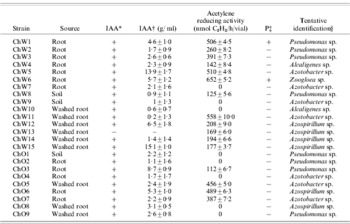
All the bacteria under study, except isolate ChW13, were able to produce IAA ranging from 0·2 to 15·1 μg/ml (Table 1). Isolate ChW15 produced the highest amount of IAA, followed by ChW5. Qualitative evaluation of two P-solubilizing isolates, ChW6 and ChW1, showed transparent zones of different diameters, i.e. 1·5 and 3 mm, respectively. No P-solubilizing bacteria were isolated from oat.
IAA production, acetylene reducing activity and P-solubilization of rhizobacteria isolated from wheat and oat grown in the soils of Lanzhou, China (means±s.d.)

* Spot test.
† HPLC.
‡ −, Lack of clear zone formation around bacterial colonies on Pikovskaia's medium containing tricalcium phosphate.
§ Tentative identification based on morphological characteristics using light microscopy.
The results of IAA and ARA are an average of four replicates.
The FAs of the two wheat isolates ChW1 and ChW6 showed antigenic uniqueness because they did not cross react with other isolates.
Nitrogen fixation of free-living bacteria in wheat and oat was detected. Most of the isolates were found to be nitrogen-fixing strains, with substantial variation in activity for acetylene reduction (124·6–651·6 nmol C2H2 reduced/h/vial; Table 1). The isolate ChW6 from wheat produced the highest amount of ARA and solubilized phosphate with maximum diameter of P-zone as well.
RAPD analysis
The RAPD-PCR analysis included seven bacterial isolates, i.e. three from wheat and four from oat. Initially, 20 random primers were used but only 10 primers resulted in reproducible DNA patterns. Other primers were tested and found to be unsuitable either because they produced no PCR product or because they produced products even in the absence of template. Ten suitable random primers, i.e. OPB-8, OPC-1, OPC-2, OPC-11, OPC-15, OPJ-18, OPJ-6, OPJ-20, OPJ-5, OPS-3, were eventually found and used for RAPD analysis.
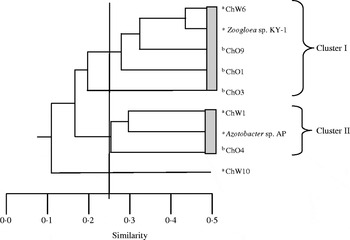
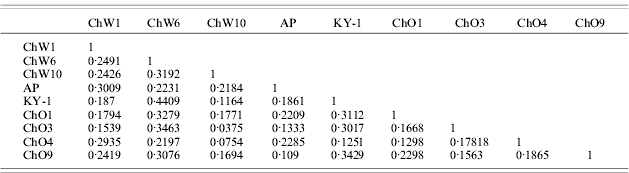
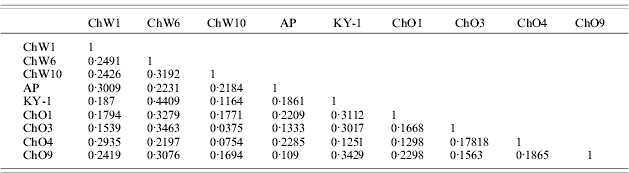
RAPD fingerprint profiles were generated on genomic DNA from bacterial isolates. The highest intensity of the bands was observed when 3 μl of 12·5 ng of DNA was used. These conditions appeared optimum for all the primers and isolates; therefore, the conditions were kept constant throughout the experiment and the results were found to be consistent and reproducible. In optimizing conditions, a template concentration of 0·5 ng/ml was found to be optimum. Template concentration higher than 12·5 ng did not give consistent amplification. The maximum and minimum numbers of fragments were produced by OPB-8 and OPJ-5, respectively. Bands were used to generate a distance matrix (Table 2). A dendrogram based on the unweighted pair group method of arithmetic mean (UPGMA) placed six isolates and two reference strains in two main clusters while one isolate fell separately in the dendrogram (Fig. 1). Isolates of cluster I, i.e. ChW6, Ky-1, ChO9, ChO1 and ChO3, showed homology ranging from 0·28 to 0·44. Cluster II consisted of three isolates, ChW1 and ChO4 and the reference strain Azotobacter sp. AP, but ChW1 and ChO4 were found to have less than 0·5 homology with AP. Maximum similarity was observed between ChW6 and Ky-1 (0·44) while ChW10 showed the least similarity with all the other isolates.
UPGMA dendrogram showing the genetic relationship of rhizobacteria isolated from wheat and oat grown in the soil of Lanzhou, China as determined by RAPD. Most of the isolates from oat grouped together may be because these were isolated from one variety, Swan, while greater genetic diversity observed among wheat isolates might be due to the fact that these had been isolated from different wheat varieties. The vertical line indicates the limit of significance. a Rhizobacteria isolated from wheat grown in soil of Lanzhou, China. b Rhizobacteria isolated from oat grown in soil of Lanzhou, China. * Reference strains.

Similarity matrix for Nei and Li's coefficient based on RAPD-PCR of rhizobacteria isolated from wheat and oat grown in the soils of Lanzhou, China
Effect of inoculated rhizobacteria on wheat and oat
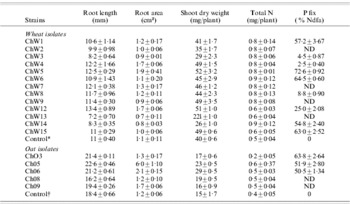
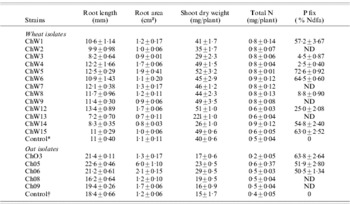
The root length increase in wheat and oat due to inoculation with rhizobacteria ranged from 7 to 19 and 12 to 60 mm respectively as compared with the uninoculated control. Increase in total N content of wheat ranged from 1·2 to 1·8 mg/plant. Among the wheat isolates, ChW5 was the best in promoting wheat growth by increasing its root length, root area, shoot dry weight and total N content. Among the oat isolates, ChO5 and ChO6 showed significant effects on different growth parameters (Table 3). Among the isolates tested, the highest nitrogen fixation levels, i.e. 0·73 and 0·64 of the N derived from air (Ndfa) were observed in the wheat plants inoculated with ChW5 and in oat plants inoculated with ChO3 (Table 3).
Effect of inoculated rhizobacteria isolated from Lanzhou on root length, root area, shoot length, shoot dry weight, total N and N fixation of wheat variety Ningchun 2 and oat variety Swan. Values are means±s.e. (d.f. wheat isolates=40, d.f. oat isolates=16)
* Control: wheat plants with N inoculated with heat killed cells.
† Control: oat plants with N inoculated with heat killed cells.
ND: not determined.
Ndfa: N derived from air.
Pfix: proportion of plant N fixed from the atmosphere.
DISCUSSION
The present study was designed to assess the plant growth promoting activities, in vitro, of various rhizobacteria on a wheat and oat variety recommended for Lanzhou, China. The results of the MPN showed the presence of a substantial number of potentially nitrogen-fixing rhizobacteria associated with the Chinese wheat variety V4. Morphological characterization of these bacteria showed that they may belong to bacterial genera including Pseudomonas, Azospirillum, Azotobacter, Zoogloea and Alcaligenes as they showed common morphological characteristics with these genera as compared using Bergey's manual (Holt et al. Reference Holt, Kreig, Sneath, Staley and Williams1994). Production of IAA by these bacteria might be possible contributing factors of wheat and oat growth promotion (Biswas et al. Reference Biswas, Ladha, Dazzo, Yanni and Rolfe2000). Previous studies have demonstrated the importance of P-solubilizing bacteria for enhanced P uptake that allowed the plants to utilize P from fixed resources (Gull et al. Reference Gull, Hafeez, Saleem and Malik2004) and many researchers have reported increased P-uptake and seed yield of wheat following inoculation of P-solubilizing bacteria (Singh & Kapoor Reference Singh and Kapoor1999). However, in the present study, most of the isolates did not have an ability to solubilize mineral phosphate. ChW1 and ChW6, isolated from wheat, were the only ones that formed colonies with clear transparent zones (Table 1). Strain-specific antibodies directed against ChW1 and ChW6 would enable localization and quantification of inoculant bacteria in different parts of the rhizosphere.
RAPD-PCR was used for seven different rhizobacteria associated with roots of wheat or oat grown in a Chinese soil. These isolates that tested positive for any of the evaluated traits were analysed by RAPD to reduce genetic redundancy by selecting genetically different bacterial strains. The bacterial isolates from the Pakistani oat variety Swan were grouped together in Cluster I, except for ChO4 which fell in cluster II. This observation that most of the isolates from oat grouped together may be because these were isolated from one variety, Swan, while the greater genetic diversity observed between wheat isolates might be due to the fact that these had been isolated from different wheat varieties (Miller et al. Reference Miller, Henken and van Veen1989). RAPD analysis showed that the strains used in the present study have a wide genomic diversity, as all the seven isolates with 10 primers revealed a unique banding pattern. This analysis has demonstrated the possibility of using the unique RAPD profiles to monitor as well as differentiate useful associative bacteria of wheat and oat (Suman et al. Reference Suman, Shasany, Singh, Shahi, Gaur and Khanuja2001).
The effect of 24 rhizobacteria on the growth of their respective hosts, i.e. wheat and oat, showed that almost all the tested isolates promoted growth of their hosts, though to different extents. ARA is an indirect method to indicate possible nitrogen fixation in plants because the possibility of ethylene emission from plants could not be excluded (Elbeltagy et al. Reference Elbeltagy, Nishioka, Sato, Suzuki, Ye, Hamada, Isawa, Mitsui and Minamisawa2001). The 15N treatment is a more direct indication of N-fixation when dilution of 15N occurs in inoculated v. uninoculated plants. Ndfa was not detected in wheat and oat without inoculation (Table 3) but significant Ndfa was detected in wheat and oat with inoculation. ChO3 fixed N2 best, but ChO5 and ChO6 promoted the best growth in oat plants. Large contributions of N (up to 0·80 of plant N) have been reported in sugar cane from plant associated N2-fixation (Boddey et al. Reference Boddey, de Oliveira, Urquiaga, Reis, de Olivares, Baldani and Dobereiner1995). The present results clearly demonstrate that bacterial isolates from Chinese soil fix significant nitrogen (N2) in association with wheat and oat, in vitro.
In conclusion, bacterial isolates ChW1, ChW5, ChW6, ChW15 and ChO3 have a great potential as inocula for wheat and oat, respectively, even for other graminaceous crops, especially in the poor alpine region grassland of China. The rapid selection system by RAPD may be a very useful tool for excluding similar bacterial isolates encountered during screening. Moreover, the present results indicate that selected bacterial isolates did promote the growth of wheat and oat in ways that could be harnessed to practical benefit for farmers and consistent with sustainable agricultural practices in China.
Financial support of this research was partly provided by IAEA TC (Project No. PAK/5/037, IAEA Project No. CPR/5/014 and Project No. 2GS035-A41-001-04) funded by S & T China and BIRCEN project funded by IDB. Thanks are due to Mr Tariq Shah and Mr Tariq Mehamood for their technical assistance, Dr Ghulam Rasul for his guidance in tentative identification of bacterial isolates as well as in 15N isotope dilution technique and Dr Farooq Latif for his help in detecting phytohormones by HPLC.