Children talk about location in space from early in development. For example, children use the word where to form questions from around the age of two years (e.g. Brown, Reference Brown1973). Where is among English-speaking children's first and most frequent question words (e.g. Bloom, Merkin & Wootten, Reference Bloom, Merkin and Wootten1982; Ervin-Tripp, Reference Ervin-Tripp and Hayes1970; Lieven, Behrens, Speares & Tomasello, Reference Lieven, Behrens, Speares and Tomasello2003). Most research on children's knowledge of the word where has focused on their ability to invert the auxiliary verb and the main verb in forming the question (e.g. De Cat, Reference De Cat, Howell, Fish and Keith-Lucas2000). Other research has focused on children's understanding of the pragmatic function of questions including where, showing that children as young as two to three years can respond appropriately to question words (Bloom, Rocissano & Hood, Reference Bloom, Rocissano and Hood1976). Furthermore, children show a good command early on of many prepositions like in and on that could indicate a variety of locations in space (e.g. Johnston, Reference Johnston, Stiles-Davis, Kritchevsky and Bellugi1988). The focus of the present study is children's understanding of the meaning of the word where. Note that the use of the word where could indicate that the speaker is interested in knowing the location of something or someone or, alternatively, the route to take to get to that something, as in ‘Where is your washroom?’ In this study, we test whether children use where to indicate route information or location information with an object and rooms. We are particularly interested in children's understanding of where in familiar space that could be navigated in a matter of steps (i.e. within their homes, rather than smaller space such as on a page in a book or larger space such as cities in a country).
Development of spatial knowledge
Adults can describe navigation in space in ways they have not experienced themselves (see review in Taylor, Reference Taylor, Kitchin and Freundshuh2000). For example, adults might be able to describe a route they have not taken themselves on the basis of paths that have intersected with that route. In order to develop that kind of understanding, children may start off attending to their own location relative to local cues (i.e. cue learning; Newcombe & Learmonth, Reference Craton, Elicker, Plumert and Pick1999) and using only an egocentric frame of reference (Hazen, Lockman & Pick, Reference Hazen, Lockman and Pick1978; Siegel & White, Reference Siegel, White and Reese1975). The egocentric frame of reference results from children's creating their understanding of space from their own visual and motor experience (Siegel & White, Reference Siegel, White and Reese1975). As children get older, they start to incorporate more cues from more distal landmarks (i.e. place learning; Newcombe & Learmonth, Reference Craton, Elicker, Plumert and Pick1999) and more frames of reference in their spatial representations until they can reason from an objective frame of reference (Hazen et al., Reference Hazen, Lockman and Pick1978; Siegel & White, Reference Siegel, White and Reese1975).
There are three important ramifications that emerge from the primacy of the egocentric frame of reference that are relevant for the present study: (1) children initially think about space on the basis of routes they have traveled rather than absolute location; (2) children might think about small spaces (e.g. about the size of a sandbox) differently than they think about larger spaces (e.g. about the size of a room or a house); and (3) reasoning about horizontal space (the azimuth surrounding self) may emerge earlier than reasoning about vertical space (events at a different elevation than self). We briefly summarize the literature on each of these points in turn.
Part of the egocentric reference for spatial reasoning observed in young children is an early reliance on route representations (Hazen et al., Reference Hazen, Lockman and Pick1978). Route representations involve remembering landmarks and the paths children have traveled relative to these landmarks (Siegel & White, Reference Siegel, White and Reese1975). In contrast, survey representations develop later as part of the objective frame of reference. Survey representations preserve the distance and bearing relationships between landmarks and places and, like cartographic maps, may represent the configuration of landmarks and places as if seen from above. According to the developmental theory of Siegel & White (Reference Siegel, White and Reese1975), survey representations are based on inference from landmarks seen and routes traveled (see also Hazen et al., Reference Hazen, Lockman and Pick1978). Other theories suggest that perceptual processes allow extraction of invariant spatial relations after exploration and interaction from different vantage points (Heft, Reference Heft and Portugali1996). In both theories, children must therefore have extensive experience with travel within an environment to develop a survey representation of its layout. In support of this idea, preschool children can conceptualize their own homes in terms of survey representations before they can do so with novel space (Conning & Byrne, Reference Conning and Byrne1984). By the time children are four years old, they show signs of beginning to think from an objective frame of reference. For example, Uttal (Reference Uttal1996) showed that four-year-olds' maps showing the location of six objects in a room preserved the configuration of the objects relative to each other, even though the maps were highly inaccurate in terms of the location of the objects in the room. Another example comes from a study by Kannass, Plumert, McDermott, Moore & Durich (Reference Kannass, Plumert, McDermott, Moore and Durich2004). In this study four- and five-year-olds (but not three-year-olds) were able to use the order of landmarks in a park model in order to remember where small objects had been hidden in the model. These studies suggest that at around four years of age, children might show signs of beginning to switch from an egocentric frame of reference to being able to use an objective frame of reference.
One implication of learning about space from an egocentric vantage first is that children might learn to orient and direct their activities in smaller spaces before larger spaces. Newcombe & Learmonth (Reference Craton, Elicker, Plumert and Pick1999) argue that children initially attend to local cues in localizing themselves and then, around the age of 1 ; 9, start to use places as landmarks. Newcombe, Huttenlocher, Drummey & Wiley (Reference Conning and Byrne1998) showed that two-year-old children can use places as landmarks when searching for a hidden toy in a sandbox and can correct for an egocentric perspective from the age of 1 ; 4 in that domain. Even within a room, two-year-old children can use cues from landmarks in the room to find a hidden toy (Learmonth, Newcombe & Huttenlocher, Reference Learmonth, Newcombe and Huttenlocher2001). Notice that objects within a room can often be seen from a single vantage point; landmarks and hiding places may even be within the same field of view. However, large-scale spaces often can only be apprehended by travel between regions. For example when navigating between rooms, preschool children sometimes reason about space on the basis of routes they have traveled (Hazen et al., Reference Hazen, Lockman and Pick1978). In the present study, we consider children's meaning of where in terms of space both between rooms and within a room.
Another possible ramification of an initial egocentric bias may mean that reasoning about horizontal space might develop earlier than reasoning about vertical space (Montello & Pick, Reference Montello and Pick1993). When we localize objects and places egocentrically, our own position and heading is the starting point for estimating bearings. Bearings or pointing along the azimuth involve the 360° that surrounds our body on the horizontal plane. If the target object cannot be seen and is at a different elevation than self, pointing in the radial surround will require the additional integration of an upward or downward estimate. It is interesting to consider whether children who attempt to point to an object that is not on the azimuth first consider its radial location and then consider its elevation. In one study, five-year-old children showed a greater degree of error in the angle of their points toward the upstairs in comparison to points to same-floor rooms (Pick & Lockman, Reference Pick, Lockman, Baird and Lutkas1982). This could be owing to the difficulty of integrating horizontal and vertical estimates. However, it is not clear in these latter observations if deviations in pointing to upstairs rooms included points to routes to travel to those rooms. In this study, we code for children's pointing to routes that would be used to achieve the elevation.
In sum, to the extent that the use of where reflects egocentric spatial reasoning, we suggest that children think where refers to the absolute location of objects hidden within the perceivable surround and think that where refers to the route to rooms that are out of view. We might observe the beginning of children using where to refer to absolute locations of rooms that are out of view around four years of age, the age previous studies have found signs of an emerging objective frame of reference. It is also possible that they represent location within a smaller space (i.e. an object within a room) at an earlier age than the locations of spaces within a larger space (i.e. a room within a house). Finally, we can predict that children are more accurate in localizing events along the horizontal plane, where estimates do not involve an appreciable elevation from self. We turn next to ways that spatial language may interact with spatial reasoning.
How spatial language maps onto spatial thought
The present study involves children's interpretation of the word where. How might children's understanding of spatial words relate to their non-verbal spatial concepts? Words indicating direction or location in space (like up and down) are often among children's earliest words (McCune-Nicolich, Reference McCune-Nicolich1981; Westbury & Nicoladis, Reference Westbury, Nicoladis, Greenhill, Hughes, Littlefield and Walsh1998). There is fair agreement among researchers that spatial language does not necessarily map neatly onto non-verbal spatial thought (e.g. Bowerman, Reference Bowerman, Wanner and Gleitman1982, Reference Bowerman, Bloom, Peterson, Nadel and Garrett1999; Gopnik, Reference Gopnik1988; Siegel & White, Reference Siegel, White and Reese1975). For example, Craton, Elicker, Plumert & Pick (Reference Craton, Elicker, Plumert and Pick1990) showed that when children were asked to tell a listener which of several identical cups contained a hidden object, there was no increase with age (between four and eight years) in relying on an allocentric representation corresponding to the previously reported developments in survey representation. Instead, children's use of themselves as a reference point in describing the location increased with age.
Part of the reason that spatial language does not map neatly onto non-verbal spatial thought is that there might be differences in function between the two. Presumably spatial thought is used primarily to navigate and/or localize objects. Spatial language, however, might serve different functions, such as directing others to localize objects or simply describing a scene for narrative purposes. Children as young as six years of age and adults give directions to a listener as to how to find a hidden object in decreasing order of spatial unit (e.g. ‘It's in the bedroom, under the bed, inside the shoe box’; Plumert, Pick, Marks, Kintsch & Wegesin, Reference Plumert, Pick, Marks, Kintsch and Wegesin1994; Plumert, Spalding & Nichols-Whitehead, Reference Plumert, Spalding and Nichols-Whitehead2001). In contrast, when adults simply describe the location of an object, they tend to use an increasing order of spatial unit (Plumert et al., Reference Plumert, Spalding and Nichols-Whitehead2001). Plumert et al. (Reference Plumert, Spalding and Nichols-Whitehead2001) conclude that adults choose the order of spatial unit depending on the function of the spatial language for the listener. In giving directions, people name the locations in the order the listener will encounter them in traveling to the final destination. Plumert & Nichols-Whitehead (Reference Plumert and Nichols-Whitehead1996) argued that children might learn how to encode the spatial information the listener needs through scaffolding with their parents. They asked three- and four-year-old children to tell their parents how to find a hidden object in a dollhouse. They found that three-year-olds were more likely to give ambiguous directions (e.g. tell a parent to look in the bucket when there were two buckets) than four-year-olds. Furthermore, they found that parents' continued questioning of further details led to children's use of more disambiguating details. Thus, parents' responses might instruct children on what must be mentioned to give adequate directions to finding an object.
In addition to spatial language serving different functions from non-verbal spatial cognition, there is one other reason that children cannot simply learn spatial language as referring to non-verbal spatial concepts: there are cross-linguistic differences in how spatial language refers to space. For example, Bowerman (Reference Bowerman, Bloom, Peterson, Nadel and Garrett1996) showed how Korean, Dutch and English subdivide spatial concepts differently and how children's early words reflect their understanding of the core concept from the input language. Frequency of spatial terms is thought to be one of the most important factors in children's understanding and use of these terms (Choi & Bowerman, Reference Choi and Bowerman1991). If children's understanding of spatial language reflects how adults use spatial language, it is important for this study to know how adults use where. Nicoladis (Reference Nicoladis2002) examined the use of the word where in spontaneous speech by the parents of five children from a longitudinal study, with videotapes made when their children were 2 ; 0, 2 ; 6, 3 ; 0 and 3 ; 6. The most frequent use of where was in asking for the location of objects, puzzle pieces or pictures in books. Where was frequently used as an alternative to the naming game, that is, in asking children to demonstrate knowledge of words the parents knew they knew (e.g. ‘Where's your nose?’). Children were rarely asked where about anything bigger than a manipulable object and if they were, it was not clear that they were expected to answer. For example, one child was asked where his grandmother lived (the correct answer was a city in Greece; the child was in Montreal). The child did not answer and the mother immediately moved on to another topic.
In the present study, we asked children to interpret our questions about where an object and various rooms were located. If children's interpretations correspond to their non-verbal spatial knowledge, younger children's interpretation of where would correspond to an egocentric frame of reference and older children's to a survey representation. Alternatively, because spatial language is not necessarily used in the same way as non-verbal spatial cognition, even young children might learn to interpret where as it is presented most frequently in the input: to refer to the absolute location of objects in space. As most of the previous research has concerned children's localization of objects, we cannot make predictions about how children interpret where with regard to rooms. One possibility is that with adults' frequent use of where to refer to absolute location, children generalize the meaning of where to refer to the absolute location of rooms. This possibility can be justified by the finding that children as young as 1 ; 6 can use words to help them classify objects as being similar (e.g. Booth & Waxman, Reference Booth and Waxman2002).
This study
In this study, children between two and five years were asked to point in response to a where question. Pointing was used as a dependent measure because children as young as two years old point frequently (Masur, Reference Masur1983), point along a reasonably correct bearing to objects in and out of sight and point with sensitive assimilation of their interlocutor's perspective (Butterworth, Reference Butterworth and Whiten1991; Franco & Gagliano, Reference Franco and Gagliano2001; Nicoladis, Mayberry & Genesee, Reference Nicoladis, Mayberry and Genesee1999). Pointing by older children has also been shown to be an informative measure of their knowledge of the layout of large-scale environments (Cornell & Heth, Reference Cornell, Heth and Allen2004; Lehnung, Haaland, Pohl & Leplow, Reference Lehnung, Haaland, Pohl and Leplow2001). We asked all children to point where a hidden object was and where were rooms on the same floor in their homes. If the children lived in a multistory dwelling, we also asked them to point where were rooms on a different floor.
If children use their egocentric spatial reasoning in their understanding of where, we expected that the youngest children (two-year-olds) would point directly to the location of objects hidden in front of them and to the observable entrances to routes to rooms on the same floor. We expected that the older children could represent rooms as objects within a larger space, the house. However, because of the difficulty integrating bearings from self to an object at a different elevation, we expected that the three-year-old children would point directly to the location of the object and rooms on the same floor and point to the route leading to rooms on different floors (cf. Pick & Lockman, Reference Pick, Lockman, Baird and Lutkas1982). Finally, we expected that the four-year-olds would have sufficient survey knowledge across the elevations to be able to point directly to the location of rooms on all floors.
Similarly, if children are guided by their most familiar discourse in their understanding of where, we expected all age groups to point directly to object locations (cf. Nicoladis, Reference Nicoladis2002). Experience with deictic exchanges, especially during picture book reading and table top activities, should prompt both younger and older children to indicate the location of hidden objects. Children might generalize from the most frequent use of where referring to absolute location of objects to also mean absolute location of rooms. As children get older, they may hear adults engage in direction-giving discourse and learn that where can refer to routes as well. Alternatively, it is possible that younger children may not represent large-scale spaces, or places that they can be contained within, as objects. If this were the case, then we would expect younger children to point to the route to rooms and only among the four-year-olds would there be a tendency to point to the absolute location of rooms, as their objective frame of reference emerged.
Finally, we also predicted that we will see a change in the kind of language children use in response to where questions, with simple deictic terms like there being used most frequently by the youngest children and spatial location terms like beside my room more common in the oldest children. Whereas pointing and uttering there may be characteristic of a self–object reference system, the use of spatial location terms may reflect the older child's appreciation of landmark–landmark relations. Older children may also use spatial location terms that indicate that space is being partitioned and organized; for example, the word upstairs may indicate that the home contains levels or the home contains routes. Based on previous studies showing children's gradual acquisition of prepositions (e.g. Brown, Reference Brown1973; Rice, Reference Rice1999), we expected the use of spatial location terms to increase linearly with age with deictic phrases decreasing linearly with age.
Method
Participants
Forty-eight children between the ages of 2 ; 2 and 5 ; 0 participated in the study. Children were divided into three age groups of sixteen children each. The median ages of the three groups were 2 ; 6, 3 ; 6 and 4 ; 6, with ranges of 2 ; 2–2 ; 10, 3 ; 2–3 ; 10 and 4 ; 2–5 ; 0, respectively. We refer to these groups as the two-year-olds, the three-year-olds and the four-year-olds respectively. There were an equal number of boys and girls in each age group.
Materials
The research was conducted in the children's homes. Note that by using a familiar location, we have made it more likely that children had developed and would express their survey knowledge (cf. Conning & Byrne, Reference Conning and Byrne1984) and less likely that children's responses would be masked by stress due to the experimental context (Newcombe & Learmonth, Reference Craton, Elicker, Plumert and Pick1999). Interviews were conducted in the presence of a parent and each interview was videotaped. The interviews were usually in the family's living room or family room, a room containing a couch. To ensure that the children remained in one spot for all testing, we asked them to stand in the ‘pointing box’, a decorated carton that extended as high as mid leg. The object to be hidden was a small stuffed animal.
Procedure
Two researchers were present for all testing sessions. They started by moving the family's couch about 0·5 m away from the wall. The pointing box was positioned at half the length of the couch away from the couch, with the camera located approximately 0·5 m behind the pointing box. The children were asked to get in the box. When the children were in the box, one researcher was sent out of the room. The second researcher said ‘We're going to hide a toy from [name of researcher]’. The child was led from the pointing box around one side of the couch to hide the toy approximately halfway along its rear length. The child was then led back to the pointing box again. Then the second researcher said, ‘Let's make it harder. Let's cover it with something.’ She then led the child out of the pointing box along the same route behind the couch and covered the toy, usually with a small cushion from the couch. The child was then led back to the pointing box. By traveling over the same route twice to hide the object, we thought we might bias children to point to the route they had traveled. The first researcher was called back in the room and instructed to stand about halfway between the side of the couch and the pointing box. The second researcher stood at the side opposite the route that the child had experienced twice. The second researcher then asked ‘Where's the toy?’ Some of the children, well versed in hiding games, did not spontaneously point. The first researcher then asked the child, ‘Can you point to the toy so that [name of researcher] can find it?’
One researcher then took the child's parent out of the room and asked them to indicate where various rooms were in their house. The other researcher played with the child. When the parent and the first researcher re-entered the room and the first researcher said to the child, ‘I would like to know where some of the rooms are in your house. Where is the kitchen?’ If there was no response, this question was repeated. If there was still no response, the researcher prompted the child by saying, ‘Can you point to where your kitchen is?’ The researcher then recorded where the child was pointing as well as any utterances that were made by the child. The researcher continued asking the child about the location of different rooms in this same manner. Each child was asked about the location of four or five rooms, regardless of the floor that the room was on. The children were asked about the location of their own bedroom, the kitchen, their parents' bedroom, the bathroom and the basement (if a basement was part of the home).
Dependent measures
We video-recorded the direction of children's pointing and the children's utterances. The experimenters had been trained using archival videotapes to estimate children's pointing within 3–5 degrees to targets that were out of camera view. To estimate the location of the target rooms, the researcher took a parent out of the room before the experimental procedure began and asked them to indicate where each target room was located. The direction of pointing was coded into three categories: route, correct location or incorrect point. If the child pointed to the center of a visible doorway, stairway or a hallway that was used to travel to the room, the point was recorded as indicating a route. If the child pointed along a bearing to the center of the target room, the point was recorded as indicating absolute location. Any point that was more than 20° away from the center of the visible portion of the route or center of the non-visible room was recorded as an incorrect point. The researcher stood behind the child to accurately judge whether the child's extended arm was pointing to the route or to the location (extrapolated beyond the appropriate wall or ceiling). If it was unclear whether the child pointed to the route or to the location, the child was asked to hold his or her arm steady while the researcher bent down to sight along the arm.
Utterances were recorded and categorized into two categories: deictic terms only and spatial location terms. The deictic terms category was assigned if there or over there was used by the child in response to where. The category spatial location terms was used when children used a spatial location term (e.g. up, next to, downstairs) as at least one of the words in response to where, including deictic terms. Thus, both up the stairs and up there were classified as spatial location terms (see Finegan (Reference Finegan2004) for linguistic analyses of preposition+deictic terms).
Results
We present the results in the following order: children's pointing to hidden objects, their verbal responses for hidden objects, children's pointing to rooms and their verbal responses for rooms.
Pointing to the hidden object
Over 80% of the children at each age pointed directly to the location of the hidden object (81% of the two-year-olds, 94% of the three-year-olds and 81% of the four-year-olds). Only two children (one two-year-old and one four-year-old) pointed to the route around the couch. The remaining children pointed to the wrong location.
We also examined the position of the children's hands in pointing. All the children who pointed to the location of the hidden object pointed straight through the couch, rather than over the couch or crooking the finger to one side.
Verbal responses to where for hidden objects
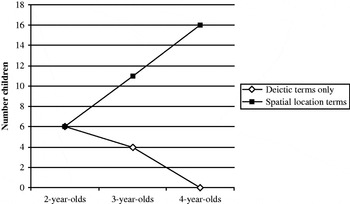
Twelve of the 16 two-year-olds gave a verbal response to where the stuffed animal was located, and all of the three- and four-year-olds verbalized. The children's choice of responses changed with age, with an increasing use of spatial location terms. See Figure 1 for a graphic representation of the results. Given the complementary nature of the categories there were similar trends: children were increasingly more likely to use spatial location terms and less likely to use only deictic terms as age increased. The number of children who used spatial location terms by age group differed significantly from a random distribution based on a chi-squared analysis (χ2 (2, N=48)=7·75, p<0·05).
Number of children who responded verbally to questions about where the hidden object was.

The specific spatial location terms the children used are summarized in Table 1. Note that the younger children were more likely to say that the toy was hidden under a pillow or blanket, landmarks that were out of sight of the person asking where the toy was. The older children were more likely to say that the toy was hidden behind the couch.
Number of children who used each spatial location term in response to where for hidden object

Pointing to rooms
We analyzed the children's pointing to rooms in two ways. First, to see to what extent children of different ages ever pointed to either the location or the route, we performed chi-square analyses on the number of children in each age group who responded in each category at least once out of all their points to rooms. Second, to see how often children of different ages pointed to the location or the route to rooms, we analyzed the rate of their responses in each category by age group.
Direct points
We first examined the number of children in each age group who pointed at least once to the absolute location of rooms. For rooms on the same floor, the number of children pointing to a room's location on their first point was 10, 11 and 15 for the two-, three- and four-year-old age groups, respectively. This distribution was significantly different from a random distribution based on a chi-squared analysis (χ2 (1, N=48)=4·08, p<0·05). This result indicates that as the children got older, they were more likely to point to the location of rooms on the same floor.
As for rooms on different floors, not all of the children's homes were multilevel. In the sample of 39 children who had multilevel homes, 13, 12 and 14 children of the two-, three- and four-year-old age groups, respectively, responded to questions about rooms that were in their basement or upstairs. The number of children pointing at least once to the location of rooms on other floors was 2, 3 and 9 for the two-, three- and four-year-old age groups, respectively. This distribution differed significantly from a random distribution on a chi-squared analysis (χ2 (1, N=39)=6·92, p<0·05). This result indicates that as the children got older, they were also more likely to point to the location of rooms on different floors.
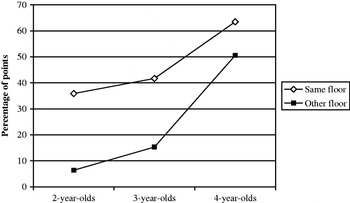
To characterize the tendency to point to absolute location of rooms, we calculated the percentage of each child's pointing responses that were to locations (i.e. points to room location/total number of points in response to where). Figure 2 summarizes the averages by age. We then performed a 2×3 (Floor×Age Group) repeated measures ANOVA with these percentages. Children pointed more often to the location of rooms on the same floor (M=54·9%) than rooms on other floors (M=24·1%; F(1, 36)=17·638, MSE=0·104, p<0·001, ηp2=0·417). Children pointed more to room location as they got older (F(2, 36)=8·425, MSE=0·118, p<0·001, ηp2=0·573). Tukey post-hoc tests revealed a significant difference between two- and four-year-olds (Mean Difference=44%; p<0·01) and between three- and four-year-olds (Mean Difference=35%; p=0·02) for the other floors. There were no other reliable effects.
The percentage of pointing responses to absolute locations as a function of age group.

Points to routes to rooms
Because children may not have pointed or may have made inaccurate points, the data characterizing pointing to routes to rooms was not an exact inverse of the data characterizing direct points to rooms. The following analyses allow us to examine whether age trends in pointing to routes were similar when rooms were on the same and the other floors. The number of children pointing to a route in response to questions about the whereabouts of rooms on the same floor was 13, 10 and 10 for the two-, three- and four-year-old age groups, respectively. This distribution was indistinguishable from a random distribution based on a chi-squared analysis (χ2 (1, N=48)=1·28, p=0·25). In the sample of 39 children who had multilevel homes, the number of points to a route in response to questions about rooms at different levels was 10, 7 and 6 for the two-, three- and four-year-old age groups, respectively. This distribution did not differ significantly from a random distribution on a chi-squared analysis (χ2 (1, N=39)=3·15, p=0·08).
To see how frequently the children pointed to routes, we examined the percentage of each child's pointing responses that were to routes (points to routes/total number of points in response to where). A 2×3 (Floor×Age Group) repeated measures ANOVA indicated only one significant main effect. There was a linear decrease in the percentage of pointing to routes to rooms across the three age groups (F(2, 36)=6·701, MSE=0·153, p<0·01, ηp2=0·578). For rooms on other floors, the two-year-olds pointed to routes an average of 71% (SD=43%) of their responses, the three-year-olds 50% (SD=48%) and the four-year-olds 23% (SD=36%). Tukey post-hoc tests revealed a significant difference between the two- and four-year-olds (Mean Difference=47%; p=0·02). No other effects were reliable. For the same floor, the two-year-olds averaged 60% (SD=37%) of their points to routes, the three-year-olds 34% (SD=38%) and the four-year-olds 29% (SD=28%). Tukey post-hoc tests revealed no significant differences between the age groups for these percentages.
Verbal responses to where for rooms
Out of a total of 16 children in each age group, 14, 14 and 13 children from the two-, three- and four-year-old age groups, respectively, used utterances when asked the location of rooms in their homes. A one-way ANOVA of the total utterances used indicates a marginally significant difference in the number of utterances from the three-year-olds to the four-year-olds (M=−1·58, p=0·05, ηp2=0·341).
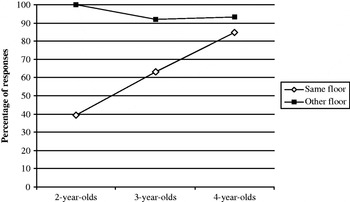
Children's verbal responses were categorized as either deictic terms only or spatial location terms. Figure 3 summarizes the averages by age group and by floor. Note that, because the two categories were mutually exclusive, the results characterizing children's use of spatial location terms is the inverse of the results for use of deictic terms only. We calculated the percentage of each child's utterances that were spatial location terms (spatial location terms/total number of utterances in response to where). A 3 (Age Group)×2 (Floor) ANOVA on the percent of spatial location terms used confirmed a reliable effect of Floor (F(1, 22)=17·03, MSE=0·07, p<0·01, ηp2=0·433), but no reliable effect of Age (F(2, 22)=1·51, MSE=0·07, p=0·24). These results indicate that children are more likely to use spatial location terms in response to where about rooms on other floors than on the same floor.
The percentage of spatial location terms as a function of age group and floor.

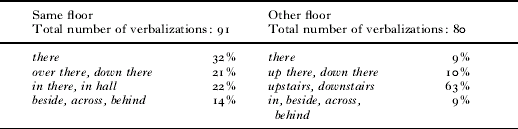
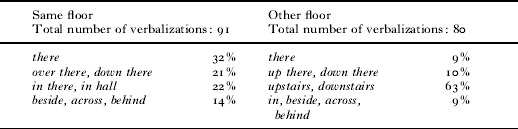
Table 2 lists the qualities of the verbalizations in response to where for rooms on the same floor and other floors. The age-related increase in use of spatial location terms to refer to locations of rooms on the same level was fairly uniform regardless of the spatial location term recorded: e.g. the frequency of in front, in back phrases was 4, 6 and 10 for the two-, three- and four-year-olds, respectively. Interestingly, although the phrases up there and down there seem as easy and familiar, upstairs and downstairs were six times more frequent. Upstairs and downstairs are common labels for a subordinate spatial category, levels contained within the house, and also specify a route to those levels.
Common verbalizations of all children when asked where are rooms
Incorporating language and points to rooms
The children's frequency of use of spatial location terms did not correlate with their frequency of pointing to the location of rooms on the same floor (r (30)=−0·088, ns) or on another floor (r (30)=−0·293, ns). Pointing was frequent regardless of the kind of verbal response they gave.
Discussion
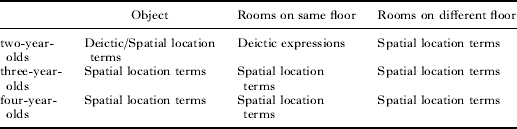
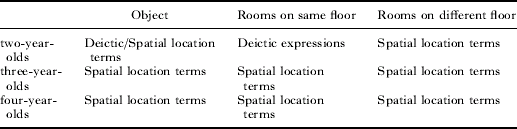
The major results can be summarized with reference to Table 3, categorizing children's pointing responses, and Table 4, categorizing verbal responses. Almost all of the children in this study pointed to the absolute location of an object hidden within the perceivable surround. An analysis of the videos showed that even the youngest children were pointing directly through the couch rather than indicating a route (say, over the couch). The youngest children did, however, point to the route to get to rooms in their houses. These results suggest that by the age of two years, children understand where to refer to the location of objects in a space that they can apprehend from a single vantage point and likewise to the visible beginning of a route that progresses within a larger space (see also Newcombe & Learmonth, Reference Craton, Elicker, Plumert and Pick1999).
Majority of pointing results by age group

Majority of verbal responses by age group
In contrast, the majority of four-year-old children were more likely to point to the absolute location of rooms on the same floor and just over half of them pointed to the absolute location of rooms on another floor. This suggests that at this age, children start to think about spaces that may contain them in the same way they do desktop areas and things they may perceive in totality (Kannass et al., Reference Kannass, Plumert, McDermott, Moore and Durich2004; Siegel & White, Reference Siegel, White and Reese1975; Uttal, Reference Uttal1996). In other words, by four years of age children are able to conceptualize rooms as if they are objects or locations (see DeLoache (Reference DeLoache, Fivush and Hudson1987) for a similar argument about children's interpretation of models). Contrary to an explanation that emphasizes young children's accumulating linguistic experience with direction giving, there was a decreasing tendency to indicate routes to the target rooms. An alternative interpretation is that the children were accumulating perceptual and motor experience in partitioning small-scale spaces (e.g. Newcombe & Learmonth, Reference DeLoache, Fivush and Hudson1999; Siegel & White, Reference Siegel, White and Reese1975). Hence, when they are asked about rooms within a house, four-year-old children respond to where in the same way as when they are asked about objects within a room (see also Choi & Bowerman, Reference Choi and Bowerman1991). Note that we did test children in their homes, a familiar space. As children's spatial representation can show familiarity effects (e.g. Conning & Byrne, Reference Conning and Byrne1984), it would be interesting to replicate the present study in an unfamiliar space, to see if the same results are obtained. Children might show the same pattern of results only at a later age in an unfamiliar space.
If our interpretation of the pointing responses is correct, then children's understanding of where maps fairly neatly onto the development of the relevant non-verbal spatial concepts (cf. Bowerman, Reference Bowerman, Bloom, Peterson, Nadel and Garrett1996). If this is true, then children might not use the word where as a cue to similar meaning, as has been shown for object category words (e.g. Booth & Waxman, Reference Booth and Waxman2002). Before reaching these conclusions, we would like to identify two ways in which the object and room conditions differed that could affect pointing by two- and three-year-olds. First, in the object condition, the target object was bounded and manipulable whereas the rooms were expansive with flat walls; the former features may prompt manual overtures such as pointing more readily than the latter. There is growing evidence that the characteristics of target objects, especially their sensorimotor features, influence the spatial representational systems and locative descriptors that adults use (DeVega, Rodrigo, Ato, Dehn & Barquero, Reference De Vega, Rodrigo, Ato, Dehn and Barquero2002). An interesting variation of the task would keep the sensorimotor features of the target object similar (e.g. hiding an object behind a wall in the middle of another room). We expect that such a manipulation would not produce results different than ours, because, as noted earlier, the children pointed through the couch. Second, we did not provide a rationale for our request to children to point to rooms – we simply asked them to point. Younger children's responses could have been based on the assumption that routes are the typical answers to where questions about rooms. This interpretation seems unlikely because the procedure for the object condition clearly emphasized that the researcher wanted to go to the hidden object and even the youngest children pointed to the location rather than the route around the couch. Nevertheless, it would be interesting to systematically vary the rationale for asking where objects and rooms are, and we suggest such research in our conclusion.
In interpreting our results in terms of having learned more about children's understanding of the word where, we have argued that the children's understanding reflects their non-verbal thinking about space. Part of the reason for this result may be our choice of dependent measure: pointing. While the onset of pointing precedes the onset of first words for many children (Masur, Reference Masur1983), pointing often coincides with vocalizations (Masur, Reference Masur1983; see also Nicoladis, Mayberry & Genesee, Reference Nicoladis, Mayberry and Genesee1999). Nevertheless, perhaps because the developmental timing of onset differs between pointing and words, there is some evidence that pointing might be somewhat more separable from speech than some other kinds of gestures for preschool children (Nicoladis, Reference Nicoladis2002). By asking children to point, we may have obtained a measure of the children's spatial cognition that was relatively free of the influence of knowledge of a particular language. This conclusion could be tested in other domains in which a specific language has been shown to have an influence on spatial cognition (see, for example, Bowerman (Reference Bowerman, Bloom, Peterson, Nadel and Garrett1999) for evidence about spatial terms like on). For example, the present study showed that young children respond differently about small-scale space (i.e. within a room) than larger-scale space (i.e. between rooms). In contrast, most tests of children's spatial words (e.g. Bowerman, Reference Bowerman, Bloom, Peterson, Nadel and Garrett1999) have been in terms of the relationships between objects that can be perceived in a single glance. It would be interesting to test if children generalize from their understanding of spatial words applied to small objects to their understanding of spatial words to larger units of space. For example, English-speaking children who understand the word on refers to a support relationship might assume that on the plane (as in I'll listen to music on the plane) also refers to a support relationship. If so, in the example sentence given previously, they might assume that the speaker was going to listen to music, seated on top of the plane. However, if the results of the present study generalize to other spatial domains, children might learn the word on differently, depending on the unit of space.
We had expected that children might have difficulties calculating the absolute location of rooms at a different elevation from self. In fact, there was almost half as much direct pointing to rooms on other floors than on the same floor. However, children did not compensate for any difficulties in calculating the absolute location of rooms at different elevations by instead pointing to the routes to reach those rooms. They showed the same tendency to point to visible routes to rooms on the same and different floors. A few children pointed directly overhead when asked where were rooms upstairs. This was not considered an accurate localization, but could indicate that some children consider that the elevation must be achieved before the azimuthal bearing of a target can be communicated. Adults show a similar response when asked to imagine the location of landmarks in non-visible spaces: they respond egocentrically and access the head–foot dimension before front–back and left–right dimensions (DeVega & Rodrigo, Reference De Vega and Rodrigo2001; Franklin & Tversky, Reference Franklin and Tversky1990).
In accord with previous studies, we observed that children between two and four years old increasingly verbalized when questioned about ‘where’ (e.g. Bloom et al., Reference Bloom, Rocissano and Hood1976). Because relationships between objects are fundamental to describing spatial location, we predicted that there would be a linear relationship with age in children's use of spatial location terms. This was found to be true for responses to where about hidden objects as well as for rooms on the same floor. Surprisingly, even the two-year-olds responded with spatial location terms for rooms on another floor and they used quite a few spatial location terms in talking about the location of the hidden objects. The predominant spatial location terms used to refer to rooms at an elevation were up and down or upstairs and downstairs. As previously discussed, up and down express the beginning of travel, a self–object relation, rather than an object–object relation such as ‘next to’. It is possible that children knew spatial location terms that express object–object relations, but lacked the capacity to entrain those phrases after first expressing the elevation from self. Upstairs and downstairs seems to indicate a hierarchical organization of the large-scale space of the house, with floors being a subordinate section (cf. Plumert et al., Reference Plumert, Pick, Marks, Kintsch and Wegesin1994). At the least, upstairs and downstairs indicates the early entrainment of a directional spatial term with a route. It is also possible that children simply became more verbally descriptive as they got older (Plumert & Nichols-Whitehead, Reference Plumert and Nichols-Whitehead1996).
The spatial location terms used to describe the object locations reveal that the younger children understand certain object–object relations but are not yet very helpful to the listener in communicating location. We found that the two-year-olds used phrases such as under the pillow, a landmark that was not visible to the interlocutor, whereas older children tended to say behind the couch. These results point to the possibility that children initially use language in response to where in an egocentric manner and can only gradually incorporate the information needed by an interlocutor (Plumert & Nichols-Whitehead, Reference Plumert and Nichols-Whitehead1996).
In summary, the pattern of results suggests that children's understanding of where maps onto their developmental of spatial cognition, from an egocentric to an objective frame of reference (Siegel & White, Reference Siegel, White and Reese1975). At two years of age, children point directly to the location of objects within a room, point to the route between rooms and give limited verbal descriptions of location or routes. By four years of age, children directly point to the location of objects and rooms and are beginning to use spatial location terms that accurately localize objects and routes in ways that are potentially useful for the interlocutor. Our interpretation emphasizes that children associate rooms and objects with different activities; other rooms are out of sight and destinations for walking while interesting objects are often visible and targets for reaching (Gauvain, Reference Gauvain1993; Newcombe & Learmonth, Reference Craton, Elicker, Plumert and Pick1999). Furthermore, hearing words frequently is important in establishing children's understanding of spatial terms (Choi & Bowerman, Reference Choi and Bowerman1991) and parents use where in relation to objects when talking with children more frequently than rooms (Nicoladis, Reference Nicoladis2001). This interpretation is consistent with the growing body of evidence that the features of objects and places constrain directional prepositions and locative constructions by adults (De Vega et al., Reference De Vega, Rodrigo, Ato, Dehn and Barquero2002).
Responding to where in natural circumstances is a pragmatic challenge. The child must select language to express locations objectively because the target object or place is not visible and the interrogator does not already know the answer. Sharing knowledge of location requires taking the perspective of another and use of prepositions. The pragmatic use of where may provide the more socially experienced child an obvious rationale and yield a consistent response to the question. This refinement can be studied by examining the development of direction-giving skills, with the responses to ‘How do I get to … ’ compared to the responses to where. We expect children's understanding of spatial language to reflect their non-verbal understanding of space, as well as their understanding of the pragmatic function of the spatial language being used.