

1. Introduction
State-owned enterprise (SOE) reform plays a key role in China’s market-oriented reform process. After going through the stages of decentralization and transfer of profits, the substitution of tax payments for profit delivery, contracting, and the establishment of a modern corporate system (Jiang et al., Reference Jiang, Yuan and Yang2023), the latest round of SOE reform introduces a transition in the role of state asset supervision and management authorities. This transition shifted the focus from managing firms to managing capital (Dong and Liu, Reference Dong and Liu2022). The core is reforming state capital’s authorized operating framework, establishing state capital investment platforms, and using capital to authorize firms’ autonomous operation. Consequently, mixed ownership reform not only requires SOEs to incorporate non-state capital but also encourages state capital injection (SCAI) into non-SOEs (Dong and Liu, Reference Dong and Liu2022; Li et al., Reference Li, Xiang, Zhou and Lin2023). As the mixed-ownership economy develops, state capital is poised to permeate multiple sectors of the national economy, and many non-SOEs are anticipated to accept state capital injection.Footnote 1 Therefore, examining the effects of SCAI has significant practical implications in this context.
Certain studies have investigated the effects of SCAI on firm performance. For example, Huang et al. (Reference Huang, Li, Ma and Qian2021) found SCAI may increase employee numbers and leverage while reducing productivity. This is because SOEs must cooperate with the government to sustain economic growth and social stability. Dong and Liu (Reference Dong and Liu2022) showed SCAI hinders technological progress, lowers managerial efficiency, and ultimately reduces total factor productivity, findings that align with those of Huang et al. (Reference Huang, Li, Ma and Qian2021). Similar conclusions were also drawn in the study by Kong and Wang (Reference Kong and Wang2016). However, existing literature rarely explores SCAI’s environmental effects.
As a developing country, China’s historical focus on economic growth has overshadowed environmental protection, worsening environmental issues. Environmental pollution harms residents’ health and undermines sustainable social and economic development (Jiang et al., Reference Jiang, Yuan and Yang2023). Consequently, the Chinese government strengthened focus on environmental issues, incorporating environmental indicators as binding constraints in officials’ performance evaluations. Due to the government-SOE subordinate relationship, SOEs often cooperate with the government to maintain stable employment, promote growth, control sensitive industries and protect the environment (Calza et al., Reference Calza, Profumo and Tutore2016; Pan et al., Reference Pan, Chen, Sinha and Dong2020). This implies that the presence of state ownership may affect a firm’s environmental performance.
Against this backdrop, some argue SOEs have more resources for pollution abatement and must cooperate with the government on environmental goals (Calza et al., Reference Calza, Profumo and Tutore2016). This enhances the likelihood and capability of firms that have received SCAI to reduce pollution and achieve better environmental performance. However, other studies contend that SOEs exhibit poor environmental performance for various reasons: SOEs wield higher environmental bargaining power (Wang and Jin, Reference Wang and Jin2007); some SOEs prove challenging to regulate because of their superior administrative standing relative to environmental regulators (Wang and Jin, Reference Wang and Jin2007); and the presence of principal-agent problems leads to a less efficient allocation of resources (Pan et al., Reference Pan, Chen, Sinha and Dong2020).
Existing literature is contentious on state ownership’s impact on firms’ environmental performance and divided on its effect on green innovation. Some argue firms with state capital access green innovation-conducive resources, boosting such initiatives (Calza et al., Reference Calza, Profumo and Tutore2016). However, other research suggests severe principal-agent problems in SOEs may discourage green innovation (Liu et al., Reference Liu, Li, Peng and Lee2020), indicating state ownership may hinder it. To our knowledge, only Jiang et al. (Reference Jiang, Yuan and Yang2023) have explored SCAI’s environmental consequences. However, they only focused on firms’ energy intensity, not whether SCAI stimulates more green innovation or greener production. We address these gaps by investigating SCAI's impact on firms’ green innovation and its mechanisms.
When exploring SCAI’s impact on firms’ environmental consequence literature by quantity and quality. The 2022 China Green Innovation Index Report notes China’s green patents surged from 43,000 in 2008 to 150,000 in 2021. This steep rise reflects the government and firms’ focus on green economic transformation. Yet concerns persist about their quality: rapid quantity growth stems from firms’ improved autonomous innovation capabilities and policy incentives. Policy-driven innovations often prioritize patent accumulation, potentially reducing innovative value and wasting resources (Zhang and Zheng, Reference Zhang and Zheng2018). In short, policy incentives may boost green innovation quantity but not necessarily quality. Thus, it is equally vital to assess its impact on the quality of green innovation.
This study offers three key contributions. First, it provides novel empirical evidence from the SCAI perspective to the state ownership–green innovation debate, enriching literature on mixed ownership reform’s environmental effects. Notably, three distinct types of state equity changes exist: (1) the injection of state capital into firms without state ownership, referred to in this study as SCAI; (2) the privatization or partial privatization of SOEs; and (3) adjustments in the proportions of state equity in firms that already possess state equity. Given the diverse agents and motivations behind these various forms of state equity changes, they may have disparate effects on firms’ green innovation. Solely examining the consequences of state equity changes may produce results entangled with the heterogeneous effects of different types of state equity changes. Therefore, our study concentrates exclusively on the impact of SCAI.
Second, it broadens SCAI’s environmental consequence literature by examining green innovation quantity and quality. Existing SCAI research focuses on firm performance, with only Jiang et al. (Reference Jiang, Yuan and Yang2023) exploring its pollution reduction effects and mechanisms. This study deepens this understanding by empirically testing SCAI’s impact on green innovation, finding it enhances both quantity and quality.
Third, it identifies SCAI’s environmental performance mechanisms and investigates its heterogeneous green innovation effects across contexts. These deepen understanding of SCAI’s impact and offer practical insights for optimizing state capital layout and improving environmental performance of state-involved firms.
2. Institutional background and hypothesis development
2.1. Institutional background
In 1993, after several stages of SOE reforms – including decentralization and profit retention, profit-to-tax substitution, and the contract responsibility system – the Chinese government outlined a reform agenda to establish a modern enterprise system in SOEs (Jiang et al., Reference Jiang, Yuan and Yang2023). However, owing to academic and ideological debates surrounding this phase of SOE reforms, over 30 per cent of SOEs were incurring losses by 1996 (Huang et al., Reference Huang, Li, Ma and Qian2021). Consequently, in 1997, China initiated a large-scale privatization wave aimed at revitalizing the underperforming state sector and promoting SOE privatization. Yet, the rapid pace of privatization reforms spurred severe unemployment problems and widespread controversies over the loss of state-owned assets (Huang et al., Reference Huang, Li, Ma and Qian2021; Jiang et al., Reference Jiang, Yuan and Yang2023). As a result, after 2000, the privatization wave in China was partially reversed. Statistics show that between 1998 and 2007 alone, approximately 25 per cent of privatized former SOEs reaccepted state capital injections (Huang et al., Reference Huang, Li, Ma and Qian2021). During this period, SOEs also undertook the split-share structure reform and essentially established a modern enterprise system.
Following the Third Plenary Session of the 18th Communist Party of China’s Central Committee in 2013, China’s SOE reforms entered a new phase focused on improving modern enterprise systems, strengthening supervision and management, and reconfiguring the layout of state capital and the positioning of SOEs. During this period, the Chinese government proposed further advancing mixed-ownership reforms, which involve encouraging SOEs to introduce non-state capital for mixed-ownership restructuring while simultaneously promoting SCAI into non-state enterprises through multiple channels (Dong and Liu, Reference Dong and Liu2022). Against this backdrop, the State-owned Assets Supervision and Administration Commission (SASAC) launched three batches of pilot programmes in 2014 for investment and operation company reforms. The pilot programme aims to establish market-oriented state capital operation platforms, undertakes investment and capital operations aligned with pilot enterprises’ core businesses, optimizes the allocation of state capital, and facilitates its mobility. Subsequently, in 2015, the State Council issued another document encouraging private enterprises to ‘actively introduce diverse investors to achieve equity diversification’ and pursue ‘cross-shareholding, mutual integration, and coordinated development of state and non-public capital’.Footnote 2
These successive policies have spurred significant state capital inflows into non-SOEs. For instance, Shanghai Electric acquired the second-largest shareholding in Tianwo Technology; Sichuan Guorun Environment obtained a 25.31 per cent controlling equity stake in Beijing Qingxin Environment, thereby becoming its de facto controller. Per SASAC data, as of July 2024, central SOEs had made investments in 13,000 non-SOEs via industrial and supply chain partnerships. This evidence highlights the emergence of SCAI as a critical form of mixed-ownership reform.
2.2. Hypothesis development
Building on the existing literature, we conjecture that SCAI exerts both beneficial and detrimental effects on firms’ green innovation. Accordingly, we advance two rival hypotheses.
2.2.1. Analysis of the positive effects of SCAI on green innovation
Its positive effect operates firstly through a multi-channel enhancement of innovation capacity. (1) Expanding resource endowments for green innovation: Existing research suggests that firms with state ownership participation can access more credit resources, government subsidies, legal protection and policy support (Kong and Wang, Reference Kong and Wang2016; Zhou et al., Reference Zhou, Gao and Zhao2017), and resource-rich firms are better positioned to invest in green innovation (Pan et al., Reference Pan, Chen, Sinha and Dong2020). Moreover, abundant resources motivate managers to undertake higher-risk research and development (R&D) investments that align with their career incentives (Yang et al., Reference Yang, Steensma and Ren2020).
(2) Strengthening human capital for green innovation: Firms with state capital participation can leverage their government connections to assist high-quality talent in resolving issues such as household registration (hukou), social security and children's education, thereby enhancing their appeal to high-caliber professionals (Chen et al., Reference Chen, Li, Shapiro and Zhang2014). This implies that SCAI helps firms attract more high-quality talent, thereby enhancing their green innovation capabilities.
(3) Elevating the probability of collaborative R&D: State capital serves as a bridge between firms and government-linked research entities, enabling collaborative R&D which has been shown to augment firms’ innovative capacity and potential (Prabhu, Reference Prabhu1997). As a result, firms receiving SCAI obtain more opportunities for collaborative R&D with SOEs, research institutes, and universities. This helps address firms’ gaps in green technology expertise and resource reserves, ultimately upgrading their green innovation capacity and potential.
Beyond capacity building, SCAI can enhance a firm’s willingness to engage in green innovation. On the one hand, Chinese SOEs often enjoy preferential status and access to government support and, in some cases, legal-policy protection (Pan et al., Reference Pan, Chen, Sinha and Dong2020; Wang and Jiang, Reference Wang and Jiang2021). This suggests that SCAI can help alleviate policy uncertainties and external risks firms encounter when undertaking green innovation. Moreover, it facilitates the securing of intellectual property protection and expedites the review process for green patents (Wang and Jiang, Reference Wang and Jiang2021). Given the state ownership and public welfare characteristics of state capital, SOEs typically demonstrate a stronger sense of social responsibility (Calza et al., Reference Calza, Profumo and Tutore2016; Huang et al., Reference Huang, Liu, Han and Peng2020). Therefore, after receiving SCAI, firms may have a higher willingness to engage in green innovation to fulfil the environmental responsibilities of state capital.
A further, more indirect mechanism is that SCAI escalates environmental pressure on firms, thereby motivating them to pursue green innovation proactively. This stems from the fact that SOEs face relatively greater environmental pressures than private firms, evident in the requirement for SOEs to pay higher sewage discharge fees, which constitute a larger proportion of their revenue (Huang et al., Reference Huang, Liu, Han and Peng2020; Jiang et al., Reference Jiang, Yuan and Yang2023). In this context, for firms that have received SCAI, green innovation – which assists firms in establishing technological barriers and gaining a competitive edge in the market (Karimi Takalo et al., Reference Karimi Takalo, Sayyadi Tooranloo and Shahabaldini Parizi2021) – emerges as a pivotal strategy for firms to enhance their market competitiveness while addressing government-mandated environmental pressures.
Finally, from a corporate governance perspective, SCAI mitigates managerial myopia, thereby promoting green innovation. Managerial myopia refers to the bounded rationality in management decisions when managers prioritize short-term interests over a firm’s long-term growth and sustainability (Lu et al., Reference Lu, Liang, Hu and Liu2024). This myopia manifests in various strategic decisions that favour short-term gains over long-term sustainability (Fan et al., Reference Fan, Chen and Mo2024). Green innovation is inherently a long-cycle, high-risk strategic endeavour (Sun and Yang, Reference Sun and Yang2024). Research indicates that managerial myopia arises partly from inadequate supervision, which enables managers to sacrifice firm sustainability for short-term personal gain maximization (Narayanan, Reference Narayanan1985). SCAI alleviates managerial myopia and promotes green innovation by subjecting firms to heightened oversight from state asset regulators and stricter compliance with state asset operation regulations (Liu and Tian, Reference Liu and Tian2012). Moreover, given the special relationship between SOEs and the government, SOEs are expected to serve as role models in green development and other domains (Huang et al., Reference Huang, Liu, Han and Peng2020). Thus, after receiving SCAI, these expectations are transferred to the recipient firms, aiding in the mitigation of managerial myopia. In summary, we propose the following hypothesis:
Hypothesis A: SCAI exerts a positive impact on firms’ green innovation.
2.2.2. Analysis of the negative effects of SCAI on green innovation
However, it is critical to acknowledge that SCAI could also potentially diminish firms’ green innovation through multiple channels. The primary concern arises from its potential to impair operational efficiency and exacerbate governance problems, which hampers the implementation of green innovation projects and undermines innovation efficiency. This is because SCAI might give rise to inherent principal-agent problems within SOEs, leading to decreased communication efficiency between managers and shareholders (Type I principal-agent problems). Consequently, this could hinder the advancement of green innovation efficiency within firms (Zhou et al., Reference Zhou, Gao and Zhao2017; Pan et al., Reference Pan, Chen, Sinha and Dong2020). Meanwhile, research suggests that when the proportion of state ownership in a firm is relatively high, de facto controllers of state capital (such as the government) may seek to control the company by withholding information from minority shareholders (Shleifer, Reference Shleifer1998), thereby giving rise to Type II principal-agent problems. This implies that, compared to private firms, firms with state ownership face more severe principal-agent problems in both dimensions. Additionally, SCAI may introduce rigid and inefficient elements of organizational management into firms, which could constrain enhancements in organizational efficiency and impede innovative developments within firms (Jiang et al., Reference Jiang, Yuan and Yang2023).
A second significant negative effect is that SCAI can augment firms’ policy burdens, thereby diminishing resources earmarked for green innovation and undermining their green innovation capacity. Existing research indicates that, compared to non-SOEs, SOEs must not only pursue profit objectives but also collaborate with the government to fulfil policy burdens such as maintaining social stability, smoothing economic fluctuations, and promoting employment (Huang et al., Reference Huang, Li, Ma and Qian2021; Jiang et al., Reference Jiang, Yuan and Yang2023). This implies that after the implementation of SCAI, resources and efforts originally earmarked for green innovation will be reallocated, thereby impeding the execution of these initiatives.
Finally, SCAI may dampen the very willingness of firms to engage in green innovation for several reasons. (1) For private firms, pursuing green innovation that aligns with government priorities serves as a key channel to secure political legitimacy. In contrast, state-capital-involved firms generally do not depend on green innovation for political legitimacy (Liu et al., Reference Liu, Li, Peng and Lee2020). (2) Green innovation is characterized by high costs, long R&D cycles, and high uncertainty (Liu et al., Reference Liu, Li, Peng and Lee2020; Wang and Jiang, Reference Wang and Jiang2021), implying substantial risks for firms undertaking such innovation. Given the need to safeguard state capital and their own interests, state capital regulators and operators may be less inclined to pursue green innovation (Chen et al., Reference Chen, Tang, Xu and Lin2024). (3) Firms with state capital participation have greater leverage in environmental enforcement, thereby facing less severe environmental penalties (Wang and Jin, Reference Wang and Jin2007). This, in turn, weakens their incentive to pursue green innovation. (4) SCAI may offer protection against pollution-related liabilities, thereby lowering firms’ incentives to pursue green innovation. Studies have demonstrated that firms with state capital participation can establish political connections through the relationship between state capital and government. These connections help them gain regulatory leniency and mitigate environmental enforcement pressures (Xiao and Shen, Reference Xiao and Shen2022). In summary, alongside Hypothesis A, we propose a competing hypothesis:
Hypothesis B: SCAI negatively affects firms’ green innovation.
3. Research design
3.1. Data
The dataset we compiled encompasses Chinese A-share listed firms from 2011 to 2021. We sourced these data from the Chinese Research Data Services Platform (CNRDS), which offers comprehensive information, including basic company details, financial data, corporate governance information and data pertaining to applications, authorizations and International Patent Classification (IPC) codes for green patents. Additionally, the CNRDS provides information on patent citations.
To ensure the dataset’s suitability for our research, following Pan et al. (Reference Pan, Chen, Sinha and Dong2020) and Jiang et al. (Reference Jiang, Yuan and Yang2023), the data was processed as follows: (1) excluding firms that possessed state ownership at the time of their initial listing, as well as firms with state ownership when they were first incorporated into our dataset; (2) removing firms designated as ST (Special Treatment) due to financial distress; (3) omitting firms operating within the financial and insurance sector; (4) deleting firms lacking the requisite indicators necessary for constructing the variables utilized in this study; (5) eliminating firms that did not possess three consecutive years of records and (6) excluding firms that underwent state capital withdrawal subsequent to accepting SCAI. Finally, the sample employed in our study comprises 17,465 observations drawn from 2,557 firms, which include 560 firms that accepted SCAI.
3.2. Empirical model
The empirical model employed in this study utilizes a staggered difference-in-differences (DID) research design to identify the impact of SCAI on firms’ green innovation. The model can be expressed as follows:
 \begin{equation}{Y_{it}} = \alpha + \beta SCAI{D_{it}} + X'\varphi + {\gamma _i} + {\delta _t} + {\varepsilon _{it}}\end{equation}
where Yit is the dependent variable, that is, firm i’s green innovation output at time t. SCAID is the independent variable, SCAID = Treat × Post, among them, Treat is the treatment group dummy variable. We classify firms that accepted SCAI during the sample period into the treatment group (Treat = 1), while those that did not accept SCAI are categorized into the control group (Treat = 0). Post is the time dummy variable for SCAI, assigned a value of 1 after a firm in treatment group accepts SCAI, and 0 otherwise, Post assigned a value of 0 for all firms in control group.
Coefficient β measures the effect of SCAI on green innovation. X is a vector of the control variables. and δ are firm- and year-fixed effects, respectively. ε is the error term. Notably, control variables other than the dummy variables are lagged by one period to alleviate issues related to bidirectional causality (Jiang et al., Reference Jiang, Yuan and Li2025).
3.3. Variable definition
3.3.1. Dependent variable
The quantity of green innovation (Inno_num) is measured by taking the logarithm of the number of green invention patents applied for by a firm in a given year, plus one to account for potential zeroes. Following Zhang and Zheng (Reference Zhang and Zheng2018), we measure the quality of green innovation using the knowledge width of applied green inventions. A broader knowledge scope in a patent signals the use of more sophisticated technologies and knowledge, thereby reducing imitation likelihood and potentially generating higher economic value (Zhang and Zheng, Reference Zhang and Zheng2018).
We measure a patent’s knowledge width by the number of IPC classification codes assigned to it. IPC codes specify a patent’s section, main class, subclass, main group, and subgroup. For example, the code H04L29/06 illustrates: ‘H’ denotes a section (8 sections, A–H), ‘04’ is the main class, ‘L’ is the subclass, and ‘/’ separates the main group from the subgroup. A patent can be assigned multiple IPC codes. For example, Patent A has three codes: H04L29/06, H24L9/32 and H06Q15/04; Patent B has three: G06Q20/38, G06Q20/32 and G06Q20/42. Notably, while all three codes for Patent A are classified under section H, their main classes vary entirely, whereas Patent B’s codes differ only at the subgroup level. Evidently, Patent A exhibits a broader knowledge breadth and correspondingly higher quality. Thus, it is important to emphasize that more IPC codes do not necessarily indicate higher quality, as codes may contain redundant information. Given these considerations, we follow Zhang and Zheng (Reference Zhang and Zheng2018) to compute patent knowledge width based on its main group codes, as follows:
 \begin{equation}widt{h_{tk}} = 1 - \sum\nolimits_{(n = 1)}^N {w_{tkn}^2} ,\end{equation}
where widthtk denotes the knowledge width of patent k in year t and wtkn is the proportion of the main group n in the IPC classification code of patent k. Specifically, greater concentration in patent main group classifications (reflected by larger wtkn values) suggests more clustered patent codes and narrower knowledge width. Zhang and Zheng (Reference Zhang and Zheng2018) contend that this measure of knowledge width incorporates both the quantity of patent classifications and their internal information structure, thus avoiding the limitations of purely counting classification codes that may contain redundant information. As specified in equation (2), greater diversity in a patent's IPC main group codes indicates broader knowledge width and thus a higher innovation quality.
After calculating the knowledge width of patents, we utilize the average value of the knowledge width of patents for firm i in year t to measure the knowledge width of firm i in year t (Inno_q1) in our baseline estimation. In subsequent sections, for robustness checks, we employ the median value of the knowledge width of patents for firm i in year t to measure the knowledge width of firm i in year t (Inno_q2).
3.3.2. Mechanism variables
Building on the hypothesis analysis, mechanism variables for the positive mechanism encompass: firms’ green innovation capability, including (1) resource acquisition capability (KZ_index), (2) human capital level (Bachelor_r), (3) joint R&D opportunities (R&D_co), green innovation willingness (R&D_exp), environmental regulatory pressure they faced (Fee_po), and managerial myopia (Myopia). For the negative mechanism, key mechanism variables are specified as principal-agent issues including (1) Type I principal-agent problems measured by management cost ratio (M_cost) and total asset turnover (TR) and (2) Type II principal-agent problems measured by other accounts receivable) and policy burdens (PB).Footnote 3
3.3.3. Control variables
The firm-level control variables include the following factors: the number of years the firm has been listed (Age), main business revenue (Sale), debt-to-asset ratio (Leverage), return on assets (ROA), main business growth rate (Growth), ownership proportion of the largest shareholder (First), balance of shares (Balance), management shareholding (Manage), board size (Board), supervisory board size (Supervisor), proportion of independent directors (Independ), and CEO duality (Duality).
To further account for industry and regional influences, we introduce the interaction fixed effects of industry and year (Industry × Year), province and year (Province × Year), and province and industry (Province × Industry). Detailed definitions and descriptive statistics of all the above variables can be found in online appendix A.
4. Empirical results
4.1. Baseline estimation
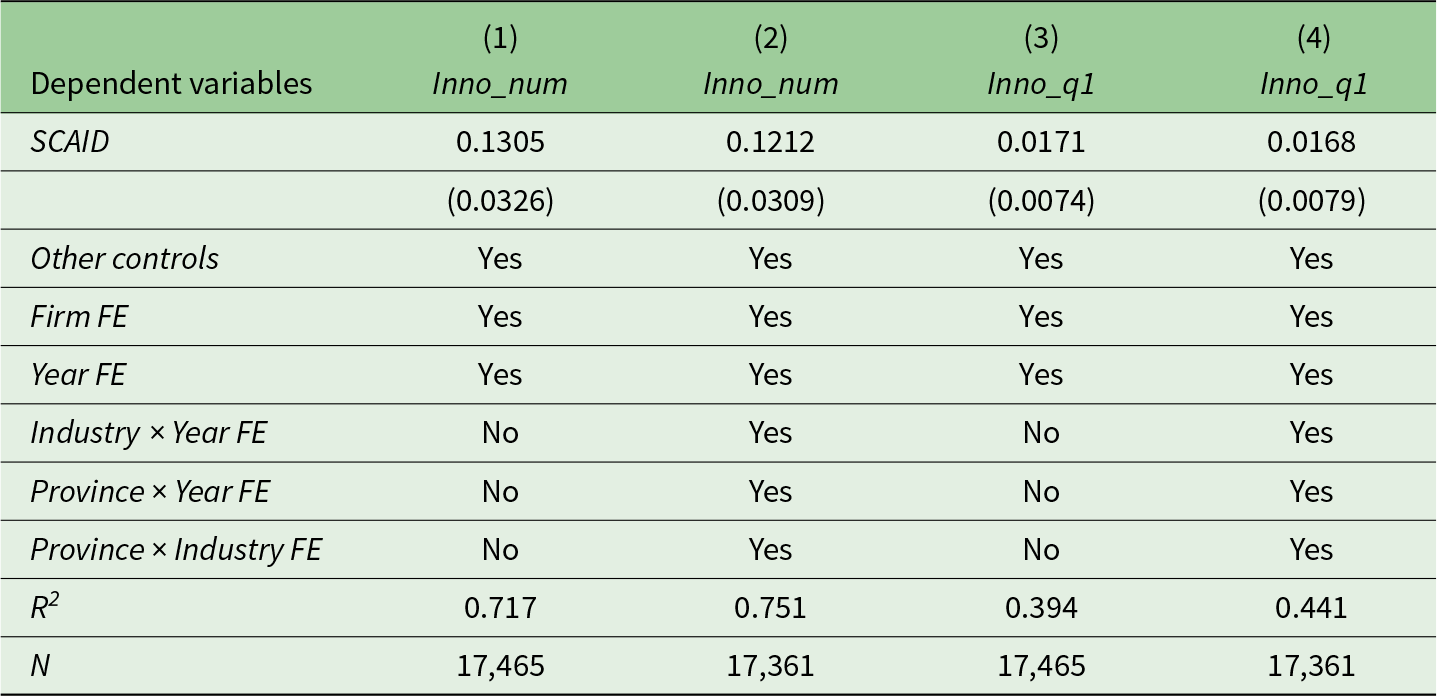
Table 1 presents the estimation results for Model (1). Columns 1 and 3 do not incorporate controls for Industry × Year, Province × Year, and Province × Industry, whereas columns 2 and 4, which include all relevant control variables, are the baseline models of our study.
Baseline estimation results

Notes: Robust standard errors clustered at the firm level are in parentheses. FE indicates fixed effects. ‘Yes’ and ‘No’, respectively, indicate whether the variable is controlled or not.
In column 2, the coefficient of SCAID is 0.1212, significant at the 1 per cent level, indicating that SCAI leads to a 12.12 per cent increase in the quantity of firms’ green innovation during the sample period. In column 4, the coefficient of SCAID is 0.0168 and significant at the 5 per cent level, suggesting that SCAI enhances the quality of firms’ green innovation. Consequently, these findings support Hypothesis A.
4.2. Robustness tests
We conducted a series of robustness tests on the results of the baseline regression. They were (1) conducting parallel trend tests to validate the common trend assumption, (2) reconstructing the dependent variable using three alternative specifications, (3) employing a fixed-effects Poisson model to quantify SCAI's impact on the volume of firms’ green innovation, (4) incorporating firms that experienced state capital divestment post-SCAI adoption, (5) applying propensity score matching method to find a suitable control group before estimation, (6) implementing the instrumental variable approach to address endogeneity concerns, (7) mitigating bias from heterogeneous treatment effects via three novel estimation techniques and (8) conducting placebo tests to rule out spurious correlations. The results of these robustness checks are documentmed in the online appendix, and all lend support to the baseline regression estimates.
5. Mechanism analysis
Our previous analysis has documented that SCAI exerts positive effects on both the quantity and quality of firms’ green innovation. However, since this result represents the net outcome of SCAI's conflicting positive and negative effects on green innovation, it is essential to simultaneously examine the positive and negative impact mechanisms of SCAI. To tackle this issue, we develop the following empirical model:
 \begin{equation}{M_{it}} = {\pi _1} + {\theta}SCAI{D_{it}} + X'\mu + {\gamma _i} + {\delta _t} + {\varepsilon _{1it}}\end{equation}
 \begin{equation}{Y_{it}} = {\pi _2} + \lambda {M_{it}} + X'\nu + {\gamma _i} + {\delta _t} + {\varepsilon _{2it}}\end{equation}
In equation (3), the outcome variable M represents the mechanism variable under investigation. Equation (4) uses mechanism variable M as the independent variable. If θ and λ are statistically significant, it indicates that accepting SCAI will have a positive effect on green innovation through the role of the mechanism variable.
5.1. Positive pathway
5.1.1. Resource acquisition capability
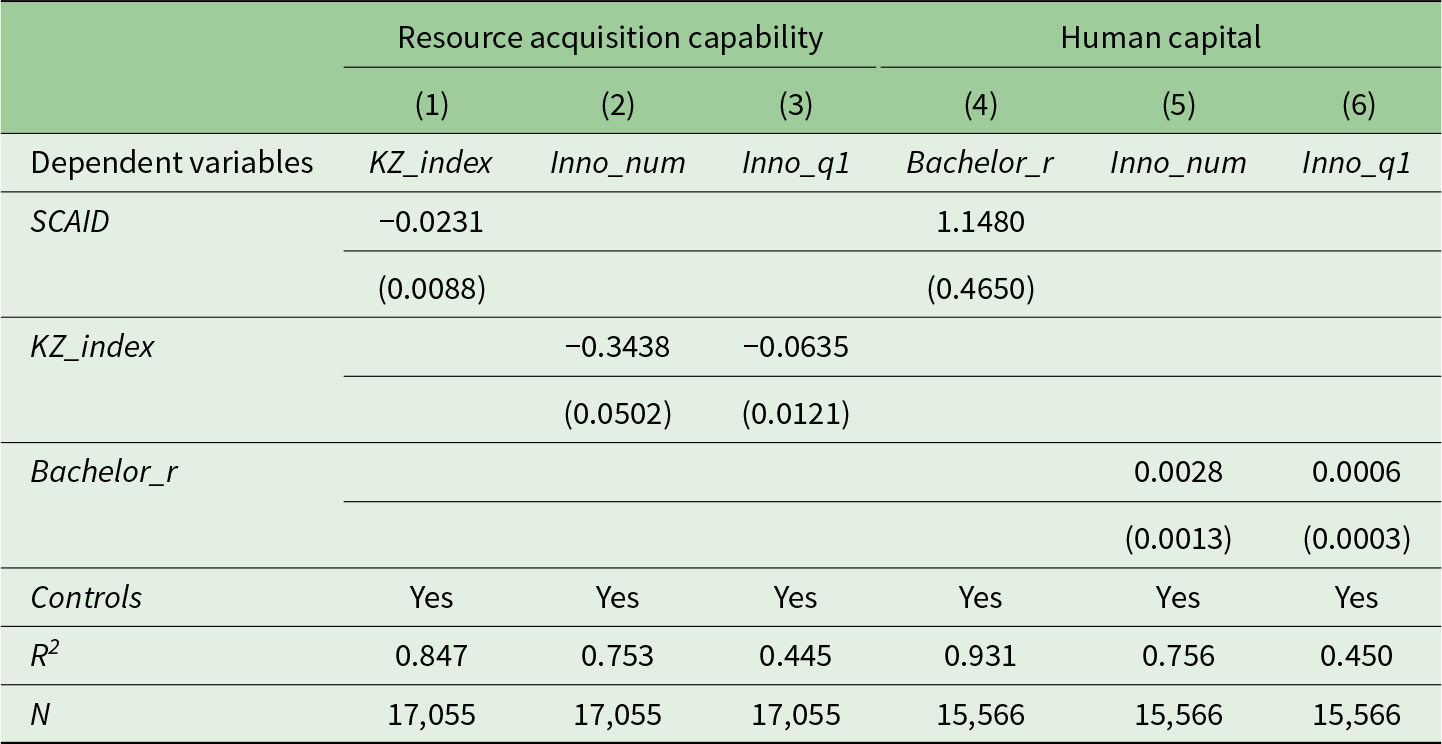
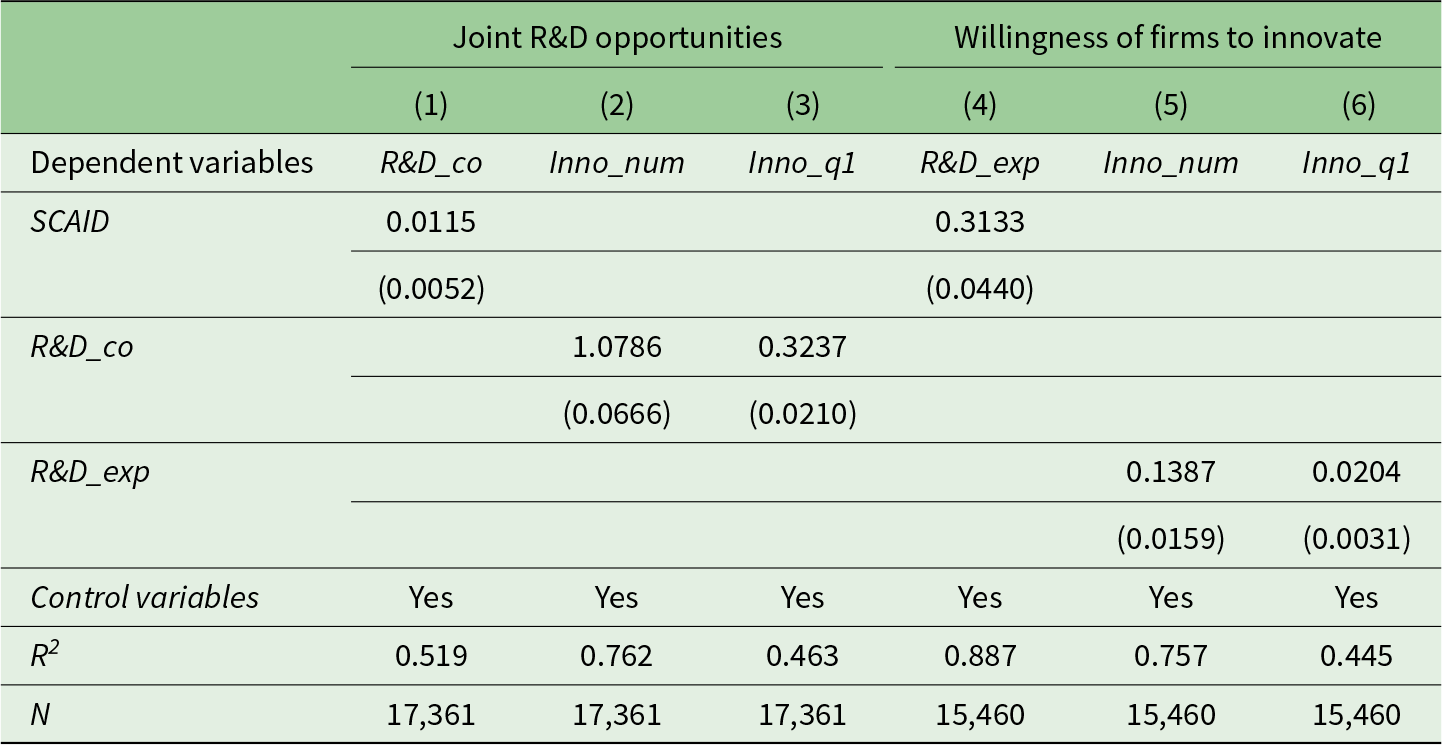
In this subsection, we investigate whether SCAI promotes the quantity and quality of firms’ green innovation by upgrading their green innovation capacity. Specifically, we measure firms’ green innovation capacity across three dimensions: resource acquisition capability (KZ_index), human capital (Bachelor_r) and joint R&D involvement in green patents (R&D_co). The estimation results are reported in Table 2 and columns 1–3 of Table 3.
The mechanisms of firms’ resource acquisition capabilities and human capital

Notes: Robust standard errors clustered at the firm level are in parentheses. ‘Yes’ indicates that all control variables in the baseline models are included.
The mechanism of joint R&D opportunities and innovation willingness

Notes: Robust standard errors clustered at the firm level are in parentheses. ‘Yes’ indicates that all control variables in the baseline models are included.
The estimation results reveal that SCAI significantly alleviates firms’ financing constraints, increases the share of employees with a bachelor’s degree or higher, and elevates the probability of joint R&D for green patents. In other words, SCAI upgrades firms’ resource acquisition capacity, human capital endowment and joint R&D prospects, thereby strengthening their green innovation capability. Moreover, all three variables capturing firms’ green innovation capability have been found to enhance both the quantity and quality of firms’ green innovations. This suggests that SCAI enhances the quantity and quality of firms’ green innovation by fortifying their green innovation capability.
5.1.2. Willingness of firms to innovate
A firm’s innovation willingness significantly influences its propensity to undertake green innovation. To measure this, we use the natural logarithm of R&D expenditure (R&D_exp) as a proxy for the firm’s innovation willingness. This allows us to investigate whether acceptance of SCAI increases the quantity and quality of green innovation within firms by boosting their innovation willingness. The estimation results are presented in columns 4–6 of Table 3.
Notably, in column 4, the coefficient of SCAID is significantly positive, signifying that SCAI is associated with higher firm innovation willingness. Furthermore, in columns 5 and 6, the coefficients of R&D_exp are both significantly positive, showing that SCAI enhances green innovation quantity and quality by boosting innovation willingness.Footnote 4
5.1.3. Firms’ environmental regulatory pressure
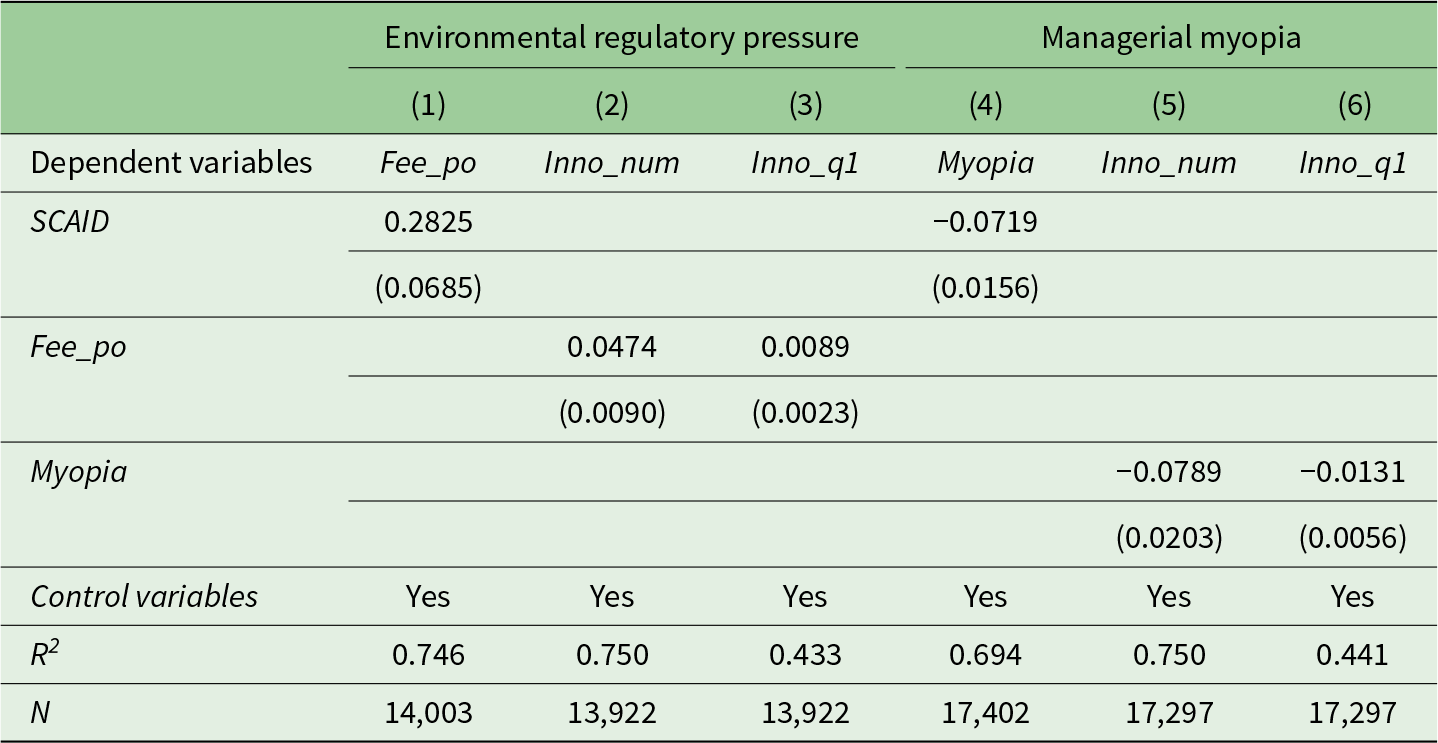
Next, we investigate whether SCAI promotes green innovation quantity and quality by escalating firms’ environmental regulatory pressure. Specifically, we measure firms’ environmental regulatory pressure by pollution discharge fees (Fee_po) (Huang et al., Reference Huang, Liu, Han and Peng2020), with mechanism test results reported in columns 1–3 of Table 4. The test results reveal that SCAI significantly elevates firms’ environmental regulatory pressure, and this pressure increase positively impacts green innovation quantity and quality. This provides empirical support for our hypothesis.
The mechanism of environmental regulatory pressure and managerial myopia

Notes: Robust standard errors clustered at the firm level are in parentheses. ‘Yes’ indicates that all control variables in the baseline models are included.
5.1.4. Managerial myopia
Finally, we examine whether SCAI enhances the quantity and quality of firms’ green innovation by mitigating managerial myopia. Specifically, following Lu et al. (Reference Lu, Liang, Hu and Liu2024), we measure managerial myopia by the proportion of managerial myopia – related vocabulary, with mechanism test results is reported in columns 4–6 of Table 4. The results show that SCAI significantly alleviates managerial myopia, and managerial myopia inhibits the quantity and quality of firms’ green innovation, thus verifying our hypothesis.
5.2. Negative pathway
5.2.1. Agency problem
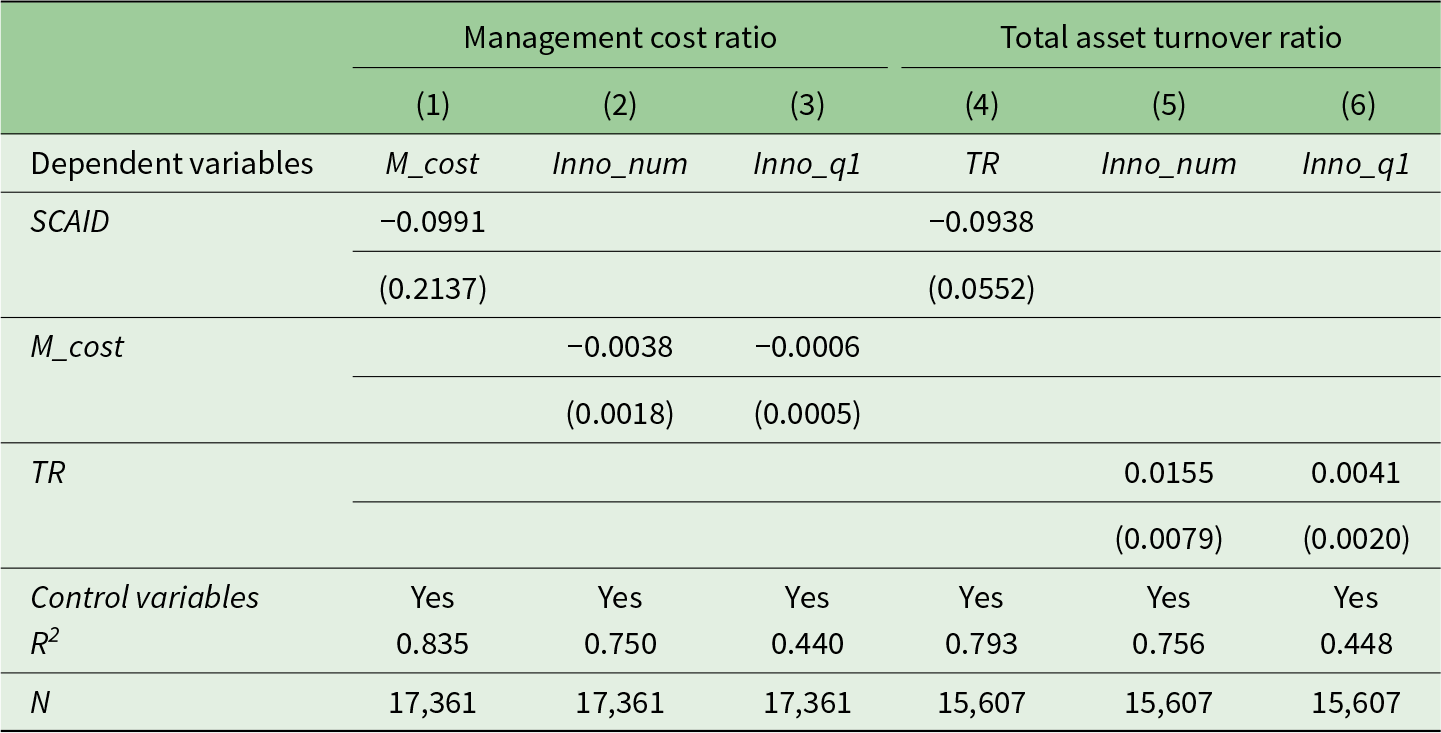
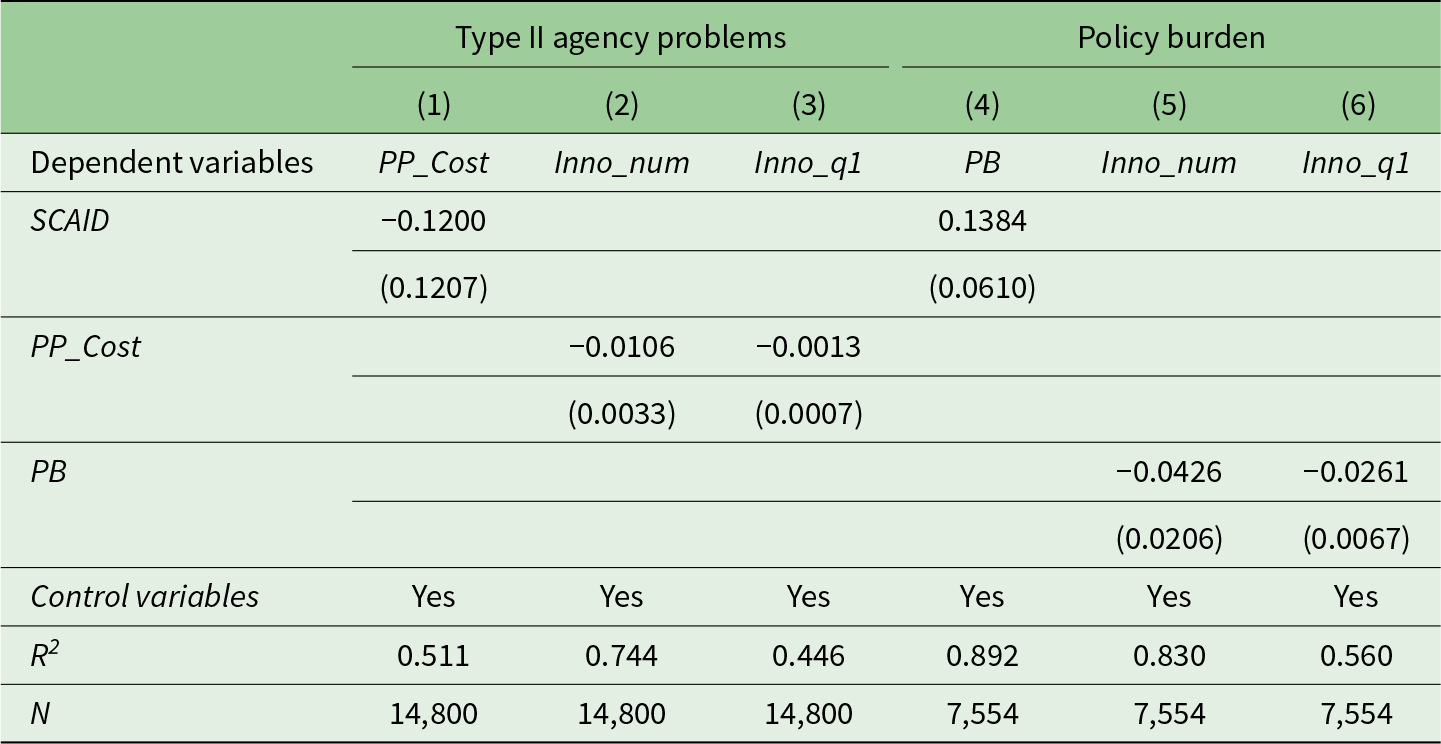
In this subsection, we empirically investigate whether the negative mechanism of principal-agent problems is valid. Specifically, we examine two types of principal-agent issues: (i) shareholder-management conflicts (Type I agency problems) measured by management expense ratio (M_cost) and total asset turnover (TR) and (ii) controlling–minority shareholder conflicts (Type II agency problems) proxied by the other receivables ratio (PP_cost). Type I agency problem results are presented in Table 5, and Type II results appear in columns 1–3 of Table 6.
The mechanism of Type I agency problems

Notes: Robust standard errors clustered at the firm level are in parentheses. ‘Yes’ indicates that all control variables in the baseline models are included.
The mechanism of Type II agency problems and policy burden

Notes: Robust standard errors clustered at the firm level are in parentheses. ‘Yes’ indicates that all control variables in the baseline models are included.
The results in Table 5 reveal that SCAI has no significant impact on M_cost and PP_cost. This may be because China’s SOEs had largely established modern management systems during the study period (Huang et al., Reference Huang, Jing, Xia, Zhang, Zhong and Zhu2024). Additionally, SCAI may curtail expropriation of minority shareholders by controlling shareholders, thereby alleviating principal-principal agency problems between controlling and minority shareholders (La Porta et al., Reference La Porta, Lopez-De-Silanes and Shleifer1999). Consequently, even when state ownership is introduced, it is unlikely to increase management costs or exacerbate principal-principal agency problems between controlling and minority shareholders.
However, SCAI has a significant negative effect on TR (see columns 1–3 of Table 6 for details), indicating that SCAI diminishes firms’ asset turnover efficiency. This may stem from SCAI introducing inherent managerial inefficiencies in SOEs, thereby causing a decline in asset turnover (Jiang et al., Reference Jiang, Yuan and Yang2023). Additionally, the test results show that TR has a positive effect on both the quantity and quality of firms’ green innovation. This implies that SCAI inhibits improvements in green innovation quantity and quality by exacerbating agency problems stemming from managers’ inefficient asset utilization.
5.2.2. Policy burden
Finally, we investigate whether SCAI inhibits green innovation quantity and quality by exacerbating policy burdens. Results of the mechanism test, where policy burden is measured by employment metrics (PB), are reported in columns 4–6 of Table 6. As expected, the results show that SCAI increases firms’ policy burdens, and policy burdens negatively affect green innovation quantity and quality. This confirms that SCAI hampers green innovation by exacerbating policy burdens.
6. Heterogeneity analysis
6.1. Proportion of state capital
The impact of SCAI implementation on firms’ green innovation may vary depending on whether a firm becomes relatively state-controlled afterward. To explore this potential distinction, following Huang et al. (Reference Huang, Li, Ma and Xu2017), we classify firms into two categories: relatively controlled and non-state relatively controlled firms. This classification is based on whether the state's equity stake exceeds 30 per cent in the year of the acceptance of SCAI (57 firms met this criterion).Footnote 5 The control firms are not categorized because they are all firms with no state equity.
Table A8 in online appendix D reveals that, following the acceptance of SCAI, when state capital assumes the role of the controlling shareholder, the positive effects on both the quantity and quality of firms’ green innovation are more pronounced. This may stem from firms’ shift to relative state control, which brings greater government subsidies, more bank credit support, and stronger ability to attract high-quality talent – all of which boost green innovation. Moreover, firms with a higher proportion of state equity are generally compelled to meet the government's expectations for environmental improvement, reflecting stronger social responsibility (Calza et al., Reference Calza, Profumo and Tutore2016). Consequently, they allocate more resources to advance green innovation initiatives.
6.2. Industries with different pollution intensity
Since the implementation of SCAI may potentially heighten environmental pressure, firms operating in heavily polluting industries might experience an even greater surge in environmental pressure after accepting SCAI (Jiang et al., Reference Jiang, Yuan and Yang2023). In turn, this could stimulate increased engagement in green innovation activities. Compared to firms in less environmentally pressured non-heavily polluting industries, SCAI may exert a more substantial positive influence on green innovation for firms operating within heavily polluting industries. To examine this hypothesis, we divide firms into two subsamples: those in heavily polluting industries and those in non-heavily polluting industries.Footnote 6 Table A9 in online appendix D presents the subsample regression results.
The estimation outcomes reveal that the positive effect of SCAI on the quantity of green innovation is more pronounced among firms operating in heavily polluting industries. Regarding the quality of green innovation, accepting SCAI does not significantly affect the green innovation quality of firms in non-heavily polluting industries. However, it significantly enhances the quality of green innovation for firms in heavily polluting industries. Thus, our conjecture receives empirical support.
6.3. Regional marketization level
Research shows that in regions with higher marketization, market forces exert more influence on resource allocation than government intervention (Zhou et al., Reference Zhou, Gao and Zhao2017). In these regions, the resource advantage associated with state ownership is mitigated by the market’s way, leading firms to rely more on the market for key operational resources (Zhou et al., Reference Zhou, Gao and Zhao2017). This suggests that, in regions with a higher level of marketization, the positive effects of SCAI on green innovation resources, such as access to bank credit, talent and opportunities for joint R&D, may be attenuated. Essentially, SCAI's favourable impact on firms’ green innovation is more pronounced in regions with lower marketization.
To examine this hypothesis, we divide our sample into two subsamples, firms in provinces with marketization levels above and below the 75th percentile of the 2011 Regional Marketization Index (compiled by Wang et al. (Reference Wang, Fan and Yu2017)). Given that many Chinese listed firms cluster in developed, higher-marketization regions, we use the 75th percentile (not the median) as the cut-off. This ensured roughly equal subsample sizes for analysis.
Table A10 in online appendix D reveals that, in comparison to firms located in provinces characterized by higher levels of marketization, SCAI exerts a more substantial positive influence on both the quantity and quality of green innovation in firms situated in provinces with lower marketization levels.
7. Conclusion
Existing literature has explored SCAI’s economic impacts, but its environmental implications remain understudied. We theoretically analyse SCAI’s potential influence on firms’ green innovation and use a staggered DID design to examine the relationship between accepting SCAI and the quantity and quality of green innovation in Chinese listed firms from 2011 to 2021.
Our analysis reveals the following: (1) SCAI significantly improves firms’ green innovation quantity and quality, with results robust to rigorous checks. (2) SCAI’s positive green innovation effect is the net outcome of conflicting channels: it promotes green innovation by enhancing innovative capacity, boosting innovation willingness, increasing environmental regulatory pressure, and mitigating managerial myopia, but may hinder it by exacerbating agency conflicts and policy burdens. (3) Heterogeneity analysis shows that SCAI’s positive effects on green innovation are more significant for heavily polluting firms, those in less marketized regions, and firms that become state-relatively controlled after accepting SCAI.
Our study’s conclusions have practical implications. For policymakers, state asset supervisors should continue advancing state capital investment company reforms, speeding up the shift to capital management. They should also continue to promote SCAI through various avenues, especially those firms necessitating green transformation in their production processes. Second, emphasizing green production and environmental protection in SOE officials’ and managers’ performance evaluations will incentivize SOEs and firms with state ownership participation to pursue green innovation. Third, SOE equity investments should prioritize sectors where the transformation of production methods into green ones is time-intensive, capital-demanding, and private capital interest is lacking.
Our conclusions offer valuable insights for managers. First, firms lacking funds, technological or human capital for green transformation – especially those in less marketized regions and heavily polluting industries – may consider introducing state capital to access resources for green innovation. Second, post-SCAI, firms should build collaborations with other state capital group firms and partner with government-affiliated research institutions to enhance green innovation capabilities. Third, in implementing SCAI, institutional design must prioritize alleviating agency conflicts and reducing policy burdens to unleash firms’ green innovation vitality. Specifically, customized performance evaluation frameworks should be designed based on firm typologies (e.g., public welfare-oriented vs. commercial-oriented) to mitigate policy burdens. Meanwhile, market-driven supervision mechanisms (such as independent directors and third-party evaluators) should be introduced to enhance management oversight, alleviate agency conflicts and improve asset utilization efficiency.
Supplementary material
The supplementary material for this article can be found at https://doi.org/10.1017/S1355770X26100436.
Acknowledgements
This research was carried out with financial support from the Philosophy and Social Science Research Program of Hubei Provincial Department of Education [Grant numbers: 25Q067 and 24D059], Doctoral Scientific Research Foundation of Hubei University of Automotive Technology [Grant number: BK202540], and Science and Technology Research Program of Hubei Provincial Department of Education [Grant number: D20231802].