The phrase Psychological First Aid (PFA) emerged in the military as a rehabilitation technique during the Second World War.Reference Shultz and Forbes 1 As a result, PFA has emerged as an essential factor in responding to the circumstances of highly stressed individuals due to a catastrophe or emergency scenario.Reference Shultz and Forbes 1 , Reference Jacobs, Gray and Erickson 2 The goal of PFA is to lessen initial distress among victims of disasters and humanitarian crises while fostering both short- and long-term adaptive functions.Reference Shultz and Forbes 1 Helpers who come into contact with individuals who have recently experienced unpleasant experiences are primarily the intended users of PFA.Reference Azzollini, Depaula and Cosentino 3 Goodridge, Isinger, and Rotter stated that helpers could be employees or volunteers like teachers, community health workers, and health care professionals who are not exceptionally trained in mental health and psychosocial support.Reference Goodridge, Isinger and Rotter 4 Therefore, PFA has evolved as a crucial reaction to excessive stress in catastrophic settings, seeking to reduce initial suffering and encourage adaptive functioning, mainly for carers working with people who have experienced traumatic events.
According to the World Health Organization, PFA is an essential first-line psychosocial support for individuals affected by crisis. 5 PFA is similar to first aid treatment used in addressing physical health problems but for mental health. It is used to address the immediate mental needs of victims.Reference Shah, Bedi and Onyeaka 6 However, Shultz stated that PFA is neither professional counseling, nor psychological debriefing, nor designed for professionals. People without prior professional or other specialized training in mental health and psychosocial support are increasingly being trained to provide emotional and psychosocial support to those in need around the world in emergencies and resource-constrained settings.Reference Mendenhall, De Silva and Hanlon 7 –Reference Singla, Kohrt and Murray 9 LeBan, Kok, and Perry also stated that peer helpers, midwives, auxiliary health workers, teachers, and community health volunteers are among those who do not hold a standardized professional service position but are nonetheless prominent and well-respected members of their communities.Reference LeBan, Kok and Perry 10 Therefore, PFA is essential for addressing the immediate mental needs of individuals affected by the crisis, provided by professionals and non-professionals trained in emergency settings and resource-constrained environments.
On a global scale, PFA and physical first aid have been integrated into disaster management, contributing to efficient crisis response and recovery.Reference Said, Molassiotis and Chiang 11 , Reference Math, Nirmala and Moirangthem 12 However, in many African nations, PFA remains underutilized and less incorporated than physical first aid. Existing literature highlights a gap in research regarding the impact of PFA practice during crisis management in these regions.Reference Wang, Norman and Xiao 13 –Reference Corey, Vallières and Frawley 15 Horn et al. (2019) define PFA as a set of supportive actions that uphold dignity while assisting individuals in distress.Reference Horn, O’May and Esliker 16 They further outline 5 core principles essential for psychological recovery: safety, connectivity, self-efficacy, tranquility, and hope. In Nigeria, as in many other African countries, PFA is often neglected in disaster response strategies. This study seeks to address the deficiency in health care workers’ knowledge of PFA, assessing their competency and the effectiveness of training programs. Additionally, it explores barriers and facilitators influencing the adoption of PFA in various health care settings. By filling this knowledge gap, the study aims to contribute to the broader understanding of PFA implementation in Nigeria and other Global South countries, emphasizing its role in psychological recovery and crisis management.
Methods
Study Design
This systematic review used the Preferred Reporting Items for Systematic Reviews and Meta-Analyses (PRISMA) updated checklist for 2020.Reference Page, McKenzie and Bossuyt 17 However, the Campbell and Cochrane Economics Method Group guideline was also followed, including the search criteria, data extraction, synthesis, and critical analysis. Systematic reviews are crucial in synthesizing evidence and providing valuable insights into specific research questions, such as the current knowledge and skills of health care practitioners in delivering PFA.Reference Snyder 18 By following a well-defined methodology, a systematic review aims to minimize bias, enhance reproducibility, and facilitate the identification of high-quality evidence.Reference Munn, Stern and Aromataris 19 The PRISMA checklist, widely recognized and utilized in this field, provides a structured framework to guide the systematic review process, promoting transparency and rigour.Reference Page, McKenzie and Bossuyt 17
Data Sources and Search Strategy
For the systematic review, we selected original studies that focused on health care workers’ current knowledge level and PFA skills in PubMed: ("Emergency Services, Psychiatric" [Mesh] or “Emergency Services, Psychiatric” [Text Word] or “Psychiatric Emergency Service*” [Text Word]) and ("knowledge*" [Text Word] or “skill*” [Text Word] or “training*” [Text Word]); Psych INFO: (("Emergency Services, Psychiatric") OR ("Psychiatric Emergency Service*")) AND ("knowledge*" OR “skill*” OR “training*”); Web of Science: TS=("Psychological First Aid") AND TS=("knowledge*" OR “skill*” OR “training*”); Google Scholar: site:scholar.google.com ("Emergency Services, Psychiatric" OR “Psychiatric Emergency Service*”) AND ("knowledge*" OR “skill*” OR “training*”) and CINAHL: (("Psychological First Aid") or ("knowledge*" or “skill*” or “training*”)) published in 2013 among health care providers. Operators “OR” and “AND” were applied for the search strategy. This resulted in the final 12 publications.
The search strategy employed in this study aimed to ensure the reliability and validity of the findings, following the guidelines provided by the Preferred Reporting Items for Systematic Reviews and Meta-(PRISMA).Reference Page, McKenzie and Bossuyt 17 The study’s specific aims and objectives were a guiding framework for the literature search. A systematic search was conducted using vital electronic databases to capture a comprehensive range of relevant research. Priority was given to peer-reviewed articles published in English, as it is widely recognized that high-impact research is often translated into English, making it crucial to include these publications to avoid omitting pertinent papers from this review. To ensure the inclusion of recent and up-to-date research, articles published from January 2013 through March 2023 were considered. This time frame aligns with the PRISMA recommendations,Reference Page, McKenzie and Bossuyt 17 emphasizing the importance of repeatability and transparency in study results. The study aimed to evaluate the most pertinent and contemporary research by limiting the search to this specific time.
The search strategy utilized a combination of relevant keywords and subject headings related to health care workers’ current knowledge level and PFA skills. These terms were carefully selected to capture the essence of the research topic and optimize the retrieval of relevant articles. Additionally, hand-searching of reference lists from retrieved articles and consultation with subject matter experts was conducted to ensure the comprehensiveness of the search strategy. Overall, the search strategy for this study was designed to identify peer-reviewed articles published in the English language within the specified time frame, utilizing a combination of electronic database searches, reference list examination, and expert consultation. By adhering to these criteria and following the PRISMA guidelines,Reference Page, McKenzie and Bossuyt 17 the study aimed to gather a robust collection of research articles that would provide valuable insights into health care providers’ knowledge and skills of PFA.
Study Inclusion and Exclusion Criteria
This review followed specific inclusion and exclusion criteria to identify relevant quantitative research on health care workers’ current knowledge level and PFA skills. Studies included in this review were those written in English. Exclusion criteria include all studies that did not focus on health care workers’ current knowledge level and PFA skills, articles with fewer than 2 study subjects, review articles, unfinished studies, conference abstracts, and editorials. The PEO framework (Population, Exposure, and Outcome), particularly for formulating questions about studies or exploring relationships and associations, is useful for developing research questions and searching for relevant literature, was employed to structure the research questions and identify relevant studies.Reference Munn, Stern and Aromataris 19 This framework assists in defining the target population (health care workers), the exposure, and the desired outcomes.Reference Munn, Stern and Aromataris 19 The review question and objectives align with the PEO framework, and studies meeting the following criteria were the only ones included in the review. The details of the PEO framework are presented below:
Population (P): Studies focused on the current knowledge level and PFA skills among health care workers will be included, as well as studies presenting primary data with more than 2 study subjects.
Exposure (E): Factors or characteristics associated with increased knowledge of PFA among health care workers, such as organizational or environmental factors.
Outcome (O): Studies that explore the relationship between the identified current knowledge level of PFA.
Selection and Appraisal
The Critical Appraisal Skills Programme (CASP) frameworkReference Moreton 20 was employed in this systematic review to evaluate health care providers’ current knowledge level and skills in PFA. The search results were then exported to EndNote, reference management software, to facilitate efficient organization and removal of duplicate articles. Duplicate articles were carefully reviewed and eliminated to ensure each study was considered only once during selection. The remaining unique articles were transferred to Microsoft Excel for further analysis and screening using the platform’s features, such as filters and sorting options, to aid in the selection process. Title and abstract screening were conducted to assess the relevance of each article, and those that did not meet the predetermined inclusion criteria were excluded. Subsequently, a full-text review was performed on the remaining articles to determine their eligibility based on the predetermined inclusion and exclusion criteria.
The CASP Checklist for Randomised Controlled Trials and Cohort Studies
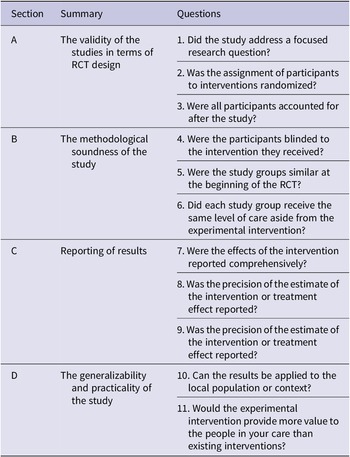
The CASP checklist for Randomised Controlled Trials (RCTs) and cohorts consists of 4 sections with 11 questions.Reference Long, French and Brooks 21 The CASP checklist for RCTs and cohort studies is presented in Table 1. The outcomes of the assessments conducted against the CASP checklistReference Long, French and Brooks 21 are summarized in Table 2a. This comprehensive evaluation of the included studies ensures a thorough examination of their quality and relevance within the context of RCTs. The mean CASP score across the 8 studies is 5.5. This suggests that the studies for this review are of average quality.
CASP checklist for eligible randomized control trial and cohort studies

CASP results for the included RCT and cohort studies

Y = Yes; N = No; C = Can’t say.
The CASP Checklist for Qualitative Studies
The CASP checklist for qualitative studies consists of 10 questions categorized into 3 sections.Reference Moreton 20 These sections aim to assess different aspects of the study and provide a comprehensive evaluation of its quality and implications. Section A focuses on the validity of the study results. The included study is evaluated against these questions using this checklist, summarizing the results in Table 2b.
CASP results for qualitative studies

Y = Yes; N = No; C = Can’t say.
Data Extraction and Quality Assessment
Data extraction was conducted by 1 researcher and included information on the study authors and date, target population description, country of the study, study design, primary study outcome, and significant findings (Table 3b). After removing the duplicates, all titles and abstracts were screened to select the relevant studies based on the inclusion and exclusion criteria. The authors selected the papers separately and then checked the comparability of studies by reviewing a random sample of included and excluded studies after the initial screening. After removing studies that met the exclusion criteria during the initial screening, the full text of the remaining studies was assessed against the inclusion criteria. Any differences were discussed, and a consensus was reached. A flow chart of the study selection procedure is presented in Figure 1.
Search and selection flow diagram.

Results
Initially, 626 potentially relevant publications were found. Three hundred thirty-five articles were screened after duplicate copies were removed. They were then filtered based on the title, and 121 studies were excluded. Full texts of the remaining 170 studies were reviewed, and 29 of them were further screened based on language and study type; only 12 studies met the inclusion criteria. The detailed process of search and selection is demonstrated in Figure 1. A description of the studies is given in Table 3a. Of the 12 studies, most (N = 4, 33.3%) were descriptive cross-sectional or randomized control trials. The demographic characteristics of participants were reported for all the studies. The 12 studies included 2848 individuals from several countries across Africa, Asia, North America, and Europe. The number of participants ranged from 16 to 1399, and all studies were conducted using primary data.
Description of the studies (N = 12)

Overview of the studies

PFA, psychological first aid.
Database Syntaxes
For the systematic review, we selected original studies that focused on health care workers’ current knowledge level and PFA skills in:
-
1. PubMed: ("Emergency Services, Psychiatric" [Mesh] or “Emergency Services, Psychiatric” [Text Word] or “Psychiatric Emergency Service*” [Text Word]) and ("knowledge*" [Text Word] or “skill*” [Text Word] or “training*” [Text Word]);
-
2. Psych INFO: (("Emergency Services, Psychiatric") OR ("Psychiatric Emergency Service*")) AND ("knowledge*" OR “skill*” OR “training*”);
-
3. Web of Science: TS=("Psychological First Aid") AND TS=("knowledge*" OR “skill*” OR “training*”);
-
4. Google Scholar: site: scholar.google.com ("Emergency Services, Psychiatric" OR “Psychiatric Emergency Service*”) AND ("knowledge*" OR “skill*” OR “training*”);
-
5. CINAHL: (("Psychological First Aid") or ("knowledge*" or “skill*” or “training*”)) published in 2013 among healthcare providers. Operators “OR” and “AND” were applied for the search strategy.
This resulted in the final 12 publications.
During the analysis, 5 key themes were identified from the data. The process of theme extraction involved a rigorous qualitative synthesis of the selected studies. Initially, common patterns and recurring topics were noted across the studies. These preliminary observations were then systematically organized into broader thematic categories, which were refined through iterative discussion and reevaluation until 5 distinct themes emerged.
Effectiveness of PFA Training Programs
Sijbrandij et al. discovered that PFA trainers had higher psychosocial responses than the control group.Reference Sijbrandij, Horn and Esliker 22 Sijbrandij et al. also found that PFA training provided in community-based peripheral health care services in post-Ebola Sierra Leone had a positive impact on the acquisition and retention of comprehension and knowledge regarding appropriate psychosocial responses among people exposed to acute disaster and crisis, as well as improved knowledge on how to apply these strategies.Reference Sijbrandij, Horn and Esliker 22 However, Sijbrandij et al. did not find an effect of PFA training on confidence related to providing psychosocial support in acute crises or on the professional quality of life, which included items on compassion fatigue and burnout.Reference Sijbrandij, Horn and Esliker 22 PFA training has a positive effect on disaster preparation.Reference Kılıç and Şimşek 24 Kılıç and Şimşek reported that to determine the effectiveness of PFA training, one needs to examine self-efficacy.Reference Kılıç and Şimşek 24 Self-efficacy was also reported to increase at the end of the training.Reference Kılıç and Şimşek 24 This study noted that the PFA sessions were conducted for 60 minutes each and were carried out once a week for over 6 weeks. The weekly sessions and the duration of the training suggest a structured and cumulative approach.Reference Kılıç and Şimşek 24 The experimental group in a study by Park and ChoiReference Park and Choi 29 underwent a 2-hour PFA lecture before participating in the simulation training. This suggests a blended learning approach, combining theoretical knowledge with practical, hands-on experience. However, the comparison group received only the 2-hour lecture without the simulation component. In contrast, the control group received a psychological first aid handout for individual study, emphasizing a self-directed learning approach.
PFA training significantly affected the psychological preparedness of nurses. Self-esteem and post-traumatic stress disorder significantly differed by time effect only.Reference Said, Molassiotis and Chiang 11 This implies that the PFA training effectively improved the study’s outcomes and that the intervention had a significant effect. PFA pre-disaster training effectively provided self-care skills and mutual support in preparing for disaster responses among auxiliary medical service personnel, including nurses. In the study by Said, Molassiotis, and Chiang, nurses in the control group reflected on their preparedness without having received such training, highlighting the improvements among nurses in the intervention group due to the provided training.Reference Said, Molassiotis and Chiang 11 The large effect size found in this study indicates a noteworthy difference between the control and intervention groups, with the intervention group having significantly better outcomes. This finding was supported by prior studies by Sijbrandij et al. and Chandra et al., which provide more substantial evidence for the intervention effect.Reference Sijbrandij, Horn and Esliker 22 , Reference Chandra, Kim and Pieters 31
PFA training is practical in providing psychological assistance to health personnel.Reference Said, Molassiotis and Chiang 11 The longer-term effects of the PFA training program are unknown.Reference Said, Molassiotis and Chiang 11
Current Knowledge and Skills of Health Care Providers in PFA
A study focusing on PFA instructors observed that the passage of time significantly impacted the participants’ understanding of proper psychosocial responses.Reference Sijbrandij, Horn and Esliker 22 As the instructors gained experience and exposure to various scenarios, their comprehension and knowledge of psychosocial support strategies improved. This finding emphasizes the importance of continued learning and practical application of learned concepts to enhance the capacity to provide adequate support.Reference Sijbrandij, Horn and Esliker 22 The study also revealed that adherence to established guidelines and principles of PFA resulted in a notable increase in knowledge and understanding of psychosocial support strategies. One-day courses designed explicitly for PFA were effective in imparting this knowledge.Reference Sijbrandij, Horn and Esliker 22 Participants who underwent the training demonstrated a greater understanding of applying psychosocial support strategies when individuals were facing acute crises.Reference Sijbrandij, Horn and Esliker 22 This highlights the significance of practical training and the application of learned skills in real-world scenarios.
However, it is essential to note that in some cases, the descriptions of actual responses to individuals in distress were not consistently aligned with the instructions provided in the PFA training or with the principles of effective interventions, as noted by Horn et al.Reference Horn, O’May and Esliker 16 This discrepancy arises from deeply ingrained patterns of behavior that are shaped by societal and cultural norms. Changing these ingrained patterns can be challenging or even impossible, which underscores the need for ongoing efforts to address cultural and contextual factors in the delivery of PFA.Reference Horn, O’May and Esliker 16
Moreover, PFA training significantly improved the trainees’ knowledge and understanding of the roles and responsibilities of PFA helpers.Reference Said, Molassiotis and Chiang 11 It also enhanced their practical application of psychosocial support strategies during acute crises. This suggests that the training program effectively equipped participants with the necessary skills and knowledge to fulfill their roles as PFA helpers.Reference Said, Molassiotis and Chiang 11 Overall, the findings emphasize the importance of continuous learning, practical application, and a nuanced understanding of cultural factors in PFA training.Reference Said, Molassiotis and Chiang 11 Ongoing efforts should focus on refining training approaches to address potential gaps in understanding and to ensure that trainees can effectively provide psychosocial support in acute crises.
PFA training significantly increases trainees’ baseline knowledge concerning mental health disorders in children, regardless of their background.Reference Wang, Norman and Xiao 28 The increase was between 5% and 15% concerning knowledge of definitions of mental health disorders and between 15% and 45% concerning knowledge of applying PFA principles and actions with children and families. The results also indicated that the trainees—mental health providers working in the Syrian refugee’s emergency response—found that the knowledge acquired during the PFA training significantly increased their readiness to deliver PFA services.Reference Wang, Norman and Xiao 28
Barriers and Facilitators to Implementing PFA in Various Health Care Settings
Chandra et al. identified issues with or impediments to the utilization of PFA.Reference Chandra, Kim and Pieters 31 Details on the limitations of responders’ responsibilities in dealing with psychological distress were sought, as well as guidance on when to refer disturbed people to available resources. Various groups raised concerns that, in the event of a disaster, resources might not be available to care for victims’ mental health because the focus would be on treating physical wounds first. The issue with devoting many resources to psychological trauma is that one could perhaps utilize those same resources more wisely for physical trauma. PFA training contributes to the health care context; it has accelerated the uptake of PFA training; Wang et al. also noted the urgency of determining the feasibility of a well-adapted PFA training intervention to inform an RCT in a larger sample effectively.Reference Wang, Norman and Xiao 28
Comparing PFA to Other Forms of Mental Health Support
Training in PFA enhances one’s professional outlook, self-assurance as a helper, and professional quality of life.Reference Kılıç and Şimşek 24 Measures that directly represented the PFA training’s content, such as awareness of PFA principles, comprehension of how PFA should be applied in practice, and roles and responsibilities of PFA helpers,Reference Kılıç and Şimşek 24 were used to determine the advantages of PFA training. This demonstrates that the overall effects were relatively minimal. PFA relies heavily on an empathic approach, which can either be developed fast and readily or is assumed to be present in most trainees. With an empathic approach, persons who mix new talents with preexisting attitudes and beliefs can avoid getting engaged in situations they are ill-equipped to handle and may do harm.Reference Kılıç and Şimşek 24
Psychological First Aid Self-Care
According to Horn et al.,Reference Horn, O’May and Esliker 16 PFA includes several components that stress the importance of self-care among responders. Horn et al.Reference Horn, O’May and Esliker 16 noted that it is emotional to deal with people who are distressed and those in challenging situations. This study also noted that providers of PFA are encouraged to know their limits, engage in self-reflection, and seek support when needed, as self-care is an essential component used in maintaining the well-being and effectiveness of individuals providing psychosocial support; it includes strategies like debriefing sessions, peer support, and access to mental health resources. Park and ChoiReference Park and Choi 29 found an improvement in self-efficacy, performance competency, and knowledge for all groups. However, the experimental group showed a greater improvement in self-efficacy and performance compared to the other groups.
Discussion
PFA assists disaster survivors in dealing with the psychological distress caused by traumatic experiences. The systematic review included 12 studies that were either descriptive cross-sectional or randomized control trials spanning several African countries, Asia, North America, and Europe. The studies were used to assess health care providers’ knowledge and skills in PFA, determine the effectiveness of PFA training programs, and investigate the barriers and facilitators of implementing PFA in various health care settings.
Effectiveness of PFA Training Programs
The review’s findings show that PFA training positively impacts the acquisition of appropriate psychosocial responses, knowledge retention, and the application of response strategies in times of acute disaster and crisis. Unswervingly, studies by Jacobs et al. and McCabe et al. also revealed that training programs ensure that responders or mental health professionals are trained in community-based PFA, enabling them to provide prompt counseling and physiological intervention.Reference Jacobs, Gray and Erickson 2 , Reference McCabe, Everly and Brown 32 Therefore, to effectively manage responses in a disaster ordeal, persons providing a PFA response must be prepared and trained. Similarly, Zakrajsek, Martin, and Wrisberg attest that trainers’ expertise and knowledge positively results in the effectiveness of rendering psychological skills.Reference Zakrajsek, Martin and Wrisberg 33 The findings indicate that PFA is beneficial for providing psychological interventions to people who have experienced or witnessed traumatic events.Reference Shah, Bedi and Onyeaka 6
The review shows that PFA training has a positive effect on psychological preparedness and disaster preparation, providing the skills of self-care and mutual support in preparing for disaster responses, similar to the findings by Wang et al.Reference Wang, Norman and Xiao 34 Although Everly et al. affirm that training increases knowledge of PFA delivery and self-efficacy in using PFA,Reference Everly, McCabe and Semon 35 similar to our finding, they disclosed it also boosts confidence in resilience, which contradicts the results of a study by Sijbrandij et al. that PFA training has no significant impact on confidence level or professional quality of life.Reference Sijbrandij, Horn and Esliker 22 Individuals experiencing mental stress may exhibit a variety of reactions, necessitating adequate preparation of the person providing aid. Therefore, to effectively manage trauma in disaster patients, persons providing a psychological response must be prepared and trained.
Evidence from the review shows that PFA training effectively provides psychological assistance to health personnel. This is congruent with studies by Lalani and Drolet and Movahed et al. that PFA training programs significantly improve perceived competence and PFA knowledge, boost confidence and competence, disaster preparedness, attitude, therapeutic engagement, and the self-care strategies needed to promote psychological resiliency among individuals and families in disaster situations.Reference Lalani and Drolet 36 , Reference Movahed, Khaleghi-Nekou and Alvani 37
However, from the findings, the longer-term effects of the PFA training program are unknown; a person with basic training can provide PFA to disaster survivors irrespective of the prevailing conditions or environments. This demonstrates that PFA’s effectiveness is increased by training programs that psychologically prepare participants with skills in mitigating trauma stemming from disasters.Reference Jacobs, Gray and Erickson 2
Current Knowledge and Skills of Health Care Providers in PFA
From the review, PFA instructors’ experience and exposure to various scenarios improved their understanding and knowledge of psychosocial support strategies over time. This indicates that continuous learning, practice, and adherence to established guidelines and principles improves skills in providing adequate support. In line with the findings of Boling and Hardin-Pierce, having experience as a provider or having practical experience improves knowledge application and patient outcomes.Reference Boling and Hardin-Pierce 38 Practical experience and applying learned skills in real-world scenarios can only be attainable through training. The skills gained while undertaking PFA training are central to promoting disaster mental health principles and practices.Reference McCabe, Everly and Brown 32
The instructions provided in the PFA training or with the principles of effective interventions to actual responses to distressed individuals vary and are shaped by societal and cultural norms, as noted in this review by Horn et al.Reference Horn, O’May and Esliker 16 The basic principles of PFA are culturally informed to enhance its effectiveness across many societies.Reference Miller and Pescaroli 39 Drawing on local cultural practices enhances healing and psychosocial restoration capacity, resulting in a more sustainable recovery process. However, breaking these deeply rooted habits can be difficult and sometimes even impossible.
PFA training improves trainees’ understanding of the roles and responsibilities of PFA helpers and enhances skills and the practical application of psychosocial support strategies during acute crises. Birkhead and Vermeulen also noted that PFA is essential in developing resilient communities and a resilient response workforce, which aids responders (health workers) and the population in managing stress and anxiety without having adverse effects or deteriorating people’s current conditions.Reference Birkhead and Vermeulen 40
The articles reviewed emphasized the importance of continuous learning, practical application, and a nuanced understanding of cultural factors in PFA training. Similarly, Johnson emphasized PFA provider training, evidence review to inform practice, and policy considerations to ensure appropriate, high-quality PFA in humanitarian emergencies.Reference Johnson 41
From the review, regardless of the trainees’ professional backgrounds, PFA training significantly increases trainees’ baseline knowledge toward specific crisis challenges/emergency responses like mental health disorders, thus increasing their readiness to deliver PFA services. The PFA training program significantly improves knowledge, perceived skills, and confidence in providing first aid among lay responders such as police, drivers, social workers, and firefighters.Reference Ndile, Lukumay and Bolenius 42 –Reference Sim and Wang 44 This demonstrates that diverse persons can receive first aid training to render support in disaster response after acquiring training. Additionally, Jacobs et al. and McCabe et al. argue that PFA is effective in various populations—including the medical staff—and there are no safety concerns regarding its potential adverse effects.Reference Jacobs, Gray and Erickson 2 , Reference McCabe, Everly and Brown 32 Thus, it can be seen that PFA training is crucial for disaster management readiness to address potential emergencies and the needs of distressed people who have experienced trauma. Professionals with the necessary training can intervene and assist those affected by an emergency or disaster to become more resilient.
Barriers and Facilitators to Implementing PFA in Various Health Care Settings
From the articles reviewed, it was discovered that resources to care for victims’ mental health might not be available in the event of a disaster because the focus would be on treating physical wounds. As North and Pfefferbaum have pointed out, this is because unlike physical injuries, the adverse mental health outcomes of disasters can often be invisible.Reference North and Pfefferbaum 45 However, the justification is that instead of devoting many resources to psychological trauma, it is better to utilize them wisely for physical trauma.
PFA training is an essential contributor to health care. Therefore, determining the feasibility of PFA training intervention ensures its efficacy. This has been argued by Ndile et al. as being facilitated by perceived first aid benefits and the availability of incentives. In contrast, practical training is hampered by accessibility and attendance constraints.Reference Ndile, Saveman and Outwater 46 In addition, Leng et al. stated that barriers like insufficient time or energy and resources impede PFA in various health care settings, while access to psychologists, training/education, and reminders are what facilitate PFA.Reference Leng, Wu and Wang 47
Comparing PFA to Other Forms of Mental Health Support
From the review, PFA training enhances one’s professional outlook, self-assurance in rendering assistance, and professional quality of life. Similar to the findings of Grant et al. training improves professional quality of life.Reference Grant and Kinman 48 However, the awareness of PFA principles, their application in practice, and the roles and responsibilities of PFA helpers are advantages of PFA training. This connotes that first aid responders will be unable to survive, let alone thrive, unless they are equipped with adequate resources and support and know their roles. As argued by Grant and Kinman, developing emotional resilience for practice is a crucial skill for enhancing well-being, job satisfaction, and retention through reflective ability, emotional literacy, appropriate empathy, and social competence.Reference Grant and Kinman 48 Hence, from the findings, PFA relies heavily on an empathic approach to enhance individuals who mix newly acquired skills with preexisting attitudes and beliefs from encountering situations they are ill-equipped to handle. In line with this, Dong and Bouey argue that PFA enhances patients’ coping by providing accurate information, comforting them emotionally, and fundamentally supporting disaster victims, thereby limiting the psychosocial impact on mental health conditions like post-traumatic stress disorder.Reference Dong and Bouey 49 Furthermore, the findings reviewed that psychological intervention promotes resiliency and recovery of disaster survivors by reducing mental breakdown. PFA is widely supported and incorporated into disasters and extreme events like mental health disorders by using psychosocial support guidelines.Reference Wang, Norman and Xiao 28
Limitations of the Study
The study initially identified 626 potentially relevant publications; however, only 12 studies met the inclusion criteria. The limited number of studies may raise concerns about the comprehensiveness of the available literature on the topic. Although the 12 studies included people from several countries across Africa, Asia, North America, and Europe, the geographic distribution is still limited. As such, the findings might not be applicable universally, resulting in variations in the effectiveness of PFA training programs based on regional and cultural differences.
What Is Not Known
This systematic review has shown that PFA training positively affects disaster preparation among health care workers. However, previous studies failed to explore the long-term effects of PFA training programs. Chandra et al. suggested that PFA training is feasible and potentially helpful in preparing a surge workforce as part of their emergency response,Reference Chandra, Kim and Pieters 31 but failed to address the cultural and contextual factors used in the delivery of PFA, as further exploration of challenges and strategies used for culturally adapting PFA training to diverse populations provided valuable insights into its applicability across different settings. Wang et al. stated that understanding these additional dimensions will contribute to refining and strengthening the impact of PFA training in promoting psychosocial support and resilience during crises.Reference Wang, Norman and Xiao 34
Conclusion
This review highlights that PFA training is essential for improving first responders’ competence and confidence in addressing post-disaster psychological needs. The findings indicate that while PFA training enhances professional skills and resilience, its effectiveness can be undermined by factors such as limited access to training, lack of standardization, and inadequate institutional support. To improve PFA implementation, health care institutions and emergency response organizations should integrate standardized PFA training into disaster preparedness programs while ensuring continuous professional development to reinforce PFA skills. Addressing logistical and resource barriers that limit access to training is also crucial, alongside promoting policies that support the widespread adoption of PFA in health care and emergency response sectors. By implementing these measures, first responders can more effectively support individuals in crisis, ultimately improving psychological recovery outcomes.
Competing interests
The authors declare no competing interests.