





1 Introduction
By space we will mean Tychonoff topological space. By countable we will mean at most countable. Recall that a space X is countable dense homogeneous (
$\mathsf {CDH}$
 ) if X is separable and for every pair
$(D,E)$
 of countable dense subsets of X there exists a homeomorphism
$h:X\longrightarrow X$
 such that
$h[D]=E$
 . We refer to [Reference Arhangel’skii and van Mill2, Sections 14 and 16] for an introduction to countable dense homogeneity, and to [Reference Hrušák and van Mill10] for a collection of open problems on this topic. It is a fundamental result that every “sufficiently homogeneous” Polish space (such as
$2^\omega $
 ,
$\omega ^\omega $
 , or any separable metrizable manifold) is
$\mathsf {CDH}$
 (see [Reference Anderson, Curtis and van Mill1, Theorem 5.2] or [Reference Arhangel’skii and van Mill2, Theorem 14.1] for a precise statement).
Motivated by a questionFootnote
1
from [Reference Hrušák and Zamora Avilés11], the article [Reference Medini and Milovich17] began the study of the countable dense homogeneity of the (ultra)filters on
$\omega $
 , viewed as subspaces of
$2^\omega $
 . Further results on this topic were obtained in [Reference Hernández-Gutiérrez and Hrušák9, Reference Repovš, Zdomskyy and Zhang21]. The following result (which is a fragment of [Reference Kunen, Medini and Zdomskyy15, Theorem 10]) can be viewed as the culmination of this line of research. According to [Reference Kunen, Medini and Zdomskyy15, Definition 5], a space X has the Miller property (
$\mathsf {MP}$
 ) if for every countable crowded
$Q\subseteq X$
 there exists a crowded
$Q'\subseteq Q$
 such that the closure of
$Q'$
 in X is compact. This property was introduced because it is very convenient when countable dense homogeneity and filters are involved, and this fact will reassert itself in the present context.
Theorem 1.1 (Kunen, Medini, and Zdomskyy).
Let
$\mathcal {F}$
 be a filter. Then the following conditions are equivalent:
-
• $\mathcal {F}$
 is a non-meager
$\mathsf {P}$
-filter;
-
• $\mathcal {F}$
is
$\mathsf {CDH}$
; -
• $\mathcal {F}$
has the
$\mathsf {MP}$
.


Given that the product of at most
$\mathfrak {c}$
 separable spaces is separable by the classical Hewitt–Marczewski–Pondiczery theorem (see [Reference Engelking5, Corollary 2.3.16] or [Reference Kunen14, Exercise III.2.13]), one might wonder whether the
$\kappa $
 -th power of a sufficiently nice separable space could be
$\mathsf {CDH}$
 for uncountable values of
$\kappa $
 . This was consistently achieved by Steprāns and Zhou [Reference Steprāns and Zhou23, Theorem 4], who showed that
$2^\kappa $
 ,
$\mathbb {R}^\kappa $
 , and
$[0,1]^\kappa $
 are
$\mathsf {CDH}$
 for every infinite
$\kappa <\mathfrak {p}$
 , where
$\mathfrak {p}$
 denotes the pseudointersection number (see [Reference Kunen14, Definition III.1.21]). In fact, in the recent article [Reference Medini and Steprāns18], we showed that much more general results hold (not just for powers, but for suitable products as well). Furthermore, the cardinal
$\mathfrak {p}$
 is sharp, because by [Reference Medini and Steprāns18, Theorem 8.1] no product of at least
$\mathfrak {p}$
 non-trivial separable metrizable spaces is
$\mathsf {CDH}$
 .Footnote
2
However, the following question remains open (see [Reference Hernández-Gutiérrez8, Question 7.1], where it is credited to Michael Hrušák).
Question 1.2 (Hrušák).
For which cardinals
$\kappa $
 and filters
$\mathcal {F}$
 is
$\mathcal {F}^\kappa \, \mathsf {CDH}$
 ?
Given the history that we discussed above, the following seems natural.
Conjecture 1.3. Let
$\kappa $
 be a cardinal and let
$\mathcal {F}_\alpha $
 be filters for
$\alpha \in \kappa $
 . Then the following conditions are equivalent:
-
• $\prod _{\alpha \in \kappa }\mathcal {F}_\alpha $
is
$\mathsf {CDH}$
. -
• $\kappa <\mathfrak {p}$
and each
$\mathcal {F}_\alpha $
is a non-meager
$\mathsf {P}$
-filter.


We will give a proof of one half of the above conjecture (see Theorem 5.1). Initially, we were rather confident that the other half could be proved by suitable adaptations of techniques from [Reference Hernández-Gutiérrez and Hrušák9, Reference Medini and Steprāns18]; unfortunately, unsurmountable technical difficulties ensued.
As a consequence of a key lemma, we will see that a product of fewer than
$\mathfrak {p}$
 non-meager
$\mathsf {P}$
 -filters has the
$\mathsf {MP}$
 (see Corollary 4.2). This prompted us to investigate more generally the preservation of the
$\mathsf {MP}$
 under intersections and products, which will be accomplished in Sections 7 and 8. As a preliminary to this investigation, we will describe explicitly the connection between the
$\mathsf {MP}$
 and the classical notion of Miller-measurability (see Proposition 6.1). A particularly quotable result is that the intersection of fewer than
$\mathsf {add}(m^0)$
 non-meager
$\mathsf {P}$
 -filters is a non-meager
$\mathsf {P}$
 -filter, where
$m^0$
 denotes the ideal of Miller-null sets (see Corollary 6.3).
2 General preliminaries
Our reference for set theory is [Reference Kunen14]. In particular, we will assume familiarity with the cardinals
$\mathfrak {p}$
 and
$\mathfrak {t}$
 , as well as Martin’s Axiom. Given
$x,y\subseteq \omega $
 , we will write
$x\subseteq ^\ast y$
 to mean that
$x\setminus y$
 is finite; we will also write
$x=^\ast y$
 to mean that
$x\subseteq ^\ast y$
 and
$y\subseteq ^\ast x$
 . Given
$\mathcal {X}\subseteq \mathcal {P}(\omega )$
 , in accordance with [Reference Kunen14, Definition II.1.21], we will say that
$z\subseteq \omega $
 is a pseudointersection of
$\mathcal {X}$
 if z is infinite and
$z\subseteq ^\ast x$
 for every
$x\in \mathcal {X}$
 . We will use the notation

Our reference for general topology is [Reference Engelking5]. We will also assume some familiarity with the basic theory of Polish spaces and their analytic subsets, for which we refer to [Reference Kechris13]. A space is crowded if it is non-empty and it has no isolated points. A space is scattered if it has no crowded subspaces. A space is zero-dimensional if it is non-empty, and it has a base consisting of clopen sets.Footnote
3
A compactification of a space X is a compact space
$\gamma X$
 such that X is a dense subspace of
$\gamma X$
 . A subset X of a space Z is meager if there exist closed subsets
$C_n$
 of Z with empty interior for
$n\in \omega $
 such that
$X\subseteq \bigcup _{n\in \omega }C_n$
 . A space X is meager if X is a meager subset of X. A space X is Baire if every non-empty open subspace of X is non-meager. Given spaces Z and X, we will say that
$X'$
 is a copy of X in Z if
$X'$
 is a subspace of Z that is homeomorphic to X.
The following result is essentially due to Dobrowolski, Krupski, and Marciszewski; in fact, it can be obtained by making obvious modifications to the proof of [Reference Dobrowolski, Krupski and Marciszewski4, Theorem 4.1]. Theorem 2.1 will be useful in the proof of Theorem 5.1.
Theorem 2.1. Let
$\kappa $
 be an infinite cardinal, and let
$X_\alpha $
 for
$\alpha \in \kappa $
 be separable spaces such that each
$|X_\alpha |\geq 2$
 . Set
$X=\prod _{\alpha \in \kappa }X_\alpha $
 . If X is
$\mathsf {CDH}$
 then X is a Baire space.
The following two well-known results will be very useful in the final portion of this article (see [Reference Kechris13, Theorem 7.7 and Corollary 21.23], respectively).
Theorem 2.2 (Alexandrov and Urysohn).
Let X be a space. Then the following conditions are equivalent:
-
• X is homeomorphic to $\omega ^\omega $
. -
• X is zero-dimensional, Polish, and no non-empty open subspace of X is compact.

Theorem 2.3 (Kechris and Saint Raymond).
Let Z be a Polish space, and let
$X\subseteq Z$
 be analytic. Then exactly one of the following conditions holds:
-
• X is contained in a $\sigma $
-compact subspace of Z. -
• X contains a closed copy of $\omega ^\omega $
in Z.


Finally, we state a simple lemma which will be convenient in certain proofs that involve the
$\mathsf {MP}$
 (it can be proved exactly like [Reference Medini and Zdomskyy19, Lemma 3.2]).
Lemma 2.4. Let K be a compact metrizable space, and let D be a dense subspace of K. If N is a closed copy of
$\omega ^\omega $
 in
$K\setminus D$
 then
$\mathsf {cl}(N)\cap D$
 is crowded, where
$\mathsf {cl}$
 denotes closure in K.
3 Preliminaries concerning filters
Recall that a filter is a collection
$\mathcal {F}\subseteq \mathcal {P}(\omega )$
 that satisfies the following conditions:
-
• $\varnothing \notin \mathcal {F}$
and
$\omega \in \mathcal {F}$
. -
• If $x\in \mathcal {F}$
and
$x=^\ast y\subseteq \omega $
then
$y\in \mathcal {F}$
. -
• If $x\in \mathcal {F}$
and
$x\subseteq y\subseteq \omega $
then
$y\in \mathcal {F}$
. -
• If $x,y\in \mathcal {F}$
then
$x\cap y\in \mathcal {F}$
.





We will use the same terminology when we consider a filter on a forcing poset
$\mathbb {P}$
 , in which case however we refer to [Reference Kunen14, Definition III.3.10].
As usual, we will identify every subset of
$\omega $
 with its characteristic function, so that every
$\mathcal {X}\subseteq \mathcal {P}(\omega )$
 will be endowed with the subspace topology that it inherits from
$2^\omega $
 . Naturally, the relevant case here is when
$\mathcal {X}=\mathcal {F}$
 is a filter. In particular, by non-meager filter we mean a filter
$\mathcal {F}$
 that is a non-meager space with this topology. Since every filter is dense in
$2^\omega $
 , this is equivalent to
$\mathcal {F}$
 being a non-meager subset of
$2^\omega $
 . The following well-known characterization of non-meager filters originally appeared as part of [Reference Talagrand24, Théorème 21].
Lemma 3.1 (Talagrand).
Let
$\mathcal {F}$
 be a filter. Then the following conditions are equivalent:
-
• $\mathcal {F}$
is non-meager. -
• Given pairwise disjoint $a_n\in \mathsf {Fin}$
for
$n\in \omega $
, there exist
$z\in \mathcal {F}$
and
$I\in [\omega ]^\omega $
such that
$z\cap a_n=\varnothing $
for every
$n\in I$
.


In fact, given a sufficiently small family of non-meager filters, a single I can be found that works for every filter. This is the content of the following result, which will be useful in the proof of Lemma 4.1.
Lemma 3.2. Let
$\kappa <\mathfrak {t}$
 be a cardinal, and let
$\mathcal {F}_\alpha $
 be non-meager filters for
$\alpha \in \kappa $
 . Then, given pairwise disjoint
$a_n\in \mathsf {Fin}$
 for
$n\in \omega $
 , there exist
$z_\alpha \in \mathcal {F}_\alpha $
 for
$\alpha \in \kappa $
 and
$I\in [\omega ]^\omega $
 such that
$z_\alpha \cap a_n=\varnothing $
 for every
$\alpha \in \kappa $
 and
$n\in I$
 .
Proof. Let
$a_n\in \mathsf {Fin}$
 for
$n\in \omega $
 be pairwise disjoint. Using Lemma 3.1 together with the assumption
$\kappa <\mathfrak {t}$
 , one can easily construct
$w_\alpha \in \mathcal {F}_\alpha $
 and
$I_\alpha \in [\omega ]^\omega $
 for
$\alpha \in \kappa $
 such that the following conditions are satisfied:
-
• $w_\alpha \cap a_n=\varnothing $
for every
$\alpha \in \kappa $
and
$n\in I_\alpha $
. -
• $I_\beta \subseteq ^\ast I_\alpha $
whenever
$\alpha \leq \beta $
.



Once the construction is completed, let I be a pseudointersection of
$\{I_\alpha :\alpha \in \kappa \}$
 . This means that we can fix
$n_\alpha \in \omega $
 for
$\alpha \in \kappa $
 such that
$w_\alpha \cap a_n =\varnothing $
 for every
$n\in I\setminus n_\alpha $
 . Finally, set

for
$\alpha \in \kappa $
 . It is easy to realize that the
$z_\alpha $
 and I are as desired.
A filter
$\mathcal {F}$
 is a
$\mathsf {P}$
 -filter if every countable
$\mathcal {X}\subseteq \mathcal {F}$
 has a pseudointersection in
$\mathcal {F}$
 . Given
$z\in [\omega ]^\omega $
 , the filter
$\{x\subseteq \omega :z\subseteq ^\ast x\}$
 is a trivial example of (meager)
$\mathsf {P}$
 -filter. While it is not hard to construct non-meager
$\mathsf {P}$
 -filters under additional set-theoretic assumptions, their existence in
$\mathsf {ZFC}$
 is a long-standing open problem (see [Reference Just, Mathias, Prikry and Simon12]).
The following result is essentially due to Shelah; in fact, it is a slight generalization of [Reference Shelah22, Fact 4.3 on p. 327], and it can be proved in the same way (see also [Reference Hernández-Gutiérrez and Hrušák9, Lemma 2.5]). The first part of Proposition 3.3 (which is a trivial exercise) will be useful in the proof of Theorem 5.1, while the full result will be relevant in Section 8 (see the remark that follows Theorem 8.2).
Proposition 3.3. Let
$\kappa \leq \omega $
 be a non-zero cardinal, and let
$\mathcal {F}_\alpha $
 be filters for
$\alpha \in \kappa $
 . Set
$X=\prod _{\alpha \in \kappa }\mathcal {F}_\alpha $
 . Then X is homeomorphic to a filter. Furthermore, if each
$\mathcal {F}_\alpha $
 is a non-meager
$\mathsf {P}$
 -filter then X is homeomorphic to a non-meager
$\mathsf {P}$
 -filter.
4 Generalizing an old lemma
The following result is a “multivariable” generalization of [Reference Kunen, Medini and Zdomskyy15, Lemma 7]; it is the combinatorial core of the proof of Theorem 5.1. Given
$z\subseteq \omega $
 , we will use the notation
$z\!\uparrow \,\,=\{x\subseteq \omega :z\subseteq x\}$
 . Observe that each
$z\!\uparrow $
 is a compact subspace of
$2^\omega $
 .
Lemma 4.1. Let
$\kappa <\mathfrak {p}$
 be a cardinal, and let
$\mathcal {F}_\alpha $
 be non-meager filters for
$\alpha \in \kappa $
 . Set
$X=\prod _{\alpha \in \kappa }\mathcal {F}_\alpha $
 , and denote the projections by
$\pi _\alpha :X\longrightarrow \mathcal {F}_\alpha $
 for
$\alpha \in \kappa $
 . Assume that
$Q\subseteq X$
 is countable and crowded, and that each
$\pi _\alpha [Q]$
 has a pseudointersection in
$\mathcal {F}_\alpha $
 . Then there exists a crowded
$Q'\subseteq Q$
 and
$z_\alpha \in \mathcal {F}_\alpha $
 for
$\alpha \in \kappa $
 such that each
$\pi _\alpha [Q']\subseteq z_\alpha \!\uparrow $
 .
Proof. Start by choosing an arbitrary
$r_\varnothing \in Q$
 . Fix
$v_\alpha \in \mathcal {F}_\alpha $
 for
$\alpha \in \kappa $
 such that
$v_\alpha \subseteq ^\ast \pi _\alpha (r)$
 for all
$r\in Q$
 and
$\alpha \in \kappa $
 . Also assume that each
$v_\alpha \subseteq \pi _\alpha (r_\varnothing )$
 . Define

Also set
$\mathcal {S}_{\leq n}=\{s\in \mathcal {S} :|s|\leq n\}$
 and
$\mathcal {S}_n=\{s\in \mathcal {S} :|s|=n\}$
 for
$n\in \omega $
 . We will need a bookkeeping function
$\psi :\omega \longrightarrow \omega $
 that satisfies the following requirements:
-
(1) $\psi (i)<i$
for every
$i\geq 1$
. -
(2) $\psi ^{-1}(j)$
is infinite for every
$j\in \omega $
.


Constructing such a function is an easy exercise, left to the reader.
Denote by
$\mathbb {P}$
 the set of all quadruples of the form
$p=(n,F,\zeta ,\vec {k})=(n^p,F^p,\zeta ^p,\vec {k}^p)$
 that satisfy the following requirements:
-
(3) $n\in \omega $
. -
(4) $F\in [\kappa ]^{<\omega }$
. -
(5) $\zeta :\mathcal {S}_{\leq n}\longrightarrow Q$
and
$\zeta (\varnothing )=r_\varnothing $
. -
(6) $s\subsetneq s'$
implies
$\zeta (s)\neq \zeta (s')$
for all
$s,s'\in \mathcal {S}_{\leq n}$
. -
(7) $\vec {k}=(k_0,\ldots ,k_n)\in \omega ^{n+1}$
, where
$0=k_0<\cdots <k_n$
.


We will also use the obvious notation
$\vec {k}^p=(k^p_0,\ldots ,k^p_n)$
 for
$p\in \mathbb {P}$
 , where
$n=n^p$
 . Define
$\ell _s\in \omega $
 for every
$s\in 2^{<\omega }$
 so that
$\{t\in \mathcal {S}:t\subsetneq s\}=\{t^s_i:i<\ell _s\}$
 , where
$\varnothing =t^s_0\subsetneq \cdots \subsetneq t^s_{\ell _s-1}$
 whenever
$\ell _s\geq 1$
 . Notice that if
$s,s'\in 2^{<\omega }$
 and
$s\subseteq s'$
 then
$t^s_i=t^{s'}_i$
 for every
$i<\ell _s$
 .
Order
$\mathbb {P}$
 by declaring
$q\leq p$
 if the following conditions are satisfied:
-
(8) $n^q\geq n^p$
. -
(9) $F^q\supseteq F^p$
. -
(10) $\zeta ^q\supseteq \zeta ^p$
. -
(11) $\vec {k}^q$
is an end-extension of
$\vec {k}^p$
(i.e.,
$k^q_i=k^p_i$
for every
$i\leq n^p$
). -
(12) $\zeta ^q(s)\upharpoonright \big (F^p\times k^q_{|s|-1}\big )=\zeta ^q\big (t^s_{\psi (\ell _s)}\big )\upharpoonright \big (F^p\times k^q_{|s|-1}\big )$
for every
$s\in \mathcal {S}$
such that
$n^p<|s|\leq n^q$
. -
(13) $v_\alpha \setminus k^q_n\subseteq \bigcap \big \{\pi _\alpha \big (\zeta ^q(s)\big ):s\in \mathcal {S}_{\leq n}\big \}$
whenever
$\alpha \in F^p$
and
$n^p<n\leq n^q$
.


Given
$\alpha \in \kappa $
 and
$n\in \omega $
 , make the following definitions:
-
• $D^{\mathsf {coord}}_\alpha =\{p\in \mathbb {P}:\alpha \in F^p\}$
. -
• $D^{\mathsf {length}}_n=\{p\in \mathbb {P}:n^p\geq n\}$
.


Claim 1. Each
$D^{\mathsf {coord}}_\alpha $
 is a dense subset of
$\mathbb {P}$
 .
Proof. This is trivial.
Claim 2. Each
$D^{\mathsf {length}}_n$
 is a dense subset of
$\mathbb {P}$
 .
Proof. Pick
$n\in \omega $
 . Clearly, it will be enough to show that for every
$p\in \mathbb {P}$
 there exists
$q\in \mathbb {P}$
 such that
$q\leq p$
 and
$n^q=n^p+1$
 . So pick
$p=(n,F,\zeta ,\vec {k})\in \mathbb {P}$
 . Begin to construct q by setting
$n^q=n+1$
 and
$F^q=F$
 . In order to satisfy condition
$(10)$
 , we must set
$\zeta ^q(s)=\zeta (s)$
 for
$s\in \mathcal {S}_{\leq n}$
 . Given
$s\in \mathcal {S}_{n+1}$
 , using condition
$(1)$
 and the assumption that Q is crowded, we can define
$\zeta ^q(s)$
 to be any element of

This way, conditions
$(6)$
 and
$(12)$
 will be satisfied. In order to satisfy
$(11)$
 , we must set
$k^q_i=k^p_i$
 for
$i\leq n$
 . To conclude the construction of q, simply choose
$k^q_{n+1}>k^p_n$
 big enough so that condition
$(13)$
 will be satisfied.
Claim 3.
$\mathbb {P}$
 is
$\sigma \text {-}\mathrm {centered}$
 .
Proof. Notice that there are only countably many triples
$(n,\zeta ,\vec {k})$
 such that the requirements
$(3)$
 and
$(5)$
 –
$(7)$
 are satisfied. Given such a triple, set

Since each
$\mathbb {P}(n,\zeta ,\vec {k})$
 is clearly centered, the desired conclusion follows.
Observe that the collection

consists of dense subsets of
$\mathbb {P}$
 by Claims 1 and 2, and that
$|\mathcal {D}|<\mathfrak {p}$
 because
$\kappa <\mathfrak {p}$
 . Therefore, since
$\mathbb {P}$
 is
$\sigma $
 -centered by Claim 3, it is possible to apply Bell’s TheoremFootnote
4
(see [Reference Kunen14, Theorem III.3.61]), which guarantees the existence of a filter G on
$\mathbb {P}$
 that intersects every element of
$\mathcal {D}$
 .
Define

and observe that
$\zeta :\mathcal {S}\longrightarrow Q$
 . Given
$n\in \omega $
 , pick any
$p\in G\cap D^{\mathsf {length}}_n$
 , then set
$k_n=k^p_n$
 . Since each
$\mathcal {F}_\alpha $
 is a non-meager filter, an application of Lemma 3.2 yields
$w_\alpha \in \mathcal {F}_\alpha $
 for
$\alpha \in \kappa $
 and a function
$\phi :\omega \longrightarrow 2$
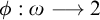 such that
$\phi ^{-1}(0)$
 is infinite and

for each
$\alpha $
 . Set

Fix
$p_\alpha \in G\cap D^{\mathsf {coord}}_\alpha $
 for
$\alpha \in \kappa $
 . Then choose
$n_\alpha \in \omega $
 large enough for
$\alpha \in \kappa $
 so that each

Finally, set
$z_\alpha =(v_\alpha \cap w_\alpha )\setminus n_\alpha \in \mathcal {F}_\alpha $
 for
$\alpha \in \kappa $
 . It is clear that the following two claims will conclude the proof.
Claim 4.
$Q'$
 is crowded.
Proof. Pick
$r\in Q'$
 . Let
$F\in [\kappa ]^{<\omega }$
 and
$\ell \in \omega $
 . We will find
$r'\in Q'$
 such that
$r'\neq r$
 and
$r'\upharpoonright (F\times \ell )=r\upharpoonright (F\times \ell )$
 . Fix
$n\geq 1$
 such that
$k_{n-1}\geq \ell $
 . Using Claims 1 and 2, it is possible to find
$p\in G$
 such that
$n^p\geq n$
 and
$F^p\supseteq F$
 . Let
$s\in \mathcal {S}$
 be such that
$s\subseteq \phi $
 and
$\zeta (s)=r$
 . Let
$j\in \omega $
 be the unique index such that
$s=t^{s'}_j$
 for every
$s'\in 2^{<\omega }$
 such that
$s\subsetneq s'$
 . By condition
$(2)$
 , it is possible to find
$s'\in \mathcal {S}$
 such that
$s\subsetneq s'\subseteq \phi $
 ,
$|s'|>n^p$
 and
$\psi (\ell _{s'})= j$
 . Set
$r'=\zeta (s')$
 , and observe that
$r'\neq r$
 by condition
$(6)$
 . Finally, pick
$q\in G$
 such that
$q\leq p$
 and
$n^q\geq |s'|$
 . It follows from condition
$(12)$
 that

Since
$\zeta \big (t^{s'}_{\psi (\ell _{s'})}\big )=\zeta \big (t^{s'}_j\big )=\zeta (s)=r$
 , this shows that
$r'$
 is as desired.
Claim 5.
$\pi _\alpha [Q']\subseteq z_\alpha \!\uparrow $
 for every
$\alpha \in \kappa $
 .
Proof. Pick
$\alpha \in \kappa $
 . We will use induction to show that
$z_\alpha \subseteq \pi _\alpha \big (\zeta (\phi \upharpoonright n)\big )$
 for every
$n\in \omega $
 such that
$\phi \upharpoonright n\in \mathcal {S}$
 . The case
$n=0$
 is clear by our choice of
$v_\alpha $
 . Now assume that
$n\geq 1$
 and
$s=\phi \upharpoonright n\in \mathcal {S}$
 . If
$n\leq n^{p_\alpha }$
 then
$z_\alpha \subseteq \pi _\alpha \big (\zeta (s)\big )$
 by our choice of
$n_\alpha $
 , so assume that
$n>n^{p_\alpha }$
 . Let
$k\in z_\alpha $
 . We will show that
$k\in \pi _\alpha \big (\zeta (s)\big )$
 by considering the following cases:
-
• $k\in [0,k_{n-1})$
. -
• $k\in [k_{n-1},k_n)$
. -
• $k\in [k_n,\infty )$
.
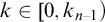


First assume that
$k\in [0,k_{n-1})$
 . Pick
$q\in G$
 such that
$q\leq p_\alpha $
 and
$n^q\geq n$
 . Since we have assumed that
$n>n^{p_\alpha }$
 , condition
$(12)$
 guarantees that

for some
$s'\in \mathcal {S}$
 such that
$s'\subsetneq s$
 . Therefore, the desired conclusion follows from the inductive hypothesis. The case
$k\in [k_{n-1},k_n)$
 is impossible, since
$\phi (n-1)=s(n-1)=0$
 implies that
$[k_{n-1},k_n)\cap z_\alpha =\varnothing $
 by our choice of
$w_\alpha $
 . To conclude the proof, assume that
$k\in [k_n,\infty )$
 . By picking
$q\in G$
 as above and using the assumption that
$n>n^{p_\alpha }$
 , one sees that
$v_\alpha \setminus k_n\subseteq \pi _\alpha \big (\zeta (s)\big )$
 by condition
$(13)$
 . Since
$z_\alpha \subseteq v_\alpha $
 , it follows that
$k\in \pi _\alpha \big (\zeta (s)\big )$
 .
It seems worthwhile to state the following corollaryFootnote 5 explicitly; however, in the proof of Theorem 5.1, we will need the stronger result given by Lemma 4.1.
Corollary 4.2. Let
$\kappa <\mathfrak {p}$
 be a cardinal, and let
$\mathcal {F}_\alpha $
 be non-meager
$\mathsf {P}$
 -filters for
$\alpha \in \kappa $
 . Then
$\prod _{\alpha \in \kappa }\mathcal {F}_\alpha $
 has the
$\mathsf {MP}$
 .
The above corollary suggests the following question (see also Theorem 8.2).
Question 4.3. Let
$\kappa <\mathfrak {p}$
 be a cardinal, and let
$X_\alpha $
 be separable metrizable spaces with the
$\mathsf {MP}$
 for
$\alpha \in \kappa $
 . Does it follow that
$\prod _{\alpha \in \kappa }X_\alpha $
 has the
$\mathsf {MP}$
 ?
We remark that, using Corollary 4.2, it is possible to show that the intersection of fewer that
$\mathfrak {p}$
 non-meager
$\mathsf {P}$
 -filters is a non-meager
$\mathsf {P}$
 -filter. We will omit the details however, since Corollary 6.3 gives a better result (better because
$\mathfrak {p}\leq \mathsf {add}(m^0)$
 by [Reference Goldstern, Repický, Shelah and Spinas7, Theorem 1.1]).
5 A partial answer to Hrušák’s question
In this section, we will combine the results that we have discussed so far to finally prove one half of Conjecture 1.3, as promised.
Theorem 5.1. Let
$\kappa $
 be a cardinal and let
$\mathcal {F}_\alpha $
 be filters for
$\alpha \in \kappa $
 . If
$\prod _{\alpha \in \kappa }\mathcal {F}_\alpha $
 is
$\mathsf {CDH}$
 then
$\kappa <\mathfrak {p}$
 and each
$\mathcal {F}_\alpha $
 is a non-meager
$\mathsf {P}$
 -filter.
Proof. Set
$X=\prod _{\alpha \in \kappa }\mathcal {F}_\alpha $
 , and denote the projections by
$\pi _\alpha :X\longrightarrow \mathcal {F}_\alpha $
 for
$\alpha \in \kappa $
 . Assume that X is
$\mathsf {CDH}$
 . By [Reference Engelking5, Exercise 2.3.F.(c)], we must have
$\kappa \leq \mathfrak {c}$
 , otherwise X would not be separable. It now follows from [Reference Medini and Steprāns18, Theorem 8.1] that
$\kappa <\mathfrak {p}$
 .
It remains to show that each
$\mathcal {F}_\alpha $
 is a non-meager
$\mathsf {P}$
 -filter. By Theorem 1.1, it will suffice to show that each
$\mathcal {F}_\alpha $
 has the
$\mathsf {MP}$
 . In fact, since X contains closed copies of each
$\mathcal {F}_\alpha $
 , it will be enough to show that X has the
$\mathsf {MP}$
 . First assume that
$\kappa $
 is finite. In this case, since X is homeomorphic to a filter by Proposition 3.3, the desired conclusion follows from Theorem 1.1.
Now assume that
$\kappa $
 is infinite. In this case, it follows from Theorem 2.1 that X is a Baire space, hence non-meager. Since each
$\pi _\alpha $
 is open, it follows that each
$\mathcal {F}_\alpha $
 is non-meager. To see that X has the
$\mathsf {MP}$
 , pick a countable crowded
$Q\subseteq X$
 . Fix countable dense subsets D and E of X such that
$D\supseteq Q$
 and
$E\subseteq \mathsf {Cof}^\kappa $
 . Since X is
$\mathsf {CDH}$
 , there exists a homeomorphism
$h:X\longrightarrow X$
 such that
$h[D]=E$
 . Set
$R=h[Q]\subseteq \mathsf {Cof}^\kappa $
 . Since every subset of
$\mathsf {Cof}$
 has
$\omega $
 as a pseudointersection, we can apply Lemma 4.1, which yields a crowded
$R'\subseteq R$
 whose closure in X is compact. To conclude the proof, set
$Q'=h^{-1}[R']$
 , and observe that
$Q'\subseteq Q$
 . Since h is a homeomorphism, it is clear that
$Q'$
 is crowded and its closure in X is compact.
6 Miller-measurability versus the Miller property
Given a separable metrizable space Z, we will say that
$X\subseteq Z$
 is Miller-null if for every closed copy N of
$\omega ^\omega $
 in Z there exists a closed copy
$N'\subseteq N$
 of
$\omega ^\omega $
 in Z such that
$N'\cap X=\varnothing $
 ; we will say that X is Miller-full if
$Z\setminus X$
 is Miller-null.Footnote
6
Using Theorem 2.2 plus standard arguments involving trees, one sees that the notions defined above are equivalent to the classical ones (see for example [Reference Goldstern, Repický, Shelah and Spinas7]) when
$Z=\omega ^\omega $
 . Recall that

is the Miller ideal and that

denotes the additivity of
$m^0$
 . It is well-known that
$\omega _1\leq \mathsf {add}(m^0)\leq \mathfrak {c}$
 , where the first inequality follows from a standard fusion argument, and the second inequality is trivial. In fact, as we already mentioned at the end of Section 4, the inequality
$\mathfrak {p}\leq \mathsf {add}(m^0)$
 holds.
Since the definition of the
$\mathsf {MP}$
 was inspired by an argument from [Reference Miller20], it is not surprising that it is strongly connected to the above notions of Miller-measurability. This connection was already exploited in [Reference Medini and Zdomskyy19], but the following result describes it explicitly. Proposition 6.1 will be applied several times in the next two sections.
Proposition 6.1. Let X be a separable metrizable space. Then the following conditions are equivalent:
-
(1) X has the $\mathsf {MP}$
. -
(2) For every metrizable compactification $\gamma X$
of X and for every countable dense subset D of X, the set
$X\setminus D$
is Miller-full in
$\gamma X\setminus D$
. -
(3) There exists a metrizable compactification $\gamma X$
of X such that for every countable dense subset D of X, the set
$X\setminus D$
is Miller-full in
$\gamma X\setminus D$
.


Proof. In order to prove the implication
$(1)\rightarrow (2)$
 , assume that condition
$(1)$
 holds. Fix a metrizable compactification
$\gamma X$
 of X; we will use
$\mathsf {cl}$
 to denote closure in
$\gamma X$
 . Pick a countable dense
$D\subseteq X$
 , and a closed copy N of
$\omega ^\omega $
 in
$\gamma X\setminus D$
 . Set
$Q=\mathsf {cl}(N)\cap D$
 , and observe that Q is crowded by Lemma 2.4. Therefore, by the
$\mathsf {MP}$
 , there exists a crowded
$Q'\subseteq Q$
 such that
$\mathsf {cl}(Q')\subseteq X$
 . Set
$N'=\mathsf {cl}(Q')\setminus D\subseteq X\setminus D$
 . Using Theorem 2.2, one sees that
$N'\subseteq N$
 is a closed copy of
$\omega ^\omega $
 in
$\gamma X\setminus D$
 , as desired.
The implication
$(2)\rightarrow (3)$
 is trivial. In order to prove the implication
$(3)\rightarrow (1)$
 , assume that condition
$(3)$
 holds. Pick a countable crowded
$Q\subseteq X$
 . Let
$D\supseteq Q$
 be a countable dense subset of X. Using [Reference Engelking5, Exercise 7.4.17], it is possible to find a zero-dimensional Polish subspace Z of
$\gamma X$
 such that
$Z\cap D=Q$
 . Since Polish spaces have the
$\mathsf {MP}$
 by [Reference Medini and Zdomskyy19, Proposition 2.3], there exists a compact subspace K of Z such that
$K\cap Q$
 is crowded and dense in K; we will use
$\mathsf {cl}$
 to denote closure in K. Set
$N=K\setminus Q$
 , and observe that N is homeomorphic to
$\omega ^\omega $
 by Theorem 2.2. Furthermore, the fact that
$N=(\gamma X\setminus D)\cap K$
 shows that N is closed in
$\gamma X\setminus D$
 . It follows from condition
$(3)$
 that there exists a closed copy
$N'\subseteq N$
 of
$\omega ^\omega $
 in
$\gamma X\setminus D$
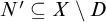
 such that
$N'\subseteq X\setminus D$
 . Set
$Q'=\mathsf {cl}(N')\cap Q$
 , and observe that
$Q'$
 is crowded by Lemma 2.4. On the other hand
$\mathsf {cl}(Q')\subseteq \mathsf {cl}(N')\subseteq N'\cup D\subseteq X$
 , which shows that
$Q'$
 has compact closure in X, as desired.
We conclude this section by pointing out that the above characterization has some interesting consequences concerning non-meager
$\mathsf {P}$
 -filters.
Corollary 6.2. Let
$\mathcal {F}$
 be a filter. Then the following conditions are equivalent:
-
• $\mathcal {F}$
is a non-meager
$\mathsf {P}$
-filter. -
• $\mathcal {F}\setminus D$
is Miller-full in
$2^\omega \setminus D$
for every countable dense subset D of
$\mathcal {F}$
.


Corollary 6.3. Let
$\kappa <\mathsf {add}(m^0)$
 be a non-zero cardinal, and let
$\mathcal {F}_\alpha $
 be non-meager
$\mathsf {P}$
 -filters for
$\alpha \in \kappa $
 . Then
$\bigcap _{\alpha \in \kappa }\mathcal {F}_\alpha $
 is a non-meager
$\mathsf {P}$
 -filter.


7 Preservation of the Miller property under intersections
In this section, we will see that the
$\mathsf {MP}$
 is preserved by sufficiently small intersections. This shows that Corollary 6.3 is just a particular case of a more general phenomenon.
Theorem 7.1. Let
$\kappa <\mathsf {add}(m^0)$
 be a non-zero cardinal, let Z be a separable metrizable space, and let
$X_\alpha $
 be subspaces of Z with the
$\mathsf {MP}$
 for
$\alpha \in \kappa $
 . Then
$\bigcap _{\alpha \in \kappa }X_\alpha $
 has the
$\mathsf {MP}$
 .
Proof. Set
$X=\bigcap _{\alpha \in \kappa }X_\alpha $
 , and pick a countable crowded
$Q\subseteq X$
 . Fix a metrizable compactification
$\gamma X$
 of X. First, using [Reference Engelking5, Exercise 7.4.17], find a zero-dimensional Polish subspace W of
$\gamma X$
 such that
$Q\subseteq W$
 . Since Polish spaces have the
$\mathsf {MP}$
 by [Reference Medini and Zdomskyy19, Proposition 2.3], there exists a compact subspace K of W such that
$K\cap Q$
 is crowded and dense in K; we will use
$\mathsf {cl}$
 to denote closure in K.
Set
$X'=X\cap K$
 and
$X^{\prime }_\alpha =X_\alpha \cap K$
 for
$\alpha \in \kappa $
 . Observe that each
$X^{\prime }_\alpha $
 has the
$\mathsf {MP}$
 because it is a closed subspace of
$X_\alpha $
 . Furthermore, it is clear that K is a metrizable compactification of each
$X^{\prime }_\alpha $
 because
$K\cap Q\subseteq X^{\prime }_\alpha $
 . It follows from Proposition 6.1 that each
$X^{\prime }_\alpha \setminus Q$
 is Miller-full in
$K\setminus Q$
 . Since
$K\setminus Q$
 is homeomorphic to
$\omega ^\omega $
 by Theorem 2.2, the assumption
$\kappa <\mathsf {add}(m^0)$
 ensures that
$X'\setminus Q$
 is Miller-full in
$K\setminus Q$
 . In particular, there exists a closed copy N of
$\omega ^\omega $
 in
$K\setminus Q$
 such that
$N\subseteq X'\setminus Q$
 . Set
$Q'=\mathsf {cl}(N)\cap Q$
 , and observe that
$Q'$
 is crowded by Lemma 2.4. On the other hand
$\mathsf {cl}(Q')\subseteq \mathsf {cl}(N)\subseteq N\cup Q\subseteq X$
 , which shows that
$Q'$
 has compact closure in X, as desired.
Naturally, it would be nice to confirm that
$\mathsf {add}(m^0)$
 is optimal.
Question 7.2. Set
$\kappa =\mathsf {add}(m^0)$
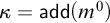 . Are there a separable metrizable space Z and subspaces
$X_\alpha $
 of Z with the
$\mathsf {MP}$
 for
$\alpha \in \kappa $
 such that
$\bigcap _{\alpha \in \kappa }X_\alpha $
 does not have the
$\mathsf {MP}$
 ?
8 Preservation of the Miller property under products
We conclude by showing that the
$\mathsf {MP}$
 is preserved by countable products (see also Question 4.3). First we will focus on the following very special case, then we will apply Theorem 7.1 to obtain the full result.
Lemma 8.1. Let X be a separable metrizable space with the
$\mathsf {MP}$
 , and let K be a compact metrizable space. Then
$X\times K$
 has the
$\mathsf {MP}$
 .
Proof. Fix a metrizable compactification
$\gamma X$
 of X. We will show that condition
$(3)$
 of Proposition 6.1 holds for the compactification
$\gamma X\times K$
 of
$X\times K$
 ; we will use
$\mathsf {cl}$
 to denote closure in
$\gamma X\times K$
 . So pick a countable dense subset D of
$X\times K$
 , and a closed copy N of
$\omega ^\omega $
 in
$(\gamma X\times K)\setminus D$
 . Denote by
$\pi :\gamma X\times K\longrightarrow \gamma X$
 the projection, and set
$E=\pi [D]$
 . Given
$x\in E$
 , set
$D_x=(\mathsf {cl}(N)\setminus N)\cap (\{x\}\times K)$
 , and observe that each
$D_x\subseteq D$
 .
Case 1. There exists
$x\in E$
 such that
$D_x$
 is non-scattered.
Let
$Q\subseteq D_x$
 be crowded. Set
$N'=\mathsf {cl}(Q)\setminus D$
 , and observe that
$N'\subseteq N$
 because
$\mathsf {cl}(Q)\subseteq \mathsf {cl}(N)\subseteq N\cup D$
 . Furthermore, it is clear that
$N'$
 is closed in
$(\gamma X\times K)\setminus D$
 . At this point, one sees that
$N'$
 is homeomorphic to
$\omega ^\omega $
 by Theorem 2.2. Finally, the fact that
$\mathsf {cl}(Q)\subseteq \{x\}\times K\subseteq X\times K$
 shows that
$N'\subseteq (X\times K)\setminus D$
 .
Case 2.
$D_x$
 is scattered for every
$x\in E$
 .
Since scattered separable metrizable spaces are Polish (see [Reference Kechris13, Corollary 21.21]), we see that
$(\{x\}\times K)\setminus D_x$
 must be
$\sigma $
 -compact for every
$x\in E$
 . Hence,

is
$\sigma $
 -compact for every
$x\in E$
 .
Set
$Z=(\gamma X\setminus E)\times K$
 , and observe that
$N\setminus (E\times K)$
 is an analytic subset of the Polish space Z. Assume, in order to get a contradiction, that
$N\setminus (E\times K)$
 is contained in a
$\sigma $
 -compact subspace of Z. Since E is countable and
$N\cap (\{x\}\times K)$
 is
$\sigma $
 -compact for every
$x\in E$
 , it follows that N itself is
$\sigma $
 -compact, a contradiction. Therefore, by Theorem 2.3, we can assume without loss of generality that N is a (closed) subset of Z.
Now set
$W=\gamma X\setminus E$
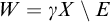 , and observe that
$\pi [N]$
 is an analytic subset of the Polish space W. If
$\pi [N]$
 were contained in a
$\sigma $
 -compact subspace of W, then it would easily follow that N is
$\sigma $
 -compact, a contradiction. Therefore, by Theorem 2.3, there exists a closed copy M of
$\omega ^\omega $
 in W such that
$M\subseteq \pi [N]$
 . But X has the
$\mathsf {MP}$
 , so by Proposition 6.1 there exists a closed copy
$M'\subseteq M$
 of
$\omega ^\omega $
 in W such that
$M'\subseteq X\setminus E$
 .
Finally, set
$N'=N\cap \pi ^{-1}[M']$
 , and observe that
$N'$
 is a closed subset of Z. Therefore, if
$N'$
 were contained in a
$\sigma $
 -compact subspace of Z, then
$N'$
 itself would be
$\sigma $
 -compact, contradicting the fact that
$\pi [N']=M'$
 . It follows from Theorem 2.3 that there exists a closed copy
$N"$
 of
$\omega ^\omega $
 in Z such that
$N"\subseteq N'$
 . It is easy to realize that
$N"$
 is a closed copy of
$\omega ^\omega $
 in
$(\gamma X\times K)\setminus D$
 such that
$N"\subseteq (X\times K)\setminus D$
 .
Theorem 8.2. Let
$\kappa \leq \omega $
 be a cardinal, and let
$X_\alpha $
 be separable metrizable spaces with the
$\mathsf {MP}$
 for
$\alpha \in \kappa $
 . Then
$\prod _{\alpha \in \kappa }X_\alpha $
 has the
$\mathsf {MP}$
 .
Proof. Fix metrizable compactifications
$\gamma X_\alpha $
 of
$X_\alpha $
 for
$\alpha \in \kappa $
 . Set
$Z=\prod _{\alpha \in \kappa }\gamma X_\alpha $
 , and observe that Z is separable metrizable because
$\kappa \leq \omega $
 . Define

for
$\alpha \in \kappa $
 , and observe that each
$X^{\prime }_\alpha $
 has the
$\mathsf {MP}$
 by Lemma 8.1. Since clearly
$\prod _{\alpha \in \kappa }X_\alpha =\bigcap _{\alpha \in \kappa }X^{\prime }_\alpha $
 , the desired conclusion follows from Theorem 7.1.
As in Section 6, we could formulate explicitly the particular case of Theorem 8.2 in which every
$X_\alpha $
 is a filter. We will refrain from doing so however, because this would amount to repeating Proposition 3.3, whose proof is much more direct.
We remark that the above result is somewhat relevant to a question of Fitzpatrick and Zhou [Reference Fitzpatrick and Zhou6, Problem 4], which can be interpreted as asking for a “natural” topological property
$\mathcal {P}$
 such that a zero-dimensional separable metrizable space X has property
$\mathcal {P}$
 iff
$X^\omega $
 is
$\mathsf {CDH}$
 . Notice that any property which satisfies this requirement would have to be preserved by countable powers. In particular, Theorem 8.2 could be viewed as encouraging by anyone who thinks that the
$\mathsf {MP}$
 might be a good candidate for such a property.
Acknowledgments
The author is grateful to Yurii Khomskii for directing him to the article [Reference Goldstern, Repický, Shelah and Spinas7].
Funding
This research was funded in whole by the Austrian Science Fund (FWF) DOI 10.55776/P35588.


 Open access

