INTRODUCTION
The rodent-specific species of Eimeria (Apicomplexa: Coccidea) are among the best represented eimerians in phylogenetic and evolutionary studies. Relevant molecular data (i.e. 18S rDNA) are currently available from 22 species infecting 11 host genera. Their phylogenetic analyses show that most of the biological and morphological characteristics used to classify these parasites are not phylogenetically informative (Eberhard et al. Reference Eberhard, da Silva, Lilley and Pieniazek1999; Zhao et al. Reference Zhao, Duszynski and Loker2001; Morrison et al. Reference Morrison, Bornstein, Thebo, Wernery, Kinne and Mattsson2004; Matsubayashi et al. Reference Matsubayashi, Takami, Niichiro, Kimata, Tani, Sasai and Baba2005; Samarasinghe et al. Reference Samarasinghe, Johnson and Ryan2008). However, 2 features seem to display some degree of ‘phylogenetic conservativeness’ – the presence/absence of an oocyst residuum and host specificity (Hnida and Duszynski, Reference Hnida and Duszynski1999a,Reference Hnida and Duszynskib; Zhao and Duszynski, Reference Zhao and Duszynski2001a,Reference Zhao and Duszynskib; Matsubayashi et al. Reference Matsubayashi, Takami, Niichiro, Kimata, Tani, Sasai and Baba2005; Kvičerová et al. Reference Kvičerová, Pakandl and Hypša2008). More specifically, analyses within a broader phylogenetic context indicate that the rodent-specific Eimeria species cluster in 2 monophyletic but unrelated branches that differ in the presence/absence of oocyst residuum (Zhao et al. Reference Zhao, Duszynski and Loker2001; Morrison et al. Reference Morrison, Bornstein, Thebo, Wernery, Kinne and Mattsson2004; Matsubayashi et al. Reference Matsubayashi, Takami, Niichiro, Kimata, Tani, Sasai and Baba2005).
However, these samples still represent only a small portion of the known diversity of the rodent eimerians and cover just 3 out of all rodent families, Cricetidae, Heteromyidae and Muridae. The availability of precise morphological descriptions together with informative molecular data on a representative set of the species is a prerequisite for any meaningful analysis of eimerian diversity and evolution. However, while hundreds of species have so far been described from various taxonomic groups of rodents (Pellérdy, Reference Pellérdy1974; Levine and Ivens, Reference Levine and Ivens1990), their descriptions as well as the subsequent reports are often incomplete and do not allow for their mutual comparison.
Eimeria myoxi from the garden dormouse, Eliomys quercinus Linnaeus, 1766 (Rodentia: Gliridae), is a good example of this issue. This species was described and named by Galli-Valerio in 1940 but the description consisted of only the oocyst shape, length and width. This had made it difficult for later researchers to relate eimerians from other closely related hosts to E. myoxi as well as to one another (Pellérdy, Reference Pellérdy1974; Golemansky and Darwish, Reference Golemansky and Darwish1993; Bertolino and Canestri-Trotti, Reference Bertolino and Canestri-Trotti2005). Since no molecular data are available for any of these studies and the descriptions given are quite vague, it is impossible to judge on the species identity and various traits (strict host specificity vs broader host specificity, oocyst variability vs uniformity) of the observed parasites.
Here we provide morphological and molecular data on a species of Eimeria found infecting the garden dormouse. The main goal of this re-description is to establish a complex characterization of this eimerian species, which could then be unequivocally utilized in future phylogenetic and evolutionary studies. We also show the phylogenetic relationship of this species to other related eimerian lineages. It is pertinent to emphasize that from the perspective of host phylogeny, the garden dormouse is the first representative from the squirrel-related clade (Blanga-Kanfi et al. Reference Blanga-Kanfi, Miranda, Penn, Pupko, DeBry and Huchon2009) for which an Eimeria-derived dataset suitable for phylogenetic analysis is made available.
MATERIALS AND METHODS
Sample collections
The garden dormice were live-trapped during their nocturnal activity using baited home-made wooden traps and/or Sherman traps placed on the ground. During the course of 2006–2009, we caught 53 specimens in the Bohemian Forest (Plzeň Region, Czech Republic); 35 individuals originated from the northwestern part of the Šumava National Park (Šumavské pláně geomorphological unit) and 18 were trapped at Královský Hvozd Ridge in the Šumava Protected Landscape Area. We also included 1 garden dormouse, which was trapped in the nearby Český Les Mountains (Mikeš et al. Reference Mikeš, Cehláriková and Řepa2007). All animals were released at the site of trapping and fresh feces were collected from every live-trap. As we never caught more than 1 garden dormouse per trap, there is no doubt that each fecal sample represents a single individual. Sampled animals were given individual ear-marks in order to prevent their re-sampling on the occasion that they were trapped again. The animals represent a critically endangered species in the Czech Republic and were trapped under official permission of the Šumava National Park and Protected Landscape Area (Nos. SZ NPS 02211/2006 - NPS 04689/2006, NPS 02844/2006) and Ministry of Education, Youth and Sports of the Czech Republic (No. 26295/2007-30).
Sample treatment and oocyst morphology
Fresh feces from each individual animal were stored separately in plastic vials with 4% (w/v) potassium dichromate solution (K2Cr2O7) and examined by the standard flotation technique with Sheather´s sucrose solution (sp.gr. 1.30). Sporulated oocysts (n=250) were measured and characterized according to the protocol of Duszynski and Wilber (Reference Duszynski and Wilber1997), using an Olympus BX51 microscope equipped with an Olympus Camedia C-5060W camera and Quick Photo Pro v. 2.0 PC software.
DNA extraction, PCR and sequencing
The total DNA of E. myoxi was extracted by the standard phenol-chloroform procedure. Nuclear 18S rDNA (∼1500 bp), plastid ORF 470 (∼700 bp) and mitochondrial cytochrome c oxidase subunit I (COI; ∼400 bp) genes were amplified by PCR in a 25 μl volume using specific primers (Zhao and Duszynski, Reference Zhao and Duszynski2001a; Kvičerová et al. Reference Kvičerová, Pakandl and Hypša2008; Schwarz et al. Reference Schwarz, Jenkins, Klopp and Miska2009) as follows.
18S rDNA
Initial inactivation-denaturation step at 95°C for 15 min, followed by 30 cycles of 95°C denaturation for 45 s, primer annealing at 53°C for 45 s, and elongation at 72°C for 90 s. A final primer extension of 10 min at 72°C completed the amplification process.
ORF 470
Initial inactivation-denaturation step at 95°C for 15 min, followed by 30 cycles of 94°C denaturation for 60 s, primer annealing at 48°C for 180 s, and elongation at 72°C for 120 s. A final primer extension of 10 min at 72°C.
COI
Initial inactivation-denaturation step at 95 °C for 15 min, followed by 35 cycles of 95°C denaturation for 45 s, primer annealing at 55°C for 45 s, and elongation at 72°C for 90 s. A final primer extension of 10 min at 72°C. The HotStarTaq DNA Polymerase (Qiagen) was used in all PCR reactions.
The amplicons were directly cloned into the pGEM – T Easy Vector (Promega). Plasmids with DNA inserts of the expected size were isolated using the PureLink Quick Plasmid Miniprep Kit (Invitrogen). The sequencing of 5 clones from each sample was performed with the PCR primers (18S rDNA, ORF 470, COI) and 4 internal primers (18S rDNA) on an automatic 3730xl DNA analyzer (Macrogen, Korea). The obtained sequences were identified by BLAST analysis. Sequences were assembled and edited using the Sequence Scanner v. 1.0 software (Applied Biosystems, USA) and DNASTAR program package (DNASTAR, Inc). The sequences were deposited in the GenBank database (NCBI) under the Accession numbers JF304148 and JF304151.
Sequence alignment and phylogenetic analyses
Since only a limited number of ORF 470 sequences is available for Eimeria species, we designed different sequence sample matrices for each gene. The 18S rDNA matrix contained 38 sequences, including all available rodent Eimeria and selected sequences representing other clades. Toxoplasma gondii and Goussia neglecta were used as outgroups. A more restricted matrix was prepared for the ORF 470 gene; it contained 13 eimerian sequences and a T. gondii sequence as an outgroup. The alignment of 18S rDNA was created with the MAFFT v. 6 program (Katoh et al. Reference Katoh, Misawa, Kuma and Miyata2002, Reference Katoh, Kuma, Toh and Miyata2005) using the G-INS-i algorithm with default parameters. The unreliably aligned regions were identified and removed with the Gblocks program (Castresana, Reference Castresana2000; Talavera and Castresana, Reference Talavera and Castresana2007). Sequences of the ORF 470 gene were aligned in the DNASTAR suite MegAlign program in the aminoacid mode. The alignment was then switched to nucleotide mode and used for the analyses. Considering the different taxa composition of the 18S rDNA and ORF 470 datasets, the two matrices were analysed separately. Three different phylogenetic approaches were applied to each matrix: Maximum parsimony (MP), Maximum likelihood (ML) and Bayesian probability (BP). MP analyses were performed in PAUP (Swofford, Reference Swofford2001), ML in PHYML (Guindon and Gascuel, Reference Guindon and Gascuel2003) and BP in MrBayes (Huelsenbeck and Ronquist, Reference Huelsenbeck and Ronquist2001). A heuristic search with 100 replications of random sequence addition was performed under the parsimony criterion with assumptions of the tv/ts ratios 1:1, 1:2, and 1:3. Evolutionary models used in ML and BP (TrN+I+G for 18S rDNA and HKY+G for ORF 470) were identified using the jModeltest program (Posada, Reference Posada2008, Reference Posada2009). The mcmcmc was run for 5 million generations with sampling set for each 100th generation. Successful chain convergence was verified by the standard deviation of split frequencies and PSRF; the burnin was set to 25% of the sample. The trees were visualized and exported using TreeView v. 1.6.6. (Page, Reference Page1996).
RESULTS
Of the 54 garden dormice sampled from the Bohemian Forest and Český Les Mountains, 46 (85·2%) were found to contain eimerian oocysts in their feces. Other identified endoparasites belonged to the nematode families Strongylidae (4/54; 7·4%) and Trichuridae (4/54; 7·4%), as well as the cestode families Hymenolepididae (2/54; 3·7%) and Taeniidae (3/54; 5·6%). Based on oocyst morphology, all eimerian infections represent a single species. For the 12 samples analysed by molecular methods, conspecifity was further verified by a high degree of sequence similarity in both the 18S rRNA and ORF 470 genes (the variability did not exceed 0·5% and 0·4%, respectively). The oocyst size and shape correspond to the original description of E. myoxi by Galli-Valerio (Reference Galli-Valerio1940) and also to the report of Bertolino and Canestri-Trotti (Reference Bertolino and Canestri-Trotti2005). Since no other criteria are provided in the original description, we consider this coccidium to be E. myoxi.
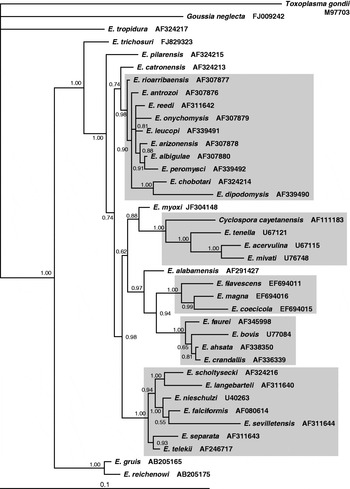
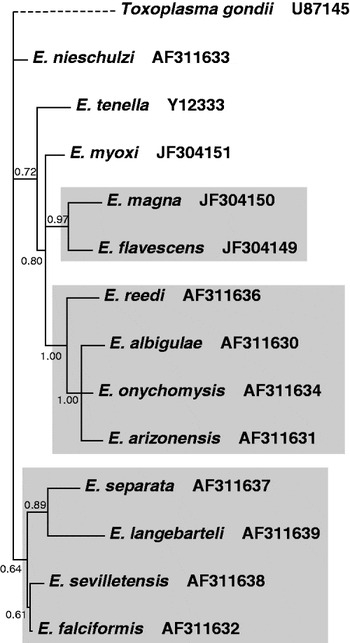
Three different genes were sequenced for this eimerian species: 18S rDNA, ORF 470 and COI. The lengths of the sequences were 1449, 681 and 404 bp, respectively. Phylogenetic analyses based on the 18S rDNA and ORF 470 gene yielded an unstable position of the E. myoxi sequences in the context of other eimerian species. This unstability, however, was not due to an overall lack of the phylogenetic signal in the matrix or the tree resolution: the rest of the sequences displayed a strong tendency towards forming a consistent pattern of 4 stable clusters, 2 rodent-specific, 1 poultry-specific and 1 rabbit-specific. These clusters were formed in both probability-based approaches (ML and BP) and in MP under the tv/ts ratios 1:1 and 1:3. The tv/ts ratio 1:3 yielded unstable topologies with strict consensus containing large polytomies. None of the analyses placed E. myoxi within either of the host-specific clusters (Figs 3 and 4).
Phylogenetic tree obtained by BP analysis using nuclear 18S rDNA gene. The values at the nodes represent the posterior probabilities of the clusters. The shaded boxes designate the clusters also revealed by the ML analysis and MP analyses under the assumption of tv/ts ratios 1:1 and 1:2.

Phylogenetic tree obtained by BP analysis using plastid ORF 470 gene. The values at the nodes represent the posterior probabilities of the clusters. The shaded boxes designate the clusters also revealed by the ML analysis and MP analyses under the assumption of tv/ts ratios 1:1 and 1:2.

Re-description of Eimeria myoxi Galli-Valerio, Reference Galli-Valerio1940( Figs 1and 2)
Type host: Eliomys quercinus (Linnaeus, 1766), garden dormouse
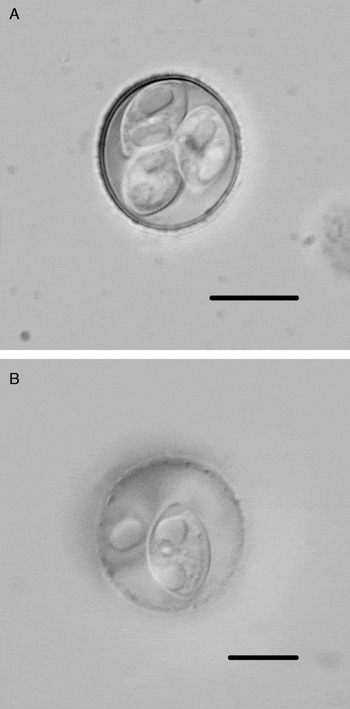
(A–B) Photomicrographs of sporulated oocysts of Eimeria myoxi obtained from the feces of Eliomys quercinus caught in the Czech Republic. Scale bar=10 μm for both figures. (B) Detail of the sporocyst.

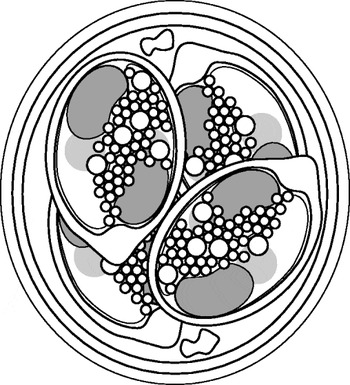
Composite line drawing of sporulated oocyst of described Eimeria myoxi.

(Rodentia: Gliridae)
Type locality: Switzerland (Galli-Valerio, Reference Galli-Valerio1940)
Other localities:
Italy (Champdepraz Valley, northwestern Alps; Bertolino and Canestri-Trotti, Reference Bertolino and Canestri-Trotti2005),
Czech Republic (Bohemian Forest, 49°N, 013°E, 600–1240 m a.s.l.; Český Les Mountains, 49°45´N, 012°27´E, 770 m a.s.l.; this study)
Other hosts: Eliomys melanurus (Wagner, 1840), Asian garden dormouse (Golemansky and Darwish, Reference Golemansky and Darwish1993)
Sporulated oocyst:
Oocyst shape: subspherical.
Oocyst wall: bilayered; outer wall slightly pitted, yellowish, ∼0·5 μm thick; inner wall smooth, ∼0·5 μm thick.
L×W (n=250): 18·1×16·9 (16–20×15–18) μm; SI=1·07 (1·06–1·19)
M: absent.
OR: absent.
PG: always present, several (1–4) granules of irregular shape, ∼2 μm in diameter.
Sporocyst and sporozoites:
Sporocyst shape: lemon-shaped.
L×W (n=250): 10·2×6·5 (9–11×6–8) μm; SI=1·57 (1·25–1·83)
SB: distinct, ∼1 μm, nipple-like; SSB: absent; PSB: absent.
SR: small granules scattered within the sporocyst, ∼0·5–1 μm in diameter.
SRB: bean-shaped, 4×2·5 μm.
Sporozoite nucleus: spherical, ∼2 μm in diameter, centrally located.
Prevalence: 46/54 (85·2%).
Sporulation: Exogenous.
Pre-patent and patent periods: Unknown.
Site of infection: Unknown, oocysts were found in the feces.
Endogenous stages: Unknown.
Pathology: None reported to date.
Cross-transmission studies: Pellérdy (Reference Pellérdy1954) failed to transmit E. myoxi from Eliomys quercinus to Eurasian red squirrel (Sciurus vulgaris).
Material deposited: Biology Centre, Institute of Parasitology, Academy of Sciences of the Czech Republic, Laboratory of Molecular Phylogeny and Evolution of Parasites, České Budějovice, Czech Republic; Sample nos.: EQ-V4, EQ-V18, EQ-V26, EQ-V28, EQ-V29, and EQ-08-10.
DISCUSSION
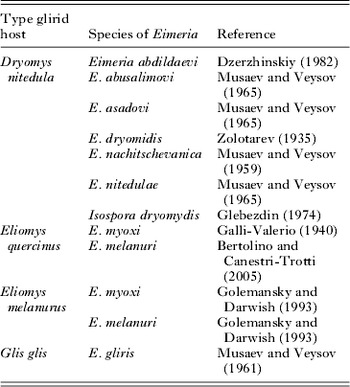
Based on the morphological and molecular data, the eimerian infections from all 46 specimens of the garden dormouse represent a single species, corresponding to the original description of E. myoxi by Galli-Valerio (Reference Galli-Valerio1940). This raises the question about the identity of the infections reported by some other authors. For example, the oocyst size reported from the same host by Pellérdy (Reference Pellérdy1974) considerably exceeds the variability observed in our material. Moreover, the presence of an “indistinct micropyle” is reported in Pellérdy's description, while we did not observe this structure in our samples. Other ambiguous observations are the supposedly mixed infections by the two species, E. myoxi and E. melanuri, in a single host, as reported by Golemansky and Darwish (Reference Golemansky and Darwish1993) from Eliomys melanurus, and Bertolino and Canestri-Trotti (Reference Bertolino and Canestri-Trotti2005) from Eliomys quercinus. Unfortunately, these reports do not provide sufficient morphological details and they base the species distinction merely on difference in the oocyst size. It is thus difficult to make any definite conclusion about the species identity, host specificity and variability. However, it should be considered that the geographical distribution of both host species, E. quercinus and E. melanurus (taxonomy sensu Holden, Reference Holden, Wilson and Reeder2005), is separate (the former is distributed solely throughout Europe while the latter occurs only in the Middle East and Libya). Furthermore, their closest localities (Cyrenaica and Sicilia) are separated by the Mediterranean Sea and the distance between them is almost 700 km. Any exchange of the parasites would thus require the involvement of additional host(s). However, general knowledge on the occurrence of eimerians in glirids is very poor; 7 species have been described from Dryomys nitedula, 2 species from Eliomys melanurus, 1 species from Glis glis and no eimerians have been described from other glirid species so far (Zolotarev, Reference Zolotarev1935; Galli-Valerio, Reference Galli-Valerio1940; Musaev and Veysov, Reference Musaev and Veysov1959, 1961, 1965; Glebezdin, Reference Glebezdin1974; Dzerzhinskiy, Reference Dzerzhinskiy1982; Golemansky and Darwish, Reference Golemansky and Darwish1993) (Table 1). Moreover, the majority of these descriptions are incomplete and often confusing, and thus require a thorough revision.
Summary of Eimeria spp. reported from glirid hosts

The phylogenetic studies of Eimeria performed so far suggest that the rodent-specific species tend to cluster in 2 different places within the tree (the clades with and without OR) and their relationships within the clusters are not dependent on the taxonomic position of the host (Zhao and Duszynski, Reference Zhao and Duszynski2001a,Reference Zhao and Duszynskib; Zhao et al. Reference Zhao, Duszynski and Loker2001; Morrison et al. Reference Morrison, Bornstein, Thebo, Wernery, Kinne and Mattsson2004; Matsubayashi et al. Reference Matsubayashi, Takami, Niichiro, Kimata, Tani, Sasai and Baba2005). However, in light of the current state of knowledge, the whole concept of host-specific lineages within Eimeria species has to be taken with caution. Since only a small fraction of eimerian diversity is represented by molecular data, the host-dependent clustering may to some degree be due to an incomplete and uneven taxonomic sampling. This is well demonstrated in one of the ‘rodent lineages’ that now also contains Eimeria species from bats (Zhao et al. Reference Zhao, Duszynski and Loker2001). Moreover, all of the rodent eimerians analysed so far were obtained from the two major rodent groups (Ctenohystrica and a mouse-related clade; Blanga-Kanfi et al. Reference Blanga-Kanfi, Miranda, Penn, Pupko, DeBry and Huchon2009). E. myoxi is thus the first species isolated from a squirrel-related lineage. In our analyses, both of the analysed genes invariably placed the E. myoxi sequences outside the two recognized ‘rodent’ clades. Considering the aforementioned problem of inadequate sampling we suppose that additional sequences obtained from other rodent genera may further ‘dissolve’ the pattern of the two specific rodent lineages.
The instability of the relationships among the main lineages is well documented in the 18S rDNA based analyses of Eimeria species (Zhao and Duszynski, Reference Zhao and Duszynski2001a,Reference Zhao and Duszynskib; Zhao et al. Reference Zhao, Duszynski and Loker2001; Morrison et al. Reference Morrison, Bornstein, Thebo, Wernery, Kinne and Mattsson2004; Matsubayashi et al. Reference Matsubayashi, Takami, Niichiro, Kimata, Tani, Sasai and Baba2005) and a similar pattern was observed here with the ORF 470 gene. The lack of reliable resolution of the deeper nodes within the eimerian tree is currently one of the main problems in the reconstruction of eimerian evolution. A proper molecular marker has to be established before this question can be seriously addressed. Considering these circumstances, we also want to stress that the analyses performed in this study cannot and were not meant to solve the phylogenetic relationships of the rodent Eimeria nor the exact position of E. myoxi. Rather, they serve as a basic characterization and indicate that this species does not fall inside the known rodent-specific clusters. In this study, we also obtained the sequence of the mitochondrial-encoded COI gene as a part of the molecular characterization of E. myoxi. However, this sequence could not be used in the phylogenetic analysis, and thus its suitability properly tested, because currently it is not adequately represented for other eimerian groups.
ACKNOWLEDGEMENTS
We are indebted to the Šumava National Park and Protected Landscape Area staff for enabling us to carry out the field research on this critically endangered species. We are grateful to the Laboratory of Medical and Veterinary Protistology (Martin Kváč, Dana Květoňová, Bohumil Sak, Oleg Ditrich), who provided us with the microscopy facilities. We thank Vojtěch Kasalický and Ondřej Průša for the help with graphic adjustments of the line drawing and figure layouts. We are grateful to two anonymous reviewers for valuable comments.
FINANCIAL SUPPORT
This work was supported by the Grant Agency of the Czech Republic (grant numbers 206/08/1019, 206/09/H026); the Grant Agency of the Academy of Sciences of the Czech Republic (grant number KJB601410816); and the Ministry of Education, Youth and Sports of the Czech Republic (grant numbers 39-LC06073H, MSM 6007665801).