Introduction
Although colonial boundaries sliced up the African continent with little regard to its inhabitants’ identities, remarkably postcolonial African countries are mostly either Christian or Muslim. Only two African nations have less than a 10 per cent gap between the two – Côte d’Ivoire and Nigeria – and in Nigeria the split is the narrowest.Footnote 1 Nor is this phenomenon new. Nigeria’s borders have long contained relatively even Muslim and Christian populations. This presented a bit of a problem in the years leading up to Nigeria’s independence in 1960, particularly because the British had not administered Nigeria on a national scale. Rather, they had divided it, first into two protectorates (North and South), and then into three regions (Northern, Western and Eastern). By the 1950s, political culture in the North bore the influence of the predominately Muslim population. Meanwhile, in the East and West, where missionaries had dominated colonial education and most government jobs required English fluency, political culture hewed closer to that of Christian Britain. Although Nigeria would remain a federation after independence, the newspapers of the 1950s teemed with a sense that, despite bureaucratic separation, the politics of one region could influence (or threaten) that of another, and that Nigeria would need to decide whether it would be aligned with the Christian West or the Muslim East.
The tension inherent in this question was perhaps most visible in the principally Yoruba Western Region, which, at least in terms of religion, given its relatively even religious demographics,Footnote 2 contained many of the divisions within Nigeria as a whole. Yet several historical factors made it unique. For one thing, the Christian population had long dominated professional careers such as law, medicine and politics, in large part due to the harassment Muslim students faced within the Christian mission-centric educational system. By the early 1950s, there was a growing sense among Yoruba Muslims that the state had unfairly denied them certain opportunities, and a suspicion that the main regional political party, the Action Group (AG), did not represent their interests. While efforts by some prominent Muslims to organize a regional Muslim political party ultimately failed, they succeeded in making sure that the AG did not take their votes for granted, delivering on one of their key demands: reforming the hajj, the Islamic pilgrimage to Mecca. It also marked the start of political mobilization of Muslims across the standard ethnic and regional divisions within the country, as Yoruba and northern Muslims collaborated on hajj policy (Katz Reference Katz2019: 118–84).
While hajj reform captivated the attention of Muslim activists and pragmatic politicians of all religious affiliations, new visual and material practices began to publicly link the prestige of being an alhaji (one who completes the hajj) with political power. Muslim politicians in the North and West began to publicly don what might be called the ‘Mecca uniform’: the white robe (thawb) and black cord (‘iqāl) common to Saudi Arabia. While Nigerian pilgrims had worn these garments for decades, their conspicuous adoption by the political elite was novel. Photographs and commentary circulating nationally in the press amplified this sartorial link between politicians and the Middle East, which generated a mix of admiration and concern. Particularly in the south-west, Christians (and some Muslims) questioned whether a secular state ought to be involved in the hajj. Within roughly a decade, politicians ceased their official use of the Mecca uniform as the press became saturated with exaggerated stories of ‘corrupt’ pilgrims engaged in smuggling and other crimes. The proliferation of other mass media, such as radio and vinyl records, contributed to this critique, as did new government policies and speeches. This was not the end of the Mecca uniform’s public life, however, as others – such as Yoruba women in the south-west – continued to employ it in self-fashioned public images, such as obituary notices. Following the history of the Mecca uniform in Nigeria brings to the fore the uneasy place of religion in Nigerian national politics (Katz Reference Katz2019: 231–302).
This article examines the frictions generated by the hajj during the decades that bookend Nigeria’s independence by attending to shifts in material and visual culture. In the Western Region, the hajj was the most prominent example of religion entering the sphere of politics. Not that this is surprising. The hajj inhabited a central space within the imaginations and experiences of numerous Nigerians in the Northern and Western Regions, and it required policies on a local, national and international scale. For some Christians, the government’s growing association with the hajj (and diplomatic ties between Muslim politicians and the Saudi royal family) represented not just inappropriate favouritism; it also fed fears of a Muslim takeover of Nigeria. Finally, the article seeks to make a case for more studies of Islam in Nigeria that transcend the boundaries of ‘Yoruba’, ‘Hausa’, etc. To understand why the Mecca uniform (and, by extension, government involvement in the hajj) became contentious in the Yoruba-dominant Western Region, one most consider how the hajj represented links to broader geographies, from Northern Nigeria to Saudi Arabia. Moreover, from the 1950s onward, various forms of media (news, radio, television and music) connected Nigerian Muslims and circulated debates about Islam throughout the nation.
Hajj reform and interethnic mobilization
Understanding the complexities of hajj reform in Nigeria during the 1950s requires consulting archives and newspapers from both the Western and Northern Regions. The impression of non-involvement (or even irrelevance) of Yoruba Muslims from the Western Region was occasionally voiced by Northern politicians and journalists.Footnote 3 Of course, Northern leaders played a crucial role in the Nigerianization of the hajj. Yet Yoruba Muslims – clerics, politicians, hajj agents and journalists – collaborated with Northern efforts or acted autonomously. This section examines how Muslim engagement with politics in the Western Region catalysed around the hajj, which helped foster ties with co-religionists in the North.
In the Western Region, starting in the 1940s, Islamic associational life instigated hajj reform as more Muslim horizons (or at least desires) expanded to include the Middle East. Zumratul Hujaj, a pilgrim society, petitioned (unsuccessfully) to replace the colonial government as the evaluator of hajj passport applications and fundraised to build a pilgrim hostel in Sudan.Footnote 4 The Society for Promoting Muslim Knowledge (SPMK), formed in 1947 in Lagos,Footnote 5 sought scholarships in Cairo (Lawal Reference Lawal1948: 4, 8)Footnote 6 and advocated for pilgrim safety.Footnote 7 Meanwhile, in 1948, the Muslim Congress began in Ijebu-Ode, with the intention of uniting Nigerian Muslims, strengthening ties with Muslim countries, and building a hotel in Jeddah for Nigerians.Footnote 8 Their meetings reflected these goals: though held in the Western Region, all Northern emirs received invitations. They discussed scholarships for study in Saudi Arabia and Egypt, hotels for pilgrims, and the need for Nigerian representation in Jeddah.Footnote 9 And they printed educational pamphlets for pilgrims.Footnote 10
Then, in 1953, the United Muslim Party (UMP) became the first Islamic political party based in the Western Region. With support from Muslim elites who felt disenfranchised by ‘the “discriminatory attitude of Christian politicians in the West”’,Footnote 11 it initially focused on achieving parity with Christians in terms of education,Footnote 12 representation in government ceremoniesFootnote 13 and programming on the Nigerian Broadcasting Service.Footnote 14 The backlash against the UMP was swift and leaned on global reference points. Some critics balked at what they saw as an attempt to make Nigeria a religious state, citing the partition of India as a troubling precedent.Footnote 15 Still, even those who dismissed the UMP feared its ability to make trouble.Footnote 16
In terms of the hajj, the mid-1950s proved pivotal for its politicization in the West. Evidencing the UMP’s global outlook, in 1955 the party expressed concern to the federal government over a Sudanese news report that Sudan planned to crack down on Nigerian pilgrims after Sudan’s independence.Footnote 17 As for regional politics, the deposition of the Alafin of Oyo in 1954 galvanized Yoruba Muslims. Although the conflict between the Alafin and Chief Awolowo (the AG’s leader) mostly resulted from intra-Yoruba tensions (Laitin 1986: 155),Footnote 18 several Muslim groups (including alhajis) interpreted the event as evidence of the AG’s hostility towards Islam,Footnote 19 though not all agreed.Footnote 20
Regardless of conflicting interpretations, the politicization of Islam and the hajj in Yorubaland contributed to the controversy. Awolowo allegedly ‘rebuked’ the Alafin for attending a meeting wearing a Saudi-style headdress (Peel Reference Peel2016: 161), and, in 1953, the regional government demanded that the Alafin wear an Islamic headdress only at ‘Muslim function[s]’.Footnote 21 While colonial officials felt that religion and politics never overlapped,Footnote 22 the Muslim Welfare Association of Nigeria retorted that this ‘definition of religious and political functions’ as distinct was ‘not acceptable to the Muslim Community’.Footnote 23 In a plea for his restoration two years later, the UMP similarly lamented the prejudice against the Alafin for wearing ‘the Meccan pilgrim head-dress’,Footnote 24 and memories of elder members of the Zumratul Hujaj branch in Ibadan emphasize this sartorial censure.Footnote 25 During the inquiry into the riots that broke out after Alafin’s removal, the hajj and Mecca became symbols and idioms of defiance. The Alafin appeared in the courtroom ‘fully clad in an Alhaji dress’ and brought up this identity in his defence.Footnote 26 But perhaps most striking was this exchange between one of the Alafin’s supporters and the British prosecutor:
Sabiganna: We are asking for your support. Oyo is our Mecca.
Moore: Mecca is a holy place?
Sabiganna: Yes.
Moore: And if Oyo is your Mecca it should be clean and not have a bad Alafin?Footnote 27
Clearly, by the mid-1950s, Mecca had become broadly intelligible as a symbol of piety and could be strategically referenced by Muslims or colonial officials. The removal of the Alafin also exposed a fault line between some Yoruba Muslims’ conception of political culture and that held by Yoruba Christians and the colonial state. Whereas Muslims saw the Mecca uniform as representing prestige and piety, others interpreted it as an attack on Nigeria’s political secularism. The hajj would continue to generate debates over the place of religion in politics, particularly as its government oversight increased throughout the 1950s.
The impetus for government involvement in hajj reform partly resulted from news reporting, particularly a sixteen-part series in the Daily Times by journalist Babatunde Jose about his 1955 hajj. The series drew national and regional attention to the sufferings of Nigerian pilgrims, especially those who travelled overland in vehicles that were overpacked, provided no protection from the Saharan sun, and often broke down (Oloso Reference Oloso1984: 162).Footnote 28 Pilgrims who crossed the Red Sea illicitly risked falling prey to unscrupulous captains who robbed and then dumped them on islands to perish.Footnote 29 Although pilgrims going by air fared better, multi-week delays could result in death if they ran out of money for food and housing.Footnote 30 And regardless of how they travelled, hajj agents often overcharged pilgrims for passports and inoculations.Footnote 31
Once pilgrims arrived in Saudi Arabia, they faced another set of obstacles. The madinatul-hujjaj (pilgrims’ city) in Jeddah was overcrowded and unsanitary.Footnote 32 Housing outside Jeddah was no better. In 1955, the cheapest housing option in Mecca was outside and near all-night traffic that covered sleeping pilgrims with dust.Footnote 33 Finally, the combination of rising costs and pilgrim numbers resulted in thousands of Nigerians stuck in Saudi Arabia without funds (Jose Reference Jose1955a: 1). When he toured Nigerian settlements in Saudi Arabia, Jose described ‘dilapidated buildings’, their ‘discomfort’ and the ‘unhealthy’ conditions that reforms initiated by the North would soon fix.Footnote 34 Readers praised Jose for ‘informing the public’ (Akins Reference Akins1955: 4), and several called for reform and greater government oversight (ibid.).Footnote 35
Muslim political ambitions and religious tensions heightened within the Western Region during the second half of the 1950s. In 1957, three Yoruba Muslim elites founded a political party, the National Muslim League (NML).Footnote 36 Shortly afterwards, in a well-covered speech, Chief Awolowo requested ‘all lovers of united Nigeria’ to condemn ‘this new-fangled party [the NML]’.Footnote 37 He then threatened that the AG ‘would carry the battle not only to the meeting[s] of the League, but also into the various mosques where the leaders of the organization worship’,Footnote 38 which was not an empty threat.Footnote 39
Not only did the AG target mosques, but at times Christian politicians dipped into anti-Muslim rhetoric. For example, not long after Awolowo’s biting speech, a minister for the Western Region accused the UMP of getting ‘inspiration from outside’.Footnote 40 Whether the ‘outside’ referenced Saudi Arabia or Northern Nigeria,Footnote 41 his accusation points to a suspicion held by some Christians that Muslims were more loyal to Islam than Nigeria.
Although the AG remained the main party of the Western Region, its hostility to the NML and UMP backfired. For one thing, it supported both parties’ claims of Muslim persecution,Footnote 42 with the UMP even advocating for the ‘creation of a Muslim State’ within Western Nigeria.Footnote 43 This sense of discrimination contributed to various regional Muslim organizations passing resolutions to support the UMP and NML.Footnote 44 The situation (King Reference King1959; Balewa Reference Balewa1959) also served as an entry point for the Northern People’s Congress (NPC) to recruit support from the region’s Muslim population.Footnote 45 And as the 1959 federal elections neared, the NML and UMP returned the favour by backing the NPC (Kukah and Falola Reference Kukah and Falola1996: 82–92; Post Reference Post1963: 71) and warning their fellow Muslims in the North against the AG (Ottun Reference Ottun1958; Reference Ottun1959).
It was within this social space of rising religious tensionsFootnote 46 that hajj reforms gained momentum in the Western Region. Although few Muslim politicians rushed to join either the UMP or NML (and some even opposed them),Footnote 47 the vocal presence of these two parties evidenced the need to appeal to Muslim voters. The key development in hajj reform during this time was the formation of the Western Region Pilgrims Welfare Board, the result of a bill put forward in the Western House of Assembly by Chief Awolowo in 1958. The board was to arrange accommodation and help with immigration, medical requirements and currency exchange.Footnote 48 Not surprisingly, Awolowo and the AG took full credit for the bill and presented it as proof that they cared for all of their constituents.Footnote 49
While the AG contributed to the creation of the board,Footnote 50 regional Muslim elites claim that this was the party’s tactic to quell regional Muslim political agitation. According to this counternarrative, Chief Awolowo sent his deputy, Chief S. L. Akintola, to the Muslim Congress, where he asked what the AG could do to get the Congress to disband. In response, the Muslim Congress lamented that most government scholarships went to Christians to study in the UK, whereas ‘our own Britain is Mecca’ (Oloso Reference Oloso1984: 169–70).Footnote 51 Thus, once again, Yoruba Muslims affirmed their desire to be equal to their Christian peers in terms of cosmopolitanism. They agreed to support the AG in exchange for the ability to foster ties with the Middle East through study abroad and the hajj.
Although hajj policies of the 1950s developed differently in the Northern and Western Regions, they provided an impetus for inter-regional collaboration between Muslim politicians. The original Nigerian hajj mission in 1955 included two Northerners and one Westerner.Footnote 52 Although the mission leader judged that future representation from the West was unnecessary because Yoruba pilgrims constituted a minority,Footnote 53 Yoruba Muslims participated in the 1956 and 1957 missions (Oloso Reference Oloso1984: 163). By 1958, Northern civil servants took a more inclusive stance towards their Yoruba co-religionists; a report advised that while a Northerner should run the Nigeria office in Jeddah, a Yoruba Muslim ought to be secretary.Footnote 54 It also recommended that a Muslim from the Western Region should remain in all future hajj missions. Besides bureaucratic collaboration, at times the hajj facilitated interethnic expressions of affinity between politicians. A prominent example is when Ahmadu Bello, the premier of the North, encouraged and financed the hajj of Adegoke Adelabu, then leader of the National Council of Nigeria and the Cameroons (NCNC) opposition party in the Western House of Assembly (Jose Reference Jose1958: 5).
Such generosity fitted within Bello’s broader outreach efforts. Newspapers and the radio informed Muslims across Nigeria that they could apply for Bello to sponsor their hajj. Although most requests came from Northerners, a significant number came from the Western Region.Footnote 55 Thus, as hajj reform nationalized, some Muslims began to think of themselves as not just Hausa, Fulani or Yoruba Muslims, but also as Nigerian Muslims.
Relatedly, travel itineraries connected pilgrims across the two regions. In 1950, the Shehu of Bornu honoured the Alafin of Oyo, during his stop at Maiduguri, with ‘Yoruba native dances’.Footnote 56 The same held for non-elite pilgrims. Yoruba overland pilgrims had long passed through Kano, and Yoruba air pilgrims started departing from Kano’s airport in 1949 until direct flights from Lagos to Jeddah started in 1957 (Oloso Reference Oloso1984: 135). Reporting on hajj reform circulated between the two regions via the press.Footnote 57 Northerners commented positively on hajj reforms and Islamic policies developed in the Western RegionFootnote 58 and vice versa.Footnote 59 Thus, despite the fact that strong regional divides between Muslims remained, Nigerian Muslims united in the 1950s around their shared interest in hajj reform.
Politicians and the Mecca uniform
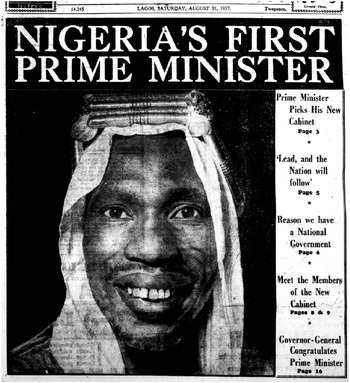
As Nigerian politicians in the Northern and Western Regions tackled hajj reform, like the ex-Alafin, they began to publicly link themselves to the prestigious alhaji title. Technological progress in transportation and photography made this possible. Starting in the late 1940s, air travel allowed elites to leave professional duties for weeks rather than months to complete the hajj. Politicians and traditional authorities took advantage of this, and the press began reporting their departure and arrival.Footnote 60 In news photographs, a new aesthetic of power emerged in both regions. The entanglement of these developments became explicit in 1956 when each member of the Nigerian mission to Saudi Arabia received from King Saud a ‘complete Saudi outfit comprising of ‘iqāl … the black coil worn on the head by Saudi nobles’ (Oloso Reference Oloso1984: 164).Footnote 61 The adoption of Saudi styles by Nigerian pilgrims was not new: while the exact start is unclear, Nigerian pilgrims had dressed like Saudi royalty since at least the 1920s (Jose Reference Jose1955b).Footnote 62 Although depictions of men sporting Saudi styles were more common, women, too, dressed like Saudi royal men,Footnote 63 a fact that led one reader of the Nigerian Citizen to argue that women ought to be allowed to wear other forms of male clothing.Footnote 64 Initially less common was the sight of a politician in Meccan garb, and even then it appears to have been almost exclusively worn by members of the NPC.Footnote 65 However, starting in 1955, more politicians began to don this distinctive attire,Footnote 66 as well as Nigerian officers in the government hajj missions.Footnote 67 This visible link between the prestige of the alhaji title and political authority greatly increased as the decade progressed, not only in the NorthFootnote 68 but also in the Western Region.Footnote 69 This occurred in a number of contexts where previously either suits or so-called native attire would have been the dress code: carrying out official government business, political party organizing, and in the stock images paired with news articles. When Alhaji Adegoke Adelabu died in 1958, the press ran with images of him in Saudi-style clothingFootnote 70 and a commemorative cloth design adopted a similar depiction.Footnote 71 But perhaps no visual image was as striking as the front page of the Lagos-based Daily Times the day after Abubakar Tafawa Balewa was elected prime minister in 1957; Balewa’s face, topped with a Saudi cord, took up almost the entire page (Figure 1). Complementing this sartorial display, several politicians declared that the hajj, as a source of moral uplift, improved their ability to govern.Footnote 72
‘Nigeria’s first prime minister’, Daily Times, 31 August 1957.

This is not to suggest that the move was merely instrumental. In the first half of the 1900s, the rare achievement of becoming an alhaji – and safely returning home – prompted jubilant communal celebration throughout the Yoruba south-west (Katz Reference Katz2019: 110–17). Family, friends and the curious would pack into the port or railway station to glimpse the arriving pilgrim. Horses, and later cars, could be hired for the day to give the pilgrim an elevated perch above the crowd of well-wishers, and musicians would accompany the procession to the central mosque for a special thanksgiving prayer.Footnote 73 No doubt, politicians who could now finally, thanks to air travel, undertake the hajj in weeks rather than months were genuinely proud of their ability to join the ranks of their fellow alhajis, and the Mecca uniform provided an easy way to repeatedly celebrate.Footnote 74
The 1950s also marked the first time that the Mecca uniform sparked a national discussion and concern over its authenticity. Babatunde Jose, the Yoruba journalist who chronicled his hajj in 1955, reported how he was ‘amazed’ when he spotted a hawker outside an airline office in Kano selling the ‘Mokawiya (popularly regarded as the official headgear of Alhajis)’. He explained that this was because he grew up learning that if a non-alhaji wore the mokawiya, he ‘would suffer acute headache until death overtook him’ (Jose Reference Jose1955b). Two years later, a Northern journalist accused people who put on ‘Mecca Wears’ without having gone to Mecca as being ‘supremely irresponsible’ and the type of person ‘you see in the pubs’.Footnote 75 Given the mythical threat (at least among Yoruba Muslims), the concern over limiting the Mecca uniform to bona fide pilgrims was already decades old; what was new was the blatant dismissal by some. Still, compared with the mid-1960s onwards, in the 1950s the Mecca uniform retained its prestige.
Debating the hajj and the rise of the ‘corrupt’ pilgrim
At the same time as many Nigerian Muslims built ties with Middle Eastern nations, many non-Muslims in the Western and Northern Regions began voicing fears of a potential Muslim takeover of the country. These anxieties often referenced the hajj. While non-Muslims by no means viewed all Muslims with suspicion, the orientation of some Muslims towards the Middle East instead of the colonial metropole, especially among political and cultural elites, caused concern. Some started rumours predicting a nightmarish Muslim-ruled Nigerian state, based on an imagined oppressive and backward Middle East. This initial distrust of Muslims’ connections with the Middle East became the basis for religious tensions to come.
One of the most widespread rumours concerned the Islamic Congress, founded during the 1954 hajj by Egypt, with financial support from Saudi Arabia and Pakistan.Footnote 76 The self-proclaimed ambassador to Nigeria for the congress, a title the congress would later deny, was Alhaji Deke, a Nigerian from Benin Province in the West.Footnote 77 Although he succeeded in courting interest in the Western and Northern Regions,Footnote 78 he dramatically quit his post in 1956, claiming that the congress had been ‘using him’ to spread ‘Egyptian communistic propaganda throughout Northern Nigeria’. He alleged that Ahmadu Bello and the NPC intended to build ‘a Muslim Empire’ with Abdel Nasser, with support from the UMP.Footnote 79 Regardless of Deke’s questionable reputation, the event provoked concern in the Western Region and among Northern Christians,Footnote 80 even if most Northerners dismissed Deke’s allegations.Footnote 81
Nor was this the first or last time Ahmadu Bello and the NPC faced accusations of conspiring with Nasser to transform Nigeria into an Islamic state. Shortly before the Deke affair, Bello had visited Egypt before travelling to Saudi Arabia. While in Cairo he met with Nasser and invited him to visit Nigeria, at least according to a couple of front-page reports.Footnote 82 Although the story got little to no attention in the Northern press, in the south-west it stoked concerns that Bello held greater allegiance to Islam than to Nigeria. One editorial in the Daily Times mused that one couldn’t know ‘where the private pilgrim ends and the Premier begins’.Footnote 83
As the 1959 federal elections approached, apprehensions of the foreign resurfaced. In 1958, the political secretary to Chief Awolowo alleged that the NPC and Nasser planned ‘to install a pro-Arab government in an independent Nigeria’, with Egypt ‘bankrolling’ the NPC. He further claimed that Nasser would send political agents, disguised as Arabic teachers, ‘for the purpose of indoctrinating’ Northerners ‘with Arab nationalism’.Footnote 84 He emphasized that it was ‘under the pretext of “Holy Pilgrimage” that the NPC met Nasser’s representatives’.Footnote 85 With this language, the AG amplified anxieties of a Muslim-led Nigeria and questioned the motives of Northern politicians undertaking the hajj. Two newspapers reported the story, as did the Nigerian Broadcasting Corporation.Footnote 86 In response, Bello accused the AG of ‘again seeking to bring the faith of Islam into disrepute and to insult the Holy Pilgrimage’.Footnote 87 The NPC similarly asked the governor-general of Nigeria to investigate the AG’s allegations to protect the reputation of the party, Islam, and the hajj.Footnote 88
These attacks by the AG confirmed Yoruba Muslims’ suspicions that the party was anti-Islam. The UMP used the controversy as a chance to reiterate the AG’s past anti-Muslim hostility and to affirm its own solidarity with Northern Muslims. For example, in a letter to the editor published in a Northern newspaper, the UMP’s president pleaded for south-western Muslims still supporting the AG out of ‘fear’ to switch to the NPC (Ottun Reference Ottun1958). And after Awolowo toured the North in 1959, the UMP president gleefully declared that Awolowo’s failure to win votes ‘has gladdened the hearts of all true sons and daughters of Islam in Western Nigeria’ (Ottun Reference Ottun1959).
For its part, the NPC presented itself as a party of all Northerners, regardless of faith. However, in the Western Region, some Muslim elites emphasized Muslim dominance in the NPC when encouraging Muslims there to support them.Footnote 89 Meanwhile in the North, some Christians worried about what might happen if the NPC took over. In 1958, the president of the Geoman Youth Movement in Jos voiced ‘strong rumours’ among his people ‘that non-Muslims in the North would be sent to do menial jobs in Saudi Arabia after Nigeria had attained independence’.Footnote 90 Thus, while, for Muslims, increased ties and travel to the Middle East represented an alternative prestige to that offered by scholarships to the UK (which mainly benefited Christians), the implications of these links haunted some of the Christians living among them.
Beyond concerns about Middle Eastern meddling, as the government at the federal and regional level became more intimately involved in orchestrating the hajj and underwriting pilgrim welfare, some non-Muslims began to perceive this use of taxpayer money as unfair. For example, after the government repatriated destitute Nigerians from Jeddah and Khartoum in 1958, although a Northern newspaper claimed that all opponents were eventually ‘satisfied’ that the scheme was necessary,Footnote 91 some articles in the Lagos press disagreed (e.g. Eual Reference Eual1958). One author wondered aloud ‘whether the Muslim faith has become State religion where all its needs must be provided by the Government’ at the expense of taxpayers (ibid.).
Despite these concerns, Nigerian Muslim politicians continued to wear the Mecca uniform into the mid-1960s.Footnote 92 And yet images of traditional authority and politicians wearing the uniform disappear from the pages of the Nigerian daily newspapers after this time. At the same time, the scale of the Nigerian hajj exploded, thanks to the reduced cost of air travel and increased national wealth brought by Nigeria’s oil boom in the 1970s. The number of Nigerian pilgrims to Mecca almost doubled between 1968 and 1973, and then doubled again in 1977 (Oloso Reference Oloso1984: 199). The discourse surrounding the Mecca uniform reflected a suspicion that not all of these pilgrims deserved the prestige of the alhaji title.
In the mid-1960s, critical voices against the Mecca uniform emerged in the press. Several commentators, both clerics and ordinary Muslims, framed wearing the Mecca uniform as separate from if not the opposite of pious behaviour. For example, in 1966, one Islamic column critically noted: ‘The shining head-gears are beautiful indeed. They made a man or a woman wearer look dignified, but unless the heads that wear them are filled with the fear of God … unless they abhor all evils’ then they ‘are meaningless, worthless adornments’ (Olatunde Reference Olatunde1966). By the 1970s, such warnings became more hostile. The president of a Yoruba Muslim association lamented to the crowd at the University of Ibadan that: ‘We have become Alhajis and Alhajas whose faith is measured by the amount of gold we can smuggle during pilgrimage and how many “Makawiya” and “Aga-Sheriff” [headgear] are on display in our showglass cases.’Footnote 93 Similarly, one prominent Muslim sternly reminded Muslim readers of the Nigerian Tribune that ‘God does not ask you to go and buy Mecca Wears’ (Mohammed Reference Mohammed1976). Occasionally, this criticism compared Nigerian pilgrims with other nationalities: for example, one radio journalist noted that ‘in the Middle-East and North Africa’ returned pilgrims neither wore a Mecca uniform nor took the alhaji title (Azeez 1973: 16–17). Other Muslim leaders suggested that some now used the Mecca uniform to ‘disguise’ nefarious activities;Footnote 94 relatedly, the Nigerian Association of Al-Hujaj [pl. alhaji] appealed to law enforcement ‘to treat as criminal impersonation anyone caught wearing designs and colors of the[ir] registered caps’ without an association ID.Footnote 95
Even the courts in the 1970s felt compelled to establish rules on the uniform’s use. The chief magistrate in Ibadan warned that nobody ought to enter his court wearing an alhaji’s headgear. He claimed: ‘It is an insult on Islamic religion for any alhaji to wear his full robes when coming to answer to any criminal charges.’Footnote 96 Somewhat different sartorial tensions arose in the Oyo senior magistrate’s court, where its magistrate forbid alhajis to wear turbans in the court ‘without the traditional Mecca cap’ when he ejected an alhaji from his court because ‘he was not properly dressed’.Footnote 97 These judges – along with the other clerical and Muslim commentators – shared a sense that the category of pilgrim, once prestigious, risked degradation at the hands of ‘fanciful’ or alternatively ‘untrained, unqualified’ pilgrims.Footnote 98
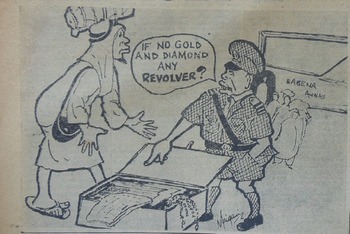
At the same time that criticism against the Mecca uniform emerged in the press, the behaviour of Nigerian pilgrims also garnered negative publicity. The most common accusation launched against pilgrims in the 1970s concerned smuggling – particularly of pharmaceutical drugs that were illegal in Saudi Arabia.Footnote 99 The public link between pilgrimage and smuggling was so strong by this time that it is striking that, as late as 1964, the very notion that pilgrims would commit such a crime provoked humour. A cartoon accompanying the article ‘Pilgrims ruffled and insulted!’ illustrated the insult for readers (Figure 2). In the cartoon, the customs officer – shown with rather exaggerated features – expresses incredulity that the bearded pilgrim (suggesting piety) is not hiding any illicit goods in his luggage, which has prayer beads spilling out. The accompanying article accused customs officials of being ‘over-zealous’ and an editorial claimed: ‘It would be certainly out of place to suggest that some people go on pilgrimage to cover up an illegal deal abroad.’Footnote 100 Yet the following year Saudi Arabia arrested twenty-two Nigerians for smuggling kola nuts and pharmaceutical drugs,Footnote 101 and an editorial lamented that those who ‘hide under the deceptive cloak of pilgrimage’ to commit crimes were ‘tarnishing the good name of this nation’ and of Islam.Footnote 102 Similar incidents surfaced in the latter half of the 1960s,Footnote 103 and in 1966 a Northern paper noted that ‘in recent years’ the hajj appeared to have ‘taken on significance other than religious’.Footnote 104 On the whole, these reports framed such crimes as the actions of a few errant Muslims. Nonetheless, the Nigerian government promised more meticulous luggage searches by customs officials.Footnote 105
Muhammadu Maigari, ‘Pilgrims ruffled and insulted!’, Nigerian Citizen, 2 May 1964.

In the 1970s, the scale and discourse surrounding smuggling escalated and registered in state regulation of the hajj. Annual government notices warned of customs officials’ strict measures against smugglers.Footnote 106 Federal and regional officials and ‘traditional’ authorities likewise publicly warned pilgrims not to engage in smuggling.Footnote 107 Commentary by ordinary Muslims and clerics echoed these official warnings. A Muslim op-ed writer from Ibadan claimed that the ‘majority’ of pilgrims went to Mecca to trade or smuggle (Bhadmus Reference Bhadmus1973), and an Islamic news column decried the ‘smuggler alhaji’ (Dada Reference Dada1973). Another column by the same cleric chastised readers that to be an alhaji required ‘much more than mere dressing’ and that pilgrims who focused on displaying their alhaji identity negated the spiritual value of their hajj (Dada Reference Dada1972a); an ordinary Muslim citizen made a similar argument in a letter to the editor (Mohammed Reference Mohammed1971). Christians also weighed in, with one remarking that the alhaji title meant ‘there goes a smuggler’ (Johnson Reference Johnson1974).
The emergence of a new convention of news reporting amplified these critiques. In the 1970s, headlines concerning anonymous alhajis committing crime became commonplace in the south-west. Although this genre of headline had existed in the 1960s,Footnote 108 it appeared rarely compared with the early 1970s.Footnote 109 In fact, almost as common in the 1960s were articles concerning criminal alhajis that did not include their title in the headline.Footnote 110 But by the 1970s, even an occasional reader of south-west newspapers would be greeted with headlines such as ‘Cattledealer loses N4,350 to trickster: alhaji absconds’ or ‘“Psychedelic alhaji” weeps to jail’,Footnote 111 much to the chagrin of at least one prominent Muslim (Oloso Reference Oloso1984: 304–5).
Popular culture helped spread the idiom of the ‘corrupt pilgrim’. Fela Kuti, who considered Christianity and Islam as harmful foreign ideologies, not surprisingly joined the chorus against the hajj (Olaniyan Reference Olaniyan2004: 59–61). In 1978, the song ‘Shuffering and shmiling’ framed elite Christians and Muslims as greedy with wealth and power, and criticized the masses for carrying their money to Mecca (ibid.: 62–3). Rounding off the decade, ‘Coffin for head of state’ conspiratorially suggested that businesses directors were either alhajis or friends of a bishop. Beyond music, alhaji characters in fiction and plays were depicted as wealthy, greedy and morally reckless (Rotimi Reference Rotimi1977; Yari Reference Yari1978; Sule Reference Sule1977; Katsina Reference Katsina1982; Sullivan Reference Sullivan2001: 80).Footnote 112
Although critiques against ‘corrupt’ pilgrims often lumped alhajas (female pilgrims) together with alhajis, some criticisms unique to alhajas replicated broader contemporary invectives against Nigerian women. Clerics and ordinary citizens claimed that women went to Mecca because it ‘enhances their prestige in the call girl or husband hunting business in Nigeria’ (Johnson Reference Johnson1974), or it helped them in ‘propagating concubinage’ (Bannerman Reference Bannerman1978), or even that alhajas were the most active smugglers.Footnote 113 Alhajas often bore the brunt of complaints that pilgrims were increasingly instrumentalizing the hajj for personal gain rather than devotion to God (Lamidi Reference Lamidi1978). These critiques accused women of viewing the hajj as a mere ‘status symbol’ (Dokee Reference Dokee1972),Footnote 114 ‘just after the wearing of the pilgrim’s dress’ without knowing its ‘true meaning’ (Dada Reference Dada1972b), leading some to conclude that the hajj had ‘been turned into a silly-looking picnic by notorious women who have found Mecca and Medina as the new target of their ungodly activities’ (Olatunde Reference Olatunde1969).
With the hajj under increased scrutiny, and ‘corrupt’ pilgrims symbolized by someone who was enamoured more with the sartorial accoutrements of their journey than with pious devotion to God, it is likely no coincidence that government officials appear to have stopped carrying out official duties adorned in pilgrim regalia. Additionally, the habit of national newspapers using stock images of politicians in pilgrim regalia also stopped.Footnote 115 Who instigated this latter sartorial rejection is unclear, but given that corruption, crime and oil wealth loaded these symbols of hajj with contradictory meaning, it is not hard to imagine why Nigerian Muslim politicians would distance themselves from these symbols.
The Mecca uniform’s gendered afterlives
To return to male accusations that women instrumentalized the hajj, in some respects in the 1970s women did gravitate more towards material markers of being a pilgrim, like the Mecca uniform. In the south-west, Yoruba women increasingly linked their pilgrimage to a wide range of advocacy and accomplishments. By the late 1960s, Yoruba alhajas had transformed celebrations at mosques for their safe return from Mecca into opportunities to speak on the importance of Muslim morality,Footnote 116 or to encourage others to vote for their political party.Footnote 117 The experience of the hajj could prompt alhajas to engage in service work. For example, Alhaja Alaga claimed that, while in Mecca, she conceived of the idea for what would become the first Muslim grammar school for girls in Ibadan.Footnote 118 Alhajas also entered the public domain through active engagement in post-independence politics, such as when alhajas in Oyo State adorned themselves in the Mecca uniform en masse to march on behalf of a political party in 1978.Footnote 119 Yoruba women’s societies also embraced the uniform, with alhaja members wearing it while attending meetings, or modifying it to use as their aso egbé (uniform dress) to celebrate the Prophet’s birthday (Maulud Nabiyy) (Gbadamosi Reference Gbadamosi2014: 10–11, 40). Alhajas and the Mecca uniform also entered the public sphere through music. For example, the musician Alhaja Salawa Abeni, ‘alias “Hadja Londoner”’, was consistently photographed wearing the sabaka cap and in 1979 issued an album Irohin Abo Mecca that narrated her journey to Mecca via London.Footnote 120
The predominance of Yoruba women publicly embracing the Mecca uniform more than men after the mid-1960s is illustrated by obituary practices. Once perhaps more frequently practised by alhajis,Footnote 121 by the 1960s onwards, obituaries for alhajas Footnote 122 were significantly more frequently paired with photographs of the deceased in the Mecca uniform. This suggests that, for alhajas, a studio portrait of themselves in the Mecca uniform usually represented their most prestigious photograph, whereas families of alhajis frequently chose portraits that emphasized the deceased’s status as a titled ‘big man’.
In the 1970s, gendered usage of Mecca uniform becomes clear when examining news photography of various Eid prayer grounds throughout the south-west. Photographs of male sections rarely depict men in the Mecca uniform;Footnote 123 in contrast, those of female sections in the late 1960s and into the 1970s typically show a row of women proudly displaying their alhaja status with their Mecca uniforms.Footnote 124
This difference continues today, particularly in discussions on the ‘Mecca tooth’, a practice dating back to at least the 1970s of pilgrims getting a gold or silver plated tooth while in Saudi Arabia (Oloso Reference Oloso1984: 299). In contemporary Nigeria, many south-west Muslims, both men and women, framed the practice as fashionFootnote 125 for the uneducated, ‘nominal’Footnote 126 Muslim who wants to ‘show off’,Footnote 127 and they accused women of indulging in this the most.Footnote 128 While male commentators have suggested that these varied practices revealed that women have a more superficial relationship to Islam, these visual displays of piety were perhaps simply the most accessible means for Muslim women in the 1960s and 1970s (and perhaps even today) to gain communal prestige and make political claims upon the state.
Of course, not all women adopted this social strategy. The public perception that most women became alhajas for selfish reasons encouraged women to police their own behaviour and prompted internal struggles. When asked if women gained prestige by going on the hajj, Alhaja Bushra Bisi Oloso, who went in 1975, carefully distinguished between ‘serious’ and ‘ceremonious’ alhajas.Footnote 129 Alhaja Sururah Oyero recalled her initial unease with her new identity as an alhaja in 1983. Her fear of being labelled an opportunist caused her to not buy the Mecca uniform, and she had to be persuaded to allow others to call her ‘alhaja’:Footnote 130
[O]ne of my colleagues said: ‘There are a lot of bad alhajas out there, people who wanted to be called alhaja, and who were not going to use … the respect conferred by that name well … why don’t you allow people to call you [alhaja]? So people can see that there can be good ones, even where there are bad ones.’ So that was when I stopped rejecting it.
Nor has this tension ceased. Alhaja Musilimot Balogun first went to Mecca in 1993, fully sponsored thanks to being one of three female winners of a Qur’anic recitation contest in Lagos. During her hajj, she purchased a Mecca tooth, but later removed it. When I asked her why, she replied: ‘Because I used to laugh; if I laugh some will be thinking, ah, because you went to Mecca, that is why you are doing this,’Footnote 131 referring to the common notion that people with Mecca teeth smile and laugh unnecessarily to show off their status.Footnote 132 And yet, Alhaja Balogun admitted that she found herself longing for a Mecca tooth again, and found it ‘very attractive’ on recent alhajas.
Conclusion
The hajj, as a religious practice, is unique in that its international scale has long entangled secular states in its facilitation and regulation. With the decline of the British Empire, more states became involved. In the case of Nigeria, not only did overland pilgrims need to navigate across national borders, but national dissatisfaction with the hajj under the British was now directed at Nigerian politicians. In the Northern and Western Regions, hajj reform became the top priority in terms of religious policy in the 1950s and 1960s and attracted a broad coalition.
Attention to material practice and visual culture surrounding the Mecca uniform helps reveal public perceptions of the hajj (and, by extension, Islam) and helps trace how these perceptions changed over time and across geographic scales. From the 1950s to the mid-1960s, the hajj signified prestige and Muslim politicians incorporated into their dress items that announced their alhaji status. Although some citizens questioned the fairness of using government funds to facilitate the hajj (particularly in the interfaith south-west), politicians in both Northern and south-west Nigeria stopped their public use of the Mecca uniform only after the figure of the ‘corrupt’ pilgrim emerged in newsprint, state policies, literature and music. In the south-west, this image built on previous anti-Muslim rhetoric and actions by one of the main political parties in the 1950s, the AG. Yet if politicians concerned with their national reputations dropped the uniform, others in more local arenas continued to incorporate it into their politics and social lives, such as Yoruba women in the south-west – although, as we saw, negative national stereotypes against ‘ostentatious’ alhajas also caused many to self-police. How individuals celebrated and marked their alhaji status was contingent on discourse surrounding government hajj policy and pilgrim behaviour at the local, regional and national scale.
This article has primarily focused on the Yoruba-dominated south-west, where I have conducted most of my research. Yet it is also informed by months spent collecting oral and archival histories in northern Nigeria and reading northern-based newspapers. Hajj reform efforts in the 1950s and 1960s linked Nigerian Muslims across ethnic and geographic boundaries. So too did the figure of the corrupt pilgrim. Northern Muslims may have continued to think of themselves as distinct from those in the south-west, but – through national hajj policies, national pilgrim stereotypes and national political parties – a collectivization of Nigerian Muslims had begun to hold sway. Yet how hajj reform or popular stereotypes impacted individuals was largely contingent on regional or more local readings. For example, some in the south-west, particularly Christians, perceived government facilitation of the hajj as evidence of either Northern dominance or a conspiracy tied to the Middle East. And Yoruba Muslim women’s societies adapted the Mecca uniform into the older practice of aso egbé, while others avoided any practice that might link them to national negative stereotypes of pilgrims. Thus, this article advocates for more scholarship that explores connections or mutual influence between Muslim communities across Nigeria, particularly in the postcolonial period.
Sara Katz is a postdoctoral associate in the history department at Duke University. Her research examines the history of the Nigerian hajj in the colonial and postcolonial periods. Her interests include Muslim–Christian relations, visual culture and global Islam.