

1. INTRODUCTION
In his article on multi-word sequences in English, Stubbs (Reference Stubbs, Hoey, Mahlberg, Stubbs and Teubert2007:164) illustrates ‘how evidence of phrasal constructions can be extracted from large corpora’. Inspired by Stubbs’ study, the present paper explores phrasal constructions around the English–Norwegian cognates eye and øye, thus bringing in a contrastive dimension to the study of phraseology.Footnote 1 One motivating factor behind the choice of eye and øye as my point of departure was the fact that high-frequency nouns in general, and body nouns in particular, have been said to have a rich phraseology, often with non-literal meanings (see e.g. Stubbs Reference Stubbs, Hoey, Mahlberg, Stubbs and Teubert2007, Lindquist & Levin Reference Lindquist and Levin2008).
Based on material drawn from the English–Norwegian Parallel Corpus+ (ENPC+), the aim is to map cross-linguistic uses of the cognates when they are part of (non-literal) phrasal constructions, or patterns. In order to outline and understand the behaviour of patterns within each language and across the languages, one of the central points in the analysis will be to survey the extent to which patterns with eye correspond to patterns with øye and vice versa. Do English and Norwegian have similar ways of lexicalizing the meanings of eye/øye-patterns, and if so, to what extent are such patterns chosen by the translators?
Initial observations of the contrastive data culled from the ENPC+ suggest interesting avenues of research. First of all, the lists of patterns with eye/øye reveal a great deal of overlap between English and Norwegian in terms of what sort of environments they occur in. A case in point is the frequent and cross-linguistically well-matched patterns keepan eye on and holde (et) øye med (lit.: hold (an) eye with). Another interesting observation is that the most frequent use of øye as part of a pattern in Norwegian – få øye på (lit.: get eye on) – is typically rendered by a pattern without eye in English, namely catch sight of. Even if få øye på and catch sight of seem to be good correspondences, they are only translated into each other in 41% of the cases. Given the focus of this volume on Corpus Linguistics and the Nordic languages, a more in-depth analysis will be offered of the Norwegian pattern få øye på and its English correspondences. The focus of this analysis will be on the extended context of the corresponding patterns, as meaning is said to reside outside the individual lexical item (Sinclair Reference Sinclair1996, Reference Sinclair and Weigand1998). Extended units of meaning will thus be explored cross-linguistically with the aim of uncovering phraseological nuances between the two languages.
To prepare the ground for the description and analysis of the cross-linguistic patterns and the focused case study of få øye på, some background to the semantic development of eye (Section 2.1) and to the study of frequent nouns as part of phrasal constructions (Section 2.2) is given, followed by an overview of previous, related research (Section 2.3). An introduction to the corpus and an outline of the data extraction method are found in Section 3. Section 4 gives an overview of expressions with eye and øye and their translations in the English–Norwegian material. Section 5 is devoted to the Norwegian pattern få øye på and its English correspondences in general, and catch sight of in particular (Section 5.1). Finally, Section 6 offers some concluding remarks.
2. BACKGROUND
2.1 Semantic development and phraseology of eye
In her book on HEAD-related lexical items, Więcławska (Reference Więcławska2012) discusses the semantic development and phraseology of eye. She also offers some contrastive insights to do with phraseological formations in English, French, German and Italian. Her work is anchored in the tradition of (cognitive) diachronic semantics, with the aim of ‘accounting for qualitative and quantitative changes by investigating the onomasiological data, which implies research into the development of metaphorically and metonymically derived synonyms and near-synonyms’ (ibid.:51).Footnote 2 A detailed overview of the approach will not be offered here, but Więcławska's main observations with regard to eye will be outlined in some detail, as they suggest a possible path for how eye and expressions with eye have developed over time and across languages.
In addition to the ‘historically primary sense of eye, namely [. . .] “the organ of sight in men and animals”’ (ibid.:74), which she terms sense A, Więcławska (ibid.:74–79) identifies seven secondary senses of the noun eye – in chronological order:
• sense B: ‘the part of face including the region of eyes’, e.g. blushing up to one's eyes
• sense C: ‘ocular knowledge’, e.g. to look somebody in the eye
• sense D: ‘various categories of human being’, e.g. an all-seeing eye (where eye = human being)
• sense E: ‘a view’, e.g. in the eyes of the court
• sense F: ‘an object resembling eye in shape and/or relative position and/or function’, e.g. the eye of a needle
• sense G: ‘various categories of natural objects’, e.g. the eye of heaven ( = the sun)
• sense H: ‘various categories of tabooed body parts’, i.e. ‘the euphemistic application of eye to convey the senses “the penis”, “the anus” and “breasts”’ (ibid.:78)
Eye (sense A) is said to be ‘grounded in the conceptual macrocategory body parts, activating the attributive paths of domain of being [(human being) ^ (animal)] and domain of function [(vision) ^ (transmission)]’ (ibid.:74). Moreover, the pattern that is discussed in more detail, namely få øye på, is seen as an A-related sense belonging to the conceptual category of communication:
It has been found that eye – through its rich phraseology – may be linked secondarily to the target conceptual category communication primarily, by virtue of numerous A-related idioms. The most abundantly represented historical phraseological senses are the A-related senses that encode various ways of looking and perceiving, such as ‘to look’, ‘to look in an observant manner’. (Więcławska Reference Więcławska2012:81)
While få øye på would belong to the former of these (‘to look’), the English pattern keepan eye on would belong to the latter (‘to look in an observant manner’). In other words, looking is communicating, and the patterns with eye in this category represent some form of looking.
From a historical-contrastive perspective, Więcławska observes that if a phraseological unit with eye in English was in use before the mid-19th century it has a ‘mirror-like reflection in terms of syntax, semantics and lexis in Romance languages . . ., while the idiomatic expressions that emerged later . . . are hardly ever found in equivalent form in either French, German or Italian’ (ibid.:83).
In the context of the present investigation, what is important to bear in mind with regard to Więcławska's work is the historical timeline of the senses she proposes, dividing them into two major categories, A-related and B-related. Although I will not attempt to categorise the patterns with eye/øye found in the ENPC+ according to those senses, they definitely provide a relevant background to, and an understanding of, how patterns with eye/øye have come to express such a myriad of meanings. In other words, the current study will not probe into the nature of the different metaphorical extensions of eye/øye. Furthermore, the suggested historical cut-off point regarding which eye-patterns are found across languages, and which are not, may also be valid in the present context. However, a diachronic analysis lies outside the scope of this investigation.
2.2 Frequency and phraseology
The choice of so-called eye-expressions as the object of study is related to several factors, including the fact that they are relatively frequent. Frequency has proved to be an essential factor in the phraseological patterning observed in language, as evidenced in Stubbs’ study referred to above, where he investigates the phrasal nature of world. He observes that ‘[t]he word world is frequent because it occurs in frequent longer phrasal constructions’ (Stubbs Reference Stubbs, Hoey, Mahlberg, Stubbs and Teubert2007:166), lending evidence to Sinclair's claim that ‘the role played by frequent words . . . in the composition of recurrent phrases . . . is substantial’ (Sinclair Reference Sinclair1999:162).
Furthermore, Stubbs notes (on page 164) that ‘there is a strong tendency for the meaning of the string [with world] to be non-compositional, in the sense of at least partly semantically opaque’. This echoes Sinclair's (Reference Sinclair and Alatis1991a:495) observations on the lemma eye, when he says that ‘the word form eyes is mostly used in a figurative sense’ and ‘the singular eye hardly ever means the anatomical object’. Indeed, the metaphorical potential of so-called ‘body nouns’ is well-established (see e.g. Smith Reference Smith1943, Lakoff & Johnson Reference Lakoff and Johnson1980, Mol Reference Mol, Aijmer and Hasselgård2004, Lindquist & Levin Reference Lindquist and Levin2008, Więcławska Reference Więcławska2012), and seems to apply to our nouns (eye/øye) as well, particularly when they are part of recurring patterns. Interesting to note in this connection is that the singular and plural forms eye and eyes have been said to behave differently. According to Sinclair (Reference Sinclair and Alatis1991a:495), ‘the patterning of each word form . . . is quite different’. Even if it would have been interesting to explore these differences in a cross-linguistic perspective as well, the plural forms are left out of this study. The current study of the singular forms may be followed up at a later stage with the plural forms, contrasting the forms both within each language and across the languages.
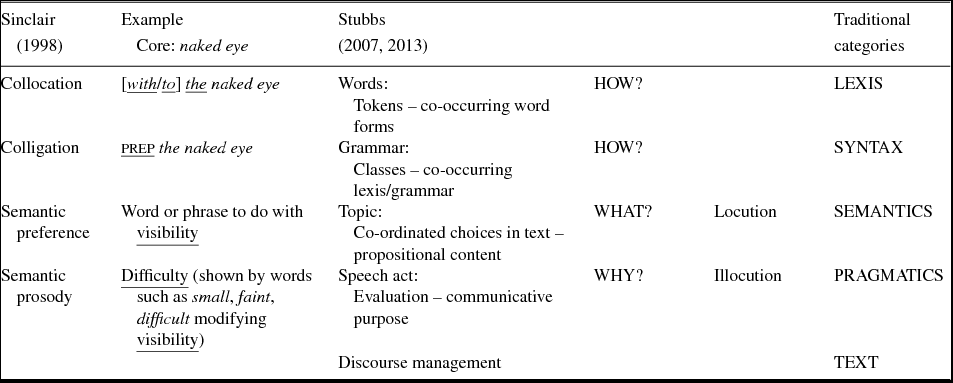
Although the scope seems to have been narrowed down, it is important to stress that the cognates in fact merely constitute the starting point, as the main concern of this paper is word combinations of which eye and øye form part. In other words, the focus is on what Sinclair has termed extended units of meaning (e.g. Sinclair Reference Sinclair1996). This concept relies on a view of language where meaning to a great extent is said to be ‘inherent in lexical items that go beyond the individual word’ (Johansson Reference Johansson2009:36). Corpus evidence has paved the way for linguists to embrace the idea of an extended-unit-of-meaning model of language, since within such a model ‘quantitative evidence is given a qualitative interpretation which becomes the basis for a powerful model of phrasal units of meaning’ (Stubbs Reference Stubbs, Hoey, Mahlberg, Stubbs and Teubert2007:177). This ‘powerful model’ integrates an obligatory core and four structural categories (or levels of analysis), namely collocation, colligation, semantic preference and semantic prosody. Stubbs (ibid.:178) explains that collocation and colligation is the relation between the core and ‘individual word-forms’ and ‘grammatical categories which co-occur frequently with it’, respectively, while semantic preference is the core's relation with ‘lexical sets of semantically related word forms or lemmas’. Finally, semantic prosody ‘is the discourse function of the unit’.
The model has been described and exemplified extensively elsewhere (e.g. Sinclair Reference Sinclair1996, Reference Sinclair and Weigand1998; Stubbs Reference Stubbs, Hoey, Mahlberg, Stubbs and Teubert2007, Reference Stubbs, Hasselgård, Ebeling and Ebeling2013; Ebeling & Ebeling Reference Ebeling and Ebeling2013); however, in the current context it is relevant to illustrate the model using Sinclair's (Reference Sinclair1996:83ff.) famous example with the core naked eye. Table 1, based on Ebeling & Ebeling (Reference Ebeling and Ebeling2013:59), conflates Sinclair's model with Stubbs’ interpretations of it.
The parameters of an extended unit of meaning.

2.3 Previous contrastive studies of extended units of meaning
Previous contrastive research that explicitly deals with extended units of meaning, and particularly the concept of semantic prosody, includes Partington (Reference Partington1998), Berber Sardinha (Reference Berber Sardinha1999, Reference Berber Sardinha2000), Tognini-Bonelli (Reference Tognini-Bonelli2001, Reference Tognini-Bonelli, Altenberg and Granger2002), Dam-Jensen & Zethsen (Reference Dam-Jensen and Zethsen2006), Xiao & McEnery (Reference Xiao and McEnery2006), Ebeling (Reference Ebeling, Huber and Mukherjee2013), Ebeling & Ebeling (Reference Ebeling and Ebeling2013) and Ebeling (Reference Ebeling, Ebeling, Grønn, Hauge and Santos2014), of which the latter three are most relevant to the present study as they involve data from a bidirectional translation corpus of the language pair English and Norwegian.Footnote 3
However, the present study also differs from these three studies in that the aim is to systematically explore the full phraseology of two pre-defined frequent cognate nouns. While the emphasis in Ebeling (Reference Ebeling, Huber and Mukherjee2013) was on the semantic prosody of units with cause (verb and noun) and their main correspondences in Norwegian, Ebeling (Reference Ebeling, Ebeling, Grønn, Hauge and Santos2014) is mainly concerned with the prosody of units with commit, signs of and utterly and their Norwegian correspondences. Ebeling & Ebeling (Reference Ebeling and Ebeling2013), on the other hand, outlines the extended-unit-of-meaning model in more detail and devises a method for how the model can be applied in in-depth contrastive analyses. All five case studies in Ebeling & Ebeling (Reference Ebeling and Ebeling2013) have multi-word patterns as their core. One of the main concerns of these case studies was to investigate to what extent extended units of meaning in two languages are translationally equivalent, measured along a scale of similarity. This will not be the main focus of this study, although it will be commented on. Moreover, the method for identifying the core element of the patterns was corpus-driven in that they were selected from n-gram lists automatically extracted from the corpus.Footnote 4 For the purpose of this study, a different extraction method was chosen (see Section 3.3).
3. MATERIAL AND METHOD
3.1 Translation and contrastive analysis
According to Ivir (Reference Ivir, Dirven and Fried1987:475), ‘translation is necessarily involved in contrastive work’, and ‘it is only fair to bring it in explicitly rather than tacitly’. The contrastive approach adopted in this paper relies on translations and cross-linguistic correspondences as tertium comparationis (see Johansson Reference Johansson2007, Ebeling & Ebeling Reference Ebeling and Ebeling2013). The notion of a tertium comparationis, or a background of sameness, as a basis for language comparison is an important one since it enables us to establish to what extent items can be compared and to assess their degree of equivalence across languages. Several contrastivists see translation equivalence as the best available tertium comparationis, as it ‘takes all kinds of meaning into consideration’, i.e. ‘ideational and interpersonal and textual meanings’ (see James Reference James1980:178).Footnote 5 In this sense, translators are our informants in that they share their cross-linguistic assessment in actual translations.
3.2 The English–Norwegian Parallel Corpus+
The main source of data for the analysis is the extended version of the fiction part of the English–Norwegian Parallel Corpus (ENPC+; Ebeling & Ebeling Reference Ebeling and Ebeling2013:86ff.). Like the original ENPC, the ENPC+ is bidirectional in structure, including comparable and translated texts in two languages (Johansson Reference Johansson2007:11–12), namely original fiction texts in English and Norwegian and their translations into Norwegian and English, respectively. Each of the four components of the corpus – English originals (EO), Norwegian translations (NT), Norwegian originals (NO), and English translations (ET) – contains roughly 1.3 million running words, i.e. it is a corpus of approx. 5.2 million words altogether, and is thus more than three times the size of the original fiction part of the ENPC. The structure of the corpus enables bidirectional investigations where not only translations of given elements can be observed and analysed, but also their sources. For further information regarding the structure, compilation and content of the ENPC+, see Ebeling & Ebeling (Reference Ebeling and Ebeling2013:83ff.).Footnote 6
3.3 Data extraction
The noun eye occurs 220 times in the English original texts of the ENPC+, while øye (and its definite form øyet) is found to be slightly more frequent in the Norwegian original texts, with 282 occurrences.Footnote 7 Not unexpectedly – bearing Stubbs’ (Reference Stubbs, Hoey, Mahlberg, Stubbs and Teubert2007) and Sinclair's (Reference Sinclair and Alatis1991a) observations in mind – in a considerable number of these cases eye and øye are used in recurrent multi-word combinations. Examples of such combinations, or phrases, include the expressions keepan eye on, looksomebody in the eye, holdeøye med ‘keep an eye on’ (lit.: hold eye with) and få øye på ‘catch sight of’ (lit.: get eye on), and also conventional noun phrases such as the evil eye, a critical eye, blotte øye(t) ‘(the) naked eye’, many of which carry a non-compositional meaning.
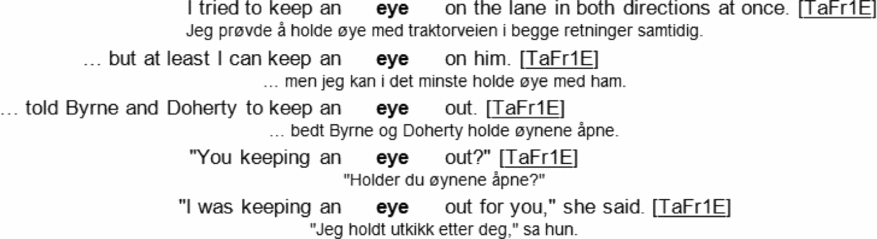
The data extraction method can be characterised as ‘traditional’ within the framework of corpus-based contrastive analysis. The two pre-defined lexical items eye and øye were searched for in the English and Norwegian original texts, respectively.Footnote 8 As the ENPC+ is not tagged for part of speech, the recurrent sequences with eye and øye were classified manually on the basis of concordance lines. The translations of the sequences were also recorded. This procedure can be illustrated by the set of concordance line pairs from the ENPC+ (Figure 1), of which the first lines are from English original texts and the second lines in smaller font are authentic Norwegian translations.
Concordance line pairs with eye in English original texts.
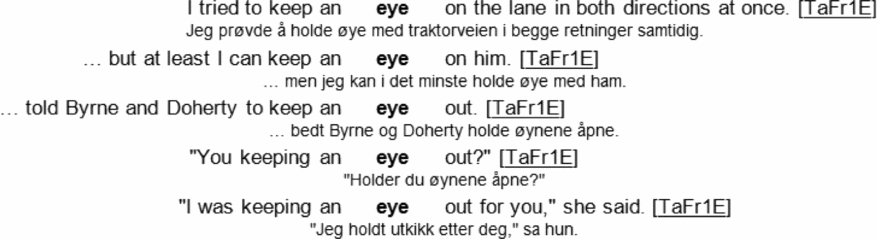
The concordance lines have been sorted alphabetically on the word immediately to the left of the keyword in context – eye. All five concordance lines have a form of the verb keep at position 2 to the left, while the first two have the preposition on immediately to the right of eye and the final three have the preposition out. The Norwegian translations of the sequences keep det(erminer) eye prep(osition) include holde øye med (lit.: hold eye with), holde/holder øynene åpne (lit.: hold eyes open) and holde utkikk etter (lit.: hold lookout after). The first two corresponding to keep an eye on have a similar structure to the English expressions: holdeøye prep, while the other correspondences show some deviance in terms of form. These are issues we will return to in Section 4.
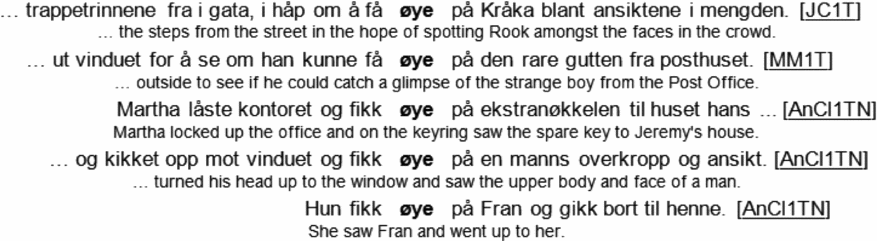
In the in-depth contrastive analysis of få øye på and its English correspondences (Section 5), another step in the contrastive procedure was also to search for the sequence få øye på in the translated texts and record their sources in English, as illustrated in the concordance line pairs in Figure 2.Footnote 9
Concordance line pairs with få øye på in Norwegian translated texts.
The five concordance lines from the Norwegian translations show instances of the recurrent string få øye på. The English expressions giving rise to the Norwegian pattern are varied, even in this small sample: spotting, catch a glimpse of and saw. In other words, we have single-word correspondences as well as multi-word correspondences as sources of få øye på. The contrastive analysis aims to shed light on what cross-linguistic implications such observations might have.
The data extraction method applied here is thus one that focuses on the immediate co-text of the two cognates eye and øye in the individual languages and across the languages. It is in this sense closer to the method described by Stubbs as one concerned with chains rather than mere collocation (Stubbs Reference Stubbs2002). In his definition ‘collocation’ shows the ‘co-selection of content words within a small span’ while ‘chains’ allows for the extraction of uninterrupted ‘phrases which consist of a combination of grammatical and content words’ (ibid.:227). Stubbs (Reference Stubbs2002) identifies chains by way of a data-driven method where no element of the recurrent chain is pre-defined, while Stubbs (Reference Stubbs, Hoey, Mahlberg, Stubbs and Teubert2007) uses the Phrases in English database to extract 2–8-word chains – or n-grams – with world. The present paper differs from the two papers by Stubbs in that it is not corpus-driven in the sense of Stubbs (Reference Stubbs2002) and it does not base itself on a phraseological search engine (Stubbs Reference Stubbs, Hoey, Mahlberg, Stubbs and Teubert2007); as described above, concordance lines are used instead. Thus, the length of the n-gram is not systematically explored from the outset but allowance is made for chains that are ‘interrupted’ for syntactic reasons, e.g. Da fikk han øye på snømannen ‘Then he caught sight of the snowman’ (lit.: then got he eye on the snowman).
4. EYE AND ØYE IN AN ENGLISH–NORWEGIAN PERSPECTIVE: AN OVERVIEW
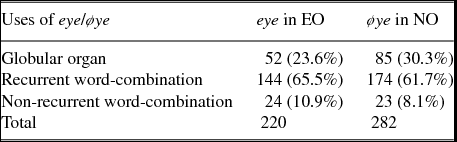
The distribution of eye/øye in the ENPC+ shows that the proportion of cases where the nouns quite clearly refer to the ‘organ of sight in men and animals’ (Więcławska Reference Więcławska2012:74) is higher in the Norwegian originals (approx. 30% of the cases) than in the English originals (approx. 24% of the cases), as illustrated by the overview given in Table 2. Although this difference is in fact statistically significant (LL = 8.14, p < .01)Footnote 10 and some of these instances form part of recurrent patterns, e.g. poss(essive) right/left eye, as in example (1) and num(eral) øye ‘num eye’ as in example (2), this study will rather focus on patterns with eye/øye where they do not have such a clear reference to the globular organ, or indeed the concrete referent of eye/øye, as in example (3).
(1) Banks touched the scar beside his right eye. [PeRo1E]Footnote 11
Banks rørte ved arret ved siden av det høyre øyet. [PeRo1NT]
(2) Han blunket flere ganger og fikk tilbake synet på det ene øyet. [JoNe2N]
He blinked several times and sight returned to one eye. [JoNe2TE]
(3) She was talking about an eye for an eye and saying she felt like a victim of Aids or vampirism. [PeRo1E]
Hun snakket om øye for øye og sa at hun følte seg som et offer for aids eller vampyrisme. [PeRo1TN]
Distribution of uses of eye/øye in the original ENPC+ texts.
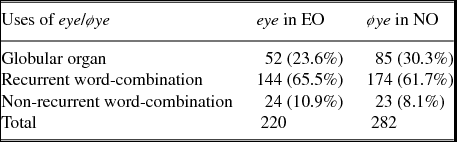
From the crude classification of the uses of eye/øye offered in Table 2, it can be inferred that, proportionally, the cognates have similar conditions of use in the two languages. While the difference between English and Norwegian in the first category was shown to be statistically significant, this was not the case for the latter two categories. In the following, a contrastive and more detailed analysis of the recurrent-word-combination category will be offered. With regard to the third category, a larger corpus would most likely have shown that most of these, if not all, are part of the recurrent-word-combination category, as those in examples (4) and (5). Nevertheless, they will not be discussed further in this study.
(4) . . . and there was a twinkle in his eye, as though she were a child about to be surprised. [MoAl1E]
(5) . . . men han hevdet at ‘østeuropeiske språk er så tunge for øyet’. [JoNe2N]
. . . but he insisted that ‘East European languages are so heavy on the eye’. [JoNe2TE]
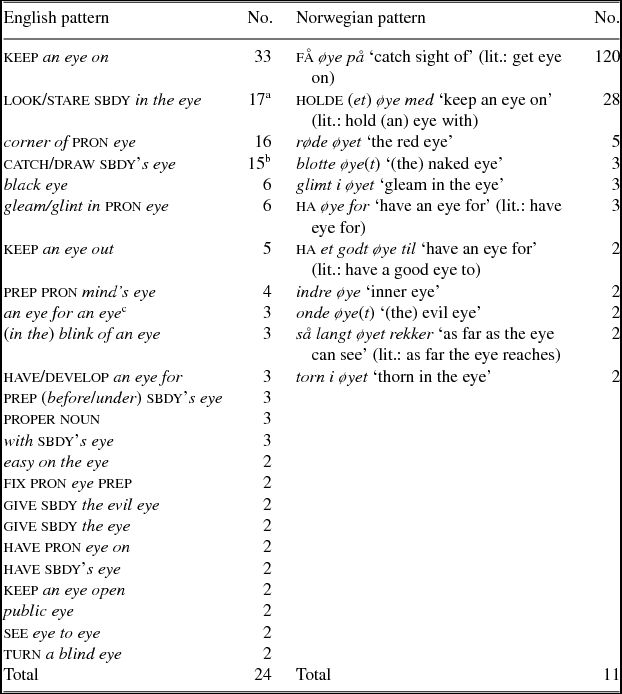
Although the proportion of non-literal uses of patterns with øye – or A- and B-related senses in Więcławska's (Reference Więcławska2012) terms – is fairly similar to that of eye, there are some distributional cross-linguistic differences worth mentioning. As shown in Table 3, there are four patterns (excluding the literal use of the word) that stand out as being fairly common in the English material, while there are only two in the Norwegian material, one of which is by far the most common one, namely få øye på ‘catch sight of’ (lit.: get eye on), with 120 occurrences. In comparison, the top four patterns in English occur 33, 17, 16 and 15 times, respectively. The second-most frequent Norwegian pattern occurs 28 times. While both languages have more than 20 patterns with eye/øye that occur once in the corpus, English has 20 expressions that occur with a frequency of between two and six; Norwegian has only nine in this category, i.e. nine different expressions that occur between two and five times. Thus, there is a greater number of different recurrent patterns/expressions in the English material, while Norwegian has one pattern that is overwhelmingly more frequent than any of the other patterns and one that is very much more frequent than the remaining nine patterns.
Recurrent patterns with eye and øye in the ENPC+, original texts.
a One instance of stare.
b One instance of draw.
c The expression an eye for an eye occurs three times in the English original texts. However, in the total count for eye, it accounts for six instances. The same applies to its Norwegian counterpart, øye for øye, accounting for two instances of øye, but only one of the pattern (and is therefore not included in this table).
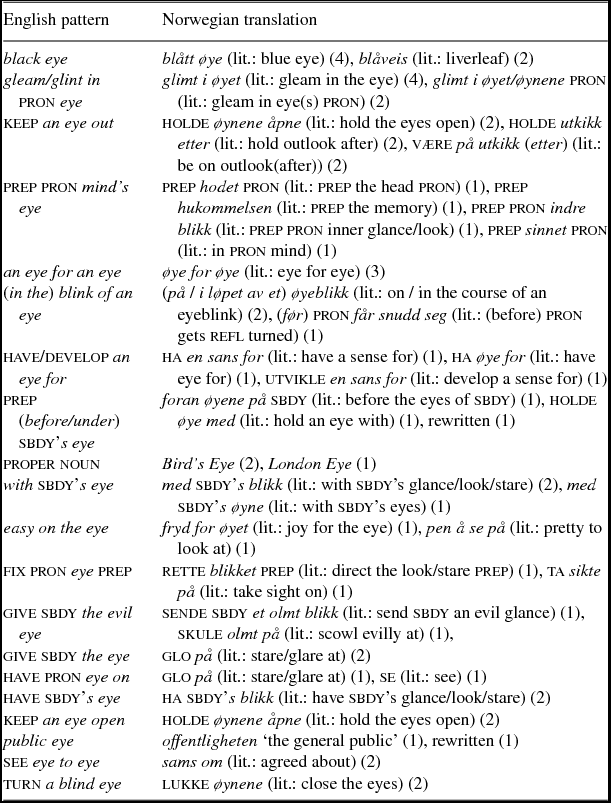
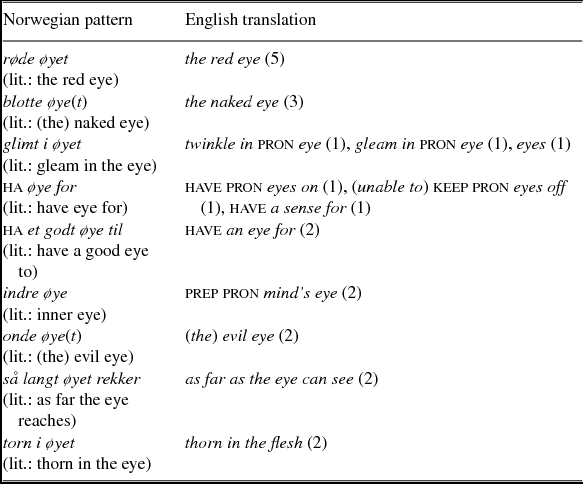
Most of the patterns occur relatively infrequently in the ENPC+ material, and only little contrastive insight can be gained on the basis of a small handful of examples. In the following, the main focus will therefore be on the most frequent patterns in the two languages: the top four in the English material and the top two in the Norwegian material. However, a survey of the translations of the least frequent patterns (see Tables A1 and A2 in the appendix) shows that the two languages have available similar eye/øye-patterns in many cases; however, in translation from English into Norwegian there is less overlap than in going from Norwegian into English, thus reflecting the tendency that English eye is more productive.
Returning now to Table 3 and the most frequent patterns, it can be seen that, among the six patterns, there is one that can be characterised as a noun phrase: corner of pron(oun) eye (as shown in example (6)), while the remaining five are verbal expressions with a reading that only hints at the eye as a globular organ. Three of the verbal patterns are formally of the type: v np (eye/øye) prep, exemplified in examples (7)–(9).
(6) She heard him standing up or saw from the corner of her eye. [MoAl1E]
(7) You, he’d trust anywhere, but me he's keeping an eye on. [TaFr1E]
(8)

(9) De holder øye med Pelle som mater endene i dammen med brødskorper. [BV1]Footnote 12
They are keeping an eye on Pelle who is feeding crusts of bread to the ducks on the pond. [BV1T]
The two remaining patterns have the following forms: v np pp and v np_gen, where eye is part of the pp and np_gen, respectively. The two uses are illustrated in examples (10) and (11).
(10) She looked him in the eye. [StGa1E]
(11) She caught Jonathan's eye. [MiWa1E]
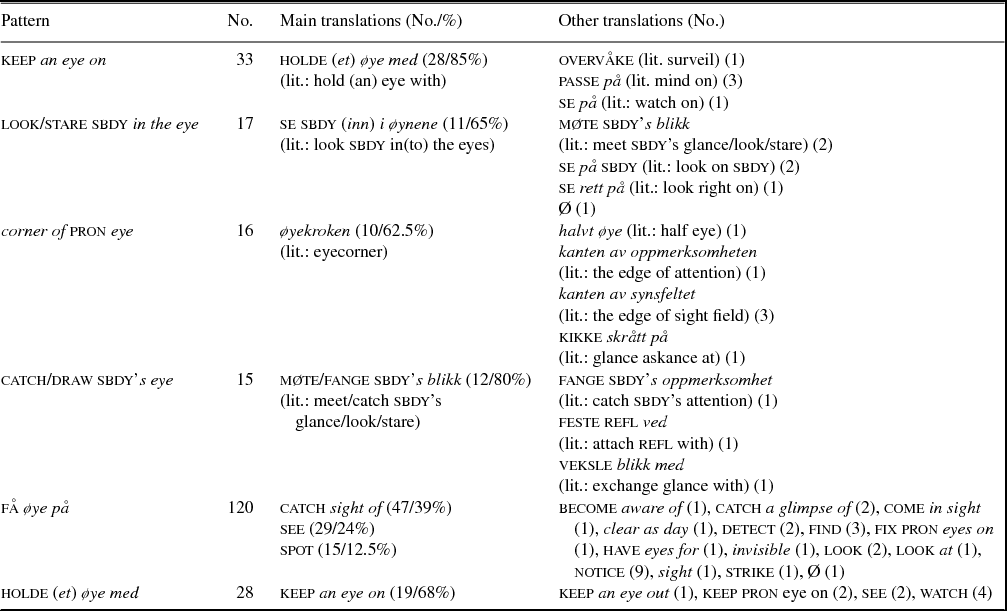
An overview of the translations of these patterns is given in Table 4.
Translations of the top four English patterns with eye into Norwegian and of the top two Norwegian patterns with øye into English.
What can be gleaned from the numbers in Table 4 is that five of the six patterns have one main translation correspondence, ranging from 62.5% for corner of PRON eye and øyekroken to 85% for keepan eye on and holde (et) øye med.Footnote 13 Moreover, it is shown that in four of the six patterns English and Norwegian seem to have similar expressions with eye and øye at their disposal, and they are used widely by the translators. In other words, the cognates are seen to share a common phraseology in some of their most frequent uses. In the case of catch /draw sbdy's ( = somebody’s) eye, the main translation in Norwegian is similar in form, but has blikk ‘glance/look/stare’ instead of øye,Footnote 14 pointing to a difference in metaphorical extension of eye and øye. To use øye in this context in Norwegian would either give it a literal meaning or a nonsensical reading. The idiomatic expression in Norwegian requires the noun blikk, which could be described as the action performed by the eyes, to correspond to the non-compositional reading of the English pattern with eye.
The sixth pattern – få øye på – differs from the other five in that it has three main translation correspondences rather than one. Although catch sight of is used in 39% of the cases, see and spot are also relatively frequent in the ENPC+ material. When it comes to catch sight of as a translation of få øye på, it resembles the catch /draw sbdy's eye-pattern in that its most frequent translation does not include the cognate eye, but rather a noun describing the function of the eyes, namely sight.
To sum up the cross-linguistic observations that can be made on the basis of the ENPC+ material, it is obvious that the two cognates have a relatively stable relationship across the two languages. Both enter into a number of more or less non-compositional patterns, albeit English eye seems to be more productive in this sense. Further, both eye and øye have acquired similar metaphorical extensions when they are part of larger units of meaning. In terms of translation correspondences, it is shown that the most frequent patterns have available formally and functionally similar expressions with eye/øye in the two languages. The main exception to this is få øye på with its three main correspondences in English, none of which includes eye.
5. FÅ ØYE PÅ AND ITS ENGLISH CORRESPONDENCES
The choice of få øye på (lit.: get eye on) for further contrastive analysis was triggered by (a) its frequency in the ENPC+; (b) its frequent translation into English by either a pattern without eye or a simple verb; (c) the observation that its most common translation catch sight of is not frequently found in the English original texts in the ENPC+ (thus, large monolingual corpora will also be consulted for this part of the investigation); and (d) the observation that one of the typical simple verbs is a state of perception verb (Quirk et al. Reference Quirk, Greenbaum, Leech and Svartvik1985:203), i.e. a verb of perception with a stative meaning – see.Footnote 15
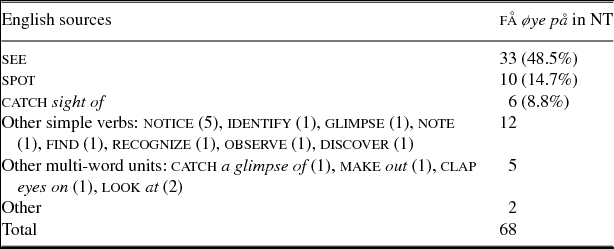
As shown in Table 4 above, få øye på occurs 120 times in the Norwegian original texts of the ENPC+. The three main correspondences account for 76.7% of the translations, with the following distribution: catch sight of (47/39%), see (29/24%), spot (15/12.5%). In the reverse direction of translation – i.e. looking at få øye på in translations from English – it was already pointed out in Section 3.3 above that some of the English items giving rise to the Norwegian pattern include both see and spot. Table 5 gives a full overview.
English sources of få øye på in the ENPC+.
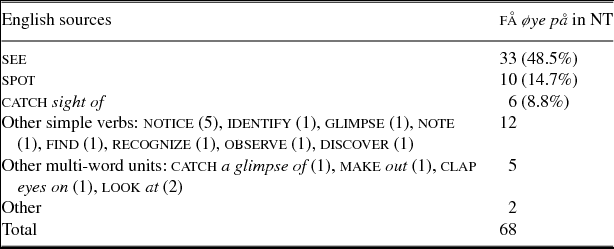
Interestingly, although the three most frequent sources of få øye på match the most frequent translations (recall Table 4 above), they have a different distribution. While catch sight of was seen to be the most frequent translation by far with 39%, it is the least frequent of the three in the English sources (8.8%). see is the most frequent source and is shown to give rise to få øye på in almost half of the cases (48.5%). spot is used in 14.7% of the cases, a frequency which is in line with what was found in the translations.
Based on semantics alone, it is perhaps surprising that a stative perception verb such as see is used as a correspondence (both as a translation and source) of the inchoative expression få øye på.Footnote 16 However, if we look into the actual instances in more detail, it becomes clear how it is possible for these two items to be used as correspondences of each other. The context plays a crucial role, and when see is the source of få øye på, there are overt temporal, conditional and sequential elements present in around 85% of the cases. These elements are shown to contribute to a more dynamic-inchoative reading of see. In example (12), the temporal conjunction when suggests that the seeing was not punctual, but rather more dynamic in nature. Similarly, in (13), if introduces a conditional clause that may be argued to involve some sort of change of state from not seeing to seeing, while in (14) the coordinating conjunction and is used to indicate a sequence of events, i.e. a change or transition of events, namely not until he looked up did he begin to see João. The fact that the same set of conjunctions is also present in the Norwegian translations may give a double emphasis in the Norwegian translations, as få in itself is inchoative.
(12) The barman was watching the television, too, but when he saw Banks, he went back to his position behind the bar. [PeRo2E]
Også bartenderen så på TV, men da han fikk øye på Banks, gikk han tilbake til plassen sin bak disken. [PeRo2TN]
(13) From across the room – if one saw her at all among so many eye-demanding people – Harriet was a pastel blur. [DL1]
Fra den andre siden av rommet var Harriet pastellblå – hvis man i det hele tatt fikk øye på henne blant så mange oppsiktsvekkende mennesker. [DL1T]
(14) He looked up and saw João and something passed across his face. [MoAl1E]
Han løftet blikket og fikk øye på João, og det gled en skygge over ansiktet hans. [MoAl1TN]
Similarly, in the other direction of translation, when få øye på is translated into see, there is a temporal or sequential element present in the context in 76% of the cases, as seen in example (15), including the temporal conjunction da ‘when’.
(15) Han holdt inne da han fikk øye på Harry. [JoNe1N]
He paused when he saw Harry. [JoNe1TE]
A few instances where a modal auxiliary is present are also attested, bringing in some sort of dynamicity that is not inherently present in see, as could as a translation of kunne does in example (16).
(16) Han tenkte seg at dødsfallet hadde satt en lyskaster på dem, og i det avslørende skjæret kunne den onde selv få øye på dem og gjøre et nytt framstøt. [KaFo1N]
He imagined that his wife's death had pointed a spotlight on his family, and in its revealing glare the devil himself could see them and would strike again. [KaFo1TE]
It would be interesting to pursue the correspondence of få øye på and see in more detail, including an in-depth analysis of the cognates se and see in Norwegian and English; is see more commonly used in this dynamic environment due to the fact that catch sight of is less used in English than is få øye på in Norwegian? This is but one of the questions that will have to be left for future study. However, the observations made in this section support some of the findings in a previous study of the inchoative–stative opposition between verbs in English and Norwegian (Ebeling Reference Ebeling2003). Here it was noted that typically stative verbs in English have come to gain ground also in transitional contexts, e.g. be was shown to be the main correspondence of inchoative bli ‘become’ and some uses of have were shown to correspond to inchoative få (Ebeling Reference Ebeling2003:313ff.). In this context it is tempting to speculate that verbs that are inherently stative in English show a general tendency to extend into more dynamic environments. These possibly typological implications will also have to await further study, as we will rather turn our attention to the apparently perfectly matched patterns få øye på and catch sight of.
5.1 få øye på and catch sight of
Moving on from the more general overview of få øye på and its English correspondences, we will now turn our attention to a more in-depth study of få øye på and catch sight of. In doing so, Sinclair's (Reference Sinclair1996, Reference Sinclair and Weigand1998) extended-unit-of-meaning model will play a crucial role in disentangling potential cross-linguistic phraseological discrepancies between the two patterns.
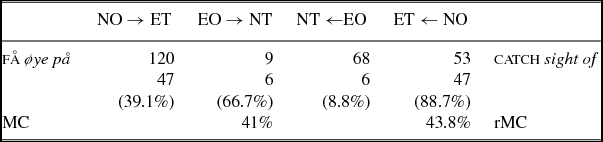
Despite the fact that many bilingual dictionaries list få øye på and catch sight of as the only equivalents of each other,Footnote 17 the mutual correspondence of two patterns only reaches 41% in the ENPC+ material. Mutual correspondence (MC) measures the intertranslatability of two items, in our case the number of times få øye på is translated into catch sight of and vice versa, divided by their total number of occurrences in the corpus (see further Altenberg Reference Altenberg1999). Ebeling & Ebeling (to appear) introduce the concept of the reverse MC (rMC), i.e. starting in the translations and calculating to what extent items operate as sources of each other. As can be seen from Table 6, the MC and rMC are well-matched, as the rMC is at around 44%. However, the correspondence bias differs substantially, in that catch sight of overwhelmingly corresponds to få øye på (in 66.7% (EO→NT) and 88.7% (ET←NO) of the cases), while the correspondence rate ranges from 39.1% in going from Norwegian into English and a mere 8.8% in Norwegian texts translated from English.
Mutual Correspondences (MCs) and Reverse Mutual Correspondences (rMCs) of få øye på and catch sight of.
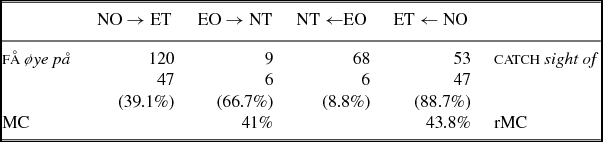
Table 6 also reveals that catch sight of is overused in the translated texts compared to the English original texts, while få øye på is underused in Norwegian translations from English when compared with Norwegian originals. ‘Overuse and underuse can be taken as evidence that the means of expression do not match in the source and the target language and that there is a tendency for the source text to leave its mark on the translation’ (Johansson Reference Johansson2007:32). Such underuse or overuse has been termed ‘translation effects’ (ibid.:33). The mark left by the source text in these cases seems to be related to frequency of use rather than a mismatch in terms of means of expression in the two languages.
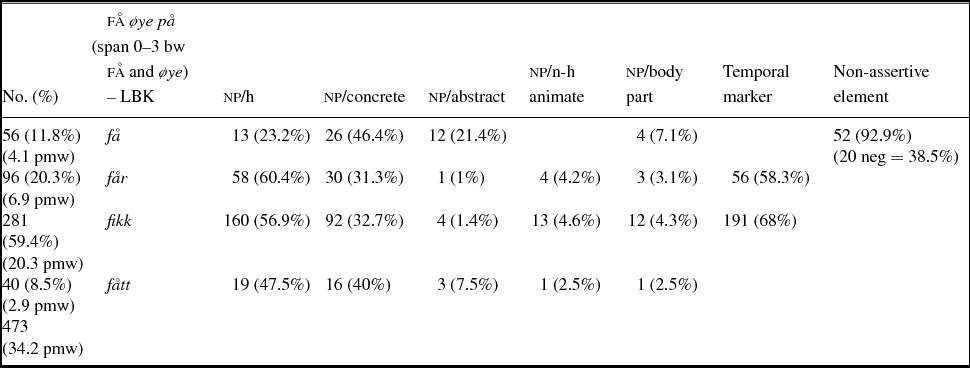
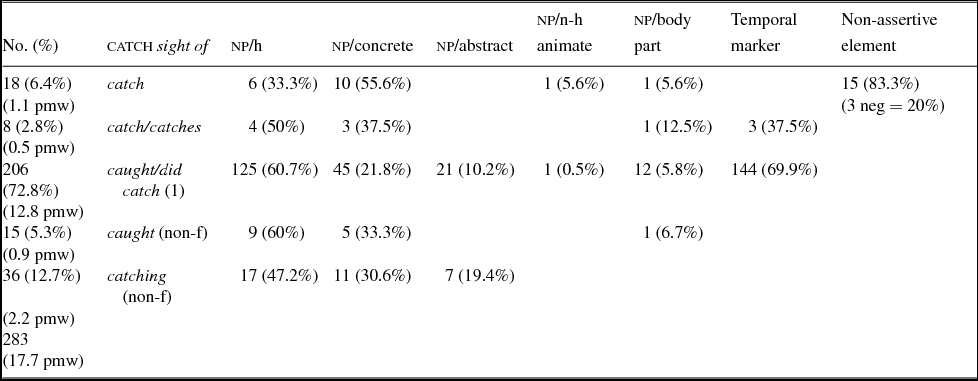
The discrepancy in frequency of use is mirrored in two large monolingual corpora – the fiction part of the British National Corpus (BNCfiction) and Leksikografisk bokmålskorpus (LBKfiction);Footnote 18 see Tables 7 and 8. In the fiction part of the BNC, catch sight of occurs with a frequency of 17.7 per million words (pmw), while få øye på occurs 34.2 times pmw in LBKfiction. The reason why the discrepancy is even greater in the ENPC+ – 6.8 pmw in English originals vs. 91 pmw in Norwegian originals – is hard to determine, but it may seem as if some Norwegian writers are particularly fond of the pattern. Another important factor in this respect may be the number of different writers represented in the different corpora; inevitably, the big monolingual corpora draw on texts from a larger pool of writers than the much smaller ENPC+ corpus.
få øye på in LBKfiction: frequencies, distribution of forms, complements and other contextual features.
catch sight of in BNCfiction: frequencies, distribution of forms, complements and other contextual feature.
The relatively low MC and rMC are in themselves reassuring in that it reflects the use of the two patterns in original language, i.e. få øye på is a frequent pattern in Norwegian and catch sight of is not such a frequent pattern in English. This suggests that translators’ individual choices mirror the patterns’ frequencies in original Norwegian and English, although some of the frequencies are slightly skewed.
In what follows, all occurrences of the English and Norwegian patterns in BNCfiction and LBKfiction, respectively, will be scrutinized with a view to establishing to what extent the two expressions can be claimed to be perfect equivalents of each other.
As the patterns include a verb, the survey of the occurrences in the two corpora will distinguish between the different verb forms of få and catch . It is generally accepted among corpus linguists that different forms of a verb may behave differently in terms of ‘pattern of usage’ (Tognini-Bonelli Reference Tognini-Bonelli2001:92, see also Sinclair Reference Sinclair1991b:8; Hunston Reference Hunston2003:34). Indeed, in a previous contrastive study of a pattern including få this proved to be the case (Ebeling & Ebeling Reference Ebeling and Ebeling2013:153ff.).
First, it is evident from the numbers in Tables 7 and 8 that there are both similarities and differences in distribution according to verb form. In terms of overall frequency, both languages prefer the past tense form of the verbs, and English even more so than Norwegian, where caught sight of accounts for 72.4% of the total vs. 59.4% for fikk øye på. While the infinitive and past participle forms are also fairly similar in terms of frequency, the present tense form is much more frequent in Norwegian than in English. It is tempting to infer that the Norwegian simple present does a similar job to that of the present participle in English. While the Norwegian present tense is often accompanied by an explicit temporal element, as shown by da ‘then’ in example (17), the English present participle may be said to inherently carry a temporal element. A likely paraphrase of example (18) is: When he caught sight of her bag . . ., he picked it up, introducing temporal when.
(17)
(18) Catching sight of her bag on the end of the bed, he picked it up and handed it to her. [BNC/JY8 3484]

Information regarding the subjects of the patterns, typically found in their left context, is not included in Tables 7 and 8 due to their exceptionally stable nature. The data investigated here confirm Askedal's (Reference Askedal, Lenz and Rawoens2012:1297) observation that the ‘fixed locution’ få øye på has an experiencer subject. This is also true of the English pattern, and these experiencer subjects are overwhelmingly realized by reference to a human being in the form of a personal pronoun.
What Tables 7 and 8 do show, however, is the complements of the patterns, typically found in their right context. A general and not unexpected observation that can be made is that both patterns are exclusively found with noun phrase complements. The types of complement have been further subdivided into five different categories: human, concrete, abstract, animate/non-human and body part. It is uncertain what role the distribution (as represented in the corpora) of these complements in fact plays. However, the general trend in contemporary literature seems to be to catch sight of a human being or a concrete object, and only very rarely an animal. An example of each of the categories is given in examples (19)–(23), all taken from BNCfiction, for convenience. If we relate the observed contexts to the first two structural categories of the extended-unit-of-meaning model, the left collocation in (19)–(22) is she and in (23) it is to. In terms of colligation, examples (19)–(22) have a pron/human to the left of the core, while (23) has the infinitive marker. To the right of the core, (19) and (22) have a colligation in the form of an np/human (Marc and face), (20) an NP/concrete (alarm clock), (21) an np /abstract (movement) and (23) an NP non-human/animate (basking seals).
(19) She didn't catch sight of Marc until that afternoon. [BNC/JXU 2372]
(20) With an almost childlike whoop of delight she bounded out of bed, quickly stifling the sound as she caught sight of her alarm clock. [BNC/JXW 2308]
(21) She caught sight of a movement out of the corner of her eye, whirled, but was too late to see anything. [BNC/G1M 2509]
(22) She’d bent down to pick up the purchases at her feet, and as she rose again she’d caught sight of a face she knew, looking straight at her through the moving mesh of people. [BNC/CRE 557]
(23) He remembered squinting eagerly to catch sight of the basking seals, content and sleepy in the afternoon sunshine, and pointing with excitement when he did. [BNC/G1M 1971]
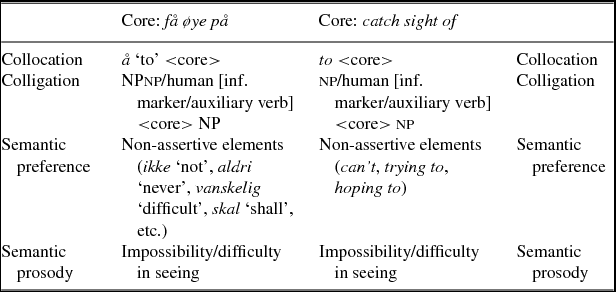
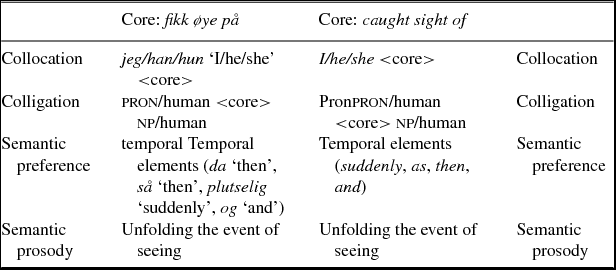
More important perhaps are the two rightmost columns in Tables 7 and 8, adding information regarding the presence or non-presence of a temporal marker and/or a non-assertive element. These suggest a particular semantic preference of the unit, which, as we shall see, also have a bearing on the extended units of meaning with få øye på and catch sight of (see Tables 9 and 10).
Comparison of extended units of meaning in English and Norwegian with få øye på and catch sight of as cores.
Comparison of extended units of meaning in English and Norwegian with fikk øye på and caught sight of as cores.
If we take a closer look at the distribution of these temporal markers and non-assertive elements, we observe in Tables 7 and 8 that the past tense form of the patterns is typically accompanied by a temporal marker of some sort, including temporal adverbs and conjunctions reflecting a sequence of events. In both languages this happens in about 70% of the cases, and similarly so for the present tense form in Norwegian, as already commented on above, and to some extent for the present tense form in English. Examples include (24), with the temporal adverb suddenly, and (25), with and indicating a sequence of events.
(24) Suddenly he caught sight of Clare and Underwood walking arm in arm along the opposite pavement. [BNC/GVT 883]
(25) Patrick glanced out the window and caught sight of a troop of British tommies marching around the Green towards them, on the opposite side of the road. [BNC/EVG 2489]
The presence of these temporal markers makes the inchoative element already present in the verb even stronger.
To sum up, and with reference to Sinclair's extended-unit-of-meaning model (see Sections 2.2, 2.3), we can describe the lexico-grammatical environment of få øye på and catch sight of in similar ways, depending on verb form. It is the infinitive and past tense forms that stand out as particularly interesting in this respect; as they seem to carry more than a merely neutral semantic prosody, these are the forms that are illustrated in the following tables.
It is interesting to note that in their study of få tak i ‘get hold of’, Ebeling & Ebeling (Reference Ebeling and Ebeling2013:167) found that an extended unit of meaning with the base form as its core has a semantic preference and semantic prosody similar to that of få øye på in Table 9. Both få tak i and få øye på are associated with difficulty and non-assertive cotexts; however, the clearly negative bias is stronger for få øye på, as shown by the more frequent use of items such as ikke ‘not’ and aldri ‘never’.
With regard to extended units of meaning with the past tense forms fikk øye på ‘caught sight of’ and fikk tak i ‘got hold of’, Ebeling & Ebeling (Reference Ebeling and Ebeling2013:168–169) note that fikk tak i ‘got hold of’ is not associated with a strong semantic preference and prosody on a par with få tak i ‘get hold of’. Fikk tak i is not associated with difficulty to the same extent as få tak i ‘get hold of’, and the accomplishment reading is stronger ‘not only triggered by the past tense form but also by the combination fikk and tak i’ (ibid.:169). A similar observation can be made for fikk øye på, where there is accomplishment involved; in addition, fikk øye på differs from få øye på in that the extended unit of meaning puts focus on the (success of the) unfolding of the event of seeing, not least through its semantic preference for temporal elements.
These observations make it clear that it is indeed the whole unit of meaning that operates with a discourse meaning and purpose, and not individual verbs, for instance. If the uses of the simple verb få had been analysed instead, these findings may have gone unnoticed.
This cross-linguistic case study of få øye på and catch sight of has shown that the two languages have available patterns that are remarkably similar when it comes to their conditions of use and their potential as cores of extended units of meaning, albeit with a slight difference in lexicalization, i.e. øye vs. sight. Thus, it can be argued that it is the frequency of use rather than the conditions of use that set the two patterns apart in the way suggested by their relatively low mutual correspondence.
Moreover, the study adds to Więcławska's (Reference Więcławska2012) (non-corpus-based) account of the semantics and phraseology of eye in that the co-text (collocation, colligation, semantic preference) and the discourse function (semantic prosody) contribute to a more detailed and uniform analysis/description than the general meaning of ‘to look’ as an A-related sense within the conceptual category of communication (see Section 2.1 above). The present analysis also uncovers different discourse functions depending on which verb form is part of the core.
6. CONCLUSION
The cross-linguistic exploration of the phraseology of eye and øye has revealed the wide-ranging semantic potential of eye-expressions. In some cases, the meanings seem to have developed differently across the two languages and different means of lexicalization are resorted to. In cases where similar eye-expressions exist in both languages, e.g. in four out of the six patterns reviewed in Table 4 above, the translators tend to opt for the corresponding eye-expression in the other language.
The focus on patterns with eye/øye in English and Norwegian further revealed that although both languages are productive in their use of eye/øye in recurrent expressions, there are clear differences with regard to conditions of use. While English has four relatively frequent patterns with eye, Norwegian has one dominant pattern – få øye på – and one that is fairly frequent – holdeøye med. Only the latter has a clear correspondence with eye in English – keepan eye on; the distribution of these two corresponding patterns is similar across the two languages. Moreover, the ENPC+ material shows that English boasts a wider range of recurrent patterns than Norwegian (see Table 3 above).
The detailed investigation of få øye på reported in Section 5 showed that English has three main correspondences, rather than one, as suggested by some bilingual dictionaries of English and Norwegian. Moreover, the contrastive analysis of få øye på and catch sight of in Section 5.1 uncovered that while the two patterns are indeed found to be perfectly matched, as suggested by the in-depth analysis of the extended units of meaning, and also by several bilingual dictionaries, their frequency of use differs substantially. This contributes to the relatively low mutual correspondences in the contrastive material at hand, as catch sight of has several, more readily available, contenders to express and lexicalize the meaning of få øye på.
The study has shown that contrastive studies based on (bidirectional) parallel/translation corpora, supplemented by larger monolingual corpora of the respective languages, bring an additional dimension to phraseological analysis of frequent nouns. Evidently, such a combination of corpora teases out similarities and differences that do not seem to surface in studies exclusively based on one type of corpus.
ACKNOWLEDGEMENTS
I would like to thank two anonymous Nordic Journal of Linguistics reviewers for their valuable feedback on an earlier version of this paper.
APPENDIX
Less frequent English and Norwegian patterns and their translations
English recurrent patterns with eye and their Norwegian translations (excluding the top four patterns).
Norwegian recurrent patterns with øye and their English translations (excluding the top two patterns).