Introduction
Communicative competence for persons with dementia is affected by cognitive and behavioral deficits. For instance, long-term and short-term memory impairments often result in word-finding problems, unexpected shifts in topics, and repetition of the same ideas and questions, making conversations with persons with dementia challenging (Tang-Wai and Graham, Reference Tang-Wai and Graham2008; Rousseaux et al., Reference Rousseaux, Sève, Vallet, Pasquier and Mackowiak-Cordoliani2010; Schrauf and Muller, Reference Schrauf and Muller2014). Communication impairments have been investigated and linked to the pathology of the disorder. However, there are limitations to approaching dementia care from a strictly pathological framework. First, the way in which social partners communicate with a person with dementia may exacerbate their communication deficits (Sabat et al., Reference Sabat, Napolitano and Fath2004). Second, confining a person's identity to a disorder can overshadow existing abilities and limit the quality of interactions (Ramanathan, Reference Ramanathan1997).
A focus on deficits can impede the level of interaction of persons with dementia and create a reductionist perception of them by social partners who do not have dementia (Ryan et al., Reference Ryan, Hummert and Boich1995). The overt symptoms and frailties of individuals with dementia tend to reinforce lowered expectations and age stereotypes of dependence and incompetence. The Communication Predicament of Aging model delineates the consequences of stereotypic expectations on communicative interactions with older adults (Ryan et al., Reference Ryan, Giles, Bartolucci and Henwood1986; Hummert et al., Reference Hummert, Garstka, Ryan, Bonnesen, Nussbaum and Coupland2004). Represented as a negative feedback loop, the Communication Predicament of Aging model suggests that speech is modified as a result of age stereotypes elicited by physical appearance, behaviors, and social contexts. Consequently, constrained opportunities and the reinforcement of age stereotypes negatively affect the older adult's sense of personal control and self-esteem. The impact of these effects is far greater for persons with dementia who reside in long-term care homes because of the increased impairment associated with the condition and a social context that is characterized by a higher expectation of dependency (Savundranayagam, Reference Savundranayagam2014).
Conversely, the Communication Enhancement Model acknowledges the role that healthcare providers play in maximizing positive and appropriate interactions with older adults (Ryan et al., Reference Ryan, Hummert and Boich1995). One of the major approaches to maximizing positive interactions with residents with dementia is through the use of language strategies that take into account both the language impairments and the existing comprehension and production abilities associated with dementia.
The language-based approach
Existing research on recommended language-based strategies for effective communication with persons with dementia comes primarily from psycholinguistic and sociolinguistic perspectives (Hamilton, Reference Hamilton1994; Ramanathan, Reference Ramanathan1997; Perkins et al., Reference Perkins, Whitworth and Lesser1998; Orange, Reference Orange, Hummert and Nussbaum2001; Santo Pietro and Ostuni, Reference Santo Pietro and Ostuni2003; Sabat et al., Reference Sabat, Napolitano and Fath2004; Smith et al., Reference Smith2011; Vasse et al., Reference Vasse, Vernooij-Dassen, Spijker, Rikkert and Koopmans2010). Due to the retained communicative abilities of normal interlocutors, the onus is on them to facilitate the communicative ability of the person with dementia. These approaches considered how the use of language-based strategies, such as allowing turn completion and using close-ended questions, can lead to successful communication (Hamilton, Reference Hamilton1994).
Common goals of successful communication within the language-based approach include coherence, clarity, reciprocity, and continuity. These indicators of successful communication are not necessarily mutually exclusive; instead what is important is the combined contribution of all these indicators during communicative encounters. Strategies that maintain the goal of coherence often involve conveying a message in a meaningful and clear manner. When there are misunderstandings, strategies such as rephrasing or verbatim repetition can be effective in offering clarification (Smallet al., 1997; Tappen et al., Reference Tappen, Williams-Burgess, Edelstein, Touhy and Fishman1997; Watson et al., Reference Watson, Chenery and Carter1999; Wilson et al., Reference Wilson, Rochon, Mihailidis and Leonard2012). Reciprocity involves equal participation in conversations and emphasizes the interactive aspect of communication. Strategies such as open-ended questions (Tappen et al., Reference Tappen, Williams-Burgess, Edelstein, Touhy and Fishman1997) can encourage more participation by persons with dementia. Continuity, although similar to reciprocity, involves maintaining the flow of communication. Strategies, such as newsmarks, which highlight the noteworthiness of the prior turn of the person with dementia (e.g. “my goodness”) generally lead to further talk by either member of the dyad and maintain continuity in the interaction (Ramanathan, Reference Ramanathan1997). Successful communication, then, includes the ongoing reflection of prior turns to appropriately respond in future turns.
There appears to be a lack of consensus regarding the utility and effectiveness of some language-based strategies when communicating with persons with dementia. For instance, some researchers suggested the use of extended pauses because they encouraged reciprocity (Sabat, Reference Sabat1991); however those pauses were viewed as threats to continuity by others (Ramanathan, Reference Ramanathan1997). Furthermore, what works for one person may not work for another because of the uniqueness of the individual and the way in which the disease progresses for that person. Moreover, what works in one situation, such as helping a person with dressing, may not always work in another situation, such as learning about a person's experience with an activity. For instance, yes/no questions and choice questions are recommended to accomplish a very specific task (Hamilton, Reference Hamilton1994; Orange, Reference Orange, Hummert and Nussbaum2001; Small et al., Reference Small, Gutman, Makela and Hillhouse2003; Small and Perry, Reference Small and Perry2005). In contrast, open-ended questions are recommended, when the goal is to learn more about a resident's thoughts and feelings (Tappen et al., Reference Tappen, Williams-Burgess, Edelstein, Touhy and Fishman1997; Ryan et al., Reference Ryan, Byrne, Spykerman, Orange and Davis2005). A personhood approach may help resolve the lack of agreement on the effectiveness of particular language-based strategies by focusing on the individual needs of persons with dementia (Ryan et al., Reference Ryan, Hummert and Boich1995; Kitwood, Reference Kitwood1997).
The personhood approach
As an alternative to the pathological framework, the person-centered approach involves the inclusion of the life history, values, and personal preferences of a person with dementia. Person-centered care emphasizes the intersubjectivity between persons with dementia and their social partners; in other words, the goal of person-centered care is the development and maintenance of rewarding relationships that are characterized, in part, by supportive social interaction (Kitwood, Reference Kitwood1997).
According to Kitwood's (Reference Kitwood1997) personhood framework, there are five psychological needs of people with dementia: comfort, attachment, inclusion, occupation, and identity. Comfort and a sense of attachment are necessary to help deal with the cognitive–communicative, behavioral, and functional changes associated with dementia. Due to such changes, people with dementia often exhibit disruptive behaviors such as disruptive vocalizations. Consequently, these residents do not gain much social contact (Hallberg et al., Reference Hallberg, Norberg and Eriksson1990; Ward et al., Reference Ward, Vass, Aggarwal, Garfield and Cybyk2008). A person-centered approach considers the function of disruptive behaviors, which are often manifestations of a need for inclusion. The remaining two needs, occupation and identity, stress the impact of acknowledging a person's life history. Persons with dementia are vulnerable to being viewed in the context of the disease process and being treated as a homogeneous class of individuals. By depriving them of the need for occupation and identity, any abilities that may have been retained can begin to atrophy.
Communication is an important aspect of person-centered care. Kitwood (Reference Kitwood1997) urged caregivers to use a personhood or person-centered approach to facilitate the process of meeting those needs and thus contribute to a greater understanding of the intersubjective process of communication. Kitwood (Reference Kitwood1997) developed a provisional list of ten indicators of effective interactions called positive person work. Kitwood's original list emerged from Dementia Care Mapping, which is an observational method that codes the quality of dementia care in terms of well- and ill-being (Wilkinson, Reference Wilkinson1993). These ten indicators included types of positive interaction that went beyond language-based conversation. For example, timalation involved engaging in interactions using the senses (e.g. massage). Of the 10 indicators, 4 indicators were most relevant to language-based conversational interaction: recognition, negotiation, facilitation, and validation (Ryan et al., Reference Ryan, Byrne, Spykerman, Orange and Davis2005; Savundranayagam, Reference Savundranayagam2014). Recognition involves acknowledging the resident with dementia as a person, calling him/her by name, and affirming in a unique way (e.g. greeting, listening, direct eye contact). Negotiation includes being consulted about their preferences, desires, and needs. Facilitation enables a person to do what he/she would not be able to do, by providing the missing parts of the action. It also enables interaction to get started, to amplify it and to help the person gradually fill it out with meaning. Finally, validation involves acknowledging the reality of a person's emotions/feelings, and responding on a feeling level.
The present study
The present study builds on previous work by Ryan and colleagues (Reference Ryan, Byrne, Spykerman, Orange and Davis2005), who analyzed conversations between a single resident with dementia and experienced communicators who were not long-term care staff members. The purpose of the interactions was to get to know the resident and foster social engagement. Ryan and colleagues (Reference Ryan, Byrne, Spykerman, Orange and Davis2005) provided examples of the four indicators of person-centered care that focused on communication. However, they did not code the conversations for language-based strategies that promoted the personhood of the resident with dementia. In contrast, the aim of the current study was to investigate whether language-based strategies for effective communication with persons with dementia were also person centered. A descriptive account of the overlap between the two sets of strategies is necessary because the results can highlight which language strategies can serve the goals of person-centered communication. What is also distinct is that the present study investigated staff-resident communication during routine care tasks. This is an important distinction because communication during routine care with untrained staff provides a more realistic account of whether person-centered communication is feasible given constraints such as workload and time limits (Savundranayagam, Reference Savundranayagam2014).
Methods
Participants and procedure
Thirteen staff-resident dyads were audio-recorded in a long-term care home located in a large metropolitan city in the USA. The recordings were collected during routine care tasks (e.g. helping with dressing). Eight staff-resident dyads were audio-recorded during the morning shift and the remaining five dyads were recorded during the night shift. Conversations were recorded at four occasions over a 12-week period, resulting in a total of 46 conversations (13 dyads at time 1, 10 dyads at time 2, 12 dyads at time 3, and 11 dyads at time 4). One of the residents passed away after the first week of data collection, and the other missing dyads were due to resident and/or staff illness. The clinical diagnoses of Alzheimer's disease (AD) for residents in the study were obtained from their charts and/or care plans. Sixty-five percent of recordings were with residents in late stage AD. Their Mini-Mental State Examination (Folstein et al., Reference Folstein, Folstein and McHugh1975) scores ranged from 0 to 11 out of 30, with a median of three. The remaining 35% of the recordings were with residents with middle clinical stage AD, who had MMSE scores ranging from 12 to 18, with a median of 16. All staff participants were female except for one. Similarly, all resident participants were female with the exception of two. All participants (or their legal guardians) provided written consent. The study was approved by the requisite Human Research Ethics Board.
Data analyses
Conversations between staff and residents with AD were transcribed orthographically and segmented into utterances. This study employed the same operational definitions that Savundranayagam (Reference Savundranayagam2014) used to code the four categories of person-centered communication: recognition, negotiation, facilitation, and validation.
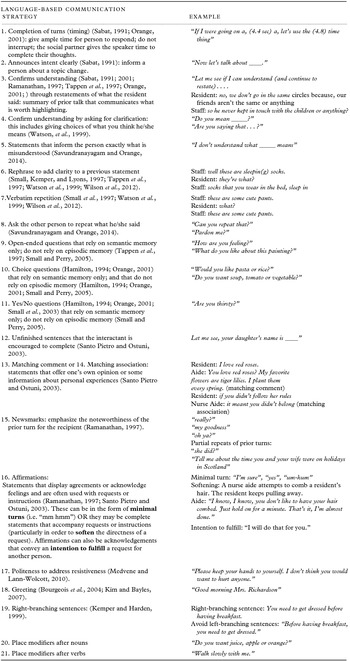
A coding system comprised of 21 strategies was also developed for the language-based perspective in order to examine the overlap between the two different approaches. The strategies included indirect repair, which include announcing intent clearly, confirming understanding through restatements or by asking for clarification, stating what was misunderstood, rephrasing, repeating, asking the resident to repeat what was uttered, and questioning (open-ended, choice, yes/no) for non-interrogative purposes (Sabat, Reference Sabat1991; 2001). Other language based strategies include allowing the resident to complete their turn, encouraging the resident to complete an unfinished sentence that was initiated by staff, matching comments or associations, newsmarks, affirmations, using politeness, greetings, right-branching sentences, and placing modifiers after nouns and verbs. Definitions and examples are provided in Appendix A.
Each transcript was coded separately using the two approaches. The purpose of coding conversations using the two approaches was two-fold. First, it assessed whether there was an overlap between the two approaches. Second, it enabled the investigation of the nature of that overlap. The coding was only applied to the utterances of the nursing staff because this study focused on ways in which the communicative competence of persons with dementia can be enhanced by staff reactions and responses. To establish the reliability of the coding systems, two trained researchers independently coded 20% of the transcripts. Two transcripts from the first three time recording sessions and three transcripts from the final recording session were selected to reflect the average number of staff utterances for all transcripts. The average number of staff utterances per transcript was 126 for all 46 transcripts. The average number of staff utterances per transcript was 130 for the nine transcripts used in the agreement analysis. The following calculation was used to perform the agreement analysis: total number of agreements divided by the total number of agreements and disagreements. The occurrence agreement was 91% for recognition, 92% for negotiation, 84% for facilitation, 85% for validation, 91% for the language strategies, and 93% for uncoded utterances.
Results
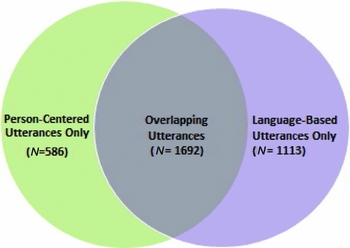
Once the transcripts were coded separately, the language-based indicators that corresponded to each of the four personhood indicators were examined. There were 5,800 utterances transcribed: 2,409 without indicators, 1,699 coded as language or person centered, and 1,692 overlapping utterances. There were 586 utterances that were coded as person centered and did not overlap with the language-based strategies, and 1,113 utterances were coded as language based and did not overlap with person-centered utterances (Figure 1). Of all utterances coded as recognition, 39% overlapped with language strategies. Ninety-six percent of the utterances coded as negotiation overlapped with language strategies, 68% of utterances coded as facilitation overlapped with language strategies, and 85% of utterances coded as validation overlapped with language strategies.
Overlap between person-centered and language-based utterances.

Overlap
Findings revealed that there were specific language-based strategies that characterized each person-centered indicator.
Recognition
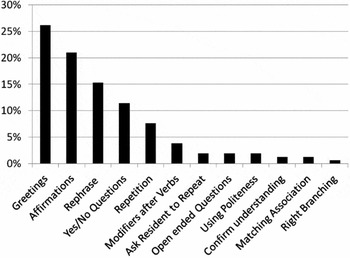
For recognition, 26% of utterances were greetings, 21% were affirmations, 13% were questions (yes/no and open-ended), and 15% involved rephrasing. The remaining overlapping strategies are found in Figure 2. Recognition involves acknowledging the resident as a unique person. Using a resident's name was often coded as recognition and this occurred with the use of greetings, affirmations, and rephrasing. Examples of each language strategy overlapping with the use of the resident's name are presented below.
Frequency of language-based strategies coded as recognition.

Staff: Good mornin(g) Anita! [Recognition] [Greeting]
Staff: Good mornin(g)! [Greeting]
Resident: Hi.
Staff: Okay I need you to hold on for me.
Staff: [8 second pause] Hold on Dorothy. [Recognition] [Rephrase]
Staff: Here roll over.
Resident: No.
Staff: There you go Ron. [Recognition] [Affirmation]
Staff: Nice and dry. [Affirmation]
Another way to recognize a resident is by acknowledging their unique life history. The excerpt below shows one primary way that staff acknowledged the unique life history of a resident. She asked open-ended questions pertaining to a topic with emotional salience to the resident such as a favorite activity or a significant other.
Staff: How's your wife doing? [Recognition] [Open-ended question]
Resident: [unintelligible speech]
Staff: Your wife? [Recognition] [Open-ended question]
Resident: Oh she's on.
Resident: She's on three floors up.
Negotiation
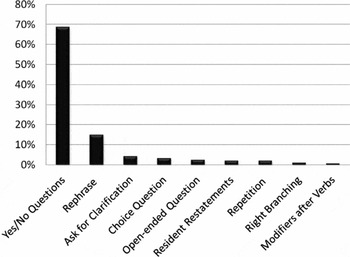
Negotiation involves consulting a person about his/her preferences and needs and using that information in current and/or future care interactions. It gives a sense of control to the person with dementia. As illustrated in Figure 3, questions comprised 74% of utterances that were coded as negotiation. Specifically, 68% were yes/no questions, 3% were choice questions, and 3% were open-ended questions. The remaining language strategies were rephrasing (15%). The following excerpt provides an example of yes/no questions as strategy for negotiation.
Frequency of language-based strategies coded as negotiation.

Staff: Put some socks on # so yo feet won't be cold.
Staff: The temperature done dropped. [Facilitation]
Staff: You want something nice and warm on? [Negotiation] [Yes/No Question]
Resident: Yes I do.
Resident: I don't like to be cold.
The excerpt below demonstrates that it is possible to use multiple language strategies in service of one person-centered communication strategy. The staff member first asked a yes/no question. When the resident did not respond, the staff member rephrased the yes/no question in order to clarify. The rephrasing resulted in a response from the resident. Multiple language strategies often co-occur with negotiation because it consists of offering choices or asking about preferences in the form of a question. Therefore, when another strategy is used to negotiate, it co-occurs with the already existing question form of the negotiation.
Staff: Here, feel your face.
Staff: You wanna shave? [Negotiation] [Yes/No Question]
Staff: You want me to shave you? [Negotiation] [Yes/No Question] [Rephrase]
Resident: No.
An example of open-ended questions as a form of negotiation is presented below. Here, the staff member used an open-ended question to respond to the resident's desire to return to bed. The staff member used an open-ended question in order to negotiate with the resident, providing her with some control over her decision about breakfast as opposed to telling her what she must do. By negotiating, the staff person was able to determine and respond appropriately to the resident's concerns.
Resident: Then I wanna go back to bed.
Staff: How (a)bout after you eat? [Negotiation] [Open-ended Question]
Resident: I suppose.
Staff: Okay.
Facilitation
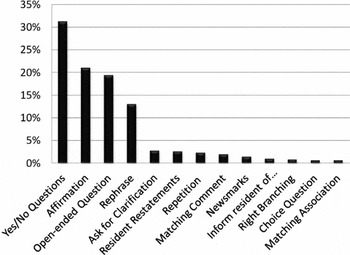
A pattern similar to that of negotiation was observed for utterances coded as facilitation where 51% of utterances coded as facilitation were yes/no questions (31%). However, 19% of facilitative utterances were open-ended questions. 21% of facilitative utterances were affirmations (13% were affirmations that conveyed an intention to fulfill a resident's request, 4% were statements of agreement where feelings were acknowledged, and 3% were statements that softened the directness of staff requests/instructions). Finally, 13% of the utterances coded as facilitation involved rephrasing. The remaining overlapping language strategies are found in Figure 4.
Frequency of language-based strategies coded as facilitation.

Facilitation involves working together or enabling the resident to perform a task or do what they would not otherwise be able to do. One way to accomplish this is by providing affirmations, which involves acknowledging the resident's feelings or agreeing with the resident. The form of affirmation called “intention to fulfill” involves acknowledging the other person's request and letting him/her know that it will be addressed. In the example below, the staff member let the resident know that her request for coffee will be addressed. The staff member is being facilitative in that by agreeing to take the resident down to the dining hall so that she may get some coffee, the staff member is helping the resident fulfill a desire that she would not have been able to fulfill on her own.
Staff: lift yo feet up for me.
Resident: have you got any coffee?
Staff: no we can get some. [Facilitation] [Affirmation – Intention to fulfill] [staff and resident head toward the dining hall]
A second type of affirmation is softening a staff members’ request so that the resident feels at ease. In the following excerpt, the resident is having trouble going to the bathroom. By responding to the resident's fear that it may hurt to go to the bathroom with an affirmation, the staff member is facilitating the resident's ability to perform the task at hand and ultimately ease her discomfort.
Resident: Does it hurt?
Staff: I dunno it's not supposed to hurt to use the bathroom. [Facilitation] [Affirmation – Softening]
Resident: Okay. Open-ended questions were also used frequently as facilitation as in the example below.
Staff: How was your breakfast Fred? [Facilitation] [Open-ended question]
Resident: Oh. It was good this morning.
Staff: That's good. [Validation]
In this example, the staff member asks Fred how his breakfast was in order to initiate meaningful conversation while performing routine care tasks. The resident then responds to her question, furthering the conversation on the topic and allowing the staff member to find out about the resident's preferences and feelings about breakfast. This also gives the staff member an opportunity to address potential unmet needs if his response had not been positive.
Validation
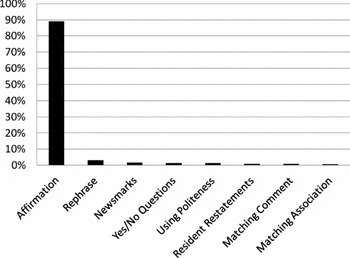
Of the utterances coded as validation, 89% were affirmations (Figure 5). Specifically, 81% were statements of agreement where feelings were acknowledged, 4% were affirmations that conveyed an intention to fulfill a resident's request, 3% were statements that softened the directness of staff requests/instructions, and 1% were minimal turns that expressed understanding. Affirmations accomplish validation by conveying empathy. Both affirmations and validation involve acknowledging the resident's feelings. The following excerpt describes the staff member calling the resident's daughter a sweetheart, agreeing with the resident's feelings of fondness of her daughter, and validating them by responding to her on the feeling level.
Frequency of language-based strategies coded as validation.

Staff: She was here today.
Resident: Yeah.
Staff: You seemed happy.
Resident: You know her?
Staff: Yeah we talk all the time.
Resident: Oh really?
Staff: Uh huh.
Resident: Isn't she nice?
Staff: She's uh. . .She is a sweetheart. [Validation] [Affirmation]
Resident: Yeah she is.
Discussion
By overlapping with person-centered communication strategies, the language strategies discussed have the potential to create the positive feedback loop that Ryan and colleagues (Reference Ryan, Giles, Bartolucci and Henwood1995) described in the Communication Enhancement Model. The language strategies that overlapped with person-centered communication strategies consist of appropriate speech modifications to be used when communicating with a person with dementia. As such, these strategies have the potential to modify the physical environment through negotiation of residents’ preferences and needs. Moreover, the strategies can modify the social environment through facilitation of conversation, validation of the residents’ feelings, and recognition of life history so that residents’ autonomy and retained competence are maintained.
The findings of this study suggest that there is some overlap in how the language and personhood frameworks define successful communication. However, personhood is a broader perspective in that it encompasses language-based definitions of successful communication, such as continuity and clarity, while it also extends this definition to include the maintenance of positive identity. Insofar as personhood and the language-based approach overlap, there are some language-based strategies that may be used to describe the form of person-centered communication.
In particular, affirmations, yes/no questions and rephrasing should be closely attended to for their multiple functions in maintaining the goals of the language-based and personhood perspectives. This mirrors the findings of Wilson and colleagues (Reference Wilson, Rochon, Mihailidis and Leonard2012), where closed-ended questions and paraphrased repetition were among the most-used strategies employed by caregivers in successfully completed hand-washing sessions. Encouraging comments, similar to affirmations, were also used frequently in the hand-washing sessions, though they were not linked to successful task completion (Wilson et al., Reference Wilson, Rochon, Mihailidis and Leonard2012).
The findings of this study which show that recognition most often overlapped with greetings are consistent with what was described by Ryan and colleagues (Reference Ryan, Byrne, Spykerman, Orange and Davis2005) where a trained communicator used personalized greetings to recognize the resident with dementia with whom he was conversing. Calling a resident by name to get his/her attention was a successful strategy used frequently by staff (Wilson et al., Reference Wilson, Rochon, Mihailidis and Leonard2012). Moreover, individuals with late stage dementia of the Alzheimer's type recognized their own names and responded appropriately (Kim and Bayles, Reference Kim and Bayles2007).
Yes/no questions were most often what overlapped with negotiation in the current study. Closed-ended questions have been found to be effective in successful task completion and interaction with persons with dementia (Tappen, et al., Reference Tappen, Williams-Burgess, Edelstein, Touhy and Fishman1997; Ripich et al., 1999; Small et al., Reference Small, Gutman, Makela and Hillhouse2003; Small and Perry, Reference Small and Perry2005; Wilson et al., Reference Wilson, Rochon, Mihailidis and Leonard2012). Intuitively, it is understandable that close-ended questions met the function of negotiation. They offer choices to the person with dementia and elicit a simple response, such as “yes” or “mmm.” This strategy is particularly useful with persons in later stages of dementia, where they may not be able to communicate their understanding with a high level of verbal capacity. This may help to ensure that the staff member gets the information that is needed to continue with the task in a useful way.
A variety of language strategies overlapped with facilitation. Like negotiation, yes/no questions were the most prevalent. However, open-ended questions overlapped more frequently with facilitation than with any other person-centered code. This is consistent with evidence that open-ended questions are useful in initiating conversation (Tappen et al., Reference Tappen, Williams-Burgess, Edelstein, Touhy and Fishman1997) and in initiating a required task (Ryan et al., Reference Ryan, Byrne, Spykerman, Orange and Davis2005), both of which are important facets of facilitation. While closed-ended questions, such as yes/no questions, may facilitate the completion of a task, open-ended questions can facilitate initiation of a task or a conversation. Open-ended questions can be person-centered in that they shift the role of the resident with dementia from receiving information to giving information, and thereby illustrate the resident's communicative ability to staff members.
Affirmations made up the large majority of language strategies overlapping with validation. This relationship makes intuitive sense, as by definition, both affirmation and validation involve the acknowledgment of feelings, often by agreeing with the resident (Ryan et al., Reference Ryan, Byrne, Spykerman, Orange and Davis2005).
The findings in this study have shown that nursing home staff currently used language strategies to facilitate conversation and task completion with residents with dementia. Moreover, some of these language strategies overlapped with the use of person-centered communication elements that satisfy the psychological needs of persons with dementia according to Kitwood (Reference Kitwood1997). For example, affirmations often overlap with recognition, facilitation, and validation and can be a tool in satisfying the goal of comfort and attachment for a person with dementia. Yes/no questions can also overlap with recognition and satisfy the goal of identity, as well as with negotiation satisfying the goal of inclusion. For example, negotiating with a resident by asking a yes/no question about their preferences has the ability to make them feel included about their everyday decisions. Finally, yes/no questions that allow facilitation of task completion can satisfy the goal of occupation. The resident may have the opportunity to complete tasks that they otherwise would not have been able to by using these strategies. Open-ended questions also overlapped with facilitation and satisfy the goals of identity and attachment, as open-ended questions have the ability to initiate conversation, giving the resident a chance to feel more attached to staff through ease of conversations.
Although some language-based strategies overlapped with communication-focused indicators of person-centered care, the use of a language strategy, such as yes/no questions, does not mean that communication is person centered. Figure 1 shows that there were many times (N = 1,113) that language strategies did not overlap with indicators of person-centered communication. Many of those instances involved staff focusing on maintaining a conversation for the purposes of task completion without being person centered. Instances of the lack of overlap between language and person-centered strategies should be included in the development of training programs for staff. Staff must consider whether the use of language-based strategies also serves the goals of person-centered care and consequently results in greater engagement by residents.
This study is unique in that it provides an analysis of conversations taking place in a naturalistic setting involving daily care routines. This represents the middle ground between the study done by Wilson and colleagues (Reference Wilson, Rochon, Mihailidis and Leonard2012) where conversational analysis was performed during a task-based interaction involving a single activity of daily living, namely hand washing, and that of Ryan and colleagues (Reference Ryan, Byrne, Spykerman, Orange and Davis2005), where trained communicators conversed with a person with dementia for the sake of having a conversation, as opposed to completing a task. The findings in this study demonstrate that similar language strategies are employed across the spectrum of interactions ranging from task based to conversational. However, some language strategies also showed differential uses among the three settings. For example, open-ended questions were not used frequently in the hand-washing conversations (Wilson et al., Reference Wilson, Rochon, Mihailidis and Leonard2012) but they were used in multiple ways, including for facilitation and negotiation in the conversations analyzed by Ryan and colleagues (Reference Ryan, Byrne, Spykerman, Orange and Davis2005). The current study showed that open-ended questions were used to facilitate, but not frequently in any other contexts. The transcripts analyzed in this study consisted of both task-related and conversation-based communication. This suggests that open-ended questions may increase in frequency as the communication becomes more conversation based, and less task based.
The most difficult, yet arguably most important component of this study was the development of the coding system for personhood. The subjective nature of personhood makes it challenging to code and measure. The function of the personhood indicators is fully developed and discussed by Kitwood (Reference Kitwood1997). However, the form in which the indicators are generally observed has not been uncovered, with the exception of a study by Ryan and colleagues (Reference Ryan, Byrne, Spykerman, Orange and Davis2005). This may be due to the highly subjective nature of personhood. The current study's findings show that the language-based approach may provide some concrete ways in which personhood can be included in conversations. The list of language-based communication strategies used in this study is not exhaustive, but reflects the existing body of research on effective communication strategies for persons with dementia. There are likely other strategies that could be included as new research findings emerge on what works and what does not work for communicating with persons with dementia. Additionally, this study is limited by the analysis of verbal communication only. Non-verbal communication is an important aspect of providing person-centered care and future studies involving analyses of video interactions will be beneficial toward our understanding of verbal and non-verbal strategies that are person centered.
From a pragmatic and applied perspective, developing more concrete strategies or heuristics to apply person-centered strategies will benefit staff caregivers involved in dementia care. The results of this study provide ecologically valid insights into the development of interventions designed to increase person-centered communication via effective language-based strategies. In particular, the findings suggest that staff need training to use more diverse language strategies that support personhood of residents with dementia. Using a frequency cut-off of at least 10% overlap between language strategies and utterances coded as each personhood indicator, Figures 2 through 5 illustrate that only four language strategies overlapped with recognition, two strategies overlapped with negotiation, four strategies overlapped with facilitation, and one strategy overlapped with validation, indicating a lack of diversity in language strategies currently being used to support personhood. Furthermore, there were many language strategies that were rarely used or not used at all. For example, matching comments and associations have the potential to be validating because they reiterate and/or reinforce a resident's utterance. Alternatively, these strategies can be facilitative in that they allow a conversation to be maintained (Santo Pietro and Ostuni, Reference Santo Pietro and Ostuni2003). Thus, a fruitful area for future research is to examine whether training nursing home staff when and how to use the language strategies that overlap with person-centered communication has an effect on the level of person-centeredness of their overall interactions. Furthermore, future research should examine whether using both language- and person-centered strategies results in greater engagement by the person with dementia. Finally, the overlap between the two perspectives offers a useful area of research for psycholinguistic and sociolinguistic researchers in that the language-based advice now holds greater functions in not only maintaining a coherent conversation but one that is also personhood affirming.
Conflict of interest
None.
Description of authors’ roles
M. Y. Savundranayagam designed the study, collected the data, and developed the protocol for data analysis. Both M. Y. Savundranayagam and K. Moore-Nielsen contributed to data analysis interpretations and writing of the manuscript.
Acknowledgments
This work was supported by an Academic Development Fund from Western University. The author is grateful to all staff caregivers and residents with dementia who participated in this study. The author acknowledges Natalie M. Davidson and Rachel K. M. Garrett for their diligent assistance on this project.
Language-based communication strategiesh