Gender in the verbal system
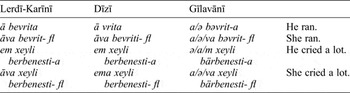
Grammatical gender in the verbal system is attested only in the 3rd person singular with short unstressed -a Footnote 4 for masculine and long stressed -fl for feminine, e.g. bevazz-a ‘he ran’, bevazz-i- fl ‘she ran’, Bahman devašta ba ‘Bahman had run away’, Mariam devašta bi- fl ‘Mariam had run away’, čǝman zuā beš-a Xerā Footnote 5 ‘My son went to Xerā’, čǝman kǝla beš-i- fl Xerā ‘My daughter went to Xerā’. The masculine and feminine of the auxiliary verb in the present are formed by -e and -fl, respectively,Footnote 6 e.g. Fereydūn dalū e ‘Fereydun is crazy’, Mariama Footnote 7 dalū fl ‘Mariam is crazy’,Footnote 8 bām-e ‘he is coming’, bām-i- fl ‘she is coming’ (see Tables 1 and 2).
Šahrūd dialect group – Present future and present continuousFootnote 9

Šahrūd dialect group – grammatical gender and preterite

Grammatical gender in nouns
In the nominal system there is no special gender ending for the masculine. The feminine nouns usually have short unstressed -a as the gender marker.
Natural and grammatical gender
The identity of natural and grammatical genders is expressed in almost all dialects.
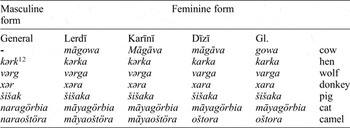
Some animal names ending with -a make their masculine and feminine forms accordingly with the words nara ‘masculine’Footnote 10 and māya ‘feminine’Footnote 11 (see Table 3).
Šahrūd dialect group – natural grammatical gender

Some animals have different names for masculine and feminine forms, e.g.:

There are some nouns in Lerd, Karīn and Dīz dialects which have only feminine forms:
-
a) animal names
anguraka ‘spider’
speǰa ‘louse’
kelma ‘worm’
niāsa ‘fly’
gāvazaka ‘tarantula’
muča ‘sparrow’
-
b) All season names, ‘sun’ and ‘moon’ are also feminine, for example, zǝmǝssun-a bam-i-ā ‘Winter came’, vahār-a bar ši-ā ‘Spring passed’, mong-a bar ām-i-ā ‘The moon rose’. These forms can be found only in the Lerd and Karīn subdialects; in the other villages (Asbū, Āskestān, Derav, Kolūr, Šāl, Dīz and Gīlavān) this rule does not apply.
-
c) All fruit trees in Lerd and Karīn subdialects:Footnote 14


In the Lerd and Karīn subdialects, when the noun takes the numerative igla/ila or-i Footnote 15 ‘one’, it is feminine, while in Dīz subdialect it is masculine.
-
Lerd․ man igla xar-i bexurt-ā (feminine) – ‘I sold a donkey’.
-
Krn․ igla xar-em rā ku bind-ā (feminine) – ‘I saw a donkey on the road’.
-
Dīz․ rā-d-em bind ila mādiān bargenes (masculine) – ‘On the way I saw a mare fall down’.
In Gīlavān both variants are attested:
I xelik-eš iakat-ā bebard-eš ā ku
‘He picked up a spade and took (it) to the mountains.’
I yuz-eš-i /karkxā-š-i /čakulu-š-i akat-ā bebard-eš ā ku Footnote 16
‘He picked up a walnut/an egg/a cock and took them to the mountain’ vs.
igla karkx-ā-m akat (masc.), rā dagenes-im, ǰegenes-ā (feminine) beškes-ā (feminine)
‘I took an egg, started off, it dropped and broke.’
However, in Gīlavān the masculine and feminine forms often have the same or a similar structure, though the masculine forms are dominant. The relationship between the masculine and feminine genders can be seen in the following example: igla pādeša-i be igla asb-i-š dāšteya (asb – masculine, dāšteya – past continuous), asb-eš-a (feminine) bǝxurt-ā do gla-š asser (masculine) aragate ‘There was a king, he had the horse, he sold a horse and bought two mules’. In the first part igla-i shows that asb has an indefinite article and is masculine, otherwise we would have asb-a. In the second part ‘horse’ has an indefinite article too (asb-eš-a), but is feminine – asb-eš-a. In the first part asb is masculine probably because it is used with the word pādeša ‘king’ (masculine).
However, it must be mentioned that the lexeme igla/ila is used mostly in the feminine form, cf. xāvem ku igla asb-i bind-ā ‘I saw a horse in my dream’ (feminine), but when it is used with plural nouns, the verb is in the masculine form, cf. xāvem ku sǝ gla-m asb bind (masculine) ‘I saw three horses in my dream’.
Grammatical gender in the pronominal system
Grammatical gender in the pronominal system can be seen in the 3rd person singular forms of personal and possessive as well as of demonstrative pronouns of Lerd and Karīn dialects.
-
a) Personal pronouns
-
b) Possessive pronouns
-
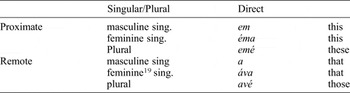
c) Demonstrative pronoun


The grammatical gender of demonstrative pronouns can be found only in the singular direct forms (see Table 4).
Grammatical gender of demonstrative pronouns

Gender agreement between noun and adjective
In Šāhrūd dialects there is noun gender grammatical agreement mainly between nouns and adjectives (in Lerd and Karīn subdialects). Attributive adjectives do not generally show grammatical gender. Predicative adjectives, however, mark the gender in some dialects.
Predicative adjective
- Lerd
-
čǝman xar bad sar ni (masculine) ‘My donkey isn't obstinate’
čǝman xar-a bad sar-a ni-a (feminine) ‘My donkey isn't obstinate’
em pis bu (masculine) ‘he is bad’
ém-a pis-a bi-a (feminine) ‘she is bad’
- Krn.
-
em mǝrdá nāxoš agahast (masculine) ‘This man feels bad’ (lit.became ill)
em-āženi-anāxoš-a agahast-a (feminine) ‘This woman feels bad’ (lit. became ill)
ma bǝrā pilá (masculine) ‘His brother is big’
mā xāhá pili-ā (feminine) ‘His sister is big’
The change of feminine marker
-
a) When an enclitic pronoun follows a feminine noun, the feminine index (-a) separates from the noun and stands after the enclitic pronoun:
I ruj beše ku naččir-a bez-eš bezz-e ‘Once he went to a mountains (and) shot a wild goat’, but em naččir-a bez-eš-a (feminine) bezzi-ā bārd-eš-ā de ‘he shot this wild goat (and) brought it to the village’, Bahman-e čǝman ǰigarbán-eš-a bebard-ā ‘Bahman stole my (cattle) guts’. Āftow-em-a bind-ā ‘I was looking at the sun’ (this sentence is an example of ergative structure and literally means ‘the sun is being looked by me’).
-
b) When a feminine noun is in the genitive case, the feminine marker changes to stressed -é. For example, vey-é dass-é bigir ‘Take the bride's hand’ (the nominative case of ‘bride’ is veya), beše Zeynab-é bāvayā ‘go (and) bring Zeynab here’ (the direct form is Zeynaba).

Conclusion
From the above-mentioned materials it can be concluded that in Lerd and Karīn and, partially, in the Gīlavān and Dīz subdialects of the Šāhrūd dialect group there are masculine and feminine forms of nouns. The nouns, ending with unstressed-a are of feminine gender, and the feminine nouns with natural gender also have -a at the end. Mostly this concerns animal names:

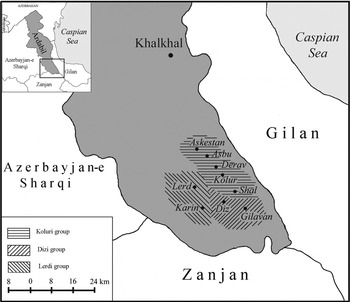
On the basis of the study of grammatical gender, Šāhrūd dialects can be divided into three groups (see the map in Figure 1):
Group 1. Here we have well-expressed grammatical gender. In this group two north-western villages of the Šāhrūd district can be included – Karīn and Lerd, situated on the bank of Lerd river and in the foothills of mount Palangā, which divides these villages from the other group of Šāhrūd villages.
Group 2. In this group grammatical gender is expressed only partially. Here we have the central villages.
Group 3. Here we have no grammatical gender. The villages of this group are Āskestān, Asbū, Derav, Kolūr and Šāl. The centre is Kolūr village.
Spread area of the grammatical gender of Šāhrūd dialect group