Parliamentary democracy is sometimes described as a chain of delegation; from voters to parliamentarians, from parliamentarians to the cabinet, from cabinets to ministers, and from ministers to the bureaucracy (Strøm Reference Strøm2000). Each link in the chain of delegation may exhibit the common problems associated with principal–agent relationships. An interesting aspect of this view of democracy—in contrast with a classical view of hierarchical organizations in which the principal at the top of the hierarchy is seen as wielding the greatest amount of power—is that the cabinet is typically seen as most influential in the parliamentary chain of delegation. Thus, we are more prone to ask whether voters hold governments accountable than their immediate agents, i.e., their representatives in parliament (see e.g., Powell and Whitten Reference Powell and Bingham1993; Powell Reference Powell, Bingham and Whitten2000; Hellwig and Samuels Reference Hellwig and Samuels2008). Indeed, the view that parliament has limited influence on government policy is quite common and often the role of parliament is seen as being reduced to providing the cabinet with support in parliament and protection against votes of no-confidence.
This view of parliamentary democracy raises questions about whether the role of members of parliament (MPs) extends beyond providing the government with legislative support and whether voters hold them accountable for their legislative behavior rather than for government performance. The latter can be seen as a precondition for MPs acting as faithful agents of their constituents. Without promise of a reward, MPs have little incentive for pursuing their constituents’ interests and are, instead, likely to align more closely with their party leadership (Kam Reference Kam2009).
Reelection is seen as one of the primary motives of legislators (Rae Reference Rae1971; Mayhew Reference Mayhew1974) that helps align legislators’ behavior with voters’ interests. There is a rich literature that argues that legislators have an incentive to cultivate a personal vote in order to maximize their chances of retaining office. Others have noted that the incentives vary in their intensity depending on whether the electoral system allows legislators to translate personal following into favorable electoral prospects (Carey and Shugart Reference Carey and Shugart1996). The electoral system is not the only factor as Cox’s (Reference Cox1987) work suggests—though sharing an electoral system with the United States, British legislators are less concerned with building a personal vote. Cheibub and Limongi (Reference Cheibub and Limongi2002) suggest that this is likely a function of centralized decision-making, i.e., individual legislators’ lack of ability to exert policy influence. Martin (Reference Martin2011), similarly, notes how legislators cultivate a personal vote via fiscal legislative particularism (as in the United States) or extra-legislative constituency service (as in Britain) and argues that particularistic mechanisms strengthen committees and affect personal vote building activity.
Although control of the legislative agenda is firmly in the hands of the cabinet in many parliamentary systems, MPs routinely seek to take advantage of their right to propose “private member bills.” The right to propose members’ bills is often restricted. Mattson (Reference Mattson1995) finds, e.g., that the passage rate of members’ bills ranges from 0 to 46 percent with a mean of 18.4 percent and median of 14 percent in Western Europe. Nevertheless, the mere act of proposing legislation may be important for MPs to signal effort to their constituents.
That MPs seek to offer members’ bills—often in the face of near-certain defeat—raises two questions. First, why do they propose members’ bills? Second, do members’ bills have the intended effect? We argue that the answers to these questions are slightly more complicated than those suggested by the literature as MPs can occupy two roles; as electorate candidates, those competing in single-member districts, and list candidates, those standing on a national list using proportional representation. Each type of candidate faces a different selectorate and, therefore, seeks to influence different audiences. In their roles as electorate candidates, MPs wish to represent, show responsiveness to, or signal effort to their constituents in the hope of building a personal vote but as Carey and Shugart (Reference Carey and Shugart1996) argue, candidates in single-member districts have a strong incentives to build a personal vote whereas candidates on a (closed) party list share their personal vote with the list. One might, thus, expect members’ bill activity to be concentrated among electorate MPs and primarily be influenced by competition within their electorate. While list MPs may gain little from a personal vote they nevertheless have an incentive to present members’ bills—their legislative efforts are, however, directed at a different audience. Their electoral fortunes are determined by their placement on the party list, placing list MPs in competition with one another for a favorable list position.Footnote 1 In their roles as list candidates, MPs propose members’ bills to signal effort, an ability to appeal to voters, or other qualities to their party’s selectorate.
New Zealand presents a unique opportunity for evaluating our claim that the selectorate of the MPs’ conditions their behavior as well as whether their efforts bear fruit for two reasons: New Zealand employs a mixed-member electoral system and members’ bills are selected randomly for introduction in the legislature. The mixed-member electoral system allows us to evaluate whether the MPs’ standing with the different selectorates influences their legislative behavior. After examining whether New Zealand MPs members’ bill activity targets different audiences—depending on their placement on the party list and their popularity in their electorate—we turn to the question of whether those activities were effective. Here the random selection of members’ bills for debate helps estimate the causal effect of members’ bills.
The Electoral Connection
Mixed-member electoral systems create two types of MPs—those elected from a party list and those elected in single-member districts—which scholars have exploited to examine how electoral systems shape legislative behavior.Footnote 2 As the fortunes of MPs elected in single-member districts are tied closely to the voters in their district, they have a strong incentive to build a personal vote (Carey and Shugart Reference Carey and Shugart1996). In contrast, list MPs are generally more dependent on their party as electoral success requires occupying a seat sufficiently high on the party list. In addition, single-member districts may offer greater rewards for pork barrel projects as co-partisan MPs have little incentive to challenge the incumbent’s credit claiming. In mixed-member systems that allow candidates to stand simultaneously for election in a single-member district and on the party list, MPs’ strategies will reflect the incentives at both tiers of the system.
New Zealand has used a mixed-member system since 1996. In total, 70 members are elected in single-member districts under plurality rule, while 50 members are elected using proportional representation from a single national district.Footnote 3 Voters cast two votes; one for an electorate candidate and one for a (closed) party list. The incentive to cultivate a personal vote thus varies among New Zealand MPs. How an MP was elected does not necessarily determine whether the MP seeks to build a personal vote as most MPs run as both electorate and list candidates. However, for these MPs, their electoral vulnerability in their electorate and on the party list is likely to shape the strategies they adopt.Footnote 4
Since 1993 the New Zealand parliamentary procedures have limited the number of members’ bills by allowing only three to eight members’ bills on the Order Paper for first reading each members’ day.Footnote 5 When space becomes available, members’ bills are selected by lot. MPs can enter bills in the ballot at any time but, on average, a ballot is held about once a month. Thus, random selection determines which MPs propose legislation and have it debated in the legislature.
That members’ bills are selected randomly offers distinct advantages for evaluating whether legislative behavior affects voters’ evaluation of MPs.Footnote 6 Where MPs do not face restrictions on proposing legislation, endogeneity is a concern. For example, if electorally vulnerable MPs are more likely to propose members’ bills then estimates of their effect on electoral success would tend to be biased downwards. As MPs must place a bill on the members’ ballot for a chance of being selected, the selection of members’ bills is not completely random. However, the randomization remains useful as the causal effect of members’ bills can be estimated by conditioning on the MPs’ observable effort.
We expect electorate MPs to cultivate a personal following with the aim of reelection. The electoral connection has been examined in a number of countries but the use of members’ bills to build a personal vote has not been studied systematically with a few notable exceptions. Bowler (Reference Bowler2010) argues that private member bills constitute one form of cultivating a personal vote. Loewen et al. (Reference Loewen, Koop, Settle and Fowler2014) suggest that in the face of limited opportunities to claim credit for policy initiatives or service, MPs will welcome any opportunity to increase name recognition or popularity. Solvak and Pajala (Reference Solvak and Pajala2016) study members’ bill in Finland and Estonia and find that the behavior of MPs depends on both whether they are elected under open- or closed-list systems and district magnitude. Employing similar logic, Bräuninger, Brunner and Däubler (Reference Bräuninger, Brunner and Däubler2012) show how patterns of members’ bill proposals are shaped by intra-party competition in the Belgian flexible list system.
One may be skeptical of the claim that members’ bills have an electoral impact and think that other forms of constituency service may be more effective. Indeed, voters may only pay attention to the major issues on the legislative agenda. When it comes to members’ bills, which generally have little chance of success, we can be virtually certain that the vast majority of voters pay little attention. However, proposing members’ bills may attract the attention of political journalists and help MPs establish themselves even if the bill itself does not receive much media coverage.Footnote 7 But occasionally they do. Farrar of the New Zealand Herald notes, e.g., that
[h]aving your bill selected from the ballot can be life changing for an MP. It can take you from an obscure backbencher to a national figure. Sue Bradford was already well known before her anti-smacking law was selected, but the bill saw her become one of the highest profile MPs (Reference Farrar2012).
Members’ bills may, thus, help MPs gain name recognition and even popularity.
Proposing a bill also allows MPs to signal effort and dedication directly to their constituents (Bräuninger Reference Bräuninger2009). MPs can highlight their legislative efforts in their campaigns and some parties highlight members’ bills on their websites. Even if MPs expect the benefits to be fairly small, proposing a member’s bill is not costly—they are rarely substantial pieces of legislation.
The incentive to propose members’ bills, or engage in constituency work, is a function of the MP’s electoral security. MPs in safe seats have little to gain from proposing a member’s bill. In marginal districts, members’ bills are more likely to have a decisive effect. Bowler (Reference Bowler2010) finds that British MPs in marginal seats propose more private member bills. French (Reference French2009) and Kellermann (Reference Kellermann2013) come to a similar conclusion regarding early day motions. New Zealand MPs’ incentives are slightly more complicated because of the mixed-member system where candidates may simultaneously run as electorate and party list candidates. Thus, the meaning of occupying a safe seat is not as clear.
New Zealand MPs can attain electoral security in two ways. First, MPs can run in a “safe” electorate. Electorally secure MPs are expected to offer fewer members’ bills.
Hypothesis 1: MPs in safe seats in their electorate are less likely to propose members’ bills.
Alternatively, electoral security can be achieved by obtaining a seat relatively high on the party list. A candidate low on the list is vulnerable in two ways. First, a decline in her party’s vote share reduces the party’s number of seats. Second, because the electoral system is compensatory, the number of list seats depends on the number of electorate seats won and can, thus, affect a list MP’s chances of a seat. However, a list MP’s chances are only affected by the success of electorate candidates that are lower or not on the party list.
While offering a members’ bill is potentially valuable for electorate candidates, it is not obvious that list candidates benefit. Offering members’ bills may help the party win votes but the benefits accrue to the party as a whole and are unlikely to have a decisive effect on the MP’s individual electoral fortune. While list MPs are unlikely to be motivated by personal vote incentives, offering members’ bills may build a reputation and signal ambition, legislative competence, or other qualities valued by the party. List MPs, therefore, face similar incentives as electorate MPs but their audience is different, i.e., list MPs offer members’ bills to influence those responsible for list nominations.Footnote 8 List MPs that face greater electoral uncertainty, i.e., were lower on the party list, are expected to offer more members’ bills.
Hypothesis 2: MPs high on the party list are less likely to propose members’ bills.
The great majority of elected MPs run both as electorate and list candidates. The electoral rules imply that those elected from the party list failed to win in their electorate. In some sense list MPs are more vulnerable as they are less likely to win in their electorate and their chances of reelection are, therefore, almost entirely dependent on a favorable spot on the party list. More generally, MPs that are electorally vulnerable both in their electorate and were low on the party list face greater incentives to offer members’ bills.
Hypothesis 3: MPs that are electorally vulnerable both in their electorate and as list candidates are more likely to propose members’ bills.
Thus, the expectation is that the marginal effect of a higher placement on the party list declines the safer the MP’s electorate seat. Conversely, the marginal effect of the MP’s vote share in her electorate declines the higher the MP is on the party list.
The hypotheses assume that offering members’ bills influences how voters, and parties, evaluate candidates. Members’ bills may do so in several ways. First, voters may notice the MPs’ effort in proposing members’ bills. It does, however, seem somewhat unlikely except for those voters directly affected by the legislation or in exceptional cases where members’ bills address highly salient or controversial issues such as the 2012 Marriage (Definition of Marriage) Amendment Bill that expanded the definition of marriage to same-sex unions. Second, having proposed members’ bills may be useful in the MP’s reelection campaign both in terms of signaling her policy emphasis and as documentation of the MP’s legislative effort. Third, journalists may pay attention to members’ bills. While the bills’ content is not always of great importance, they may still serve to draw attention to the MP. Members’ bills may be more likely to be offered by backbenchers with high ambitions, MPs that are electorally vulnerable, and mavericks—all of which have the potential of making a good news story. The expectations about the effects of proposing members’ bills are straightforward—proposing members’ bills improves voters’ evaluation of the MP.
Hypothesis 4: MPs that propose members’ bills are viewed more favorably by voters in their electorate.
To examine how the electoral connection conditions legislative behavior in New Zealand, we focus on members’ bill proposals in the 46th–50th parliaments, using electoral results and party lists between 1999 and 2011 to evaluate whether electorally vulnerable MPs are more likely to propose members’ bills and, subsequently, whether it influenced their approval ratings.
Empirical Analysis
The data on members’ bills placed and selected on the ballot were gathered from the parliamentary archives and website.Footnote 9 Constituency level electoral results were obtained from the constituency level electoral archive (Kollman et al. Reference Kollman, Hicken, Caramani, Backer and Lublin2013), while party lists were obtained from the New Zealand Electoral Commission.Footnote 10 Information on MP approval comes from the New Zealand Election Studies (1999, 2002, 2005, and 2011).Footnote 11
Proposing Members’ Bills
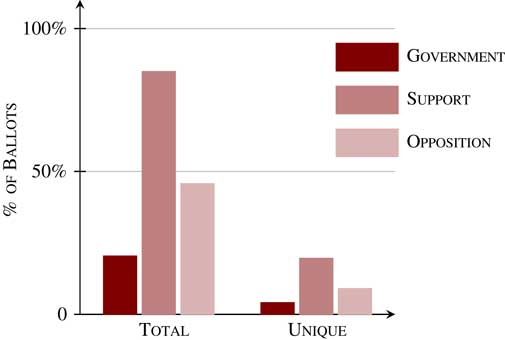
The members’ bill ballot is held whenever room opens on the Order Paper, which typically means at most once or twice a month. One or two bills are drawn out of about 40 bills placed on the ballot. MPs are allowed to place the same bill on subsequent ballots if not drawn. A total of 3174 bills were placed on the ballot during the 45th–50th parliaments. The chance of success is fairly low—only 159 bills were drawn (5.0 percent). Figure 1 graphs the average participation rate in members’ ballots by government, support party, and opposition MPs. Opposition MPs participated on average in nearly half the ballots, placing a total of 1805 bills on the ballot or on average 6.91 bills/MP (per session). Government MPs placed 516 bills on the ballot, averaging only 1.80 bills/MP (per session). Government support party MPs were the most active, making use over 80 percent of their opportunities to place a bill on the ballot.
Share of opportunities to enter bill used Note: Excludes ministers, house leaders, and all speakers. New Zealand Parliament (www.parliament.nz).
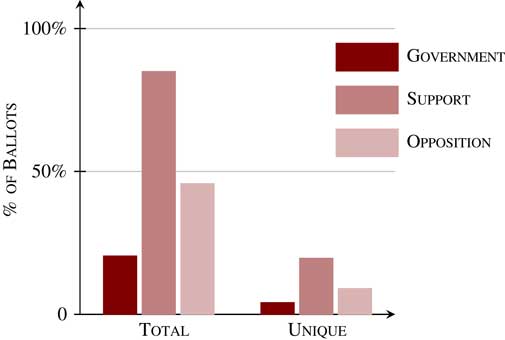
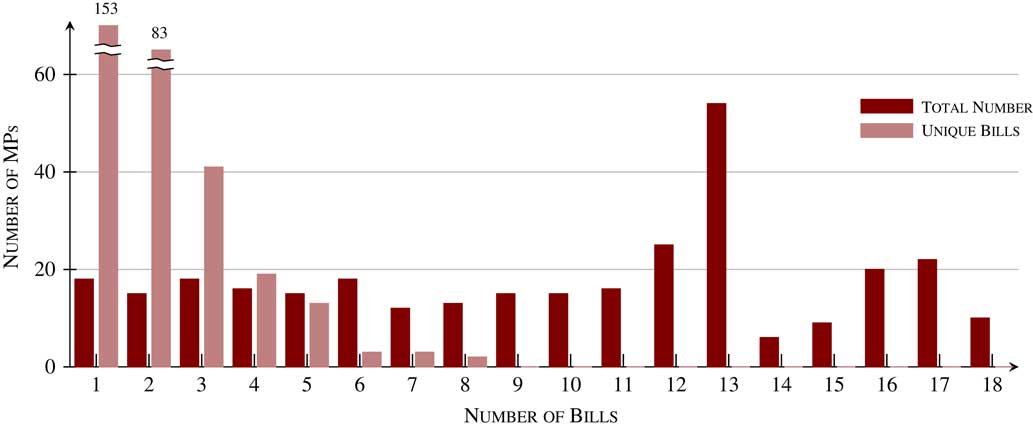
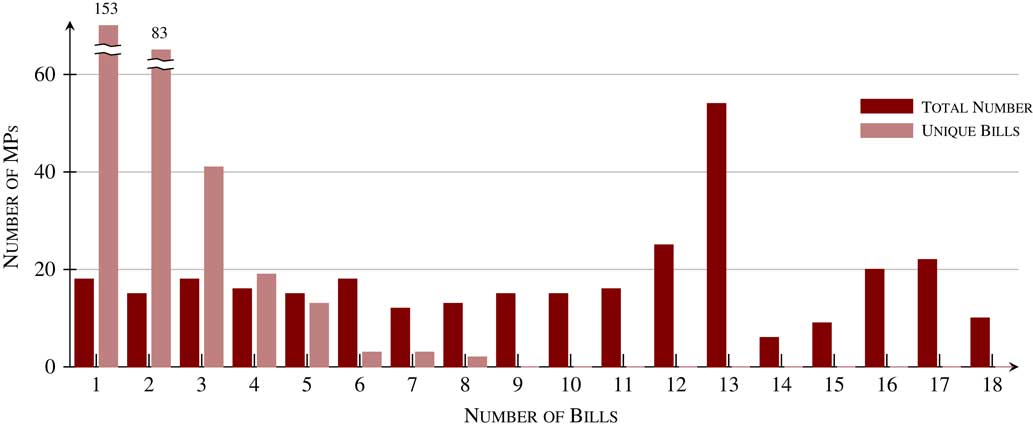
Figure 2 graphs the number of unique bills placed on the ballot by a MP as well as the number of attempts made. About 35 percent of the MPs (excluding ministers) did not participate in the ballot at all. The number of attempts is fairly evenly distributed although a fair number of MPs take every opportunity to place a bill on the ballot.Footnote 12 However, 94 percent of the MPs who placed a bill in the ballot did so more than once. A plurality, 48 percent, placed a single (unique) bill on the ballot with 27 percent placing two separate bills.
Bills placed on the ballot by MP Note: New Zealand Parliament (www.parliament.nz).
To evaluate the effect of electoral vulnerability on participation in the members’ bill ballot, we consider whether each MP entered a bill in each ballot. Proposing members’ bills can be seen to have an effect for different reasons. For example, if the MP seeks to signal legislative effort, placing the same bill on the ballot repeatedly and proposing several different bills may both be effective strategies, i.e., in either case her name appears on each ballot and is more likely to be noticed by party members or journalists. If the benefits are only realized if a bill is drawn and debated in parliament then the number of attempts rather than the number of unique bills determines the probability of the MP’s bill being selected. If the MP is targeting her constituents, presenting unique bills may be more effective, i.e., the MP may benefit from having advocated different issues. Thus, we measure members’ bills activity as (i) whether the MP placed a bill on the ballot and (ii) whether she entered a new bill.
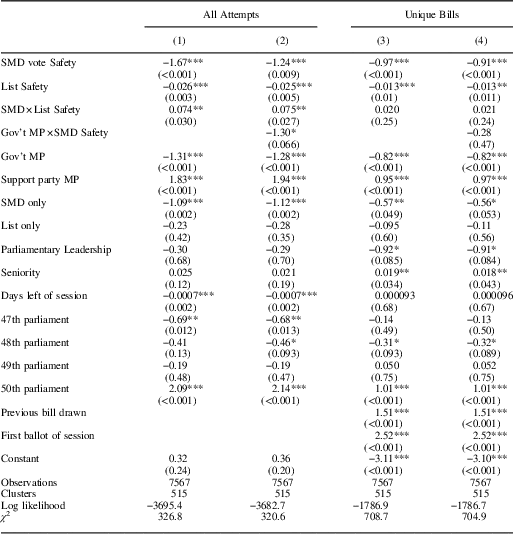
Our key independent variables measure electoral safety. List Safety is the difference between the number of seats won by the MP’s party and her place on the party list. Similarly, SMD Safety is the MP’s margin of victory in her electorate.Footnote 13 The variables are interacted as MPs that are low on their party’s list and have limited support in their electorate are the most vulnerable. In contrast, MPs that won by a large margin in their electorate has little reason to worry about list placement.
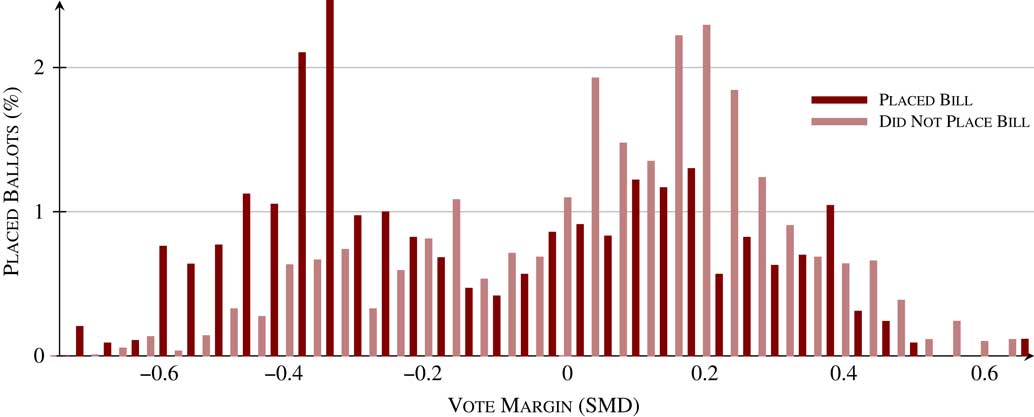
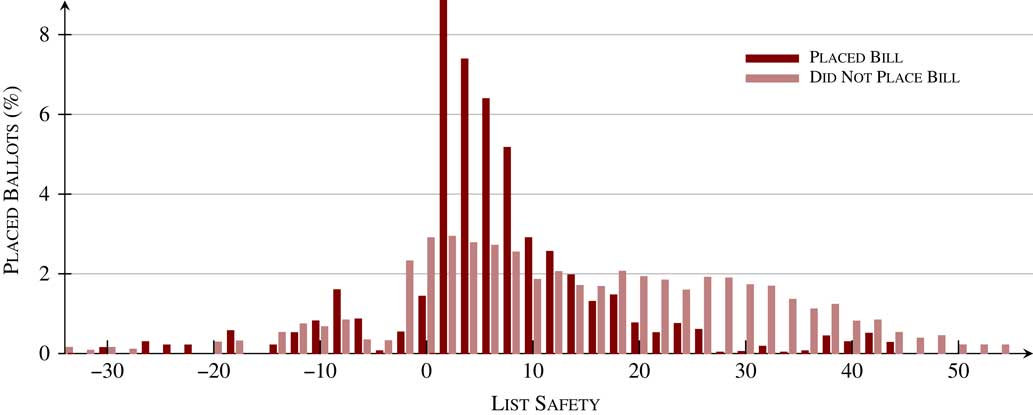
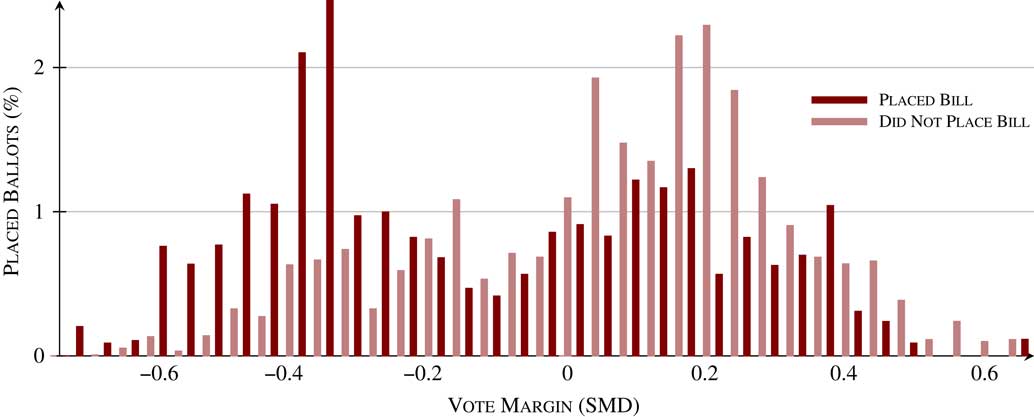
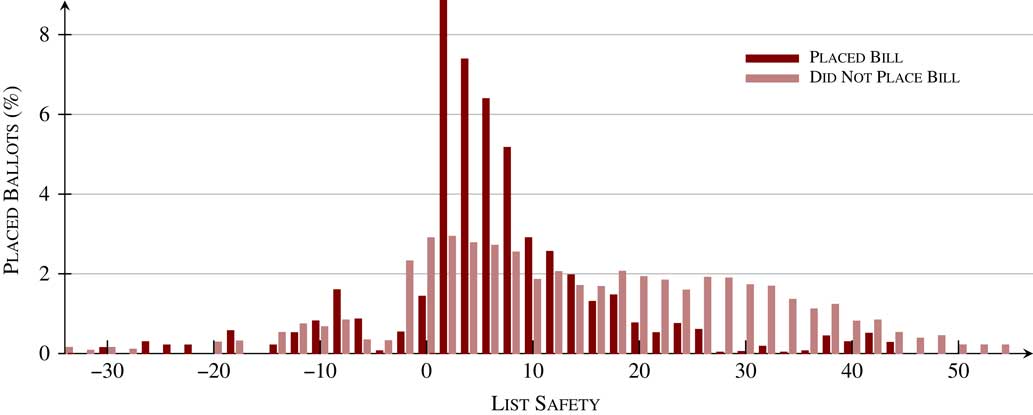
Figures 3 and 4 graph the distributions of SMD Safety and List Safety for MPs that placed and did not place a bill on the ballot. If the incentive to propose members’ bills is unrelated to electoral safety then the distribution of those that did and did not place a bill on the ballot would have the same shape. That is not the case. Figure 3 suggests that MPs that placed bills on the ballot are more likely to have fared poorly in their electorates and entered parliament on the party list. In contrast, MPs that did not place a bill on the ballot are more likely to be electorate MPs in safe seats. Figure 4 reveals a clearer pattern. MPs that placed bills on the ballot are far more likely to be at the lower rung of their party’s list while those who did not are more evenly distributed.Footnote 14 The figures suggest that offering members’ bills is directed more at the MP’s party than voters—MPs that offer members’ bills appear to have failed to win an electorate seat and were among the last ones to come in off the party list.
Vote margin and bills placed on the ballot Note: New Zealand Parliament (www.parliament.nz).
List Safety and bills placed on the ballot Note: New Zealand Parliament (www.parliament.nz).
Government MP and Support Party MP are indicators for government and government support party MPs. As ballot participation is potentially seen as a rebellion for government MPs, we examine an interaction between Gov’t MP and SMD Safety. The coefficient for the interaction term should be negative, indicating that government MPs reduce their members’ bill activity more rapidly than opposition MPs as their margin of victory in their electorate increases. SMD Only and List Only indicate whether the MP ran only in an electorate and only on the party list with the baseline category being having run both as electorate and list candidates. Parliamentary Leadership is an indicator for a parliamentary leadership position (Leader of the House, Speaker of the House, or Deputy or Assistant Speaker). We control for the Days Left of the legislative session. Electoral motives become more salient at the end of the session with MPs being more likely to enter the ballot. Indicators for parliamentary session are included. The analysis of whether MPs enter a new bill on the ballot includes two additional variables. First, Previous Bill Drawn is an indicator for whether the MP’s previous bill was drawn (and, thus, cannot be resubmitted). Second, an indicator for the first ballot of each session accounts for the bill being new by definition.
A logit model is used to estimate the MP’s propensity to enter a bill. The unit of observation is the MP-Ballot.Footnote 15 As each MP contributes multiple observations, standard errors are estimated assuming clustering by MP in each session.
The results, Table 1, suggest that electoral vulnerability matters. Greater safety, whether in the electorate or on the party list, reduces the likelihood of a members’ bill being submitted by MPs. To gauge the substantive effect of the variables, we calculate the change in the probability as the safety variable goes from its mean minus its standard deviation (μ s −σ s ) to its mean plus its standard deviation (μ s +σ s ). The effect of such a change in List Safety reduces the probability of entering the ballot by 13.6 percentage points, while the corresponding change in SMD Safety reduces the probability by 11.0 percentage points. Over a parliamentary session this amounts to, on average, about one and a half additional bills.Footnote 16
Member Bill Attempts and Electoral Safety: 46th–50th Parliament, Logit Models

Note: p-values in parentheses.
*p<0.10, **p<0.05, ***p<0.01.
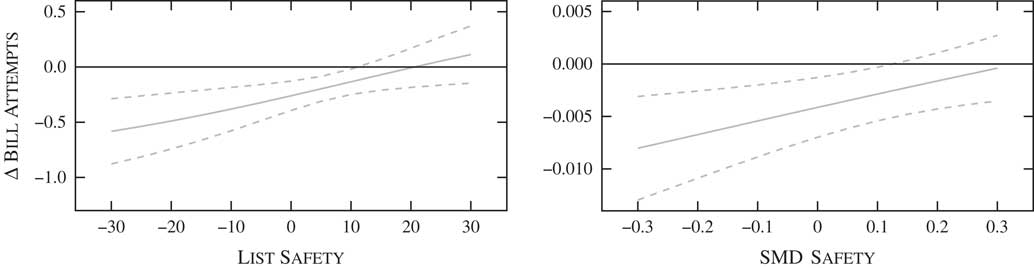
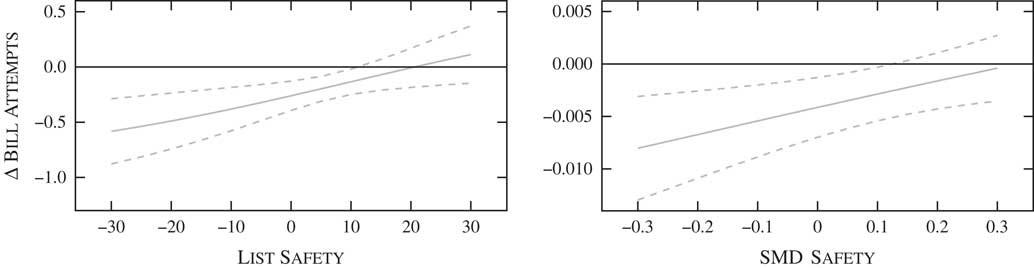
The coefficient for the interaction is correctly signed but is only statistically significant when considering whether the MP entered a bill in the ballot. This suggests that members’ bill activity is related to concerns over electoral standing. As shown in Figure 5, improvement in a MP’s SMD Safety has a smaller effect for MPs that are in safe seats on their party list than MPs that are low on the list. Conversely, moving up the party list has less of an effect on participation in the members’ ballot for an MP who carried her electorate by a wide margin. Moreover, the graphs show that improved safety only reduces the number of bills proposed if the MP lacks safety as measured by the other safety variable. That is, improved SMD safety has no effect if the MP was high on the party list. This is in line with expectations—as most MPs run both in an electorate and on the party list they only face electoral insecurity if they are in a vulnerable position in both. If a MP occupies a safe seat on the party list then her standing in her electorate is of little concern to her.
The effect of SMD and List Safety on the number of attempts (a) Marginal effect of SMD Safety conditional on List Safety (left panel) (b) Marginal effect of List Safety conditional on SMD Safety (right panel)
The interaction between Gov’t MP and electoral safety for electorate MPs suggests that government MPs respond more sharply to electoral vulnerability although there is considerable statistical uncertainty about the effect. Overall the results suggest that MPs are influenced by electoral concerns and that their behavior reflects concern about their electorate as well as their standing within the party.
Rewarding Legislative Action: Approval
We now turn our attention to the question whether voters approve more of MPs that place members’ bills on the ballot or are afforded the opportunity to present them in parliament. The 1999, 2002, 2005, and 2011 New Zealand Election Study asked respondents how much they approved of their electorate MP on a five-point scale.
MP approval is modeled using ordered logit models, estimating the effect of the total number of attempts to place a bill on the ballot, the number of unique bills placed on the ballot, and whether the respondent’s MP was lucky enough to have her bill drawn. We take advantage of the members’ bill ballot approximating a natural experiment, i.e., members’ bills are drawn at random. The “natural experiment” brings us closer to establishing a causal relationship as the random selection of bills implies that the treatment (a bill being drawn) is exogenous and the possibility of endogeneity is, thus, eliminated. There are some complications as the probability of having a bill drawn is not completely exogenous, i.e., the MP must have placed a bill on the ballot for it to be drawn and the more bills she places, the better her chances. As this non-random selection onto the ballot interferes with the random assignment of the “treatment,” we also estimate models that only include respondents represented by MPs that placed a bill on the ballot, include controls for the number of times the MP placed a bill on the ballot, and estimate models for subsamples of respondents whose MPs placed the same, or similar, number of bills on the ballot.Footnote 17
A reason for questioning the “natural experiment” generated by the members’ bill ballot is the possibility that MPs that place more bills on the ballot are different from other MPs. Other factors, whether characteristic or context, may both induce the MP to place more bills on the ballot and cause voters to evaluate her more highly. This is one version of the popular refrain “correlation doesn’t imply causation”. Why, then, do we bother estimating models of the number of attempts and the number of unique bills placed on the ballot? The reason is simple. While the above refrain is certainly true, it is also true that “correlation does not imply the absence of causation.” That is, in some instances there are good reasons to think that a causal relationship exists even when one can only estimate correlations. Consider the number of bills placed on the ballot. As we have argued theoretically and shown empirically, electoral vulnerability affects MPs’ attempts at proposing members’ bills. Electorally vulnerable MPs typically suffer from lower levels of approval. Thus, if placing bills on the ballot has no effect on approval, one would actually expect a negative coefficient for the number of bills placed on the ballot. While examining the effects of the number of bills placed on the ballot does not offer the clean identification that a natural experiment offers, it does offer some insight into the question whether legislative effort matters apart from the chance of having one’s bill debated.
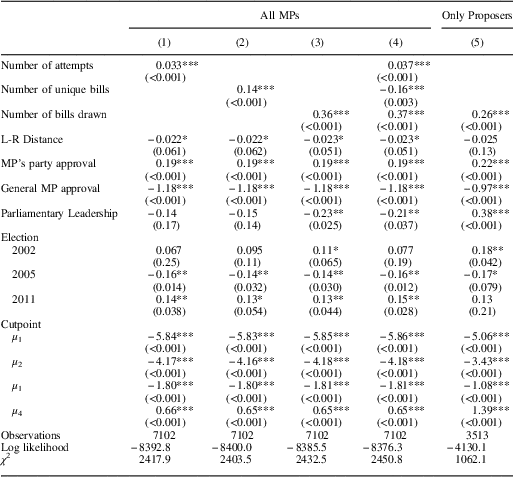
We control for the absolute distance between the respondent’s self-placement on the left-right scale and her placement of the electorate MP’s party (L-R Distance) as well as the respondent’s approval of the electorate MP’s party. MP’s Party Approval is expected to be positively correlated with the respondent’s evaluation of the MP.Footnote 18 General MP Approval captures evaluations of MPs in general and accounts for heterogeneity in the respondents’ attitudes toward parliamentarians. Finally, we control for MPs in the Parliamentary Leadership.
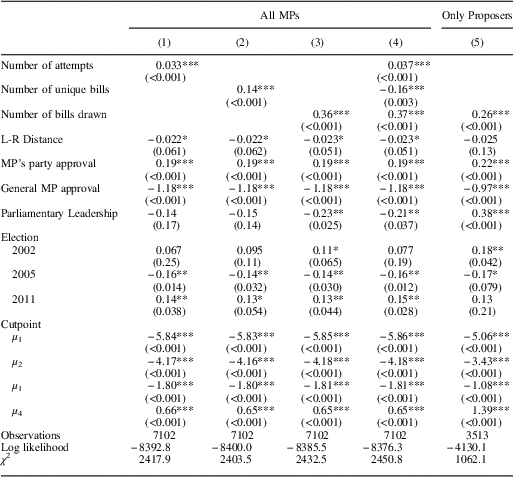
The first three columns of Table 2 examine the effects of the three measures of legislative activity. Each has a positive effect on MP approval. In the fourth column, which includes all three variables, the total number of bills and the number of bills drawn remain statistically significant while the effect of the number of unique bills is now negative. While these results suggest that participating in the ballot and having one’s bill drawn is more beneficial to the MP than presenting multiple different bills, it must be noted that the three variables are correlated, which inflates the estimated standard errors and makes coefficient estimates unstable.
MP Approval: Number of and Unique Attempts, Bills Drawn
Note: L-R=left-right.
*p<0.10, **p<0.05, ***p<0.01.
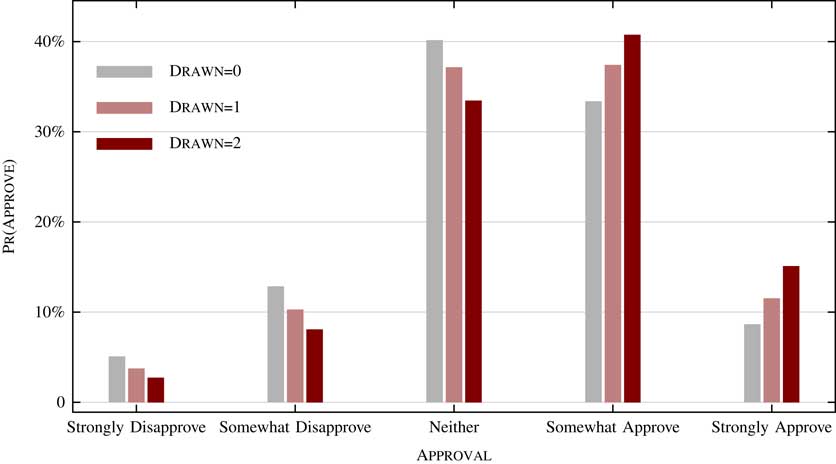
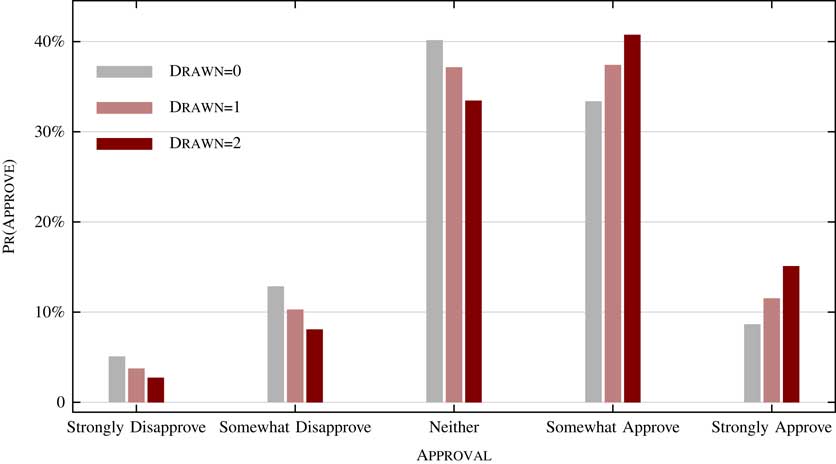
MPs that participate in the ballot may differ from MPs that do not participate. Column 5 presents the results of the ordered logit model for the subsample of respondents whose MPs placed at least one bill on the ballot. The effect of the number of bills drawn remains substantively similar, which suggests that the results are not driven by MPs having different incentives to participate. Figure 6 graphs the predicted probabilities of the different answers to the approval question. MPs who had one or two bills drawn were more likely to be rated favorably. The effect is substantial—the probability of a respondent approving of a MP was about 7 percentage points higher for each bill drawn.
Predicted respondent approval of MP
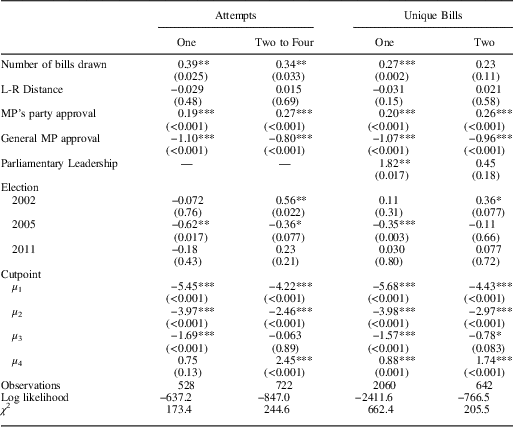
There is still significant variation in the legislative effort of MPs who had a bill drawn (Table 2, column 5). Further conditioning on legislative effort is straightforward except that further partitioning implies fewer observations within each subsample. The subsample of respondents whose MPs placed a single bill on the ballot, e.g., consists of only 528 observations. Because of these limitation, four ordered logit models are estimated; for MPs that made a single attempt, for MPs that made two to four attempts, for MPs that proposed one unique bill, and for MPs that proposed two unique bills.Footnote 19
Table 3 suggests that having a bill drawn affects approval ratings. The effect is statistically significant except in the second model. Each bill drawn increases the average approval rating between 0.2 and 0.3 points on the five-point approval scale, which corresponds to between one in every five voters and three in every ten voters ranking the MP one point higher on the scale.
MP Approval: Ordered Logit—Conditioning on Number of Attempts and Unique Bills

Note: L-R=left-right.
p-values in parentheses.
*p<0.10, **p<0.05, ***p<0.01.
In sum, there is clear evidence of members’ bills influencing MP approval and, furthermore, that they matter in two distinct ways. First, as Table 3 shows, having the opportunity to present a members’ bill in parliament affects MP approval. Second, the results in Table 2 suggest that respondents give their MP an “A” for effort—merely placing a bill on the ballot appears to improve approval ratings.
Placing a new bill on the ballot or having one’s bill drawn is expected to have a bigger impact on approval than placing an “old,” and thus less newsworthy, bill on the ballot. Placing the same bill on the ballot repeatedly can still signal effort, even if fairly minimal, and the MP may also hope to convey persistence. Nevertheless, introducing a new bill or having one’s bill debated is more likely to raise the profile of the MP. The results suggest that these expectations are borne out by the data. Each additional attempt nets the MPs considerably less positive approval than placing a new bill on the ballot or having her bill drawn.Footnote 20
In addition to MP approval, we explored the effects of private members’ bills on whether survey respondents knew their electorate MP’s name and on her electoral performance. Respondents were more likely to know their MP if they had proposed members’ bills and if they had placed multiple different bills on the members’ ballots whereas the effects of having a bill drawn were ambiguous—perhaps because voters are more likely to be informed about members’ bills by the MPs themselves than from observing legislative politics. The results with regard to electoral performance are at first sight in stark contrast with Loewen et al. (Reference Loewen, Koop, Settle and Fowler2014), and to a lesser extent Bowler (Reference Bowler2010), who find clear evidence of voters rewarding MPs for members’ bills. Our results suggest that members that participate more frequently in the ballot and place more unique bills fare, if anything, worse electorally. However, considering the incentives to participate in the members’ ballot, this stands to reason. MPs that place bills on the ballot do so because they face electoral insecurity—the observed negative relationship is the result of endogeneity. When we consider the effect of having a bill drawn, which allows us to condition on the MPs’ effort, we find that having a bill drawn has a positive, albeit statistically insignificant, effect. Thus, there is a slight indication that members’ bills positively affect electoral outcomes.Footnote 21
There are, however, good reasons why members’ bills have limited impact on electoral performance—even when important for MP approval. In New Zealand, as in many parliamentary systems, politics are dominated by parties and elections largely revolve around which party, or parties, will form government. Evaluations of individual candidates, therefore, play a rather limited role. Members’ bills may help the MP’s approval rating but are unlikely to overcome partisan differences.Footnote 22 Moreover, one might ask which voters reward MPs for members’ bill activity—our analysis suggests, unsurprisingly, that approval increases most among ideologically proximate voters. That is, the voters that respond most positively to the MP’s effort to present members’ bills are primarily voters that were already likely to vote for the MP.Footnote 23
Conclusions
Parliamentary systems are characterized by tight government control of the legislative agenda and high levels of party discipline. As a consequence, MPs generally face limited options outside their parties when it comes to achieving their career goals, whether related to policy or their reelection. Private members’ bills are one opportunity to achieve such goals. There are many reasons why MPs might not want to propose members’ bills. First, members’ bills are highly unlikely to be adopted. Second, offering members’ bills can be a costly exercise—especially for government MPs whose parties may put a premium on party discipline. Third, parliamentary elections tend to be party focused, i.e., voters pay greater attention to the party platforms and leaders than individual candidates. Fourth, some electoral systems, e.g., closed-list proportional representation systems, vastly limit the value of a personal vote and, therefore, diminish the incentive to propose members’ bills or engage in other legislative activity that might otherwise appeal to voters. Yet, MPs do propose members’ bills.
We have sought to explain why MPs propose members’ bills and to show that members’ bills do represent a form of an electoral connection. New Zealand has particular features that are conducive for studying members’ bills. Its mixed-member proportional system has distinct benefits. In order to say something interesting about the electoral connection, the system under study ought to provide MPs with some incentives to build a personal vote. The presence of single-member districts provides this condition in New Zealand—electorate MPs have an incentive to build a personal following, especially if they are located in electorates where their party is weak and they are low on the party list. List MPs owe their parliamentary seat to the party and have, therefore, little incentives to worry about a personal vote. List MPs, however, have an electoral connection but it is quite distinct from the one that electorate MPs must grapple with. Vulnerable list MPs, those low on the party list, are more likely to offer members’ bills. In this instance the goal of the MP is not to signal competence or legislative effort to voters but rather to the members of their own party who influence party list nominations.
The major advantage of studying New Zealand is that the members’ ballot resembles a natural experiment, which helps estimate the causal effect of presenting members’ bills in parliament. MPs whose bills are drawn on the ballot have higher levels of approval. The effect is quite substantial—as many as 20–30 percent of the respondents are estimated to rate a MP that has had a bill drawn a point higher on the five-point scale. These are remarkable figures considering that it is unlikely that voters pay close attention to members’ bills. Such politically attuned voters are not a necessary condition for members’ bills to affect voters’ attitudes. The MPs themselves, e.g., can bring the members’ bills to voters’ attention when campaigning for reelection. Members’ bills may also draw media attention—whether it is because of the content of the bill or because it signals ambition, or electoral vulnerability, to political journalists.
The total number of bills and the number of unique bills also correlate positively with MP approval but it is not possible to claim a causal relationship. However, if MP approval affects the incentive to place a bill on the ballot, MPs who face a poor approval rating are more likely to place bills on the ballot which is what we find when examining how often MPs place a bill on the ballot. Thus, if endogeneity is a problem it is likely to bias the estimated effects of members’ bills downwards.
Our findings contribute to a growing body of literature that has sought to demonstrate how members’ bills connect MPs with their constituents but suggest that members’ bills may also have an important role in systems where MPs do not gain much from a “personal vote.” The results suggest that MPs use members’ bills to signal effort and competence to their own parties in the hope of securing a more favorable list position. While our analysis takes place within a mixed-member system where contamination between the electorate and proportional representation part of the electoral system are a concern, we do find that MPs respond to electoral safety within the two parts of the system in a predictable manner. It is, thus, plausible that similar effects would be found in examining members’ bills—or constituency service and legislative behavior more broadly—in other electoral systems, whether they employ only single-member districts or are proportional representation systems.