Introduction
Alumina ceramics are very attractive engineering materials because they present remarkable properties such as low density combined with high hardness, high strength, refractoriness, thermal and chemical stability, and wear resistance. Although their low fracture toughness limits their potential applications due to small imperfections in their structure, cracks grow rapidly, causing them to fail catastrophically when they are in service. Faced with this situation, many researchers have taken on the task of reinforcing alumina-based ceramics by adding ductile metal particles in their matrix [Reference Ighodaro and Okoli1]. Thus, in order to improve the fracture toughness of alumina, a good number of studies have been carried out in which various metals have been added to the alumina matrix [Reference Konopka2, Reference Asthana, Mrityunjay and Sobczak3, Reference Travitzky4, Reference Moreno, Bansal, Singh, Lamon and Choi5, Reference Govindaraju, Balasubramanian, Chakkingal and Prasad Rao6, Reference Binner, Chang and Higginson7, Reference Auger, Saunier and Valdivieso8, Reference Szafran, Konopka, Bobryk and Kurzydłowski9, Reference Liu, Zhang, Sun and Zhang10]. These studies have achieved interesting results in which it was established that the reinforcement mechanism is due to the deflection of cracks when they move forward and collide with a metallic particle [Reference Sbaizero and Pezzott11, Reference Agrawal and Sun12, Reference Marci and Katarzyna13]. It has also been determined that the size and distribution of the reinforcing particles have a strong influence on the mechanical properties of the resulting composite.
In addition, different processing methods and techniques have been used to produce these composite materials and include powder techniques involving either hot or cold uniaxial pressing, hot isostatic pressing, spark plasma sintering, chemical routes, infiltration, CVD, friction stir, current-activated pressure-assisted infiltration, and gel casting [14, Reference Yangaiu, Zhaohui, Minghao, Singh, Bansal, Goto, Lamon, Choi, Mahmound and Link15, Reference Vahed, Kammler, Singh, Bansal, Ko, Castro, Pickrell, Manjooran, M Nair and Singh16, Reference Xiao-Shan, Shai, Bo, Guocai, Na, Yang, Singh, Bansal, Bhalia, Mahmound, Manjooran, Singh, Lamon, Choi, Pickrell, Lu, Brennecka and Goto17]. As it is well known, the processing route has an important influence on the final characteristics of the composite obtained [Reference Wessel18]; therefore, it is something that must also be considered in order to manufacture ceramic materials with good characteristics.
A review of the work carried out in the study of alumina reinforcement has showed that the effect of processing routes and reinforcement metals has been extensively studied with emphasis on the mechanical properties of alumina. However, the effect of these methods and metallic particles on other properties of the resulting composite, such as electrical or optical properties, has not been analyzed. In this study, alumina-based composites with different pure metals were manufactured by means of powder techniques in order to determine the effect of metals on the mechanical, electrical, and optical properties of the resulting composites.
Results and discussion
Particle size
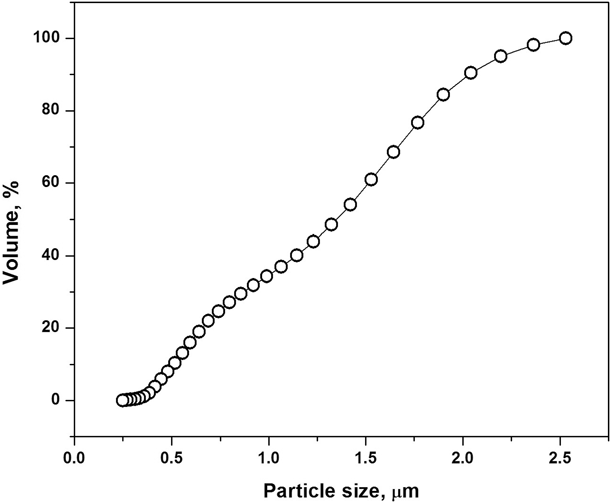
Figure 1 shows the particle size distribution in the Al2O3/Ti sample ground under the conditions mentioned in the experimental part. In this figure, only the particle size distribution of a sample is presented as representative of all studied systems because the milling conditions and initial sizes of all powders were identical for each sample, producing very similar results for all samples. What can be observed in the graph of Fig. 1 is that after the milling stage, a good distribution of particle sizes was achieved in the powder mixture: approximately 35% of powders have sizes less than 1 μm, 60% of powders are between the size of 1 and 2 μm, and the remaining 5% do not reach 2.5 μm. These fine particle sizes and their homogeneous distribution will surely help consolidate the material well during sintering.
Particle size distribution (Al2O3/Ti sample).

Density and mechanical properties
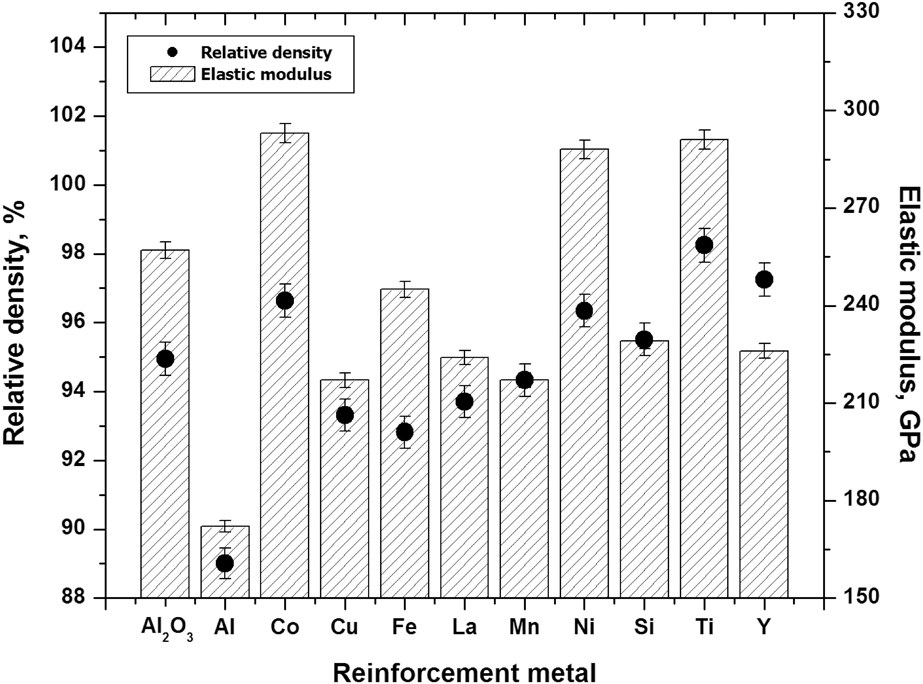
Figure 2 shows the values of the resulting measurements of density and elastic module in each studied system. These values are presented together because the elastic module is strongly dependent on the density of the material being measured. In this figure, it is observed that the control sample (100% Al2O3) reached a relative density of 95%, whereas samples with additions of Al, Cu, Fe, La, and Mn obtained densities lower than 95%, highlighting the low value of density of the sample with Al addition, which was 89%. On the other hand, samples with Co, Ni, Si, Ti, and Y achieved densities higher than the relative density of 95%, where the sample with Ti attained more than 98% density. The good density values of these last 5 samples were due to the good distribution of particle sizes in them, sizes that favored the diffusion phenomena during the sintering stage. With regard to the elastic modules, the figure shows an important correspondence between the density value of each sample and the elastic module unfolded by it. As already mentioned, this is due to the fact that the stiffness of a material, represented by the elastic module, is inversely proportional to the porosity in the material in such a way that the less consolidated bodies present lower values of the elastic module, as can be seen in the figure.
Density and elastic modulus of the studied systems.

Hardness and fracture toughness
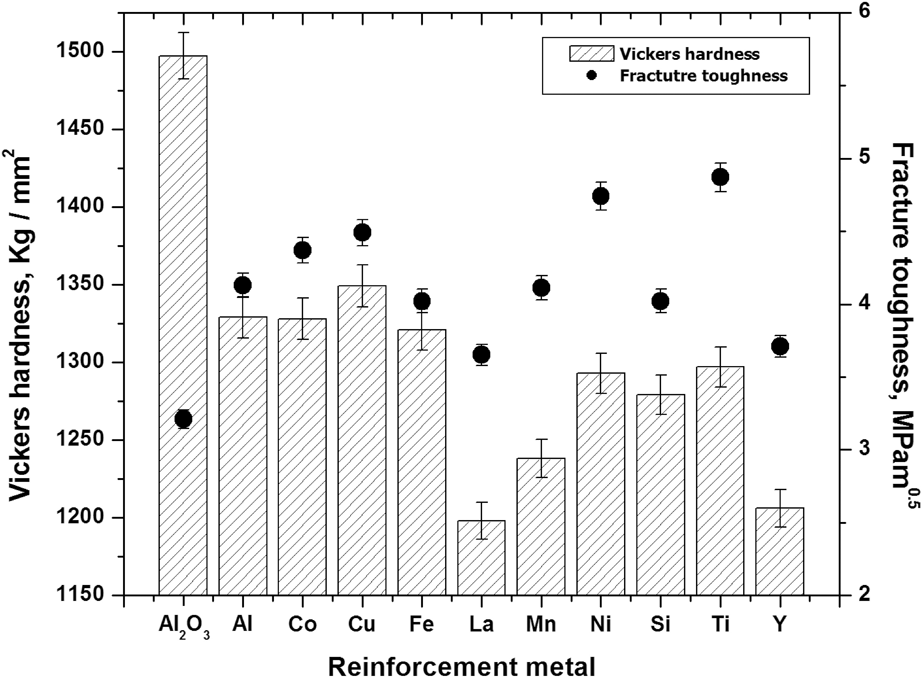
Figure 3 shows the measured values of hardness and fracture toughness in each studied system. In this figure, as expected, it is observed that the sample with the highest hardness was the witness (100% Al2O3). According to the nature of the metal added, its addition causes changes in the hardness of the respective composite, prompting its diminution in all the cases. Regarding the fracture toughness of composites, according to Miyoshi’s equation used to calculate this property [Reference Miyoshi, Sagawa and Sassa19], there is a certain dependence of toughness on the elastic module and hardness of the material. According to this formula, the tenacity increases with the elastic module of the material, which, in turn, is greater with less porosity (better consolidated bodies). On the other hand, toughness decreases with greater hardness in the material. Hence, according to the results obtained for density, elastic module, and hardness, there is an important correspondence with the final toughness of the composite. The highest toughness values were obtained in the Ni and Ti reinforced samples, whereas the use of La and Y metals has the least effect on improving composite fracture toughness. However, the graph shows that the fracture toughness values were improved in all cases with the addition of a ductile metal as a reinforcement of the matrix. The reinforcement mechanism of metals in alumina has previously been well documented and is due to the deflection of cracks as they grow and meet with metal particles which force the cracks to stop or divert their course to continue advancing [Reference Sbaizero and Pezzott11, Reference Agrawal and Sun12, Reference Marci and Katarzyna13].
Fracture toughness and hardness values of the different studied systems.

Microstructures
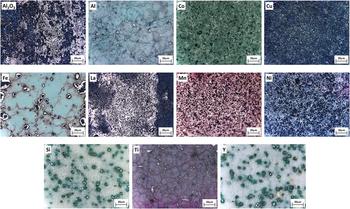
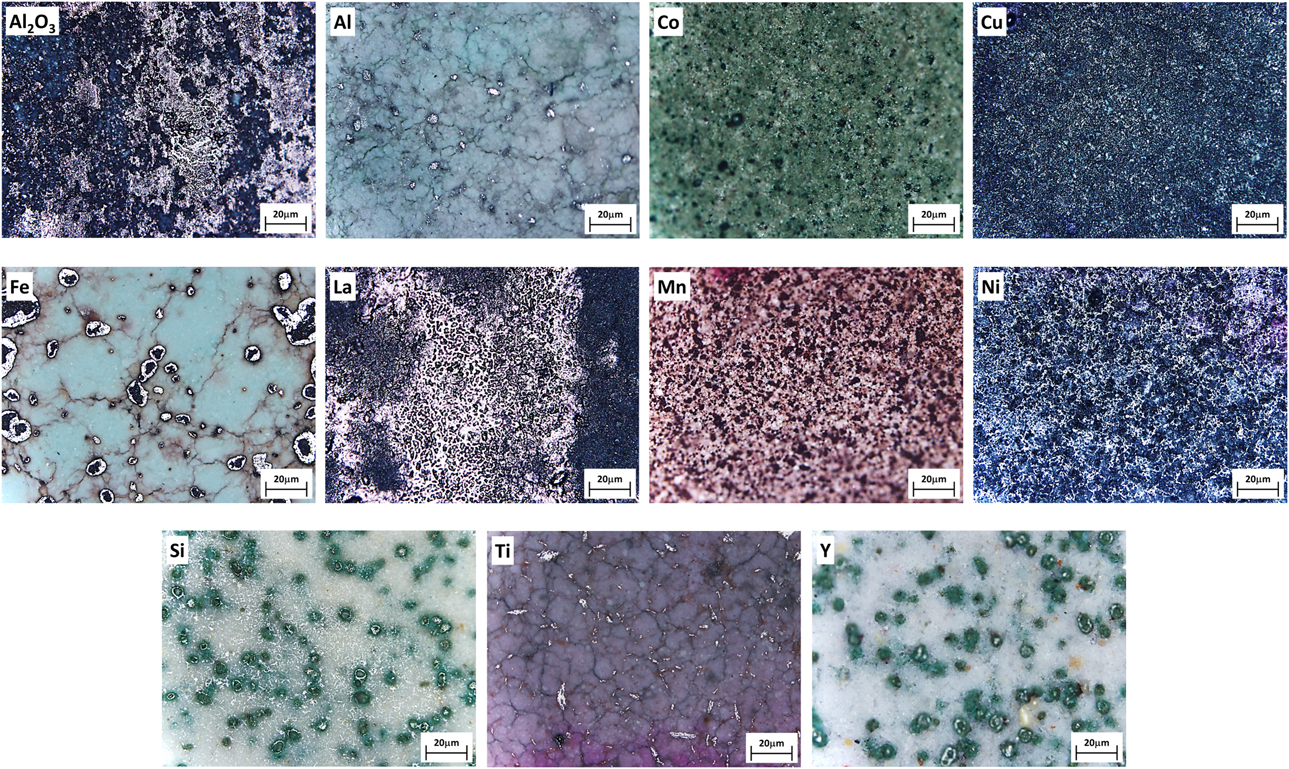
Figure 4 shows micrographs of the microstructure of different studied materials observed with the aid of an optical microscope. Microstructures with very diverse characteristics are observed in this series of images, which somehow also manifested themselves in the results of mechanical properties; this is because each metal affects the consolidation of the sample in a different way. Thus, we have microstructures with high porosity such as those of the samples with Fe, Si, and Y; with intermediate porosity such as the samples with Al, Co, La, and Mn; and with better consolidation such as the samples with Cu, Ni, and Ti. In the microstructure with Cu, it is possible to observe a small metallic net along it, which helps understand the important effect of this metal on the resistivity of the composite. Likewise, it is clear that the samples with Ni and Ti, which present a dense, homogeneous microstructure with good distribution of metallic particles, are the ones that displayed the best mechanical properties, mainly fracture toughness. With regard to the microstructure of pure alumina, a fine and homogeneous matrix can also be observed. Finally, it is possible to observe the strong and clear effect on the microstructural characteristics and, therefore, on the properties of alumina, by the addition of different metals in it.
Microstructure of the different studied materials.
Electrical properties
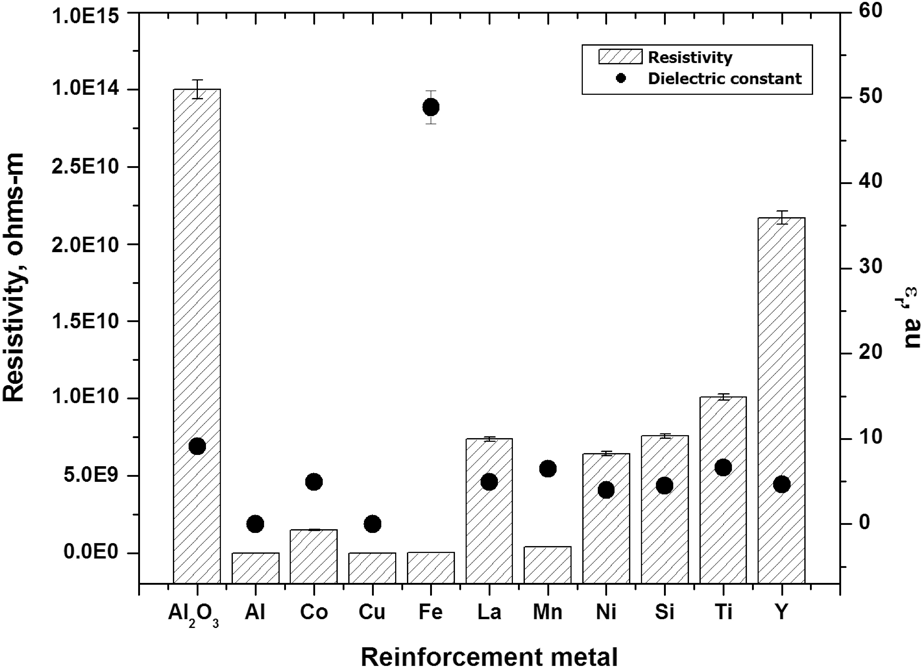
Figure 5 shows the values of the electrical properties evaluated in the studied materials. The resistivity values obtained for all the samples are within the range characteristic of insulating materials, typically from 108 to 1020 Ωm [Reference Moulson and Herbert20]. The low resistivity values of these materials are due to two factors: the first is the high concentration of flaws in the samples, which were probably introduced into them during the high-intensity grinding to which the original powders were subjected; the second and most important is that it is a composite material with a ceramic matrix such as alumina, which by nature is not a good electrical conductor. However, the graph clearly shows that with the addition of metals which by nature are good electrical conductors, the resistivity of the composite decreases considerably, mainly the strong effect on the decrease in resistivity by the addition of aluminum and especially of copper. Generally, this behavior indicates that with the addition of a conductive metal in an insulating matrix such as alumina, the resistivity of the resulting composite can be altered due to the size of the metal and its homogeneous distribution in the matrix. As a consequence, a conductive network is created by the material allowing the passage of electrons when it is subject to an electric field. Applications of alumina matrix composites range from electric insulators, such as those present in spark plug insulators, to thin films such as a part of miniature electrical devices embedded on silicon chips to create resistors, capacitors, and semiconductor devices, among others. In this same figure, it is observed that the dielectric constant suffers a decrease depending on the doping material added to alumina. There is also an anomaly in the dielectric constant for the sample doped with Fe. This phenomenon is related to the grain size and the porosity of the sample, where a microstructure of fine grains with large pores tends to have low resistivity values but very high dielectric constant values [Reference Li, Cho, Wu and Ignatiev21].
Resistivity values and dielectric constant of the different studied systems.

Optical properties
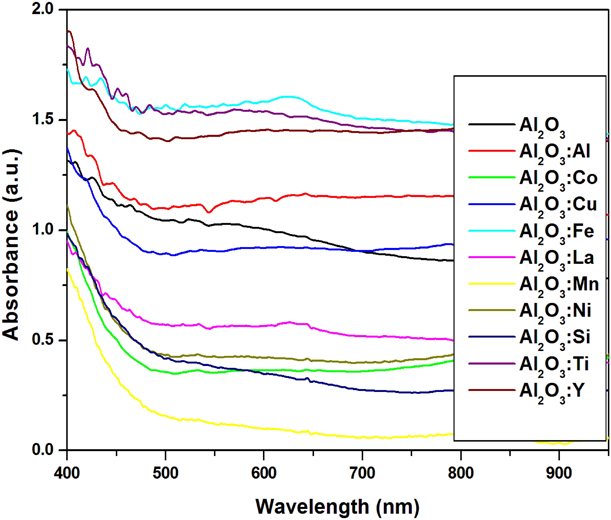
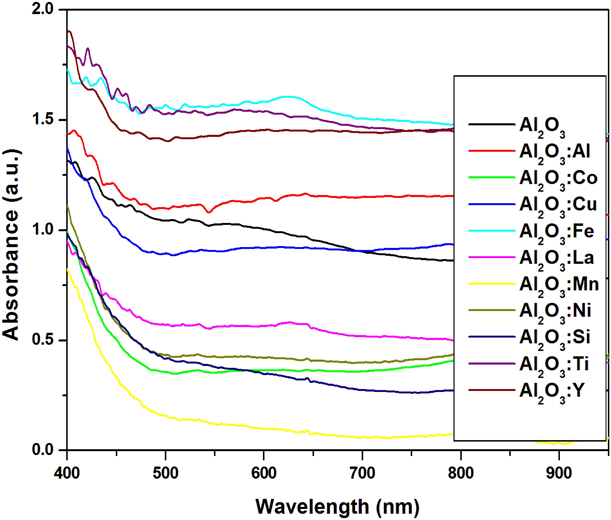
Figure 6 shows the optical spectra ranging from 380 to 820 nm of Al2O3 alone and with the addition of elements. As can be seen in Fig. 6, Al2O3 (shown in black) shows a similar response to Al2O3:Al from 380 to 550 nm, whereas from 550 to 820 nm, its absorbance is similar to that of Al2O3:Cu. It is also shown that Al2O3:Fe, Al2O3:Ti, and Al2O3:Y present higher levels of absorbance. On the other hand, Mn, Co, Si, Ni, and La reduce the level of Al2O3 absorbance. Particularly, it can be seen that Al2O3:Mn shows the lowest absorption in the whole range of the visible spectra. These results could potentially benefit the development of photonic devices such as photodetector buffer layers to improve their photoelectric characteristics such as enhancing their optical sensitivity or preventing the dark current effect [Reference Hong-Liang, Yu-Zhu, Yuan, Xin-Yan, Peng-Fei, Qing-Qing, Shi-Jin and Wei-Zhang22]. Alumina matrix composites, in conjunction with metals, could also be used to improve the optical properties of plasmonic metal waveguides [Reference Baba23]. Finally, another area of application of Al2O3 composites could be found in the development of phosphate glasses to enhance luminescence properties [Reference Yu, Yajie, Yabin, Si, Qinling, Wei and Lili24].
Visible absorption spectra of Al2O3 compared with Al2O3:Al, Co, Cu, Fe, La, Mn, Ni, Si, Ti, and Y.
Conclusions
This study was carried out with the idea of determining the effect of the addition of different particle metals (Al, Co, Cu, Fe, La, Mn, Ni, Si, Ti, and Y) on the properties of alumina-based ceramics. The synthesis of composite materials has been made by means of pressure-less sintering of an intensive mechanical mixing of powders. Significant changes in the original properties (mechanical, electrical, and optical) of alumina were reached through the individual use of metals in chemical formulations. This was because metals significantly affect the densification and microstructure of final composites. In this way, all metals have improved alumina’s fracture toughness, via crack deflection. On the other hand, hardness and elastic modulus diminish due to the addition of metals that are less stiff than alumina. In relation to electrical properties, due to the conductive nature of metals, there is a considerable decrease in the electrical resistivity of alumina, mainly when copper is added. This behavior is because of the formation of a metallic net in the microstructure. With respect to the optical properties of alumina, these were also considerably affected. It was observed that the addition of Fe, Ti, and Y contributes to enhancing the Al2O3 absorbance in the visible spectra, whereas Mn considerably decreases the alumina optical absorption.
Methodology
The materials used for the preparation of the Al2O3–metal composites were Al2O3 powder (Sigma-Aldrich, Toluca, México; Meyer, México City, México, 99.9%, 5 μm) and metal powders of Al, Co, Cu, Fe, La, Mn, Ni, Si, Ti, and Y, (all of them by Mayer, 99.5%, 1 μm). The final metal content in the produced composites was 10 vol%. Grinding and mixing of the powders was carried out for 12 h at a rotation speed of 300 rpm in a ball mill (Retsch PM 100, Retsch, Düsseldorf, Germany), using a stainless steel container with zirconia grinding elements of 0.3 cm diameter; the ratio between the powder weight and ball weight was 1:14. Using the powders obtained from the milling stage, cylindrical samples of 2 cm diameter by 0.3 cm thickness were manufactured by uniaxial pressing, applying 350 MPa with the aid of a hydraulic press (Montequipo 20 tons, Montequipo, Mexico City, México). The pressed samples were sinterized for 2 h in a tubular electric furnace (Thermo Scientific Linderg Blue M, Despatch, Minneapolis, Minnesota) at 1500 °C, using an argon flow of 10 cm3/min in the furnace chamber. The particle size distribution of the milled powders was determined using a Mastersizer 2000 equipment of English origin, Malvern Panalytical, Malvern, U.K. Density was determined by the alcohol immersion method based on Archimedes’ principle, as specified in ASTM C20-00 [25]. The theoretical density value of 3.95 g/cm3 and the corresponding density reported in the handbook for metals were used to calculate the theoretical density of composites using the rule of mixture [Reference Shackelford, Shackelford and Alexander26]. Observations of milled powders and microstructure of each sintered sample were performed by optical microscopy (Nikon, Eclipse MA 200, Nikon Instruments, Tokyo, Japan). Young’s module was determined by the ultrasonic method, following the ASTM C1198-09 standard [27], using Grindosonic A-360 Japanese manufacturing equipment, Grinsosonic, Leuven, Belgium. Microhardness was evaluated in agreement with the ASTM C1327 standard [28]. In this case, twelve measurements were performed at different locations of the sample; these measurements were performed with a microhardness tester (Wilson Instruments Model S400, Wilson Instruments, Canton, Massachusetts). Fracture toughness was determined by the indentation fracture method using Miyoshi’s equation [Reference Miyoshi, Sagawa and Sassa19]:
 $${K_{{\rm{IC}}}} = 0.018{\left( {{E \over H}} \right)^{0.5}}\left( {{P \over {{c^{1.5}}}}} \right)\quad ,$$
where K IC is the fracture toughness (MPa m0.5), H is the Vickers hardness (GPa), E is the module of elasticity (GPa), P is the applied load (N), and c is the average length of the cracks obtained from the Vickers fingerprint tips (m).
Resistivity and dielectric constant measurements were performed at 0 Hz frequency (direct current) at room temperature, using the 4-point method, applying currents of the order of nanoamperes, through a controlled current source manufactured in our laboratories. This source was manufactured using circuits for stabilization of junctions in bipolar transistors [Reference Hart29].
To study Al2O3 optical properties, nanoparticle dispersion of each compound was prepared in a solution in the proportion of 1 g/L. The solution consisted of citric acid (C6H8O7) dissolved in distilled water at a concentration of 13 g/L. The optical absorption experiments were carried out with a CCD spectrometer (Thorlabs, CCS200, Thorlabs, Newark, New Jersey) with a spectral resolution of 2 nm and an operation range from 200 to 1000 nm. A quartz–tungsten–halogen lamp with emission from visible to near-infrared spectra and 50 mW of optical power was used to perform the experiments. For transmission measurements, a multimode fiber optic system with a 200-µm core (Thorlabs, BFL200HS02, Thorlabs, Newark, New Jersey) was used. To study the optical properties of Al2O3 with the addition of several elements (Al, Co, Cu, Fe, La, Mn, Ni, Si, Ti, and Y), absorbance measurements were carried out in the visible spectra under the same conditions.