Case
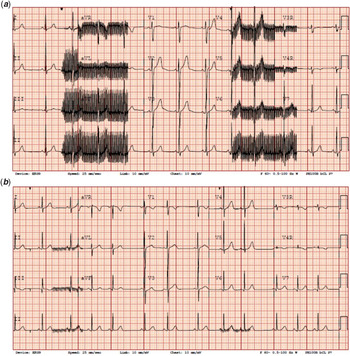
Two paediatric patients with gastroparesis secondary to mitochondrial disease, treated with gastric stimulator implantation (Medtronic® Enterra II Neurostimulator implanted subcutaneously in the lower left abdomen), were screened for cardiomyopathy. Screening electrocardiogram showed sinus rhythm and distinct artefact (Fig 1a and b), with an automated machine interpretation of atrial fibrillation.
(a) Electrocardiogram from a 12-year-old boy with mitochondrial disorder, gastroparesis, and permanent gastric stimulator. Device settings were 8 milliamp, 420 µs pulse width, rate of 40 Hz, and machine cycle of 2 s on and 3 s off. Artefact correlates with the impulse frequency and is noted only when the stimulator is on. (b) Electrocardiogram from a 6-year-old girl with a permanent gastric stimulator. The rate was set at 28 Hz with a cycle of 1 s on and 4 s off.

Discussion
These cases present unique examples of ECG artefact for educational purposes. Tracing artefact can arise from non-cardiac devices, with the quality of artefact dependent on device type, settings, and location in or outside of the body. Reference Guinand, Noble, Frei, Renard, Tramer and Burri1,Reference Gupta, Saidi and Bryant2 One such example is a gastric stimulator, which is used for drug-resistant gastroparesis commonly seen in mitochondrial diseases. Electrical impulses from gastric stimulators are typically low amplitude and high frequency in quality with cyclical on/off periods, thereby mimicking physiologic gastric function. These impulses can be recorded on ECG despite signal filtering. Recognition of this and other types of extracardiac artefact is essential for proper ECG interpretation in complex paediatric patients.
Acknowledgments
None.
Financial support
This research received no specific grant from any funding agency, commercial, or not-for-profit sectors.
Conflict of interest
None.
Ethical statement
The authors assert that all procedures contributing to this work comply with the ethical standards.